III.—THE ATMOSPHERE
Reading edition
THE OCEAN OF AIR —Agnes Giberne
Our earth has many robes. Closely-fitting garments come first, of brown soil or gray rock and green grass, with wide liquid underskirts of deep blue filling up the spaces between. Outside these are coverings more wonderful still; fragile, yet strong, transparent, almost invisible, folded around layer upon layer, or, as one might say, veil upon veil, each more gossamer-like than the last. These form earth’s surrounding atmosphere—a substance pervading everything, found everywhere. One may travel from the equator to the poles, one may journey by sea or by land, one may soar high in a balloon or descend deep into a mine, but one can never in this world go to a place where the atmosphere is not.
A substance—for air can be felt; air has weight; air occupies space; air, like any other body, can be made hot or cold; air is composed of particles of substantial matter. Air has a faint bluish tint, which on a sunshiny day becomes in the sky a very pure and deep blue. This tint is not believed to be the natural color of the atmosphere. Were it so, the air would merely act the part of a blue pane of glass, rendering the white light of the sun blue as it reaches our eyes; but the blue of the atmosphere is known to be a reflected blue.
If reflected, there must be something in the atmosphere to reflect it; and such indeed is the case. Perfectly pure air would doubtless be without color, but perfectly pure air we do not find. The whole atmosphere is full of multitudinous minute specks, so small as to be in themselves invisible, so light as to remain aloft. To the presence of these the blue tint is believed to be due. They scatter the light of the sun, and produce the blue effect.
A beam of strong white light, caused to pass through a liquid which contains a large supply of minute floating particles, is affected by them in a like manner. The short blue waves are more abundantly reflected than the long red waves; and so the water seems to be blue. This explanation serves for the deep-blue color of the ocean, as well as for the blue of the atmosphere.
The whole earth is surrounded by this marvelous air-ocean; an ocean of gaseous matter, at least one hundred times as deep as the water-ocean. At the bottom of the gaseous ocean we small human creatures crawl about, commonly on flat lower levels—the ocean bottom, in fact. Sometimes, with much toil and trouble, we climb the little ridges and mounds called “mountains”; little compared with the depth of the atmosphere, though not little compared with ourselves. The highest mountain-peaks of even the vast Himalayas lie low down near the bottom of the ocean of air.
But the very extent of the ocean of air adds to our difficulty in studying its nature. All observations that we can make must be limited by the state of the atmosphere just around ourselves. We can never get out of and beyond the atmosphere, so as to see it as a whole. At any time a slight local fog is enough to put a stop altogether to such observations, beyond the unpleasant experience of the fog itself.
It used to be supposed that the atmosphere reached only to a height of about fifty miles above earth’s surface. Of late years the opinion has gained ground that the atmosphere reaches to a height certainly of two or three hundred miles, probably of four or five hundred, possibly a good deal more. But the condition of the air far above is different from that of the air in lower levels, where we live and breathe. The higher we ascend, the more thin or “rare” becomes the air. A less quantity fills a certain space up there than down here. The particles float further apart one from another.
This difference in the density of the air is chiefly due to attraction. Each separate air-particle is drawn steadily earthward by the force of gravitation, and that force is stronger on the surface of earth than at a distance. The closer to earth, the heavier the pull; the further from earth, the less the pull. Besides the actual attraction of the earth drawing the air-particles downward, there is the great weight of the whole atmosphere above, caused by the same attraction. Miles and miles of air overhead press mightily downward, packing tightly together the lower layers of air near to earth’s surface.
Without this pressure of the overlying atmosphere, the air down here would not be nearly so dense as it is; and, indeed, would not be fitted to support life. A man ascending a mountain or rising in a balloon leaves heavy layers of air below, and has an ever-lightening weight above, so that the atmosphere around him becomes constantly more thin, more difficult to breathe.
In the beginning of the last century Humboldt made a vigorous attempt to scale Chimborazo, one of the loftiest of the Andes. He and his party suffered severely from sickness, giddiness, and difficulty in breathing, and the attempt proved a failure. Not till over seventy years later was the ascent actually accomplished by Mr. Whymper.
Carried upward passively in a balloon, without effort, men have risen higher than the highest mountains. Mr. Coxwell and Mr. Glaisher in their celebrated aerial voyage of 1862 are believed to have mounted seven miles above the sea. No little peril and suffering were involved, alike from the extreme thinness of the air, and from the bitter cold.
The voyagers suffered from severe “sea-sickness,” though not from bleeding of the nose or singing in the ears, popularly expected on such occasions. They had enough to bear without these additions. Mr. Glaisher held manfully to his task, observing and noting down the state of the atmosphere minute by minute, despite sickness, brain-pressure, violent headache, and a pulse at 108 per minute, all due to the rarity of the air.
In those lofty regions of the air-ocean no living creatures exist. The voyagers passed through boundless silent solitudes—silent except for the hurried beating of their own hearts, the sound of their own panting breath, the sharp ticking of their watches, and the “clang of the valve door.”
On leaving earth the thermometer stood at 59°. Soon afterward the balloon passed through masses of cloud, thousands of feet in depth, then came out into dazzling sunshine, with deep-blue sky above and countless mountain masses of billowy cloud below.
As they rose, they released at intervals a captive pigeon. One set free at a height of nearly five miles “fell downward like a stone.” Of two others taken higher, one died of the cold and the other was stupefied. When they reached five miles above the sea, the temperature was below zero.
Still upward, further upward, rose the resolute pair. Then blinding darkness and insensibility seized Mr. Glaisher. Had he been alone, he could never have revived. With no one to open the valve, the balloon must have carried him onward into yet higher and deathlier regions, where for lack of air he would have perished. Even then Mr. Coxwell did not at once give in; but he was strictly on the watch. At the seven miles’ level, a tremendous height, he too felt signs of failing consciousness. In a few minutes more all would have been over with them both, and at last he yielded. It was indeed time that he should. His hands were powerless to act, but he seized the valve rope in his teeth and pulled. The gas rushed out; the balloon steadily sank. Both lives were saved, and a mighty feat had been accomplished.
Yes, a mighty feat, and a tremendous height—in consideration of human powers! Seven miles high would seem to be the outside limit at which animals generally can exist for even a short time. Birds may be to some extent an exception. Certain birds are believed to soar occasionally two or three miles higher still.
But what are seven miles—what are even ten miles—compared with the four or five hundred miles of atmosphere-depth? With all our utmost efforts, we and the birds still find ourselves only able to creep and flutter on or near the floor of the ocean of air.
What earth would be without her surrounding ocean of air, we can scarcely imagine. The atmosphere plays so extraordinary and essential a part in all around, that to picture its entire absence is not easy. We see faintly on the moon something of what an airless world must be. Yet since we only “see” from a distance of two hundred and forty thousand miles, that does not mean much. Imagination has to come in, and imagination is apt to play us curious tricks when running after affairs which lie outside the range of human experience.
Without air, man and beast can not breathe. Without air, plants and trees can not grow. Without air, life as we know it—the lower animal life common to man and beast—is a thing impossible. Without air, our world would be, as we suppose the moon to be, a world of lifelessness.
Air is earth’s outer robe, “for use and for beauty”—for use in modes uncountable; for beauty, not so much in itself as in the softening, the diffusing, the controlling effects of its presence. Air is a mighty ocean, in which all things living must dwell. Even the living things of the sea are not exceptions to this rule, for water itself is pervaded by air. A man, going into and under water, does not get beyond the touch of air; only, not being provided, like fishes, with breathing gills, he can not make use of what is there—he can not separate the air from the water, and so keep himself alive by breathing it.
Some animals living in the water-ocean are as dependent upon the air-ocean as man himself for “the breath of life.” Whales are a remarkable example of this. They are not fishes, though often mistakenly called so, but belong to the same “family” of creatures as men and land-quadrupeds generally. A whale is warm-blooded, has no gills, and breathes atmospheric air, coming to the surface for it. A whale kept forcibly for a long while under water would be drowned exactly as a man would be. If a whale is thrown upon the shore, it does not die of suffocation, but of inanition. A fish’s gills are no more fitted to breathe air in bulk than a man’s lungs are fitted to breathe air diffused in minute particles through water. The fish out of water is suffocated by getting air too rapidly: the man under water by exactly the reverse. A whale breathes like a man, and on land it simply starves fast from lack of the incessant food required by such a huge carcass.
There is a difference certainly between man and whale in the matter of breathing. A man has to take in fresh supplies of air constantly, and if he is beyond reach of air for more than a few minutes he dies. A whale comes to the surface for about ten minutes, spouting out enormous supplies of used-up air and taking in enormous supplies of fresh air, after which it can remain under water for half an hour or more: some say an hour. Then a fresh bout of noisy breathing becomes an absolute necessity. This, however, is merely a matter of internal arrangement. The whale has an immense reservoir of blood, which, being thoroughly purified by the air during ten minutes of vigorous breathing, serves slowly to supply the creature’s requirements while below. But the need for air, and the effect of that air upon the blood, are much the same in man and whale.
Small creatures, as well as big ones, spending much time under water, and yet breathing air, have to come regularly to the surface.
If our world had no ocean of air, there could be on earth no men, no quadrupeds, no whales or fishes, no birds or insects, no forms of life.
Like the ocean of water, the ocean of air knows no repose or stagnation. What we call stillness on the most sultry of summer days does not mean absolute stillness. Though not enough wind may stir to lift a feather, yet the air is in ceaseless motion, to and fro, hither and thither. The whole atmosphere is a vast and complicated system of air-currents, and each lesser portion of air has its own lesser circulation. You can not lift your hand without causing a tiny breeze; you can not turn a wheel without making a minute whirlwind; and every separate air-movement draws other movements in its train.
There is water enough on earth for all needed purposes; but we should find ourselves in direful straits if the whole water-carrying from lakes and rivers for men and animals had to be performed by human agencies.
Far from this, a mighty apparatus is provided. The scanty aid that man can give only shows how little he is capable of. The entire atmosphere is a tremendous pumping engine, an enormous watering machine, always at work; always receiving supplies of liquid from the ocean, from seas, lakes, rivers; always showering this water down again upon the land, as needful drink for plants and animals, as needful cleansing for all things.
Air, the great carrier of water, in its wonderful strength and restlessness, bears vast layers of cloud to and fro, wafts away superfluous damp, drenches the dry and thirsty earth, fills ponds and lakes, feeds—nay, actually makes—the rivers, never flags in its ceaseless energy. If clouds hang low or fogs arise, we are glad of the moving air which sweeps them elsewhere. If the soil is caked and plants droop, we are glad of the moving air which brings rain. Thus our wants are supplied, and the wide water circulation of earth is carried on. Without circulation, without motion, stir, change, there can not be life. Stagnation must mean death. Our earth, without her ocean of moving air, would be a world of death.
Without air, earth would be in great measure a soundless world. Silence would reign here, as probably it does reign on the moon. Sound, as it commonly reaches our ears, depends for its very existence upon air. Let the concussion of two bodies be ever so mighty, if there were no air to bear away the vibrations of that concussion, there could be no crash of sound. True, sound-waves can be conveyed through a liquid or through a solid as well as through air; and we might be conscious of the ground’s vibrations, but our ears would hear no noise.
So an airless world would be a silent world. Without air, supposing we could ourselves exist, we should hear no trickling brooks, no rush of waterfalls, no breaking ocean waves, no sighing of the wind, no whisper of leaves, no singing of birds, no voices of men, no music, no thunder, no one of the thousand concomitant sound-waves which together make up the babble and murmur of country and town. Those only who are perfectly deaf can know what such silence means.
Without air our world would not be in darkness; for light does not, like sound, depend mainly upon air for its transmission. Light travels through regions where air is not; and if light is communicated by waves, they are not waves of air. But though the absence of air would not deprive the earth of light, it would make a very great difference in the kind and degree of light received.
Without air the blue sky would be black as ink; stars would glitter coldly in the daytime beside a glaring sun; deep shadows would alternate with blinding dazzle, and all the soft tints of sunrise and sunset would be wanting. Earth would be like the almost airless moon—all fierce whiteness and utter blackness—with no gray shades, no rosy gleams, no golden evening clouds; nay, without air there could be no clouds. On the moon is no twilight; for no air-particles float about, reflecting the sunlight from one to another, and forming a soft veil of brightness, to reach further than the direct sunlight alone can reach.
Sunbeams travel straight to earth, unbending as arrows in their flight, and unaided they can not creep any distance round a solid body, though they may be reflected or turned back from it. But the air breaks up the sunbeams, bends them, diffuses them, spreads them about, surrounds us with a delicate lacework of woven light. A sunbeam traveling through space is invisible till it strikes upon some object. If that object is solid, the light of the sunbeam is partly absorbed, partly reflected; if the object is transparent, the sunbeam passes through and onward. Few substances, if any, are perfectly transparent. We call air transparent, yet it is so only in a measure. Each sunbeam passing through the atmosphere loses part of its brightness by the way, and so the great glare of the sun is softened before it reaches the lower depths of the air-ocean.
The sun’s rays are rays of heat as well as of light. While the atmosphere softens the glare, giving us shade and twilight, it also modifies the extremes of temperature, from which, without air, we should suffer.
When the sun goes down, although we are often conscious of a chill, it is not the instant and overwhelming chill which we should feel but for the atmosphere. All day long the sun has been warming the earth and air. When his direct rays are withdrawn, the warm air for a while keeps its warmth, and gives over of that warmth to us.
WEATHER —Sir Ralph Abercromby
The earliest records of weather among every nation are to be found in those myths, or popular tales, which, while describing rain, cloud, wind, and other natural phenomena in highly figurative language, refer them to some supernatural or personal agency by way of explanation.
The most interesting thing about these mythical stories is the remarkable fidelity with which they reflect the climate of the country that gave them birth. For example, from the mythologies of Greece and Scandinavia we can almost construct an account of the climate of those two countries by simply translating the figurative phraseology of their legends into the language of modern meteorology.
Many survivals of mystic speech are still found among popular prognostics, and especially in cloud names.
In England and Sweden “Noah’s Ark” is still seen in the sky, while in Germany the “Sea-Ship” still turns its head to the wind before rain. In Scotland the “Wind-Dog” and the “Boar’s Head” are still the dread of the fisherman, while such names as “Goat’s Hair” and “Mare’s Tails” recall some of the shaggy monsters of antiquity.
At a rather later period of intellectual development, the premonitory signs of good or bad weather become formulated into short sayings, or popular prognostics. A large number of these are still current in every part of the world, but their quality and value are very varied. Some represent the astrological attitude of mind, by referring weather changes to the influence of the stars or phases of the moon; others, on the contrary, are very valuable, and, in conjunction with other aids to weather forecasting, prognostics will never be entirely superseded, especially for use on board ship. Till within a very recent period, their science and explanation had hardly advanced since they were first recorded. In many cases the prognostics came true; when they failed, no explanation could be suggested why they did so; neither could any reason be given why the same weather was not always preceded by the same signs. A halo sometimes precedes a storm; why does it not always do so? Why is rain sometimes preceded by a soft sky and sometimes by hard clouds?
About one hundred and fifty years ago the barometer was invented. Very soon after that discovery, observation showed that, in a general way, the mercury fell before rain and wind, and rose for finer weather. Also that bad weather was more common when the whole level of the barometer was low, independent of its motion one way or the other, than when the level was high. But as with prognostics, so with these indications, many failures occurred. Sometimes rain would fall with a high or rising barometer, and sometimes there would be a fine day with a very low or falling glass. No reason could be given for these apparent exceptions, and the whole science of barometric readings seemed to be shrouded in mystery.
The science of probabilities came into existence about the commencement of the Nineteenth Century, and developed the science of statistics. By this method the average readings of meteorological instruments, such as the height of the barometer or thermometer, or the mean direction and force of the wind, at any number of places were calculated, and the results were sometimes plotted on charts so as to show the distribution of mean pressure, temperature, etc., over the world.
By this means a great advance was made. Besides giving a numerical value to many abstract quantities, the plotting of such lines as the isothermals of Dove conclusively showed that many meteorological elements hitherto considered capricious were really controlled by general causes, such as the distribution of land and sea.
Still more fruitful were these charts as the parents of the more modern methods of plotting the readings of the barometer over large areas at a given moment, instead of the mean value for a month or year. Then by tabulating statistics the relative frequency of different winds at sea, many ocean voyages—notably those across the “doldrums,” or belt of calms near the equator—were materially shortened.
Statistics also of the annual amount of rainfall became of commercial value as bearing on questions of the economic supply of water for large towns, and much valuable information was acquired as to the dependence of mortality on different kinds of weather. Of more purely scientific interest were the variations of pressure, temperature, wind, etc., depending on the time of day, or what are technically known as diurnal variations, which were brought to light by these comparisons.
This branch of the subject is known as “Statistical Meteorology,” and has advanced very little since it was first developed by Dove and Kaemtz.
When the attempt was made to apply statistics to weather changes from day to day, it was found that average results were useless. The mean temperature for any particular day of the year might be 50°, if deduced from the returns of a great many years, but in any particular year it might be as low as 40°, or as high as 60°. The first application of the method was made by the great Napoleon, who requested Laplace to calculate when the cold set in severely over Russia. The latter found that on an average it did not set in hard till January. The emperor made his plans accordingly; a sharp spell of cold came in December, and the army was lost.
It has now been thoroughly recognized that statistics give a numerical representation of climate, but little or none of weather, and that large masses of figures have been accumulated, to which it is difficult to attach any physical significance. The misuse of statistics has done much to bring the science of meteorology into disrepute.
But within the last thirty years a new treatment of weather problems has been introduced, known as the synoptic method, by which the whole aspect of meteorology has been changed. By this method, a chart of a large area of the earth’s surface is taken, and after marking on the map the height of the barometer at each place, lines are drawn through all stations at which the barometer marks a particular height. Thus a line would be drawn through all places where the pressure was 30.0 inches, another through all where it was 29.8 inches, and so on at any intervals which were considered necessary. These lines are called “isobars,” because they mark out lines of equal pressure. When these charts were first introduced, the estimation of the value of the mean pressure was so great that, instead of drawing lines where pressure was equal at the moment, they were drawn through those places where the pressure was equally distant from the mean of the day for each place. These lines were called “is-abnormals”; that is, equal from the mean. After the isobars have been put in, lines are usually drawn through all places where the temperature is equal at the moment. These are called “isotherms,” or lines of equal temperature. Then arrows to mark the velocity and direction of the wind are inserted; and finally letters, or other symbols, to denote the appearance of the sky, the amount of cloud, or the occurrence of rain or snow. Such a chart is called a “synoptic chart,” because it enables the meteorologist to take a general view, as it were, over a large area. Sometimes they are called “synchronous charts,” because they are compiled from observations taken at the same moment of time.
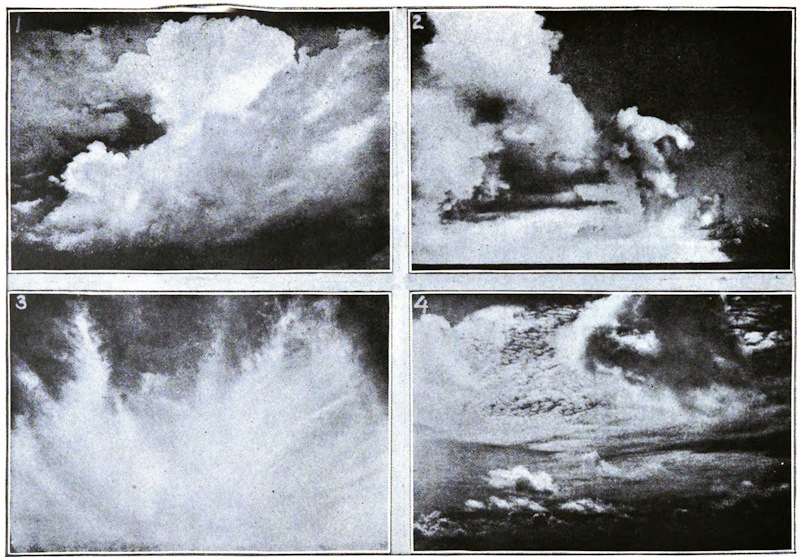
Typical Forms of Clouds
1, Squall Cumulus; 2, Pillar Cumulus; 3, Cirrus; 4, High Stratus and Cumulus
When these came to be examined, the following important generalizations were discovered:
1. That in general the configuration of the isobars assumed one of seven well-defined forms.
2. That, independent of the shape of the isobars, the wind always took a definite direction relative to the trend of those lines, and the position of the nearest area of low pressure.
3. That the velocity of the wind was always nearly proportional to the closeness of the isobars.
4. That the weather—that is to say, the kind of cloud, rain, fog, etc.—at any moment was related to the shape, and not the closeness, of the isobars, some shapes inclosing areas of fine, others of bad, weather.
5. That the regions thus mapped out by isobars were constantly shifting their position, so that changes of weather were caused by the drifting past of these areas of good or bad weather, just as on a small scale rain falls as a squall drives by. The motion of these areas was found to follow certain laws, so that forecasting weather changes in advance became possible.
6. That sometimes in the temperate zone, and habitually in the tropics, rain fell without any appreciable change in the isobars, though the wind conformed to the general law of these lines.
Observation also showed that, though the same shapes of isobars appear all over the world, the details of weather within them, and the nature of their motion, are modified by numerous local, diurnal, and annual variations. Hence modern weather science consists in working out for each country the details of the character and motion of the isobars which are usually found over it; just as the geologist finds crumplings and denudation all over the world, and works out the history of the physical appearance of his own scenery by studying the local development of these agencies.
So far the science rests on pure observation—that such and such wind or weather comes with such and such a shape of isobars. But it has been found, still further, that the seven fundamental shapes of isobars are, as it were, the product of so many various ways in which an atmosphere circulating from the equator to the poles may move. Just as the motion of a river sometimes forms descending eddies or whirlpools, sometimes back-waters in which the water is rising upward, or yet at other times ripples in which the circulation is very complex, so it now appears that the general movement of the atmosphere from the equator to the pole sometimes breaks up into a rotating and descending movement round that configuration of isobars known as an anticyclone, sometimes into a rotating and ascending movement round that known as a cyclone, or at other times quite in a different way during certain kinds of squalls and thunderstorms.
Isobars, therefore, represent the effect on our barometers of the movements of the air above us, so that by means of isobars we trace the circulation and eddies of the atmosphere.
By carrying the general laws of physics into the conception of a circulating gas, we find that a cold mixed atmosphere of air and vapor descending into a warmer soil would remain clear and bright; while a similar atmosphere rising into cooler strata would condense some of its vapor into rain or cloud. It is by reasoning of this nature that the origin of some of the most beautiful and complex forms of clouds has been discovered.
Following out these lines of research, a new science of meteorology has grown up, which entirely alters the attitude of mind with which we regard weather changes, and gives rise to an entirely new method of weather forecasting that far surpasses all previous efforts, and which explains and develops all that was known before.
On the one hand, the new method not only explains why certain prognostics are usually signs of good or bad weather, and the reason why the indications sometimes fail; but also the reason why rain, for instance, is sometimes foretold by one prognostic and sometimes by a totally different one.
On the other hand, it not only gives a more extended meaning to all the statistics which partially represent the climate of a place, and to the relation of the diurnal to the general changes of weather; but it also enables new inferences to be drawn, which had hitherto been impossible from some observations, and explains why other sets of figures must always remain without any physical significance.
We may notice here an attempt which has been made by one school of meteorologists to deduce all weather à priori from changes in the radiative energy of the sun; that is to say, that from a knowledge of greater or less heat being emitted by the sun, they would treat the consequent alteration of weather as a direct hydrodynamical problem. Given an earth surrounded by fifty miles of damp air, and a sun at varying altitude, and of varying radiative energy, deduce from that all the diverse changes of weather. This is doubtless a very tempting ideal, for there is no doubt that the sun’s heat is the prime mover of all atmospheric circulation; but when we have explained what the nature of weather changes is, we see that there is little hope that this method will ever lead to satisfactory results.
Other meteorologists, who lay less stress on the varying power of the sun, have taken up the indications of synoptic charts, and endeavored to construct a mathematical theory of cyclones and the general circulation of the atmosphere. Ferrel, Mohn, Gulberg, Sprung, and others have all started with the analysis of the motion of a free mass of air on the earth’s surface, first given by Professor Ferrel, and worked out, from that and other general principles, schemes of the nature and propagation of cyclones, and of the general distribution of pressure over the world.
THE ROMANCE OF A RAINDROP —Arthur H. Bell
Depth of rainfall is, of course, ascertained by means of a rain-gauge, which measures the amount of water precipitated from the atmosphere during certain definite periods—usually twenty-four hours. Sir Christopher Wren has the credit of constructing the first rain-gauge; but they have been made in various shapes and sizes since his time; and perhaps none of the instruments in the meteorologist’s armory is so familiar to the general public as the rain-gauge. The methods of using the instrument and the meaning of rainfall statistics are also thoroughly understood nowadays. However, behind these statistics and the methods of obtaining them, there are questions of great interest that obtrude themselves when we are watching the falling rain, and we desire to learn about the history of the raindrop—for example: Why is a raindrop round? How are raindrops formed? At what particular time does vapor become visible as mist? And what are the causes which change this mist into cloud and subsequently into rain?
The two prime causes of rain are, of course, the sun and the ocean; and since these two factors do not appreciably vary from year to year, it follows that the annual rainfall on the earth as a whole, if it could be measured, would also be found to be invariable. It is obvious, however, that the rainfall at all places is not equal. In London, for instance, the average yearly rainfall is twenty-two inches; but on the Khasi Hills in India it is no less than six hundred inches. Similar contrasts are observable in other parts of the world, the differences being due to local geographical conditions.
The starting points in the history of rain are, therefore, heat and moisture. From the surface of land and water tiny globules or vesicles of moisture are continually rising into the atmosphere by the force of the sun’s heat; and the warmer the air the greater the number of these globules of water the atmosphere is able to absorb. In this respect the atmosphere may be likened to a sponge, for it is from the moisture thus retained that the subsequent raindrops are formed. Most persons are well acquainted with the very familiar phenomenon which is to be noticed when a glass of very cold water is brought into a warm room: the drops of moisture which form on the outside of the glass being among the commonest phenomena in what may be termed domestic meteorology. There is a similar transformation in the outside atmosphere; so that when the warm, moist currents of air flow against the sides of a cold mountain, or it may be against a body of cold air, there is a reduction in temperature, the atmosphere is squeezed like a sponge, and the particles of moisture are forced out of it. The particles then assume the form of cloud, fog, mist, rain, snow, and hail, as the case may be.
Now, as regards the globules of moisture, the most recent experiments and observations point to the conclusion that before the drops of vapor can form, there must be a tiny nucleus of dust upon which the condensed water may settle. At the centre of every drop of vapor in a cloud there is probably a little core of dust; and without these little atoms there could be no rain. These atoms of dust are visible only under the strongest microscopes; and so minute are they that in a cubic foot of saturated air it has been calculated that they number one thousand millions, their total weight being only three grains.
It is commonly considered that the particles of moisture within a cloud are quite motionless; and when looking at a huge cloud floating serenely in a summer sky it is difficult not to think of its constituent parts as being quite at rest. The apparently stationary cloud is all commotion and movement, the particles within it being always on the move, some going up and others down. The particles of moisture, moreover, being probably only about the four-thousandth part of an inch in diameter, the resistance offered by the air to their movement is very slight; indeed, as soon as they are condensed they immediately begin to fall downward, and were it not for the atoms of dust waiting to catch them the particles would at once fall to the ground. It is often asked why the vapor, if so readily condensed in the atmosphere, does not continually fall to the earth. The answer to this question, it will be seen, is that the moisture, instead of always pouring down on the earth, settles on the surface of the atoms of dust. Thus the first downward movement of the incipient raindrop is arrested by the dust-nuclei which swarm in all parts of the atmosphere; so that instead of being destroyed as soon as it is formed, the particle of moisture is preserved and stored for future use. In realizing the fact that a cloud is always in motion, the first step has been taken in discovering how a raindrop is formed.
It might be supposed that the raindrops would evaporate as quickly as they were condensed; but observation of the drops of moisture running down a window-pane and forming larger drops gives a good idea of what occurs in the clouds; as also does the fact that in a bottle of soda-water the bubbles of air overtake one another and, colliding, make larger bubbles.
One of the principal causes of the manufacture of a raindrop is to be found in the circumstance that there is a similar process of amalgamation at work in every part of the atmosphere. It often happens that a drop of moisture falls downward through a cloud for a distance of a mile or more; and although it may pass through strata of very warm air, thus running a great risk of being evaporated and destroyed, it has also many collisions by which its bulk is considerably increased, and eventually becomes so heavy that its rate of progress is very much accelerated. Then, no longer able to float in the air, it plumps down to the earth as a full-grown raindrop.
Supposing it were possible for an observer to occupy a position immediately below a cloud, and close enough to see all that was taking place, he would notice raindrops of all sizes leaping from the under side of the cloud and plunging toward the earth. The simplest experiment to get some idea concerning the variation in raindrops is to expose an ordinary slate for a few minutes during a shower of rain, and it will be seen by the different-shaped blotches on the slate that, although the raindrops have all made a similar journey, they have, nevertheless, contrived to acquire an individuality during their downward passage. That the raindrops are round admits of a very simple explanation. They are this shape owing to the action of capillarity, which in the case of the raindrop acts equally in all directions.
In many parts of the world the very curious phenomenon of colored rain sometimes occurs, and in many instances it is due to very simple causes. In some cases the coloring matter is found to be nothing but the pollen-dust shaken out of the flowers on certain trees at such times as a strong wind happened to be blowing over them. Fir trees and cypress trees, when grouped together in large forests, at certain seasons of the year give off enormous quantities of pollen, and this vegetable dust is often carried many miles through the atmosphere by the wind, and frequently falls to earth during a shower of rain. The microscope clearly reveals the origin of such colored rain, which has on more than one occasion puzzled and mystified the inexperienced. Pollen is, therefore, very largely responsible for the reports sent from different parts of the world of golden, black, and red rain. Fish and insects also descend to earth during showers of rain; but since it is probable that these and other unwonted visitors to the atmosphere were originally drawn up into the air during the passage across the country of a whirling storm, with powerfully ascending currents of air, there is no need to look for any far-fetched explanation of what, after all, is a very simple occurrence.
The history of a raindrop, then, has some very romantic and interesting episodes connected with it; but, wonderful as are the incidents in what is really a very remarkable career, it is not until the raindrops fall on the earth that the full purport of the work they do is wholly realized. Contemplated by itself, a raindrop seems a very insignificant thing; but when the drops combine in a heavy downpour of rain the result is truly wonderful. The information that one inch of rain has fallen over a certain area is not very impressive; the amount does not seem very great. A fall of one inch of rain means, however, that no less than one hundred tons of water have fallen on each acre of surface, or no less than sixty thousand tons on each square mile. Instead of expressing the amount of water in tons, it may be thus stated in gallons, taking the Thames basin as a convenient area for reference: a rainfall of three inches over that area means that one hundred and sixty thousand million gallons of water have been precipitated from the atmosphere. At times, too, when the rainfall is still heavier, rivers overflow their banks and floods occur, and still further evidence is then forthcoming of the power and the might of the raindrops working toward one common end. Sooner or later the raindrop, whether it runs off the surface of the earth in a river or in a disastrous flood, finds its way, under the influence of evaporation, back into the atmosphere, and is then ready to start on another journey, which, like all its predecessors, will be full of incident from start to finish.
THE RAINBOW —John Tyndall
The oldest historic reference to the rainbow is known to all: “I do set my bow in the clouds, and it shall be for a token of a covenant between me and the earth.... And the bow shall be in the cloud; and I will look upon it, that I may remember the everlasting covenant between God and every living creature of all flesh that is upon the earth.”
To the sublime conceptions of the theologian succeeded the desire for exact knowledge characteristic of the man of science. Whatever its ultimate cause might have been, the proximate cause of the rainbow was physical, and the aim of science was to account for the bow on physical principles. Progress toward this consummation was very slow. Slowly the ancients mastered the principles of reflection. Still more slowly were the laws of refraction dug from the quarries in which Nature had imbedded them. I use this language because the laws were incorporate in Nature before they were discovered by man. Until the time of Alhazan, an Arabian mathematician, who lived at the beginning of the Twelfth Century, the views entertained regarding refraction were utterly vague and incorrect. After Alhazan came Roger Bacon and Vitellio, who made and recorded many observations and measurements on the subject of refraction. To them succeeded Kepler, who, taking the results tabulated by his predecessors, applied his amazing industry to extract from them their meaning—that is to say, to discover the physical principles which lay at their root. In this attempt he was less successful than in his astronomical labors. In 1604, Kepler published his Supplement to Vitellio, in which he virtually acknowledged his defeat by enunciating an approximate rule, instead of an all-satisfying natural law. The discovery of such a law, which constitutes one of the chief corner-stones of optical science, was made by Willebrod Snell, about 1621.
A ray of light may, for our purposes, be presented to the mind as a luminous straight line. Let such a ray be supposed to fall vertically upon a perfectly calm water-surface. The incidence, as it is called, is then perpendicular, and the ray goes through the water without deviation to the right or left. In other words, the ray in the air and the ray in the water form one continuous straight line. But the least deviation from the perpendicular causes the ray to be broken, or “refracted,” at the point of incidence. What, then, is the law of refraction discovered by Snell? It is this, that no matter how the angle of incidence and with it the angle of refraction may vary, the relative magnitude of two lines, dependent on these angles, and called their sines, remains, for the same medium, perfectly unchanged. Measure, in other words, for various angles, each of these two lines with a scale, and divide the length of the longer one by that of the shorter; then, however the lines individually vary in length, the quotient yielded by this division remains absolutely the same. It is, in fact, what is called “the index of refraction” of the medium.
Science is an organic growth, and accurate measurements give coherence to the scientific organism. Were it not for the antecedent discovery of the law of sines, founded as it was on exact measurements, the rainbow could not have been explained. Again and again, moreover, the angular distance of the rainbow from the sun had been determined and found constant. In this divine remembrancer there was no variableness. A line drawn from the sun to the rainbow, and another drawn from the rainbow to the observer’s eye, always inclosed an angle of 41°. Whence this steadfastness of position—this inflexible adherence to a particular angle? Newton gave to De Dominis[4] the credit of the answer; but we really owe it to the genius of Descartes. He followed with his mind’s eye the rays of light impinging on a raindrop. He saw them in part reflected from the outside surface of the drop. He saw them refracted on entering the drop, reflected from its back, and again refracted on their emergence. Descartes was acquainted with the law of Snell, and taking up his pen, he calculated, by means of that law, the whole course of the rays. He proved that the vast majority of them escaped from the drop as divergent rays, and, on this account, soon became so enfeebled as to produce no sensible effect upon the eye of an observer. At one particular angle, however—namely, the angle 41° aforesaid—they emerged in a practically parallel sheaf. In their union was strength, for it was this particular sheaf which carried the light of the “primary” rainbow to the eye.
There is a certain form of emotion called intellectual pleasure which may be excited by poetry, literature, nature, or art. But I doubt whether among the pleasures of the intellect there is any more pure and concentrated than that experienced by the scientific man when a difficulty which has challenged the human mind for ages melts before his eyes, and re-crystallizes as an illustration of natural law. This pleasure was doubtless experienced by Descartes when he succeeded in placing upon its true physical basis the most splendid meteor of our atmosphere. Descartes showed, moreover, that the “secondary bow” was produced when the rays of light underwent two reflections within the drop, and two refractions at the points of incidence and emergence.
Descartes proved that, according to the principles of refraction, a circular band of light must appear in the heavens exactly where the rainbow is seen. But how are the colors of the bow to be accounted for? Here his penetrative mind came to the very verge of the solution, but the limits of knowledge at the time barred his further progress. He connected the colors of the rainbow with those produced by a prism; but then these latter needed explanation just as much as the colors of the bow itself. The solution, indeed, was not possible until the composite nature of white light had been demonstrated by Newton. Applying the law of Snell to the different colors of the spectrum, Newton proved that the primary bow must consist of a series of concentric circular bands, the largest of which is red and the smallest violet; while in the secondary bow these colors must be reversed. The main secret of the rainbow, if I may use such language, was thus revealed.
I have said that each color of the rainbow is carried to the eye by a sheaf of approximately parallel rays. But what determines this parallelism? Here our real difficulties begin. Let us endeavor to follow the course of the solar rays before and after they impinge upon a spherical drop of water. Take, first of all, the ray that passes through the centre of the drop. This particular ray strikes the back of the drop as a perpendicular, its reflected portion returning along its own course. Take another ray close to this central one and parallel to it—for the sun’s rays when they reach the earth are parallel. When this second ray enters the drop it is refracted; on reaching the back of the drop it is there reflected, being a second time refracted on its emergence from the drop. Here the incident and the emergent rays inclose a small angle with each other. Take, again, a third ray a little further from the central one than the last. The drop will act upon it as it acted upon its neighbor, the incident and the emergent rays inclosing in this instance a larger angle than before. As we retreat further from the central ray the enlargement of this angle continues up to a certain point, where it reaches a maximum, after which further retreat from the central ray diminishes the angle. Now, a maximum resembles the ridge of a hill, or a watershed, from which the land falls in a slope at each side. In the case before us the divergence of the rays when they quit the raindrop would be represented by the steepness of the slope. On the top of the watershed—that is to say, in the neighborhood of our maximum—is a kind of summit-level, where the slope for some distance almost disappears. But the disappearance of the slope indicates, as in the case of our raindrop, the absence of divergence. Hence we find that at our maximum, and close to it, there issues from the drop a sheaf of rays which are nearly, if not quite, parallel to each other. They are the so-called “effective rays” of the rainbow.
But though the step here taken by Descartes and Newton was a great one, it left the theory of the bow incomplete. Within the rainbow proper, in certain conditions of the atmosphere, are seen a series of richly colored zones, which were not explained by either Descartes or Newton. They are said to have been first described by Mariotte, and they long challenged explanation. At this point our difficulties thicken, but, as before, they are to be overcome by attention. It belongs to the very essence of a maximum, approached continuously on both sides, that on the two sides of it pairs of equal value may be found. The maximum density of water, for example, is 39° Fahr. Its density, when 5° colder and when 5° warmer than this maximum, is the same. So also with regard to the slopes of a watershed. A series of pairs of points of the same elevation can be found upon the two sides of the ridge; and, in the case of the rainbow, on the two sides of the maximum deviation we have a succession of pairs of rays having the same deflection. Such rays travel along the same line, and add their forces together after they quit the drop. But light, thus reinforced by the coalescence of non-divergent rays, ought to reach the eye. It does so; and were light what it was once supposed to be—a flight of minute particles sent by luminous bodies through space—then these pairs of equally deflected rays would diffuse brightness over a large portion of the area within the primary bow. But inasmuch as light consists of waves, and not of particles, the principle of interference comes into play, in virtue of which waves alternately reinforce and destroy each other. Were the distance passed over by the two corresponding rays within the drop the same, they would emerge as they entered. But in no case are the distances the same. The consequence is that when the rays emerge from the drop they are in a condition either to support or to destroy each other. By such alternate reinforcement and destruction, which occur at different places for different colors, the colored zones are produced within the primary bow. They are called “supernumerary bows,” and are seen, not only within the primary, but sometimes also outside the secondary bow. The condition requisite for their production is that the drops which constitute the shower shall all be of nearly the same size. When the drops are of different sizes, we have a confused superposition of the different colors, an approximation to white light being the consequence. This second step in the explanation of the rainbow was taken by a man the quality of whose genius resembled that of Descartes or Newton, and who in 1801 was appointed Professor of Natural Philosophy in the Royal Institution. I refer, of course, to the illustrious Thomas Young.
But our task is not, even now, complete. The finishing touch to the explanation of the rainbow was given by the eminent Astronomer Royal, Sir George Airy. Bringing the knowledge possessed by the founders of the undulatory theory, and that gained by subsequent workers, to bear upon the question, Sir George Airy showed that, though Young’s general principles were unassailable, his calculations were sometimes wide of the mark. It was proved by Airy that the curve of maximum illumination in the rainbow does not quite coincide with the geometric curve of Descartes and Newton. He also extended our knowledge of the supernumerary bows, and corrected the positions which Young had assigned to them. Finally, Professor Miller of Cambridge and Dr. Galle of Berlin illustrated with careful measurements with the theodolite the agreement which exists between the theory of Airy and the facts of observation. Thus, from Descartes to Airy, the intellectual force expended in the elucidation of the rainbow, though broken up into distinct personalities, might be regarded as that of an individual artist, engaged throughout this time in lovingly contemplating, revising, and perfecting his work.
The white rainbow (l’arc-en-ciel blanc) was first described by the Spanish Don Antonio de Ulloa, lieutenant of the Company of Gentleman Guards of the Marine. By order of the King of Spain, Don Jorge Juan and Ulloa made an expedition to South America, an account of which is given in two amply illustrated quarto volumes to be found in the library of the Royal Institution. The bow was observed from the summit of the mountain Pambamarca, in Peru. The angle subtended by its radius was 33° 30′, which is considerably less than the angle subtended by the radius of the ordinary bow.
The white rainbow has been explained in various ways. The genius of Thomas Young throws light upon this subject, as upon so many others. He showed that the whiteness of the bow was a direct consequence of the smallness of the drops which produce it. The smaller the drops, the broader are the zones of the supernumerary bows, and Young proved by calculation that when the drops have a diameter of 1-3000th or 1-4000th of an inch, the bands overlap each other, and produce white light by their mixture.
SNOW, HAIL, AND DEW —Alexander Buchan
Snow is the frozen moisture which falls from the atmosphere when the temperature is 32° or lower. It is composed of crystals, usually in the form of six-pointed stars, of which about 1,000 different kinds have been already observed, and many of them figured, by Scoresby, Glaisher, and others. These numerous forms have been reduced to five principal varieties: Thin plates, the most numerous class, containing several hundred forms of the rarest and most exquisite beauty; spherical nucleus or plane figure studded with needle-shaped crystals; six or more rarely three-sided prismatic crystals; pyramids of six sides; prismatic crystals, having at the ends and middle thin plates perpendicular to their length. The forms of the crystals in the same fall of snow are generally similar to each other. The crystals of hoar-frost being formed on leaves and other bodies disturbing the temperature are often irregular and opaque; and it has been observed that each tree or shrub has its own peculiar crystals.
Snowflakes vary from an inch to 7-100ths of an inch in diameter, the largest occurring when the temperature is near 32°, and the smallest at very low temperatures. As air has a smaller capacity for retaining its vapor as the temperature sinks, it follows that the aqueous precipitation, snow or rain, is much less in polar than in temperate regions. The white color of snow is the result of the combination of the different prismatic rays issuing from the minute snow-crystals. Pounded glass and foam are analogous cases of the prismatic colors blending together and forming the white light out of which they had been originally formed. It may be added that the air contained in the crystals intensifies the whiteness of the snow. The limit of the fall of snow coincides nearly with 30° N. lat., which includes nearly the whole of Europe; on traversing the Atlantic, it rises to 45°, but on nearing America descends to near Charleston; rises on the west of America to 47°, and again falls to 40° in the Pacific. It corresponds nearly with the winter isothermal of 52° Fahr. Snow is unknown at Gibraltar; at Paris, it falls 12 days on an average annually, and at St. Petersburg 170 days. It is from 10 to 12 times lighter than an equal bulk of water. From its loose texture, and its containing about 10 times its bulk of air, it is a very bad conductor of heat, and thus forms an admirable covering for the earth from the effects of radiation—it not infrequently happening, in times of great cold, that the soil is 40° warmer than the surface of the overlying snow. The flooding of rivers from the melting of the snow on mountains in summer carries fertility into regions which would otherwise remain barren wastes.
The word hail in English is unfortunately used to denote two phenomena of apparently different origin. In French, we have the terms grèle and grésil—the former of which is hail proper; the latter denotes the fine grains, like small shot, which often fall in winter, much more rarely in summer, and generally precede snow. The cause of the latter seems to be simply the freezing of raindrops as they pass in their fall through a colder region of air than that where they originated. We know by balloon ascents and various other methods of observation that even in calm weather different strata of the atmosphere have extremely different temperatures, a stratum far under the freezing point being often observed between two others comparatively warm.
But that true hail, though the process of its formation is not yet perfectly understood, depends mainly upon the meeting of two nearly opposite currents of air—one hot and saturated with vapor, the other very cold—is rendered pretty certain by such facts as the following. A hailstorm is generally a merely local phenomenon, or at most, ravages a belt of land of no great breadth, though it may be of considerable length. Hailstorms occur in the greatest perfection in the warmest season, and at the warmest period of the day, and generally are most severe in the most tropical climates. A fall of hail generally precedes, sometimes accompanies, and rarely, if ever, follows a thunder-shower.
When a mass of air, saturated with vapor, rising to a higher level, meets a cold one, there is, of course, instant condensation of vapor into ice by the cold due to expansion; at the same time, there is generally a rapid production of electricity, the effect of which upon such light masses as small hailstones is to give them in general rapid motion in various directions successively. These motions are in addition to the vortex motions or eddies, caused in the air by the meeting of the rising and descending currents. The small ice-masses then moving in all directions impinge upon each other, sometimes with great force, producing that peculiar rattling sound which almost invariably precedes a hail-shower. At the same time, by a well-known property of ice, the impinging masses are frozen together; and this process continues until the weight of the accumulated mass enables it to overcome the vortices and the electrical attractions, when it falls as a larger or smaller hailstone. On examining such hailstones, which may have any size from that of a pea to that of a walnut, or even an orange, we at once recognize the composite character which might be expected from such a mode of aggregation.
A curious instance of the fall of large hail, or rather ice-masses, occurred on one of her Majesty’s ships off the Cape in January, 1860. Here the stones were the size of half-bricks, and beat several of the crew off the rigging, doing serious injury. We may conclude by a description (taken from Mem. de l’Acad. des Sciences, 1790) of one of the most disastrous hailstorms that has occurred in Europe for many years back. This storm passed over Holland and France in July, 1788. It traveled simultaneously along two lines nearly parallel—the eastern one had a breadth of from half a league to five leagues, the western of from three to five leagues. The space between was visited only by heavy rain; its breadth varied from three to five and a half leagues. At the outer border of each, there was also heavy rain, but we are not told how far it extended. The length was at least a hundred leagues; but from other reports it may be gathered that it really extended to nearly two hundred. It seems to have originated near the Pyrenees, and to have traveled at a mean rate of about sixteen and a half leagues per hour toward the Baltic, where it was lost sight of. The hail only fell for about seven and a half minutes at any one place. The hailstones were generally of irregular form, the heaviest weighing about eight French ounces. This storm devastated 1,039 parishes in France alone, and the damage was officially placed at 24,690,000 francs.
For any assigned temperature of the atmosphere, there is a certain quantity of aqueous vapor which it is capable of holding in suspension at a given pressure. Conversely, for any assigned quantity of aqueous vapor held in suspension in the atmosphere, there is a minimum temperature at which it can remain so suspended. This minimum temperature is called the dew-point. During the daytime, especially if there has been sunshine, a good deal of aqueous vapor is taken into suspension in the atmosphere. If the temperature in the evening now falls below the dew-point, which after a hot and calm day generally takes place about sunset, the vapor which can be no longer held in suspension is deposited on the surface of the earth, sometimes to be seen visibly falling in a fine mist. This is one form of the phenomenon of dew, but there is another. The surface of the earth, and all things on it, and especially the smooth surfaces of vegetable productions, are constantly parting with their heat by radiation. If the sky is covered with clouds, the radiation sent back from the clouds nearly supplies an equivalent for the heat thus parted with; but if the sky be clear, no equivalent is supplied, and the surface of the earth and things growing on it become colder than the atmosphere.
If the night also be calm, the small portion of air contiguous to any of these surfaces will become cooled below the dew-point, and its moisture deposited on the surface in the form of dew. If this chilled temperature be below 32° Fahr., the dew becomes frozen and is called hoar-frost. The above two phenomena, though both expressed in our language by the word dew, which perhaps helps to give rise to a confusion of ideas on the subject, are not necessarily expressed by the same word. For instance, in French, the first phenomenon—the falling evening-dew—is expressed by the word serein; while the latter—the dew seen in the morning gathered in drops by the leaves of plants, or other cool surfaces—is expressed by the word rosée.
The merit of the discovery of the “Theory of Dew” has been commonly ascribed to Dr. William Charles Wells, who published in 1814 his Essay on Dew, which obtained great popularity. The merit should, however, be divided between him and several others. M. Le Roi of Montpellier, M. Pictet of Geneva, and especially Professor Alexander Wilson of Glasgow, largely contributed by experiment and inducement to its formation.
THE AURORA BOREALIS —Richard A. Proctor
The aurora is one of those phenomena of nature which are characterized by exceeding beauty, and sometimes by an imposing grandeur, but are unaccompanied by any danger, and indeed, so far as can be determined, by any influence whatever upon the conditions which affect our well-being. Comparing the aurora with a phenomenon akin to it in origin—lightning—we find in this respect the most marked contrast. Both phenomena are caused by electrical discharges; both are exceedingly beautiful. It is doubtful which is the more imposing so far as visible effects are concerned. When the auroral crown is fully formed, and the vault of heaven is covered with the auroral banners, waving hither and thither silently, now fading from view, anon glowing with more intense splendor, the mind is not less impressed with a sense of the wondrous powers which surround us than when, as the forked lightnings leap from the thundercloud, the whole heavens glow with violet light, and then sink suddenly into darkness. The solemn stillness of the auroral display is as impressive in its kind as the crashing peal of the thunderbolt.
The reader is no doubt aware that auroras or polar streamers, as they are sometimes called, are appearances seen not around the true poles of the earth, but around the magnetic poles which lie very far away from those geographical poles which our Arctic and Antarctic seamen have in vain attempted to reach. The formation of auroral streamers around the magnetic poles of the earth shows that these lights are due to electrical discharges of electricity, which, though only visible at night, take place in reality in the daytime also.
Remembering that the aurora is due to electrical discharges in the upper regions of the air, it is interesting to learn what are the appearances presented by the aurora at places where the auroral arch is high above the horizon—these being, in fact, places nearly under the auroral arch. M. Ch. Martins, who observed a great number of auroras in Spitzbergen in 1839, thus writes: “At times they are simple diffused gleams or luminous patches; at others, quivering rays of pure white which run across the sky, starting from the horizon as if an invisible pencil were being drawn over the celestial vault; at times it stops in its course, the incomplete rays do not reach the zenith, but the aurora continues at some other point; a bouquet of rays darts forth, spreads into a fan, then becomes pale, and dies out. At other times long golden draperies float above the head of the spectator, and take a thousand folds and undulations as if agitated by the wind. They appear to be but at a slight elevation in the atmosphere, and it seems strange that the rustling of the folds as they double back on each other is not audible. Generally, a luminous bow is seen in the north; a black segment separates it from the horizon, the dark color forming a contrast with the pure white or bright red of the bow, which darts forth rays, extends, becomes divided, and soon presents the appearance of a luminous fan, which fills the northern sky, and mounts nearly to the zenith, where the rays, uniting, form a crown, which in its turn darts forth luminous jets in all directions. The sky then looks like a cupola of fire; the blue, the green, the yellow, the red, and the white vibrate in the palpitating rays of the aurora. But this brilliant spectacle lasts only a few minutes; the crown first ceases to emit luminous jets, and then gradually dies out; a diffused light fills the sky; here and there a few luminous patches, resembling light clouds, open and close with incredible rapidity, like a heart that is beating fast. They soon get pale in their turn, everything fades away and becomes confused, the aurora seems to be in its death-throes; the stars, which its light had obscured, shine with a renewed brightness; and the long polar night, sombre and profound, again assumes its sway over the icy solitudes of earth and ocean.”
The association between auroral phenomena and those of terrestrial magnetism has long been placed beyond a doubt. Wargentin in 1750 first established the fact, which had been previously noted, however, by Halley and Celsius. But the extension of the relation to phenomena occurring outside the earth—very far away from the earth—belongs to recent times. The first point to be noticed, as showing that the aurora depends partly on extra-terrestrial circumstance, is the fact that the frequency of its appearance varies greatly from time to time. It is said that the aurora was hardly ever seen in England during the Seventeenth Century, although the northern magnetic pole was then much nearer to England than it is at present Halley states that before the great aurora of 1716 none had been seen (or at least recorded) in England for more than eighty years, and no remarkable aurora since 1574. In the records of the Paris Academy of Sciences no aurora is mentioned between 1666 and 1716. At Berlin one was recorded in 1707 as a very unusual phenomenon; and the one seen at Bologna in 1723 was described as the first which had ever been seen there. Celsius, who described in 1733 no less than three hundred and sixteen observations of the aurora in Sweden between 1706 and 1732, states that the oldest inhabitants of Upsala considered the phenomenon as a great rarity before 1716. Anderson of Hamburg states that in Iceland the frequent occurrence of auroras between 1716 and 1732 was regarded with great astonishment. In the Sixteenth Century, however, they had been frequent.
Here then we seem to find the evidence of some cause external to the earth as producing auroras, or at least as tending to make their occurrence more or less frequent. The earth has remained to all appearance unchanged in general respects during the last three centuries, yet in the Sixteenth her magnetic poles have been frequently surrounded by auroral streamers; during the Seventeenth these streamers have been seldom seen; during the last two-thirds of the Seventeenth Century auroras have again been frequent; and during the Eighteenth Century they have occurred sometimes frequently during several years in succession, at others very seldom.
Connected as auroras are with the phenomena of terrestrial magnetism, we may expect to find some help in our inquiry from the study of these phenomena. Now it appears certain that magnetic phenomena are partly influenced by changes in the sun’s condition. We may well believe that they are in the main due to the sun’s ordinary action, but the peculiarities which affect them seem to depend on changes in the sun’s action.
Many of my readers will doubtless remember the auroras of May 13, 1869, and October 24, 1870, both of which occurred when the sun’s surface was marked by many spots, and both of which were accompanied by remarkable disturbance of the earth’s magnetism.
It may, then, fairly be assumed that the occurrence of auroras depends in some way, directly or indirectly, on the condition of the sun. But what the real nature of that connection may be is not easily determined.
Angström was the first to observe the spectrum of the aurora borealis. He found that the greater part of the auroral light, as observed in 1867, was of one color, yellow, but three faint bands of green and greenish blue color were also seen. The aurora of April 15, 1869, was seen under very favorable conditions in America. Professor Winlock, observing it at New York, found its spectrum to consist of five bright lines, of which the brightest was the yellow line just mentioned. One of the others seems to agree very nearly, if not exactly, in position with a green line, which is the most conspicuous feature of the spectrum of the solar corona. During the aurora of October 6, 1869, Flögel noticed the strong yellow line and a faint green band. Schmidt, on April 5, 1870, made a similar observation. He saw the strong yellow line, and from it there extended toward the violet end of the spectrum a faint greenish band, which, however, at times showed three defined lines, fainter than the yellow line.
It was not till the magnificent aurora of October 24-25, 1870, that any red lines were seen in the spectrum of an aurora. On that occasion the background of the auroral light was ruddy, and on the ruddy background there were seen three deep red streamers very well defined. The ruddy streamers, on the night of October 25, converged toward the auroral crown, which was on that occasion singularly well seen. Förster of Berlin failed to see any red line or band despite the marked ruddiness of the auroral light. But Capron at Guildford saw a faint line in the red part of the spectrum; and Elger at Bedford observed a red band in the light of the red streamers, the band disappearing, however, when the spectroscope was directed on the white rays of the aurora.
As yet the auroral spectrum has not been interpreted. The reason probably is, that the conditions under which the light of the aurora as of the corona is formed are not such as have been or perhaps can be attained or even approached in laboratory experiments.
CLOUDS —D. Wilson Barker
Those who are professionally engaged in the scientific work of weather bureaus recognize the importance of accurate observations of cloud forms and nature, and much good work has been done in this connection in recent years by scientific observers in England, Australia, and the United States; but as a popular study, nephology is almost entirely overlooked, and this notwithstanding the fact that, perhaps, no branch of knowledge offers greater facility and ease of acquisition. Each cloud has its history fraught with meaning; its open secret is writ on its face, and may be read by any one who will, give himself a little trouble, nor need he go deeply into the study in order to make observations interesting to himself, and perhaps of great use in the furthering and perfecting of weather lore. To the ancients, the sky was doubtless an object of constant remark and interest, and possibly their intuitive knowledge of weather forecasting was much more accurate than ours. The dwellers in our modern cities see little of the sky, clouds have no interest for them beyond the personal consideration as to the advisability of taking out an umbrella or not. But farmers, fishermen, sailors, and others following open-air avocations are dependent on the weather, and to be wise in its forecast is of importance to them. To these, especially, cloud study should appeal; it can not fail to be profitable to them in their personal work, and they have all the opportunity, if the will be there, to forward the general knowledge of the subject by careful painstaking observations, which they may transmit to those scientifically engaged in dealing with weather laws, and thus assist in the elucidation of questions on which we are at present but very imperfectly informed.
In this article the broad distinctions of clouds will be dealt with. There are two well-defined types—Stratus and Cumulus—so distinct in actual appearance and in physical formation that they may be taken as the basis of classification. Sometimes both types appear to merge into each other, in which case no variety of classification suffices to describe them satisfactorily, as any one who has studied cloud-forms must allow. “Stratus” is a sheet-like formation of cloud. “Cumulus” is recognizable by its heaped-up appearance and vertical thickness. Numerous varieties of cloud-forms may be observed graduating from one of these types to the other, but when an observer can clearly distinguish Stratus from Cumulus he has already acquired valuable knowledge.
The presence of either type of cloud alone indicates a more or less set condition of the atmosphere, and generally foretells a continuance of the existing weather. The simultaneous presence of both types indicates a coming change, the gradation of Stratus into Cumulus foreboding worse weather, and of Cumulus into Stratus heralding good. Again, as we shall show later on, the vertical thickening of the stratiform clouds is a distinctly bad indication.
Up to quite recently, Luke Howard’s division of clouds, formulated in 1802, held first place; even now it is in constant use, for though attempts have been made at a more scientific classification, all of them, with the single exception of that proposed by the late Rev. Clement Ley, can only be termed make-shifts. Mr. Ley’s classification, unfortunately, is long, and not well adapted to the use of any but professional investigators, or enthusiasts with ample time on their hands. There exists a so-called “international” system of cloud nomenclature, but, for all that, each country has its own especial system, with the result that vast collections of cloud statistics are of little value as helps to a classification, and are useful only as records of clouds present at certain times.
Clouds owe their existence to two causes:
1. Through the passing of warm, moist air into colder, when, owing to condensation, a certain proportion of the moisture becomes visible in the form of a cloud.
2. Through changes occurring in the atmosphere as it rises into higher regions of atmosphere, where decrease in pressure and expansion and consequent loss of heat take place and cause condensation of moisture.
The first process may be described as the condensation formation of clouds, and the second as the adiabatic formation of clouds. As a matter of fact, no hard and fast line separates these two operations; they act in unison, and the combination of vertical and horizontal currents goes to make up the diversity of forms which clouds assume.
In settled states of the atmosphere, Stratus clouds are common, or the sky may be clear. In unsettled conditions, Cumulus or Heap clouds are formed.
We shall now describe a few familiar forms of cloud, giving them simple names and endeavoring to compare them with other nomenclatures.
Of Cumulus clouds there are five well-defined varieties.
Rain Cumulus, of which there are two sub-varieties:
(a) Shower-cumulus, when rain falls from the cloud without increment of wind. The edges of this cloud are not cirrus-topped.
(b) Squall-cumulus, when the rain is accompanied by wind, or by wind with hail and snow falling from this cloud.
In these cases the Cumulus cloud is generally much serrated, having a cirriform edging. In some cases this cirriform edging extends far over the sky and forms halos, particularly at the rear.
Two rarer varieties of Cumulus are:
Pillar-cumulus, generally noticed over the calm belts of the ocean, and distinguishable by its slender forms, which rise to great altitudes.
Roll-cumulus generally accompanies strong winds, particularly polar west winds, which succeed cyclonic disturbances. Here we have the ordinary Cumulus cloud so blown along by the wind as to assume the roll formation from which it is named.
A still rarer form of Cumulus appears in scattered patches over the sky, and is indicative of an electrical state of the atmosphere.
Cumulus clouds form at a low altitude, but they frequently tower upward to great heights.
It should be noticed that in these clouds the fine weather form is of soft, smooth outline, and has a quiet appearance.
Stratus Clouds may be divided into four varieties as follows:
1. Fog, so well known as not to need description. It is, in fact, a Stratus cloud resting on the earth’s surface.
2. Stratus, a cloud sheet which covers the whole sky at a moderate elevation. Here and there the cloud is thin, and under surfaces appear as parallel lines all round the horizon. This is the characteristic cloud of anti-cyclonic, or dry, fine weather conditions. It may continue to cover the sky for several days in succession.
3. High Stratus, including all the varying forms of Cirro-cumulus from the mackerel skies to the Cirro-macula of Clement Ley. Many beautiful varieties of this cloud of minute cumuliform appearance are caused by the changes taking place in the atmosphere. We notice waves, wavelets, stipplings, and flecks. To it are due the coronas sometimes seen round the sun, as also iridescent clouds occasionally noticed in the same vicinity. The wave-like appearance of the clouds is due to the passage of a more rapidly moving air current over a slower one, or of a wave current crossing a motionless portion of the air. When two air currents pass over one another at an angle, the particles of clouds tend to fall into different shapes, hence our mackerel skies. But this cloud, although beautiful, is essentially one of warning, more especially when the flecks are of a thin, scaly appearance (resembling the scales of certain fishes so closely that I have called it the scale cloud). Sometimes these detached flecks appear in lines, and very striking is the effect produced.
4. Cirrus.—The highest form of cloud and the most important as a factor in the science of weather forecasting. Cirrus, ordinarily, appears as wisps and feather pieces scattered over the sky, and its significance is then of no import.
When, however, this cloud takes the form of lines parallel to the horizon, or of lines appearing to radiate as wheel-spokes from any one part of the horizon, it should be carefully noted as indicative of approaching weather. Its movement and propagating transition should be observed. This cloud is composed of ice-dust or crystals.
When a cyclonic disturbance is about to pass over an observer, Cirrus generally appears first in parallel lines, or at a radiant point; the threads gradually increase and interlace until a complete sheet of Cirro-stratus covers the sky, causing a halo. The cloud further thickens, the halo disappears, all becomes overcast, and rain comes on. The cloud is now known as Nimbus, and after it has endured some time, the wind shifts, the Nimbus clears off, and it is succeeded by a polar west wind.
In addition to these forms of clouds, we may often notice, particularly during high winds, fragments of clouds hurrying across the sky. These are known as “scud”; they are generally pieces carried off by the winds from the main bodies of clouds.
Occasionally two forms of cloud are present at the same time. This is ordinarily taken as a case of Cumulus and Stratus, and has become known as Cumulo-stratus; but, if observed in the zenith, it may readily be noted that the two forms of cloud are distinct, and they had better be dealt with separately. The appearance of Cumulo-stratus is an effect of perspective.
Clouds float at varying altitudes, according to the latitude and elevation of the ground; the vertical temperature and adiabatic gradients determining the level at which the vapor becomes visible as cloud. It is desirable in all cloud observations, that note should be made of the approximate relative altitudes of clouds and of their velocity of motion. This is particularly desirable when dealing with the stratiform clouds, whether as ordinary Cirro-cumulus or as very high Cirro-macula.
The beautiful coloring of clouds results from the breaking up of light beams in passing through them or along their edges. This phenomenon is caused by diffraction, and to it is due our lovely sunrises and sunsets. When the sun is high in the heavens, the light is white, but as the orb nears the horizon, and its rays pass through thicker layers of atmosphere, the smaller light waves get gradually cut off, until the sun sinks as a red ball below the horizon. The largest waves of light produce the red rays and the after glow which are so beautiful. Sunrise and sunset effects are matters of much interest, but are of too complicated a nature to be fully gone into here; we must, however, notice them briefly, because of their importance in weather forecasts. Soft sunset colors indicate fine settled weather; fiery brilliant hues denote change to stormy or wet weather.
Other color effects in clouds are due to phenomena, known as halos and coronas. Halos appear as rings round the sun and moon; they are caused by the shining of the orb through very high Stratus or Cirrus clouds, and have a diameter of 42°. Sometimes shades of color, resembling those of a rainbow, are visible—red appears on the inside and blue on the outside. These rings of color are due to the reflection and refraction of light passing through the fine ice crystals of which high Stratus or Cirrus clouds are composed. Occasionally a complicated series of beautifully colored rings is noticeable. Generally speaking, these rings are due to the thinness of the high cloud through which the light is passing. Still more curious arrangements of halos sometimes occur.
Coronæ are broader rings seen quite close to the sun or moon, and are due to the shining of light through the edges of loose Cumulus or Stratus clouds. They have red on the outside and blue on the inside of the ring; the colors are, generally, easily distinguishable. The more brilliant hues occasionally seen, as has been said, in the vicinity of the sun and moon, would appear to be incomplete sections of circles intermediate in size between coronæ and halos. An interested observer will be well repaid if he chooses to study more closely the many curious optical phenomena connected with clouds, but it would be beyond the scope and object of this paper to go into them more fully here.
Whoever wishes to be weatherwise, and who has time to study the weather charts published daily, may easily acquire such knowledge of local characteristics as will enable him to forecast fairly accurately. Cirrus clouds, as a rule, are reliable guides; they form, as we have said, in parallel threads, from the position and movements of which forecasts may be made. Should the threads appear on, and parallel to, the west horizon, and moving from a northerly point, a depression is approaching from the west, but, although causing some bad weather, it will probably pass to the north of the observer. Should the lines appear parallel to the southwest or south-southwest horizon, and be moving from a northwesterly point, the depression will very likely pass over the observer and occasion very bad weather. These are two of many possible prognostics. Weather forecasting is much helped by a study of the daily weather charts. Again, weather is often very local, and to predict with fair accuracy a knowledge of local conditions is necessary.
WINDS —William Hughes
Among the secondary causes affecting climate, probably none is of greater importance than the direction of prevailing winds. The currents of air are warm or cold, wet or dry, according as they have had their origin in warm or cold latitudes, and have traversed inland tracts, or the expanse of ocean, in their advancing course. With us, and in the northern half of the globe in general, north and east winds are cold and dry, while south and west winds are warm, and often accompanied by moisture. Within the Southern Hemisphere these conditions are reversed, and the hottest currents of air come from a northwardly direction. The prevailing winds of western Europe are from the west and southwest; and it is to this fact that we must mainly ascribe the high winter temperature, as well as the comparative freedom from extremes of heat and cold which distinguishes the countries of western Europe. The same cause explains the abundant moisture which belongs to those regions in general, and which distinguishes the western shores of our own islands in a remarkable degree. Such winds have traversed the immense expanse of the Atlantic, and come to the western seaboard of Europe laden with the moist vapors gathered on their course. These vapors, condensed upon the high grounds which line the western side of the British Islands, or, further to the northward, upon the long chain of the Scandinavian Mountains, fall to the earth in copious torrents of rain. In the process of condensation, a vast quantity of latent heat is disengaged, and the temperature is correspondingly raised. Warmth and moisture are, indeed, speaking generally, concomitant conditions of European climate, and are especially so in the case of western Europe.
Even in the case of lands which nearly approach the tropic, the influence of prevailing winds in raising or lowering the temperature is strikingly seen. At New Orleans, bordering on the Mexican Gulf, and throughout the adjacent portions of the United States, the winters are often of excessive severity. Cold winds, generated in the higher latitudes of the New World, and blowing for weeks in succession from the northern quarter of the sky, are the cause of this. The generally level interior of the North American Continent—a vast lowland plain, bounded only to the east and west by the Alleghanies and the Rocky Mountains—presents no obstacle to the advance of these cold northerly blasts. The middle and eastwardly parts of North America are subject to like influences, in this regard, to the plains of eastern Europe. To the westward of the Rocky Mountains, on the other hand, the conditions affecting climate present greater analogy to those that belong to western Europe.
In the case of many countries, some local wind, of occasional prevalence, forms a marked characteristic of climate. The most remarkable of these local winds are the simoon, the sirocco, the föhn, the harmattan, and the mistral.
The often-described simoon of the desert is an intensely heated and dry wind, which raises the temperature like the blast of a furnace, and fills the air with particles of sand, of suffocating quality. The same wind is known in the deserts of Turkestan as the tebbad (fever-wind), the terrible conditions of which are thus described by the pen of a traveler. “The kervanbashi (leader of the caravan) and his people drew our attention to a cloud of dust that was approaching, and told us to lose no time in dismounting from the camels. These poor brutes knew well enough that it was the tebbad that was hurrying on; uttering a loud cry they fell on their knees, stretched their long necks along the ground, and strove to bury their heads in the sand. We intrenched ourselves behind them, lying there as behind a wall; and scarcely had we, in our turn, knelt under their cover, than the wind rushed over us with a dull, clattering sound, leaving us, in its passage, covered with a crust of sand two fingers thick. The first particles that touched me seemed to burn like a rain of flakes of fire. Had we encountered it when we were deeper in the desert we should all have perished. I had not time to make observations upon the disposition to fever and vomiting caused by the wind itself, but the air became heavier and more oppressive than before.”
The sirocco of the Mediterranean coasts is the hot wind of the African desert, tempered, before reaching the coasts of southern Europe, by its passage across the great expanse of inland waters. The enervating influences of this wind are well known to the resident on the shores of Sicily, the Italian mainland, or the islands of the Archipelago. The same wind, when it reaches the high mountain regions of the Apennines and the Alps, is known as the föhn.
The föhn, or warm south wind, is an important agent in modifying the climate of the higher Alpine region, where its prevalence for a few days in succession causes the snow-line to recede, and is often accompanied by inundations occasioned by the suddenly melted snows. Its absence during a longer period than usual is attended, on the other hand, by a prolongation of the glaciers into a lower region of the mountain valleys. The Swiss peasants have a saying, when they talk of the melting of the snow, that the sun could do nothing without the föhn.
The harmattan of Senegambia and Guinea is a cold and intensely dry wind, which blows from the northeast during the months of December and January.
The mistral of southern France possesses similar qualities to the last-named wind, and blows, for days together, down the valley of the Rhone.
Winds transport particles of dust, and, with them, the minuter forms of vegetable and animal life, to vast distances. The phenomena known to sailors as red fogs and sea-dust are evidence of this. In the Mediterranean, and also in the neighborhood of the Cape Verde Islands, showers of dust, of brick-red or cinnamon color, are sometimes experienced in such quantity as to cover the sails and rigging hundreds of miles away from land. Among this sea-dust, examination with the microscope has detected infusoria and other organisms native to the tropical regions of South America.
The prevailing currents of the atmosphere, or winds, constitute an important feature in the climate of any country, and it belongs to Physical Geography to explain the prevalent winds which distinguish great regions of the globe. Such explanation is more easily made in regard to the warmer latitudes of the earth, where alone the direction of the wind is constant, than might be at first supposed by those whose personal experience is limited to such countries as Britain, and other temperate lands, where the variable condition of the atmosphere is the well-known subject of common observation and remark. But within those parts of the globe which experience a vertical sun, and for a few degrees beyond the exact line which marks the limit of the sun’s vertical influence on either side of the equator, the conditions either of perennial calm, or of currents of air that constantly blow in one given direction, are the uniform characteristics of climate.
Throughout a zone of a few degrees in breadth, which extends round the globe in the neighborhood of the equator, and the limits of which undergo a certain amount of variation, dependent on the sun’s passage of the equinox, the variation of temperature throughout the year is confined within very narrow limits, and the result is a general prevalence of calms—that is, of undisturbed atmosphere. Wind is air set in motion, mainly by the existence of different conditions of temperature between adjacent bodies of air—of colder and denser air pressing against warmer and lighter air, and taking the place which is left vacant by the latter, as it rises into the higher regions of the entire aerial sea. Between the heated air of the tropics in general, and the comparatively cooler air of the regions lying some distance north and south of the tropics, for example, there is a very manifest difference as to temperature, as well as in regard to other conditions; but for a few degrees in the immediate neighborhood of the equator there is no such obvious difference, and, consequently, nothing to occasion disturbance (temperature alone being considered) in the general equilibrium of the atmosphere. Hence the prevalence of calms in that region. Within the parallels of 8° or 10° on either side of the line, the angle at which the solar rays reach the earth is at no time more than a few degrees from the perpendicular, for the equator divides the total amount of angular difference which is involved in the entire yearly path of the sun.