II.—THE SEA
Reading edition
THE PRIMITIVE OCEAN —G. Hartwig
The greatest of all histories, traced in mighty characters by the Almighty Himself, is that of the earth-rind. The leaves of this great volume are the strata which have been successively deposited in the bosom of the sea or raised by volcanic powers from the depths of the earth; the wars which it relates are the Titanic conflicts of two hostile elements, water and fire, each anxious to destroy the formations of its opponent; and the historic documents which bear witness to that ancient strife lie before us in the petrified or carbonified remains of extinct forms of organic existence—the medals of creation.
It is only since yesterday that science has attempted to unriddle the hieroglyphics in which the past history of our planet reveals itself to man, and it stands to reason that in so difficult a study truth must often be obscured by error; but although the geologist is still a mere scholar, endeavoring to decipher the first chapters of a voluminous work, yet even now the study of the physical revolutions of our globe distinctly points out a period when the molten earth wandered, a ball of liquid fire, through the desert realms of space. In those times, so distant from ours that even the wildest flight of imagination is unable to carry us over the intervening abyss, the waters of the ocean were as yet mixed with the air, and formed a thick and hazy atmosphere through which no radiant sunbeams, no soft lunar light ever penetrated to the fiery billows of molten rock, which at that time covered the whole surface of the earth. What pictures of desolation rise before our fancy at the idea of yon boundless ocean of fluid stone which rolled from pole to pole without meeting on its wide way anything but itself. Ever and ever in the dark-red clouds shone the reflection of that vast conflagration, witnessed only by the eye of the Almighty, for organic life could not exist on a globe which exclusively obeyed the physical and chemical laws of inorganic nature. But while the fiery mass with its surrounding atmosphere was circling through the icy region of ethereal space (the temperature of which is computed to be lower than 60° R. below freezing point) it gradually cooled, and its hitherto fluid surface began to harden to a solid crust. Who can tell how many countless ages may have dropped one after the other into the abyss of the past, ere thus much was accomplished; for the dense atmosphere constantly threw back again upon the fiery earth-ball the heat radiating from its surface, and the caloric of the vast body could escape but very slowly into vacant space?
Thus millions of years may have gone by before the aqueous vapors, now no longer obstinately repelled by the cooling earth-rind, condensed into rain, and, falling in showers, gave birth to an incipient ocean. But it must not be supposed that the waters obtained at once a tranquil and undisturbed possession of their new domain, for, as soon as they descended upon the earth, those endless elementary wars began, which, with various fortunes, have continued to the present day.
As soon as the cooling earth-rind began to harden, it naturally contracted, like all solid bodies when no longer subject to the influence of expanding heat, and thus in the thin crust enormous fissures and rents were formed through which the fluid masses below gushed forth, and, spreading in wide sheets over the surface, once more converted into vapors the waters they met with in their fiery path.
But after all these revolutions and vicissitudes which opposed the birth of ocean, perpetually destroying its perpetually renewed formation, we come at last to a period when, in consequence of the constantly decreasing temperature of the earth-rind and its increasing thickness, the waters at last conquered a permanent abode on its surface, and the oceanic empire was definitely founded.
The scene has now changed; the sea of fire has disappeared, and water covers the surface of the earth. The rind is still too thin and the eruptions from below are still too fluid to form higher elevations above the general surface: all is flat and even, and land nowhere rises above the mirror of a boundless ocean.
This new state of things still affords the same spectacle of dreary uniformity and solitude in all its horrors. The temperature of the waters is yet too high, and they contain too many extraneous substances, too many noxious vapors arise from the clefts of the earth-rind, the dense atmosphere is still too much impregnated with poisons to allow the hidden germs of life anywhere to awaken. A strange and awful primitive ocean rises and falls, rolls and rages, but nowhere does it beat against a coast; no animal, no plant grows and thrives in its bosom; no bird flies over its expanse.
But, meanwhile, the hidden agency of Providence is unremittingly active in preparing a new order of things. The earth-rind increases in thickness, the crevices become narrower, and the fluid or semi-fluid masses escaping through the clefts ascend to a more considerable height.
Thus the first islands are formed, and the first separation between the dry land and the waters takes place. At the same time no less remarkable changes occur, as well in the constitution of the waters as in that of the atmosphere. The further the glowing internal heat of the planet retires from the surface, the greater is the quantity of water which precipitates itself upon it. The ocean, obliged to relinquish part of its surface to the dry land, makes up for the loss of extent by an increase of depth, and the clearer atmosphere allows the enlivening sunbeam to gild here the crest of a wave, there a naked rock.
And now also life awakens in the seas, but how often has it changed its forms, and how often has Neptune displaced his boundaries since that primordial dawn?
Alternately rising or subsiding, what was once the bottom of the ocean now forms the mountain crest, and whole islands and continents have been gradually worn away and whelmed beneath the waves of the sea, to arise and to be whelmed again. In every part of the world we are able to trace these repeated changes in the fossil remains imbedded in the strata that have been successively deposited in the sea, and then raised again above its level by volcanic agencies, and thus, by a wonderful transposition, the history of the primitive ocean is revealed to us by the tablets of the dry land. The indefatigable zeal of the geologists has discovered no less than thirty-nine distinct fossiliferous strata of different ages, and as many of these are again subdivided into successive layers, frequently of a thickness of several thousand feet, and each of them characterized by its peculiar organic remains, we may form some idea of the vast spaces of time required for their formation.
The annals of the human race speak of the rise and downfall of nations and dynasties, and stamp a couple of thousand years with the mark of high antiquity; but each stratum or each leaf in the records of our globe has witnessed the birth and the extinction of numerous families, genera, and species of plants and animals, and shows us organic Nature as changeable in time as she appears to us in space. As, when we sail to the Southern Hemisphere, the stars of the northern firmament gradually sink below the horizon, until finally entirely new constellations blaze upon us from the nightly heavens; thus in the organic vestiges of the Palæozoic seas we find no form of life resembling those of the actual times, but every class
“Seems to have undergone a change Into something new and strange.”
Then spiral-armed Brachiopods were the chief representatives of the mollusks; then crinoid star-fishes paved the bottom of the ocean; then the fishes, covered with large, thick rhomboidal scales, were buckler-headed like the Cephalaspis, or furnished with wing-like appendages like the Pterichthys; and then the Trilobites, a crustacean tribe, thus named from its three-lobed skeleton, swarmed in the shallow littoral waters where the lesser sea-fry afforded them abundant food. From a comparison of their structures with recent analogies, it is supposed that these strange creatures swam in an inverted position close beneath the surface of the water, the belly upward, and that they made use of their power of rolling themselves into a ball as a defence against attacks from above. The remains of seventeen families of Trilobites, including forty-five genera and 477 species, some of the size of a pea, others two feet long, testify the once flourishing condition of these remarkable crustaceans, yet but few of their petrified remains, so numerous in the Silurian and Devonian strata, are found in the carboniferous or mountain limestone, and none whatever in formations of more recent date.
Thus, long before the wind ever moaned through the dense fronds of the tree ferns and calamites which once covered the swampy lowlands, and long before that rich vegetation began to which we are indebted for our inexhaustible coal-fields, now frequently buried thousands of feet below the surface on which they originally grew, the Trilobites belonged already to the things of the past.
In the seas of the Mesozoic or medieval period, new forms of life appear upon the scene. A remarkable change has taken place in the cephalopods; for the chambered and straightened Orthoceratites and many families of the order have passed away, and the spiral Ammonites, branching out into numerous genera, and more than 600 species, now flourish in the seas, so that in some places the rocks seem, as it were, composed of them alone. Some are of small dimensions, others upward of three feet in diameter. They are met with in the Alps, and have been found in the Himalaya Mountains at elevations of 16,000 feet, as eloquent witnesses of the vast revolutions of which our earth has been the scene. Carnivorous, and resembling in habits the Nautili, their small and feeble representatives of the present day, their immense multiplication proves how numerous must have been the mollusks, crustaceans, and annelides, on which they fed, all like them widely different from those of the present day.
Then also flourished the Belemnites (Thunder-stones), supposed by the ancients to be the thunder-bolts of Jove, but now known to be the petrified internal bones of a race of voracious ten-armed cuttle-fishes, whose importance in the Oolitic or cretaceous seas may be judged by the frequency of their remains and the 120 species that have been hitherto discovered. Belemnites two feet long have been discovered, so that, to judge by analogies, the animals to which they belonged as cuttle-bones must have measured eighteen to twenty feet from end to end, a size which reduces the rapacious Onychoteuthis of the present seas to dwarfish dimensions. But of all the denizens of the Mesozoic seas, none were more formidable than the gigantic Saurians, whose approach put even the voracious sharks to flight. The first of these monsters that raises its frightful head above the waters is the dreadful Ichthyosaurus, a creature thirty or even fifty feet long, half fish, half lizard, and combining in strange assemblage the snout of the porpoise, the teeth of the crocodile, and the paddles of the whale. Singular above all is the enormous eye, in size surpassing a man’s head. Woe to the fish that meets its appalling glance! No rapidity of flight, no weapon, be it sword or saw, avails, for the long-tailed, gigantic Saurian darts like lightning through the water, and its dense harness bids defiance to every attack. Not only have fifteen distinct species of Ichthyosauri been distinguished, but the remains of crushed and partially digested fish-bones and scales which are found within their skeleton indicate the precise nature of their food. Their fossil remains abound along the whole extent of the Lias formation, from the coast to Dorset, through Somerset and Leicestershire to the coast of Yorkshire, but the largest specimens have been found in Franconia. Along with this monster, another and still more singular deformity makes its appearance, the Plesiosaurus, in which the fabulous chimæras and hydras of antiquity seem to start into existence. Fancy a crocodile twenty-seven feet long, with the fins of a whale, the long and flexible neck of a swan, and a comparatively small head. With the appearance of this new tyrant, the last hope of escape is taken from the trembling fishes; for into the shallow waters inaccessible to the more bulky Ichthyosaurus the slender Plesiosaurus penetrates with ease.
A race of such colossal powers seemed destined for an immortal reign, for where was the visible enemy that could put an end to its tyranny? But even the giant strength of the Saurians was obliged to succumb to the still more formidable power of all-changing time, which slowly but surely modified the circumstances under which they were called into being, and gave birth to higher and more beautiful forms.
In the Tertiary period, the dreadful reptiles of the Mesozoic seas have long since vanished from the bosom of the ocean, and cetaceans, walruses, and seals, unknown in the primitive deep, now wander through the waters or bask on the sunny cliffs. With them begins a new era in the life of the sea. Hitherto it has only brought forth creatures of base and brutal instinct, but now the Divine spark of parental affection begins to ennoble its more perfect inhabitants and to point out the dim outlines of the spiritual world.
During all these successive changes the surface of the earth has gradually cooled to its present temperature, and many plants and animals that formerly enjoyed the widest range must now rest satisfied with narrower limits. The sea-animals of the North find themselves forever severed from their brethren of the South by the impassable zone of the tropical ocean; and all the fishes, mollusks and zoophytes, whose organization requires a greater warmth, confine themselves to the equatorial regions.
As the Tertiary period advances toward the present epoch, the species which flourished in its prime become extinct, like the numberless races which preceded them; new modifications of life, more and more similar to those of the present day, start into existence; and, finally, creation appears with increasing beauty in her present rich attire.
Thus old Ocean, after having devoured so many of his children, has transformed himself at last into our contemporaneous seas, with their currents and floods, and the various animals and plants, growing and thriving in their bosom.
Who can tell when the last great revolutions of the earth-rind took place, which, by the upheaving of mighty mountains or the disruption of isthmuses, drew the present boundaries of land and sea? or who can pierce the deep mystery which veils the future duration of the existing phase of planetary life?
So much is certain, that the ocean of the present day will be transformed as the seas of the past have been, and that “all that it inhabit” are doomed to perish like the long line of animal and vegetable forms which preceded them.
We know by too many signs that our earth is slowly but unceasingly working out changes in her external form. Here lands are rising, while other areas are gradually sinking, here the breakers perpetually gnaw the cliffs and hollow out their sides, while in other places alluvial deposits encroach upon the sea’s domain.
However slowly these changes may be going on, they point to a time when a new ocean will encircle new lands, and new animal and vegetable forms arise within its bosom. Of what nature and how gifted these races yet slumbering in the lap of time may be. He only knows whose eye penetrates through all eternity; but we can not doubt that they will be superior to the present denizens of the ocean.
Hitherto the annals of the earth-rind have shown us uninterrupted progress; why, then, should the future be ruled by different laws? At first the sea only produces weeds, shells, crustacea; then the fishes and reptiles appear; and the cetaceans close the vista. But is this the last word, the last manifestation of oceanic life, or is it not to be expected that the future seas will be peopled with beings ranking as high above the whale or dolphin as these rank above the giant Saurians of the past?
THE FLOOR OF THE OCEAN —John James Wild
If we wish to form a perfect idea of the distribution of land and water, we must consider not only the length and breadth of the areas occupied, but also the height of the land and the depth of the water; in other words, the volume of those portions of the solid crust of the earth which are raised above the level of the sea, and the volume of the masses of water which fill up the depressed portions of the earth’s crust. We are thus led to regard the surface of the solid crust of our planet as composed of heights and hollows, of areas of elevation and areas of depression, and, as a next step, to discriminate between these areas—not according to the usual standard of the level of the sea, but according to their relative distance from the centre of the earth. In this sense we may conceive an area of elevation—i. e., a raised portion of the earth’s surface, which may be partially or entirely covered with water, and an area of depression—i. e., a hollow in the same surface, which may be raised above the level of the sea, and from dry land or the basin of an inland sea or lake.
If we examine a chart of the world in the light which has been thrown upon this question by all the reliable soundings obtained up to the present, it will be found that continents and islands which we have been in the habit of considering as separated from each other by wide seas and deep straits virtually form part of the same area of elevation; and, in a similar manner, that certain oceans and seas, which we are accustomed to distinguish by separate names, form part of the same area of depression. It will also appear that, with the exception of the islands scattered over the face of the ocean and of the Antarctic region, all the dry land at present existing may be reduced to one large area of elevation gravitating to the North Pole, as the common centre of the principal land masses; similarly, if we except the Arctic region and other inland basins, all the oceans and seas compose a single vast area of depression, with the South Pole for common centre of the larger accumulations of water on this globe. The Arctic region forms a distinct area of depression placed in the centre of the great area of elevation, and the Antarctic region, according to the evidence we at present possess, is an area of elevation, surrounded on all sides by the above-described great area of depression. The numerous small islands that crop up in the middle of the oceanic basins are generally found associated in groups, and they belong to areas of elevation at the present time submerged, that is to say, in the condition in which we know the dry land to have been at an epoch more or less remote in the history of our planet. In support of the above generalization, we may point to the following facts as established by recent soundings. The 100-fathom line, as is well known, joins the whole of the British Islands, including the Hebrides, Orkneys, and Shetland Islands, to the continent of Europe. It forms a broad band connecting the Asiatic and American continents across Behring Strait. It unites Australia, Papua, and Tasmania in a single area of elevation, which, together with the intervening archipelago of Java, Sumatra, Borneo, Celebes, the Moluccas, and the Philippines, may be looked upon as a prolongation of the continent of Asia. It joins Ceylon to Hindostan and the Falkland Islands to the South American continent. The 500-fathom line connects North America, Greenland, Iceland, the Faroe Islands, and the continent of Europe, the only unexplored space being Denmark Strait, between Iceland and Greenland, where the soundings may exceed the above depth. The 1,000-fathom line unites New Zealand with Australia, Madagascar with Africa, and nearly exhausts the depth of the more or less landlocked seas which lie between Australia and Asia, Africa and Europe, South and North America, and of the seas situated within the Arctic and Antarctic Circles. The Cape de Verde Islands and the Canaries belong to Africa, Madeira to Europe, and less than 500 fathoms divide Norway from Spitzbergen.
Depths from 100 to 1,000 fathoms may be considered as shallow in comparison with the prevailing depths from 2,000 to 3,000 fathoms of the principal oceanic basins, and sufficient to establish a connection between islands and continents, the more so as we generally find one or more islands occupying the intervening space, thus betraying the common link between them.
The result of this examination is that all the larger land masses compose an area of elevation which, after nearly completing the circuit of the world in the latitude of the Arctic Circle, subdivides itself into two parts, an eastern and a western one—the former embracing Europe, Africa, Asia, and Australia, the latter North and South America. In a similar manner, the different oceans combine into an area of depression which, after making the circuit of the world along the parallel of lat. 60° S. under the name of the Southern Ocean, divides itself into three large basins, respectively designated as the Pacific, the Atlantic, and the Indian Oceans. Thus the two elements, land and water, starting from opposite hemispheres, extend their arms across the equator, holding each other in close embrace, like two champions wrestling for the mastery of the world.
A comparison of the deep-sea soundings obtained up to the present date shows that, if we omit the seas situated beyond the parallels of lat. 60° N. and lat. 60° S.—no depths exceeding 2,000 fathoms having as yet been ascertained beyond these latitudes—the average depth of the ocean between these parallels may be estimated at about 2,500 fathoms, or more roughly at three English miles, and the average depth of all seas on the surface of the globe at probably two miles.
Contrary to the ideas formerly entertained of the enormous depth of the ocean, the soundings of H.M.S. Challenger, S.M.S. Gazelle, and of the U.S.S. Tuscarora and Gettysburg, indicate that depths of five miles, or even 4,000 fathoms, are but seldom met with, and are as exceptional as heights of the same amount on land.
One of the greatest depths ascertained in the Atlantic was found by H.M.S. Challenger, about eighty miles north of the island of St. Thomas in the West Indies. It is 3,875 fathoms, or about four and a half miles. In May, 1876, the Gettysburg found 3,593 fathoms only eleven miles south of the Challenger sounding. A depth of 3,370 fathoms obtained by the American ship shows that the deepest area in the Atlantic is placed to the northward of the Virgin Islands, and extends over 400 miles along the meridian of 65° W.
The greatest depth observed in the Indian Ocean was discovered by the Gazelle in May, 1875. Two soundings of 3,020 and 3,010 fathoms were taken in the eastern extremity of this ocean between the northwest coast of Australia and the line of islands extending from Java to Timor.
The greatest of all depths of which we have reliable evidence was found by the Challenger on the 23d March, 1875, in the comparatively narrow channel which separates the Caroline Islands from the Mariana or Ladrone Islands. This sounding amounts to 4,575 fathoms, or about five miles and a quarter. Several soundings exceeding 4,000 fathoms were obtained by the Tuscarora to the eastward of the islands of Nippon and Yesso, and another close to the most westerly of the Aleutian Islands. Two of these soundings are over 4,600 fathoms, but as it appears that no sample of the bottom was brought up, there is no evidence of the latter having been reached. H.M.S. Challenger, shortly after her departure from Yokohama, sounded 3,950 and 3,625 fathoms, and in doing so seems to have just touched the southern border of this deep but narrow area of depression, which runs parallel to the eastern coasts of Japan and the Kurile Archipelago as far as the entrance to the Behring Sea.
It will be observed that the above exceptional depths in the Atlantic, Indian, and Pacific Oceans are not placed, as one might be inclined to conjecture, in or near the centre of these oceanic basins, but, on the contrary, upon their confines and in close proximity to the land. This remarkable circumstance suggests the idea that such areas of maximum depression may be the effect of a sinking of the bottom of the sea in compensation for an upward movement of the land in their immediate vicinity.
Just as the results of the recent soundings have rendered the existence of depths from six to nine miles, as formerly reported, highly improbable, so have they modified our ideas of the shape of the sea-bottom. The latter was generally represented as a repetition of the dry land with its combination of mountain, valley, and plain. No doubt the sea-bottom within a short distance of the shore naturally forms a continuation of the leading features of the adjoining land. Thus a large plain or a low-lying country will, as a rule, continue its almost level slopes to a considerable distance out to sea, while a range of hills or a chain of mountains often extends its steep inclines below the surface of the water.
The alteration of level in mid-ocean between two points as much as a hundred miles apart is generally so slight that to an observer standing at the bottom of the sea, the latter would appear a perfect plain. Thus the bottom of our oceanic basins is composed of gentle undulations rising and falling from a few fathoms to two or three miles, in distances extending over many hundred miles. This view accords with the experience of the geologist who finds that the bulk of the dry land consists of sedimentary strata originally laid down in a horizontal, or nearly horizontal, position at the bottom of the sea, and there can be little doubt but that the depths of the ocean are at the present time the scene of the formation of sedimentary strata which some day may be converted into dry land, and contain imbedded in their folds traces of the animal life with which they abound.
One of the most remarkable results in connection with the exploration of the sea is the discovery of several extensive submarine plateaus, which interrupt what was until lately supposed to be an unbroken waste of fathomless abyss. One of these plateaus traverses the Atlantic Ocean in its whole length from north to south, repeating in its form the S-shaped contour of the eastern and western shores of this ocean. After attaching itself by its northern end to the plateau which connects Europe and Iceland, and separates the Atlantic from the Arctic basin, it runs southward toward the Azores, and, gradually contracting in width, sweeps round toward St. Paul’s Rocks. Reduced, comparatively speaking, to a narrow ridge, it follows the line of the equator as far as the meridian of Ascension Island, where, resuming its southward course, it widens out until in lat. 30° S. it occupies nearly half the space between South America and Africa, uniting the island of Ascension with St. Helena in the east, Trinidad in the west, and the group of Tristan d’Acunha and Gough Island at its southern end.
Considerable portions of this plateau are within 1,500 fathoms, or a mile and a half, of the surface of the sea, and most of the islands are of volcanic origin. An extinct volcano, 8,300 feet in height, forms the island of Tristan d’Acunha; Ascension Island rises to 2,800 feet, and the summit of Pico in the Azores to 7,600 feet above the level of the sea. The northern end of the plateau joins the plateau of Iceland with its still active focus of eruption.
By this central plateau, the Atlantic Ocean is divided into two longitudinal areas of depression or channels, one following the shores of North and South America, the other the shores of Europe and Africa. The depths vary from 2,000 to nearly 4,000 fathoms, the average depth being about three miles. The deepest portion of the eastern channel is situated to the westward of the Cape de Verde Islands, and forms an area of depression of over 3,000 fathoms. In the western channel there are two such depressions, one placed between the Antilles, Bermudas, and the Azores, the other between Cape St. Roque, Ascension, and Trinidad. They are divided from each other by a submarine elevation, which apparently connects the central plateau with the South American continent.
The soundings taken in the Indian Ocean prove the existence of a submerged plateau on the limit between the Indian Ocean and the Southern Ocean. It rises in many parts to within 1,500 fathoms of the sea-surface, and forms the common foundation of all the islands situated in this part of the world—viz., Prince Edward Island, the Crozet Islands, the Kerguelen group, the Heard Islands, and the islands of St. Paul and Amsterdam. The origin of all these islands is probably volcanic.
The main basin of the Indian Ocean with an average depth of over 2,000 fathoms, stretches from the meridian of the Cape of Good Hope toward the angle between Java and northwestern Australia, where it attains its greatest depths, forming a depression of over 3,000 fathoms. It communicates with the Arabian Sea by two narrow channels situated north and south of the Chagos Archipelago, being nearly cut off from that sea by a line of islands and shallow soundings which connect Africa, Madagascar, Bourbon, and Mauritius, the Chagos Islands and the Maldive Islands with the Asiatic continent. The 2,500-fathom area of the Indian Ocean crosses the parallel of lat. 40° S. between St. Paul and Amsterdam Islands and Cape Leeuwin in Australia, and forms, between the south coast of Australia and the forty-fifth parallel, an area of depression which extends beyond the southern end of Tasmania, includes the deepest portion of the basin between New South Wales and New Zealand, and probably communicates with the depths of the Pacific by a channel situated off the southern extremity of New Zealand.
If we divide the Pacific Ocean into an eastern and a western half by a line passing from Honolulu to Tahiti, or by the meridian of long. 150° W., we observe a remarkable contrast between the two portions thus formed. While the eastern half, extending toward America, presents a vast unbroken sheet of water, almost devoid of islands, the western half, toward Asia and Australia, and inclosed between the parallels of lat. 30° N. and lat. 30° S., is composed of a labyrinth of seas, separated from each other by chains of islands, the projecting points of numerous submarine ridges. Although extensive tracts in the Pacific Ocean remain as yet untouched by the sounding-line, the observations made by the Challenger, the Gazelle, and the Tuscarora enable us to form an idea of the general contours of its bottom. From the shores of North and South America, the depths of the eastern half of the Pacific gradually increase until, upon the line between Honolulu and Tahiti, they attain 3,000 fathoms. The latter depth forms extensive areas of depression in the western half of this ocean, and increases to 4,000 fathoms in the already described hollow extending along the Japanese and Kurile Islands toward the entrance of the Behring Sea. Thus the idea formerly entertained of the inferior depths of the Pacific in comparison with the Atlantic, founded apparently upon the large number of islands scattered over its surface, is proved to be erroneous. Many of these islands, especially in the northwestern half, rise immediately from depths of 3,000 fathoms and more.
In the southeastern portion of the Pacific there are indications of a submerged plateau connecting the Society Islands, the Low Archipelago, the Marqueses, and the intervening islands of Easter Island and Juan Fernandez with the coast of Chili and Patagonia. It seems as if an almost uninterrupted area of elevation crossed the whole basin of the Pacific in a northwesterly direction from Patagonia to Japan. The tendency of most of the submerged ridges of this ocean to follow the same direction has been frequently commented upon, and, as is the case with the submerged plateaus of the Indian and Atlantic Oceans, their association with centres of volcanic activity is equally evident.
A line passing from Kamtchatka over Japan, the Ladrone, Caroline, Marshall, Gilbert, Ellice, Samoa, Tonga, and Kermadec Islands to New Zealand, divides the main basin of the Pacific, of an average depth of 3,000 fathoms, from the much shallower seas lying to the westward, and may possibly have formed the coast-line of a large continent which existed at a remote epoch in the history of the surface of our planet, and the boundaries of which have since been driven back to the present confines of Asia and Australia.
The Southern Ocean, which makes the circuit of the world along the parallel of 60° S., in length equal to half the circumference of the earth at the equator, may be considered as occupying the space between the Antarctic Circle and the parallel of lat. 40° S. Owing to the limited number of soundings as yet obtained within its limits, we can only form a general idea of the distribution of its depths.
The boundary-line of the fortieth parallel, which separates the Southern Ocean from the Pacific, Atlantic, and Indian Oceans, is occupied alternately by areas of depression, with depths ranging from 2,500 to nearly 3,000 fathoms, and by areas of elevation, or submarine plateaus, approaching to within 1,500 fathoms of the sea-surface. With regard to the general distribution of depth in the Southern Ocean, its bottom appears to rise gradually from nearly 3,000 fathoms at the fortieth parallel (with the exception of the intervening plateaus) to little over 1,500 fathoms at the Antarctic Circle. There are also indications of an area of depression of an average depth of 2,000 fathoms, making the circuit of the globe between the parallels of 50° and 60° lat. S. The whole surface of the Southern Ocean is strewn with masses of floating ice, some of them forming islands many miles in extent, and rising from 100 to 300 feet above the level of the sea—an imposing spectacle, but fraught with much danger to the navigator in these regions. It is this central ocean which supplies the masses of cold water that fill up nearly two-thirds of the total depth of the Atlantic, Pacific, and Indian Oceans.
We are indebted to Sir James Ross for the first soundings procured within the Antarctic Circle. They are situated in the wide inlet, discovered by that illustrious navigator in the year 1840, which extends along the meridian of New Zealand, and terminates at the foot of Mount Erebus and Mount Terror. These soundings, which are all under 500 fathoms, viewed in combination with the above-mentioned gradual rise of the bottom of the Southern Ocean toward the Antarctic Circle, justify the assumption that the seas included within the latter do not exceed 1,500 fathoms in depth, their average depth probably falling below this estimate. The extensive formation of ice in this region, as well as the numerous indications of land reported by the daring sailors who have penetrated so far south, suggest the hypothesis of the existence, if not of an Antarctic continent, at all events of a considerable extent of land, rising in the mountain ranges and volcanoes of Victoria Land to 10,000 and 15,000 feet above the level of the sea.
The region inclosed within the Arctic Circle forms an area of depression, almost completely surrounded by the land-masses of the great eastern and western continents. A shallow strait of less than fifty fathoms in depth connects it with the Pacific Ocean, and it is separated from the depths of the Atlantic by the plateau between the British Islands and Iceland, which rises to within 500 fathoms of the sea-surface. Greenland is probably the largest land-mass belonging to this basin, and next in importance we have the group of Spitsbergen, of Franz Joseph Land, discovered by the Austrian expedition; Nova Zembla, the Liakhov Islands, Kellett Land, off Behring Strait, discovered by the Americans in 1867; and finally the extensive archipelago, a continuation of the American continent.
The few soundings taken within the Arctic Circle leave much to conjecture, but we are tolerably safe in stating that the average depth of the Arctic basin is probably under 1,000 fathoms. The immense plains of Northern Asia and America seem to continue beneath the surface of the Arctic Sea, as indicated by the numerous islands which skirt the coasts of these continents, and the greatest depths to be found inside the Arctic Circle are probably confined to the basin situated between Greenland and Norway, Iceland and Spitzbergen.
CORAL FORMATIONS —Charles Darwin
I will give a very brief account of the three great classes of coral-reefs: namely, Atolls, Barrier, and Fringing-Reefs, and will explain my views on their formation. Almost every voyager who has crossed the Pacific has expressed his unbounded astonishment at the lagoon islands, or as I shall for the future call them by their Indian name of atolls, and has attempted some explanation. Even as long ago as the year 1605, Pyrard de Laval well exclaimed, “C’est une meruille de voir chacun de ces atollons, enuironné d’un grand banc de pierre tout autour, n’y avant point d’artifice humain.” The immensity of the ocean, the fury of the breakers, contrasted with the lowness of the land and the smoothness of the bright green water within the lagoon, can hardly be imagined without having been seen.
The earlier voyagers fancied that the coral-building animals instinctively built up their great circles to afford themselves protection in the inner parts; but so far is this from the truth that those massive kinds, to whose growth on the exposed outer shores the very existence of the reef depends, can not live within the lagoon, where other delicately branching kinds flourish. Moreover, on this view, many species of distinct genera and families are supposed to combine for one end; and of such a combination, not a single instance can be found in the whole of nature. The theory that has been most generally received is, that atolls are based on submarine craters; but when we consider the form and size of some, the number, proximity, and relative positions of others, this idea loses its plausible character: thus, Suadiva atoll is 44 geographical miles in diameter in one line, by 34 miles in another line; Rimsky is 54 by 20 miles across, and it has a strangely sinuous margin; Bow atoll is 30 miles long and on an average only 6 in width; Menchicoff atoll consists of three atolls united or tied together. This theory, moreover, is totally inapplicable to the northern Maldive atoll in the Indian Ocean (one of which is 88 miles in length, and between 10 and 20 in breadth), for they are not bounded like ordinary atolls by narrow reefs, but by a vast number of separate little atolls; other little atolls rising out of the great central lagoon-like spaces. A third and better theory was advanced by Chamisso, who thought that from the corals growing more vigorously where exposed to the open sea, as undoubtedly is the case, the outer edges would grow up from the general foundation before any other part, and that this would account for the ring or cup-shaped structure. But we shall immediately see that in this, as well as in the crater theory, a most important consideration has been overlooked; namely, on what have the reef-building corals, which can not live at a great depth, based their massive structures?
Numerous soundings were carefully taken by Captain Fitz Roy on the steep outside of Keeling atoll, and it was found that within ten fathoms the prepared tallow at the bottom of the lead invariably came up marked with the impressions of living corals, but as perfectly clean as if it had been dropped on a carpet of turf; as the depth increased, the impressions became less numerous, but the adhering particles of sand more and more numerous, until at last it was evident that the bottom consisted of a smooth sandy layer: to carry on the analogy of the turf, the blades of grass grew thinner and thinner, till at last the soil was so sterile that nothing sprang from it. From these observations, confirmed by many others, it may be safely inferred that the utmost depth at which corals can construct reefs is between 20 and 30 fathoms. Now there are enormous areas in the Pacific and Indian Oceans in which every single island is of coral formation, and is raised only to that height to which the waves can throw up fragments and the winds pile up sand. Thus the Radack group of atolls is an irregular square, 520 miles long and 240 broad; the Low Archipelago is elliptic-formed, 840 miles in its longer, and 420 in its shorter axis: there are other small groups and single low islands between these two archipelagoes, making a linear space of ocean actually more than 4,000 miles in length, in which not one single island rises above the specified height. Again, in the Indian Ocean there is a space of ocean 1,500 miles in length, including three archipelagoes, in which every island is low and of coral formation. From the fact of the reef-building corals not living at great depths, it is absolutely certain that throughout these vast areas, wherever there is now an atoll, a foundation must have originally existed within a depth of from 20 to 30 fathoms from the surface. It is improbable in the highest degree that broad, lofty, isolated, steep-sided banks of sediment, arranged in groups and lines hundreds of leagues in length, could have been deposited in the central and profoundest parts of the Pacific and Indian Oceans, at an immense distance from any continent, and where the water is perfectly limpid. It is equally improbable that the elevatory forces should have uplifted, throughout the above vast areas, innumerable great rocky banks within 20 to 30 fathoms, or 120 to 180 feet, of the surface of the sea, and not one single point above that level; for where on the whole face of the globe can we find a single chain of mountains, even a few hundred miles in length, with their many summits rising within a few feet of a given level, and not one pinnacle above it? If then the foundations, whence the atoll-building corals sprang, were not formed of sediment, and if they were not lifted up to the required level, they must of necessity have subsided into it; and this at once solves the difficulty. For as mountain after mountain, and island after island, slowly sank beneath the water, fresh bases would be successively afforded for the growth of the corals. It is impossible here to enter into all the necessary details, but I venture to defy any one to explain in any other manner how it is possible that numerous islands should be distributed throughout vast areas—all the islands being low—all being built of corals.
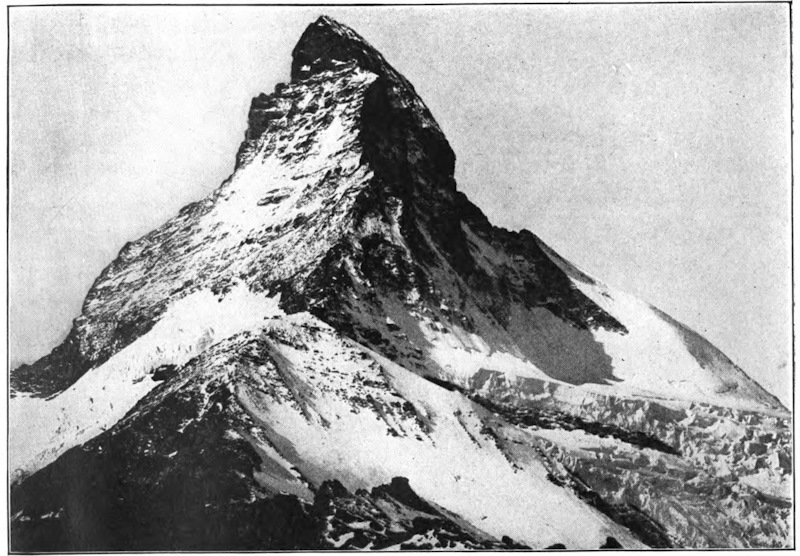
Matterhorn, Valais Alps, Switzerland
Before explaining how atoll-formed reefs acquire their peculiar structure, we must turn to the second great class, namely, Barrier-reefs. These either extend in straight lines in front of the shores of a continent or of a large island, or they encircle smaller islands; in both cases, being separated from the land by a broad and rather deep channel of water, analogous to the lagoon within an atoll. It is remarkable how little attention has been paid to encircling barrier-reefs; yet they are truly wonderful structures.
Encircling barrier-reefs are of all sizes, from three miles to no less than forty-four miles in diameter; and that which fronts one side, and encircles both ends, of New Caledonia, is 400 miles long. Each reef includes one, two, or several rocky islands of various heights; and in one instance, even as many as twelve separate islands. The reef runs at a greater or less distance from the included land; in the Society Archipelago generally from one to three or four miles; but at Hogoleu the reef is 20 miles on the southern side, and 14 miles on the opposite or northern side, from the included islands. The depth within the lagoon-channel also varies much; from 10 to 30 fathoms may be taken as an average; but at Vanikoro there are spaces no less than 56 fathoms or 336 feet deep. Internally the reef either slopes gently into the lagoon-channel, or ends in a perpendicular wall, sometimes between two and three hundred feet under water in height; externally the reef rises, like an atoll, with extreme abruptness out of the profound depths of the ocean. What can be more singular than these structures? We see an island, which may be compared to a castle situated on the summit of a lofty submarine mountain, protected by a great wall of coral-rock, always steep externally and sometimes internally, with a broad level summit, here and there breached by narrow gateways, through which the largest ships can enter the wide and deep encircling moat.
As far as the actual reef of coral is concerned, there is not the smallest difference, in general size, outline, grouping, and even in quite trifling details of structure, between a barrier and an atoll. The geographer Balbi has well remarked that an encircled island is an atoll with high land rising out of its lagoon; remove the land from within, and a perfect atoll is left.
But what has caused these reefs to spring up at such great distances from the shores of the included islands? It can not be that the corals will not grow close to the land; for the shores within the lagoon-channel, when not surrounded by alluvial soil, are often fringed by living reefs; and we shall presently see that there is a whole class, which I have called fringing-reefs, from their close attachment to the shores both of continents and of islands. Again, on what have the reef-building corals, which can not live at great depths, based their encircling structures? This is a great apparent difficulty, analogous to that in the case of atolls, which has generally been overlooked.
Are we to suppose that each island is surrounded by a collar-like submarine ledge of rock, or by a great bank of sediment, ending abruptly where the reef ends? If the sea had formerly eaten deeply into the islands, before they were protected by the reefs, thus having left a shallow ledge round them under water, the present shores would have been invariably bounded by great precipices; but this is most rarely the case. Moreover, on this notion, it is not possible to explain why the corals should have sprung up, like a wall, from the extreme outer margin of the ledge, often leaving a broad space of water within, too deep for the growth of corals. The accumulation of a wide bank of sediment all round these islands, and generally widest where the included islands are smallest, is highly improbable, considering their exposed positions in the central and deepest parts of the ocean. In the case of the barrier-reef of New Caledonia, which extends for 150 miles beyond the northern point of the island, in the same straight line with which it fronts the west coast, it is hardly possible to believe that a bank of sediment could thus have been straightly deposited in front of a lofty island, and so far beyond its termination in the open sea. Finally, if we look to other oceanic islands of about the same height and of similar geological constitution, but not encircled by coral-reefs, we may in vain search for so trifling a circumambient depth as 30 fathoms, except quite near to their shores; for usually land that rises abruptly out of water, as do most of the encircled and non-encircled oceanic islands, plunges abruptly under it. On what then, I repeat, are these barrier-reefs based? Why, with their wide and deep moat-like channels, do they stand so far from the included land? We shall soon see how easily these difficulties disappear.
We come now to our third class of fringing-reefs, which will require a very short notice. Where the land slopes abruptly under water, these reefs are only a few yards in width, forming a mere ribbon or fringe round the shores: where the land slopes gently under the water the reef extends further, sometimes even as much as a mile from the land; but in such cases the soundings outside the reef always show that the submarine prolongation of the land is gently inclined. In fact, the reefs extend only to that distance from the shore at which a foundation within the requisite depth from 20 to 30 fathoms is found. As far as the actual reef is concerned, there is no essential difference between it and that forming a barrier or an atoll: it is, however, generally of less width, and consequently few islets have been formed on it. From the corals growing more vigorously on the outside, and from the noxious effect of the sediment washed inward, the outer edge of the reef is the highest part, and between it and the land there is generally a shallow sandy channel a few feet in depth. Where banks of sediment have accumulated near to the surface, as in parts of the West Indies, they sometimes become fringed with corals, and hence in some degree resemble lagoon-islands or atolls; in the same manner as fringing-reefs, surrounding gently sloping islands, in some degree resemble barrier-reefs.
No theory on the formation of coral-reefs can be considered satisfactory which does not include the three great classes. We have seen that we are driven to believe in the subsidence of those vast areas, interspersed with low islands, of which not one rises above the height to which the wind and waves can throw up matter, and yet are constructed by animals requiring a foundation, and that foundation to lie at no great depth. Let us then take an island surrounded by fringing-reefs, which offer no difficulty in their structure; and let this island with its reef slowly subside. Now as the island sinks down, either a few feet at a time or quite insensibly, we may safely infer, from what is known of the conditions favorable to the growth of coral, that the living masses, bathed by the surf on the margin of the reef, will soon regain the surface. The water, however, will encroach little by little on the shore, the island becoming lower and smaller and the space between the inner edge of the reef and the beach proportionally broader. Coral islets are supposed to have been formed on the reef; and a ship is anchored in the lagoon-channel. This channel will be more or less deep, according to the rate of subsidence, to the amount of sediment accumulated in it, and to the growth of the delicately branched corals which can live there. We can now see why encircling barrier-reefs stand so far from the shores which they front. We can also perceive, that a line drawn perpendicularly down from the outer edge of the new reef, to the foundation of solid rock beneath the old fringing-reef, will exceed, by as many feet as there have been feet of subsidence, that small limit of depth at which the effective corals can live: the little architects having built up their great wall-like mass, as the whole sank down, upon a basis formed of other corals and their consolidated fragments. Thus the difficulty on this head, which appeared so great, disappears.
If, instead of an island, we had taken the shore of a continent fringed with reefs, and had imagined it to have subsided, a great straight barrier, like that of Australia or New Caledonia, separated from the land by a wide and deep channel, would evidently have been the result.
As the barrier-reef slowly sinks down, the corals will go on vigorously growing upward; but as the island sinks, the water will gain inch by inch on the shore—the separate mountains first forming separate islands within one great reef—and finally, the last and highest pinnacle disappearing. The instant this takes place, a perfect atoll is formed: I have said, remove the high land from within an encircling barrier-reef, and an atoll is left, and the land has been removed.
We can now perceive how it comes that atolls, having sprung from encircling barrier-reefs, resemble them in general size, form, in the manner in which they are grouped together, and in their arrangement in single or double lines; for they may be called rude outline charts of the sunken islands over which they stand. We can further see how it arises that the atolls in the Pacific and Indian Oceans extend in lines parallel to the generally prevailing strike of the high islands and great coast-lines of those oceans. I venture, therefore, to affirm that, on the theory of the upward growth of the corals during the sinking of the land, all the leading features in those wonderful structures, the lagoon-islands or atolls, which have so long excited the attention of voyagers, as well as in the no less wonderful barrier-reefs, whether encircling small islands or stretching for hundreds of miles along the shores of a continent, are simply explained.
It may be asked whether I can offer any direct evidence of the subsidence of barrier-reefs or atolls; but it must be borne in mind how difficult it must ever be to detect a movement the tendency of which is to hide under water the part affected. Nevertheless, at Keeling atoll I observed on all sides of the lagoon old cocoanut trees undermined and falling; and in one place the foundation-posts of a shed, which the inhabitants asserted had stood seven years before just above high-water mark, but now was daily washed by every tide: on inquiry I found that three earthquakes, one of them severe, had been felt here during the last ten years. At Vanikoro the lagoon-channel is remarkably deep, scarcely any alluvial soil has accumulated at the foot of the lofty included mountains, and remarkably few islets have been formed by the heaping of fragments and sand on the wall-like barrier-reef; these facts, and some analogous ones, led me to believe that this island must lately have subsided and the reef grown upward: here again earthquakes are frequent and very severe. In the Society Archipelago, on the other hand, where the lagoon-channels are almost choked up, where much low alluvial land has accumulated, and where in some cases long islets have been formed on the barrier-reefs—facts all showing that the islands have not very lately subsided—only feeble shocks are most rarely felt. In these coral formations, where the land and water seem struggling for mastery, it must be ever difficult to decide between the effects of a change in the set of the tides and of a slight subsidence: that many of these reefs and atolls are subject to changes of some kind is certain; on some atolls the islets appear to have increased greatly within a late period; on others they have been partially or wholly washed away. The inhabitants of parts of the Maldive Archipelago know the date of the first formation of some islets; in other parts the corals are now flourishing on water-washed reefs, where holes made for graves attest the former existence of inhabited land. It is difficult to believe in frequent changes in the tidal currents of an open ocean; whereas we have, in the earthquakes recorded by the natives on some atolls and in the great fissures observed on other atolls, plain evidence of changes and disturbances in progress in the subterranean regions.
Not only the grand features in the structure of barrier-reefs and of atolls, and of their likeness to each other in form, size, and other characters, are explained on the theory of subsidence—which theory we are independently forced to admit in the very areas in question, from the necessity of finding bases for the corals within the requisite depth—but many details in structure and exceptional cases can thus also be simply explained. I will give only a few instances. In barrier-reefs it has long been remarked with surprise that the passages through the reef exactly face valleys in the included land, even in cases where the reef is separated from the land by a lagoon-channel so wide and so much deeper than the actual passage itself that it seems hardly possible that the very small quantity of water or sediment brought down could injure the corals on the reef. Now, every reef of the fringing class is breached by a narrow gateway in front of the smallest rivulet, even if dry during the greater part of the year, for the mud, sand, or gravel, occasionally washed down, kills the corals on which it is deposited. Consequently, when an island thus fringed subsides, though most of the narrow gateways will probably become closed by the outward and upward growth of the corals, yet any that are not closed (and some must always be kept open by the sediment and impure water flowing out of the lagoon-channel) will still continue to front exactly the upper parts of those valleys at the mouths of which the original basal fringing-reef was breached.
We can easily see how an island fronted only on one side, or on one side with one end or both ends encircled by barrier-reefs, might after long-continued subsidence be converted either into a single wall-like reef, or into an atoll with a great straight spur projecting from it, or into two or three atolls tied together by straight reefs—all of which exceptional cases actually occur. As the reef-building corals require food, are preyed upon by other animals, are killed by sediment, can not adhere to a loose bottom, and may be easily carried down to a depth whence they can not spring up again, we need feel no surprise at the reefs both of atolls and barriers becoming in parts imperfect. The great barrier of New Caledonia is thus imperfect and broken in many parts; hence, after long subsidence, this great reef would not produce one great atoll 400 miles in length, but a chain or archipelago of atolls, of very nearly the same dimensions with those in the Maldive Archipelago. Moreover, in an atoll once breached on opposite sides, from the likelihood of the oceanic and tidal currents passing straight through the breaches, it is extremely improbable that the corals, especially during continued subsidence, would ever be able again to unite the rims: if they did not, as the whole sank downward one atoll would be divided into two or more. In the Maldive Archipelago there are distinct atolls so related to each other in position, and separated by channels either unfathomable or very deep (the channel between Ross and Ari atolls is 150 fathoms, and that between the north and south Nillandoo atolls is 200 fathoms in depth), that it is impossible to look at a map of them without believing that they were once more intimately related. And in this same archipelago, Mahlos-Mahdoo atoll is divided by a bifurcating channel from 100 to 132 fathoms in depth, in such a manner that it is scarcely possible to say whether it ought strictly to be called three separate atolls or one great atoll not yet finally divided.
I will not enter on many more details; but I must remark that the curious structure of the northern Maldive atolls receives (taking into consideration the free entrance of the sea through their broken margins) a simple explanation in the upward and outward growth of the corals, originally based both on small detached reefs in their lagoons, such as occur in common atolls, and on broken portions of the linear marginal reef, such as bounds every atoll of the ordinary form. I can not refrain from once again remarking on the singularity of these complex structures—a great sandy and generally concave disk rises abruptly from the unfathomable ocean, with its central expanse studded, and its edge symmetrically bordered with oval basins of coral-rock just lipping the surface of the sea, sometimes clothed with vegetation, and each containing a lake of clear water!
One more point in detail: as in two neighboring archipelagoes corals flourish in one and not in the other, and as so many conditions before enumerated must affect their existence, it would be an inexplicable fact if, during the changes to which earth, air, and water are subjected, the reef-building corals were to keep alive for perpetuity on any one spot or area. And as by our theory the areas including atolls and barrier-reefs are subsiding, we ought occasionally to find reefs both dead and submerged. In all reefs, owing to the sediment being washed out of the lagoon or lagoon-channel to leeward, that side is least favorable to the long-continued vigorous growth of the corals; hence dead portions of reef not infrequently occur on the leeward side; and these, though still retaining their proper wall-like form, are now in several instances sunk several fathoms beneath the surface. The Chagos group appears from some cause, possibly from the subsidence having been too rapid, at present to be much less favorably circumstanced for the growth of reefs than formerly: one atoll has a portion of its marginal reef, nine miles in length, dead and submerged; a second has only a few quite small living points which rise to the surface; a third and fourth are entirely dead and submerged; a fifth is a mere wreck, with its structure almost obliterated. It is remarkable that in all these cases the dead reefs and portions of reefs lie at nearly the same depth; namely, from six to eight fathoms beneath the surface, as if they had been carried down by one uniform movement. One of these “half-drowned atolls,” so called by Captain Scoresby (to whom I am indebted for much invaluable information), is of vast size; namely, ninety nautical miles across in one direction and seventy miles in another line; and is in many respects eminently curious. As by our theory it follows that new atolls will generally be formed in each new area of subsidence, two weighty objections might have been raised; namely, that atolls must be increasing indefinitely in number; and, secondly, that in old areas of subsidence each separate atoll must be increasing indefinitely in thickness, if proofs of their occasional destruction could not have been adduced. Thus have we traced the history of these great rings of coral-rock, from their first origin through their normal changes, and through the occasional accidents of their existence, to their death and final obliteration.
Authors have noticed with surprise that, although atolls are the commonest coral structures throughout some enormous oceanic tracts, they are entirely absent in other seas, as in the West Indies: we can now at once perceive the cause, for where there has not been subsidence, atolls can not have been formed; and in the case of the West Indies and parts of the East Indies, these tracts are known to have been rising within the recent period. The larger areas are all elongated; and there is a degree of rude alternation, as if the rising of one had balanced the sinking of the other. Taking into consideration the proofs of recent elevation both on the fringed coasts and on some others (for instance, in South America) where there are no reefs, we are led to conclude that the great continents are for the most part rising areas; and from the nature of the coral-reefs, that the central parts of the great oceans are sinking areas. The East Indian archipelago, the most broken land in the world, is in most parts an area of elevation, but surrounded and penetrated, probably in more lines than one, by narrow areas of subsidence.
Bearing in mind the statements made with respect to the upraised organic remains, we must feel astonished at the vastness of the areas which have suffered changes in level either downward or upward, within a period not geologically remote. It would appear, also, that the elevatory and subsiding movements follow nearly the same laws. Throughout the spaces interspersed with atolls, where not a single peak of high land has been left above the level of the sea, the sinking must have been immense in amount. The sinking, moreover, whether continuous, or recurrent with intervals sufficiently long for the corals again to bring up their living edifices to the surface, must necessarily have been extremely slow. This conclusion is probably the most important one which can be deduced from the study of coral formations; and it is one which it is difficult to imagine how otherwise could ever have been arrived at. Nor can I quite pass over the probability of the former existence of large archipelagoes of lofty islands, where now only rings of coral-rock scarcely break the open expanse of the sea, throwing some light on the distribution of the inhabitants of the other high islands, now left standing so immensely remote from each other in the midst of the great oceans. The reef-constructing corals have indeed reared and preserved wonderful memorials of the subterranean oscillations of level; we see in each barrier-reef a proof that the land has there subsided, and in each atoll a monument over an island now lost. We may thus, like unto a geologist who had lived his ten thousand years and kept a record of the passing changes, gain some insight into the great system by which the surface of this globe has been broken up, and land and water interchanged.
MAGNITUDE AND COLOR OF THE SEA —G. Hartwig
Of all the gods that divide the empire of the earth, Neptune rules over the widest realms. If a giant hand were to uproot the Andes and cast them into the sea, they would be engulfed in the abyss, and scarcely raise the general level of the waters. The South American Pampas, bounded on the north by tropical palm-trees, and on the south by wintry firs, are no doubt of magnificent dimensions, yet these vast deserts seem insignificant when compared with the boundless plains of earth-encircling ocean. Nay! a whole continent, even America or Asia, appears small against the immensity of the sea, which covers with its rolling waves nearly three-fourths of the entire surface of the globe.
The length of all the coasts which form the boundary between sea and land can only be roughly estimated, for who has accurately measured the numberless windings of so many shores? The entire coast-line of deeply indented Europe and her larger isles measures about 21,600 miles, equal to the circumference of the earth; while the shores of compact Africa extend to a length of only 14,000 miles. The coasts of America measure about 45,000 miles, those of Asia 40,000, while those of Australia and Polynesia may safely be estimated at 16,000. Thus the entire coast-line of the globe amounts to about 136,000 miles, which it would take the best pedestrian to traverse from end to end.
How different is the aspect of these shores, along which the ever-restless sea continually rises or falls! Here steep rock-walls tower up from the deep, while there a low sandy beach extends its flat profile as far as the eye can reach. While some coasts are scorched by the vertical sunbeam, others are perpetually blocked up with ice. Here the safe harbor bids welcome to the weather-beaten sailor, the lighthouse greets him from afar with friendly ray; the experienced pilot hastens to guide him to the port, and all along the smiling margin of the land rise the peaceful dwellings of civilized man. There, on the contrary, the roaring breakers burst upon the shore of some dreary wilderness, the domain of the savage or the brute. What a wonderful variety of scenes unrolls itself before our fancy as it roams along the coasts of ocean from zone to zone! What changes, as it wanders from the palm-girt coral island of the tropical seas to the melancholy strands where, verging toward the poles, all vegetable life expires! And how magnificently grand does the idea of ocean swell out in our imagination, when we consider that its various shores witness at one and the same time the rising and setting of the sun, the darkness of night and the full blaze of day, the rigor of winter and the smiling cheerfulness of spring!
The sea is not colorless; its crystal mirror not only reflects the bright sky or the passing cloud, but naturally possesses a pure bluish tint, which is only rendered visible to the eye when the light penetrates through a stratum of water of considerable depth. In the Gulf of Naples, we find the inherent color of the water exhibited to us by Nature on a most magnificent scale. The splendid “Azure Cave,” at Capri, might almost be said to have been created for the purpose.
All profound and clear seas are more or less of a deep blue color, while, according to seamen, a green color indicates soundings. The bright blue of the Mediterranean, so often vaunted by poets, is found over all the deep pure ocean, not only in tropical and temperate zones, but also in the regions of eternal frost. Scoresby speaks with enthusiasm of the splendid blue of the Greenland seas, and all along the great ice-barrier which under 77° S. lat. obstructed the progress of Sir James Ross toward the pole, that illustrious navigator found the waters of as deep a blue as in the classical Mediterranean. The North Sea is green, partly from its water not being so clear, and partly from the reflection of its sandy bottom mixing with the essentially blue tint of the water. In the Bay of Loanga the sea has the color of blood, and Captain Tuckey discovered that this results from the reflection of the red ground-soil.
But the essential color of the sea undergoes much more frequent changes over large spaces, from enormous masses of minute algæ, and countless hosts of small sea-worms, floating or swimming on its surface.
“A few days after leaving Bahia,” says Mr. Darwin, “not far from the Abrolhos islets, the whole surface of the water, as it appeared under a weak lens, seemed as if covered by bits of hay with their ends jagged. Each bundle consisted of from twenty to sixty filaments, divided at regular intervals by transverse septa, containing a brownish-green flocculent matter. The ship passed several bands of them, one of which was about ten yards wide, and, judging from the mud-like color of the water, at least two and a half miles long. Similar masses of floating vegetable matter are a very common appearance near Australia. During two days preceding our arrival at the Keeling Islands, I saw in many parts masses of flocculent matter of a brownish-green color floating in the ocean. They were from half to three inches square, and consisted of two kinds of microscopical confervæ. Minute cylindrical bodies, conical at each extremity, were involved in large numbers in a mass of fine threads.”
“On the coast of Chili,” says the same author, “a few leagues north of Concepcion, the Beagle one day passed through great bands of muddy water; and again a degree south of Valparaiso, the same appearance was still more extensive. Mr. Sullivan, having drawn up some water in a glass, distinguished by the aid of a lens moving points. The water was slightly stained, as if by red dust, and after leaving it for some time quiet a cloud collected at the bottom. With a slightly magnifying lens, small hyaline points could be seen darting about with great rapidity and frequently exploding. Examined with a much higher power, their shape was found to be oval, and contracted by a ring round the middle, from which line curved little setæ proceeded on all sides, and these were the organs of motion. Their minuteness was such that they were individually quite invisible to the naked eye, each covering a space equal only to the one-thousandth of an inch, and their number was infinite, for the smallest drop of water contained very many. In one day we passed through two spaces of water thus stained, one of which alone must have extended over several square miles. The color of the water was like that of a river which has flowed through a red clay district, and a strictly defined line separated the red stream from the blue water.”
In the neighborhood of Callao, the Pacific has an olive-green color, owing to a greenish matter which is also found at the bottom of the sea in a depth of 800 feet. In its natural state it has no smell, but when cast on the fire it emits the odor of burned animal substances.
Near Cape Palmas, on the coast of Guinea, Captain Tuckey’s ship seemed to sail through milk, a phenomenon which was owing to an immense number of little white animals swimming on the surface and concealing the natural tint of the water.
The peculiar coloring of the Red Sea, from which it has derived its name, is owing to the presence of a microscopic alga, sui generis, floating at the surface of the sea and even less remarkable for its beautiful red color than for its prodigious fecundity.
I could add many more examples, where, either from minute algæ, or from small animals, the deep blue sea suddenly appeared in stripes of white, yellow, blue, brown, orange, or red. For fear, however, of tiring the reader’s patience, I shall merely mention the olive green water which covers a considerable part of the Greenland seas. It is found between 74° and 80° N. lat., but its position varies with the currents, often forming isolated stripes, and sometimes spreading over two or three degrees of latitude. Small yellowish Medusæ, of from one-thirtieth to one-twentieth of an inch in diameter, are the principal agents that change the pure ultramarine of the Arctic Ocean into a muddy green.
When the sea is perfectly clear and transparent, it allows the eye to distinguish objects at a very great depth. Near Mindora, in the Indian Ocean, the spotted corals are plainly visible under twenty-five fathoms of water.
The crystalline clearness of the Caribbean Sea excited the admiration of Columbus. “In passing over these splendidly adorned grounds,” says Schöpf, “where marine life shows itself in an endless variety of forms, the boat, suspended over the purest crystal, seems to float in the air, so that a person unaccustomed to the scene easily becomes giddy. On the clear sandy bottom appear thousands of sea-stars, sea-urchins, mollusks, and fishes of a brilliancy of color unknown in our temperate seas. Fiery red, intense blue, lively green, and golden yellow perpetually vary; the spectator floats over groves of sea-plants, gorgonias, corals, alcyoniums, flabellums, and sponges that afford no less delight to the eye, and are no less gently agitated by the heaving waters, than the most beautiful garden on earth when a gentle breeze passes through the waving boughs.”
TIDAL ACTION —Sir Robert S. Ball
Every one is familiar with the fact that the moon raises tides on the earth; these tides ebb and flow along our coasts, and in virtue of them the satellite exercises a certain control on the movements of our globe. If the moon had liquid oceans on its surface there can not be a doubt that the attraction of the earth would generate tides in the oceans on the moon just as the attraction of the moon generates tides in the oceans of the earth. But there would be a fundamental difference between the two cases; the shores of the lunar seas would be periodically inundated by tides far vaster than any tides which the moon can create on the earth. But it may be said that as the moon contains no water it seems idle to talk of the tides that might have been produced in oceans if they had existed. It is no doubt true that the moon contains no visible liquid water on its surface at the present time; it is, however, by no means certain that our satellite was always void of water; it is not at all impossible that spreading oceans may have once occupied a large part of that surface now an arid wilderness. The waters from those oceans have vanished, but the basins they presumably filled are still left as characteristic features on our satellite. For our present argument, however, it is really not material that the moon should ever have had oceans as we understand them. The water at those remote periods must have been suspended in the form of vapor around the more solid parts of the glowing globe. But tides can be manifested in other liquids besides that which forms our seas. In fact if the basins of our great oceans were filled with oil or with mercury, or even with molten iron instead of water, the moon would still cause tides to ebb and flow, no matter what the material might be, so long as it possessed to some extent the properties of a liquid. It need not be a perfect liquid, for any material which is in some degree viscous, like honey or treacle, would still respond to tidal influence, though not, it may be well believed, with the same alacrity and freedom of movement as would a fluid of a more perfect character. In the molten moon itself, throughout the very body of our satellite, the tidal influence of the earth must have been experienced in these primitive ages.
There can not be a doubt that in ancient days when the moon was sufficiently fluid, the action of the tides tended without ceasing to the establishment of such an adjustment between the rotation of the moon around its axis and the revolution of the moon around the earth, that the two should be brought to have equal periods. Friction would incessantly operate until this adjustment had been effected, and owing to the preponderating mass of the earth such strenuous tides must have been evoked in the moon that our satellite was brought under tidal control with comparative facility. Hence it arose that in those early days the habit of bending the same face incessantly toward the earth around which it revolved was established on our satellite.
Time passed on, the moon gradually dispensed its excessive heat by radiation into space, and it gradually became transformed from a molten globe to a globe with a solid crust. It may be that the water was condensed from vapor and then collected together into oceans on the newly formed surface; if so, these oceans would not have any ebbing tide or flowing tide, for it would be constant high tide at some places and constant low tide at others. Such a state of things would at all events endure so long as the adjustment of equality between the moon’s rotation and its revolution continued. In fact, should any departure from this adjustment have manifested itself, corresponding tides would have begun to throb in the lunar oceans, and their tendency would be to restore the adjustment which was disturbed. This arrangement between the two movements was necessarily stable when tidal control was always at hand to check any tendency to depart from it.
It may be that the moon has now cooled so thoroughly that not only is it hard and congealed on the exterior as we see, but it seems highly probable that the heat may have so entirely forsaken even the interior that there is no longer any fluid in the globe of our satellite to respond to tidal impulse. There is, therefore, in all probability, no longer any actual tidal control. On the other hand, however, there is nothing to disturb the adjustment. It was, as we have seen, caused by the tides which have done their work; the consequences of that work are still exhibited in the constant face of the moon, which, now that it has been brought about, seems likely to exist permanently as a stable adaptation of the movement.
The tendency of the tides on a tide-disturbed globe is to adjust the movements of that globe in such a way that the tides shall no longer ebb or flow, but that permanent high tide shall be established in some places and permanent low tide in others. If the rotation of the body be not fast enough the tide will pull the body round in order to effect this object. If the rotation of the body be too rapid, then the influence of the tide will tend to check the movement and bring down the speed of rotation until the desired adjustment is obtained. At present the earth is spinning too fast to permit the high tides to remain at permanent localities, and consequently tides are applied with the effect of checking the rotation. The earth is, however, so vast, and the tides generated by so small a body as the moon are relatively so impotent, that their effects in reducing the speed of the earth’s rotation are insignificant. Nevertheless, small though they are, they unquestionably exist, and there can not be a doubt that to some extent the earth is affected by the unremitting action of the tides; the consequence is that the rapidity with which the earth rotates upon its axis is gradually declining.
One result of this can be stated in a very simple manner. The length of the day must be increasing. It is true that this gradual stretching of the day is very slow; it is indeed quite inappreciable in so far as our ordinary use of the day as a measure of time is concerned. The alteration almost eludes any means of measurement at our disposal. Even in a thousand years the change is so small that the increase in the length of the day is only a fraction of a second. We can doubtless afford to disregard so trifling a variation in our standard of time so far as the period contemplated in mere human affairs is concerned. In fact the change is absolutely devoid of significance within such periods as are contemplated since the erection of the Pyramids, or indeed since any other human monument has been reared. We must not, however, conclude that the change in the length of the day has no significance in earth history.
The significance of the gradual elongation of the day by the tides arises from the circumstance that the change always takes place in one direction. In this form of effect the tide differs from other more familiar astronomical phenomena which sometimes advance in one direction and then after the lapse of suitable periods return in the opposite direction, and thus restore again the initial state of things. But the alteration of the length of the day is not of this character, it is not periodic, its motion is never reversed, is never even arrested. Only one condition is therefore necessary to enable it to obtain tremendous dimensions, and that is sufficient time in which it can operate.
There are many lines of reasoning which show the extreme antiquity of our globe: the disclosures of geology are specially instructive on this head. Think, for instance, of that mighty reptile the Atlantosaurus, which once roamed over the regions now known as Colorado. The bones of this vast creature indicate an animal surpassing in proportions the greatest elephant ever known. No one can count the æons of years that have elapsed since the Atlantosaurus whose bones are now to be seen in the museum at Yale University breathed its last. A still more striking conception of time than even the antiquity of this creature affords is derived from the consideration that his mighty form was itself the product of a long and immeasurable line of ancestry, extending to a depth in the remote past far beyond the limits of computation. I have mentioned this illustration of the antiquity of the earth for the purpose of showing the ample allowance of time that is available for tides to accomplish great work in earlier stages of our globe’s history.
As the evidence of the earth’s crust proves that our globe has lasted for incalculable ages, it becomes of interest to think how far the gradual elongation of the day may have attained significant proportions since very early time. It may be that even in a thousand years the effect of the tides is not sufficient to alter the length of the day by so much as a single second. But the effect may be very appreciable or even large in a million years, or ten million years. We have the best reasons for knowing that in intervals of time comparable with those I have mentioned, the change in the length of the day may have amounted not merely to seconds or minutes, but even to hours. Looking into the remote past, there was a time at which this globe spun round in twenty-three hours instead of twenty-four; at a still earlier period the rate must have been twenty hours, and the further we look back the more and more rapidly does the earth appear to be spinning. At last, as we strain our gaze to some epoch so excessively remote that it must have been long anterior to those changes which geology recognizes, we see that our globe was spinning round in a period of six hours or five hours, or possibly even less. Here then is a lesson which the tides have taught us: they have shown that if the causes at present in operation have subsisted without interruption for a sufficiently long period in the past, the day must have gradually grown to its present length from an initial condition in which the earth seems to have spun round about four times as quickly as it does at present.
We should, however, receive a very inadequate impression of what tides are able to accomplish if we merely contemplated this change in the length of the day, striking and significant though it doubtless is. The student of natural philosophy is well aware that there is no action without a corresponding reaction, and it is instructive to examine in this case the form which the reaction assumes. Our reasoning has been founded on the supposition that it is the attraction of the moon on the waters of our globe that gives rise to the tides. It is, therefore, the influence of the moon which checks the speed of the earth’s rotation and adds to the length of the day.
As the moon acts in this fashion on the earth, so, by the general law that I have mentioned, the earth reacts upon the moon. The form which this reaction assumes expresses itself in a tendency to allow the moon gradually to move further and further away from the earth than the earth’s attraction would permit if our globe were a solid mass void of all liquid capable of being distracted by tides. It is, therefore, certain that the distance of the moon, which is at present about two hundred and forty thousand miles, must be gradually increasing; but we need not look for any appreciable change in the moon’s distance arising from this cause when only an interval of a few centuries is considered. We need not expect to measure the difference due to tides between the size of the moon’s orbit this month and the size of the orbit last month. In fact, there are so many periodic causes of change in the dimensions of the moon’s orbit that it becomes impossible to detect the tidal influence even in the course of centuries. Here, again, we have to remember that in dealing with the history of our earth we are to consider not merely the thousands of years that include the human period, not merely the millions of years that are required by the necessities of geology, but also those unknown periods anterior to geological phenomena to which we have already referred.
In the course of such vast ages the reaction of the earth on the moon’s orbit has not only become perceptible, it has become conspicuous; it has not only become conspicuous, but it has become the chief determining agent in making the moon’s orbit as we find it at the present day. We have seen that as we look into the past the length of the day seems ever shorter and shorter; and concurrent with this decline in the day is the diminution in the moon’s distance from the earth. There was a time when the moon, instead of revolving at a distance of two hundred and forty thousand miles, as it does at present, revolved at a distance of only two hundred thousand miles. As we think of epochs still earlier we discern the moon ever closer and closer to the earth, until at last, at that critical time in the history of the earth-moon system, when the earth was quickly revolving in a period of a few hours, our satellite seems to have been quite close to the earth; in fact, the two bodies were almost in contact
The study of the tides has therefore conducted us to the knowledge of a remarkable configuration exhibited in the primitive earth-moon system. The earth was then spinning round rapidly in a day which was only a few hours long, while close to the earth, or almost in contact with it, the moon coursed around our globe, the period of its revolution being shorter to such an extent that the satellite completed its circuit in the same time as the earth required for one turn round its axis.
We must remember that the materials destined to form the pair of allied planets did not then form two solid bodies as they do at present; they were both, in all probability, incandescent masses glowing with fervor, and soft, if not actually molten, or incoherent, or even gaseous. These aggregations were close together, and one of them was whirling around the other in a period of a few hours, the duration of that period being equal to the time in which the larger mass revolved on its axis. In fact, the two objects, even though distinct, seem to have revolved the one around the other as if they had been bound together by rigid bonds. The rapid rotation with which they were animated suggests a cause for this state of things. It is well known that a fly-wheel, when driven at an unduly high speed, is liable to break asunder in consequence of its rapid motion. If a grindstone be urged around with excessive velocity the force tending to rend the stone into fragments may overcome its cohesion, and it will fly into pieces, often projected with such violence that fearful accidents have been the consequence.
Viewing the earth as a rotating body, it must be subject to the law that there is a speed which can not be exceeded with safety. With the present period of rotation of once in every twenty-four hours the tendency to disruption is but small and consequently the earth retains its integrity, though no doubt the protuberance at the equator is the result of the accommodation of the shape of the globe to the circumstances attending its revolution. But let us suppose that the length of the day was greatly diminished, or, what comes to the same thing, that the speed with which the earth rotates on its axis was greatly increased; it is then conceivable that the tension thus arising might be too great for the coherence of the material to withstand. We believe that the earth could turn round with double the speed that it has at present before this tension approached the point at which disruption would ensue. But supposing the day were to be so much shortened that the period of rotation was only a very few hours instead of twenty-four, there is then good reason to know that the tension in the earth arising from this rapid rotation would be so great that a rupture of the globe would be imminent.
Provided with this conception, let us think of the initial stage when the moon was quite close to the earth. Our globe was then, as we know, spinning round so rapidly that its materials were almost on the point of breaking up in consequence of the strain produced by the rotation. It is interesting to note that the tidal action of the sun would also conduce to the rupture of our globe in the critical circumstances we have supposed. It seems hardly possible to doubt that such a separation of the glowing mass did actually take place, a small fragment was discarded, and gradually drew itself by the mutual attraction of its particles into a globular form and thus became the moon.
We have seen that at the present moment the day is becoming gradually longer and the moon is steadily receding further and further from the earth. At present these changes take place with extreme slowness, but in the primitive periods of which we have already spoken, the changes in the length of the day, and the changes in the distance of the moon, proceeded at a rate far more rapid than at present. As the moon has receded further from the earth its efficiency as a tide-producer has declined, and consequently the rate at which the consequences of tidal action have proceeded is continually lessening. It must therefore be expected that the progress of tidal evolution in the future will be ever getting slower and slower, so that the periods of time required for the further development of the phenomena far exceed those which have elapsed in the course of the history already given. We can, however, foreshadow what is to happen in the following manner. The length of the day will slowly increase; and we can indicate a state of things in the excessively remote future toward which it may be said the system is tending. The day will grow until it becomes not merely twenty-five or twenty-six hours, but until it becomes as long as two or three of our present days. In fact, as we stretch our imagination through ages so inconceivable that I forbear to specify any figures which might characterize them, we seem to discern that the length of the day may go on ever getting longer and longer until at last a stage is reached when the day is about fifty or sixty times as long as our present day.