PART III The Passing of Arthur
Reading edition
HERE beginneth the history of the passing of Arthur, of his Round Table, and of many of the splendid and glorious knights thereof. With it comes the conclusion of this history, for no more shall then remain to be written thereof.
Chapter First
How Queen Guinevere visited Sir Launcelot in the forest; how Sir Launcelot returned to Court as aforetime, and how he fled once more from the Court.
NOW it hath been told how that after the quest of the Grail all those knights who had not died in that quest, or who were able to return did return to the Court of King Arthur.
Sir Launcelot dwelleth in the forest.
But Sir Launcelot of the Lake did not return with the other knights, for he abided in the forest not very far distant from the habitation of the Hermit of the Forest. There he lived a recluse in pious meditation, considering of his sins and repenting of them.
Several knights had seen him at that place where he was dwelling and they knew him, and they brought away from that place news of him and of the life he led. That news became known at the Court of King Arthur, and there was much talked of, and King Arthur said, “What a pity it is that so great and so noble a knight as Sir Launcelot should thus deny himself to the world. For in the world he is the greatest knight of the world, but out of the world he is as any other man.”
Queen Guinevere sendeth for Sir Launcelot.
All these things Queen Guinevere heard and she meditated upon them as she sat thoughtfully in her bower. So one day she called to her a page, and she said to him that he should ride to such and such a part of the forest, and that there he would find Sir Launcelot. And the Queen said to the page that he was then to tell Sir Launcelot to return to the Court of the King. And she said to the page to tell Sir Launcelot that all the court spake of him continually, and that all desired that he should return to them.
So the page went to that part of the forest as the Queen had commanded, and there he found Sir Launcelot in his cell; and the cheeks of Sir Launcelot were hollow and his limbs and body were thin and shrunken from continual fasting and meditation. Then the page kneeled down before him and said, “Sir, the Queen bids you for to return to the Court of King Arthur; for all the ladies and the lords of the court desire you to return there and be the ornament of that court as you were aforetime.”
Sir Launcelot said to the page, “Return thou to the Queen and say to her that I will not return back into the world as she desires me to do. For here I dwell in peace and quietness and I repent me of all my manifold sins as it becometh me to do. For those same sins have stood as a shadow betwixt me and the Grail, so that when the Grail was present I slept, and when it was gone I awoke and found that it was gone. Wherefore I repent me of those sins. And so I will abide here and meditate upon them for all the rest of my life.”
So the page returned to Queen Guinevere and delivered these words of Sir Launcelot to her, and the Queen said, “How is this? He will not come? Then will I go myself and bring him.”
Queen Guinevere goeth to Sir Launcelot.
So she procured a great white horse, and she procured rich and gaudy raiment, such as a knight at court might wear, and with these things and with a court of knights and ladies and several pages she betook her way into the forest.
Then all that part of the forest into which she penetrated became gay and jocund with her coming. For it was as though the sunlight had suddenly burst through the leaves of the forest. All the silent woodland was made noisy with the clear sounds of talk and laughter, and of musical and merry chattering.
So the Queen came to that part of the forest where Sir Launcelot was, and Sir Launcelot came forth from his hut to meet her. And he stood afar off from her and said, “Lady, what wouldst thou here?” She said, “Launcelot, I come to thee to bring thee away from this lonely place, for the Court of the king is the fittest place for thee to be in. For thou art the greatest knight in Christendom, wherefore it ill becometh thee to hide thyself away in this desolate place.”
Then Sir Launcelot lifted up his voice and cried aloud, “Get you gone, Lady, and trouble me no more, for I know you not. Yet it was because of you that I cast aside my wife so that she died because of my neglect. Because of that sin and because of other sins that thou wottest of I slept while the Grail passed before me, and could not awake until after it was gone. So lie I here thinking of that and of other misfortunes that have visited me because of my many sins. Thus it is that here in the woodlands I endeavor to purify my soul of those sins.”
The Queen speaketh to Sir Launcelot.
Then the Queen drew nearer to him and she said to him, “Launcelot, thinkest thou that thus thy sins may be remitted unto thee? Wit thou that thy sins are like an enemy, and that the only way in which thou canst conquer those sins is to battle manfully with them and not to fly from them. Arise! shake off this sluggishness and come forth into the world again, for it awaits thee. There and there only may thy sins be remitted unto thee.”
Then Sir Launcelot groaned and he hid his face in his arms and anon he said, “Lady, tempt me not.” Then after another while he said, “I cannot go with thee, for I have no horse to ride.”
Then Queen Guinevere smiled and she said, “Launcelot, I have purveyed thee with a horse, and it is here.” Then Sir Launcelot cried out again as in a sort of despair, “Still I cannot go with thee for I have no clothes fit to wear at court.”
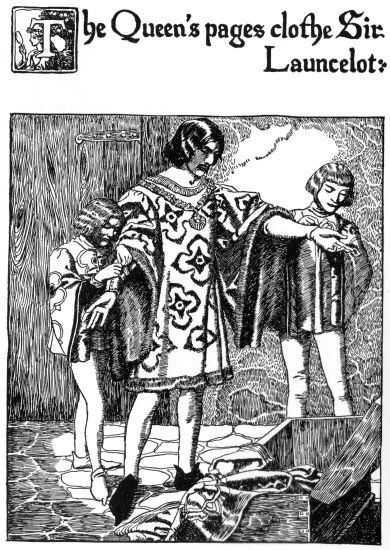
And again Queen Guinevere smiled and she said, “Also I have provided thee with clothes; they, too, are here.” Then she commanded two of her pages to convey the chest of clothes into Sir Launcelot’s cell and they did so. Then they opened the chest and Sir Launcelot gazed into it, and beheld all that noble apparel of silks and velvets, of gold and jewels, of silver and of lace.
So Sir Launcelot suffered those two pages to clothe him in that raiment, and presently he came forth from the cell, shining as with great glory. And he mounted upon the great white horse which the Queen had brought him, and so they rode away together from that place.
Sir Launcelot returneth to the court.
Now there were at court several who were unfriends to Sir Launcelot; some of these were unfriends because they were malicious, others because they were jealous of his fame; others for this reason, and others for that reason. Two of these were Sir Mordred and Sir Agravaine, who were brothers to Sir Gawaine. Then there was Sir Kay the Seneschal and Sir Florence and Sir Lovel, who were sons to Sir Gawaine, and who were jealous of Sir Launcelot upon Sir Gawaine’s account.
These and several others were unfriends to Sir Launcelot, and they talked much amongst themselves concerning the return of Sir Launcelot, saying, “Lo! this knight hath come forth out of the forest and hath assumed his knighthood again over us all, yet at first he would not come, but when the Queen went thither then he beheld her and followed her forth.”
Sir Launcelot heareth unfriendly talk.
These words and words like them came to the ears of Sir Launcelot, and because of them he withdrew himself from the presence of the Queen, and consorted with other lords and ladies of the court. This the Queen observed, and was grieved at it, for she wished for Sir Launcelot to be with her, and she desired to have him near to her. So one day she sent for Sir Launcelot to come to her and she gazed at him for some time without speaking. Anon she said to him, “Launcelot, why dost thou keep thyself afar off from me?” He replied, “Lady, I avoid thee for thine own sake and not for my sake.” To the which she said, “How is that?”
He said, “I will tell thee. There is much talk about this court concerning thee and concerning me, and that talk links our names together. I fear not this talk upon mine own account. For it cannot hurt me, but it may do great injury to thee; therefore do I hold myself away from thee.”
Then Queen Guinevere began weeping, and she said, “Ah, Launcelot, Launcelot! Thou art not to me as thou one time wert. For one time thou wert ever ready to come to me, but now thou keepest thyself afar off from me. That which thou sayst is thy excuse for not being with me, and is not the cause of that absence.” Then she said of a sudden to him, “Go! Get thee away from this court, for thou bringest nothing but disturbance to my soul.”
Then Sir Launcelot said very bitterly, “Lady, it would have been well for both of us if thou hadst permitted me to remain where I was in the forest, and not have tempted me to quit my sanctuary.”
Then the Queen cried out upon him, “How now! What is this thou sayst? I went to thee to save thee and not to tempt thee. If thou longest for thy husks again, return to them. At any rate, get thee gone from me, and never come near to me again. For thou bringest naught but sorrow and great tribulation to me.”
Sir Launcelot departeth again from the court.
So Sir Launcelot bowed and withdrew from where he was, and his heart was filled with a great despair. So he came to where Sir Bors and Sir Lionel were and he told them all that had passed. And he cried out to them, “What now shall I do who have sacrificed my sanctuary and have got naught by that sacrifice?”
Then quoth Sir Bors, “It would have been well for thee, if thou hadst never quitted that safe sanctuary within the forest. But as thou now hast quitted it, so mayst thou not return to it again. For so wouldst thou strive to walk backward into that which hath passed. No man may do that in the life which he leads.
“As for the anger of the Queen, soon will she forget that anger, and as soon as she forgets it, then will she desire to see thee again. For so hath she done several times before, and so will she do again.”
Said Sir Launcelot, “I will go to my castle of Joyous Gard and there will I abide until her anger against me hath grown cold again.”
He departeth to the castle of Sir Brasius.
“Not so,” said Sir Bors, “the Queen spake truly in this; that thy place is in the field, and neither in the hermit’s cell, nor enclosed in the walls of that castle. But get thee to the castle of Sir Brasius the Good Knight, and there abide for a little while, seeking such adventures as may be found around about. For when the Queen’s mind changes toward thee, then wilt thou easily be found at that place, and either I or Sir Ector will come to seek thee.”
“Thou sayst well,” said Sir Launcelot. “Thither will I go and there will I stay until thou or Sir Lionel sendest for me.”
So Sir Launcelot took horse and rode away to the castle of Sir Brasius, and there took up his inn.
But never, at any time, did anyone ever behold him to smile. For though in the earlier days of his knighthood he had a happy and jocund spirit and frequently smiled, yet now that happiness had departed from him and he never smiled. For many sad things had happened to him in his life, and those things had destroyed that happiness as a hailstorm destroys those flowers that to-day are and to-morrow are not, but are withered and dead like the grass in the fields.
Thus I have told you all those circumstances that led to Sir Launcelot’s returning to Court, and as to his withdrawing himself thence again. For so it is that though a man may think to return again into that life from which he has passed, yet he cannot do so. For the life that is lived in once and which hath been laid aside for another life, that first life is dead and cannot be revivified again by the man’s entering into it again, but remaineth dead for aye.
So it was with Sir Launcelot, for, when he had committed the sin of leaving the Lady Elaine the Fair, he had committed it, and all that befell him thereafter became colored by that evil happening. For, because of that sin he failed to behold the Holy Grail with the eyes of his body, and now, because of that sin, and of what was said concerning him and his doings, he was compelled to exile himself again from that court in which, by grace of his chivalry and force of arms, he truly belonged.
So let us take warning by this example and let us not try to return to the life which we may have left, but let us endeavor to live that other life that now presents itself to us after such a happening, whether of good or of evil.
Now followeth that which treats of the poisoning of Sir Patrice of Ireland at the feast given by Queen Guinevere; so if you would hear how Sir Launcelot saved the life of the Queen at that time, I pray you to read what followeth.
Chapter Second

How Queen Guinevere held a feast, and how Sir Patrice of Ireland was poisoned at that feast.
NOW after Sir Launcelot had quitted the Court of King Arthur as aforetold of, the Queen pretended to great joyousness of heart, although there was no joyousness within her. “I was hasty,” she said to herself, “and Sir Launcelot was hasty and hath left me again. But this was my fault and I must show no repining, but must appear to be cheerful to all. So I will give a feast, that my seeming joyousness may be made manifest to the world, and no one shall have cause to say that I repine at the loss of Sir Launcelot.” So said the Queen to herself upon that occasion.
Queen Guinevere proclaimeth a feast.
So she proclaimed a feast, and she had at that feast the following knights of the Round Table: there were Sir Gawaine and his brothers, to wit, Sir Agravaine, Sir Geharis, Sir Gareth, and Sir Mordred. Also there were Sir Bors de Ganis, and Sir Bleoberis de Ganis, and Sir Blamor de Ganis, and there were Sir Galahad and Sir Galyhadin and Sir Ector and Sir Lionel and Sir Palamydes and Sir Safyr; and there were Sir Persavant and Sir Ironside and Sir Brandiles; and there were Sir Kay the Seneschal and Sir Mador de la Porte and Sir Patrice of Ireland, and Sir Alyduke and Sir Artamore.
Now at that time Sir Lamorack of Gales had been slain, and report placed his death at the hands of Sir Gawaine (although this report was not true), and of two of Sir Gawaine’s brothers, to wit, Sir Agravaine and Sir Geharis.
There was at the Court of King Arthur a certain knight hight Sir Pinal the Savage, who was cousin to Sir Lamorack, and Sir Pinal was very bitter against Sir Gawaine, and was anxious to be revenged upon him, yet he wit not how to take that revenge.
Sir Pinal, surnamed the Savage, poisoneth an apple.
Now Sir Gawaine had a custom of eating an apple immediately after he had dined, and this Sir Pinal was aware of. So Sir Pinal took the fairest apple he could find, and he introduced into it a very subtle and very malignant poison, and this apple he placed in the centre of the table, and in the midst of all the fruit. For he said to himself, “There will Sir Gawaine find this apple, and he will take it and eat it and will die.” And he said, “Queen Guinevere will be blamed for that death, for all the world knoweth that she and Sir Gawaine are unfriends.” So said Sir Pinal, for he thought thus to be revenged for the death of Sir Lamorack upon Sir Gawaine, and he knew not how else to achieve that vengeance. For next to Sir Launcelot, Sir Gawaine was the strongest knight of the court, and he was besides nephew to King Arthur and of great importance in the King’s household. Wherefore it was that Sir Pinal sought to slay Sir Gawaine by that poisoned apple.
Sir Patrice of Ireland eateth the apple, and dieth.
But at the end of that feast Sir Gawaine did not take the apple, but instead of Sir Gawaine, Sir Patrice of Ireland took it. And Sir Patrice bit a great bite into that apple, and he ate that piece. Then anon he cried out in a very loud and piercing voice, “Hah! What is this that ails me?” And then he cried out in a very terrible voice, “Alas! I am poisoned and I die from eating this apple!” And he cried out again, “Friends, see that my death is avenged!”
Therewith he fell down to the ground in great agony, lashing with his hands and feet and frothing at the mouth, and so in a little while he died.
Then Sir Gawaine rose up, and he turned his face toward the Queen, and his face was very white, and he said, “Lady, how is this? This apple was poisoned! For whom was it intended?”
Sir Gawaine accuseth the Queen.
The Queen hid her face in her hands for horror of what she had beheld, and she cried out in a very shrill voice, “I knew not that it was poisoned, and I know not how it was poisoned!” Sir Gawaine said, “That apple was poisoned, and thou knewest that it was poisoned. Methinks it was intended for me. Thou hast always borne enmity toward me, wherefore thou didst place that apple upon the table that I might eat of it. One time thou wert innocent, but now thou art innocent no longer, but art full of malice and guile, wherefore thou hadst the will to poison me.”
Then the Queen cried out with a great passion, saying, “Gawaine, thou and I were never friends, but rather would I cut off my right hand than to do so evil a thing as this, to seek to poison thee.”
Sir Mador de la Porte also accuseth the Queen.
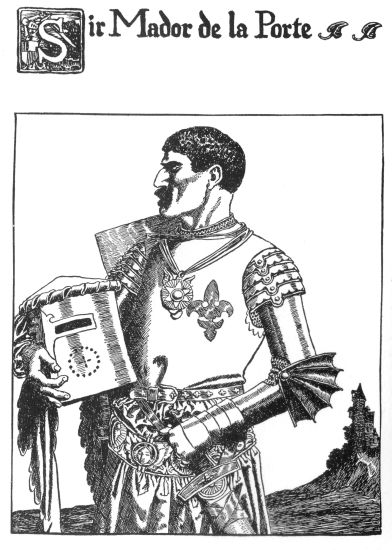
Then Sir Mador de la Porte stood up before them all, and he said, “Lady, that which thou sayst may deceive some who are here, but it shall not deceive me. For I know of thy comings and of thy goings, and I know how thou didst of malice hold Sir Launcelot here at court when he would fain have followed the Lady Elaine away from this place, and because that Sir Launcelot remained here the Lady Elaine died. From this I know that thy heart is full of guile and wickedness, wherefore it is but a step from that sin to the sin of poisoning.”
The Queen weepeth.
So saying, Sir Mador went out from that place, and all the other knights followed after him; for Sir Mador was a king’s son, and of great importance at the court. Then the Queen was left there alone, weeping with great passion, for she wist not how that poison had been administered to Sir Patrice. After that came several men who were in the suite of Sir Mador, and they took up the body of Sir Patrice and they bore it away from that room.
Sir Mador appeareth before the High Court of the King.
As soon as might be, Sir Mador de la Porte appeared before the King as he sat in council, and he appealed the Queen of treason in that she was a murderess; and this he proclaimed before the King and all his council.
Then King Arthur turned very white and he bowed his head and anon he said, “Sir Mador, what wouldst thou have me do in this case? For lo! thou dost attaint the Queen of murder, and I do not believe it possible that she could do so wicked and so evil a thing as this. Wherefore thou must tell me what thou wouldst have me do in this instance.”
Sir Mador challengeth the Queen of treason.
Quoth Sir Mador, “Lord, I do accuse her of having administered poison at her feast, whereof my cousin Sir Patrice died. In that she certes hath committed treason against thee and against us all, for this feast of hers was held here, in this castle, and we were her guests. So accusing her, I am ready to defend that accusation with my body.” So saying, he flung his glove down upon the ground, and he cried out, “Here lieth my glove in gage of battle, and I will defend my accusation with my own person, my accusation being that the Queen is a murderess.” Quoth the King, “Hast thou no pity and no mercy for this lady who is thy Queen? Hast thou no honor and no regard for me, thy King?” And Sir Mador made reply, “Not in this case! For in this case I have no regard for anything but to punish the guilty.”
Then the King arose, and he said, “Send for the Queen to come hither, so that she may face her accuser.”
The Queen appeareth at the High Court.
So anon the Queen came, and two ladies supported her, one upon one side and the other upon the other. And the Queen wore her veil over her face for she had been weeping continually and with great passion ever since the ending of that feast. Now there were many knights gathered there and many lords and ladies of several sorts, and some of these were the Queen’s friends and felt sorrow for her, but some of them felt satisfaction that she was accused.
The King said, “Arise, Lady, and stand.” And thereupon the Queen stood up before the King and Sir Mador de la Porte and the entire council. Then the King said to her, “Lady, this knight, Sir Mador de la Porte, accuses thee of having used poison at thy feast. What hast thou to say to that?”
Then the Queen put back her veil and she had ceased to weep, and her eyes were very hard and proud, albeit her face was extraordinarily white. “Sir,” she said, “thou knowest me well—no one better—and thou knowest that with all my shortcomings (and they be many), I could never do such a thing as that, to poison an enemy at mine own table. For I have many enemies at this court, and amongst them is thine own nephew, Sir Gawaine; for he is my bitterest enemy, and hath always been so. It was he who first accused me at that feast of having used poison, and because he is thy nephew and because he is so powerful at court, there be few knights here who will defend mine innocence against mine accusers, when he stands at the head of those accusers, holding that I attempted to poison him. Had I Sir Launcelot here at court, then would I have had a good worthy defender of mine honor, but I have driven Sir Launcelot away from me by my pride and anger, and he is not now here to defend mine innocence. Yet I believe that someone will arise to defend it, wherefore I will accept this knight’s gage of battle and will abide by it, come life, come death.”
Then the King groaned, and he bowed his head, and at last he said, “Lady and Queen; thou art the wife of my youth, and I would fain defend thee myself. But this cannot be, for I am the King, and the head of all the laws. Nevertheless, I believe that some champion will arise for thee; for it is not possible that in this court there is no knight who will arise to defend thine innocence. Wherefore, let it be as thou sayst. Here shall the glove of Sir Mador de la Porte lie upon the ground, until some defender arises to take it up, and if no other defender arises, then will I take it up mine own self. Let us now depart.”
So with that they all arose and left that place, and left Sir Mador de la Porte’s glove still lying upon the floor of the council chamber.
The Queen asketh Sir Bors to defend her.
That night a messenger came to Sir Bors asking him to come to the Queen, and Sir Bors went with the messenger, who took him to the bower of the Queen where she was. When Sir Bors entered that place he found that the King was with the Queen. Then the Queen arose and stood before him. And she set her hands together, the palm of one against the palm of the other, and she said, “Sir Bors, will you not serve as my champion in this quarrel?”
Then Sir Bors bowed his head, and anon he said, “Lady, I would you had asked someone else to act as your champion.”
The Queen looked at him very proudly, and she said, “Why do you say that? Had I known that your feelings were such, then I would not have troubled you by asking that service of you. But you are the nephew of Sir Launcelot, and you are a good worthy knight and one of those three who have achieved the Grail. Wherefore I ask you why you are not willing to serve as my champion. Do you then also believe that I would poison a guest at the feast which I prepared for the entertainment of such noble and worthy champions?”
“Nay,” said Sir Bors, “I think no such thing as that of you, Lady. But in this quarrel there be many upon either side who are my friends, and if I fight upon one side then my friends upon the other side would fall away from me because I did so.”
“Alas!” said the Queen. “The time was when I had many knights upon my side. For did not Sir Pelles in the days of my youth take a foolish quarrel upon him for my sake? And did not Sir Launcelot stand ever ready to defend me? Oh, Launcelot, Launcelot! If thou wert but here to stand my champion in this quarrel! But thou art not here, for I, in my haste, have driven thee away from me, I know not whither.” So said Queen Guinevere, and with that she began weeping as though her heart would break.
Sir Bors will serve as the Queen’s champion.
Then Sir Bors was very much moved and he said, “Weep not, Lady, for thou hast yet no cause for weeping. Thou yet hast many good true knights who would defend thee. Yea; I will serve as thy champion unless a better champion arise to defend thee. So take thou heart of grace in this, that thou art innocent of this crime; wherefore, may God defend the right.”
The Queen declareth her innocence.
At this the Queen took comfort and wiped her eyes and smiled, and she said, “Sir Bors, for thy satisfaction I hereby make thee my solemn vow that I did not do this thing of which I am accused. And methinks I know who it was who laid that poisoned apple upon the table, for there was an attendant at that table who stood behind a screen, and this attendant beheld a knight come into that room ere others came thither. But I cannot accuse that knight now, for I myself am accused, wherefore if I accuse him, all will say that it is to shelter myself that I make that accusation.”
Sir Bors said, “Lady, if this be true, it shall be as you wish, and I will certes do all that I am able to defend you.”
Then King Arthur spoke and said, “Sir Bors, there is not any knight in all the court who is so well fitted to defend my Queen as thou. For as thou art one of the most virtuous knights who ever lived, so will thy virtue shine upon any undertaking to which thou settest thy hand. And besides this high virtue of thine, there is no knight at this court, unless it be Sir Gawaine, who is so strong and so excellent a knight as thou.”
So spake they at that time, and after those speeches Sir Bors went to the council chamber where lay the glove of Sir Mador de la Porte, and he took up that glove and he thrust it into his belt. With that glove he paraded the court, and many beheld the glove of Sir Mador in his belt. Some came to him and proclaimed that they were secretly pleased that he had assumed the championship of the Queen; but others came and were very angry that he had assumed it.
Sir Gawaine is angry with Sir Bors.
Amongst these last was Sir Gawaine who said to him, “Sir, what is this you do? Are you not aware that the poison served to us at dinner was meant by the Queen for me and not for Sir Patrice who was poisoned by it?” To him replied Sir Bors, “Friend, in this you are mistook. For though the poison might have been intended for you and not for Sir Patrice, yet it was not the Queen who placed it there. For I think I know who placed it there, and by and by it will be made manifest to all after that the Queen is freed from this accusation under which she lieth.”
Then Sir Gawaine smiled very bitterly and he said, “Thou art easily satisfied, Sir.” “If I am,” said Sir Bors very calmly, “there is this virtue in my belief; that I cannot believe that my Queen and the wife of my King should do this thing. Nor do I envy those who so easily believe evil of their Queen.”
Sir Bors rideth to Sir Launcelot.
Now when the next day was come, Sir Bors took horse and rode to the castle of Sir Blasius, which place he reached before the sun set. There he found Sir Launcelot, and he told Sir Launcelot all that had befallen, and when Sir Launcelot heard it he was very angry. “How is this?” he cried. “Do they dare accuse the Queen of this offence? They do it because they know I am absent and cannot defend her.” And Sir Bors said, “Yet even so it is. For there is a large party at court that is willing to ascribe that wickedness to her. And that party is headed by several of those who are of most influence at court.”
Sir Launcelot and Sir Bors talk together.
“Well,” said Sir Launcelot, “I ask not who they are who believe this evil of her. But I will be there to defend the Queen when her trial cometh. Meantime, do thou take her championship upon thee till I come; for if it be necessary to prove the innocence of that noble lady, then thou, who art one of the three knights of the Grail, can best sustain it. Besides this, Sir Mador is a very hot and heady knight, wherefore, if thou wilt keep up this quarrel against him till I come, he will be the more ready to do battle according to his beliefs. And it is necessary that the Queen should be defended by arms.”
Then Sir Bors told Sir Launcelot that it was the Queen’s belief that it was Sir Pinal the Savage who had placed the poisoned apple upon the table; and he also told how the Queen did not dare to bring this accusation against Sir Pinal until she herself was cleared of that accusation.
All this while Sir Launcelot sat frowning as he listened, but at the end of Sir Bors’s speech he only said, “I will be there as the Queen’s defender, but tell nobody that thou hast spoken to me.” And Sir Bors said, “I will not tell of this.”
Sir Bors returneth to court.
So Sir Bors bid adieu to Sir Launcelot, and Sir Launcelot bid adieu to Sir Bors, and Sir Bors returned that night to Camelot again, reaching his inn at that place before the dawn of the day.
Chapter Third
How Sir Bors was relieved of the defence of the Queen, and of how Sir Mador de la Porte was overthrown.
SO came the eve of the day of that conflict when the innocence of the Queen was to be approved by conflict. That evening the Queen sent for Sir Bors de Ganis, and she said to him, “Sir, what is your mind in this battle which you are to fight to-morrow?” Quoth Sir Bors, “Lady, it is even as it was aforetime. For ever I do believe in your innocence and deem it be impossible that you could administer poison to one of your guests. So I will do battle for you to the best of my ability as I promised you I would do. But should another knight, better fitted by skill at arms than I, appear to assume that honor, then would I surrender the honor to that knight; yea, even at the last minute.”
The King praiseth Sir Bors.
So after Sir Bors had departed from her, the Queen went to the King and told him what Sir Bors had said to her. Quoth the King, “Lady, thou hast one of the best champions that can be found in the entire world to defend this case in thy behalf. For I know of no knight who could be better chosen to defend thine honor than Sir Bors, unless it were his kinsman, Sir Launcelot of the Lake. For even Sir Gawaine is not stronger nor better, nor was Sir Percival stronger nor better than is Sir Bors de Ganis.”
So said the King, and at his words the Queen took great comfort and cheerfulness.
The Queen cometh with the King to the lists.
So came the next day of trial. For at about the eleventh hour of the morning there came to the open square within the walls of the town the King and the Queen and the Court of the King. At that place the Lord Constable was already come, and to one side was a great pile of dried fagots laid cross wise, the one upon the other, and in the midst of that pile of fagots was an iron stake with fetterlocks attached to it about as high as one could reach, standing before that stake. Those high lords and ladies who were there looked very closely at the Queen, and they beheld that she smiled as she looked about her, but that her face was white like to purified wax for whiteness. And the Queen was clad entirely in white; for her robe was long and spotless of color, and she wore a belt of white leather, studded with silver, bound about her waist, and her hair hung down upon either side and was wound about with ribbons of white and silver. And some of those who looked upon her were grieved and sorrow-struck at her trouble, but others were pleased and triumphant to see her thus brought low, even to the trial of her life and her good fame.
Then King Arthur called the constable to him and he said to him, “Lord Constable, here do I commit to thee the tender body of this my Queen, who stands here wrongfully accused of the crime of murder. Take her; she is thine until after this trial of battle.” So saying, the King took the Queen by the right hand and led her to the constable, and he gave the right hand of the Queen into the hand of the constable. And the constable took the Queen by the hand, and he said, “Lord King; here take I the body of this lady who is my Queen. But I take that body only to return it unto thy ward; so hold thou this lady in thy keeping, and may God keep ye both, amen.”
The King sitteth beside the Queen.
Therewith the constable replaced the hand of the Queen into the hand of the King, and thereupon withdrew to one side. Thereafter the King conducted the Queen by the hand up the flight of steps to a high seat that had been prepared for her beside his own seat. Then the King said, “Let the accusers of this lady be summoned.”
Sir Mador de la Porte appeareth.
Then came Sir Mador de la Porte, clad all in very brilliantly shining armor, and riding a red-roan horse, whose coat glistened like red silk. So he drew rein in front of the King’s pew in the list. And the King looked at Sir Mador, frowning till his eyes disappeared beneath his brows; yea, till the veins at his forehead became expanded and knotted, and until his entire visage became empurpled with blood.
Anon he found his voice, and he said, “Sir, what brings you here? For you claim to be a gentleman of my court and of my Round Table, and yet you bring accusation against your Queen, and the lady of all others whom you should be most called upon by honor to defend.”
Sir Mador challengeth the Queen.
Then Sir Mador spoke up in a very bold voice, both high and loud. “Sovereign and awful lord,” said he, “here stand I for justice and for right; without awe and without fear of anyone or of anything. Wit ye then, that some days ago I and several others sat at feast with the Queen. What time my near kinsman, Sir Patrice of Ireland, ate an apple at that feast, and the apple was poisoned and he died of eating thereof. Now that was the Queen’s feast and we were the Queen’s guests; how, then, was the poisoning done, saving by the Queen’s orders? So here stand I now to accuse that Queen of the treason of poisoning; nor will I rest satisfied from that accusation, saving only as someone shall overthrow me in this, my coming battle.”
The King challengeth Sir Mador.
Then spake the King, “Sir, did you make research concerning this accusation, or did you question anyone concerning this affair? For certes it is very criminal and very wicked to administer poison to another; but it is none the less criminal and none the less wicked to utter such treason as you do by accusing the Queen unjustly and without cause. Wherefore, Sir, you should be very certain of your accusation.”
Quoth Sir Mador, “Sir, I believe the testimony of mine eyes; for they beheld that which my lips have spoken, and so my hand shall uphold in this, my just encounter against the Queen’s strong champion.”
Then the King spoke very haughtily. “Sir,” quoth he, “you have entrusted the verity of your case to the testimony of your eyes, and that testimony has deceived and misled you. Nevertheless, I shall not answer you here, for anon you shall be answered to your pain.” Then the King spake to an esquire who stood below in the tilt yard. “Hasten,” said he, “and bid Sir Bors de Ganis to come hither.”
Sir Bors appeareth.
So the esquire departed and anon he returned, leading the white horse of Sir Bors by the bridle. And Sir Bors was clad all in armor of pure and virgin white, and all his trappings and the trappings of his horse were white, so that he shone glistening, like to a figure of pure silver.
Sir Bors appealeth for delay.
“Sir,” said Sir Mador to Sir Bors, “Knowest thou why I am here, and upon what accusation?” Sir Bors said, “Aye, I know it well.” Then said Sir Mador, “Dost thou stand for the other side?” Sir Bors said, “Yea, I stand heart and soul for the other side. But I will tell thee truly. I said that I would undertake this quarrel upon the Queen’s behalf unless some better knight than I should take that battle upon him. I know you, Sir Mador, for a noble and valiant knight, and you know me for what you have beheld of me, wherefore you know that I fear not to meet you or any knight in all of the world, and that I would do battle with anyone with all of my might in a lesser quarrel than this. Wherefore I ask you now to postpone this battle until the hour of noon, for by that time there may come more worthy than I to defend this honorable and much abused lady.”
Sir Mador denieth him any delay.
“Is that all you have to say?” said Sir Mador. “Well, then, Messire, either come you to battle with me without loss of time, or else withdraw you from the field for someone else to take your place.”
“Take your horse and your arms,” said Sir Bors, “and as I suppose you will not tarry long, so also will I not tarry long, but will be with you anon.” So each knight withdrew from the field, and each busied himself in preparing for the conflict. In this Sir Mador was the quicker, and so rode out of his pavilion and around the course, and whilst none applauded him in that procession, yet there were some who frowned not upon him.
A new champion appeareth upon the Queen’s behalf.
So Sir Bors, when he was made ready, came forth from his pavilion, and he cast his eyes toward the forest and immediately he was aware that a knight was coming thence, riding easily yet swiftly. And this knight was clad in strange armor, and he bore a shield without any escutcheon, nor was there any emblazonment about him whatsoever to tell what knight he was. But Sir Bors knew very well that that knight was none other than Sir Launcelot of the Lake.
Anon this knight came quickly to where Sir Bors was, and he said to him, “Messire, I give you grammercy for assuming this quarrel upon behalf of the Queen. But now I come to assume that quarrel myself and so you are freed from it.” Sir Bors said, “Come you to King Arthur.” And the knight said, “Conduct me to him.”
The new knight appeareth before the King.
So Sir Bors conducted the knight to where King Arthur sat, and when he was come there King Arthur said to him, “Sir, what knight are you? For that I should know ere I consent to establish you instead of Sir Bors in this quarrel.” To which Sir Bors made reply, “Lord, I know this knight, and I know that he is a better knight than I am, so I yield my rights in this quarrel unto him.”
Then King Arthur said to Sir Mador de la Porte, “Sir, will you accept this new knight in your quarrel?” To which Sir Mador replied, “Sir, I will accept him or any.”
Sir Mador is overthrown.
So each knight withdrew to his end of the lists and there they made themselves ready. And when they were all prepared, then each launched against the other with all the speed and vehemence that he possessed. So they met in the midst of the course and in that encounter the spear of Sir Mador was broken all to pieces, but the spear of the other knight held so that Sir Mador and his horse were both overturned into the dust.
But Sir Mador recovered from his fall very suddenly, and drawing his sword and setting his shield in front of him he came forward to the assault of his enemy as though this were the very beginning of the battle. Upon this the other knight leaped very nimbly and quickly down from his horse, and setting his shield before him, he drew his sword and came forward as with great eagerness for battle.
Sir Mador is beaten in battle.
Each struck at the other with great fierceness, for Sir Mador was a very strong and powerful knight, and was further upheld by his indignation. So they fought for above an hour, and in that time Sir Launcelot held his strength, but the strength of Sir Mador began to wane so that he could hardly sustain his arm. Then Sir Launcelot redoubled his strokes until Sir Mador held his shield full low. At that Sir Launcelot lifted up his sword and he smote Sir Mador so terribly upon the helm that he fell grovelling to the earth. Then Sir Launcelot drew near to Sir Mador to smite him again, but Sir Mador raised himself a little and lifting his sword he smote Sir Launcelot through the thick of the thigh.
But when Sir Launcelot felt himself to be thus wounded and when he beheld how that the blood flowed forth in a red stream from the wound in his thigh, he drew away and waited for Sir Mador to rise again. And when Sir Mador had arisen he rushed upon him and smote him again, so terrible a blow that the blade bit through the iron helmet, and the leather coif and into the bone beneath the coif.
Sir Launcelot spareth Sir Mador.
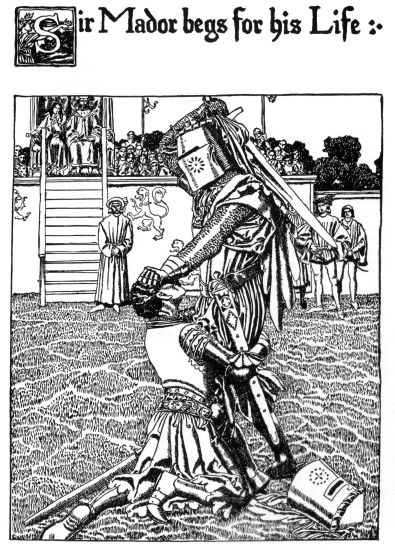
Then Sir Mador fell down and lay upon the ground like one who was dead, and Sir Launcelot ran in to where he lay and seizing the helmet that covered the head, he cut the thongs with his misericordia and rushed it off from his head. With that the light shone in upon the face of Sir Mador and aroused him from his swoon; and beholding Sir Launcelot standing terribly above him, he cried out, in a loud piercing voice, “Spare me my life, Sir Knight! Spare me my life!” Quoth Sir Launcelot, “I will not spare thee thy life, unless thou dost confess that thou wert mistaken concerning the guilt of the Queen, and that she is innocent of evil.” Said Sir Mador, “I do confess it.”
Then Sir Launcelot called the Lord Constable of the lists to him and he said to Sir Mador, “Confess what thou hast confessed to me to this gentleman.” And Sir Mador said, “Sir, to this constable I do confess and acknowledge that I was mistook as to the guilt of the Queen, and that she is indeed guiltless of that of which I have accused her, and of all other crimes whatsoever.”
Then Sir Launcelot said, “Bear this knight hence away from this spot.”
Upon that there came several attendants to that place and they lifted Sir Mador and carried him away from that place.
Then Sir Launcelot and the constable went from that place of conflict to the presence of King Arthur, and the King and the Queen descended from their high seats to welcome him. Quoth the King, “Sir, well have you fought this day, and well may we guess who you are who have done this battle. We do both give you thanks—I for that you have saved to me my Queen; she that you have saved to her her life and her honor.”
Sir Mador confesseth a wrong accusation.
“Lord,” said Sir Launcelot, “here have I brought with me this constable to avouch for it that Sir Mador hath confessed that he hath wrongfully accused the Queen of this crime, and that she is as guiltless of it as she is of any other crime at this present.” And the constable said, “I do avouch for the truth of that.” Then the King said to Sir Launcelot, “Sir, I perceive that thou art wounded. Wilt thou not refresh thyself with a glass of wine?” And Sir Launcelot said, “Yea, Lord, for wine would be exceedingly grateful to me at this present.”
So a little page ran and presently returned, bringing a flagon of sparkling yellow wine, and Sir Launcelot unlaced his helmet and removed it from his head, so that all beheld his face and knew him for Sir Launcelot.
Sir Launcelot pledgeth the Queen.
And then King Arthur said, “Sir, methought that you were Sir Launcelot of the Lake when I beheld how you did battle a little while ago. Moreover, when Sir Bors spoke of a better knight than he rising for the Queen’s defence, I wist he must mean you, for you are the only one who is better than he. But now we have you, we will not let you go again.” “Lord,” quoth Sir Launcelot, “I will not leave this court again unless I am bidden to go. For here may I defend both your honor and the honor of your Queen. For first of all do I owe my duty to you who made me a knight; and then do I owe my duty to her who is my revered and honored lady.” Then, taking the flagon of wine into his hands he turned him about and lifting that flagon on high, he cried in a loud, clear voice so that all might hear him, “Here do I drink this flagon of golden wine to the truth and innocence of my Queen. Health to her friends, confusion to her enemies, and may harm fall upon those who contemplate harm to her!”
Then he put the brim of the flagon to his lips and drank off the entire draught of wine ere he removed it again.
Then King Arthur said, “Let us go visit that wounded knight, for I have something that I would say to him.” So Sir Launcelot and the constable and King Arthur went across the meadow of battle to the pavilion of Sir Mador. And they entered the pavilion and Sir Mador was lying upon a couch and the surgeon was searching his wounds.
King Arthur dismisseth Sir Mador from the court.
King Arthur said to him, “Sir, who besides yourself were the accusers of the Queen?” Sir Mador said, “Lord, I was her only accuser.” The King said, “Thou liest, for there was a conspiracy against her to undo her, and thou wert but the instrument of that conspiracy. I will ask thee no further to betray those who were with thee in this affair. Only I have this to say to thee, that if by to-morrow morning thou art within the purlieus of this court, or if at any future time thou comest into my power again, or if ever I meet thee in battle or out of battle, that time spells for thee thy death. Bear my words well in mind; for though I spare thee this time upon behest of the Queen, yet will I not spare thee again upon the beseeching of anyone in all of the world.”
Sir Mador said very bitterly to the King, “My Lord, thou speakest as a sound man to one who is very grievously wounded and who may not defend himself.” “Not so,” said the King very calmly, “I speak, first of all, as a king to his knight, and next I speak as one knight to another knight who hath wrought him a grievous injury. For thou canst not undo what thou hast done; for thy quarrel hath sowed dissension and evil thought among my entire court, so that I, who was one time loved by my entire court, know not now who are my friends and who mine enemies.” Then the King turned to the constable, and he said, “Lord Constable, thou hearest what I have said. If this man is found hereabouts to-morrow day, cast him immediately into prison and report the same to me. For if after this day he falleth into my power, then he shall himself suffer destruction by the flames, as he would have consigned his own Queen to the flames.”
Thereupon the King turned upon his heel and left Sir Mador de la Porte gnawing his finger nails.
The servant telleth how Sir Pinal placed the apple.
That day the King held a council of his chief lords and subordinate kings. And before this council came that servant who had hidden behind the screen as aforetold of. And this servant told of how he had beheld Sir Pinal place the apple upon the table whereon the feast was to be held. This evidence they all heard and listened to, and when it was ended the King said, “Send for this Sir Pinal and let us hear what he hath to say to this.”
So they sent for Sir Pinal, but he was nowhere to be found, for the Queen’s enemies had told him that that evidence was to be admitted and he had fled away from the court into the wilderness, never to return again.
Yet is the Queen accused by many.
So was the innocence of the Queen proven. But still there were some who disbelieved that evidence, for they said, “See ye not how it is? For first they overthrow Sir Mador and then they drive him away from this court. Then they bring in this evidence to clear the Queen from guilt and they lay that guilt upon poor Sir Pinal, who is not of the Round Table. Thus there is no one to contradict the evidence of this poor knave, and so the Queen is to be cleared of the suspicion of guilt.”
So spake several, and the news of this was brought to the ears of Sir Gawaine. But Sir Gawaine would say no word upon the matter, for whilst he felt bitter enmity toward the Queen, and whilst he suspected the worst things of her, yet he would not give voice to that which he suspected. Neither would he give accusation against her, but went his own way thinking his own thoughts and keeping those thoughts within his own bosom.
Of the dissensions at the court.
Thus have I told you the history of these things as I myself have read of them in the ancient books that treat of them. For this was the first beginning of the end. For now that the Grail had been lifted from the earth, there was naught to hold together the Court of King Arthur as it had been held together before. But each knight began now to think of his own glory and of himself, and not of the glory of the King and the Good of the world.
So now begin we with the history of those dissensions that presently broke forth in the Court of the King.
Chapter Fourth
How there came quarrels at the court, and how Sir Launcelot of the Lake was assaulted by the brothers of Sir Gawaine.
NOW there was at court at that time much dissension and many angry recriminations back and forth between the one party and the other party. For the one party maintained that the Queen had been ill-used and had suffered much, and would have suffered death, saving only for the defence of Sir Launcelot of the Lake; and the other party maintained that the Queen possessed an evil soul, and that Sir Launcelot was her dishonorable lover and that it was for this reason that he had fought for her.
Sir Mordred and Sir Agravaine accuse Sir Launcelot of treason.
Of this latter party were some of the brothers of Sir Gawaine, who were at the head of that party; to wit, there was Sir Mordred and Sir Agravaine. These knights spoke very boldly and openly, saying that Sir Launcelot practised treachery with the Queen against the King’s high honor. Sir Agravaine said, “Well is it that Sir Launcelot is the greatest knight now living on the earth (for this is true now that Sir Galahad had departed in glory), yet it is not to be forgotten that he is not greater in his strength than several knights who might come against him at once. So when Sir Launcelot next visits the Queen, if a number of us shall fall upon him, it can scarcely be but that those knights should overcome him, and that so the King’s honor should be revenged.”
Sir Gawaine will not join with them.
Whilst he so spoke, Sir Gawaine sat at one side gnawing his mustache. Then he up and spake, saying, “What is this you would do? Would you practise treachery against Sir Launcelot and against the Queen? God knows I have no love for the Queen, and never have had love for her, but neither would I practise treachery against her, but would assail her openly and against the entire world. As for Sir Launcelot of the Lake; long hath he been my dearest friend and companion at arms; am I then to practise treason against him?” Then turning to Sir Geharis and Sir Gareth, he said, “What say you, my brothers? Speak!” Then Sir Geharis and Sir Gareth said, “What thou sayst, Gawaine, we also say.” And Sir Gareth said upon his part, “I cannot now forget and I can never fail to remember that it was Sir Launcelot of the Lake who made me a knight. Shall I then sit in judgment upon my godfather in knighthood, and undertake to practise evil against him?”
Quoth Sir Mordred, “I say with my brother Agravaine that the Queen is altogether evil and that Sir Launcelot is her lover, and that saying I am ready to maintain to the peril of my life.”
Sir Mordred declares that he will arrest Sir Launcelot.
Said Sir Gawaine, “I pray you tell me; what is it you seek to do?” Him answered Sir Mordred, “We seek to spy upon Sir Launcelot and, when next he visits the Queen in her apartments, we would make assault upon him. When we have thus espied upon him, then we and several others will fall upon him and seize him and hale him before the King for trial.” Said Sir Gawaine, “That is no such easy matter for to do. And when you have done it, it will be but of little avail; for the King will not condemn Sir Launcelot upon such uncertain accusation. For what accusation shall you bring against Sir Launcelot and the Queen that you dare mention to the King?”
Then Sir Mordred made no immediate answer, but when he was come to a place apart from those three, he said to Sir Agravaine, “Sir Launcelot is guilty of thou knowest what treason against the King. Now I told Gawaine that we would arrest him and bring him to the King. What I really purpose is this: that we assault Sir Launcelot in the Queen’s apartments, and that we slay him. For once he is dead the King will quickly forgive us and will believe the Queen to have been guilty, but if Sir Launcelot is alive he will never forgive us. Hah, brother, a dead lion is a less dangerous enemy to a man than a living fox. So it were best that Sir Launcelot died.” In this Sir Agravaine agreed with him; so after that they set watch upon Sir Launcelot to take him when next he should visit the Queen. But Sir Launcelot was warned by one who overheard them, and for that while he did not visit the Queen in her apartments.
Sir Mordred betrayeth Sir Launcelot.
So one night Sir Mordred called to him a page of the Queen’s court when the page was passing, and he said to him, “Lanadel” (for such was the page’s name)—“Lanadel, go you to Sir Launcelot of the Lake and tell him that the Queen would fain speak with him in her bower.” Thereupon the page, suspecting no evil, went to Sir Launcelot, and delivered that message to him, and Sir Launcelot, suspecting no evil, fulfilled the terms of that message, and went secretly thither to the Queen’s apartments.
Sir Launcelot goeth to the Queen’s bower.
Finding the Queen there, Sir Launcelot said to her, “Lady, what is it thou wouldst say to me?” She looked upon him in astonishment and said, “Sir, I did not send for you to say anything to you.” Sir Launcelot said, “How is this? Your page, Lanadel, came to me and brought it to me as a message that you would speak to me at this place.” She said, “Launcelot, I sent no such message as that to thee. Yet, in very truth, it hath been long since thou hast been hither to speak to me. Art thou affronted with me, Launcelot?”
He said to her, “Lady, thou knowest that I am not affronted with thee. But there is this: I must consider thine honor and reputation as I do mine own. But, Lady, touching this message of late delivered to me, here is treachery of some sort, for certes that message came to me as from thee, wherefore I know that some treachery is brewing against us, though I know not what that treachery is.”
Now turn we to those enemies of Sir Launcelot to see what they did upon this occasion. For Sir Mordred watched at the entrance of the Queen’s apartments until that he beheld Sir Launcelot enter them. Upon that he ran to Sir Agravaine, and said to him, “Brother, wit ye that Sir Launcelot is at this time in the Queen’s chamber. Let us now make haste to take him.” So those two called about them certain knights who were at enmity with Sir Launcelot, and they said to them, “Gentlemen, let us hasten and take that traitor knight who is even now in the Queen’s bower.”
Now those knights whom they called upon to accompany them were as follows: There were Sir Colgrance and Sir Gingaline, and Sir Melyot of Logris, and Sir Galleron of Galway; there were Sir Melion of the Mountain, and Sir Petypas of Winchelsea; there were Sir Gromer Somerjour and Sir Astamore, Sir Cuselaine, Sir Florence, and Sir Lovel. And these last two were sons to Sir Gawaine.
The Queen is warned.
These eleven knights, together with Sir Agravaine and Sir Mordred, making thirteen in all, went together in a party to the apartments of the Queen. And the ladies of the Queen beheld them coming, and wist that they came for no good purpose. Wherefore these ladies ran screaming and in haste and bolted and barred the door. Then they ran to the Queen’s apartment and they found that Sir Launcelot was there and they cried out, “Lady, arouse you, for your enemies are upon you!”
The thirteen knights challenge Sir Launcelot to appear.
By this those knights were at the door, and Sir Agravaine knocked and cried aloud in a very loud and thunderous voice, “Thou traitor knight! What doest thou here? Why liest thou behind locked doors in the Queen’s apartments? Come forth to us who are thy fellows of the court and of the Round Table, and render an account to us. For we are here to receive thine account!”
These words were uttered so loudly and so powerfully that they echoed and re-echoed throughout that entire part of the castle, and when they struck upon the Queen’s ears, she fell as white as an ash of wood and sank back upon a couch, placing her hand above her heart.
Then Sir Launcelot stood up from where he sat and he cast his eyes around him from side to side, but he could see no armor for defence, and no way of escape. And ever those knights without smote upon the door, and ever Sir Agravaine cried out, “Sir Launcelot of the Lake; what doest thou there in the Queen’s chamber? Come forth and deliver thyself to us.”
Then Sir Launcelot said, “Lady, I prithee tell me, is there ere a suit of armor in this place as I could clothe myself withal?” She said, “Nay, Launcelot, there is no armor in this room.” Then Sir Launcelot said to her, “Then must I defend myself without armor; for I know that these knights have no purpose for to take me prisoner to the King. Otherwise, that which they purpose is to take my life.” Then the Queen sank down terrified upon her knees before him, and said, “Launcelot, go not forth to them, for assuredly they mean thy death.” He said to her, “Lady, I must go; but this I beseech of thee, that thou wilt pray for me. And this also I beseech of thee, that, should I fall in this encounter, thou wilt go with my relatives, Sir Ector and Sir Bors and Sir Lionel and Sir Ure, and bid them that they shall take thee to an asylum of refuge at my castle of Joyous Gard. For there is now no safety for thee at this place, and only great and continual dangers. For ever there is growing at this court against thee a rooted jealousy of all that thou sayest or doest, and if so be I lose my life, then these, mine enemies, will overwhelm thee.” Then the Queen wept, and she cried out, “Launcelot! Launcelot! Go not forth to them!”
The thirteen knights threaten to burst in the door.
As thus they spake, those knights without continually beat upon the door, crying ever in louder and more violent tones, “Traitor! Open to us!” And the door was not opened, but remained closed. Then they cast their eyes about and they beheld a great form that stood there in the hall. And Sir Agravaine said to certain of the others, “Bring hither yonder form, and let us beat down the door with it. For thus alone may we hope to come at this traitor!” So they brought that form and they beat with it upon the door, and the door cracked and bent beneath their blows.
Sir Launcelot defendeth himself with a cloak.
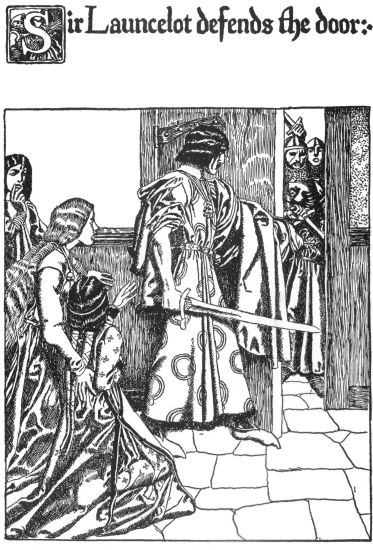
Then Sir Launcelot wrapped his cloak about his arm, and he took his sword in his hand, and he said to those who were beating upon the door, “Messire, cease your uproar and I will come forth to you.” Then he turned the key in the lock of the door, and he opened the door a little, but not very far, setting his foot against it lest they should burst it open from without and so rush in, many at once, upon him.
But when the door was opened and they beheld Sir Launcelot standing there without any armor of defence whatsoever saving only the cloak that was wrapped about his arm, they took heart of grace that they should easily overcome him. Then there came forward a tall and very powerful knight, hight Sir Colgrance of Gore, and he struck a terrible strong and powerful blow at Sir Launcelot with intent to hew him down. This blow Sir Launcelot put aside with his sword and immediately delivered a blow in return.
He slayeth Sir Colgrance.
In that blow he smote Sir Colgrance upon the head, and the blow bit through the bascinet upon his head and it smote deep into the bone of the brain so that Sir Colgrance fell down grovelling to the earth, and immediately he died.
Then Sir Launcelot seized Sir Colgrance’s body by the shoulders and dragged it into the room ere the others had recovered, and immediately he bolted and barred the door as it was before. And Sir Launcelot said to the Queen, “Lady, here hath Providence delivered armor into my hands. I prithee aid me to arm myself.”
Sir Launcelot armeth himself in Sir Colgrance’s armor.
So the Queen and her affrighted ladies hastened to Sir Launcelot and together they stripped the armor off the body of Sir Colgrance. And they assisted Sir Launcelot to clothe himself very quickly and nimbly in that armor. Then, having thus armed himself in the armor of Sir Colgrance, Sir Launcelot came to the door of the room and he spoke to those without, and he said to them, “Messires, what is it you would have with me?” They say, “We would have you come forth and surrender yourself to us so that we may take you to King Arthur.” Sir Launcelot said, “I cannot surrender myself to you, but this I will promise to do: if you will go hence and leave me in peace, I will surrender myself to King Arthur to-morrow morning, and will then abide by his justice.” Sir Agravaine said, “We will not do this. We will not trust thee. Deliver thyself to us immediately, or we will slay thee.”
Sir Launcelot assaileth his enemies.
Then Sir Launcelot said, “I come!” and therewith he flung wide open the door. And Sir Launcelot strode out amongst them like to a lion into the midst of a pack of dogs. And they beheld that Sir Launcelot was clad all in the armor of Sir Colgrance. And Sir Launcelot fronted Sir Agravaine and the eyes of Sir Launcelot flashed forth pure fire from under the vizor of his bascinet. And Sir Launcelot strode to Sir Agravaine, crying out, “Thou first!” And therewith he smote Sir Agravaine with might and main.
Sir Agravaine warded the blow, but so wonderfully powerful was it that it smote down that ward; and it smote Sir Agravaine upon the bascinet; and it cut through the iron of the bascinet and through the bone of the brain pan and into the brain itself.
He slayeth Sir Agravaine and several others.
Then Sir Agravaine cried out very terribly and fell down dying to the earth; and Sir Launcelot put his foot upon the neck of Sir Agravaine, and wrenched forth the sword out of the cut that he had made. Then Sir Launcelot smote to the right hand and to the left; and of those eleven knights who were with Sir Agravaine and Sir Mordred he slew nine in that little room. And he smote Sir Mordred upon the shoulder so that he sheared the flesh of the arm, a great slice from the bone, and the other two knights were more or less wounded, so that anon they fled in tumult from that place.
And Sir Launcelot was also wounded in many places in that conflict, so that he was, as it were, all bathed in crimson from head to foot. Then, having put his enemies to flight, he turned him and re-entered the Queen’s chamber.
Sir Launcelot is wounded.
But when the Queen beheld him thus all bathed in red, she shrieked aloud, for she thought him to be mortally wounded. But Sir Launcelot said to her, “Fear not, Lady, thine enemies are put to flight and I am not sorely hurt.” And he said to her, “Lady, my love for thee hath ever been my curse, and now it hath brought us to this end. For in thy defence and in my defence I have slain the nephew of the King and two of the sons of Sir Gawaine. So now the King will be my foe, and so I must quit this place for aye. But I cannot leave thee, Lady, for without me thou wilt be defenceless. So I prithee prepare thyself for a journey. I will go forth and gather about me a number of knights of mine own kindred and friends, and we will take thee hence away from this place. For to-morrow they will bring thee forth to trial, and when they bring thee forth, then will we seize thee and carry thee away.”
Then the Queen fell to weeping very bitterly, and she said, “Ah, Launcelot! Alas and alas! Is this then the end?” And he said, “Aye, Lady.” Therewith he went forth from that place and left her.
Sir Launcelot adviseth with Sir Bors.
So Sir Launcelot came to Sir Bors’s inn, and when Sir Bors beheld him, all covered and ensanguined with blood, he cried out, “God save us! What is this? What aileth thee?” Then Sir Launcelot told Sir Bors all that had befallen, and when he had told it Sir Bors sent for Sir Ector and for Sir Lionel and for Sir Ure, and fourteen other knights, relatives and friends of Sir Launcelot, and Sir Launcelot told unto them what he had told to Sir Bors.
Then Sir Bors said to those who were there gathered, “Messires his is a very sad and bitter quarrel. For I do avouch that my relative, Sir Launcelot, is in all ways perfectly innocent toward the Queen. For we know that he was deceived into her presence by a false message delivered unto him by someone who was an enemy to him and who meant to undo him. So this lady hath also been misused in such a way that it is contrary to his honor as a knight that we should suffer such harm to approach her. Now it is my advice that we await to see what shall presently befall. For if this quarrel is condoned by the King, then is all very well; but if the King seek to punish Sir Launcelot by bringing the Queen to a trial, then shall he save her from that trial and shall convey her away to Joyous Gard where she may remain safe from harm.”
Other knights swear fealty to Sir Launcelot.
Then all those other knights to whom Sir Bors spake held up their swords with their handles before them, and they said, “Herewith and upon this holy sign of the crucifix do we swear that we will ride with and aid Sir Launcelot of the Lake in this undertaking. And, if it be demanded of us, we will assist him to bring this lady to Joyous Gard, and we will there aid and defend him and her with our bodies until the last extremity and until death.”
Sir Mordred accuseth Sir Launcelot to the King.
Meantime, Sir Mordred had had his wound bound up and had taken horse and had ridden to the inn of King Arthur, and he appeared before King Arthur in the room when the King was then with several of his court. And when the King beheld him thus wounded, he started up and cried out, “Hah, Sir Mordred! What bringeth thee before me in this plight? Where gottest thou that wound?” Then Sir Mordred kneeled down before the King, and he said, “Sovereign Lord and Master, I got this wound in thy service. For Sir Launcelot visited the Queen recently in her bower, and I and twelve other knights sought to arrest him there and to bring him before thee. But he resisted that arrest, and of the thirteen who assaulted him nine are dead and one is like to die.”
Then the King drew his breath very hard between his teeth, at that news, and anon he said, “Who are dead? Are they any of my friends?” Sir Mordred said, “All are thy friends, and three are of thy kin.” Quoth King Arthur, “Who are those of my kin?” And Sir Mordred said, “One of them is Sir Agravaine, thy nephew, and the others are Sir Florence and Sir Lovel, the young sons of Sir Gawaine.”
Sir Gawaine sorroweth.
Then the King groaned and Sir Gawaine who was with him covered his head and also groaned in sorrow. Quoth the King, “To-morrow day this shall be inquired into, and the Queen shall be brought to trial for this treason.” And with those words he arose and withdrew from that place, accompanied only by Sir Gawaine, Sir Geharis and Sir Gareth and Sir Mordred; and leaving the other knights who were attendant upon him sunk in silence, not knowing which way to look or what to say.
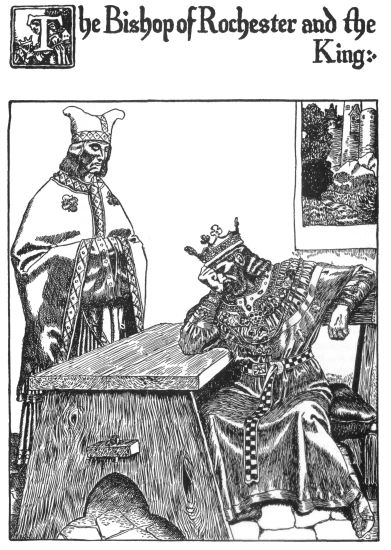
So when the King was come to a private place, he seated himself and buried his face in his hands. And he groaned aloud, and he said, “Alas is me! This is certes the beginning of the end that was foretold by Merlin!” And anon he said to Sir Gawaine, “To thee, Gawaine, will I entrust the pushing of that inquiry which must follow. For thou and Geharis and Gareth shall go with a company of an hundred knights, and ye shall arrest the Queen, and shall bring her for trial for this offence.”
Then Sir Gawaine kneeled down before King Arthur, and he said, “Sovereign and lawful Lord and Master, I pray you to spare me from this.” King Arthur said, “Why should I spare thee?” Sir Gawaine said, “For these two causes: firstly, I am sworn brother in arms to Sir Launcelot; secondly, I am not friendly with my lady the Queen and so am not fit to serve her as her escort.”
Then King Arthur said, “I do not understand your refusal, Messire. Was not Sir Agravaine your brother? And was not he a strong and noble knight? And were not Sir Florence and Sir Lovel your sons?”
“Yea, Lord,” said Sir Gawaine. “All this is true; but I suspected evil in this affair, and I strongly advised them to refrain therefrom. This they have refused to hearken to and so they have perished, armed and in fair conflict with Sir Launcelot—he one against many.”
Then King Arthur’s face flushed very red with anger, and he turned to Sir Geharis and Sir Gareth. “And you, Messires,” said he, “do you also refuse me this duty?” “Sir,” said Sir Gareth, “if you bid us upon our duty to undertake this commission, we will do so. Yet wit you that Sir Launcelot was he who made me a knight; wherefore I will not go in arms to escort the Queen. But if thou commandest me to go, then will I go without armor or defence of any sort to protect me. For I will not stand in arms before the avowed lady of him who made me a knight.”
King Arthur said, “I do command you both to go, so let there be an end to this argument. But see to it that the Queen shall be brought to her trial in a plain white robe without a girdle and that she come in her bare feet like to any criminal. For I shall not believe her to be innocent until she be proved so.”
Sir Gareth and Sir Geharis go unarmed to arrest Sir Launcelot.
Now when the next day was come, it being then about the tenth hour of the morning, Sir Geharis and Sir Gareth took those five score knights and they rode to the lodgings of the Queen. Meantime, word had been sent to the Queen that she was to clothe her in such a guise as the King had said; to wit, ungirdled and in white, and in her bare feet. And it was said to her that she was to come to her trial like to a criminal—barefoot in that wise, and without a girdle about her waist.
The Queen weepeth.
Then the Queen wept very many bitter tears, and said, “Alas, my lord, the King, hath already condemned me in his heart, so that my trial will mean my death.” And the ladies of the Queen wept with her and they said, “Lady, alas for thy happiness! For this is certes the end.” Then the Queen dried her tears and she said to them, “Comfort ye! For I have done many evil deeds in my life, but ye know that I am innocent of this deed.” They say, “Yea, we know it and will avouch for it.”
Now word of all these things had also been brought to Sir Launcelot, and when he heard of them he aroused himself and called his esquires about him. Then he went forth in his full armor and he found Sir Bors and Sir Lionel together. And Sir Launcelot said to them, “Messires, do you remember that you and several others promised to aid me in the rescue of the Queen? Well, then, the time is come, for she is about to be brought forth to her trial, for they have sent for her. She shall not come to the disgrace of trial, for I will bear her hence. Go you and summon all those who will support me and bring them in haste to the Queen’s inn, for I go there immediately.” Sir Bors said, “Go not thither from this place until we summon aid.” Sir Launcelot said, “Then make haste.”
So Sir Bors and Sir Lionel hastened away from that place, leaving Sir Launcelot walking in great strides up and down the length of the room.
Anon came one running to where Sir Launcelot was, and said to him, “Sir, the Queen biddeth thee to come to her in haste, for they are taking her barefoot to her trial.”
Sir Launcelot hasteneth to aid the Queen.
Then Sir Launcelot waited for no further word, but hastened with all speed to where the Queen was, and when he had come there he found many of his knights already there, and several came immediately thereafter. And as Sir Launcelot approached he beheld the Queen seated upon her horse in her bare feet and surrounded by that armed escort which the King had sent. Then the Queen beheld Sir Launcelot and she called to him, saying, “Sir Launcelot, make haste!” And she reached out her arms toward him.
Sir Launcelot slayeth Sir Gareth.
Then Sir Launcelot emitted a great loud and bitter cry. And therewith he drew his sword like lightning and his friends drew their swords and they rushed into the throng smiting from right to left and from left to right again. And those who were thus assaulted smote back again at those knights and bore them hither and thither by weight of numbers because they who fought for the Queen were so few. But the knights of Sir Launcelot were prepared for this assault and the knights of King Arthur were not prepared for it, wherefore those latter were quickly separated and driven back. Now in the fury of that small battle Sir Gareth was pushed near to Sir Launcelot and he was unarmed as hath been told of, and Sir Launcelot saw him but knew him not. So Sir Launcelot smote Sir Gareth upon the head with his sword and he clave asunder the head of Sir Gareth to the throat and Sir Gareth fell dead beneath the horses’ feet.
And Sir Launcelot thought nothing of what he had done by that blow; for in his fury and raging he beheld the Lady Queen Guinevere before him. With that he spurred forward without looking down upon the earth to see who it was whom he had smitten down, and he catched the Queen up from her saddle and seated her on his saddle before him. Then he shouted, “Let us away and escape while there is yet time!”
He slayeth Sir Geharis.
So with that Sir Geharis put himself forward to stay Sir Launcelot, and Sir Launcelot, beholding him there in the way and not witting who he was, smote him also with his sword and slew him.
Sir Launcelot escapeth with the Queen.
So with that they all ceased fighting and spurred away from that place, cleaving their way before them and taking Queen Guinevere with them. And they rode away from that place and from that city, and they ceased not to ride until they had come to the confines of Joyous Gard, where there was an asylum of peace and safety. And in that battle there were lost twenty-seven knights of the King, and of these there were eleven knights of the Round Table. And there were lost sixteen knights of Sir Launcelot’s party and of them there were nine knights of the Round Table. And in that battle Sir Kay the Seneschal and Sir Gareth and Sir Geharis and Sir Griflet lost their lives.
Chapter Fifth
How King Arthur attacked Sir Launcelot at Joyous Gard; how Sir Lionel was slain and how Sir Bors was wounded.
NOW come we to the beginning of the end of this great and glorious reign of King Arthur of Britain. For so Sir Launcelot stepped between the Queen and the law as hath afore been told of, and having done so there was no recession for him from that act. For so was he bound to protect the Queen and to cherish her if he could do so; and King Arthur was bound to recover his Queen to bring her back to her duty again if he could do so.
Concerning Queen Guinevere and Sir Launcelot.
Yet in all this the Queen had not sinned against King Arthur, saving only that she had escaped from her enemies and from justice at Camelot, and also because King Arthur supposed that her affections had wandered from him and toward Sir Launcelot. For in all other respects the Queen was ever as honorable and as pure as she had been when first she came to King Arthur that long while before at Camilard (which same hath been told in full in the Book of King Arthur). Yet there was this, that the coming of Sir Launcelot from the Lake and the greatness of Sir Launcelot as a knight, and the beauty of the person of Sir Launcelot, so fascinated her that she could not let him go his way without meddling with his fortunes. Wherefore she demanded him for her knight, and she was angry at any interference that prevented him from serving her as her knight both singly and in all things.
But now had come to her the end of all this. For now was she escaped from her lord the King, and from justice, and she was hiding under the protection of Sir Launcelot of the Lake and of those knights of his blood and kindred at Joyous Gard. So had the end come to her of all the joy of her life, for King Arthur could now never condone or forgive her offence.
King Arthur grieveth.
For when the news of that battle came to the ears of King Arthur, he was filled with anger and with grief. “Alas!” cried he, “that this quarrel should have begun, for in it I behold the end of my reign. For already the joy of the Round Table is past and gone, and never shall it return again.”
For wit ye that that joy which is gone can never return, but only its memory shall live in the heart to lend a dim and distant lustre upon the sorrows of the present, and of that King Arthur was very well aware. So also he knew that the glory of the Round Table had departed, and he knew that ere the end of that Round Table should come many knights should die in that quarrel that was now toward.
Then the King said, “Doth Sir Gawaine, the high prince, know that his two brothers have been slain?” They say to him, “No, Lord.” (For they did not then know that Sir Gawaine had already been informed thereof.) The King said, “Then let him not be told of it, for if he is told of it now he will, in his haste, vow vengeance against Sir Launcelot who was his sworn comrade in arms and his very dear friend, and so there will be added war to this war.” They say to the King, “He shall not be told, but it shall be kept secret from him.”
The news cometh to Sir Gawaine.
But meantime there had come a messenger hastening to Sir Gawaine, and said to him, “Lord, the Queen hath escaped and is now upon her way to Joyous Gard with Sir Launcelot of the Lake.”
At this Sir Gawaine gazed at the messenger and for a little while he said nothing, though he thought many things. And the face of Sir Gawaine grew white like to wax for whiteness, for he feared what further news should come to him. Anon he said, “What news is this? Were not my brethren set as a guard upon her? How then did they suffer her to escape from them?”
The messenger said, “Sir, Sir Launcelot, and others of his blood, assaulted that guard and they seized upon the Queen and took her away. And in the mêlée at that time Sir Gareth was slain unwittingly. And then Sir Geharis was also slain whilst attempting to stay Sir Launcelot.”
Sir Gawaine grieveth.
Then Sir Gawaine covered his head with his cloak, and he sat there for a long time with his head covered. And ever he wept beneath the cloak, but his face was hidden, and no one could behold his tears. And anon he said in a muffled voice, “Five of them are gone! Five of them are gone!” meaning by that that his two sons and his three brothers had already died in that war. And after a little while he said, “There was comfort for me in that those three of them who died aforetime were armed for battle. For so I advised them that they should not enter this dispute; and yet they did enter it, and lost their lives therein. But these latter two were naked and unarmed, and of one of them Sir Launcelot was godfather when he was knighted. And he loved Sir Launcelot more than he loved his own blood and his own brethren. Ah, Gareth! Gareth! All things could I forgive in Sir Launcelot saving only thy death. For I loved Sir Launcelot above all others in the world, and to him could much be forgiven; but this I can never forgive. For those two were his friends and not his enemies, and they meant him good and not harm; yet he slew them, all naked and unarmed as they were.”
Sir Gawaine cometh to the King.
And Sir Gawaine said, “Where is the King?” They say, “The King is at such and such a place.” So by and by Sir Gawaine arose and went to where King Arthur was. And Sir Gawaine said to King Arthur, “Lord, what now will you do?” King Arthur said, “I know not what I shall do.” Sir Gawaine said, “Sir, know you that my two brothers are slain?” And King Arthur bowed his head and said, “Yea, I know it.” Sir Gawaine said, “I will tell you what you shall do. You shall wage war to the extremity of life against this false and traitorous knight, Sir Launcelot of the Lake. What? Hath he not taken your Queen from you and carried her away to his own castle? Hath he not slain your blood and kindred? Hath he not bathed his hands in the blood of your knights of the Round Table? Hath he not slain Sir Kay, your foster brother, in this last assault? Hath he not slain Sir Griflet and my kinsman Sir Aglaval and my two sons and my two other brethren who were all unarmed and defenceless against his attack? Sir, arouse yourself. Call for your kings and princes, your earls and barons and knights, and let us set forth as an army and utterly destroy this nest of traitors and murderers. I myself will call my dependants around me and will accompany you to that war, for now it shall either be Sir Launcelot’s life or my life. For never will I forgive him so long as I have breath in my body.”
The King offers forgiveness.
Quoth the King, “Nephew, if these knights will return the Queen to me, then I will forgive them, and if I forgive them cannot you also forgive? For these are Knights of the Round Table, and I must not destroy the Round Table so utterly as you advise me to do.”
Sir Gawaine said, “I cannot forgive Sir Launcelot, nor shall I ever forgive the deaths of my innocent brothers. For they were naked and unarmed, and they loved Sir Launcelot, and yet Sir Launcelot slew them. Naught can wipe this from my memory saving only the blood of him who slew those two gentlemen. Wherefore, prepare for war and I will join you.”
The King summoneth his vassals.
So King Arthur armed himself and he summoned those knights and princes, earls and barons who were dependent upon him to his assistance. And he summoned all of those knights who were still allied to him. All this he did, but he did it very reluctantly, for he wished not to wage war with Sir Launcelot and his knights.
And news of this call to arms that King Arthur had made came to Sir Launcelot, and he upon his part gave call to all of those lords and knights who were allied to him to come to him and to aid him to defend Joyous Gard. And they or many of them went to him as he bade them.
How the King cometh to Joyous Gard.
Then King Arthur led his army to Joyous Gard and it was so vast and multitudinous that it covered all the hills and valleys as it advanced. And red clouds of dust hung over it as it passed forward so that the bright and tranquil light of the sun was obscured by those clouds. And great flocks of carrion crows accompanied the army, for they smelt the blood of many carcasses as from afar, wherefore they flew accompanying that army. So this army came and settled down and about Joyous Gard, and it was like an army of locusts that had settled at that place.
And Sir Launcelot and his brother Sir Ector stood upon the parapet of the castle of Joyous Gard, and they looked out upon the hills and upon the multitude of the hosts that were there foregathered and that encompassed them. And when Sir Ector beheld the vast and limitless extent of that army, his heart failed within him and he said to Sir Launcelot, “Behold, oh brother! the vast and limitless host that surrounds us. However shall we withstand such a host as that? Would it not be better to compromise with the King and to surrender the Queen to him?” Quoth Sir Launcelot, “How talk you of compromise, Messire, and how talk you of surrendering the Queen? Wit you that to surrender the Queen at this time would be to dishonor ourselves in surrendering her to dishonor? For unless we fight for her, what terms can we now make that would insure her safety? No, brother, let us abide their coming, and defend ourselves with all our mights.”