PART II The Story of Sir Galahad
Reading edition
HERE beginneth the Story of Sir Galahad, which same includes the history of the recovery of the Grail and its deposit in the Minster of Sarras, also its exaltation into Paradise, as follows:—
Chapter Firsts
How Sir Galahad was made a knight; how he came to the Court of King Arthur, and of the several miracles that happened at that time.
A damsel comes to the Court of the King.
ONE day Sir Launcelot sat at court with many lords and ladies of high degree who were gathered there at that time. Suddenly there entered that place a maiden clad in a long, straight robe of white, girdled about the middle of the body with a crimson girdle of leather. And the girdle was embroidered with threads of gold. This maiden stood at the door of the hall and called out in a high and very clear voice, “Sir Launcelot of the Lake—which knight is he?”
To this Sir Launcelot made reply, “I am he; what seekest thou of me?” The maiden said, “Sir Launcelot, I bid thee arise and follow me.” Quoth he, “To what purpose?” She said, “Thou shalt see.”
So Sir Launcelot arose and, clad as he was and without armor of any sort, he followed her.
Sir Launcelot rides with her.
Outside of the hall were two horses standing; one of them was a white palfrey, the other was a black stallion. Sir Launcelot assisted the maiden to mount upon the white palfrey and he himself mounted upon the black stallion, and so together they rode away from Camelot.
They travelled for some while until they came to the skirts of the forest. Then they rode into the forest, and all day they traversed the woodlands. Toward eventide of that same day they came to an open place amidst the surrounding trees, where was a quiet and very fruitful valley, stretched out wide to the length and breadth of a league. In that valley Sir Launcelot beheld orchards and fields of wheat and barley, and meadow-lands where cattle were browsing in numbers. For it was a very beautiful and fertile spot.
In the midst of this valley there stood a nunnery, with white walls and green trees all about it. Above the nunnery was the clear and radiant sky, very blue and all full of floating clouds. A soft wind blew up the length of the valley, and upon the breeze there came the remote sound of a crowing cock and the voice of the ploughboy as he drave the plough horses along the smoking, upturned furrows, the ploughman following laboring behind them.
Quoth the maiden, “Thither is where I am taking thee.” Said Sir Launcelot, “To what end?” “That thou shalt presently see,” said the maiden.
They come to the nunnery.
So the maiden rode down into the valley and Sir Launcelot rode after her. Thus, anon, they came to that pleasant and secluded convent. Here the gate was opened to them by a fair and youthful esquire, and they entered the portals of the place. Then several came and assisted them to dismount, and took the horses of Sir Launcelot and the maiden.
After that the maiden led Sir Launcelot across the quadrangle of the convent and so to the chapel, and they entered the chapel. Here Sir Launcelot beheld four ladies kneeling upon four cushions before the altar; and he beheld that beside these ladies there were two knights kneeling, each upon a cushion. Of the four ladies, one was the Lady Abbess of that convent; and of the two knights, one was Sir Bors de Ganis and the other was Sir Lionel.
Sir Launcelot finds two whom he knows.
Anon they who kneeled there ceased their orisons and arose, and Sir Launcelot beheld the faces of Sir Bors and Sir Lionel and knew them, and they knew him. Then Sir Launcelot said to them, “Messires, what is it brings you hitherward?” To this Sir Bors replied, “Sir, we were in distant places and to each of us came a fair maiden who was the messenger who brought each of us to this place. Since our coming we have been waiting for thee, and now thou art here.” Sir Launcelot said, “For what purpose have I been brought hither?” Sir Lionel said, “Thou shalt see.” Then Sir Lionel said to the Abbess, “Bring him forth that Sir Launcelot may behold him.”
Sir Launcelot finds his son.
Upon this the Lady Abbess turned to one of the nuns who stood beside her and she spake aside to her, and with that the nun left them and went away. For a little while she was gone, and then in a little while she returned, bringing with her a youth of eighteen years of age, very tall and fair, and clad from top to toe in clothes of white silk. Said Sir Launcelot to the Abbess, “Lady, what youth is this?” The Abbess replied to him, “Sir, this is thine own son, hight Galahad, and his mother was the Lady Elaine the Fair.”
Then Sir Launcelot cried out in a loud voice, “How is this? I knew not that I had a son. I beheld the Lady Elaine the Fair upon a certain black and terrible day, lying dead in a boat at Camelot, and I stood upon the quay and the boat floated beneath my feet. All this I beheld, and never shall I forget it; but I knew not that she left a son behind her.” Said the Abbess, “Ne’ertheless she did so, and this is that son. Here hath he lived with us since the time of his birth when Sir Bors fetched him hither, and no one knew that he dwelt with us saving only Sir Bors de Ganis. But now hath the time come that he must quit us, for the period is imminent when the search for the Holy Grail shall be begun, and this is he who shall achieve the Grail. He is now to be knighted, and for that purpose thou hast been sent for that thou mightest make him a knight. This is the reason for thy being brought hither.” Quoth Sir Launcelot, “Let me then make him a knight. For I know of no joy that would be greater than that, that I should make him a knight.”
Sir Launcelot makes Galahad a knight.
So that night Galahad watched his armor in the chapel, and Sir Bors and Sir Lionel sat near to him to support him in his watch. And when the morning was come, they two took him thence and bathed him, and Sir Bors marked the sign of the cross upon his right shoulder and Sir Lionel marked the sign of the cross upon his left shoulder, each with the water of the bath. Thereafter that, they clad him in a robe of white, pure and spotless, and they brought him to where Sir Launcelot was, and Sir Launcelot made a knight of him, according to the accepted custom.
So was Sir Galahad made a knight by the hand of his own father, Sir Launcelot of the Lake.
Sir Launcelot returns to the court.
Now, after this ceremony was completed, Sir Launcelot besought Sir Galahad that he would accompany them to the Court of King Arthur, so that the King might behold him (for Sir Launcelot desired that Sir Galahad should be manifested to the entire world of chivalry). But to this Sir Galahad replied, “Sir, I cannot yet go to the Court of the King, for all is not yet accomplished to prepare me for that going. Anon, however, I shall come thither; meantime, do thou wait for me at King Arthur’s Court.” So, shortly after this, Sir Launcelot and Sir Lionel and Sir Bors de Ganis departed from that convent, and that same day they reached the Court of the King at Camelot.
But they said nothing to that court concerning the knighting of Galahad, for at that present it was not to be made known to the world that there was such an one as Galahad, and that he was Sir Launcelot’s son and a knight of Sir Launcelot’s making.
So it befell Pentecost Day, what time the Feast of the Round Table was held. Upon this day those miracles happened that are here written of, and that were afterward so much talked of and concerning which so much was written.
Concerning the miracle of the sword.
For it happened upon that day, early in the morning when the water-carriers went down to the river to draw water, they there beheld at that place a very strange, and wonderful sight. For beside the river they beheld where there stood a great block of red marble—cubical in shape, and polished until it was smooth as glass. And into that cube of stone there was thrust a sword, half way down its blade into the marble. And the hilt of the sword and the haft, thereof, was studded all over with precious stones of divers sizes and colors, very rich and glorious to behold. And the blade of that sword (so much thereof as could be seen) shone like to lightning for brightness.
Then they who beheld the wonder that appeared before them made all haste to the castle of the King, and straightway told the news of what they had seen. Anon this reached the ears of the King and of several of those lords who were in attendance upon him. Then the King spoke to those lords, saying, “What is this I hear tell of? Let us straightway go and see.”
The King and his lords view the sword.
So the King, and those lords of the court who were in his company, went down to the river to look upon that wonder, and amongst those lords were Sir Launcelot of the Lake and Sir Percival of Gales and Sir Bors de Ganis and Sir Lionel and Sir Ector and Sir Gawaine, and several other high lords of chivalry.
When they had come to that place where the sword was they beheld that there were words written around about the blade thereof. So King Arthur commanded Sir Launcelot that he should read those words, and Sir Launcelot read as follows:
“This sword is for the greatest knight in the world and for him who shall win the Holy Grail.”
Then he read:
“Whoso draweth forth this sword from the stone, to him shall that sword belong; but upon him who shall endeavor to draw it forth and shall not be able to do so, shall fall a wound from the blade thereof.”
Then King Arthur said to Sir Launcelot of the Lake, “Messire, thou art the greatest knight in the world, and perhaps thou shalt win the Holy Grail. Let me see thee draw forth that blade.”
Sir Launcelot will not attempt the sword.
Quoth Sir Launcelot, “Lord, I know not that I am the greatest knight in the world, and I fear me that I shall not be able to win the Grail, for I am a sinful man. Look you; it saith here that he who shall endeavor to draw it forth from the marble and shall fail to do so, he shall be wounded by the blade thereof. So I would fain not endeavor to draw forth this sword.”
Then King Arthur turned him to Sir Gawaine, and he said, “Sir, let me see thee attempt that sword, for mayhap thou mayst be able to draw it forth out of the marble.” Sir Gawaine said, “Lord, if Sir Launcelot dare not attempt that sword, so, also, do I not dare to do so.” King Arthur said to him, “Gawaine, I command thee upon thy fealty to attempt that sword.” Quoth Sir Gawaine, “Dear my Lord, if thou dost command me upon my fealty, then I must attempt to obey thy command.” King Arthur said, “I do command thee thus.”
Sir Gawaine attempts the sword.
So Sir Gawaine came forth and he laid hand to the hilt of the sword and drew strongly upon it, but the sword did not move a hair’s breadth in the marble stone in which it stood emplanted.
Then Sir Launcelot spoke and said, “Alas, Sir Gawaine, that thou shouldst have made that attempt and failed therein. For if thou art wounded by that bright-shining blade it may be of more injury to thee than it would be if thou shouldst lose three several castles.” Quoth Sir Gawaine, “That may well be, Sir Launcelot, but yet it was incumbent upon me to do that which the King’s command called upon me to do.”
Sir Percival attempts the sword.
Then up spake Sir Percival, “Lord,” said he, “let me also attempt that sword, for if it should be turned against Sir Gawaine I would have it that it should be turned equally against me. Else I would endeavor to draw it forth from the stone for mine own.” The King said, “Try thou for the sword.” So Sir Percival laid his hand to the sword and drew upon it very strongly, but neither could he move it so much as the breadth of a single hair.
After that no other lord of all those present chose to attempt the sword, but all avoided it from a distance, no one coming nigh enough to it to touch it.
So, thereafter, they all withdrew from that place and went away, marvelling at the miracle. And all that day many came to where was that sword and the block of marble, and these stood to look upon that sight and to marvel at it.
Such is the story of the sword so far as this, and so have I told it to you as I have read of it in an ancient book of olden days, wherein these adventures and several other adventures are spoken of.
Thus that day of marvels began, and by and by came the time of the Feast of the Round Table.
Sir Galahad is brought to the Feast of the Round Table.
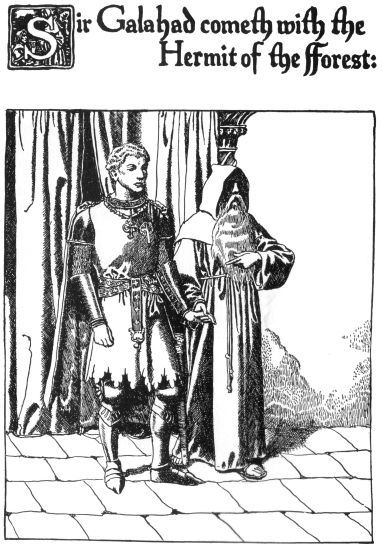
Now all they of the Round Table were gathered about that board and every man sat in his place, and behind every knight stood a young knight to serve him with meat and drink. Thus, as they all sat there, there came, of a sudden, a commotion at the doorway, and after that commotion there appeared at the doorway an old man clad all in white. That old man was the Hermit of the Forest, and with him he brought a tall, fair young knight and that knight was Sir Galahad. At that time Sir Galahad was clad in flame-colored armor from top to toe, but he bare no shield for his defence upon his shoulder, nor was there any sword within the sheath that hung empty and hollow at his side. From his shoulders there hung a long mantle of flame-colored cloth, and the mantle was lined with sable and trimmed and bordered with sable.
The old man lifted up his voice and spake aloud to all who were there, saying, “Lords, here by the grace of God come I amongst you with him who is to be the greatest knight that ever the world beheld. Also, he is to be the one who shall achieve the Holy Grail. So I have brought him hither to this place.”
Him answered King Arthur, saying, “Holy Sir, if thou sayest sooth, then this is a very great and marvellous thing. But soon shall we put it to the test; yonder is the Seat Perilous wherein no one hath dared to seat himself for all this while of the Round Table. Let this youth take there his seat, for that seat is for him who is without sin of the flesh—then will we believe that which thou tellest us. Also, down beside the river there is a strange and marvellous sword in a cube of marble. Let him draw that sword and then shall we certes believe in him.”
Sir Galahad assumes the Seat Perilous.
The old hermit said, “Sir King, it shall be done as thou desirest. Let him take that seat.” So the old man took him by one hand and King Arthur arose and took him by the other, and so together they led Sir Galahad to the Seat Perilous. Here he took his seat, and lo! no harm of any sort befell him. Then, anon, Sir Launcelot reached forward and drew aside the silken coverlet that hung at the back of the seat upon which Sir Galahad sat, and, behold! there was a word estamped upon the back of the seat in letters of gold; and that word was:
SIR GALAHAD
Then a great shout went up from all the Knights of the Round Table, for thus was the Seat Perilous achieved, and so was the Round Table completed.
Then King Arthur said, “Lo! this youth is he for whom we have been waiting for all this time. For so the miracle of the Round Table is fulfilled. Let us now take him to the sword thrust into the marble stone, for certes he shall draw forth that sword, and it shall be his. For, wit ye, that this is he who shall indeed achieve the Holy Grail.”
Sir Galahad draweth the sword.
So all they arose from their seats and went forth, and they conducted Sir Galahad down to the river. There he beheld the stone of marble and the sword thrust into the stone, and he said to those who stood about that place, “This sword is assuredly mine, for I have no sword, and for that sword I have come hitherward.” So Sir Galahad went to where was the sword and he set hand to the sword and drew it forth from the stone very smoothly and easily, and where the sword came forth it left no mark upon the stone, for, lo! it was solid and whole and without any blemish whatsoever. Then Sir Galahad thrust the bright-shining blade into the scabbard that hung beside him, and it fitted to the scabbard, and so he was armed.
Thereafter King Arthur took him by the hand and kissed him upon either cheek, and the King said, “Hail, Sir Galahad! All hail to thee! For thou art to be the crowning glory of my entire reign. For many mysteries and miracles have befallen in that reign, but thy coming is the greatest miracle of all.” And he said, “Come, let us go up to the castle that I may present thee to the Queen.”
Sir Galahad will not stay at Camelot.
Then Sir Galahad said, “Not so, O Lord! I cannot go with thee now. For one cometh and is nigh to here at this present, and with her I must go. For I go first to seek for the shield of Balan, who slew his brother Balin unwittingly at the time of Uther Pendragon. Through him the Holy Grail was lost to the earth, so that I must recover first his shield and then the Holy Grail. After I have thus armed me with that shield, then must I go to search for the Holy Grail, for that same is my mission here in life. Likewise I have this news to tell thee, that two of those knights here present shall win the Grail along with me; but who those two shall be, I may not relate to you at this time.”
A maiden cometh for Galahad.
Thus said Sir Galahad, and even as he ceased speaking there appeared in the distance a damsel clad all in white raiment, and the maiden came thitherward, riding upon a white palfrey, and by her hand she led by its bridle-rein a coal-black charger of great size and girth. So as she drew near, Sir Galahad went forward to meet her, and to him the maiden said, speaking very high and clear, “Art thou ready, Sir Galahad?” Whereunto he said, “Yea, I am ready.” And she said, “Come!” So Sir Galahad mounted upon the black charger, and he saluted King Arthur and he saluted Sir Launcelot and he saluted Sir Bors and Sir Lionel, and after that he rode away from that place, leaving them all in great wonder and amazement, both at his coming and at his going, and at all that had befallen.
So, when he had gone, King Arthur turned to his court of lords, and he said, “This is certes a very wonderful visitation, for this youth came to us like an angel from heaven, and, like an angel, he hath gone. Let us now go and hear the mass ere we return to the Hall of the Round Table.”
So all they who were there went to the mass, and as they were going Sir Gawaine said to Sir Launcelot, “Messire, this is a sad day for thee, for now there is a greater knight than thou art in the world.” Him answered Sir Launcelot, “Not so, Messire, there is no sadness in this for me, for, wit you, that this is mine own and well-beloved son. Wherefore I, being his father, may well surrender unto him that glory which I cannot carry with me into paradise, but which I would not be willing to yield to any other man.”
So said Sir Launcelot, and thus all the world became acquainted with that fact that no one but Sir Bors and Sir Lionel knew until then; to wit, that Sir Galahad was the true son of Sir Launcelot of the Lake.
The knights vow to attempt the Grail.
Now, after the mass in the minster was over, all they of the Knights of the Round Table retired to the Hall of the Round Table, and there they took their seats in due order. Then, when all were seated, King Arthur up and said, “Messires and Lords of the Round Table, all ye have heard what Sir Galahad hath said but a little while since; to wit, that two of you who are here should achieve the Grail with him. Now it doth seem to me that several of you who are the chief of all the knights should go forth in search of that Holy Chalice, so as to be able to join him. For, by not going, those two may miss the chance of achieving that great glory.”
So said King Arthur, and, in answer, all those who were there arose, each man in his place. And each man drew his sword and each held up the handle of his sword before his eyes as a crucifix. And each man swore upon that crucifix that he would presently depart from the Court of the King, and that he would search for the Holy Grail either until he discovered it or until he should perish, or until the Grail should have been achieved.
King Arthur takes sorrow.
Then King Arthur was filled with sorrow, for he would not that all of his knights should go in that wise, for many of them he would have kept with him at his court. And most of all he was grieved that Sir Gawaine should go, for he loved Sir Gawaine above all the knights of his court, because Sir Gawaine was the son of the well-beloved sister of the King. So he said to Sir Gawaine, “Alas, Gawaine, you have slain the joy of my life! For with this oath that ye all have uttered there departeth from this court all that was of joy therein. Until now there hath been great joy and good content at this Court of Camelot, but now that joy hath taken wing and hath flown away. For, though many of you shall return to this place, yet I foresee that many shall die; and I foresee that from this time there shall follow great bitterness and rancor, and anon that death and devastation shall overtake us all. For this is the time foretold by Merlin, of which ye all have heard tell. For, according to that prophecy, this day the Round Table hath been filled to its completion, so that hereafter it shall soon fall apart into warring and contention until it be altogether destroyed.”
Sir Launcelot comforts King Arthur.
Then Sir Launcelot said to the King, “Comfort you, my lord, for though the Round Table may indeed perish thus, yet, ere it be dissolved, there shall come great honor and a great glory unto you and unto us all. For what greater glory can there be to you than that the knights of your Round Table should achieve the Holy Grail? And what greater honor can there be than that we should endanger our lives in that quest? For we all seek death hither and thither, and if it so befall that death cometh to us in this cause, how much better is it to die in that wise than to have death come to us in some vain quarrel or adventure.”
Quoth King Arthur, “That which thou sayest, Launcelot, is very true, yet do I greatly grieve for this happening. For though we may look forward to a glorious sorrow, yet when that sorrow cometh to us it appeareth to be so much greater than the glory that it hides that glory from our eyes. So, Launcelot, is it with me; for though I may take glory that my knights shall achieve the Holy Grail, yet is the sorrow very great to me that this Round Table should be dissolved. Alas, and alas, that it should be so!”
Thus the Knights of the Round Table went forth in quest of the Grail—fifty of them in all. All of those who thus went had adventures, and many of them lost their lives and did never return again. But of those of whom this history telleth there is only Sir Launcelot, Sir Gawaine, Sir Percival, Sir Bors, and Sir Galahad, and one or two others. Of them and of their adventures it remains now to be told; wherefore, followeth the history of those things hereinafter written.
Chapter Second

How Sir Galahad was led by a strange lady to a monastery of White Friars. How he met there two other Knights of the Round Table. How King Bagdemagus wore the shield, and how it was taken from him and given unto Sir Galahad. Also the story of the shield.
SIR Galahad rode away from Camelot, where was the Court of King Arthur, following after the maiden clad all in white. Thus they wended onward until they reached the skirts of the forest. At this place the maiden said, “Sir Galahad, I must here leave you. But go you farther upon yonder path, and by and by you will be met and entertained.”
Sir Galahad comes to a strange country.
So Sir Galahad rode forward upon that path as the maiden directed. And he rode a great distance into the forest until at last he reached the Forest of Arroy, otherwise called the Forest of Adventure. Here, after he had ridden for a considerable time, he came at last to a very strange place. For he found the trees grew thin and thinner about him. Then, at last, the trees ceased around him, and he found himself upon the edge of a wide and open plain. And he beheld that all about him in this plain there were great quantities of lilies, and there were also daffodils, and all those flowers moved this way and that, very slowly in the gentle air, as though they saluted him in coming. And Sir Galahad beheld that this was a very wonderful place indeed, for the light that illumined it was not the light of the sun nor of the moon, but it was a radiant and golden glory that was not due to the light of either of those luminaries.
And in the midst of that flowery plain Sir Galahad beheld that there was a wide and very placid lake that was in no wise troubled by the soft breeze that blew across it, but that was otherwise like a smooth mirror of clear water.
So as Sir Galahad beheld all these things and marvelled at them, he was aware that this was not the land of common earth, but that it was fay.
Then anon he was aware that voices were calling aloud, saying, “Welcome, welcome, Sir Galahad!” as it were with great rejoicing. So he looked, and lo! he beheld to one side a fair and shining pavilion of green silk. And there were many people gathered in the field near the pavilion, and some of them were ladies and some were lords and others were pages, and all were clad in very gay and rainbow colors, so that it appeared as though it were a flock of gaudy birds of various plumage that was gathered in that place.
So Sir Galahad turned him toward that gay and jocund company, and as he drew near to them he beheld that they were weaving garlands and wreaths of fair flowers.
(For these, you are to know, were the attendants of the Lady of the Lake, and that was the lake in which was her habitation, and he had been led to that place for a certain purpose that they and others might see and know him.)
Sir Galahad abides there for four days.
So this place pleased Sir Galahad very greatly, and he remained for three days, taking great joy in that jocund company. For somewhiles they feasted and somewhiles they sang; somewhiles they danced and somewhiles they related pleasant tales and contes of several kinds. So it was that these three days passed very pleasantly and very quickly with Sir Galahad.
There cometh the Lady of the Lake.
Then, upon the morning of the fourth day, there appeared a lady in their midst to whom all who were there paid great deference and high respect; and this lady was of a very wonderful appearance. For she was clad in green samite from head to foot, and her hair was long and extraordinarily black, and very soft and glossy. And her face was pale, like to ivory, and her eyes were bright, like to jewels set in ivory. And upon her neck and around her arms were chains and bracelets of gold inset with emerald stones. Wherefore, from these things, and from the appearance of all about him, Sir Galahad was aware that that lady was not mortal, but that she was fay.
(For this was indeed the Lady of the Lake, although he knew it not then nor afterward.)
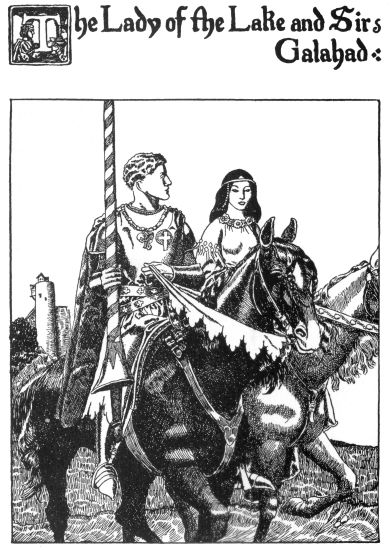
So Sir Galahad kneeled in the grass before the lady and he set his palms together. But she smiled upon him and she said to him, “Arise, Galahad, and kneel not to me, who am not of the spirit, but of the earth.” And she said to him, “Where is thy shield?” He said to her, “Lady, I have no shield.” She said to him, “Let us go and find thee a shield.”
So straightway there came several attendants, and some of these brought Sir Galahad his black charger, and others brought for the lady a beautiful janet as white as milk. And upon the back of the janet was a saddle of scarlet Spanish leather, embossed with gold and jewels, so that it shone and glistered with great splendor.
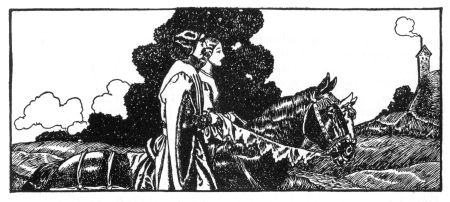
Then Sir Galahad mounted his horse and the lady mounted herself upon the janet, and so together they rode away from that place.
The Lady of the Lake leadeth Sir Galahad to a shield.
Thus they rode for all that day, and against the sloping of the afternoon they had come to the edge of the forest opposite to that part of the forest where was the town of Camelot. At this place there was a monastery of White Friars, and to this the lady pointed and said to Sir Galahad, “Thither thou wilt find a shield.”
Then Sir Galahad would have thanked her for bringing him thither, but lo! she was gone from his sight and he was alone. Then the monastery bell began ringing, and Sir Galahad rode down to that holy house.
Sir Galahad enters the monastery.
So he came to the monastery and smote with the butt of his lance upon the gate. Then the porters came and opened the gate to him, and when they beheld him they gave him welcome to that place. So he entered the courtyard of the monastery, and several came and gathered about him. Some of these took his horse and led it away to the stable; others conducted him into the house and afterward brought him to the chamber wherein he was to be lodged. Here they removed his armor and brought him to a bath of tepid water. After that they clad him in raiment that was soft and warm so that he had great ease and comfort.
Sir Galahad findeth Sir Bagdemagus and Sir Ewaine.
Then, when he was thus clad, they conducted him to the hall of that monastery, and there he beheld that there were two other knights then present. The one of these was Sir Ewaine, and the other was Sir Bagdemagus, erstwhile called King Bagdemagus. These were both Knights of the Round Table, wherefore they greeted him and gave him great welcome.
Sir Ewaine said to him, “I pray you, sir, tell us how you came hither.” Sir Galahad said, “I will tell you.” So he told them how he had abided in the midst of the forest near to that magic lake for the space of three days. And he told them how that lady, who was fay, had conducted him to that place, and had told him that there was here a shield with which he might provide himself. To all this Sir Ewaine and King Bagdemagus listened, and then Sir Ewaine said to Sir Galahad, “Messire, no doubt that lady who accompanied thee hitherward was the Lady of the Lake, for so hath she appeared to several of King Arthur’s Court as she hath appeared to thee.”
The Abbot tells of the shield.
Just then came the Abbot of that place, and King Bagdemagus said to him, “Sir, I pray you tell us, is there at this place a shield of such and such a sort?” The Abbot replied to him, “Aye, sir, there is here a strange and miraculous shield, and it hangeth behind the altar, and it hath hung there for God knoweth how long.” King Bagdemagus said, “I would fain see that shield.” The Abbot replied, “I will show it to you to-morrow morning, but not to-night. For I am come to conduct you to supper, and not to show you a shield.”
So, when they were seated at supper, Sir Galahad said to the two knights, “I pray you tell me how you came hitherward to this place.” “That I will do,” quoth Sir Ewaine. And he said, “Sir Bagdemagus and I set forth from Camelot in search of the Grail. After we had journeyed for a long distance, we came to that part of the forest that is called the Forest of Arroy, or otherwise the Forest of Adventure. Here we wandered for some while without being freed from it, for the Forest of Adventure is not very difficult to find, but is often very difficult to escape from. After a while, however, we found a way to escape from that forest, and so came out upon the further side of it. There we beheld, below us, this place and so we came to it. Such, sir, is the way in which we came hither.”
Thus these three knights and the high officers of that monastery ate and drank together, discoursing very pleasantly the while. And when they had ceased eating and drinking and talking together, they were weary, and each withdrew to his couch and to sleep.
The Abbot takes the three knights to the shield.
Now, when the next morning had come and when they had broken their fast, King Bagdemagus said to the Abbot, “I pray you now to show us that shield concerning which we spoke last night.” The Abbot said, “I will do so. Come with me.” So he led them to the chapel and he led them behind the altar, and there they beheld the shield where it hung. And the shield was exceedingly white and shining, as it were of brightly polished silver. And upon the shield was marked a red cross, very strong and bold in its marking.
King Bagdemagus covets the shield.
But when King Bagdemagus beheld the shield, he coveted it exceedingly, and he said, “That is a very beautiful shield. I pray you let me have that shield for mine own, and I will give my shield to Sir Galahad.” To him the Abbot replied, “Messire, I would gladly give you that shield, but there is said of it that whoever taketh it except the one man for whom it is destined, harm shall come to him, and great suffering.” King Bagdemagus said, “That may be so, but, haply, I am he for whom it is destined. At any rate, I am a tried and well-approved knight, wherefore if I take it I will essay to keep it, as a knight of standing may hope to keep his shield.” The Abbot said to him, “Then take it, sir, in God’s name.”
So King Bagdemagus took the shield and hung it about his neck. And he said to those other two knights, “Messires, I know not whether there is any malaventure appertaining to this shield, but, at any rate, I shall essay to keep and to hold it. Nevertheless, I pray you to await me here for this day. And if anything happeneth to me, I will return and give you report as to that happening.”
To this Sir Galahad and Sir Ewaine replied that they would remain at that place until the following morning.
Sir Bagdemagus rides errant into the forest.
After that Sir Bagdemagus mounted horse and rode away. And he directed his horse into the forest, and rode there a considerable distance away from the monastery. So, by and by, he came to a place where two highways parted, and where there was a cross of stone, and at that place he beheld a knight in white armor, seated upon a white horse. This White Knight stood across the way upon which Sir Bagdemagus was travelling, and he appeared to be very threatening and austere. So, when Sir Bagdemagus came pretty close to that White Knight, the White Knight said to him, “Messire, I prithee tell me, where got you that shield that I behold hanging upon your neck?” Sir Bagdemagus said to him, “I got this shield at a monastery of White Friars, at some distance from this.” The White Knight said to him, “I bid you take back that shield, and return it whence you got it, for it belongeth not to you.” Quoth Sir Bagdemagus, “That will I not do until I am compelled. For now that I have this shield I propose to keep it for mine own, unless it is taken away from me in battle.” To this the White Knight replied, “Very well, then, thou shalt do battle for it, and that anon. Now prepare thyself straightway for battle with me.”
Sir Bagdemagus is overthrown by the White Knight.
Upon this each knight made himself ready, and when they were in all ways prepared, they dashed together with great violence. In that encounter the spear of Sir Bagdemagus passed very smoothly from the shield of the White Knight, but the spear of the White Knight pierced the shoulder of Sir Bagdemagus, over above the shield which protected not that part of his body. And the point of the spear of the White Knight passed through the shoulder of Sir Bagdemagus, so that he was flung with great violence to the earth.
Then anon the White Knight came to where Sir Bagdemagus lay, and he said to him, “Sir, how fares it with you?” Quoth Sir Bagdemagus, “Alas, Messire, I am very grievously hurt, for thou hast pierced through my shoulder with thy lance, and I suffer very greatly.”
Therewith the White Knight dismounted from his horse and he lifted and raised Sir Bagdemagus. And after that he had beheld the wound, he laid Sir Bagdemagus upon his horse. Then he took the bridle-rein of Sir Bagdemagus’ horse, and he led the horse and the wounded man back to the monastery whence he had that morning come.
The White Knight bringeth Sir Bagdemagus to the monastery.
So, by and by, they two arrived there, and several came and took the horse of Sir Bagdemagus. And they lifted him from his horse and carried him into the house, and laid him upon a bed, and searched his wound. But when they came to look for the White Knight, he was gone, nor wist they whither he went. And the wound of Sir Bagdemagus was very deep, so that for a long while he hung, as it were, balanced betwixt life and death.
But Sir Bagdemagus did not die; otherwise, the next day, he summoned Sir Galahad to him. And when Sir Galahad had come to him, Sir Bagdemagus said to him, “Messire, I had no right to that shield and I suffered for taking it. I believe that it belongeth, indeed, to you; wherefore I pray you for to take it and to wear it, henceforth, for your own. But who that White Knight was who met me, or whence he came, or how he knew that I had that shield, I know not, nor perhaps ever shall know.”
To this Sir Galahad answered, “Sir, I will assume that shield and all the dangers that appertain to it, trusting that it belongs to me, and doing battle to retain it if need be.”
Sir Galahad takes the shield.
So Sir Galahad took the shield and hung it about his neck. Then he called for his horse, and mounting upon it he rode away from that place.
But King Bagdemagus lay there at the monastery for many days and for several weeks ere he was fit to travel again.
After that Sir Galahad travelled for all that day, and anon, toward the sloping of the afternoon, he was an hungered, and he wist not where he should come at refreshment for to eat. At that time he passed through a little woodland, and when he had traversed it he came out of it upon a small, open place upon the other side of it, where there was a fair meadow of short green grass.
Here he beheld a pavilion of particolored silks, and he beheld that before the pavilion there stood a tall and noble-appearing knight, clad in white armor. This knight, beholding Sir Galahad, said to him, “Sir, whence come you?”
To this Sir Galahad made answer, “Sir, I came from a monastery over yonderways, where I got me this shield.” Quoth the White Knight, “Art thou Sir Galahad?” and Sir Galahad replied, “Yea, I am he.”
Sir Galahad meets the White Knight.
Then the White Knight said to him, “I pray you, sir, to dismount from your horse and to come in and refresh yourself, for I have been awaiting you this long while.” And Sir Galahad replied, “Sir, I give you grammercy for your kindness.”
So the White Knight assisted Sir Galahad to dismount from his horse. And he brought him into the pavilion, and Sir Galahad beheld that there was there set a feast spread ready for his coming. So they seated themselves at table, and three esquires clad in green samite waited upon them, and they both ate and drank of the food and drink that was set before them, and which was very excellent.
Then the White Knight said, “Sir, to-morrow we shall ride together for a little way, meanwhile let us rest here to-night.” And Sir Galahad said, “So let it be.”
So, by and by, there came two other esquires who took Sir Galahad and brought him to where was a soft and luxurious couch of down, and there he rested and slept for the night.
And when the morrow had come, Sir Galahad arose and the White Knight arose and the esquires came and armed them. Then they each mounted his horse, and so they rode away together.
The White Knight tells Sir Galahad of the shield.
Now when these two, to wit, Sir Galahad and the White Knight, were thus upon their way, the White Knight said to Sir Galahad, “Sir, wit you what is the story of the Grail, and what is the history of that shield that you wear at your neck?” Sir Galahad said, “Nay, but I pray you to tell me that story.” Quoth the White Knight, “I will do so. It is as follows:
“In the old days of Uther Pendragon there were two knights who were twin brothers. One of these knights was hight Balan and the other was hight Balin.
“Now at that time there was in the enchanted city of Sarras two very great marvels; one of these was the spear with which the blessed side was wounded at the time of the crucifixion, and the other was the chalice into which the blood was drained from that deep and pitiful wound. But how they came to the city of Sarras is too long a story to tell.
How Sir Balan came to Sarras.
“Now Sir Balan was in the city of Sarras, and he was entertained at the castle of the king of that country, whose name was King Pischer. This King was at enmity with Sir Balan, whom he very greatly hated. So that night when Sir Balan lay upon his bed, King Pischer, at the head of several men, attacked Sir Balan where he lay unarmed. He, starting up from his sleep, beheld them coming, and so he fled away from those who would assail him, and so he escaped into the chapel of the castle, where those two holy relics—to wit, the spear and the chalice—were kept. Hither his enemies followed him and would have slain him, even upon the steps of the altar, only that, beholding the spear, Sir Balan seized upon it and ran with it against them. In that assault he smote King Pischer with the spear, a very great and bitter stroke. For the point of the spear penetrated the corselet of King Pischer, and inflicted a deep wound in the shoulder. And after that Sir Balan attacked the others who were with King Pischer, and drave them all before him. So Sir Balan used that holy spear for his own preservation.
“But as Sir Balan stood holding the spear and beholding his enemies retreat from that place, there came to him a voice as from heaven, saying to him, ‘Balan! Balan! what hast thou done?’
How there came an earthquake.
“And as the voice ceased its words there came, as from beneath, a deep and hollow rumbling. And the rumbling grew louder and louder, until it became a great earthquake, so that the earth rocked beneath the feet. Then the chapel and the castle and all that place reeled, and the castle fell, one stone upon another, so that all who were within it were buried beneath the ruins. At the same time the spear and the chalice disappeared from that place, and neither have they ever been seen from that time—saving only that in visions they have been seen. For Sir Percival beheld both the spear and the chalice, and others have beheld them from time to time.
How Sir Balan escapes.
“Sir Balan was not killed by the fall of that castle, nor was King Pischer killed, but all others in the castle perished in its fall. But rather had King Pischer been killed, for that wound in his shoulder remained unhealed, and King Pischer could not die for a long while, though he suffered very greatly from that wound every day that he lived. Such, O Galahad! is the story of the Grail.
“Now touching this shield; wit you it is the shield of Sir Balan, and the way in which it came to the monastery of the White Friars is as followeth:
How Sir Balan fought with the Knight of the Ford.
“One day Sir Balan came to a certain part of the country where was a monastery of White Friars, and where he had news of a knight who guarded the ford of a river at that place. So Sir Balan went to that river and he beheld there the knight guarding the ford. Then Sir Balan attempted to pass the ford, but the knight would not allow him to do so, wherefore they came to battle with one another. They fought for an entire morning, and for longer than that, and each gave the other many grievous wounds, and what with loss of blood and with continuous fighting they grew ever weaker and weaker, so that neither of them could stand without great ado. But at last Sir Balan gave to his enemy a deadly blow that brought him to the earth. Then he rushed off his helmet to make an end of him, but when the face beneath was free from its helmet he beheld it, and saw that it was the face of his twin brother, Sir Balin, whom he was about to slay.
“Then he cried out in horror, ‘Alas, and woe is me! Is it thou, Balin, whom I am about to slay? Lo! I am thy brother Balan!’
How Sir Balan slew his brother Balin.
“Then Balin, feeling that he was near to death, wept a great deal. And he forgave his brother Balan, and he bade Balan, when he was dead, to bury him at that place beneath a thorn tree that grew there and that was covered all over with spikes, as it were a chevaux de frise. Then he died, and Balan performed that task—to wit, to bury him there.
“Anon came several White Friars from a monastery that was near by, and these took Balan to the monastery and there he died, for he was very sorely wounded, and his heart was broken.
How Sir Balan marked the shield.
“But ere he died he took his shield to him and he drew upon it a great cross in his own blood. And he told the friars of that place to keep that shield until he should come who was to achieve the Holy Grail and to return it unto Sarras again. And Sir Balan predicted of that shield that it should always remain bright as silver until that time, and that the cross of blood should ever remain as red as it was that day; and he predicted of it that no one should be able to wear that shield saving only that one for whom it was intended; and he predicted of that shield that it should never be pierced by the point of any weapon forged by the hand of man. So it was and such is that shield which thou carriest, Sir Galahad.”
All this Sir Galahad listened to and heard, and when the White Knight had ended his words, he said, “Sir, I would that I knew who thou art. I pray thee to tell me that.” But to this the White Knight only smiled and made reply, “I may not tell thee who I am, only this I may say, that I am he who hath had that shield under continual surveillance until now, and now I find that it hath fallen into hands that are even better able to care for it and to cherish it than were the hands of Sir Balan of old.”
Sir Galahad parts from the White Knight.
Thus these two knights travelled forward together until night to the setting of the sun. Then at last they came to a place where the roadway divided, and at that place the White Knight said to Sir Galahad, “Messire, here I must leave thee. Continue upon that way and anon thou wilt come to a chapel where thou mayst be refreshed, and where thou mayst lodge for the night.” So saying, the White Knight saluted Sir Galahad, and he saluted the White Knight again. Then the White Knight rode down one path into the woods, and Sir Galahad entered upon the other path as he had been directed to do. But Sir Galahad turned his head to look after the White Knight ere he should reach the forest, but lo! he was not there, nor was anything to be seen, saving only the trees of the woodland and the red light of the sunset that lay upon the ground, falling through the leaves of the trees like to liquid gold spread there upon the earth in small, round, and brightly shining discs.
After that Sir Galahad continued upon his way until, anon, he heard the ringing of a bell, and with that he wist where he was, and that he was not far distant from the chapel of the Hermit of the Forest. So Sir Galahad spurred forward and in a little while he beheld the chapel, and he beheld the Hermit of the Forest, ringing the bell for vespers.
Sir Galahad lodges with the Hermit of the Forest.
So he came to that place that was very quiet and innocent, for he beheld that many birds sat perched upon the branches of the trees coadjacent to that place, and that several of the wild creatures of the woods, together with a wild doe and its fawn, were also there. For these things loved the Hermit of the Forest, and followed him whithersoever he went about that place.
Then the Hermit of the Forest beheld Sir Galahad and gave him welcome, and he brought him to eat and drink and prepared a lodging for him for the night.
Thus, then, was Sir Galahad armed with his shield, and therewith was he armed completely, for he needed no other thing to arm him for his defence.
So I have told you the history of these doings that you might know of them how they were. Now, having thus armed him entirely, so shall we turn to the further history of the adventures relating to these things.
Chapter Third
How Sir Galahad met with Sir Melyas. How Sir Melyas was overthrown, and how Sir Galahad overthrew his enemies. Also how Sir Galahad did at the Castle of Maidens.
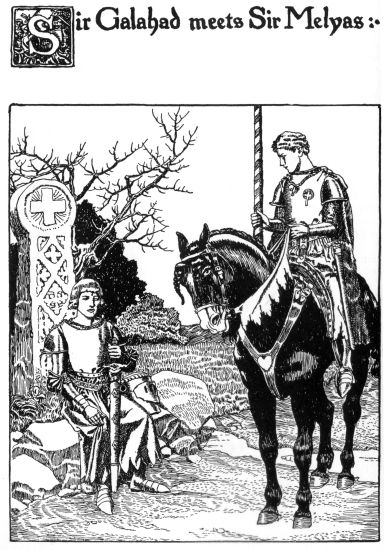
NOW Sir Galahad departed next morning betimes, after he had broken his fast. And he wended his way through the forest, he knew not whitherward. After a considerable while he came to where two roads crossed one another, and where there was a cross of stone. Here was a clear, limpid fountain of cold water, and at the fountain Sir Galahad beheld that there sat a young knight.
This young knight had been refreshing himself with draughts of the water, and now sat with his helmet beside him, whilst the soft and gentle wind blew upon his forehead and his hair.
Sir Galahad meets Sir Melyas.
Anon, when Sir Galahad had come nigh to him he said to the youthful knight, “Sir, I pray you tell me who you are.” “I will do so,” replied the young knight. “But you must also tell me your name and degree.” “That I will do,” said Sir Galahad. “Wit you that I am called Galahad, and that I am lately made a knight of King Arthur’s Round Table.” “And I,” said the other, “am hight Melyas, and I am the son of the King of Denmark.” Quoth Sir Galahad, “I give you grammercy for your information.” And he said, “I pray you tell me, what do you here in the forest alone?”
“Last night,” said Sir Melyas, “I came hitherward, and since then I have been travelling through the forest. I slept in the woodland then and I have not broken my fast since the prime of yesterday.” “Hah!” said Sir Galahad. “Now I will give you advice. Journey whence I came and by this road, and you will, by and by, come to the chapel of the Hermit of the Forest, which is not very far distant. He will give you to eat and to drink.”
Quoth Sir Melyas, “I give you thanks, Messire.” Thereupon he arose, and assuming his helmet he mounted his horse; and, having saluted Sir Galahad and Sir Galahad having saluted him, they parted company, each going upon his way.
Sir Melyas meets two strange knights.
Now Sir Melyas had not gone half a mile from that place when he met two knights, and as Sir Melyas approached them, one of the knights set his horse athwart the way and he said, “Sir, I pray you tell me who you are and whither you go.” Him answered Sir Melyas very mildly, “Messire, my name is Melyas, and I travel toward the chapel of the Hermit of the Forest.”
Quoth the knight, “Well, sir, since you come hitherward, I will have it that you try a pass with me. So prepare yourself to encounter me forthwith.”
Him answered Sir Melyas, “Messire, I have naught against you, but if it is your will that I do battle with you, then I must do so.”
The strange knight overthrows Sir Melyas.
So Sir Melyas prepared himself in all ways for that encounter, and the other knight likewise prepared himself, and when both were in all ways ready they launched themselves the one against the other with the utmost violence. So they met in the midst of the course and the spear of Sir Melyas was broken into a great many pieces in that encounter, but the spear of the other knight held, so that it pierced through the shield of Sir Melyas, wounding him in the side, and casting him with such violence to the earth that he lay there without motion, like one who is dead. Then the other knight leaped from his horse and he ran to Sir Melyas and rushed the helmet from his head and he set his misericordia to his throat, saying, “Yield thee, Sir Knight, or I shall presently slay thee.” And Sir Melyas reviving from his swoon said, “Sir, slay me not, for I am sorely hurt.”
Now turn we to Sir Galahad:
As he rode onward upon his way, a voice suddenly spoke within him, as it were in his very ears. And the voice said, “Return, Sir Galahad, for Sir Melyas is in peril of his life.” And again it said, “Return in haste, for Sir Melyas is in peril of his life.”
Sir Galahad rides to rescue Sir Melyas.
Thereupon Sir Galahad turned his horse about and set it to the gallop, for he thought that were he mistaken in the voice, then was there no great harm done in returning. So he rode back whence he had come. And anon he reached that place where Sir Melyas had fallen, and he beheld the knight kneeling upon Sir Melyas with the misericordia at his throat, and he heard the words that the knight uttered and that Sir Melyas uttered. Then Sir Galahad cried out in a loud voice, “Sir Knight, withhold thy hand. Turn thou to me, for I am here to defend that knight.”
Then the knight withheld his hand, and he cried out, “Who art thou, Sir Knight, who cometh hither?” Sir Galahad replied, “It matters not who I am, saving only that I am here to defend that fallen knight.” “Well,” quoth the other, “let it be that way if such is your will. Make you ready.” So the knight arose and ran to his horse and mounted thereon; and he took his spear in hand, and when he was in all ways prepared, each knight took stand for the assault.
Sir Galahad overthrows the strange knight.
Then they rushed together like a thunderbolt and each knight smote the other in the midst of the shield. But the spear of the knight could not penetrate the shield of Sir Galahad; otherwise, it slid away from it as though it had been made of adamant, and in sliding away the spear was broken into several pieces. But the spear of Sir Galahad held, so that with it he pierced through the shield of the other, and pierced through his body until the spear’s point stood a hand’s breadth out behind his back. With that the knight was flung to the earth with such violence that his neck was broken and he lay dead.
When the other knight beheld him fall, he cried out, “Hah, Messire, what have you done? You have slain my brother.” Therewith he drew his sword and rushed at Sir Galahad, and Sir Galahad threw aside his spear and drew his sword in defence. Then the knight launched a blow at Sir Galahad, which he turned with his sword and his shield. Then rising in his stirrups he launched a blow at the knight that was like a stroke of lightning for speed and force.
Sir Galahad overcometh the other knight.
The other knight tried to turn that blow, and he did turn it from his head, but the blow fell upon his left shoulder with great and terrible force, so that the edge of the sword cut through the epulier of the shoulder and it cut through the flesh and the bone of the arm so that the arm was severed from the trunk.
Then the knight emitted a great loud and bitter cry, and casting aside his sword he set spurs to his horse and sped away through the forest, crying aloud as he spurred, “Oh, God! Alas, and woe is me!”
Sir Galahad bringeth Sir Melyas to the Hermit of the Forest.
Then Sir Galahad wiped his sword and thrust it back into its scabbard. And he turned to Sir Melyas, and he said, “Sir, how fares it with you?” Quoth Sir Melyas, “Messire, I am sorely wounded, but you have saved me; for never did I behold so fierce and terrible a blow as that which you struck just now, nor did I think it possible that anyone could strike with such dreadful force as that.” Quoth Sir Galahad, “Nor could I have struck such a blow were it not that meseemed that those two knights represented two great sins; the one of the sin of pride, the other the sin of cruelty. So that thought gave me, as it were, the strength of ten, wherefore when I struck I struck with the strength as of ten.” After that he turned to the knight lying upon the ground and found him dead. And he raised Sir Melyas and set him upon his horse. And he upheld him in that wise and returned with him to the chapel of the Hermit of the Forest. There the Hermit received Sir Melyas, and laid him upon a couch. And he searched his wound and dressed it, and Sir Melyas was put to all possible ease with him.
This was Sir Galahad’s first adventure, and so I have told it to you as it happened, for so have I read it in the ancient history of these things.
Sir Galahad heareth of the Castle of the Maidens.
Now, after Sir Galahad had quitted that forest he came out the next day upon a fair and fertile plain. Anon he met an old man and a young lad. These he saluted, and he said to the old man, “Reverend Sir, I pray you tell me, is there any adventure hereabouts that a young knight such as I am might undertake to his honor?” Quoth the old man, “Aye, I know of such an adventure.” And he said, “Know you that there is not far from this a castle called the Castle of Maidens. At that castle there are ten knights dwelling, who exact tribute from every passer-by. Moreover, these knights are very cruel and unruly, for they now govern all this land as with a rod of iron, exacting taxes from the people thereof where no taxes are due, so that all in this country groan beneath the burden laid upon them. Pass you by that castle, fair sir, and you will have adventure enough and to spare from those ten knights.”
Then Sir Galahad inquired, “Whither is that castle whereof thou speakest?” And the old man pointed in a certain direction with his hand, saying, “Yonderway you will find it.” So Sir Galahad gave the old man grammercy for that which he had told him, and he rode away whitherward the other pointed.
Anon he came to the crest of a high, steep hill of no very great extent, and from that hilltop he beheld beneath him a large and noble castle. And the castle had tall, red roofs of tile, and great quantities of rooks and daws flew about those roofs like bees about a beehive. And a river ran down past the castle and beyond it, and where it ran past the castle the pollard willows were pressed close against the castle walls, because of the narrowness of the space between the castle wall and the waters of the river. Beside the walls of the castle there was a town, and the town was very populous, for Sir Galahad, from the hilltop where he sat, could behold many people coming and going along the stony streets thereof. Then Sir Galahad surmised that this must be the Castle of Maidens (though why it was so called he did not know then nor till afterward).
Sir Galahad cometh to that castle.
So Sir Galahad gathered up his reins and he rode down that hill and toward the castle, and he was not aware that anyone knew of his coming. But as he rode past the castle beneath the walls thereof, he was of a sudden called to from above. And when he looked up he beheld there a small turret, and he beheld that upon that turret there stood ten fair maidens, and these were they who called to him. Beholding these ten fair young ladies at that place, he bespoke them, saying, “Ladies, heaven keep and defend you. Now, I pray you tell me, what is the name of this castle, and what is it you do here?” They say to him, “Fair Sir, this castle is called the Castle of Maidens. We are prisoners here, and are kept in this duress by ten wicked and discourteous knights, from whom heaven keep you. For if you travel on the road upon which you are journeying, you will pass by the bridge-head of this castle, and they will maybe come down to assail you.” To them Sir Galahad said, “Ladies, I know not whether I could do battle with success as one against ten—yet if I considered these knights as being the ten deadly sins, methinks I would have strength given to me to do combat with them. Now I pray you tell me, how may I assure myself to meet these knights?”
Quoth one of the ladies upon the turret, “Sir, assuredly thou hast a great heart within thee. Now if thou wilt pursue the way thou art going, thou wilt by and by come by the bridge-head. Thereby thou wilt find an iron horn hanging from a stone pillar. If those knights do not appear, set thou that horn to thy lips and blow upon it, and anon thou wilt behold those ten warriors of whom we have been speaking.”
Sir Galahad bloweth the castle horn.
So Sir Galahad saluted them and rode away, and anon he came to where the bridge crossed the stream, and there he beheld the post of stone and from it, hanging by a chain, he beheld the horn of iron. This horn he set to his lips and blew very loud and shrilly upon it, so that the walls of the castle echoed back the bleat of that horn.
Soon after that the gates of the castle were opened and the portcullis let fall, and there came thundering forth from that place ten knights, armed cap-a-pie in shining armor.
The foremost of those knights rode up to Sir Galahad and said to him, “Sir, art thou shriven?” “Why ask you that?” said Sir Galahad. “Because,” said that knight, “thou art presently to die, therefore thou shouldst be shriven.” “So far as that is concerned,” said Sir Galahad, “I am not unready to die.” “Then,” said the other, “thou shalt presently awaken in paradise, since thou art ready for it.”
So each knight assumed such stand as appeared to him to be fitting, and each set his spear in rest, and then each dashed at the other with might and main. So they met in the middle of the course with such violence and uproar as was wonderful to see and to hear.
Sir Galahad overcometh the first knight.
In that encounter the spear of the knight of the castle slipped from the shield of Sir Galahad, and was broken into many pieces, but the spear of Sir Galahad held, wherefore he overthrew that knight with such terrible violence that his neck was broken in his fall, and he lay dead upon the earth.
Sir Galahad doeth battle with nine.
Then when the other knights beheld the fall of that knight, they cried out, “Hah! A rescue! a rescue!” Therewith they all nine made at Sir Galahad to overwhelm him with numbers. All nine of them struck him upon the shield at one time, but their spears glanced from the shield of Sir Galahad and could not penetrate it, nor was he overthrown by their assault, nor did he lose even a foot from his stirrup.
Then Sir Galahad cast aside his spear and drew his bright, shining sword, and he rode at those nine knights and he rode in amongst them, striking with his blade to the right hand and to the left. Nor could their blows harm him, for in that short time he struck down to the ground three of those knights, so that there were but six of them left.
Sir Galahad overcometh the knights.
Then the hearts of those six knights began to fail them, and they bore back across the bridge with intent to enter the castle once more. But meantime the people of the castle, seeing how affairs went with them, had raised the bridge and had closed the castle gates against them. Nor would they lower the bridge nor open the gates again, wherefore those knights wist not what to do in their hour of need. Then Sir Galahad was upon them and smote down two more of them and with that the four who were left fled with great speed and he pursued them back across the bridge. And Sir Galahad still pursued them, and he struck once and again, now to the right and now to the left, so that ere they could escape from him and in those two blows Sir Galahad had struck down two more of them. Then the two who were left made their escape and they fled from that place with might and main. And Sir Galahad pursued them also with might and main, but their horses were fresher than his, and so they escaped away from him.
So Sir Galahad rode back again slowly to the castle, and at his coming the gates were opened with great sound of rejoicing. For the streets were full of people of all sorts and conditions, and these lifted up their voices with loud and prolonged applause. And of those eight whom he had overthrown, all of them were dead. For those who had not died by their fall, the people had put to death upon their own account.
Then Sir Galahad said to the chief magistrate of that town, “Where are those ten maidens who bespoke me ere I came to this place?” And the chief magistrate answered him, “Sir, we will bring them to you.” So anon came those ladies, and when they had come to Sir Galahad they kneeled before him and kissed his hand and gave him great praise and loud acclaim. Sir Galahad said to them, “Why do you kneel to me, and why do you kiss my hand?” They say to him, “Because of your strength and your prowess.” He said, “Nay, that strength and that prowess I gave not to myself; therefore, if I have shown strength and prowess, give praise therefor unto the God who gave them to me, and not to me who am their continent.” And he said, “Where is the chief lord of this town?”
Sir Galahad liberates the captive lord.
The ten maidens said, “Sir, he is our father, and he is a prisoner now in the dungeon of this place. For those ten knights overthrew him and made him prisoner, wherefore he now lieth in duress.” Sir Galahad said, “Bring him forth that I may behold him.” So several ran to where he was, and anon they returned with him, and the chains that bound him were still upon his hands and feet. Sir Galahad said, “Let these chains be removed.” And when they were taken off of that knight, he said to him, “Take back that which is thine own and oppress not thy people. For so have they been oppressed of late by their ten masters, who were the ten knights whom I have overthrown. But now thine enemies are either slain or put to flight, so that thou art free. Nor shall you ever be put to such pain again.”
Then, again, was there great applause.
Then the eldest of those ten maidens said to him, “Sir, will you not rest here awhile with us?” Sir Galahad said, “I may not rest with you, for my time is short and there is much to do in that time; wherefore I must be again upon my way.”
So he bade them farewell, and after that he departed from that place, taking with him the thanks and the blessings of all the people dwelling therein. Yet for many long years afterward, the memory of Sir Galahad was held at that place, and parents told to their children, and those children to their children for several generations, how that Sir Galahad of the Grail had come thither and had done those great and redoubtable actions at arms that are herein told of and recounted. For it was not until afterward that he became known as the greatest knight that the world had ever beheld until that time.
Such is the story of Sir Galahad and of the Castle of the Maidens; so he, one knight, overcame the ten knights of that castle, and thus he departed thereafter.
Now turn we from Sir Galahad and take we up the adventures of Sir Launcelot at this time. Wherefore I pray you to read that which followeth.
Chapter Fourth
How Sir Launcelot and Sir Percival met Sir Galahad, and what befell them. Also how Sir Launcelot beheld the Grail in a dream.
AFTER Sir Launcelot left the Court of the King of Camelot, he wended his way from place to place, meeting no adventure anywhere. So, upon a certain day, he came to a farmhouse, close to the borders of the forest, and there sought shelter for the night.
She who met him was the farmer’s wife, and she was both brown and buxom. Beside her stood two children, holding by the skirts of her garments. She gave Sir Launcelot welcome, and said to him, “Here, to-day, hath come another knight who hath sought shelter as you now beseech it.” Sir Launcelot said, “Who is he?” She said, “I know not, only that he is gentle and kind.”
Sir Launcelot meets Sir Percival at the farmhouse.
So Sir Launcelot entered the house, and he whom he beheld there was Sir Percival, and at that he was very glad. And Sir Percival was also very glad to behold Sir Launcelot. So the next morning early, and after they had broken their fast, they took horse and rode away very lovingly together.
So they journeyed for the great part of that morning, and about high noontide they had come to a very pleasant part of the country where were hills covered with green fields rising up against the sky; where were many pleasant streams and watercourses; and where were flocks and herds browsing in the long, damp grass of the pasture lands.
Here in a dale where there was a small wooden bridge crossing a glassy and smooth-flowing river, they beheld a knight coming from the other direction, and Sir Launcelot and Sir Percival were upon one side of the bridge, and that knight was upon the other side. And that other knight was Sir Galahad, though neither of those two knew who he was.
Then Sir Launcelot held up his hand, and he cried out, “Messire, I pray you for to wait until we have crossed the bridge, for three of us cannot cross it at the same time.”
“Nay, sir,” quoth Sir Galahad, “my business does not allow me to wait, so I pray you to let me pass.”
Sir Launcelot challenges Sir Galahad at the bridge.
“Not so,” quoth Sir Launcelot, “I cannot let you pass until you have proven your right to pass. You must run a tilt with me, and if I overthrow you, then will you wait to let us pass; but if you overthrow me, then will we wait to let you pass.” So said Sir Launcelot, for it did not seem to him to be possible that the strange knight could overthrow him.
Sir Launcelot is overthrown.
So each knight set his spear in rest, and anon each charged with great violence at each other. Thus they swept together like a hurricane, and so met in the centre of the bridge. In that encounter the spear of Sir Launcelot struck the shield of Sir Galahad, directly in the centre thereof; but the blow that he gave glanced aside as if the shield had been a polished mirror. But the spear of Sir Galahad struck Sir Launcelot in the middle of the shield and it held, and so violent was the blow of Sir Galahad that both Sir Launcelot and his steed were overthrown upon the planking of the bridge.
Sir Percival is wounded.
Sir Percival looked with great amazement at the overthrow of Sir Launcelot. Then, crying out in a great voice, “Sir, what have you done? Defend yourself from me!” he drew his sword and rushed forward upon the bridge. And Sir Galahad, when he beheld Sir Percival approach in that manner, cast aside his spear and drew his sword likewise. So, when they met in the middle of the bridge, Sir Percival smote Sir Galahad a great buffet with his sword, which stroke Sir Galahad turned with his shield. Then Sir Galahad rose up in his stirrups and he launched a blow like a thunderbolt against Sir Percival. Sir Percival endeavored to turn that blow with his shield, but he could not turn it, for it smote through his shield and it smote through his helmet and it smote through the iron cap beneath the helmet, and, had the blade not turned in the hand of Sir Galahad, it would have slain Sir Percival. As it was, Sir Percival’s head swam beneath that blow and he swooned away, swaying from side to side in his saddle until he fell from his saddle and lay upon the bridge without life or motion, like one who was dead.
But Sir Galahad did not stop to inquire who were those two knights whom he had overthrown, nor did he pause to inquire how badly he had hurt them; but regaining his spear and setting spurs to his horse he rode away from that place, leaving them lying upon the bridge.
Anon Sir Launcelot aroused himself, and he beheld Sir Percival where he lay. Then Sir Launcelot arose and went to Sir Percival, and removed his helmet. And he cast water into the face of Sir Percival so that, in a little while, Sir Percival was aroused from his swoon. Then Sir Launcelot said, “I would God I knew who that knight was, for never have I felt such a blow as I just now received, nor have I ever been so shamed as I was shamed this day.” Said Sir Percival, “Wit ye not who that knight was?” and he said, “Meseems it was none other than your son, Sir Galahad.” Quoth Sir Launcelot, “At that I would take comfort were he my son, but not at anything else.”
Then each knight mounted his horse, and so together they presently rode away from that place. But Sir Launcelot’s head hung down upon his breast, for the memory of that blow which had overthrown him, and for the shame thereof; for never had he been overthrown from his horse before this day in all of his life. And, somewhiles, he thought that he who had overthrown him was, maybe, Sir Galahad, and at that he took comfort, because Sir Galahad was his son. But otherwhiles he thought that it was not Sir Galahad, and then he was filled with shame because of his overthrow.
Sir Launcelot and Sir Percival part company.
So riding in that wise they, by and by, came to where the road divided into two ways, and here Sir Launcelot said, “Sir, let us part company, for you shall take one road and I will take the other.” Quoth Sir Percival, “Are you then weary of riding with me?” “Nay,” said Sir Launcelot, “but I have been overthrown and I am ashamed.” Said Sir Percival, “What shame do you take in that, seeing it was your own son that overthrew you?” But to this Sir Launcelot made no reply.
Then, seeing that Sir Launcelot was determined to quit him, Sir Percival took the left-hand road, and Sir Launcelot took the right-hand road, and so they parted.
Now follow we Sir Launcelot after they had thus separated.
Sir Launcelot findeth a deserted chapel.
Sir Launcelot rode for the rest of that day without meeting further adventure, until about evening time, when he came to a bare and naked knoll covered with furze bushes. Here, in the midst of that wild, he beheld an ancient ruined chapel, and he said to himself, “Here will I rest me for the night.” So he rode around that chapel, seeking for the door thereof, but he could find no door upon any side of the chapel, but only windows, very high raised from the ground. And he could not enter that chapel by any of its windows, because they were built in the wall so far beyond his reach that he could not attain to them. Then Sir Launcelot said, “This is a very strange chapel that it should have no doors, but only windows so high that I cannot enter by them. Now I will rest here and see what is the meaning of this place.”
So saying, he dismounted from his horse, and lay down beneath a thornbush that was not far distant from the chapel.
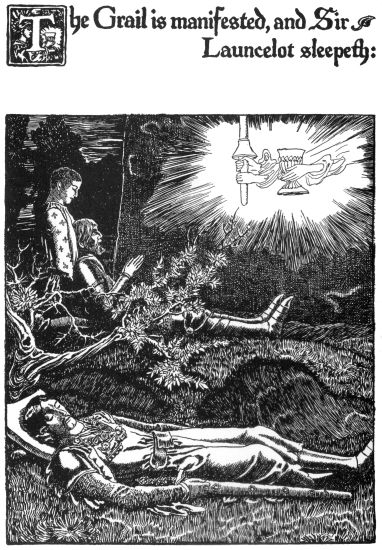
Now, as Sir Launcelot lay there, a drowsiness began to descend upon him, and though he could not sleep yet it was as though he did sleep, for he could move nor hand nor foot. Yet was he conscious of all that passed about him as though he had been wide awake. For he was conscious of the dark and silent vaults of sky, sprinkled all over with an incredible number of stars, and he was conscious of his horse cropping the herbage beside him in the darkness, and he was conscious of the wind that blew across his face, and that moved the corner of his cloak in the silence of the night time. Of all these things was he conscious, and yet he could not move of his own will so much as a single hair.
There cometh a wounded knight.
Anon, whilst he lay in that wise he was presently aware that some people were approaching the chapel in the darkness, for he heard the sound of voices and of the feet of horses moving upon the road. So, in a little while, there came to that place a knight and an esquire. And the knight was very sorely wounded, for his armor was broken and shattered by battle, and the esquire sustained him in the saddle so that, except for the upholding of the esquire’s arm and hand, he would have fallen prostrate down upon the ground.
Then Sir Launcelot, as he lay in that waking sleep, heard the knight say to the esquire, “Floradaine, is the chapel near at hand, for mine eyes are failing and I cannot see.” And the esquire wept and he said, “Yea, Lord, it is here. Sustain yourself but for a little and you will be there.”
To this the knight made answer, “Floradaine, I cannot sustain myself for long.” And the esquire said, “It is here.” The knight said, “Give thanks to God for that, for had it been a little farther I would have fallen from my horse. Now, Floradaine, lift me to earth.”
Therewith the esquire drew rein and he dismounted from his horse and he lifted the knight down from his charger, and the knight groaned very dolorously as the esquire lifted him down. Then, breathing very heavily and with great labor, the knight said, “Floradaine, is there a light?” And the esquire said, “Not yet, Messire.” Again, after a little, the knight said, “Is there yet a light?” And again the esquire answered, “Not yet, Messire.” And again, after awhile, the knight said for the third time, “Floradaine, is there yet a light?” And this time the knight breathed the words as in a whisper of death. Then of a sudden the esquire called out in a loud and joyful voice, “Yea, Lord, now I behold a light!”
There cometh a light.
All this Sir Launcelot beheld in that waking dream, and though it was in the darkness of night, yet he beheld it very clearly, as though it were by the sun of noonday. For he beheld the face of the knight that it was white as of pure wax, and that the sweat of death stood in beads upon his forehead. And he beheld that the esquire was young and fair, and that he had long ringlets of yellow hair that curled down upon his shoulder. Then when the esquire said that he beheld a light, Sir Launcelot beheld the windows of the chapel that they were illuminated from within with a pale blue lustre, as though the dawn were shining in that chapel. And he heard the sound of chaunting voices, at first very faint and far away, but anon ever growing stronger and stronger as the light from the chapel grew stronger. And those voices chaunted a melody that was so sweet and ravishing that it caused the heart to melt as with an agony.
Then the walls of that chapel opened like a door and a light shone forth with a remarkable lustre so that it illuminated the face of that dying knight, and of the page who upheld him. And at the same time the song burst forth in great volume, as it were a thunder of chaunting.
Then forthwith there came out of the chapel a bright shining spear, and two fair hands held the spear by the butt, yet Sir Launcelot could not behold the body to whom those two hands belonged. And after the spear there came forth a chalice, and two fair, white hands held that chalice, but neither could Sir Launcelot behold any body to which those hands belonged. And the chalice seemed to send forth a light of such dazzling radiance that it was as though one looked at the bright and shining sun in his glory.
Sir Launcelot beholdeth the Grail in a dream.
Then Sir Launcelot was aware that this was the Holy Grail of which he was in search, and he strove with all his might to arouse himself, but he could not do so. Then the tears burst out from his eyes and traced down his cheeks in streams, but still he could not arouse himself, but lay chained in that waking sleep.
So the chalice advanced toward that knight, but the knight had not strength to reach forth and touch it. Then the esquire took the arm of the knight and raised it, and he raised the hand of the knight so that the hand touched the chalice.
The Grail healeth the wounded knight.
Then it was as though Sir Launcelot beheld the virtue of the Grail go forth from it, and that it passed through the hand of the wounded knight, and that it passed through his arm and penetrated into his body. For he beheld that the blood ceased to flow from that wounded knight, and that the color flooded back into his cheeks and that the light came back into his eyes and that the strength returned to his body.
Then the knight arose and he kneeled down before the Grail, and he set his palms together and he prayed before the Grail.
Then, slowly, the light that had been so bright from the Grail began to wane. First the spear disappeared, and then the hands that held it disappeared. Then, for awhile, the Grail glowed with a faint, pallid light, and then it, too, vanished, and all was dark as it had been before.
So Sir Launcelot beheld the vision of the Grail, but as in the vision of a dream as I have told it here to you. And still the tears rained from his eyes, for he could not rouse himself to behold it with his waking eyes.
After this the knight and the esquire approached to the place where Sir Launcelot lay asleep, and the esquire said to the knight, “Messire, who is this man, and why sleepeth he here whilst all these wonders pass him by?” And the knight said, “This knight is a very sinful man, and his name is Sir Launcelot of the Lake.” Quoth the esquire, “How hath he sinned?” To which the knight replied, “He hath sinned in this way. He had a beautiful and gentle lady, and he deserted that wife for the sake of Queen Guinevere. So his lady went away and left him, and anon she gave birth to Galahad, and in that birth she also gave her life. So Sir Launcelot betrayed his wife, and because of that betrayal he now lieth sleeping, and he cannot waken until after we are gone away from this place.”
The knight taketh Sir Launcelot’s horse.
Then the esquire said to the knight, “Messire, behold; here this knight hath a good, strong horse. Take thou this horse and leave thine own in its stead. For this horse is fresh and full of life, and thine is spent and weary with battle.” And the knight said, “I will take that horse.”
So the knight took the horse of Sir Launcelot instead of his own. And he left his own horse behind him. Then he mounted the horse of Sir Launcelot and the esquire mounted his horse, and after that the knight and the esquire rode away from that place.
Then, after they had gone, Sir Launcelot bestirred himself and awoke. And he would have thought that all that he had beheld was a dream, but he beheld the worn and weary horse of the knight was there, and that his horse was gone. Then he cried aloud in great agony of soul, “Lord, my sin hath found me out!” And therewith he rushed about like a madman, seeking to find a way into that chapel, and finding no way.
Sir Launcelot is absolved by the Hermit of the Forest.
So when the day broke he mounted the worn and weary horse that the knight had left, and he rode away from that place and back into the forest; and his head hung low upon his breast. When he had come into the forest and to the cell of the hermit thereof, he laid aside his armor and he kneeled down before the Hermit of the Forest, and confessed all his sins to him. And the Hermit of the Forest gave him absolution for these sins, and he said, “Take peace, my son. For although thou shalt not behold the Grail in thy flesh, yet shall God forgive thee these sins of thine that lie so heavily upon thy soul.”
Then Sir Launcelot arose chastened from his confession. And he left his armor where it lay and assumed the garb of an anchorite. And he went away from that place, into the remoter recesses of the forest. There he dwelt in the caves and in the wilds, living upon berries and the fruits of the forest. And he dwelt there a long time until he felt assured that God had forgiven him. Then he returned to his kind again; but never after that day was he seen to smile.
So hath this been told to you that you may see how it is that the sins that one hath committed follow one through one’s life and in the end bring the soul such distress and failure as that which Sir Launcelot here suffered and endured. For it hath already been told in another volume than this book (which same is called “The Story of Sir Launcelot and His Companions”) how that Sir Launcelot of the Lake remained at the Court of King Arthur whilst his Lady, Elaine the Fair, quitted the court, and how that he remained at that court, being held there by the wiles and the charms of Queen Guinevere. Then it was told how that the Lady Elaine died for loneliness and grief in giving birth to Galahad, and it was told how that Sir Launcelot repented him for that death with deep and bitter remorse.
So it was because of that sin that he was not now permitted to behold the Grail with his waking eyes nor to touch it with his living hands. For a sin doth not quit a man because he hath remorse for it nor is it wiped from his soul because he repents him of it, but always it remaineth by him and by and by the time cometh when he must pay to the full the account of that sin which he hath one time committed.
For so it is with all of those who commit a sin, be it great or be it less. For they cannot correct that sin by remorse or by repentance, but only by so living a life of righteousness that that sin shall be removed away from them, so that it becometh as though it were not.