PART I The Story of Sir Geraint (continued 2)
Reading edition
Then each knight threw aside his lance and sprang from his saddle, and each drew his sword and each rushed the one against the other like two fierce bulls raging for battle. Each lashed at the other many terrible and severe strokes, and for a time neither had any advantage over the other. Several times Geraint was wounded and several times more he wounded his adversary. Thus they fought for a long while, and Geraint suffered many wounds, until at last, because of the smart of those wounds, his anger flamed up like fire and added strength to his strength. Then he rained blows fast and furious upon his assailant, striking him with terrible violence again and again and yet again, so rapidly and so fiercely, violently and furiously that the Little King bore back before him, holding his shield full low because of his weariness and wounds. Then Geraint beheld the opening that the other gave him, and with that he rushed in upon him, and he smote him with might and main upon the crown of the helmet.
So terribly fierce was that blow that it split apart the helmet and the iron cap beneath and cut deep into the bone beneath the cap.
Sir Geraint overthrows the knight.
Then the wits of the Little King flew away from him like a flock of flies, his strength deserted him, his thighs trembled and he sank down upon his knees. Thereupon Geraint rushed upon him and plucked the helmet off of his head. Then he catched him by the hair of the head and drew his head forward, whirling his sword aloft as though to strike the head off from the body.
At that the senses returned to the Little King, and he beheld that death was very near to him. So he clutched Sir Geraint about the knees, and cried out aloud, “Lord, spare me my life.” “I will spare thee,” said Sir Geraint, “upon one condition, and that is that thou wilt swear to be true fellow to me henceforth and shall be faithful to me as I shall be to thee. For certes thou art the noblest, worthiest knight that ever I have yet encountered.” Then the other arose from his knees. “Sir Knight,” said he, “I know not who thou art.” “I am Sir Geraint,” said Sir Geraint, “the son of King Erbin.”
“Well do I know of thee,” said the Little King. “Often have I heard of thee, and had I known who thou wert, I would not have assaulted thee.” Then the Little King said to Sir Geraint, “Sir Knight, Sir Geraint, I perceive that thou art hurt in several places, and I am very sorry for that. For lo, the leg-pieces of thine armor are all red with blood, and blood is flowing from thy body armor from several wounds. Thou art not fit to travel in the hot sun, so I pray thee that thou and thy lady will return with me to my castle. There thou mayst refresh and recover thyself from thy hurts, and rest and reinvigorate thyself for thy continued journeyings.”
But Sir Geraint refused him. “Nay,” said he, “I will not go with thee to thy castle, but instead of that I will go forward upon my way.”
Then the Little King looked at Enid, and when he beheld how fragile and how beautiful she was, and when he beheld how grieved she was that Geraint had suffered so many and such grievous wounds, he felt great pity for her. “Messire,” he said to Sir Geraint, “thou dost wrong not to rest thyself and have thy wounds looked to and dressed, for if thou fallest in with another adventure such as this, it is not likely that thou wilt be able to defend thyself from assault. Who then would have care of thy lady if harm should befall thee?”
Then Sir Geraint cried out very fiercely, “Sir, already have I answered thee that I will continue on my way, therefore do not try to dissuade me any further, for both I and my lady are going forward upon our way!” So saying he went to his horse and he mounted upon his saddle and he took his spear in hand and rode away from that place, and he bade the Lady Enid to ride on before him as aforetime she had ridden and so they quitted that place.
Sir Geraint suffers because of his wounds.
Sir Geraint stands beneath a tree.
Now the day was very hot so that the blood within the armor of Sir Geraint when he ceased to bleed, it dried upon him by reason of the heat of the sun. Then the wounds that Sir Geraint had suffered were glued with blood to the armor, so that he suffered three times more pain from those wounds now than he suffered when he had received them. But of this he said naught, only he rode along very grimly. But at last he could endure his pain no more, wherefore he called upon the Lady Enid to halt for a little while at a certain place where the oak trees of a woodland came down to the road and shaded the high-road. Then the Lady Enid would have helped him to dismount, but he would not suffer her to do so but forbade her, saying to her, “Go and stand aside under yonder tree, for my wounds ache me and I would be alone for a little while.” So Enid went to the other tree and stood there weeping, and Sir Geraint dismounted from his horse and stood under his tree, suffering very bitter pain from his wounds.
As they thus stood, there came the sound of a sudden tumult of horses and of voices, and the cause of that tumult was that King Arthur and his court were come hunting into the neighboring woodland. So whilst Sir Geraint was considering which way he should go to escape from them, he was espied by a foot-page who was attendant upon Sir Kay the Seneschal.
This page went to Sir Kay, and he said to him, “Sir, yonder under that tree is a man in broken and defaced armor who appeareth to be wounded.” Sir Kay said, “Where is he?” and then he too beheld Sir Geraint.
Sir Kay bespeaks Sir Geraint.
So Sir Kay came to where Sir Geraint was, and at his coming the Lady Enid slipped behind her tree, for she was ashamed for Sir Kay to behold her weeping in that place. So Sir Kay did not know Sir Geraint, but Sir Geraint knew Sir Kay. Sir Kay said to Sir Geraint, “Sir, how is this? I perceive you are wounded! What art thou doing here?” Sir Geraint replied, “I am standing under the shade of this tree so as to avoid the heat. For in the sun my armor clings to my wounds so that they ache me.” Said Sir Kay, “Whither dost thou journey, and who art thou?” Quoth Sir Geraint, “It matters not who I am. As for my journeying, wist thou that I am in search of adventure.” Said Sir Kay, “I wit thou hast had adventures enough for one day. Come with me and I will take thee to King Arthur, who is near by.” “I will not go with thee,” said Sir Geraint, “for I am not fit to stand before the King.” Said Sir Kay, “Thou must needs come with me.” And so saying, he advanced and laid hold of the arm of Sir Geraint.
Sir Geraint strikes Sir Kay.
Now in all this time, as hath been said, Sir Geraint knew Sir Kay who he was, but Sir Kay knew not Sir Geraint because his shield was so defaced with battle and his armor so stained with blood. But when Sir Kay laid hold of Sir Geraint, the anger broke hot within the wounded man, wherefore he lifted his spear, and he smote Sir Kay upon the head with the butt of the spear (for he scorned to strike him with the point thereof), and with the force of that blow Sir Kay fell down upon the ground, like an ox when the butcher smites it with a mallet.
After a little while Sir Kay stirred and then he sat up. Then he awoke and arose and went away, leaving Sir Geraint standing where he was.
Now it happened that the pavilion of Sir Percival was not far away. Thither went Sir Kay, and Sir Percival was in his pavilion. Sir Kay said to Sir Percival, “My page tells me that over yonder under that tree there stands a wounded man in armor. Hadst thou not better go and see who it is and bring him to King Arthur?” Sir Percival said, “Where is he?” Sir Kay said, “Over yonder. But beyond doubt he is hasty of temper, so be wary of thy approach to him.”
Sir Percival bespeaks Sir Geraint.
Then Sir Percival went thither to that tree and he beheld where Sir Geraint was standing, and he knew him not because his armor was so defaced and wounded and stained. But Sir Geraint knew Sir Percival who he was. Sir Percival said to Sir Geraint, “Sir Knight, wilt thou not come to the tent of King Arthur and have thy wounds searched and dressed?” “No,” said Sir Geraint, “I will not do so.”
Sir Percival knoweth Enid the Fair.
Now the Lady Enid heard the voice of Sir Percival and knew it, so she appeared from behind the tree and her face was all wet with weeping. And she cried out to Sir Percival, “Sir Percival, I beseech thee to compel him to go to King Arthur.”
Then Sir Percival knew the Lady Enid and he wist that the wounded man must be Sir Geraint. So he cried out, “Sir Geraint, is it thou?” Sir Geraint said, “Nay, I am not Sir Geraint.”
But Sir Percival put these words aside and he said, “What condition is this that thou and thy lady are in, and whither wouldst thou go? If thou goest forward, thou wilt die, and if thou stayest here thou wilt die.”
Sir Geraint said, “I will go forward,” and at those words Enid fell to weeping again.
Now there was a page standing a little aside and Sir Percival beckoned to him and the page came to Sir Percival. Sir Percival whispered to the page, saying, “Go, find King Arthur and tell him that Sir Geraint is standing here wounded,” and the page made haste and ran away.
Then Sir Percival spoke aside to the Lady Enid and he said to her, “How is it that thou and thy lord are in this outland place?” Enid replied, “I know not how it is, but my lord commanded me to ride errant with him and I have done so.” Sir Percival said, “Certes, I think he is mad.”
King Arthur comes to Sir Geraint and Enid the Fair.
Anon King Arthur and several of his court and Queen Guinevere and several of her court came to that place. Sir Percival said to King Arthur, “Lord, this is Sir Geraint whom thou seest here in such a sad melancholy condition.” And Geraint said nothing, only he groaned very dolorously. King Arthur said to the Lady Enid, “Enid, how came ye to this pass?” “Lord,” said Enid, “I know not how it is, only that whithersoever my lord goeth, thither also I am bound to go.” Then King Arthur said to Queen Guinevere, “Lady, I pray thee take the Lady Enid and care for her. As for Sir Geraint, him shall I put beneath the care of my physicians.”
“Lord,” cried out Sir Geraint, “I beseech thee to let me go upon my way thither I was going.” “I will not do so,” said King Arthur. “Thou art mad, for that would let thee go to thy death. Thou canst not live with such wounds as those that cover thee, fresh and undressed as they are.” Then Sir Geraint said, “They are not so bad,” but King Arthur would not listen to this.
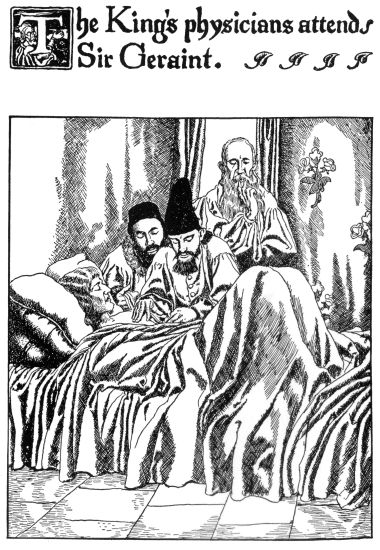
The physicians search the wounds of Sir Geraint.
So King Arthur had a tent pitched at that place, and he had a soft couch laid within the tent, and he had Sir Geraint laid upon the couch. And the King had his own physicians come to search the wounds of Sir Geraint and to anoint them and to bind them up, and so Sir Geraint was put in great comfort from their attention.
Meanwhile the Queen brought the Lady Enid to her pavilion and she had her change her riding robes for clothes of another sort. And she asked Enid many things and Enid told her many things of her adventures, and all marvelled at what the Lady Enid had to relate.
So Geraint and Enid remained at that woodland court of King Arthur for nearly a month, and Enid was very well entertained by the court of the King. And whilst it was so that she was not permitted to see Sir Geraint nor to speak to him, yet she heard very intimately from him from day to day, and wist that ever he was becoming healed of his wounds. For, after that month was passed, Sir Geraint’s wounds were knit together and were scarred over with fair white flesh. And even at that time Sir Geraint grew restless, for as he grew stronger of body he remembered more and more strongly the words that he had overheard the Lady Enid speak that morning when he awakened, and again he doubted her.
So one day he said to King Arthur, “Lord, I pray thee let me depart from this place, for I must be upon my journeying again.” King Arthur said, “Messire, whither wouldst thou go?” Geraint said, “I know not, saving only that I would go errant in search of adventure.”
King Arthur said, “Then let thy Lady abide at this place.” Quoth Sir Geraint, “She cannot abide here, but she must travel abroad with me.” King Arthur said, “Sir, this is not folly but madness, for thy lady’s body is too soft and delicate for her to endure such hardships as thou wilt have to endure.” “No matter,” said Sir Geraint, “she must travel with me whithersoever I go.”
Then King Arthur considered a little and after a little he said, “Sir, I will not let you go until my physicians declare you to be healed.” Quoth Sir Geraint, “Call the physicians.”
So King Arthur summoned the physicians and he asked them if Sir Geraint was healed of his wounds and the physicians declared that he was healed.
Sir Geraint and Enid depart from the Court of the King.
So King Arthur gave leave to Sir Geraint to depart and that day Sir Geraint took leave of King Arthur and his court and he and the Lady Enid departed as aforetime. That is to say, the Lady Enid rode some distance ahead of Sir Geraint, and Sir Geraint rode some distance behind the Lady Enid as it was before.
Here followeth the further adventures of these two which you may read if you will peruse that which is herein written.

Chapter Sixth

How Sir Geraint destroyed three giants of the highway. How he was hurt, and how he and the Lady Enid were carried off by a knight of that country. Also how Geraint slew the knight.
Sir Geraint finds a lady in grief.
NOW after they had travelled in that wise for some time they came to a wood, and the wood was very thick and dark and dismal, and some way in the wood they heard the sound of a voice lifted in lamentation. Thitherward they directed their steps and anon they came to an open glade of the forest. Here they beheld a lady and two horses and the figure of a knight who lay dead, all covered with blood, upon the ground. Sir Geraint said to that lady, “Lady what ails thee?” “Alas!” she said, “I have journeyed thitherward, but three gigantic oafs broke out of the woodland upon us. Him they slew as thou beholdest and so I sit mourning for him here.”
“What way went these giants of whom thou speakest?” said Sir Geraint. “They went yonder way by that path,” said she.
Geraint said to Enid, “Bide thou here for a little while with this lady, and I will ride forward and punish those three giants.” Enid said, “Lord, remember thou art only now fresh from thy bed of pain.”
But Sir Geraint paid no heed to what Enid said, otherwise he rode forward upon the path that the lady had pointed out. After awhile he beheld before him the three gigantic men, walking side by side along the way.
Each wore about his body a huge body-piece of armor, and each carried over his shoulder a huge club shod with iron.
The giant strikes Sir Geraint.
Upon them Sir Geraint charged, and the first of the three he ran through his body with the lance. Then he withdrew the lance very quickly, and charged the second of the three, and him also he transfixed with his spear. But ere he could withdraw his lance again the third of the three smote him a terrible buffet with his club so that his shield was split and his helmet was split and the armor was beaten off from his shoulder. Under that blow Sir Geraint fell upon his knees, and all his wounds burst out bleeding as though they were freshly given. But quickly he recovered himself. He drew his sword, and rushing at the giant he smote him with the sword so that his head and his neck and his shoulders were split asunder even to the pap of the breast, and that giant also fell dead to the ground.
Sir Geraint swoons a death-swoon.
Then leaving those three where they lay, Geraint mounted his horse again and returned to where he had left Enid and the widowed lady. And when he came to her he tried to speak but he could not speak. He began by saying “Lady—” but then he stopped, and swaying from side to side, he fell lifeless from his horse to the ground.
Then Enid ran to him and lifted his head and laid it in her lap. And Enid thought that he was dead, for his face was the color of wax for whiteness. Then believing him to be dead she lifted up her voice and wept very loud and shrill.
Now it chanced that an earl known as the Earl of Limours was in that part of the forest, and several of his attendant knights were with him. These heard the loud piercing sound of Enid’s grief, and the Earl of Limours said, “Hark! What is that sound?” And one of his attendant knights said, “It is the sound of somebody in grief.” Quoth the Earl, “Let us go thitherward.”
The Earl of Limours comes to that place.
So the Earl of Limours and his attendants galloped toward that place, and anon they came out into the forest glade. There they beheld the four horses, and the two ladies and the two knights.
The Earl of Limours said to Enid, “Lady, what is the cause of thy grief?” “Alas, Sir,” she cried, “the only man that I ever loved or ever shall love is slain.” Then the Earl of Limours said to the other lady, “What is the cause of thy grief?” Quoth she, “They have slain my husband also.” “Who was it slew them?” said the Earl of Limours. “My husband,” said the Lady, “was slain by three giants. This other knight pursued the three giants, and when he returned he was as thou seest.” “Whither went those giants?” said the Earl. She replied, “They went yonder ways.” “I will go and see what has befallen them,” said the Earl of Limours.
The Earl finds the dead outlaws.
So that Earl took several of his knights and he went in that direction, and in a little while he found all three giants lying dead upon the ground. “Pardee,” quoth he, “yonder was a parlous strong knight to slay all three of those giants.”
The Earl carries Sir Geraint to his castle.
After that he returned to the forest glade and he made examination of the knights that lay there. The one knight he found was dead, but it did not seem to him that Sir Geraint was altogether dead. So the one knight he buried, but Sir Geraint he laid in the hollow of a shield with his sword behind him. And he laid him upon a bier and so he bore him away toward his castle, the two ladies accompanying them.
By and by, after a very long journeying, they came to the castle of the Earl of Limours. And the castle was very large and comely and strong.
The Earl and those who were with him entered the castle and he had the shield with Sir Geraint stretched upon it borne into the hall of the castle. And he had his physician to come and examine Geraint and the leech came and made examination of him. Then after due examination the leech said that he was not yet dead, but that he was exceedingly near to death.
Then the Earl bade the two ladies to go and change their clothes and to assume garments that were more fitting to grace that hall, and the other lady went as he bade, but Enid would not go.
The Earl of Limours said to her, “Lady, thou art not wise in this, for I mean well by thee. Thou pleasest me very greatly by thy appearance. When thy lord is dead, then will I marry thee and will bestow upon thee myself and this castle and all these lands through which we passed to-day, and all other things thou shalt have that are mine.” But Enid only wept, and she said, “Alas! I know not what to do, for I am very lonely. If my lord dieth, nevermore shall I have any more joy or happiness as long as I shall live.”
The Earl of Limours said, “Take heart, my pretty one.” But she said, “I cannot take any heart.” Then the Earl gave orders that a feast should be made ready, and it was done according to his command. And when that feast was ready, he said to Enid, “Come and sit here beside me and eat.” She said, “I will not eat and I will not sit at table unless my lord sits here also.” Then the Earl laughed, and he said, “Lady, thou art very foolish in this, for thy knight will never sit at table again, for he is dead, or else he is dying.” Then Enid wept again, very bitterly.
The Earl of Limours strikes Enid the Fair.
The Earl said, “Come sit beside me, and I will have thy knight at table also.” So he had them bring the bier whereon Sir Geraint lay to the side of the table. Then he took Enid by the hand and led her to the table and compelled her to sit beside him. But still she would not eat. Then the Earl offered her a goblet of wine and he said, “Drink this wine, for it will help thee to forget thy sorrows.” “I will not drink,” she said, “until my husband shall arise and drink with me.” Then the Earl of Limours became angry. “A plague upon thee and thy knight!” he cried, and so crying he lifted his hand and delivered to her a box upon the ear.
Then Enid felt her loneliness as never before. For she knew that had Geraint been with her the Earl of Limours would not have dared to serve her thus. So when she felt that blow upon her face she lifted up her voice and shrieked aloud.
Now Geraint had been recovering from his swoon, but still he lay with his eyes closed listening to what was said and done about him. And he heard Enid how that she refused to eat or to drink, and he heard the blow that the Earl of that place delivered upon her face, and he heard her shriek with the pain thereof. At that the eyes of his soul were opened, and he beheld how mad and how blind he had been, and he knew how faithful to him Enid had been, maugre any words she might have uttered. Then rage and shame flamed up like fire within him, the last vapors of his swoon passed away, and he felt within him the strength of ten.
Sir Geraint slays the Earl of Limours.
Thereupon he grasped the sword that lay beside him in the hollow of the shield and he arose from the shield all white and wan and smeared with blood, and those who beheld him saw him arise as though from the dead. Then they shrieked and screamed and fell aside before him. But Geraint leaped from the hollow of the shield and he ran to where the Earl of Limours sat, and crying out, “Wouldst thou dare to smite my wife?” he smote him with all his might upon the head. So terrible was that blow that it smote asunder the head and the neck and the breast of the Earl, and was only stopped by the oaken board of the table against which the sword blade smote in its descent.
Then all those who thus beheld the dead man arise from his death and strike that blow, shrieked and roared aloud, and they fled away from that place in terror and amazement, and no one was left but Geraint and Enid, and the dead man sitting dreadfully in his seat.
Then Enid said, “O my lord! Art thou dead or art thou alive?” And Geraint said, “Beloved, I am alive and well.” And Enid said, “I thank God for that.” But Geraint said, “Let us hasten to escape from this place whilst we may, for presently these people will return again.” And he said to her, “Where are our horses?” She said, “I know not where is my horse, but thy horse is in the house yonder, for I saw them put him there.”
So Geraint and Enid went to the house that was near at hand and there Geraint found his horse. And Geraint took his horse out of the stable and he mounted upon his horse and he reached his hand to Enid and lifted her up from the ground and placed her upon the horse behind him; and she clasped her arms around his body and felt his body with her arms with great joy and delight.
Sir Geraint and Enid depart from that place.
So they rode away from that place and no one dared to stop them, for all believed that it was the living riding with the dead.
Then, when they were come out into the sunlight again, Sir Geraint turned his head and looked his lady, Enid, in the face, and he perceived how she had lost her color and was grown thin and fragile because of the hardships to which his anger and his injustice had subjected her. Then he turned his own face away and bowed his head.
By and by he lifted his head and said to her, “Lady, canst thou forgive me?” To that she smiled a little, but very faintly. “I do forgive thee,” said she, “but never shall I forget.” Therewith the tears ran from her eyes and fell like diamonds down her cheeks, and Sir Geraint turned away his face again and again bowed down his head.
So they rode in silence, each occupied with his or her own thoughts, until at last they came to a place where there were high hedges upon either side of the way. At this place they heard the sound of many horses coming toward them, and in a little while they perceived the points of a number of spears between them and the sky over the top of the hedge. So Geraint put Enid upon the other side of the hedge and made him ready to face those who were coming.
The Little King finds Sir Geraint and Enid.
Anon there came a small host of horsemen in armor into that road, and the first of all those who came was the Little King. Then Geraint cried out with joy, “Is that thou, the Little King?” And the other said, “Yea, it is I, but who art thou?” For he did not know Sir Geraint because of the blood that was upon him and because of his changed appearance. Then Geraint said, “It is I, Geraint the son of Erbin.”
Then the Little King came forward, and embraced him. And Enid came forth from her hiding, and the Little King paid his respects to her. Quoth the Little King, “I was in search of thee, Sir Geraint, for I heard thou wert in trouble. So I am here.” And Sir Geraint said, “That is according to the conditions of our bond.”
So Sir Geraint and Enid and the Little King returned along the way toward the castle of the Little King, and when they reached the castle the wounds of Sir Geraint were searched and dressed and he was made in all wise as comfortable as he could be.
THUS have I told you the story of Sir Geraint and of Lady Enid at this, its fitting time.
Of the story, how it hath been sung of old.
This story has been very often sung and told and so you have no doubt heard of it or read it before this. For it hath been told by a great poet, and it hath been told by the ancient bards of Wales, and both that great poet and I have obtained it from those ancient chronicles of the Welsh Mabinogi.
But as this story concerns the story of King Arthur and his court, so it must be written when it cometh in its due place and so I have written it.
So I pray you read it and consider it as a very famous story of one of the chiefest knights of the Round Table of King Arthur.
And now I shall have to tell you of the coming of Sir Galahad and of the Quest of the Grail by certain of the Knights of King Arthur and his Round Table, and of how certain other knights failed in that quest. So if you will read that which followeth you shall be informed of all those very wonderful things which many people for many years believed to be sooth and real.