PART II The Story of Sir Galahad (continued 2)
Reading edition
So it was with Launcelot, for he was to pay in full for that sin which he had committed. For never did he behold the Grail other than it was at that time and never did he touch it with his hand; nay; never did he touch it even with so much as a single finger; but otherwise he remained as a recluse in a cell coadjacent to the cell of the Hermit of the Forest, as aforesaid.
There leave we him to follow the other parts of this story, for here followeth the story of Sir Percival, which you are now to read if you would enter further into the history of these things herein told of.

Chapter Fifth

Sir Percival findeth a horse that nearly bringeth him to destruction. Also he meeteth a fair damsel and feasts with her. Finally he enters a boat and there finds rest and comfort.
NOW, after Sir Percival had left Sir Launcelot as aforetold of, he rode upon his way alone. And his way led him, by and by, through a waste of land where was nothing growing, but where there were great quantities of stones scattered all over the earth. Here he rode for some time, looking forward before him for something that grew.
Sir Percival’s horse falleth lame.
So while the mind of Sir Percival was elsewhere, the horse which he rode slipped his foot upon a round, loose stone, and the stone turned under the horse’s foot so that it strained its shoulder. At first Sir Percival knew naught of this mishap, but presently, anon, the horse began to limp as it walked. And every minute the horse of Sir Percival limped worse than it had limped the minute before. So Sir Percival wist not what to do, for here was he with a horse that could not fare farther with him, and there was no house within sight, and there was no person within sight upon all that barren waste.
So Sir Percival dismounted from his horse, and he took the bridle of the horse over his arm, and so he walked with the bridle over his arm and the horse limped behind him.
Thus he travelled for a great way, and anon he left that stony waste behind him, and came to a country where green things grew. And anon after that he came to a place that was spread all over with fertile fields of grass interspersed with plantations of trees, both oak trees and elm trees.
Sir Percival meeteth a damsel in red.
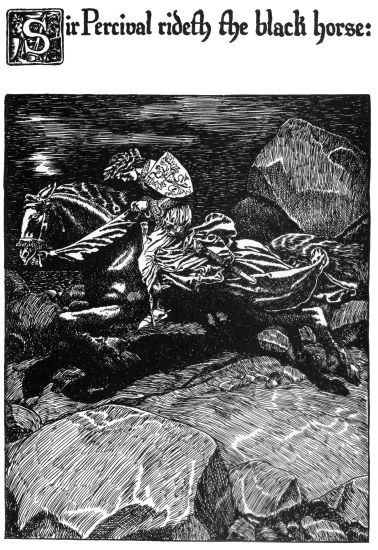
Here, passing by a small fountain of water, he beheld a fair damsel sitting beside the margin of that fountain, and the damsel was clad all in red, from top to toe. This damsel had with her a palfrey and a great black horse beside that palfrey, and the black horse was very remarkable for breadth and sinew, for his shoulders were deep and his legs were corded with muscles, and his fetlocks were adorned with long and curling hairs, and his eyes were very bright and shining as with fire beneath them, and his ears were sharp and pointed, as though they had been cut with a fine knife, and his mane and tail were thick and black, like the clouds of night, and there was not a white hair upon him, from the tip of his nose to the end of his tail.
The damsel giveth a horse to Sir Percival.
Quoth Sir Percival, “Hah, maiden, that is a fine horse that thou hast there.” Said she, “Yea, Messire; he is a very fine horse.” Said Sir Percival, “I would that thou wouldst sell me that horse; for mine own, as thou seest, is gone lame.” The maiden said, “Sir, are you not Sir Percival of Gales?” Then Sir Percival was greatly astonished that the damsel should know him, and he said, “Yea, damsel, that is my name.” “Then,” quoth she, “I cannot accept money from you for this horse. But if you will take him for your own, then you may have him. So leave you your lame horse here, and take this horse instead of it. For wit you I have been sent with this horse that you might have it to ride upon.”
Then was Sir Percival still more astonished at what the damsel said, and he knew not what to think that the damsel should be there at that place with a fresh, sound horse for his use when his own horse had fallen lame. So he thanked the damsel in great measure, and he handed her the reins of his horse, and took the reins of the black horse. Then he put his foot in the stirrup and mounted the black horse at one leap.
The horse rideth away with Sir Percival.
So the horse stood quite still until Sir Percival had his seat and his feet in the stirrups. After that it bowed its head and took the bit in its teeth. Then immediately it rushed away to the southward with great speed like the wind, and its mane and tail stood out straight behind it because of its speed. Nor could Sir Percival control or guide it, for the horse held the bit between its teeth and it was as though blinded, rushing forward like the wind. And ever it ran toward the southward, without let or stay. And Sir Percival said to himself, “What sort of a beast is this upon which I am sitting, is it a horse or is it a lion or is it a dæmon?”
The horse bringeth him to the sea.
So the horse rushing onward began, by and by, to draw nigh to the sea, for now and then Sir Percival could catch glimpses of the sea across the uplands like a thread of bright silver against the distant horizon; for by this time night had fallen. And anon he could hear the roaring of the sea beating upon a place where there were a great many rocks, and where the water spouted and churned amongst the rocks as white as milk. Then, reaching this spot, the horse stopped all of a sudden, panting and trembling and all a lather with sweating foam.
Then Sir Percival dismounted from the horse, and as soon as his foot touched the earth the black horse vanished and Sir Percival stood there alone. And he wist not what to do, but stood there doubting and wondering.
Sir Percival meeteth a beautiful lady.
Anon as he so stood he beheld something coming a great way off, and ever it came nearer and nearer, and by and by he perceived that it was a boat, and that it was approaching very rapidly the place where he stood, and that without either sails or oars to urge it upon its course. So Sir Percival stood there and watched the boat as it drew rapidly nearer to him, and by and by he perceived that there was someone in the boat, and then he perceived that it was a beautiful lady, and that there were seven beautiful damsels attendant upon her. And he beheld that this lady was clad all in red, and that her hair was red, the color of gold, and that it was emmeshed in a net of gold. And around her dress and her neck he beheld that there were chains and ornaments of gold, so that the lady sparkled and gleamed as though she had been an image of jewels and of gold. And the attendants of the lady were also clad in red and also wore ornaments of gold about their necks, wherefore the whole boat gleamed and shone as with a shine of golden light.
Thus that boat came to the beach where Sir Percival stood, and the lady stepped from the boat upon the sand, and Sir Percival came forward and assisted her to disembark. And the lady said, “Hail, Sir Percival, and give thee peace.” And all the attendants of that lady also said, “Give thee peace.”
Quoth Sir Percival, “Who are ye who know me and I know not you?” To the which the lady made reply, “We are fay and not of this earth, therefore we know many things that you wit not of.”
Sir Percival sits at feast with the lady.
Then that lady bade her attendants to set up a pavilion and they did so, and the pavilion was of red samite, and above it was a great banner of white samite embroidered with the figure of a leopard in threads of gold. And in the pavilion they set a table of gold, and they covered the table with a napkin of finest linen, and the lady of the boat took Sir Percival by the hand and led him into the pavilion.
Then Sir Percival and the lady seated themselves at the table, and the damsels attendant upon the lady served them with food. And certain of these attendant maidens took harps into their hands, and they played upon the harps, and sang in unison to those two, and so sweet was the music they made that it melted the heart to listen to them.
And those who waited upon Sir Percival and the lady brought to them all manner of dishes, dressed with spices and condiments of all sorts, and Sir Percival and the damsel ate together. Then others brought wines of all sorts, both white wines and red, and this wine was very powerful and sweet, and Sir Percival and the lady drank together. And the wine flowed very strongly through the veins of Sir Percival so that his head swam with the strength of that wine and with the potency thereof.
Then, by and by, the lady grew very fond toward Sir Percival, and she put her arms about his shoulders and held him very close to her. With this the wine swam still more powerfully in Sir Percival’s head, and he knew not very well what he said or did. And he said, “Lady, tell me—what is this, and why am I here?” To this she answered, “Percival, thou glorious knight! this is the pavilion of Love, and I am the spirit of Venus who inhabits it. So yield thou to that spirit and take thou the joy of thy life whiles thou mayst.”
Sir Percival kisses the lady.
Therewith she reached her arms again to Sir Percival and he reached his arms toward her and he took her into his arms. And Sir Percival kissed her upon the lips and the fire from her lips passed into his heart and set his soul aflame.
Then, in that moment, he knew not why, he suddenly bethought him of that fair lady whom he had met in the tent when first he went forth as a knight, clad in his armor of wicker-work. And he thought of how he had kissed her that time; and he thought of how he had beheld her in that cold and windy room of the castle, lying dead and white before him; and he thought of how he had beheld the Spear and the Grail that time in the castle. Then it was as though a wind of ice struck across the flame of his passion, and he cried out thrice in a loud voice, “God! God! God! What is this I would do, and why should I sin in this wise?” And therewith he drew upon his forehead the sign of the cross.
The lady disappears.
Then in an instant the lady who sat beside him shrieked very loud and shrill, and all about him was confusion and turbulence. And Sir Percival looked, and behold! it was not a strange and beautiful lady who sat beside him like a wonderful goddess, but it was the Enchantress Vivien, clad in red and bedecked with her jewels. For it was she who had thus planned the undoing of Sir Percival by causing him to sin.
Then Sir Percival cried, “Hah! Is it thou who wouldst betray me?” And therewith he reached for his sword which he had laid aside. Then, seeing what he intended, the Enchantress Vivien shrieked again, and she smote her hands together, and in that instant she disappeared, and all her attendants disappeared, and the pavilion and the table and all of the feast and wine disappeared, and the boat in which she had come disappeared, and Sir Percival found himself sitting alone upon the seaside.
Then Sir Percival kneeled down and he set his hands together and he prayed. And he said, “O God! how hast thou saved thy servant by means of a floating thought? For the thought of that which was sacred and holy hath purged my sin that was very close to me.” And he said, “How shall I thank thee for this; for lo! I trod upon a crust so thin that, had I borne even a part of my weight upon it, I would have fallen through that crust as into a lake of fire.”
So he prayed for a long time and by and by he was comforted. Then he arose and stood up, and he girded his sword tight about him. And he cast his eyes all around and he beheld that he was alone and in a very desolate place. And, at that time, the full moon was shining very brightly.
Anon he beheld in the gloom of the distance an object that approached very rapidly. And this object also was a boat, but there was no one in it.
And when the boat approached nigh enough he beheld that there was a couch within it, and that the couch was covered with white linen. But no other thing was in the boat but that.
Then Sir Percival said, “What is this? Is there a sin also in this, or is it without sin?” And he said, “If this be sin, then let it declare itself,” and therewith he marked the sign of the cross upon his forehead.
But there followed not any malignant sign after that, but the boat remained there where it was.
Sir Percival entereth a boat.
Then Sir Percival perceived that it was intended for him to enter that boat, and he did enter it. And at that time the moon had arisen very full and round. And the moon shone down upon the earth with a wonderful radiance. So that what with the light in the sky from the moonlight, it was as though a strange and magical radiance embalmed the entire earth.
The boat sails away with him.
Then the boat moved away from the shore very rapidly and smoothly. And it ran past the sharp and treacherous rocks, and it went past all obstructions and so out into the broad and heaving surface of the sea beyond.
Here all was stillness and peace, for all about was the hush and silence of night time, and there was no sound whatsoever to mar that stillness, but only the moon and the stars shining above in the sky.
So Sir Percival laid him down upon the couch and anon he slept a very deep and dreamless sleep.
Now leave we Sir Percival lying in that boat, and turn we to the story of Sir Bors de Ganis and how it befell with him at this time.
Chapter Sixth
How Sir Bors confessed himself to the Hermit of the Forest. How he overthrew a knight, and how he came to the seashore and of what befell him there.
Sir Bors confesses to the Hermit of the Forest.
UPON a certain day Sir Bors rode into the forest, and by and by he came to the chapel of the Hermit of the Forest. And the Hermit welcomed Sir Bors, saying, “God save thee,” and Sir Bors greeted the Hermit, saying, “God save thee and keep thee, Sir Hermit.” So Sir Bors abided that night with the Hermit of the Forest, and when the next morning had come he besought the Hermit to confess him. And the Hermit of the Forest shrived Sir Bors, and he beheld that the soul of Sir Bors was very white and clean and that he was extraordinarily free from sin. And the Hermit said to him, “Sir, if valor and if purity of life may so recommend a man that he may win the Grail, then will you certainly behold it with the eyes of your body and touch it with the hand of your flesh. For you are both very brave and very pure of life.”
To this Sir Bors said, “Sir, that which you tell me is exceedingly comforting to me, for so would I rather achieve a sight of the Grail and touch that sacred vessel than anything else in all the world. Now, I pray you, tell me if there is anything else that I may do that may better fit me to find that holy chalice.”
Sir Bors vows a fast.
Quoth the Hermit, “There is but one thing, and that thing is that you finally purify yourself by refraining from eating any manner of meat, and that you fast upon bread and water until you have beheld and have touched the Grail.” Said Sir Bors, “Holy Father, so will I fast from meat and wine.” And the Hermit said, “And this also shall you do. You shall lay aside your armor and shall ride forth in leathern doublet and hose and shall wrap yourself in your red cloak against the inclemencies of the weather.” Said Sir Bors, “That also will I do.”
So Sir Bors laid aside his armor of defence, and he wrapped himself in his red cloak, and thus he rode forth into the world.
After that Sir Bors travelled for an entire day, and whensoever he came to a roadside cross, he kneeled down before it and recited a prayer. So against early eventide he came to a part of the country that was altogether strange and new to him, for here were bogs and marshes, and many pools and ponds of water where were heron and other water-fowl. So Sir Bors wist not where he should lodge that night. But anon he beheld in the distance before him a single tower standing upright upon that flat expanse, and the tower was like a finger of stone pointing up into the sky. So Sir Bors made his way toward the castle, and by and by he came to where the castle was.
Sir Bors cometh to a castle.
Coming to that place Sir Bors smote upon the doorway of the castle, and he smote again and again. By and by one came and opened the door, and that one was a very aged porter clad all in buckram, and the buckram was stained and blotched, as with the stain of many years.
The porter said to Sir Bors, “Sir, who are you, and whence come you?” And to this Sir Bors made reply, “I am one seeking lodging and shelter for the night.” The porter said, “Sir, I pray you enter, for you are exceedingly welcome, and the lady of this castle, though just now in very great sorrow, is about to sit at supper.”
So Sir Bors entered the courtyard, and he tied his horse to an iron ring that was in the side wall of the castle in the courtyard. Then the aged porter led Sir Bors to his room and there left him to wash and to refresh himself, whilst he returned to the horse to put it into the stable and to feed it.
After Sir Bors had washed and refreshed himself he descended from his room again, and there he found the aged porter awaiting him. The porter said, “Sir, come with me,” and Sir Bors followed him. And the porter led the way from that place into a hall, where there was a table set out for refreshment.
Here Sir Bors beheld a young and very beautiful lady, and she was the chatelaine of the castle. The face of this lady was very white and exceedingly sorrowful, and her eyelids were red as with continual weeping. And she was clad in a long, straight black robe, without ornament or adornment of any sort. She received Sir Bors with great civility, albeit she did not smile at all; and anon they sat down at table together.
Sir Bors sups with a beautiful lady.
So the supper was brought in and set before them, and it was the old porter who served them with their meal. But Sir Bors ate no meat, neither did he drink any wine; otherwise, he ate of the bread and drank of the water that was set before them. Anon the chatelaine of the castle said to him, “Sir, you do not eat of the food of the castle that is set before you. How doth that happen?” Quoth he, “Lady, I do not eat the food because I have assumed a vow to eat no meat of any sort until I have accomplished a certain purpose, and I drink the water because I have made the same vow concerning wine.” And the lady said, “To what purpose is that, Messire?” Quoth he, “I am in quest of the Grail, and to that end I travel, fasting and mortifying myself.”
The lady tells her story.
Then, after a little while, he said to her, “Lady, you are sad, will you not tell me the cause of your sorrow?” To the which she said, “Sir, that will I gladly do. It is thus: my father was the king of all this land as far as you can see to the westward of this. For this castle standeth upon the marches of my father’s country, and is very near to the lands of another king who is neighbor to this place. My mother died, and my father married another lady who was both wicked and cruel. So when my father died this lady seized upon my inheritance, and cast me out into the world upon mine own dependence. After that she drove me from castle to castle until this is my last refuge and defence. For now I dwell herein with only this ancient porter and his wife in attendance upon me. Nor is she satisfied to leave even this poor house in my possession, for to-morrow she cometh with several knights to drive me forth from this my last refuge.”
Sir Bors offereth himself for her defence.
So said the Lady Chatelaine of that place, and when she had ceased speaking she wept with a passion of tears. Then the heart of Sir Bors was greatly moved with sympathy, and he said to her, “Lady, I am greatly grieved at thy sorrow and at its cause.” And he said, “What is thy name?” She said, “It is Leisette.” Then said Sir Bors, “Lady Leisette, let me tell thee that had I but a suit of armor to wear, I would stand as thy defender upon this occasion, and that to-morrow I would stand between thy father’s wife and thee, even though the knights that follow her be several and I be but one.” “Sir,” said the lady, “It may hardly be that one knight could withstand the assault of several; but I may tell you that in this castle there is a suit of armor (though of a bygone date), that might serve your purpose. But to what end would you use it? For the knights attendant upon this lady are all well-tried knights of battle, and you are maybe not accustomed to wearing armor, seeing that you travel through the world without armor of any sort upon your body.” Then Sir Bors smiled, and he said, “Let that be as it may; nevertheless, I have worn armor more than once in my life; so I pray you to send that suit of armor to my room to-night, that I may look at it, and perhaps try it on.” And the lady said, “It shall be done as you ask.”
So that night the old porter brought the armor to the room of Sir Bors, and he assisted Sir Bors to clothe himself in the armor, and Sir Bors found that the armor fitted him very exactly, and he was glad.
Now when the next day was come Sir Bors walked with the Lady Leisette in the gardens of the castle. And Sir Bors beheld that she was exceedingly beautiful and his heart went out to her, and he said to her, “Lady, meseems your trouble lyeth in this, that you have no knight for your husband who may defend your rights and claims. Were you wedded to such a knight, then, you would not suffer these wrongs.” Quoth she, “What knight would take me for his wife, who am a dowerless lady, with only one castle left of all her inheritance?”
Sir Bors talketh at length with the lady.
He said to her, “I say naught concerning myself and mine own strength and valor. But this I will say, that if I have such fortune as may lead me to overcome your enemies to-day, I would offer myself to you as your husband.” She said, “Sir, thou doest me great courtesy. Were I owner of those three considerable towns that were once my father’s then I would take thee for my suitor. But as I am now the puppet of so sad a fate, what shall I say to thee?” Quoth he, “Say aye.” And she said, “Who art thou, sir?” Quoth he, “I am called Sir Bors de Ganis.” Then she said, “Aye,” speaking with downcast eyes, and so low a voice that he could hardly hear her. For the name of Sir Bors was very well known throughout the entire world, both because of his strength and his valor. Wherefore she was very much pleased to have him with her.
Just then there came to them the old porter of the castle and he said to them, “Prepare yourselves, for hither cometh the Queen of this country, together with a court of lords and ladies, and with several knights champion for her escort.” Then Sir Bors said, “Now I will go and arm myself for battle.” And she said, “Go!”
So Sir Bors withdrew to his room and the porter of the castle went with him, and the porter put upon him the pieces of armor and buckled them very tightly together so that they joined and fitted. And they buckled a great sword upon one side of him and a misericordia upon the other. Then when he was in all wise prepared, he took a mighty lance into his hand and went down into the courtyard and mounted upon his horse. Then came the Lady Leisette to him and saluted him and he said to her, “Give me, I pray you, some favor for to wear.” And she said, “I will do so,” and therewith gave him the scarf from about her throat. And she tied the scarf about his arm. Then the porter of the castle opened the gate, and Sir Bors rode forth from the castle and took his stand in the high-road in front of the castle, and awaited the coming of those others who were now drawing near to that place.
Sir Bors offereth himself as champion.
Anon the Queen of that country perceived Sir Bors where he stood and she cried out to him, “Sir, who are you who stand there, and why do you confront us so?” To the which Sir Bors made reply, “Lady, I am the champion of the lady of this castle, and as her knight I stand here to await your coming.”
She said to him, “Know you to whom you speak?” and he said, “Yea, I know very well; therefore I am here.”
Then the Queen was very angry, and she cried out to one of her knights, of whom there were seven in all, “Remove this man from our path so that we may enter the castle and turn out of it that lady who now holdest it.”
Thereupon, with that saying, the knight to whom she spoke rode forth from the others, and he said to Sir Bors, “Sir, will you do battle with me?” Quoth Sir Bors, “Very gladly, and for that purpose am I here.”
Sir Bors overthroweth the knight.
So each knight prepared himself in all wise for battle, and when each had assumed his proper place, the word of command was given and they rushed together, thundering and with great violence. So they met in the midst of the course, and in that encounter the spear of the knight who assaulted Sir Bors was broken into as many as twenty or thirty pieces, but the spear of Sir Bors held, so that the knight was hurled out of his saddle and down to the earth with such violence that his neck was broken, and he died.
Then the Queen was astonished that her chiefest knight should be so overthrown, and therewith she cried out to her other six knights, “Hey, Messires! Assault him all at once so that he may be overthrown, and so that we may enter this castle!” So, upon that word of command, all six of those knights drew their swords and rushed upon Sir Bors. He, beholding them coming thus, threw aside his spear and drew his brightly shining sword, and so they all met together, Sir Bors in the midst of them.
In that battle he well proved his right to be a knight of the Round Table, for he wheeled his horse to this side and to that, and ever as he wheeled it about he smote from right to left and from left to right. Two knights fell before those strokes, and then another fell, so that there were but three left standing against him.
These, seeing how he dealt with them, presently bore back before his fierce assaults, and so he sat for awhile, panting for breath, and with the crimson flowing from several wounds he had received.
Then the Queen chided the three knights, crying out upon them, “How now! How now! Are you, three knights, afraid of that one knight who is already wounded in several places? Go ye against him and overthrow him!”
But ere these three could bring themselves to assail him again, he, not waiting for their assault, rushed upon them shouting and in that sudden assault he smote down another of them with his sword. Then the two who were left, beholding their comrade fall, were filled with terror and dismay. Their hearts melted like wax within them, and they drew rein and turned and immediately fled from that place.
Sir Bors chases the fleeing knights.
So Sir Bors pursued them thence shouting, and the two fled straight through the midst of the court of the Queen, and the court dissolved away to right and left from before them, shrieking with terror. Just beyond the purlieus of that court Sir Bors overtook the first of those two who fled, and he smote him so that he fell like a sack from his horse, and rolled over and over upon the ground. Then anon he reached the last of those knights, and coming to him he rose up in his stirrups and smote him with all his might and main. And the blade of that sword shore through the helmet of that knight and it shore through the iron cap beneath the helmet, and it shore through his skull to the throat. Then that knight emitted a dreadful groan, and fell dead to the earth, and his horse galloped on without him.
Then Sir Bors rode back again to that court, and he rode up to the Queen with a threatening countenance, and at his coming she was struck as white as an ash of wood. And Sir Bors said to her, “Lady, what do you here at this place?” Then the Queen trembled before him, and anon she said, “Sir, I come hither seeking my rights.” He said, “Those rights you seek are not yours, they are another’s. Come with me.”
Sir Bors takes the Queen into the castle.
So saying, he suddenly catched her horse by the bridle and drew her thence, and no one of all that court dared to prevent him. And Sir Bors led the horse of the Queen toward that solitary tower of stone, and when he reached the gate he cried out aloud, “Open to me!” Then the porter of that castle opened the gate thereof, and Sir Bors led the Queen into the castle. Then the porter shut the gate of the castle again, and the Queen was within the walls of the castle and her court of lords and ladies was without the walls thereof.
All this the lady of the castle had beheld from the battlements, and her heart was filled with joy and triumph thereat. So anon when Sir Bors appeared upon the roof of the turret where she was, she ran to him and catched him and embraced him with great passion, wounded as he was.
But Sir Bors put her aside, and he went to the edge of the wall, and he spake to the court of the Queen, saying, “Why wait ye there? Your Queen is here with us, and here she shall remain our prisoner until justice is done to the lady of this castle. So return ye to your towns and tell them this word of mine to you: that justice must be done to this lady, or else she who called herself Queen cannot go free.”
After that he withdrew himself from their sight, and he went to his room where he might bathe himself and dress his hurts. Meantime the court of the Queen went away from that place, and they were left alone.
That same day in the afternoon there came three knights thitherward, and with them came three esquires, and each esquire led a horse, and upon each horse was a chest.
Of these three knights, one each was from one of the towns of that kingdom.
Of the three knights of the towns, their mission.
Then the knight from the chiefest of those three towns blew upon a bugle-horn, and anon Sir Bors appeared upon the battlement of the tower where there was a small turret. Then the knight from without greeted him, saying, “Sir, hail to you. We three come hither to tell you that we repent us that we have done wrong to the lady of this tower, wherefore we will accept her for our queen. Only this: that she shall marry some good, worthy knight such as yourself, and that he shall be our King as she is our Queen. For that which we need at this place is not a woman to rule us, but a man.”
Then Sir Bors laughed and he said, “Sir, I will take you at your word, and in a little while this lady shall marry some gentleman who shall rule over you.” For Sir Bors thought to himself, “Haply I shall be that man.”
So the gates of that castle were opened, and the three knights entered the courtyard thereof. Then they opened the three chests that their esquires had brought into the castle courtyard, and in those chests were all manner of raiment of silks and velvets, together with jewels, and golden ornaments of divers sorts and designs such as were fit for a queen to adorn herself withal.
These were conveyed to the rooms of the lady of the castle, and she arrayed herself in them, and when she was thus arrayed she shone with a wonderful beauty and splendor, even as the sun shines when the mists of heaven dissolve before his face.
Sir Bors and the lady ride away from the castle.
After that the lady of the castle and Sir Bors and the three knights and their esquires all mounted upon their horses and rode away from that castle, leaving behind them the lady who had been the Queen of that land. For there she should abide for awhile under guard of the old porter of that place.
So, at last, they reached the chief city of that kingdom where were great concourses of people assembled to welcome them. These shouted aloud with a tumult of applause as their new Queen rode up the stony street amongst them. And everywhere were banners and streamers of many colored silks, fluttering in the sunlight from the pinnacles of the houses. So that all the sunlight was gay with radiant tints of red and blue and yellow and green, and divers gaudy colors, and all the air was merry with the shouting of multitudinous voices.
Thus they reached the castle, and so the rightful queen became queen again.
Sir Bors hath a dream.
Now one night Sir Bors had a dream. He saw before him a tall and splendid knight, clad all in pure and shining white, and the knight said to him, “Sir Bors! Sir Bors! What is it you do?” And Sir Bors dreamed that he said to him in reply, “I would abide here and rule this kingdom justly.” The knight said, “Hast thou so soon forgot the quest of the Grail that in such a short time thou shouldst think only of this and not of that?”
Then it seemed to Sir Bors that he was stricken to the heart with remorse and he cried out aloud, “I will not forget! I will not forget!” And with that cry he awoke from his dream and found that it was a dream and that he was trembling as with an ague.
And all that day the thought of the dream haunted him, so that in the afternoon, whilst he and the Queen were walking in the garden of the castle, he spoke to her of it. And after he had told her what he had dreamed, he said to her, “Lady, ere I wed thee and settle in this place, there is a duty I must yet perform. For wit you I am in quest of the Grail and the Grail hath not yet been found. So bid me now to go forth and to continue my search of it, and when I have found it, then I shall return to thee and wed thee.” To this the Queen made reply, “Sir Bors, you have only been with me now for four days, and your wooing is not yet grown warm. Would you then leave me before that wooing groweth warm so that it may cool the quicker?” Quoth Sir Bors, “My wooing shall not grow cold, for I will hold it close to my heart in thy remembrance, and there I will keep it warm, so that when I return again it will be sprung into life.” The lady said, “Do not leave me, Sir Bors, for now that my rights are won, thou must remain near to me to help me to protect those rights. Else it may be that my enemies shall rise against me once more and overthrow me. It is well for thee to search for the Grail, but what peculiar virtue will there be in it, or in thee when thou hast found it?”
Sir Bors said, “Lady, I do not think that thine enemies can arise against thee. For thine enemy is thy father’s wife, and she is yet confined in that solitary castle in which I found thee. But come what may, I must now quit this place and go forth again upon my quest. For when a knight hath vowed to undertake a certain thing, that thing he must continue to pursue until he hath completed it—even though that thing may appear to be small unto others. Yet the recovery of this Grail is not a small thing; otherwise it is a very great and a very considerable thing for any knight to undertake.”
Then the Queen of that town began weeping, and she said, “Sir Bors, if thou quittest me now, I know that it must be that thou quittest me for aye. For in the recovery of the Grail thou wilt forget me, and wilt never again return to this place. What, then, shall I do without thee?” Then Sir Bors bowed his face full low and he said, “Lady, that is a hard saying that thou utterest. Yet even were it so, still should I be compelled to search for the Grail. For that is the crowning work of the Round Table, and if so be I shall be instrumental in its recovery, then shall I, indeed, have done a great work in the world and shall not have lived in it in vain.”
Sir Bors quitteth the lady.
After that Sir Bors withdrew from that place. And he went to his rooms and summoned three esquires. These assisted him to his armor, and when he was armed he descended to the stables and there he gave orders that his horse should be brought forth to him. And he mounted upon his horse, and so he rode forth upon his way once more. And he did not again speak to that Lady Queen; for he said to himself, “Of what avail can it be to bid her adieu? It will but cause pain to her and pain to me. So I will go without bidding her adieu.”
For thus it was whenever a knight of old made a vow, then that knight set behind him all that was of pleasure or of profit, and drave straight forward to fulfil that vow which he had made. Hence it was that those great knights of King Arthur’s Round Table achieved all their vows that it was possible for them to achieve. For thus is it better to do one’s duty at all hazards and no matter what may befall one in the doing thereof. For duty lyeth before all the pleasures and all the glories of the world, wherefore he who doeth his duty under all circumstances, that man cannot go astray in his performances.
So Sir Bors rode forward for all that day and for part of the next day, and toward evening of the second day he found himself in a strange, wild place. For he knew not where he was or what place it was to which he had come. For there was a wide stretch of dark and dismal land upon all sides of him. And very little grass grew upon that land, but many thorn bushes, most of them without leaves or foliage of any kind. And anon a carrion crow would spring from the earth and fly heavily away against the grey and dismal sky, but beyond such things there was no eye of any sort at that place, but only darkness without any soul alive within it.
Sir Bors meets a White Knight.
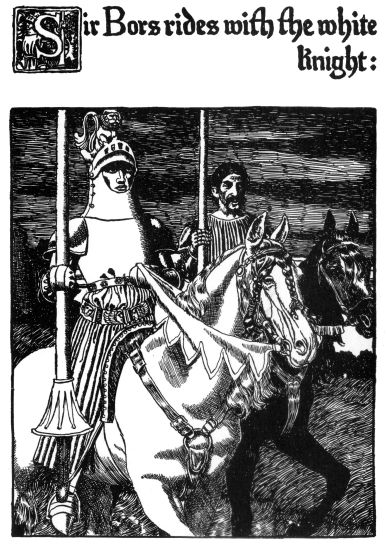
Here he came to a cross-road and as he approached that cross-road he was aware of a solitary knight who was there and waiting. And this knight was clad all in white armor, and he sat upon a white horse, and he was the knight whom Sir Bors had seen in his dream; and when Sir Bors drew nigh he saluted him, saying, “Greeting, Sir Bors, whither goest thou?”
Then Sir Bors said, “Messire, who art thou who knowest me and I know not thee? For I beheld thee last night, but in a dream.” The White Knight said, “It matters not who I am, but wit you this, that I know you very well, and I know that you seek the Holy Grail. Sir Galahad shall achieve that Grail, and you and Sir Percival, who am the next purest knight to him, shall find it with him. Here have I been waiting for you for some while, and at last you have come. So come now with me.” And Sir Bors said, “I will do so.”
So after that they two rode together side by side. And anon the sun sank and the moon arose, very still and bright, and ever they two rode on in that way side by side together.
And Sir Bors spoke no word to the White Knight and the White Knight spoke no word to Sir Bors, but ever they rode in silence all bathed by the white moonlight; their shadows, black and obscure, following them.
So at last they came to where there was a wide and stony waste without a blade of grass or a tree growing upon it, but only a great stretch of round hard stones of various sizes spread thick all over the earth before them. Then the White Knight said to Sir Bors, “Yonder is our road; let us go thither.”
So they two rode straight forward as that knight had directed they should do, and all about them lay the white and silent moonlight, like to a bath of pure and limpid silver. So anon and after a considerable while Sir Bors heard a great roaring, though far away from where they were. Then the White Knight drew rein and said, “Hearken, Sir Bors, hear ye that sound, and wit ye what it is?” Sir Bors said, “What is that sound?” The White Knight said, “That is the sea breaking upon the beach. Thither it is we go.”
They come to the sea.
So by and by they came to where there was a little cove of the sea, and beyond the cove the great waves burst upon the beach. So the White Knight rode down to the shores of that cove, and Sir Bors followed, and at that place there was a hard and level beach of pure white sand, and some rocks were beyond that sand.
Here Sir Bors beheld that there was a boat beside the rocks, and the boat rested against the shore, and it was hung within with pure white linen. And within the middle of the boat was a couch, and on the couch there was a knight lying asleep. And Sir Bors perceived that that knight was Sir Percival.
Then the White Knight said to Sir Bors, “Sir Bors, enter yonder boat, for so only shalt thou find the Grail.”
Sir Bors enters the boat.
So Sir Bors dismounted from his horse and he entered the boat, and with that Sir Percival awoke and sat up. And when Sir Percival perceived Sir Bors there in the boat he gave him greeting, and Sir Bors greeted Sir Percival.
Then the White Knight gave the boat a thrust from the shore, and the boat immediately sped away very swiftly into the night-time. And as Sir Bors and Sir Percival gazed back behind them they could yet see the figure of the White Knight seated upon his horse as still and motionless as though he were carved in marble stone. And though neither of them knew it, yet that knight was the spirit of Sir Balan who had returned to lead those knights champion to find the Grail.
Then anon that white figure faded into the dimness of the moonlight and was gone, and all about them lay the sea, very strange and mysterious and yet full of motion. And the bright whiteness of the moonlight lay moving upon the crests of the waves, and ever it wavered this way and that as though it were liquid silver poured upon the waves.
Such were the adventures of Sir Bors at this time.
Nor shall you think ill of him because he left that beautiful lady who was his betrothed wife to seek the Grail. For wit you that the Grail was thought by all the world to be the greatest and the most important thing in that world; and its recovery was adjudged to be the most splendid and the noblest deed that any knight could undertake. Wherefore it was that Sir Bors would surrender all his hope of love and of riches and of worldly honor to seek for that Grail.
This he did not for his own glory but for the glory of heaven, and not for his own honor, but for the honor of Paradise, where that Grail really belonged.
Wherefore he would turn aside from all that the world had to offer him and would direct his face and all his endeavor to the recovery of that sacred chalice, content, if he should recover it or aid in its recovery, to sacrifice all the world for the sake of that recovery.
For be it said at this place that the Lady Leisette did not wait the return of Sir Bors, but, finding him gone, she took for her husband a certain noble knight of that kingdom, and he ruled that land in her behalf with great benignity of judgment and with high honor of knightly wisdom.
Now pass we from the story of Sir Bors and turn we to the further adventures of Sir Galahad at that time, as followeth.
Chapter Seventh
How Sir Galahad smote down Sir Gawaine, and how he accompanied a Fair Lady to the seashore. And of what happened thereafter.
NOW, after Sir Galahad had smitten down Sir Launcelot, as aforetold of, he rode for a long while in a wild forest and had many adventures of divers sorts, of which no account hath been given, though mention is made of them in the ancient histories of those things which I have read. That while he dwelt in the forest and slept in the forest, and was fed, when he was an hungered, by the people of the forest.
So it befell that one morning he rode out from the forest and found himself in an open country that sloped down very deep to a valley, as though it were a deep bowl of the earth.
Sir Galahad beholds several knights in the valley.
And Sir Galahad sat upon his horse on the edge of that bowl and gazed down into it. And he beheld a great way off a castle; and he beheld that there was a concourse of many knights gathered about that castle. For the early sunlight shone down upon the armor of those knights, so that the armor caught the light and flung it back again as it were in brilliant points of pure and blazing flame.
Then Sir Galahad said to himself, “What is that concourse of knights, and why gather they around about that castle in such a wise?” And he said to himself, “I will ride down thither into the valley, and will see for myself what is the meaning of that assembly.”
Sir Galahad bespeaketh those knights.
So therewith he drew rein and descended down into the valley as he proposed to himself to do. And so he approached ever nearer to that distant castle. So by and by he was near enough to them to bespeak them, and when he had come still a little nearer he said to them, “Messires, what is this that you do at this place?” They say to him, “Sir, at this place there was not long since held a tournament of eight knights. In that tournament a certain young knight was slain. We be his relatives and his friends who have come hither to avenge him. So we wait here outside the castle, and those seven knights hide them away from us within the walls of the castle.”
“For shame!” said Sir Galahad. “For shame, that ye who are several should thus besiege seven men who cannot stand against ye. Get you gone and let them come forth.”
They say to him, “We will not get us gone from this place until we have taken those seven men with us. Because it is for that purpose we have come hither and for that purpose shall we stay until it be achieved.”
“Well, then,” said Sir Galahad, “I will assail ye upon this side, and then they will come forth and assail ye upon the other side, and so will we raise this siege.”
At this they all laughed, saying, “Is it possible that one knight can lift the siege of so many against seven? Well, then, let us see if he can do so.”
Sir Galahad doeth battle with those knights.
So they began to prepare themselves for battle, and Sir Galahad began to prepare himself also for battle. So, when he had cast aside his lance and had drawn his sword he lifted up his shield on high, and, shouting, he drave against them. And he drave into the midst of the press, lashing upon this side and upon that. And so terrible were the strokes which he gave that many fell down before them, and all bare away from him, so that anon he had carved a small open space about him.
Now in that party who were thus besieging the castle were Sir Gawaine and Sir Ewaine his cousin. But Sir Galahad knew not these two knights, and they knew not him. For his armor was much defaced in battle and in the adventures through which he had passed, and at that time he wore a leather covering to his shield. So they knew him not.
So they stood about and looked upon Sir Galahad and he looked upon them, and meantime the knights of the castle made them ready to come forth.
Sir Galahad overcometh Sir Gawaine.
Then Sir Gawaine said, “For shame that we should thus be driven back by one man! Now I will have to do with him myself.” So he came forward against Sir Galahad, and Sir Galahad awaited him. Then when Sir Gawaine had come close enough, Sir Galahad arose in his stirrups, and he launched a blow at Sir Gawaine that nor leather nor iron could stay. For that blow clove asunder the shield of Sir Gawaine, and it clove asunder his helmet, and it clove asunder the iron coif beneath the helmet, and it bit deep into the bone of the brain-pan itself.
Then the brains of Sir Gawaine swam like shallow water, and he reeled this way and that in his saddle, and would have fallen had it not been for Sir Ewaine, who catched him ere he fell beneath the feet of his horse, and so held him up in the saddle.
Then Sir Gawaine said, “Ah, Ewaine! That was none other than Galahad who smote me that blow. For none other than he could give such a stroke as that. So have I suffered for attempting to draw forth that sword out of the marble stone. Ah! woe is me.” So saying, his dissolving wits left him, and he swooned away as though he were dying.
Sir Galahad bringeth Sir Gawaine into the castle.
Meantime the knights within the castle had given command that the gates should be opened. So they were flung open according to that command, and the seven knights within the castle issued out to conduct the assault from that side. But Sir Ewaine cried out, “Messires, give over, and we will withdraw from this place. For here is most sorely wounded a very excellent knight, who is the nephew of King Arthur.” “Alas!” cried Sir Galahad. “Woe is me! For so have I carried out the provisions of that prophecy relating to the sword. For it was predicted of this sword that it should bite deep into the life of Sir Gawaine, and lo! it hath done so.” And he said to Sir Ewaine, “Convey him into this castle, for here shall his wound be searched, and he shall be cared for.” And he said to those of the castle, “See to it that all care is given to this gentleman.” And they say to him, “We will do so.”
So Sir Gawaine was conveyed within the castle, and was laid upon a couch. And his wound was searched, and balm was laid upon it. Thus was he put at ease at that place, and so was the prophecy concerning that sword fulfilled.
Then they all beseeched Sir Galahad that he would stay at that castle for a little while, but he would not stay at that place. Otherwise he said, “I must go upon my way, I know not whither. For I have a mission to fulfil, and in fulfilling it I know not whither I go.” So he drew rein and rode away, leaving them behind him.
Now wit ye how the knights of those days fared when they rode errant? I will tell you.
About the middle of that day Sir Galahad came to the house of a farm yeoman, and the wife of the yeoman and the daughter of the yeoman stood in the doorway of the house. The woman who was the wife was large and buxom, but the daughter was very slender and brown.
How Sir Galahad refreshes himself.
Of these Sir Galahad besought food to eat, and they brought to him a loaf of bread, a piece of cheese, and a crock of cider, and Sir Galahad ate and drank, sitting under the shade of a wide-spreading tree. Meanwhile, those people watched him from afar with great interest and curiosity, for never had they beheld a knight so tall and so noble as Sir Galahad.
Thus did these bright-armed knights who wandered errant through the world in those days refresh themselves, and so were they received and entertained by the people whom they met. Thus have I told you of that so that you might know thereof.
That evening, after the sun had set, and the soft and starry night had descended upon the earth like a sparkling coverlet of darkness, very damp and warm, Sir Galahad found himself in a wide moorland, and he wist not where he should sleep.
So at last the moon arose, shining very brightly and tranquilly, and by the light thereof Sir Galahad perceived before him a small chapel. And he said to himself, “Here will I lodge me for the night.”
Sir Galahad lodges at a chapel.
So Sir Galahad rode up to the door of the chapel and he smote very loudly upon the boards of the door with the handle of his misericordia. Anon there came the recluse to whom that chapel belonged, and when he beheld Sir Galahad standing there he bade him to enter. So Sir Galahad entered the chapel, and after the recluse had put the horse of Sir Galahad into the stable nigh to the chapel, he came to where the knight was, and set before him some broth and some pulse, together with some freshly gathered fruit, and Sir Galahad ate thereof with great heartiness.
There cometh a lady to the chapel.
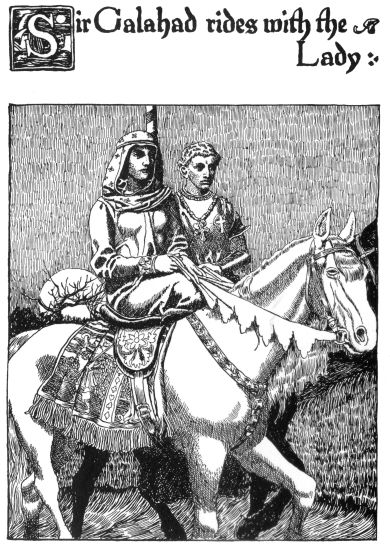
Now, whilst Sir Galahad sat there eating, there came another knock upon the door, and when the recluse went to open it, he beheld standing there a very beautiful lady clad all in white, and with her dark hair bound around with a ribbon of silver. And the lady was mounted upon a cream-white jennet, and the saddle of the jennet was of crimson Spanish leather, embossed and studded with plates and buttons of silver.
When the door was opened, the lady said to the recluse, “Sir, I pray you tell me, is there here within a knight hight Galahad?”
This heard Sir Galahad, and hearing it he arose and came forward, and he said, “Lady, I am Galahad. What would you have of me?”
She said, “Sir, I pray you to come and ride with me and I will lead you to such an adventure as you have never had in all of your life before.” Quoth he, “Where is that adventure?” She said to him, “It is not very far distant from here. But I cannot tell you more than that.” Sir Galahad said, “Whither would you lead me?” She said, “Come and I will show you.”
So Sir Galahad went back into the chapel and armed himself, and the recluse brought forth his horse out of the stable. And anon Sir Galahad, being in all ways armed, came forth out of the hermitage and mounted his horse.
Immediately he was mounted the lady drew rein and turned, and rode away from that place, and Sir Galahad followed her.
The lady and Sir Galahad ride together.
So they rode away across the moorland together. All around them was the stillness of the night-time, and overhead and about them lay the silent whiteness of the effulgent moon. And the shadows of each and the shadows of the horse of each followed them across the moorland, very black and mysterious.
So they travelled a considerable while in silence, for the lady did not speak to Sir Galahad, nor did Sir Galahad speak to her. But each rode in silence, and each was occupied with his or her own thoughts.
Sir Galahad beholds the sea.
Thus, by and by, they reached a high part of the moorland, and of a sudden Sir Galahad beheld the sea, over above the downs. And the moon shone down upon the sea so that it looked like a shining stretch of pure and radiant silver against the night sky that lay behind it. Then Sir Galahad said, “Lady, yonder is the sea.” “Aye,” quoth the other, “and it is thither that I am bringing thee.”
So after awhile they came to where the sea lay below them, and they beheld the waves illuminated by the light of the moonshine lapping against the shore. Then they rode down to the sea, and there was at that place a rocky promontory that stretched out into the water. And they rode across that promontory, and there Sir Galahad beheld a boat lying in the moonlight moored, as it were, to the shore, although no rope attached it to the shore. And as they two approached the boat, Sir Galahad perceived that the boat was all draped and hanged with white linen, and he perceived that there were two men within the boat.
He perceives Sir Percival and Sir Bors in a boat.
The faces of these two were cut out very clear and sharp and white from the darkness behind because of the moonlight that shone upon them, and Sir Galahad perceived that the one of those faces was the face of Sir Percival, and that the other face was the face of Sir Bors de Ganis. These two, beholding Sir Galahad there upon the shore, gave him loud and joyous greeting, crying out, “Greeting, Sir Galahad! And welcome to thee!”
Then Sir Galahad sprang down from off his horse, and he ran down to the shore, leaping from rock to rock. And he sprang into the boat and kissed each of those two upon the cheek, and they kissed him upon the cheek in return. And Sir Galahad said to them, “What do ye here?” To the which they replied, “We wait for thee.” And they say, “What lady is that with whom thou hast come hither?” He replied, “I know her not, but she hath brought me to this place.”
Sir Percival beholdeth his sister.
And then they beheld that the lady had also dismounted from her horse and was approaching to them. And she came to them down the rocks and she stood close to the boat, and when she did so Sir Percival saw her more clearly and he knew her. Then he cried out, “I know thee! Thou art my sister!” She said, “Yea, that is true.” He said to her, “Sister, what doest thou here?” She replied, “I come to give you information, and it is this: You shall sail away from this place, and by and by you shall find another boat of a very magnificent sort. For that boat is the Ship of Solomon, and it is waiting for you. In it you will find the Grail established, and the ship itself will take you whither the Grail belongeth. So enter the Ship of Solomon freely, for no harm shall befall you in it, and it shall convey you to the city of Sarras where the Grail belongeth.” Then turned she to Sir Galahad, and she said, “And to thee, Galahad, am I permitted to say this thing: That it is given to thee that when thou willest thy soul shall depart from thy body. And it shall leave thy body behind, and shall ascend with the glory of angels into Paradise at thy command. All this I have to tell you, and now fare you well.”
Thereafter the lady turned away from them and mounted her horse and rode away. And as she departed she wept, for she was aware that she would never behold Sir Percival again.
Then that boat in which they were moved away from the shore, and anon it moved very swiftly. And it sailed past the headland and out into the sea, and, in a little while, the land disappeared from sight, melting, as it were, into the soft glory of the moonlight that illuminated all the darkness of the earth. And so they sailed swiftly across the sea and the great waves of the sea, and ever the moonlight lay all about them, and they were cradled in the arms of the sea.
So they sailed for all that night, and anon the day dawned, and then they perceived before them another and a larger ship than the boat in which they sailed. And the boat in which they were moved very swiftly toward the ship and at last came close beside it.
They come to the “Ship of Solomon.”
Then they beheld that that ship was of a very wonderful sort, for it was built all of santal wood, and was tinted with vermilion and ultramarine, and was glorified with gold. And the sails of that ship were of variegated silk, very wonderful to behold. And the decks were spread with rich carpets, and there was no human being of any sort to be perceived about that ship.
Then Sir Percival said, “This wonderful ship must be the Ship of Solomon, and into it we are destined to enter and to discover the Grail. So let us enter it forthwith and without loss of time.”
So they departed from their own boat and entered the Ship of Solomon, and as soon as they had done so the boat in which they had sailed disappeared and was gone, and they saw it no more. And at that time they were hushed as with a great awe.
They find the Grail.
Then Sir Percival said, “Come, let us behold the Grail, which is here.” So with that saying they all descended below the deck of that boat, and coming there they beheld a table of carved silver, and against the table there leaned the spear and upon the table was a purple velvet cloth, spread over something that stood upon the table, and the cloth was embroidered very richly with gold and ornamented with many precious stones of divers colors. And from beneath it there shone a clear and brilliant light, and that light was emitted by the Grail.
Sir Galahad went to the table and took the cloth by the corners and lifted it up; and lo! beneath it was the Holy Chalice itself. And it blazed with a light that was like that of the sun—very splendid and effulgent—so that they could scarcely look upon the splendor thereof.
Then they all three kneeled down before the Grail, and set their palms together, and gave all honor and glory to its splendors. And Sir Percival said, “I have seen this before, but never so near at hand as this.” And again they all gave praise to it.
So the Ship of Solomon sailed very swiftly away with those three knights in it, and it sailed for all that day, and near eventide it approached a great city that stood upon a high and rocky hill.
They come to the city of Sarras.
And that city was the city of Sarras, and it appeared to the eyes of the three knights to be very great and beautiful. For they beheld that there were very many high pinnacles and towers to that city, and they saw that these were illuminated by the setting sun, so that they appeared as though they were built of pure and shining gold.
So the boat in which they sat sailed very swiftly toward the city, and anon it ceased its voyage beside a wharf that was there.
Then Sir Galahad said, “Let us convey this Holy Chalice to the minster, for, certes, this is where it belongeth.” And Sir Bors and Sir Percival said, “Let us do so.”
So they three took up the silver table by three of its corners, and they bare it toward the gate of the town.
How the cripple was healed.
Now the history of these things telleth that at the town gate there sat a cripple begging, and the cripple had not walked for thirty years. They say to him, “Come, help us bear the fourth corner of this table.” He said, “How can I help bear the table? Lo, I have been a cripple for thirty years, and in that time I have not walked a step without my crutches.” Sir Galahad said, “Nevertheless, arise and come hither.” Then the man arose, supported by his crutches, and they brought the table of the Grail to him, and he laid hands upon the silver table.
Then, no sooner had he touched that table, than the strength flowed into him; his joints became strongly knit and supple, and he was, as it were, no longer a cripple. Then he cried out, “Lo! I am healed!” And with that he skipped and leaped in his strength.
So the Grail was achieved, and now followeth the account of how those three worthy knights brought it in return to the city of Sarras where it belonged, and of what befell them there; so I pray you to read the conclusion of this passage hereinafter written.
NOW the news of the healing of this cripple became known; it went all through the town, so that when they entered the town, great crowds presently gathered and followed them, and the noise of the tumult of that following was like to the noise of the roaring of many waters. For ever the crowd gathered more and more to it, until all that part of the town was filled full of a slow-moving concourse of people.
They bring the Grail to the minster.
Thus they came to the minster, what time the Bishop of that minster was there, and seeing them enter with the silver table he said, “What have you there?” Sir Galahad replied, “Sir, this is the Holy Grail upon this table, and we who have achieved the quest of it have brought it hither where it belongeth.” The Bishop said, “Let me see that Grail.”
So Sir Galahad took the velvet covering of the Grail by the corners and lifted it, and lo! the glory of the Grail blazed forth before the eyes of all. And so great was that glory that it illuminated the entire interior of the minster, so that it was like the illumination of sunlight that was burst into that place. And all they who beheld the Grail and that sudden illumination bowed down before it and uttered their prayers of thanksgiving that it was returned to where it belonged.
So the Grail and the spear were placed before the high altar, and there they remained unveiled; and the glory of them illuminated all the coadjacent spaces with brightness.
So the Grail remained exposed in that city for three days, and at the end of that time it was elevated from earth to heaven, as shall now be told of.
The three knights were there in the great minster, kneeling and praying before the high altar where stood the Grail, when of a sudden they heard a voice from on high, saying, “Hail, ye heroes, and all praise to ye! For ye have recovered that Grail which here and now is to be translated from earth to heaven.”
How the Grail ascends to heaven.
With that voice there came two hands, very white and shining, and they took the Grail, and there was no body to be seen with those hands, but only the hands themselves. And there came two other hands and took the spear, and neither was there any body to those hands. So those four hands lifted the Grail and they lifted the spear, and they bore those two holy relics aloft and away from that place. And they ascended, as it were, through the roof of the minster and were gone in a burst of glory that lingered for some little while and then faded away into darkness.
So it happened with the Grail that it was elevated into heaven, and that this was so was avouched for by many who were in the minster at that time; and several of these beheld those four hands, and saw the Grail elevated from earth to heaven. So this is to be believed in as here narrated.
Then there sounded from on high to the ears that were unstopped to hear that sound, a great anthem as of thanksgiving, as it were the tones of a mighty organ, or as it were the tones of a wonderful and melodious thunder, and they three heard that melody of music, but no other who was there heard it. And they were aware that it was the rejoicing of heaven over the return of those sacred relics to that place, wherefore they were filled with an ecstasy that was not of this world, but of heaven, and that was of great joy, yet was of awfulness and of a sort of terror.
Then was the spirit of Galahad exalted, and he lifted up his voice and cried aloud, “There is nothing remaining for me to live for. So now let me depart in peace.”
Of the passing of Galahad.
Thereat with those words the soul was drawn out of his body and the eyes of those two knights who kneeled beside him were opened and they beheld his spirit ascend into glory, and they beheld that the illumination of heaven shone round about it, and at the same time they heard, with a louder and more momentous tone, the thunder peal of heavenly triumph as the spirit of Galahad was received into its glory, together with the Grail which he had achieved.
Then the brightness closed from their eyes and they beheld themselves to be kneeling in the dark and empty minster. And they looked at the body of Sir Galahad, and behold! it was dead.
So passed Sir Galahad, and at that time he was yet not twenty years of age.
Sir Bors went to the Bishop of that minster, and he said to him, “Sir, this man was altogether a good, virtuous, and perfect knight. It is our desire that his dead body should lie here in this minster at that spot whence the Grail ascended into heaven but now. Wherefore, we beseech you to suffer it to lie at that place.” To these the Bishop said, “Let, then, that be fulfilled as you ask. For I believe that that knight was indeed a very good, excellent, holy man withal.”
So they buried the body of Sir Galahad there in the minster, beside the spot whence the Holy Grail ascended into heaven, and there the tomb of Sir Galahad remained to be seen for many years after his body was so buried.
Sir Percival taketh holy orders.
After this was over and done, it being then the fourth day after they had come thither, Sir Bors said to Sir Percival, “Sir, whither now shall we go?” And Sir Percival said to him, “I shall not go anywhere; for here shall I remain, and here I shall take upon myself holy orders and shall live and die as a monk in those orders. But return you, Sir Bors, to the Court of King Arthur, and tell them of the court concerning all those things that have befallen; to wit, tell them how the Grail was achieved by us three, and how that it was taken up into heaven before our eyes, and how we beheld it enter the gates of heaven. So go you to Camelot, and tell them concerning all these things.”
Sir Bors returneth to the Court of the King.
Thus said Sir Percival, and Sir Bors said, “I will do as you bid me.” So the next day Sir Bors kissed Sir Percival upon the cheeks and either wept salt tears over the other. Then they parted company and Sir Percival remained at that place and became a monk, and Sir Bors departed thence, returning back again to Camelot.
There he arrived at the ending of a year and a day, and all they who were there made great joy over his return. For all those knights who had gone forth in search of the Grail and had not died in that quest had now returned, saving only Sir Launcelot of the Lake. For it had become known throughout the world that the Grail had been found, and that it had been elevated into heaven, so that all those who were seeking for it were returned back home again.
Then Sir Bors told them all the circumstances of the finding of the Grail, and how it had been elevated in the minster at Sarras, and of how Sir Galahad had died, and of how he had beheld the soul of Sir Galahad exalted to heaven.
And King Arthur had that history written down in three great books, and one of those books was established at Salisbury, and another at Camelot (which same is Winchester), and the third at Carleon upon the Usk; and from these three volumes the story of the Grail has descended to us of the present day, and so I have written a part of that for your delectation.
It remaineth now only to be said that Sir Bors, after all these events, returned to that lady whom he had quitted to search for the Grail. But the happiness of earth was not to be his, for he found that she had wearied of waiting for his return, and had married elsewhere. So Sir Bors returned to Camelot, and there he abided until the time of that quarrel that preceded the ending of the reign of King Arthur.
For wit ye that he who aims high will often miss the small joys of this life, and so it was with Sir Bors de Ganis. For though he was one of those who achieved the Grail, yet he missed the lesser joys of wedded life, and of that kingdom which belonged to them.
Thus hath been told to you the famous history of the recovery of the Grail and of its translation into Paradise. And this was the crowning glory of the reign of King Arthur. For after these circumstances had happened, as herein told of, there came dissensions and battles amongst those knights—knight against knight—until the famous Round Table of King Arthur was severed and shattered, never to be reunited again.
But of that more anon, for it is hereinafter to be told of. So now I pray you for to read that which followeth if you would learn the ending of all these things.