PART III The Passing of Arthur (continued 2)
Reading edition
The Queen adviseth Sir Launcelot.
That night the Queen also spoke to Sir Launcelot, and she said, “Launcelot, why do you suffer for me? Surrender me unto King Arthur and with that this war will cease. Else will there many worthy knights perish in this war. For there are a great many knights here foregathered of the Round Table, and there be many other famous and worthy knights and nobles and kings here foregathered. Is my one life then worth more than all their lives?”
Then Sir Launcelot groaned, but he said, “Lady, I will not surrender you until I am sure that your safety is insured. Let first the King assure your safety and then we shall consider whether or not you shall return to him.”
Then the Queen burst out weeping and she cried out, “Oh, woe is me that I should have brought so much trouble and sorrow upon this world!”
The King assaults Joyous Gard.
Now the army of King Arthur made assault upon Joyous Gard and they made assault upon assault. And somewhiles they made breaches in the walls; but ever those breaches were rebuilded at night so that they could not enter the castle. And the army of King Arthur lost many hundreds of men, both of knights and yeomen; but the defence of the castle lost many scores, and those scores were of greater loss to them than the hundreds that King Arthur lost. For those hundreds could be replaced by other hundreds, but the scores could not be replaced by other scores.
The friends of Sir Launcelot advise with him.
So the knights who kept the castle held a council of defence, and there were at that council Sir Bors and Sir Lionel and Sir Ector and Sir Bleoberis and Sir Blamor de Ganis, and there were other knights and worthies of the blood of Sir Launcelot. Sir Lionel said, “Why remain we here within this castle? Ever we grow weaker and weaker, and by and by our enemies will break within the castle and then we shall all be put to the edge of the sword. Let us sally forth against those who thus surround us, for so haply we may cut our way through them and thus escape to the sea-shore and to France. There we shall be safe from those who could work for us our undoing.” Sir Launcelot said, “Sir, even if we could do this thing, what blood would be spilt in doing it, and what friends would we slay in that attempt!” Quoth Sir Ector, “What matters that? Are they not seeking our lives and our blood, and are we not defending ourselves? These men are no longer our friends; they are our enemies, and are seeking our lives. Let us then go forth and assail them.” All this Queen Guinevere heard, and she wept many and very bitter tears as she listened to that council. As for Sir Launcelot, he groaned very deeply but anon he said, “Let it then be so as you say, only first I must bespeak King Arthur.”
So that afternoon he appeared upon the battlements of the castle. And he leaned out over the battlements and called out to those who were below, saying to them, “Where is King Arthur? I would speak with him.”
Those who heard him ran to King Arthur, and they said to the King, “Lord, Sir Launcelot asks to speak to thee. Haply he meaneth to surrender to thee.”
The King speaketh to Sir Launcelot.
So King Arthur hurried to that place where Sir Launcelot was: and Sir Gawaine and the King of North Wales were with him. King Arthur said to Sir Launcelot, “What wouldst thou have of me, Messires? Dost thou surrender this castle?” “Not so,” quoth Sir Launcelot, “I do not surrender it, but I would speak to you of other things.”
“Sir,” said King Arthur, “concerning what other things have you to speak to me withal?”
“Lord,” said Sir Launcelot, “this is what I would say to you. What seek you here in thus assaulting this castle? Here within are many lordly knights and many knights of the Round Table who were a short time ago your friends and dependants. Some of them you yourself made knights as you made me a knight, and all of those would gladly surrender their lives for your sake. What benefit or what honor can it then be to you to slay them, who were your support and your defence, and who would be so again if you would live in peace with them? Would it be to your honor that you should slay these good, worthy honorable knights?”
“Sir,” said King Arthur, “you forget that you have seized upon my Queen and that you hold her from me in this castle. First surrender to me my Queen, and then I will consider all these things that you have to say and will reply to them as I deem to be fitting.”
“Lord,” said Sir Launcelot, “thy Queen is held here in high and honorable regard. With us she is safe from harm or injury of any sort. Would she be thus free from danger of harm and dishonor if she were with you? Pledge me first that you would do her no harm or injury, and then it will beseem us as true and honorable knights to consider the surrender of her to you.”
“Am I then,” said the King, “to make treaty with you for the return to me of that wife with whom I have lived in amity for all these years? Sir, you do not consider how unfit such a treaty would be upon my part.”
Sir Gawaine accuseth Sir Launcelot.
Then up spake Sir Gawaine. “Also, Messire, you have forgot another thing, and that is that you have slain my two young brothers who stood before you defenceless and unarmed. I reckon naught of those whom you slew, armed and in battle. For I loved you well and truly for many years, and I advised them not to hazard battle with you; but they would hazard battle and so they were slain by you. But of those two others, they did not hazard battle; for they were unarmed and naked, and they would have stood your friends; yet you slew them as though they had been enemies. This I will never forgive you, but either you will answer for it with your blood, or I will answer for it with mine.”
Then Sir Launcelot groaned, and he said, “God pity us all for our sins, and God pity you, Sir Gawaine, for your unchristian hatred.” And with that he turned away.
The defenders of the castle sally forth.
So when the next day had come, they of the castle prepared themselves for battle and for escape. They placed the Queen in their midst and they surrounded her upon all sides. Then, of a sudden, all the gates upon one side of the castle were flung wide open and they issued out in full armor. And at that time the sun shone out very brightly, and it gleamed and sparkled like flames of fire upon the brightly polished steel of those knights. Then they, the defenders of the castle, shouted very loud, and they charged against their enemies, bearing the Queen with them in their midst.
And for awhile they carried all before them and no one could withstand them; and so they might have escaped, had it not been that the Queen was with them and retarded them in their charge and their advance. For, in a little while, owing to that delay, those of King Arthur’s army armed themselves, and in another little while the friends of Sir Launcelot were almost entirely surrounded by that vast multitude.
Then Sir Launcelot beheld that in a short time they would be shut off from return to the castle, but that as yet the way was still open to them. Wherefore he lifted up his voice and shouted, “Retreat! Retreat!”
They of the castle retreat into it again.
Then, through the roar and thunder of battle and of blows and of sword blade upon steel armor, all those who were there heard these words, “Retreat! Retreat!” And they beheld that that retreat was nearly cut off, but not quite. So they turned their horses and made their way slowly backward toward the castle again, with the Queen still in their midst. Those before turned their horses toward the castle, and those behind fought with their faces toward their foes. And many who assaulted that band tried to come to the Queen, but none could do it because of the close array of horsemen that surrounded her. Many lost their lives in that attempt, for if they penetrated the first line of horsemen they were slain by the second line of defence.
Sir Gawaine overthroweth Sir Lionel.
In that mêlée Sir Gawaine sought ever to come at Sir Launcelot, but he could not do so because that Sir Launcelot remained ever near to the person of the Queen. But Sir Gawaine charged against Sir Bors and pierced him with his lance through the shoulder; and then he charged with great violence against Sir Lionel, and in that charge he pierced through the body armor of Sir Lionel so that the point of the spear stood a hand’s breadth out behind his back. Then Sir Lionel would have fallen from his horse only that the press that surrounded him held him up and kept him from falling. And with that blow against Sir Lionel, the end of Sir Gawaine’s spear broke off, and it remained penetrated into the body of Sir Lionel, a part of it showing in front and a part of it showing behind.
Then Sir Lionel felt that he had received his death-wound, and he groaned very dolorously. And Sir Gawaine heard him groan and perceived how badly he was hurt. And he redoubled his attack, endeavoring to obtain the body of Sir Lionel. But he could not obtain that body for it was still held upright upon the horse, supported by several, and others gathered about to defend it.
Sir Lionel dieth.
Then Sir Gawaine was furious with rage and he fought as though he had gone wode. For his sword flashed like flashes of lightning, and ever as he struck he cried out in a loud and terrible voice, “That for Sir Launcelot!” and “That for Sir Launcelot!” and ever again “That and that for Sir Launcelot!” And so fierce and terrible were the blows that he gave that many fell down before them and never moved again. But in spite of his striving, they bore away Sir Lionel from his endeavor and so brought him into the castle, where that night he died in a great agony of thirst and of torment.
King Arthur is overthrown.
In that battle, King Arthur and those who were with him made many charges against the centre of Sir Launcelot’s array, and anon they had come so close to where was the Queen that the King could almost have touched her with his lance. So King Arthur came at last face to face with Sir Launcelot, and Sir Ector was beside Sir Launcelot. And ever the King strove to come at Sir Launcelot, but was unable to do so. For somewhiles Sir Launcelot warded the blows from himself, and otherwhiles those who were with him took those blows from him. Then Sir Ector perceived how the King neglected his guard in assaulting Sir Launcelot, and he arose in his stirrups and smote the King a terrible buffet upon the helmet. At that blow the King’s brains swam, and he reeled and fell off from his horse upon the earth. Then Sir Ector leaped from his horse and he said, “Here will I put a stop to this war at its fountain-head.” Whereupon he rushed off the King’s helmet and whirled his sword, and prepared to smite the head off from the King.
They spare the King his life.
But Queen Guinevere perceived the King’s danger and she shrieked out very dolorously, “Spare the King his life, Sir Ector!” And Sir Launcelot said to Sir Ector, “Sir, how is this? Would you slay your King? Remember it was he who made you a knight and who made me a knight. Haply he may forget that he made us knights, but let us not forget it.”
So with that Sir Ector put up his sword again, and he and Sir Launcelot lifted the King and set him upon his horse once more. And the King wept bitter tears to see how noble and knightly was Sir Launcelot, and he said, “Ah, Launcelot, Launcelot, that this should be!”
So after that Sir Launcelot withdrew into the castle with the Queen and the gates were closed behind him. But ever King Arthur sat still weeping and saying, “Ah, Launcelot, Launcelot, that this should be!”
Then the friends of Sir Launcelot wist not what they should do in this extremity, for there were they within the castle again, and could not come out thence because of those who besieged them in that place. And ever they were growing weaker with each assault, but the armies of King Arthur were not growing weaker.
The Bishop of Rochester cometh to the King.
At this extremity there came the Bishop of Rochester to the camp of King Arthur, and the purpose of the Bishop was to make peace betwixt these parties. So the Bishop came to where King Arthur was, and he found King Arthur sunk in grief. For already three-and-twenty Knights of the Round Table had lost their lives in these wars and contentions, and King Arthur grieved for them very sorely. For there were no more knights like those first knights foregathered about the Round Table, nor have there ever been such knights as they were from that day to this.
Then the Bishop stood before the King, and the King looked at him remotely as though he were a great distance away, for his eyes were dimmed with weeping. And the Bishop said to the King, “Lord, let this quarrel cease between you and Sir Launcelot, and let there be peace in the land. For now is the entire land distracted with this quarrel. For friend fighteth against friend, neighbor against neighbor;—yea, even brother against brother. As for you, my lord, these knights are of your Round Table and of your making; what pleasure or what honor then can it be to you to destroy them?”
The King said to him, “Sir, this war was not of my forming or my seeking, but of Sir Launcelot’s. For first Sir Launcelot resisted arrest in a just cause, and then he resisted the arrest of the Queen. So he and his fellows took the Queen away from me, and they have her in this castle. Let them then deliver the Queen to me and there shall be peace betwixt the friends of Sir Launcelot and my friends.”
The Bishop intercedes for the Queen.
The Bishop said, “They will not deliver the Queen to thee, Lord, excepting thou wilt declare upon thine honor that no harm shall befall her. For it is said of all that the life of the Queen is in danger from thee. Yet she is an honorable lady and as pure to thee as the day upon which she came to thee. For she is free from sin or from guilt of any sort. Wherefore, unless thou wilt declare that no harm shall befall the life of the Queen and wilt declare that same in writing, she will not be returned, but otherwise they will lay down their lives to guard her safety.”
Then the King sat with his fist upon his forehead, and he considered for a long time what the Bishop had said, and at last he said, as in a smothered voice, “Well, then, let the Queen be delivered to me at Camelot, and I upon my part shall promise that no harm shall be done to her life, either to threaten it or to deprive her of it.” The Bishop said, “Let me have that in writing.” And the King said, “I will do so.”
So the King called to him his scribe and he had him write those words; to wit, that if the Queen would return to him, no harm should befall or threaten her life in any way. And the King signed and sealed that document and the Bishop took it with him and entered the Castle of Joyous Gard.
The Bishop grieveth for the Queen.
Thus the Bishop came before Sir Launcelot and his kindred, and Queen Guinevere was with them at that time. And the Bishop looked at the face of the Queen and he beheld that it was all white and wan with sorrow and that her eyelids were red with continual weeping. And the Bishop was very sorry for the Queen and for her sadness. So the Bishop came to her and took her by the hand and he said to her, “Lady, stint thy sorrow, for the time of sorrow is passed. For here am I with this document that saith that no harm or injury of any kind shall be meditated against thy life, but if thou wilt return to the King all shall be forgiven thee. For wit you well that the King is determined that you shall return to him, even if it cometh to the tearing down of this castle stone from stone.”
Then the Queen took the document that the Bishop had and she read it very carefully, and when she had ended she said, “Lord Bishop, how is this? I see here that mine own safety is provided for, but that the safety of no one else is mentioned. How of those good worthy knights and gentlemen who have endangered their safety in my behalf; where is their safety provided for in this parchment?”
Quoth the Bishop, “I will bespeak the King that point. Meantime, do you remain here without endeavoring either to attack or to escape.”
She said, “I will remain here in peace until this time to-morrow.”
So the Bishop returned to the King and he brought that word to him; that a pledge must also be given for the safety to the life of those knights who thus guarded and sheltered the Queen. Then the King frowned, and he said, “What other conditions will they impose upon me; why should I give this pledge to those who have acted treasonably against me?”
The King promises to spare the knights of the castle.
Then Sir Gawaine plucked the King by the sleeve and the King turned aside with him. And Sir Gawaine whispered for awhile with the King and by and by the King turned again to the Bishop and he said to the Bishop, “Very well, then; take thou this my word to those knights that I will in no wise do harm to them whilst they are within this Kingdom of Britain. Take thou that word unto them.”
So the Bishop took that word to them within the castle and they were very glad of it. And Sir Launcelot said to the Bishop, “Let the King return to Camelot, and I will bring the Queen to him in three days’ time surrounded by all the pomp and circumstance that appertain to her lordly grace.”
So the King withdrew his army from that place and he returned to Camelot. And Sir Launcelot made ready to bring the Queen to him at Camelot.
Thus came to an ending that sad and cruel war in the which many good knights and warriors lost their lives and in which fourteen worthy knights of the Round Table lost their lives.
For though all those knights were commanders of armies and of battalions, yet death came to them as to other men of lesser note, so that many of them, even to the highest, laid down their lives in this dolorous war.
For so the hand of Fate lay heavy on that great and glorious company, for though all grieved and made great sorrow over the war, and over those who had died therein, and though comrade grieved over comrade who died therein—even over those who were upon the other side and who were enemies—yet the hand of Fate thrust them forward to do what they were compelled to do, and to slay and to be slain in that sorrowful battle.
And so it was to the end, for ere that end was reached others who were the foremost and the greatest of them all laid their bodies down to an eternal sleep upon the bosom of that earth that gave them shape and foothold. For yet were there other wars to come until all but a very few of those who were left had given all that they had of the earth to give in those wars.
But of this anon, for that which followeth has to treat of those things.
So now followeth the history of those things that remain to be hereinafter related in that which followeth, as shall now appear.
Chapter Sixth

Sir Launcelot brings the Queen to King Arthur at Camelot. He quitteth England, and King Arthur and Sir Gawaine pursue him.
SO the King went to Camelot, and upon the third day the Queen was brought to him at that place.
Thus saith the history of these things when the Queen was brought to the Court of the King, to wit:
How Sir Launcelot brings the Queen to Camelot.
First there came an hundred knights clad cap-a-pie all in armor and with fittings and trimmings of green velvet. And these knights wore olive wreaths upon their heads, indicative of peace. Followed these, four and twenty esquires clad all in green velvet, and these were also crowned with olive wreaths. After these came four and twenty ladies in waiting upon the Queen, and these, like all the others, were clad in green velvet and were embroidered with pearls and precious stones even to the heels of their horses, and the bridles of their horses were bound with wreaths of olive. Then came the Queen and Sir Launcelot clad all in white samite, and the Queen carried an olive branch in her hand and Sir Launcelot was crowned with an olive wreath. And the raiment of these two was all aglitter with the jewels and pearls with which their clothes were embroidered until they were stiff with that embroidery.
How the King sat at Camelot.
At that time King Arthur received them seated upon his throne with great dignity in the hall of the Castle at Camelot. And the throne upon which he sat was of wrought gold and was cushioned and trimmed with crimson velvet, embroidered in gold with the figures of leopards. And over above the throne was a great canopy of crimson velvet ornamented with the figures of leopards, embroidered with threads of gold. The King was clothed all in white, and he wore a gold chain studded with jewels about his neck and he wore his royal crown upon his head. Upon the left hand of the King stood seven bishops in full canonical robes, and upon his right hand was a throne like to his, and on that throne the Queen should have been seated. But she was not seated there, for otherwise it was empty.
Upon the left hand of the King, but upon the second step below the throne, sat Sir Gawaine, the beloved nephew of the King. And all about the hall were several hundred knights in full armor and armed cap-a-pie with sword and lance, so that that hall glittered and gleamed with the shine of that armor.
So King Arthur sat in state to receive the return of the Queen, and anon she came to that place where the King awaited her. First came the knights and esquires of Sir Launcelot, and these drew up in two parties extending the length of the hall, leaving a line between them. Then came Sir Launcelot and the Queen walking hand in hand up the length of that lane, and the faces of Sir Launcelot and of that lady were both of them exceedingly pale—hers with fear and his with fear for her. Behind these two came the four and twenty ladies in waiting upon the Queen, and these stopped in the midst of that lane and waited, whilst she and Sir Launcelot approached King Arthur.
So Sir Launcelot and the Queen came to the foot of the throne where sat the King, and when they had come to that spot Sir Launcelot kneeled and the Queen stood before King Arthur.
Sir Launcelot speaketh.
Quoth Sir Launcelot, “Dread Lord and King, here I bring to you your Queen as I have promised to do, and if I took her away in sorrow and in haste, then do I return her to you with ten thousand times the joy as compared to what was that sorrow, and in ten thousand times the peace and amity to what was that haste. Lord, for thirteen weeks has she dwelt at Joyous Gard with all the state and circumstance due to her royalty, and she cometh to you now as pure and as virginal as she came to you at Camilard when first you loved her at that place and she loved you. Lord, I pray you that you will take the Queen to your heart, and will cherish her there as you one time cherished her, for, excepting that you pledged me your word that no harm should befall her, she otherwise would not have been thus brought to you as she is brought to-day.”
The King rebukes Sir Launcelot.
Then King Arthur frowned until his eyes disappeared beneath his eyebrows. For a little he answered nothing, then in a little he said, “Messire, one time you were my friend and the best-beloved of all my knights, but that time is past and gone, never to return again, for now it is altogether otherwise with me and with you. Messire, I admire at your coolness and phlegm. For you took my Queen away from me by force and by force have you held her for all these several months. Many knights have died by your hand and through your instrumentality, and several of those knights were knights of my Round Table that one time held you to it in bonds of love and amity. Yet now you stand before me and recommend to me that I shall take back my Queen into my heart again. Messire, wit you not that that which hath been done can never be undone, but is and must remain altogether finished and completed? So it is with this thing that you have done; for it also is and must remain altogether finished and completed. Look you, Messire, here beside me is this throne, which is empty. So it shall remain forever empty for me, for never again shall Queen Guinevere or any other queen occupy it, for I hereby and herewith renounce her utterly and entirely. She hath withdrawn herself from my court and my bed and so she shall forever remain withdrawn from them, for never again will I take her to my heart, or place her in that estate which she once occupied.
The King sendeth the Queen to a convent.
“I have pledged myself that no harm shall come to her through me; but herewith I give her over to the Church. There she shall remain a recluse until the day of her death.”
So said King Arthur, and at a motion of his hand the Lord Bishop of Rochester came forth and took the Lady by the hand and led her away; and as he led her away, she was weeping very bitterly.
So the Bishop of Rochester took the Queen to the Convent of Saint Bridget at Rochester, and there she remained the lady abbess of that convent even to the day of her death, as shall hereinafter be related.
Now all this while Sir Launcelot still kneeled before King Arthur, and anon the King said to him again, “Messire, your own doom I will not announce to you; but I will relegate the annunciation of that doom to this lord, my well-beloved nephew, Sir Gawaine. For the injury which you did to him is a thousand times greater than the injury which you did to me. For though you took my Queen away from me, yet you did her no harm. But with him, you slew five of his blood; to wit, three of his brethren and two of his sons. And whilst three of them were in arms against you so that you slew them wittingly and in self-defence, yet two of those stood unarmed and naked before you, and those two loved you better than anyone in all the world. One of those two your own hand made a knight and the other was knit to you with many acts and deeds of friendship and of love. Accordingly, I commit your doom to Sir Gawaine to announce to you.”
Sir Gawaine pronounces the doom of banishment against Sir Launcelot.
Then Sir Gawaine smiled very bitterly upon Sir Launcelot, and he said, “Messire, this is the doom that I pronounce. The King hath, in his great clemency, promised you that no harm shall befall you in life or in limb. So no harm shall come to you in that way if you are reasonable and obey the commands of the King. This is his command—that in fifteen days from this you must quit this kingdom, and that you shall never again return to it whilst I live or while the King liveth.
And against his knights.
“Also I pronounce the doom of banishment against those who have been associated with you in these late affairs, to wit, against Sir Ector de Maris, Sir Bors de Ganis and Sir Ure, and Sir Blamor and Sir Bleoberis de Ganis, against Sir Galahautin, and Sir Galahud, and Sir Menaduke, and Sir Galahadin, and Sir Hebes, and Sir Lavaine, and Sir Melias de Lisle, and Sir Palamydes, and Sir Safyr, and Sir Clegis. Upon all of these I pronounce the doom of banishment upon behalf of this King, and if any of you be found within this isle of Britain fifteen days from now, you will be arrested and hanged as traitors. Meantime all your castles, earldoms, and baronies shall be forfeited to the King.”
Said Sir Launcelot, “Sir, that is a bitter sentence; for here in this island have I lived all my life, and of it I love every stock and stone that mine eyes behold. But if I be outlawed and cast forth from this kingdom, then will I go to my Castle of Chillion in the land of France, and there I believe I shall be right well welcome and protected. So come, my lords, and let us be gone to that country whiles there yet remains time for us to depart.”
Sir Launcelot and his knights withdraw.
So Sir Launcelot and all those lords who were condemned with him departed from the coast of England and entered into France, where they took up their lodging with much sorrow and repining.
And King Arthur seized upon all their earldoms, baronies, and estates, and some of these he bestowed elsewhere and some of them he held for the crown.
Now after those knights had departed for France, Sir Gawaine urged upon King Arthur that he should follow them to that kingdom and attack them there at the Castle of Chillion. King Arthur said, “Sir, why should I do this thing? Did not Sir Launcelot bring back my Queen to me and did I not forgive him for what he had done? Is he not now banished from the land, and is he not then punished for all those things that he has done? Let him now live and die in peace.”
But to this Sir Gawaine ever answered, “Sir, I cannot reconcile it to myself thus to surrender my rights in this case. For Sir Launcelot slew my brothers and my sons, and never will I forgive him for that offence. Either his blood or my blood shall answer for this; wherefore, if thou wilt not follow him to France, then I myself will go thither and will seek him out and punish him. As for thee, thou mayst forgive him as a man, but yet thou mayst not forgive him as a king. For as a king thou art the head of the law, wherefore thou mayst not forgive one who hath broken the law. So with Sir Launcelot of the Lake, for he broke the laws and he brought these Knights of the Round Table against thee and to follow him; wherefore it is thy duty under the law to assail him and to punish him for his treason, and also to punish those who follow him likewise for their treason.”
The King moveth against Sir Launcelot.
Now by this time King Arthur was growing toward being an old man, and he was much broken by sorrow and by cares, wherefore these words of Sir Gawaine so moved him that at last he agreed to sail with an army into France and to attack Sir Launcelot and his friends at Chillion. So King Arthur entrusted the government of Britain to his nephew, Sir Mordred (who was brother to Sir Gawaine), and he and Sir Gawaine departed with a great army for France.
So this army appeared before the Castle of Chillion, and they shut Sir Launcelot and his friends up within the castle and besieged them at that place.
Then said Sir Launcelot, “How is this; hath not King Arthur any mercy upon us, or doth he seek our lives and our blood? Well, if he seeks those lives and that blood, then will there be many cruel and bitter battles betwixt us, and many knights shall fall, and so will come the entire end of the Round Table. Ah, well, if God willeth that it be so, so it must be.”
Of the battles about Chillion.
So there were many battles around about Chillion and many lost their lives. And though the knights of King Arthur lost more lives than did the knights of Sir Launcelot, yet they could better afford to lose those lives because new knights were constantly coming from Britain to replenish the army of King Arthur, but no new knights were coming to the army of Sir Launcelot, wherefore his losses were not replenished to him.
Now at that time there was a very wise and learned physician in the camp of King Arthur, and one day Sir Gawaine sent for this learned man to come to him. When that wise man stood before Sir Gawaine, Sir Gawaine said to him this, “Sir, can you not produce for me a lotion that shall render me free from all wounds of any sort?”
The wise man provides medicine for Sir Gawaine.
Quoth the wise man, “Sir, this is impossible. But I can give to you a medicine of this sort, that if you take it, you will, from the ninth hour of morning until the prime of noon, have the strength in your limbs and in your arms as of ten men.” Sir Gawaine laughed, and said, “Provide me then with that medicine.”
So the wise man prepared that medicine and gave it to Sir Gawaine, and so it was for him as that physician had promised. For from the ninth hour of the morning until the prime of noon, Sir Gawaine was uplifted in arm and body to the strength of ten men.
Sir Gawaine giveth challenge against Sir Launcelot.
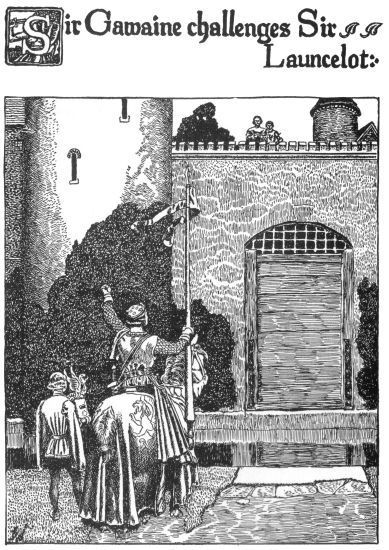
So the next day after this medicine had been delivered to him, Sir Gawaine went to the walls of the castle and he paraded under the walls of the castle, and he called out, “Sir Launcelot, come forth and do me battle. For this satisfaction thou owest to me for slaying my kindred.” But Sir Launcelot would not come forth to do him battle. For Sir Launcelot still loved Sir Gawaine and he loved King Arthur; both for the sake of those times that were past and gone, when they had joy and pleasure together. So because that the one was Sir Gawaine and the other was King Arthur, he would not come forth to do battle. Nay, because of his love for those two, Sir Launcelot would not fight in that part of the battle where Sir Gawaine or King Arthur was, but would do battle at other parts.
But when the next day had come, Sir Gawaine came again and the strength of ten men was in his arms and his body. And he paraded back and forth under the walls of the castle, and ever as he paraded he cried out aloud, “Sir Launcelot, thou caitiff knight! Come forth and do me battle! For thy doom is upon thee, and thou shalt die in this war; wherefore, come and do me battle, or else announce that thou art afraid of me.”
But still Sir Launcelot would not go forth against him, but he sat in the castle and groaned for sorrow and bitterness of spirit. Then Sir Ector came to Sir Launcelot, and he said, “Kinsman, suffer me that I go forth and do battle in thy behalf; for this man sharneth us by this challenge.”
Then Sir Launcelot wept, and he said, “Thou shalt not go, for wit you that I loved this man better than mine own blood. And if he should be slain, then will my heart be filled with grief such as can never vacate it again. And if thou art killed, then will I be without my brother, and must take it upon me to fight Sir Gawaine upon the behalf of thy death. Wherefore, I pray thee go not forth to meet him.”
But ever Sir Ector besought Sir Launcelot saying, “Brother, suffer me to go!” And at last Sir Launcelot said, “Well go, and may God be with thee!”
So Sir Ector armed himself and departed out of the castle to meet Sir Gawaine.
Then Sir Gawaine rode up to Sir Ector and he said to him, “Sir, what knight are you?” Quoth Sir Ector, “I am Sir Ector de Maris, the brother of Sir Launcelot of the Lake.” Said Sir Gawaine, “Why come you here?” And Sir Ector replied, “I come to do battle with you upon my brother’s behalf.” Then Sir Gawaine laughed and he said, “Sir, you are welcome. Rather would I have it that you were Sir Launcelot, but failing him I will accept you as his proxy. So make yourself ready to encounter me.”
Sir Gawaine overthroweth Sir Ector.
So each of those two knights rode to a certain distance and prepared himself for that encounter. And when they were in all ways prepared they charged very furiously against one another. In that meeting the spear of Sir Ector broke into many pieces, but the spear of Sir Gawaine held. And because he had the strength of ten men behind his spear, it penetrated the shield of Sir Ector and it penetrated his body, so that it stood a haeadth out behind his back.
Then Sir Ector fell from his horse and, in passing, the spear of Sir Gawaine was broken so that the baton of the spear of Sir Gawaine remained sticking in the body of Sir Ector; a part of it sticking out before, and a part of it sticking out behind.
Then Sir Gawaine rode back to where Sir Ector lay, and he said to him, “Sir, how fares it with you?” Quoth Sir Ector, “Alas, Messire! I have received my death-wound.” Then Sir Gawaine laughed very bitterly, and he said, “So shall it always be with traitors, such as thou.”
Then with that Sir Gawaine turned his horse and rode away from that place, leaving Sir Ector lying where he was.
Anon there came forth those from within the castle and they lifted up Sir Ector where he lay. And they laid him in the hollow of the shield and bare him into the castle. And all who saw Sir Ector in that condition wept to behold him so.
So they bore him to a chamber and laid him upon a soft couch and Sir Ector groaned very dolorously with the agony of his wound, and Sir Launcelot and several others stood before him, and ever as Sir Launcelot considered him, the tears welled out of his eyes and rolled like shining jewels down his cheeks.
So about the eleventh hour of the night Sir Ector said to Sir Launcelot, “Sir, this wound is my death-wound. I pray you to draw out the baton of that spear and let me pass.” Sir Launcelot said, “I cannot draw it forth.” Sir Ector said, “Is there no friend here who will draw forth this baton, and suffer me to die?”
Then said Sir Bors, “I will draw it forth,” and with that he came to the bedside of Sir Ector and he laid hold of the baton of the spear. And he drew very strongly upon that baton and it came forth out of that wound and with it came a great effusion of blood.
Sir Ector dieth.
Then Sir Ector groaned very deeply and he said, “I pass,” and with that he closed his eyes and in a little while he was dead. Then they who were there wept a great passion of tears, for Sir Ector was well-beloved of all of them.
Now when the next morning was come, Sir Gawaine came again before the castle and rode there as aforetime. And ever as he rode he cried out, “Sir Launcelot, thou craven knight, come forth and do me battle.” But still Sir Launcelot would not come forth against him. Then Sir Bors de Ganis came to Sir Launcelot and he said to him, “Sir, suffer me to go forth against this knight, for he bringeth shame upon us all.”
Quoth Sir Launcelot, “I crave you not to go, Sir; for this knight, Sir Gawaine, is a very strong and powerful knight. Already hath he slain Sir Ector, and should you also lose your life, what great loss that would be to us all.” “Nevertheless,” said Sir Bors, “I would fain go forth against him. For God may give me the victory, in which it will be a great benefit to us all in that he will no more come to trouble us.”
Then Sir Launcelot turned away his head, and anon he said, “Go, in God’s name, and may good fortune attend you. As for me, I cannot go against Sir Gawaine because of the love I held for him. For should he slay me, that would be a great misfortune for us all, but should I slay him, never would I cease to sorrow and to repine for his death. Wherefore, I cannot now go against him, but you may go against him.”
So Sir Bors armed himself and went forth out of the castle, and when Sir Gawaine beheld him coming he was rejoiced, for he thought that this was Sir Launcelot.
So Sir Gawaine rode up to him as he approached, and he said to him, “Messire, what knight are you?” Him Sir Bors made answer, “Sir I am Sir Bors de Ganis, and I have come forth here against you upon behalf of Sir Launcelot of the Lake.”
“Sir,” said Sir Gawaine, “you are very welcome; though rather would I have to do with Sir Launcelot of the Lake than with any other man in all of the world. For I have no quarrel against you, but against him I have a quarrel.”
“Nevertheless,” said Sir Bors, “I stand here now upon his behalf to do battle for him.”
Quoth Sir Gawaine, “Prepare yourself then for battle!” So Sir Bors took his assigned place and when they were in all wise prepared they rushed together with great violence and fury.
In that encounter the spear of each knight was broken into many pieces, even to the very fist that held the spear, and the horse of each recoiled so that it sunk back upon its haunches and would, perhaps, have fallen, had not the address of the knight rider recovered it. Then each knight cast aside the truncheon of his spear and voided his horse, and each drew his sword with great readiness and rushed to the battle very furiously, violently and impetuously. Each smote the other many sore buffets and strokes so that each knight was wounded in several places.
But Sir Gawaine was possessed of the strength of ten, and Sir Bors was possessed but of the strength of one, so that by and by Sir Bors was obliged to hold his shield low because of weariness from the redoubled fury of Sir Gawaine’s attack.
Sir Gawaine woundeth Sir Bors.
So Sir Gawaine perceived that opening which he made in his defence, and, grinding his teeth together, he whirled up his sword and smote Sir Bors upon the shoulder of that arm that held his sword. So violent and savage was the blow that it sheared through the iron of the epulier and it sheared through the flesh and bone of the shoulder so that the arm of Sir Bors fell and hung down from the shoulder and his hand dropped the sword that he held.
Sir Bors asks his life.
Then Sir Gawaine laughed and ran forward and he set his foot upon the sword of Sir Bors. And Sir Bors sank down upon his knees and he said in a weak and faltering voice, “Sir Gawaine, I am sorely wounded. If it please thee to do so, I pray thee to spare my life.”
Quoth Sir Gawaine, “Why should I spare thee thy life? Thou art a traitor knave, and it is not fit that I should spare thee, but rather I should slay thee as thou kneelest before me. But I cannot forget our long and many associations; and I cannot forget that thou wert one of those three knights who achieved the Grail, and brought the Grail back again to Sarras. So I will forgive thee, and will spare thee thy life, if so be that God will also spare it.”
Then Sir Gawaine turned and sheathed his sword, and he mounted his horse and rode away. And anon there came the friends of Sir Bors from the Castle of Chillion, and they lifted him up and laid him upon a litter, and so they bore him away into the castle.
And they took Sir Bors to a room of the castle and stripped off his armor and beheld the wound that it was very ghastly and dismal. And so much blood was emitted from that wound that Sir Bors fainted and for awhile he hung hovering upon the edge of death.
Sir Bors doth not die.
But he did not die then or afterward, but he revived and his wound was healed so that he, by and by, became well and strong again.
Then Sir Launcelot came to where Sir Bors was, and he said to him, “Sir Bors, how fared it with thee?” And Sir Bors said in a fainting voice, “Sir, I know not how it was with Sir Gawaine. For I found him to be so passing strong that never have I found a stronger. For he smote down my defences and he smote me this blow that I have received, and from which I shall maybe die. For mine arm is nearly severed from its shoulder, and I wit not whether I shall ever be strong and hale again.”
Then Sir Launcelot wept and he said, “Alas, that this is so! For now I cannot forego this battle with Sir Gawaine any longer. For yesterday he slew my brother, Sir Ector, and to-day he hath nearly slain thee. So to-morrow I shall have to have ado with him, or else, by and by, all shall perish at this place.”
Then Sir Bors said, “Sir, beware of him, for he hath strength more than human, wherefore I fear that he may prove to thee thy undoing.”
To that Sir Launcelot answereth, “I should be sorry to find it so. But whether it is thus or not, still must I have ado with him upon the chance that I may thus save the lives of others within this place.”
So it came that Sir Launcelot was prepared to do battle with Sir Gawaine.
Now if you would hear more of this famous fight betwixt Sir Launcelot and Sir Gawaine, I pray you to read that which followeth. For there it shall be fully and distinctly set forth as it hath been told of in several ancient histories dealing with these things.
Chapter Seventh
Of the battle betwixt Sir Launcelot and Sir Gawaine. Also how King Arthur returned to Little Britain.
SO came the next day and Sir Gawaine had his esquires to enclose his body in full armor of proof, and he mounted his horse and took a good stout lance of ashwood in his hand, and he set forth once more to seek Sir Launcelot as aforetime he had done. So Sir Gawaine came beneath the wall of the castle, and he paraded before the wall, and ever as he thus paraded he cried aloud and on high, “Come forth, Sir Launcelot of the Lake! Come forth, thou caitiff knight, and do me battle!”
Then Sir Launcelot wist that now the time was come for him to do that battle.
Sir Launcelot goeth against Sir Gawaine.
So Sir Launcelot mounted upon his horse and took into his hand a good stout lance of ashwood for his defence, and thus armed he gave orders and the portcullis of the castle was raised and the drawbridge was let fall and Sir Launcelot rode forth all clad in that armor of proof to meet Sir Gawaine.
Then Sir Gawaine rode up to Sir Launcelot and gave him greeting and he said to Sir Launcelot of the Lake, “Sir, I pray you tell me, are you Sir Launcelot of the Lake, or are you another knight than he? For by your figure and by your conduct and by that device which is upon your shield, I wit you to be Sir Launcelot, and yet I know not whether you are he or not he. For this is the third time I have challenged, and heretofore he would not come out against me.”
Sir Launcelot bespeaks Sir Gawaine.
Quoth Sir Launcelot of the Lake, “Sir, I am Sir Launcelot indeed, and wit you, Sir Gawaine, I have well tried to avoid this battle, for I fear me in this battle or in some other battle of its kind, either you or I shall be slain. And I would not slay you for the love that was of old betwixt us; for still I remember me of that love, and I hold it very dear to my heart. Wherefore I would not do battle with you if that battle could be avoided.”
Quoth Sir Gawaine, “What prate you of love, Sir? This battle cannot be avoided, for wit you that even if ever I loved you, yet all that love is now passed away, or rather it is transformed into hate. For you have wounded me so deeply in my heart that no man can wound me so deeply and yet live while I live also upon the earth. Wherefore either you or I shall die by the hand of the other, if not at this time, then at some other time.”
Quoth Sir Launcelot, “How have I wounded thee, Gawaine, or in what way have I done thee such hurt as this? Tell me that I may make that wrong right again.”
Sir Gawaine accuses Sir Launcelot.
Said Sir Gawaine, “Wit you not that I have often told you how that first you slew two of my sons, and my brother, and how that afterward you slew two more of my brothers? Is not that injury enough for any man to bear within his heart and yet to live under that injury?”
Then Sir Launcelot sighed and he said, “Sir, wit you that those two sons and that brother I slew in battle and they were armed, and assaulting me, and I knew them not. As for those two of your brothers whom I afterward slew, them I slew in the press and fury of fighting. For I saw not their faces in that fury and knew them not. For if I had known them, wit you that I would have held my hand and spared them? Sir, for that I am grieved to the heart, for I loved them both very well; more especially Sir Gareth whom I made a knight in the field.”
Then Sir Gawaine laughed very bitterly, and he said, “Sir, you make a very good excuse, still you did that which you did, and having done it you must pay for it. For so every man must pay for that which he hath done; let it be good or let it be ill. Come, Sir, prepare yourself for battle, for I am hungry to have battle with you.”
Then again Sir Launcelot sighed, this time so deeply that his heart had been lifted from its strings within his bosom by that sigh. And with that sigh he closed his helmet, and reined in his horse and withdrew to that part of the field which was to be his assigned place of battle.
Many view the battle.
Then many of the defenders of the castle came down to the walls of the castle and stood there, and looked down from those walls upon the two who stood so in array of battle. And King Arthur and many others came from the camp of the besiegers, and also stood them afar off to behold the battle, so that with those and with these who were there it was as good an assembly as any knights could have chosen in which to do battle.
And the sun shone very clear and strong—yet not too strong. And the breeze blew very freely so that all the poplar trees around about the castle were turned white with its blowing, and the river that ran down past the castle was dusked and rippled by that wind, and all the reeds of the river bowed and dipped into the water thereof.
So those two knights prepared themselves for the assault, making their armor in all ways tight and secure. Then when they were in all ways ready, they shouted to their horses and so sprang to the charge, galloping against one another with a noise like to the noise of thunder.
So they met in the midst of the course and smote one another, in the centre of the other’s shield. And before that shock the spear of each was split into a great many very small pieces, even to the hand that held it. And each horse sank quivering back upon its haunches at the recoil of that blow, and would have fallen, were it not that the extraordinary address of the knight rider recovered his horse with spur and rein and voice. Then each knight cast aside the truncheon of his spear and drew his sword, and each rushed at the other very furiously and valiantly. Then each smote the other with great power and strength.
Sir Launcelot faileth.
But though Sir Launcelot smote with all of his strength, yet Sir Gawaine smote with the strength of ten. So that Sir Launcelot was driven backward, and around and around in small circles, and in that assault he was altogether astonished at the fury and the strength of Sir Gawaine. For he wist not that Sir Gawaine had that strength of ten men, and he knew not that Sir Gawaine had taken that medicine to lend him that strength.
And Sir Launcelot had much ado to defend himself so that he made no attack, but only a defence with sword and shield against the attack of Sir Gawaine. And Sir Launcelot thought that never in all of his life had he fought with so strong and so powerful a knight as Sir Gawaine—nay, not even when he fought with Sir Turquine that day at the ford before the castle of Sir Turquine. For anon the blood began to flow forth from him in spite of all his defence, so that in a little while the ground on which he fought was all sprinkled red with that blood, and his armor was all ensanguined with the crimson streams that bathed it. And in all that while Sir Gawaine had hardly any wounds at all, but he fought with all his strength and might, and with the purpose to beat down his assailant.
But though Sir Gawaine fought in that wise, yet, by and by, it reached the prime of noon, and still he had not struck down Sir Launcelot. Then that strength of ten that he had with the medicine that he had taken began to fade and wane away as the flame of a candle flickers and wanes away when the wax is consumed. So anon Sir Launcelot felt that the attack of Sir Gawaine was no longer so furious and so violent as it had been, but that it was weaker. Therewith he redoubled his own battle with tenfold violence. And now he no longer made defence, but instead of defence he made attack. And he drave Sir Gawaine backward before him, for Sir Gawaine could not stand before the fierceness of that attack now that his strength was waning.
Sir Gawaine faileth and is overthrown.
So Sir Gawaine bore back from before those blows, and by and by he began to hold his shield full low for weariness. Then Sir Launcelot perceived his opening, so he rushed the attack with double fury, and anon he swung his sword and smote Sir Gawaine with it full upon the head. And so violent was that blow that it clave asunder the helmet and the coif, and it wounded the head beneath the coif.
Then Sir Gawaine sank down upon his knees, his hand relaxed and the sword that was in his hand fell out from it upon the ground. Then Sir Launcelot ran to Sir Gawaine and he set his foot upon the sword and he rushed off the helmet of Sir Gawaine and he cried out very fiercely, “Sir, yield yourself to me or I will slay you!” But Sir Gawaine said, “I will not yield me to thee, so thou mayst slay me at thy pleasure!” Then Sir Launcelot gazed at Sir Gawaine, and as he gazed at him the fury of battle passed away from his soul like a mist from before the face of the sun; and Sir Launcelot felt such great love for Sir Gawaine and such great pity for him that his eyes ran all with tears.
Sir Launcelot spareth him his life.
Then Sir Launcelot said, “Sir Gawaine, even if you do not ask me for your life, yet will I grant it to you. Arise and depart!” To this Sir Gawaine said, “Messire, in this you are foolish. For if you do not slay me now, then when I am well and healed again, I will come back against you, and will assail you again as I have assailed you to-day. For wit you that in this quarrel either you shall die or I shall die.”
Sir Launcelot said, “Sir, this matters not to me! I cannot slay you now and I will not slay you.”
So Sir Launcelot turned away from that place. And he mounted his horse and departed thence. And as he rode back to the castle Sir Launcelot wept so that hardly could he see the way before him because of the tears that rained down from his eyes.
Then came those from King Arthur’s side who had looked upon the battle, and they raised Sir Gawaine up and led him away to his tent. And when he had come to his couch they unarmed Sir Gawaine and searched his wounds and found that they were very deep and sore. So they dressed the wounds of Sir Gawaine and put salves and unguents upon them, and so he was made in all ways as comfortable as could be.
And Sir Gawaine sent for that cunning and learned physician who had given him the medicine of strength, and he said to him, “Cannot you give me a stronger medicine than that, and one that will make in me the strength of twenty?” The physician said, “Sir, I cannot do that, for I have no such power.” Sir Gawaine said, “Then can you not give me a medicine that will make me stronger for a longer time than till the prime of noon?” But the physician said, “Sir, I cannot do that either.” Then Sir Gawaine sighed and he said, “Woe is me! I fear me I shall never be able to overcome Sir Launcelot.”
Meanwhile the wounds of Sir Launcelot were being searched at the castle and also were found to be very sore and very deep. So it was several weeks before Sir Gawaine or Sir Launcelot recovered from those wounds. But after those several weeks were over, then each knight was as strong and as hale as he had ever been.
Sir Gawaine is healed. He challengeth Sir Launcelot.
So, after Sir Gawaine was in all ways healed again, he clad himself in armor and took in his hand a very strong and powerful lance and mounted upon his horse once more. And Sir Gawaine rode out to the castle and he rode up and down before the walls of the castle, and ever as he rode he called out on high, “Sir Launcelot, come forth, thou caitiff knight, and do me battle!”
Then they who heard those words went to Sir Launcelot, and they said to him, “Sir, here Sir Gawaine is riding beneath the walls of the castle, and he uttereth his challenge against you.” Sir Launcelot sighed and anon he said, “Send mine armor here to me”; and he said, “Send Galliard hither” (Galliard being the name of the esquire of Sir Launcelot).
So the esquire came and he aided Sir Launcelot to put his armor upon his body and his limbs, and so Sir Launcelot was in all wise armed cap-a-pie in that armor. Then Sir Launcelot took a good stout strong spear in his hand, and he mounted his horse. And the gates of the castle were opened to him as they had been aforetime; and Sir Launcelot rode forth into the sunlight to meet Sir Gawaine as he had aforetime done.
So Sir Launcelot rode up to where Sir Gawaine was and he said to Sir Gawaine, “Sir, I am here to meet thee.” Sir Gawaine said, “I see that thou art, and I give thee welcome.” Sir Launcelot said, “Sir, it is with greater grief than ever that I come forth to meet you to-day. For this is the fourth challenge that you have given to me, and I cannot receive any more challenges from you. So it is this day either you or I shall have to die. For I cannot suffer it that you shall come to me for day after day as you do, to utter your challenge against me.” Said Sir Gawaine, “Messire, it is to my mind also that either you or I lay down our life to-day. If it be I who must die, then am I glad to lay down my life for my sons and my brothers whom you have slain; if it be you who are to die, then am I still more glad to sacrifice you to their spirits. Yet as you slew them unarmed, so it will be a greater pleasure to me to slay you for their sakes.”
Quoth Sir Launcelot, “Are you ready?” and Sir Gawaine said, “Yea, I am in all wise ready.”
So once more as it was before so it was now, for many of those of the castle came and stood upon the walls of the castle to behold that battle; and also there came many from the camp of King Arthur, and these stood upon the surrounding hills so that all those hills were covered with a multitude of men watching that combat.
So each knight having assumed his place of battle, and each being in all wise prepared, each set his spear in rest and each shouted to his horse to advance. Then the one charged against the other with great speed and violence, and so each met the other in the middle of the course with a crash like to a clap of thunder.
They two do battle together.
As it was before, so now each lance was shivered to splinters, even to the very truncheon of the spear, and each horse reeled back from that assault. Then again each knight recovered his horse with spur and voice so that he did not fall in that recoil.
Then each knight cast aside the stump of his spear, and each leaped from his horse, drawing his sword from its scabbard for the assault. So they rushed together as aforetime, striking and lashing with might and main.
But again Sir Launcelot found Sir Gawaine possessed of such strength as astonished him, for he felt that he was fighting with his own strength against the strength of ten men.
In that battle he received many wounds that were worse than they had been before; for this time Sir Gawaine fought with great desperation to end that battle before high noontide. But ever Sir Launcelot made very strong and powerful defence, striking but few blows of assault, but putting himself ever in the posture of defence. Yet in spite of that defence, both the armor upon his body and the earth upon which he stood were all ensanguined with the blood that flowed from the many wounds that he received in that battle.
But at last it came high noontide, and with the coming and passing of noon the strength of Sir Gawaine reached its height and limit, and then it began its decline. So Sir Launcelot felt the waning of Sir Gawaine’s strength and therewith ceased from his defence and began to frame his attack against the other. Then Sir Gawaine retreated backward, and he assumed such defence as he was able. But Sir Launcelot rushed upon him and beat him again and again and yet again with his sword. And Sir Gawaine was wounded in many places, for the blood gushed in streams out of many deep cuts through his armor plate.
Sir Launcelot wounds Sir Gawaine mortally.
Then from weariness the shield of Sir Gawaine began to fall full low, and Sir Launcelot perceived this and ran in upon him. And Sir Launcelot whirled his sword and smote Sir Gawaine with all his might upon the neck upon the left-hand side. And the blade of Sir Launcelot’s sword sheared through the armor at that place, and it sheared through the neck and the breast, and so deep was that wound that Sir Gawaine suffered from that blow his death-wound.
Yet Sir Gawaine would have stood to fight if he could have done so; but he could not stand. Otherwise, he sank slowly down upon his knees and there rested, with his hand upon the earth. And the blood poured down his arm and wet the earth beneath him.
Then Sir Launcelot ran in upon him and he rushed the helmet off Sir Gawaine’s head, and he cried out, “Sir Gawaine, yield thee or I will slay thee!”
Quoth Sir Gawaine, “Messire, already thou hast slain me. For this wound which thou hast given to me is my death-wound. So I feel it to be, for the life is already passing out of me through that wound.”
Then Sir Launcelot wept and he said, “Sir, say not so. Now I pray thee that thou wilt forgive me for this wound and for all else that I have done against thee!”
Sir Gawaine will not forgive Sir Launcelot.
But Sir Gawaine looked at the blood that ran in streams down his arm, and he said, “I will not forgive thee, Launcelot, for otherwise, I will die in my hatred of thee. For thou hast slain me as thou hast slain my brothers, and upon thee I voice my curse and their curse as well. For my curse and their curse is this: that never after this day shalt thou prosper in anything that thou shalt undertake. Never shalt thou join in any battle from this time forth; and the dearest wish of thy heart shall disappear from thy hands when thou closest them upon that wish. Thou shalt live in sorrow and shall die shut away from all sounds and sights of knightly battle. This is my curse and my sons’ curse and my brothers’ curse upon thee, so wit you that though I die yet you shall be in a worse estate than I who am dead.”
Then Sir Launcelot knelt weeping before Sir Gawaine, and Sir Gawaine said, “Get you hence, Sir knight, for my friends are coming.”
Then Sir Launcelot raised his head and looked and he beheld that the Knights of King Arthur were coming in that direction. So he turned and mounted his horse and rode away at a hard gallop toward the castle, and he entered the castle and the gates thereof were closed behind him.
Sir Launcelot grieveth.
Then many of those knights who were dearest to Sir Launcelot came about him to give him praise for overthrowing Sir Gawaine. But Sir Launcelot would not look at them. Otherwise, he turned away his head from them and withdrew to his own inn. For wit you that Sir Launcelot loved Sir Gawaine better than any man in all of the world; yea, better than his own blood and kindred. And now he knew that he had slain that one whom he loved the best of all; wherefore he lay with his face turned to the wall and melancholy enclosed him all over, like to a cloak of black.
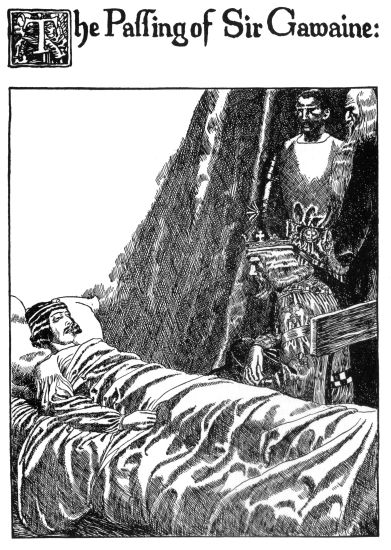
But meanwhile Sir Gawaine had swooned so that when those knights and gentlemen, his friends, came to him, he lay on the ground like one who was dead. Those gathered him up and laid him upon a litter, and they bore him away in that litter to his tent. There they unlaced the armor and removed it, and anon the chirurgeon came to him to search his wounds. But when the chirurgeon beheld that great wound in his neck, he wit that Sir Gawaine could not live. So the chirurgeon sent for King Arthur to come hither, and he said to the King, “This man cannot live, but must die.” King Arthur wept, and he said to the chirurgeon, “How know ye that he must die?” To which the chirurgeon replied, “Lord, when I looked in at that wound in the lower part of his neck, methought I could see his heart beating beneath it. Wherefore, I know that if the heart groweth cold through his wound, then he must die.”
Then King Arthur hid his face and for awhile he said nothing. Then he went to the bedside of Sir Gawaine, and he said to him, “Messire, how is it with you?”
Sir Gawaine advises the King.
Sir Gawaine smiled at him and said to him, “Sir, wit you that I must die of this hurt.” King Arthur said, “I trow not.” Sir Gawaine said, “In that you are mistook, for here have I my death-wound, and in a little while I must die.” King Arthur said, “Sir, keep up your heart.” To this Sir Gawaine made answer, “My heart faileth not, but my life hangeth fluttering upon my lips, and soon it must pass away from me.” And Sir Gawaine said, “Sir, wit ye of this, your own case is as bad as mine. Return you again to Britain as fast as you are able, for I trust not more than need be to Sir Mordred’s truth, albeit he is my brother. For he hath ever had a dark and gloomy spirit. And he hath ambition for the throne, and now that he hath the power behind that ambition, and now that you have lost so many good and worthy knights at this castle, he will certes seize upon your throne unless you are by to wrest it out of his hands. Wherefore I pray you to return to Britain as soon as may be.”
King Arthur said, “Sir, these are imaginings upon your part. For Sir Mordred is a Knight of the Round Table, and is bound to me in fealty. Why, therefore, think you he would be treacherous to me?”
Sir Gawaine said, “Lord, I lie now very close to the edge of death and all things appear extraordinarily clear and distinct to mine eyes. Sir Mordred hath no love for any soul save only for himself. Wherefore, I fear me he will sacrifice you to his desires, and will seize upon your throne. Lord, I shall not live until to-morrow morning, wherefore, I charge you that when I am dead, you shall bury me here in haste, and depart straightway for England, for I fear me for your kingdom in Britain.”
Sir Gawaine dieth.
So that night in the second hour after midnight, Sir Gawaine drew his last breath and died. And King Arthur was there at that passing, and several knights companions of the Round Table were there, so that Sir Gawaine did not die in loneliness. And after he had passed, King Arthur wept and he said as follows:
THE LAMENT OF KING ARTHUR
King Arthur’s lament.
“So passeth this dear and faithful friend. There is not of all those who are left anyone whom I love so well as I loved him. For though he was passionate in his angers and his indignations, yet to me he was always loving and full of dutifulness and kindliness. He was the right hand and support of my throne and its chiefest prop in all of its weaknesses, and I had hoped that he would have occupied that throne after I had departed from this earth.
“But now this is past and gone and he is taken who was, next to Sir Launcelot of the Lake, the brightest and most glorious figure of all my Round Table.
“He was the companion of my youth. For when I had fought my battles and come to my throne, he was among the first who came and laid his hands between my palms. Also he was one of the first of all those knights-elect of the Round Table to take his seat at that table.
“But now he is gone and I am left alone, like the tree in the forest that hath been struck by lightning. Yea, like that tree my foliage is withered and now I stand stark and bare against the sky. For my Queen, who was the lover of my youth, is estranged from me, and I shall never behold her more. My Round Table, that was otherwise the chiefest glory of my reign, is broken and scattered and many of those who were one time dearest to me in love are now my foes. Where are now the defenders of my throne? They are gone; and that throne itself totters to its fall.
“All these are sad and woful happenings, but the saddest and most woful of all is that this good worthy knight hath died. Would that I had died in his stead and that he had not died, but that I had died for him. What worse hath Fate in store for me than this that he is dead?”
So in words such as these or in words like to them, King Arthur mourned for Sir Gawaine; for it seemed that no worse blow could befall him than this; to wit, the death of Sir Gawaine.
News cometh to the King of Sir Mordred.
That morning King Arthur was aroused very early from his couch of grief by a messenger that came to him with a message from Britain, and that message was this: that Sir Mordred had seized upon the throne and the crown of Britain, and was holding them for his own.
This message came from Sir Constantine of Cornwall, who was the cousin of Sir Gawaine and who was yet living in England. And Sir Constantine said, “Hasten! Hasten your return, O Lord King, and let nothing delay that return!”
Then King Arthur gave command that the siege of Chillion should be raised, and that after Sir Gawaine was buried they should all return again to Britain.
Sir Gawaine is buried.
So that day the funeral of Sir Gawaine was held with great pomp and circumstance. Four bishops conducted the mass for the rest of his soul, and the whole army knelt to pray for him. And those people within the Castle of Chillion also kneeled upon the battlements of the castle wall and prayed for the rest of his soul. For next to Sir Launcelot, he was the greatest knight in the world.
So they laid him at rest at that place—a good worthy knight and one well established in all courts of chivalry both then and thereafter. For if he was violent of temper and if he sought revenge upon Sir Launcelot for the death of his sons and his brethren, yet he gave his life for that anger and that revenge, and that the manes of his kindred might be satisfied.
So endeth the history of Sir Gawaine.
Chapter Eighth
How King Arthur returned to England. How he fought his last battle with Sir Mordred.
Sir Mordred despaireth.
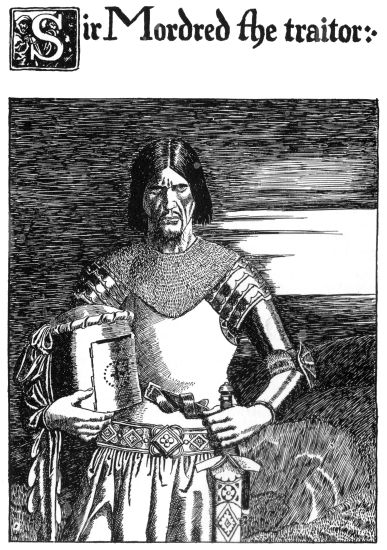
SO the news came to Britain that King Arthur was returning to that realm, and that news was conveyed to Sir Mordred where he was. And when Sir Mordred heard thereof he sat sunk in melancholy, his head bowed upon his breast, and his food and wine standing untasted beside him.
And several of the friends of Sir Mordred were with him at that time, and with them was Sir Mador de la Porte, who had, since his battle with Sir Launcelot, been an enemy to King Arthur. These say to Sir Mordred, “Sir, why are you so cast down? Wit you that King Arthur is not yet returned, and that when he doth return he must do battle with you to regain his kingdom.”
Quoth Sir Mordred, “Yes, that is very true, but wit you that I have given out word to the world that King Arthur was slain in battle before the Castle of Chillion, and in that word lay my strength. Wherefore now, when King Arthur returneth to Britain, and when the people find that he is yet alive, they will turn to him and will cast me out.”
His friends advise him.
Quoth Sir Mador de la Porte, “Then it behooves you, Sir, to make stir and to proclaim to the people that with King Arthur there will be continued wars, but that with you there will be peace and tranquillity. For wit you that King Arthur for this year past hath been continually at war against Sir Launcelot, and during that time you have not had one single war in all of Britain. Wherefore, as people love peace, so they will cling to you. Beside this, you should summon the Archbishop of Canterbury to your presence and have him crown you as king. For if you be a king in your own right, then will you have that much more strength to do battle for your own rights. Now here at hand is the Archbishop of Canterbury, and he shall be summoned and shall crown you at your demand.”
Sir Mordred beseeches the Archbishop to crown him.
So they sent for the Archbishop of Canterbury, and he came to where Sir Mordred was. Sir Mordred said to him, “Sir, wit you why I have sent for you? It is that you shall crown me King of Britain.”
The Archbishop refuses.
Quoth the Archbishop, “I cannot do this thing that you ask of me, for the news is that King Arthur is returning to Britain. How then can you be crowned King of Britain when the rightful King of Britain is still alive?”
To this Sir Mordred made reply, “I have not set for you to reason with me, but to crown me as the King of this realm. For if you crown me, then do I believe that I shall be well able to defend my crown and my kingship, but if you do not crown me, then will I do battle with King Arthur as a usurper to make myself a king instead of him.”
Then said the Archbishop, “Sir, you shall not do this thing. For I, as the head of the Church in this realm, bid you to surrender your rights and claims unto the just and lawful king who now returneth. For he surrendered his kingship to you for a little while whilst he was away from Britain, and not for a permanency. Yet you would make that surrender permanent, for you would make yourself king instead of him. Wherefore, if you do not surrender yourself to King Arthur’s mercy upon the day of his landing, then will the Church curse you with bell, book and candle as the usurper of those rights that belong to another.” Then Sir Mordred was filled with rage against the Archbishop and he cried out, “Sir, get you gone, or I shall forget myself and draw my sword and slay you perhaps.”
The Archbishop withdraweth.
So the Archbishop withdrew from the presence of Sir Mordred, and he called his court about him, and he recounted to that court all that had passed between him and Sir Mordred. And he said, “Let us fly from this place. For we are in danger here.” So the Archbishop took him a strong horse and he mounted upon it and his court also mounted upon horses, and then he and his court rode with great haste away from that place and to Dover, where King Arthur was expected to be about to land.
After the Archbishop had gone and when Sir Mordred found that he had gone, Sir Mordred collected such of his army together as were there at hand; and he also descended to Dover, taking that army with him; his intent being to prevent the King from landing if he could do so.
So came King Arthur to Dover, and as one stood upon the cliffs one beheld that his ships and galleys covered the entire sea as far as the eye could behold. And as the King approached the shore, he beheld that there was a considerable army drawn up in array upon the beach where he was to land, and he knew not whether that array were to welcome him or to do battle with him. But at length he perceived Sir Mordred in the forefront of that array, and he wist that that army was there to do battle with him. Then he groaned aloud and he said, “Is there yet more blood to be shed? Well, then, it must be shed, for never will I give up my throne unless I give it up with my life. For eight and twenty years have I held that throne, and shall I now surrender it to this man, my nephew Mordred? No; never!”
Of the battle of Dover.
So as the boats drew near to the shore, those who were in them leaped into the water and waded to the shore. And the army of Sir Mordred came down to the water and did battle with those who sought to land. And so a great battle was fought there at the edge of the water, so that the water was all discolored red with the blood of those who were wounded or slain and who fell into the flood. Wherefore it was that with each recurring wave this red water ran upward upon the white sands, and then receded, leaving the sands all stained red where it had flowed upon it.
But yet Sir Mordred did not prevent that army from landing, for ever more knights and yeomen and still more leaped from the boats and into that shallow water, and so at last the army of Sir Mordred was forced back from the water and King Arthur’s army landed upon the shore.
Then Sir Mordred withdrew his army from that place and King Arthur took possession of that part of Britain.
After that the Archbishop of Canterbury came to where King Arthur was, and he gave him greeting, saying, “Greeting, King Arthur, and give thee joy of landing upon this soil. For here am I who am the head of the Church and I give thee welcome to thy realm. For wit you that Sir Mordred would fain have had me crown him king, but I would not crown him, having heard that thou wert still alive.”
Then King Arthur embraced the Bishop and kissed him upon either cheek, and said to him, “Sir, I thank you for your welcome. And I thank you that you have guarded and protected my rights.”
Now, after having been thus driven away from Dover, Sir Mordred withdrew to Baremdown, and at that place he gathered about him all those of his followers who had hitherto been tardy in coming to him. And he assembled with him all those who had been friends to Sir Launcelot (for these were now at enmity with King Arthur). So at that place Sir Mordred had a very considerable army to confront King Arthur withal.
Then Sir Mordred stationed that army upon a rise of land where were three steep hills. For so he could charge down those hills against his enemies, whilst they must charge up those hills against him.
So came King Arthur, and when he perceived the dispersion of Sir Mordred’s army, he also arranged his army into three divisions. The centre division he took himself; the right division he entrusted to the King of North Wales, and the left division he placed under the leadership of Sir Ewaine, who had not quitted Britain for all this time.
Of the battle of Baremdown.
Then King Arthur charged his army up those hills against his enemy, but he could not climb those hills because of the steepness thereof, and because of the defence of the enemy at the top of the steeps. And afterward he charged again and again, but still he could not gain the crest of those hills.
Then Sir Ewaine’s division overlapped the army of Sir Mordred, and he charged up that hill both before and behind. And he doubled Sir Mordred’s party up upon itself and threw it into great confusion.
But that wing of Sir Mordred’s army could not retreat to the rear by reason that Sir Ewaine’s knights were there; wherefore, it fled back upon the centre of the army and threw that centre also into confusion. Then King Arthur charged for the fourth time, and this time he took the centre hill of the three, and with that the army of Sir Mordred broke and fled. And the army of Sir Mordred fled toward Salisbury, and a great many knights were slain in that flight. And the army of Sir Mordred took up its station not far from Salisbury, and not far distant from the sea.
So King Arthur won the battle of Baremdown, but with sad and bitter loss. For many knights fell in that assault and amongst them was Sir Ewaine, who was mortally hurt.
Sir Ewaine is wounded.
Now when King Arthur heard that Sir Ewaine was hurt, he went to where the wounded knight lay in his pavilion. And Sir Ewaine’s face was very wan and hollow and pale, and the dew of death stood upon his forehead. Then King Arthur went to the couch of Sir Ewaine and he kneeled beside the couch and embraced Sir Ewaine about the body with his arms. And the tears ran down King Arthur’s face and wet the face of Sir Ewaine that was beneath him. And Sir Ewaine said, “Art thou there, my king? For I cannot see thee, and yet meseems I feel thee weeping upon me.” And King Arthur said, “Ewaine, it is I.”
Sir Ewaine biddeth King Arthur to send for Sir Launcelot.
Then Sir Ewaine said, “Sir, send for Sir Launcelot to aid thee in this war. For Sir Launcelot is the best of all thy knights and he has with him several knights that are very good and strong. These will come to thine aid if thou wilt ask it of them, and so thou wilt easily overthrow Sir Mordred. For many of the knights also are friends with Sir Launcelot who are now in the army of Sir Mordred, thinking that thou art at enmity with Sir Launcelot. But if Sir Launcelot cometh to thee, then will those knights quit Sir Mordred and will cleave to thee. But if thou dost not send for Sir Launcelot then it may be that Sir Mordred will overthrow thee. Wherefore I beseech thee to send for Sir Launcelot and for his knights to aid thee.”
Quoth King Arthur, “How shall I send for him? And by what right shall I ask him to come to mine aid? Sir Launcelot is my foe, for he took from me my wife and held her from me for several months. And he hath slain my nephews and he slew Sir Gawaine, who was my best beloved of all. How, then, shall I now ask him to come to mine aid?”
Sir Ewaine writeth a letter to Sir Launcelot.
Quoth Sir Ewaine, “Give me parchment and ink.” So they brought ink and parchment to Sir Ewaine and they propped him up upon his bed. And with that his wounds burst out bleeding afresh, so that he wist that he had but a short time to live.
Then Sir Ewaine wrote to Sir Launcelot and he said to him, “Sir, this day hath been fought a great battle upon Baremdown, and King Arthur, mine uncle, won that battle. But many knights have died in that battle, and I in it have received my death-wound. Sir, I pray you let all bygones pass and be done betwixt you and King Arthur. And I pray you to forget and forgive any injury you may have received or given; for in this war King Arthur is put to such a pass that maybe he shall win and maybe he shall not win; wherefore I pray you to come to him without any delay, and so make his winning this war a certainty.
“Sir, I myself have been sorely wounded and am dying, and in an hour I shall have passed and gone from this earth. So, with my dying strength I write you to come to the aid of your king who made you a knight some while ago.”
Such as this was Sir Ewaine’s letter, and after he had written it he signed his name to it.
This letter King Arthur sent by a messenger to Sir Launcelot of the Lake in France. There Sir Launcelot received it and paid heed to it. For he summoned his knights about him and he read that letter to them, and he said to them, “Messires, such as this is the need of King Arthur. Now who will go with me to Britain and do battle in this for the King of Britain?” And those knights said, “I will go!”—“And I!”—“And I!”—“And I!”—until they all of them agreed to go to Britain and fight for King Arthur.
Sir Ewaine dieth.
Now return we to King Arthur again. For there was he left kneeling beside the couch of Sir Ewaine. And so he continued to kneel and presently Sir Ewaine said, “Good, my Lord, are you there?” For Sir Ewaine’s eyes were now darkening in death and he could not see anything. And King Arthur said, “Yea, I am here.” And he took Sir Ewaine’s hand in his, and Sir Ewaine’s hand was cold and very heavy, like to lead. And Sir Ewaine said, “Hold my hand and do not let it go.” So King Arthur held the hand of Sir Ewaine. So Sir Ewaine lay for a little while, breathing deep draughts of death; and by and by he sighed very deeply and then he lay still; for his spirit had passed from him with that deep sigh.
Then King Arthur arose and he said, “Alas, that this good worthy knight is gone. For he was my nephew and he was very faithful to me.” And he said, “To-day we will bury him, and to-morrow we shall follow Sir Mordred, and either he shall die or I shall die. For so through him and his deeds hath this kind and noble gentleman died; wherefore he must pay the price of that death—he must slay me as well, or else I will slay him.”
So King Arthur arose and went forth from that place. And when the day was come, Sir Ewaine was buried at the minster at that place, and it was said in the history of these things that his skull was to be seen there even to the very day of the ancient writing of this history.
King Arthur advances against Sir Mordred.
Then after all honors had been paid to the body of Sir Ewaine, King Arthur gathered his army together and he arose and pursued Sir Mordred in the direction of Salisbury. And the next day he came to that place where Sir Mordred was, and there he halted his army.
That night King Arthur lay in his pavilion and he slept very deeply and profoundly, as sleeps the man who is weary of toil and marching. And anon while he slept he had a dream and the dream was this:
The King hath a dream.
He dreamed that he sat upon his throne, and that his throne was established upon a monstrous wheel. And the wheel rose high with him sitting upon his throne. And anon the wheel rose above the rim of the earth, and he beheld the sun shining in all his glory. And the sun glittered upon him and he felt all the joy and all the delight of that sunlight. And it seemed to King Arthur that he was a great while in that sunlight, but he was not, for the wheel was turning very slowly with him. So the wheel reached its highest apex, and then it began to descend. And the wheel descended more and more swiftly, and anon it descended below the rim of the world, and so the sunlight had left the King. And the wheel descended more and more swiftly, so that King Arthur began to fear he would be cast out of his throne by the turning of the wheel. And King Arthur dreamed that he looked down beneath him, and he beheld that the wheel was descending very rapidly to a great pool, as it were a lake. And this pool was filled with blackness and with blood, and behold there was no bottom to that pool. And by then the throne of King Arthur was inclining very greatly toward that pool, and the King felt that he was slipping from his throne, and at that his soul was filled with terror. Then he tried to awaken, but he could not. So, in his terror, he screamed very loudly and shrilly, “Save me! Save me, or I fall!” And so shrill was his calling that several knights and attendants ran into the pavilion where he was, and these beheld the King struggling in his sleep. And they cried out, “Lord, Lord! What aileth thee? Awaken!” And with that King Arthur awoke.