PART I The Story of Sir Geraint
Reading edition
HERE beginneth the story of Sir Geraint, which same hath been noted in many ancient histories of the reign of King Arthur, and which is here inserted because it belongeth to the story of King Arthur at this place, as follows:—
Chapter First
How Sir Geraint followed the knight and the lady to whom the dwarf belongeth. How he lodged in a ruined castle, and how he found armor to wear.
SO Sir Geraint followed after that knight and the lady and the dwarf, and they led him at first toward Camelot. Then they turned aside and led him in another direction. For, by and by, they came to a cross-road and they turned into it, and later they came to a high ridge of land that overlooked a valley. And the valley was spread out beneath them, meadow and dale, woodland and fallow, as though it had been carved very minutely in ivory or in some sort of wood, very hard and fine, and so exquisitely and wonderfully modelled that it was as though a man might have covered it with the palm of his hand.
Then, after awhile, they quitted this open ridge of land and entered a woodland. Here they beheld no other thing than trees and green leaves, for all else was shut from sight. And no other sound disturbed the ear saving only the sweet song of the woodland birds, chaunting their pretty roundelay. Anon they descended from these places, and so at last came to a high-road that led beside a wide and brightly shining river, where slow-moving barges and quick wherries drew silvery threads across the smoothly mirroring surface.
Thus, by highland and lowland, by farm and woodland and waterway, the knight, the lady and the dwarf travelled for all that day; and for all that day Sir Geraint followed patiently after them.
So toward eventide they came to a town set on a hill. And overlooking the town was a high grey castle, and there was a wall drawn all about the castle and the town. And over against the town and the castle and set up on a hill opposite to them was another castle, very ruinous and neglected.
The knight enters the town.
The knight, the lady, and the dwarf entered the town, and Sir Geraint followed after them. And he followed them through the streets, and everywhere he beheld great crowds of people, and his ears were confused by the constant and continuous sound of laughing and chatting and calling of voice to voice. For all these people cheered and applauded the knight with his lady and the dwarf, when they entered the town—crowding after them and about them, seeking to touch the knight or his horse. And everywhere the lights of forge fires were burning, and the bellows were blowing, and the anvils were ringing with the continual beating of hammers upon armor. For all the town was in a bustle and uproar, as though preparing an army for battle.
Meantime the knight, the lady and the dwarf made their way through the throng and the turmoil, which every moment became greater and greater about them. For the street was presently full of people, and other people appeared at the windows and looked out and down upon them as they went forward upon their way. And some waved scarves and others cheered, and everywhere there was an uproar around about that place.
Sir Geraint inquires concerning the knight.
Then Sir Geraint said to one who was near to him, “I prithee, friend, what is all this bustle and noise and what does it all portend?” Quoth he to whom Sir Geraint spoke, “The Sparrow-Hawk! The Sparrow-Hawk!” and hurried away.
Then Sir Geraint queried of another, “What is all this to do?” Quoth he, “The Sparrow-Hawk, good friend, the Sparrow-Hawk!” and he also hurried away.
Then there came by a stout red-faced man, and of him Sir Geraint asked, “What is all this noise and bustle? I prithee tell me.” Quoth the fat man, “The Sparrow-Hawk, good sir, the Sparrow-Hawk.”
Then Sir Geraint was angry, and he reached down from his horse and caught the fat man by his collar, and held him fast. And he said, “Sirrah, I will not let you go until you tell me what is the meaning of all this tumult. Who is yonder knight, and whither goeth he?”
“Hah! Sir! Do you not know?” said the fat man. “Yonder knight is the Knight of the Sparrow-Hawk, and he goeth to the castle where he shall lodge until the battle of to-morrow.”
Sir Geraint inquires concerning lodging.
“Well,” said Sir Geraint, “that is something to know. Now I bid you tell me where I may find lodgings in this town and where I may find arms wherewith a knight may arm himself.”
Quoth the fat man, “There is no lodging to be had in this town at such a time as this, nor are there any arms to be found at any place. But if, fair sir, you will cross the valley, to yonder ruined castle, you will doubtless find lodgings for the night, and maybe you may find arms, and to-morrow you may behold the Knight of the Sparrow-Hawk overthrow in the lists all who come against him.”
Then Sir Geraint, seeing that the three whom he followed were now at the ending of their day’s journey, let go the man, who immediately ran away into the crowd that still followed after the knight, the lady, and the dwarf.
So Sir Geraint drew rein and he turned his horse and he quitted that town and crossed over the valley to the ruined castle upon the other side as he had been advised to do.
Sir Geraint approaches the ruined castle.
He bespeaks the old man.
As Sir Geraint drew near to the castle, he was aware of an old man who walked along upon the parapet of the wall. When this old and reverend man beheld Sir Geraint, that he approached, he descended from the wall and he came down to the gate and there met Sir Geraint. And Sir Geraint beheld that the old man was tall and lordly in his appearance and that he had a noble and stately countenance. But Sir Geraint beheld that he was clad in poor and simple garments, grey in color, and patched in places, and worn and threadbare at the seams. Sir Geraint said to him, “Sir, I pray you tell me—shall I find lodgings at this castle for to-night? And I pray you also tell me if you know where I may procure a suit of armor fit for me to wear?”
Quoth the old man, “Fair Sir Knight, it hath been long since any of your quality hath been to this place. For this is a poor and ruined house of a poor and ruined man. Ne’ertheless, such as it is, you are welcome hither. I pray you come in. As for armor, I have every belief that I shall be able to supply you with the same, provided you will accept that which is old and out of date.”
Thus saying, the old man took the horse of Sir Geraint by the bridle and he led it into the courtyard of the castle, and when he was come there he set his fingers to his lips and whistled very loud and shrilly. Anon a side door of the castle opened and there came forth a maiden both young and graceful, very tall and slender. And she was clad in a plain blue garment, straight and slim, and girdled with a girdle of blue leather. Her hair was plaited and twisted, and was without any net or ornament of any sort. But Sir Geraint looked at her very searchingly, because it appeared to him that this was the most beautiful young maiden whom he had ever beheld in all of the world.
When the maiden had come to them the old man bade her to take the horse of Sir Geraint to the stable and to see that it was fittingly groomed and cared for.
Then Sir Geraint would have protested at this service, but the old man said, “Sir, I pray you to let be, for we have no servants in this house, and we deem it a shame for a guest to do himself his own service. Wherefore my daughter shall find it a pleasure for to serve our guest.”
The maiden stables the horse of Sir Geraint.
So Sir Geraint dismounted from his horse and the maiden led it away to the stable. Then the old lord took Sir Geraint into the castle and he conducted him to an upper room wherein he was to lodge. And he prepared a tepid bath for Sir Geraint, and he brought him a loose garment, faded in color but trimmed with fur that had once been handsome and of rich texture, and the garment was very soft and comfortable.
Then the old man called to his wife and he gave some money into her hand, and he said to her, “Go down into the town and procure the best that you are able with this money, for it hath been many days since we have had a guest of so much worth and nobility as this gentleman appears to possess.”
So the old gentlewoman went down into the town, and after a little she returned again with a porter bearing a great hamper of food.
Meanwhile, whilst this food was preparing for supper, Sir Geraint and the old lord of the castle walked in the garden talking together.
Sir Geraint inquires concerning the knight of the Sparrow-Hawk.
Quoth Sir Geraint, “Sir, I pray you tell me several matters. First, I pray you tell me of this Sparrow-Hawk concerning whom yonder place appears to have gone mad?”
“Messire,” said the old lord, “I will tell you. Some years ago I was the earl and overlord of yonder town. But my younger brother undermined me with the inhabitants, and lately he hath gathered all of my power into his hands. Wherefore he is there, lodged in all splendor, and I am here, as thou seest.
“Now you are to know that my brother hath a mind to assemble a court of very worthy knights about him. Wherefore he hath had made a sparrow-hawk of pure silver which same is mounted at the top of a silver staff. For this sparrow-hawk many knights have come jousting; for what knight soever gaineth it and keepeth it for three years in succession, that knight shall be known as the Knight of the Sparrow-Hawk. Wherefore many have contested for it.
“For two years now a knight, hight Sir Gaudeamus of the Moors, hath overcome all who have come against him, and if he overcometh all the knights contestant again for this year, he shall be acknowledged as the true Knight of the Sparrow-Hawk.”
Sir Geraint asks for armor.
Thus spake the old lord of the ruined castle, and when he had done Sir Geraint said, “Sir, with that armor which you say you have, I think that I myself will contend with that knight to-morrow day. So I pray you to let that armor be sent to my room, where I may have it to hand when I want it.”
Quoth the old lord, “Messire, I have, as I told you, such a suit of armor, but it is of a sort that I know not whether you will wear it or not, for it is old and beaten; but if so be you are not ashamed to wear such ancient armor, I shall be glad to purvey it for you.”
“Sir,” said Sir Geraint, “I give you high thanks. And now come I to another matter. A short while ago I saw a maiden whom I thought was the most beautiful that ever mine eyes beheld. Now if that damsel hath no knight to serve her, I pray you tell me if I may fight for her sake to-morrow in the field of the Sparrow-Hawk?”
Said the old man, “Sir, that maiden is my daughter and my only child. Her name is Enid. If so be she shall accept you for her knight, then shall I be more than glad for her to do so. But I will send her to you, and you may break that matter to her yourself.”
Sir Geraint bespeaks Enid the Fair.
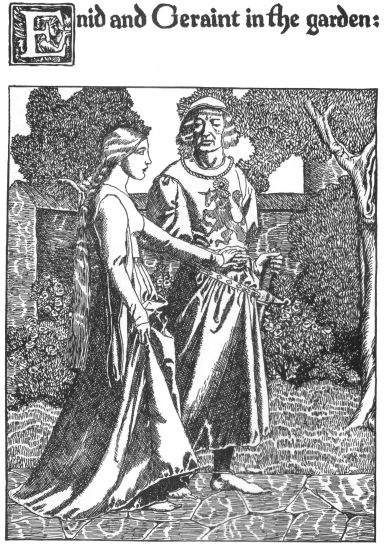
With this, the old lord took his departure; anon came Enid the Fair into the garden where Sir Geraint awaited her, and when he beheld her coming, his heart was very glad. So she came to him, and he took her very gently by the hand, and he said to her, “Lady, here am I, a knight of King Arthur’s Round Table and of his Court. I am of good repute and I believe am not altogether unworthy of my belt and my spurs. You, I think, are not more than twenty years of age, and I have nearly twice those years, yet I find that I have great pleasure in gazing upon you. Now I pray you, tell me if your heart may incline unto me sufficiently to suffer me to be your knight in the tournament to-morrow day. For I purpose then to endeavor for this Sparrow-Hawk, and I have no lady whom I might consider as the lady of my heart upon such an occasion.”
At this address Enid was very much astonished and abashed. She uplifted her eyes and looked at Sir Geraint very steadily for a little. And she beheld that he was tall and powerful of frame and that he possessed a strong and very noble face. Wherefore her heart went out to him and she said, “Noble Lord, it will give me great pleasure to accept you for my knight champion, if it so be that one of your high nobility and splendid distinction shall regard my poor estate. For my father hath not money to buy him clothes for us all, nor hath he any honor or estate saving only this ruined castle wherein we dwell. Wherefore it is not meet for me to lift mine eyes to one of your high estate and exalted quality.”
Then Sir Geraint regarded her very earnestly, and he found her to be still more beautiful than he had at first thought her to be; and he said, “Enid, it may be that thy present estate and quality is not very great, yet thy face is more beautiful than that of any woman whom I ever yet beheld, wherefore I would fain have thee to consign thyself for my true and only lady. If thou wilt do this, it may be that I shall be able to be of great help and assistance both to thee and to thy father.”
She said to him, “Lord, I will accept thee for my true and faithful knight.”
Enid gives Sir Geraint her belt.
Then Sir Geraint said, “Now I have no favor of thine to wear. I pray thee give me that belt thou wearest about thy waist, for I myself will wear it twisted about mine arm to-morrow.” So Enid gave him her belt of leather and he buckled it about his arm.
Then he gave her his hand and she gave her hand to him. So, hand in hand, they departed from that place and entered the castle.
Chapter Second

How Sir Geraint fought with the Knight of the Sparrow-Hawk; how he set right the wrongs of the earldom and how he returned to the Court of the King.
NOW tell we of that notable battle betwixt Sir Geraint and the Knight of the Sparrow-Hawk.
Of the place of battle.
In the level field below the town there was a fine field of green grass, such as was well fitted for knights to tilt upon. Here there was a high seat arranged for the earl of that town, and for his court, and that seat was hung and draped with crimson cloth embroidered with silver gryphons (which same was the emblazonment of the earl). Below the place of tilting and hard by that place was the silver sparrow-hawk under guard of six esquires clad all in crimson embroidered with silver gryphons. The sparrow-hawk was of pure silver, shining very brightly in the glorious sunlight. And it was set upon a cross-bar of pure silver, and the cross-bar of silver was supported by a rod of silver thrust into the earth.
Already the Knight of the Sparrow-Hawk had fought with several opponents that morning and had overthrown them all, the one after the other. So now, as none came against him, he waited in his pavilion till noon, against which time the silver sparrow-hawk should be assigned to him; and as to the people who were gathered to view the sport, they were grown restless and moved about and conversed together, for it seemed to them that no one would come to contest again with Sir Gaudeamus.
How Sir Geraint and his companions arrive at the place of battle.
But of a sudden, a little group of four figures suddenly appeared coming across the meadowland beyond. The first of these was the old Earl of that town. Beside him rode a knight, tall and strong of figure, and behind these two came the lady of the Earl and his daughter. These presented a very dull and motley appearance, for the Earl was clad in frayed and weather-worn black, and Sir Geraint was clad in the ancient and battered armor of the Earl that had been given to him. In this he presented a very singular appearance, as though he had stepped from an olden painting.
When those who were there perceived how poor and ancient was the armor that Sir Geraint wore, there began a ripple of laughter that spread and grew in magnitude until it was like a torrent of high sounding mirth. But ever the Earl of the town did not join in this mirth, otherwise he sat with great dignity in his seat, and neither laughed nor smiled, although all of his court made great mirth and applauded at Sir Geraint as though he were some jester clad in armor for their sport.
But Sir Geraint paid no heed to all this merriment; otherwise he rode forward through the field. And after he had found place for the old Lord who was with him, and for the lady of that Earl and for Enid, he rode up to the high seat of the Earl and bespoke him thus:
“Lord, here stand I, a knight of the Court of King Arthur, and of his Round Table, to do battle upon behalf of the Lady Enid of this place for yonder silver sparrow-hawk. Now I pray thee tell me, have I thy permission to engage in that battle?”
But now no longer was there any sound of laughter or of jeering from the lords and the ladies of that court; otherwise, all stood up to look upon him, although they could see naught of his face by reason that the visor of his helmet was lowered.
“Sir Knight,” said the Earl, “this contest is open to all, wherefore it is also free to thee.”
Sir Geraint challenges the Knight of the Sparrow-Hawk.
Then Sir Geraint saluted the Earl and his court, and riding across the meadow of battle to the pavilion of Gaudeamus, the Knight of the Sparrow-Hawk, he smote with his spear upon the shield of that knight with all his might and main so that it rang again like a bell. Then the Knight of the Sparrow-Hawk appeared at the door of his pavilion, and he said, “Who art thou in that ancient, outland armor who smites my shield with thy lance? Art thou a jester? If so, I think thy jest will cost thee very dear.”
Quoth Sir Geraint, “I am not a jester, but am one who hath come to do battle with thee. Therefore, prepare thyself to meet me, for I have great reason to be offended with thee. If fortune betide me, this day shalt thou do penance to a great lady for thy dwarf and for his discourtesy to her.”
“Hah!” quoth the Knight of the Sparrow-Hawk, “this is a very strange thing, that thou shouldst have taken up such a quarrel as this against a strange and misshapen dwarf. As for thy challenge, it shall be answered immediately.” Therewith he of the Sparrow-Hawk went back into his pavilion again to put on his helmet and to make him ready for combat.
Meantime Sir Geraint rode to his stand, which he assumed in due order, preparing himself in all wise for this encounter that was about to befall.
Anon came the Knight of the Sparrow-Hawk, armed cap-a-pie in shining and very splendid armor. Upon his shield he had emblazoned a silver sparrow-hawk, and the crest upon his helmet was also a silver sparrow-hawk wreathed with a thin silver scarf. And all who beheld those two figures could not but applaud the splendor of his appearance, as they could not but laugh at the quaint appearance of Sir Geraint.
Sir Geraint engages the Knight of the Sparrow-Hawk.
So when these two knights were in all wise ready, each in his place, the trumpets of the marshals of the list sounded the assault, and they rushed together like thunder and so that the earth trembled and shook beneath the trampling of their horses’ hoofs.
So they crashed together in the midst of the course with a roar and a crackle of splintered lance.
Sir Geraint overthrows the Knight of the Sparrow-Hawk.
For in that assault the lance of the Knight of the Sparrow-Hawk was broken into as many as twenty pieces, but the lance of Sir Geraint held, so that it pierced through the shield of the other knight, lifting him completely out of the saddle and casting him with great violence to the earth so that he rolled three times over ere he ceased to fall.
But when the people of the town beheld their champion thus cast to the earth by that strange knight in ancient armor they were very greatly displeased and murmured together saying, the one to the other, “What knight is this? Who is this clad in outland armor who overthroweth our champion? Is he a hero? Is he Sir Launcelot of the Lake; or who is he?”
But even whilst they thus spoke the Knight of the Sparrow-Hawk recovered from the terrible violence of his fall. His wits returned to him like a flock of scattered birds, and with them a knowledge of the shame of his overthrow. Then he leaped to his feet and drew his sword, crying out, “Sir Knight! Come down and do me battle afoot! For though thou hast overthrown me with thy lance, yet thou hast not yet conquered me.”
And with that, others of those who were there assembled began to cry out, “Come down, Sir Knight! Come down, and fight him afoot!”
Sir Geraint does battle with the Knight of the Sparrow-Hawk.
So Sir Geraint leaped down from his horse and drew his sword. And he set his shield before him and so approached his enemy, and meantime Sir Gaudeamus had made ready for that assault. Then suddenly they sprang together like two wild bulls in battle; lashing and lashing again and again. The dust arose up around them and for a time no onlooker could tell which had the better of that fight. But at last Sir Geraint waxed very angry at being so withstood, wherefore he rained blow upon blow like the continual crashing of thunder. Then the Knight of the Sparrow-Hawk grew weak in his assault. He bore back and held his shield full low. Upon that Sir Geraint uplifted his strength and smote his enemy with so furious a might that Sir Gaudeamus let fall his shield from his defence. Then again Sir Geraint smote him with all his might upon the crown of his undefended helmet, so woful a blow that the blade bit through the iron of the headpiece and deep into the bone of the brain pan.
He overcomes that knight.
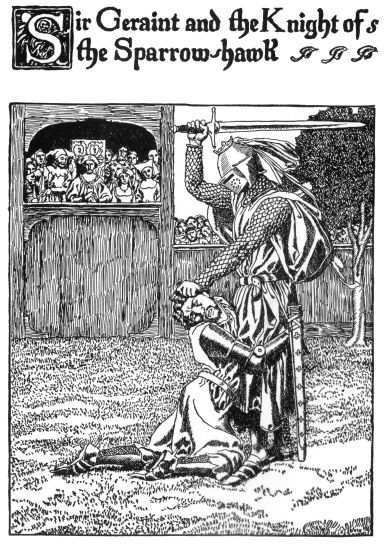
With that blow the brains of the Knight of the Sparrow-Hawk swam like water; the strength left his limbs; his thighs trembled and he fell down upon his knees and sought to catch hold of the thighs of Sir Geraint. But Sir Geraint avoided him, and reaching forward, he catched him by the helmet and snatched it from off his head. Then he catched the Knight of the Sparrow-Hawk by the hair of the head and he drew his neck forward as though to smite off his head upon the ground. But the Knight of the Sparrow-Hawk, beholding death hovering above him, cried out in a muffled voice, “Spare me, Sir Knight, spare my life!”
Then Sir Geraint cried out, “I will not spare thy life, Sir Knight, unless thou wilt thus, upon thy knees, tell me thy name.”
The knight proclaims his name.
“My name,” said the Knight of the Sparrow-Hawk, “is Sir Gaudeamus of the Moors.”
“Still will I not spare thee,” said Sir Geraint, “unless thou wilt bind thyself with a pledge to go to the Court of King Arthur and there tell to Queen Guinevere thy name and thy degree of arms.”
“All this,” said the other, “I promise in full.”
“Still I will not spare thee,” said Sir Geraint, “unless thou wilt engage that thy dwarf shall go with thee to earn forgiveness for his discourtesy to the damsel of the queen whom he hath offended.”
“This also,” said the knight, “I will engage for him to do.”
Sir Geraint spares the knight his life.
Then Sir Geraint said, “Arise, Sir Gaudeamus, for I spare thee.” And therewith Sir Gaudeamus arose and stood upon his feet, still trembling with the weakness of his battle, and the blood running in torrents from the great wound upon his head. Then came several esquires and Sir Geraint said to them, “Take him away and look to his hurts,” and they did so.
Now, after this, there came an herald upon the field of battle, and he approached Sir Geraint and said to him, “Sir Knight, the earl of this town hath sent me to beseech you to come to him.” Sir Geraint said, “Take me to him.”
So the herald led the way and Sir Geraint followed after him until he stood face to face with the Earl. The Earl said to him, “Sir Knight, I make my vow thou art a strong and terrible knight. I pray thee, tell me thy name that I may know to whom I am to give the prize of battle.”
“Sir,” said Sir Geraint, “I am called Geraint, and am the son of the King of Erbin, and I am a Knight of King Arthur’s Court and of his Round Table.” “Hah!” said the Earl, “then it is small wonder that thou didst win thy battle so easily, for thy deeds are famous in all the courts of chivalry. Now I pray thee, Sir, that thou wilt come to my castle and will feast with me to-night, so that I may do honor to so famous a knight, for all the world knoweth of thee and of thy deeds.”
Then Sir Geraint looked at him very sternly and he said, “Messire, I will not sit down with thee at table unless I know by what right thou assumest thy state as earl, and by what right thou hast dispossessed the former earl of his state and his property.”
At this the Earl’s face fell, but he presently said, “Well, I will tell all these and several other things to thee if thou wilt come with me to my castle. And my brother the old Earl and his wife and his daughter shall also come. And when we sit at feast, I will lay all things before thee and thou shalt judge betwixt the old Earl and me, and I will abide by what thou decidest as to the rights of this case.”
“Then,” said Sir Geraint, “we will come to thy castle with thee.”
Sir Geraint feasts with the young Earl.
So that night there was a great feast prepared in honor of Sir Geraint, and Sir Geraint and the old Earl and his countess and their daughter Enid sat with the Earl and his court at the castle of the Earl. Sir Geraint sat upon the right hand of the Earl, and upon his left hand sat the old Earl.
So after they had eaten and whilst they sat with their wine before them, quoth Sir Geraint, “I pray thee now, my Lord Earl, for to tell me what thou promised to do; to wit, how it stands with thee and the old Earl of this city.”
“Sir Knight,” said the young Earl, “I will do so. Thus it was: When our father died he left this town to my brother, whilst to me he left that ruined castle yonderway across the valley.
“Now my brother was a very passive man and would do little to benefit this place either by regulating its laws or by punishing its criminals; or by establishing in it a court of chivalry.
The young Earl tells his story.
“All the affairs of state were left to my command, whilst my brother contented himself with his domestic life and did very little to regulate the affairs of the state. Hence it befell that the people of this town looked to me to help them and to advise with them. Thus, at last, I became the real ruler of all our affairs. This continued for several years; then at last the people said, ‘Why should we support our Earl who does nothing for us, whilst this lord whom we do not support giveth us all that he hath in him to give?’ So the people arose one night, and drove their earl and his wife and his daughter out of the castle and out of the town, and since that time he hath been dwelling in that old ruined castle that one time belonged to me, where thou didst find him; and I have been dwelling here. This, Sir Geraint, is the true story of our affairs.”
Then Sir Geraint turned to the old Earl and he said, “Sir, I pray you tell me, is this true?” The old Earl said, “Methinks it is true.” “Then,” said Sir Geraint, “this is the doom that I pronounce: That the present Earl shall rule this town as he hath ruled it heretofore, but that he shall give to the old Earl the one-half of all the money receipts of the town, so that he may support the style of living befitting his rank. And I furthermore ordain that this Earl who rules this city shall transmit the rule thereof to whatsoever heirs or assigns he may elect to succeed him.”
Sir Geraint proclaims the doom of the two Earls.
So Sir Geraint decided his doom, and that which he said was satisfactory to all. And he abided several days at that place, and during that time he saw much of Enid and the more he saw of her the more he loved her.
So one day, they two walking in the garden of the old castle alone together, he said to her, “Lady, I have seen many fair dames in my day, but never did I behold one who was so dear to my heart as thou art. Now I pray thee tell me, have I found favor in thy sight?” She said, “Yea, Lord, thou hast found great favor.” Said Sir Geraint, “Have I found such favor that thou wilt depart hence with me as my wife?” Enid said, “Lord, if it is thy desire to have me do so I will gladly become thy wife, and will depart with thee whithersoever thou dost command; for, in truth, I have now no other thought in all the world but of thee.”
Then Sir Geraint kissed her and thus was their troth plighted.
Sir Geraint is betrothed to Enid.
So they were wedded, and before they were wedded the young Earl said, “Sir Geraint, suffer that I purvey thy lady with a robe of cloth of gold meet for such an one to wear upon the occasion of her marriage.” But Sir Geraint said to him, “Not so, Messire, for I won her whilst she was clad in this robe of plain blue cloth. Thus will I take her to the Court of King Arthur and thus will I present her to Queen Guinevere, and I will have it that Queen Guinevere will provide her with fresh raiment meet for her to wear.”
Then the young Earl bowed his head and said, “As thou sayst, so let it be.”
Thus it befell that Sir Geraint was married, and the morning after his marriage he and his lady departed from that town. And he seated his lady before him upon the saddle and turned his horse’s head toward the Court of King Arthur and so rode away.
Now return we to Queen Guinevere and to the Court of the King.
Sir Gaudeamus arrives at the court of Queen Guinevere.
Three days after the departure of Sir Geraint the Queen was riding abroad, and several of her court attendants were with her, and amongst them was the young damsel who had inquired of the dwarf concerning the name of the knight whom he followed. As they rode talking and laughing together—chattering in clear voices, like a bevy of bright and gloriously tinted birds—they perceived coming toward them a procession. First they beheld a litter borne by several bearers and on the litter was a wounded knight. Behind the litter came the horse of the knight, and the horse was laden with his bright and shining armor, and led by an esquire. Behind the horse there came a fair young lady clad in scarlet riding upon a white palfrey, and behind her a small misshapen dwarf.
Now when this party had come a little nigher, Queen Guinevere perceived the face of the dwarf more clearly and she knew him for that dwarf who had rebuffed her damsel as aforetold. And she said to that one of her attendants who had aforetime met the dwarf, “Is not that the dwarf who rebuffed thee a few days ago?” The damsel said, “Yea, Lady.” “Then,” said the Queen, “meseems the knight his master hath met Sir Geraint and hath suffered in his encounter and is coming here to bespeak me. Let us go forward to meet them.”
So the Queen and her court hurried forward until they had come beside the litter. Then the Queen said, “Sir Knight, I pray you tell me, what is it that ails you?” “Lady,” said he, “I am a knight who hath suffered in battle. Now I pray you tell me, where may I find Queen Guinevere?”
The Queen said, “Messire, I am she.” Quoth the knight, “Lady, is it truth you are telling me or are you making sport of me?” The Queen said, “Sir, it is the truth.”
Then Sir Gaudeamus raised himself upon his elbow in the litter, and he said, “Lady, I come to thee upon command of Sir Geraint, who hath overthrown me in battle; and upon his command I am to tell thee that my name is Sir Gaudeamus of the Moors, and upon his command I am to seek for the damsel to whom my dwarf was rude.”
Said Queen Guinevere, “This is she.”
Then Sir Gaudeamus said to the maiden, “Fair damsel, of thee I am to ask pardon for the rudeness of my dwarf, and to crave of thee that thou from thy grace and kindness wilt forgive his offence.”
Then the heart of Queen Guinevere was moved with pity for the knight, and she said to him, “Messire Sir Gaudeamus of the Moors, thou and thy dwarf are fully forgiven by her and by me. Now I pray you to come straightway to the castle where your hurts may be examined and cured.”
So the Queen led the way to the castle of the King, and all they went thitherward. And after they had come to the castle she had the wounded knight laid upon a couch in a bright and cheerful room, and she had the king’s physician to come and to look at his hurts and to dress them. And so Sir Gaudeamus was made in all ways as comfortable as might be.
So passed three or four days.
Sir Geraint and Enid arrive at the castle of King Arthur.
One morning the Queen looked out from her bower window and she beheld a knight riding toward the castle. And there sat before him upon his saddle a fair lady with golden hair, and the lady was clad in blue. The Queen called to her bower women and said, “Who is that knight coming yonder?” Said one of the women, “That, methinks, is Sir Geraint.” The Queen said, “Yea, that is true. Methought it was he; let us hasten to meet him.”
So she and her ladies made haste and they met Sir Geraint and Enid at the gateway of the castle. The Queen said, “Sir Geraint, who is it that thou hast with thee?” He said, “Lady, this is my wife, to whom I am but newly married. I have brought her here clad in blue cloth as I first beheld her. And I have hope that thou wilt clothe her as beseemeth her estate as the daughter of an earl, the lady of a knight-royal, and as my wife.”
Then the Queen said, “Welcome! welcome, Lady! I give thee welcome!” And after that she assisted Enid to dismount from the horse. Thereafter she took her to her bower, and there she clad her in the richest robes that could be furnished for her. And the face of Enid shone from out of that raiment of silver and gold as the face of the moon upon a summer night shines from the thin and golden clouds that surround but do not obscure it.
Thus was the Fair Enid brought to the Court of King Arthur.
Chapter Third
How Sir Geraint lived with the Lady Enid at Camelot. How he suspected her truth; how his suspicions were confirmed, and how he departed with her in search of adventure. Also how they met with three unusual adventures in the forest.
IT is not always well for a man to be married to a woman of half his age; for that which he thinks and loves she may neither think nor love, and that which she thinks and loves, he maybe does not think and does not love.
Now Sir Geraint was serious, as became his years, and Enid was gay and debonaire as became her youth, so that there were many sports and pastimes that she engaged in that he looked upon remotely and from afar, and not always without displeasure.
Amongst the lords of the Court of King Arthur was a young knight and lord, hight Sir Peregrans, who was son to King Ludd of Cornwall. This noble young knight-royal was very full of joy and gladness. He was ruddy-cheeked and gay, with broad black eyebrows and curly black hair, and he was ever ready for any sport or pastime that fell his way.
It befell that he and Enid were much together in company and sports of several kinds, and though Sir Geraint was too proud to appear to observe this, yet he did observe it and was much affected by it. For he would sometimes say to himself, “What pity it is that this dear lady of mine should be bound to my age and sobriety instead of to one like this Sir Peregrans who is in all ways suited to her!” Yet Sir Geraint would say nothing to Enid concerning his thoughts, but only kept those thoughts locked in his own heart, and so withdrew himself from her afar off.
This and several other things the Lady Enid observed, and it sometimes seemed to her either that her lord was in trouble or that he was offended, yet she wist not what offence she could have given to him in any way. For it did not seem to her that it could be any offence for her to play in the same sports with Sir Peregrans, but only that it was natural and seemly upon her part to do so.
Sir Geraint sits in thought.
Now one day Sir Geraint sat meditating concerning these things, and as he sat he gazed out of the window at the King’s Castle. What time his eyes beheld a wide and fruitful stretch of meadow-land and fields, of glebe and of a river that wound through all this fair level fruitful campagne like to a ribbon of pure and shining silver. The sun at that hour shot his slanting rays across the earth, so that all this fair prospect appeared, as it were, to be bathed in a pure golden brightness. From the level stretch of horizon, great clouds climbed up into the blue and radiant sky, peeping, as it were, over one another’s shoulders down upon the peaceful earth.
All this the eyes of Sir Geraint beheld, yet he saw nothing of it. For the sight of his soul was turned away from such things, and was directed inward upon himself, and there he beheld naught but gloom and darkness.
To that place where he sat came the Lady Enid, and she beheld him where he was, but he did not turn his eyes upon her, nor seem to know that she was there.
Enid comes to Sir Geraint.
Then she came to him and seated herself upon his knee. She put her thin fair arms about his neck, and interwove her fingers into one another. Then she said, “Dear my Lord, I pray thee tell me in what way I have offended thee. Thou art no longer toward me as thou wert when first I came hitherward to this court.”
He said to her, speaking very gently, “Enid, thou hast in no wise offended me.”
Then she said, “What is it that troubles thee, my husband?”
He said, “I have no trouble.” Then, as in a second thought, he said, “Enid, I will tell thee somewhat.” Therewith he unlocked her two hands and sat, holding one of them in his. “Sometimes,” quoth he, “a man loveth the home that is his very own. So love I the home of my childhood and of my youth. There my father dwelleth in honor, and my mother also. It hath been many years since I have seen it and I long to see it now.”
She said, “Dear Lord! Let us go thither.”
He said, “Wouldst thou like to go, Enid? Well, then, we shall do so, and that as soon as my Lord the King shall grant us leave to depart.”
So that very day Sir Geraint asked leave of King Arthur to leave the court for awhile, and King Arthur gave him permission to withdraw.
They two depart for the castle of Sir Geraint.
So the day after that day Sir Geraint and Enid departed from the Court of King Arthur, and travelling with a small party of noble attendants betook their way to Amadora (which was the name of the castle of Sir Geraint’s father), which place they reached within three days of easy journeying.
There they abided for several months, in which time there was hunting and hawking and jousting, so that the days were as full of joy and pleasure as it was possible to be.
Sir Geraint takes sport at his castle.
But in all that while Sir Geraint did nothing of knightly daring or adventure, so that by and by the people of Amadora began to talk to one another concerning the matter, saying, “How is this? Our Prince, the Lord Geraint, is surely besotted concerning his wife, for he is with her all the while. The time was when he took his joys, but when the time of those joys was past then he performed many works of knightly daring, so that all we of this place were very proud of him. When now doth he enter into any such undertaking? Never. He is always the first in the chase or with the hawk or in the joust, yet his youthful glory is now departed from him, so that he lieth forever, as it were, with his head upon the knees of his wife.”
Thus the people talked amongst themselves, and at last such words, or words like these, came to the ears of the Lady Enid and troubled her very sorely.
Enid regards Sir Geraint whilst he sleeps.
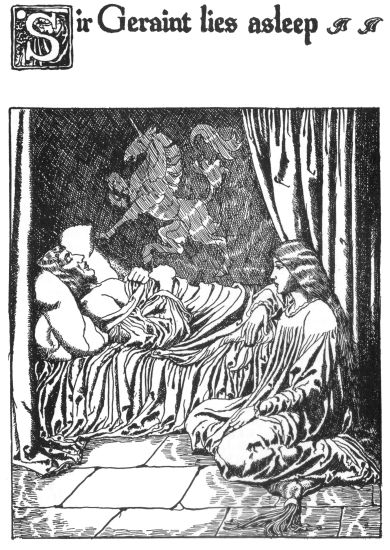
One day in the summer weather she awoke very early in the morning and the Lord Geraint lay upon his bed beside her. He had thrown aside the coverlets and he now lay with his great breast and his arms and shoulders bare to the softness of the air. These she beheld, how huge and mighty they were and how comely in their strength and power. Then she looked at her own arm, how slender and white it was, how lacking of strength, how feeble and childish in its weakness, and she thought to herself, “Is it then true what they say—that my white and tender limbs may hold my husband away from those great adventures to which he belongs? Is it then true that mine arms confine him in a little and narrow circumference? Alas! Is it true that the love of a woman can sap a man of all purpose and ambition in his life of activity? Nay; it is not true, for many knights who are wedded to other ladies are still noble knights in the field of adventure. Alas and alas! The weakness of my lord must indeed reside in me.” Here she sighed very deeply and with the deepness of that sigh Sir Geraint awoke from his slumbers and lay with his eyes still closed. Then she said, whispering as though to herself, “I am at fault and am no true, right wife for this noble hero.”
Sir Geraint hears her words.
Now Sir Geraint, lying with his eyes closed, overheard these last words that she thus whispered to herself. He heard her say that she was no true, right wife to him, and it seemed to him that she thus confessed that she was unfaithful to him. This thought was, as it were, a dagger thrust into his life, sudden, shining and very deep. And though he still lay with his eyes closed, he said to his heart, “Is she then false, and was I too late in bringing her away from the Court of King Arthur? Woe is me!”
Thereupon he opened his eyes, and looked her full in the face, and she, seeing that he was awake, smiled into his eyes. But he did not smile upon her in return, otherwise he said, “Lady, art thou there?” Then the smile slowly faded from her eyes, for she saw that he was in an angry mood. And so they regarded one another.
Then suddenly he arose and began dressing himself, and he said to her, “Arise, Lady, and clothe yourself.” And she did as he commanded. He upon his own part accoutred himself in his full armor, that hung erstwhile shining against the stone wall of the room.
When they were thus apparelled he said to her, “Follow me.” She said, “Whither, Lord?” but he made no reply to her. So they went forth together out of that apartment. And she followed him down the stairway to the courtyard, and she followed him from the courtyard to the stable, and still in all that while he spoke no further word to her.
Now this time was still very early in the morning, for the sun had only just arisen, round and red and full of the glory of daylight. The birds were chaunting with might and main, but all of the castle folk were yet asleep. All was cool and balmy and exceedingly pleasant, and the silence of the early daytime was full of the remote sound of the river below the castle, where it rushed down, roaring, through its deep and mossy gorges of green and slimy rocks and stones.
Sir Geraint entered the stables and Enid awaited him what he would do; and that while she stood not far off from the stable. After awhile he came forth from the stable again and by one hand he led the horse of Enid by the bridle, and by the other hand he led his own horse by the bridle.
He said to Enid, “Mount thy horse, Lady,” and giving her his hand he lifted her very lightly to her saddle. Then he in his turn mounted his own horse.
They depart from the castle.
Then when he was seated in his saddle, he said to the Lady Enid his wife, “Lady, for this day and haply for several days I will endeavor to prove to thee that strength and life have not yet left me, but that I am still a strong and able knight and as well worth the love of any woman as I was in the full heyday of my youth. Ride you forth and lead the way, and I will follow after you. But make yourself well acquainted with this: that under no circumstances are you to speak a word to me unless I give you leave to speak to me. Only ride straight forward, anywhither you may be inclined.”
She said to him, “Lord, I will fulfil your commands.”
So they rode away from the castle without any one knowing that they were gone, for there stood no guard at the gateway at that hour and the porter drowsed in his lodge.
So, according to the command of Sir Geraint, the Lady Enid rode ahead of him and he himself followed after her some considerable distance behind.
Thus they went forward for several leagues, and meantime the sun rose very full and round and shone down hotly upon the earth. So by and by they approached the purlieus of a thick dark forest, and as they drew near to it the Lady Enid was aware of the sudden shining of armor through the leaves, wherefore she wist that some threatening of danger must lie before them. As they drew still nearer to that place, she perceived that there were three armed men hidden in the thickets, and anon she heard them speaking the one to the other. And she heard the voice of him who was the chief of the three say to the other two, “Hitherward cometh good fortune to us this morning. For here is one man, well appointed in all ways, but sunk very deep in brooding thought, and with him is a fair lady. Now if we engage him as three against one, it is not likely that he can withstand our assault, and so he and his horse and his armor and his lady shall be ours by right of battle.”
Enid overhears the words of the robber chief.
These words, or words like these, the Lady Enid overheard the chief of the robbers speak to the other two who were with him; and she said to herself, “Here is great danger threatening my dear Lord. Well, if I warn him he may be very angry with me and may even chastise me for disobeying his command. But even if this is so, what will it matter?” So therewith she turned her horse and rode back toward Sir Geraint.
She tells Sir Geraint of the ambush.
He, when he beheld her coming, appeared to be very angry, and he said, “Lady, what is it disturbs you?” She said, “Dear Lord, have I your permission to speak?” Quoth he, “It seems that you have taken that permission yourself. Well, say on.” She said, “Lord, at the edge of yonder wood I perceived three men of ill intent hidden in the thicket. I overheard them to say that they purposed presently to assail you. Wherefore I deemed it expedient that I should warn you of their presence.”
Then Sir Geraint frowned so that his eyes shone with a bright green light. “Lady,” said he, “it may perhaps be that you would not be displeased to see me fall before the attack of those three men. Nevertheless, I have hopes that I shall not fail in this encounter. Meantime, continue here and consider you of your disobedience in breaking my command laid upon you not to speak to me without my permission.” Having thus spoken Sir Geraint closed and latched the visor of his helmet, and then with spear in hand he rode forward toward the edge of the woods.
Now when Sir Geraint had come pretty close to the woodland, all three of those armed men suddenly burst forth from their covert and bore down upon him in full charge, whilst he, upon his part, drave spurs into his war-horse and charged against them. So they met in the midst of the course with such violence that a clap of thunder could not have been so great. All three of their spears struck Sir Geraint upon the shield, but he turned them so that all three were broken into a very great many pieces. But the spear of Sir Geraint held against him toward whom it was directed, so that it penetrated his shield and it penetrated his armor and it penetrated his body, so that he was lifted out of his saddle and cast dead the length of a spear and an arm’s length behind his horse.
Sir Geraint slays the robbers.
Then Sir Geraint threw aside his spear and drew his bright shining sword. And he whirled his horse and with his sword in hand he bare down upon those other two villains. Then he arose in his saddle, crying out, “Hah, villain!” and therewith he smote down one. Then whirling about, he cried out again, “Hah, villain!” and so crying he smote down the other. Each man fell with a single blow of his sword. Thus in a little space of time, he slew all three of those villains who had for a long time infested those parts.
When Sir Geraint had thus ended this work, he wiped his sword and returned it to its scabbard. Then he removed the armor from each of the fallen men, and he lashed the armor to the saddle-bow of the horse to which it belonged. Then he tied all three bridle reins together and returned to where Enid sat watching him with terror and admiration commingled. And Sir Geraint said to her, “Lady, take thou the bridle reins of these three horses. Then ride forward as before, and this time bear well in mind that thou turn not to speak to me under any condition whatsoever. Once I have forgiven thee; twice I may not do so.”
To this speech Enid made no reply, but taking the bridle reins of the three horses into her fair white hand, she rode forward into the forest, leading those three horses, Sir Geraint following after her as aforetime.
Thus they proceeded onward for a very considerable length of time and until high noontide, beholding nothing but the forest before them or behind them or on either side of them.
Enid overhears the words of the four men.
Thus they came almost to the centre of that wood where was a sudden turn in the high-road, which here entered into a defile between two high and very precipitous banks. At this place Enid perceived, not far away, four armed and mounted men of a very evil appearance, and she overheard these men talking among themselves. The one who was chief of them was saying to his companions, “Look! yonder cometh a good prize for us to take. For there is a very beautiful damsel and three sets of fine armor and three horses. And all this is guarded only by one armed man. Let us slay him and all these will be ours to do with as we choose.”
Then Enid said to herself, “Well, I can die but once, and even though my lord shall slay me for breaking his command, yet it would be by his beloved hands that I should die. So I will turn back and tell him of this.”
Therewith she turned her horse about and rode backward to Sir Geraint, and he, when he saw her coming, frowned very darkly. But she said, speaking very steadily, “Lord, have I your leave to speak?”
He said with great bitterness, “Lady, it appears that it does not need my leave for you to speak whensoever you choose to speak. Say on.”
She tells Sir Geraint.
She said, “Lord, I have to tell you that there are four very powerful and fully armed men yonder. And I overheard the chief of them to say to his fellows that their intent is to slay you so that they may have your horse and your armor and me and these three horses and this armor to dispose of as they see fit.”
“Is that all,” quoth he, “that thou hast to tell me? It seems that thy delight in talking is so great that thou canst not be checked. Bide thou here and I will go forward and deal with these men, and so will clear thy path for thee.”
Thereupon he closed the visor of his helmet and latched it. Then he set spurs to his horse, and being thus in all ways prepared, he drave forward to meet his enemies.
Suddenly they appeared bearing down upon him and riding two together (because of the narrowness of the way that prevented them from riding all four abreast).
Then Sir Geraint drave his war-horse to the charge and so they came together with a great crash and uproar, their spears striking him in the centre of the shield.
But in that encounter both their spears brake into several pieces, but Sir Geraint’s spear did not break. Otherwise it held and burst through the shield against which it was directed, and it burst through the armor and pierced through the body of the man within the armor so that he was cast dead upon the ground.
Then Sir Geraint threw aside his spear and drew his sword, and rising in his stirrups he smote the other man so fierce and direful a blow that he split asunder his shield and his helmet and pierced through the brain-pan of the head and into the brains themselves, so that he who was thus smitten cried out most dolorously, “I die! I die!” and thereupon fell grovelling to the earth.
Then Sir Geraint whirled his horse and setting spurs to its flanks he thundered down upon the other two, who sat beholding aghast how easily and quickly he had overthrown their comrades. Nor hardly had they recovered themselves than he was upon them, smiting to the right hand and to the left. Then observing an opening in the defence of one of them, he whirled upon him and smote with might and main, and the blade of the sword clave that man through from the shoulder to the midriff.
Sir Geraint slays the four men.
Then the fourth villain, seeing his companions fall thus terribly into death, would have escaped away, but death was upon him. For he beheld Sir Geraint rise in his stirrups with sword lifted. Then the sword descended like a thunderbolt, and he too fell with his brain dissolving into death.
Then Sir Geraint dismounted from his steed and wiped his terrible blade, and thrust it back into its scabbard. And he stripped the armor off the dead bodies, and tied each suit of armor upon the horse to whom it appertained. After that he tied the reins of the four horses the one with the other, and gave them all to Enid, and he said to her, “I call upon thee to observe that I yet possess my knightly manhood, and that I am not yet altogether devoid of strength and even of youth. Take thou now these four horses together with the three horses which thou hast and ride on before me as heretofore, leading all seven horses. And see to it that this time thou dost not turn to me to say a word of any sort. For I find that the anger of battle is upon me, and in my rage I may smite thee with my sword in haste and ere I am able to control myself.”
She said, “Lord, I will do as thou dost command.”
So she rode on before Sir Geraint, and though she rode in silence yet her heart sank within her, for she said to herself, “Did ever any lady before me possess such a high-exalted and noble lord as this lord of mine?”
Enid overhears the words of the five outlaws.
Now as Enid rode forward thus exulting she heard of a sudden the sound of voices talking together in the thickets near at hand. The one voice said to the other voices, “Look! hither cometh a beautiful damsel, leading seven good horses laden each with a noble suit of armor, and here is only one man in guard of all this train. Let us five make here an ambushment, and let us fall upon him from behind and from before. So we shall easily overcome him and obtain all those things for ourselves.”
Then Enid said to herself, “It may be that my lord will do as he said, and will strike me with his sword in his haste if I disobey him for the third time by speaking to him. But what matters that? Rather would I die by his hands than suffer his anger without his love.”
So she turned her horse and rode back to him and when she had come to him she said, “Lord, suffer me to speak to thee?”
He said, “Did I not tell thee to speak to me no more?”
She said, “Lord, this time I must speak to thee, for I cannot do otherwise.”
He said, “So it appeareth. Well, then, say on!”
She tells Sir Geraint what they say.
She said, “Lord, this is what I have to say, that ahead of thee are five men lying in ambushment against thee with intent to destroy thee.”
Sir Geraint said, “Is this all that thou hast to say?” To which she replied, “Yea, Lord.” He said, “Abide here with thy horses for a little and suffer me to go forward alone, to clear thy path for thee.”
So Enid abided at that place, and Sir Geraint rode forward into the ambushment that was prepared for him.
So he reached that ambushment, and of a sudden there leaped all those five men out against him and about him.
Then there followed a great and bitter fight betwixt Sir Geraint and those who thus assailed him. And sometimes he might be seen and at other times he might not be seen for the press that gathered about him. His sword flashed like lightning and at every blow he uttered a great and terrible cry of war, for the fury of battle was now fully upon him. At first there were five against him and then there were but four, then three, then two and at last only one who cried out in terror, “Spare me, Lord! For I yield myself to thee.”
Sir Geraint slays the five men.
Enid leads the twelve horses.
Sir Geraint said, “I will not spare thee,” and therewith he struck him so dreadfully that he clave his head asunder and he fell down dead upon the ground. After he had thus overthrown all five of his enemies, he wiped his sword, panting, and put it away into its sheath. Then he stripped the armor from off the dead bodies of the five, and bound a suit of armor upon each horse. Then tying all five bridle reins together, he attached them to the bridle reins of the other horses and gave all twelve into Enid’s hands, saying to her, “Lead them forward and speak to me no more, I charge thee.”
So they travelled upon their way through the wood, and anon the day began to draw to a close, and the grey of twilight to descend. And Enid led the twelve horses with difficulty. This Sir Geraint observed, and was sorry for her, but still they rode onward. Then the darkness fell and the moon arose, very bright and clear and round, silvering the tops of the trees and laying patches of silver upon the earth between the shadows of the leaves.
Then Sir Geraint called to Enid and he said to her, “Lady, I do not think we shall get out of this woods to-night. Let us rest here until to-morrow.”
She said to him, “Lord, may I speak?” He said, “Say on.” She said, “What will we do to eat?” Quoth he, “Lady, it oftentimes happens when a knight travelleth errant, as I have travelled to-day, that he goeth without food to eat for the entire day—and sometimes for even longer than that. Let that suffice.”
Therewith she fell silent and sighed, for she was very hungry.
Meantime Sir Geraint gathered the leaves together into a sort of bed and he spread a cloak upon them. Then seeing that Enid was very weary and in pity of her weariness, he said, “Lie thou here, Lady, and I will keep watch for the night.”
They abide that night in the forest.
So Enid laid herself down upon the bed of leaves and she was very sick for weariness. And for awhile she watched her lord, Sir Geraint, as he stood a little distance away, and she beheld how the moonlight flashed and sparkled upon his polished armor whensoever the soft night wind of summer stirred the leaves; and she heard the rustling and the stamp of the horses as they moved at their stations; and she heard a distant nightingale, singing from afar, now and then heard in the darkness, and the murmurous silence, and now and then silent again. Then all these things blended together, the darkness disappeared and she slept.
This was the first day of that journeying. Now if you would read of the second day thereof, I pray you to peruse that which hereinafter followeth, and which I have writ for your pleasure.
Chapter Fourth
How Sir Geraint and Enid came forth out of the forest into the land of an earl. How they abided at an inn, and of what befell them thereafter.
WHEN the next morning had come Sir Geraint, very early, awoke Enid from her slumbers. The pangs of hunger were great upon her but she made no complaint thereof. Otherwise, she mounted her horse and took the reins of the twelve horses into her hands and rode away, followed by Sir Geraint as upon the former day.
Geraint and Enid come into the open country again.
Anon and after awhile the trees of the woodland grew thinner and the sunlight came more freely through their branches. Anon again and the trees of the forest ceased altogether, and so Enid and Geraint came forth out of the woodland and into the open plains once more.
Here were hedgerows upon either side of the way, and there were fields and open country beyond the hedgerows; and there were meadow-lands, and the mowers were mowing in the meadows.
They cross the river.
Before them lay a river and toward that they took their way. And there was a ford to the river and they entered the river, and all the horses bowed their heads and drank of the water. Afterward they crossed the ford and ascended a steep high bank upon the other side of the river.
At the top of this bank there stood a slender youth with yellow hair. And the youth had a satchel of leather slung over his shoulder, and in his hands he carried an earthenware crock of milk.
Sir Geraint bespeaks the youth.
Sir Geraint spoke to the youth, saying to him, “Whence cometh thou, fair youth?” Quoth the youth, “I come from the town which you cannot behold from here, but which you may behold from the crest of yonder hill when you have reached it. And now, Lord, if it be not too venturesome for me to ask, I pray you to tell me whence you have come?”
Said Sir Geraint, “Fair youth, we came from the forest yonder. All day yesterday we travelled through the forest and all night we slept there beneath the trees.”
“Well,” said the youth, “I daresay you had but small entertainment at that place, and I daresay also you are very hungry to-day.”
“I would,” said Sir Geraint, “find food for this lady if it be possible to do so.” Said the youth, “we are then well met, for in this satchel I have bread and cheese, which I am taking to the mowers for their breakfast; and in this crock I have milk, which also I am taking to them for their breakfast. If you will partake of these things, I will gladly give you to eat and to drink.” “I give thee thanks, fair friend,” said Sir Geraint, “and gladly will I accept the offer of thy hospitality.”
The youth gives them to eat.
So the youth assisted the Lady Enid to dismount from her saddle, and she and Sir Geraint took their station at the roadside beneath the shade of a crab-apple tree. And the youth gave them to eat of the white bread and cheese from his satchel and he gave them to drink of the milk from the crock, and they were both greatly refreshed.
After the two had thus satisfied their hunger the youth said, “Now, Sir Knight, by thy leave I will depart for more food for the mowers.”
Sir Geraint gives the youth a horse and the armor thereof.
Sir Geraint said, “Fair youth, I pray you to return to the town whence you came and to procure for us the best lodgings that are to be found at that place. And I also pray you that you will, in return for these courtesies of yours, choose whichsoever horse and suit of armor that best pleases you out of all those that the lady is conducting, and I pray you that you will keep that horse and armor for yourself.” “Lord,” said the youth, “what have I done for such a great reward? That is too much to accept for so small a service.” “Nevertheless,” said Sir Geraint, “I pray you to do as I bid you.”
So the youth joyfully chose a horse and a suit of armor that pleased him the best, and leading these he departed for the town to fulfil Sir Geraint’s behest as to securing him lodgings.
Now as the youth entered the town a servant of the Earl of that town met him and the servant of the Earl said to the youth, “Where got ye that horse and that armor?” The youth said, “A noble and knightly lord, who hath eleven other such horses and armor, gave this one to me.”
The servant said, “This is a strange saying. Come with me to the Earl and tell him concerning these things.”
The youth tells the Earl of Sir Geraint.
So the servant of the Earl took the youth to that lord, and the youth told his story to the Earl of how he had met the lordly knight and the lady, and of how the lady had led twelve horses loaded with armor, and of how the lord had given him one of those horses and the suit of armor that best pleased him. To all this the Earl hearkened, and then he said to the youth, “Go you and fetch that lord hitherward, for I would fain see him and his lady and entertain them at my castle. He shall lodge here with me.”
So the youth hastened back to Sir Geraint where he sat with Enid resting beneath the crab-apple tree, and he said to him, “Lord, the Earl of yonder town hath sent me here to bid you come and lodge with him.”
Then Geraint was displeased and he said to the youth, “How is this? I bade thee secure us lodgings, not with an earl but at some good inn. I will not lodge with the Earl, but will go to such an inn.”
Then the youth was abashed, and he said, “I will take you to an inn.”
The youth conducts them to an inn.
So the youth conducted Geraint and Enid into the town, and he conducted him to the best inn in the town. Here the landlord came forth to meet him and Geraint said, “Show us to the best room of this place,” and the landlord did so. Geraint said to Enid, “Keep thou yonder to that side of the chamber, and I will keep to this side, for I am weary and fain would sleep.” And Enid said, “I will do so.” And Geraint said to the youth, “When I awake, be thou here to serve me.”
The youth said, “I will be here; but meantime I would fain go and see the Earl and tell him where you are lodged.” Sir Geraint said, “Go, but return again.”
So whilst Sir Geraint slept, the youth hastened to the castle of the Earl, and he said to the Earl, “Sir, certes this man is a prince or a knight-royal, for he commandeth all things as he wills.” Then the Earl said, “Where is he lodged?” And the youth told him, and the youth said, “I go presently to serve him when he awakes, for now he sleepeth.” “Commend me to him when he awakeneth,” said the Earl, and the youth replied, “I will do so.”
Sir Geraint bids the landlord to summon his friends to a feast.
That afternoon when Geraint awoke, it was time for them to take their food. So Sir Geraint summoned the landlord and bade him prepare him a feast, and the landlord said he would do so. Then Sir Geraint inquired of the landlord whether he had not some companions whom he would like to entertain, and the landlord said, yea, that there were several. Upon this Sir Geraint commanded the landlord to summon those companions and to prepare for them the best that there was in the town both to eat and to drink. “For,” quoth he, “though I be unhappy myself, yet do I love to behold those about me as happy and as gay as may be.” So the landlord went forth and bade many to come and feast with him, all these feasted at Sir Geraint’s expense, so that the entire inn was full of light and laughter and noise and merrymaking.
The Earl visits Sir Geraint.
That evening the Earl came to visit Sir Geraint, and with him he brought twelve of the worthiest knights of his court. Then Sir Geraint arose and welcomed him, and the Earl greeted Sir Geraint and sat down and conversed with him. And he asked Geraint the object of his journey, to which Geraint replied, “I have no object, saving to seek adventure such as may become the life of a knight-errant.”
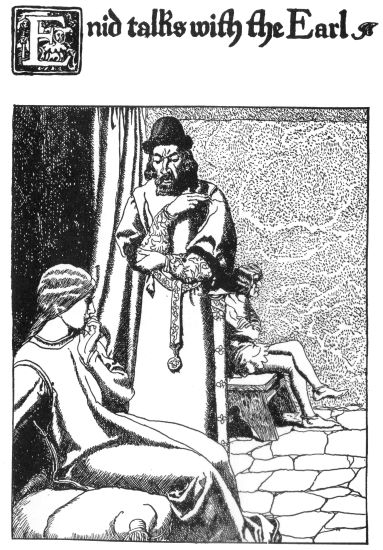
Then the Earl cast his eyes upon Enid, and he looked at her very steadily, and he thought that he had never beheld a lady so fair and so beautiful as she. And as he gazed upon her his heart went out to her and he found that he loved her very extremely. Then he said to Geraint, “Have I thy permission to converse with yonder lady? For I see that she is not with thee.” “Thou hast it gladly,” said Geraint.
The Earl bespeaks Enid the Fair.
So the Earl went to where Enid sat, and he said to her, “Lady, thy hands are soft and white and thy body is fragile and delicate; it cannot be pleasant for thee to travel through the rough and cruel world with this man.” She said, “It is not unpleasant for me to journey with him whithersoever he goeth.”
The Earl said, “Lady, thou shouldst have youths and maidens to wait upon thee and to attend thee and to serve thee.” She said, “It is pleasanter to me to travel alone with yonder man than to live in state with youths and maidens to wait upon me.”
“Listen,” said the Earl, “I will give thee good advice. Give up that man and come with me. All my earldom will be at thy disposal if thou wilt do so, and thou shalt be the mistress of it and of me and of my life.”
Then Enid was very angry, and she said, “Lord, I will not go with thee! Know thou that yonder man is dearer to me than all the earth and its kingdoms and principalities, its dukedoms and its earldoms. He was the first man to whom I plighted my faith, and never hath it been withdrawn from his keeping. Shall I then leave him now for the sake of this little patch of ground, to live with thee in dishonor and suffer him to go forth into the world alone?”
Then the Earl said, “Lady, thou art in the wrong in this, for if I slay that man, then can I take thee by force. And if I take thee by force, then, when I tire of thee, I shall cast thee off into the world. But if thou comest to me willingly, then I will never cast thee off, but will keep thee as my most precious treasure so long as I am permitted to breathe the breath of life. Come thou with me, and yonder man may be suffered to depart in peace, hale and strong in limb and body, but come thou not with me and he shall die.”
Then Enid was greatly troubled at that which the Earl had said to her, for she saw that he had the strength and the will and the power to do with Sir Geraint whatsoever he chose. So at last she said to him, “Listen, O great Lord and Earl. All this that I have said to thee I have said for the sake of mine honor. But if thou art of the mind that thou sayst, I would rather abide with thee. Come hither to-morrow morning with twelve armed knights and bear me away as though by force. For thus it shall appear that I have not yielded up to thee, except by force.” “I will do so,” said the Earl. “This and all things shall be as thou sayst.” After that, in a little while he arose and departed from that place.
But of all that had passed Enid said nothing to Geraint, lest he should be blinded by his rage against the Earl. Otherwise, she kept it secretly in her heart for that time.
Enid prepares the armor of Sir Geraint.
That night they both lay in the same chamber. In a little while Sir Geraint fell asleep, but Enid did not sleep. When she heard his deep breathing she arose very softly and she gathered his armor together piece by piece. And she piled all the armor where he could easily lay hand upon it. Then she lay down and slept.
Enid telleth Sir Geraint of the Earl.
Before the day broke she arose and went softly to where Sir Geraint slept, and touched her finger upon his breast and with that he awoke and started up. “Lord,” said she, “knowest thou what the Earl of this town said to me last night?” Geraint said, “Tell me.” So Enid told him all that the Earl had proposed to her. Then Geraint was very angry, and he said, “Thy beauty bringeth evil whithersoever thou bringest it. Now I will slay this Earl ere I leave this place, for he hath proposed dishonor to me.”
“Not so,” said Enid, “let be the Earl, for there are many scores against thee, and thou art only one. Rather put thou on thy armor and let us go hence with all the speed that we may, for there is yet time to escape, and thus only may we escape in peace.”
Then Geraint perceived that what she said was very true, and that he was at that place in a parlous state. So he arose and put on his armor and he summoned the landlord and the landlord came to him.
Sir Geraint gives all the horses and all of the armor to the landlord.
Quoth Sir Geraint, “What do I owe thee, good fellow, for the entertainment that I have had at this house?” Said the landlord, “Not a great deal, Messire.” “Well,” said Sir Geraint, “take thou all those eleven horses and the armor appertaining to them for thy reckoning. Will that pay our score?” “Heaven bless thee, Messire,” cried the landlord, “but that is far more than thou owest me; for thou hast not consumed in this house the value of a single horse.” “Well,” said Sir Geraint, “in that case thou wilt be all the richer. But put on thy cloak and thy hat and conduct me out of this place by some way that is another way than that by which we entered here, for I must hasten upon my quest.” Quoth the landlord, “I will do so, Lord.”
With that he hurried away. Anon he returned again, clad as for a journey. Then Sir Geraint mounted his horse and Enid mounted her horse, and they departed from that place after the landlord.
The landlord leads them from the town.
So the landlord led them by another highway from the town, and when the sun arose Sir Geraint dismissed him from their service.
The Earl follows Sir Geraint and Enid the Fair.
Now when the landlord returned to the inn he beheld that several men surrounded that place. Those men were the Earl of that town, and the twelve chief knights of his state, and all were clad in full armor. The Earl was very wroth and when he beheld the landlord he cried out to him, “Fellow, where is the knight and where is that lady who were with thee last night?” “Lord,” quoth the landlord, “they have departed and by now are many miles from this. For I myself conducted them far upon the way, and am only now returned from guiding them.” Quoth the Earl, “What way went they?” and the landlord told him. Then the Earl and his court of knights departed thence. And they rode at a swift gallop upon the way that the landlord directed them. Anon they beheld the marks of horses’ hoofs fresh upon the earth, wherefore they wist that they were upon the right way.
Now as Enid and Sir Geraint rode onward upon their course, Enid looked behind her many times. At last she beheld a cloud of dust that came rapidly nearer, and she was aware that in that cloud of dust were the Earl and his court of knights. Then she cried out to Sir Geraint, “Sir Knight, prepare for battle, for yonder come thine enemies.”
Then Sir Geraint, who had been sunk in thought, became aware of the coming of those others. Thereupon he closed the visor of his helmet and prepared himself in all ways for the encounter. Thereafter he turned his horse in the middle of the highway and stood waiting for his enemies.
Anon they reached him and drew rein a little distance away. Then the Earl came forward and spake to Sir Geraint, saying, “Sir Knight, we mean no harm to thee, but only ask thee that thou wilt give up that lady whom thou hast with thee. For thou holdest her against her desire; her only desire being to go with us.”
Then Sir Geraint turned to Enid and said, “Lady, is this true? If thou desirest to go with yonder Lord thou hast my leave to do so.” “Nay,” said she, “I do not desire to go with him. Rather would I go with thee to death than to go with him to joy.”
So Sir Geraint said to the Earl, “Messire, the lady says thou art mistaken and she does not desire to go with thee.”
The Earl said to Enid, “Lady, what didst thou tell me yesterday?” And Enid said, “Messire, I told thee many things to mislead thee, for the occasion called upon me to do so.”
Then the Earl talked aside for a little while with his followers. Anon he called to Sir Geraint, “Sir Knight, I will not let thee go until thou hast tried a fall or two with these knights of mine for the sake of thy lady, her bright eyes and her slender body.” “Well,” said Sir Geraint, “I am willing to do battle with thy knights now or at any time.” “And this shall be the result of this battle,” said the Earl. “If thou winnest this battle, thou mayst go free, but if we win then thy lady must return with us.” Quoth Sir Geraint, “That is certes a hard saying.”
Sir Geraint does battle with the followers of the Earl.
So the strongest and most powerful of all those knights made him ready for the assault, and when he was in all ways prepared, he and Geraint made a violent charge, the one against the other. Three times they charged and at the third assault Sir Geraint overthrew him so violently that he lay like one dead in the middle of the high-road. Then one after the other all the others of those twelve knights assaulted Sir Geraint, and each in turn was overthrown very violently upon the earth.
Then the Earl said to Sir Geraint, “Sir Knight, thou hast fought well and very valiantly for thy lady, and truly hast thou won her. Depart in peace.” “Not so,” cried Sir Geraint in great passion, “for I have one more to deal with, and that one is thou thyself. For I have yet to do with thee ere I depart from this place.”
“Well,” said the Earl, “be it as thou sayst. For I will fight with thee till either thee or I have overcome the other. And to that one who overthroweth the other thy lady shalt belong.” “So be it,” said Sir Geraint.
Sir Geraint overthrows the Earl.
So each made him ready for the encounter, and when they were in all ways prepared they set spur to flank and drave the one against the other with such violence that they met with a crash as of thunder in the middle of the course. In that encounter Sir Geraint was upborn by his passion so that he smote true and fairly against his enemy’s shield. But the spear of the Earl was shattered into a great many pieces. The spear of Sir Geraint held, so that it pierced the shield of the Earl, and Sir Geraint lifted the Earl out of his saddle and hurled him several ells behind the crupper of his horse, where he lay like one dead upon the earth.
Then Sir Geraint ran to where the Earl was. And he rushed off his helmet and he drew his sword and catching the Earl by the long hair of his head he drew forward his neck so as to sever his head from his body. Thereupon the Earl awoke from his swoon and perceiving that death loomed very near to him, he clutched Sir Geraint about the thighs, clinging to them and crying out, “Sir Knight, spare my life!” “Why should I spare thee?” cried out Sir Geraint very violently. “Hast thou not attempted my life and hast thou not attempted mine honor and the honor of my lady, and were we not guests in thy town? I will not spare thy life!” And he whirled his sword as though to strike.
Sir Geraint spares the life of the Earl.
Then Enid came to where Sir Geraint was and clutched him by the arm and she said, “Worthy knight, Sir Geraint! I pray thee spare this man his life. For what canst thou gain by slaying him?” “Well,” said Sir Geraint, “since this lady asks thy life at my hands I give it to her to dispose of as she pleases.” Enid said, “I thank thee, Lord!” Then she said to the Earl, “Arise, and go thou hence in peace!”
So after that Sir Geraint remounted his horse and he and Enid departed from that place, riding as aforetime. That is, Enid rode a long distance ahead and Geraint rode behind, following after her.
But of the knights whom he overthrew in that encounter it is to be written that several were so sorely hurt that it was many weeks ere they were sufficiently recovered to be abroad again.
And now followeth the further adventures of Sir Geraint and of Enid at this time; so I pray you to read that which hereinafter appeareth.
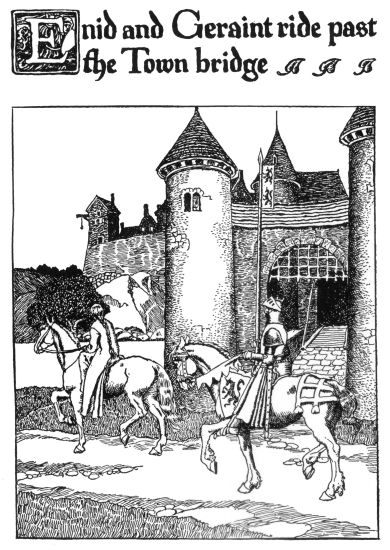
Chapter Fifth
Sir Geraint is wounded in his encounter with another knight. He is discovered by the Court of King Arthur and is healed of his wounds.
SO Sir Geraint and Enid travelled in that wise until at last they came through a thin, small woods and so out into another open place.
Here they beheld before them a valley of singular beauty, for through the centre of the valley there ran a wide, smoothly flowing river, and upon either side of the river there were meadow-lands and fields, and not far away from where they were there was a town, very large and considerable. All around the town was a wall of stone, very high and strong. And about the town was a fortress castle, tall and forbidding, that looked down upon the town and upon the high-road. The high-road upon which they travelled crossed a bridge over the river, and so entered the town, but ere it reached the bridge it branched and one branch ran down along one side of the river upon which they were. Upon either side of the bridge head were two tall towers that overlooked the bridge and guarded it.
Sir Geraint questions the horseman concerning the town.
So Sir Geraint and Enid sat for awhile looking down upon that fair prospect, and the more they looked upon it the more they delighted in it. As they so sat, anon they beheld a horseman come from the town and cross the bridge, and when he had crossed the bridge he turned him in their direction. By and by he had approached closely enough for Sir Geraint to speak to him, and thereupon Sir Geraint rode forth and met him and they two saluted one another. Then Sir Geraint said to him, “Sir, I pray you tell me; what town is that yonder, and who is the lord of this fair and beautiful valley and of yonder town?” “Messire,” said the other, “I will gladly tell thee that and anything else that I am able. The town itself is called the Town of Redlands. The lord of all this country is a very brave, renowned and valiant Earl called the Little King. He is so called because he rules this place away from all other lords as though he were king of it in his own right.”
Sir Geraint said, “May I pass by yonder bridge head where are the two towers without crossing over the bridge and into the town?” The other replied, “Messire, I will tell thee truly. The Little King hath ordained it that no one shall pass into his land without his permission, wherefore he will not allow that any knight shall pass by yonder bridge and into the lands beyond it.” “Nevertheless,” said Sir Geraint, “I am of a mind to pass by that bridge and into the country beyond it maugre his will that wise or otherwise.” “If thou dost do so,” said the other, “thou wilt in all likelihood meet with shame and disgrace.” “No matter for that,” said Sir Geraint, “I shall assume even such a risk as that.” At that the other laughed, and so they saluted each one the other again and then the knight departed upon his way.
Sir Geraint and Enid pass by the bridge head.
So Sir Geraint followed the Lady Enid and she preceded and he followed after her. Thus together they went down to the river. Coming there, he bade her not to cross the bridge, so in obedience to that command they went past the bridge and past the two towers at the bridge head, and so rode along beside the river. Thus with Enid riding before him and he riding behind her, he had gone a considerable distance when he became suddenly aware that some one was galloping behind them. Then Sir Geraint turned him about and beheld that an armed knight was following after them at a swift gallop.
So Sir Geraint drew rein and waited for the other to come up with them, and when the other knight had come pretty close to where he stood, he also drew rein. The Strange Knight said, “Sir Knight, is it through ignorance or through presumption that you travel thus without leave through my dominions?” Him Sir Geraint answered very proudly, saying, “Messire, how should I know that this road was forbid to those who would pass to travel along it?”
“Nay,” said the other fiercely, “thou didst know that it is forbidden to any one to pass into my land without my permission and so thou hast infringed the rules of my earldom. Hence thou shalt come now with me to my court and do me satisfaction.” “I will not come with thee to thy castle,” said Sir Geraint, “and I will not do thee any satisfaction. For this is an high-road and it is free for any one to travel upon it who chooses to do so.” “Well,” said the other, “let that be as it may; but I tell thee that thou shalt this day do satisfaction to me or else I will suffer defeat at thy hands.” “That,” said Sir Geraint, “shall be as Heaven shall foreordain.”
Sir Geraint does battle with the knight.
So upon that each knight made him ready for the combat, and Enid stood to one side to observe what happened. Anon they were in all ways prepared, and each took post for a tilt. When all this was prepared, each knight shouted to his horse, and each drave spurs into the flanks of his steed and each launched the one against the other with wonderful speed and vehemence. So they met in the midst of the course with a crash like to thunder, and in that encounter the lance of each knight held so that the horse of each sank back upon his haunches quivering from the shock of that assault.