Front matter (continued 4)
Reading edition
How strangely this dispute sounds in our ears, with its childish display of offended dignity on one side, and half-soothing, half-taunting tone on the other! But the petulant old prior did not long add to the difficulties of the corporation. When John Boteler, the untiring steward, went to London in the following Lent to find out what course the convent meant to pursue with regard to the suit at law between them and the city, he learnt that the enemy was dead.[407] But though the article about surcharging and the minor questions sank into insignificance the dispute about the murage continued for many years, the convent still refusing to pay the tax. At last, in 1498, the matter was set at rest by the bishop's arbitration, the prior paying the annual tax, upon condition that he should in future be made privy to the chamberlains' accounts, in so far as they related to murage.[408]
But though the prior was dead, and Laurence for the moment quiet, the troubles and litigations in which the corporation was involved were by no means past. On Lammas day, 1481, Bristowe, contrary to the tenor of previous arbitration, refused to allow the chamberlains to enter and throw open his field at Whitley, threatening, if they did so, to sue them for trespass. Immediately the recorder, town-clerk, and others rode to Worcester to lay the matter before the prince's council.[409] There it was decided that until the prince could appear to adjust the rival claims neither party should enjoy the use of this meadow. Two experts came[410] by order of the prince's council to examine documents, but Bristowe's were not ready, and after a repetition of the old practice of consulting the oldest inhabitants, the decision was postponed. But the common people could not afford to wait the law's delays. After the departure of the lords of the prince's council, says the Leet Book, "divers evell disposed persons in gret nombre of their frowardnesse went to the seid grounde and ther cast down heggs and dikes." Harry Boteler, the recorder, always active when trouble came, went out and bade them "leave off their frowardness." All went back to their work save one, John Tyler, who gave the recorder "froward and unfitting language," and was committed to prison. A riot took place on the Trinity guild feast day, the Decollation of S. John the Baptist, the rioters rang the common bell, and made an attempt to rescue Tyler. Until, the writer of the Leet Book says with evident relief, "loued (praised) be God, the meir and dyvers of his brethern came among them and sessed them," Tyler being delivered to the citizens under surety for that time.[411]
The news of the riot was not long in reaching the ears of the King. He wrote in great wrath, straitly charging the mayor and his brethren, as they would avoid "his high displesur" and "entende to enjoye the fraunches and liberties of the seid cite," to show no favour to the rioters, and to inform "our derrest son," the prince, of the whole proceeding. The mayor and his brethren were in an extremity of terror, remembering the King's high actions and the confiscation of ten years back after Barnet Field. They sent a letter to the prince at Woodstock by the hand of their steward, beseeching him to be a "gracious mean" for them with his royal father, promising speedily to punish the offenders already "endited for riot and trespass." Meanwhile, they laid the cause of the riot at the door of the real offender. "The common peopull her in gret noumbre," they alleged, "thynken that all the defalt is caused be William Bristowe," who had not kept his promise made to the lords of the prince's council with regard to the meadow, nor removed "the bestes of estraunge persones occupeyng in his name the seid common."[412] Of Bristowe and his lengthy suit they were well weary. "The people understondon," the mayor writes hopelessly, "that be his longe defferyngs, cautels, vexacions and troubles, he wold never have conclucion, but find measne of trouble and vexacion to hurt and disheryte the pore commons her of their rightfull common," which he will do, except the prince aid.
Edward IV. was not altogether satisfied with this humble submission. He complained of conventicles that were not suppressed, and evil-doers unpunished, "diuers of yowe in maner supposyng them to be supported and fauored be persones hauying rule in our seid cite."[413] Two of the rioters were ordered to be sent to the King at Woodstock, to be delivered up to Lord Rivers for imprisonment at Ludlow.[414] One of the two was immediately arrested; another "withdrew himself," but afterwards, as it seems, of his own free will, went off to Ludlow to share the imprisonment of his companion. They were released on the following Easter, and returned to the city.
But this rising had at least the effect of precipitating matters with regard to Bristowe. He appears to have desired the whole affair to be settled according to common law; but as the community had no evidence to support their claims, save the testimony of the aged men of the place, they were most anxious to have the affair arranged "according to composition."[415] For five weeks the master of the Trinity guild and John Boteler, the steward,[416] lingered in London about the business, and even undertook a journey to Southampton, where the King, being informed of Bristowe's "wilfulness," seems to have inclined favourably towards the cause of the citizens. In the August of the following year their stubborn antagonist gave way and consented to abide by the arbitration of the Prince of Wales. Boteler accordingly hurried off to Ludlow, and a final decision was arrived at in favour, we suppose, of the community; but although such ample details concerning this thirteen-year old dispute are laid before us, nothing is said of the final result.
But although this matter was decided, nothing was done with regard to the other enclosures, and Laurence Saunders became unquiet. He drew up a second list of the meadows that were withheld from the community, and laid it before the mayor and council.[417] It is noteworthy that "Mr" Onley, a member of one of the oldest merchant families within the city, figures in the list as the holder of a "field called Ashmore." The council condescended to explain how and when the enclosures had been made. The Leet Book says "they made him privy to the evidence of the city in that behalf." But when Laurence desired a copy of these records to show to "certain people of the city"—old men of his party, no doubt, whose memories reached to bygone times—it was indignantly refused him. The mayor and council would never stoop so low as to furnish all chance comers with the means of cavilling at their proceedings! Then Laurence Saunders burst forth into "untoward" speech, asking to be released from his bond (the £500?), and showing he would not "otherwise be ruled than after his own will." The matter was shown to the lords of the prince's council, then tarrying in Coventry. By their advice Laurence was committed to the "porter's ward" the Saturday before All-Hallows'; and when, after a week had passed, and he was released "at the great instance" of his friends, it was not without an admonition. The lords told him this was the second time "he had ben in warde for his disobeysaunce and for commocions made among the pepull; they bad hym be war, for yf he cam the IIIde tyme in warde for such matiers, hit shulde cost hym his hedde." The warning was not without its effect. Laurence, for the second time, made a full submission, and also signed a "statute merchant," this time in £200, undertaking that he would be "of good bearing to the mayor and his successors ... for ever"; and four craftsmen, who dwelt near him in Spon Street,[418] were responsible for his conduct in half this sum. Of the fine of £10, which they exacted from him, half was in course of time to be given back, if his submissive temper showed signs of lasting. It might well be thought he would not again question the high ways of the corporation, for by so doing he might involve his friends in ruin.[419]
For twelve years there is no record that Saunders ever troubled the peace of men in high places. During this interval death removed his great enemy, the old recorder; and royal favour—for Henry VII. was ever prudent in such matters—gained the vacant post for Richard Empson. In 1484, three years before his death, Boteler was overtaken by a great disgrace. He magnified his own office at the mayor's expense;[420] and, as a punishment, the Forty-eight—with Laurence for the first time on record sitting among the number—decreed that on all public occasions he should not immediately follow the mayor, but should give precedence to the master of the Trinity guild.[421] It may be that this blow broke the old man's proud spirit. He became "of so gret febulness" that the men of the city, fearing that "any casualte of disease by God's visitation [might] come unto him," began to take into consideration the claims of possible recorders. Boteler, however, kept the post until his death, when the King, hearing how "it had pleased our blessed Creatur to calle late from this vncertain and transorite lif unto his great and inestimable mercy"[422] the old recorder, wrote to inquire concerning the candidates for the vacant post.
There are signs that about this time Laurence was looked upon with more favour by those in power.[423] In 1494, however, a change of policy, owing perhaps to the influence of the mayor, a grocer, named Robert Green, caused him to take up his old position. In those days the matter of enclosures was but one among many sources of trouble. In the first place, in that same year, the corporation, perhaps suddenly roused to the doings of the various crafts, thought that they had enjoyed in the past few years more liberty than they were disposed to allow. They turned their attention to the pewterers' and tanners' fellowships.[424] Complaint being made concerning "discevable" pewterers' ware, the leet ordained,—that all such as "maken and medle metailles within this cite, as vessels of brasse, peauter and laten," should sell true goods, "medled be due proporcion," and to such merchants as had served an apprenticeship to the craft. Furthermore, the master of the fellowship received orders to seize any faulty vessels and bring them before the mayor and council; the maker, in the event of the charge being proved, was condemned to forfeit the sum of twenty shillings. Then the tanners felt the effects of the energy of the leet. Certain of the craft were wont to buy raw hides "in grete," with the intention, no doubt of selling them at a profit. This practice the court forbade, under pain of a forty-shilling fine, to be taken from buyer and seller alike. The irritation these ordinances called forth among certain members of these fellowships can be illustrated from the records of the leet held the following year. It was then enacted that John Duddesbury, a tanner,[425] and John Smith, a pewterer, for their repeated ill-behaviour to "men of worship," were to be put "under surety from session to session,"[426] until their submissive behaviour should content the justices of the peace.
A highly unpopular measure was the work of the mayor himself. This ordinance looks simple enough, but there is possibly a deeper meaning underlying it. Before his indentures were made, every apprentice was ordered to pay twelve pence towards the common funds, have his name entered in a book prepared for the purpose by the town clerk, and "swear to the franchises" of the city.[427] The apprentices' friends might feel aggrieved at this new exaction; it is less easy to understand why the masters were inclined to resist the measure. That they were so inclined is shown by an order made some six months afterwards to the effect that those who still received apprentices contrary to the ordinance, and continued stubborn, were to be committed to ward and find surety that they would in future obey all ordinances of leet.[428] The corporation had some motive in binding the apprentices by a solemn oath and enrolling them in this methodical fashion; they evidently wished to keep a tight hold on them for some particular purpose. For a hundred years Coventry had been celebrated for clothmaking, and the sellers of cloth had been the richest men in the city, and members of their fellowship more frequently in office than those of any other occupation.[429] It was important that the merchants and drapers—and of these the corporation was chiefly composed—should be able to keep the makers of cloth, weavers and fullers, well under control; and in attempting this, quarrels may well have arisen. The merchants, thinking they would again arise, determined to weaken the master-makers of cloth by keeping this tight hold over the apprentices, and making them responsible to the corporation.
Certain practices, in all probability lately revived under this mayor or his successor, were particularly detested by the citizens concerned in clothmaking. Coventry was a great centre for the weaver's industry. For a long time past, in accordance with orders of leet, cloth had been sold on market days in the "Drapery," in S. Michael's churchyard, a house of which the Trinity guild had been possessed for the last 130 years.[430] There was a second selling place, the porch of S. Michael's church, which lay a few yards from the Drapery door. This had been in all probability the traditional sale ground for cloth before the Drapery was fixed on and passed into the possession of the guild. In the church porch the payment of stallage might be avoided, and it may be the makers did not fear for their workmanship the strict supervision of the craft of drapers. In 1455 the sale of cloth in the porch was forbidden by the leet;[431] yet no doubt, in spite of pains and penalties, the weavers or makers still drove their bargains, whenever it was possible, outside the walls of the Drapery. But the municipality resolved that the orders of leet should no longer be set at nought; cloth must henceforward be sold in the Drapery,[432] and not elsewhere.
There was also a fixed place for the weighing and sale of wool, called the Wool-hall, adjoining the Drapery, and likewise the property of the guild.[433] The trade in wool was, no doubt, chiefly in the hands of the wealthy merchants, many of whom were "of the Staple of Calais." The wardens also overlooked the weighing, and took from the owners certain dues "for the profit of the town."[434] These dues must have increased the price of wool, so that the weavers or clothmakers—or whatever body of men purchased the wool for manufacture in the first instance[435]—suffered by reason of such a regulation, and poor householders who bought the wool to weave for their own use were in like case. The enforcement of this order[436] and the consequent collection of dues were bitterly resented, and the citizens, reminded of the traditional "toll freedom" of their market, cried that the city that had been free was now in bondage.
"Dame goode Eve[437] made hit fre, & now the custom for wol & the draperie."
But before Green's year of mayoralty was past, the corporation found that they would still have to reckon with Laurence Saunders. It was on Lammas day, 1494, in the presence—so the mayor and council were "credibly informed"—of forty persons, that he spoke these words: "Sirs, her me! we shall never have our rights till we have striken of the heads of III or IIII of thes Churles heds that rulen us, and if thereafter hit be asked who did that dede, hit shalbe seid, me and they, and they and me." "He shuld constreyn," Laurence went on, "William Boteler to drive his Cart laden with Ots into the Croschepyng, and ther to unlade the seid cart." Now, William Boteler was probably either a forestaller and regrater, who intercepted, in defiance of all manner of ordinances to the contrary, the grain intended to be sold openly in the market, or he had encroached upon the common land. Laurence, it appears, fulfilled his threat, and cried out to the crowd assembled in the Cross Cheaping or market place: "Come, Sirs, and take the corn who so wyll, as your owne."[438] The whole proceeding utterly scandalised the mayor and his worshipful brethren. On the "Wednesday after the Exaltation of the Holy Cross" they committed Laurence to prison, and fixed his fine at £40. For months he lay there, while two friends, whose names were Alexander Horsley and Robert Barlow,[439] were surety for the payment of this great sum. But this amount meant ruin, and drove Laurence's party to fury. The mayor and council had treated a fellow-citizen no better than one of those hated Scots. And this was not enough. They also bound over this sower of strife "to good bearing," and the next year, whether for the sake of old offences or for the commission of new ones, wiped out his name from among the number of the rulers of the city. Laurence Saunders was "discharged," the order ran, "from the mayor's council, the common council, and all other councils ... taken and kept within this city for the welfare of the same," and forbidden under the penalty of £40 ever to ride out with the chamberlains on Lammas day.[440]
It was an old custom in Coventry to nail up all announcements, which for obvious reasons no crier would consent to proclaim, on the church door, where all might read them. It was in this manner that friar John Bredon, on the occasion of a dispute between his order and the monks, some forty years back, appealed to the citizens to throw off the dominion of the prior, as "the thraldom of Pharaoh." So within eight days after Lammas, 1495, some unknown rhymester of the "commonalty" nailed up some verses of his making on the north door of S. Michael's church; forgetting in them neither the oppressive acts which had been lately passed nor the punishment visited on Laurence for the tumult of the preceding year.[441]
"Be it knowen & understand, This Cite shuld be free & nowe is bonde, Dame goode Eve made hit free, & now the custome for woll & the draperie. Also hit is made that no prentes shalbe But xiii penyes pay shuld he; That act did Robert Grene, Therfor he had many a Curse, I wene. And nowe a nother rule ye do make That none shall ride at Lammas but they that ye take When our ale is Tunned ye shall have drynk to your cake."
The final lines recall the heavy fine to be paid by Saunders:—
"Ye have put on man like a Scot to raunsome, That wol be remembered when ye have all forgoten 'Caviat.'"[442]
It may be that, in the face of this wrathful discontent—it was just at this time that the ill-behaviour of John Smith and John Duddesbury to "men of worship" caused the offenders to be watched so closely—the corporation felt some anxiety. At least they thought it prudent to relieve Laurence of the payment of half of the fine they had laid upon him. Of the remaining sum half was paid by the sureties, but £10 was yet due, and in 1496 Saunders appealed to the King. The fruit of his solicitings was a privy seal, addressed to the mayor and sheriffs asking them in charity to take £10 and remit the rest of the fine, as Laurence was now old and fallen into poverty.[443] There was one sentence in the letter very little to the recipients' liking. The King ordered the mayor "to do right" in a variance concerning a common pasture which Laurence had informed his grace to be in the city; "where," as the "men of worship" declared with righteous anger, "no such variance was." It would be folly indeed to smooth the lot of Laurence Saunders or release his friends from their bond. So the great culprit having paid £10 and his sureties a like sum, matters must be set right at Court, and the appeals of Laurence and his party made of no effect. So a "writing of the great and many offences of the said Laurence" was sent to Master Richard Empson, who was then in London, to be laid before the King. The mayor and his fellows awaited meanwhile the issue of the recorder's mediation.
Laurence Saunders, too, had his hopes of Court. "As for Mr Recorder," he said confidently a little later, "I have reckoned with him before the King, and he shall be easy enough." Meanwhile Lammas time was approaching, and he looked for some great movement against the corporation, which that season should bring forth. So he went into the house of the mayor, John Dove, and said: "Master mair, I advise yewe to loke wisely on your self, for on Lammasse day ye shall her other tythyngs, & ffor many of these catifes that loke so hy nowe shall be brought lower; and ye knowe wele amongist yowe ye have of myn x li: of money, which I dought not I shall have ayen on Lamasse day, or elles III or IIII of the best of yowe shall smart. Therfor I advise yowe, ber upright the swerd at your perill, for ye shall knowe mor shortly."
That allusion to the mayor's sword carried a sting. A century ago, Richard II. had ordered it to be borne behind John Deister, the mayor, rather than before him as the custom was, "because he did not do justice." It may be John Dove was secretly afraid. Had he done justice continually? What if the King should visit Laurence with his favour now? Though this man made so light of the mayor's dignity, he was not punished; but all waited for the news from London.
On July 20 Laurence determined to justify his position by putting in his petition of grievances for the third time. He laid before the mayor a list of the enclosed common lands, drawn up from inquiries made among old men of the city the year of his chamberlainship. He asked that the bill might be read aloud in open court, for the sessions of the peace were then proceeding. John Dove was not prepared to do this. It was not a matter to be determined in that court, and besides, he understood that it required no haste. Saunders might come and have his answer on the morrow by nine of the clock. On hearing this the old taunt sprang to Laurence's lips, "Maister meir," he said aloud in the assembly, "hold upright your swerde"; and after expressing his hope of "reckoning with Mr Recorder," he left John Dove to recover his dignity.
As far as we can tell, Saunders' hour of triumph never came, for there was no rising at Lammas; but soon after the scandal at the sessions came a letter from the King, giving the mayor and council full permission to deal with the rebel "after the good and laudable custom of the city." This permission must have afforded them untold relief. As Laurence refused to give any pledge as to his future conduct, they committed him to prison. But he never rested, nor did his friends give up the battle. They interceded at Court, this time with Thomas Savage, the Bishop of Rochester,[444] and it seemed that their intercession was likely to bear fruit, for letters arrived to the effect that Laurence should be set free to plead his cause before the King at Woodstock. But the mayor and council would not let him go, for he offered, to their thinking, insufficient surety, letting fall also many seditious words, which are recorded in the Book of Council, and saying, "he wold fynd no other what so ever fell theruppon." Wherefore, the Leet Book says, he remained in prison.
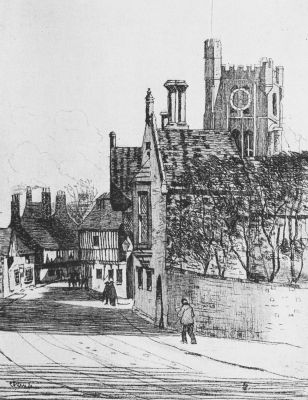
BABLAKE AND S. JOHN'S CHURCH
Two "seditious bills"—one nailed on the minster door on S. Anne's Day—show how strained the situation was becoming. If ever, during a century and a half, the rule of the Coventry guilds had been as thoroughly detested as now, the feeling had never been put in words that have come down to us with such unmistakable force. Of these attacks, the second has a much loftier tone. After a passing reference to Laurence, lying in prison—
"You have hunted the hare, You hold him in a snare"—
there come, in the first set of verses, a warning to all the great folk that have forgotten to rule justly:—
"Ye that be of myght, Se that ye do right, Thynk on your othe; For wher that ye do wrong, Ye shall mend hit among, Though ye be never so loth."
The poet and his friends—he says in the second set of verses—show outward respect to their rulers, but their minds are full of bitterness:—
"This cyte is bond thad shuld be fre, The right is holden fro the Cominalte; Our Comiens that at lamas open shuld be cast They be closed in & hegged full fast, And he that speketh for our right is in the hall,[445] And that is shame for yewe & for us all; You can not denygh hit but he is your brother; & to bothe Gilds he hath paid as moch as another."
As for the "commonalty," they have no more to lose, the verse goes on to say:—
"For eny favour or frenship the comins with yowe fynde, But pyke awey our thryfte & make us all blynde; And ever ye have nede to the Cominalte, Such favour as ye shewe us, such shall ye see. We may speke feir & bid you goode morowe, But luff with our herts shull ye hav non. Cherish the Cominalte & se that they have ther right, For drede of a worse chaunce be day or be nyght, The best of you all litell worth shuld be, And ye had not help of the Cominalte."[446]
Matters remained for some time at a standstill; then at last, early in November, Laurence's "labour and busy suit" brought two privy seals, containing full directions, to Coventry.[447] The mayor was required to release the prisoner after taking surety in £100, so that he might appear before the King and council and state his case; while two or three of the mayor's brethren sufficiently instructed in the matters to be laid to his charge were to bear him company. At a meeting of the council on November 14, certain citizens, among whom was John Boteler the steward, were appointed to ride to London. There, joined by the recorder and others of the city, who no doubt had already entered on various negotiations connected with this suit, they were to lay an account of Laurence's "demeasner" before the King. Another privy seal had been received, addressed to four friends[448] of Laurence, who were summoned to London "to th' entent that they shuld testyfie with hym in such matier as he wold allege for his greves." And now the business went quickly forward. "Accordyng which appoyntement the day was kept at London," says the Leet Book, "befor the Kyngs Counceill in the Sterr Chambre, the Friday next after Seynt Martyn day, and ther continied dayly vnto the Tewesday next befor the fest of Seynt Andrew ... at which day befor my lords of Caunterbury, London and Rochestre, the chief Justice Mr ffyneux, and many other lords, the hole matier was hard at large, both the compleynt of the seid Laurence, the answer therunto, the replicacion of the seid Laurence, and the rejoynder theruppon, with the disposicions of the witnesse, and proves of the seid Laurence, wheruppon the seid Laurence was ther and then comyt vnto the Flete, ther to abyde unto the tyme the kyngs pleasur was knowen."
So Laurence Saunders vanished into the Fleet, while Boteler and the rest returned in triumph to Coventry. The corporation remained clearly masters of the field. In a privy seal,[449] received by the mayor and sheriffs the next December, Laurence's complaints were pronounced "feined and contrived," and himself a "seducioux" man, who had "of his great presumpcion and obstinacie not seldom but often tymes disobeyed the liefell ... precepts of you the said mair ... to the right evil and pernicioux example of other, therby embolded and encouraged to offende in like wise." But the King willed that the laudable and prosperous governance of the city should not "surceasse or be sette aparte by the sinistre or crafty meanes of any privat personne," and so the folk of the city were commanded "for the pretense of any right herafter by thaim ... to bee claymed" to make no conspiracies and unlawful assemblies.
As for the details of the trial, of them we know nothing.[450] Boteler kept the complaint and the answer, the replication and the rejoinder, in papers, "whereof the tenor," says the Leet Book, "her ensuen ..." but just at this place occurs an unlucky break. The careful and zealous town clerk was called away, no doubt, at that moment on business of the first importance; there are no further entries made; so there can be nothing told of the trial in the Star Chamber that Martinmas and of the long agony of Laurence Saunders.
FOOTNOTES:
CHAPTER XIII
The Companies of the Crafts
The men of Coventry, a city which, in later mediæval times, stood fourth among the wealthy towns of England,[451] gained a livelihood by the buying and selling of wool and the making of cloth.[452] As early as 1398 the traffic in the frieze of Coventry[453] extended beyond the modest limits of the city itself. In that year two hundred pounds' worth, the export of one merchant, lay in the port of distant Stralsund, on the Baltic Coast,[454] and in London and other places the cloth was in great request during the fifteenth and early sixteenth centuries.
The men of mediæval Coventry naturally attached great importance to the maintenance and extension of the cloth trade in view of the wealth it brought. Special buildings were set apart for the staple traffic of the city. The Drapery and the Wool-hall, both in Bayley Lane, under the shadow of S. Michael's Church, were the recognised selling places for the raw and finished material; and a small illicit market went on in the porch of the church itself.[455] Hard by stood the Searching-house, a place devoted to the examination of all the cloth made by the city workpeople. Two weavers and two fullers, specially appointed for the purpose, overlooked the handiwork of their fellow-craftsmen; while six drapers were appointed to superintend these weavers and fullers, so as to guard against any exhibition of partiality or slackness in the execution of the task. If the material were sufficiently fulled and well woven, the city seal was attached to it in token of its genuine quality; but the searchers were straitly charged to warrant no piece that fell short of the standard excellence, and bad wares were returned to the owner to make therewith as good a bargain as he could.[456]
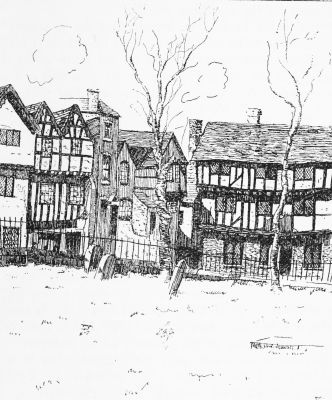
TRINITY LANE
An order of leet passed in 1518 gives very precise directions for the searching process.

ARMS OF CITY OF COVENTRY
"Hit is to be had in mynde that for a trueth of Clothmakyng to be had in this cite as foloeth, if it myght be folowed, and the execucion of the same to be don schortly, or els the cite wolbe so fer past that it wolbe past remedie to be recouered to eny welth or prosperite, hit is thought hit were good to have ij wevers & ij walkers sworn to make true serche of the wevers doyng & also of the walkers & to present the trueth; and also to be chosen vj drapers to be maisters, & ouerseers of the doyng of the serchers, that if some of them cannot a lesour to be at the serchyng at the dayes of the serchers, yet some of these vj maisters schall euer be ther. And by cause it were to great a besynes for the serchers to go to every mannes howse, hit is enacted at this lete to haue a howse of the gilde,[457] or of some other mannes nyghe the drapery doore, to be ordeyned well with perches to drawe ouer the clothes when they be thykked, and also weightes & ballaunce to wey the cloth, and when it cometh frome the walkers, the walkers to bryng it to the serchyng house, and to serche it, & to se it ouer a perche, and if it be good cloth as it owght to be in brede & lengh, that the cite may have a preise by hit & no sklaunder, then to sett upon hit the Olyvaunt in lede,[458] and of the bak of the seall the lengh of the cloth, by the which men shall perceyve and see it is true Coventre cloth, ffor of suerte ther is in London & other places that sell false & untrewe made cloth, & name hit Couentre cloth, the which is a gret slaunder to the cite than it deserveth by a gret partie. And if there be eny man that hath eny cloth brought to the serchyng house, what degre so ever he be of, if it be not able for the worschip of the cite to be let passe, let hym pay for the serche & lett hym do his best with hit, but set not the Olyvaunt upon it.
"And this serche to be made also this fourme,[459] that is to sey ij days in the weke, Tewesday & Saturday, and ij of the serchers to be ther from viij of the clok to a xi, and frome on to iiij of the clok; and a sealer to be ordeyned & sworne to stryke the cloth and seale hit, and wrete hit, and fynde leed, & to have a peny for his labour; and the sealles to be put in a cofre with ij keys, the master of the vj drapers to have the on, and the serchers the other, and for the serche of every cloth to the serchers to have j d. and it is to be thought every good man schal be gladde of that payment."
The person who consistently reaped the greatest benefit from this activity was the draper, the merchant of cloth. Within the city his fellowship ranked next to that of the mercers, or merchants proper, who traded in wool as members of the Staple of Calais, or trafficked in wine and wax, which they brought in barges from Bristol.[460] None but the well-to-do could enter into the ranks of the drapers' craft.[461] Some of its more fortunate brethren were able to purchase estates and take rank among the county gentry. Thus John Bristowe, draper, sometime mayor and justice of the peace in Coventry, became possessed of land at Whitley; and his son William spoke of his "manor" in those parts, and frequently described himself as a "gentleman." And John, grandson of Julian Nethermill, a city dignitary of the same craft, held lands in Exhall, and had his arms blazoned among those of the great county folk.[462] Many members of this fellowship have left a name showing the great power for good or ill that they possessed within the city. There was John Bristowe, mayor in the early fifteenth century, who, as the oldest inhabitants declared, "after he had boron office within the cite of Couentre thynkyng that the common people of the seid cite durst nor wolde contrarie his doyng, claymed unlawfully" to have certain rights over the common pasture. John Haddon, another draper-mayor, has left a better reputation; it was he who came to the rescue of the poverty-stricken clothiers of the city in 1518,[463] and by a timely loan enabled them to continue work. While John Bond, who, as his epitaph declares, gave "divers lands and tenements for the maintenance of ten poore men, as long as the world shall endure," is yet remembered as the founder of the Bablake hospital.
The near connection between these great cloth merchants and the corporation is one of the most striking features of municipal life in Coventry during the fifteenth and sixteenth centuries. The marks of the drapers' influence in civic affairs are continually before our eyes. It was in a draper's mayoralty that ordinances were first made respecting the searching of cloth.[464] And when the system of overlooking was perfected in 1518, a few years later, it was to six men of this craft, that the task of superintending the searchers' investigations was assigned. Just as, about a hundred years before that time, when an unsuccessful attempt was made by the town rulers to exercise complete control over the dyers' craft, it was suggested that two drapers as well as two dyers, in either case nominees of the corporation, should keep watch over the dyers' movements, and "present" them for any "fault or confederacy" at the court of the mayor.[465]
Measures framed by this body in the interest of any particular craft or class were doubtless found oppressive by those who had no lot or part in their enactment. Thus while the yea or nay of the fullers had little weight in municipal councils, the wealth of the drapers gave them a control over the local trade to an extent which we can hardly realise. The reason of this supremacy is not far to seek. The mercers and drapers in their character of wealthy men usually occupied the principal official posts in the city.[466] No one, unless he were possessed of a certain amount of wealth, could rise to a high place in the corporation. Men were ranked according to the amount of property in their possession, and to speak of a citizen as "of the degree of a mayor" or "bailiff," conveyed as definite an idea as the assertion that "So-and-so has a fortune of £20,000 or £30,000," would convey to our minds at the present date.
This body of wealthy merchants, in whose hands was vested all control over the city trade, could and did make and unmake regulations of the deepest significance to the various crafts. By an ordinance of the city leet they could completely alter the conditions regulating the work of salesmen or artificers, as they had an absolute control over all workers, since by the craft system all who practised the same calling were compelled to obey the same regulations. Nominally the regulations were drawn up by the crafts. In reality, as certain members of the corporation overlooked them, amending and annulling at their pleasure, this power of the crafts was held at the will of the municipal rulers.[467] And the corporation did not let their power lie idle. In the interests of the general public they forced the crafts to embody in their rules the ordinances framed by the court leet. Thus the cloth-workers were compelled to bring the cloth they had woven to be measured and examined by the searcher,[468] the fullers to adopt the custom of using a special mark whereby the work of every individual craftsman could be recognised and known,[469] the dyers to abstain from using a certain French dye of inferior consistency,[470] and, much against the wills of this community, to admit another member into their craft.[471] It was not only as regards the working of their cloth, but in all other matters the crafts had to bow before the will of the corporation. Appeals to courts spiritual to punish for oath-breach any who disobeyed the ordinances of the fellowship were looked coldly on by the municipal rulers, and the practice suppressed. In 1518 the mysteries were compelled to make the mayor the arbiter of all cases of dispute between offenders and the wardens of their respective fellowships. If anyone committed a fault against the fellowship, he must be asked to pay a "reasonable" penalty, and "if he deny and will not pay ... according to the ordinance ... within three or four days, let the master ask it of him again ... and if he deny it eftsoons and will not pay it, let the master of the craft and three or four honest men of the craft come to master mayor and show unto him the dealing of that person." Whereupon the mayor and justices, should he refuse to pay double the original sum to the craft, were bound to commit him to ward until he promised obedience. The offender on his release was to make submission to the master entreating him to be "good master" to him during his year of office, and "his good lover" in time to come.[472]
We may follow in detail the dealings of the corporation with several of the crafts. The fullers seem to have combined with the tailors to form the guild of the Nativity some time in the reign of Richard II., but were prevented from acting under the terms of their charter. In the eighteenth year of the reign of Henry VI. the royal licence was renewed.[473] But the guild was a singularly ineffective body, holding little if any property, and soon after, possibly at municipal instigation, the two crafts who formed it were separated, though the tailors obtained a third renewal of their licence in the twenty-eighth year of Henry VIII. The dyers appear to have been more stubborn. Early in the reign of Henry V. they combined together to increase the price of dyeing of cloth by one-half, and to have the flower of the woad for their own use.[474] In 1475 they attempted, perhaps, to renew their old combinations of sixty years back; and five years later Laurence Saunders, a member of their calling, became the leader of the opposition which prevailed during the close of the century within the city.[475] In 1496 all the thunders of the leet ordinances launched against those who, of their "froward wills," refused to contribute to the furnishing of the pageants played on Corpus Christi day, failed to make the dyers join with the other crafts in paying their share.[476] When the municipality desired to thrust a new member into their craft, the dyers forbade the journeymen to work for him, and it was only by circumventing their tactics that the town rulers could compel the admission of the new candidate into their ranks.
Not only the workers in cloth, but all the fraternities were forced to bow to the corporation's will. In 1436 the attention of the leet was drawn to certain malpractices which had arisen among the workers in iron. A bill, drawn up no doubt by some member of the ruling class and presented by him to the court, shows the full extent of the evil and suggests certain measures of reform. Certain workers in iron, we are told, by employing labourers of the four allied crafts of smiths, brakemen, girdlers, and card-wiredrawers, had acquired entire control over the trade, and were able to pass off ill-wrought iron upon their customers. It was suggested that labourers of but two occupations should be employed by one master instead of those of four occupations as had been the custom hitherto.
"Be hit known to you," the bill runs, "but yif certen ordenaunses of craftes withe in this cite ... be takon good hede to, hit is like myche of the kynges pepull, and in speciall poor chapmen and clothemakers, in tyme comeng shullen be gretely hyndered, and as hit may be supposed the principall cause is like to be amonges hem that han all the craft in her own hondes, that is to sey, smythiers, brakemen, gurdelmen, and card-wire drawers, for he that hathe all thes craftes may, offendying his conscience, do myche harme." A negligent smith, the bill continues, might heat the iron by "onkynd hetes," so that it became unfit for future use. "Never the later for his own eese he will com to his brakemon and sey to hym: 'Here is a ston of rough iron the whiche must be tendurly cherysshet.'" When the brakeman has done his task, the metal comes to be sold for making fish hooks. "And when hit is made in hokes and shulde serve the ffissher to take fisshe, when hit comythe to distresse then for febulnes hit all-to brekithe, and thus is the ffisher foule disseyved and to him grete harme." And if the iron be used for making girdles, the master passes it to the girdleman with these words: "'Lo, here is a stryng or ij (two) that hathe ben misgouerned atte herthe, my brakemon hathe don his dever; I prey the, do now thyne.' And so he dothe as his maister biddethe hym." Or it may be passed on to the cardmaker, who finds that it "crachithe and farithe foule; so the cardmaker is right hevy therof, but neverthelater he sethe be cause hit is cutte he must nedes helpe hym self in eschueing his losse, [so] he makithe cardes[477] ther of as well as he may, and when the cardes ben solde to the clothemaker and shuldon be ocupied, anon the tethe brekon and fallon out, so the clothemaker is foule disseyved. Wherefore, sirs," is the conclusion of the bill, "atte reverens of God in fortheryng of the kynges true lege peapull, and in eschueng of all disseytes, weithe (weigh) this mater wysely, and ther as ye see disseyte is like to be, therto settithe remedy be your wyse discressions." For, as the petitioner suggested, if the two crafts of smiths and brakemen, and these only, were united on the one hand, and the two crafts of girdlers and card-wiredrawers, and these only, on the other, "then hit were to suppose that ther shuld not so myche disseyvabull wire be wrought and sold as ther is." For if the crafts were severed in this manner, it was argued, then the girdlers and cardmakers would buy their wire from the smiths, and look well to their bargain. "And if the card-wiredrawer," the petitioner proceeds, "were ones or thies disseyved withe ontrewe wire, he wolde be warre, and then wold he sey vnto the smythier, that he bought that wire of: 'Sir, I hadde of you late badde wire, sir, amend your honde, or in feithe I will no more bye of you.' And then the smythier, lest he lost his custemers, wold make true goode; and then withe the grase of godd (God) the craft shuld amend and the kinges peapull not disseyved with eontrewe goode."[478]
The mayor, we learn, on this important occasion sent round to all the worthy men of the leet to take their advice upon the matter. Either the corporation sought an occasion of humbling the workers in iron, or the common sense expressed in this bill was irresistible; for the leet fell in with the arrangement of severing the crafts. A number of master smiths agreed to employ only journeymen of this occupation and brakemen, while the cardmakers on the other hand undertook to find occupation for girdlers and cardmakers only. Furthermore, the leet decreed that their two last-named crafts should by "no colour ne sotell imagynacion 'sell or buy' no cardwyre ne mystermannes wyre, the whiche may be hynderying or grevying to the kinges lege pepull 'under pain of £20.'"
The craftspeople, however, occasionally resented municipal interference, and endeavoured by all means within their power to get the control of the industry in which they were engaged into their own hands. Any temporary weakness or disorganisation on the part of the corporation was taken advantage of by these fraternities. It was in 1456, when the finances of the city were in some disorder, owing to the expense of entertaining the Court and the active support given by the city to the Lancastrian cause, that the craftspeople took occasion to sue in spiritual courts offenders who had broken the rules observed by members of fellowships.
"Discord daily falleth in this city among the people of divers crafts"—such are the words of an order of leet passed in 1457—"because that divers masters of crafts sue in spiritual courts divers people of their crafts, affirming they have broken their oaths made in breaking divers their rules and ordinances, which rules ofttimes be unreasonable, and the punishment of the said masters over excess, which, if it continue, by likelihood would cause much people to void out of the city." The masters were thenceforth forbidden to bring "any manner suit, cause or quarrel in any court spiritual against any person of their craft," until "the mayor for the time being have heard the matter and variance ... and have licensed the suit to be had."[479] But though defeated in this scheme, the crafts doubtless did not give up the battle. The dyers' attempt in 1475 to form confederacies happened in a time of great division within the town respecting the enclosure of the common pasture. And the same disputes agitated the community twenty-one years later, when a member of the party of discontented craftsmen nailed up inflammatory verses on the church door, taunting the corporation with injustice and inveighing against the rules they had made for the buying of wool and selling of cloth.
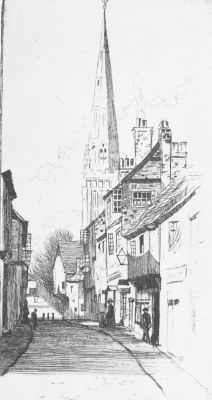
NEW STREET
And indeed it may have been well that persons high in authority curbed the self-seeking spirit of the crafts. These bodies, formed early in the thirteenth century for mutual help and preservation, had since degenerated into close corporations eager to exclude competition at any price.[480] Fettered as they were by ordinances fixing price, hours of labour and the like, there was so little free play allowed the craftsman in the management of his business, that the difficulty of acquiring wealth must have been great. Each company of craftsmen practically monopolised all the traffic or business connected with their special calling in the district in which they lived, and were bound to take good heed that the numbers of those who formed their body should not be greatly increased, lest the individual profits should be reduced. They were resolved at all hazards to guard against competition. The trade of the town might support ten tanners for instance, but the admission of an eleventh or twelfth into the craft might endanger the older members' prosperity. Thus, in 1424, the weaver showed a distinct dislike to allowing their members to take any number of apprentices,[481] who were potential masters of the craft; and the cappers who in the fifteenth century had risen to be a very important body, allowed each master to take but two apprentices only, and when one departed before his serving-time of seven years was accomplished, the master was forbidden to take another in his place, without licence from the keepers of the craft, until the allotted time should be past.[482] The corporation, however, wished to break down this exclusiveness, and in 1524 declared that any member of what craft soever might receive what number of apprentices he would "notwithstanding any ordinance to the contrary."[483] Some twenty years later, finding perhaps that this sweeping measure aroused too much opposition, the leet tried to thrust a modified form of it on the cappers.[484] Twice within a few months [1544-5] they decreed that any master of the fellowship might take an extra apprentice when one of them had served five and a half of the allotted seven years and they repeated the order after a few years' space.[485]
The craftspeople had another method for keeping would-be members out of their ranks. They demanded on admission such fines as could only be paid by the well-to-do. And it was owing to their jealousy that precautions were taken to ensure the payment of these admission fines. Trouble came about, we are told, because new members departed from the town just when the fine was due, a year after setting up their shop. They were henceforth to be compelled to pay half their fine at setting up, and to put in two sufficient sureties that the second half should be paid at the end of the first year.[486]
It was part of the policy of the town rulers to recognise the apprentice's possible future citizenship, and withdraw him somewhat from his master's authority. The lad was therefore forced by the ordinance of 1494[487] to take the oath "to the franchises," and bring his twelve pennies to the steward for the town use when his term of service began. We see from the list of those who took the oath in 1495 that the apprentice lived in his master's house, serving him usually—though not invariably—for seven years' space. He earned a nominal sum, perhaps a shilling, or even 4d., the first six years, and a larger one, perhaps 10s. or 13s. 4d., during the seventh. Thus the son of John Preston, of Stafford, "gentleman," who was apprenticed to a grocer, earned 12d. a year, the wages of his last year of service—the ninth—being unfixed; while another lad, learning the same trade, received 13s. 4d. as his last year's earnings. The son of a Durham "husbandman" took from his master, a hat-maker, 4d. a year for six years, and 6s. 8d. during the seventh. The crafts seem to have made it their business to see that the boys were properly cared for. If any one of them complained that his master did not give him sufficient "finding," i.e. food and raiment, the offender was to receive first an "admonition," and on the repetition of the offence to pay a reasonable fine; if matters did not mend, the lad was to be removed and placed elsewhere.[488] The master exercised a superintendence over the apprentice's moral well-being. In an early indenture of the time of Richard II. the lad promises to haunt neither taverns nor houses of ill-fame, nor hold illicit intercourse with any of the women of the household.[489]
No doubt the number of apprentices was limited partly in order to prevent any one master from engrossing more than what was deemed his fair share of trade and profits. The craftspeople were very sensitive on this point. Thus, in 1424, quarrels arose between a certain John Grinder on the one side and his fellow-members of his craft of weavers on the other. The fact that Grinder wove linen as well as cloth, and had two sets of looms for the purpose,[490] had aroused the jealousy of the other weavers of the city. It may be remarked that this weaver was a man wise in his generation. He gained his cause and made his fortune, and filled the post of bailiff some time before 1449, being apparently the only man of his calling during the second quarter of the fifteenth century who ever occupied a high municipal office. Many precautions were taken to prevent undue rivalry between brethren of the same fellowship. It was usual among the artisan crafts for the member to report the closing of a bargain to the master or keeper of his fraternity.[491] And no other member of the calling could come between the contracting parties until the work was finished.[492] But among the more powerful craftsmen means were often taken to defraud their brethren of the poorer sort. By collusion between butchers and tanners the latter were able to buy raw hides "in grete," or wholesale, with the intention, no doubt, of reselling them at a profit to others of the craft, a practice the corporation forbade under a penalty of forty shillings, to be taken from buyer and seller alike.[493] When any excessive profit was to be made, the public, then as now, was fair game. In Coventry, as elsewhere, ale-wives gave short measure, and used an unsealed cup. The clothmakers stretched out broadcloth to the "high displeasure of God and deceit of the wearers" to a length the material could ill bear. Of all these matters the corporation took cognizance, inflicting fines, punishing by the pillory, or in extreme cases by loss of the freedom of the city.
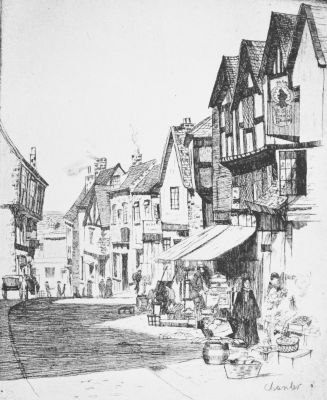
BUTCHER ROW
There was one point, however, on which all employers were agreed, and that was on the advisability of checking unions and combinations among their workmen for the purpose of obtaining better wages. The journeymen's, or, as they were called, "yeomen's" guilds, which seem to have been fairly universal at the close of the fourteenth and during the fifteenth century, appear in Coventry with great frequency and persistence. Three several times the corporation obtained patents against the formation of guilds other than those already existing in the city.[494] The patent for the suppression of the first of these combinations that comes before our notice, the fraternity of S. Anne, is addressed to the mayor and bailiffs, in 1406, and relates how it had come to the ears of the government that a certain number of youths, serving men of the tailors and other artificers working by the day called journeymen, gathered together in the priory, or the houses of the friars, and formed a fraternity called the fraternity of S. Anne, to the end that each might maintain the other in their quarrels. This action was likely, in the opinion of those in authority, to breed dissensions in the city, do great harm to the societies founded of old time, namely, the Trinity and Corpus Christi guilds, and hence bring final destruction upon the townsfolk. The meetings were declared unlawful, and all who persisted in assembling to hold them after the patent had been openly proclaimed were to be arrested, and their names certified to the King, who would have them punished according to their deserts.[495] But, in spite of this warning, the journeymen did not give up the conflict, for the fraternity had again to be crushed in the first year of Henry V.,[496] only to reappear in 1425 under the title of the guild of S. George.
Connected with this last movement was the discontent which affected the journeymen weavers in the year 1424. Indeed it is possible that the whole company of journeymen within the city were at that time making demand for higher pay. The weavers had a bond of union in a common fund which they apparently appropriated to the furnishing of altar or processional lights, a pretext possibly like that of the journeymen saddlers in London in the time of Richard II., who, under "colour of sanctity" and religious meetings, "sought only to raise wages greatly in excess."[497] The movement among the Coventry weavers assumed all the forms of a modern strike. The men not only refused to serve at the usual wages, but hindered others from filling their place. The corporation took the matter in hand, and the question was finally settled by arbitration. The men were forbidden to hinder any of their fellows from working for their masters as they had done aforetime, and a regular rate of wages was established, whereby the journeymen took a third of the sum paid to their employers for the weaving of each piece of cloth, while the masters were ordered to exact threepence and no more from their workmen as a fine for each "contumacy," being, however, forbidden, under colour of this rule, to oppress their servants.[498]
Nearly a hundred years later we find that the fraternities of journeymen were still in existence, albeit jealously watched by the masters of the crafts. In 1518 all initiative was taken from them. "No journeymen of what occupation or craft soever," runs the order of leet, shall "make or use any cave or bylaw, or assembly, or meetings at any place by their summoner without license of the mayor and the master of their[499] occupation" upon pain of 20s. at the first fault; at the second the offender's "body to prison," there to remain until the master and six honest persons of his occupation would speak for him.[500] At the same time the workers' fraternities were ordered to bring in the rules already made for the mayor's inspection. But the attempts on their part to form closer unions in order to facilitate concerted action still continued, and in 1527 we find the dyers' serving men assembling together for the apparently pacific purpose of attending marriages, betrothals, and burials, as if "they had been a craft or fellowship." These meetings served most likely as a cloak to more serious proceedings, and they were forbidden by the leet.[501] Nor was the movement entirely confined to the workers of the crafts; it spread among those outside the guild organization. In 1518 the daubers and rough masons were forbidden to form a fellowship of themselves, but were henceforth to be common labourers, "and to take such wages as are limited by statute."[502]
In other matters we may see the discontented attitude of the workfolk. Thus the journeymen cappers objected to the lengthening of the hours of their working day, which in 1496 had been fixed to last from six till six, but which by 1520 was further increased by two hours in the summer-time, thus lasting from five in the morning to seven in the evening.[503] Six years later it was enacted that, unless they kept these hours, it was permitted to any master to "abridge their wages according to their time of absence." Any rivalry in trade between masters and men was crushed whenever the masters' power availed to do so. Thus in 1496 the journeymen cappers carried on a contraband trade, and scorning to be content with the permission to "scour and fresh old bonnets" for that purpose, made new caps for sale; nor did the imposition of a fine of twenty pence at every default avail to check their activity. Therefore according to the rules of 1520, members of the craft were forbidden to give any work to those who knitted the journeymen's caps, or to the spinners who span for them, thus indirectly checking this illicit competition. In other ways the journeyman was made to feel the weight of the master's hand. Among the carpenters none could be set to work unless he had served for seven years as apprentice to the handicraft;[504] and a journeyman capper was compelled to certify the cause of leaving his late master to the satisfaction of the masters of the craft.[505]
These are some points connected with the life of mediæval craftsmen. Although so much has been written on the economical, social, and religious aspects of the subject, we are still very ignorant as to the actual workings of the craft system. Modern industry seems to have entirely passed through, and, as it were, forgotten this immature phase of its existence. The companies in Coventry which were able to survive the shock of the suppression of the guilds and chantries under Edward VI., and have lasted to our own day—the mercers, drapers, cappers, fullers, clothiers, and worsted weavers—possess none of the powers or organization of their predecessors, and are mere survivals of a bygone time, "the shadows of a great name."
FOOTNOTES:
CHAPTER XIV
Daily Life in the Town—the Merchants and the Market
At the "beating of the bell called daybell," the townsfolk rose and began their daily work. Country people, wayfarers and chapmen, bearing their burdens of merchandise, saw the city in the morning light, with its ring of walls and upstanding posterns and gates over-topped by six tall spires, lying in the midst of fields and far-reaching common grounds in a slight dip in the plain. Entering the newly-opened gates, they were at once inside the narrow paved[506] streets, bounded on either side with black and white timbered houses, for travellers from the Warwick side did not make their entrance by spacious Hertford Street,[507] but by the Grey Friars' and Warwick Lanes, then part of the main thoroughfare of the city. Passing up the hill, they found that the street on a line with these—the Broadgate—belied its name, being but a very narrow thoroughfare, bounded on the left hand by a block of houses, whereof the removal in 1820[508] has caused moderns to think that the open space on the crown of the hill is very rightly named.
Soon after daybreak the streets were alive with the noise and press of a busy throng. It is true there were many impediments to traffic. Cattle[509] and ducks wandered hither and thither; fishmongers' stalls stood in the middle of the streets, greatly to the hindrance of the passers-by, whether horsemen or pedestrians;[510] while inn signs[511] had perforce to be limited in length, lest they should strike the heads of unwary riders in the by-lanes of the city. But the mediæval trader was well inured to inconvenience. Neither did noise distract him, though taverners and cooks standing at the door offered good things hot from the oven to passers-by, each seeking to cry louder than his neighbour; while in the open places the crier proclaimed the terms of a recent charter, or newly-made ordinance of leet or council;[512] and overhead the church bells pealed forth, calling folk to their prayers, to the market, or, in case of a brawl or riot, to a common meeting-place.[513]
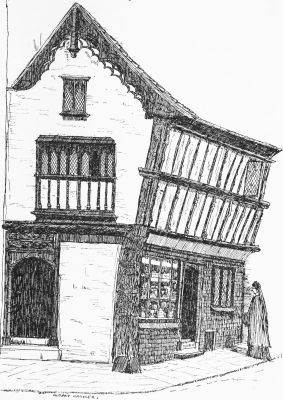
OLD HOUSE BESIDE S. MARY'S HALL
Long before curfew the countryman had gone home to his village in the Arden country or by the London road to Dunsmoor Heath; while the traveller in his inn and the townsman under his own roof were soon abed. What light there was in the deserted streets on winter evenings came from the lamps which hung over the door of every hostelry and every substantial citizen's house, until nine o'clock,[514] after which time the city gates were closed,[515] and none were abroad save thieves and watchmen. Indeed, the very fact of being out after dark was in itself presumptive evidence of some dishonest purpose on the part of the belated wayfarer. At any suspicious sight or sound the watch were on the alert, and prepared to arrest the wanderer; should the prisoner escape and take to flight, they would instantly give chase, and fill the dark and empty streets with the echoes of their pursuit. A hue and cry would be raised, doors open, and householders pour forth to aid the watch. If the unlucky fugitive were captured, he would be committed to ward in all haste.[516]
What a crowd of different types of men must have jostled against one another in the noisy throng! Craftsmen, attired in the livery proper to their calling, a custom whereof we have this day a relic in the butcher's blouse; merchants from foreign parts, or natives fresh from a sea voyage; mayor and aldermen clad maybe in festal scarlet; the crier and sergeants in the livery of the city; men-at-arms, the retainers of some great lord, bearing the badge of the Earls of Warwick, or the Stafford knot; Benedictines, clad in white cassock and black gown and hood; Franciscans, with their brown habit and knotted girdle; Carmelites from Whitefriars in white frock and brown scapulary; Carthusians from the Charter-house, with white cassock and hood; chantry and parish priests—all these, laymen and clerics, warriors and traders, met, passed, and gave greeting in the streets.
Strange figures might be seen in the streets or the road neighbouring the city, such as the hermits, whose dwellings—the one by Bablake church,[517] the other at Gosford Green—stood at either end of the highway leading through Coventry. Times had changed; it was now customary for hermits to build by the highway, and no longer withdraw into solitary places, and spend their lives in prayer and meditation. They rather preferred to dwell in "boroughs among brewers," seeking society and good cheer. Nor did the pilgrims, who might be seen flocking to the shrine of S. Osburg[518] or to the image of Our Lady in the Lady Tower on the London Road hard by the Whitefriars' to pay their devotions, invariably set about their task in a religious spirit. Many who travelled to the far-famed shrines of S. Thomas of Canterbury, S. Edmund of Bury, S. Cuthbert of Durham, or to "Our Lady" of Walsingham, to the Roods of Chester and Bronholme, or the Holy Blood of Hales, looked on their journey as a holiday jaunt rather than as an act of devotion. The author of Piers Plowman thought little spiritual good came from this gadabout religion. The Lollards were wont to condemn pilgrimages, and one John Blomstone of Coventry, a heretic, examined in 1485 declared:—
"That it was foolishness to go on a pilgrimage to the image of Our Lady of Doncaster, Walsingham, or the Tower of Coventry, for a man might as well worship by the fireside in the kitchen as in the aforesaid places, and as well might a man worship the Blessed Virgin when he seeth his mother or sister, as in visiting the images, because they be no more but dead stocks and stones."
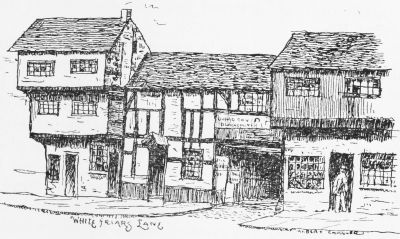
Whitefriar's Lane
Interesting, too, are several persons occurring in Coventry history, whose occupations were hardly so legitimate as those of pilgrim or hermit. We have had a glance at the ruinous house where John de Nottingham, the necromancer, by means of his waxen effigies wrought such terrible evil to one of the prior's servants, and revenged the wrongs of the Coventry men. We would fain know more of John French, the alchemist, who appears in the Leet Book,[519] only to disappear directly from its pages. We learn in 1477 that he intended, "be his labor, to practise a true and profitable conclusion in the cunnyng of transmutacion of meteals to" the "profyte and pleasur" of the King's grace, and was, so Edward IV. charged the mayor, never to "be letted, troubled, or vexed of his seid labor and practise, to th' entent that he at his good liberte may shewe vnto vs, and such as be by vs therfor appointed, the cler effect of his said conclusion." There can be little doubt that the citizens looked askance at John French, and whispered that he dabbled in black magic and had dealings with the Prince of Darkness. We know not how many years the alchemist spent in his fruitless labours; or if he imparted his views on the subject of the "transmutation of metals" to the citizens, or ever journeyed to London to pour a tale of hope deferred into the ears of the disappointed King.
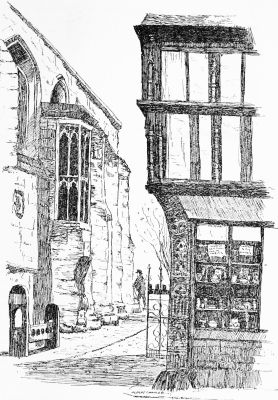
ORIEL WINDOW AND STOCKS. S. MARY'S HALL
There were many sights in a mediæval city to remind us that men seldom cared to cloak their brutality in those days. The stocks, where offenders were held by their feet, the pillory, where they were held by the head and hands, stood conspicuous, probably in neighbourhood of the guild-hall. A pillory, a favourite place for the chastisement of fraudulent bakers, may yet be seen in Coleshill, and stocks stand yet on many a village green.[520] Here the great punishment lay in the shame of exposure: the criminal stood for hours unable to move, a pitiful target for the derision of the multitude. The like penance was imposed on those who suffered at the cucking-stool, followed by ducking in water, a highly disagreeable incident in the punishment. The prisoners in the gaol looked out into the highway, and perhaps held conversation with their friends as they passed. Now and then a craftsman might be seen among the debtors pursuing his calling, for it was not thought expedient to bring a man to utter destitution by depriving him of the means of livelihood during imprisonment; and those who chose might cobble shoes or work at the loom during those monotonous days. Hard by the busy worker might stand a felon, traitor, or murderer, his mind full of gloomy thoughts of his coming end.[521] The gallows, naturally reared on high where all men might see them and their ghastly burden, were probably in sight of the prison; and rich and poor crowded to see a condemned man drawn in a tumbril, or executioner's cart, to the gallows, or a woman exposed to open shame. "It is ordained," an order of leet ran, "that William Rowett, capper, and his paramour be carried and led through the town in a car, in example of punishment of sin, and that all other that be proved in the same sin from this time forward shall have the same pain."[522] But these were only a few among many unpleasant sights that would attract the notice of a passing stranger. Heads of traitors stuck on the top of long poles often adorned the gates. Part of the body of Jack Cade was sent down in 1450, no doubt to breed terror into all disloyal beholders, and in 1470 the head of one Chapman[523] was set up on the Bablake gate; while that of Sir Henry Mountford, an adherent of Perkin Warbeck, shared the same fate in 1496.[524] Gosford Green was the Tower Hill, and the Little Park the Smithfield of Coventry. At the former place Lord Rivers and his son suffered death under Warwick in 1469; while the latter saw the burning of many martyrs, including the famous Marian victim, Laurence Saunders.
Many were the efforts made to keep the place clean and wholesome to live in; but frequent appearances of the plague show that they met with but partial success. At the awful visitation known as the Black Death there remained not "the tenth person alive," we are told, to bury the dead;[525] while in 1479 the plague is said (without doubt exaggeratively) to have carried off 3300 of the inhabitants.[526] Filth of every kind was deposited in the Cross Cheaping under the magnificent cross itself, much incommoding the folk who thronged to the market-place, "to the danger," the leet jury complained, "of infection of the plague," and by sweeping the pavement there dust was raised, which did "deface and corrupt" the said cross.[527] In that half of the city wherein the prior held sway the people put all the refuse of their houses just outside the Cook Street gate, with the result that when the country people did not come to carry it away to manure their fields, the lord prior could not "have his carriage through his orchard."[528]
According to orders of leet, however, a better system should have prevailed. The sergeants collected every quarter a penny from each citizen dwelling in a house with a hall door, and a halfpenny from every shop, to provide a cart which carried away the filth from the streets.[529] Moreover all the citizens were enjoined to clean that portion of the pavement which lay in front of their dwellings every saint's day under payment of a fine of 12d. This order was hardly a popular one, and the sergeants were continually taking distress from those who would not pay the quarterly cart-rate, or raising fines for the omission of the festal cleaning. For the good folk evaded all sanitary regulations whenever they might do so with impunity. As for those misdoers who threw filth into the common river, to inquire concerning them was a hopeless task.[530] This was, as the mayor and corporation owned to prior Deram when he loudly complained thereof, one of the worst evils of the city. Coventry seems, however, never to have fallen into such an evil plight as Hythe did in the fifteenth century. Here, owing to the abominable habit of casting refuse into the streets, to say nothing of blocking them with all imaginable obstructions,[531] they were more like evil-smelling swamps than highways fit for traffic.
Measures, somewhat primitive in character,[532] were taken to guard against an outbreak of fire, which so frequently wasted mediæval cities, where the plaster and timber of the houses, with their projecting storeys almost touching one another across the narrow streets, afforded excellent fuel for the flames. A stone house was a rarity, and in the fifteenth century bricks were as yet not in general use. The leet forbade the building of wooden chimneys or the roofing of houses with straw in lieu of tiles.[533] Moreover late mayors and other officers with "commoners of thrift," were forced to provide leather buckets, "such as the aldermen think sufficient" to hold the water wherewith to quench the flames. In order to prevent the supply of water—brought in a leaden pipe from a spring without the city[534]—from being exhausted, a lavish use of it was not permitted. The conduits, whereof there was one in Cross Cheaping, and another, called the Bull, probably by the Bablake Gate,[535] were kept locked during the night, and brewers were forbidden to take water thence for their brewing, or any one to wash linen and clothes therein.[536] The practice whereby individuals, by means of a grant sealed with the common seal, obtained a licence to take water continually from the conduit for their private use, was looked on most unfavourably, and finally forbidden by the leet.[537] No doubt the people who wished to obtain this permission were the wealthy brewers and victuallers who were answerable for so many disturbances in Coventry.
For here as elsewhere this important class of townsfolk made great profit out of the "pence of the poor," in spite of law and ordinance. One of the great problems facing mediæval legislators and local authorities was the task of ensuring the natural price of provisions. "No police of the Middle Ages," says Thorold Rogers, "would allow a producer of the necessaries of life to fix his charges by the needs of the individual, or, in economical language, to allow supplies to be absolutely interpreted by demand. The law did not fix the price of the raw material, wheat or barley. It allowed this to be determined by scarcity or plenty—interpreted, not by the individual's needs, but by the range of the whole market. But it fixed the value of the labour which must be expended on wheat and barley in order to make them into bread and ale."[538] The central government ordained what weight of bread was to be sold for a certain sum, and what price should be given for a gallon of ale; and the enforcing of the law was the business of the local authority. The local rulers themselves fixed the price of other provisions—fish, meat, poultry, and wine—allowing for profits according to a certain scale on their resale by victuallers.[539] Stringent rules were laid down against the enhancement of price by "forestalling and regratery," that is intercepting merchandise on the way to market and selling it at an increased price. For example, native fishmongers, it was feared, would lay in wait for travelling salesmen bringing in "panyers" of salt fish, and, after buying the same, would ask a higher price for it before the next fasting day. So to guard against this contingency, strangers selling fish were forbidden to be "osted or inned" in the house of a native brother of the craft, but to pass the night at inns at the mayor's "limitation," and after "making relation" to him of the kind of fish they brought, to sell the same openly in the common market-place.[540] A multitude of regulations were also made to ensure the good quality of provisions, the mayor examined all fish brought by foreign fishmongers, whilst ale-tasters, appointed by the bailiff, summoned by each brewer to taste his new beer, received "a gallon of the best ale" at the detection of any default. In addition to all these expedients for regulating price and quality, the statute-book provided for the giving of a just quantity to the buyer at the conclusion of every bargain. On each opening day of a new mayoralty all shopkeepers and victuallers delivered up their weights and measures for the mayor's inspection, and after comparison with the standard model, kept in the town chest, they were sealed if found correct, or, if faulty destroyed.
On his entry into office, the mayor's "crye" or proclamation informed all and sundry of these regulations, and of the perils consequent on their infringement.
Here we learn the price of "coket" bread[541] and horse-bread at that time; how white wine of Rochelle was to be sold at 6d. a gallon, Malvoisey at 16d., and "no derer upon the peyn of xxs. at every trespas," and that on Oseney, Algarbe and Bastarde the "mayor and his peres" would set a price when any occasion of selling offered.[542] The "crye" tells us what penalties were laid on those who made use of fraudulent measures, "coppes and bollys" unsealed,[543] and how informers were stimulated by the promise that whosoever gave notice to the mayor of this abuse should "have iiiid. for his travayll and a galon of the best ale" and also what hard punishments were meted out to those who practised forestalling and regratery.[544]
But in spite of all these regulations the task of curtailing profits seemed a hopeless one, and again and again the worthy men of the leet confess that the law remains a dead letter through the frauds of the victuallers. These, we are told, holding their heads high, refused to sell their wares at the "limited" price, "and in maner destitucion the seid cite of wyne and vitayle" to the manifest hurt of the inhabitants and of all people "confluent to the same." While, when the mayor insisted that the bakers should obey the orders of leet regulating their trade, the whole craft "struck" with the greatest unanimity, and leaving the city "destitute of bread," took sanctuary at Bagington, a village about four miles distant. Night, however, brought counsel, and they submitted next day to the mayor, paying for their lawlessness a fine of £10.[545] As for the brewers in the sixteenth century, they found their calling so lucrative that others were thereby encouraged to forsake their occupations and take up this profitable trade. At that time, said the worthy men of the leet in 1544, "divers of the said brewers nothing regarding the displeasure of God, the danger of the laws of the realm nor the love and charity which they ought to bear to their neighbours nor the commonwealth of this city, for their own private lucre ... do ... regrate and forestall barley coming into this city to be sold," and sell ale at excessive and unreasonable prices.[546]
Regulations, however, affected this powerful and wealthy class but little, and in listening to the ever-renewed complaints against them we begin to realize the universal detestation in which they are held in the Middle Ages. Mediæval imagination, with its love of the grotesque, delighted to picture the unhappy end of those who bade defiance to the laws of God and man. How hardly shall an alewife, thought the Ludlow artist, "enter the kingdom of Heaven," and in carving the miserere of the parish church he shadowed forth her fate. "A demon is bearing away the deceitful one; she carries nothing about her but her gay head-dress and her false measure; he is going to throw her into hell-mouth, while another demon is reading her offences as entered in his roll, and another is playing on the bag-pipes by way of welcome."[547] A pleasant man was that Ludlow artist,—one, we may fancy, who abhorred cheating, and dearly loved his glass.
Ordinances of leet were frequently passed upon the order to be maintained upon a market day, for there was but scanty room for traffic in the Cross Cheaping, even though the carts can have been no wider than trollies, taking up but "the brede of a yard" in passing by. Stalls and boards were a great encumbrance. "No fishmonger," runs an order of leet, "(can) have his board standing forth at large in the street for to let cart, horse or man, but that there be a reasonable space left ... between their houses and their boards."[548] Round about the market-place were clustered the dwellings of provision merchants and the lesser craftsmen. Ironmonger Row, Butcher Row or the Poultry, Cook Street, and the Spicer-Stoke[549] tell by their names the calling of those who lived or chiefly trafficked there;[550] while the drapers made their homes hard by the Drapery, in Bayley Lane and Earl Street.[551] On market days this neighbourhood was crowded with the overflow of stall-holders and salesmen; the poulterers standing before the Priory gates, and round about the Bull-ring "usque finem de le Litel Bochery,"[552] while the fishmongers and leather sellers had stalls within the Cheaping itself.[553] Other stalls were placed in the procession way in S. Michael's churchyard, and the sellers of cloth had an illicit market in the church porch opposite the Drapery door, until it was made forbidden ground by a leet ordinance. For all merchants and chapmen resorting to the city on the Friday were forced by this authority to sell all their mercery, cloth, and linen inside the Drapery;[554] and all sellers of wool to have their merchandise weighed at the Wool-hall hard by, and pay a fee for the weighing thereof at the "Beam" or public weighing machine.
Equally stringent were the orders of leet, which curtailed the privileges of the "foreyn," who came to buy or sell within the city. He was not allowed to purchase corn in the market until mid-day, three hours after the townsfolk had been admitted to make their bargains.[555] A certain time of sale was assigned him,[556] and very frequently his goods were examined by the mayor ere he could dispose of them in the market. If his trade competed in any serious degree with that of the city craftsmen, there was no end to the restrictions wherewith he was hampered. Urged by a spirit of local monopoly, the authorities regulated the trade in hides and tallow in favour of the dealers of the city, though on the butchers' assertion that the country tanners would give a better price for the hides than their town brethren, the rules were somewhat relaxed. No chandler, however, was permitted to sell more than twelve pounds of candles out of the city[557] to one purchaser.
The frequent enactment of these and similar regulations in the early sixteenth century shows the terror with which the townsfolk looked on the spread of industry in country districts. Owing to the conversion of arable land to pasture for sheep farming, agricultural labourers had been thrown out of work; many therefore were employed in handicrafts in their own houses and their competition was thought to seriously threaten the prosperity of their town neighbours.[558]
At the Corpus Christi fair all was bustle and activity in Coventry, and the mayor had doubtless much ado to settle all the disputes arising from differences of currency or hard driving of bargains at the pypowders court, for all the world of the neighbourhood came to lay in stores for the year, and merchants from far and near to sell their wares. Eight weeks a year of a farmer's life is said to have been spent more or less at fairs and markets,[559] and undoubtedly a merchant employed a far longer period in travel to and from these centres of trade. Our forefathers were not altogether such simple stay-at-homes as we love to picture, but, rather, experienced travellers, and in those days travelling meant experience, and was not as it is now—at least in civilized countries—a method for getting from place to place which puts no tax on the body, and the least possible on the mind of the traveller. All manner of men and of merchandise[560] were to be seen at the fair. Irish traders brought druggets from Drogheda; coarse cloth came from the west country;[561] Frenchmen brought dyes for cloth; Bristol traders wine from Guienne and Spain; country gentlemen and local graziers bales of wool for export or home manufacture.
It is true that in spite of its popularity, the Corpus Christi fair never equalled the S. Giles' fair at Winchester, the centre of trade between the southern counties and France, or that of Stourbridge, near Cambridge, the great mart for horses, and the centre of commerce between the eastern counties and Flanders. To many, however, the fair at Coventry, the centre of traffic on the great road to the north-west, was the chief event of the whole year. The local makers displayed to the utmost advantage the bales of Coventry cloth, and the blue thread, to which the skill of the native dyers gave the colour which was the envy of the whole country. This merchandise could be bought openly by the strangers, who jostled against one another before the stalls in the Drapery. But many transactions, which the dealers hoped would not come to light, must have taken place unnoticed in the busy crowd. The prior of Sulby, in terror of the rapacity of Henry VIII., sold his cross-staff to the wife of a London goldsmith at Coventry fair one Corpus Christi day, just as the monks of Stoneley—provident men—about this time disposed of a silver censer, and other things "worth £14 or thereabouts," to Master John Calans, goldsmith, of Coventry.[562] Maybe the spare scholar might there be seen, as at the fair of S. Frideswide, at Oxford, counting the few coins his purse contained to find out if they would avail to purchase a book he coveted greatly. While in Elizabeth's days Puritan purchasers, who found the "Martin Marprelate" tracts edifying reading, could obtain these locally printed attacks on the episcopate from some discreet salesmen.[563] But the bulk of the buyers were local folk: farmers on the look-out for a good horse, or intent on replenishing the stock of sheep-dressing, and their wives keenly enjoying a bargain over some pewter vessels, or article of "mercery," a gay belt or kerchief for the daughters at home.
More important transactions than these frequently took place, and not at fair time only but throughout the year, as the records of the mayor's court of Statute Merchant clearly show. The amount of the various purchases was, when viewed from a mediæval standpoint, very large; a "gentilman" of Attleborough, for instance, in 1415, acknowledges that he is bound to certain Hinckley folk and others "in ducentis libris" (£200 sterling), while a Dublin merchant, Dodenhall, without doubt a connection and kinsman of the Coventry mayors of that name, owed in 1394 a fellow-merchant of the latter place £210, money which he did pay before distress was levied upon him. The following, however, would be a more usual example of recognition of debt: "On the eighteenth day of the month of February, in the third year of King Henry the Fifth after the Conquest, at Coventry, William Lyberd, hosier, of Coventry, acknowledges that he is bound ("recognoscit se teneri") to Thomas Dawe of Coventry, passenger, in sixteen pounds sterling, payable at Coventry at the feast of S. Michael the Archangel next ensuing."[564]
When all the bargaining was over, when the debt had been duly paid, or the amount enrolled at the mayor's court, men thought of other things. The "commons" of Coventry could discuss the everlasting "Lammas" question with the Nottingham men, while those who took more interest in national politics whispered to one another complaints against abuses in Church and State. They hinted darkly at the cause of the death of the "good" Duke Humphrey, condemned the malice of the Yorkists, the scandals of the archdeacon's court, or lifting their eyes to the defaced monastery and cathedral, spoke of the high-handed character of the "King's Proceedings."[565]
The nightly sojourn at inns was a great feature of the wayfaring merchant's life, for it was only in sparsely-peopled districts that monasteries afforded hospitality to the travelling trader.[566] "Strangers and baggers of corn between Yorkshire, Lancashire, Kendal, and Westmoreland and the bishopric," the people of the north declared at the dissolution, "were greatly helped both horse and man by the said abbeys; for never was in these parts denied either horse-meat or man's meat, so that the people were greatly refreshed by the said abbeys, where now they have no such succour."[567] But the majority of wayfarers sought shelter either at inns or at herbergeors' houses, for the private citizens, even the richer merchants, frequently increased their gains by the entertainment of travellers. The public inns were often the scene of gambling and intrigue, and unwary guests, who had not the wherewithal to discharge the heavy bills they had been induced to contract, frequently found their baggage seized to several times the amount of the debt. "The greater barons and knights were in the custom of taking up their lodgings with herbergeors, rather than going to the public hostels; and thus a sort of relationship was formed between particular nobles or kings and particular burghers, on the strength of which the latter adopted the arms of their habitual lodgers as their signs."[568] It might still be possible to learn the story of the connection between certain noble houses and the inhabitants of a given district by means of inn-sign heraldry; while from the same source we could gather a hint of popular political feeling at a later date. The jubilant cavalier would swing his sign of the Royal Oak at the Restoration, and the staunch adherent of the "Great Commoner" flaunt his Old King of Prussia in the next century, just as surely as the mediæval inn-keeper decorated his sign with the White Hart, White Boar, or Bear and Baculus, in honour of his patrons Richard II., Richard III., or the Earl of Warwick. Famous old inns in Coventry were the Crown, in "platea vocata Brodeyatys" hard by the Langley's inn, the Cardinal's Hat, in Earl Street.[569] The Peacock, still existing in the last century, was in the Broad Gate, but the locality of the Angel, where Stafford, Duke of Buckingham, lodged, is unknown. One authority speaks also of the White Rose, of late years the Roebuck, still standing in Little Park Street, where the Yorkists held rendezvous, and the Red Rose in Much Park Street, a meeting-place for Lancastrians.[570] The herbergeors frequently received distinguished guests. Henry VII., after a triumphal entry into Leicester on his way from Bosworth field, came to Coventry, and took up his lodging in the house of Robert Onley, the mayor, at the Bull, in Smithfield Street, a visit he repeated in two years' time, when he conferred on his host the honour of knighthood.[571]
The Coventry merchants, like their fellows in other towns, had plentiful dealings with the outside world. The Botoners, whom tradition credits with the building of S. Michael's spire and chancel, held intercourse, it seems, with the men of Bristol, for they married a daughter of their house to a native of those parts, and she became the mother of the chronicler, William Worcester.[572] As the traders of a later generation, the Botoners, most likely, conveyed their wine and wax in vessels towed up the River Severn, a journey beset with difficulties, as the towing-path was overgrown with brushwood, and private landowners and corporate towns on the river bank demanded tolls from the passers-by.[573] The Bristol men, too, were not averse from straining a point in the matter of tolls, and in spite of the grants of freedom the Coventry men possessed, demanded "cayage" from them,[574] when their goods were upon the landing stage. Many times did Adam and William Botoner serve in the mayor's office, and their donations to the church, to town guilds, murage funds, and the like are numberless. As for the great tower of S. Michael's steeple that the brothers built, tradition credits them with spending £100 every year for twenty-one years upon the work.[575] In the early part of the fifteenth century the family entered the ranks of the country landowners by the purchase of an estate at Withybrook. Not only at Bristol, but at Southampton, the chief port of the south, where French dyes were sold, did Coventry men carry on a great part of their trade. And William Horseley, mayor in 1483 and member of the dyers' craft, brought about an agreement between the men of this port and his fellow-citizens in 1456, whereby mutual freedom of tolls was secured.[576]