Front matter (continued 6)
Reading edition
Before entering the church by the south door notice the rare round trefoil-headed arch of the south porch, earliest portion of the church, a few steps beyond, opposite the door of S. Mary's Hall. What first strikes the spectator on entering is the great size of the building, a fact mainly owing to the simplicity of the ground plan, no space being lost in transepts, and to the absence of any partition or arch between nave and chancel, so that from the west end there is an uninterrupted view of the entire church. From this spaciousness and simplicity comes a grandeur which mere size could never wholly give. The style of architecture—of the kind called "Perpendicular"—shows that the fabric belongs to the end of the fourteenth and the first half of the fifteenth century, the choir being older than the nave, which dates from 1434 to 1450. It has been suggested that the building was just complete when Henry VI. paid his visit to the church in 1451.
The width of the arches and slightness of the pillars display the technical skill of the architects of this period, who, by a just distribution of weight, etc., contrived to raise churches of maximum size at a minimum expense of material and labour. It is a church where a large congregation may be comfortably housed, but it has the great defect of the later style of Gothic building,—all sense of mystery and aspiration, with which the lofty roof and high-pointed arch of the earlier periods impress the beholder, are wholly absent.
On looking up from the west end, a curious break in the line of the roof at the junction of nave and chancel is very apparent. The choir inclines to the north, and in so doing furnishes an architectural problem difficult of solution.[735] It is curious that the tower, which is not central with the nave, is in line with the choir.
The lantern at the west end has been opened out since the recent restoration, and the sight of the beautiful groining of the roof is not one that should be missed. The nave has six bays; and in the clear-story windows of both nave and chancel the mullions are carried down until they meet the line of the arch; in the chancel the scheme is more decorative, and over the central arch of the three bays the window is a four-light one.
The step between nave and chancel is of oak and may have been the ancient sill of the rood-screen.[736]
The church is somewhat poor in detail, having suffered from the zeal of reformers, and from the ignorance and carelessness of "Bumbledom" in the succeeding centuries. At the Reformation there came down a fellow with a "counterfeit commission," and for "avoiding of superstition" tore up all the memorial brasses on the tombs, so that those that are left date from Elizabethan times—or later—and are of small interest. In a "restoration" of 1851 there was a regular "double twilight" among the tombs, which were taken up from their original resting-places, and deposited wherever the restorer thought fit. Amongst those thus displaced, and now standing at the west end of the north aisle, was the alabaster tomb of Julines Nethermyl, a worthy draper of the city, whose family entered the ranks of the squirearchy of Warwickshire, and bore arms like gentlefolk. In the front of the tomb is a bas-relief of Julines and his wife, with their five sons and five daughters, and the following inscription:—
"Hic jacit Julianus Nethermyl, pannarius, quondam Maior hujus civitatis, qui obiit xi die mensis Aprilis anno domini MDXXXIX., et Johanna, uxor ejus, quorum animabus propitietur Deus. Amen."[737]
The various crafts or trading companies had special chapels allotted to their use before the Reformation; the dyers, the present baptistery; the cappers, one adjoining the south aisle, while in a little parvise over the south porch, they still meet once a year, transact the company's business, eat, drink, and spread upon the table the venerable velvet cloth, once a pall, an interesting relic, albeit torn and faded, of the days when the making of cloth caps was one of the main industries of the city. The smiths and girdlers had chapels off the north aisle; and the drapers and mercers the space at the east end of the north and south aisles respectively. It was from its place among its fellows in the drapers' chapel that Nethermyl's tomb was brought, and many others stand behind a railing in the Mercers' Chapel in the south aisle. Here is a much defaced early Renaissance erection, traditionally known as "Wayd's tomb," and a most interesting relic of a city officer in the memorial to Dame Elizabeth Swillington and her two husbands, one of whom, Ralph Swillington, was sometime recorder of the city. Round the tomb is the legend: "Orate pro anima Elizabethe Swyllington, vidue, nuper uxoris Radulphi Swillyngton, Attornati Generalis Domini Regis Henrici octavi, Recordatoris Civitatis Coventrensis; quondam uxoris Thome Essex, armigeri; que quidem Elizabeth obiit anno domini millessimo CCCCC—."[738] The worthy attorney-general and recorder lies on the side nearest the spectator; the squire, Master Thomas Essex, in armour, on the side farthest off; Dame Elizabeth, wearing a pedimental head-dress, her hands raised in supplication, in the middle. The dame, the date of whose death is unknown, as the tomb was erected in her lifetime, lived at Stivichall, near Coventry, and gave £140 for the support of the poor and repair of roads in the neighbourhood of the city. Master Swyllington, who was made recorder in 1515, doubtless discharged his duties with all faithfulness, but I know of no memorable event in which he figures during his tenure of office.
All the pre-Reformation brasses save the one commemorating Thomas Bond are gone. One in the west end on the north aisle shows Maria Hinton (1594) and four swaddled babes. She was the wife of that Archdeacon of Coventry and Vicar of S. Michael's who had such a troublesome correspondence with James I. about non-kneeling communicants. Another in the south aisle shows the figure of Ann Sewell (1609) kneeling in prayer. The inscription runs:—
"Her zealous care to serve her God Her constant love to husband deare, Her harmless harte to everie one, Doth live, although her corps lie here. God graunte us all, while glass doth run To live in Christ as she has done."
"Ann Sewell, ye wife of William Sewell, of this cytty, vintner, departed this life ye 20th of December, 1609, of the age of 46 yeares. An humble follower of her Saviour Christ, and a worthy stirrer up of others to all holy virtues."
The Sewell family, which gave two mayors to Coventry, have a great many American descendants.
On the wall near the south porch is a brass to Gervase Scrope (1705), who describes himself "as an old toss'd Tennis Ball."
In the Cappers' Chapel by the south porch are the Hopkins' tombs; and in the Dyers' Chapel is a monument to female friendship commemorating Dame Bridgman and Mrs Eliza Samwell. Above "Wayd's" tomb in the Mercers' Chapel is a monument to Lady Sheffington (1637), whose husband is described as a "true moaneing turtle."
In the Drapers' or Lady Chapel, which is divided from the north aisle by an oak screen, we are continually reminded of the powerful Trinity guild, as well as the drapers' company, whose priests said daily service here. This part of the church was chosen as a burial place for the chief members of the latter society. In a brass plate let into the north wall of the chapel you may see the memorial inscription to the most notable of these:—"Here lyeth Mr Thomas Bond, draper, sometime mayor of this cittie, and founder of the Hospitall of Bablake, who gave divers lands and tenements for the maintenance of ten poore men so long as the world shall endure, and a woman look to them, with many other good guifts; and died the xviii day of March, in the yeare of our Lord God MDVI."
Bond's Hospital still stands by S. John the Baptist's church. May it endure—as the epitaph has it—as long as the world itself.
The dark oak roof of the chapel is ancient, and in some cases angels carrying shields are figured on the corbels. The first of these, at the east end of the north wall, bears, however, the Agnus Dei, a reference to S. John the Baptist, one of the patrons of the guild; the next a pelican "in her piety," i.e. feeding her young from her own breast, a symbol of Christ.
The Communion-table is of seventeenth-century work; there are curious poppy-heads in this chapel; and on the other side of the screen, which is made up of ancient fragments, is an old oak chest showing that favourite Coventry subject, the Coronation of the Virgin, with swans, Tudor roses and grotesques.
The miserere seats are worth inspection, though the carving is somewhat rough. They seem to fall into three classes, illustrating:—
1. The labours of life.
2. The saints of the guild.
3. The certainty of death, and judgment to come, illustrated by the favourite mediæval series, the Dance of Death.
They may be taken in the following order, beginning with the north wall:—
First series.—Labours of life.
1. A man thrashing; a man bat-fowling (agriculture and hunting).
2. Shepherd piping (pastoral life).
Second series.—Saints of the guild.
3. (Defaced.) Decapitation of a martyr, perhaps S. John the Baptist.
4. (Defaced.) The Assumption of the Virgin.
Third series.—Dance of Death.
5. A burial scene. Two men are laying the body, wrapped in a winding sheet, in an open grave; a priest, holding a torch in his hand, and two attendants stand near; mattock and spade are beside the grave.[739] On either side of the central carving Death is represented leading a mortal—in this case the pope—by the hand.
6. A man is being stripped of his shirt, symbolical perhaps of the fact that in dying we must relinquish all worldly possessions. A cripple, whom by the irony of fate Death has spared, watches the process of unclothing. The side subject has been cut off, but Death's companion is a bishop; see the outline of his mitre.
7. A death-bed scene; the sick person is in bed, his friends surround him.
8. The tree of Jesse. "The Word was made flesh."
9. The Last Judgment.
10. Grotesque.
11. The chaining of Satan.
12.
13. Grotesque.
14.
The church terminates in a five-sided apse, with five large, slightly pointed windows. The modern coloured glass of the three central ones is a miracle of ugliness, but the two outer ones are composed of fragments of ancient stained glass, out of which it is impossible, however, to distinguish any connected group. Figures of the cherubim standing on wheels are scattered about the various lights, still in fair preservation. Other fragments show the Apocalyptic Lamb, the kiss of Judas, and the description of the Trinity beginning, "Pater est Deus," etc.[740] In the clear-story windows may also be seen more of these beautiful, but sadly fragmentary remnants of ancient glass. In one of these on the south side, the scissors, which were the mark of the tailors' and sheremen's company, are conspicuous.
The chancel roof is lower than the nave, and the two levels are connected by a cove on which was once a fresco of the Archangel overcoming Satan,[740] fragments of which are preserved though not in situ.
Painted on the beam above the cove which spans the nave between the rood piers are traces of an old Latin hymn on the nine orders of angels (a facsimile will be found in the vestry):
"Archangeli presunt ciuitatibus. Potestates presunt demonibus. Dominaciones presunt spiritibus angelicis. Cherubyn habent omnem scienciam. Principalitates presunt bonis hominibus. Virtutes faciunt mirabilia. Seraphyn ardent in armore dei. Troni eorum est judicare. Angeli sunt nuncii domini."
Opposite the south porch of S. Michael's is the entrance to S. Mary's hall, the banqueting room and meeting-place of the guild of the Holy Trinity, S. Mary, S. John Baptist and S. Catherine, and the centre for the transaction of all municipal business. The great north window, of which the mullions bear trace of a recent restoration, is visible from the street, and from an opening in the front to the hall, long since blocked up, it was customary to proclaim the acts of leet passed by the fathers of the city to the crowd below. Built as it was for the honour and glory of this guild, whose members were the chief folk of the city, the building is full of detail reminding us of the patron saints of this fraternity. We shall see this more clearly later, when we come to examine the tapestry which hangs in the Hall itself. In the meantime note that the porch, which gives entrance to the court-yard, bears on its keystone a carving, representing the Coronation of the Virgin, and from one of the stones, whence the inward arch springs, is a sculpture of the Annunciation, now almost unrecognisable, save that on the inner side the feathers of S. Gabriel's wings are to be clearly made out. To the right of the court-yard, underneath the great Hall, is the entrance to the crypt, two beautifully proportioned chambers with plain groined roof, probably once a storehouse, now a receptacle for lumber. In the end chamber or "tavern" is a fine carving of a lion. On the western side are the cupboard-like openings in the wall, intended, Sharp thinks, to receive the deeds and valuable property belonging to members of the guild.
On the south side of the court-yard is the fourteenth-century kitchen, full of memories of the great feasts which were once cooked there, and whence dishes were borne smoking hot up the stairs to the Hall above. Now the modern cooking appliances stand out in all their incongruity. Here is the old whipping-post, and in the roof is an ancient louvre or smoke-vent. In the window stands a statue which came from the now demolished cross. It probably represents Henry VI. The arches on the north side bear rudely sculptured figures of angels, each holding a shield on which is a merchant's mark, bearing the initials J.P., i.e. John Percy (living 1392), a benefactor of the guild.[741] On the ground floor is the new muniment room. (For admission apply to the hall-keeper.) When inside the pretty little modern Gothic chamber, ask the hall-keeper to point out Ranulf's charter, and notice the beautiful twelfth-century writing, which you can contrast with the more fanciful hand of the great charter of Edward III. The Leet Book, from which so much contained in this history has been obtained, stands on one of the bookshelves which line part of the room. The Letter-Book is usually open at Elizabeth's letter, 1569, referring to the safe-keeping of Mary, Queen of Scots. The municipal scales, engraved with the "Elephant," the city arms, are also visible in an inner compartment of this chamber.
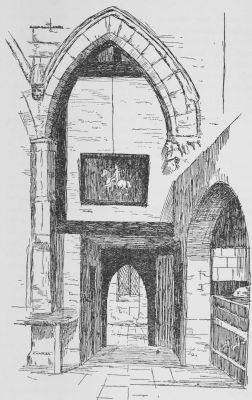
ENTRANCE TO KITCHEN. ST MARY'S HALL
If the council is not sitting, the hall-keeper will also show the much restored Mayoress's Parlour, on the upper floor. Here stands the mediæval chair of state, used on great occasions, probably by the mayor and the master of the guild. Only half remains of this magnificent relic. No doubt the side where the guild-master took his seat was sawn off, cast aside as useless on the suppression of this "superstitious" society at the Reformation. The chair bears on one side a figure of the Madonna, "the arms of Coventry surmount the back on the one side, and on the other (which was the centre in its complete state) are two lions rampant supporting a crown."[742] Several portraits line the room, those of John Hales, founder of the Free Grammar School, of Christopher Davenport, mayor of the city, and Sir Thomas White, are of great local interest; others are of Elizabeth, Charles I., and James I., but undoubtedly the most artistic is a curious portrait of Queen Mary, said to be by Zucchero or Antonio More.
As the Great Hall[743] served as a banqueting-hall for the Trinity guild, a flight of steps at the south end communicates directly with the kitchen. At the north end was a daïs, where the principal guests took their seats.
The room was also used for municipal purposes, particularly when the town rulers found it necessary to convoke a large assembly of their fellow-citizens. Many a stormy scene has this beautiful room witnessed. Here it was—or in an earlier hall—that the common folk, enraged at the bad quality of bread, threw loaves at the mayor's head when he neglected to punish the frauds of the victuallers. Here Laurence Saunders defied or submitted to the dictates of the corporation, and the citizens met together promising to uphold the mayor and council in their attack on William Bristowe, who had encroached upon the Lammas lands. Here the mayor was elected and courts held. But when the council met, they chose a smaller room communicating with the Great Hall, for privacy's sake.
The armour is a most interesting collection. A great many pieces are Elizabethan, but the "Black Prince's helmet" is a unique sallet of the period of the Wars of the Roses. The right way to study the Hall is to mount the little flight of steps at the southern end, and, sitting in the Minstrel Gallery, behind the array of civic armour, examine the glorious fifteenth-century window at your leisure. A few years back the glass was in utter confusion, having been carelessly replaced after re-leading, and the respective heads, bodies and legs of the magnanimous conquerors and kings therein commemorated were sadly astray, their anatomy being rendered thereby most perplexing. This has, however, been judiciously remedied, and we can now clearly see in the nine compartments—as the artist, possibly William Thornton, or a pupil of his, designed—the figures of the Emperor Constantine, King Arthur, William I., Richard I., Henry III., Edward III., Henry IV., Henry V., and Henry VI., the last occupying the place of honour in the central light. Above are the arms of various nobles and cities, among others the "elephant and castle" of this city, the three "garbs," wheat-sheaves of Chester, and the sable eagle of Earl Leofric, the city's earliest benefactor.
The dark oak roof belongs also to the fifteenth century, and is worth, even at the cost of some strain to the muscles of the neck, a careful study. At the centre of each beam are whole-length figures of angels, ten in number, of whom eight are playing on various instruments. The first, close to the great north window, has a violin-like instrument, the second a harp, the third a flute, the fourth a flute, but of a peculiarly flat shape, the fifth a violin, the sixth a curved tube, the seventh a tabor, the eighth a curved tube, while the ninth and tenth have no wings or instruments at all; possibly they represent the "morning stars singing for joy."
Under the great north window hangs a piece of tapestry, dating, so say experts, from the beginning of the sixteenth century. It is of Flemish design, and was woven, possibly in England, with the intention of filling the place it now occupies. Faded in colour, often blurred in outline, the tapestry still remains a glorious memorial to the love of beauty and artistic workmanship and corporate pride of the great guild. It is divided into six compartments, and represents a king, queen, and their Court adoring the Virgin, the Trinity, and divers saints in glory; being undoubtedly designed to commemorate the admission of a king and queen into the ranks of the Trinity guild—an event which did actually occur in 1500 in the case of Henry VII. and Elizabeth of York. Among the company of saints the place of honour is given to those who were the chosen patrons of the guild. Unfortunately the tapestry has not come down to us in the condition in which it left the makers' hands. The figure of Justice holding the scales is obviously out of harmony with the whole design. There is no doubt that the personification of the Trinity, God the Father on the throne holding Christ extended upon the Cross, with the Dove, once occupied this space. The Hebrew letters of the word Jehovah found above the cross still remain, but the reformers, who could not endure the representation of this mystery, cut out the rest.[744] Round the present incongruous figure of Justice kneel angels bearing the instruments of the Passion, the nails, the sponge of hyssop, the crown of thorns, the scourge, pillar and spear. The Assumption of the Virgin in the lower central compartment reminded the guildsmen of their earliest patroness, whose festival was one of their chief days of assembly. The Virgin's feet rest on the crescent moon, which is supported by an angel. The apostles kneel round in attitudes of adoration. On either side of the lower tier a king kneels in prayer, on the right a queen, traditionally identified with Henry VI. and Margaret of Anjou; this attribution has not gone unchallenged; and it is at least possible that the contemporary king and queen, Henry VII. and Elizabeth of York, may be intended; the heraldic roses in the border are, however, Lancastrian and not Tudor. The King kneels at a table whereon lie a crown and missal; he wears a jewelled cap. None of his followers can be identified save the kneeling cardinal, who probably is intended for Beaufort, Bishop of Winchester (or Cardinal Morton), and the standing figure behind the King, who may be the "good Duke Humphrey" (or Henry, Prince of Wales). The Queen kneels opposite. None of her ladies can be identified. The Queen has a head-dress embroidered with pear-pearls, upon which is a crown of fleur-de-lys, her dress is yellow, and the sleeves lined with ermine. Of the three ladies who kneel behind her the third is obviously a child.[745]
In the upper left-hand division is a group of male, on the right-hand a group of female, saints respectively led by the patrons of the guild, S. John the Baptist and S. Catherine. The former are the less interesting company; they consist of S. John the Baptist bearing the book and Agnus Dei; the next is probably S. Thomas, holding a lance. There follow S. Paul with a sword; S. Adrian, patron of brewers, standing on a lion, and holding a sword and an anvil, instrument of his martyrdom; S. Peter with the key; S. George holding a banner, but, oddly enough, with no dragon at his feet; S. Andrew with a transverse cross; S. Bartholomew with a knife; S. Simon with a saw; and S. Thaddeus with a halberd. In the opposite division stands an array of saints in charming Tudor dress; S. Catherine with her wheel; S. Barbara with the tower; S. Dorothea with the basket of roses; S. Mary Magdalene with the vase of ointment; S. Margaret, name-saint of the queen who kneels in the compartment beneath, with a queer, flabby, spotted demon curling round her body; S. Agnes with a delightful little lamb, which she holds by a string. Then follows an abbess, concerning whose identity there has been much discussion. She is arrayed in a monastic habit, bears a crozier, and has three white mice about her person, one on either shoulder, and another springing in the air above. This is S. Gertrude of Nivelles in Flanders,[746] patroness of travellers, and maybe also of the locality where the tapestry was designed. Noted far and wide for hospitality in her lifetime, the saint did not cease her ministrations to wayfarers after death. The journey to Paradise is a long one, occupying three days, so that the popular fancy said that the souls slept with S. Gertrude on the first night, with S. Gabriel on the second, and the third they rested in Paradise. "The saint therefore became," says Mr Baring Gould, "the patroness and protector of departed souls. Next because popular Teutonic superstition regarded rats and mice as symbols of souls, S. Gertrude is represented in art as attended by one of these animals. Then, by a strange transition when the significance of the symbol was lost, she was supposed to be a protectress against rats and mice, and water from the crypt at Nivelles was distributed for the purpose of driving away these vermin." It may be noted that the two nuns in the compartment of ladies attending upon the queen, wear the same habit as S. Gertrude. The next saint of the company is usually identified with S. Anne, but on what grounds I am unable to discover. She bears a long staff (or taper) in her hand. Now the saint likely to be associated with S. Gertrude would be her godchild, S. Gudule, patroness of the cathedral of Brussels. Her appropriate symbol is, however, a lantern. But the artist is not very careful about these, and possibly may have substituted the taper. In this case the demon hovering over S. Apollonia, who follows next, bearing her pincers, really belongs to S. Gudule, and is a reminiscence of the saint's nocturnal difficulties in keeping her lantern alight, so persistently did the evil spirit blow it out.
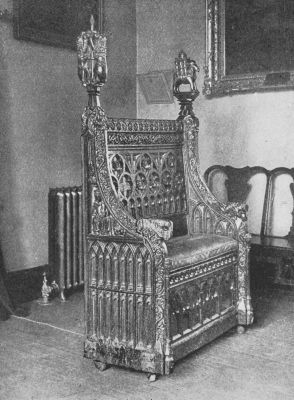
MAYORESS' PARLOUR, SHOWING STATE-CHAIR
After examining the tapestry there is little to detain you. The oriel window contains some fragments of old glass; on the floor are some ancient tiles; small figures from the ancient cross also stand in the recess. The inscriptions about the Hall are reproductions of Elizabethan black letter which once adorned the ancient wainscotting. A brass commemorating the lease of Cheylesmore Park, granted to the citizens by the Duke of Northumberland in the reign of Edward VI., is fixed in the wall close to the entrance to the Mayoress's Parlour. It is dated 1568. As for the terrible windows, filled with glass in 1826 in imitation of the old work which had been destroyed in an affray concerning a contested election of 1780, known as the "bludgeon fight," let us not speak of them. At the south end of the hall is (right) the Prince's Chamber, leading to the ancient stone-groined treasury in the tower, and containing fragments of carving, one a figure of S. George and the Dragon from S. George's chapel at Gosford gate, and (left) the Council-Chamber, which has been recently wainscotted with Jacobean carving brought from a house in Earl Street. There is a fine Jacobean fireplace, an old chair, and an Elizabethan drawing-table in the room. At the back of the minstrel-gallery is the Armoury, where lies, in neglect and dust, a large picture, "The Baccanali," by Luca Giordano; and at the back of the armoury is Queen Mary's Chamber, the traditional place of confinement of the Scottish Queen in 1569.
Crossing the churchyard, you arrive at Trinity Church whereof the spire was rebuilt in the seventeenth century. The exterior, which has been frequently recased, suffers somewhat from the neighbourhood of S. Michael's, but the interior is of earlier and more finely proportioned architecture than its giant neighbour. Rebuilt at the close of the fourteenth century on the site of a parish church, which existed at least as far back as the reign of Henry III., this building is also full of problems, and is in some respects most interesting of all the churches of Coventry. The jambs of blocked windows at various levels are fruitful of speculations on the original appearance of the church, and a piscina high up on the wall of south transept proclaims the former existence of an upper chapel, with a floor level over a vaulted passage, which was done away with for probably quite insufficient reasons in 1834. The church, which was served by twelve parochial and two chantry priests before the Reformation, contained fifteen altars; while in the Lady-chapel a priest held services, taking a stipend from the Corpus Christi guild.
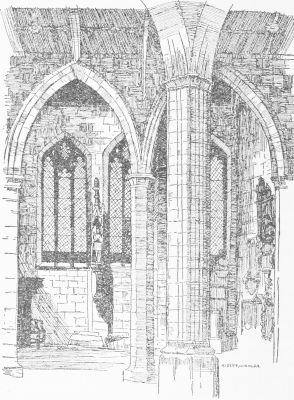
ARCHDEACON'S CHAPEL. HOLY TRINITY CHURCH
The earliest part of the church is the thirteenth-century north porch with its groined roof, and a beautiful double doorway, now blocked up, leading from the porch to S. Thomas's chapel. West of the porch, in the Archdeacon's chapel, is another blocked window, a fine example of the Decorated type. The nave is of the first half of the fourteenth century, and was built before the chancel. The fresco of the Last Judgment, which could once be discerned above the chancel arch, is now obliterated. As in S. Michael's the mullions of the fifteenth-century clear-story windows are continued to the top of the arches of the nave, forming a series of stone panels. Marler's-chapel, leading out of the north chancel-aisle, is the latest part of the structure, belonging to the sixteenth century. The stone pulpit dates from about 1470. The lectern, which is also antique, aroused the suspicions of the Puritans, and in 1654 there was some talk of selling it, a transaction which was happily not accomplished, though the "eagle" at S. Michael's, the gift of William Botoner, had been sold at so much the pound a few years before.
Scarcely a vestige now remains of the ancient stained glass which once made the church beautiful. Its disappearance was owing not perhaps so much to Puritan zeal, as to the deliberate action of the authorities in the last century. From 1774 to 1787 the masons of Coventry must have revelled in the work of mutilating the window traceries, and the old glass after being taken down was never put back. The old sexton told the antiquary, Sharp, particulars of the famous window, wherein Leofric and Godiva were represented, the former holding a charter with the words:
"I, Luriche, for love of thee Doe make Coventre Tol-free."
But this was removed in 1779; but a few last fragments of glass are now in the window of the Archdeacon's chapel. A small figure is seen holding a spray of leaves and part of a horse; there are also architectural fragments in the stained glass that appear in Stukeley's drawing of the Godiva window, but they are very insignificant and broken.
In this same chapel is a brass to John Whitehead (1597) and his two wives in Elizabethan costume, and a monument in Philemon Holland (1636), once master of the grammar school, translator of Camden's Britannia. The font is of the fifteenth century. Close to the west door is a fine Elizabethan alms-box.
To the north of Trinity churchyard are the Cathedral ruins. Little more than the bases of a few fine pillars are left of the once splendid minster, dedicated to S. Mary, S. Peter, S. Osburg, and All Saints. From the gates of Trinity church you pass the top of the picturesque Butcher Row, and, if time does not fail you, may turn down Cross Cheaping—alas that the cross should be no longer there!—till you come to the Old Grammar School, at the corner of Hales Street. This was the ancient home of the Hospitallers, who tended the infirm and sick, but was converted after the Reformation into a free grammar school. It is now a parish room; but round the walls of the ancient chapel of the Hospitallers are the old stalls they once occupied, cut and hacked by many generations of schoolboys. The east window is a fine specimen of nearly flamboyant tracery. Here Dugdale received his education; also the Davenports and a great many more who have never risen to fame in the world. Mr Tovey, father of Milton's Cambridge tutor, and Philemon Holland, the "translator-general of his age," were masters here.
On returning up the Broadgate to the cross roads give a glance at the authentic "Peeping Tom" looking out of a window in the top storey of the King's Head Inn. It is a full-length wooden statue of a man in armour, with helmet, greaves, and sandals; the arms are cut off at the elbows. What the statue anciently represented is, I believe, unknown.
The turning to the right, Smithford Street, leads to S. John's Church, another building raised to the glory of God and the guild of the Holy Trinity, S. Mary, S. John Baptist, and S. Catherine. Nothing of the present church, built, it may be remembered, in some sort to commemorate the king's victory at Sluys, is earlier than 1357, for the first church, begun in 1345 and consecrated in 1350, disappeared before the more ambitious plans of a later time. Prayers were said therein for Isabella's "dear lord Edward," at whose tomb at Gloucester Cathedral so many pilgrims paid their devotions, to the no small gain of the ecclesiastics of that place. The new church at Bablake owed its south aisle—still called after his name—to William Walscheman and Christiana his wife, which Walscheman is described as "valet" (vadlettus) to Queen Isabell, and had of her gift control over the Drapery, where vent was made of "foreign" cloth brought to be sold within the city. The south (Walscheman's) aisle and the north clear-story are the oldest portions of the now existing building, the south clear-story, which is of different pattern, is not earlier than the fifteenth century, though it contrasts very favourably with the scheme employed both at Trinity and S. Michael's.[747] Off the north chancel-aisle was a hermitage, whereof traces have been found on the site of the present vestry. The church is small, the nave being but of three bays' length, but it is lofty and of fine proportion. The modern screen, however, strikes an inharmonious note.
Oblong as to ground-plan, though, curiously enough, never quite rectangular, the building, when seen from outside, is cruciform as to clear-story, and from the crossing springs a high fortress-like lantern tower with turrets or bartizans at the angles of the battlements. The east and west windows are restorations, and indeed the many vicissitudes this church has undergone, and its low situation, have frequently exposed it to two evils—restorations and floods. Granted to the corporation after the suppression of the guilds and chantries in 1548, the church was used as a kind of religious lecture-hall in 1608 and for some years later; and in 1648 as quarters for the Scots prisoners taken at Preston. The fabric was described as in a state of sad neglect in 1734, when it was linked to a parish for the first time in its history.
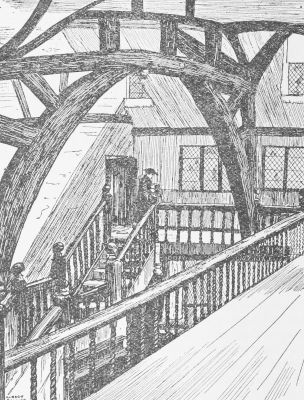
THE STAIRCASE, OLD BABLAKE SCHOOL
Close by the church and forming the view of all views to be dwelt on in the city, stand two picturesque black and white timbered houses, one given by John Bond for an almshouse for aged and decayed folk recommended by the Trinity guild, and the other the Bablake school raised by the benevolence of Mr Wheatley in the sixteenth century. Bond's Hospital, which contains some good seventeenth-century furniture, has been restored; but by preternatural good luck Wheatley's School escaped that devastating touch. The hall contains roof timbers possibly older than the bulk of the building, and an ancient staircase; and the room to the left on the ground floor has a fine Jacobean mantelpiece which came from Sir Orlando Bridgman's house in Little Park Street. There is an open gallery both on the ground floor and the upper storey.
The sight of these houses, grandly planned and strongly built, with lovely gables where barge-board and finial are marvels of the house-carver's art, is a fitting close to a day in Coventry. Let us hope that no restorer, modern builder, well-meaning or enterprising commercial man will ever rob us of the loveliness of Bond's Hospital and Wheatley's School at Bablake.
FOOTNOTES:
INDEX
A Abingdon, monastery at, 16; letter sent to, 152 Actors, Coventry, 288 Aelfgar, 23 Alchemist, an, 240 Aldermen, 77; appointment of, proposed, 115; police duties of, 267, 279 Aldgyth, 23 Ale-tasters, 247 Ale-wives, 228, 249 Almshouse, 263 "Angel" inn, 131 Annals, or mayor-lists, unreliability of, 106 (and note) Annunciation, 82; pageant of, 287, 299 Apprentices, swear to franchises, 200-1, 226; morals of, 227, 279; number of, limited, 225; on setting up shop, pay fine, 226 and note; treatment of, 227 Archery, 278 Armour, provided by citizens 114-115; delivered to captains, 311-2 Arms, view of, 311 Arthur, Prince of Wales, 307 Assize of ale, 246; of bread, 51, 71, 98, 246, 248 Assumption, 82; pageant of, 287, 299 Audley, Lord, 130 Bablake, church of St John the Baptist at, see Churches, Hospital; gate at, 8 Baginton, 102, 248 Bagot, Sir William, 102 Bailiffs, duties of, 88; see also Sheriffs Bakers, offend against assize of bread, 98; take sanctuary at Baginton, 248; rules of, 251 (note). Ball, John, taken at Coventry, 97; discourse of, 98 Banbury, 144, 151; Puritanism at, 279 Barnet Field, 151, 152 Baron's Field, 179 Bath, Roman town, 15 Battle, trial by, 53 Beam, wool weighed at the, 250 Bear-baiting, 278 Bearward, 88, 278 Beaumont, Lord, 120, 128 Bedford, Duke of, 110; Duchess of, 111, 149 Bedon, William, quarrels with Huet, 137 Belfry, symbol of independence, 74 (note). Bell, church, 158, 234 and note; daybell, rung at dawn, 234; "larum" bell, 126 (note) Benedictines, house of, at Coventry, 16, 24; life among the, 27-8; habit of, 238; see also Coventry, Monks, Priors, Priory "Benevolences," 155 Beverley, plays at, 290 Bishopric of Coventry, title of, 167 Bishops of Coventry, see Coventry Black Death, 13, 244 Blood, Holy, of Hales, 238 Bloreheath, battle of, 130 Blue thread, special colour used in dyeing, 252 Bolingbroke, Henry, 9, 101, 102 Bond, John, 216; see also Almshouse Bonfires on S. John's Eve, 285 Books sold at fairs, 253 Bordars, 37 (note) Boston, ship of, 259 Bosworth Field, battle of, 157, 256 Boteler, Henry, see Recorders Botoner, family of, trade with Bristol, 256; build S. Michael's steeple, 257; purchase estate, ibid. —— Adam, 257 Botoner, William, 257 Brakemen, workers in iron, 221-3 Brass, memorial, to Sir William Bagot, 102 Braytoft, Richard, 176 Breauté, Faulkes de, 95-6 Bredon, Friar John, opposes the hermit's preaching, 107; attacks monks, 276-8; nails bills on the church door, 277 Brethren, of the mayor, see Mayor's Council Brewers, forbidden to take water from conduits, 246; forestall barley, 249; trade of, lucrative, 248 Bridgman, Sir Orlando, house of, 6 Bristol, cannon brought from, 115; trade with, 215, 252, 256; toll demanded at, 257 Bristowe, John, draper, 172, 216; encroaches on common lands at Whitley, 172-3, 180; drives cattle on Coventry pastures, 173 —— William, of Whitley, 172, 174; offends the corporation, 174-5; the mayor and citizens break into his closes, 175-6, 177-8; appeals to the privy council, 177; suit between, and the community about the ownership of enclosed lands, 178-80; keeps meadows, several, 194; further suit, 196-7; see also Whitley Broadgate, 73 Bruges, staple for cloth at, 258 Buckingham, Duchess of, 128 —— Duke of, Humphrey Stafford, quarrels with Coventry men, 113; retainers and badge of, 113, 238; attends Henry VI., 119, 128; assists Duke of York to escape, 126; visits Coventry, 131; dies at Northampton, 132 Bull-baiting, 278 Bull-ring, poulterers stand near the, 250 Burgage, free, 46 Burgundy, wool trade with, 140, 150 Bury S. Edmund's, monastery at, 16; men of, get concessions from the abbot, 66 C Cade, Jack, 114; quarters of, exposed on town gates, 243 Caen, abbeys at, 16 Calais, 143, 146; see also Staple Caludon Castle, 102 Cannock Chase, robbers at, 258 Canterbury, Archbishop of, 210; Arundel, 103, 104 Cantilupe, Fulk de, 34 Cappers, 225; company of, survives, 232; fines for admission to freedom of craft, 226 (note); treatment of apprentices among, 227 (note); see also Apprentices, Chapel, Journeymen, Pageants Caps, making of, by journeymen forbidden, 232 Cardmakers, bill concerning abuses of the, 222; see also Journeymen Card-wiredrawers, see Cardmakers Carmelites, habit of, 238 Carpenter, John, of London, 263 Carpenters, apprentices of, 232; feasts of, 284, 309 (note) Carthusians, house of, at Coventry, 100; habit of, 238; see also Charter-house Cartwright, Presbyterian, at Warwick, 165 Castle, of Coventry, 40 Catesby, John, 178, 180 Catherine of France, Queen, 107 Chamberlain, duties of, 88, 187; see also Saunders, Laurence Chapel Fields, 41 Chapel of S. George on the Gosford Gate, 83, 275 (note) —— of S. James and S. Christopher, 8 —— of S. Mary Magdalene, at Spon, 41 Chapels of the crafts in the parish churches, 274, 275 (note) Chard, 152 Charity of the merchants, 259, 263; of the corporation, 268 Charles I. is refused entrance to Coventry, 6, 166 —— II. orders the walls to be dismantled, 7, 166 Charter, Ranulf's, 47-9, 61, 62; confirmation of, 59; privileges granted by, 69, 70, 74, 121; probably purchased by Guilds, 80; of 1621, 75; to prior, 59, 60 Charter-house, 6, 100, 278; see also Carthusians Chester, bishop's seat transferred from, 30; canons of, 32; S. Werburgh's at, 18 (note); Earls of, 38; Hugh rebels against Henry II., 40-1; builds lazar-house, 41; Hugh Lupus, 39; Ranulf Blonvil's career, 42; gives charter to burghers, 47; Ranulf Gernons, his career, 39-40; Ranulf Meschines, 39; plays at, 290; written by Higden, 291 Cheylesmore, officers of, 135-6; becomes royal manor, 96; Earl of Chester's dwelling at, 44, 95 (note), 101; Princes of Wales at, 154 Chimneys, wooden, 245. Churches, of Coventry, 269-78 —— S. John the Baptist's, 8, 82, 270; priests of, 120 —— S. Michael's, bell brought to, 158; chapels of crafts in, 274; door of, verses nailed to, 204, 208, 277; priests of guilds employed in, 82-3, 270 (note); royal visits to, 120, 167; sale of cloth in porch of, 202 —— S. Nicholas, supported by Corpus Christi guild, 163 (note); chaplains of, 270 (note) —— Holy Trinity, 269-70; fresco in, 273, 306; priests employed in, 83, 270 (note) Churchyard, S. Michael's, 49, 250 Clapham, 144, 243 (note) Clarence, Duke of, conspires with Warwick, 142, 143; pledges jewel, 146; deserts Warwick, 151; mediates with Edward IV. for Coventry men, 152 Cloth of Coventry, 212-5; drapers, merchants of, 215; dyers, makers of, 203 (note), 220; Florentine, 315; makers of, 203 (note); manufacture of, 61; sale of, 202, 212; sealing of, 214-5; weaving of, how paid, 230; see also Drapery, Frieze Clothiers, company of, survives, 232 Clothmakers, see Cloth Cock-fighting, 278 "Cofantreo," 16 (note) Coket, bread, 248 and note Colchester, 15 Coleshill, 128, 129; pillory at, 240 Combe, abbot of, 179 Commission of array, 312-3 Common Council, 204 Common labour, 310 Common lands, enclosures of, 170-3; part of, held by Trinity guild, 91-2; old men testify to the extent of, 179-80; ploughed up, 160; technical possessors of, 171 (note); see also Enclosures, Lammas lands, Prior's Waste, Saunders, Laurence, Stint, Surcharging Common seal, 92 Competition, rules against, 225; of outsiders, 251 Compurgation, 51 (note) Conduits, 1, 246 Coniers, Sir John, 141 Cook, Laurence, 109, 258 Cookery in Middle Ages, 283 Coopers, feast of, at Whitefriars, 275 (note) Coroner, 59 Corpus Christi, eve of, 282; procession on feast of, 287-8, see also Pageants Corpus Christi guild, see Guild Corrody, 63 (note) Corvesars, 283 Council, great, held at Coventry, 126, 127; see also Mayor's Council, Prince of Wales Court, of the royal household, 101; of statute merchant, 253-4 and note; spiritual, for trial of craftsmen, 218; see also Leet, Portmanmote Coventry, bishops of, Blythe, 158; Durdent, 32, 40; Limesey, 30; Nunant, expels monks from Priory, 30-2; la Pucelle, 33; elections of the, 32-5; burgesses of, protest against confiscation of guilds' lands, 162; cathedral of, 18, 25; derivation of, 11; see also Charters, Mayors, Recorders —— send to, 3 —— bells, flower name, 3 Cox Street, or Mill Lane, pageant houses in, 12, 293 Crafts, combinations of, suppressed, 220 (note); companies of, now existing, 232; members of, tried in spiritual courts, 218; feasts of, 284; fines paid by, 219; fines paid on admission to freedom of, 226 and note; power of corporation over, 217-23; rules of, overlooked, 218 (note); see also Apprentices, Cappers, Dyers, etc., Pageants Cucking stool, 240 D Danes, 15, 308 Dartmouth, 141 (note) Daubers and rough masons forbidden to form a fellowship, 231 Daventry, 6 Despensers, plot to kill by witchcraft, 64 Dieulacres, 42 Dissolution of the monasteries, 161-2 Domesday Survey, Coventry in, 37 and note; Prior's-half not in, ibid. Doomsday, pageant of, 129, 295, 305, 306 Drama, liturgical, see Pageants Drapers, apprentices of, 226 (note); chapel of, 275 (note); influence of, 75, 216; overlook searchers of cloth, 217; survival of company of, 232 Drapery, cloth sold in, 202, 212, 250 and note; and Trinity guild, 82; drapers live near, 250 Drayton, Michael, 1, 14 Drogheda, 252 and note Dublin, 252 (note), 254 Dugdale, Sir William, attributes the Ludus Coventriæ to the Grey Friars, 297 Dunstable, 56, 276 (note); play at, 290 Dunster, 22 Dye, French, 218, 257 Dyers, men of, ride in armed watch, 286; chapel of, 275 (note); raise price of dyeing cloth, 220 and note; combinations of, 217, 220 and note; payment of, to minstrels, 309 (note); petition against abuses of, 217, 220 (note); treatment of, by corporation, 220-1; see also Journeymen, Saunders E Eadric Streona, 15 Earl's-half of Coventry, 7, 38, 57; becomes a royal manor, 67; see also Prior's-half Edgcote, battle of, 144, 243 (note) Edward I., 61 —— II. borrows from citizens, 61; supports prior, 62; plot to kill by witchcraft, 64 —— III., 68 —— IV. and jurisdiction, 135-136; citizens embrace cause of, 132-3; citizens give welcome to, 153; confiscates franchises, 152; plots of Warwick against, 143, 145; a prisoner in Coventry, 144; war between, and Warwick, 150-1 Edward V. as Prince of Wales, appeal to, by Saunders, 184; arbitrates in Bristowe's case, 197; born, 149; corporation entreats mediation of, 155; member of guilds, 154; oath of allegiance taken to, ibid.; reception of, 153-4 Edward the Confessor, charter of, 16-17 Election of officials, 75 Elephant, city arms, 214 Eliot, George, 3, 4, 7 Elizabeth, Queen, visits Coventry, 14, 164; sees Hox Tuesday play, 308-9 —— Queen of Bohemia, 165 —— Woodville, 149, 154 —— of York, 160, 296 Empson, Richard, see Recorders Enclosures, award of 1860, 170-1; commons break into, 160; petition to parliament concerning, 131; list of, presented by Saunders, 188, 197; of Prior's Waste, 176-7; see also Common Lands Ethelnoth, 18 Exeter, 146; Vespasion at, 14 F Fair, grant of, 54; of Coventry, 251-2, 288 (note); of Stourbridge and Winchester, 252 Fee-ferm, 74, 162; in arrears, 138; paid by Trinity guild to prior, 91 Fineux, Chief-Justice, 210 Fire, protection against, 245 Fishmongers, 247, 249 Fleet prison, 210 Folk-lore, 3-4 Ford, William, founds almshouse, 263 Forestalling, 247, 248, 249 Fortification of Coventry, 114-5 Forty-eight, Council of, 92-4; see also Mayor's Council Foss Way, 24 Fotheringay, 141 Fresco, at Charter-house, 100; in Trinity Church, 306-7 Friars, Grey, 55; church of, 4, 296; habit of, 238; Isabella protects the, 97; supposed actors in pageants, 4, 296-8; see also Bredon, Ludus Coventriæ Frieze of Coventry, 212 Fullbrook, castle of, 110, 111 Fullers, craft of, 201, 232; guild of, 219; adopt special mark, 218; two appointed searchers, 214 G Gaming, 279-80 Gaol, 240 Gates, closed at nine o'clock, 237 Girdlers, 221-3; chapel of, 274 (note) Gloucester, city of, 133 —— Duke of, Humphrey, 113; loan demanded by, 109; present made to, 110-11 Glover, Robert, martyr, 163 Godiva, buried at Coventry, 17; family of, 23; founds and endows Priory, 16; estate of, 37 and note; employs goldsmiths, 17-18; procession, 19-20; legend of ride of, 18-23; and horse-toll, 18; and "black lady," 22; and "Peeping Tom," 22-3 Gosford Green, 171; proposed duel at, 11, 102; executions at, 144; hermitage at, 238 —— Street, and pageants, 12 Grace, John, disturbance caused by preaching of, 107 Grauntpee, William, suit of, with prior, 63 Greville, Sir Fulk, 278 Grey, Walter de, 34, 35 Guild of S. Anne, founded by journeymen, suppressed, 83, 229 —— of S. Catherine, united with Trinity, 82 —— of Corpus Christi, 80, 83; chapel of, 83; feasts of, 283-4; master of, and mayoralty, 77; and Corpus Christi procession, 287; and S. Nicholas church, 163 and note; Prince Edward, member of, 154 —— of S. George, founded by journeymen, suppressed, 83, 229 —— of S. John the Baptist, founded and builds Bablake church, 82; united with Trinity guild, ibid. —— merchant of S. Mary, founded, 80; and S. Mary's Hall, 81-2; masters of and the mayoralty, 80 and note; reasons for foundation of, 80 (note); priests of, 83; union with Trinity guild, 82 Guild merchant of Priory tenants, 59, 60 —— of the Nativity of fullers and tailors, 83, 219-20; pageant of, 299 —— of Holy Trinity, 80, 83; and Bablake church, 82; and the Drapery, ibid.; and Corpus Christi injured by formation of other guilds, 83; master of, 77, 85, 87; encloses commons to pay ferm to prior, 78, 91; feasts of, 283; and procession, 287; pays schoolmaster, 266; union of, with other guilds, 82 and note Guilds, rise of, 79-80; suppression of fresh, 83; suppression of, and chantries, 162-3 Guy of Warwick, 12, 24 (note) Guy's Cliff, 131 H Haddon, John, loans of, 216 Hales, John, 162 Hanseatic League, 258 Harcourt, Sir Richard, brawls in Coventry, 281-2 "Harrowing of Hell," see Pageants Hawking, 280 Hearsall Common, 8, 171 Hell-mouth, 305 Henry II., 40, 49 —— III., 57 —— IV., 104; see also Bolingbroke —— V., loan to, 104; as Prince of Wales and Justice Gascoigne, 105; and Mayor Hornby, 106; visits Coventry, 107, 288 —— VI., 114; visits Coventry, 116-21, 125, 126, 127; grants charter, 121; letter of, 131-2; men of Coventry turn against, 132; see also Church, Margaret of Anjou —— VII., 159-60, 198; at Coventry, 156, 157, 288, 296; appeals for loan, 158-9 —— VIII., at Coventry, 307 Herbergeors, 255 Herbert, Lord, 144 Hereford, Nicholas, 100 Heresy, court of, 158 Hermits, in Coventry, 238 Herod, King, see Pageants Heywood, John, see Pageants Hinckley, 254 Holy cake, 87 Hopkins' family, 165 Hostry, monastic, 25-6 Hospital of S. John the Baptist, 26-7 Hox-Tuesday play, 3-4, 308-9 Huet, William, appeals to King-maker, 137 Huguenot silk weavers, 167 Hull, 252 (note), 265 (note) "Hundred Merry Tales," 288 I Iklynton collar left in pledge, 104 Immorality, punishment of, 243 Indenture tripartite, 71-2 Inns, 255-6; blind, 279 Iron, workers in, abuses of, 221-3 Isabella, Queen, Earl's-half manor of, 43, 67; feud between and the prior, 67-70, 71-2; protects the Grey Friars, 97; and Bablake church, 82; grants charter of liberties, 74 J James I., 166 James II., 165,167 Jews in Coventry, 55 John, King, 31; forces his candidate on the chapter, 33-5 Jordan Well, 13 Joseph, character in pageants, 302 Journeymen, cappers and cap-making, 231; working hours of, ibid.; workers in iron, 223; dyers, 231; guilds of, 80, 83, 228-31; see also Guilds; suppers of, 284; tailors, 83, 229; weavers, 229-30; and pageants, 292 (note), 294 Justices of Peace, 76 K Kenilworth, Abbot of, 179; castle of, 96, 123; prisoners kept in, 161; royal visits to, 127, 129, 308 L Lady Tower, 8 Lammas day, 160, 181 Lammas lands, 170, 171; see also Common Lands, Enclosures Landor, Walter Savage, 18 Laneham's letter, 308-9 Leet Book, 76 Leet, court of, or view of Frankpledge, 51 (note), 77; jury of, 77, 90; orders of, 87; petitions to, 90, 221-3 Leicester, 116, 133, 150; bailiff of, 38; men of, rebel against Henry II., 41 Leofric, buried at Coventry, 17; founds and endows the Priory, 16; husband of Godiva, 23; see also Godiva Leprosy, 41 Lichfield, title of bishopric of, 167; canons of, and Coventry monks, 32-5; play performed at, 289 Lincoln, customs of, 47; burgesses of, 48 Livery and maintenance, Henry VI. warns Coventry men against, 121 Loans to royal persons, 104, 109, 110, 146, 159 Lollard martyrs, 158 Lollardry, 3, 98-100, 108, 158 London, 42; inn-signs in, 234 (note); streets in, 250 (note); precautions against fire in, 245 (note); S. John's Eve, in, 284-5; schools in, 263 (note), 265 (note); sympathy of men of, with Coventry men, 64 (note); body of Twenty-four in, 90; Tower of, 38 Ludlow, castle of, 184, 188, 189, 196; misericord in church at, 249 Ludus Coventriæ, see Pageants Lullaby, 310 Lutterworth, 98 Lynn, 148; burgesses and guilds of, 162 M Mace, 128 Maintenance, 127 Mareshall, Robert le, informer, 63-4 Margaret of Anjou, Coventry men turn against, 132; Coventry called "secret harbour" of, 112; reception of, 125-6; visits Coventry, 127-8; sees pageants, 129, 288; is reconciled to Warwick, 147; lands after Battle of Barnet, 151 Marisco, Richard de, 34 Market, held in Prior's-half, 58, 62-3, 71; regulations concerning, 249-51; toll-free, except for horses, 18 Marlborough, 49 (note) Marmion, of Tamworth, 39-40 "Marprelate, Martin," 253 and note Marshal of the royal household, 101 Mary, Queen of Scots, 164 Martyrs, 5, 158, 163 Masons, fellowship of, 231 Matilda, Queen of Henry I., called Godiva, 23 Maxstoke, 113, 158 Mayor, arbiter in cases of craft disputes, 219; cap of, 89; supports malcontents, 161; duties of, 88; fee of, 89; attends mass, 86; overlooks craft rules, 218 Mayor's Council, of Forty-Eight, 90, 92-4; tyranny of, 94; Saunders expelled from, 204; of Twenty-Four, 90 Mayors of Coventry: Bette, John, deprived of civic sword, 152; Cook, Laurence, 177; Deister, John, and the sword, 101, 207; Dove, John, 207; Green, Robert, 199, 205; Onley, Sir Robert, and Henry VII., 156, 157; Saunders, William, 142, 174; opens Bristowe's fields, 175, 177; Stoke, Richard, 6; Strong, John, 94; Wyldegrys, John, 131, 132 Melton, 47 Mempric, founder of Oxford, 15 Mercers, craft of, apprentices to, 216 (note); chapel of, 275 (note); company of, survives, 232; influence of, 75, 216 Merchant Adventurers, 314 Merchants, attend council of Edward I., 61; families of, 256-9; manage municipal affairs, 74 and note, 216 Merevale, Abbot of, 179 Military duties of citizens, 311-3 Minstrels, 309 Miracle plays, see Pageants "Moll of Coventry," 3 Monks, of Coventry, receive charters, 16-17, 38; dispute with bishops, 30-2; with canons, 32-5; with Coventry men, 58, 59, 60, 62-3, 67-72, 190-4; with Friar Bredon, 276-8; with Isabella, 67-72; as landlords, 36 Montalt or Mohaut, Roger de, 58-9, 95 (note) Montfort, Simon de, 96 "Mother of Death," 305; see also Pageants N Neville, Sir Humphrey, 145 Newgate, and Charles I., 6; wall, begun it, ibid. "Nine Conquerors," 125 Northampton, 130, 131; battle of, 132; Earl of, 166 Norwich, 75 (note); court-leet of, 50 (note) Nottingham, 34, 250 (note); receives customs after pattern of Coventry, 48 (note) —— John de, necromancer, 63-4 O "Obits," 275 Onley, family of, 257 (note), 258 —— 144 and note Ordeal, trial by, 53 Oven, feudal lord's, 46 Oxford, 15; S. Frideswide's fair at, 253 P Pageants, Corpus Christi, 287-307; acted 1392 in Coventry, 290; absence of Old Testament scenes in, 299; payment of actors in, by crafts, 293; dress of actors in, 306; of cardmakers, later cappers, 300, 305, 306; characters of Herod, Pilate and the devil in, 287, 303-5; minor characters in, 305-6; crafts evade contributions to, 292; Ludus Coventriæ probably unconnected with Coventry cycle of, 297-8; "Doomsday" or drapers', 129, 295, 300, 305, 306; liturgical drama and, 289; of girdlers, 300; "Harrowing of Hell," see Cardmakers; Heywood's allusions to, 305; of mercers, 299, 307; and miracle plays, 289-90; pageant houses, 293; of pinners and needlers, 299-300; "Nativity" or sheremen's and tailors', 299-302; of smiths, 299, 300, 304; royal spectators of, 288; stage properties of, 305-6; stations where acted, 294-5; titles of, 299-300; vehicles used for, 293-4; "Presentation in Temple" or weavers', 292 (note), 299, 300, 302; for reception of royalty, Arthur, Prince of Wales, 307; Edward, Prince of Wales, 152-4; Henry VIII., 307; Margaret of Anjou, 124-6; Princess Mary, 307 Pakeman, Simon, prior's bailiff, 68 Palace Yard, 165 Park, Little, 5, 107; martyrs burnt in, 6, 158; plays played in, 290, 296 Parliament "Unlearned," 102-3; "Diabolical," 131 "Pastores," 289; see also Pageants Peasant revolt, 97 "Peeping Tom," see Godiva "Peregrini," 289; see also Pageants Pewterers, 200 Pilate, see Pageants Pilgrims, 238-9 Pinners, feast of, 275 (note) Pisford, William, 263 Plague, 244 Players, strolling, 279; of Coventry, 288 Play, S. Christian's, 296 and note Plays, stationary, acted in the Little Park, 296 Poddycroft, common land, 92 Polesworth, 15; S. Edith of, 40 Population of Coventry, 162 Portmanmote, court of, 48, 49-51 Poulterers, 250 Preston, 47 (note) Prince of Wales, lord of the Earl's-half, 43, 167; Council of, 184; see also Edward V., Henry V. Prince's Chamber, title of Coventry, 73 Prior, quarrel between Isabella and the men of Coventry, 67-72 Priors of Coventry: Brightwalton, William of, purchased Earl's-half, 58; Deram, 190-4; Geoffry, 29; Irreys, Henry, 62; plot to kill by witchcraft, 63-4 Prior's-half of Coventry, 37, 57; Trinity Church serves for parish of, 7, 37 Prior's Waste, 176 Priory, 39; remains of, 25-6, 74; Henry VI. lodged at, 119-20; shrine at, 8 Procession at Corpus Christi, 287-8; on Midsummer and S. Peter's Eves, 284-7; of royalty, 120, 128 Processus Prophetarum, 289, 299 R Reading, 16 Recorders of Coventry: Boteler, Henry, 121, 187; death of, 198; disgrace of, 199; opposes Saunders, 188; quells tumult, 195; Empson, Richard, 159, 198, 206, 207; Littleton, Thomas, 119, 121; Swillington, Ralph, 274 Regratery, see Forestalling Richard I., 33 —— II., 102; forbids duel, 11, 101-2; lays foundation-stone of Carthusian chapel, 6, 100 —— III., 155-6; sees pageants, 288 Rivers, Earl, 148; guardian of the Prince of Wales, 184 —— Lord, 126, 129; beheaded on Gosford Green, 11, 144 Robin of Redesdale, 140, 144 Rochester, Bishop of, Thomas Savage, 207 Roger of Wendover, 18, 19 Rood, of Bronholme, of Chester, 238 Rous, John, antiquary, 131 S Saddlers, journeymen, of London, 230 S. Albans, 16; battles of, 122, 132; men of, 46, 56 S. Augustine of Hippo, 18 S. Catharine, chapel of, 82; character of, 287; play of, 296; see also Guilds S. George, Coventry birthplace of, 4, 154 (note); chapel of, 12, 275 (note); character of, in pageants, 153-4; riding of, 307; mummers's play of, ibid.; see also Guild S. John the Baptist's Eve, 284, 285-6 S. Margaret, 125, 287 S. Mary's Hall, 74, 161, 178, 190; guild-hall of, 81-2; tapestry in, 82; window in, 314 S. Nicholas Hall, 1 S. Osburg, 15; pool of, 7-8; shrine of, 8, 238 S. Paul's Cathedral, 160 S. Thomas' or cappers' chapel in S. Michael's, 274 S. Thomas of India, 287 Samson, character of, welcomes Edward IV., 133 Sanctuary, right of, 95 Sanitation, 244-5 Saunders, Laurence, dyer, made chamberlain, 182; champion of malcontents, 181, 204; complains of abuses, 184-8, 197-8, 316; imprisoned, 190, 204, 210; member of the Forty-Eight, 199 (note); seditious speeches of, 203; trials of, 189, 210 —— Laurence, martyr, 5, 163 Schoolmaster and school, 25, 264-6 Severn, river, 257 Shakespeare, 105 Sharpe, Jack, rising under, 109 Shepey, Jordan, mayor, 12 Sherbourne river, regulations concerning, 87 Sheremen, see Tailors Sheriffs, 254 (note); county court of 52-3; Henry VI. promises to make, 121 Ship-money, 166 Shipton, Mother, prophecy of, 7 Shops, 62 (note), 234 (note) Shrewsbury, Countess of, 129; see also Talbot Shrines, of saints, 238-9 Silk industry, 167 Simnel bread, 248 (note) Sluys, battle of, 8 Smith, Walter, age of, 296 Smiths, craft of, 286; abuses of, 221-3; chapel of, 275 (note); journeymen of, 223; see also Pageants Soap, making of, 61 and note Somerset, Duke of, retainers of, and city watch, 126-7 Somerset, Duke of, Protector, 162 Southampton, 257 Sowe, Richard, killed by witchcraft, 64 Spain, 252 Spicer-stoke, 250 Stafford, Sir Humphrey, brawl between and the Harcourts, 281-2 Stamford, 141 (note) Staple of Calais, 147; John Onley of Coventry, mayor of, 257; monopoly of wool trade, 140, 215 Star Chamber, 210, 211 (note) Stephen, King, 40 Steward; see Town Clerk Stivichall, 4, 40; common at, 171 Stocks, 240 Stoke, common at, 171 Stoneleigh, Abbot of, 179; church of, 4; monks of, 283 Stourbridge, fair at, 252 Stowe, antiquary, of London, 284 Stralsund, 259 Strike of journeymen, 230 Swanswell Pool, 24 (note), 191, 193 Swine of S. Anthony's Hospital, 234 (note) Sulby, Prior of, 253 Surcharging of common lands, 187-8 Swynderby, William, 98-9 T Tables, draughts, 280 Tailors, journeymen of, 83, 229; guild and fullers, 219-20; see also Pageants Talbot, Earl of Shrewsbury, 3, 110 Tamworth, 40 Tanners, title of pageant of, lost, 299; regulations concerning, 200 Tapestry, 82 Tewkesbury, 35 Thomas, monk of Coventry, 31-2, 34 Thornton, John, window of, 314 Tilers, 275 (note) Toll, 17, 257; Coventry free from, 18, 19, 71; at Southampton, 257 Town clerk and steward, Boteler, John, 189, 194, 197, 211 Towton, battle of, 133 "Trial and Crucifixion of Christ," see Pageants Tree, traditional, near Smithford Bridge, 9 V Vagabonds, sturdy, 266-7 Vespasian, visit of, to Exeter, 14 Victuallers, 169 and note, 246-9 W Wakefield, battle of, 133; cycle of plays at, 301 Walkers, see Fullers Walls of city, begun, 6; dismantled, 6-7, 166-7 Walter of Coventry, 28 (note) Ward, Joan, martyr, 158 Wardens, 88, 202 Wards of the city, meeting of men of, 91 (note), 92 Warwick, 151, 161; Leycester Hospital at, 165 —— Earl of, Richard Beauchamp, 109, 110 —— Earl of, Richard Neville, the King-maker, 149; appeal made to by Huet, 138; plans to raise Clarence to throne, 139-40; foments rebellion, 140-1, 144, 145-8; letter from, to Coventry mayor, 141-3; marriage of daughters of, 143, 147; Edward IV. prisoner of, 144; refused to give battle at Coventry, 150 Wastel bread, 248 (note) Watch, 237, 311; fray between Somerset's retainers, 126-7 Weavers, craft of, 201, 202; apprentices of, 225; journeymen of, 229-30; searchers of cloth, 212-3; see also Pageant Westminster, Abbey of, 149; Abbot of, 29 Wheatley, founder of Bablake School, 259-60 White, Sir Thomas, 264 Whitley, common at, 171-2; Bristowe, encloses land at, 175; meadows at, thrown open, 175-6; suit concerning meadows at, 177-80, 194-5, 196-7 Whittington, Sir Richard, 263 Wickliffe, 98, 100 William I., 16, 29, 38 Winchester, 15; fair at, 252; men of, receive customs after pattern of Coventry, 48 (note) Woodville, John, 9, 144-5 Wool, 140, 184, 215, 224 —— hall, 202, 212, 250 Worcester, Tiptoft, Earl of, 149 Y York, 15; men of, 207 (note); plays performed at, 290 —— Archbishop of, 143, 149 —— Richard, Duke of, 119, 123, 126 "York Plays," 301, 305
INDEX TO CHAPTER XVI.
A America and Coventry men. John Davenport, 319; the Sewell family, 326 B Bablake School, founded by Wheatley, 344-5; staircase in, 345 Bond's Hospital at Bablake, 344, 345 Botoner, family of, 319, 322 Bridgman, Sir Orlando, mantelpiece from the house of, at Bablake School, 345 Butcher Row, 342 C Cathedral, ruins of, 342 Church of Christ, or of the Greyfriars, 320 Church of S. John the Baptist at Bablake, 342-4; clear-story in, 343; ground-plan of, ibid.; history of, 343-4; Isabella and, 343; Scots prisoners in, ibid.; Walscheman's aisle, ibid. Church of S. Michael, 322-9; apse, 328; architecture, 323; brasses, memorial, 326, 327; communion table, 327; cove, 329; "Dance of Death," 327-8; drapers' chapel, 326-8; lantern, 324; Latin hymn on beam, 329; misericordes, 327-8; steeple, 322; tombs—Dame Bridgman's, 326; Nethermyl's, 324; Swyllington's, 325; Wayd's, ibid.; windows, 328-9 Church of the Holy Trinity, 339-342; alms-box, 341; brass to John Whitehead, ibid.; font, 341; fresco, 340; Godiva window, 341; lectern, ibid.; monument of Philemon Holland, ibid.; porch, 339; pulpit, 341 D Davenport, Christopher, Franciscan, 320, —— John, Puritan, 319 Dugdale, Sir William, 320 E Eliot, George, 319; describes S. Mary's Hall in "Adam Bede," ibid. Elizabeth of York, 335, 336 F Ford's or Greyfriars' Hospital, 321 G Godiva, 319; window commemorating, 341 H Henry VI., 323; statue of, 330; portrait in tapestry, 336; in window, 334 Henry VII., 335, 336 M Margaret of Anjou, 336 Marston, John, dramatist, 319 Mary, Queen of Scots, chamber of, 339; see also S. Mary's Hall P "Peeping Tom," 342 Pisford, William, 321 Population of Coventry, 318 S Saints, see S. Mary's Hall, tapestry. S. Mary's Hall, 329-39; armour, 334; chair of state, 333; charters, ibid.; crypt, 330; kitchen, ibid.; Mary, Queen of Scots, letter concerning, in Muniment Room, 333; Mayoress's parlour, ibid.; Minstrel Gallery, 339; Muniment Room, 332-3; portraits, 333; roof, 335; S. Gertrude of Nivelles, 338; tapestry, 335-8; whipping-post, 330; window, 334-5 S. Osburg, 319 Saunders, Laurence, martyr, 319 School, Free Grammar, 342; Dugdale educated at, 320; Philemon, Holland, and Tovey, masters at, 342 Siddons, Sarah, 319 T Terry, Miss Ellen, 319 W Wanley, Humphrey, 320 —— Nathaniel, 320 Ward, Joan, martyr, 319 Wheatley, Bablake School founded by, 344-5; mantel piece in, 345; staircase in, ibid. White, Sir Thomas, statue of, 319 Whitefriars, 318 Women in Coventry history, 319
TURNBULL AND SPEARS, PRINTERS, EDINBURGH
[Transcribers note: Original spelling has been retained]
ADVERTISEMENT The Mediæval Town Series
*ASSISI. By Lina Duff Gordon.
+BRUGES. By Ernest Gilliat-Smith.
+BRUSSELS. By Ernest Gilliat-Smith.
+CAIRO. By Stanley Lane-Poole.
+CAMBRIDGE. By the Rt. Rev. C. W. Stubbs, D.D.
+CHARTRES. By Cecil Headlam, M.A.
*CONSTANTINOPLE. By Wm. H. Hutton.
+DUBLIN. By D.A. Chart, M.A.
+EDINBURGH. By Oliphant Smeaton, M.A.
+FERRARA. By Ella Noyes.
+FLORENCE. By Edmund G. Gardner.
+LONDON. By Henry B. Wheatley.
+MILAN. By Ella Noyes.
*MOSCOW. By Wirt Gerrare.
*NUREMBERG. By Cecil Headlam, M.A.
+OXFORD. By Cecil Headlam, M.A.
+PADUA. By Cesare Foligno.
+PARIS. By Thomas Okey.
*PERUGIA. By M. Symonds and Lina Duff Gordon.
+PISA. By Janet Ross.
*PRAGUE. By Count Lützow.
+ROME. By Norwood Young.
+ROUEN. By Theodore A. Cook.
+SEVILLE. By Walter M. Gallichan.
+SIENA. By Edmund G. Gardner.
*TOLEDO. By Hannah Lynch.
+VENICE. By Thomas Okey.
+VERONA. By Alethea Wiel.
The price of these marked (*) is 3s. 6d. net in cloth, 4s. 6d. net in leather; (+), 4s. 6d. net in cloth, 5s. 6d. net in leather.