Front matter (continued 3)
Reading edition
Many of the towns took part with Edward in this famous battle, for order and good government seemed more likely to follow from the Yorkist than the Lancastrian rule. Each town went to the field under their ancient ensign. As a contemporary ballad has it:—
"The wolf came fro Worcester, ful sure he thought to byte, The dragon came fro Gloucester, he bent his tayle to smyte; The griffin cam fro Leycester, flying in as tyte, The George cam fro Nottingham, with spere for to fyte."[275]
The citizens certainly continued to deserve the King's favour. They presented him with £100 and a cup to his "welcome to his cite of Coventre from the felde yn the North,"[276] and decorated the city with pageants and goodly shows in his honour, the smiths' craft providing the character of Samson, who no doubt gave in appropriate verses the promise to use his great strength in defending the King's just claim "to his newly-acquired sovereignty."[277] In that year also all men dwelling in the city were sworn to King Edward to be "his true lege men." In later times the King learnt to distrust this ancient Lancastrian refuge, but for the present there was nothing but amity between himself and the citizens. So vivid was the remembrance of the plundering of Margaret's army, that the old loyalty towards the Lancastrians turned to rancour. And the same spring, on the King-maker's coming—the first important mention of him in the city annals—£40 was collected to be given to him for the payment of forty men that went to the north to resist "kyng Herry and quene Marget that were, and alle other with theym accompanyed, as Scottes and Frenchemen, of theyre entre yn to this lande." The mere whisper of a foreign alliance and invasion was sufficient to damn the Lancastrian cause, for Lord Rous, with other refugees, aided by the Scots, were making trouble on the Border. The men returned on July 29, for the north was pacified, men believed, the Scots having rebellions, stirred up by King Edward, to look to nearer home.
FOOTNOTES:
CHAPTER XI
The Last Struggle of York and Lancaster—the Tudors and Stuarts
The men of Coventry settled down under the rule of Edward IV.; and if the clash of arms was heard in the north—for Margaret would not tamely submit to lose her son's inheritance—it did not disturb the Midlands. Henry VI., the weak, mad, saintly King, lay in the Tower of London, and men thought the Yorkist firmly seated on his throne. The wars and party troubles had, however, much disorganized the city finances, and it is probably from this time that we must date the backwardness of the city in paying their ferm to the exchequer; and though the vigorous measures of the leet may have kept temporary order for those within and without the ruling body, yet the embarrassments of the corporation were not past. An attack on the franchises,[278] made, so it would appear from some words the steward of Cheylesmore let fall, at the instigation of some of the malcontents within the city in 1464, was the cause of much trouble and fear to the townsfolk. The arrest of one Hikman, a dyer, a craft always at daggers drawn with the corporation, in Cheylesmore Park, was the occasion of the trouble. At the instance of the officials of the royal manor,[279] Edward IV. called in question the right of the city officers to make arrests within the manorial territory. The matter was decided in the city's favour after many journeys and much suffering of the law's delays.
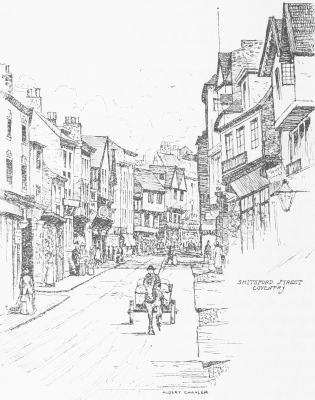
SMITHFORD STREET COVENTRY
Edward treated the Coventry folk graciously enough, paying them several visits at this time[280]; but another figure had begun to loom large in English politics, and Warwick, the King-maker, now exercised even more power in the Midlands than had been enjoyed by the Lancastrian Buckingham. In 1464 the earl first appears as meddling in the internal affairs of Coventry. A quarrel arose between a certain William Bedon and William Huet about a debt—it may have been a party affair between the weavers and tailors—and appeal was made to Edward IV. The matter, the King declared, was "screpulus and doubtefull," and directed that the litigants should abide by the arbitration of certain citizens, or that the mayor, in the event of their inability to decide upon the case before Michaelmas, should step in and dispose of the matter.
Accordingly at the appointed time, when the arbitrators failed to agree, the mayor took the matter into his own hands, and decreed that Huet should ask Bedon's forgiveness for his behaviour towards him, giving also 40s. "for amends." "Which laude and decree," the Leet Book says, "the seid William Huet yn neyther braunche wold not obey, but utterly refusyd," using "right vnfyttyng, inordinate and ceducious langage sownyng to the derogacion of the kynges lawes and of his peace, yn right evyll example, for the which the seid mair, vmper,[281] be the advyse of his seid brethern, comyttid hym to warde," the King giving him "right good and special thank" for his action in this behalf. Tiptoft, it appears, who was then in the city, kept Edward informed of the progress of the business. But the affair soon assumed serious proportions, and the King wrote to inform the mayor that if any others vexed their neighbours by any "imaginacions, sclaundours or feyned accusacions hereafter," or made any "conventicles," they were to be repressed; the officer requiring all the king's liege men in the city to aid him in the work "at thair peril."[282]
But peace was not to be restored by these means, for the city authorities had still to reckon with Huet, who lay in prison. By the "meane of his frendes," the account goes on, he "labored vnto my lord of Warrewyk for favor and ease to be had yn the seid decree at my lordes instaunce, so that to ouer gret rebuke ne charge were not don to the seid William yn makyng therof. And theruppon the seid mair, allethough after his dimeretys, well and indifferently be hym vnderstondon, he were worthy to have made as lowly submission as cowde be thought therfore, and to have boron to the utmost of his godes besides that, and rightwesnes without mercy shold have ben don therin; but at the seid instaunce leying rightwesnes apart and folowyng mercy," the mayor "made his laude and decree thus: that the seid William Huet shuld be of good seying and behavyng fro that tyme fourth, and that he shuld yeve the seid William Bedon 10 marcs in amendes towards his costes. And so he did, which amounted not to the thryd peny that he had made hym to spende; and yette further at my seid lordes instaunce"—here the mayor, sadly confused and harassed by the divergence of the paths of "mercy" and "righteousness," takes up the account in his own person—"my worshipfull Brethren and I so effectuelly entreted the seid William Bedon, that he yave the seid Huet agayn V nobles of the seid X marcs." Then Huet, being further bound over to keep the peace, was "set at his large," or released.
Owing to these repeated attacks, as well as to the unsettled state of the kingdom, things had not prospered with the Coventry corporation. They were in 1468 £800 in arrear of their annual ferm of £50. The sheriff was ordered to seize the goods of the mayor and men of the place as distress. He could find no more than 106s. worth of goods, and these "remained on his hands for lack of buyers," "and since the said mayor and men had no other goods or lands within the bailiwick that could be taken into the king's hands, no further payment was then made,"[283] a rather amusing betrayal of the helplessness of the central government. But the Trinity and Corpus Christi guilds were bodies possessed of great wealth, though upon their funds the exchequer had no claim, thanks to the astuteness of the corporation in thus disposing of its possessions. But no doubt the resources both of guilds and townsmen were failing, even as those of the monastery, for in 1466 the prior was £550 in arrears to the Crown for the rent of the Earl's-half; his tenants in the city must therefore have been backward in paying the rent due to the priory treasury. And to add to the general confusion in 1469 the commonalty rose crying that they were defrauded of their lawful share of the Lammas lands. More serious than all, when civil war again broke loose and Edward and Warwick measured swords together, the men of Coventry chose the losing side, nor did a too late repentance avail to save them from the terrible humiliation of a temporary forfeiture of their franchises.
Meanwhile matters were going from bad to worse in the government of England. The great earl was becoming rapidly estranged from his young kinsman, Edward, whom he had helped to place on the throne. Jealousy of the Queen's relations, and the decay of his own influence in the royal councils, were rapidly converting Warwick into a secret enemy of the ruling house. Edward[284] was in favour of a Burgundian alliance; the King-maker, on the contrary, pressed forward the claims of France to the friendship of England, and when the King treated the French ambassadors with scant courtesy, his too powerful subject entered into intrigues with Louis XI. on his own behalf. He had some thoughts of placing on the throne his future son-in-law, the Duke of Clarence; and Calais, where the earl and the King's brother were staying, became in 1469 a perfect hot-bed of conspiracy.
How far Warwick carried with him the general sentiment of English folk is rather doubtful, but so great was his territorial influence that he was a highly dangerous enemy. Besides, there were various elements of disaffection abroad in the land. The Lancastrians had still some hold on the hearts of those living in the north and west, while others who had expected an era of peace and perfection under Yorkist rule were naturally disappointed at the small results of Edward's government. Though there seems to have been no very distinct notion of what the people wanted, one thing was clear, they wanted a change, and the country was filled with the old tokens of unrest and discontent. Bad times seem rather unaccountably to have befallen the people of Coventry; the city was deeply in debt, and on that account the citizens were probably more willing to lend an ear to Warwick's emissaries. It is possible that foreign trade relations may have more to do than we are at present aware with town politics. The great merchants of the Staple, who were heads of the powerful civic families, and who possessed the monopoly of trade in wool, would welcome the alliance with Burgundy, and a ready export of the raw material to Flanders; while the bulk of the townsfolk, cloth workers and artisans, were glad that the wool should be kept in England and be converted into cloth by home manufacture. For that reason Warwick and his anti-Burgundian policy may have been popular in cloth-working towns such as Coventry then was.
We follow with difficulty the record of obscure risings which marked the beginning of a fresh struggle. Two movements agitated the north in the early part of the year 1469. One seems to have been a Lancastrian outbreak; the other, under Robin of Redesdale, was undoubtedly fomented by Warwick. The men of Coventry found themselves as usual drawn into the strife. They were compelled to pay, and send fifty men to York against the rebels,[285] who joined their forces together, and finally turned southwards under Sir John Coniers towards the Midlands. For some time Edward appeared unconscious of the danger that threatened him, and during June he went quietly on a progress through the eastern counties. At last there came a rude awakening. On July 1,[286] he wrote from Fotheringay, bidding the mayor take and commit to ward any person using seditious language among the King's liege people to the intent to "stor and incens theym to rumor and comocion"; and later letters were urgent in their appeals for dispatch of men. Meanwhile the extent of Warwick's plotting stood revealed. On July 12 came tidings from this arch conspirator, who, far from being the haughty noble of the conventional type, was, as his latest biographer[287] tells us, very affable in his bearing and an ardent seeker after the commonalty's good will. Warwick had very probably gained a strong party among the populace at Coventry, and in addition to the letter destined for the mayor, the messenger bore a duplicate addressed to his master's "servonds and welwyllers" within the city.[288] "Ryght trusty and well belovyd frende," the earl wrote to the mayor, William Saunders, "I grete you well. Forsomuche as hyt hath pleasyd the kings gode grace to sende at this tyme for hys lords and other hys subgetts to atende on hys hygnes northwards, and that both the rihgt hye and myghty prince, my lord the duke of Clarens, and I be fully purposid, after the solempnizacion of the maryage by Godds grace in short tyme to be hadde bitwene my sayd lord and my dohgter, to a wayte on the same, and to drawe vn to our sayd soveren lordes hyghnes, therfor desire and pray you that ye woll in the meene tyme geve knowlache to all suche felisshipp as ye mowe make [toward theym] to arredy theym in the best wyse they can, and that bothe ye and they defensibly arrayd be redy apon a days warnyng to accompany my sayd lord and me toward the sayd highnes, as my specyall trust ys in yowe; yevyng credens to this berer in that he shall open vnto you on my behalve, and ore Lord have you in hys keping. Writon at London the xxviii day of Juyn." The marriage thus referred to was solemnised some ten days or more after the date of the missive—July 11, Clarence and Archbishop Neville having secretly stolen over to Calais, where Warwick was then posted, to take part in the ceremony; and the next day the King-maker and his following landed on the coast of Kent.
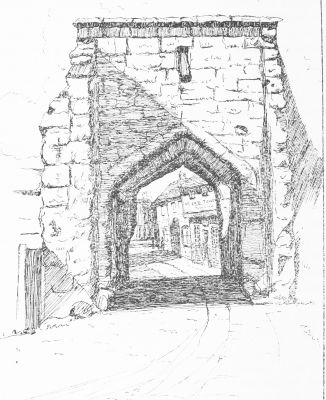
COOK STREET, GATE
The letter[289] as it stands conveys but scanty indications of the real state of affairs, but no doubt the citizens read between the lines, and in "giving credence to the bearer" heard as much as the earl wished of his plans for the overthrow of the Queen's relations and the recovery of the Neville influence. Whether they understood that Clarence, Warwick's son-in-law, was to occupy his brother Edward's place, and be raised to the throne, is another matter. Nevertheless they must have been somewhat bewildered by Warwick's change of front. Lancaster they knew, and York they knew, but they might with all justice ask, "Who are ye?" of the King-maker.
Once more, as in Margaret's time, Coventry, with its command of the north-western road, became a centre of operations. News now came thick and fast. Coniers' army of Yorkshiremen, supplied with a later manifesto and petition of grievances promulgated by Warwick, and the royal troops under Herbert and Stafford of Southwick, were converging towards Banbury. On Maudlin day (July 22) Coventry was hastily fortified, certain of the principal citizens overlooking the equipment of soldiers and the strengthening of the gates with cannon. On the 26th July the battle of Edgcote was fought near Banbury, ending in the discomfiture of Herbert and the royalist troops. For just when victory seemed assured, a rabble of Northampton men, led by one John Clapham, bearing the banner of the White Bear, and shouting "a Warwick! a Warwick!" appeared over the hillside in the rear of Lord Herbert's men, and they, thinking the Earl himself was come, broke and fled. "Lord Herbert," the Leet Book says, "was taken in fight by Banbury with Robin of Redesdale" on the vigil of S. James, and was brought to Northampton, and there beheaded, and Lord Richard Herbert, with others.[290] Some days afterwards Edward was captured at Honiley or Olney, near Kenilworth, and brought by Archbishop Neville to Coventry, there to meet the Archbishop's "brother of Warwick."[291] He was detained in the city as a prisoner until August 9. But even then his humiliation was not complete. Three days later, when the King was certainly no further removed from the city than Warwick, the father and brother of Edward's Queen, Lord Rivers and his son, John Woodville, who had been captured by rioters at Chepstow, fell into Warwick's hands, and were beheaded on Gosford Green by his order.[292] The Leet Book also records the executions of Lord Stafford of Southwick at Bridgewater, and again that of Sir Humphrey Neville, a Lancastrian, and Charles, his brother, who had risen in rebellion in September, in the "north coasts," and that of the bailiff of Durham at the same time ("et ballivus de Duram eodem tempore"). It was on the occasion of this northern or Lancastrian rising that the Nevilles found themselves forced to release Edward; for the unpopular ministers having been brought to justice, there was a feeling abroad that the King should be set free.
So far Warwick's revolt had been successful, but it did not wholly gratify his ambition. No doubt he felt that the King was hopelessly alienated, and, whenever powerful enough, would free himself from the influence of the house of Neville. Fresh troubles broke out, this time in Lincolnshire, in February 1470. Warwick's agents so worked on the fears of the people that they rose in great numbers, and converted a local dispute into a rising of some magnitude. A royal missive, bearing date February 9, arrived at Coventry late in the evening, and in accordance with the commission, money was collected throughout the wards for men to go to Grantham by March 12.[293] The King's letter was imperative; there were rebels abroad, it said, "and many assemble for the retaining of the said enemies ... so that if their malice be not ... withstanden, it might grow to the great jeopardy of us and to the destruction of all true subjects." Edward defeated the rebels at Empingham, near Stamford, on 12th March, and so sudden was their flight that the battle received the name of Lose-coat Field. Meanwhile the ringleaders, mainly belonging to the Welles family, were brought in; but before execution they showed that Clarence and Warwick were seriously implicated in their designs. Edward, whose suspicions were thoroughly aroused, sent to the duke and earl at Coventry, bidding them disband their levies, for they were followed by a great number of men, and join him without delay; but they would not, merely sending excuses and promises.[294] And perhaps it was then that Clarence, being in need of money, left in pledge a "coronall," garnished with "rubies, diamonds, and sapphires," in return for a loan of 300 marks from the citizens.[295] Finally Warwick and the King's brother, after trying the disposition of men's minds towards their cause in the northern parts, turned southwards, whither Edward followed them; but they had already taken ship at Dartmouth when the King reached Exeter. Edward passed through Coventry on his way southwards, and forty men went with the King on April 5 to the south coasts, taking the great sum of 12d.[296] a day for payment. For the citizens of Coventry—provident men—afforded help to either party, hoping surely to have their reward whichever side might prevail in the end. They admitted Clarence and Edward, and furnished the former with money and the latter with men. This shows either that they took a dispassionate view of these dynastic and political struggles in which they had no concern, or that they were more deeply involved in them than we imagine, but parties being so evenly balanced in the city, the presence or near neighbourhood of a leader of either party was sufficient for the time being to turn the scale in his favour.
The two conspirators sailed for Calais, but there the merchants of the Staple were heart and soul for Edward and the Burgundian alliance, and the garrison, being in their pay, closed the harbour against them. So they put into the Seine, and Warwick, abandoning his old project of dethroning Edward to make room for Clarence, prepared to take up a more definite policy, and made overtures to the Lancastrians. It is difficult to imagine how Queen Margaret could bring herself to forgive the man who had wrought so much evil to her and hers. But Louis XI., King of France, who knew that if the Yorkists continued to reign they would strengthen Burgundy, his great foe, acted as peacemaker, and the compact between Lancaster and Neville was sealed by the betrothal of Warwick's daughter to the Prince of Wales. When the King-maker and the Lancastrian lords landed at Plymouth in September, they caught Edward unawares in the north, and they replied to his summons, ordering them to appear at court, "humbly and measurably accompanyed," by proclaiming Henry VI. King of England. The army in the north declared for King Henry; for the moment the game was up; Edward IV. fled to Lynn, and took ship for the Low Countries.
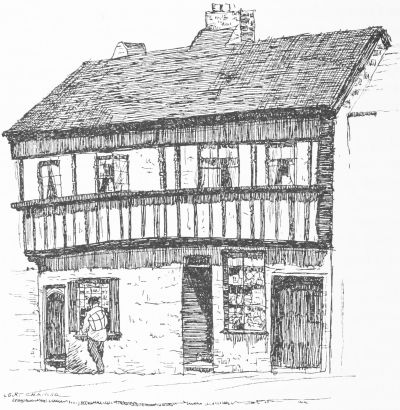
OLD HOUSE IN LITTLE PARK STREET
The Coventry Leet Book thus summarizes the year's events:[297] "In the Lenton when William Stafford was mayor ... the Lord Wellys[298] were byhedyd. The duke of Clarance and the yrle of Warw[ick] w[ent] o[ut] of the londe, and went to the kynge off Franse, and there were gretly cheryshyd, and there was a m[arriage] m[ade] by twix prinse Edward and a dohgter of the sayd yrle of Warwic. And in the monthe of Sept[ember] the sayd duke and yrle with the yrle of Oxynford, the yrle off Pembroke,[299] brother to kyng Harry, the bastard ffawkynbruge[300] comyn a londe at Ex—.[301] They ther drewe to hem muche pepull, or they com to Coventry, they wer xxx thowsand. [Ky]ng Edward laye at Notynham, and sende for lordes and all other men, but ther com so lytell pep[ull] to hym that he was not abyll to made a fylde a gaynes hem, and then he with the yrle [R]evers, the lorde Hastyng,[302] the lord Haward, and the lorde Say went to Lynne, and ther goten hem shippes, and sayledon to the duke of Borgoyne,[303] the whiche duke hade weddyd kyng Edwards syster, the lady Margete. And then the duke of Clarans, the yrle off Warwic, the yrle of Oxynford, the yrle of Shroysbere, the lord Stanley, [and] the bysshoppe of Yorke[304] went to the towre at London, and set out of prison kyng Harre the Syxt, the wyche hade be ix yer and a halfe and mor[305] as a prisonere, and brohgt hym to the bysshoppes palys at Powlys[306] in London, and made hym there to take on hym to be kyng as he was afore tyme. And then was the yrle of Wyrseter[307] behedyt at London.... The quene that was wyfe to kyng Edward, with hyr moder, the duches of Bedford,[308] toke seynt wary[309] at Westmynster, and ther the quene was lyght of a son that was crystonyd Edward."
So the year that had seen such astonishing events now drew to a close. England saw one king displaced by a powerful subject after a bloodless struggle, and another, weak, possibly imbecile, and long a neglected prisoner, restored to his former state; a queen driven to take sanctuary for fear of her husband's enemies, and the birth of a Prince of Wales, the history of whose short unhappy life accords well with the inauspicious season of his coming into the world. Though Englishmen passively accepted these changes, Warwick's position was still one of great difficulty; the King's weakness, Margaret's delay in France, and last the unstable temper of "false, fleeting, perjured Clarence," all combined to make the firm establishment of the restored dynasty a matter involving risk on every hand.
John Bette counted the beginning of his mayoralty in January, 1471, according to the regnal year of Henry VI., and the townspeople doubtless considered that the rule of the Yorkists was a thing of the past.[310] Perhaps the craftsmen party were pleased with the reversal of policy which followed on the reaccession of the Lancastrian King. The French King held Warwick to an agreement to make war with Burgundy. And war with Burgundy meant interruption in the Flemish wool trade, and a plentiful supply of wool for the home market. In the following March, forty men, now waged at 6d. a day, were commissioned to go for two months to Flanders. But the Flemings, by their support of the fugitive King, Edward IV., carried the war into the enemy's country. On March 14, 1471, Edward landed at Ravenspur, to claim—so he averred—the duchy of York, his ancestral inheritance. Slipping past Montagu, who had been set to guard the north road, he pressed on towards the Midlands. Followers presently flocked to his standard, and on March 29, coming from Leicester, he offered battle beneath the walls of Coventry. Warwick, who lay within the city, waiting for fresh levies, had not troops sufficient to accept the challenge, and suffered Edward to pass on, and cut off his communications with London.
The citizens of Coventry must have long remembered this terrible season, "the Lenton next afore Barnet ffeld," and the hurried and almost unintelligible writing of the Leet Book, with the frequent and probably intentional mutilation of its pages, bespeak the agitation and confusion which filled men's thoughts. There could be no temporizing now the great earl was within their gates, no making overtures to the returning Yorkists, who, now that there was no army barring the way to the capital, found their position greatly increased in strength. The townsfolk lent Warwick 100 marks,[311] and during that period of terrible anxiety, wherein the earl was waiting for the levies under Montagu from the north, Oxford from the east, and Clarence from the south-west, they sent "riders into the country" to bring back tidings, and having fortified their city, kept a strict watch.[312] The levies under Clarence never came to the earl's aid, for meeting Edward on the road between Warwick and Banbury, the duke deserted the cause of his father-in-law, and was "right lovingly reconciled" to Edward. Afterwards Clarence, stung perhaps with remorse at his desertion, sent unto the earl "to require him to take some good way with king Edward[313] ... the earle (after he had patientlie heard the duke's message) he seemed greatlie to abhorre his unfaithfull dealing.... To the messengers (as some write) he gave none other answer but this: that he had rather be like himselfe than like a false and perjured duke; and that he was fullie determined never to leave warre till he had either lost his owne life or utterlie subdued his enimies."
Strengthened by Clarence's levies, the King again returned to offer battle on April 5 before the gates of Coventry, but as Warwick still refused, he drew off down the Watling Street towards London. The citizens of Coventry continued faithful to Warwick, and when he left for the capital to stake his all on a battle with Edward, twenty horsemen and twenty foot from the city set forth with him on the eventful march, and fought at Barnet Field. But when the battle was over the terror-stricken townsmen would fain—in Clarence's words—have "made so good a way with king Edward," and did all that in them lay to appease the conqueror. Margaret of Anjou and her son had landed two days after the battle. Prince Edward no doubt expected aid from the Lancastrian stronghold, and sent a proclamation from Chard, where he then was, to Coventry. But the townsfolk knew that the day was with the Yorkist King.
The Leet Book records the receipt of "a letter fro Edward, the son of Harry the VIte, the xxv day of Aprile, that was wryton at Cherd the xviii day of Aprile the whyche was sent to Kyng Edward and the messenger therewith to Abyndon."[314] But they were not allowed to make their peace after this easy fashion. In May Edward came to Coventry, deprived the mayor, John Bette, of the civic sword, and confiscated the liberties of the city, which were only redeemed by a payment of 500 marks.[315] The citizens owed even this grace to Clarence's mediation. They received a charter of pardon "for the hevy greffe that our soveraign lord beer to the citee ... ffor the tyme that Richard, late Erle of Warwyke, with oder to hym then acompanyed, kept the citee in defence agenst his Royall highnes in the Lenton next afore Barnett ffeld."[316] Clarence's mediation and the king's pardon cost the citizens a further sacrifice. Edward brought his influence to bear upon them for the release of the jewel, which the duke's necessities had induced him to leave in pledge, in return for the loan of 300 marks. This "coronall," the deed declares, "had been utterly forfeit for two years past," as the duke had not discharged the debt. But as Clarence had "laboured to be good lord" unto the citizens, the mayor agreed to remit a portion of the money owing, and to deliver up the jewel "for the singular pleasure and good grace of our sovereign lord, king Edward."[317]
The reconciliation being accomplished, the citizens were eager to show their entire loyalty to King Edward, and accordingly granted a most splendid reception—equal to that given to Margaret eighteen years before—to the four-year-old prince of Wales on his visit to Coventry (April 1474) for S. George's feast. The mayor and divers of the commonalty, arrayed in green and blue, met the prince with the gift of 100 marks in a gilt "cuppe" upon which was a "kerchief of plesaunce." At the Bablake gate stood a pageant, with figures of Richard II. and many nobles thereupon. The character of King Richard II. in allusion to the York genealogy, saluted the child, "of the right lyne of royall blode" with a verse of greeting. There were further pageants "with mynstralcy of harpe and dowsemeris" (dulcimers); and at the Broadgate stood S. Edward (who had done duty on a previous occasion) with "mynstralcy of harpe & lute," and more verses with allusions to the prince's father's "imperial right," wherefrom he "had been excluded by full furious intent," by way of welcome.
What wonderful memories these local poets possessed! Their verses show how the old friendship of the city to Lancaster had wholly escaped their remembrance! When the little prince rode in his "chare" down to the Cheaping, he beheld three prophets at the Cross, and above were "Childer of Issarell" (the Innocents) casting down flowers and cakes, and four pipes running wine. The three kings of Colen (Cologne) were also pressed into the service; but the great feature of the show was the pageant of S. George upon the conduit of the Cheaping, the saint being represented armed, "and a kynges daughter knelyng a fore hym with a lambe, and the father & the moder beyng in a toure a boven, beholdyng Seint George savyng their daughter from the dragon."
"O myghty God, our all socour celestiall, Wich this royme hast geven to dower, To thi moder, and to me, George, proteccion perpetuall, Hit to defende from enimies ffere and nere, And as this mayden defended was here, Bi thy grace from this Dragon devour, So, Lorde, preserve this noble prynce and ever be his socour."[318]
A truly splendid reception for such a young child, who, we will hope, appreciated the "kerchief of plesaunce," if the drift of the political allusions was above his understanding. True to his policy of ingratiating himself with the burghers and moneyed classes, the King allowed his little son to stand godfather to the mayor's child on this occasion. Nevertheless Edward was not content with mere compliments or protestations of loyalty from the lips of actors, but made this visit of his son an opportunity for strengthening his political position. The mayor and his brethren were called upon to cause the commons of the city to swear an oath of allegiance to the Prince of Wales.[319] After this the King and Elizabeth Woodville were all graciousness to the citizens. The Queen in September of that year sent twelve bucks from Fakenham Forest as a present to the mayor, his brethren and their wives.[320] She also praised their "sadde polit[y], guydyng and diligence" in appeasing an affray, and thanked them warmly for their duties ... "by you largely shewed vnto vs and to our derrest son the prince; and in like wyse to all oure childern ther in sundry wises heretofore, and namely vnto our right dere son, the Duc of York, in this time of our absens."[321] Four years later, Edward sent the prince of Wales with his court to Cheylesmore, where the child sojourned for some time, and was admitted a member of the Trinity and Corpus Christi guilds.[322]
But the fair words of royalty often bore a most unwelcome meaning, and the yoke of the Yorkists was not light. Edward, in 1474, applied to "his feythful subgetts" in the city of their "benevolence" to aid him with a substantial sum of money for various undertakings incident to a war with France.[323] The king found "benevolences" or forced loans more convenient than subsidies granted by parliament, and in the wars a treaty better served his purpose than a battle, when the French king was willing to pay for peace. The frequent interference of the Prince of Wales's council in city disputes at first ruffled the tempers of the great folk at Coventry not a little. "We, your humble and true servants here," the corporation wrote to the Prince of Wales in 1480, "know of no variance ... here but that we among ourselves, be the grace of God shall amicably and righteously settle." But all thoughts of resistance had been abandoned, when the next year a commotion, raised by the common folk at the enclosure of the Lammas pastures, put the franchises in danger of confiscation a second time, and the corporation earnestly entreated the Prince of Wales by intercession to avert his father's wrath.
Richard III., in his brief reign, did all that in him lay to conciliate the Coventry folk; in 1485 he kept Whitsuntide at Kenilworth,[324] and paid a visit to the city to witness the Corpus Christi pageants, but we hear of no joyous welcome given him by the citizens. Perhaps—though there was little sentiment in contemporary politics—they could not lightly forget the faces of the two little boys, who had visited the city during their father's lifetime, and had since mysteriously disappeared, men knew not by what means, in the Tower of London. In an interesting letter written probably in the previous year, the King charges the authorities of this thoroughfare city to provide horses for the royal messengers.
"Forasmoche," he says, "as we have appointed and ordeined certain of our servants to lye in diverse places and townes betwix us and the west parties of this our royaume for the hasty conveiaunce of tydings and of all other things for us necessarie to have knowledge of, we therefore wol and desire and also charge you that, if any of oure seid servants comyng by you shal nede any horses for thair hasty spede to or from us, ye wil see them shortly for to be provided therof for thair redy money. And also if it fortune any of them to travell from you by nyght that than ye will see that they may have guydes and that they shalbe suffisauntly rewarded for thair labors. And that ye faile not to doo your effectual diligence herein as we trust you, and as we may undrestande the redynesse and good will that ye have to please us."[325] There is an undertone of threat underlying these last few words, shewing maybe something of the anxiety the King felt concerning the loyalty of the citizens. But the inhabitants were decidedly worth conciliating, and Richard wrote very cordially in the last year of his reign praising the "sadness and circumspect wisdoms" of the mayor and his brethren in allaying debate, and acknowledging their "auctorite to provide, make and establisshe ordenaunces and rules ... for the vniversall wele and pollitique guiding of" the said city.[326]
It seems that this cordiality was wasted on the men of Coventry, so gladly did they welcome King Richard's rival, the victor of Bosworth, when he took up his lodging at the Bull, in Smithford Street, after the battle.[327] The wardens' accounts record payments made "for brede, ale and wyn and other vitailes that was hadde to Maister Onleys, he then beyng mair, at the comyng of Kyng Henre," the most expensive items of the account being "i pype claret wyn iii li., i pype redde wyn iii li.," with "xx motons," "ii oxen," and 7 "stockfishes," the price of which made a total of £4, 13s. 6d. It is true that the citizens, with their old supreme indifference to political party, also supplied bread and ale "to the feld of Kyng Richard,"[328] and one of their number fought, we know not on which side, at Bosworth, for the accounts record that 2s. 6d. was paid by the Corpus Christi guild "towards the hurt that Thomas Maideford had in the fylde." Two years after Henry kept S. George's feast at Coventry, and also, like his predecessor, saw on S. Peter's day later on in the year (June 29) a performance of the famous mystery plays.
A great council was held at this time in the city, and the Archbishop of Canterbury and other bishops read in the minster the papal bulls, affirming Henry's right of succession, and threatening with excommunication all such as should rebel against him.[329] The King was still at Coventry when he heard that the Earl of Lincoln, a Yorkist, with help from Burgundy, had landed in Lancashire to support the claim of Lambert Simnel, whom historians call "the organ-maker's son," but who gave himself out to be the son of the duke of Clarence. After the defeat of the rebels at Stoke, near Newark, Simnel, as all the world knows, became a scullion in the royal kitchen. The annals record that another pretender, Thomas Harrington, who also called himself the son of Clarence, was beheaded in this year "on the cunduit by the Bull," and was buried at the Grey Friars'.[330] At the King's second visit at S. Peter's-tide he lodged with Robert Onley, who had been mayor when the battle of Bosworth was fought, and conferred on him the honour of knighthood.[331] After Simnel's rising had been crushed, the good folk no doubt expected to enjoy an era of peace, and in the following year the churchwardens of S. Michael's, and other well-disposed people, "for joy brought to S. Michael's a great bell, and called it Jesus Bell."
Lollardry had never died out, and it flamed up anew when the land was at peace. In 1485 Foxe records that various people of Coventry were "troubled for religion," and compelled to recant, though not without injunction to penance.[332] The annals tell us they bore faggots about the city on the market day, the dread of fire being no doubt more convincing to the suspected heretics than the bishop's logic. But in the next generation both men and women had strength to endure to the end. In 1511 Bishop Blythe held a "Court of Heresy" at Maxstoke, but the accused saved themselves by abjuration, and went through the form of bearing faggots throughout the city. All were not thus to be delivered, however, and a persistent heretic, Joan Ward, who had performed this penance, was handed over to the secular arm to be burned. Seven suffered in the Little Park at Coventry this year (1512), say the city annals (differing in date from that given by Foxe in his account of the "Seven Godly Martyrs burnt at Coventry"), but one, who was not staunch enough for martyrdom, recanted, and did penance "on a pipe head," holding a faggot on his shoulder while his comrades were burning.[333]
Henry's frequent appeals for money must have somewhat lessened the goodwill the Coventry men bore him for his frequent visits[334] and complimentary membership of the city guilds. It was in 1500 that he and his Queen became a brother and sister of the Trinity fraternity.
Echoes reach us of the wars he undertook, which after vast preparations and much ingathering of money, usually ended in a truce or peace. We hear of the depredations of the King of Scots, who in 1496 broke the truce, crossed the border, and after doing all "the harme and crueltee to men, woman, and children ... that he coulde to th'uttermuch of his power," returned in great haste over Tweed, a crossing which occupied him but six or seven hours, whereas in coming over the river two whole days had been taken up.[335] The insult was to be avenged, and two of the most expert men of the city were summoned to meet at a great council to confer upon this matter. The conference naturally ended in a demand for a loan. Henry had in Richard Empson, who succeeded Boteler in the recorder's office, a servant well able to aid him in extorting money from his loyal Coventry subjects. No doubt the citizens were most unwilling to part with their substance. One Richard Smith, by an appeal to the King's "ffader of Derby," the husband of Lady Margaret, and by his "importune and dissimuled sute," managed to gain an abatement of the sum he had originally agreed on, so that others of the city who knew of Smith's wealth were "greatly discouraged" at the inequality of the assessment. Empson was to proceed, said King Henry, as he thought fit, an injunction which may be construed to mean that he was to get all the money he could out of Richard Smith for the King's use.[336]
Yet the citizens prospered no doubt under Henry's firm and sagacious rule, and when they recorded his death chronicler-fashion in the Leet Book, it is with some appearance of regret. In "this year," the account begins, "dyed king Henry the VIIth, the xxii day of April, ... at Rychemount ... and was brought to London in to Pollys[337] with many nobles of the realme and grete nombre of torches, and a grete nombre of peple both on horsbak and a fote. And after iii dayes beying in Pollys he was brought to Westmynster, and ther he lieth and his quene Elizabeth with him in a newe chapell, which he causid to be made in his lyffe, on whoos saule Jhesu have mercy. And his son kyng Henry the VIIIth was crownyd the same yere at Westmynster the Sonday next after Midsomer day."[338]
If the father had chastised the men of Coventry with whips, the son was to chastise them with scorpions. Loans and subsidies were the order of the day, for the great treasure gathered together by Henry VII. was quickly dissipated by his successor. In 1524 a hundred and ninety-four persons advanced to Henry a hundred and fifty pounds eleven shillings by way of loan,[339] and this is only a single example of what was then a very common arrangement. But the citizens could ill bear the pressure of increased taxation. For some time their prosperity had been waning, for foreign competition had begun to tell upon the English cloth manufacture.[340] Discontent and divisions were rife among them as in the preceding century. During years of dearth the common lands had been ploughed up, and when the dearth was over—when, "thanks be now to almighty God," as the Leet Book says, "corn is comen to good plente and to easy and reasonable price," the ploughing was still continued, and the cattle of the common folk deprived of pasture.
In 1525 the citizens rose, after their old practice, to resist the enclosure of the common lands. On "Ill Lammas Day," say the annals, "... the commons of Coventre rose and pulled down the gates and hedges of the grounds inclosed, and they that were in the cittie shutt the Newgate against the chamberlain and their company. The mayor was almost smothered in the throng; he held with the commons, for which he was carried as prisoner to London; he was put out of his office and Mr. John Humphrey served out his year." A special commission under the Marquis of Dorset was appointed to try the rioters. Thirty-seven prisoners were sent to Warwick and Kenilworth Castles, and seven to the Marshalsea.[341] Some suffered at the pillory, others after long imprisonment were pardoned by the King on the occasion of the Pope's jubilee.[342] But the rulers of the city were highly unpopular, and frequent "slanders" were proclaimed against them.[343]
The annals record the discovery of the wildest schemes, which sprang, no doubt, from the misery of the people. In 1523 two men, Pratt and Sloth, were arrested in Coventry on the charge of treason. They confessed that their purpose was to kill the mayor and his brethren, rob S. Mary's Hall, where the common chest was kept, and take Kenilworth Castle. They were taken to London for judgment, but executed at Coventry, and their remains figured on the city gates.[344] The next year a further scheme came to light. This time the King's subsidy was the object at which the plunderers aimed; it was to be stolen from the collectors on the highway to London; the conspirators proposed to seize Kenilworth Castle and to fight there for their lives. These men, Phillips, a schoolmaster, Pickering, clerk of the King's larder, and Anthony Manville, gentleman, were hanged, drawn and quartered at Tyburn.[345]
The "King's Proceedings" of 1536 undoubtedly intensified the misery of the citizens. The monastery was dissolved by the royal commissioners; the cathedral church defaced and its roof pulled off, and the lead, worth £647, stacked within the desecrated building;[346] the house of the Franciscans razed "because the poor people lay so sore upon it;[347] and all monastic property seized into the King's hand." Dugdale, quoting Hales' letter to the Protector Somerset, attributes to the dissolution the state of decay and misery into which the city had fallen in the third year of Edward VI. "There were not at that time," the letter runs, "more than 3,000 inhabitants, whereas within memory there had been 15,000."[348] It is very doubtful whether the high figure is correct, and certainly the population never sank to so low as 3,000. In a petition coming from the people of Coventry in 1548 it is stated that there were "to the number of eleven to twelve thousand housling people"[349] within the city. But it was the sweeping and iniquitous act of confiscation, known as the suppression of the guilds and chantries, rather than the dissolution of the monasteries, which brought the citizens to the verge of ruin. So extensive was the house property belonging to the guilds, and so intimately were these bodies connected with the corporation, that this calamity involved the city finances in the most terrible confusion. Having no property from which to draw the money for the annual fee-ferm of £50, one or two persons, the citizens declared to the Earl of Warwick, were yearly ruined by the tax levied for its payment.[350] The poorer class—of late years greatly increased in numbers—were deprived of the guild charities, the children of a schoolmaster[351] and the less wealthy craftsmen of all hope of provision for old age and an honourable burial after death. The burgesses of Lynn and Coventry protested against the confiscation. There were but two churches in the city, the latter declared, "wherein God's service is done, whereof the one, that is to say, the church of Corpus Christi, was specially maintained of the revenues of such guild lands as had been given heretofore by divers persons to that use.... If therefore now by the act the same land should pass from them, it should be a manifest cause of the utter desolation of the city." For the people, the petitioners declared, "when the churches were no longer supported, nor God's service done therein, and the other uses and employments of those lands omitted, should be of force constrained to abandon the city and seek new dwelling places."[352] This energetic protest was not without its effect. The citizens were permitted to purchase back the guild lands for the sum of £1315, 1s. 8d., a very large amount in those days,[353] which, in spite of their poverty, they were enabled to gather together.
Once more in Mary's reign, January 31, 1554, when Coventry closed its gates against Lady Jane Grey's father, the Duke of Suffolk, the city became of strategic importance. The city failed to rise, and the Protestant cause in the midlands was for the moment lost. May be the citizens regretted their inertia in the years that followed when in 1556 Laurence Saunders and Robert Glover, martyrs, were led out to die in the Little Park. Of Glover, it is said that he remained "lumpish," being dull of spirit, and fearing that the Lord had withdrawn His favour from him. But a change overtook him on his way to the stake, so that he clapped his hands with joy, "seeming rather to be risen from some deadly danger to liberty and life, than as one passing out of the world by any pains of death."
By this time a royal visit had ceased to be a political event, it became merely an occasion for splendour, or an act of courtesy. Elizabeth visited the city in 1565, being lodged at Mr Hales' at the Whitefriars, and was greeted with much courtier-like compliment by the recorder, but the reception given to her has none of the significance which attaches to the welcome, say, of Margaret of Anjou. Little remains of Whitefriars save the east wing of the cloister with its fine groined roof of the fifteenth century; but an oriel window on the western side is still called after Queen Elizabeth, Coventry saw the great Queen's rival a few years later, when in 1569, in order to be out of reach of her confederates in the north, Mary Queen of Scots was hurriedly conveyed from Tutbury to the city, and placed under a strong guard. She was confined first in the "Bull Inn," and then in S. Mary's Hall. Some years later this Queen's grand-daughter, another of the fascinating, luckless Stuarts, was hurried in November 1605 from Combe Abbey to Coventry, out of reach of the plotters of the Gunpowder Treason. This was Elizabeth, later the "winter Queen" of Bohemia. She was lodged for the nonce with Mr Hopkins of Palace Yard.
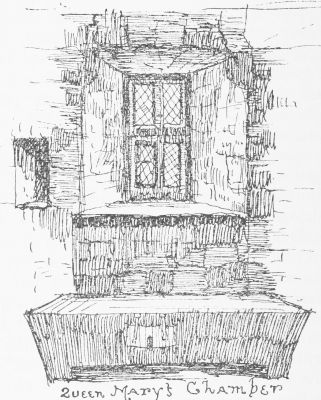
Queen Mary's Chamber
The old town house of the Hopkins' family still stands in Earl Street, having undergone perhaps more vicissitudes than any other well-known house in Coventry. Once a coaching-inn, known as the "Golden Horse," and a ladies' school, kept by one Miss Sheldrake, it was originally the home of the Hopkins' family, who first appear in Coventry history in the late fifteenth century. Its best-known member, when sheriff of Coventry, suffered much by reason of his openly expressed Protestantism, and fled to Basle in Queen Mary's reign. In this house James II. held his court in 1687, and here were also lodged Princess Anne and George of Denmark. It is a beautiful old seventeenth-century quadrangle with fine exterior lead-work, containing in its upper storey, a stone chimney-piece of classic type, disfigured by a coat of paint, while its banqueting-chamber with its finely panelled plaster ceiling presents a veritable image of decay. The tombs of the family with their busts and togas, 'mid all the panoply of classic memorial and woe, appear in the Cappers' chapel of S. Michael's church.
The chief feature of the Stuart period is the strengthening of the Puritan feeling among the citizens. Either owing to the influence of the Presbyterian Cartwright, who, during his tenure of the mastership of Leycester's hospital at Warwick, established his system of church discipline among the clergy of the county, or from some hereditary instinct, which had led them to embrace Lollardism under the Lancastrians, and furnish martyrs for the faggot under the Tudors, the men of Coventry grew more Puritan year by year. They greatly vexed the soul of King James in 1611 by refusing to kneel in receiving the Sacrament, a circumstance the English Solomon never forgot, and ten years later he refused to grant a new charter to the city until he was certified by the bishop that the orders of the Church were complied with.[354] Nor did a lawsuit, which the Prince of Wales carried on for many years with the corporation about the rent due to him from the monastery lands as lord of Cheylesmore, improve the understanding between the people and the Stuart kings. When, however, the famous writ of ship-money was first issued in 1635, it was not against the principle, but rather against the unfair assessment of the local tax, that the men of Coventry murmured. The city, they complained, was no longer prosperous, nor was it able to pay a sum so disproportionate to that levied on the remainder of the county. Many were the journeys the diligent town clerk, Humphrey Burton, undertook ere he could get the tax lightened for the citizens.[355]
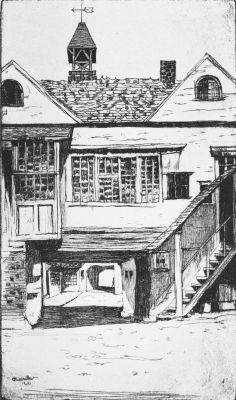
PALACE YARD
But no readjustment of the assessment of this unpopular tax could win over the hearts of the Coventry men to King Charles. And when in August 1642, a few days before the royal standard was unfurled at Nottingham, Charles appeared before the walls and summoned the people of Coventry to admit him, they refused to allow him to enter the city.[356] This circumstance rankled sore in the King's mind, and it seems that the feeling was shared by his son, for when Charles II. came into his own again, he ordered that the walls of the city where his father had suffered this check should be demolished. The work of destruction, which was begun by the Earl of Northampton on July 22, 1662, occupied nearly 500 men for three weeks and three days,[357] and when it was over the history of Coventry as a fortification comes to a close. Moreover, the title of the bishopric was now transposed, running henceforth not Coventry and Lichfield but Lichfield and Coventry.
King James II., who tampered here as everywhere with the civic constitution in favour of the Tories, his supporters, paid the city a peaceful visit in 1687, was lodged in Palace Yard, and touched for the evil in S. Michael's church, on which occasion "the very galleries crackt again," the throng was so great.[358] This closes the list of notable royal visits to Coventry, and the interest shifts to the varying fortunes of the citizens. Although, as compared with London, provincial towns ceased to be great centres of trade, Coventry never gave itself wholly up to stagnation and decay, but always kept alive some sort of manufacturing activity. At first the settlement of Huguenot exiles gave an impulse to the silk industry, and for nearly two centuries the weaving of silk and ribbons was the main employment of the citizens. In the eighteenth century the manufacture of watches was introduced,[359] but it has been reserved for our own day to see the city again put on that busy, eager, thriving look which must have distinguished it under the later Plantagenets. The cycle manufacture has won back for the city some of the prosperity it once enjoyed. But nothing can bring back the pomp and grandeur and the semi-independence of mediæval times; neither can the modern builder lend it any of the consistent beauty of the architecture of the Middle Ages. Still, unlike Abingdon, Winchester, or S. Alban's, it is a town with a present to work in, as well as a past on which to look back. As for the future, who can tell?
FOOTNOTES:
CHAPTER XII
The Lammas Lands
We have passed the period wherein the men of Coventry rebelled against their overlord the prior; in the late fourteenth century we enter upon one marked by internal strife. The law passed under Edward II.,[360] forbidding victuallers to hold any municipal office was frequently evaded, and in many towns the great power of this class was a source of endless trouble. Excitements in the guild-hall when the men, whose wages were fixed at statute rate, found they would not avail to buy them proper food, the shouting of angry crowds when the chamberlains at their Lammas ride refused to pull down fences to admit the freemen's sheep and cattle as they had done in times past, must have warned the mayor and his brethren to give heed to their ways. Murmurings were heard at an early date. In 1370 the customs laid on food for the purpose of raising money for murage provoked a rising. In 1387 the townsfolk "cast their loaves at the mayor's head, because the bakers kept not the assize",[361] neither did the mayor punish them according to his office, and again and again we hear of risings owing to that fruitful cause of trouble, the enclosure of the common lands.[362]
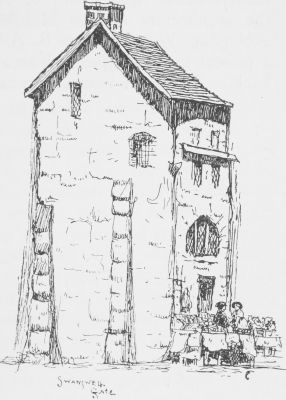
Swanswell Gate
Perhaps the townsmen were more sensitive with regard to the Lammas lands than on any other point. From time immemorial they had possessed certain rights over the common and Lammas pastures, which heretofore surrounded the city. There was still a great belt of these, about 2300 acres in extent in 1835, the commons, no doubt, representing the ancient manorial waste—Godiva's wood, two miles long and the same broad—and the Lammas and Michaelmas pastures, the manorial fields of meadow and arable, which were only free after the hay and corn harvest had been carried in. Thus, while there was on the common lands pasture for the cattle the whole year through, the citizens merely shared with various tenants or freeholders the use of Lammas and Michaelmas grounds, driving their cattle on them at certain seasons of the year, namely from Lammas (August 1) or Michaelmas (September 29) to Candlemas (February 2); during the remainder of the year the fields were in private hands. The extent of the common pastures was well known, but the peculiar tenure of the Lammas lands made it a more difficult matter to determine the exact area of pasture, held six months "in commonalty," and six "in severalty." From time to time angry disputes arose concerning the boundaries and extent of these lands, and a series of enclosures, whereof there was such bitter complaint in Warwickshire in the sixteenth century, did much to diminish the broad belt of pasture which once engirt the city. Various questions were, however, set at rest by a settlement in 1860, whereby half of the Lammas pasture was made over to the various freeholders who had half-yearly rights over them, and the remaining portion, held in trust for the freemen, was converted into common land for the whole year through. To this day there still remain tracts of breezy and often gorse-grown common at Hearsall, Stivichall, Whitley, Stoke, and Gosford Green. These and the small triangular patch, once known as Grey Friars' Green, form considerable relics of the freemen's pastures. Held, as the common report went, by the commonalty, "afore that any mayor or bailiff was,"[363] in other words before the incorporation of the city—these lands could not be alienated from the burghers' use without their consent.[364] The pastures were, however, frequently enclosed, openly for municipal purposes,[365] secretly for private gain. In the latter case there was naturally no word of consulting the burghers, and although in the former the community gave their consent to the measure, formally summoned by the mayor, the whole system of enclosures was so unpopular that it bred riots and endless discontent.
The whole question can be better surveyed by examining the careers of William Bristowe and Laurence Saunders in so far as they touch the little commonwealth of the city.
Close by Whitley Bridge is a piece of meadow called Alderford Piece,[366] which is still held by the owners of Whitley Abbey, although they have no other land on the Coventry side of the river Sherborne. Concerning this and sundry other meadows[367] a bitter feud was waged in Coventry during the fifteenth century between the family of Bristowe on the one hand, and the mayor, bailiffs, and community of the city on the other. The account of the struggle, which reveals some of the most interesting personalities in Coventry history, shows how tenacious were the memories of the commonalty where the extent of the Lammas lands was concerned, and how fierce their resentment when these suffered diminution by encroachment.
There are doubts whether William Bristowe, of Whitley, came of gentle blood, though he spoke of his manor in those parts, and wrote himself "gentilman" with the best. His father, John Bristowe, had gained his livelihood in the city as a draper, and growing in wealth and influence, became mayor in 1428,[368] and later justice of the peace and master of the Trinity guild. But he left an ill name behind him, and his acts of encroachment were fruitful of many troubles both to him and his descendants.
Thinking maybe to improve his position and step into the ranks of the country gentry, John purchased an estate at Whitley, a mile or two south of the city gates. Then began those enclosures of the common pastures which were hereafter to be remembered against him. Forty years later the tale of his doings were related by the oldest of his fellow-townsmen.[369] After "the said John Bristowe had boron office within the cite of Couentre, thynkyng that the common people of the seid cite neither durst nor wolde contrarie his doyng ... [he] let sowe with corne dyuers landes and buttes lying in the seid comyn grounde of Couentre fastby Whitley Crosse." But the encroachment did not go unnoticed, nor was the transgressor allowed to have his will. Whereupon, the aged citizens continued glad to remember the stalwart resistance made by a bygone generation, ... "the seid people of Couentre put the hierdlym[370] of bestes of Couentre into the saide corne and eton hit up as corne sowen on their owen common grounde." Nevertheless John did not amend his ways, being assured his good friends, the mayor and corporation, would wink at his misdeeds. But "inordynatly be the fauor of dyuers then officers of the cite of Couentre, dyuers tymes, [he] let inclose parte of the forseid common grounde be diuers parcels, with hegges and dykes, and then aftur dyuers tymes let heire[371] and sowe dyuers of the same closes be hym so wrongfully inclosed, entendyng euer azeyns all good consiens for his singler avayle[372] to approwe hym[373] of parte of the seid common grounde, so that be suche coutynuance hit myght be called his owne lande, wher in trouthe he had neuer right, title, nor other possession therin."
But this was not the least of John Bristowe's encroachments. He laid claim to share with the freemen of Coventry the rights of pasture on the side of Whitley brook nearest to the city, a claim no lord of Whitley had heretofore advanced. But he met with a second check. "Whiche wrong, when the people of Couentre understode hit, they pynned[374] the bestes of the seid John Bristowe at Couentre. Wheruppon the same John made amendes for the seid wrong, and never aftur wolde suffer his cattel occupying at Whitley to passe ouer the seid broke toward Couentre be his will." But after his death, when his son William entered into the inheritance, either the relaxation of the citizens' vigilance or the warm friendliness of men in high places enabled the new lord of Whitley to drive his tenants' cattle across the brook, the natural boundary between the pasturage of the folk of the hamlet of Whitley and the city of Coventry. Moreover the meadows between Baron's Field and Whitley brook were kept several. The citizens did not, however, forget these encroachments, though, for many years, custom sanctioned the double wrong.
The fruit of these evil dealings was seen in the year 1469; a troubled one for Coventry. The mayor, William Saunders, a dyer, one of a craft which had often been, and was again often to be, at variance with the corporation, seems to have had leanings towards the popular side. Wars and rumours of wars brought some distress upon the city, and the mayor gave £5 "in relesynge of pore men that shuld have bor her part" towards defraying the cost "for fifty men to go to York to the king against Robin of Redesdale," for Warwick's party were rising in rebellion, and the soldiers, weary of war, demanded the unheard of sum of 10d. a day as payment. Financial difficulties also beset the corporation. The ferm, as we have seen, had in the previous year fallen greatly into arrears; but the trouble concerning the Lammas lands was to dwarf by comparison all the rest.
It was at this time that William Bristowe by his own deed brought down upon himself the anger of the corporation. From a house in the West Orchard he built a wall, which was found to encroach "by a foot or more" upon the common river; wherefore "it was taken up again." Indignant at this usage, Bristowe brought an action for trespass in the county court against the mayor and community. This was an unwise step on his part, for the corporation at once "remembered," the Leet Book[375] says with unconscious irony, "that he was suffered to overlay the common betwixt Whitley and Coventry, and had no common there." In other words, Bristowe had continued to tread in his father's footsteps. They resolved forthwith that this should not be suffered to continue. On the eve of S. Andrew, before Sir John Nedam, knight and justice, they demanded what evidence Bristowe could put forth in support of his claim; and heard the testimony of "agyt" men concerning the impounding of his father's cattle in former days when they had been found in the Coventry pastures. While matters were in debate the other encroachment of this family was brought forward. Men told one another how John Bristowe had, by "dyking and hedging," enclosed "divers parcels" of the common pasture by the water at Whitley, and how the father and son had kept these meadows several ever since.
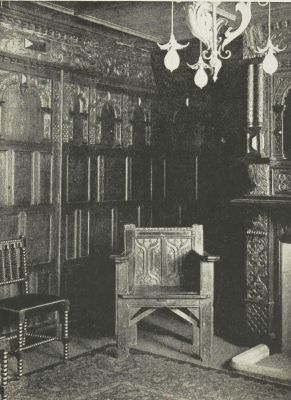
COUNCIL CHAMBER, SHOWING PANELLING
For once corporation and "commonalty" were of one mind as regards the question of the Lammas lands. It was resolved that John Bristowe's work should be undone. So on the Monday after S. Andrew's day the mayor and divers citizens—such is the account of the affair Bristowe gave in his petition to Edward IV. in the following year[376]—"stered, provokyd and comaundyd mony and dyuers rotys personys ... to the number of vc (500) personys and mooe ... [who] in manere of warre arrayed, that is for to say [with] byllys, launcegayes, jakkys, salettys, bowes, arrowes, and with mottokys and spadeys, sholles and axes," with evil intent came to Bristowe's fields. Here they went to work, and "caste down his gatys and his dyches, cutte down his hegeys and his trees ... and mony grete okeys beyng growyng in the hegeys and dycheys of the age of c years and more," carrying away wood, clay and gravel, and "riotously" destroying two "swaneys ereyrs" (nests). The trespassers would even have pulled down the petitioner's mills had not one of his servants induced them to desist by meeting them with a certain money "by way of a fine." And afterwards, Bristowe continued, with a touch of bitterness at this last indignity, "William Pere, oon of the aldermen of the same cite, by the commaundment of the seid late mayre and Richard Braytoft, browght with hym the wayteys of the same cite to the seid riotours in reresyng[377] of their seid rioteys, and like as the[y] hade doon a grete conquest or victori, ... made theym pype and synge before the said riotours all the weye ... to the seid cite, which ys by space of a myle largele or more." And that day, the petition goes on yet more bitterly, "these men were in the tavern setting, avauntyng and reresyng of their gret riotes, saying that if your seid besecher[378] sueyd any persone ... for that cause by the course of your laweys, that they wold slee[379] hym." In this manner, with tossing of tankards and playing of pipes, the meadows and arable lands at Whitley were thrown open to the community at S. Andrew's tide in the year of grace 1469.
William Saunders, the mayor, found the commonalty apt pupils in learning to resent old encroachments; but the pupils soon grew too strong for the master's hand. A fresh trouble arose after Bristowe's claims had been disposed of. The Prior's Waste was held by the convent, but the community was possessed of a somewhat doubtful title to the pasturage of the same. On S. Nicholas' day the people broke out into open riot, threw down hedges round about the Waste and those of other gardens belonging to the convent. The prior professed to be "greatly aggrieved," and proposed to "trouble" the city no doubt with a lawsuit.[380] But the mayor, perceiving perhaps that the matter was one of great difficulty, entreated him to come to terms, and finally granted him as compensation the Waste and a piece of land without the New Gate "to be kept several for evermore," These enclosures were the beginning of troubles. A body of 216 men had approved of this measure, but they were, very likely, selected with a special view to obtaining this approval, as the names of sixty-five of them can be identified with those of past or future municipal officers. At least the common people did not approve of the step. They refused to relinquish their ancient rights over the Prior's Waste and the close by the New Gate, though the leet forbade them to break open the meadows reserved for the prior's use.[381]
But Bristowe did not tamely endure to be cut off from his supposed inheritance. The following year he appealed to the privy council to redress his wrongs; and Saunders, the late mayor, Pere, and another citizen who had been prominent in the affair of the preceding year, were summoned before the council to answer for the matters laid to their charge.
The late mayor and his assistants scornfully denied the bulk of Bristowe's accusation. Whitley, they averred, was no "manor," and claims such as its present owner put forward had been formerly unknown. They gently ridiculed the complaint of the damage wrought among the "gret okes," whereof none, they declared, were more than twenty years old, the value of the whole timber being but 6s. 8d.; but they were fain to admit the felling of twelve small trees, as well as of breaking hedges, and carrying away sundry loads of clay and gravel. But it was not on Bristowe's land, they declared, that these trespasses had been done. The land he asserted to be part of his inheritance was in reality the property of the community, and in the time of Lawrence Cook (he had succeeded Bristowe's father in the mayoralty in 1429) the corporation had held these meadows in the community's name. And this possession dated back to the days before the city's incorporation. "The commonalty of the same city, afore that any mayor or baliff was, were seized thereof in their demesne as of fee, time that no man's mind is to the contrary."
Bristowe's second statement, or "replicacion," and Saunders' "rejoinder," were a mere tissue of mutual contradiction, and the King deputed the Prior of Maxstoke, Sir Richard Byngham, and Thomas Littleton, to inquire into the business, and "make a return under their conclusions respecting the same, in the quindene of S. Michael next coming."[382] What the end of these worthy persons' inquisition was we have no means of knowing. The matter, however, dragged on, with various appeals to justice, until April 1472.
In that year the corporation made a great effort to end the dispute. A large gathering—"these," says the Leet Book, giving about 120 names,[383] "and of other many moo"—assembled in S. Mary's Hall at the mayor's bidding; and being asked "how they wold be demened in that behalf," answered and said, "they wode abyde with the mair and his bredern to the utmost of herr goodes" in the matter; "and as the mair and his cownsaill did in the mater [would] agree thereto." Fortified by this support, the mayor and his council proceeded to seek for means of closing the quarrel by arbitration. On the Wednesday in Whitsunweek the two sheriffs offered to treat on Bristowe's behalf, their labour being undertaken, they confessed, "thorow the speceal meanes and lamentable instaunce of the wyffe of the seid William Bristowe."[384] The mayor and council, "in order that it might not be said that they had refused a reasonable offer," ordered that bills, "endented and ensealed," should be made, setting forth the matter at variance, both parties agreeing to abide by the decision of John Catesby, sergeant-at-law, and William Cumberford. Moreover, a representative of the mayor and community was to be chosen to ride to London and lay the matter before the arbitrators.[385]
As there were, of course, no deeds existing testifying to the rights of the community in this case, measures were taken to prepare documents. "And on the Monday next after the blessed Trinity Sunday"[386] the common lands were viewed by certain great men of the neighbourhood, the Abbots of Kenilworth, Combe, Stoneley, and Merevale, Sir Simon Mountford of Coleshill, Sir Robert Strelley, and William Hugford of Emscote. These, then, had an "examination" of certain of the oldest men of the city. "The whyche old men all and everych of them by himself deposed and swar openly uppon a boke" that the land in question was "common to the commonalty."[387] There was then a "letter testimonial" made to this effect, to which all the worshipful men and these great folk affixed their seals.
The thirty old men—their ages ranged from forty years "and more" to fourscore[388]—were much impressed with the solemnity of the occasion. "In alsmoche," their "letter testimonial" runs, "as for oure gret ages be liklyhode wee may not long abyde in this erthely lyfe, and we knowe verely that hit is medefull to our soweles to witnesse thynges that be true and in oure knowlech, callyng to our remembraunce the unlawefull and wilfull troble whiche William Bristowe dothe azeyns the maire and commonalte of Couentre, claymyng the common ground that lieth betwyxt Baronsfelde[389] withoute the Newe Yate under the kynges park, stretchyng to Whitleybroke, called Shirburne," they affirmed that his claim was contrary to old custom, and "open wrong." They told also the tale of John Bristowe's offences in enclosing and sending his cattle upon the pastures.
"And sithen the deth of the seid John Bristowe ... the same William Bristowe, willyng be his power to contynue the forseid wrong done be his seid ffadir, wrongfully put into the same closez, and the forseid other common grounde residue, dyuers bestes of his ffermors of Whitley, seying presumptuously that he and his tennantez of Whitley wolden haue comyn for their bestes at Whitley withoute nombre" in all places upon the said common ground. Whereas this land, on the contrary, had formerly been occupied by the commonalty of Coventry "yearly" at their pleasure to make their "shutynges, rennynges, daunsynges, bowelyng aleyes, and other their disportez as in their owne ground. And these matiers," the record concludes, "be us also declared ben iuste and true, so help us God at the day of Dome."
No records remain to tell us what was the ultimate decision at which the arbitrators, Catesby and Cumberford, arrived. In the July of the next year another set of arbitrators were at work, either party of litigants being bound in an obligation of 100 marks to abide by their decision. According to this verdict Bristowe was allowed to retain possession of the enclosed parts, but the mayor and community were to have "common for beasts from Lammas to Candlemas in the said land if it were fallow, and if it be sown as soon as the corn is carried away," while Bristowe and his heirs were allowed to common with the inhabitants of Coventry on the lands between his estate and the city.[390]
It is very probable that the good folk of the city were ill-pleased with this decision, which was of the nature of a compromise; for although they were allowed, as of old, the use of the fields during the autumn and winter months, yet they must, according to the terms of the arbitration, admit Bristowe's cattle to a share in their pastures. And the large flocks, which he kept together with those of the prior, and another grazier, devoured, they said to one another, the pasture which of right belonged to their geldings and cattle. It appears that attempts had been made to break up the Prior's Waste and the close by the New Gate, for the leet fixed the penalty of those who should offend in this manner at forty shillings.[391] Men of long memories must have pointed out to the anxious crowds at Lammas these encroachments on the land of the community. "The people come at the opening and overseeing of the common," runs an order of leet for the year 1474, "in excess number and unruly to full ill example." And it was ordained that on this day none should accompany the chamberlains, when they rode out into the fields about the city to throw open the common lands, but those to whom permission had been previously given.[392]
But those whose minds dwelt on these abuses of encroachment and surcharging with others permitted by the corporation found a spokesman and chief of their party in the dyer, Laurence Saunders. To judge from the position of Laurence and his friends, the heads of this party were men of good standing in the town and well-to-do. They could count among their number brethren of the guild, and men "of substance" sufficient to admit of their filling the lower municipal offices, the warden's post or the chamberlain's. These men had grievances other than the surcharging or enclosing of the common pasture—questions to which Laurence's formal petitions are wholly devoted: their trade was shorn of its profits. In complaints coming from Laurence's followers, we are told that the rulers of the city "picked away the thrift" of the "commonalty"; and reference is made to certain unpopular acts of leet touching the citizens, not only as sharers of the common pasture, but also as makers, buyers, and sellers—in short, as craftsmen.
William Saunders, the father of Laurence, had been mayor in the year the Prior's Waste was enclosed. He must have been a wealthy citizen to rise to the mayor's degree. Since 1434 the family had lived in Spon Street,[393] a convenient neighbourhood for those of the dyer's occupation, as the river flowed near. If he had been of a submissive temper, in all likelihood Laurence would have risen to high places, as his father had done. Owing perhaps to William Saunders's influence, early in life the son once gave his adherence to the municipality, in so far as, when the question of enclosing the Waste was brought forward, his name appears among the two hundred and sixteen who consented to the measures which, on looking back eleven years later, he unreservedly condemned. It was in 1480 that he was chosen to fill the post of chamberlain or treasurer, and probably from that time, as a member of both the guilds, or as a late municipal officer, he was on the roll of those liable to be summoned by the mayor to attend the council.[394] The chamberlainship was an irksome post. The officers were overseers of the common pasture, and took fines from the owners of strayed cattle. They received the murage dues, which were devoted to repairing the walls and city buildings, giving in an account of the outlay at the end of the year. The murage money was continually running short about this time, as the prior could not be induced to pay his share, and the chamberlains were frequently called upon to make up the deficit.[395]
The corporation quickly found they had reason to repent of their choice. Laurence was a "masterful" man; "where he is subject and servant he would subdue us all if he might get assistance," the mayor complains in a letter written this year to the Prince of Wales. The Leet Book gives a specimen of the new officer's insubordination.[396] It appears that labourers had been set to quarry for stone required for repairing the town wall. At the end of the week the two chamberlains, Saunders and his fellow, William Hede, refused, contrary to custom, to give them their wages, Laurence saying "presumptously" to the mayor that "those that set them awork shuld pay for him." The two officers were there and then committed to prison, where they lay for a week. In the end the petitions of their friends obtained a release. Both were, however, bound in £40 to abide by the decision of the mayor and council as to their punishment. The mayor and council fixed upon a fine of £10, and of this they afterwards gave back £6 to the two chamberlains, a piece of liberality which shows that the town rulers knew their cause was weak, or thought it impolitic to push Saunders to extremities while such a strong feeling in his favour existed throughout the city.
Matters did not improve as time went on. The Leet Book relates how Laurence, in spite of the forbearance shown towards him, was "wilfully disposed" against both the mayor and "common people," distraining their cattle and taking "excess" fines for the pound. When summoned before the mayor to "see direction," according to custom, he "many times grudged so to do, and in manner at all times disdained to be led by the said mayor." Finally, on September 20, having obtained licence to leave the city on the plea of business at Southampton, he turned his horse's head in the direction of Ludlow and rode thither, bearing in his hands a petition addressed to the Prince of Wales, who, as Duke of Cornwall, was the lord and special protector of the city. The prince, a child of ten years old, kept his court at Ludlow Castle, at that time under the guardianship of his uncle, the Earl Rivers.
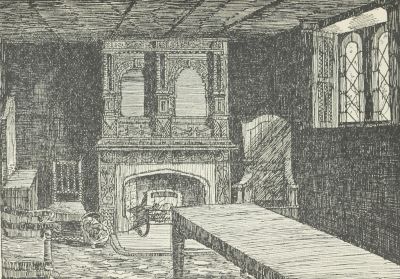
THE COUNCIL CHAMBER, ST. MARY'S HALL
It is very evident that this account of the first falling-out between the chamberlains and the corporation does not go to the root of the matter. Laurence's conduct is more explicable when we turn to the version he gives of the affair in the "Petition of the chamberlains and citizens of Coventry,"[397] for in this document, which he tendered to the prince's council, his finger can be distinctly traced. According to this petition, there were two grievances under which the community then laboured. In the first place the prior, the recorder, Bristowe, and others, withheld from them half of the common lands; in the second, a favoured few "maintained" by the recorder and the mayor, "surcharged" the pasture with what number of sheep they chose, while the common folk of the city were not allowed to go beyond their "stint," the number laid down by the authorities. In a city where there was much clothmaking, and wool greatly in request, there was naturally a good deal of scope for the grazier, and no doubt the men of this calling had come to an understanding with the municipality. The chamberlains' duty, however, was perfectly clear. They were enjoined by an order of leet, passed only nine years before, to drive the flocks of those who surcharged the commons to the pound, and take distress from the owners until they should pay the customary fine.[398] This order they accordingly fulfilled, but whether they really asked for what the municipal version calls an "excess" fine there is no means of discovering. But the mayor desired that they should be ruled by his likings and accordingly tried the persuasion of a week's imprisonment. Finding that after their release the chamberlains still persisted in this course, he again and again delivered up the sheep and remitted the fine. Whenever this was done the officers sustained the loss of several shillings, for the charge for every score was fourpence, and there is mention of nine and ten score, and even of 300 sheep driven into the pound. It would seem that in all these matters the mayor was but the tool of the recorder, Harry Boteler, or Butler, who had succeeded to the recordership in 1456, in the room of Thomas Littleton, of famous memory. It was Boteler who, according to the petition, kept Saunders and Hede in prison over the day of the Easter leet, and "wolde in no wyse suffre" them "to speke a worde for the said comown." He, too, urged on them the signing of the recognisance in £40 "to obbeye the meirs commandements" about the pinfold charges, although the chamberlains "grudged" to do so, "in so moche as they were solemply sworen to the contrarie." And from this bond he would not release them, he cried a month later, "for the best pece of scarlet in England." As for the prior's sheep, though four hundred of them were grazing on the common, "contrarie to old custom," the recorder would not suffer them to be pinned, because the prior, forsooth, was "lord of the soil." And when the chamberlains asked that the closes which the prior kept in severalty might be thrown open at Lammas, it was Boteler who refused, alleging the "composition" made between the prior and the community "in the time of William Saunders beying meir."[399]
"Wher it ought to be comen as all the body of the city knowen; in that the forseid Laurens, on of the said Chamberleins, grugged (grudged) insomoche as the seid mair, decessed, was his fadir and myght not answer for hymself, but said 'that he trusted in God to see hit comen ayen.'"
Then the recorder burst forth:
"That he wold make the seid Chamberlein to curse the tyme that ever he sigh hym and wolde make him to wepe water with his yen,[400] and for to be revenged vppon hym he saide he wolde ryde to complayne vppon him unto our soveraign lorde the Kyng."
The petition ends with a list of the fields enclosed by the prior, the Trinity guild, and others of the city.
It is clear from the recorder's speech that there was expectation of battle toward, and Boteler had no mind to give quarter. Meanwhile Laurence, by his appeal to the prince's council, had stolen a march upon his enemies. A letter, dated September 30, 1480, required that some discreet persons of the city council should ride to Ludlow, bearing a copy of the chamberlain's oath, in order that the prince's council might compose "a variance between certain people of the city about a common pasture." This letter revealed to the corporation the chamberlain's secret mission. "We, your humble and true servants here," the mayor and his brethren wrote in reply, "know no variance betwixt any person here for any common pasture but that we among ourselves, by the grace of God, shall amicably and righteously settle." They begged that Saunders' words might not be "printed in the prince's remembrance," and hoped to have license to punish this troublesome citizen, inasmuch as he would raise up "commotions among the people," and by this means discourage "other misruled to presumptuously attempt such things herafter." As the prince still insisted that the suit should be heard at Ludlow, eighteen "worshipful" men, chosen by the common council, set forth on the journey. Among them were numbered the recorder, lately recovered from sickness; the master of the Trinity Guild; John Boteler, town clerk, presumably a son of the recorder; and William Hede, the chamberlain, Laurence's fair-weather friend, who had betimes humbly submitted to the corporation. The wardens, to whom the paying of extraordinary expenses fell, went with the party to pay for the cost of the journey. There was a goodly following of servants, bringing up the number to forty-four persons in all, for the worshipful folk travelled luxuriously, and to secure their comfort a cook and a harbinger were of the company. The cost of the journey—amounting to £15, 11s. 11d.—was afterwards, by decree of the mayor and council, discharged by Laurence Saunders. There is nothing related of the proceedings of the case, save that the decision was against Laurence. The Leet Book says, as openly was proved, he intended no "reformacion, ... but feyned matiers to th' entent to have be venged for the due punysshement yeven to him for his obstinacy."[401] So he came home to receive "correction," and in his company there came a gentleman of the prince's council to see that he fulfilled all the commands laid upon him. There was nothing for it now but to bow before the storm. In the presence of the mayor, the council, and divers "commons" assembled in S. Mary's Hall, Laurence, it is said, knelt down and besought the mayor's forgiveness, acknowledging his wrong-doing. He was then committed to ward. After a little time his friends' intercession prevailed, and he was allowed to leave the prison, being bound in £500 to appear at the next quarter sessions. The bond, too—for the corporation were little inclined to allow further complaints to royalty—was to be renewed "till content wer' had" of his "sadde demeasnyng."
But though Saunders had been effectually silenced, the strife he had kindled raged on. Bristowe and the prior, whose transgressions in the matter of surcharging were revealed in Laurence's complaint, were both ready to pour forth counter-claims and accusations against the corporation in the hearing of the prince's council, at the time when Saunders' case was still under discussion. Prior Deram being advised to present his grievances in writing to the mayor and his brethren, tendered, on November 16, 1480, an exhaustive list of them,[402] which list the corporation hardly received in a befittingly serious spirit.
Although in the prior's complaint the matter of surcharging is kept somewhat in the background, there can be little doubt that here the real grievance lay. The mayor and his friends had been perhaps very lenient to the convent in this particular until Laurence's petition to the prince had aroused their scruples, and they may have been forced to revive old regulations concerning the "stint." When the prior argued that as "lord of the soil" he was not "admeasurable," but able to drive on to the pasture what number of cattle he chose, the mayor and his brethren feigned blank ignorance. They did not know, they declared, that the prior was "lord of the soil,"[403] but were of opinion that his action would be "disseizin of the common."[404] They even tried to shield Laurence Saunders when the prior alleged that his "slanders" were a source of great annoyance to the convent. He had been examined, they affirmed, and declared he never "noised" such lands as were held by the monks to be common, but those he had believed were so according to "the black book of the city"; but if Laurence had offended, they continued, he would be pleased to abide by what the mayor and prior chose to command him.
There was another memory that rankled with the monks—the tumult on S. Nicholas' day, 1469, and the subsequent action of William Saunders to prevent the prior from "troubling" the city with a lawsuit. His gardens, Deram indignantly reminded them, and his woods at Whitmoor, had been broken into at that date; and he was not allowed to sue the misdoers at law. Again he was met by a front of stolid ignorance. The mayor and community remembered no such breaking, or any hindrance to the prior's suit, which he was at liberty to pursue. Grievances Deram had to pour forth in plenty. The town wall was built on his land, he complained, though his payment of £10 for murage, of pure good will, for repairing the town wall outside his ground entitled him to some consideration in this matter. The folk of the city gave him hourly torment. They broke down his underwood, birches, holly, and hawthorn in Whitmoor Park, and carried them away; they trod under foot his grass and his corn, damaged his hedges "at their shooting called roving, to his hurt a hundred shillings"; they washed in Swanswell pool, and fished in his ponds "by night and by day," and made his orchard and several grounds a sporting place with shooting and other games, and when "they been challenged by his sergeants they gyven hem short langage, seying that they will have hit their sportyng place." The churchwardens lopped off the boughs of the trees in S. Michael's churchyard, and all manner of filth was deposited in the convent ground, "so that the prior may not have his carriage through his orchard"; while by reason of the refuse swept into the river his mill was "letted to go," and himself and his brethren sorely hurt and discomfited by the stench. At divers times the prior had put up bills against the offenders "in certen sessions, but," he concluded resentfully, "thei ben so supported within this citie and the enquestes so favourable to hem that no reformacion nor punysshement hath ben don."
The mayor and community[405] assured the prior in return that they were most anxious to maintain a friendly understanding with the convent. The authorities of the city, they said, "maken dayly als gret diligens as they can to knowe the stoppers of the seid common ryver, and when eny be perceyved, they ben punysshed after their deserve." As to the breaking of the underwood, every year masters of the crafts, by the command of the mayor, enjoined the members to refrain from this "in eschewyng the doughtfull censures of the Church," and also temporal punishment. But the prior was reminded how "the people of every gret cite as London ... yerely in somer doon harme to divers lords and gentyles hauyng wods and groves nygh to such citees ... and yit the lords and gentils suffren sych dedes ofte tymes of their goode will." And if the town wall ran on the prior's land—as it did on other freehold within the city—the convent owed their security to these fortifications, and ought of right to contribute to their erection and repair, "because their lyffeloode within this citie, and their proper Churche may rest in surte be measne of the seid murage." The lopping of trees in the churchyard they laid to the charge of the vicar; while as for the fish in Swanswell pool, they profited by the washing there, and thereby grew "the fatter!" Let the prior, the mayor continued, send in the names of the shooters, trespassers, and the like, and bring an action against them; and take proceedings against the casters of refuse—for they were his own tenants—in his own court leet.
The prior fumed at the audacity of this reply, and still more at the delay in returning it, for more than six weeks had elapsed since his bill of complaint had been issued. His rejoinder[406] was drawn up in two days, a briefer space. The mayor had besought him (not without hypocrisy, to Deram's mind) "that he would be as good to the common weal as his predecessors had been," so that "love ... betwixt" him and the city might "continue and dayly better increce"; but he distrusted these professions of peace. "And whereas," he said, "the meire and his brethren prayen hertly to the prior and his convent lovyngly to accept their answeres made to their compleynts, thei think it is (in them) no lovyng desire." "His greves," he reminded them, had been presented in writing "the xvi day of November last past ... to the which the iide day of Januar next followyng" they had returned answer: "by the which I and my bredern," the good man went on, lapsing into the first person in the heat and hurry of his sentences, "thinke is no thyng accordyng for reformacion, but delayes; wherefore I and they desyre and prey you to have us excused of further communicacion.... For we trust to God in [that] our compleynts ben no feyned matiers, but such as shall be proved be credible proves in writyng." "And for your answeres," he added with a touch of irony, "ye have taken longe leysar to conceyve, suasyous-like (persuasive) as it appereth," they would have none of it, "but we trust to haue oder remedye wher trowthe shalbe knowen."