Front matter (continued 2)
Reading edition
Meanwhile the men of Coventry were gaining every year important graces from Edward III. Now that the power of the prior was thus diminished, there was no one to prevent the acquisition of fresh liberties, and their money circulated freely at Westminster, the messengers bringing back in return the precious slips of parchment sealed with the King's seal, the testimony of new rights to be enjoyed by the townsfolk. In 1334 their merchandise was freed from toll in all places throughout the King's dominions.[120] Six years later licence was given them to form a merchant guild,[121] while other kindred societies sprang up, and received licence to hold land in mortmain.[122] In 1341 the King granted a charter to the effect that any inquisition of lands or tenements within the city should be taken by the townsmen, and not by strangers, an important provision at a time when there were frequent lawsuits between the Queen and the prior.[123]
The convent give a graphic description of the effect of such an inquisition upon their holding, and of the plot between the Queen and the Earl's-men which caused the inquiry to be made.[124] "There came the Men of the Earl's-half of Coventry amongst others ... Conspiring and Compassing the undoing of the said prior and of his monks, and the Disinheritance and Destruction of their Church, and making show of their Intent unto my said Lady that her Seigniorie was more largely than she had occupied.... Whereupon the Stewards and some of the officers of my said Lady, without having any Power or Commission from the Court of our Lord the King, took an Inquisition of the said Men, Adversarys to the said Prior and Convent, what were the Bounds in Ancient times of the Seigniorye of the Earl Rondulph ... which men quickly and Maliciously gave up the said false verdict to the Damnation of their Souls, Saying that all the Prior's-half, which is of foundation of the Church, is two little leys (meadows), whereon the profits by year are not above 50s.... and did fasten stakes of Division to Separate the Seigniory of my said Lady from the Seigniory of the said Prior." What made this action so particularly galling was that it was the "Seigniory of the ffoundation" of their "Church" Isabel called in question, though they had held it, they declared, long time before the coming of the Conqueror, and before the Earls of Chester, whose representative the Queen was, had been heard of in England.
The prior's complaints availed nothing; the men of Coventry were in a sure way of victory, and in 1345 the city was incorporated by charter. Three years later one John Ward took his seat as first mayor of the city. The mayor, bailiffs, and community were henceforth to be responsible for the fee-ferm;[125] and power to hear and adjudge certains pleas, hitherto treated of in the county court, was given to the city officers. The prior and his brethren looked upon this as a last indignity. "They are become lords of the said prior, all whome beforetime were his tenants," and in consequence of the inquisition above mentioned, he and his brethren were now "entirely involved within the danger of the mayor and his bailiffs, for they had not a foot of land of their Seigniory" beyond the priory gates.[126]
Wearied of a struggle which had lasted for twenty years, the litigants, the Queen, the prior, and the newly-made corporation allowed the dispute to be set at rest once and for all in 1355, and the "Indenture Tripartite" made between them took the form of a compromise. Each of the three parties agreed to restore or forego the exercise of certain rights, or at least to accept an equivalent. The prior gave up all claim to jurisdiction over the Earl's-men, and the Queen forgave him £10 of the yearly ferm owing to her, while the franchises he thus relinquished—the right of holding view of frankpledge or leet and other courts with the exercise of the coronership—Isabel bestowed on the mayor, bailiffs, and community. These in their turn agreed to indemnify the convent by a payment of £10 a year.
Other matter of contention was laid at rest. The prior's tenants were to be taxable with the Earl's-men, and to serve as mayors and bailiffs with their fellow-citizens. The restrictions on buying and selling, which had given rise to the lawsuit in the former reign, were wholly laid aside. "Any persons of whatsoever condition they be, [may] sell any manner of wares" in the Earl's part, "or buy at what day or time it shall please them, and they shall not be disturbed by the said prior and convent." And although the market was to continue to be held as of old in the Prior's-half, no toll was to be taken according to the ancient custom, except for horses, while all the regulations concerning sale and merchandise should henceforth "be at the ordinance of the mayor and community." The assize of bread, ale, and victuals was to be kept by the mayor; and though the prior was to have all the profits arising from the fines of offenders against the assize, the officers of the corporation could enter the convent half, and, in case the prior's officers neglected to punish fraudulent brewers and bakers, could levy fines upon these evil-doers and see justice done.
Various restitutions were made on the Queen's part, showing that she and her advisers were really intent on a peaceful solution of the difficulty. The advowson of chapels, chantries, and the like, which she had appropriated, were restored to the prior, who, in his turn, forgave all the delinquencies of the Earl's-men against himself.[127] The "Tripartite" was drawn up so clearly, and in so fair a spirit, that in essentials it was never afterwards called in question. Disputes arose between the convent and the townsmen in later days, it is true, but not concerning the all-important matters of trade and jurisdiction. Nevertheless, this compact put an end, once and for all, to the prior's dominion in Coventry. Henceforth in recounting the history of the place, we have little concern with the convent; our subject touches only upon the rule and fortunes of the mayor, bailiffs, and community of the city.
FOOTNOTES:
CHAPTER VII
The Corporation and the Guilds
After the Settlement of 1355 the figure of the head of the great religious house at Coventry fades into comparative insignificance, and all further quarrels between city and convent hardly rise above the level of petty squabbles of no historical moment. The prior is no longer lord of the place; he merely appears as host of the royal folk, kings, and kings' sons, representatives of the ancient line of the Earls of Chester, when they sojourn within the city. The rent of the Earl's-half[128] now swells the revenue of the Princes of Wales, hence the appellation "Camera Principis," or the prince's (Treasure) chamber, the familiar motto on the city arms.[129]
With the disappearance of earl and prior from the foreground of the picture there emerges another figure, the city merchant, type of a newly-enriched class, the future guide of the destinies of the place. Curiously enough, it is this man's work in stone that has best survived the test of time. What has become of the castle of Hugh and Ranulf? It has utterly disappeared; indeed, its very existence has been sometimes doubted; the name "Broadgate" alone recalls the entrance (latam portam) whereto reference is made in one of Earl Hugh's charters.[130] Where is the priory of Irreys and Brightwalton? Mean streets cover the site, and of the cathedral nought remains but a few bases of clustered shafts in Priory Row and a portion of the North-West tower converted into a dwelling-place. But the outline of S. Michael's spire[131] built by the people is still the wonder of Coventry, and the guild-hall of S. Mary with its glorious roof and window has behind it five hundred years of continuous civic life.
Coventry was now a free and independent corporate borough. The townsmen had power to elect their own officers, and hold their own courts, taking for the common use the profits of jurisdiction, so long as they paid into the royal exchequer the annual fee-ferm of £50 and the prior's ferm of £10. The leading men of the place, most likely the wealthy merchants and others, who had won the charter of liberties from Queen Isabel,[132] now set to work to reorganise courts, elect officials, in short to shape the whole administration to fall in with the new order of things.[133] We know nothing of the manner in which this was done, and as so many of the early records have been lost we can give no account in many cases of the form of municipal rule chosen by the citizens. Here and there curious documents give us a glimpse of the working of certain courts, or the municipal action of this or that body of men. But the information concerning very important points is unfortunately lacking. We are referred, for instance, to the "old custom" of electing officials, but we do not know what the old custom was, and are hence left in ignorance of the manner in which the election was made.
What part the poorer folk—menus gentz—smaller craftsfolk, and working-people played in the struggle for liberty is dark to us, but we may infer from the analogy of other towns,[134] and from the subsequent history of Coventry, that they had but little effective power under the new constitution. The growth of oligarchy[135] in towns is a matter of much debate. How early the few in Coventry engrossed the governing power of which the whole community was—in theory at least—the source, it is impossible in our present state of knowledge to determine. We have testimony as early as 1450 of the great influence of the leading crafts, mercers, and drapers. The evidence—though not always so clear as we could wish—points to a gradual absorption of the conduct of affairs during the fifteenth and sixteenth centuries by a small official class. In the end this clique succeeded so effectually in freeing itself from every device framed to ensure some regard for the popular will, that the charter of 1621 vested all power—and incidentally considerable official emolument—in a close select body "entirely independent of the rest of the community."[136] How early the citizens became aware of the trend of affairs we know not, but it is, maybe, significant that that popular discontent began to manifest itself within a generation after the incorporation of the city. In the late fourteenth and early fifteenth centuries the commonalty set order at defiance, reviled the mayor in the guild hall, and sought occasion to break out in riot and tumult, while under the veil of religious societies, industrial combinations—akin to the modern strike—formed again and again, and were with difficulty suppressed.
After 1420, when the graphic chronicle contained in the Leet Book[137] begins to be available for our researches, a glimpse is given of a fully evolved constitution in working order. On January 25, the feast of the Conversion of S. Paul, the mayor, chamberlains, and wardens were annually elected, the permanent officials, the recorder, legal adviser of the corporation, and the coroner re-appointed, the justices of the peace selected, while the bailiffs, according to ancient custom, received nomination at the Michaelmas assembly of the court leet. The justices of the peace—with the exception of the recorder—served also as key-keepers of the chest containing the common treasure. The court of portmanmote, mentioned in Ranulf's charter, still survived under various names, and in it pleas for debt were tried by the presiding officers, the mayor, and bailiffs. At quarter sessions the mayor, recorder, and three other late mayors, justices of the peace, dealt with criminal offences, and it was, probably, the activity of these comparatively recently created officials,[138]that brought about the degeneration of the leet or view of frankpledge, normally a court of justice for the trial of minor criminal offences, particularly evasions of the assize of bread and beer.[139] By the fifteenth century, the Coventry leet had retained little or nothing of its judicial functions, and merely survived as a court wherein by-laws, binding on the whole community, and grounded on petitions of grievances, received the sanction of the jurats of the leet. Another body, which also possessed legislative functions, was the mayor's council of forty-eight, later known as the common council. While it is from a small select body called the council-house, of which the mayor and aldermen appear to have been ex-officio members, that there sprang the close, corrupt corporation of later times.
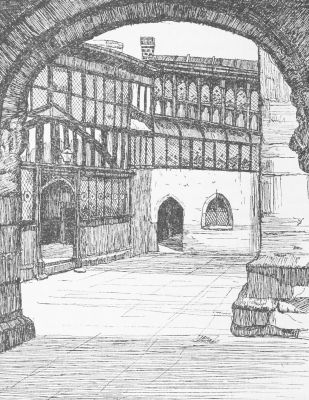
COURTYARD, ST MARY'S HALL, COVENTRY
There are certain officials whose elections or appointments are not entered in the regular municipal records, but who, nevertheless, had great weight in the councils of the city. Such were the aldermen, who first appear in 1477.[140] These officials discharged certain police duties in their respective wards and were of the inner council of the mayor. Under the charter of James I. they became permanent justices of the peace, and members of the corporation. While as justice of the peace, key-keeper, head of the electoral jury and jury of the leet, the master of the Trinity guild was one of the foremost figures among the municipal rulers. His connection, and that of his fellow, the master of the Corpus Christi guild, with the mayoralty was very close. Two years before entering office each mayor was master of the Corpus Christi, and two years after quitting it, master of the Trinity guild. The control they exercised over the revenues of the guilds, which were often put to municipal uses, gave these masters much power and authority with the magnates of the city. The guilds joined their funds with those of the wardens to pension deserving townsfolk[141] and pay the salary of the recorder.[142] Before 1384 the Trinity guild discharged the ferm of £10 due to the prior, receiving a share of common land to be held in severalty[143]—that is separate from the lands of the community—as compensation. Indeed, the guild officers were so clearly considered as officers of the corporation that when they, together with the city wardens and chamberlains, neglected to present their accounts at the annual audit[144] they were one and all brought to book by the leet, and ordered to remedy their neglect under pain of punishment.
The origin of societies known as guilds is involved in controversy, but they were common throughout all Europe in the Middle Ages, bearing eloquent testimony to the fortifying power of combination. They afforded mutual protection to their members, frequently making good any loss sustained from an insurance fund to which all were contributory, and devoting other portions of their revenues to feasts, almsgiving, and public works. Guilds are best remembered, however, in the twelfth and thirteenth centuries, as monopolist organisations, and a third of all the towns in England, with the possible exception of London, had their merchant guild, or body of traders and handicraftsmen, engrossing the local commerce to the exclusion of all men without their ranks. The craft guild was a century behind the merchant guild in its rise and development. Its members met together to make rules, by which all who practised a particular calling in the locality were to be directed in all affairs connected with their trade or handicraft. They devoted some of their revenue to religious uses, the members frequently supporting some church or chapel, or providing candles for altar or processional lights. Other local guilds not definitely commercial, but rather social, in character, often called after some saint, were active in the performance of all good works; they clad the poor in their livery, supported churches, colleges of priests and grammar schools, and pensioned decayed and deserving members. At Coventry, in the later fourteenth and earlier fifteenth centuries, guilds rose rapidly, and as rapidly coalesced, or, in the case of those "yeomen" or journeymen fraternities, which served to focus the prevailing industrial discontent, failed to maintain themselves in face of the hostility of other powerful previously existing associations. Two fraternities survived to play a great part in the city's mediæval history, the Corpus Christi guild, founded in 1348, and the better-known society of the Holy Trinity, S. Mary, S. John the Baptist, and S. Catherine, properly a fusion of four different fraternities, founded between 1340 and 1364, and known for brevity's sake as the Trinity guild.
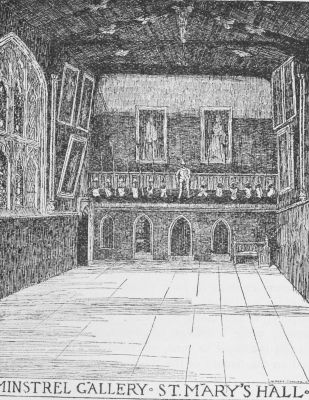
MINSTREL GALLERY ST MARY'S HALL
It is possible that it was to the foundation of the merchant guild of S. Mary[145] in 1340, the kindred associations which sprang up around it, and to the gifts of their members in lands and money that the townsfolk owed the purchase of the incorporation charter.[146] It is frequently found that the same man serves in different years as mayor and master of the merchant fraternity.[147]
The town hall of S. Mary, in which not only the guild feasts were held, but municipal business[148] was transacted, and the town chest, as well as the guild plate,[149] stored, tells by its name of its connection with S. Mary's brotherhood. The vaulting of the entrance porch of this building still bears on its central boss a carving which represents the coronation of the Virgin; another of the porch carvings—now weather-worn—recalled the Annunciation, and a scene on the famous tapestry within the hall, the Assumption,[150] so that the guild brethren, could be everywhere reminded of the scenes in the life of their chief patroness. No church, however, recalls the Virgin's name, though materials from an unfinished building, which should have borne that dedication, were transported from Cheylesmore to Bablake, where the stately, early Perpendicular church of S. John the Baptist was rising on ground granted by Queen Isabel in 1342 to the fraternity called after that saint.[151] Both S. John the Baptist's guild and S. Catherine's—the latter connected with S. Catherine's chapel in S. John's Hospital,[152] coalesced between 1364-5 with the guild merchant, to be absorbed later by the all-embracing Trinity fraternity. This fusion of the guilds, which had certainly taken place informally before 1384,[153] was ratified by patent in 1392,[154] when the united revenues were increased to the amount of £86, 13s. 4d. a year. The completion of S. John's church became the especial care of the Trinity guild, and the dues taken at the Drapery, where cloth was sold, were devoted to that purpose, while a college of priests, whose number was in 1393 increased to nine, officiated at this church, and lived on the bounty of the brotherhood.[155]
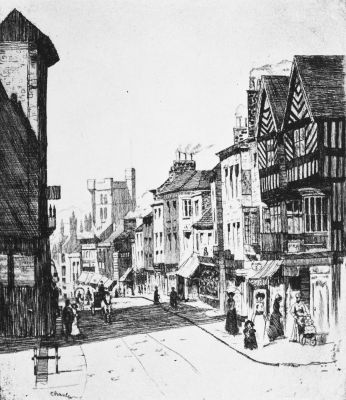
SMITHFORD STREET
The priests of the merchant guild, as was meet, occupied from the beginning the most honourable place of all. They sang their "solemn antiphonies" in the lady-chapel of S. Michael's, the great parish church of the Earl's-half, a practice which was still continued after the title of the guild became merged in the society of the Trinity;[156] while the guild of the Corpus Christi, composed, it would seem, of the prior's tenants, occupied the corresponding chapel in the parish church of the Trinity.[157]
One guild, that of the fullers and tailors, called after the Nativity, carried on an obscure existence in connection with the since demolished chapel of S. George outside the Gosford gate. The formation of this society was violently opposed by the powers that were in 1384 on the ground that the purpose of its members—"labourers and artificers of the middling sort" and strangers—was to withstand the mayor and officers of the city, and not to promote the welfare of souls.[158] After 1400, further guild-making had come to have little favour with the ruling men of the city. Three several times did the mayor and bailiffs obtain patents forbidding the formation of guilds other than those already existing within Coventry.[159] While the close alliance of the older fraternities and the corporation is shown in the fact that the meetings of the guilds of S. Anne and S. George, formed by journeymen tailors in the first quarter of the century, were suppressed by royal command under the pretext that their meetings were to the manifest destruction of the ancient foundations, the guilds of Holy Trinity and Corpus Christi.[160]
FOOTNOTES:
CHAPTER VIII
The Mayor, Bailiffs, and Community
We have seen that it was the stable and well-to-do classes which bore rule over their fellow-citizens. Men of substance, and they only, were eligible for office, and the terms "degree of a mayor," "degree of a bailiff," used in assessing fines, show that there was some strictness maintained with regard to this property qualification. And indeed it was needful that mayors, bailiffs and the like should be moneyed men, for their responsibilities were great and the turns of fortune curious, for should any source of revenue fail, they were compelled to make up the deficit, and hence were poorer men at the year's end than at the beginning. Thus when the prior refused to pay the murage tax for twenty years, the chamberlains, or treasurers, contributed the sum that was lacking from their own purses.[161] Still, on the whole, the magnates preferred to acquiesce in their election rather than pay £100, 100 marks, or £40 as a fine for refusing to fill the respective offices of mayor, sheriff or master of either guild. Once, indeed, a certain Roger a Lee declined to occupy the office of chamberlain, though he was a man well-to-do, having received £30 in money and plate with his wife, and must—so the prevailing opinion was—have "had right largely of his own," or else "John Pachet would not have married his daughter to him." When solemnly adjured to "come in and exercise the said office," Roger persisted in his refusal, nor did the imposition of a fine of £20 avail to shake his resolution.[162]
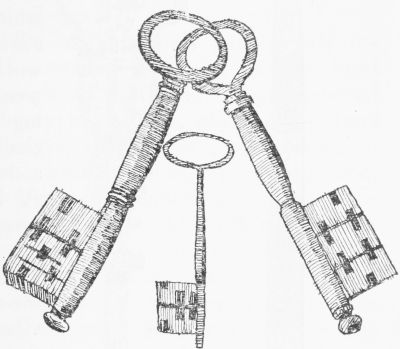
THE CITY KEYS
But having once accepted office, with all its emoluments, risk and toil, a citizen was forthwith raised to a platform, high above the mere "commoner," who had neither lot nor part in the rule of his city. He became one of the "men of worship," whom to insult was a dire offence;[163] and his doings must not be cavilled at, or explained to the vulgar herd. Gravity, decorum, and, above all things, secrecy[164] marked the councils wherein he took part. Seemliness of behaviour was demanded from him; a late mayor must live cleanly, the leet decreed, and not give way after warning to "avowtre, fornicacion, or usure," if he wished to rise higher as master of the Trinity guild, or continue to meet his brethren at the council board.[165]
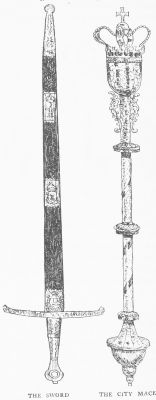
THE SWORD THE CITY MACE
Distinguished on great occasions by his official dress, he was surrounded by an atmosphere of form and ceremony, which no doubt had its effect on the outside world. When the mayor went to mass every morning at "seven of the clock" the sword-bearer and officers attended him. A like procession was formed on the way back, for though the underlings might go about their business during service, they were commanded to "hearken" the time of the mayor's coming out of church so as to be ready to accompany him homewards.[166] So sensible were these worthy men of the dignity of their position, that questions of precedence were ever considered of great moment. When Harry Boteler, the recorder, fell into disgrace in 1484 by magnifying his office at the mayor's expense, the council thought it a due punishment that he should yield his place to the master of the Trinity guild, who thenceforth went by the mayor's side in all municipal processions,[167] an order afterwards rescinded probably to gratify one of Boteler's successors; the mayor from that time walked alone, the master and recorder together.[168]
The labours of the town officials were greatly increased by the all-embracing character of the local legislation. The people of the Middle Ages believed devoutly in the efficacy of the law, and many matters concerning prices, wages, and the like, now known to regulate themselves according to supply and demand, were at times the subject of an infinite amount of often fruitless law-making. Nothing could check the zeal and energy of the local law-givers; no subject was too difficult for them to grapple with, none beneath their consideration. The worshipful men might reverse the whole organisation of the crafts connected with the iron industry at one leet sitting,[169] or, on the other hand, turn their attention to the local supply of halfpenny pies, or the amount of wheat put by the families of the two parishes into the holy cake, or blessed bread, distributed to the congregation. No doubt it was impossible to enforce all these regulations. All the energy of the leet, or council, and the vigilance of the town officers often failed to do away with a long-standing abuse. It was forbidden, under penalty of £10, to throw refuse into the Sherbourne; yet though "great diligence" was made to learn who the offenders were, it did not hinder the commission of the offence.[170] And although, according to the decrees of leet and council, people were compelled to be cleanly, honest and peaceable, I make no doubt that ducks[171] and swine still appeared in the streets,[172] bakers' loaves fell short of the proper weight,[173] and men of craft bore arms in the city, and wounded each other in quarrel.[174] In short, many regulations were mere paper regulations to the end of the chapter.
The mayor and his colleagues had no light work before them on taking office. Numberless details of municipal business went far to fill their days with employment. In addition to his judicial duties, a mayor examined, either in person or by deputy, a great part of the household stuff which came into the city to be sold. He must needs have some acquaintance with matters military, when a threat of invasion or civil war turned him into a captain, and the citizens under him into soldiers, such as they appeared at the half-yearly muster, each armed with such weapons as suited his degree.[175] While, in order to acquit himself with credit in the difficult and delicate relations wherein the citizens were frequently involved with the outside world of politics, a mediæval mayor must gather all the information he could upon affairs of state.
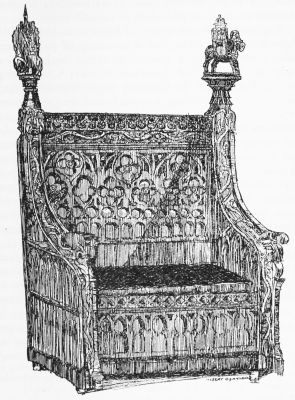
THE OLD STATE CHAIR
The bailiffs, with their work of court-holding, ferm-paying, and fine-collecting;[176] the chamberlains, who overlooked the common pastures, and put the murage money to its proper use;[177] the wardens, who supervised town property and made payment of sundry expenses, delivering up their accounts for the annual audit, were all deeply immersed in business. And the keeping of these accounts was no easy matter, so great a variety of items was included therein, and so frequent were the demands upon the public purse. Now the wardens would be called upon to entertain and reward the bearward of a neighbouring nobleman, or the groups of strolling players who set up their booth in the inn-yard or market-place; or, again, to contribute to the maintenance of the knights of the shire,[178] or lay down the ten pounds, which the mayor took as the "fee of the cloak";[179] now to defray the cost of a civic banquet, or that of the mayor's new fur cap, keeping in the latter case, the "olde stuffe" for the use of the town.[180] Surely much of the activity of the House of Commons under Edward III. and the House of Lancaster is in the main due to the training many of its members received at home in the local guild-hall or council-house.
A great part of the municipal business in the Middle Ages was carried on by bodies consisting of twenty-four men, a double jury, a number occurring in London as early as 1205-6,[181] in Leicester in 1225,[182] and rather later in Norwich.[183] In Coventry in the fifteenth century twenty-four late officials, frequently including the justices of the peace, brought together by some indirect process of which we have lost the secret, elected the officers for the ensuing year. The same number, and to all intents and purposes the same men, were the jurats of the leet. A council of twenty-four, chosen by the mayor and perhaps identical with the jury of the leet, examined petitions four days before the two great assemblies of this court, in order, it seems, to discuss and decide on their rejection or acceptance by the jury of the leet. Moreover, twenty-four nominees of the mayor reinforced the electoral jury of twenty-four to form the mayor's council of forty-eight.[184] In practice, however, there was no rigid adherence to these numbers; small executive or deliberative bodies frequently met, and on occasions when it was deemed necessary large "halls" or assemblies of indeterminate numbers were summoned by the mayor to testify to the popular will. This calling together of the community, a relic maybe of immemorial custom,[185] affording in its traces of ward[186] organisation evidence of a form of government older and more popular than the system employed by the town rulers in the fifteenth century, reveals a lack of any well-thought-out scheme to ensure the election of representatives. Hence it seems to have been of little avail for purposes of popular control. The members were summoned at the requisition of the mayor, and were frequently to a great extent members of the official class. Hence in the cases of which we have record they did nothing but set the seal of approval to the official policy. Thus in 1384[187] the mayor summoned four or six out of every ward to learn what the common wish was concerning the Podycroft and other common lands, which the Trinity guild kept in severalty in return for the annual ferm of £10 paid to the prior on behalf of the corporation, the assembly was in favour of the continuance of the old arrangement, though it was avowedly a most unpopular one. And no orders of leet availed to check the open discontent of the common folk, who certainly did not feel themselves in any way bound by this assembly. The guild constantly found that their fences were broken down, and their fields overrun by the people at Lammas; and in 1414[188] it was thought necessary to decree that people trespassing (delinquentes) in the enclosures should be arrested, and imprisoned until they had made sufficient amends "by view of the guild master and six of the guild brethren."
But the discontent of the commonalty did not abate, and once more, in 1421, the officers in high place went through the form of consulting their fellow-townsmen. A hundred and thirty-four citizens, summoned at the mayor's requisition to S. Mary's Hall, gave the lie to popular discontent a second time, and approved of the giving over of the Mirefield, the Podycroft and Stivichall Hiron to the use of the guildsmen. But the anger of the townsmen became so hot that in the following year they destroyed certain gardens at Cheylesmore, which, it appears, had been enclosed by well-known townsmen, members of the mayor's council and justices of the peace.[189]
The mayor's council of Forty-eight, one of the most important of the constitutional expedients ever devised by the ruling class at Coventry, met apparently for the first time in 1423. In the previous year, no doubt with the notion of allaying the prevailing discontent, the idea of selecting a definite number of commoners from every ward to form a council to watch over the interests of the commonweal first took shape. There had been "dissentious stirrings" concerning enclosures, and there is little doubt that at the Michaelmas leet there was some speech of giving those outside the corporation some means of checking the alleged malpractices of the municipal rulers. The mayor had been charged to call forty-eight commoners, divers out of every ward, to hear the chamberlains' accounts for three years past, and to witness any grants made under the common seal.[190] But there is little or nothing to tell of the activity of this body of commoners.[191] On the other hand, at the first opportunity the corporation turned this idea of a council into a weapon for their own defence by providing at the election of the mayor in the following January that there should be one consisting of the staunchest supporters of the town rulers. "It was provided," the Leet Book says, "that the said mayor should call and take to him the same twenty-four worthy men, that were of his election, with other twenty-four wise and discreet men, chosen to them and named by the said mayor," and that this company should "put in rule all manner of good ordinances" for the benefit of the city.[192] And the worthy men were determined that this good ordaining should be followed by prompt obedience.
"It is and hath been accustomed," says an insertion in 1484 in the records of Leet, "that whatever the foresaid forty-eight persons ordaineth and establisheth for worship of mayoralty, bailiffs and commonalty of this city, according to the law, all the whole body of this city shall be bound thereby."[193] A certain latitude was allowed to the mayor as to whom summons should be sent "when he had need of forty-eight persons," save that he was always warned to require the attendance of "sufficient" men,[194] i.e. of suitable rank. After 1446 we find that the presence of a quorum of twelve persons was sufficient for the transaction of business, the whole body afterwards giving their assent to the measures ordained by this smaller company.[195] And it was most probably this small working body that was the ancestor of the inner council of the mayor and aldermen, which ultimately, by the charter of James I., gained complete and unchecked control over the municipal affairs of Coventry. The rule of this council gradually became a veritable tyranny. Even the official class rebelled against its dictates. We hear of a majority, "the most part" of the council, and this includes the idea of a dissentient minority. Those who transgressed the commands of this majority, if they had never filled the sheriff's post, lost the freedom of the city; while late mayors or sheriffs lost their official rank. He shall "be exempt," the order ran[196] in the sheriff's case, "from wearing scarlet among his company in all common assemblies, feasts, and processions"; and further, to be punished with fine and imprisonment at the mayor and council's discretion; on a late mayor the same penalty was laid, with the addition that he should be "exempt from his cloke and council"; while any citizens "comforting the disobedient" were to suffer the same penalties. When we learn that this order was framed in 1516 for the correction of John Strong, late mayor and ex officio member of the council, we may form some conception of the tyranny of this body, whose doings even divided the corporation against itself.
FOOTNOTES:
CHAPTER IX
Coventry and the Kingdom of England
So far was Coventry from the great centres of the national life, that there is little to connect the place in the earlier parts of its history with the history of the kingdom.
William I. may have passed through on his way from Warwick to Nottingham on one of his journeys to crush the rebellious Saxons, and Stephen, as we have seen, swept down on the castle—that famous "castlelet or pile"[197] in Earl Street—and razed it to the ground. Other notable travellers came during this period to Coventry, but secretly, for they wished to escape pursuit. Many evil-doers claimed the protection of the Church in those days, and when any fugitive entered the sanctuary, he was safe from pursuit. There he made confession of his crime, and, if he left of his own free will, he must abjure the kingdom, and make straight for some port appointed him by the coroner, there to take ship for foreign lands. Many criminals on quitting the sanctuary found their enemies lying in wait, and perished, although they held the cross, symbol of the Church's protection, in their hand. Men feared to incur the penalty of excommunication, which the violation of sanctuary always brought, by dragging Faulkes de Breauté from Coventry church; and this Norman adventurer, whom the favour of John and Henry III. had raised to riches and greatness until he was "plasquam rex in Anglia"—of more account than the King—put himself under the bishop's protection, and travelled in his company to Bedford to throw himself on the King's mercy. He was banished the kingdom. With him fell, in 1222, the foreign party under Peter des Roches, who for so many years had thwarted the designs of Henry's great minister, Hubert de Burgh.
In other ways the reign of Henry III. was locally a memorable one. During the siege of Kenilworth, which lasted from midsummer to December 1266, the neighbourhood was the centre of military operations, but when the castle containing the remnant of De Montfort's following surrendered, the smouldering fires of civil war died away. Part of the famous ruin that witnessed this siege, the Norman keep, or Cæsar's Tower, is standing yet. But of all these events the local documents tell us nothing. In spite of the stirring scenes enacted at Kenilworth, scarce five miles away, we do not know whether the folk of the town took part with De Montfort or with the King.
The city has no associations with Edward I.,[198] but his son, who had strong partisans among the convent folk, appointed a levy to meet him at Coventry on February 28, 1322, before he went to fight with and defeat Lancaster at Boroughbridge.[199] Edward III. tarried in Coventry in 1327, the year Cheylesmore passed into Isabella's hands. This queen is one of many women who bulk large in Coventry history. Her ears were always open to the complaints of the hard usage her tenants received from the prior, and messengers doubtless often travelled between Coventry and Castle Rising, in Norfolk, to bear news to the queen of her enemy's undoing. She also took the Grey Friars, who had become famous for their sanctity, under her protection, and a letter[200] from her, written at their request, begging that there might be no interference with their privileges of burial, is still extant. At that time many bodies of great folk, who "as Franciscans thought to pass disguised," were buried clothed in the habit of the order in the Grey Friars' chapel, bringing no small profit to that famous house. No doubt the Queen's protection of their rivals was another drop in the monks' cup of bitterness.
After Cheylesmore and the Earl's-half became a royal manor, kings and princes very frequently visited the city; for as Coventry had by this time become an important place—already accounted the fifth city in the kingdom—its wealth was an attraction to needy kings, who desired to be on good terms with burghers who were becoming a power in the land. It was this wealth which enabled the citizens to establish their position in the reign of Edward III. and his grandson by the purchase of fuller and yet fuller charters of liberty; but this wealth did not relieve the city from the agrarian and industrial unrest which makes memorable the reign of Richard II. At the time of the Peasant Revolt in 1381 John Ball was taken in hiding in an old house, says Froissart, in Coventry, where he had possibly a home or relatives.[201] The commonalty of the city had, maybe, given ear to his doctrines of equality and communism in former days, for there was at that time great suffering and discontent among the poorer folk. The artizans were oppressed not by their lord—as the men of S. Alban's or Bury S. Edmund's—but by their own fellow-townsfolk, the rich merchants, who held high office in the corporation. Year after year there comes the same complaint. This or that mayor enclosed the common pasture lands,[202] so that the people had not sufficient grass for their cattle, or refused to punish his brethren and allies the victuallers, who broke the assize of bread, so that the people were cheated of the barest necessaries of life. The enraged artizans, who, in 1387, "cast loaves at the mayor's head because the bakers kept not the assize, neither did the mayor punish them according to his office," would no doubt listen gladly to the discourses of this old-time socialist. "Good people," he would say to the assembled multitude, "the maters gothe nat well to passe in Englande, nor shall nat do tyll every thyng be common.... We be all come fro one father and one mother, Adam and Eve; wherby can they (the gentlemen) say or shewe that they be gretter lordes than we be?... They dwell in fayre houses, and we have the payne and traveyle, raine and wynde in the feldes; and by that that cometh of our labours they kepe and maynteyne their estates.... Thus Jehan [Ball] sayd ... and the people ... wolde murmure one with another in the feldes and in the wayes as they went togyder, affermyng howe Jehan Ball sayd trouthe."[203] Change a word here and there, substitute "merchant" for "gentleman," and "in the workshops" for "in the fields," and you have a discourse which would have greatly enraged the men of Coventry at the time of the Peasant Revolt.
The murmur about another name greater than that of John Ball had also reached the citizens. Lutterworth is scarcely fifteen miles distant from Coventry, and if we may judge by the tale of subsequent troubles and persecutions, there were many followers of Wickliffe within the city.[204] William Swynderby, who had preached to crowds in the Lollards' chapel at Leicester, being forsaken of his friends because he had recanted rather than face martyrdom, left that place and so came to Coventry in 1382.
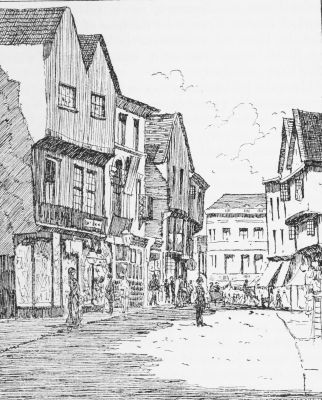
HIGH STREET, COVENTRY
There he tarried nearly a year, making many converts, but being forced by the clergy to depart, he vanished into the fastnesses of the forest beyond the Malvern Hills and there hid from his persecutors many years.[205]
Nevertheless the Wickliffite tradition must have persisted after his departure, for in Oldcastle's day the city had become a centre for the issue of Lollard books.[206] Nicholas Hereford, collaborator in Wickliffe's version of the Bible, is also associated with Coventry, where—after 1417—he died.
His was a life of strange vicissitudes, for having endured imprisonment in a papal dungeon at Rome, and "grievous torment" in the archbishop's castle of Saltwood, Kent, he abandoned Lollardry, recanted at Paul's Cross, and rising to important position in the Church, learned to persecute those of his ancient faith. In later years he entered into the solitude and silence of the Carthusian monastery at Coventry and so vanished from our sight.[207]
The foundation-stone of the church of this very monastery had been laid in 1385, by that champion of orthodoxy, Richard, King of England, who, in the hearing of the mayor and other notables promised to be the founder thereof and bring the work to completion.[208] After the Dissolution this house passed into the hands of the Lincoln family; the arms of Edward Clinton, Earl of Lincoln, are painted in one of the rooms of the still existing house. Part of the Prior's lodging remains, and in one room a portion of a large fresco of the Crucifixion reveals the figure of Christ from the knees downwards sprinkled with fleur-de-lys. Two years later Richard again visited the city what time Chief-Justice Tressilian, the "hanging judge" of the Peasants' Revolt, and the court of King's Bench,[209] sat therein, and bestowed on the mayor the right to have the civic sword borne before him by an officer. The MS. Annals say that in 1384 the mayor, John Deister, had forfeited this right, and that the sword was borne behind him, "because he did not justice." The Leet Book, however, makes John Marton mayor in this year,[210] and indeed the Annals have come down to us in a state of sad corruption.
Maybe these frequent royal visits were not always welcome. A court of justice accompanied the King wherever he went, for the steward and marshal of the household had jurisdiction, superseding other authority of shire or borough, over an area of twelve miles to be counted from the King's lodging.[211] Before setting forth the steward gave notice to the sheriff of the place wherein the King proposed to sojourn, so that prisoners might be brought thither for trial at the household officers' court, a practice so little popular that rich and powerful towns purchased the chartered privilege, whereby the mayor became steward and marshal of the household. This right Coventry obtained in 1451. Kings, when they came to the city, were usually lodged at the Priory, though there was a quasi-royal residence, first occupied by the Mohauts, at Cheylesmore; but the vast retinue found shelter within the town. At the command of the marshal the doors of the principal folk of the place were marked with chalk, and the dwellers there found they had to accommodate some member of the royal party. There was a certain price to be paid for the advantages of situation as a great thoroughfare town between London and the north-west, and a manorial relationship to the Princes of Wales.
The most memorable sojourn of this vain, beautiful, decadent king, Richard II., within the city took place in 1397 when Coventry witnessed the preparations for the duel between Henry Bolingbroke and Mowbray, Duke of Norfolk. The splendour of royal and knightly accoutrements at this meeting must have dazzled the sober townsfolk, and perhaps they shared in the bewilderment of the Court at the strange vacillation of the King, who, when all preparations were made, forbade the duel to take place. Holinshed[212] tells of the "sumptuous theater" on Gosford Green wherein the lists were made ready for the combat; and wherein too, after the combat had been stayed, the two adversaries sat two long hours waiting until the King's pleasure should be known. When sentence of banishment was pronounced and leave-takings over, "the duke of Norfolk departed sorrowfullie into Almanie, and at the last came to Venice, where he for thought and melancholie deceased"; for Harry Bolingbroke, however, whose sentence was not like his adversary's, for life, but for ten years, many active days remained. Gosford Green, where this scene was enacted, is still a green, and as yet unbuilt on. The ruins of Caludon Castle, where Mowbray, Duke of Norfolk, passed the night before the meditated encounter with Bolingbroke, are still visible from the highway leading from Stoke to Leicester, but of Baginton Castle, where his adversary slept, scarcely more than the foundations remain. Richard was lodged in a tower belonging to Sir William Bagot, about a quarter of a mile without the town. Sir William, who with Bushy and Greene acquired such unenviable notoriety as creatures of Richard II., lies buried in Baginton church, where a monumental brass of rare workmanship, now placed immediately under the rafters of the chancel roof, once marked the place where he was laid.
It is likely that Richard saw Coventry once again when, badly horsed and in unkingly array, in 1399 they brought him, a prisoner, on the way from Flint on the last journey to London.
It is fitting that in a city so unorthodox as Coventry the first attack should be made on the vast possessions of the Church. At the summoning of the "Unlearned Parliament" in 1404 a special precept was given to the sheriffs to prevent the return of those skilled in the law as members of parliament, and Coventry, remote as it was from the law-courts at Westminster, was a happy spot to choose for such an assembly. The respect the clergy had once commanded was now withheld from them by reason of the dissolute lives so many led, and their greed of wealth, whereto we find such abundant allusion in "Piers Plowman" and Chaucer's poems, and the proposal to appropriate the wealth of the Church to secular ends was well liked by the knights of the shire. Archbishop Arundel pleaded in response to this attack that the clergy gave tenths and the laity only fifteenths towards the King's necessities; moreover, the Church was not wanting day nor night in rendering the King service by masses and prayers to implore God's blessing upon him. Whereat Sir John Cheyne, the speaker of the Commons, with a stern countenance, said "that he valued not the prayers of the Church." But it was early days for such words as these. "It might easily be seen what would become of the kingdom," was the severe reply, "when devout addresses to God, wherewith His Divine Majesty was pleased, were set so light by." The work of Henry VIII. was not to be anticipated, and the knights desisted from the attempt at the threat of excommunication.[213]
The town was witness at this time of an example of the lack of reverence for the mysteries of religion displayed by the people who were about the person of the King. Dysentery was very prevalent at Coventry during the session of parliament, and one day the archbishop of Canterbury encountered a procession bearing the Host through the streets to some sick man's bedside.[214] The archbishop bent his knee, but the King's knights and esquires, not interrupting their conversation, turned their backs upon the Sacrament. The ecclesiastic was filled with holy indignation at such irreverence. "Never before was the like abomination beheld among Christian men," he cried, and went to complain of the offenders to the King. Henry was at first loth to punish his followers, but he was finally moved to do so by the prelate's eloquence, for the House of Lancaster in its weakness had allied itself with the Church, and looking to that body for support, the King was careful not to alienate so powerful a friend as the Archbishop of Canterbury.
The Lancastrian kings were, however, better known in the city as borrowers than as champions of the orthodox faith. Royal folk at that time, in spite of their great array and state, were often at a loss for ready money, and the treasury of Henry IV. was notoriously an empty one. Henry V. too, wanting money to prosecute his wars, in the third year of his reign borrowed 200 marks from the mayor and community, leaving in pledge "his great collar, called Iklynton collar,"[215] garnished with 4 rubies, 4 great sapphires, 32 great pearls, and 53 other pearls of a lesser sort, weighing 36¾ oz., and then valued at £500. When the King or any great noble desired to borrow, and the citizens were willing to lend, collectors were appointed by the corporation to go through each ward and take from every man his contribution towards the loan. Each citizen paid, according to his ability, a sum varying from 13s. 4d., taken from the most substantial people, to a penny from those, of the poorest class. The extent of every one's property, more or less accurately gauged on these occasions, was a matter of common knowledge. Where there was so little privacy in life and such frequent assessments, neither wealth nor poverty could well be hid.
Did Shakespeare glean any legends of Prince Hal from Coventry sources? He must often have visited the city as a travelling player, and, since both the names of Shakespeare and Ardern (or Arden) occur in the Coventry records, the poet may have had kinsfolk in the place. He brings the prince quite gratuitously thither, causing him to meet Falstaff followed by the famous ragged regiment on the high road leading to the city.[216] Falstaff was in his youth "page to Thomas Mowbray, Duke of Norfolk,"[217] who held Caludon Castle, a few miles from Coventry, and Peto, whom his master bade meet him at the towns-end, bears a Coventry name.[218] It may be there is little or no contemporary evidence for the tale of Henry's wild doings, which Shakespeare localised at Gadshill and the "Boar's Head" tavern in Eastcheap, and it is more or less a matter of temperament or preconceived notions with historians whether, on weighing the testimony, they dismiss or accept familiar traditions of the prince's robbery of his own receivers,[219] or assault on Judge Gascoigne.[220] To the ordinary reader it seems as if there cannot have been such a vast deal of smoke without some little fire. The suspicion grows that Henry may well have passed a short time of idle apprenticeship before becoming a veritably industrious master.
There is a familiar Coventry variant of the Gascoigne story wherein the mayor, John Hornby, plays, as it were, the part of the Chief-Justice, since he, in 1412, say the City Annals or Mayor-lists—"arrested the Prince in the Priory [one MS. reads "city"] of Coventry." Unfortunately the source whence this information is obtained—the MS. Annals or Mayor-lists—is not above suspicion. The annals are a collection of seventeenth- and eighteenth-century documents,[221] varying slightly among themselves, but evidently, as far as the bulk of the earlier entries are concerned, copies of a common original, now probably lost. A chronological tangle, they contain most valuable and authentic information—particularly about the mystery plays—coupled with entries that are manifestly corrupt. It is conceivable that the earliest annalist placed on record that the prince "rested," i.e. remained at the priory during that particular mayoralty, or that he was concerned in some arrest made at the time, and that the entry has been transformed by the errors of successive copyists. In the latter case the process could be paralleled by the entry of 1425 when the MSS. gave as the principal event in the mayoralty of John Braytoft:—"He arrested the Earl of Warwick and brought him to the Gaol of this city." This is, beyond all possibility of doubt, an error. No Earl of Warwick was ever arrested at Coventry. Thomas Sharp, who worked eighty or ninety years ago, from documents that have been since destroyed, gives the early, correct version, borne out by independent testimony, when he reads: "The Earl of Warwick came to Coventry to seize on the Franchises, and inquisition was made of John Grace, and the mayor arrested him and brought him to the Gaol of the City."[222] It is therefore possible that similar errors may have crept into the Hornby entry, though this cannot be dismissed as a pure invention until a searching investigation has been made of contemporary records.
Henry V. seems to have been much beloved in Coventry, if we may judge by the hearty welcome given to him on his coming thither on March 21, 1421. The mayor and council ordered that £100 and a gold cup worth £10 should be presented to the King, and the same to the Queen "in suo adventu a Francia in Coventre," for those times a truly magnificent gift. The citizens never thereafter beheld the King. For in the following year, being overtaken at the Bois de Vincennes by a so grievous sickness that his physicians told him he had but two hours to live, he bade his confessors chant the Penitential Psalms. And in the midst of their chanting, as if in answer to an unseen adversary, he cried: "Thou liest, thou liest! My part is with the Lord Jesus." Thus died Henry V.
Troubles connected with religion soon came upon Coventry. In 1424 the preaching of a hermit attracted a great audience in the Little Park during five days' space. The preacher, one Grace, who had been first a monk, then a friar, and lastly a recluse, disarmed suspicion by announcing that he had been licensed to preach by the bishop's ministers of the diocese. At last, however, a report spread that he was not "licenciate," "and grett seying was among the people that the priour and frer Bredon wold have cursid all tho' that herdon the said John Grace preche." This rumour of the intention of the two most influential churchmen in the city—the head of S. Mary's convent, and the best-known member of the community of Grey Friars—greatly moved the townsfolk, and the two ecclesiastics above-named, fearful lest harm should befall them, refused to leave Trinity church, whither they had repaired for evensong, until the mayor should come to appease the multitude. "Notwithstandyng they myght have goone well inoughe whethur thei wold," the Leet Book says, with a touch of contempt. And thus it was that a report went about in the country "that the comens of Coventre wer rysen, and wold have distroyd the priour and the said frer," which report unhappily spread to the ears of those that were about the King. The next year the Earl of Warwick and a special commission of justices were sent down from Westminster to inquire into this movement within the city.[223] For some time the franchises were in danger of confiscation; but after the citizens had borne great charges, upwards of £80 for "counsel" and other costs, their peace with the ruling powers was made.
It is natural to infer that this disturbance, which the city authorities treated as so trifling, but which appeared to the powers at Westminster a highly serious matter, was connected with Lollard preaching. It seems that this obscure sect was never wholly crushed, but lingered on in certain districts throughout the fifteenth century. Leicestershire, in Wickliffe's time, had been a perfect hot-bed of heresy. "There was not a man or woman in that county," it has been said, "save priests and nuns, who did not at that time openly profess their disbelief in the doctrines of the Church, and their approval of the new views of the Lollards."[224] The contagion soon spread to Warwickshire. No doubt persecution did its work in many parts. The open profession of Lollardism was highly dangerous in the fifteenth century, and the cause counted many martyrs.
The Coventry men were, most likely, implicated in the obscure rising under Jack Sharpe in 1431; at least arrests were made in their neighbourhood.[225] These offenders, whose scheme for the disendowment of the Church was both behind and in advance of those times, were shown no mercy, but suffered the penalty of treason. The bishops of Coventry, at a later date, made the city the theatre of their persecutions, whereat many recanted, but others endured to the end.
Echoes, first of the great doings of Englishmen in the French wars, and then of the reverses which befell them, reach us from time to time, chiefly in the form of requests to relieve the royal poverty. And the chief folk of the town frequently travelled to London in order to procure sureties for repayment of money lent to the King or other members of the royal house. Thus when the Earl of Warwick, in 1423, wrote to beg the citizens to relieve the necessities of the child-king Henry, "now in his tender age and his greatest need," informing them, as an incentive to their liberality, that the townsmen of Bristol had "notably and kindly acquit them" in these matters, the citizens lent £100 willingly enough. But with the prudence which distinguished their everyday doings, they sent John Leder, late mayor, to London to negotiate for pledges for future repayment,[226] which sureties, we are told, "might not be gotten without great labour."[227] Richard Joy and Laurence Cook[228] undertook a like errand the same year, for the protector Gloucester, the husband of Jacoba of Hainault, who proposed—so he informed the citizens—"to pass over the sea with God's might ... to receive ... his lands and lordships," begged the good folk of Coventry to ease him in his undertaking with £200 "upon sufficient surety." Whether the good folk believed that the expedition to Flanders would turn to "right great ease of the people, and especially of these merchants of this realm," as the duke boasted, we cannot tell; but they sent him 100 marks, insisting nevertheless upon obtaining the security he had been so ready to offer. They gave, however, "with all their good hearts" to those more worthy of respect than Gloucester; and when Talbot was a prisoner in the hands of the French, they sent 23 marks towards his ransom.[229] To the King's later applications for a loan, they usually gave a favourable answer. In 1431 Laurence Cook bore to London £100, lent for the prosecution of the war, "and many lords, spiritual and temporal," the Leet Book says, "that is to say, the worthy cardinal, then bishop of Winchester, the bishop of Bath, the bishop of Ely, and the bishop of Rochester, lords spiritual, the duke of York, the duke of Norfolk, the earl of Warwick, the earl of Stafford ... with other reverent barons and bachelors ... took the water at Dover, and riveden (arrived) thro' God's grace at Calais, and so comen to the city of Roan (Rouen) by the land of Picardy."[230]
Four years later the government was forced yet again to have recourse to borrowing, and on the occasion of the congress at Arras the same sum was collected to relieve the King's necessities "by way of loan" throughout the wards of the city.[231]
There were other charges besides direct loans that the citizens were forced to support that they might pleasure the members of the royal house. The Dukes of Gloucester and Bedford came frequently to the royal castle of Fullbrook, which lay some four miles beyond Warwick, and the good folk of the town felt called upon to furnish them with appropriate gifts. Thus, in 1434, a sum of 50 marks, with a silver cup, was presented to the Duchess of Bedford, and an offering to the Duke, of 24 pike, 12 bream, 12 tench, and a ton of red wine.[232] These presents were often not without some political significance. Thus, in 1431, the year wherein the protector Gloucester made a progress through England on the track of the Lollards, the Coventry men, who were, it seems, not free from the suspicion of holding unorthodox tenets, sent to the duke and duchess at Fullbrook a silver cup, 40 marks, and a plentiful supply of fish and wine.[233]
FOOTNOTES:
CHAPTER X
The Red and White Rose
We are now come to the time when the history of Coventry is closely interwoven with that of the nation at large. The city and its neighbourhood became the chosen home of the Court circle during the earlier part of the Wars of the Roses. The Lancastrian cause found some of its staunchest supporters among the folk of the "Queen's secret harbour," as the city was called, because Margaret of Anjou so often took refuge therein to plot and scheme for the undoing of the Yorkists. But the devotion of Coventry to Lancaster did not last throughout the struggle; the citizens' minds were alienated by the Queen's partizan fury at the "Diabolical Parliament" in 1460, and by the unruliness of her troops, and they afterwards professed themselves devoted followers of Edward IV. These professions did not, however, hinder them from backing the winning side when Edward's supremacy was imperilled through Warwick's revolt, and the Yorkist King punished their treachery by the confiscation of the city liberties. It was only by means of Clarence's costly mediation and the payment of an enormous fine that the citizens were enabled to make their peace with Edward. Thus Coventry partook to a greater extent than other towns of the miseries of this dynastic conflict. The citizen class were, as a rule, only too glad to let the barons fight out the question among themselves, submitting, as far as we can judge, to whichever army was victorious and at their gates. After all, the battles of the Roses meant little more than the concentration of the fighting power of the kingdom, usually at that period employed in desultory local warfare, into one place, and frequent provincial frays and skirmishes were really more harmful to the district wherein the feud raged than civil war itself.
Happily for the Coventry men there was in the earlier part of the fifteenth century no great lord living within the walls to drag them into his frays and quarrels, and to anticipate that great period of party strife which was so soon to break in upon the kingdom. It is true that the townsfolk had not always been able to keep clear of baronial influence. We hear of fighting between the young Earl Stafford, the lord of Maxstoke, and the citizens, though we are not told what was the cause of the quarrel. Such animosity was felt by the two parties at variance that in 1427 the Duke of Gloucester summoned the mayor with others of the citizens to Leicester, and bound them over to keep the peace.[234] Men held this earl, better known by his later title of the Duke of Buckingham, in great awe, for in war-time he could arm two thousand fighting men bearing the Stafford knot.[235] "The indignation of the lordship of the said duke,"[236] said Sir Baldwin Montfort, whom Buckingham imprisoned in Coventry because he made some difficulty about surrendering his manor of Coleshill into the duke's keeping ... "had in those days been too heavy and unportable for me to have born." We find the citizens, however, on good terms with this omnipotent nobleman during the civil war; and in 1458 the mayor and his brethren received an invitation to come and share in the festivities which took place at Maxstoke Castle on the occasion of the marriage of one of his younger sons.
It is doubtful whether even Buckingham's great influence would have been sufficient to turn the scale in favour of Lancaster in the coming season of strife if the frequent visits of the King and the princes of the reigning family, as well as the old connexion between the city and the first prince of the blood as Duke of Cornwall and Earl of Chester, had not bred among the citizens a feeling of loyalty, which kept them on the side of Henry and Margaret for many years. The year 1449 marks a crisis in the reign of King Henry. The re-opening of the French war was the herald of a series of swift disasters, which put an end to the rule of the English in France. Town after town opened its gates to the invading host of Frenchmen, and Rouen, and with Rouen the last English foothold in Normandy, capitulated after a siege of nineteen days. To this pass had England been brought under the guidance of Suffolk and Somerset, and the King not only breathed no word of dismissing these unpopular ministers, but gave them every mark of his favour and support.
An unmistakable sign of the times was to be found in the fact that the nobles were quietly arming; and acting probably on a hint from the Court, the Coventry men made ready to equip a goodly number of men for the city's defence. Every man that had been mayor was commanded by order of leet to provide 4 jacks, with as many sallets, habergeons, and sheaves of arrows for this purpose; while late bailiffs, chamberlains, and all commoners able to bear the cost were respectively required to furnish three, two, and one of these several parts of an archer's accoutrement.[237] By this means there was provision made for over six hundred men. In the following year, wherein Jack Cade held London in fear for many days, a strong guard of forty armed men kept nightly watch within Coventry.[238] As the year drew to a close, there were expectations of war on every side. Wherefore in the beginning of Richard Boys' mayoralty (1451) it was resolved that all the fortifications should be made ready in case of attack. At a great meeting of the worthies of the council on the Saturday after the feast of the Purification, a plan of operations was laid down "for strengthening this city, if need be, which God forbid."[239] The town ditch was cleansed by common labour, so as to furnish a surer means of protection. Portcullises were made for the gates, and iron chains to close up the ends of divers lanes in the city.[240] There was some debate as to whether aldermen should be made over every ward, to whom the men of their several districts might have recourse "if ony aventure falle," but it seems no steps were taken in this direction. Of ammunition the worthy men laid in a plentiful store. Four "gonnes of brasse," two greater called "serpentynes,"[241] and two smaller, were cast and brought from Bristol at great cost, for they weighed, we are told, 328 lbs., and the price of transport amounted to 6s. 8d. These guns, "a barell of gonnepowdur" thirteen "pelettes" of iron for the larger, and four dozen of lead for the smaller guns, were kept in the tower of Bablake Gate, in readiness for the troubled times which were at hand.
Though England was rid of Suffolk, who, after his impeachment and banishment, was killed on board the Nicholas of the Tower by some political enemies, affairs in 1451 prospered no better under the guidance of Somerset and the Queen, and the whole kingdom was uneasy with foreboding of the coming strife. Doubtless the news of the good order which prevailed in Coventry, and of the great military efforts the citizens had made, reached the ears of the King, as he made a progress through the Midlands in the late summer of that year. And on September 21 he came from Leicester, another famous Lancastrian fortress, to bestow his praises on the rulers of the city.[242] The men of Coventry made great preparations for his welcoming. And in order to avoid "stody and labur" hereafter, the mayor "let to compile" the account of the King's reception and residence within the city, a sort of manual of etiquette to be referred to in future.
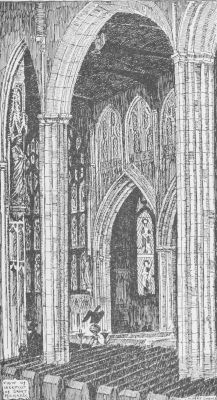
View of Interior of Saint Michaels
"When the kyng our soveren lorde," the Leet Book says, "came from Leycestur toward Coventre, the meyre ... Richard Boys and his wurthy bredurn arayed in skarlet and all the commonalty[243] cladde in grene gownes and rede hodes, in Haselwode beyonde the brode oke on horsbak, attented the comeng of our soveren lorde. And also sone as they haddon syght of our soveren lordes presens, the meyre and his peres lyghton on fote, [and] mekely thries kneleng on their knees dud unto our soveren lorde ther due obeysaunce, the meyre seyeng to hym thes wordes: 'Most highest and gracious kyng, ye arn welcome to your true lege menne withe all our hertes'"; and therewith, after taking the mace from a sergeant, he kissed it, and presented it to Henry. "The kyng," the Leet Book continues, "tarieng and herkening the meyres speche in faverabull wyse, seyde thes wordes: 'Well seyde, Sir meyre, take your hors.' The meyre then rode forthe afore the kyng bereng his mase in his honde with the knyght-constabull next afore the kynges swerde, the bayles of this cite rideng afore the meyre withe ther mases in ther hondes makeng wey & rome for the kynges comeng; and so they ridon afore the kyng till the kyng come to the vttur[244] yate of the priory. The kyng then forthewithe send for the meyre and his bredurn be a knyght to come to his presence and to speke withe hym in his chambur, and the meyre and his peres accordeng to the kynges comaundement come into his chambur, and thries ther knelleng dudde ther obeysaunse. Thomas Lytelton then recordur[245] seyde unto the kyng suche wordes as was to his thynkyng most pleasaunt, our soueren lorde seyeng agayne thes wordes, 'Sirs, I thank you of your goode rule and demene and in speciall for your goode rule the last yere past for the best ruled pepull thenne withe in my reame. And also I thank you for the present that ye nowe gaue to vs'—the whiche present was a tonne wyne & XXti grete fatte oxon. The kyng then moreover gaf hem in comaundement to govern well his cite and to see his pease be well kepte as hit hathe been aforetyme, seyeng thenne to hem he wolde be ther goode lorde, and so the meyre and his peres departed."
With what a glow of pride the town clerk must have recorded all these gracious sayings, little knowing that the King's good will could avail them nothing in the troublous times that were at hand! Henry, it appears, remained several days at Coventry, the Earl of Salisbury and the Duke of Buckingham attending upon him there with a numerous following. He was engaged, the historian tells us, upon an ineffectual attempt to bring the Dukes of York and Somerset to friendly terms,[246] but the former, far from desiring peace, was at that moment weaving plans for his rival's overthrow. The good-hearted King did not neglect religion in all this pressure of political business.[247] "The kyng then abydeng stille in the seide priory apon Michaelmas Evon sende the clerke of his closet to the churche of sent Michell to make redy ther his closette, seyeng that the kyng on Michaelmas day wolde go on procession and also her there hygh masse." The "meyre and his peres" suggested that the Bishop of Winchester (Waynflete) should be asked to officiate. "And agayne the kynges comeng to sent Michell churche, the meyre and his peres cladde in skarlet gownes with ther clokes and all oder in ther skarlet gownes wenton vnto the kynges chambur durre ther abydeng the kynges comeng." Possibly as an especial honour to the Trinity guild the clerks of Bablake went in the procession through S. Michael's churchyard before the celebration, the King devoutly walking in the train, bare-headed, and "cladde in a gowne of gold tussu furred with a furre of marturn sabull, the meyre bareng the mase afore the kyng ... tille he come agayne to his closette. At the whyche masse when the king had offerd and hes lordes also, he sende the lorde Bemond (Beaumont) his chamburlen to the meyre, seyeng to him, 'hit is the kinges will ye and your bredurn come and offer,' and so they dudde." After the evensong the King sent by "two for his body and two yeomen of the crown," "the seyde gowne and furre ... and gave hit frely to god and to sent Michell. Ynsomyche that non of them that brought the gown wolde take no rewarde in no wyse."[248]
Henry did not remain long in Coventry after the celebration of the Michaelmas festival. On the following Tuesday he went to Kenilworth, the corporation and the "commonalty" riding with the company and preserving the same order as they had used at his welcoming a few days previously. When they came to a place beyond Asthill Grove, "agayne a brode lane the (that) ledethe to Canley ... the kyng willeng to speke with the meyre and his bredurn seyde to hem thes wordes: 'Sires, I thank you of your goode rule and demene at this tyme, and for goode rule among you hadde and in speciall for your good rule of the yere last past, and where as ye ben nowe baylies we will that ye be herafter sherefes, and this we graunt to you of our own fre wille and of no speciall desire. Moreour,'" he went on, mindful no doubt of his own danger, and of the preparations for war among the factious nobles of the country, "'we charge you withe our pease among you to be kepte and that ye suffer no ryottes, conventiculs ne congregasions of lewde pepull among you, and also that (ye) suffer no lordes lyvereys, knyghtes, ne swyers (squires) to be reseyved of no man withe in you for hit is agayne our statutes ... and yif ye be thus ruled we will be your goode lorde.' And thus don, the meyre and his bredurn takeng ther leve of the kyng ... departed and ridon to Coventre agayne," no doubt astounded at the idea of this new responsibility and greatness now thrust upon them. The mayor and council held great consultations concerning the bailiffs' acquisition of the sheriffs' dignity summoning Thomas Littleton, their recorder, and Henry Boteler, who was soon to be this famous lawyer's successor in the office, to their deliberations, to learn what privileges were most needful for them to include within the charter which was to convert their city into "the city and county of Coventry."[249]
In the year 1453, which saw the close of the Hundred Years' War and the birth of a Prince of Wales, Henry was attacked by insanity.[250] In 1454 the King's recovery marked the close of the Duke of York's protectorate and the restoration to power of the Queen's friends, particularly Somerset. The Yorkist party fell into disgrace, and measures were taken to compass their destruction the following spring in a parliament to be held at Leicester. The duke on hearing this drew sword in the north, and marched on London with a goodly following at his back. The royal troops barred his way at S. Alban's; but when the first battle of that long and weary struggle was fought out at that town on the great London highway, the Coventry men were not found in Henry's ranks. In fact the battle was hardly looked for at that time. It is true the townsfolk received a summons for "such feliship ... in their best and most defensable aray" as they could furnish, and that "having tendurnes of the well fare and also of the saveguard of our soveren lorde," they duly equipped 100 men. Much ado was made to provide the men with a new "pensell" or standard "in tarturne," at a cost of 16d.; 14d. went "in rybands" to the same, while the making, with a tassel of silk attached to it, cost a similar sum; "bends," or badges of red and green, were also provided, with a garment of red, green, and violet for the captain. But in spite of all this preparation the men never saw S. Alban's fight, or the terrible execution done by Richard, Earl of Warwick, among the Lancastrian ranks. For on May 22, the day whereon the mayor received the commission, the battle was fought and over, and the King in the hands of his victorious enemies. "They wenton not," says the Leet Book, with some reticence in referring to the soldiers, "for certen tydenges that wern brought," the King having returned to London.[251]
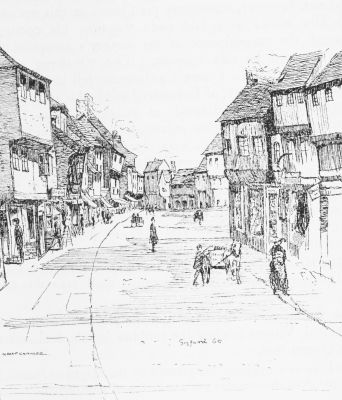
Gosford St
Henry was shortly after this again attacked by insanity, and for a few months York was appointed regent. Duke Richard's power did not, however, wholly cease with the King's recovery, and after March 1456 he continued for some months to direct the government, which was nominally in the hands of the Bourchiers, half-brothers of the Duke of Buckingham. Meanwhile the two arch-enemies, the Queen and the Duke of York, watched and "waited on" each other ceaselessly until August, when Margaret's plans were laid, and she drew off the King to sport in the Midlands, having fortified Kenilworth with cannon in case of another appeal to arms. A great council of notables was summoned to meet at Coventry for October 7.[252] The news of the Queen's intended visit reached the city about August 24, and a council was called to provide for her highness's welcome.[253] A hundred marks was collected throughout the wards to be given as an offering to the Prince of Wales and his mother, together with two cups whereof the joint value amounted to £10, 7s. 1d. The prince did not, however, accompany the Queen on this occasion, so fifty marks were laid aside "against his coming," though the magnificence of his mother's reception was not lessened on this account. The "makyng of the premesses " of the Queen's welcoming fell to the lot of one John Wedurby, of Leicester,[254] and by his arrangement pageants as gaily dressed as at the Corpus Christi festival, with appropriate personages standing thereon to utter words of welcome, were placed at all the principal points in the streets between Bablake and the "utter" gate of the Priory. John Wedurby thought as other men of his time, that Margaret's son would one day have rule in England, and hoped that each party would forget their differences and live in peace under his government.
"The blessyd babe that ye have born prynce Edward is he, Thurrowe whom pece & tranquilite shall take this reme (realm) on hand,"
said Prudence to the Queen in the pageant of the four Cardinal Virtues; while the prophet Isaiah declared to the Queen that,—
"Like as mankynde was gladdid by the birght of Jhesus, So shall this empyre joy the birthe of your bodye."
And the companion prophet Jeremiah was equally positive:
"The fragrant floure sprongen of you shall so encrece & sprede, That all the world yn ich (each) party shall cherisshe hym & love & drede."
In his conception of the Queen's character Wedurby was a thorough courtier.
"The mellyflue mekenes of your person shall put all wo away,"
the same prophet said; and S. Edward greeted her as "moder of mekeness."
To what strange freaks will not the rules of his art—and especially alliteration—betray a poet! The "she wolf of France" had nothing of the quality thus assigned to her; her name had merely the same initial letter.
The King and Queen entered Coventry on Holy Cross day, by the Bablake Gate.[255] Close by the entrance was a pageant whereon stood the two above-named prophets, and a "Jesse," or figure representing the genealogy of Christ, was placed upon the gate itself. At the east end of Bablake church were the figures of the Confessor—in allusion to Prince Edward—and S. John the Evangelist. A few paces distant at the conduit in Smithford Street the four Cardinal Virtues were displayed. A second set of pageants, grouped in the open spaces at the Cheaping, next met the Queen's eyes. There were the Nine Conquerors, Hector, Alexander, and the rest; and finally by the conduit a stage was placed whereon S. Margaret appeared, "sleying" a great dragon "by myracull." While upon the cross itself were grouped a company of angels, and the pipes of the conduit ran wine. Between the cross and the conduit the Queen received the homage of the Nine Conquerors, while her name-saint gave to her a final salutation:
"Most notabull princes of wymen erthle, Dame Margarete, the chefe myrth of this empyre, Ye be hertely welcum to this cyte, To the plesure of your highnes I wyll sette my desyre, Bothe nature & gentilnes doth me require, Seth we be both of one name, to shew you kyndnes, Wherfore by my power ye shall have no distresse; I shall pray to the prince that is endeles, To socour you with solas of his high grace. He wyll here my peticion, this is doutles, For I wrought all my lyf & that his wyll wace; Therefore, lady, when ye be yn any dredeful cace, Call on me boldly, ther of I pray you, And trist to me feythefully I well do that may pay yow."
John Wedurby was, no doubt, an indifferent poet, but viewed in the light of subsequent events, his verses have all sorts of ironical and tragic meanings, whereof he was, of course, wholly unconscious.
The pageants and welcome entertainments cost the citizens not a little, we may suppose, in time and treasure. They made the king a present of a tun of wine costing £8, 0s. 4d.; while by the "advice of his council" the mayor distributed 20s. among "divers persons of the king's house."[256] Lord Rivers too had a glass of rose-water at the mayor's expense, whereof the cost was 2s.; thirteen years later his lordship had a very bitter drink at Coventry.[257] Still the coming of the Court no doubt brought trade to the city; had it brought also peace, all would have been well. The council met on October 7, and a blow was aimed at the Duke of York in the dismissal of the Bourchiers.[258] It was even said that the duke's life was in danger, but that his kinsman, the Duke of Buckingham, assisted him to escape. Margaret required the presence of Somerset to lend strength to her party, and with him there came, it seems, a company of turbulent retainers. These men fell out with the city-watch and slew three or four of the townsmen; whereat, says a writer in the Paston series, "the larum belle was ronge and the toun arose and would have jouperdit to have distressed the men of the duke of Somerset, ne had the duke of Buks taken direccion therin."[259] Coventry was already ceasing to be the well-ordered and peaceful place whereon the mind of King Henry loved to dwell. Next year we hear that the civic finances were disorganised, that the officers of the city were negligent in the performance of their duty, and that the citizens, being "of froward dispositions," were inclined to appeal to "mighty men in strange shires" for their support in carrying on lawsuits against their neighbours in courts without the city.
In February, 1457, the court was again at Coventry; the King came thither on the 11th "to his bedde," and the Queen coming "suddenly" next day "unto her mete."[260] Margaret was doubtless burdened with some weighty tidings, for "she came rydyng byhynde a man, and so rode the most part of all her gentylwemen then, at which tyme she sende vn to the meyre and his brethern that she wold not that [the] spiritualte ne the temporalte shold be laburd to met her then, and so she was not met at that tyme." A great council[261] was held at Coventry from February 15 to March 14, all the great men of both parties being present, and the Duke of York was re-appointed to the deputyship of Ireland. Henry left the city for Kenilworth on March 14, the mayor and his brethren, and a "goodly fellowship of the city" having "right great thank" for accompanying his highness "to the utter side of their franchise." A characteristic touch is given concerning Margaret's departure for Coleshill two days later. The mayor, his brethren, and a "feyre felyship" of the commons—we seem to gather from these words that there was but a scanty attendance—went with Queen Margaret to the boundary of the city liberties. The mayor, having his mace in his hand, rode immediately before her, the sheriffs with their white yards or rods directly preceding the mayor. Hitherto this ceremony in its completeness had only been observed when the King was in question. "And so," the Leet Book says, "they did never before the quene tyll then, for they bere before that tyme alwey theire servants (sergeants') mases ... at her comynges, at which doyng her officers groged (grudged), seying the quene owed to be met yn like fourme as the kyng shold, which yn dede," the writer continues with some trepidation, "as ys seide owe to be so, except her displeser wold be eschewed."[262]
An unexplained rising took place at Hereford in April, and the King and Queen went thither to quell it, Margaret alienating even her friends in that district by her severity. At Whitsuntide, however, the whole Court again sojourned at Coventry, and a grand procession at the Pentecostal feast dazzled the eyes of the citizens.[263] The Duke of Buckingham followed next after Henry, but Lord Beaumont "bere the kynges treyne," the Earl of Stafford "his cap of astate," and Sir John Tunstall his sword. The great nobles followed every one in his proper rank, while after her the Queen and her chief lady, the Duchess of Buckingham, there came "mony moo ladyes yn her mantels, surcotes, and other appareyll to theyre astates acustumed." Mass was celebrated in the cathedral by the Bishop of Hereford, assisted by the dean of the King's chapel, the prior and his monks.
Queen Margaret could occasionally be gracious, and her eagerness to see the Mystery Plays performed at the feast of Corpus Christi must have flattered the citizens. She came "prively" from Kenilworth on the eve of the festival, and "lodged at Richard Wodes, the grocer,[264] where Richard Sharp sometime dwelled; and there all the plays were first played," save Doomsday, the drapers' pageant, which could not be seen, for evening came on and put a close to the performance. The mayor and bailiffs sent a present to Richard Wood's house, namely "ccc (300) paynemaynes,[265] a pipe of rede wyne, a dosyn capons of haut grece,[266] a dosyn of grete fat pykes, a grete panyer full of pescodes and another panyer of pipyns and orynges, & ij cofyns of counfetys, & a pot of grene gynger." Quite a little court was assembled at the grocer's house to witness those strange spectacles in which the dramatic instinct of the Middle Ages found vent. The Duke of Buckingham and "my lady his wife," who might be regarded as natives of the city, would do the honours of the place; and let us hope those ardent Lancastrians, Lord Rivers and his lady, father and mother of the future queen, Elizabeth Woodville, and the elder and younger Countess of Shrewsbury, applauded the ravings of Pilate and Herod, the pompous characters of the religious drama, or heard with complaisance the devil's jokes. It is hard to imagine Queen Margaret, that tireless fighter and plotter, or Lady Shrewsbury, the great Talbot's widow, whose feud with the Berkeleys filled Gloucestershire with strife for over a generation, engaged in such a harmless amusement as laughing over the quaint performances of their citizen supporters, nibbling the while some of the good mayor's supply of apples and sweetmeats. How delighted the citizens were at her highness's condescension! When she went next day "to her mete" to Coleshill, "right a good feliship—which plesid her highnes right well,"—attended her to the "vtmast side of theyre franchise, where hit plesyd her to gyff them grete thank bothe for theyre present and theyre gentyll attendaunce." In the August of that same year, Henry and his Queen again visited Coventry, sleeping there from August 31 until September 2, and "about x of the belle" on the latter day the Queen rode to Sharneford and on to sleep at Leicester "toward the forest of Rokyngham for to hunt," while at two o'clock Henry rode forth on his journey towards Northampton, and the men of Coventry did not see them again for two years, when a more troubled scene had opened.
The records of Coventry are nothing but a blank during the succeeding years; for the council merely met at the appointed season to elect a mayor, but transacted, as far as we know, no other business; tradition has it that the city was divided against itself, a highly probable case when we consider how high the tide of Yorkist and Lancastrian party spirit was running in the rest of the country. In the political world this season was filled by ineffectual peacemakings and renewed preparations for war. Warwick, after provoking the wrath of the Lancastrian party, fled to Calais, and his father, Salisbury, met and worsted Lord Audley, the royalist leader, who had been sent to capture him, at the field of Bloreheath (September 23, 1459). The Yorkist lords flew to arms; but when the King proposed to give battle at Ludford, weakened by the defection of a certain Andrew Trollope, they all dispersed and fled. The Yorkists being thus humbled, the time was come for Margaret's vengeance. No writs were sent to the principal Yorkist chiefs for the parliament summoned to meet at Coventry on November 20, and the knights and burgesses were nominated by the Lancastrian leaders. The assembly met, and, by one sweeping act of attainder, deprived twenty-three leading Yorkists of their inheritance. People called this the "diabolical parliament"; henceforward there was no hope of a reconciliation between York and Lancaster. A petition[267] presented by John Rous, the antiquary of Guy's Cliffe, to this parliament, calling attention to the enclosure of common lands and increase of pasture, is now lost; it fell on deaf ears at that time of party strife.
It seems that the Queen's late violent proceedings, or the plundering propensities of her followers, had caused the townspeople to grow somewhat cold in her cause. When a commission of array dated from Northampton arrived a few days before the Candlemas feast, 1460, the sheriffs kept it back, and it was fourteen days before the newly elected mayor, John Wyldegrys,[268] received the missive addressed to his predecessor conveying the king's command. This was surely not the result of accident but design, the sheriffs having their own reasons for thwarting the mayor, or being ardent Yorkists. Then the Duke of Buckingham arrived, perhaps to learn the reason of the delay, and the mayor bethought him of this indiscretion. "To my lord of Buckingham," lodging at the "Angel," he sent to ask whether "any hurt might grow to the city" because of the neglect of the commission, and to ensure the duke's goodwill, sent thirty loaves, two pike, two tench, some capons, a peacock, and a peahen to his lodging.
A letter which he received from the King about this time hardly tended, it may be thought, to reassure John Wyldegrys.[269] "For asmuche," the King wrote, "as credible reporte is made vn to us howe diuers of th' inhabitantes of oure cite of Coventre haue, sithe the tyme of oure departyng from thens, vsed and had right vnfittyng langage ayenst oure estate and personne, and in favouring of oure supersticious[270] traitours, and rebelles, nowe late in oure parlement there attaincted, wherby grete comocions and murmur ben like to folowe, to the grete distourbance of oure feithfull, true subgettes, onlesse that punisshement and remede for the redresse therof the rather be had, we therfor ... charge you diligently t' enquer and make serche among the seid inhabitants of suche vnfittyng langage as is aboue seid, and do theym to be emprysoned and punisshed accordyng to their demerits, and in example of other of semblable condicion, as ye desyre to do that shall plaise vs."[271]
John Wyldegrys probably executed this commission with all the alacrity of fear, and we hear that in the following October the Duke of York had a strange commission to sit in judgment on various offenders in Coventry "to punish them by the fawtes to the kyng's lawys." But the duke, who was on his way home from Ireland, could not afford to tarry, having weightier business on hand, namely, the laying claim to the throne of England, and the drawing up of a genealogy to lay before parliament, showing that his claim to the throne was based on rightful inheritance. Since the battle of Northampton (July 10, 1460), the King had been in the hands of the Yorkist lords, Salisbury and Warwick.[272] At this battle, too, Henry lost Buckingham, the most powerful man at the time in Warwickshire, and a pillar of the Lancastrian cause. After his death, maybe, the men of Coventry felt more free to choose what side they would, and the plunder wherein Margaret's host indulged after Wakefield (December 14) and S. Alban's (February 17, 1461) completed their alienation from the Lancastrian party. The Yorkists had now the upper hand in the city. After the battle of S. Alban's £100 was collected throughout the wards for men to go to London with "the earl of March,"[273] who, since his father's death at Wakefield, had become the hope of the Yorkist cause. On the day after his coronation (March 5) Edward IV. dispatched a letter to the mayor and his brethren full of thanks for the citizens' loyalty to his cause, praying for their "good continuance in the same," and praising their "good and substantial rule." He thus assured the support of the people of the place, and on the terrible field of Towton, where "the dead hindered the living from coming to close quarters," the men of Coventry fought under the standard of the Black Ram in the Yorkist ranks. The Leet Book tells us that £80 was collected throughout the wards for the 100 men "which went with oure soverayn liege lord kyng Edward the IIIIthe to the felde yn the north."[274]