Front matter (continued 5)
Reading edition
But the trading enterprise of these inland-dwelling townsfolk was not confined to their native country merely. Another family, the Onleys, whereof one John Onley, the founder, was mayor of the Calais Staple,[577] had dealings with merchants beyond the sea. This foreign intercourse was often beset with danger to life and limb. John Onley, son of the above, was apprenticed to one Thomas Aleyn, a London mercer. When travelling to Bruges in 1413, where the chief staple for cloth then was, on his master's errand, this apprentice fell into the hands of a goldsmith of that place, who, because he could not obtain redress for the treatment he and his goods had received from an English "roberdesman" in the neighbourhood of Dover, kidnapped and kept John Onley as hostage. At last the good folk of Bruges, fearing the anger of the English, forced him to let the apprentice go.[578] Our sympathies are divided between the innocent lad and the outraged goldsmith, for in the wilder parts of England "roberdesmen" were a veritable scourge to the foreign trader. Did not Henry III. hang more than sixty of the brigands of Alton, who had plundered certain merchants of Brabant, though the whole county of Hants conspired to ensure the acquittal of the accused?[579] Occasionally the highwaymen also attacked English folk. In the days of the third Edward, there was a pretty gang, composed chiefly of "gentlemen born," who beneath the shelter of Cannock Chase did much harm to the merchants of Lichfield, and apportioned what spoil they took "to each according to his rank."[580]
But foreigners were quick at reprisal when debts were owing to them, or any injury had been done by English merchants. And the proud traders of Lübeck and Bergen, members of the Hanseatic League, who warred with and dictated to kings, were especially sensitive in this respect. This may be seen by the fate which befell Laurence Cook, afterwards twice mayor of Coventry, in the days of his apprenticeship to William Bedforth, and Thomas Walton, servant to John Cross, another local merchant, who aided in the erection of S. Mary's Hall. For in 1398, as they lay in the ship of one Thomas Herman, of Boston, in the port of Stralsund, certain allies of the League, who had some grudge against the English traders, fell upon the apprentices, beat and wounded them minus juste, taking moreover from the ship 240 dozen pieces of cloth of divers colours, Bedforth's property, valued at £200; "much merchandise" belonging to Cross, worth half the sum, and other pieces of cloth, exported by a third Coventry merchant, valued at £50.[581] Such incidents as these were not uncommon in the lives of mediæval merchants, and for the making of a successful trader it was necessary that a man should have a dash of the warrior and a great deal of the adventurer in his composition. Trained by exposure to such perils by land and sea as nowadays only explorers undergo, it is little wonder that they proved themselves keen, energetic, and resourceful in their civic life.
The servant of one Mr Wheatley had a happier adventure than Laurence Cook when in the sixteenth century he undertook a journey to Spain. For, wishing to purchase steel gads, he bought a chest at a fair, and lo! when it was opened it was found to contain ingots of silver, treasure brought perhaps from over the Spanish main. The servant, not knowing of whom he bought them, Mr Wheatley—honest man—kept them for a time, but as no inquiry was ever made, he gave the profits, amounting with contributions from the city to £96 a year, to the maintenance of twenty-one boys at a school at Bablake, an institution which exists and thrives even to this day. This benefactor, the "Dick Whittington" of Coventry, is a person of whom we would gladly learn more. The real Sir Richard, "thrice Lord Mayor of London," was, as historians tells us, not the poor friendless wanderer of legend, but the hopeful son of a well-to-do family of the country gentry, and was apprenticed to a wealthy London merchant by his kinsfolk after the orthodox fashion.[582] But as yet no historian has deemed it necessary to investigate Mr Wheatley's early career, and we still believe that he came to Coventry as a nameless adventurer, "a poor boy in a white coat," as Dugdale says. He died a bachelor, and bequeathed his fortune to charity.[583]
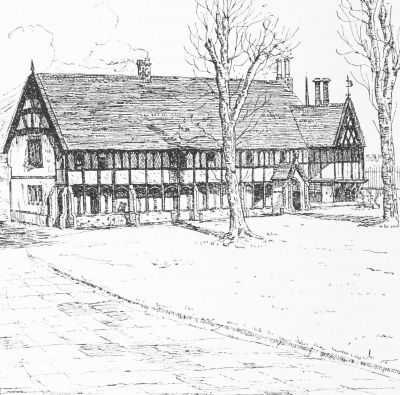
OLD BABLAKE SCHOOL
But Mr Wheatley was not the only benefactor the city knew. Wealthy merchants were generous givers, and the education of youth and provision for the sick and needy were not matters held to be solely within the Church's province. The names of Richard Whittington and John Carpenter[584] of London, and of Cannynges of Bristol, deserve ever to be held in remembrance, and there are hundreds of other half-forgotten donors entitled to an equal fame. Thomas Bond, merchant of the Staple, founded at Bablake a hospital for ten men "and one woman to look after them," the candidates to be chosen on a general day of the Trinity guild, and, as bedesmen of this omnipotent fraternity, to repeat three times a day Our Lady's Psalter for the brethren of the guild. Both Bond's almshouse and that erected by William Ford, merchant, and William Pisford, at Greyfriars, still remain, and are among the few perfect specimens of domestic architecture of the sixteenth century that we possess. The latter, first enriched by Ford's will in 1509, contained six men and their wives, the nominees of the Trinity guild, each couple receiving 7-1/2d. a week for their maintenance.[585]
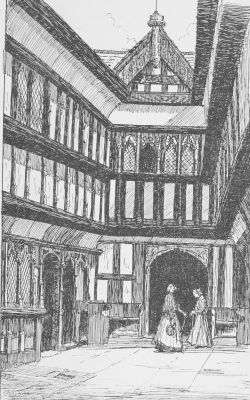
FORD'S HOSPITAL
But it was not the welfare of the aged alone which absorbed the charity of these merchants. To John Haddon, draper, is due the honour of initiating the system of granting loans to young freemen to aid them in beginning commercial life. By his will (1518) he bequeathed £100 to be distributed among men of the drapers' fellowship—poor clothmakers the Leet Book calls them—in loans of £5 each, to enable them to buy wool or cloth, for the cloth trade at that time was undergoing a period of great depression in Coventry, and £100 to be similarly divided in £4 loans among young freemen of all occupations; all loans, free of interest, to be repaid at the end of first year.[586] His example had numerous imitators;[587] but undoubtedly the gifts of Sir Thomas White, mayor of London and founder of S. John's College, Oxford, whom Mary knighted for his loyalty at the time of Wyatt's rebellion, surpassed the rest. At the time of their greatest need, in 1543, he lent the corporation £1400, wherewith they purchased certain lands and tenements confiscated at the Reformation, and they agreed to distribute £40 arising from the rents of the tenements in loans to apprentices of the city for nine years' use.[588] From some cause or other, probably by reason of his great and numerous acts of benevolence, and the backwardness of the corporation in paying a promised annuity, Sir Thomas fell into poverty in his later years, and seems to have been utterly cast down by the thought that his wife would be left without provision. "Whereas I have gently written unto you heretofore," he writes in 1566 to the mayor and corporation, "to let my wife have her annuity of £46 for part of her jointure, I require you as you shall answer before God at the day of judgment that you lett my wife have £24 assured to her during her life." Two days after another letter betrays his unbearable anxiety on this subject. If the mayor and corporation are not able to perform the undertaking with regard to the jointure, "I shall even," he says desperately, "cast my colledge for ever ... so am I utterly shamed in this world and the world to come."[589] Happily for the cause of "true religion and sound learning," the college was not abandoned, and we will hope the Coventry folk fulfilled their contract.
Long before the Reformation and Mr Wheatley's gift the sons of the Coventry burghers attended school, for it is an error to suppose that the education of the laity began with the grammar schools founded by Edward VI. Indeed these foundations were but the "fresh and very inadequate supply of that which had been so suddenly and disastrously extinguished"[590] at the Reformation. Nor was the occupation of teaching confined to the monasteries. The trading-class in or before the fifteenth century threw themselves heartily into the work of providing schools for the coming generations. In most cases the support of these institutions was committed to the leading local guild. In London alone nine grammar schools were set up in the reign of Henry VI.,[591] and in many other places the bounty of some well-to-do bishop or merchant enriched country towns with the endowment of a grammar school. At Coventry there was, it is true, a school at the priory for the "children of the aumbry,"[592] but it appears that there were other "teachers of grammar" in the city, whose well-being was a source of anxiety to the leet, and to these, perhaps, the citizens preferred to send their children to be instructed in the Latin tongue. In 1426 it was enacted by leet that "John Barton shall come to the city of Coventry, if he will, to keep a grammar school there."[593] Barton, however, if he came at all, probably soon made way for a successor, for in 1429 we find an order of leet to the effect that "Mayster John Pynshard, skolemayster of grammer, shall have the place that he dwellethe inne for xls. (40s.) be yere, whyles that he dwellethe in hit, and holdyth gramer skole hym self ther inne."[594] The prior appears to have looked upon these teachers as the rivals of the conventual schoolmasters, but the corporation did their best to soothe his jealousy, and in 1439 the mayor and six of the council, at the request of the leet, went to the prior to "commune" with him concerning this matter, "wylling hym to occupye a skole of gramer, yffe he lyke to teche hys brederen and childerun off the aumbry, and that he wolnot gruche ne move the contrari, but that every man of this cite be at hys fre chosse (choice) to sette his chylde to skole at what techer of gramer that he likyth, as reson askyth."[595] No doubt the town school continued to prosper, for we find at the time of the suppression of the chantries of 1543 that the Trinity guild paid £6, 13s. 4d. as a yearly salary to the schoolmaster. All this general activity in education goes to prove that the men of the later Middle Ages were not the illiterate boors historians have loved to imagine. The knowledge of reading, writing and Latin, or, as they called it, grammar, was surely very widely diffused, when not only a multitude of scribes, but farm bailiffs could make, audit and balance accounts in that language.[596]
Not only were the citizens called on to support by their charity almshouses and schools, and to furnish loans for youthful enterprise, but the poor made a constant demand on their bounty, and in the sixteenth century poverty was greatly on the increase. The town rulers were confronted with a problem which, then and subsequently, has been found incapable of solution—the problem of the "unemployed." In the reign of Henry VIII. a terrible influx of vagabonds from the country set in, well-nigh driving the local rulers to distraction. Here we first gain some glimpses of a surplus population of shiftless, landless, moneyless folk, driven by the decay of tillage to seek work in the towns. These families, together with the whole labouring class, were later reduced to unspeakable poverty by the debasement of the coinage and depreciation of silver, circumstances which, while affecting wages but little, greatly increased the price of food. This difficulty was at first unfamiliar to men's minds. Society had been hitherto somewhat stationary. Individuals lived and worked where their fathers had lived and worked before them, or at least remained in a town where they had been able by a seven years' appenticeship or by purchase to obtain civic rights. But townspeople were jealous of granting freedom to any but the well-to-do, who would be able to share the burden of taxation, and the wanderer, who by quitting home had dropped out of the framework of local society, became one of a herd of vagabonds liable to be punished according to the utmost rigour of the law.
The town rulers did not attempt to solve this question, they shelved it. This wretched population was perpetually ordered to "pass on." "And those bygge beggers," says an order of leet passed in 1518, "that wilnot worke well to gete their levyng, but lye in the felds and breke hedges and stele mannys fruyte ... let theym be banysshed the town, or els punysshe theym so without favor, that they shalbe wery to byde therin."[597] And again and again aldermen were exhorted to cause "lusty beggars and vagabonds" to "voyde out of their ward" upon pain of imprisonment.[598] Only such impotent and needy beggars as were licensed, and had the city seal, the sign of the elephant, on their bags, were allowed to remain and demand charity.[599] But the worthy men of the leet did not refuse to aid those who suffered undeservedly from the acutest misery. "If any by infirmity or multitude of children be not able by his labour to sustain his family," the aldermen were ordered to provide for their sustenance out of the town chest.
FOOTNOTES:
CHAPTER XV
Daily Life in the Town (continued)—Religion and Amusements of the Townsfolk
High above market-place and churchyard, above booth and stall, and the life and movement of a busy crowd, rose a forest of magnificent spires, three from the cathedral and one from either parish church. And after the day's chaffer many a busy trader would turn aside and enter the long aisles to listen to the chanting of vespers or tell his beads before the image of his patron saint.
In these days of tempered enthusiasm and lukewarm local interest we can hardly realise what a source of joy and pride these churches were to the townsfolk. Self-denial had enabled them to raise these goodly buildings, which they gave of their best to beautify. The painters, masons, carpenters, and carvers of the city did the work; the red sandstone, which, alas! so soon crumbles and decays, came from the local quarries; and though the grand outline of S. Michael's may be due to some bishop of the thirteenth century,[600] the design of the building, with which we are now familiar, came from the brain of a local architect—some parish priest, perhaps, or master mason of the city. For the churches of Trinity and S. Michael's were practically built anew from their foundations, neither perhaps by one family of merchants, but by the whole body of parishioners in the hey-day of the city's wealth,[601] while the small collegiate church of S. John the Baptist was raised by the Trinity guild. All these show the influence of the new "Perpendicular" style; but S. Michael's more than the rest is a triumph of the amazing lightness and technical skill so characteristic of the architecture of the fifteenth century—a style which, though lacking the strength and mystery of the earlier Gothic of the thirteenth century, has yet a certain majesty of its own.
Having once built the churches, the townsfolk made provision for continual prayer and supplication to be held therein. With a touching belief in the efficacy of prayer, even vicarious, and a business-like intention of making the best of both worlds, these worthy men devoted large sums to the support of chantry priests, who, while their patrons were engaged in secular business, prayed for the souls of the faithful departed and for living members of the town guilds and brotherhoods.[602] In the lady chapels of S. Michael's the priests of the Trinity guild chanted daily the "Antiphones of the Virgin" and the psalm De Profundis on behalf of the founders of the fraternity.[603] Similarly a priest said mass at the altar of Our Blessed Lady in Trinity church "for the good estate of King Richard and Anne his Queen, the whole realm of England, and all those by whom this altar is sustained ... and for their souls after death," remembering especially his patrons, the brethren of the Corpus Christi guild.[604] The dyers' and drapers' priests had their appointed task, so had the chaplains of S. John the Baptist's and S. Nicholas' churches, while the bedesmen, as their name implies, in the almshouse offered daily prayers for the welfare of the members of the Trinity guild.
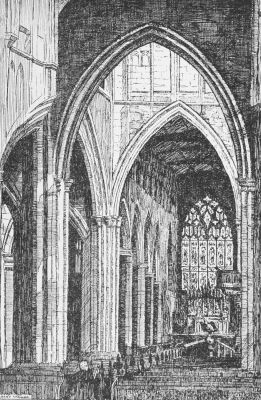
HOLY TRINITY CHURCH
But the good folk were not content with offering their supplications by proxy. Although much of the spiritual fervour of the thirteenth century died away in the later Middle Ages, the townsfolk were methodical and regular in their religious observance and attended church with due decorum on Sunday and holy-days. In the pews sat the city officers and their wives each in their degree, the various craftsmen occupying no doubt the special chapels called after their names, and the apprentices and servants sitting or standing "in the alleys."[605] The walls of the churches were bright with fresco, where even the most ignorant could learn the stories taken from the lives of the saints or from Holy Writ; it is only within living memory that the smoke has blackened a rediscovered representation of the Last Judgment above the chancel arch of Trinity church. And when the worshippers lifted their eyes to the window-glow they beheld amid the company of the saints scenes taken from local legend, the old compact for the freedom of the market between Leofric and Godiva, the blazoning of the arms of founders and benefactors, and the insignia of trade and craft.[606] For the mediæval artist saw no firm line sundering the things of religion from the affairs of daily life, and the people did not care to keep their civic patriotism and inspirations solely for the guild-hall. In the aisles and chapels lay the most honoured of the city dead; Bond and Haddon were laid among their fellow drapers, and the tomb of Ralph Swyllington, recorder, may yet be seen on the mercers' side in S. Michael's church.
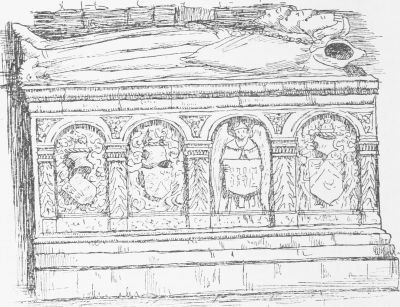
SWILLINGTON'S TOMB, S. MICHAEL'S CHURCH
The craft companies paid an annual rent for the chapels within their keeping, whither they repaired at least once a year to keep the festival of their patron saint and present their offerings. Thus each of the cappers subscribed twelve pence a year towards the maintenance of the furniture in S. Thomas's chapel in S. Michael's, and presented a penny as an offering on the feast of the translation of the saint.[607] In these chapels, where the glory of goldsmiths' and artist's work testified to the munificence of the craftsfolk, dead members of the brotherhood were occasionally buried, and their obits or anniversaries kept.
It was a common practice to bequeath house property to provide funds for the continual commemoration of the testator's death and prayers for his soul's peace. Thus in 1492 Richard Clyff, late parson of S. George, London, bequeathed to the church of Holy Trinity, Coventry, a tenement in Well Street "to the entent ... that the Wardeyns of the same Church, for the tyme beinge yerely, for evermore, observe and kepe within the same Church, in the vigyll of Saynt Alphege, placebo, and dirige over nyght, by ii well-dysposyd prestys, there to be said devoutly without note; and on the morowe after, ayther of the same prestys to say messe of Requiem for the soules of John Cliff, and Margarete hys wyff, hys ffader and moder, hys own Soule, all hys ffrendys Saulys, and all Crystyan Saulys." Other features of the obit were the distribution of alms to the poor, and the feast which followed the service. Thus on the day whereon Robert Burnell's obit was kept 4s. was given to the poor, and 3s. 10d. expended in bread and ale.[608]
When a craftsman died, the whole company of his brethren were present at his burial, which, if he were a noteworthy citizen, would take place with much solemnity at the Greyfriars' or one of the parish churches.[609] Funeral masses were invariably said in the cathedral, the offerings remaining to the use of S. Mary's minster and convent; the candles also that had burnt about the coffins[610] were left in the cathedral after the dead had been borne away to their graves. Whether the people of Coventry disliked this practice we cannot tell, but it brought the convent into collision with the Greyfriars, who, as an active and popular body within the town, were rather disposed to call the authority of the monks in question. The matter of the funeral candles and offerings touched the former very nearly, for their chapel was a favourite burial place; and in 1446 Friar John Bredon threw down his glove. We would fain know if brother John were a mere busybody or a born reformer; perhaps he belongs rather to the latter than the former class, as he also appears, it seems, as a champion of the poorer folk against the deceiving victuallers.[611] Be this as it may, he was a man of great influence with the citizens, and, together with the prior, had helped on a former occasion to still the religious excitement which had followed on the preaching of Grace, the hermit. The enmity between the friars and the convent was at last the cause of his overthrow. Concerning this matter of the candles, the friar was so moved to bitterness that he openly preached and affirmed "in the parish churches of this same citee ... that alle maner offerynges owen to be yeven alonely to theyme that mynistren the Sacraments to the parisshens," and bade the people give these candles to the parish churches; "permytting my selfe," he says, "to defende theyme that so did." Moreover, the friar declared "that in Englond was not so bonde a Citee as this Citee of Coventry is, in keping and observyng the said custome"; and in bills which he set up on the church doors he "promysed to delyver the pepull of this same Citee from the thraldom of Pharao." The prior of S. Mary was not to be daunted by this audacious front, and petitioned the King against Friar Bredon. In due time sentence was pronounced, and a form of recantation arrived prescribed by parliament. In presence of the Forty-eight[612] the friar was compelled to admit that the custom he had inveighed against "is a custom commendable, and so owyng to be kept and observed to encrese of mede, by pleasure made to Almighty God, who graunte to you and me to lif in this world aftir juste lawes and lawful customs vertuously, soo that we may deserve to rejoyse (enjoy) hevenly recompense everlastyngly."[613] After which recantation he was banished the city.
The citizens were as thorough and systematic in their pastimes as in their prayers, and all sorts of amusements of a vigorous character, wherein they gladly indulged, were rarely discouraged by the corporation. The practice of archery was looked on as part of every man's necessary training, and crafts were ordered to keep butts in good repair, so that all members of their fellowships could keep their hands well in use.[614] Bull-baiting, a favourite sport, gave its name to the Bull-ring hard by Trinity church;[615] but the traces of "le cokfyting place"[616] and of the bowling-green near the Charter-house[617] have been lost.
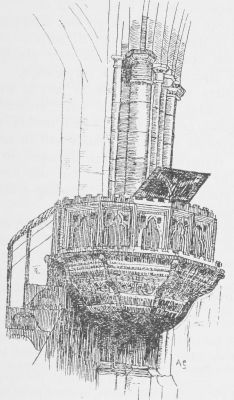
PULPIT, HOLY TRINITY CHURCH
Bear-baiting was highly popular likewise, and frequent gifts to Sir Fulk Greville's bearward[618] form a feature in the chamberlains' accounts in the early days of Elizabeth. Like all the great Queen's subjects the men of Coventry delighted in theatrical representations, and now that the local religious drama was dead, their appreciation of the strolling players' art caused constant inroads to be made on the public purse. The wardens were frequently called upon for payments, such as "to the Earle of Darbyes players vs.," "to the lord Chamberlain's players xs.,"[619] items which accord ill with the payments for sermons at this time.[620] In the end the sermons gained the day, and it would be hard to find in the Midlands—save Banbury—a more staunchly Puritan town than Coventry under the Stuarts.
In the sixteenth century the corporation appear to have become disquieted at the reckless lives and illicit amusements of those over whom they ruled. A new era was about to dawn, wherein mediæval barriers would be broken down; and it seems as if the discreet and worthy burghers were afraid of the lawlessness and unrest which had entered into the spirit of society, and which in itself was the sign of coming change. Orders directed against gaming,[621] or intercourse, especially on the part of apprentices, with women of evil fame had always been a feature of the regulations passed by the leet; but as time goes on the mention of "unlawful games" becomes more and more frequent. As early as 1510 the aldermen of the several wards were charged to make search "for all them that keep misrule," who on being discovered were to be committed to ward, or, if they persisted in their evil ways, to be banished the city.[622] In 1516 this command was followed up by a fresh ordinance enjoining them to make inquiry for vagabonds, "as well women as men," suspected alehouses, "blynde ynnes," unlawful games, and the like.[623] But the evil appeared to increase as the century advanced, and in 1548 a complaint of leet reveals a state of things which has quite a modern look, so little change has human nature and human habit undergone these three hundred and fifty years. Many, we learn, passed their time drinking in taverns, and "playnge at the cardes and tables,[624] and spende all that they can gett prodigally upon theym selfes to the highe displeasure of God and theyre owne ympovershyng, whereas," the worthy men of the leet were of opinion, "if it were spente at home in theyre owne houses theyre wiffes and childerne shulde have part therof."[625] It was forthwith decreed that any of these prodigals, whether "labourer, journeyman, or apprentice," if discovered resorting to any alehouse on a work day should be imprisoned for a day and night.
In those days, as in our own time, the lower classes had the keenest appreciation of all that appertained to sport, and the loafer loved to roam the country lanes with a dog at his heels. Long time since the prior had complained how the citizens hunted and hawked in his warren, and in the sixteenth century the corporation were hard put to it to keep this passion within the bounds prescribed by the statutes of the realm. People, we hear in the eighteenth year of Henry VIII., who did not possess the necessary qualification, a 40s. freehold, presumed to keep birds and dogs, whereby idleness "is greatly encreased"; henceforward they were forbidden to keep hawk, hound, greyhound, or ferret, or to presume to hunt with the same under a heavy penalty.[626]
Other practices in which the citizens indulged were looked upon with an unfavourable eye by the rulers of the town, brawling being expressly forbidden. No one was allowed to carry defensive weapons through the streets, and hosts were charged to bid their stranger guests leave their swords behind them, when they had occasion to leave the hostels wherein they had taken lodging.[627] The penalty for smiting "with a knife drawyn" was half a mark, unless the smiter were "himself defendant." "No man of craft," another order runs, "bear no bills, nor gysarnes, nor great staves," upon pain of forfeiture of the same weapons. Those who were driving cattle to market could, however, carry a small staff in their hands.[628] These orders did not suffice by any means to abolish brawls, and sometimes lords, knights and squires, the "mighty" men of the country round, fought out their ancient family quarrels among the dwellings of the burgher folk;[629] at others the citizens had their own grievances to urge against one or other of these mighty men, and drew sword upon him and his retainers. In these cases there would be, most likely, death or shedding of blood, while in disputes arising among the citizens themselves merely blows and beatings would be given on either side, but with such violence that combatants were afterwards often spoken of as "in despair of their lives" from the injuries they had received.
Troubles of this kind were a feature of the times when the gentry flocked into the city to see the far-famed Corpus Christi shows, or to be near the Court, for Henry VI. and his Queen tarried frequently at Coventry. On Corpus Christi even in the year 1448 Sir Humphrey Stafford and his son Richard were attacked in the Broadgate[630] after nightfall, as they came from Lady Shrewsbury's[631] lodging, by Sir Robert Harcourt and his men. Richard was slain and his father wounded in the darkness and confusion, while two of the Harcourt faction died also in the fray. All this took place, says John Northwood, writing to Viscount Beaumont, "as men say, in a Paternoster while." It was a terrible business; Northwood, evidently striving to be exact, could hardly describe how it happened. The two chief enemies, he says, "fell in handes togyder, and Sir Robert smot hym (Sir Humphrey) a grette stroke on the hed with hys sord, and Richard with hys dagger hastely went toward hym, and as he stombled on of Harcourts men smot hym in the bak with a knyfe, men wotte not ho hytt was reddely; hys fader hard noys and rode toward hem and hys men ronne before hym thyderward, and in the goyng downe of hys hors, on, he wotte not ho,[632] be hynd hym smot hym on the hede with a nege tole,[633] men know not with us with what wepone, that he fell downe and hys son fell downe be fore hym as goode as dede." And the whole affray—characteristically enough—was "be cawse of an old debate that was betwene heme for takyng of a dystres as hyt is told." The law was not always prompt in bringing gentlefolk to account, and Sir Robert Harcourt at that time escaped justice, only to be overtaken by revenge, however, twenty-two years later, when he died at the hands of the Staffords.[634]
Among the citizens also certain feasts and merry-makings ministered occasion for riots and quarrels. Such were the Lammas feasts, whereon the chamberlains, with a tumultuous following, opened out the common pasture lands that encircled the city. Such again were the three great processional nights, the vigils of Corpus Christi, of S. John the Baptist (Midsummer eve) and S. Peter. "The people come at Lammas," runs an order of Leet, "in excess number and unruly, to ill ensample"; and it was laid down that only a few from each ward, who had been appointed by the corporation, should accompany the chamberlains on their annual ride. Moreover, "great debate and manslaughter and other perils and sins" fell out on Midsummer eve and S. Peter's night, because so "great a multitude" was gathered together at that season within the city, "that it lieth in no man's power ... for to please them all";[635] and the Church tried to interfere in the interests of peace, but without success. Occasionally the good folk of the place fell to blows, it would seem, on ordinary working days, without having their presence at a merry-making to urge in extenuation of their fault. Thus in 1444 the corvesars, or tanners of leather, fell out about some obscure point or other with the weavers, and so hotly did the quarrel rage between them, and so frequent the exchange of deadly blows, that Thomas Burdeux, weaver, was said to be in "despair of his life" by reason of the sore beating he had received. The quarrel was allayed, according to the wisdom of the mayor and his discreet council, by the drinking of a certain amount of ale among the fellowship of both crafts at their joint expense.[636]
But few pleasures appealed to the mediæval citizen so strongly as that of dining well; and besides these peace-promoting drinkings there were many occasions whereon members of guilds and crafts met together to feast and do their best to justify the reputation, which still clings to city folk and aldermen, of loving good cheer. The meals of the Middle Ages were long and heavy. The highly-flavoured cookery, with its strange mixture of meat and sweets—fowls stuffed with currants was a favourite dish—would appear barbarous to modern epicures; but such as it was, vast preparations and much money were lavished upon it. The members of each craft fellowship met once a year to hold a feast, while the brethren of the Trinity guild celebrated the Assumption and S. Peter's Eve by a banquet and probably also the festival of the Decollation of S. John. The Corpus Christi had a "Lenton" dinner, a "goose" dinner in August, and a "venison" one in October,[637] and in 1492 they spent £26, 0s. 4d. on their feasts, a sum only 13s. less than the annual stipend due to the five priests supported by the guild.[638] But the record of common feasting is not yet exhausted. The members of the Corpus Christi fraternity met together at a breakfast on the morning of the festival of the Body of Christ, and all the crafts supped on cakes and ale on the great processional nights. One dozen spiced cakes, three dozen white cakes, "a seysterne" and a half of ale with "comfets," and a pound of "marmalet" were ordered for the carpenters' merry-making on Midsummer eve, 1534.[639] Nor were the journeymen forgotten on these joyous evenings; they partook of plainer fare—bread and ale—at their master's expense.
On Midsummer and S. Peter's eves the townsfolk gave themselves up to mirth and jollity, decorating banqueting-halls, streets, and houses with birchen boughs and all manner of greenery.[640] This custom was, Stowe tells us, also observed in London, where every man's door was "shadowed with Greene Birch, long Fennel, S. John's wort, Orpin, white Lilies, and such like, garnished with Garlands of beautifull flowers, and had also Lamps of glasse with Oyle burning in them all the night."[641] But lamps were not the only means of illumination on those joyous nights. "On the Vigils of Festivall dayes and on the same Festivall dayes in the Evenings," continues the London chronicler, "after the Sun-setting, there were usually made Bone-fires in the streets, every man bestowing wood or labour towards them. The wealthier sort also before their doores, neere to the said Bone-fires, would set out Tables on the vigils, furnished with sweete bread and good drinke, and on the Festivall days with meats and drinkes plentifully, whereunto they would invite their neighbours and passengers also to sit, and be merry with them in great familiarity, praysing God for his benefits bestowed on them. These were called Bone-fires, as well of amity amongst neighbours, that being before at controversie, were there by the labour of others reconciled, and made of bitter enemies loving friends."[642]
It is good to dwell on this scene of frank gaiety and open-handed hospitality, the pleasantest, to my thinking, that has come to us from mediæval times. The dusk lighted by the flicker of the bonfires, the flower-wreathed houses, the merry groups, the hand-clasp in token of reconciliation, what a picturesque glimpse we have here of common union and common joy to which our fêtes and holidays nowadays can afford no parallel!
But the chief glory of these festal nights was the setting forth of the armed watch.[643] This was not such an imposing spectacle in Coventry as in London, where the route extended, says Stowe, "to 3200 Taylors yards of assize." The procession way was lighted by 700 cressets, and the marching watch numbered 2000 men. Yet the Coventry folk made great preparation for their humbler show, which was undertaken, so said the drapers' craft with pardonable pride, "to the lawde and prayse of God and the worship of this city." All the craft fellowships met together to consult as to ways and means some days beforehand, "at the mayor's commandment," and dire penalties were laid on those who should refuse to attend on Midsummer night when the chief master sent his "clerk or sumoner" to warn them.[644] When all was ready for the procession, the worthy folk rode forth, two by two, each man in the livery proper to his calling, the least important brotherhood going first, the others following, each in their degree, until the train of fellowships closed with the mercers, the senior craft.[645] The journeymen, perhaps on foot, followed their masters, and the chief folk of the corporation rode conspicuous in their scarlet cloaks, each one having an attendant torchbearer.[646] But the chief glory of the procession was the sight of the watch riding in shining armour, and bearing battle-axes, swords and guns. Thus the dyers sent forth two clad in complete white armour, and four in brigandines, the drapers four "in almayne revetts," while the smiths among others hired four, and the butchers made provision for six armed men.[647] Moreover, a crowd of minstrels and hirelings bearing cressets, torches, spears gay with pennons and bells,[648] streamers whereon were depicted the arms of the various crafts,[649] and mirth-provoking figures of giants and giantesses,[650] caused the streets to fill with colour, light, music, and laughter. The citizens in the dusk of those June evenings beheld a right gallant show. There was the sound of minstrelsy, broken by a sudden discharge of guns,[651] with the murmur of many voices and the tramp of many feet, and between the rows of densely packed crowd the torchlights glinted on the bright advancing line of the armed watch, or glowed on the stately figures of my masters the mayor, sheriffs and aldermen, arrayed in scarlet, bringing up maybe the rear of the train. In this manner did the good folk of Coventry celebrate the vigils of S. John the Baptist and S. Peter, according to the ancient custom of the city, until the changes of the sixteenth century, or the growth of Puritan feeling, or poverty, or a combination of all these, caused the observance to be laid aside. The riding on S. Peter's eve was discontinued after 1549,[652] though Midsummer eve was still celebrated by a procession for some years after that date.
On the morning of the Corpus Christi festival, before the Mystery Plays were acted, another procession of the crafts, more strictly religious in character than those we have described, also took place. Following the train of companies of traders and artificers came the members or priests of the Trinity guild bearing the Host, the various religious bodies of the city probably walking behind the Sacrament. The Corpus Christi guild provided gorgeous vessels, wherein the consecrated elements were placed, and four burgesses hired by the fraternity carried a canopy of costly material over the same, while the effect of the religious ceremonial was heightened by banner and crucifix coming from the treasuries of the guilds. A pageant setting forth scenes in the life of the Virgin, the Annunciation, which, on account of its mystical meaning, was highly appropriate to the occasion, and the Assumption also figured in the train, and the records of the Corpus Christi guild show the payments made to the persons who represented S. Gabriel bearing the lily,[653] the Virgin with a crown of great price upon her head, the twelve apostles, including S. Thomas of India, eight virgins, S. Margaret and S. Catherine. And the smiths caused the actor who was to represent Herod in their pageant to ride on horseback in a gorgeously painted coat in the procession. After this portion of the festival was over, the craftsfolk set forth the famous plays or pageants, whereof the fame filled Coventry from time to time with royal and noble visitors, and all the good folk of the surrounding country. Henry V. in 1416, Margaret of Anjou in 1457, Richard III. in 1485, Henry VII. in 1487, and again with his Queen, Elizabeth of York, in 1493,[654] witnessed these shows, which in the fifteenth and early sixteenth centuries were at the height of their popularity.
Among the everyday people who came at this season in crowds to Coventry, merchants combined business with religious edification, since the fair followed hard on the plays,[655] with others the latter counted most. "If you believe not me," says a preacher in the Hundred Merry Tales, at the conclusion of his sermon on the Creed, "then for a more surety and sufficient authority, go your way to Coventry and there ye shall see them all played in Corpus Christi play."[656] We may take it that the dramatic illusion was notably sustained in these plays, and that they "fortified the unlearned in their faith." The men of this midland city had a passion for acting; they performed on every occasion; such adepts were they at their art that we hear of their playing at Court in 1530, at Bristol and Abingdon in 1570, and four times in Leicester between 1564 and 1571-2.[657] In this manner did Warwickshire folk prepare for Shakespeare's coming. The soil on which the Elizabethan drama grew with such luxuriance, had been tilled for well-nigh two hundred years by nameless actors, who set forth on local stages the tragedy, which for simple dignity, has no peer among the tragedies of the world.
The famous Corpus Christi pageants were not of lay but of clerical origin. The church was the earliest theatre; clerks the first actors; and the earliest plays grew out of the dramatic rendering of parts of the Easter and Christmas services—a colloquy between those representing the angel at the sepulchre and the women bearing precious ointment,[658] or the singing by a choirboy "in the similitude of an angel" perched "in excelso"—aloft—of glad tidings to personators of the shepherds of Bethlehem,[659] or the successive utterance of clerks in the character of Isaiah, Habakkuk and other prophets of appropriate testimony to the coming of Christ. From such simple, liturgical sources there developed first in clerical, then in lay, hands, a religious drama which ultimately covered the whole field of Christian history from the Creation to the Day of Doom. In view of the near connection between the Coventry monks and the Lichfield canons, it is of great interest to note that the Peregrini—the appearance of Christ to the travellers at Emmaus—an early development of the Easter cycle, and the Pastores, or the Christmas Shepherds' play, were regularly performed at Lichfield under Bishop Hugh of Nonant.[660] Of other plays, called Miracula or Miracles, whereof the source was not the liturgy, but rather the life of a saint, there is frequent mention; such an one in honour of S. Catherine was performed before 1119 at a monastic school at Dunstable on the road between London and Coventry. Nearly 400 years later a "miracle" on the same subject was seen in the "Little Park" just outside the walls of the midland city.
As the liturgical plays grew long and elaborate they ceased to be included in the church service; and gradually it came about that the churchyard, since it would admit of more spectators than the church, was deemed a more fitting place for their representation, as at Beverley, where about 1220 a crowd assembled to witness a play on the Resurrection.[661] Thence, so greatly did the laity love these shows, they passed to convenient greens and highways, somewhat to the scandal of rigider moralists, who held that, though clerks might act in church plays, it was a "sight of sin" for them to hold these performances in a more secular neighbourhood. It was probably in response to this feeling that the regular clergy—save on occasions the friars—gradually withdrew from out door plays, and that lay performers, controlled by the growing and wealthy craft-guilds, practically replaced clerks. The vulgar tongue ousted Latin, and plays proper to Easter and Christmas, linked together into one whole religious story, were acted on the great processional feasts, when daylight is longest, Corpus Christi or, less frequently, Whitsuntide. The process, still somewhat obscure to us, whereby the performances passed under secular control, would seem to be complete in the fourteenth century. Local tradition places the earliest representation at Chester in 1328, while we have more certain knowledge of them at Beverley in 1377, York in 1378 and Coventry in 1392. What part, if any, was played by the professional entertainers, wandering "mimes," minstrels and jugglers in the gradual secularization of the plays we know not, neither is there definite information about the earliest dramatic authors, save that tradition points to Ralph Higden of Polychronicon fame as author of the Chester cycle. Plays, however, were so frequently revised and expanded by local folks, clerks and laymen, that they sometimes became, like the Coventry craft-plays, affairs of metrical patchwork. The last redaction these special dramas underwent was at the hands of Robert Croo, a jack-of-all-trades theatrical, by whom they were "neuly translate" or "neuly correcte" in 1535.[662]
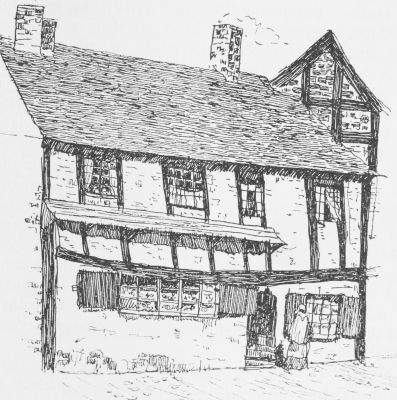
OLD HOUSE IN COX STREET
Each Coventry craft was required by the authorities to contribute towards the setting forth of a pageant at the festival. The more important fraternities—such as the mercers and drapers—were able to bear the expenses of furnishing stage scenery, paying actors, and providing suitable accessories without any aid from bodies outside their ranks. But among the lesser crafts it was usual for two, three, four, or more to band together in order to lessen the individual burden,[663] while in all cases the journeymen probably contributed towards the expenses of their masters' pageant.[664] The task of adjusting these payments according to the means of the various inferior craft companies, was a delicate one, and often brought trouble upon the corporation. None of them cared to undertake the expenses and responsibility involved in the provision of a play. The smiths in 1428 petitioned the leet to be released from the burden;[665] the dyers in 1494 could not be induced to take the load upon their shoulders;[666] while for many years the skinners, fishmongers, cappers, corvesars, butchers, and others contrived to evade payment towards the support of a pageant, until a complaint arose from some of the contributory crafts that they were over-burdened with charges consequent thereon.
This primary difficulty being overcome, the crafts took no little pains to make the representations as perfect as possible. They provided the dresses and stage furniture from their own funds, each company having a pageant-house[667] usually in Mill Lane, now Cox Street, wherein these properties were stored. They paid the composer of the piece, if need were, or the copyist; the actors also, who were maybe lower craftsfolk, had a fixed hire, with "bread and ale" at rehearsals, and between the repetition of the performance on the festival day in different quarters of the town. All were required by order of leet to play "well and sufficiently," "lest any impediment should arise" in the performance, under pain of 20s. to the town wall,[668] and in order that they might be perfect in their several parts, there were usually two, or in the case of a new play no less than five, rehearsals before the festival,[669] some of these taking place in the presence of the assembled fellowship, while the "keeper of the play book" attended, no doubt in the capacity of prompter.
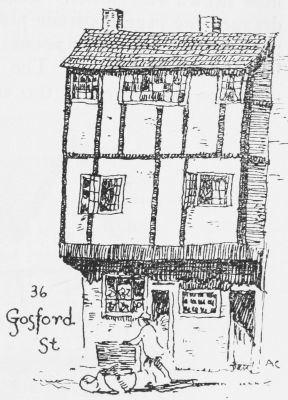
36 Gosford St
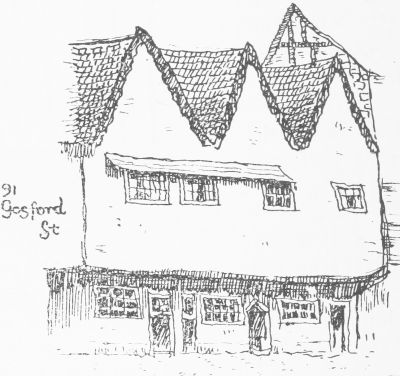
91 Gosford St
The common word for these craft-plays is pageants, a word of uncertain origin, which is also applied to the vehicle or movable stage whereon the acting took place. These pageants[670] were divided into two parts; the actors dressed—and no doubt waited also, when their presence was not required on the stage—in the under part, where they were concealed by hanging cloths; the play was set forth on the upper part, which was open to the view, and furnished with suitable scenery, and the floor strewn with rushes. Journeymen and other hirelings dragged the pageants from place to place, the play being repeated at convenient points within the city, beginning with Gosford Street. The second and third stations appear to have been at the end of Much Park Street, most likely the corner of Jordan Well, and at the New Gate respectively. Dr Craig thinks that there were ten stations, which would accord well with the number of pageants and of wards within the city, though I cannot think that each of the plays was performed ten times over. Flesh is weak, and it is difficult to see how either actors or spectators could have borne the strain.[671] Moreover even the long light days of May or June would hardly have sufficed for such a stupendous task: when it was once essayed, all the pageants being first played before Richard Wood's door to pleasure Queen Margaret, in 1457, daylight failed, and the performance of "Doomsday" was perforce abandoned. Indeed it seems that this particular play, which naturally concluded the series, was but thrice acted, since the drapers regularly order three "worldys"—for which in 1556 they paid Croo two shillings—one to be destroyed, it appears, in each performance.[672]
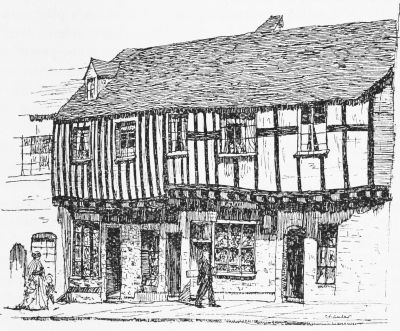
OLD HOUSE IN COX STREET
No doubt this mobility of the theatre, and the simultaneous acting of various pageants at different stations was necessitated by the lack of an open space within the city sufficient to contain the throng of spectators. The acting of single plays, not belonging to the traditional cycle, such as the play of S. Catherine acted in 1491, or that of S. Crytyan or Christian, "magnus ludus vocatus seynt Xpeans pley,"[673] performed at Whitsuntide in 1505, took place in the Little Park where space was ample. That a regular open-air amphitheatre was constructed—such as the plân an guare which survives at S. Just in Cornwall, is improbable; the Park-Hollows, where later Lollard and Marian martyrs suffered death, would maybe serve aptly for the purpose. Such an indelible impression did S. Christian's play make on those that beheld it, that years later when divers neighbours and friends were asked to give proof of Walter Smith's age—it was the Walter Smith who was after strangled by means of Dorothy, his faithless wife—they recalled that his baptism took place the year S. Christian's play was played in the Little Park.
There was possibly a convenient station close to the Greyfriars' church, where Henry VII. and his Queen viewed the plays in 1493. This is the explanation, whereat Dr Craig[674] has arrived after a careful sifting of the evidence, of the cryptic saying of some of the annalists that the King and Queen saw the plays acted by the Greyfriars. "In his Mayoralty," says one version, "K.H. 7 came to see the plays acted by the Grey Friers and much commended them"; another version, quoted by Dr Craig, varies the reading to "at the greyfriers," the probably correct interpretation.[675] The only other reference to the grey friars' acting comes from Dugdale, who goes further in attributing a particular manuscript to this particular house. The plays were "acted," he says, "with mighty state and reverence by the Friers of this House"; and further "I have been told," he continues, "by some old people, who in their younger years were eye-witnesses of these Pageants so acted, that the yearly confluence of people to see that shew was extraordinary great, and yeilded no small advantage to this City."[676] Here Homer distinctly nods. Dugdale does not seem to have heard of the craft plays, whereof the regular representation did not cease until 1580,[677] twenty-five years before his birth, and thirty-five years before his entry into Coventry grammar school, but it was clearly to these pageants that the old people aforesaid referred, since any hypothetical acting on the part of the friars must have ceased in 1538 with the suppression of their house, sixty-seven years before Dugdale's birth and seventy-seven years before the beginning of his scholastic life at Coventry.
It is also on the slenderest grounds that the historian of Warwickshire attributes the fifteenth century MS. of the Ludus Coventriæ to the Franciscans of that city. The first possessor of the manuscript was one Robert Hegge of Durham, after whose death in 1629 it appears to have passed into Cotton's possession and is still included in the great Cottonian collection in the British Museum.[678] Cotton's librarian, Richard James, described the MS. on the fly-leaf as scenes from the New Testament,[679] acted by monks or mendicant friars, adding that the book is commonly known as the Coventry plays or Corpus Christi plays.[680] A later librarian in 1696 omitted the Coventry attribution, but still alluded to the plays as represented by mendicant friars.
Here the matter must rest. Probably the last word has still to be said on the subject. Scholars are not agreed on the locale of the Ludus Coventriæ which have been assigned to districts as far removed as the northeast midlands and Wiltshire, or to their actors, who have been represented as strolling players, or even Coventry friars "on tour."[681] We might be disposed to accept—with caution—the view, evidently based on some tradition or other, that these plays were acted by friars,[682] but the objection to identifying these friars with the Coventry Franciscans, acting at any rate in Coventry, is that the city was furnished already with well-authenticated craftsmen-acted plays of great renown, whereof some examples are now left, and that it would be impossible for two sets of plays and actors to command attention at the feast of Corpus Christi. Nor is there evidence, so far as I am aware, to connect any of the Coventry religious with the stationary plays acted on occasions at Whitsuntide.[683]
We touch surer ground when we come to examine the craft-plays, whereof we have abundance of evidence. Unlike those of Chester, York and Wakefield, the Coventry plays were few in number, having been fused together, and, it seems, formed a series illustrating the life of Christ, closing with His second coming on the Day of Judgment. The absence of Old Testament scenes would be a rare feature, and the point has been disputed,[684] but so few of the pageants remain unidentified, and such striking scenes in the life of Christ have no play assigned to them, that there hardly seems room for scenes drawn from the Old Testament. The procession of prophets[685]—Processus Prophetarum—the nucleus whence the Old Testament cycle spread, is likewise very undeveloped in Coventry. None of the prophets are individualized in the plays that have come down to us, except Isaiah, who appears as prologue to the tailors' and sheremen's play of the Nativity; others appear as rather "defuce" commentators—to use their own word—further on in the action, and again as prologue to the weavers' play of the Purification.[686] It is impossible to construct the whole series of the Coventry plays, for, save two pageants—that of the sheremen and tailors, and that of the weavers—all are missing, and in some cases the very titles of the plays cannot be recovered. The first pageant set forth was probably that of the guild of the Nativity, the company of tailors and sheremen, representing the Annunciation, Joseph's Trouble, the Journey to Bethlehem, the Birth of Christ, the Angels and the Shepherds, the Offering of the Magi, the Flight into Egypt, and the Murder of the Innocents. The weavers' pageant, wherein was set forth the Presentation of Christ in the Temple, and Christ and the Doctors, would follow as a matter of course. The titles of four pageants—those of the mercers, tanners, whittawers, and girdlers—are lost, though Dr Craig has made the shrewd guess that the subject of the first was the Assumption.[687] The story of Christ's Trial and Crucifixion was the theme of the smiths' show, the Burial or the "taking down of God from the Cross" was played by the pinners and needlers, the Harrowing of Hell and the Resurrection was enacted on the stage furnished by the cardmakers, later cappers, and this, with the drapers' Doomsday, closes the list of the plays that are known to us. It will thus be seen that the inferior clothing crafts represented the Christmas cycle, and the workers in iron, smiths, pinners, cardmakers, the Passion-Resurrection one, so that we may suppose that the subject of the girdlers' pageant, since they were workers in iron, would be a subject nearly connected with this latter group—possibly the "Maundy" and the Agony in the Garden.
The shearmen and tailors' pageant of the Nativity and the weavers' Presentation in the Temple, both plays whereof the text has been preserved, were discovered by the antiquary, Thomas Sharp, and printed early in the last century, a fortunate circumstance, since the former with all Sharp's collection perished in the fire at Birmingham in 1879. One manuscript alone remains, now in the possession of the broad weavers and clothiers, a small volume of seventeen leaves, one missing, bound in ancient boards and leather, with end-papers of Holbeinesque wood-cuts. The whole—save two songs at the end—is in the handwriting of Robert Croo, by whom it was "newly translate" in 1534.
Both these plays are written in many metres, and obviously show the workmanship of many hands. Rhythm and versification often betray the 'prentice; indeed on the whole it is but clumsy writing; and yet here and there that wonderful instrument, the English language, gives out its music though it be stricken with an unsure and careless hand. Isaiah's prologue, the scenes between Simeon and Anna,[688]—even the lines of that sublime braggart, Herod, have a hint of that wonderful quality to which English verse attained when Spenser wrote it. The kernel of the story is told in rough, simple quatrains; here and there—particularly in the comic parts—a rollicking stanza, derived apparently from one employed in the Chester cycle, breaks in; while some portions of the piece have been so worked over that the verse defies metrical analysis.[689]
There is no comedy connected with the shepherds' scenes in the Coventry Christmas plays, such as occurs in the Towneley (Wakefield) cycle, where the sheep-stealing episode is the work of a master-hand. Nor is the presentation of their gifts to the Child as charming as the "bob of cherries" passage in the northern dramatist's verses, still the scene is full of the tender feeling, which it never fails to draw forth.
"I have nothing," says the first shepherd to Mary,—
"I haue nothyng to present with thi chylde But my pype; hold, hold, take yt in thy hond; Where-in moche pleysure that I haue fond; And now, to oonowre thy gloreose byrthe, Thow schallt yt haue to make the myrthe. II. Pastor. Now, hayle be thow, chyld, and thy dame! For in a pore loggyn here art thow leyde, Soo the angell seyde and tolde vs thy name; Holde, take thow here my hat on thy hedde! And now off won thyng thow art well sped, For weddur thow hast noo nede to complayne, For wynd, ne sun, hayle, snoo and rayne. III. Pastor. Hayle be thou, Lorde ouer watur and landis! For thy cumyng all we ma make myrthe Have here my myttens to pytt on thi hondis. Other treysure have I non to present the with."
A pipe, a hat, a pair of mittens! How homely it sounds! In the York Plays the Child receives a broach with a tin bell, two cob-nuts on a string, and a horn spoon that can hold forty pease!
In the Nativity scene Joseph warms the Child at the breath of the beasts in the manger.
Mare. A! Josoff, husebond, my chyld waxith cold, And we haue noo fyre to warme hym with. Josoff. Now in my narmys I schall hym fold, Kyng of all kyngis be fyld and be fryth; He myght haue had bettur, and hym-selfe wold, Then the breythyng of these bestis to warme hym with. Mare. Now, Josoff, my husbond, fet heddur my chyld, The Maker off man and hy Kyng of blys. Josoff. That schalbe done anon, Mare soo myld, For the brethyng of these bestis hath warmyd [hym] well, i-wys.
The comic element in the preserved plays is represented by Joseph, a weariful old husband, and natural grumbler, who becomes exceedingly fretful when bidden by Mary to find some doves for the Purification offering at the Temple.
"Swette Josoff," says Mary, "fuffyll ye owre Lordis hestes."
"Why," says her husband ruefully,
"Why and woldist th[o]u haue me to hunt bridis nestis? I pray the hartely, dame, leve thosse jestis And talke of thatt wol be. For, dame, woll I neuer vast my wyttis, To wayte or pry where the wodkoce syttis; Nor to jubbard among the merle pyttis, For thatt wasse neyuer my gyse. Now am I wold and ma not well goo: A small twyge wold me ouerthroo; And yche[690] were wons lyggyd aloo, Full yll then schulde I ryse."[691]
Finding the task inevitable, he murmurs that "the weakest go ever to the wall," and appeals for sympathy to the audience, particularly to the husbands of young and headstrong wives in the traditional manner beloved by mediæval play-goers,
"How sey ye all this company Thatt be weddid asse well asse I? I wene that ye suffer moche woo; For he that weddyth a yonge thyng Must fullfyll all hir byddyng, Or els make his handis wryng, Or watur his iis when he wold syng; And thatt all you do know."[692]
Finally he subsides helplessly upon a "lond" or furrow, till the angel appears and thrusts the birds into his hands. No mention is made to Mary of the miraculous interposition when Joseph has hurried home, pluming himself upon the capture.
"I am full glade I haue them fond. Am nott I a good husbonde?"
says the saint with glee. It is a delicious scene, and its writer was a comedian of no mean order.
Herod was the popular favourite of the Christmas play cycle, for the predecessors of Shakespeare's groundlings loved to have their ears split by his noisy arrogance. He "ragis in the pagond and in the strete also," according to a stage direction, and it is possible that his buffoonery was tinged with the memory of the wild frolic of the ancient Christmas festivals, the feast of the Ass and the feast of Fools.[693]
"It out-herods Herod," says Shakespeare, the professional player, in scorn of the amateur of the old régime. But the rant Herod utters is gorgeous rant.
How the children shuddered when he wielded his "bright brond" or terrible sword, and how his great voice rang out through the streets when he cried:—
"For I am evyn he thatt made bothe hevin and hell, And of my myghte power holdith up this world rownd. Magog and Madroke, bothe them did I confounde."
What megalomania! "Magog and Madroke," are undeniably fearsome names and suit well with Herod's vizor, his falchion and towering crest.
"I am the cawse," he cries out,—
"I am the cawse of this grett lyght and thunder; Ytt ys throgh my fure that the[694] soche noyse dothe make. My feyrefull contenance the clowdis so doth incumbur That oftymis for drede ther-of the verre yerth doth quake. Loke, when I with males this bryght brond doth schake, All the whole world from the north to the sowthe I ma them dystroie with won worde of my mowthe!
Behold my contenance and my colur, Bryghtur then the sun in the meddis of the dey. Where can you haue a more grettur succur Then to behold my person that ys soo gaye? My fawcun and my fassion, with my gorgis araye,— He thatt had the grace all-wey ther-on to thynke, Lyve the[694] myght all-wey with-owt othur meyte or drynke."[695]
There was another Herod in the smiths' play of the Passion, which has not survived, but he was outshone by Pilate, who received 4s. for his hire from the same company, whereas his fellow, the personator of Herod, received but 3s. 8d.; the former, too, drank wine in the intervals between the proformances, while the minor players were refreshed with mere ale for the nonce. Both these above named were rampant characters, Pilate always possessing the organ of Stentor. He appears again in the cappers' play of the Resurrection, and evidently became very terrific, laying about him with his club or mall when the soldiers brought news that Christ had risen from the dead. Years after in 1790 when even the tradition of the pageants was almost forgotten, Sharp, the antiquary, found Pilate's mall in an old chest in the cappers' chapel in S. Michael's church.[696] It was made of leather and stuffed with wool, and had evidently served as the head of a staff. Pilate's "balls," also made of leather, and possibly the forerunners of the fool's bauble, also ministered occasion for noise and laughter. Both Herod, Pilate, and the demons had vizors or masks, hence the smiths' entry, "paid to Wattis for dressyng of the devells hede viiid."[697] The devil—sometimes in the plural—appears in at least three Coventry plays, the Trial, where no doubt he whispered the dream to "Dame Procula," Pilate's wife, as he did at York,[698] the Harrowing of Hell, and Doomsday. In the last two pageants there would be much by-play with Hell-mouth and the souls in the infernal place. I cannot tell in which particular piece the devil, whom John Heywood, interlude-writer, claimed as an "old acquaintance," was an actor, but it undoubtedly was in one of them, since in his Foure P.P. Heywood says:—
"Oft in the play of Corpus Christi, He had played the deuyll at Coventry."
Among the cappers' list of actors there is one which has about it a certain Miltonic grandeur; it is the "Mother of Death."[699] It is to be regretted that Doomsday has not survived, for the names of the persons represented are very suggestive; two demons, two spirits were among them, two "worms of conscience," three black—or damned—souls, and three white—or saved—souls, and a Pharisee.[700] The details of the stage property and payments abound in naïf and grotesque allusions. Thus we learn that a "new hook" for hanging Judas was purchased at the cost of 6d.;[701] and one Fawston received 4d. for "coc croyng," presumably "to startle the penitent Peter."[702] Adam's spade, "Eve's distaff," and the "apple tree,"[703]
"the fruit Of that forbidden tree, whose mortal taste Brought Death into the world and all our woe,"
are part of the stage furnishing of the Harrowing of Hell, since therein Christ drew out from limbo our first parents. Everything about these pageants must have been terrifying especially to sensitive or guilty consciences. A hireling was paid fourpence "for kepyng of fier at hell mothe"[704]from the drapers. This craft also purchased a "baryll," whereof the rolling might imitate the sound of the "yerthequake" on the Judgment Day.[705]
There is a good deal of information about the dresses of the actors in the pageants. Annas and Caiaphas wore "mitres,"[706] Christ and Peter wigs of a gold colour.[707] The tormentors who took part in the scourging had jackets of "blake bokeram" ... with nayles and dysse (dice) upon them.[708] It was the custom for actors to paint their faces.[709] In Doomsday the "saved souls" were clothed in white leather, while those damned were made hideous by blackened faces, and—it seems—a parti-coloured dress of black and yellow, the yellow being so combined as to represent flame.[710] It sounds crude but effective; and effective also, no doubt, was the blare of trumpets when the four angels of the judgment standing on their "pulpits" or raised platform called on the dead to appear before the judgment-seat.
No doubt the artist who painted the blackened and all but invisible fresco of the judgment day over the chancel arch of Trinity church, saw in his mind's eye as he painted Christ seated on the rainbow, with saints and angels, lost and saved souls to His left and right, the rude and realistic representation enacted on the drapers' pageant at Corpus Christi-tide.
Another procession took place on S. George's day,[711] but there is no evidence that any play was acted on this occasion. S. George, however, had a legendary connection with Coventry; and he appears in two occasional pageants, the welcome to Prince Edward in 1474 and that to Prince Arthur in 1498; in the former case with elaborate stage setting, so that there may have been a play in his honour. Another dragon-slayer, S. Margaret, walked in the Corpus Christi procession,[712] and it is possible she may have had a part in the play, as also the other six champions of Christendom, who greeted Queen Margaret in 1457, but here all is conjecture. S. George's long dramatic life in the Mummers' Christmas play in Warwickshire has, of course, only ceased in our time.
Other occasional pageants, noted in the annals, afford us glimpses of tantalising brevity of dramatic shows and gorgeous preparations for the reception of royalty. Thirteen years after Arthur's visit, the prince's brother, King Henry VIII., and Queen Catharine, who must have entered on the eastern side of the city, found at Jordon Well three pageants, embellished with the "nine orders of angels," to greet them. There were others, with "divers beautiful damsels," and "goodly stage play" upon them, but we have no record of the verses composed in the King's honour.[713] While the mercers' pageant stood gallantly trimmed at the Cross Cheaping in 1526 to welcome the Princess Mary. This was before the divorce question had become the talk of Europe, and the daughter of Catherine of Arragon was still held in high honour; so that the citizens made great preparations for her coming, even taking down the heads and quarters of traitors from the gates lest they should annoy the lady's sight.[714]
Fifty years later another sovereign witnessed a memorable performance of the Coventry men. On Hox Tuesday—the Tuesday after the second Sunday after Easter—certain folk-games were held to commemorate, so the historians of the sixteenth century declared, the defeat of the Danes in the eleventh.[715] These games, "invented"—so say the annals—in 1416, fell into disuse soon after the Reformation, but were revived on the occasion of Elizabeth's visit to Kenilworth in 1575. At that time certain "good harted men of Couentree," led on by Captain Cox, alecunner and mason, presented the "olld storiall sheaw" before the Queen, "whereat," Laneham tells us in his delightful letter, quoted in Gascoigne's Princely Pleasures of Kenilworth Castle, "her Maiestie laught well," while the players "wear the iocunder ... becauz her highnes had giuen them too buckes and fiue marke in mony to make mery togyther." The play consisted in a sham fight between the English and the Danish "launsknights," but whether accompanied by folk-rymes or no we cannot tell. "Eeuen at the first entree," says Laneham, who greatly enjoyed the fun, "the meeting waxt sumwhat warm.... A valiant captain of great prowez az fiers az a fox assauting a gooz, waz so hardy to give the first stroke: then get they grisly togyther: that great waz the activitee that day too be seen thear a both sidez: ton[716] very eager for purchaz of pray, toother[717] utterly stoout for redemption of libertie: thus, quarrell enflamed fury a both sidez. Twise the Danes had ye better, but at the last conflict, beaten down, ouercom, and many led captiue for triumph by our English weemen." The last detail was no doubt well liked by her majesty, who was certainly proving that she shared in the mettle of these women of long ago, and who could laugh well—that great royal Tudor laugh—at the rude performances of her subjects.
Music was always a great feature of these pageants and processions. "Mynstralcy of harp and lute," or of "small pypis," or that of "orgon pleyinge," formed a part of the greeting which came to Prince Edward from the stages whereon S. Edward, the prophets, or "the iii Kyngs of Colen" or "seint George" were shadowed forth. There were four chosen minstrels or city waits, and it may be remembered how on one occasion the mayor and aldermen sent for these and bade them go before the throng making their way from Whitley to the city, "which is by the space of a mile largely or more," and pipe and play as they went, "like as the people had done a great conquest or victory." The waits played also on less stirring occasions than the opening of Bristow's meadows, being greatly in request at the banquets of the guilds and crafts,[718] and much sought after in all the country round. They wore silver chains and badges charged with the arms of the city,[719] and besides occasional fees given for their performance during feasts, they received a regular "quarteredge," that is to say, a penny from every citizen having "a hallplace," and a halfpenny from every one dwelling in a cottage four times a year for their maintenance.[720]
The citizens themselves delighted in music; some must have been practised singers, as the representation of the Corpus Christi pageants was diversified by songs. One of these, a lullaby from the tailors' and sheremen's play, is so pretty that it will well bear quotation.
"Lully, lulla, thow littell tine child, By by, lully lullay, thow littell tyne child, By by lully lullay. O sisters too, how may we do For to preserve this day This pore yongling, for whom we do singe, By by lully lullay? Herod, the king, in his raging Chargid he hath this day His men of might in his owne sight All yonge children to slay. That wo is me, pore child, for thee, And ever morne and may For thi parting nether say nor singe By by, lully lullay."
The provision of these games, pageants and processions must have entailed great cost and labour, yet every member of the various fellowships helped to support them, and bore as well his part in the common labours and duties involved in his citizenship. Every one was compelled to obey the mayor's summons under penalty of a fine, whether called upon to come to the leet, or the council, or to help in the common labour of the town. In 1451, when wars were threatening, the call went round for all to come and aid in the work of cleansing the town ditch.[721] The summons went twice round the town according to the watch, we are told, in "right great charge and in special" to the poor folk, who had to leave their other occupations in consequence, besides paying their quota towards the taxes, which were necessarily heavy at that time. And the council hearing thereof ordered that £12, 10s. should be collected from "thrifty" men to pay for the work, and the poor people spared, save that labourers earning 4d. a day were to pay 1d. or 2d. towards the required sum. In addition to their labour in the common defence, all citizens were required to make one of the company of watchmen when their turn came round, or to find a substitute. Fifteen men usually kept the nightly watch, but in times of disturbance their number was increased; thus in 1450 it was enacted that "forty men of decent, good and honest communication and strong in body ... shall nightly watch and guard the city from the ninth hour until the beating of the bell called daybell,"[722] and the light enabled all to see thief or enemy approach.
Neither were the citizens permitted to shirk the common military duties. At the "view of arms" all the freemen appeared in military accoutrement as suited their degree, and the threat of a siege turned artisans into soldiers and aldermen and councillors "for savegard of the cite" into captains of the wards and guardians of the gates. In 1469—the year of the battle of Edgcote—the city was changed into a very arsensal and barracks, so lively were the military preparations going forward at that time. The city accounts show the heavy charges which the distribution of arms and armour entailed upon the public purse.
"Item," says the Leet Book, "delyvered to Robert Onley on Maudelyn day a serpentyne ... for the Newe yate and a honde gunne with a pyke in the ynde and a fowler." To John Hadley for Bishop Gate "i staffe gunne." "Item delyvered to William Saunders, meyr, ii staffe gunnes and a grett gunne with iii chamburs, iii jacks and xxiv arowys." "Item ... to John Wyldgris i gunne with iii chamburs." There also follows the mention of the distribution of jacks and arrows to the various captains,[723] until possibly the supplies ran short, and the last obtained but "i newe jacke and a olde." In the "Lenton" of 1471 the scene was repeated. Guns and pelettes were again delivered to the captains for the gates, and money was hastily collected throughout the wards for the company of soldiers who followed my lord of Warwick to Barnet Field, whereby the citizens incurred King Edward's enmity and great displeasure.
The provision of soldiers according to the terms of the commissions of array, so common in civil warfare, were a heavy tax on municipal resources. When the city officers were ordered by the King's commission to send the local forces to join the royal army, the corporation had to "reteyn" their contingent, provide their dresses, badges and equipment, appoint a captain, and collect money, according to assessment, throughout the wards for their pay. At the beginning of the civil war all went merrily enough, and the citizens threw themselves with right good will into the equipment of the soldiers who were to have gone to St Alban's. But in a few years the artizans, called from their homes and business, were heartily weary of the continual strife, and clamoured for 12d. a day in payment. The hiring of recruits must have become a more difficult matter as time went on, though, like the clinching of all bargains in the Middle Ages, it was accompanied by plentiful drinking. The Leet Book records the following items in July 1470, after Edward IV. had summoned a company of archers to a rendezvous at Nottingham: "dedit ad le sowders ad bibendum xvid.," ... "a gallon wyne vid.," ... "pro ale to the sowders vid."[724] But even after the Wars of the Roses were over we have a sorry picture of the numerous inconveniences attending the hiring of troops. In February 1481, Edward IV. sent commissioners to find out what money or what number of men the burghers would provide in the event of an invasion of Scotland in the summer. After various discussions, commandings and countermandings, it was finally agreed that sixty men should be waged for the royal service for a quarter of a year at a cost of £148, 6s. 6d.; recruits were found and arrows and salets distributed amongst them. More, however, was to be wrung from the reluctant burghers; £40 was collected from 180 of the "most sufficient" men of the town to provide horses and jackets for the soldiery.[725] But sixty archers were not deemed a sufficient contingent by the Court; and when in the following June Lord Rivers came to know if the number could be increased, the mayor called a "Hall" of divers out of every ward to know what the common will was in this matter, and it was finally ordained that the citizens should equip and pay forty additional men, bringing up the number to 100. As all the recruits could not be drawn from the ranks of the townsfolk, the worthy men enlisted the service of strangers, and these had to be kept together, housed and fed, at great trouble and cost[726] until the time for departure. In the end, however, the levy was countermanded, and the troops thus laboriously collected were merely dispersed;[727] a statement of facts the town clerk may be pardoned for recording in a murmuring and discontented spirit.
But however onerous these duties may have been, the Coventry men were loyally proud of their city and citizenship. Albeit a traveller, the mediæval merchant loved, as he loved nothing else on earth, the small stretch of land enclosed by the walls of his native town. He or his ancestors had won and maintained at great cost the city's liberties, and he and they spared no pains to make it beautiful. Historians are wont to despise the English burgher of the fourteenth and fifteenth centuries, by reason of his insignificance and poverty, and his neglect of the highest forms of art, and pointedly contrast his small achievements with those of the merchant princes of Italy, or the proud and daring members of the Hanseatic League. It is true he was a commonplace person, living in what was for his country a commonplace age; nevertheless his doings are worthy of remembrance. If the English townsfolk never produced a Van Eyck or a Da Vinci, a Peter Fischer or a Donatello, they patronised all the local forms of art they knew. They had the same great delight in the common possession of a beautiful object as the people of the Italian republics. Though they lacked wealth to build themselves tall and stately houses like their brethren on the Continent, the English burghers could raise tall steeples, build vast churches, adorn their common halls, and rear exquisite crosses in the market place. The fifteenth century glass in S. Mary's Hall, Coventry, still attests the skill of John Thornton, a native of the city, and one of the first acts of the council of Forty-eight was to decree that a cross should be set up in the Cheaping, which was done, though at a cost of £50.[728] In Coventry, as elsewhere, the rich merchants and craftsmen set carvers to carve the miserere seats—enjoying the grim humour these sometimes display, a quality which crops up everywhere in the fifteenth century, even now and then in legal documents—and bade the engraver commemorate the dead by tracing their effigies on brass, or the mason by fashioning their portraits in stone.
Neither should we regard as contemptible the Englishman's achievements in trade and travel. The Merchant Adventurers, in the teeth of the opposition of the Staplers and the Hanseatic League, first by piracy and chance trading and then by organised and chartered commerce, filled the North Sea with their ships, founded settlements at Bergen and Antwerp, and on the ruins of their rivals built up one of the most successful trading companies of northern Europe. English merchants carried from Crete or Lisbon the precious stores of eastern wine and spices, and brought their bales of wool to the port of Pisa to supply the makers of Florentine cloth, or to the ports of Normandy to supply the looms of northern France.[729]
But it is not for his patronage of art or for his enterprise in foreign trade that the English burgher is chiefly noteworthy, but rather for his "politic guiding" of the cities in which he lived. Pirates, perhaps, on the Narrow Seas, he and his fellows were at home, for the most part, law-abiding men. A certain innate conservatism, a truly British love of appeal to custom and precedent, marks their rule, and, although the populace was frequently unquiet and discontented, the result was, on the whole, happy and successful. If the dangers of foreign commerce made them hardy and fearless, their political and civic life, with its manifold responsibilities, taught them a prudence and worldly wisdom, which appears in all their transactions. Never were men who paid such heed to the Gospel precept, "Be ye wise as serpents." Liable to be deserted or oppressed by the King, thwarted by the open violence or secret maintenance of some great noble or the factiousness of some fellow-burgher, their self-reliance turned these necessities to "glorious gain." It is true that we meet with little heroism, and few distinct types of character. The men of this class can boast of no individuals who can be rightly considered as important historical figures. Like the great Gothic architects, these men, who built up such a flourishing and successful society, have been chary of leaving their names to us. Now and then, however, a bit of grimy and neglected parchment reveals a striking history. We see the clothes they wore and hear the words they said. The quarrel resounds once more in the guild-hall. The stern recorder testifies against the supposed factiousness of Laurence Saunders; and the aged men, lifting up their hands, swear to the ancient extent of the common pasture. These are not heroic or world-known scenes, but they represent the life of the citizens of an old-time city, men whose labours are not entirely forgotten.
FOOTNOTES:
CHAPTER XVI
Old Coventry at the Present Day
Coventry is well worth a whole day's visit, though the day may be an easy one, as the principal buildings lie very near together, and are practically always open, so that no time need be wasted ringing up this or that caretaker or running after the sacristan. Either the powers that be have little leisure to think of tourists, or they must be men of singular enlightenment, for I know of no place which can be seen so freely and cheaply, where lingering over a charming effect, a boss, inscription or painted window may be done with such pleasure because interruption is so rare.[730] The tourist will show his wisdom by not going too far afield in his sight-seeing; the three churches and S. Mary's Hall will, with a passing look at many a picturesque narrow street, carved gable, or interesting relic of old Coventry, furnish him with some hours' occupation. Those, of course, who possess indomitable physical and mental energy may ascend S. Michael's spire for the view's sake, or brave a walk through the somewhat dreary environs of Coventry to the historic but commonplace-looking strip of land known as Gosford Green.[731] Or, if they are proof against the depressing influence of the workhouse—for into this building the remains of the Carmelite monastery have been incorporated—may follow the line of Much Park Street to Whitefriars, and there see the fine monastic cloister, with its fifteenth-century groining, which now serves as the paupers' dining-room.[732]
Castle and monastery have been destroyed in Coventry, and, after all, nobles and monks had very little to do with the making of the city, which, in 1381, was the fifth, and about seventy years later the fourth, among the cities of the kingdom. A fortunate junction of high roads, and the enterprise of the inhabitants, accounts for the great riches and large population during those seventy years. And mark that the most noteworthy buildings were raised within this period: the churches of S. Michael, and the Holy Trinity, and S. Mary's Hall. S. John's church is a little earlier in date. During this period the people of Coventry were possessed with a magnificent frenzy, such as shames our modern efforts, for building and making their city beautiful. That is to say, within a little over two generations the inhabitants of a town of what we should call nowadays contemptible smallness, for it contained at first a population of only about 7000, and later certainly no more than 10,000 souls, raised two parish churches of unusual size, and a fine town hall. One of these churches is indeed the largest in the kingdom, and possesses a spire almost unrivalled in height and beauty. They also kept their fortifications in good repair during this period, and raised—to speak of inconsiderable trifles—a market cross, which has unfortunately perished, besides lending to all the buildings their bounty was making or had made, all the riches of suitable adornment that the carpenter's, carver's, painter's, glazier's, weaver's and goldsmith's art could devise. Much has perished in the destruction of the cathedral, the friars' and other chapels, the cross, a parish church, a guild-hall, and many unremembered buildings; but enough remains to show that we owe a great debt to those dear, dead folk who knew so many things we have forgotten and loved so many things we have ceased to care for, and above all, knew what to do with stone and glass and metal, and loved their handiwork, for it was good.
Women have always been to the fore in Coventry; the names rise of S. Osburg, Godiva, Isabella, Margaret of Anjou, of the virgin sisters Botoner, who built the spire, and of Joan Ward, the first Coventry Lollard martyr. Women of the city, too, helped to keep out Charles I. Here Sarah Kemble (Mrs Siddons) was married and Miss Ellen Terry born. It is fitting that the chief literary interest of Coventry should centre in a woman's name. George Eliot went to school at a house in the south-west end of Warwick Row, 1832-5. Coventry is said to be the original of Middlemarch, and S. Mary's Hall is described in the trial scene in Adam Bede.
In coming from the station down Warwick Row, as you pass the angle of Greyfriars' Green, look at the modern statue of Sir Thomas White, merchant, Lord Mayor of London in 1555, founder of S. John's College, Oxford, and benefactor of the city of Coventry. Other famous folk connected with the city were Laurence Saunders, the Marian martyr, who was led out to die in the park to the right of Christ church, the spire of which is close before you, while John Marston, satirist, writer of plays, friend and foe of Ben Jonson, was born here. Perhaps some day our cousins from over the Atlantic may raise a tribute to the memory of John Davenport, Puritan, of this city, who, after a troubled career as pastor in the city of London, fled to Amsterdam; and finally, in 1637, at the invitation of John Cotton, departed for New England, where he lived as pastor of Newhaven for very many years; and, after much controversy concerning baptism, and writing of books, departed this life at Boston on March 13, 1670. Others may feel more interest in his brother or kinsman, Christopher, a convert to Romanism, and hence the religious antipodes of the aforesaid John. After a sojourn at Douay, this Franciscan friar became chaplain to Queen Henrietta Maria, and subsequently to her daughter-in-law, Catherine of Braganza, wife of Charles II. He died in 1680, and was buried at the Savoy Chapel, London. Being suspected of designs for promoting the union of the English and Roman Churches, it was one of the indictments against Archbishop Laud that he held frequent converse with Christopher Davenport. Other notable folk have at one time or another lived within the city. Sir William Dugdale, Garter King-at-Arms under Charles II., author of the Monasticon and the Antiquities of Warwickshire, "maestro" and "autore" of all such as love the lore of the famous shire of Warwick, received his education at the Free Grammar School. While Humphrey Wanley, to whose skill and knowledge the British Museum owes—not the gift—but the collection and arrangement of the Harleian manuscripts, while he held the post of librarian under Harley, Earl of Oxford, in Queen Anne's time, was son of a vicar of Trinity church, one Nathaniel Wanley, whose book Wonders of the Little World, was greatly loved by Browning.
Full in front is the view of the "three tall spires." The nearest, that of Christ church,[733] is all that remains of the far-famed chapel of the Greyfriars, wherein so many local notables and members of noble families lay buried. The church having been demolished at the suppression of the monasteries under Henry VIII., the steeple remained a solitary landmark until 1830, when the body of a new church was added. This is an uninteresting structure, and not worth a visit.
We are now inside the compass of the ancient wall, and those who wish to keep up old illusions, and enter the city by the ancient road, should turn up Warwick Lane, alongside of the Grapes' Inn, avoiding modern Hertford Street, and so along Grey Friars' Lane to High Street and the main thoroughfare of the city. A little below the junction of the Warwick and Grey Friars' Lanes stands Ford's Hospital, a beautiful black and white timbered house with carved gables such as artists love. The windows are of nine lights, divided into threes, with window-headings of fine tracery. In a room over the porch called the chapel are oddments of stained glass. Some of the seventeen old women who are housed there, and daily bless, or should bless, the memory of Master Ford and Master Pisford, merchants, may often be seen sitting in the little inner quadrangular court. Worthy Master Pisford, by his will, dated 1517, made provision for six old men and their wives, "being nigh unto the age of threescore years and above, and such as were of good name and fame, and had been of good honesty and kept household within the said city, and were decayed and come to poverty and great need." Nowadays, however, it is only old women who profit by their benevolence.
On reaching High Street, which is part of the great north-west road, and the old coaching way between London and Holyhead, it is best to go right on down Pepper Lane, which immediately faces you, until you come to S. Michael's churchyard. This broad open space was, and is still, the centre of the life of the town. Here stood the cathedral and the two great parish churches, the house containing the cloth market, and the guild-hall, where the rulers of the city assembled to take council together. Possibly while the churches, as we know them now, and S. Mary's Hall were yet unbuilt, the common assembly of city folk met together here to hold courts, and decide on questions touching the common weal. Now the cathedral and drapery are gone, but the church spire still stands fronting the spectator, and a few paces will bring him where, behind the projection of a small black and white cottage, stands the red and crumbling entrance porch of S. Mary's Hall.
Tradition, which we can never afford to disregard, says that S. Michael's Church—spire, tower, chancel, and nave—was built by the Botoners, a great merchant family, further affirming that a brass plate was found in the church, with the following lines engraved upon it:—
"William and Adam built the tower, Ann and Mary built the spire, William and Adam built the church, Ann and Mary built the quire."
Undoubtedly the Botoners were wealthy and generous folk, but whether this little quatrain is founded on fact or no, we have no means of proving.
The famous nine-storied steeple, consisting of tower, octagon and spire, whereof the tower, begun in 1371, occupied twenty-one years in building, is 300 feet high or thereabouts, but gains a fictitious appearance of greater height in that it springs immediately from the ground. The architect had a marvellously happy thought when he added the flying buttresses, which connect the pinnacles of the main tower with the octagon above it, converting a mere tall spire into a "star-ypointing" thing of lightness and beauty.[734] The stone figures in the niches are modern; the ancient ones, worth inspection though worn past identification, have been placed in the crypt, to which entrance is gained on the north side of the church. It is perhaps the finest specimen of the florid Perpendicular spire in England. The decoration is concentrated in the storeys easily seen, i.e. the upper ones of the tower, gradually dying away as the eye travels upwards. The steeple recently underwent restoration under Mr Oldrid Scott, and whatever was gained in stability by the process, much was lost with the look of old age which vanished with the crumbling surface of the ancient stone.