Chapter III · —The Earliest Stations and their Sequence
Reading edition
The word statio (station) appears in Christian literature from a very early date, with a special and quasi-liturgical signification. It is not quite easy to trace its primitive development. There can be little doubt that its Christian meaning grew out of the military use of the term to designate an outpost or picket, especially for night duty.[34] Early in the second century it is familiar to Hermas[35] in the sense of a “fast,” possibly, because on certain days, stationes (i.e., vigils) were kept up during the night and early morning beside the tombs of the martyrs, such vigils being, perhaps, marked by a fast, or at least a semijejunium. This, however, is quite uncertain. In the time of St Cyprian, the word frequently had reference to the “synaxis,” or gathering of the faithful for liturgical purposes, which took place on those fast-days. In the indications still retained in the Roman Missal, e.g., “Statio ad S. Anastasiam, Statio ad S. Laurentium,” etc., statio no doubt denotes rather the service itself than the meeting-place in which it was held. Such a rubric was intended to convey that the statio, i.e., solemn Mass, with its accompanying procession, etc., took place on this day at the Church of St Anastasia or of St Laurence. But the further use of the term in the general sense of halting-place in a procession, or site calling for special veneration, was obvious, and became familiar in the vulgar tongue of most European countries during the middle ages. The “Stations of Rome,” for instance, is the title of a fourteenth-century English guide-book, which gives in rude verse an account of all the more conspicuous churches and of the holy places in the city where indulgences could be gained.
In this sense the word statio has been applied to the different halting-places along the Via Dolorosa. Curiously enough, the first instance of its consistent use, with this signification, meets us in the narrative of an English pilgrim, Master William Wey, one of the original fellows of Eton College. Wey visited Palestine on two separate occasions—in 1458 and 1462. On both occasions he went to Jerusalem, and made the ordinary round of the holy places (through the the city, and to the Mount of Olives and back), under the guidance of the Franciscans of Mount Sion. He obviously took special interest in the minute details of these tours, for he has not only written a twofold account of most of them, but he has invented an elaborate memoria technica, of which more anon, for recalling them to mind in their proper order. Now, while Wey gives minute descriptions, providing also memorial verses for each, of several other tours, namely, the holy places around Bethlehem, the places within the precincts of the Holy Sepulchre, the holy places beside the Jordan, the holy places on Mount Sion, etc., he reserves the name Stations for one tour, and one tour only, that within Jerusalem, which begins with the sites of the Via Crucis. If these places had been but once referred to in the volume which he has left us, we might easily have supposed that the word stationes appeared there by accident, but seeing that it occurs four separate times in the same connexion, and nowhere else, it would hardly be reasonable to explain its presence in these passages by mere coincidence. First, we note that among the headings of the memorial verses the tour beginning with the Via Crucis is entitled “Loca Sancta in Stacionibus Jerusalem.” In none of the rest does the italicized word appear, though we have “Loca Sancta in Monte Syon,” “Loca Sancta in templo sancto Christianorum,” “Loca Sancta in Bethlehem,” etc., in any one of which we might have expected to find it. Again, in the general account, which is given apart, when Wey begins a detailed description of the same tour, starting eastwards from the Holy Sepulchre, we meet the rubric, “Hic incipiunt sancte Staciones,” the other tours being headed like those just referred to—“Peregrinaciones Vallis Josaphat,” “Peregrinaciones Montis Oliveti,” “Peregrinaciones sacri Montis Syon,” etc. Then, in Wey’s narrative of his first pilgrimage, the same word is twice repeated in connexion with the same series of sites under the form “Peregrinaciones ad loca Stacionum,” and, finally, in the account of the second journey of 1462, the term seems to be introduced with emphasis into the text itself. It will be well to translate this brief passage:
“After supper,” says the writer, “we lay down upon mats, and at early dawn the brothers came to call us to make the round of the stations (veniunt fratres vocantes nos ad peragrandum staciones). And so, upon July 20, we traversed those sites (ivimus per ista loca). First, the stone with crosses upon it on which Christ fell;[36] second, that paved street in which Christ carried the cross; third, the house of the rich man that was damned; fourth, the meeting of the ways where Christ fell with His cross; fifth, the place where the women wept over Christ; sixth, where Veronica received the countenance of Christ upon her napkin; seventh, where the Blessed Virgin Mary swooned; eighth, the gate through which Christ was led out to death; ninth, the pool where the sick were healed at the moving of the waters; tenth, where are two white stones built into the wall over the head of the passers-by, upon which Jesus stood when He was sentenced to death by Pilate; the eleventh is the school of the Blessed Mary, where she learnt to read; and along that road on the other side is the house of Pilate, in which Christ was scourged and condemned to death; and so on for the rest of the places in Jerusalem—Josaphat, the Mount of Olives, the Valley of Siloe and Mount Sion, as I have described them in my preceding itinerary.”
It seems to me not wholly accidental that Wey interrupts his list at the house of Pilate. We may remember that the famous stations erected in Nuremberg, at the instance of Martin Ketzel, begin with a Pilatushaus, and were suggested seemingly by the pilgrimage he made in Palestine about 1468, six years after Wey’s last visit to the Holy Land. We may also remember that in the next century there is strong evidence of a special cultus paid to this clearly-defined portion of the tour (peregrinatio, circulus or Umgang). Hence it seems likely that Wey himself regarded the road along which our Saviour travelled to His death as standing out in some conspicuous manner from the rest.
Other pilgrims in the latter part of the fifteenth century use the name Stationes, though not seemingly with such an exclusive reference as this English traveller to the sites along the Holy Way. The matter deserves fuller investigation, although, on account of the very large number of those who have left accounts of their pilgrimages at this period, the undertaking would be a serious one. I may be content to notice here the prominence given to the word Stations in the Pilgrims’ Guide of Antonio de Aranda, a Spanish Franciscan, who wrote in 1530. The book is particularly important, because it does not, like so many of the others, record merely the fleeting and necessarily inaccurate impressions of a single hurried visit to the holy places, but the writer, who was guardian of the important Franciscan Friary of Alcalà, seems during a considerable period to have been the honoured guest of his brethren of Mount Sion, and to have had constant opportunities of obtaining information from those who lived on the spot.[37] Of Aranda’s volume we shall have to speak further, but for the present it will be sufficient to notice that he uses the word estaciones frequently, and that it seems to be particularly applied to the sites on the way to Calvary, and not so commonly to be employed of the sites, even though richly indulgenced, in the pilgrimages outside Jerusalem. Thus Chapter XIV bears the following heading, conspicuous among the few such headings in which the word estaciones is introduced:
“Cap. XIV.—Of the Stations [estaciones] which there are from the House of Caiphas up to Calvary along the Road which Christ travelled.”
In this chapter, when referring more particularly to the way between Pilate’s house and Calvary, Aranda makes the further statement that “in this road there are three stations.” The first station so specified is the meeting-place of our Blessed Lady and her Son. The second is that of the meeting with the women. The third the house of Veronica.
Now, whether we look to the sites which, according to the testimony of travellers, were held in honour in Jerusalem itself, or whether we look to the imitation pilgrimages which were carved in stone or set down in books for the devotion of the faithful at home, we must recognize that there was a complete want of any sort of uniformity in the enumeration of the Stations. As so much has just been said of William Wey’s pilgrimage, we may conveniently take the first two verses of his memoria technica, which by a coincidence happen to commemorate just fourteen sites. They run as follows: In Wey’s own manuscript, and in the reproduction of it for the Roxburghe Club, the words of which the verses are made up are written in a very large hand, while the explanations of each, here given in footnotes, are added in minute writing over the word to which they have reference. The crosses, which in the MS. have been written in red ink, indicate the places where plenary indulgences may be gained.[38]
“Loca Sancta in Stacionibus Jerusalem
Those of my readers who do not understand the Latin explanations may be referred back to the passage already translated from Wey (p. 48). The places there mentioned are the same as those cited here, except that two others, viz., the house of Herod and the house of Simon the Pharisee are here added. It should be observed, too, that the memorial verses continue without any break or division to indicate nearly thirty sites, some within Jerusalem, some outside the walls. In all, the holy places about Jerusalem number in his reckoning more than a hundred. It will be seen that the fourteen Stations on this list by no means correspond to those with which we are familiar. If we count the first mentioned by Wey (Lapis cum crucibus, i.e., the stone with crosses shown in the courtyard before the church of the Holy Sepulchre,) as the equivalent of the scene of His third fall, we have only four others which can be properly identified with ours. These are trivium, the “cross-road” where Simon of Cyrene was made to assist our Lord; flebant, the weeping women; sudar, i.e., sudarium, the napkin of Veronica; and sincopizavit—“she swooned,” the meeting with Mary. Strat, the paved way leading to the hill of Calvary; di, the house of the rich glutton of the parable; por, the judicial gate of the old city: pis, the probatic pool; lap, the two stones in the Ecce Homo arch; schola, our Lady’s school; and the houses of Pilate, Herod and Simon the Pharisee, expressed by the words dom, Her, Symonis Pharisey, are only remotely related to the Way of the Cross as we know it. For purposes of comparison it may be interesting to quote the narrative of another English pilgrim, a layman of distinction, who made the same round of stations about fifty years later, in 1506, and who has left an account in the vernacular. He also, like Wey, travelled eastwards from Calvary, but the pilgrimage, which in Wey’s time was performed in one day, seems in 1506 to have been spread over several. The site which Wey mentions first as lapis cum crucibus (the stone with crosses) is included by Sir Richard Guylforde[53] in the series of “stations” at the Holy Sepulchre, being referred to in the following words:
“And withoute, forthe before the entre into this Temple (of the Holy Sepulchre), X paces in distaunce, is put a stone in memorye and token that our Savyour Criste, berynge His Crosse, for very feblenesse, fell there to the grounde undernethe the crosse.”
Then under the heading, “Pylgrymages within Iherusalem,” Guylforde continues:
“[7] And so this day aforesayde we vysited all ye longe wey by the whiche our Savyour Criste was led frome the hous of Pylate unto the place of His crucyfyinge.
“[6] And firste, as our way laye, we came to the house of Veronica, whiche is from Pylate’s house 550 paces, where as our blessyd Savyour impressyd ye ymage of His face in her wympell whiche is at Rome, and is there called the varnacle.
“[5] And from thens we went to the house of Diues Epulonis, qui sepultus est in inferno, etc.
“[4] And from thens we went to a place called Bivium, that is as moche to say as a crosse strete, or a crosse wey, where ye women of Jherusalem stode and sorowfully wepte whan oure Savyour was led to His deth, to whom He sayde, ‘Wepe ye not vpon me, ye daughters of Jherusalem, but wepe ye vpon yourself and vpon your children,’ etc.
“[3] Item nexte is the place where ye Jewes constreyned Symeon Cirenen, comynge from the towne, to take the crosse after our Savyour, etc.
“[2] The next place yt we come to is wher our blessyd Lady stode when she met with her dere Sone berynge His crosse, where, for ouer moche sorowe and dolour of herte, she sodenly fell into a sowne and forgetfulness of her mynde; and this place is called Scta Maria de Spasmo. Saynt Elyn buylded a churche there, but it is downe, and ye Sarrasyns haue often attempted to buylde there, but their edifying wold not stande in no wyse.
“[1] Item, as we passyd by ye strete, there standeth an arche ouer ye way, vpon ye whiche stoude ii large whyte stones; vpon the one of them our Savyor stode whan he was juged to deth, and upon ye other stode Pylate whan he yaue sentence yt he shuld be crucyfied.”
I have prefixed numerals in square brackets to these paragraphs to call attention to an interesting change in the practice of the pilgrim guides at Jerusalem. Eleven years after the voyage of Sir Richard Guylforde to the East, another English pilgrim, Sir Richard Torkington, a priest, set out to visit the holy places, and he also compiled an account of his adventures. In accordance with a custom very prevalent in the days when literary copyright was yet unknown, Torkington freely availed himself of the descriptions left by previous travellers. Guylforde’s pilgrimage had been printed by Pynson in 1511, and from this source Torkington has copied almost verbatim the account there given of the various shrines and stations in Jerusalem. But there is one noteworthy modification. In his description of “the longe way by whiche our Savyour Christe was led unto the place of His crucyfyinge,” Torkington, while borrowing sentence by sentence the exact words of his predecessor, has carefully arranged the sites in the reverse order. From this it seems clear that in 1517 the good Franciscans at Jerusalem had for some reason changed their practice and now conducted the pilgrims along the way of the Cross towards Calvary, as our Lord Himself had travelled on His last sorrowful journey. At any rate, so far as I am aware, we do not after this date find in the descriptions of the Via Dolorosa that the sites are any longer enumerated in the reverse order from Calvary eastward.
But to return to Sir Richard Guylforde’s description. It may be noted from what follows that he passes without perceptible break from the Stations of the Way of the Cross to other sanctuaries. We may fairly infer that in 1507 the Way of the Cross was not yet generally recognized as a separate object of devotion:
“From thens we went vnto ye hous of Pylate, in ye whiche our Savyoure was scorged, betyn, crowned with thornes, and put to all iniuryes yt myght be deuysed, and fynally condempned to deth; there is also clene remyssyon.
“And there is also the way that gothe to the Temple, by the whiche, when the Jewes came from the Temple, they cryed, ‘Crucifige,’ etc.
“From thens we went vnto the hous of Herode, that is on the lefte hand of Pylates hous, and standeth hygher vpon the fronte of the hyll, into the whiche hous our Savyour was presented unto Herode by Pylates sendynge, accusyed by ye Jewes; neverthelesse, the sayde Herode clothed hym in a whyte garment, and sent hym agen to Pylate, et facti sunt amici Herodes et Pilatus in illo die, etc., and thyse ii houses of Pylate and Herode be yet now moch what the fayrest houses in Jherusalem, and specyally the house of Herode.
“Therby is an other fayre hous yt was sometime a fayre churche of Saynt Anne, but now ye Sarrasyns have made thereof a muskey [mosque], that is to say, theyr temple, and that is the selfe place yt was Saynt Anne’s house, and there she died; and in a vaught vnderneath is the very selfe place where our blessyd Lady was borne; and there is plenarye remyssyon. The Sarrasyns wyll suffre no man to come into this place, but pryuely or for brybes, because it is theyr muskey.
“Nota that relyques of the stones of the place there our Lady was borne is remedy and consolacion to women that travayll of childe, etc.
“Item, a lytell therby is Probatica Piscina, where our Savyour healyd many men that were seke, as the Gospell sheweth, etc.
“From thens we went to the hous where the synnes of Mary Magdalene were foryeuen.”[54]
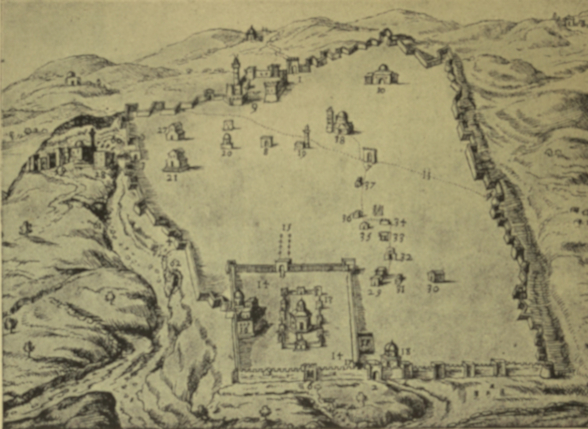
MAP OF JERUSALEM From MS. Addit. 33566, at the British Museum, drawn about 1616 by Giovanni Cales to illustrate the Viaggio di Gerusalemme of Vincenzo Favi. The dotted line from 29 to 38 represents the Via Dolorosa. The other dotted line represents what Cales believed to be the position of the City Wall in the time of Our Lord. The principal sites, as indicated by the numbers, are thus explained by the artist: 12-14. The Temple, now the Mosque of Omar. 29. Pilate’s House. 30. Herod’s House. 31. Supposed place of the Scourging. 32. Arch from which Christ was shown to the people. 33. Church of Our Lady’s Swoon. 34. Place where Simon of Cyrene came to help our Lord. 35. The Glutton’s House. 36. The House of the Pharisee. 37. House of Veronica. 7. Judicial Gate. 38. Church of the Holy Sepulchre. 9. Mount Sion and the Cenacle.
However, despite a good deal of variation in the selection, arrangement, number and distances of the Stations, it is clear that at Jerusalem in the early part of the sixteenth century the traversing of the route of our Saviour from Pilate’s house to Calvary had already begun to be regarded as a special exercise of devotion which was in some sense complete in itself. Aranda, who, by the by, sets down the distance at 1,862 passos,[55] tells us that this is the Holy Way, par excellence, “Esta es la via sancta particularmente ansi llamada de los Cristianos”; and he remarks further, “Also it is to be observed that this road from Pilate’s house to Calvary is that which we friars (nosotros los frayles) are wont to follow when for our devotion, and out of reverence for our Saviour, we set out to traverse the very road which, as we believe, His most compassionate Majesty Himself trod.”
Undoubtedly one of the earliest indications of special veneration attaching to the holy “Cruysganck,” i.e., the carrying of the Cross, is the practice of measuring the distance from the Prætorium to the place of Crucifixion. The first traveller who seems to attach importance to the exact distance from Pilate’s house to Calvary, and who professes to have carefully measured it, is Martinus Polonus, in 1422.[56] Polonus estimates the length of our Lord’s last journey at 450 paces. Martin Ketzel, who had the famous Stations erected at Nuremberg, lost the measurements he made during his first pilgrimage (c. 1468), and actually undertook a second pilgrimage some few years later in order to take the measurements again. In spite of all the care supposed to have been used by Polonus and others the most extraordinary diversity prevails in the measurements given, which, for fear of the Turks, could only be made in paces. Thus, while Polonus, in 1422, gives the distance from Pilate’s house to Calvary at 450 paces, it is set down by sundry different travellers—as Tobler[57] points out—in 1479, at 1,050 paces; in 1491, 1000; in 1507, 1,067; in 1508, 500; in 1519, 846; in 1586, 750; in 1593, 1,321 (this last measurement is that of Adrichomius); in 1611, 850. It is to be noted that by passus some travellers must have meant a double step, others a single stride, but even so the divergence is difficult to explain. Probably the main cause of the discrepancy was the fact, as we shall have occasion to note further on, that the ground between the old Judicial Gate and Calvary was all built over. Hence pilgrims could only guess at the path actually followed by our Lord.
The only satisfactory way of bringing home to the reader the wide divergence between the Stations in Jerusalem itself, as known to travellers between 1300 and 1720, and those of our modern Way of the Cross would be to draw up an elaborate table recording the dates of the principal narratives and all the sites mentioned in them. This can hardly be attempted here save on a very small scale, which does not in any way make apparent to the eye the complete absence of any record regarding the first two falls, the sentence by Pilate or the stripping of the garments. On the other hand, if we accept the mention of the Ecce Homo Arch—i.e., the two stones, as Wey calls them—as the equivalent of the reception of the cross, and the stone marked with crosses before the Holy Sepulchre as the site of the the third fall, it may be said that these two stations—the second and the ninth—appear in the narrative of almost every early traveller.[58] This disposes of six stations, and the four last—the nailing to the cross, the crucifixion, the taking down and the entombment of our Saviour—call for no comment. We are left, therefore, with four variable stations, which may be thus indicated: the meeting with our Blessed Lady by M, that with Simon of Cyrene by S, that with the women of Jerusalem by W, and that with Veronica by V. With regard to these, the data of our selection of travellers may be tabulated as follows. The order of these meetings is that in which they would have occurred as our Saviour made His painful way from the Prætorium towards Calvary.[59]
1294 Ricoldo W M S
1320 Pipinus M S W
1350 Dublin MS. W M S
1391 Swinburn and Brigg M S
1395 Ogier d’Anglure M M W S
1419 Nompar de Caumont M { W
{ S
1422 Johannes Polonus M { W
{ S
1435 Lochner M V W S V
1436 Georg Pfintzing M W S V
1458 Wey M V W S
1480 Fabri M W S V
1483 Breydenbach M S W V
1484 Francisco Suriano M W S V
1491 Dietrich von Schachten M { W V
{ S
1496 Harff M W V
1506 Guylforde M S W V
1530 Aranda M S W V
1586 Zuallardo M S W V
1620 Bernardino Amico M S W V
1639 Quaresmius M { S V
{ W
1646 Surius M S W V
1656 Parviller M S W V
1674 Nau M S W V
1694 Caccia M S W V
1713 Hietling M S V W
1716 Turpetin M S W V
1724 Francisco Jesus Maria M S W V
1735 Myller M S V W
1736 Antonio do Sacramento M S V W
1744 Horn M S V W
It will be remarked that no mention of Veronica occurs before the account of Lochner in 1435. In his narrative, her name appears twice, though that marked V(1) is but a casual allusion. In all the later descriptions down to 1713, with the single exception of Wey in 1458, the meeting with Veronica comes nearest to Calvary. Wey is so painstaking in his descriptions that when we couple his divergence from the commoner arrangement with the double mention of Veronica in Lochner we are led to the conclusion that the tradition about the site of Veronica’s house remained rather vague and uncertain until some years after we first hear of it. During the same period the meeting of our Lord with Simon of Cyrene and that with the holy women were uniformly regarded as having taken place close together. It is noteworthy, then, how completely our present arrangement of stations, which separates the holy women and Simon of Cyrene by Veronica and by the second fall, contradicts all local tradition. But upon this point there will be occasion to speak further in a later chapter.