Chapter VIII · —The Stations in Modern Times
Reading edition
It is not the purpose of this little volume to provide devotional aids for performing the exercise of the Way of the Cross, neither is it meant to be a manual of information for those who are interested in the minutiæ of ecclesiastical legislation on the subject. Of such books there is already an abundant supply,[155] and the aim of this essay is to throw light upon certain historical questions which have hitherto failed to attract particular attention. But before taking leave of the whole subject it seems desirable to say a few words about the developments of the devotion during the last two centuries, and it is impossible to do this without touching at least briefly upon the obscure and delicate question of the indulgences of the holy places.
If in making the Way of the Cross Catholics have come in modern times to follow one almost uniform system throughout the world, the cause of the uniformity is not far to seek. Even apart from the strong appeal which our present arrangement of fourteen Stations seems to have made to the devotional sense of the faithful, the question of indulgences must undoubtedly have had much to say to the rapid disappearance of all rival methods. According to the terms of the concessions made by various popes at the instance of Friars Minor of the Observance during the last two hundred years the grant of indulgences is, practically speaking, limited to that form of the exercise which we use to-day, the form which was gradually adopted in the West by the sons of St Francis, and which has been placed by the Holy See under their special charge and direction. That the Franciscan Order may justly claim to hold a quite exceptional position with regard to this devotion no one will be tempted to dispute. Ever since the thirteenth century these devoted religious have been the official custodians of the holy places. They have borne the heat and burden of the day during periods of great hardship, danger and humiliation. They have remained faithful at their posts, never faltering in their work of love, and no tongue can tell the countless services they have rendered to successive generations of pilgrims who, thronging from all parts of the world to this barbarous and hostile land, have found themselves almost entirely dependent upon their good offices.
But while in this way the great work of the veneration and maintenance of the holy places owes almost everything to the sons of St Francis, it would not seem that down to the close of the seventeenth century we can connect them with any definite system of honouring the Way of the Cross in western lands. In Antwerp, as we have already seen (p. 69), they favoured an arrangement of seven stations; at Jerusalem itself they counted eight; on the Sacro Monte di Varallo Blessed Bernardino Caimi, O.F.M., arranged for the erection of more than a score of chapels leading up to Calvary.[156] Hence, although before the days of that great apostolic preacher St Leonard of Port Maurice, the Way of the Cross had become a practice of devotion which was almost distinctive of the Franciscan missionaries in Italy and was much relied upon by them, the scheme of Stations was not of their own creation. There can be no doubt that, consciously or unconsciously, they had merely borrowed the arrangement set out by Adrichomius and invented by Pascha, adapting the exercise for popular use by the recitation of a few simple prayers at each halting place and by the singing of hymns as the congregation moved from one to another. It is only with the closing years of the seventeenth century that we begin to meet with a certain number of papal briefs directly connecting the Franciscans of the Observance with the exercise of the Way of the Cross. These were granted at the instance of the General of the Order, and they were the prelude of an important movement which was soon to follow. It would take us a great deal too far to attempt to enter into the exact provisions of these early papal documents. The question all turned upon the possibility of communicating to those who took part in the exercise of the Stations in Europe or elsewhere the extraordinarily rich indulgences which were believed to attach to the veneration of the actual halting places in the Via Dolorosa in Jerusalem. It is sufficient to say that this communication of privileges was first accepted in principle by Popes Innocent XI and XII, and that after being limited at first to those who were under the jurisdiction of the Franciscan General, either as members of the Order or as tertiaries, etc., it was gradually extended to those who visited the sets of Stations erected in Franciscan churches, and finally was placed within the reach of all the faithful who complied with certain conditions in any church, providing that the fourteen Stations had been canonically erected there by some priest duly empowered, either as himself a member of the Order of Friars Minor[157] or as the appointed delegate of their Father General.
Curiously enough it had been boldly asserted, as far back as the close of the fifteenth century, that those who travelled to Jerusalem in spirit only, might gain all the indulgences offered to the pilgrims who venerated the holy places by their bodily presence. There was certainly at that time no papal authority for any such belief, but the statement is clearly made upon the title page of the little book of Heer Bethlem mentioned above (see p. 79, note),[158] and is developed in the following passage of Bethlem’s Introduction:
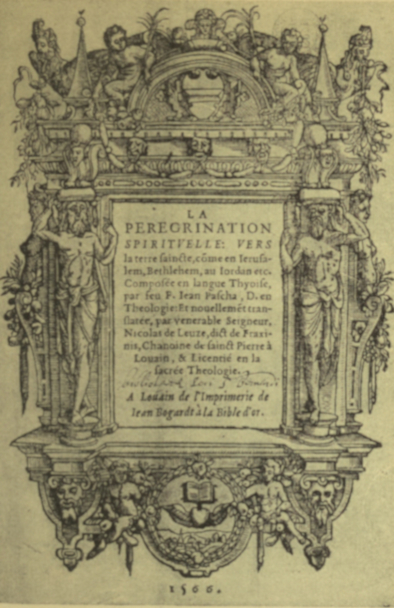
TITLE PAGE (reduced) OF THE FRENCH EDITION OF PASCHA’S “GHEESTELYCK PELGRIMAGIE” This book includes the mention of the usual indulgences to be gained at the Holy Places (see the facsimile, p. 78) though it does not, like Bethlem’s little manual, proclaim them on its title-page.
“This is the indulgence of the holy city of Calvary, which indulgence everyone can gain who follows the painful and heavy way of the cross-bearing of the naked, bleeding Jesus, and thinks with pity on the bitter Passion in his inmost heart. This is not so to be understood as if those only gained it who are in Jerusalem or who travel there, but all persons in what place soever they are, if in their inmost heart they turn to God and meditate with attention and compassion on those holy places where this took place—as much as humanly they can—may gain this indulgence from the mercy of God as often as they themselves wish, and also as entirely as if they were in the city of Jerusalem and visited bodily all these holy places. Still those who travel thither with great labour and expense will, without doubt, be heard by our dear Lord according to the greatness of their labours and their devotions. But those who cannot come there bodily, and who with the powers of their soul meditate on those holy places and salute them with compassion, after the manner hereafter described, to such as these the indulgence of the holy city of Jerusalem and of Calvary shall be as fully granted as if they had been present there in person; because the holy popes have given us this out of the worthy merits of the bleeding, crucified Jesus Christ, our dear Lord, by His holy Wounds and precious Blood poured out, in the same way as the indulgence of Rome is given us to be gained in all churches. Thus those pastors give us power to lessen penalties and remit guilt. This [indulgence] is found true and has been proved, and all Christian men should constantly gain it, that their cold hearts may be inflamed by the hot Blood of Jesus Christ as He suffered His bitter Passion so willingly for us.”[159]
Of the fact that the indulgences of the holy places have now been validly communicated, and are available for those who piously make the Way of the Cross in any church in which it has been properly erected, there can be no doubt whatever. What is not quite so clear is the precise nature of the spiritual treasures which have been thus placed within the reach of all the faithful. From the fourteenth century onwards the numberless accounts which have been preserved to us of the pilgrimage to the Holy Land make particular mention of the large indulgences which were there to be gained upon the simple condition of praying at each of the various shrines to which they were attached. It would even seem that at an early date compendious lists of these holy places, both in Jerusalem and throughout Palestine, naming each shrine and the indulgence attached to it, were in regular use and passed from hand to hand. We have, moreover, much evidence to show that the pilgrims made a practice of copying out these lists and bringing them back with them to Europe, where they too often served the writer, instead of notes of a more personal and trustworthy character, to draw up an account of his visit to the holy places after his return. The items mentioned in this list and the character of the indulgences attached to them often vary considerably; though in saying that the indulgences vary, I do not mean that, as so often happened with devotional shrines in the West, fantastic figures and terms of years were quoted at haphazard. Only two types of indulgence commonly appear—the plenary, which was usually called an indulgence a pœna et culpa (remission of penalty and guilt),[160] and the partial, which was always in these cases an indulgence of seven years and seven quarantines (or lents). The reader is informed in many of these relations that where a cross is marked (☩) a plenary indulgence is to be understood; where some other symbol is used or nothing is said, an indulgence of seven years should be assumed. At the same time, if we compare the narratives of different pilgrims, we find a great many discrepancies. The shrine which according to one witness enjoys a plenary indulgence, according to another is only to be credited with an indulgence of seven years, and in the opinion of yet a third is not indulgenced at all.[161] The general impression derived from these varying statements is not very favourable either to the authenticity of the grants or to the seriousness of the effort to keep an accurate record of them.
There is, however, one point upon which we find that the writers who mention the matter at all, were, practically speaking, unanimous. They maintained that the indulgences attached to the holy places were of the most venerable antiquity. It was Pope St Silvester, they asserted, who granted them at the prayer of the Emperor Constantine and his mother St Helen. Thus, to take an example almost at random, Ogier d’Anglure, in 1395, distinctly asserts[162] that the said indulgences were granted at the prayer of St Helen and of “Saint” Constantine her son. Or to quote the still more formal assertion of Nompar de Caumont in 1419:
“Ci Ensuivent les pérégrinations, endulgences et pardonances de peine et de coulpe de toute la terre sainte, que je, Noper, Seigneur de Caumont, de Chasteau Nuef, de Chasteau Cullier et de Berbeguières, ay ensuités par la grace Nostre Seigneur; lesquelles endulgences furent concedées de saint Silvestre, papa, à la requeste de l’empereur Constantin et de sainte Hellene, sa mere, et furent escriptes en la cipté de Jherusalem le xiiie jour du mois de juillet, l’an mil ccccxix.” Which is to say, in modern English:
“Here follow the pilgrimages, indulgences and pardons from penalty and guilt, of all the Holy Land, the which I, Noper, Lord of Caumont of Chasteau Nuef, of Chasteau Cullier and of Berbeguières, have duly accomplished by the grace of our Lord. And the said indulgences were granted by St Silvester, Pope, at the request of the Emperor Constantine and of St Helen his mother, and they were written down [by me] in the City of Jerusalem the thirteenth day of the month of July in the year one thousand four hundred and nineteen.”[163]
No doubt it may very reasonably be objected that these are statements made by irresponsible private pilgrims, laymen who would naturally in those days have accepted without questioning any pious legend that was current among their contemporaries. But, if this be so, we can only attach the more importance to the deliberate utterances of the official custodians of the holy places. Now among these a certain Brother Francesco Suriano holds an exceptional position. He was twice over guardian of Mount Sion (i.e., Superior of all the Franciscan communities in Palestine) and Commissary Apostolic, and he was evidently a man of scholarly tastes, who gave himself to research, as research was understood in those days. Now, in his book, which he calls distinctly “Indulgentie de Terra Sancta,” he says, with all the deliberation of a man who has taken some pains to investigate the point, that all the indulgences of the Holy Land, with the exception of three, were granted by St Silvester. The other three indulgences, which he specifies, had been granted only a few years before by Pope Sixtus IV,[164] and the document containing them was still preserved in their archives at Jerusalem. But the Bull of Pope Silvester, adds Fra Suriano with much naïveté—he had evidently hunted for it—is not any longer to be found there. Moreover, in another revision of his work, Suriano himself propounds the objection that the institution of plenary indulgences was more recent than the time of St Silvester, for the Portiuncula indulgence of St Francis had been, he declares, the earliest example of such a concession. To this difficulty he finds nothing better to say than that Pope Silvester no doubt granted the indulgences in the form which was customary in his own day. The matter, I may add, is discussed with the same seriousness by Quaresmius, in the most careful and authoritative of all the books ever produced by the Franciscan custodians of the holy places. Quaresmius unhesitatingly accepts the tradition referred to, and is at pains to refute the objections which had been made against the possibility of St Silvester having granted such indulgences as early as A.D. 335.
Now, the modern reader will not require to be told that the supposition of St Silvester having granted indulgences in the time of Constantine is absolutely inadmissible and impossible. If no better authority than that of St Silvester can be found for these indulgences, they are unquestionably spurious. Moreover, so far as regards the middle ages, it is hard to understand why no record should be found at Mount Sion if the grants had really been made by any later pope. By the end of the fifteenth century, for example, it was generally stated that there was an indulgence at the house of Veronica. But the numerous early pilgrims, while mentioning other sites, say nothing of this one. Veronica’s house had only been known for one hundred years at most, and if any indulgence had been attached to it, the grant must have been made in quite recent times. Yet, when Suriano wrote in 1485, no documents were preserved and no memory existed of any such separate concession for Veronica’s house. What is more, we find that in the numerous extant narratives of pilgrimages earlier than about 1345 there is not the least mention of any indulgence attaching to the holy places.[165] Such detailed accounts as those of Wilbrand de Oldenburg (1212), Burchard (1283), Ricoldus (1294), Philippus Brusserius (c. 1287), Simon FitzSimon (1322), Marino Sanuto (1321), or Lodulf Sudheim (1348) may be searched in vain for the slightest trace of any belief to that effect.[166] It is hard to resist the conviction that the whole complexus of these vague, fluctuating and indefinite indulgences was apocryphal.
Now this, of course, is rather a startling conclusion, for it would follow from it that the pilgrims who at the cost of infinite hardship, danger and expense made their way over sea and land to pay honour to the scenes of our Lord’s earthly life were deceived and disappointed in their hope of generous recompense from the spiritual treasury of the Church. Perhaps we may reasonably hold that in the case of an error so widespread and so inculpable “the Church supplied,” and that the well meaning pilgrims were not defrauded of their expectations. But the element of doubt must in any case remain.
With regard to the indulgences of the holy places at a later period, and with regard consequently to the indulgences now communicated to those who make the Stations, matters stand upon a somewhat different footing. It seems to have occurred to Brother Boniface of Ragusa, who was the guardian of Mount Sion in the middle of the sixteenth century, that a grant of indulgences attributed to Pope Silvester was not perhaps the safest form of title-deed upon which these privileges of the Church could be based, and he accordingly applied to Pope Pius IV for a confirmation. This was granted in a Bull dated July 17, 1561, a copy of which in Quaresmius’s time was preserved at Jerusalem among the archives of the Franciscan Custodians of the Holy Places. The Bull of confirmation is in many respects a most remarkable document. It does not specify the indulgences which were to be confirmed, but it states that they were said to have first been conceded by Pope St Silvester and that they were enumerated upon a certain “tabella” in the Church of the Holy Sepulchre at Jerusalem. When Quaresmius wrote, not much more than fifty years later, he, though himself the successor of Brother Boniface in the office of guardian of Mount Sion, was quite in the dark as to what this “tabella” might be. He knew of nothing of the sort preserved in the Holy Sepulchre Church, but he conjectures that the Bull must refer to a copy of that widely circulated list of the shrines and their indulgences to which we have made reference above. That Pius IV should have confirmed a list of indulgences which professed to emanate from St Silvester but were quite indeterminate in their nature does not seem a very satisfactory proceeding. Neither is the case improved by the clause in the Bull to the effect that the indulgences “are conceded anew in the same manner and form in which they were originally granted.” At the same time the terms of the document leave no doubt that Pius IV intended to remedy all defects and to make a new grant in case the former concession was invalid. How far this Bull of confirmation can be treated as of undoubted force and authority I must leave to more learned theologians to determine. Without in the least questioning the genuineness of the instrument itself, it seems to me to offer certain weak points to an opponent who might be disposed to argue that the Bull was void, owing to the irregular form in which it had been drafted.
Perhaps the most remarkable feature of the document is the manifest intention of the framer to tie the hands of succeeding pontiffs. Apart from the ordinary non obstantibus clauses familiar in such concessions and the equally familiar formula that the privilege conceded is to “endure for ever,” the Pope seems distinctly to contemplate the case of some subsequent enactment which might revoke his grant. “We declare these present letters,” he says, “to be in no wise included under any dispositions to a contrary effect which may emanate on occasion from us and from the Roman Pontiffs our successors, but seeing the remoteness of these holy places and their sanctity, we declare these present letters to be always excepted from any such dispositions, and as often as they shall be issued so often shall these letters of ours be restored to their primitive and most vigorous state ... and shall be granted and be held to be granted anew.” Let us hasten to admit that the text of the Bull by no means reads so simply and straightforwardly as I have rendered it. There are several intervening clauses which I have omitted, and of one of these I can make no sense whatever. The tenses also as printed by Quaresmius are quite untranslatable. But, in spite of this the general meaning seems plainly to be what I have stated. All things considered, it is probable that we ought to lay stress upon the words attenta locorum distantia et religione, and to conclude that this portion of the document is intended to protect the holy places from any ill-considered general clause in some future papal constitution revoking such concessions. It was no doubt meant that the indulgences attached to the holy places should remain in force until there had been time to represent the matter, and to obtain a final decision upon this special point direct from the Holy See. Whether such provision for the automatic reviviscence of privileges, in case a subsequent pontiff should attempt to abrogate them, was ultra vires concedentis, and whether a concession ultra vires invalidates the whole document in which it is contained, I leave for canonists to determine.
It should also perhaps be noticed here that when Clement XII, in 1731, issued his instructions for making the Way of the Cross in public, the following regulation was included among the rest:
“No announcement should be made either from the pulpit or otherwise, and still less by any written placard set up in the chapels or attached to the Stations, to publish in definite numbers the amount of the indulgences which may be gained by performing the Stations. It has often been discovered that either by inadvertence or by error, or by confusion between one devotion and another, the true character of the indulgences has been wrongly represented. Consequently it will be sufficient to say that whoever meditates on the Passion of our Lord during these holy exercises, by the concession of the sovereign Pontiffs, will gain the same indulgences as if he had personally visited the Stations of the Cross in Jerusalem.”
In his treatise on the Way of the Cross, St Leonard of Port Maurice, at whose instance this instruction of Clement XII had been issued, declares that the regulation just quoted had been made for very wise reasons; for the catalogues which contained authentic details of these indulgences of Jerusalem had been destroyed by fire in the Church of the Holy Sepulchre in the time of St Pius V (1566-1572). Be it said in passing that there seems to be no record of any such fire. Quaresmius, who was the superior of the Franciscans in Jerusalem a little more than fifty years afterwards and who was anxious to explain the disappearance of the tabulæ, makes no mention of a conflagration in the Church of the Holy Sepulchre. On the contrary we know that the building remained intact from the middle ages to the great fire of 1808. Again it is remarkable that Suriano (c. 1495), who was equally guardian of Mount Sion, makes no mention of any “authentic” catalogue of indulgences, although he has every reason to touch upon the subject in the various redactions of his “Indulgentie de Terra Santa.” Supposing, with Quaresmius and Ferraris, that the lost tabulæ were simply a copy of one of the old medieval lists of which we have spoken, we may note that for Quaresmius, who had such a list before him, the Stations of the Cross from the Prætorium to the Holy Sepulchre apparently included six plenary and five partial indulgences. The guide books at the present day indicate six plenary and eight partial indulgences. But the variations in the estimates of the indulgences attaching to the Via Crucis had best be studied in the tabular statement of the data given by various authorities both before and after the Bull of Pius IV, which will be found in the Appendix. In any case these indulgences are extremely moderate when compared with those alleged to belong to the Stations at Rome.
We have already said that the greatest development of the Way of the Cross as a popular devotion dates back to the time of St Leonard of Port Maurice, O.F.M. (he died in 1751), being due partly to the immense zeal with which he propagated this practice of piety, partly to the favour which he enjoyed with Popes Clement XII and Benedict XIV. It was the latter Pontiff who, in 1750, erected the Stations of the Cross in the Coliseum, the great ruined amphitheatre of ancient Rome, and there the exercise used to be conducted processionally every Friday afternoon down to the time of the Italian occupation. Under the influence mainly of the Franciscan Fathers of the Observance, the devotion of the Stations spread rapidly from Italy throughout Europe, in the same form, practically speaking, in which it is familiar to us at the present day. In England it does not appear to have become at all generally known before about 1845, and we may probably attribute its introduction to the devotional revival which took place among English Catholics about that date, under the influence of such men as Dr Gentili, Father Ignatius Spencer and other representatives of a more ultramontane tradition. None the less a booklet upon the Way of the Cross, which was published in Rome in 1834 and was indulgenced by Pope Gregory XVI for private recitation with the same indulgences as if the exercise were performed in a church, was translated into English and issued about 1835 from the Propaganda Press. It seems to have been intended for use in all English-speaking countries, and I have seen a copy printed at Sydney, Australia, in 1840.
Of the conditions regulating the practice of the Stations of the Cross at the present day I may be content to say only a very few words. All the larger modern treatises on indulgences, for example those of Beringer and Mocchegiani, afford the fullest information upon every question that is likely to arise. For the proper performance of the exercise and the gaining of the indulgences it is in the first place necessary that the Stations should be properly erected. This involves the obtaining of the permission of the bishop and the parish priest, and the blessing of the Stations on the spot, according to a specially appointed form, by a Franciscan or some other priest duly empowered for the purpose. The sculptures or pictures need not be blessed, but the crosses which are fastened to them must. These crosses are bound to be of wood, and it is to them that the blessing attaches. In other words, the pictures or sculptures may be replaced as long as the crosses remain. The Stations must be fourteen in number, and should be separated the one from the other by some little interval, while the subjects depicted upon them are not optional, but must be those mentioned in the papal constitutions. Lest any scruple or popular deception should arise from some flaw in the observance of these conditions in the past, the Holy See has several times issued decrees declaring all the sets of Stations, which up to a certain date had been exposed in churches for the veneration of the faithful, validly erected and duly indulgenced, thus supplying for any accidental defect.[167]
With regard to the exercise itself three things only are required: first meditation on the Passion of Christ; secondly, the moving from station to station; thirdly, that the whole fourteen stations should be visited continuously, that is to say, without any notable interruption.
Supposing the state of grace on the part of the person performing the exercise, the indulgences may be fully gained by the devout observance of these three conditions. Moreover, according to the more probable opinion they may be gained toties quoties, i.e., as many times in the day as the exercise is repeated. No recitation of a specified number of “Our Fathers” or “Hail Marys” is prescribed as of obligation; neither is it necessary to meditate upon the subject of each successive station as it is visited in order. Meditation on the Passion in general is sufficient. With regard to the moving from place to place recent decrees have approved the practice of the congregation remaining in their seats when the exercise is being publicly made in a crowded church. Some little external indication that the procession is being mentally followed, as the priest and acolytes pass from one station to another, is all that is recommended.
In practice it is customary when the exercise is performed in public to follow the prayers now to be found in almost every prayerbook. The officially approved “Manual of Prayers for Congregational Use” embodies a concise form of the devotion translated from the Italian of St Alphonsus Liguori. In passing from station to station a strophe of the Stabat Mater is usually sung.
Finally, it should be noticed that for the benefit of invalids, prisoners and others who are unable to obtain access to the stations in a public church, Fathers of the Franciscan Order have power to communicate the stational indulgence to crucifixes for private use. To gain the indulgence it is only necessary to hold the crucifix in the hand and to say twenty Our Fathers, Hail Marys and Glorias with contrition and devotion. For those who are too ill to make this physical effort the conditions may be rendered less onerous.