Chapter V · —The Spiritual Pilgrimage of Jan Pascha
Reading edition
The booklet just mentioned, “Den Berch van Calvarien,” is only one of a group of similar devotional works which seem to have had great vogue in Germany and the Netherlands at the beginning of the sixteenth century. If I am not mistaken in my conclusions, it is to one particular ideal pilgrimage of this type, of which more anon, that we are primarily indebted for the form in which the exercise of the Way of the Cross is practised at the present day. But before we turn our attention to the volume in question, it will be well to say a few words regarding some other similar booklets which must have influenced many pious minds and have familiarized them with the idea of a spiritual accompanying of our Saviour on His journey to the summit of Calvary.
The earliest work[82] of this sort of which I have found mention has unfortunately proved inaccessible. This is the more to be regretted as its title seems to promise much that would be of interest to our present inquiry. The book is briefly described in Campbell’s Bibliography of Dutch Incunabula, and I must content myself here with translating the title which he has copied. The drift of the little volume is sufficiently indicated in this summary description:
“The Journey which our Lord Jesus made from Pilate’s House up to the Mount of Calvary.
“This is the journey which our Lord Jesus made from Pilate’s house, loaded with His heavy cross, up to the Mount of Calvary, and it is arranged in thirteen points which are very devout to read.”[83]
The thirteen points probably correspond to as many stations. As regards date the little volume is certainly older than 1501, and was probably printed in 1499.
Another early “Stations” book which deserves special mention is a tiny brochure of sixteen leaves, with many rough illustrations, of which I have seen two editions both printed at Antwerp, one of 1536, the other of 1561. It is possible that this little treatise had been in use for many years, as it is difficult to trace and has no proper title.[84] The heading states that it is a collection of meditations on the Passion of our Lord with the measurements from one to another of the places at which He suffered for us. The book is also arranged according to days of the week. The considerations begin with Monday, and for that day is arranged the journey from the room of the Last Supper to the Garden of Olives, of which the distance is said to be “xxxc ellen” (3,000 ells, say 4,000 yards). Then from the place where He left the apostles to where He left Peter, James and John (34 ells), from thence to the grotto of the Agony (12 ells), and further to the place of the meeting with Judas (34 ells). A “Pater” and “Ave” are to be said at each of these stopping-places. On Tuesday we are conducted to Annas, Caiphas, Pilate and Herod, all the distances as estimated by the writer being given as before. The Wednesday is taken up with the journey back to Pilate’s house where sentence is pronounced; and to this are added two other Stations, one the place where the cross was laid on our Lord’s shoulders (11 ells from the place of judgement), and the other, the site of the Scala Santa (25 ells further on) upon which stairs Jesus, crushed under the weight of the cross, met with a terrible fall. On the Thursday we are bidden to contemplate the journey from “the place of the fall” to the Ecce Homo Arch (23 ells), from the arch to the place of our Lady’s swoon (100 ells), thence again to the place of meeting with Simon of Cyrene (72 ells), thence again to the house of St Veronica (282 ells), and finally to the Judicial Gate (recht poorte) 300 ells further on, where He again fell prostrate and could not rise. The journey of 230 ells from thence to Calvary is meditated on Friday, and with it the stripping of the garments and the crucifixion. Finally, the Saturday is given to devotions at the Sepulchre. Much care has been spent upon the printing of the 1536 edition of this little book, copies of which exist both in the Bodleian and at the British Museum. The earlier copies inform us that the meditations were written by a devout priest named Heer Bethlem,[85] who had sojourned for a long time at Jerusalem and had measured all the holy places over again. For some reason or other the author’s name is omitted in the edition of 1561. There is much earnest and simple piety conspicuous in the prayers with which the exercises are diversified.[86]
Another book published in 1521 at Nuremberg is typographically a much more important work. The printing is good, and the woodcuts, several of which have been reproduced here,[87] are said by modern authorities to show distinct traces of the influence of the seven sculptures of Adam Krafft.[88] There are fifteen, or more strictly sixteen stations, and a picture corresponding to each. This represents a group or groups of sculpture raised upon a pillar. The subjects begin much further back than ours, the first representing our Saviour taking leave of His blessed Mother at Bethany; the second, the Last Supper; and the third, Gethsemani. With each Station certain psalms and prayers are printed for recitation. The purpose of the whole book is clearly indicated in the verses which form its only title page, and which are reproduced opposite.
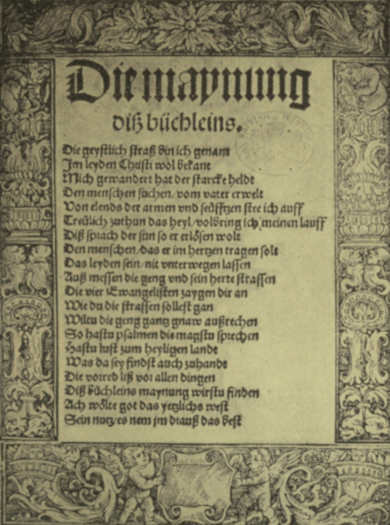
TITLE-PAGE (reduced) OF THE “GEYSTLICH STRASS” Nuremberg, 1521.
Die geystlich strass bin ich genant
Im leyden Christi wol bekant.
Wiltu die geng gantz gnaw ausrechen,
So hastu psalmen die magstu sprechen;
Hastu lust zum heyligen lande,
Was da sey, findst auch zuhande.[89]
In close accord with these verses are the following remarks freely summarized from the preface:
“Our Lord said that the love of many should wax cold, and St Paul, in his Epistle to Timothy, said that men would be lovers of themselves rather than lovers of God. We see that these sayings are verified, and especially that of St Paul to the Philippians: ‘All seek their own and not the things of Jesus Christ.’ Thus from the exceeding wickedness of mankind the love of Christ is forgotten, and although the image of Christ is placed in the churches and streets, men have so little compassion for His sufferings that they scarce pause to say an ‘Ave Maria’ before the picture, or consider what it means. Such pictures are called the lay-folk’s books, because men may read therein and lay to heart the words of our Lord in the Book of Lamentations: ‘O all ye that pass by, behold and see if there be any sorrow like unto My sorrow.’
“Amongst the common simple people one finds much love for the Passion of Christ. Some men also show their devotion by setting up various memorials to awaken the piety of others, as for instance the cross, or a representation of the Last Supper or the Mount of Olives. Some choose the Seven Falls or the seven bloodsheddings, and some again the carrying of the cross, with all the episodes which happened until He came to Calvary, such as the meeting with Mary, the compelling Simon to bear the cross, the meeting with Veronica, and the like. These are often set up nowadays with their descriptions, measures and distances, according as noble pilgrims have brought back the measurements from the Holy Land, or themselves have set them up. In order, therefore, to keep in remembrance the sufferings of Christ, I have not only considered our Lord while on His cross, but from the beginning to the end of His Passion, that is, from Bethany to the crucifixion. And what happened at one time or in one place I have put together, as, for example, the three incidents on Mount Sion, i.e., the passover, the washing of feet and the institution of the Blessed Sacrament. So, again, three events took place on Olivet, where the Lord went with His three disciples alone, and where He prayed three times, and where the Jews came and took Him. Then at Mount Calvary, whither He is brought; in one place the cross is made ready, in another spot our Lord is left until the cross is ready; afterwards He is led to the cross, stripped and crucified. All these I have set forth in order, each in its proper place, and each stage has a picture belonging to it. But in these four incidents, viz., Sion, the Mount of Olives, Pilate and the Judgement-place,[90] the same picture contains several episodes. Also in each stage we ought to contemplate, not only what Christ suffered by the way, but also what happened at each place from which or to which He is led. And it is particularly to be observed that a passage of the holy Gospels is always set down along with the picture so as to explain it, as well as a passage from the prophets or psalms. I have also added the distances of the holy places, etc. Lastly, as my desire has been to bring to men’s contemplation the sufferings of Christ, therefore I have adopted this method of portraying them to the eyes, to the heart and to the lips, by picture, by meditation and by prayer. Rich and poor, religious and seculars may use this book in private or in public. The rich may have similar sculptures set up, the poor, in looking upon them, can say their psalm-prayer or ‘Pater noster,’ or what they will. Nay, every man can erect these stations in his own house. A simple cross will serve to mark them. There is no need to reproduce the exact distances from one to another, or to take as many paces as are measured here. It is much better to make pilgrimage with one’s heart than with one’s feet.”
The book does not seem to be particularly rare, though it is not known that there was more than one edition of it.
A third devotional work of still greater importance is the volume already alluded to, written by John Pascha,[91] and edited by Peter Calentyn, at Louvain, in 1563. Its title in French is “La Pérégrination Spirituelle.” The pilgrimage is to occupy 365 days, and it is made very realistic by the assigning for each day a definite section of the journey to the Holy Land, along with a subject for meditation, and certain general devotions as explained in the introductory chapter. On the first day, for instance, the pilgrim imagines himself to travel from Louvain to Tirlemont, and is directed to meditate upon the truth that God is the final end of all creation; on the second, he travels from Tirlemont to Tongres, and meditates upon the creation of the angels, and so on. But when we get to the Holy Land and, on the 188th day, are visiting the scene of the agony in the garden, we have a new exercise interpolated with this conspicuous heading:
“Here begins the first prayer of the long journey of the Cross.☩
“And the prayers of this Way of the Cross are fifteen in number, and they are good to say also outside the time of pilgrimage, for instance, on Fridays, or on other days, for affairs of great importance.”[92]
The second station is given under the 193rd day at the house of Annas; the third, under the 196th day, at the spot where Christ is kept a prisoner and mocked. Then, under the 206th day, when the pilgrim has meditated upon our Saviour’s trial before Pilate, we have another noteworthy interruption of the text, with the heading: “Hier beghint den rechten Cruysganck na den berch van Calvarien—Here begins the proper Way of the Cross to Mount Calvary.”
The prayer for the fourth station, which follows, has reference to the condemnation of Christ by Pilate.[93]
Then follow the succeeding stations in order, still mixed up with the days of the pilgrimage, but frequently supplemented from this time onwards with measurements in feet or double paces (= five feet) of the distances from one station to another. The fifth station is the place where Christ receives the cross; it is thirteen paces from the place where He was sentenced. The sixth station is at the spot where Christ met His Blessed Mother, and where also He fell for the second time; and here the author is careful to tell us that between this spot and the place where our Lord received the cross there had already been a first fall when He had advanced forty paces. The meeting with His Blessed Mother was 418 feet (in Louvain measurement) from the place of His sentence. The seventh station, 179 feet further on, is where Simon of Cyrene took the cross, and Jesus fell a third time. The eighth station, 478 feet from the last, is the scene of the meeting with Veronica, and also of the fourth fall; and after another 842 feet we reach the foot of the ascent to Calvary, where Christ fell a fifth time, but this is not counted as a station. The ninth station is 872 feet further on up the ascent. Here Christ turned to the women of Jerusalem, and here also He fell a sixth time. After another 404-1/2 feet Calvary itself is reached. Here is the stone engraved with crosses, just outside the church of the Holy Sepulchre. This marks the place of the seventh and last fall, and is the tenth of Jan Pascha’s stations. The prayer for the eleventh station, nine paces further on, is taken up entirely with the theme of our Saviour’s being stripped of His garments, but no special name is given to this station. The twelfth station is still six paces further, and commemorates the nailing to the cross. We are also told that the total distance from the place where our Lord was sentenced by Pilate to this spot is 3,306 feet (of Louvain). The thirteenth station commemorates the death of Christ upon the cross, and the fourteenth station the taking down from the cross. Finally is given a prayer for the fifteenth station, which is concerned with the burial of Christ.
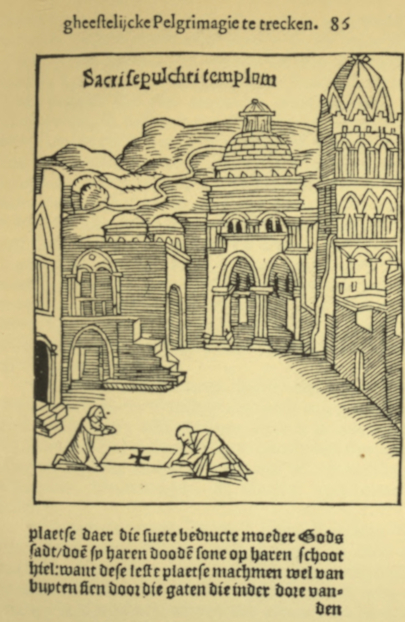
A PAGE OF THE 1568 EDITION OF PASCHA’S “GHEESTELYCK PELGRIMAGIE” If this woodcut of the Church of the Holy Sepulchre be compared with that of Breydenbach on p. 28, it will be noticed that this illustration has been clumsily imitated from Breydenbach, but reversed in cutting the block. The tower should of course stand on the left hand side of the entrance porch.
Let me furthermore point out that precise details are everywhere given with such confidence and with such minuteness that it is not wonderful that the book should have produced the impression of having been written out of abundant and scientific knowledge. A single specimen will suffice.
“Now you must know,” says Pascha, “that the cross was fifteen feet long and the arms together eight feet, and the said cross weighed 100 pounds. From the place where Christ was sentenced to the place where the cross was laid upon His shoulders there were thirteen strides, and from the same spot where the cross was laid upon Him to the place where He fell for the first time under the cross there are forty strides. And also from this same spot where He fell for the first time to the place where His Mother stood upright in front of Him there are thirty strides and three feet. The number of persons who accompanied our Saviour was 15,000.”
And here in the French version the translator interpolates a note of his own.
“It will be well,” he says, “to explain here in order to the understanding of what has just been said above and also of other passages which follow, that a stride (enjambée) is the space you leave between one leg and the other [‘l’espace qu’on faict d’une jambe à l’autre’—he really seems to mean the space between the print of one foot and the next imprint of the same foot], and it contains two paces, in other words five feet. For by one pace (avant pas) we mean the distance ordinarily covered in going or walking at an ordinary rate, and a footstep (un pas) is nothing but the sign or mark of a foot. We are compelled to render it thus and to give you notice in our translation, on account of what we find in the Dutch original which cannot be otherwise expressed.”[94]
Now, any reader who will have the patience to study these details in Pascha’s book, and to compare them with the subjects of the fourteen stations now universally adopted, will perceive at once that this old Flemish pilgrimage supplies the key of the whole problem. The order of Pascha’s Stations is exactly the order of our modern Stations. Though the number is greater, and the starting-point seems different, Pascha himself, or his editor, Calentyn, by remarking that “the proper way of the cross” begins with Pilate’s house, has suggested the very modification which, in fact, has come to prevail. It has been commonly asserted, e.g., by Bishop von Keppler and by Doctor N. Paulus, that our present Stations are to be traced back to the book of Adrichomius, “Jerusalem sicut Christi tempore floruit,” published in 1584. This, in a sense, may be true, for Adrichomius enjoyed a very wide popularity, and was early translated into most European languages, even into English, Polish and Czech. His delineation of the stations along the Via Crucis, in his map of Jerusalem, has been reproduced on a reduced scale opposite, and the attentive student will perceive that, while Adrichomius makes no mention of the last two Stations, the first twelve are exactly those of our modern Way of the Cross. But Adrichomius, who cites Pascha amongst his authorities, has undoubtedly borrowed both the arrangement and all the measurements of the much older Flemish pilgrim. Dr N. Paulus, in his extremely valuable article in the “Katholik” (April, 1895), had already suggested this as a possibility, but as no copy of the “Gheestelyck Pelgrimagie” was accessible to him at Munich, he was unable to confirm his conjecture.[95]
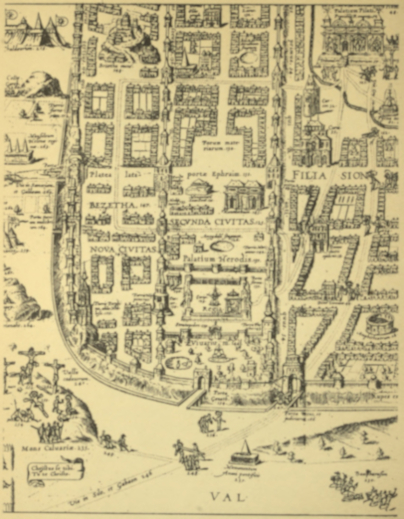
REPRODUCTION, MUCH REDUCED, OF PART OF THE MAP OF JERUSALEM, BY ADRICHOMIUS (1584), SHOWING THE STATIONS OF THE CROSS The Stations begin in the upper right hand corner with the condemnation of Christ. 121 marks the receiving of the cross; 122, first Fall; 123, Mary; 124. Simon of Cyrene; 44, Veronica; 247, second Fall; 248, Women of Jerusalem; 249, third Fall; 250, stripping; 251, nailing; 252, raising on cross. The left is the North side, but, as explained elsewhere, the details of the map are quite inaccurate.
Perhaps the most interesting result of a comparison between the books of Pascha and Adrichomius is the light which we are enabled to throw upon the origin of that most puzzling feature in the Stations, the triple fall of our Saviour beneath His cross. It arises clearly from a curious blending of the old stational system of seven falls (as depicted by Adam Krafft at Nuremberg, and by his imitators) with certain traditional sites pointed out to pilgrims in Jerusalem. Four of these falls are supposed by Pascha to have synchronized with other episodes, i.e., the meetings of Christ with His Mother, Simon of Cyrene, Veronica and the women of Jerusalem. In these four cases the mention of a fall is suppressed, but it survives in the remaining three, which have nothing otherwise to distinguish them.[96] The first fall, which precedes the meeting with Mary, and the fifth fall, which follows that with Veronica, are not counted by Pascha as stations. Adrichomius, however, seeing that he begins only with the condemnation at Pilate’s house, finds room for them as separate stations in his system. The seventh and last fall at the summit of Calvary was commemorated by a stone marked with crosses, and is mentioned by almost every pilgrim in the fourteenth and fifteenth centuries, though they speak of no other falls. This stone is the first item, lap(is), in Wey’s memoria technica (reverse order), and Breydenbach in his pilgrimage (1486) gives an excellent illustration, reproduced on page 28, of the pilgrims kissing it.
Allusion has been made above to an English abridgement of Pascha’s book, which, under the title of “The Spiritual Pilgrimage of Hierusalem,”[97] was printed abroad about the year 1630. Jan Pascha’s name is not mentioned, but there can be no question that it is his work, which has been partly translated, partly adapted by “R. H.,” a writer whom it is not easy to identify. Two copies of this little volume are in the Bodleian Library. Even in its condensed form the allegorical setting of the original has been retained, as for instance where we are told on the 43rd day, as the pilgrim is supposed to be setting sail for Venice, “pray for a good wind and say Veni Creator Spiritus.” The English version has been slightly adapted to suit the circumstances of its new readers, and thus it ends on the 365th day not at Louvain but with “thy lodgings in London or from where thou departedest.” It is particularly interesting that in “the Way of the Cross” the curious amalgamation of the old Seven Falls with the new system of stations has been retained by the translator. Hence we have such headings as, “The 111th day, to the place where Jesus turned to the women that bewailed Him. Here was the sixth falling.”
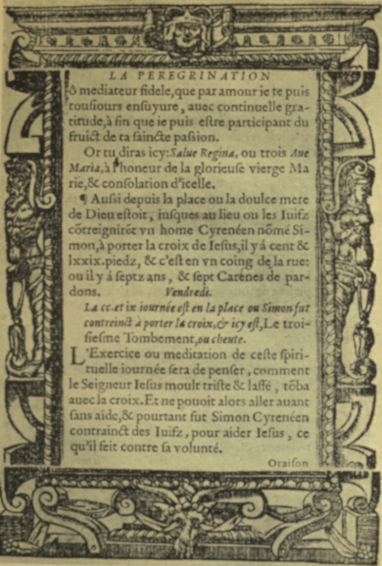
A PAGE OF THE FRENCH TRANSLATION (1566) OF PASCHA’S “GHEESTELYCK PELGRIMAGIE” Note the indication of distance and the indulgence, and also how “le troisieme tombement ou cheute” (i.e., the Third Fall of the old system of Seven Falls) is identified with the coming of Simon of Cyrene. See p. 88.
On the whole it seems true to say that the selection of the Stations owes much more to the pious ingenuity of devotional writers in Europe than to the actual practice of Jerusalem itself. At Jerusalem the merit of this exercise seems to have consisted rather in the good-will of wishing to trace our Lord’s footsteps and in the fatigue and and unpleasantness encountered on the way, than in any set devotions at assigned halting-places. Aranda tells us how Mary fell to the ground on meeting her Son. The stone she fell on was subsequently built into the wall. The Christian pilgrims used to try to kiss it, but the Turks, regarding it as idolatry, would not allow it, and constantly profaned the stone.[98]
That no proper exercise of the Stations could have been performed publicly in Jerusalem at the close of the sixteenth century appears very clearly from the extremely interesting book of Zuallardo,[99] published a year or two after that of Adrichomius. He prints at the end of this work a copy of the prayers and hymns used by the pilgrims in visiting the different sites, the which prayers agree closely with those contained in a little treatise widely circulated in the middle ages and printed in Venice in 1491.[100]
Thus we have the hymn proper to the spot “where St James the Less hid himself during the time of the Passion,” the spot “where St Peter wept bitterly”—a site which of late years has given rise to some rather lively controversy between the representatives of different religious orders in Jerusalem[101]—the spot “where the Jews attempted to carry off the holy body of our Blessed Lady after her death,” “where the angels brought the palm to our Blessed Lady,” “the grave of Lazarus,” “the spot were Christ stood when Martha said, ‘Lord, if Thou hadst been here,’” etc., “the spot where the Virgin Mother used to rest when she revisited the holy sites,” “the spot before the Golden Gate where Christ foretold the last Judgement,” “the place where Isaias was sawn in two,” “the pool of Siloe,” and many others, all of them being places outside the city, upon the Mount of Olives, or in Bethlehem, or at any rate in parts where no great concourse of people was likely to be found. Now, for each of these, even the most unimportant, there is assigned in Zuallardo a special versicle and prayer; but for the scene of Ecce Homo, of the Scourging, of the mocking before Herod or of the various incidents of the journey to Calvary, though these are all sites of the very deepest devotional interest, no provision of hymns and prayers is made. Noting the absence of any recognition of those sites now so honoured, I was at first inclined to conjecture that the printed edition of 1491 was incomplete, and that some sheets had fallen out, but an examination of Harleian MSS. 2333 and 3810 showed me that the omissions were not peculiar to the printed text. Zuallardo’s fuller account explains the reason:
“In Pilate’s house,” he remarks, “where our Redeemer was scourged and crowned with thorns and sentenced to death, at the Ecce Homo Arch, and in other spots where it is impossible to enter, an ‘Our Father’ and ‘Hail Mary’ are said as the pilgrims pass along.”[102]
Similarly in the descriptive part of his work Zuallardo remarks of the different sites along the Via Dolorosa, which he is one of the first to call by that name:
“Of all these holy places we had no more consolation than just to see them as we passed on our way, since it is not permitted to make any halt nor to pay veneration to them with uncovered head, nor to make any other demonstration, nor to look at them fixedly, nor to write nor take any notes in public.”
As long as this state of things prevailed it is obvious that the pious exercises of the Way of the Cross could be performed far more devoutly beside the artificial Stations of Nuremberg, or Louvain, or Rhodes, than in Jerusalem itself. If any one individual can lay claim to the honour of formulating our present devotion, that distinction seems to belong more justly to the pious Flemish Carmelite, Jan Pascha, than to any other person.
None the less, even Pascha seems to be dependent for his measurements upon the data supplied him by Peter Sterckx (Petrus Potens) and carved in stone at the base of the seven Stations which, as mentioned above, were erected in Louvain in the first years of the sixteenth century. How far it was Sterckx and how far it was Pascha who elaborated the whole series of incidents repeated by Calentyn and Adrichomius, it is impossible to determine. The one thing which may be affirmed with certainty is that our present series of Stations of the Cross comes to us, not from Jerusalem, but from Louvain.
Perhaps the most extraordinary feature in this rather remarkable history is the way in which those who possessed an intimate knowledge of the Holy Land and of the practice of the pilgrims allowed the inventions of the Louvain Religious to spread uncontradicted. No doubt they felt that such imaginary pilgrimages could only promote devotion to the Passion of our Lord and serve the cause of piety. It was no business of theirs to contradict what had been asserted by pious men who lived before their time. The facts did not accord with the tradition of Jerusalem in their own day, but they might conceivably be true and, at any rate, they had no positive evidence to the contrary. Aranda, Bonifacius (represented by Zuallardo), Quaresmius, Surius, Caccia and a host of others were intimately acquainted with Jerusalem. Several of them had been for many years the official custodians of the holy places. They were not contemporaries, but they cover nearly the whole period from 1520 to 1680. They agree closely with each other, but are all ignorant of—and for some points in absolute contradiction with—the statements of Pascha and Adrichomius. None the less, the fictions of Adrichomius, who it appears never visited the Holy Land, but compiled his map from pre-existing accounts, have won the day simply by reason of the wide diffusion of the volume which he published; and now, even in the Holy City itself, the attempt has been made to bring local traditions into accord with the practice of our modern Stations. But on this point it will be necessary to speak more fully in the next chapter.
For the present, before passing further, it may be interesting to give some illustration of the manner in which the Stations must often have been made in early times even without the aid of sculptures or pillars. The document from which I am about to quote seems to have been copied by a certain Sister Barbara de Langhe, in a convent in Antwerp in the year 1664. It was probably transcribed from an original of much earlier date and it is obvious that the idea of travelling the exact distance traversed by our Blessed Lord must have been very prominently before the mind of the framer. The distinction made between “the long way of the cross”[103] and “the way of the cross proper,” or “the short way,” as it is here called, is also particularly interesting in the light of the similar distinction which we have just noticed in Pascha. Hardly less noteworthy for our present purpose is the retention of the system of Seven Falls at so late a date as 1664. Not to be tedious I omit the prayers and quote only the directions or rubrics which accompany them. The document begins thus:[104]
“Item. For those who wish to make the long way of the cross (den grooten Kruyswech).
“They must begin in the Church, which shall represent the place where Christ took His last supper with His Apostles; then they must go round the garden six times and the seventh time must kneel at the last door outside the cloister by the school, and there is the Garden of Olives. The first prayer, ‘O Lord Jesus Christ,’ etc.
“Go now as far as the churchyard door to the Poor Clares’ wall, there Jesus Christ is kissed by Judas. The second prayer, ‘O Lord,’ etc.
“Now make the round of the garden six times, and the seventh time kneel down at the third door into the cloister (pant), and this will be the house of Annas. The third prayer.”
Omitting for brevity’s sake, the journey to Caiphas, Pilate and Herod, we take the next entry.
“Go now three times round [the garden], and in the fourth round you must kneel at the first door of the cloister, and this may count as Pilate’s house [dat is tot Pilatus, i.e., that is as far as Pilate].
“Here we begin the short way of the cross. The seventh prayer.
“Go now as far as the last door in the cloister, and this is the first fall with the cross. The eighth prayer.
“Next go on as far as the churchyard door to the wall of the Poor Clares and this is the second fall. The ninth prayer.”
No other incidents are specified except the Seven Falls, which are duly measured out in order, but the corresponding prayers would probably show that, as in Pascha’s book, four of these falls were identified with the incidents of Mary, Simon, the Women and Veronica. Finally we have:
“Now go on to the last window of the workroom; this is the seventh fall. The fourteenth prayer.
“Go on now to the last door in the cloister, and there Christ is crucified. The fifteenth prayer.
“Then go on as far as the churchyard, and there say Miserere and De profundis for the dear souls [Sielkens, a diminutive of endearment or compassion], and then go to the door by the pump; there Christ is buried, being laid in the sepulchre. The sixteenth prayer.
“Go now to the church, and offer your prayers Then it is finished.”