Chapter Nine The Young Art and its Exponents
Reading edition
On Hester Street, east of the Bowery, the poor Jew is revealed in many a characteristic way. It is the home of the sweat-shop, of the crowded tenement-house. Old pedlers, as ragged as the poorest beggars, stand on street corners. In long uninterrupted lines are the carts—containing fruit, cake, dry goods, fish, everything that the proletarian Jew requires. Behind these tower the crowded tenement-houses, with fire-escapes for balconies. Through the middle of the street constantly moves a mass of people. No vehicle can go rapidly there, for the thoroughfare is literally alive. In the least crowded part of the day, however, tattered little girls may sometimes be seen dancing with natural grace to the music of a hand-organ, the Italian owner of which for some strange reason has embedded himself in the very heart of poverty. Between the lumbering wagons which infest the street at the less busy part of the day these little children wonderfully sway and glide and constitute the only gladsome feature of the scene. Just as Canal Street, with its cafés where the poets, Socialists, scholars and journalists meet, is the mind of the Ghetto, so Hester Street represents its heart. This picturesque street has recently become the study of several young Jewish artists.
The last few years have brought the earliest indications of what may develop into a characteristic Ghetto art. In the course of their long civilization the Jews have never developed a national plastic art. Devoted to the things of the spirit, in an important period of their history in conflict with the sensuous art of the Greeks, they have never put into external forms the heart of their life. There have been occasional painters and sculptors among them, but these have worked in line with the Gentiles, and have in no way contributed to a typical or national art. With the slackening of the Hebraic religion, however, which prohibits images in the temple—that fertile source of inspiration in Christian art—the conditions have been more favorable, and the beginning of a distinctive Ghetto art has already made its appearance in New York.
On the corner of Hester and Forsyth streets is a tumble-down rickety building. The stairs that ascend to the garret are pestiferous and dingy. In what is more like a shed than a room, with the wooden ribs of the slanting roof curtailing the space, is the studio of an east side artist. A miserable iron bedstead occupies the narrow strip of floor beneath the descending ceiling. There is one window, which commands a good view of the pushcart market in Hester Street. Near the window is a diminutive oil-stove, on which the artist prepares his tea and eggs. On a peg on the door hang an old mackintosh and an extra coat—his only additional wardrobe. About the narrow walls on the three available sides are easels, and sketches and paintings of Ghetto types.
Jacob Epstein, the name of the artist, has a melancholy wistful face. He was born in the Ghetto twenty years ago, of poor Jews, who were at first tailors and afterwards small tradespeople, and who had emigrated from Poland. He went to the public schools until he was thirteen years old. Since then he has worked at various jobs. Until recently he was an instructor in the boys' out-door gymnasium near the corner of Hester and Essex streets. For one summer, in order to get a vacation, he became a farm laborer. His art education as well as his education in general is slight, consisting of two terms at the Art Students' League. But for so young a man his intellectual, as well as his artistic activity has been considerable. He belongs to a number of debating societies, and is now hesitating in his mind whether to become a Socialist or an Anarchist, altho he is tending towards a humane socialism.
Two things, however, he seems definitely to have settled—that he will devote himself to his art, and that that art shall be the plastic picturing of the life of his people in the Ghetto. He seems to rejoice at having lost his various pot-boiling positions.
"I was not a gymnast," he said cheerfully, explaining why he left the last one, "and now they have a gymnast."
Now he lives alone on his beloved Hester Street and the studio, where he sleeps and eats. For that modest room he pays $4 a month, and as he cooks his own meals, $12 a month is quite sufficient to satisfy all his needs. This amount he can usually manage to make through the sale of his sketches; but when he does not he "goes to bed," as he puts it, and lies low until one of his various little art enterprises brings him in a small check. Withal, he is very happy, altho serious, like his race in general; and full of idealism and ambition. On one occasion the idea occurred to him and to his friend, Bernard Gussow, that men ought to live closer to nature than they can in the Ghetto. It was in the winter time that they were filled with this conviction, but they nevertheless packed off and hired a farmhouse at Greenwood Lake, and stayed there the whole winter. When their money gave out they cut ice in the river to pay the rent.
"We enjoyed it very much," said Epstein, "but there were no artistic results. The country, much as I love it, is not stimulating. Clouds and trees are not satisfying. It is only in the Ghetto, where there is human nature, that I have ideas for sketches."
With a kind of regret the artist spoke of the beauty of Winslow Homer's landscape. He called it "epic," and was filled with sorrow that such an art could not be in the Ghetto.
"There is no nature in the sweat-shop," he said, "and yet it is there and in the crowded street that my love and my imagination call me. It is only the minds and souls of my people that fill me with a desire to work."
It is this ambition which makes Jacob Epstein and the other young artists to be mentioned of uncommon representative interest. Epstein is filled with a melancholy love of his race, and his constant desire is to paint his people just as they are: to show them in their suffering picturesqueness. So he goes into the sweat-shop and sketches, induces the old pedlers of Hester Street to pose in his studio, and draws from his window the push-carts and the old women in the street. It is thus a characteristic Ghetto art, an art dealing with the peculiar types of that Jewish community, that Epstein's interest leads to; a national plastic art, as it were, on a small scale.
In the studio and at an exhibition at the Hebrew Institute Epstein had two years ago a number of sketches and a few paintings—the latter very crude as far as the technique of color is concerned, and the sketches in charcoal rough and showing comparatively slight mastery of the craft. But, particularly in the sketches, there is character in every one, and at once a sympathetic and a realistic imagination. He tells the truth about the Ghetto as he sees it, but into the dark reality of the external life he puts frequently a melancholy beauty of spirit. Portraits of old pedlers, roughly successful as Ghetto types, in order to retain whom as models the artist was frequently forced to sing a song, for the pedlers have a Jewish horror of the image, and it is difficult to get them to pose; one of them with an irregular, blunted nose and eyes sad and plaintive, but very gentle; an old Jew in the synagogue, praying "Holy," "Holy"; many sweat-shop scenes, gaunt figures half-dressed, with enormously long arms and bony figures; mothers working in the shops with babies in their arms; one woman, tired, watching for a moment her lean husband working the machine—that machine of which Morris Rosenfeld sings so powerfully in "The Sweat-Shop"; a woman with her head leaning heavily on her hands; Hester Street market scenes, with dreary tenement-houses—a kind of prison wall—as background; one pedler with a sensitive face—a man the artist had to catch at odd times, surreptitiously, for, religious to an extreme, the old fellow would hastily trundle off whenever he saw Epstein.
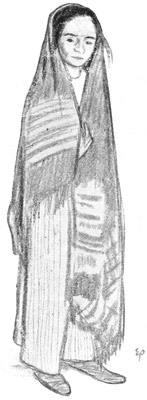
A LITTLE GIRL OF HESTER STREET
A characteristic of this young artist's work is the seriousness with which he tries to get the type as it is; the manifest love involved in the way it takes his imagination. With his whole soul he hates caricature of his race. Most of the magazine illustrations of Ghetto characters he finds distorted and untrue, many of them, however, done with a finish of technique that he envies. A big and ugly nose is not the enthusiastic artist's idea of what constitutes a downtown Jew. The Jew, to him, is recognized rather by the peculiar melancholy of the eyes. In the nose he sees nothing particularly typical of the race. It is a forcible illustration of how, while really remaining faithful to the external type, his love for the race leads him to emphasize the spiritual and humane expressiveness of the faces about him; and so paves the way to an art imaginative as well as typical, not lacking even in a certain ideal beauty.
Bernard Gussow, Epstein's friend and fellow-worker in the attempt to found a distinctive Ghetto art, is in a still earlier stage of development. His essays in the plastic reproduction of Hester Street types are not yet as humanly interesting as those of the younger man, who, however, has been working longer and more assiduously. It is only for the past year or two that Gussow has definitely espoused this cause.
Unlike Epstein he was not born in New York. The town of Slutzk, in the government of Ulinsk, Russia, is his birthplace, where he stayed until he was eleven years old. His father is a teacher of Hebrew, and young Gussow consequently received a much better education than Epstein; and also became much more familiar with the religious life of the Orthodox Jews. For that reason Epstein urges his friend to take the New York Orthodox synagogue and the domestic life of the religious Jew as his distinctive field in the great work in hand. For this, too, Gussow hopes, but in the present condition of his technique he limits himself to Hester Street scenes.
In New York Gussow continued to build up an education uncommonly good in the Ghetto. He went through the High School, entered the City College, which he left for the Art School, and spent one season at the League and two at the Academy of Design. He has for many years given lessons in English; to which occupation he, unlike his more emotional friend, prudently holds on. But Gussow, also, is deeply if not emotionally interested in the life of the Ghetto, and in a broader if less intense form than is Epstein. With the contemporary Yiddish literature and journalism of New York he is well acquainted. His mind is more conservative and judicial than that of Epstein; but his sketches lack, at present at least, the touch of strong sympathy and imagination which is marked in the art of the younger man.
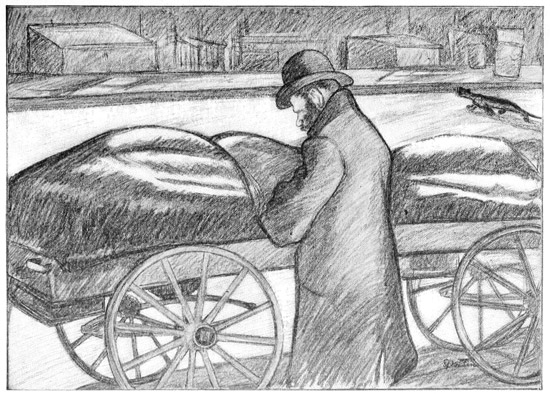
THE PUSH-CARTS OF HESTER STREET AND THEIR GUARD AT NIGHT
Gussow lives with his father's family, where he keeps his sketches—but to work, he goes to a room on the corner of Hester and Essex streets occupied by a poor Jewish family. Here the artist sits by the window and watches the poor and picturesque scenes in the big push-cart market directly beneath him. The subjects of his sketches are roughly the same as those of Epstein, altho he draws rather more from the street and Epstein from the sweat-shop. Groups standing about the push-carts, examining goods and bargaining; an old woman with a cheese in her hand, and an enormous nose (which Epstein reproachfully calls a caricature); several sketches representing men or women holding eggs to the sun, as a test preliminary to buying; carpenters waiting on the corner near the market for a job; an old Jew critically examining apples; a roughly indicated, rather attractive Jewish girl; a woman standing by a push-cart counting her money; a confused Hester Street crowd, walled in by the lofty tenement-houses; a wall-painter with an interesting face, who peddles horse-radish when not occupied with painting; a pedler out of work, just from the hospital, his beard straggling in again, with the characteristic sad eyes of his race; this rather small list comprises the greater part of Gussow's work, and most of it is of a distinctly sketchy nature.
"You see," said Epstein sympathetically, "Bernard has until recently been working for the tenement-house committee, and has only just got away from his job." Both of these young men seem to think it a piece of good luck when they are discharged by their employers.
These artists both recognize that the distinctive Ghetto art is in its earliest stage; and that whatever has yet been done in that direction is technically very imperfect. But they call attention even to the crayon art stores of the Ghetto as crudely pointing in the right direction. In those chromos, which contain absolutely no artistic quality, is represented, nevertheless, the religious and domestic life of the Jews and their physical types. And whatever art there is at present is supported by the popularity with the people of this crayon work. On the basis of that the artist proper may work out the type into more truly interpretative forms.
For this young art, the object of which is to give a realistic picture of the life of the Ghetto, it is easy to conceive an unduly sentimental interest. It is not unnatural in this time of great attention to east side charitable work to give greater value than it deserves to an art which represents the sordidness and the pathos of that part of the city. Against this attitude, which they also call sentimental, Epstein and Gussow earnestly protest, and maintain that unless the Ghetto art becomes some day technically excellent it will have no legitimate value. They want it judged on the same basis that any other art is judged; and they are filled with the faith, or at least the enthusiastic Epstein is, that the time will come when the artists of the Ghetto will paint typical Jewish life, and paint it technically well.
It is true, of course, that the ultimate value of this little art movement in the Ghetto will depend upon how well the attempt to paint the life is eventually carried out. But, nevertheless, even if nothing comes of it, it is important as suggesting an interesting departure from what is the prevailing limitation of American art. In Epstein's work something of the typical life of a community is expressed; of what American painter from among the Gentiles can this be said? Where is the typical, the nationally characteristic, in our art? Our best painters experiment with all kinds of subjects; they put talent, sometimes genius, into their work, but at the basis of it there is no simple presentation of well-recognized and deeply felt national or even sectional life; merely essays in art, of more or less skill, showing no warm interest in any one kind of life.
There are many other artists, besides these two, in the Ghetto, some of whom also occasionally paint a distinctive Ghetto type. But for the most part, trained as they have been in the uptown art schools, they experiment with all sorts of subjects in the approved American style. They paint girls in white and girls in blue, etc., as Epstein expressed it scornfully; and put no general Ghetto quality into their work. They do not seem deeply interested in anything except painting. Many of them are technically better educated than Epstein and Gussow; tho it is probably safe to say that no one of them has the sympathetic imagination of Epstein. It is to this eclectic, experimental tendency of the artists in the Ghetto in general that Epstein and Gussow present a contrast—in their love of their people and their desire to paint them as they are.
A typical representative of this less centred art is Samuel Kalisch, twenty-six years old, who came to this country from Austria twelve years ago. Older than the two young enthusiasts, Kalisch has had more experience and has developed a more efficient technique. He works in oils to a greater extent than the others and has a number of comparatively finished pictures; but his studio resembles that of any rather undistinguished uptown artist in point of diversity of subject and artistic impulse. There is an Oriental scene of conventional character; a portrait of himself taken from the mirror; a number of examples of still-life, apples, flowers, a "cute" scene of children playing on the beach; a landscape, etc. Of distinctive Ghetto things there are two old men, one just from the synagogue, with pensive eyes, a long beard and a Derby hat; the other, ninety-four years old, who sits in the synagogue, with a long white beard, a black cap on his head, a cane in one hand and the Talmud in the other. These two portraits show considerable technical skill, but are faithful rather than interpretative, and indicate that the artist's sympathy is not absorbed in the life of the Ghetto. They are merely subjects, like any other, which might come to his hand.
Now in full sympathy with what may be called the "movement" is Nathaniel Loewenberg, a little, black-haired, sad-eyed, sensitive and appealing Russian Jew of twenty-one years of age. It is only recently, however, that he has turned from landscape to city types, of which he has a few sketches, very incomplete with one exception, that also unfinished but unusually promising; it is in oil and represents a Jew fish pedler of attractive countenance and shabby clothes trying to sell a fine fish to three Ghetto women; these latter cleverly distinguished, one who will probably buy, another who apparently would like to if she could reduce the price, and the third indifferent.
Loewenberg was born in Moscow, of parents who were then and are now in business. He is enthusiastic at present over two things: Russian literature and the life of the Jews. On his table are two books—one a history of the Hebrews, the other Tolstoi's "Awakening," in Russian. His newest interest is the Ghetto; "for," he said, "the Ghetto is full of character. There the people's life is more exposed than anywhere else, and the artist can easily penetrate into it."
The type Loewenberg hopes to delineate is of different character from that of Hester Street, where Gussow and Epstein work. His field is mainly at the corner of Rivington and Attorney streets, where the Jews are Hungarians and Poles and have a distinctive type. That is the location of another push-cart market, and altho the human types are different from those of Hester Street, the peddling occupations are identical. Loewenberg's fancy runs largely to the young Jewish girl of this quarter, and she is represented in several half done sketches.
The New York Ghetto is constantly changing. It shifts from one part of town to another, and the time is not so very far distant when it will cease to exist altogether. The sweat-shop will happily disappear with advancing civilization in New York. The tenement-houses will change in character, the children will learn English and partly forget their Yiddish language and peculiar customs. In spite of the fact that the Jews have been at all times and in all countries tenacious of their domestic peculiarities and their religion, the special character of the Ghetto will pass away in favorably conditioned America. The picturesqueness it now possesses will disappear. Perhaps, however, by that time an art will have been developed which will preserve for future generations the character of the present life; which may thus have historical value, and artistic beauty in addition. Epstein and Gussow, devoted to this result as they are, are yet quite eager to see present conditions pass away. To them the art they have selected seems of trifling importance in comparison with a general improvement of the people they seem genuinely to love. They would be glad to have the present picturesqueness of the Ghetto give place to conditions more analogous to those of happier sections of New York.
But in the meantime these few young artists, two or three particularly interested in Ghetto types, five or six others, perhaps more, who occasionally contribute a sketch of the Ghetto, are in a fair way to get together a considerable body of pictures which shall have the distinction of portraying the Jewish community of the east side with fair adequacy. Certainly the interest of that Hester Street life, and of the tenement-houses that line it, is deep enough to inspire some serious man of plastic genius. And then it is not improbable that some great sombre pictures will be painted. The conditions for such a significant art are ripe, and it may find its master in one or another of the young men who are passionately "doing" Hester Street.