Chapter Ten Odd Characters
Reading edition
No matter how "queer" are the numerous persons whom one can meet in the cafés of the quarter they are mainly redeemed by a genuinely intellectual vein. It is reserved for this final chapter to tell of some men who do not well fit into the preceding categories, but whose lives or works are, in one way or another, quite worthy of record.
AN OUT-OF-DATE STORY-WRITER
Shaikevitch is the author of interminable, unsigned novels, which are published in daily installments in the east side newspapers. He is so prolific that he makes a good living. There was a time, however, when he gladly signed his name to what he wrote. That time is over, and the reason for it is best brought out by a sketch of his history.
He was born in Minsk, Russia, of orthodox Jewish parents. He began to write when he was twenty years old, at first in pure Hebrew, scientific and historical articles. He also wrote a Hebrew novel, called the Victim of the Inquisition, to which the Russian censor objected on the ground that it dealt with religious subjects.
Compelled to make his own living, young Shaikevitch, whose nom de plume has always been "Schomer," began to write popular novels in the common jargon, in Yiddish. At that time the Jews in Russia were, even more than now, shut up in their own communities, knew nothing of European culture, had an education, if any, exclusively Hebraic and mediæval and were outlandish to an extreme. The educated read only Hebrew, and the uneducated did not read at all. Up to that time, or until shortly before it, the Jew thought that nothing but holy teaching could be printed in Hebrew type. A man named Dick, however, a kind of forerunner of Shaikevitch, had begun to write secular stories in Yiddish. They were popular in form, intended for the ignorant populace who never read at all. Shaikevitch followed in Dick's lines, and made a great success.
He has written over 160 stories, and for many years he was the great popular Yiddish writer in Russia. The people would read nothing but "Schomer's" works. The ignorant masses eagerly devoured the latest novel of Schomer's. It goes without saying that, under the circumstances, these books could be of very slight literary value. They were long, sentimental effusions, tales of bad Christians and good Jews, with a monotonous repetition of stock characters and situations; and with a melodramatic and sensational element. They probably corresponded pretty closely to our "nickel" novels, published in some of our cheapest periodicals, and intended for the most ignorant element of our population. Some of their titles are A Shameful Error, An Unexpected Happiness, The Princess in the Wood, Convicted, Rebecca.
"Schomer" was so successful that he had many imitators, who never, however, succeeded so well. The publishers sometimes tried to deceive the ignorant people into thinking that a new novel of Schomer's had appeared. On the cover of the book they put the title and the new author's name in very small letters, and then in very large letters: "In the style of Schomer." But it did not work. The people remained faithful to the books of the man whom they had first read.
When Shaikevitch, or "Schomer" himself, describes the purpose and characters of his work he talks as follows:
"My works are partly pictures of the life of the Jews in the Russian villages of fifty years ago, and partly novels about the old history of the Jews. Fifty years ago the Jews were more fanatical than they are now. They did nothing but study the Talmud, pray and fast, wear long beards and wigs and look like monkeys. I satirized all this in my novels. I tried to teach the ignorant Jews that they were ridiculous, that they ought to take hold of modern, practical life and give up all that was merely formal and absurd in the old customs. I taught them that a pious man might be a hypocrite, and that it is better to do good than to pray. My works had a great effect in modernizing and educating the ignorant Jews. In my stories I pictured how the Jewish boy might go out from his little village into the wide, Gentile world, and make something of himself. In the last twenty-five years, the Jews, owing to my books, have lost a great deal of their fanaticism. At that time they had nothing but my books to read, and so my satire had a great effect."
Shaikevitch is not entirely alone in this good opinion of his work. Dr. Blaustein, superintendent of the Educational Alliance, said that he owed his position as an educated and modern man to reading novels when he was a boy. Dr. Blaustein lived in a small Russian village, and one day he read a story of "Schomer's" which represented a Jewish boy going out into the world and criticizing his Hebraic surroundings. That was the beginning of Dr. Blaustein's "awakening." Other intelligent Russian Jews probably had this same experience, altho now as mature men they would all, no doubt, grant only a very small, if any, artistic quality to the famous Yiddish writer.
A few years after Shaikevitch's great popularity two men began to write in Yiddish stories which really had value for the intelligent and educated—Abramovitch and, particularly, his pupil Rabinovitch. It was this work which, in some sort of form, did intelligently for the more educated Jews what Shaikevitch had done for the lowest stratum. Rabinovitch published a book in which he brought Shaikevitch to trial. He literally "tore him up the back" as far as literature is concerned—pointed out the tasteless, cheap, sensational character of his work, and held him up generally to ridicule.
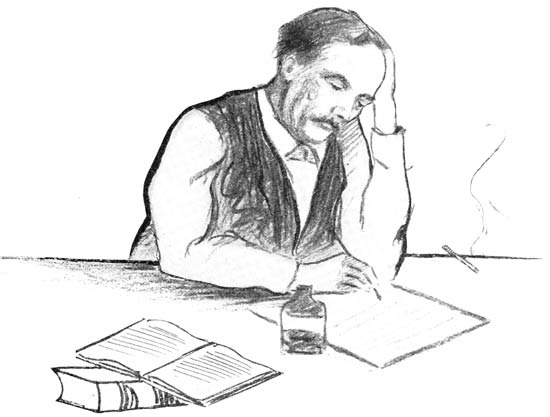
N. M. SHAIKEVITCH
As the Jews became better educated this critical feeling about Shaikevitch's work grew more general. It is significant of the progress towards modern things made by the Jews that even the very ignorant no longer admire Shaikevitch's work as much as formerly. He is "out of date," so much so that he now does not sign the stories he publishes in the Yiddish newspapers, which, nevertheless, are still popular among the most ignorant.
The intellectual Socialists of the Jewish quarter in New York also had their fling at the popular writer, and helped to put him into obscurity. Now it is a common thing in the Ghetto to hear a Socialist say that Shaikevitch wielded a more disintegrating and unfavorable influence on the Jews than any other writer. But, nevertheless, the calm old man, who has a wife and several grown children, who are making their way in the new world, still sits quietly at his desk, drinking Russian tea and doing his daily "stunt" of several thousand words for the Yiddish newspapers.
The reason given by Mr. Shaikevitch for coming to America is that he began to be interested in play writing, when the Yiddish stage was prohibited in Russia. The actors left Russia then and came to America, and some of them later wrote Shaikevitch, who was one of the earliest Yiddish playwrights, to join them in New York. He did so, and has written twelve plays, which have been produced in this city. Some of the better known of them are: The Jewish Count, Hamann the Second, Rebecca and Dreyfus. Shaikevitch is interesting mainly as representing in his work an early stage of the popular Yiddish consciousness.
A CYNICAL INVENTOR
The "intellectuals" who gather in the Russian cafés delight in expressing the ideas for which they were persecuted abroad. Enthusiasm for progress and love of ideas is the characteristic tone of these gatherings and an entire lack of practical sense.
Very striking, therefore, was the attitude of a Russian-Jewish inventor, who took his lunch the other day at one of the most literary of these cafés. Near him were a trio of enthusiasts, gesticulating over their tea, but he sat aloof, alone. He listened with a cold, superior smile. He neither smoked nor drank, but sat, with his thin, shrewd face, chillily thinking.
It is common report in the community of the intellectual Ghetto that Mr. Okun made a great invention connected with the electric arc lamp. It resulted in lengthening the time before the carbon is burnt out from four or five hours to 150 hours or thereabouts. He might have been a millionaire to-day, both he and his acquaintances maintain, but, with the usual unpractical nature of the Russian Jew, he was cheated by unscrupulous lawyers. He was a shirt maker, and for six years saved from his $10 a week to buy the apparatus necessary for the task. At last it was completed, but he was robbed of the fortune, of the fame, of the prestige to which his great idea entitled him. As it is, he gets only $1,250 a year for the great deed, spends much of his time silently in the cafés, and dreams of other inventions when not engaged with criticizing his kind.
An American, who sometimes visited the place for "color" and for the unpractical enthusiasm which he missed among his own people, sat down by the inventor, whose face interested him, and entered into conversation. He spoke of a Yiddish playwright whom he admired.
"I do not know much about him," said the inventor. "I am not a genius, like the others."
He sneered, but it was so nearly imperceptible that it did not seem ill-natured.
"But I am told," said the American, "that you are a great inventor. And that is a kind of genius."
"Yes, perhaps," he replied, carelessly. "It takes talent, too, to do what I have done. But I am not a genius, like these people."
Again he smiled, sarcastically.
"I find," said the American, "a great many interesting people in these cafés."
"Yes, they are what you call characters, I suppose," he said, dispassionately; "but I find them interesting only for one reason—no, no, I won't tell you what that reason is."
"You don't seem to be as enthusiastic about the people as I am," said the American, "but whenever I come into a café down here I find serious men who will talk seriously. They are different from the Americans who amuse themselves in bars, at horse races and farces."
The inventor smiled coldly.
"I do not call serious, what you call serious," he said. "It is not necessary to talk seriously to be serious. Serious men do things. The Russians don't do things. If they were gay and did things, they would be more serious than they are. But they are solemn and don't do anything."
"I don't agree with you," said the American, warmly. "Doesn't Blank, who writes so many excellent novels, do anything? Don't the actors, who act so truthfully, without self-consciousness, do anything? Don't the journalists, who spread excellent ideas, do anything?"
The inventor nodded judicially and remarked that there were some exceptions.
"But," he added, "you are deceived by the surface. There are many men in our colony who seem to be stronger intellectually than they really are. In Russia a few men, really cultivated and intellectual, give the tone, and everybody follows them. In America, however, the public gives the tone, and the playwright, the literary man, simply expresses the public. So that really intellectual Americans do not express as good ideas as less intellectual Russians. The Russians all imitate the best. The Americans imitate what the mass of the people want. But an intellectual American is more intellectual than these geniuses around here whom you like. Of course, they have some good things in them, as everybody has."
"What is it that you find to like in this Russian colony?" asked the American.
"I find," replied the inventor, "that when they come over here they lose what is best in the Russian character and acquire what is worst in the American character."
"And what do you deem best in the Russian character?"
"Well, in Russia they are warm hearted and friendly. They are envious even there, but not nearly so envious as they are here."
"And what do you find that is worst in the American character?"
"Oh, you know; they do everything for money. But yet there is more greatness in the American character. They are mechanical. They are practical. They don't get cheated by unscrupulous lawyers.
"Are you married?" asked the American, sympathetically.
"No, thank God!" he replied, with more energy than he had yet shown.
"But you have no friends?"
"No."
"Some men," commented the American, "find a friend in a wife."
"That depends on a man's character. It increases the loneliness of some men," replied the inventor, smiling in spite of what he was saying.
"You seem to me to be rather pessimistic," remarked the American.
"No, I am not pessimistic. I understand that a pessimist thinks life is worse than it is, but I see things just as they are; that is all. When I came to New York I was enthusiastic, too; I was an optimist. I saw life as it is not. But the mists have passed from before my eyes, and I see things just as they are."
AN IMPASSIONED CRITIC
He loves literature with an absorbing love, and is pained constantly by what he deems the chaos of art in the United States. The Americans seem to him to be trivial and immature in their art, lacking in serious purpose.
"It is a vast and fruitful land," he will say, "but there is no order and little sincerity as far as art is concerned. Your writers try to amuse the readers, to entertain them merely, rather than to give them serious and vital truth. Why is it that a race which is clever and progressive in all mechanical and industrial matters, which in such things has no overpowering respect for the past, is weighed down in art by a regard for all the literary ghosts of bygone times? Look at the books put forth in any one year in the United States! What a senseless hodgepodge it is! Variety of all kinds, historical novels, short stories, social plays, costume plays, bindings, illustrations, editions de luxe, new editions of books written in all ages alongside of the latest productions of the day. The Americans have great tact in most things. They are the cleverest people in the world, and yet they are very backward in literature.
"Indeed the whole Anglo-Saxon race, great economically and practically as it is, is curiously at sea and chaotic in all that pertains to literary art. There are men of genius, great artists among them, but they are artists only in part, fragmentarily, artists without being aware of it, with no consistent and clear understanding of what art is. Your great men are hindered by their environment. America and England are the most difficult countries in the world for real art to get a hearing, for all the people insist on being amused by their authors. They treat them as they do their actors, merely as public servants whose duty it is to amuse the public when it is tired. But art is a serious thing, instinct with sincerity, and should never be lightly approached either by the artist or the reader.
"Another indication of what I mean is the way you all talk about style over here, as if the style had anything to do with art. Some of the great Russian realists have no style, but they are great artists. There was a time when to write well was an exception, and people who did it were supposed to be great. Now so many write well that it constitutes no longer any particular distinction. Real art consists in the presentation of ideas in images, and in the power of seeing in images, and of reproducing imaginatively; what is thus seen is wholly independent of style. And, more, words often stand in the way of art. A man writes a pretty style. There may be no idea or image beneath it, but you Anglo-Saxons say: 'Ha! Here is a man with a style, a great artist!' But he is no artist. He is a mere decorator, trivial and empty. He doesn't seize earnestly upon life and tell the truth about it. Now and then, indeed, I see indications of real art in your writers—great images, great characters, great truth, but all merely in suggestion. You don't know when you do anything good, and most of you don't like it when you see it. You prefer an exciting plot to a great delineation of character. Sometimes you throw off, often in newspapers, something that indicates great talent, real art, but you cover it up with an indistinguishable mass of rubbish. You don't know what you are after. You have no method. Every writer goes his single way, confused, at cross purposes. There is no school of literature. Consequently, there is great loss of energy, great waste of material; great richness, but what carelessness, what deplorable carelessness, about the deepest and noblest and most serious things in life! I love you; I love you all; you are clever, good fellows, but you are children, talented, to be sure, but wayward and vagrant children, in the fields of art. Sincerity, realism, purpose and unity are what as a race you need, if you wish ever to have a consistent and genuine art.
"The Russian, the Frenchman, the German, knows what he wants. He is after the truth. He is serious about life. He doesn't try to dodge the facts for the sake of a little false cheerfulness and optimistic inanity."
Thus talks the Russian prophet. He is a robust, earnest man, who is trying to make head and tail out of contemporary English literature. He finds no great mainspring of impulse or principle behind it, but an infinite pandering to an infinitely diversified public taste. He thinks it is a kind of vaudeville of art, full of compromises, vulgar in its lack of principle. It makes him sad in much the same way that skepticism and profanity sadden a deeply religious person. Wisdom and truth he wants, and doesn't find them. What he finds is haste, greed, incompleteness and waste, and his soul abhors anything which takes away from the deepest nature of the soul. He is really a religious man, profound and sincere, sad at the wasteful, foolish lightness in art of the Anglo-Saxon world. Like his great countryman, Tolstoy, he writes stories, and, again like Tolstoy, as he grows older the more he sees in art and life which he would like to reform and deepen. Economy of the heart, soul and brain, the direction of them to a constant end—the feeling of the necessity of this is now an altruistic passion with this man. Like all reformers, he is sad, but, again like all reformers, he is robust and calm, self-sufficient.
THE POET OF ZIONISM
Naptali Herz Imber is known to all Jews of any education as the man who has written in the old Hebrew language the poems that best express the hope of Zion and that best serve as an inspiring battle cry in the struggle for a new Jerusalem. Zangwill has translated into English the Hebrew "Wacht Am Rhein," the most popular of Imber's poems, which is called The Watch on the Jordan. It is in four stanzas, the first of which is:
Like the crash of the thunder Which splitteth asunder The flame of the cloud, On our ears ever falling, A voice is heard calling From Zion aloud; "Let your spirits' desires For the land of your sires Eternally burn From the foe to deliver Our own holy river, To Jordan return." Where the soft flowing stream Murmurs low as in dream, There set we our watch. Our watchword, "The sword, Of our land and our Lord," By the Jordan then set we our watch.
Mr. Imber is a peculiar character and is said to be the original of the poet Pinchas in Zangwill's Children of the Ghetto.
At a Russian-Jewish café on Canal Street he may often be found. Not long ago I met him there and discovered that the dignified Hebrew poet had as a man many of the more humorous and less impressive peculiarities of the character in Mr. Zangwill's book. It is difficult to take him seriously. He was sitting opposite an old "magid," or wandering preacher, whose specialty is to attack America, and he consented to tell about his work and to confide some of his ideas.
"I am the origin of the Zionistic movement," he said. "It is not generally known, but I am. Many years ago I went to Jerusalem, saw the misery of the people, felt the spirit of the place and determined to bring my scattered people again together. For twelve years I struggled to put the Zionistic movement on foot, and now that I have started it I will let others carry it on and get the glory. For long I was not recognized, but when my Hebrew poems were published our whole race were made enthusiastic for Zion.
"If you wish to know what the spirit and purpose of my Hebrew poems is I will tell you. For two thousand years Hebrew poetry has been nothing but lamentations—nothing but literature expressing the spirit of Jeremiah. There have been no love songs, no wine songs, no songs of joy, nothing pagan. There have been no poets, only critics in rhyme. Now what I did in my Hebrew verses was to do away with lamentations. We have had enough of lamentations. I introduced the spirit of love and wine, the pagan spirit. My theme, indeed, is Zion. I am an individualist. It is the only 'ist' I believe in, and I want my nation to be individual, too. I want them to be joyously themselves, and so I am a Zionist. Therefore I did away with critical poetry and with lamentations and led my people on to an individual and a joyous life."
Altho Mr. Imber's best work is in Hebrew poetry, he is yet a very voluminous writer on science, economics, medicine, mysticism, history and many other subjects.
"I have written on everything," said the poet, "everything. I know almost nothing about the subjects on which I write. I don't believe in reading. I believe in knowing myself. In that way we learn to know others. Psychology is the only science. All others are fakes, and I can fake as well as anybody. Why read, or why seek amusement in the theatres or elsewhere, when one can sit in a café and talk to a man like that?"
He pointed in the old "magid" opposite him.
"Whenever I want to amuse myself," he said, "I talk to a man like that, and I cannot amuse myself without learning more about psychology."
With the exception of his poems most of the poet's work was written in the English language.
"I began to write English late in life," he said. "Israel Zangwill helped me to begin. He said he would correct what I wrote, but I wrote so much that Mr. Zangwill stopped reading it and told me to go ahead on my own hook. So I did. I have written infinitely in English, some of which has been published—Music of the Psalms; Education and the Talmud, which was issued by the United States government in the report of the commissioner of education; many articles on mysticism and other subjects in the magazine Ariel; The Mystery of the Golden Calf, The Music of the Ghetto, and many other works on the cabalistic mysticism. I have also written, Who Was Crucified? wherein I prove that it was not Jesus. If I kept on all day I could not tell you the names of all I have written. I have published many articles in the Jewish-American papers satirizing the rabbis, who consequently hate me. Much of my work, indeed, is satirical. The world needs cleaning up a little, particularly the rabbis. Put the reformed and orthodox rabbis together and some good might come of them. I am not afraid of these people, whom I call silk-chimney rabbis, because they wear tall hats instead of knowing the Talmud. It was my own invention—'silk-chimney rabbis.'"
Mr. Imber is evidently very fond of this phrase, for he repeated it many times. Indeed, he does not seem to be a very pious Jew. He himself admits it, for he said:
"I do not think they will say 'Kaddish' for my soul when I am dead. And yet I am not a skeptic, exactly. I have a principle, Zionism. And beyond Zionism I have another great interest. I have now perfected Zionism, so I am free to pass on to Mysticism, in which I am deeply at work. The mystics are all bluffers. I am a mystic, but my mysticism is simple and plain. My aim is to present a perfectly simple view of occultism. It is difficult to persuade Americans to become mystics. They care nothing for Hegel and Kant. Their philosophy I call Barnumism."
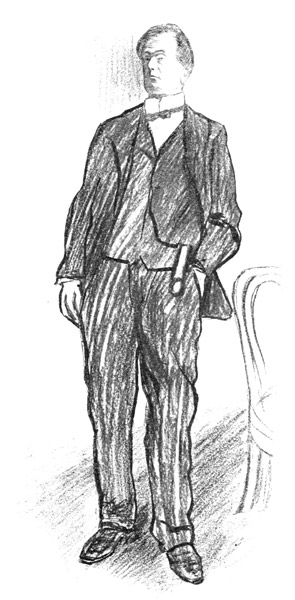
NAPTALI HERZ IMBER
Mr. Imber has largely given up writing Hebrew now, but lately he wrote a Hebrew poem comprising 200 closely printed pages. He did it, he said, to spite a man who said the poet had forgotten Hebrew because of his penchant for English.
Not long ago Mr. Imber wrote a Last Confession in Hebrew. He was very sick in a St. Louis hospital with blood poisoning, and thought he was going to die. They wanted him to confess his sins. So he did it, in Hebrew verse, which he translated to me, evidently on the spur of the moment, thus:
When my day will come To wander in distress, Call the priest to my room, My sins to confess. The sins which I have committed With deliberation, They will by the Lord be omitted, Who promised us salvation. The evils I have done, Not conscious of the action, Have passed away and gone Without satisfaction. I see near me the green table: The gamblers play aloud, And I am sick and unable To mix up with the crowd. There are still beautiful roses, With aroma blessed; There are still handsome maidens, Whose lips I have not pressed. This has me affected, I am full of remorse, That of late I have neglected The girl and the roses.
Written on what the poet thought was his deathbed, this satirical poem is almost as heroic as The Watch on the Jordan.
Mr. Imber has also written many original poems in English, which, however, he fears will not live. Many of them are satirical poems about American life and politics. When in Denver before the Spanish war he wrote some verses beginning:
Our flag will soon be planted In a land where we do not want it.
It was, the poet said, through the simple, clear character of his mystical attainments that he was able to predict the results of the war with Spain.
Mr. Imber looks upon America as the "land of the bluff" and as such admires it. But he disapproves of our reform movements. He thinks the recent attempt to reform the east side was due to the desire of the rich to divert attention from their own vices. He doesn't approve of reform any way.
"We have been trying to reform human nature," he said, "for 2,000 years, and have not done it yet. The only way to make a man good is to remove his stomach, for so long as he is hungry he will steal, and so long as he has other desires he will commit other wicked actions. Moses and Jesus were smart men and knew that evil could not be rooted out, and so they tolerated it."
Mr. Imber has recently made his last will and testament. It is in Hebrew prose and runs thus in English:
"To the rabbis I leave what I don't know; it will help them to a longer life. To my enemies I leave my rheumatism. Between the Republican and Democratic parties I divide the boodle which they have not yet touched. To the Jewish editors I leave my broken pen, so that they can write slowly and avoid mistakes. My books—those intended for beginners—I leave to the eight professors, so that they can learn to read. As an executor there shall be appointed a man who knows Barnum's philosophy through and through. Written on my deathbed. Witness, Mr. Pluto of the Underground and his Famulus, the doctor. As an afterthought I leave to my publishers the last bill unpaid by me. They can frame it and keep it as an amulet to ward away that class of authors."
"Is it sarcastic?" asked Mr. Imber, chuckling delightedly.
Some time ago Mr. Imber sent the news of his own death to the various Hebrew and Yiddish publications. Many long obituaries—"very fine ones," said the poet—appeared.
"In that way," said Mr. Imber, "I learned who were my enemies. It had one evil consequence, however. When I afterward asked the editor to publish one of my articles he said:
"'You are officially dead, and as such cannot rush into print.'
"That reply really gave me a grievous moment," said the poet, with a shrewd, Voltairian smile.
AN INTELLECTUAL DEBAUCHEE
Four men sat excitedly talking in the little café on Grand Street where the Socialists and Anarchists of the Russian quarter were wont to meet late at night and stay until the small hours. An American, who might by chance have happened there, would have wondered what important event had occurred to rasp these men's voices, to cause them to gesticulate so wildly, to give their dark, intelligent faces so fateful, so ominous an expression. In reality, however, nothing out of the ordinary had happened. It was the usual course of human affairs which kept these men in a constant glow of unhappy emotion; an emotion which they deeply preferred to trivial optimism and the content founded on Philistine well-being. They were always excited about life, for life as it is constituted seemed to them very unjust.
It was nearly midnight, and the men in the café, altho they had drunk nothing stronger than Russian tea, talked on, seemingly intoxicated with ideas. One was the editor of a Yiddish newspaper in the quarter and a contributor to the Anarchistic monthly. He was a man of about forty years of age, lighter in complexion than his companions, but yet dark. Like them he was dressed carelessly and poorly. In his melancholy eyes shone a gentle idealism. He spoke in a voice lower and softer than those of his fellows. He was deeply liked by them, for he was capable of sweet and beautiful ideas about the perfect humanity, some of which he had put into a play which had a short life on the Bowery, but lived in the hearts of these warm intellectuals. Non-resistance to evil was the favorite principle of this gentle Anarchist, whose name was Blanofsky.
His companions were younger and more heated and violent in speech, tho their attenuated bodies and thoughtful and sensitive faces did not suggest reliance on physical force. On the Bowery the Irish tough fights after a word, but an all day dispute between two Jews on Canal or Hester Street is unaccompanied by the clenching of a fist. A dark, thin young man, whose closely shaven face seemed somehow to fit his spirit, given over entirely to the "movement," sat at Blanofsky's right hand. At almost any hour of the day or night Hermann Samarovitch could be found at the Anarchist headquarters on Essex Street, poring over the books of the propaganda and engaging in talk with other bright spirits of the "movement." Now, as he talked or listened in the café on Grand Street, his pale, smooth face seemed dead to all the ordinary interests of youth. The spirit of life was represented in him only by the passion for the cause, which burned in his black eyes. He had no other function than to worship at the shrine. How he lived, therefore, was a mystery.
Of the other two men, one, Jacob Hessler, a labor leader in the Ghetto, an eloquent speaker, of more commanding presence, but less sensitive and impressive at short range than either Blanofsky or Samarovitch, was silent, for the most part. He talked only to crowds, partly because it was exciting, but mainly because his limited intelligence put him at a disadvantage in intimate talk with men of concentrated intellectual character. The fourth man in the café, Abraham Gudinsky, was a simple admirer of Blanofsky. He was born in Jerusalem, had studied law in Constantinople, had lived in Paris as a bohemian, and, after a few years passed in the commonplace, dissipated gayety of youth, had come to New York, where his sympathetic and idealistic character had come under the influence of the quiet charm of Blanofsky. He had small, live, eyes and a high forehead, and his body perpetually moved nervously.
"I do not believe," said Blanofsky, in Russian, "that anything can be accomplished by force. Our cause is too sacred to tarnish it with blood, and it is too strong in logic and justice not to conquer peaceably in the end; and that, too, without leaving behind it the ill-breeding weeds of a violent course. I have nothing but pity for the misguided wretch who took the life of King Humbert, thinking he was acting for the cause. It is the acts of such madmen as he that make us appear to the public as merely irrational monsters."
"Nevertheless," said Samarovitch, his dark eyes glowing, "it is natural that the crimes of society against the individual should irritate us sometimes into violent acts. I am not sure but that it is good that it should be so. Those devoted men, in the great movement in Russia, at the time the Czar was killed, were as clearheaded as they were devoted; and they felt that the governmental evil pressing in Russia could be relieved only by a kind of terrorism. And they were right," he concluded, with gloomy emphasis.
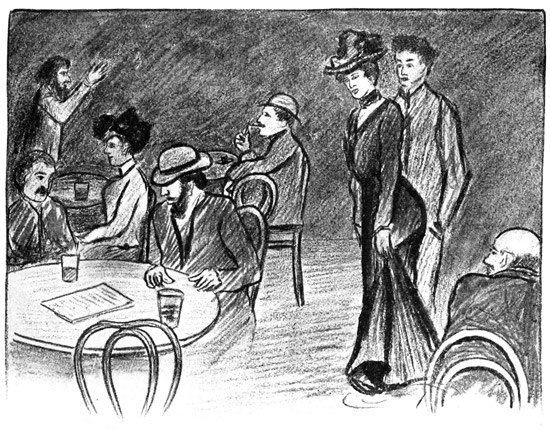
A YOUNG MAN AND A YOUNG WOMAN JUST ENTERED THE CAFÉ
Blanofsky shook his head, and was about to speak of Tolstoy, whom he regarded as the great interpreter of genuine anarchy, when he was interrupted by the approach of a young man and a young woman who had just entered the café. Sabina, as she was familiarly known to the faithful, dark and slender, with very large, emotional eyes and a mobile mouth, had just come from her lecture to a crowd of workingmen, to whom she had spoken eloquently of their right to lead a life with greater light and beauty in it. The emotions expressed by her eloquence, and stirred by it, still lay in her deep eyes as she entered the café. Her companion, who had walked with her from the lecture, was a young poet, whose words followed one another with turbulent energy. His head was set uncommonly close to his compact, stout shoulders, seeming to have a firmer rest than usual on the trunk, and thus better to support the strain of his thick-coming fancies. His habitual attitude was to hold his closed fist even with his shoulder, and punctuate with it the transitions of his thought. Even in winter the perspiration rolled down his face as he spoke, for thought with him was intense to the point of pain. He was the perfect type of the intellectual debauchee of the Russian-Jewish colony. He drank nothing but tea and coffee, but within him burned his ideas. He made his living by writing an occasional poem or article for a Yiddish paper, and when he had gathered together a few dollars he repaired again to the cafés, seeking companions to whom he could confide his exuberant thoughts, which were always expressed in poetic images. He slept whenever and wherever he was tired, but he slept seldom, and unwillingly. Unrest was his quest and unhappiness his dearest consolation. The type of his mind was as Russian as his name, which was Levitzky. The girl looked and listened to him, fascinated. They sat down at the table with the others, and while the waiter was bringing their tea and lemon, Levitzky continued his discourse:
"No, I do not like America. The people here are satisfied. Things seem frozen here—finished. Great deeds have been done, great things have been created. Wall Street and Broadway fill me with wonder. The outside is great, showing energy that has been. But at the core, all is dead. The imagination and the heart are extinguished. Content and comfort eat up the nation. New York seems to me an active city of the dead, where there is much movement, but no soul. Russia, which I love, is just the opposite. There nothing is done, nothing finished. One sees nothing, but feels warmth and vitality at the heart. In love it is the same way. The American wants a legal wife and a comfortable home, but the Russian wants a mistress behind a mountain to whom he can not penetrate but towards whom he can strive, for whom he can long and dream. It is better to hope than to attain."
Sabina looked at him, her bosom heaving. His last words seemed to trouble her, but she sat in silence and appeared to listen to the conversation, which turned on a recent strike in the Ghetto. Finally she got up to go home, refusing Levitzky's offer to accompany her. Leaving the Anarchists still engaged in talk, she went into the street, which, altho it was after one o'clock, was still far from deserted.
Instead of going to her poor room in the tenement-house on Hester Street she walked slowly along Grand Street, towards the Bowery, deep in reflection. She was thinking of Levitzky and of her life. Ten years before, as a child of twelve, she had come to New York from Russia, with her father, a tailor, who had worked for several years in the sweat-shops. He had died two years before, and since then Sabina had worked in the sweat-shops in the day time and in the evening had devoted herself to the cause. At first she had gone to the Socialistic and Anarchistic meetings merely because they were attended by the only society in the east side which at all satisfied her growing intellectual activity. These rough workingmen sometimes seemed to her inspired, and her ardor and youth were soon deeply interested in the cause of Socialism, partly because of the pity inspired by the sordid poverty about her, but mainly because of the strong attraction any earnest movement has for a young and emotionally intellectual person. As was quite inevitable, she went from an unreserved love for the group of ideas called Socialistic to the quite contrary ones of Anarchy. And this change was not founded on intellectual conviction, but was due to the simple fact that the Anarchistic cause was more extreme and gave greater apparent opportunity for self-sacrifice; and for the reason, too, that the most interesting man she had met, Levitzky, was at that time an Anarchist. These two made, very often, passionate speeches on the same evening to a crowd of attentive laborers, and after the meeting walked the street together or sat over their tea in the café discussing high ideals, not only Anarchy, but all noble subjects that detach the soul from the sordid business of life.
Of course, Sabina loved Levitzky. His robust intellect and exuberant, poetical nature, a nature constant to passion, but inconstant to persons, made her beloved ideas seem real, gave a concrete seal to the creations of her imagination.
Neither Levitzky nor Sabina were conscious of the strong feeling that he was arousing in the girl's soul. He poured his mind out to her. His rich nature unfolded in her sympathetic presence. She loved him for the mental crises he had passed; and he loved merely the mental images his words aroused in him when she was present.
It was not until the evening of the scene in the café that she had fully understood that she was eternally in love with Levitzky. On the walk from the lecture to the Grand Street café they had for the first time spoken of love between man and woman, and Levitzky had launched forth into an eloquent tirade against satisfied desire, a speech which was concluded in the café, with the remark about how a Russian loves an inaccessible mistress, a beautiful creature separated from her lover by a mountain, while the despised American wants a legal wife whom he can enjoy and be sure of.
The sentiment fitted in beautifully with Sabina's habitually enthusiastic habit of mind. But to-night she was ashamed of herself because his words filled her with fear and pain. Irrational emotion drove her theories from her head, and struck her dumb with grief for what she looked upon as a betrayed ideal. She, who had devoted herself to the "movement"; she, who had chosen an intellectual career, a life devoted to the cause of humanity; she, who had been proud of her independence and had confidently looked forward to a life of celibacy; this superior person was in love, and loved as passionately and as personally as any commonplace woman. She devoutly believed in the worth of Levitzky's ideas against human love between the sexes, and the fact that her nerves and imagination went against her head overwhelmed her with remorse. She was unfaithful not only to her own ideals, but to the ideals of the man she loved. She knew that Levitzky felt no love for her. If he had, she would not have loved him. She longed to tear this feeling, which she felt to be unworthy of her and in the nature of an insult to him, from her heart; but she knew she could not.
After leaving Levitzky and the Anarchists in the café, Sabina walked slowly towards the Bowery, suffering with love and humiliation, thinking of Levitzky and of the past, the devoted past which now seemed deeply wronged. Her despair can perhaps be understood by the fanatical nun whose years of devotion to her vows are rendered vain by a sudden impulse of the heart which is yielded to; or by the ambitious man of affairs who betrays a governmental trust because of the repeated frenzy of an emotion which wears out his resistance and leads him to the woman who has charmed and deceived him.
As Sabina passed through the street her attention was mechanically caught by the notice in a shop window, which was still dimly lighted, of an important labor meeting, to take place in a couple of days, at which a famous German Anarchist was to speak—a man who was coming from Europe to join the "Movement" in New York, whose books she had read and loved. Such notices always arrested her eager attention, and even now habit led her to stop by the window and dully read the entire poster. The thought of the coming event, which would once have been of palpitating interest to her, increased her remorse and despair. Of such great activity as this she had rendered herself incapable. To go to any such meeting now would be hypocrisy, she felt. The cause she wanted to love and serve and still did love she could yet never again be wholehearted about. She bore with her a burden. She seemed to herself to be a sinful creature, and the devoted life she had led seemed poisoned by this terrible passion which controlled her. She felt she never again could look Levitzky in the face; for a terrible impulse in her was about to drag her from the pedestal where he had helped to place her; and to drag with her the man she loved from the impersonal height at which he stood.
Her passionate nature rebelled at the thought of any compromise with the ideal. She could not endure life otherwise than as her imagination dictated—and here was a passion which threatened the existence of all she approved. What in a colder nature would have been a mere intellectual phase was with her an unbearably emotional upheaval; and on the spot she made a resolution conceived in despair but carried out with logical coolness. As the rebellious thought surged over her and filled her being with hot emotion she became aware that the shop was that of an apothecary on East Broadway, whither she had unconsciously wandered. With set lips she entered, aroused the sleeping clerk, a Socialist whom she knew, and bought that which soon allayed her problem without solving it. Early the next morning the clerk found her lying near the doorway, with an expression of impulsive energy on her dark face.
About three days later Blanofsky and his three friends were sitting in the café on Grand Street, drinking their eternal Russian tea and talking about Levitzky.
"I never saw a man so broken," said Blanofsky in his soft voice, "as Levitzky was by the death of that girl. For a week I feared for his life, he was so desperate. It seems he met Lefeitkin's clerk, who told him. He disappeared from the quarter for several days, and no one knew where he went. Four days ago he came to my room looking like a madman. His hair was full of mud and his clothes torn and filthy. His eyes burned in his pale face, and his speech, more voluminous than ever, was broken and incoherent. He stayed all day, refused to eat, but talked all the time of Sabina, of her mind, of her rare personality, of her devotion to the cause. He was interrupted by fits of sobbing. I did not know that this man of intellect was capable of so great personal feeling."
"Levitzky is weak," said Herman Samarovitch, "and inconstant. He has vivid ideas, and imagination, but he never really cared for the cause. He was a Socialist before he was an Anarchist. Before that he was an atheist, which followed a period of religious mysticism. At one time he was a conventional capitalist in principle, with the English government as his model. He is easily moved by an idea or an emotion, but he easily passes to another. He will soon forget this girl's death, to which he should have been superior. He has no steadfastness, and is not one of us."
At this point, Levitzky entered the café. With him was the new arrival, the German Anarchist. To him Levitzky was talking with great animation. His words rolled over one another with enthusiasm.
"Do you know," he said eagerly, his face beaming, to Blanofsky and his companions, "that our distinguished friend here has consented to debate to-morrow night with our Socialist friend, Jacob Matz, that mistaken but able man, on the nature of individual right as interpreted by the Anarchist on one side and the Socialist on the other. I have written a poem on liberty which I intend to read at the meeting. Do you wish to hear it?"
He drew a manuscript from his pocket and read enthusiastically a poem in which a turbulent love for man and nature, for social equality and foaming cataracts was expressed in rich imagery. His face glowed and he seemed transported. He had forgotten Sabina.
Charles Dana Gibson says: "It is like a trip to Paris."
THE REAL LATIN QUARTER OF PARIS
By F. Berkeley Smith
Racy sketches of the innermost life and characters of the famous Bohemia of Paris—its grisettes, students, models, balls, studios, cafes, etc.
John W. Alexander: "It is the real thing."
Frederick Remington: "You have left nothing undone."
Ernest Thompson Seton: "A true picture of the Latin Quarter as I knew it."
Frederick Dielman, President National Academy of Design: "Makes the Latin Quarter very real and still invests it with interest and charm."
Evening Telegraph, Philadelphia: "A captivating book."
Boston Times: "A genuine treat."
The Argonaut, San Francisco: "A charming volume. Mr. Smith does not fail to get at the intimate secrets, the subtle charm of the real Latin Quarter made famous by Henry Murger and Du Maurier."
The Mail and Express, New York: "When you have read this book you know the 'Real Latin Quarter' as well as you will ever come to know it without living there yourself."
Boston Herald: "It pictures the Latin Quarter in its true light."
Water-Color Frontispiece by F. Hopkinson Smith. About 100 original drawings and camera snap shots by the Author, and two caricatures in color by the celebrated French caricaturist Sancha. Ornamental Covers. 12mo, Cloth, Price, $1.20, net. Postage, 13 Cents.
FUNK & WAGNALLS COMPANY, Publishers, New York & London
LOVE AND THE SOUL HUNTERS
By John Oliver Hobbes
Author of "The Gods, Some Morals, and Lord Wickenham," "The Herb Moon," "Schools for Saints," "Robert Grange," etc., etc.
In this new novel Mrs. Craigie (John Oliver Hobbes) has made, according to her own statement, the great effort of her life. It is the most brilliant creation of an author whose talent and versatility have surprised readers and critics in both Europe and America for several years. It treats of unique examples of human nature as they are, and not merely as they ought to be. Swayed by complex motives, they are always attractive, but often do what is least expected of them. The story is graphically told, and is full of action. Each personage is distinctively drawn to the life.
"There is much that is worth remembering in her writings."—Mail and Express, New York.
"More than any other woman who is now writing, Mrs. Craigie is, in the true manly sense, a woman of letters. She is not a woman with a few personal emotions to express: she is what a woman so rarely is—an artist."—The Star, London.
"Few English writers have so lapidarian a style of writing as Mrs. Craigie, and few such a capacity for writing epigrams."—The Toronto Globe.
12mo, Cloth. $1.50
FUNK & WAGNALLS COMPANY, Publishers NEW YORK & LONDON
A ROMANCE OF A STRANGE COUNTRY
THE INSANE ROOT
By Mrs. Campbell Praed
Author of "Nadine"; "The Scourge Stick"; "As a Watch in the Night," etc.
This story has the same motif as Stevenson's Dr. Jekyll and Mr. Hyde, and a weird treatment resembling that of Bulwer's "Strange Story." It will compare favorably in strength and literary quality with either of these great productions. Isadas Pacha, Ambassador at the Court of St. James's from Abdullulah Zobeir, Emperor of Abaria, dying at last after a long life of mixed good and evil, leaves to his physician, Dr. Marillier, "the insane root," a mandragora root, enclosed in a small box. Marillier, a suitor of Rachel, the beautiful ward of the Pacha, envies Ruel Bey, his favored rival. Learning from the papers left by the Pacha that the mandrake root has marvelous powers, Marillier succeeds in assuming the body of Ruel who has been accidentally killed. On this change of identities the fascinating story turns. After marrying Rachel the problem of consummating the marriage can not be solved by Marillier, the wraith of the real Ruel preventing. A bolt of lightning solves the problem. There is a mystery about Rachel, who turns out to be the Emperor's own daughter. The scenery is partly that of the Algerian mountains, very graphically and beautifully described. The supernatural elements are handled in a way to make them seem actually credible. The storm climax reminds the reader of Hawthorne's best work in the Marble Fawn.
12mo, Cloth. 380 Pages. $1.50
FUNK & WAGNALLS COMPANY, Publishers NEW YORK & LONDON
THE NEEDLE'S EYE
By Florence Morse Kingsley
Author of "The Transfiguration of Miss Philura," "Titus," "Prisoners of the Sea," "Stephen," etc.
"The Needle's Eye" is a remarkable story of modern American life,—not of one phase, but of many phases, widely different and in startling contrast. The scenes alternate between country and city. The pure, free air of the hills, and the foul, stifling atmosphere of the slums; the sweet breath of the clover fields, and the stench of crowded tenements are equally familiar to the hero in this novel. The other characters are found in vine-covered cottages, in humble farmhouses, in city palaces, and in the poorest tenements of the slums. Immanuel, the hero, begins life as a foundling, and the chapters telling of his unhappy infancy and happy boyhood are written with a tenderness, a pathos, and an intimacy of knowledge and description that touch the deepest sympathies of the reader. Later, Immanuel finds himself the heir of a vast fortune. His struggle to use the wealth in relieving the miseries of the slums demonstrates the truth of the declaration of Jesus: "It is easier for a camel to go through a needle's eye than for a rich man to enter into the kingdom of God."
Many of the situations in the novel are exceedingly dramatic. Others sparkle with genuine humor. This is a story to make people laugh, and cry, and think.
Illustrations by F. E. Mears. 12mo, Cloth. $1.50
FUNK A WAGNALLS COMPANY, Publishers NEW YORK & LONDON
St. Louis Globe-Democrat: "It is a simple, gentle, quietly-humorous narrative, with several love affairs in it."
UNDER MY OWN ROOF
By Adelaide L. Rouse
Author of "The Deane Girls," "Westover House," etc.
A story of a "nesting impulse" and what came of it. A newspaper woman determines to build a home for herself in a Jersey suburb. The story of its planning is delightfully told, simply and with a literary-humorous flavor that will appeal to lovers of books and of the fireside.
Before the house-building details are allowed to tire the reader, a love story is begun, and catches the interest. It concerns the home-builder, an old flame, and an old friend, the third of whom has become a next-door neighbor. With this romance are entwined a number of heart affairs as well as warm friendships.
The style is bright, and the humor genial and pervasive. The "literary worker" and the "suburbanite" particularly will enjoy the book. Women of culture everywhere should appreciate its delicate style.
Illustrations by Harrie A. Stoner. 12mo, Cloth. Price, $1.20, net; postage, 13 cents.
FUNK & WAGNALLS COMPANY, Publishers, New York & London
JESUS THE JEW AND OTHER ADDRESSES
By Harris Weinstock Introduction by Prof. David Starr Jordan
Ten straightforward talks by a broad-minded student of the Jewish Race, explaining alike to Jew and Christian the fundamental and highest conceptions of liberal Judaism and its relationship in Christianity.
HIGH PRAISE FROM THE NON-JEWISH PRESS
Herald and Presbyter, St. Louis, Mo.: "The author is a man of force and of large liberality, and goes far beyond what the ordinary orthodox Jew would be willing to concede."
The Outlook, New York: "It will justify a wide attention from both Jews and Christians, and in many respects will be of peculiar helpfulness to some who have no conscious religious faith."
News-Letter, San Francisco: "A very interesting volume, well written, broad in its tendencies, and one that will be helpful to any one who reads it, regardless of race or creed."
COMMENDED BY LEADING JEWISH PAPERS
The Jewish Spectator, New Orleans: "Its tendency is to remove prejudices from the minds of non-Jews and to strengthen the faith of the Jew. Every Israelite in the land should obtain two copies, read one for his own benefit and comfort, and give the other to a Christian friend who entertains yet a few prejudices and is desirous of divesting himself of them."
Jewish Ledger, New Orleans, La.: "It deserves a conspicuous place in the homes of intelligent people.... Always couched in respectful and courteous language, and refreshing in logical consideration of the question."
12mo, Cloth, 229 pp. $1.00, net; by Mail, $1.07
FUNK & WAGNALLS COMPANY, Publishers NEW YORK & LONDON