Chapter Two Prophets without Honor
Reading edition
SUBMERGED SCHOLARS
A ragged man, who looks like a peddler or a beggar, picking his way through the crowded misery of Hester Street, or ascending the stairs of one of the dingy tenement-houses full of sweat-shops that line that busy mart of the poor Ghetto Jew, may be a great Hebrew scholar. He may be able to speak and write the ancient tongue with the facility of a modern language—as fluently as the ordinary Jew makes use of the "jargon," the Yiddish of the people; he may be a manifold author with a deep and pious love for the beautiful poetry in his literature; and in character an enthusiast, a dreamer, or a good and reverend old man. But no matter what his attainments and his quality he is unknown and unhonored, for he has pinned his faith to a declining cause, writes his passionate accents in a tongue more and more unknown even to the cultivated Jew; and consequently amid the crowding and material interests of the new world he is submerged—poor in physical estate and his moral capital unrecognized by the people among whom he lives.
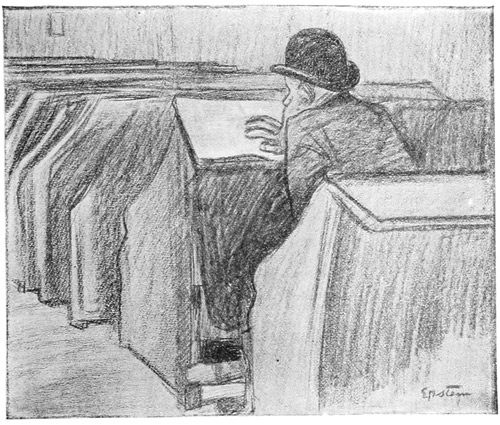
HE IS UNKNOWN AND UNHONORED
Not only unrecognized by the ignorant and the busy and their teachers the rabbis, who in New York are frequently nearly as ignorant as the people, he is also (as his learning is limited largely to the literature of his race) looked down upon by the influential and intellectual element of the Ghetto—an element socialistic, in literary sympathy Russian rather than Hebraic, intolerant of everything not violently modern, wedded to "movements" and scornful of the past. The "maskil," therefore, or "man of wisdom"—the Hebrew scholar—is called "old fogy," or "dilettante," by the up-to-date socialists.
Of such men there are several in the humble corners of the New York Ghetto. One peddles for a living, another has a small printing-office in a basement on Canal Street, a third occasionally tutors in some one of many languages and sells a patent medicine, and a fourth is the principal of the Talmud-Thora, a Hebrew school in the Harlem Ghetto, where he teaches the children to read, write, and pray in the Hebrew language.
Moses Reicherson is the name of the principal. "Man of wisdom" of the purest kind, probably the finest Hebrew grammarian in New York, and one of the finest in the world, his income from his position at the head of the school is $5 a week. He is seventy-three years old, wears a thick gray beard, a little cap on his head, and a long black coat. His wife is old and bent. They are alone in their miserable little apartment on East One Hundred and Sixth Street. Their son died a year or two ago, and to cover the funeral expenses Mr. Reicherson tried in vain to sell his "Encyclopædia Britannica." But, nevertheless, the old scholar, who had been bending over his closely written manuscript, received the visitor with almost cheerful politeness, and told the story of his work and of his ambitions. Of his difficulties and privations he said little, but they shone through his words and in the character of the room in which he lived.
Born in Vilna, sometimes called the Jerusalem of Lithuania or the Athens of modern Judæa because of the number of enlightened Jews who have been born there, many of whom now live in the Russian Jewish quarter of New York, he has retained the faith of his orthodox parents, a faith, however, springing from the pure origin of Judaism rather than holding to the hair-splitting distinctions later embodied in the Talmud. He was a teacher of Hebrew in his native town for many years, where he stayed until he came to New York some years ago to be near his son. His two great intellectual interests, subordinated indeed to the love of the old literature and religion, have been Hebrew grammar and the moral fables of several languages. On the former he has written an important work, and of the latter has translated much of Lessing's and Gellert's work into pure Hebrew. He has also translated into his favorite tongue the Russian fable-writer Krilow; has written fables of his own, and a Hebrew commentary on the Bible in twenty-four volumes. He loves the fables "because they teach the people and are real criticism; they are profound and combine fancy and thought." Many of these are still in manuscript, which is characteristic of much of the work of these scholars, for they have no money, and publishers do not run after Hebrew books. Also unpublished, written in lovingly minute characters, he has a Hebrew prayer-book in many volumes. He has written hundreds of articles for the Hebrew weeklies and monthlies, which are fairly numerous in this country, but which seldom can afford to pay their contributors. At present he writes exclusively for a Hebrew weekly published in Chicago, Regeneration, the object of which is to promote "the knowledge of the ancient Hebrew language and literature, and to regenerate the spirit of the nation." For this he receives no pay, the editor being almost as poor as himself. But he writes willingly for the love of the cause, "for universal good"; for Reicherson, in common with the other neglected scholars, is deeply interested in revivifying what is now among American Jews a dead language. He believes that in this way only can the Jewish people be taught the good and the true.
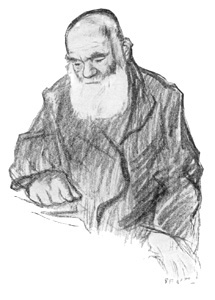
MOSES REICHERSON
"When the national language and literature live," he said, "the nation lives; when dead, so is the nation. The holy tongue in which the Bible was written must not die. If it should, much of the truth of the Bible, many of its spiritual secrets, much of its beautiful poetry, would be lost. I have gone deep into the Bible, that greatest book, all my life, and I know many of its secrets." He beamed with pride as he said these words, and his sense of the beauty of the Hebrew spirit and the Hebrew literature led him to speak wonderingly of Anti-Semitism. This cause seemed to him to be founded on ignorance of the Bible. "If the Anti-Semites would only study the Bible, would go deep into the knowledge of Hebrew and the teaching of Christ, then everything would be sweet and well. If they would spend a little of that money in supporting the Hebrew language and literature and explaining the sacred books which they now use against our race, they would see that they are Anti-Christians rather than Anti-Semites."
The scholar here bethought himself of an old fable he had translated into Hebrew. Cold and Warmth make a wager that the traveller will unwrap his cloak sooner to one than to the other. The fierce wind tries its best, but at every cold blast the traveller only wraps his cloak the closer. But when the sun throws its rays the wayfarer gratefully opens his breast to the warming beams. "Love solves all things," said the old man, "and hate closes up the channels to knowledge and virtue." Believing the Pope to be a good man with a knowledge of the Bible, he wanted to write him about the Anti-Semites, but desisted on the reflection that the Pope was very old and overburdened, and that the letter would probably fall into the hands of the cardinals.
All this was sweetly said, for about him there was nothing of the attitude of complaint. His wife once or twice during the interview touched upon their personal condition, but her husband severely kept his mind on the universal truths, and only when questioned admitted that he would like a little more money, in order to publish his books and to enable him to think with more concentration about the Hebrew language and literature. There was no bitterness in his reference to the neglect of Hebrew scholarship in the Ghetto. His interest was impersonal and detached, and his regret at the decadence of the language seemed noble and disinterested; and, unlike some of the other scholars, the touch of warm humanity was in everything he said. Indeed, he is rather the learned teacher of the people with deep religious and ethical sense than the scholar who cares only for learning. "In the name of God, adieu!" he said, with quiet intensity when the visitor withdrew.
Contrasting sharply in many respects with this beautiful old teacher is the man who peddles from tenement-house to tenement-house in the down-town Ghetto, to support himself and his three young children. S. B. Schwartzberg, unlike most of the "submerged" scholars, is still a young man, only thirty-seven years old, but he is already discouraged, bitter, and discontented. He feels himself the apostle of a lost cause—the regeneration in New York of the old Hebrew language and literature. His great enterprise in life has failed. He has now given it up, and the natural vividness and intensity of his nature get satisfaction in the strenuous abuse of the Jews of the Ghetto.
He was born in Warsaw, Poland, the son of a distinguished rabbi. In common with many Russian and Polish Jews, he early obtained a living knowledge of the Hebrew language, and a great love of the literature, which he knows thoroughly, altho, unlike Reicherson and a scholar who is to be mentioned, Rosenberg, he has not contributed to the literature in a scientific sense. He is slightly bald, with burning black eyes, an enthusiastic and excited manner, and talks with almost painful earnestness.
Three years ago Schwartzberg came to this country with a great idea in his head. "In this free country," he thought to himself, "where there are so many Russian and Polish Jews, it is a pity that our tongue is dying, is falling into decay, and that the literature and traditions that hold our race together are being undermined by materialism and ethical skepticism." He had a little money, and he decided he would establish a journal in the interests of the Hebrew language and literature. No laws would prevent him here from speaking his mind in his beloved tongue. He would bring into vivid being again the national spirit of his people, make them love with the old fervor their ancient traditions and language. It was the race's spirit of humanity and feeling for the ethical beauty, not the special creed of Judaism, for which he and the other scholars care little, that filled him with the enthusiasm of an apostle. In his monthly magazine, the Western Light, he put his best efforts, his best thoughts about ethical truths and literature. The poet Dolitzki contributed in purest Hebrew verse, as did many other Ghetto lights. But it received no support, few bought it, and it lasted only a year. Then he gave it up, bankrupt in money and hope. That was several years ago, and since then he has peddled for a living.
The failure has left in Schwartzberg's soul a passionate hatred of what he calls the materialism of the Jews in America. Only in Europe, he thinks, does the love of the spiritual remain with them. Of the rabbis of the Ghetto he spoke with bitterness. "They," he said, "are the natural teachers of the people. They could do much for the Hebrew literature and language. Why don't they? Because they know no Hebrew and have no culture. In Russia the Jews demand that their rabbis should be learned and spiritual, but here they are ignorant and materialistic." So Mr. Schwartzberg wrote a pamphlet which is now famous in the Ghetto. "I wrote it with my heart's blood," he said, his eyes snapping. "In it I painted the spiritual condition of the Jews in New York in the gloomiest of colors."
"It is terrible," he proceeded vehemently. "Not one Hebrew magazine can exist in this country. They all fail, and yet there are many beautiful Hebrew writers to-day. When Dolitzki was twenty years old in Russia he was looked up to as a great poet. But what do the Jews care about him here? For he writes in Hebrew! Why, Hebrew scholars are regarded by the Jews as tramps, as useless beings. Driven from Russia because we are Jews, we are despised in New York because we are Hebrew scholars! The rabbis, too, despise the learned Hebrew, and they have a fearful influence on the ignorant people. If they can dress well and speak English it is all they want. It is a shame how low-minded these teachers of the people are. I was born of a rabbi, and brought up by him, but in Russia they are for literature and the spirit, while in America it is just the other way."
The discouraged apostle of Hebrew literature now sees no immediate hope for the cause. What seems to him the most beautiful lyric poetry in the world he thinks doomed to the imperfect understanding of generations for whom the language does not live. The only ultimate hope is in the New Jerusalem. Consequently the fiery scholar, altho not a Zionist, thinks well of the movement as tending to bring the Jews again into a nation which shall revive the old tongue and traditions. Mr. Schwartzberg referred to some of the other submerged scholars of the Ghetto. His eyes burned with indignation when he spoke of Moses Reicherson. He could hardly control himself at the thought that the greatest Hebrew grammarian living, "an old man, too, a reverend old man," should be brought to such a pass. In the same strain of outrage he referred to another old man, a scholar who would be as poor as Reicherson and himself were it not for his wife, who is a dressmaker. It is she who keeps him out of the category of "submerged" scholars.
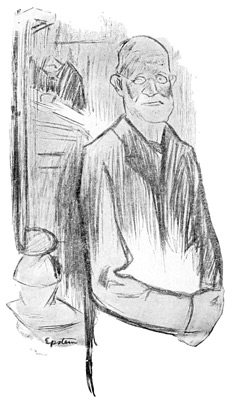
REV. H. ROSENBERG
But the Rev. H. Rosenberg, of whose condition Schwartzberg also bitterly complained, is indeed submerged. He runs a printing-office in a Canal Street basement, where he sits in the damp all day long waiting for an opportunity to publish his magnum opus, a cyclopedia of Biblical literature, containing an historical and geographical description of the persons, places, and objects mentioned in the Bible. All the Ghetto scholars speak of this work with bated breath, as a tremendously learned affair. Only two volumes of it have been published. To give the remainder to the world, Mr. Rosenberg is waiting for his children, who are nearly self-supporting, to contribute their mite. He is a man of sixty-two, with the high, bald forehead of a scholar. For twenty years he was a rabbi in Russia, and has preached in thirteen synagogues. He has been nine years in New York, and, in addition to the great cyclopedia, has written, but not published, a cyclopedia of Talmudical literature. A "History of the Jews," in the Russian language, and a Russian novel, "The Jew of Trient," are among his published works. He is one of the most learned of all of these men who have a living, as well as an exact, knowledge of what is generally regarded as a dead language and literature.
Altho he is waiting to publish the great cyclopedia, he is patient and cold. He has not the sweet enthusiasm of Reicherson, and not the vehement and partisan passion of Schwartzberg. He has the coldness of old age, without its spiritual glow, and scholarship is the only idea that moves him. Against the rabbis he has no complaint to make; with them, he said, he had nothing to do. He thinks that Schwartzberg is extreme and unfair, and that there are good and bad rabbis in New York. He is reserved and undemonstrative, and speaks only in reply. When the rather puzzled visitor asked him if there was anything in which he was interested, he replied, "Yes, in my cyclopedia." The only point at which he betrayed feeling was when he quoted proudly the words of a reviewer of the cyclopedia, who had wondered where Dr. Rosenberg had obtained all his learning. He stated indifferently that the Hebrew language and literature is dead and cannot be revived. "I know," he said, "that Hebrew literature does not pay, but I cannot stop." With no indignation, he remarked that the Jews in New York have no ideals. It was a fact objectively to be deplored, but for which he personally had no emotion, all of that being reserved for his cyclopedia.
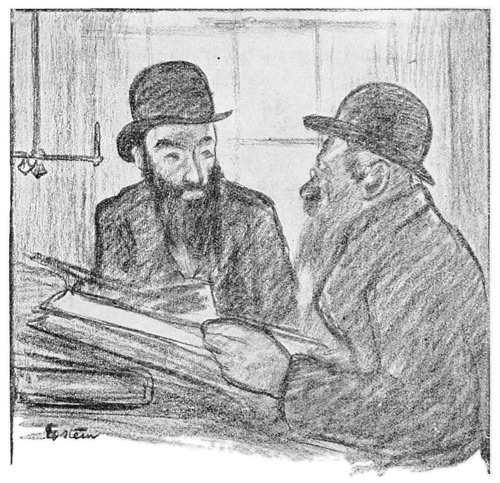
"SUBMERGED SCHOLARS"
These three men are perfect types of the "submerged Hebrew scholar" of the New York Ghetto. Reicherson is the typical religious teacher; Schwartzberg, the enthusiast, who loves the language like a mistress, and Rosenberg, the cool "man of wisdom," who only cares for the perfection of knowledge. Altho there are several others on the east side who approach the type, they fall more or less short of it. Either they are not really scholars in the old tongue, altho reading and even writing it, or through business or otherwise they have raised themselves above the pathetic point. Thus Dr. Benedict Ben-Zion, one of the poorest of all, being reduced to occasional tutoring, and the sale of a patent medicine for a living, is not specifically a scholar. He writes and reads Hebrew, to be sure, but is also a playwright in the "jargon;" has been a Christian missionary to his own people in Egypt, Constantinople, and Rumania, a doctor for many years, a teacher in several languages, one who has turned his hand to everything, and whose heart and mind are not so purely Hebraic as those of the men I have mentioned. He even is seen, more or less, with Ghetto literati who are essentially hostile to what the true Hebrew scholar holds by—a body of Russian Jewish socialists of education, who in their Grand and Canal Street cafés express every night in impassioned language their contempt for whatever is old and historical.
Then, there are J. D. Eisenstein, the youngest and one of the most learned, but perhaps the least "submerged" of them all; Gerson Rosenschweig, a wit, who has collected the epigrams of the Hebrew literature, added many of his own, and written in Hebrew a humorous treatise on America—a very up-to-date Jew, who, like Schwartzberg, tried to run a Hebrew weekly, but when he failed, was not discouraged, and turned to business and politics instead; and Joseph Low Sossnitz, a very learned scholar, of dry and sarcastic tendency, who only recently has risen above the submerged point. Among the latter's most notable published books are a philosophical attack on materialism, a treatise on the sun, and a work on the philosophy of religion.
It is the wrench between the past and the present which has placed these few scholars in their present pathetic condition. Most of them are old, and when they die the "maskil" as a type will have vanished from New York. In the meantime, tho they starve, they must devote themselves to the old language, the old ideas and traditions of culture. Their poet, the austere Dolitzki, famous in Russia at the time of the revival of Hebrew twenty years ago, is the only man in New York who symbolizes in living verse the spirit in which these old men live, the spirit of love for the race as most purely expressed in the Hebrew literature. This disinterested love for the remote, this pathetic passion to keep the dead alive, is what lends to the lives of these "submerged" scholars a nobler quality than what is generally associated with the east side.
THE POOR RABBIS
The rabbis, as well as the scholars, of the east side of New York have their grievances. They, too, are "submerged," like so much in humanity that is at once intelligent, poor, and out-of-date. As a lot, they are old, reverend men, with long gray beards, long black coats and little black caps on their heads. They are mainly very poor, live in the barest of the tenement houses and pursue a calling which no longer involves much honor or standing. In the old country, in Russia—for most of the poor ones are Russian—the rabbi is a great person. He is made rabbi by the state and is rabbi all his life, and the only rabbi in the town, for all the Jews in every city form one congregation, of which there is but one rabbi and one cantor. He is a man always full of learning and piety, and is respected and supported comfortably by the congregation, a tax being laid on meat, salt, and other foodstuffs for his special benefit.
But in New York it is very different. Here there are hundreds of congregations, one in almost every street, for the Jews come from many different cities and towns in the old country, and the New York representatives of every little place in Russia must have their congregation here. Consequently, the congregations are for the most part small, poor and unimportant. Few can pay the rabbi more than $3 or $4 a week, and often, instead of having a regular salary, he is reduced to occasional fees for his services at weddings, births and holy festivals generally. Some very poor congregations get along without a rabbi at all, hiring one for special occasions, but these are congregations which are falling off somewhat from their orthodox strictness.
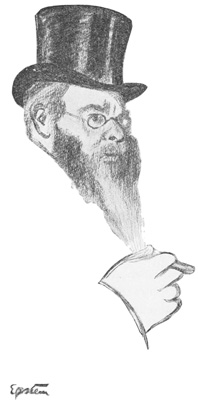
The result of this state of affairs is a pretty general falling off in the character of the rabbis. In Russia they are learned men—know the Talmud and all the commentaries upon it by heart—and have degrees from the rabbinical colleges, but here they are often without degrees, frequently know comparatively little about the Talmud, and are sometimes actuated by worldly motives. A few Jews coming to New York from some small Russian town, will often select for a rabbi the man among them who knows a little more of the Talmud than the others, whether he has ever studied for the calling or not. Then, again, some mere adventurers get into the position—men good for nothing, looking for a position. They clap a high hat on their heads, impose on a poor congregation with their up-to-dateness and become rabbis without learning or piety. These "fake" rabbis—"rabbis for business only"—are often satirized in the Yiddish plays given at the Bowery theatres. On the stage they are ridiculous figures, ape American manners in bad accents, and have a keen eye for gain.
The genuine, pious rabbis in the New York Ghetto feel, consequently, that they have their grievances. They, the accomplished interpreters of the Jewish law, are well-nigh submerged by the frauds that flood the city. But this is not the only sorrow of the "real" rabbi of the Ghetto. The rabbis uptown, the rich rabbis, pay little attention to the sufferings, moral and physical, of their downtown brethren. For the most part the uptown rabbi is of the German, the downtown rabbi of the Russian branch of the Jewish race, and these two divisions of the Hebrews hate one another like poison. Last winter when Zangwill's dramatized Children of the Ghetto was produced in New York the organs of the swell uptown German-Jew protested that it was a pity to represent faithfully in art the sordidness as well as the beauty of the poor Russian Ghetto Jew. It seemed particularly baneful that the religious customs of the Jews should be thus detailed upon the stage. The uptown Jew felt a little ashamed that the proletarians of his people should be made the subject of literature. The downtown Jews, the Russian Jews, however, received play and stories with delight, as expressing truthfully their life and character, of which they are not ashamed.
Another cause of irritation between the downtown and uptown rabbis is a difference of religion. The uptown rabbi, representing congregations larger in this country and more American in comfort and tendency, generally is of the "reformed" complexion, a hateful thought to the orthodox downtown rabbi, who is loath to admit that the term rabbi fits these swell German preachers. He maintains that, since the uptown rabbi is, as a rule, not only "reformed" in faith, but in preaching as well, he is in reality no rabbi, for, properly speaking, a rabbi is simply an interpreter of the law, one with whom the Talmudical wisdom rests, and who alone can give it out; not one who exhorts, but who, on application, can untie knotty points of the law. The uptown rabbis they call "preachers," with some disdain.
So that the poor, downtrodden rabbis—those among them who look upon themselves as the only genuine—have many annoyances to bear. Despised and neglected by their rich brethren, without honor or support in their own poor communities, and surrounded by a rabble of unworthy rivals, the "real" interpreter of the "law" in New York is something of an object of pity.
Just who the most genuine downtown rabbis are is, no doubt, a matter of dispute. I will not attempt to determine, but will quote in substance a statement of Rabbi Weiss as to genuine rabbis, which will include a curious section of the history of the Ghetto. He is a jolly old man, and smokes his pipe in a tenement-house room containing 200 books of the Talmud and allied writings.
"A genuine rabbi," he said, "knows the law, and sits most of the time in his room, ready to impart it. If an old woman comes in with a goose that has been killed, the rabbi can tell her, after she has explained how the animal met its death, whether or not it is koshur, whether it may be eaten or not. And on any other point of diet or general moral or physical hygiene the rabbi is ready to explain the law of the Hebrews from the time of Adam until to-day. It is he who settles many of the quarrels of the neighborhood. The poor sweat-shop Jew comes to complain of his "boss," the old woman to tell him her dreams and get his interpretation of them, the young girl to weigh with him questions of amorous etiquette. Our children do not need to go to the Yiddish theatres to learn about "greenhorn" types. They see all sorts of Ghetto Jews in the house of the rabbi, their father.
"I myself was the first genuine rabbi on the east side of New York. I am now sixty-two years old, and came here sixteen years ago—came for pleasure, but my wife followed me, and so I had to stay."
Here the old rabbi smiled cheerfully. "When I came to New York," he proceeded, "I found the Jews here in a very bad way—eating meat that was "thrapho," not allowed, because killed improperly; literally, killed by a brute. The slaughter-houses at that time had no rabbi to see that the meat was properly killed, was koshur—all right.
"You can imagine my horror. The slaughter-houses had been employing an orthodox Jew, who, however, was not a rabbi, to see that the meat was properly killed, and he had been doing things all wrong, and the chosen people had been living abominably. I immediately explained the proper way of killing meat, and since then I have regulated several slaughter-houses and make my living in that way. I am also rabbi of a congregation, but it is so small that it doesn't pay. The slaughter-houses are more profitable."
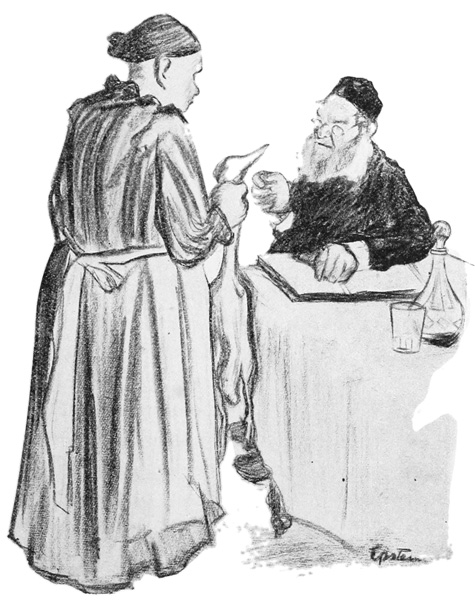
THE RABBI CAN TELL WHETHER OR NOT IT IS KOSHUR
These "submerged" rabbis are not always quite fair to one another. Some east side authorities maintain that the "orthodox Jew" of whom Rabbi Weiss spoke thus contemptuously, was one of the finest rabbis who ever came to New York, one of the most erudite of Talmudic scholars. Many congregations united to call him to America in 1887, so great was his renown in Russia. But when he reached New York the general fate of the intelligent adult immigrant overtook him. Even the "orthodox" in New York looked upon him as a "greenhorn" and deemed his sermons out-of-date. He was inclined, too, to insist upon a stricter observance of the law than suited their lax American ideas. So he, too, famous in Russia, rapidly became one of the "submerged."
One of the most learned, dignified and impressive rabbis of the east side is Rabbi Vidrovitch. He was a rabbi for forty years in Russia, and for nine years in New York. Like all true rabbis he does not preach, but merely sits in his home and expounds the "law." He employs the Socratic method of instruction, and is very keen in his indirect mode of argument. Keenness, indeed, seems to be the general result of the hair-splitting Rabbinical education. The uptown rabbis, "preachers," as the down-town rabbi contemptuously calls them, send many letters to Rabbi Vidrovitch seeking his help in the untying of knotty points of the "law." It was from him that Israel Zangwill, when the Children of the Ghetto was produced on the New York stage, obtained a minute description of the orthodox marriage ceremonies. Zangwill caused to be taken several flash-light photographs of the old rabbi, surrounded by his books and dressed in his official garments.
There are many congregations in the New York Ghetto which have no rabbis and many rabbis who have no congregations. Two rabbis who have no congregations are Rabbi Beinush and Rabbi, or rather, Cantor, Weiss. Rabbi Weiss would say of Beinush that he is a man who knows the Talmud, but has no diploma. Rabbi Beinush is an extremely poor rabbi with neither congregation nor slaughter-houses, who sits in his poor room and occasionally sells his wisdom to a fishwife who wants to know if some piece of meat is koshur or not. He is down on the rich up-town rabbis, who care nothing for the law, as he puts it, and who leave the poor down-town rabbi to starve.
Cantor Weiss is also without a job. The duty of the cantor is to sing the prayer in the congregation, but Cantor Weiss sings only on holidays, for he is not paid enough, he says, to work regularly, the cantor sharing in this country a fate similar to that of the rabbi. The famous comedian of the Ghetto, Mogolesco, was, as a boy, one of the most noted cantors in Russia. As an actor in the New York Ghetto he makes twenty times as much money as the most accomplished cantor here. Cantor Weiss is very bitter against the up-town cantors: "They shorten the prayer," he said. "They are not orthodox. It is too hot in the synagogue for the comfortable up-town cantors to pray."
Comfortable Philistinism, progress and enlightment up town; and poverty, orthodoxy and patriotic and religious sentiment, with a touch of the material also, down town. Such seems to be the difference between the German and the Russian Jew in this country, and in particular between the German and Russian Jewish rabbi.