Chapter Three The Old and the New Woman
Reading edition
The women present in many respects a marked contrast to their American sisters. Substance as opposed to form, simplicity of mood as opposed to capriciousness, seem to be in broad lines their relative qualities. They have comparatively few états d'ame; but those few are revealed with directness and passion. They lack the subtle charm of the American woman, who is full of feminine devices, complicated flirtatiousness; who in her dress and personal appearance seeks the plastic epigram, and in her talk and relation to the world an indirect suggestive delicacy. They are poor in physical estate; many work or have worked; even the comparatively educated among them, in the sweat-shops, are undernourished and lack the physical well-being and consequent temperamental buoyancy which are comforting qualities of the well-bred American woman. Unhappy in circumstances, they are predominatingly serious in nature, and, if they lack alertness to the social nuance, have yet a compelling appeal which consists in headlong devotion to a duty, a principle or a person. As their men do not treat them with the scrupulous deference given their American sisters, they do not so delightfully abound in their own sense, do not so complexedly work out their own natures, and lack variety and grace. On the other hand, they are more apt to abound in the sense of something outside of themselves, and carry to their love affairs the same devoted warmth that they put into principle.
THE ORTHODOX JEWESS
The first of the two well-marked classes of women in the Ghetto is that of the ignorant orthodox Russian Jewess. She has no language but Yiddish, no learning but the Talmudic law, no practical authority but that of her husband and her rabbi. She is even more of a Hausfrau than the German wife. She can own no property, and the precepts of the Talmud as applied to her conduct are largely limited to the relations with her husband. Her life is absorbed in observing the religious law and in taking care of her numerous children. She is drab and plain in appearance, with a thick waist, a wig, and as far as is possible for a woman a contempt for ornament. She is, however, with the noticeable assimilative sensitiveness of the Jew, beginning to pick up some of the ways of the American woman. If she is young when she comes to America, she soon lays aside her wig, and sometimes assumes the rakish American hat, prides herself on her bad English, and grows slack in the observance of Jewish holidays and the dietary regulations of the Talmud. Altho it is against the law of this religion to go to the theatre, large audiences, mainly drawn from the ignorant workers of the sweat-shops and the fishwives and pedlers of the push-cart markets, flock to the Bowery houses. It is this class which forms the large background of the community, the masses from which more cultivated types are developing.
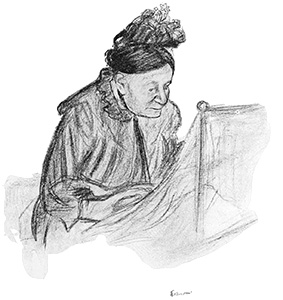
HER LIFE IS ABSORBED IN OBSERVING THE RELIGIOUS LAW
Many a literary sketch in the newspapers of the quarter portrays these ignorant, simple, devout, housewifely creatures in comic or pathetic, more often, after the satiric manner of the Jewish writers, in serio-comic vein. The authors, altho they are much more educated, yet write of these women, even when they write in comic fashion, with fundamental sympathy. They picture them working devotedly in the shop or at home for their husbands and families, they represent the sorrow and simple jealousy of the wife whose husband's imagination, perhaps, is carried away by the piquant manner and dress of a Jewess who is beginning to ape American ways; they tell of the comic adventures in America of the newly-arrived Jewess: how she goes to the theatre, perhaps, and enacts the part of Partridge at the play. More fundamentally, they relate how the poor woman is deeply shocked, at her arrival, by the change which a few years have made in the character of her husband, who had come to America before her in order to make a fortune. She finds his beard shaved off, and his manners in regard to religious holidays very slack. She is sometimes so deeply affected that she does not recover. More often she grows to feel the reason and eloquence of the change and becomes partly accustomed to the situation; but all through her life she continues to be dismayed by the precocity, irreligion and Americanism of her children. Many sketches and many scenes in the Ghetto plays present her as a pathetic "greenhorn" who, while she is loved by her children, is yet rather patronized and pitied by them.
In "Gott, Mensch und Teufel," a Yiddish adaptation of the Faust idea, one of these simple religious souls is dramatically portrayed. The restless Jewish Faust, his soul corrupted by the love of money, puts aside his faithful wife in order to marry another woman who has pleased his eye. He uses as an excuse the fact that his marriage is childless, and as such rendered void in accordance with the precepts of the religious law. His poor old wife submits almost with reverence to the double authority of husband and Talmud, and with humble demeanor and tears streaming from her eyes begs the privilege of taking care of the children of her successor.
In "The Slaughter" there is a scene which picturesquely portrays the love of the poor Jew and the poor Jewess for their children. The wife is married to a brute, whom she hates, and between the members of the two families there is no relation but that of ugly sordidness. But when it is known that a child is to be born they are all filled with the greatest joy. The husband is ecstatic and they have a great feast, drink, sing and dance, and the young wife is lyrically happy for the first time since her marriage.
Many little newspaper sketches portray the simple sweat-shop Jewess of the ordinary affectionate type, who is exclusively minded so far as her husband's growing interest in the showy American Jewess is concerned. Cahan's novel, "Yekel," is the Ghetto masterpiece in the portrayal of these two types of women—the wronged "greenhorn" who has just come from Russia, and she who, with a rakish hat and bad English, is becoming an American girl with strange power to alienate the husband's affections.
THE MODERN TYPE
The other, the educated class of Ghetto women, is, of course, in a great minority; and this division includes the women even the most slightly affected by modern ideas as well as those who from an intellectual point of view are highly cultivated. Among the least educated are a large number of women who would be entirely ignorant were it not for the ideas which they have received through the Socialistic propaganda of the quarter. Like the men who are otherwise ignorant, they are trained to a certain familiarity with economic ideas, read and think a good deal about labor and capital, and take an active part in speaking, in "house to house" distribution of socialistic literature and in strike agitation. Many of these women, so long as they are unmarried, lead lives thoroughly devoted to "the cause," and afterwards become good wives and fruitful mothers, and urge on their husbands and sons to active work in the "movement." They have in personal character many virtues called masculine, are simple and straightforward and intensely serious, and do not "bank" in any way on the fact that they are women! Such a woman would feel insulted if her escort were to pick up her handkerchief or in any way suggest a politeness growing out of the difference in sex. It is from this class of women, from those who are merely tinged, so to speak, with ideas, and who consequently are apt to throw the whole strength of their primitive natures into the narrow intellectual channels that are open to them, that a number of Ghetto heroines come who are willing to lay down their lives for an idea, or to live for one. It was only recently that the thinking Socialists were stirred by the suicide of a young girl for which several causes were given. Some say it was for love, but what seems a partial cause at least for the tragedy was the girl's devotion to anarchistic ideas. She had worked for some time in the quarter and was filled with enthusiastic Tolstoian convictions about freedom and non-resistance to evil, and all the other idealistic doctrines for which these Anarchists are remarkable. Some of the people of the quarter believe that it was temporary despair of any satisfactory outcome to her work that brought about her death. But since the splits in the Socialistic party and the rise among them of many insincere agitators, the enthusiasm for the cause has diminished, and particularly among the women, who demand perfect integrity or nothing; tho there is still a large class of poor sweat-shop women who carry on active propaganda work, make speeches, distribute literature, and go from house to house in a social effort to make converts.
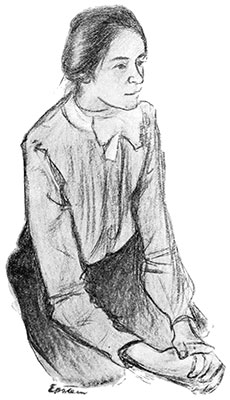
INTENSELY SERIOUS
As we ascend in the scale of education in the Ghetto we find women who derive their culture and ideas from a double source—from Socialism and from advanced Russian ideals of literature and life. They have lost faith completely in the orthodox religion, have substituted no other, know Russian better than Yiddish, read Tolstoi, Turgenef and Chekhov, and often put into practice the most radical theories of the "new woman," particularly those which say that woman should be economically independent of man. There are successful female dentists, physicians, writers, and even lawyers by the score in East Broadway who have attained financial independence through industry and intelligence. They are ambitious to a degree and often direct the careers of their husbands or force their lovers to become doctors or lawyers—the great social desiderata in the match-making of the Ghetto. There is more than one case on record where a girl has compelled her recalcitrant lover to learn law, medicine or dentistry, or submit to being jilted by her. An actor devoted to the stage is now on the point of leaving it to become a dentist at the command of his ambitious wife. "I always do what she tells me," he said pathetically.
The career of a certain woman now practising dentistry in the Ghetto is one of the most interesting cases, and is also quite typical. She was born of poor Jewish parents in a town near St. Petersburg, and began early to read the socialist propaganda and the Russian literature which contains so much implicit revolutionary doctrine. When she was seventeen years old she wrote a novel in Yiddish, called "Mrs. Goldna, the Usurer," in which she covertly advocated the anarchistic teachings. The title and the sub-theme of the book was directed against the usurer class among the Jews, and were mainly intended to hide from the Government her real purpose. The book was afterwards published in New York, and had a fairly wide circulation. A year or two later her imagination was irresistibly enthralled by the remarkable wave of "new woman" enthusiasm which swept over Russia in the early eighties, and resulted in so many suicides of young girls whom poverty or injustice to the Jew thwarted in their scientific and intellectual ambition. She went alone to St. Petersburg with sixty five cents in her pocket, in order to obtain a professional education, which, after years of practical starvation, she succeeded in securing. With several degrees she came to America twelve years ago and fought out an independent professional position for herself. She believes that all women should have the means by which they may support themselves, and that marriage under these conditions would be happier than at present. Her husband is a doctor, and her idea is that they are happier than if she were a woman of the old type, "merely a wife and mother," as she put it. She maintains that no emotional interest is lost under the new régime, while many practical advantages are gained. Since she has been in America she has furthered the Socialist cause by literary sketches published in the Yiddish newspapers, altho she has been too busy to take any direct part in the movement.
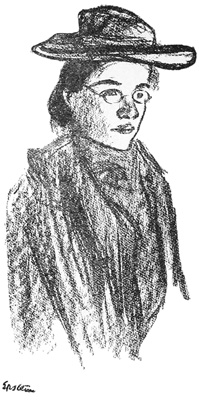
A RUSSIAN GIRL-STUDENT
The description of this type of woman seems rather cold and forbidding in the telling; but such an impression is misleading. There is no commoner reproach made by the women of the Ghetto against their American sister than that she is unemotional and "practical." They come to America, like the men, because they cannot stand the political conditions in Russia, which they describe as "fierce," but they never cease loving the land of their birth; and the reason they give is that the ideal still lives in Muscovite civilization, while in America it is trampled out by the cult of the dollar. They think Americans are dry and cold, unpoetic, uninterested in great principles, and essentially frivolous, incapable of devotion to persons or to "movements," reading books only for amusement, and caring nothing for real literature. One day an American dined with four Russian Jews of distinction. Two were Nihilists who had been in the "big movement" in Russia and were merely visiting New York. The other two were a married couple of uncommon education. The Nihilists were gentle, cultivated men, with feeling for literature, and deeply admired, because of their connection with the great movement, by the two New Yorkers. The talk turned on Byron, for whom the Russians had a warm enthusiasm. The Americans made rather light of Byron and incurred thereby the great scorn of the Russians, who felt deeply the "tendency" character of the poet without being able to understand his æsthetic and imaginative limitations. After the Nihilists had left, the misguided American used the words "interesting" and "amusing" in connection with them; whereupon the Russian lady was almost indignant, and dilated on the frivolity of a race that could not take serious people seriously, but wanted always to be entertained; that cared only for what was "pretty" and "charming" and "sensible" and "practical," and cared nothing for poetry and beauty and essential humanity.
The woman referred to, as well as many others of the most educated class in the quarter, some of them the wives of socialists, doctors, lawyers or literary men, are strongly interesting because of their warm temperaments, and genuine, if limited, ideas about art, but most of them are lacking in grace, and sense of humor, and of proportion. They are stiff and unyielding, have little free play of imagination, little alertness of ideas, and their sense of literature is limited largely to realism. Japanese art, for instance, as any art which depends on the exquisiteness of its form, is lost on these stern realists. They no more understand the latest subtle literary consciousness than they do the interest and eloquence of a creature who makes of herself a perfect social product such as the clever French woman of history.
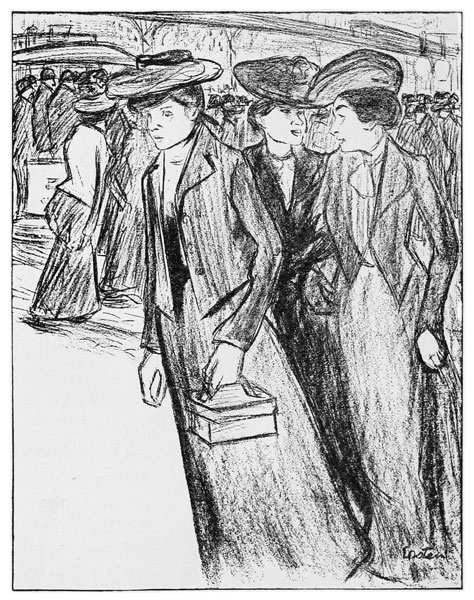
WORKING GIRLS RETURNING HOME
But the charm of sincere feeling they have; and, in an intellectual race, that feeling shapes itself into definite criticism of society. Emotionally strong and attached by Russian tradition to a rebellious doctrine, they are deeply unconventional in theory and sometimes in practice; altho the national morality of the Jewish race very definitely limits the extent to which they realize some of their ideas. The passionate feeling at the bottom of most of their "tendency" beliefs is that woman should stand on the same social basis as man, and should be weighed in the same scales. This ruling creed is held by all classes of the educated women of the Ghetto, from the poor sweat shop worker, who has recently felt the influence of Socialism, to the thoroughly trained "new woman" with her developed literary taste; and all its variations find expression in the literature of the quarter.
PLACE OF WOMAN IN GHETTO LITERATURE
Ibsen's "Doll's House" has been translated and produced at a Yiddish theatre; and an original play called "Minna" registers a protest by the Jewish woman against that law of marriage which binds her to an inferior man. Married to an ignorant laborer, Minna falls in love (for his advanced ideas) with the boarder—every poor family, to pay the rent, must saddle themselves with a boarder, often at the expense of domestic happiness—and finally kills herself, when the laws of society press her too hard. Another drama called "East Broadway" presents the case of a Russian Jewess devoted to Russia, to idealism and Nihilism, and to a man who shared her faith until they came to New York, when he became a business man pure and simple, and lost his ideals and his love for her. In a popular play called "The Beggar of Odessa," lines openly advocating the freest love between the sexes accompany other extreme anarchistic views put into the loosest and most popular form. "Broken Chains" is a drama which criticises the relative freedom of action given to the man in matters of love. The heroine reads Ibsen at night while her husband amuses himself in the quarter. A young bookkeeper is there who serves to make concrete her growing theories. But her sense of duty to her child restrains her from the final step, and she dies in despair. Suicides in sketches and plays abound, and as often as not result simply from intellectual despondency. "Vain Sacrifice" is the fierce outcry of a woman against the poverty which makes her marry a man she loathes for the sake of her father. In the newspaper sketches there are many pictures of sordid homes and conditions from the midst of which fierce protests by wives and mothers are implicitly given.
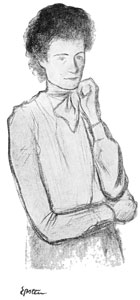
A RUSSIAN TYPE
An appealing characteristic of the "new woman" of the Ghetto is the consideration which she manifests towards the orthodox "greenhorn" who may be her aunt, her mother, her mother-in-law or her grandmother. The sense of infinite form prescribed by the Talmud is dead to her, but extraordinary love for the family bond is not, and, moved by that, she observes the complicated formulæ on all the holidays in order to please the dear old "greenhorn" who lives with her; eats unleavened bread, weeps on Atonement Day in the synagogue, and goes through the whole long list. Her conduct in this respect is in striking contrast to the off-hand treatment of parents by their American daughters, and to that of the Orthodox Jewish woman in relation to the theatre. The law forbids the theatre, but even the slightly disillusioned ladies of the quarter will go on the Sabbath; and it is said that they sometimes hypocritically relieve their consciences by hissing the actor who, even in his rôle, dares to smoke on that day. This is on a par with the hypocrisy which leads many Orthodox Jewish families to have a Gentile as their servant, so that they can drink the tea, and warm themselves by the fire, made by him, without technically violating "the law."
Love in the Ghetto is, no doubt, very much the same as it is elsewhere; and this in spite of the fact that among the Orthodox marriage is arranged by the parents, a custom which is condemned in "The Slaughter," for instance, where the terrible results of a loveless union are portrayed. The system of matrimonial agents in the quarter does not seem to have any important bearing on the question of love. In this respect the free thinking of the people grows apace, and love-marriages in the quarter are on the increase. In matters of taste and inclination between the sexes, however, there are some qualities quite startling to the American. The most popular actor with the girls of the Ghetto is a very fat, heavy, pompous hero who would provoke only a smile from the trim American girl; and the more popular actresses are also very stout ladies. From an American point of view the prettiest actresses of the Ghetto are admired by the minority of Jews who have been taken by the rakish hat, the slim form, and the indefinite charm to which the Ghetto is being educated. It is alleged that at an up-town theatre, where a large proportion of the audience is Jewish, the leading lady must always be of very generous build; and this in spite of the fact that the well-to-do Jews up-town have been in America a long time, and have had ample opportunity to become smitten with the charms of the slender American girl.