Chapter Four Four Poets
Reading edition
In East Canal Street, in the heart of the east side, are many of the little Russian Jewish cafés, already mentioned, where excellent coffee and tea are sold, where everything is clean and good, and where the conversation is often of the best. The talk is good, for there assemble, in the late afternoon and evening, the chosen crowd of "intellectuals." The best that is Russian to-day is intensely serious. What is distinctively Jewish has always been serious. The man hunted from his country is apt to have a serious tone in thought and feeling.
It is this combination—Russian, Jewish, and exile—that is represented at these little Canal Street cafés. The sombre and earnest qualities of the race, emphasized by the special conditions, receive here expression in the mouths of actors, socialists, musicians, journalists, and poets. Here they get together and talk by the hour, over their coffee and cake, about politics and society, poetry and ethics, literature and life. The café-keepers themselves are thoughtful and often join in the discussion,—a discussion never light but sometimes lighted up by bitter wit and gloomy irony.
There are many poets among them, four of whom stand out as men of great talent. One of the four, Morris Rosenfeld, is already well known to the English-speaking world through a translation of some of his poems. Two of the other three are equally well known, but only to the Jewish people. One is famous throughout Jewish Russia.
A WEDDING BARD
The oldest of the four poets is Eliakim Zunser. It is he that is known to millions of people in Russia and to the whole New York Ghetto. He is the poet of the common people, the beloved of all, the poet of the housewife, of the Jew who is so ignorant that he does not even know his own family name. To still more ignorant people, if such are possible, he is known by what, after all, is his distinctive title, Eliakim the Badchen, or the Wedding Bard. He writes in Yiddish, the universal language of the Jew, dubbed "jargon" by the Hebrew aristocrat.
Zunser is now a printer in Rutger's Square, and has largely given up his duties as Badchen, but at one time he was so famous in that capacity that he went to a wedding once or twice every day, and made in that way a large income. His part at the ceremony was to address the bride and bridegroom in verse so solemn that it would bring tears to their eyes, and then entertain the guests with burlesque lines. He composed the music as well as the verses, and did both extempore. When he left his home to attend the wedding there was no idea in his head as to what he would say. He left that to the result of a hurried talk before the ceremony with the wedding guests and the relatives of the couple.
Zunser's wedding verses died as soon as they were born, but there are sixty-five collections of his poems, hundreds of which are sung every day to young and old throughout Russia. Many others have never been published, for Zunser is a poet who composes as he breathes, whose every feeling and idea quivers into poetic expression, and who preserves only an accidental part of what he does.
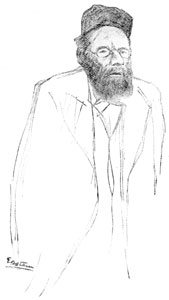
ELIAKIM ZUNSER
He is a man of about seventy years of age, with kind little eyes, a gray beard, and spare, short figure. As he sits in his printing office in the far east side he wears a small black cap on his head. Adjoining the office is another room, in which he lives with his wife and several children. The stove, the dining-table, the beds, are all in the same room, which is bare and chill. But the poet is hospitable, and to the guests he offered cake and a bottle of sarsaparilla. Far more delightful, however, the old man read some of his poems aloud. As he read in a chanting tone he swayed gently backwards and forwards, unconscious of his visitors, absorbed in the rhythm and feeling of the song. There was great sweetness and tenderness in his eyes, facility and spontaneity in the metre, and simple pathos and philosophy in the meaning of what he said. He was apparently not conscious of the possession of unusual power. Famous as he is, there was no sense of it in his bearing. He is absolutely of the people, childlike and simple. So far removed is he from the pride of his distinction that he has largely given up poetry now.
"I don't write much any more," he said in his careless Yiddish; "I have not much time."
His poetry seemed to him only a detail of his life. Along with the simplicity of old age he has the maturity and aloofness of it. The feeling for his position as an individual, if he ever had it, has gone, and left the mind and heart interested only in God, race, and impersonal beauty.
So as he chanted his poems he seemed to gather up into himself the dignity and pathos of his serious and suffering race, but as one who had gone beyond the suffering and lived only with the eternities. His wife and children bent over him as he recited, and their bodies kept time with his rhythm. One of the two visitors was a Jew, whose childhood had been spent in Russia, and when Zunser read a dirge which he had composed in Russia twenty-five years ago at the death by cholera of his first wife and children—a dirge which is now chanted daily in thousands of Jewish homes in Russia—the visitor joined in, altho he had not heard it for many years. Tears came to his eyes as memories of his childhood were brought up by Zunser's famous lines; his body swayed to and fro in sympathy with that of Zunser and those of the poet's second wife and her children; and to the Anglo-Saxon present this little group of Jewish exiles moved by rhythm, pathos, and the memory of a far-away land conveyed a strange emotion.
Zunser's dirge is in a vein of reflective melancholy. "The Mail Wagon" is its title. The mail wagon brings joy and sorrow, hope and despair, and it was this awful mechanism that brought Zunser's grief home to him. "But earth, too, is a machine, a machine that crushes the bones of the philosopher into dust, digests them, that crushes and digests all things. From it all comes. Into it all goes. Why may I not therefore be chewing at this moment the marrow of my children?"
Another song the old man read aloud was composed in his early childhood, and is representative in subject and mood of much of his later work. "The Song of the Bird" it is called, and it typifies the Jewish race. The bird's wing is broken, and the bird reflects in tender melancholy over his misfortunes. "Take me away from Roumania" has the same melancholy, but also a humorous pathos in the title, for the poet meant he would like to be taken away from Russia, but was afraid to say so for political reasons. But the sadness of Zunser's poetry is lightened by its spontaneity and by the felicity of verse and music, and the naïve idea in each poem is never too solemnly insisted upon for popular poetry.
The dirge, which touched upon an episode of his life, led the poet to tell in his simple way the other events of a life history at once typical and peculiar.
He was born in Vilna, the capital of ancient Lithuania, and became apprentice to a weaver of gold lace at the age of six. His general education was consequently slight, tho he picked up a little of the Talmud and sang Isaiah and Jeremiah while at work. At the end of six years, when he was supposed to know his trade, his master was to give him twenty roubles as total wage. But the master refused to pay, and young Zunser took to the road with no money. He went to Bysk in the Ostsee province, and there worked at his trade during the day and at night studied the Talmud under the local rabbi. He also began to read books in pure Hebrew for the love of the noble poetry in that tongue. Before long he received word from home that his little brother had died. He went back and helped his mother cry, as he expressed it. Away he went again from home to a place called Bobroysk, where he obtained a position to teach Hebrew in the family of an innkeeper, who promised to pay him twenty-five roubles at the end of six months. When the time came his employer said he would pay at the end of the year. Ingenuous Zunser agreed, but the innkeeper, just before the end of the year, went to a government official and reported that there was a boy at his house who was fit to be a soldier. Young Zunser was pressed into the service. He was then thirteen. It was in the barracks that he composed his first three songs. In these songs he poured out his heart, told all his woe, but did not print them, "for," he said, "it was my own case."
On being released from the service, Zunser went to Vilna and continued his trade as a gold-lace maker. He also wrote many poems and songs. They were not printed at first, but circulated in written copies. Zunser is said to be the first man to write songs in Yiddish, and soon he became famous. "It was 'the lacemaker boy' everywhere," as the poet expressed it. Now that he could make money by his songs he gave up his trade and devoted himself to art. In 1861 he returned to his native town a great man. There he first saw his work in print. Then came a period when he wrote a great deal and performed every day his function as wedding bard. For ten years things prospered with him, but in 1871 his wife and four children died of cholera. Zunser composed the famous dirge, left Vilna, which appeared to him unlucky, and went to Minsk. Here he continued to get a living with his pen, and married again. Ten years ago he came to New York with his family and kept up his occupation as wedding bard for some time.
The character of Zunser's poetry is what might be expected from his popularity, slight education, and humble position in the Jewish world. His melancholy is common to all Jewish poets. There is a constant reference to his race, too, a love for it, and a sort of humble pride. More than any of the four poets whom we are to mention, with the possible exception of Morris Rosenfeld, Zunser has a fresh lyric quality which has gone far to endear him to the people. Yet in spite of his sweet bird-like speed of expression, Zunser's is a poetry of ideas, altho the ideas are simple, fragmentary, and fanciful, and are seldom sustained beyond what is admissible to the lyric touch. The pale cast of thought, less marked in Zunser's work than in that of the other three poets, is also a common characteristic of Jewish poetry. Melancholy, patriotic, and thoughtful, what is lacking in Zunser is what all modern Jewish poetry lacks and what forms a sweet part of Anglo-Saxon literature—the distinctively sensuous element. A Keats is a Hebrew impossibility. The poetry of simple presentation, of the qualities of mere physical nature, is strikingly absent in the imaginative work of this serious and moral people. The intellectual element is always noticeable, even in simple Zunser, the poet of the people.
A CHAMPION OF RACE
A striking contrast to the popular wedding bard is Menahem Dolitzki, called the Hebrew poet because he has the distinction of writing in the old Hebrew language.
His learning is limited to the old literature of his race. He is not a generally well educated man, not knowing or caring anything about modern life or ideas. The poet of the holy tongue, he is what the Jews call maskil, fellow of wisdom. The aloof dignity of his position fills him with a mild contempt for the "jargon," the Yiddish of Rosenfeld and Zunser, and makes him distrustful of what the fourth poet, Wald, represents—the modern socialistic spirit.
Singularly enough, he is called by the socialists of the Ghetto the poet of the dilettanti. An Anglo-Saxon American employs the term to mean those persons superficially interested in much, deeply interested in nothing; but these socialistic spirits stigmatize as dilettante whatever is not immersed in the spirit of the modern world. The man of form, the lover of the old, the cool man with scholastic tinge has no place in the sympathetic imagination of the Ghetto intellectuals. They leave him to the learned among old fogies. And it is true that Dolitzki's appeal is a limited one, both as a man and as a poet. He is a handsome man of about forty-five years, with a fine profile, an unenthusiastic manner, a native reserve very evident in his way of reading his poetry. He has nothing of the buoyant spontaneity, the impersonal feeling of Zunser. The poet of the people was a part of his verse as he read. He threw himself into it, identified himself with his musical and fanciful creation. But Dolitzki, who has been recently a travelling agent for a Yiddish newspaper on the east side, and has a little home suggesting greater cleanliness and comfort than that of Zunser, held his manuscript at arm's length and read his verses with no apparent sign of emotion. About his poetry and life he talked with comparative reserve, in the former evidently caring most for the form and the language, and in the latter for the ideas which determined his intellectual life rather than for picturesque details and events.
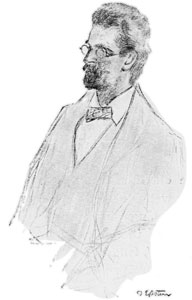
MENAHEM DOLITZKI
Dolitzki's life and work are identified with the revival of Hebrew literature of fifty years ago, and, more narrowly, of twenty years ago. He is one of the great poets of that revival, and wherever it is felt in the Jewish world, there Dolitzki is known and admired. He was born in Byelostock, but spent his early manhood in Moscow, whence he was expelled. That event partly determined the character of his first writings—patriotic poems of culture, reasoned outcries against the religious prejudice of the orthodox Jews, the Jews who take their stand on the Talmud, led by the hair-splitting rabbi, upholders of the narrow Jewish theology. Just as the revival of learning in Europe brought doubt of orthodoxy along with it, so the revival of the pure Hebrew literature brought doubt of the religion of the established rabbi, founded on a minute interpretation of the Talmud. The Hebrew scholars who went back to the sources of Jewish literature for their inspiration were worse than infidels to the orthodox. And Dolitzki was the poet of these "infidels."
When, however, the Jews were expelled from Moscow, Dolitzki's interest broadened to love of his race. It is not so much interest in human nature that these noble and austere poems manifest, as an epic love for the race as a whole, a lofty and abstract emotion. The intellectual and moral element characteristic of Jewish poetry is particularly marked in Dolitzki's work. His first poems, those of culture inspired by hatred of Talmudic prejudice, and his later ones, filled with the abstract love of his race, are poems of idealism expressed largely in complicated symbolical language, lacking, as compared with Zunser's poetry, spontaneity, wholly wanting in sensuous imagery, but written in musical and finished verse.
A poem illustrating Dolitzki's first period tells how a cherub bore the poet, symbolizing the Jewish people, aloft where he could see pure and beautiful things, but soon the earth appeared, in the shape of a round loaf of bread symbolizing need and poverty and prejudice; and to this the aspiring Jew must return and from this he could not escape. One of the poems in which Dolitzki's love of his race is expressed describes a man and a maiden (the Jewish race) who, driven by love of one another and fear of oppression, are sitting upon a lofty rock. Below them on the plain they see their family murdered by the invaders. Then they voluntarily die, declaring that they will yet live forever in the race.
Dolitzki's remote idealism represents a nobler kind of thing than what is generally associated with the east side. A dignified and epic poet, he is filled with moral rather than enthusiastic love of the old language and the old race.
A SINGER OF LABOR
Morris Rosenfeld, poet and former tailor, strikes in his personality and writings the weary minor. Full of tears are the man and his song. Zunser, Dolitzki, and Wald, altho in their verse runs the eternal melancholy of poetry and of the Jews, have yet physical buoyancy and a robust spirit. But Rosenfeld, small, dark, and fragile in body, with fine eyes and drooping eyelashes, and a plaintive, childlike voice, is weary and sick—a simple poet, a sensitive child, a bearer of burdens, an east side tailor. Zunser and Dolitzki have shown themselves able to cope with their hard conditions, but the sad little Rosenfeld, unpractical and incapable in all but his songs, has had the hardest time of all. His life has been typical of that of many a delicate poet—a life of privation, of struggle borne by weak shoulders, and a spirit and temperament not fitted to meet the world.
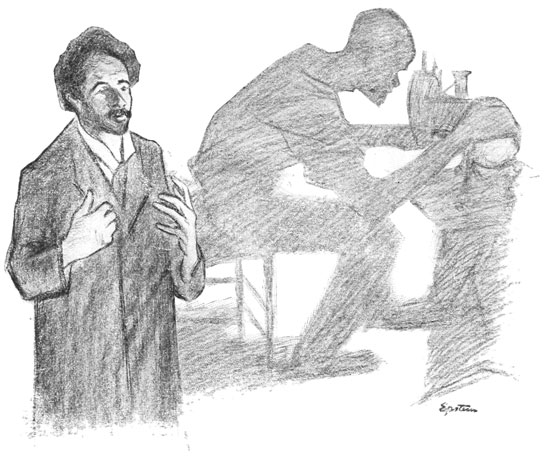
MORRIS ROSENFELD
Much younger than Zunser or Dolitzki, Morris Rosenfeld was born thirty-eight years ago in a small village in the province of Subalk, in Russian Poland, at the end of the last Polish revolution. The very night he was born the world began to oppress him, for insurgents threw rocks through the window. His grandfather was rich, but his father lost the money in business, and Morris received very little education—only the Talmud and a little German, which he got at a school in Warsaw. He married when he was sixteen, "because my father told me to," as the poet expressed it. He ran away from Poland to avoid being pressed into the army. "I would like to serve my country," he said, "if there had been any freedom for the Jew." Then he went to Holland and learned the trade of diamond-cutting; then to London, where he took up tailoring.
Hearing that the tailors had won a strike in America, he came to New York, thinking he would need to work here only ten hours a day. "But what I heard," he said, "was a lie. I found the sweat-shops in New York just as bad as they were in London."
In those places he worked for many years, worked away his health and strength, but at the same time composed many a sweetly sad song. "I worked in the sweat-shop in the daytime," he said to me, "and at night I worked at my poems. I could not help writing them. My heart was full of bitterness. If my poems are sad and plaintive, it is because I expressed my own feelings, and because my surroundings were sad."
Next to Zunser, Rosenfeld is the most popular of the four Jewish poets. Zunser is most popular in Russia, Rosenfeld in this country. Both write in the universal Yiddish or "jargon," both are simple and spontaneous, musical and untutored. But, unlike Zunser, Rosenfeld is a thorough representative, one might say victim, of the modern spirit. Zunser sings to an older and more buoyant Jewish world, to the Russian Hebrew village and the country at large. Rosenfeld in weary accents sings to the maimed spirit of the Jewish slums. It is a fresh, naïve note, the pathetic cry of the bright spirit crushed in the poisonous air of the Ghetto. The first song that Rosenfeld printed in English is this:
"I lift mine eyes against the sky, The clouds are weeping, so am I; I lift mine eyes again on high, The sun is smiling, so am I. Why do I smile? Why do I weep? I do not know; it lies too deep. "I hear the winds of autumn sigh, They break my heart, they make me cry; I hear the birds of lovely spring, My hopes revive, I help them sing. Why do I sing? Why do I cry? It lies so deep, I know not why."
A DREAMER OF BROTHERHOOD
Abraham Wald, whose nom de plume is Lessin, is only twenty-eight years old, the youngest and least known of the four poets, yet in some respects the most interesting. He is the only one who is on a level with the intellectual alertness of the day. His education is broad and in some directions thorough. He is the only one of the four poets whom we are discussing who knows Russian, which language he often writes. He is an imaginative critic, a violent socialist, and an excitable lover of nature.
One of his friends called the poet on one occasion an intellectual débauché. It was in a Canal Street café, where Wald was talking in an excited tone to several other intellectuals. He is a short, stocky man, with a suggestion of physical power. His eyes are brilliant, and there seems to be going on in him a sort of intellectual consumption. He is restlessly intense in manner, speaks in images, and is always passionately convinced of the truth of what he sees so clearly but seldom expresses in cold logic. His fevered idealism meets you in his frank, quick gaze and impulsive and rapid speech.
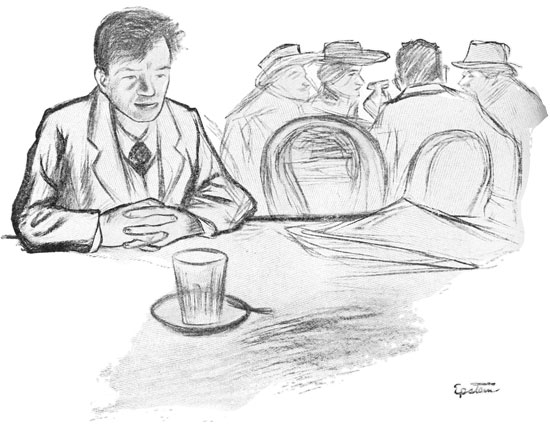
ABRAHAM WALD
Lacking in repose, balance, and sobriety of thought, Wald is well described by his friend's phrase. Equally well he may be called the Jewish bohemian. He is not dissipated in the ordinary sense. Coffee and tea are the drinks he finds in his little cafés. But in these places he practically lives, disputing, arguing, expounding, with whomsoever he may find. He has no fixed home, but sleeps wherever inevitable weariness finds him. He prefers to sleep not at all. Like all his talented tribe he is poor, and makes an occasional dollar by writing a poem or an article for an east side newspaper. When he has collected three or four dollars he quits the newspaper office and seeks again his beloved café, violently to impart his quick-coming thoughts and impulses. Only after his money is gone—and it lasts him many days—does he return to his work on the paper, the editor of which must be an uncommonly good-natured fellow.
Impelled by political reasons, Wald left Russia three years ago, but before that time, which was in his twenty-fifth year, he had passed through eight mental and moral crises. Perhaps the number was a poetical exaggeration, for when I asked the poet to enumerate he gave only five. As a boy he revolted from the hair-splitting Talmudic orthodoxy, and was cursed in consequence; then he lost his Jewish faith altogether; then his whole Cultur-Anschauung changed, on account of the influence of Russian literature. He became an atheist and then a socialist and perhaps a pantheist: at least he has written poems in which breathes the personified spirit of nature. Without the peace of nature, however, is the man and his work. He dislikes America because it lacks the ebullient activity of moral, imaginative life. Wald likes Russia better than America because Russia, to use the poet's words, is idealism, hope, and America is realization.
"Before I came to America," he said, "I thought it would not be as interesting as Russia, and when I got here I saw that I was right. America seemed all worked out to me, as if mighty things had already been done, but it seemed lifeless at the core. Russia, on the other hand, with no external form of national prosperity, is all activity at heart, restless longing. Russia is nothing to see, but alive and bubbling at the core. The American wants a legal wife, something there and sure, but the Russian wants a wife behind a mountain, through which he cannot penetrate, but can only dream and strive for her."
These four poets have what is distinctive of Jewish poetry—the pulse of desire and hope, in which there is strain and reproach, constant effort. The Russian Jew's lack of appreciation of completed beauty or of merely sensuous nature is strikingly illustrated by the fact that there has never been a great expression of plastic art in his history. Painting, sculpture, and architecture are nothing to the Jew in comparison with the literature and music of ideas. In nearly all the Jews of talent I have met there is the same intellectual consumption, the excitement of beauty, but no enjoyment of pure beauty of form. The race is still too unhappy, too unsatisfied, has too much to gain, to express a complacent sense of the beauty of what is.
Wald's is the poetry of socialism and of nature, and one form is as turbulent as the other. He writes, for instance, of the prisoner in Siberia, his verses filled with passionate rebellion. Then he tells how he dreamed beside the gleaming river, and of the fancies that passed through his brain—not merely pretty fancies, but passionately moral images in which rebellion, longing, wonder, are by turns expressed; never peaceful enjoyment of nature, never simply the humble eye that sees and questions not, but always the moral storm and stress.
Wald and Rosenfeld represent at once things similar and unlike. Both are associated with the modern spirit of socialism, both are identified with the heart of big cities, both are very civilized, yet in temperament and quality no two poets could be more widely separated. Rosenfeld is the finer spirit, the more narrow, too. He is eminently the Ghetto Jew. But Wald, as one sees him talking in the café, his whole body alive with emotion, with his youthful, open face, his constant energy, and the modernity and freshness of his ideas, seems the Russian rather than the Jew, and suggests the vivid spirit of Tolstoi.
In comparison with Wald and Rosenfeld the older men, Dolitzki and Zunser, seem remote. Dolitzki has the remoteness of culture and Zunser that of old age and relative peace of spirit. But compared among themselves the poets of the four are Zunser and Rosenfeld, the spontaneous lyric singers. Wald, however, is making his way rapidly into the sympathetic intelligence of the socialists—a growing class—but has not as yet the same wide appeal as the two poets who sing only in the tongue of the people.