Chapter Six The Newspapers
Reading edition
Yiddish newspapers have, as compared with their contemporaries in the English language, the strong interest of great freedom of expression. They are controlled rather by passion than by capital. It is their joy to pounce on controlling wealth, and to take the side of the laborer against the employer. A large proportion of the articles are signed, a custom in striking contrast with that of the American newspaper; the prevalence of the unsigned article in the latter is held by the Yiddish journals to illustrate the employer's tendency to arrogate everything to himself, and to make the paper a mere organ of his own policy and opinions. The remark of one of the Jewish editors, that the "Yiddish newspaper's freedom of expression is limited by the Penal Code alone," has its relative truth. It is, of course, equally true that the new freedom of the Jews, who in Russia had no journal in the common Yiddish, runs in these New York papers into an emotional extreme, a license which is apt to distort the news and to give over the editorial pages to virulent party disputes.
Nevertheless, the Yiddish press, particularly the Socialistic branch of it, is an educative element of great value in the Ghetto. It has helped essentially to extend the intellectual horizon of the Jew beyond the boundaries of the Talmud, and has largely displaced the rabbi in the position of teacher of the people. Not only do these papers constitute a forum of discussion, but they publish frequent translations of the Russian, French, and German modern classics, and for the first time lay the news of the world before the poor Jewish people. An event of moment to the Jews, such as a riot in Russia, comes to New York in private letters, and is printed in the papers here often before the version "prepared" by the Russian Government appears in the Russian newspapers. Thus a Jew on the east side received a letter from his father in Russia asking why the reserves there had been called out, and the son's reply gave him the first information about the war in China.
The make-up of the Yiddish newspaper is in a general way similar to that of its American contemporary. The former is much smaller, however, containing only about as much reading matter as would fill six or eight columns of a "down-town" newspaper. The sporting department is entirely lacking, the Jew being utterly indifferent to exercise of any kind. They are all afternoon newspapers, and draw largely for the news upon the morning editions of the American papers. The staff is very limited, consisting of a few editors and, usually, only one reporter for the local news of the quarter. They give more space proportionately than any American paper to pure literature—chiefly translations, tho there are some stories founded on the life of the east side—and to scientific articles of popular character. The interesting feature of these newspapers, however, consists in their rivalries and their differences in principle. This can be presented most simply in a short sketch of their history.
THE CONSERVATIVE JOURNALS
Yiddish journalism in New York began about thirty years ago, and continued in unimportant and unrepresentative newspapers until about twelve years ago, when the Tageblatt, the first daily newspaper, and the Arbeiterzeitung, an important Socialistic weekly, now defunct, but from which developed the present Socialist dailies, came into existence. The Tageblatt, which has maintained its general character from the beginning, is the most conservative, as well as the oldest, of the daily newspapers of the Ghetto. It is national and orthodox, and fights tooth and nail for whatever is distinctively Jewish in customs, literature, language, and religion. It hates the reform sects in religion and the Socialistic tendencies in politics and economics. It is called a "capitalist" paper by its opponents, and is so in the sense that it is more dependent upon its advertisements than the Socialistic papers, which are partly supported by frequent entertainments and balls, to which all their friends go. And yet how little capitalistic is even this paper is shown by the fact that while it takes a non-committal attitude towards strikes in the Ghetto it supports those which occur outside.
Sympathetic with workingmen and not antagonistic to the employers of the Ghetto, the Tageblatt conventionally unites all the Jewish interests it consistently can, and has admittedly the largest circulation of any daily paper in the Ghetto. The Socialists call it "bourgeois" as well as "capitalistic" (which is the most horrid of all words in the quarter). Some call it chauvinistic because of its strong Nationalist tendency, and fanatic because it upholds the religion of the Jews; the Jew who wants first of all to be an American and up-to-date hates the Tageblatt as tending to strengthen the distinction between Jew and Gentile. This paper goes so far in its conservatism that, according to its enemies, it condemns all rabbis who mention the name of Christ in their sermons, and holds to a strict interpretation of Talmudic law in regard to habits of life. "It is only the old-fashioned greenhorns," said the editor of one of the other papers, "coming from the old country, who will stand for it."
THE SOCIALIST PAPERS
The Socialist weekly, the Arbeiterzeitung, marked the beginning of the most vital journalism of the east side, and stood in striking contrast to the Tageblatt. In the circumstances attending its development into the two existing rival Socialistic papers, the Vorwärts and the Abendblatt,[2] a picture of the progressive and passionate character of the Russian-Jewish Socialists of the Ghetto is presented, and some of the most important and picturesque personages. The most educated and intelligent among the Jews of the east side speak Russian, and are reactionary in politics and religion. Coming from Russia, as they do, they have a fierce hatred of government and capitalism, and a more or less Tolstoian love for the peasant and the workingman. The purpose of the organizers of the Arbeiterzeitung Publishing Association was to educate the people, promulgate the doctrines of Socialism, and be altogether the organ of the workman against the employer. From the outset, beginning in 1890, the Arbeiterzeitung was a popular and influential paper.
All the older journals had affected a Germanized Yiddish, which the people did not understand; but the new paper, aiming at the modern heart of the Ghetto, carried on its propaganda in the common jargon of the Jew, the pure Yiddish; and, growing enormously in circulation, forced the language down the throats of the conservative journals. In this popular tongue, the Arbeiterzeitung carried on for five years a most energetic campaign for a broad Socialism, admitting all allied movements in favor of common ownership, directing and encouraging strikes, printing popular scientific articles, realistic stories, dramatic criticisms, and expressing and leading generally the best intelligence of the Yiddish community. With the constituency of which this journal was the organ, Socialism had almost the force and passion of a religious movement. An example of the paper's power was in connection with the Bakers' Union. That organization imposed a label on all bread made in the Ghetto, and insisted that all the bakers should handle only bread of that brand. The Arbeiterzeitung supported the Union so effectively that no other bread could possibly be obtained in the quarter. At the first Yahresfest of the journal, Cooper Union overflowed with enthusiastic workingmen, and long lines of the excluded stretched out down the Bowery to Houston Street.
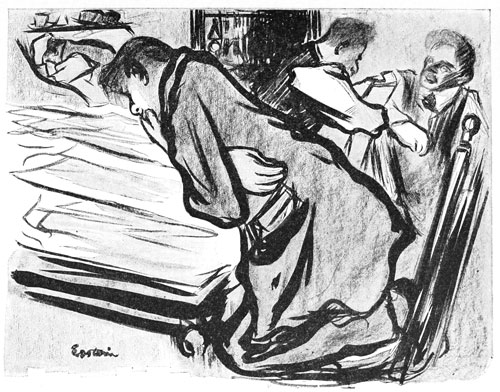
IN THE OFFICE OF THE "VÖRWARTS"
The man whose name is most intimately connected with the Arbeiterzeitung is its former editor, Abraham Cahan, now known outside of the Ghetto as a writer in English of novels and short stories of Jewish life. He is of the best type of the ethical agitator; a convincing and impassioned speaker; he has held hundreds of workingmen by his clear and strongly expressed ideas, whether written in his paper or spoken at nightly meetings in some poor hall on the east side, where the men gathered after the labors of the day. Twice he went abroad to speak at international labor conferences. At the same time that he supported the definite cause of the Social Democracy, he put the same energy and passion into the education of the people in scientific and literary directions. He spoke and wrote for directness, simplicity, and humanity. In art, therefore, the realistic school of Russian writers, of whom in our generation there have been so many great men, received his fighting allegiance. For five years Cahan put all his intelligence and devotion into this work, and the power of the Arbeiterzeitung was partly his power. To-day, in the Ghetto, where fierce jealousies are rampant, Cahan is admitted to be the man, among many men of energy, intelligence, and devotion, who has wielded most influence in the community.
A literary and dramatic event happened in 1892 which showed the power of Cahan and his Socialist associates in influencing the taste of the Ghetto. It was the production of Gordin's drama Siberia. Up to that time, nothing but conventional opera, melodrama, and historical plays had been given on the Bowery, but the day after the performance of Siberia the Arbeiterzeitung contained a long review of the play by Cahan, welcoming it enthusiastically as an event breaking the way for realistic art in the colony. Since then this type of play has taken a prominent place in the repertory at the Yiddish theatres. For five years the Arbeiterzeitung continued its influence, but then came a split among the Socialists, which resulted in two daily papers—the Abendblatt and the Vorwärts.
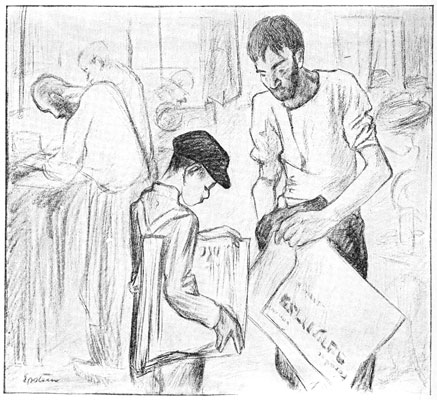
BUYING A NEWSPAPER
Cahan, Miller and others of the men who had started the Arbeiterzeitung gradually lost control through the share system which had been inaugurated. They desired to maintain a liberal policy towards all labor movements, and to allow the literary and Socialistic societies to be represented in the paper, but the other faction wanted the newspaper to be exclusively an organ of Socialism in its narrow sense. The result was that, soon after the publication of the Arbeiterzeitung as the Daily Abendblatt, Cahan resigned the editorship and turned disgusted to English newspapers and to realistic fiction, in which he was absorbed until recently. A few months ago he resumed the editorship of the Vorwärts after an absence of several years from participation in Yiddish journalism. Louis Miller, a witty and energetic Socialist and writer, who had from the first been active in the management of the weekly, was one of the most prominent of the men who continued the fight against the narrower Socialistic element—a fight which resulted in the establishment in 1897 of the other Socialist daily now existing, the Vorwärts.
These two papers were, until recently, when the Abendblatt died, bitter rivals. The Abendblatt was devoted to the interests of the Socialist Labor Party while the Vorwärts supports in a general way the Social Democracy; altho it is not so distinctively a party paper as was the Abendblatt. The adherents of the latter paper looked upon the Vorwärts as unreliable and the Vorwärts people thought the Abendblatt intolerant. The Abendblatt prided itself on its uncompromising character, and the Vorwärts is content to adapt itself to what it deems the present needs of the Jewish community. Thus the Vorwärts is willing to join hands with reform movements in general, with trades unions, etc., while the Abendblatt stiffly demanded that allied organizations should enter the socialist camp. The triumph of the Vorwärts was therefore a triumph of the more liberal spirits.
Two other daily publications are more distinctively mere newspapers than the two Socialistic organs, and make no consistent attempt to influence public opinion, at least in the definite direction of a "movement." The Abend-Post seems to have no very distinctive policy or character; it is neither Socialistic nor conservative Jewish; the distinction it aims at is to be a newspaper simply, to reflect events and not to determine opinion. In the editor's words, the Abend-Post "is not chauvinistic, like the Tageblatt; the Jew does not resound in it. It aims to Americanize the Ghetto, and diminish or ignore the chasm between Jew and Gentile." The editor of one of the Socialist papers calls this sort of thing by another name. "The Abend-Post," he said, "is an imitation of American yellow journalism." A fifth daily, the Herald, is even less distinctive than the Abend-Post. It has no party and is not as sensational as the other. It might, perhaps, be called the Jewish "mugwump."
Recently a sixth daily, The Jewish World, has been organized under favorable auspices. Its avowed policy is to bridge the chasm which exists between sons and fathers in the Ghetto; to make the sons more Hebraic and the fathers more American; the sons more conservative and the fathers more progressive. Connected with its management is H. Masliansky, one of the most impassioned orators of the Ghetto.
The question of the circulation figures of these five dailies is a difficult one. About the only thing that seems certain is that the Tageblatt leads in this respect. Even the editors of the other papers admit that, altho they differ as to the absolute figures. The editor of the Tageblatt places his paper's circulation at 40,000, the Abend-Post at 14,000, the Herald next, and the two Socialistic papers last, which ending is a felicitous consummation for the editor of the most conservative newspaper in the Ghetto. The editor of the Abend-Post says the Tageblatt leads with a daily issue of about 30,000, the Abend-Post coming next with 23,700, the Herald and the Socialist papers stringing out in the rear. The editors of the Socialist sheets naturally give a somewhat different order. Mr. Miller of the Vorwärts puts the actual circulation of the Tageblatt at about 17,000; his own paper, the Vorwärts, next, with about 14,000 daily except on Saturday, the Jewish Sunday, when the number ranges between 20,000 and 25,000, owing to the fact that the conservative newspapers (i. e., those that are not Socialistic) do not appear on that day. The circulation of the rival Socialistic paper, the Abendblatt, he puts at about 8,000. In these figures there is no attempt at entire accuracy.
THE ANARCHIST PAPERS
There are several Yiddish weekly and monthly journals published in New York. The Tageblatt, Abend-Post and Herald have weekly editions, but by far the most interesting of the papers which are not dailies are the two Anarchistic sheets, the Freie Arbeiter-stimme, a weekly, and the Freie Gesellschaft, a monthly.
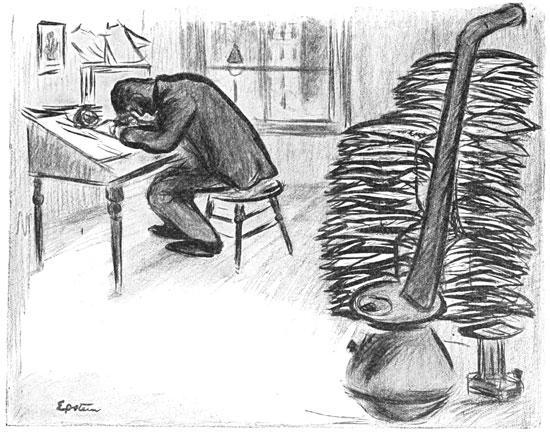
A "GHETTO" NEWSPAPER OFFICE
Contrary to the general impression of the character of these people, in which bombs play a large part, the Anarchists of the Ghetto are a gentle and idealistic body of men. The abnormal activity of the Russian Jews in this country is expressed by the Socialists rather than the Anarchists. The latter are largely theorists and aim rather at the education of the people by a journalistic exploitation of their general principles than by a warlike attitude towards specific events of the time. Their attitude is not so partisan as that of the Socialists. They quarrel less among themselves, and are characterized by dreamy eyes and an unpractical scheme of things. They believe in non-resistance and the power of abstract right, and are trying to work out a peaceful revolution, maintaining that the violence often accompanying the movement in Europe is due to the fact that many Anarchists are passionate individuals who in their indignation do not live up to their essentially gentle principles. The Socialists aim at a more strictly centralized government, even than any one existing, since they desire the whole machinery of production and distribution to be in the hands of the community; the Anarchists desire no government whatever, believing that law works against the native dignity of the individual, and trusting to man's natural goodness to maintain order under free conditions. A man's own conscience only can punish him sufficiently, they think. The Socialists go in vividly for politics, while the Anarchists have nothing to do with them. The point on which these two parties agree is the common hatred of private property.
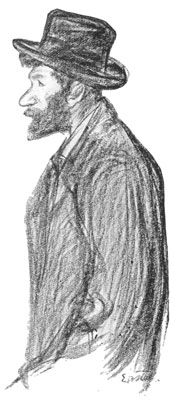
S. JANOWSKY
The weekly Anarchistic paper, the Freie Arbeiter-stimme, prints about 7,000 copies. Out of this circulation, with the assistance of balls, entertainments, and benefits at the theatres, the paper is able to exist. It pays a salary to only one man, the editor, S. Janowsky, who receives the sum of $13 a week. He is a little dark-haired man, with beautiful eyes, and soft, persuasive voice. He thinks that government is so corrupt that the Anarchists need do little to achieve their ends; that silent forces are at work which will bring about the great day of Anarchistic communism. In his newspaper he tries to educate the common people in the principles of anarchy. The aim is popular, and the more intelligent exploitation of the cause is left to the monthly. The Freigesellschaft, with the same principles as the Freie Arbeiter-stimme, has a higher literary and philosophical character. The editors and contributors are men of culture and education, and work without any pay. It is still gentler and more pacific in its character than the weekly, of whose comparatively contemporaneous and agitatory method it disapproves calmly; believing, as the editors of the monthly do, that a weekly paper cannot exist without giving the people something other than the ideally best. With reference to the ideally best, a number of serious, contemplative men gather in a basement opposite the Hebrew Institute, the headquarters of the monthly, and there talk about the subjects often discussed within its pages, such as Slavery and Freedom, Darwinism and Communism, Man and Government, the Purpose of Education, etc.,—any broad economic subject admitting of abstract treatment.
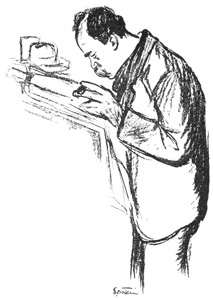
KATZ
The talk of these Anarchists is distinguished by a high idealism, and the unpractical and devoted attitude. One of the foremost among them (they say they have no leaders, as that would be against individual liberty) is Katz, literary editor of the Vorwärts, a contributor to the Anarchistic monthly, a former editor of the Anarchistic weekly, and a recently successful playwright in the Ghetto. His play, the Yiddish Don Quixote, was produced at the Thalia Theatre on the Bowery. Not since Gordin's Siberia has a play aroused such intelligent interest. The hero is a Quixotic Jew, full of kindness, devotion, and love for his race and for humankind.
SOME PICTURESQUE CONTRIBUTORS
There are many other picturesque and interesting men connected with these Yiddish journals, either as editors or contributors. Morris Rosenfeld, the sweat-shop poet, writes articles and occasionally poems for the Socialistic papers; Abraham Wald, the vigorous and stormy young poet, contributes literary and Socialistic articles three times a week to Vorwärts; the editor of one of the conservative papers, distinguished for his logic and his clever business management, is interesting because of the facility with which he adapts his principles to the commercial needs of the moment. At one time he was a Socialist, then became a Christian, then a Jew again simply, and now is a conservative Jew. Another editor remarked that he was a man of sense and logic. One of the Jews who writes for the Ghetto papers is A. Frumkin, who has the rare distinction of having been born and educated in Jerusalem. There he lived until he was eighteen, when he went to Constantinople and studied Turkish law; afterwards he journeyed to Paris, where he married, and then to New York, where he writes many articles in Yiddish about Jerusalem and Palestine, which are published largely in the Vorwärts. He is a young man of about thirty, with a fresh, rosy look and a buoyant manner. He is an Anarchist, and his energetic bearing is in strong contrast to the pale cast of thought that marks his fellows, the intellectuals among the Anarchists of New York. Other occasional or constant writers are the Hebrew poet Dolitzki, who is characterized in another chapter; and the poets Morris Winchevsky and Abraham Sharkansky.
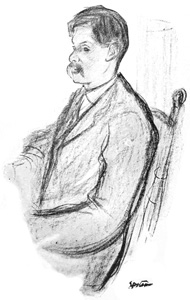
A. FRUMKIN
These two men are in a class quite different from that of the four poets to whom a separate paper has been devoted. They are, as opposed to Rosenfeld, Zunser, Dolitzki and Wald, interesting rather for form than for substance. They are men with some lyric gift and a talent for verse, but are strong neither in thought nor feeling. Winchevsky is a Socialist, a man who has edited more than one Yiddish publication with success, of uncommon learning and cultivation. In literary attempt he is more nearly like the ordinary American or English writer than the Jewish. Most of the Ghetto poets portray the dark and sordid aspect of their lives. Most of them do it with unhappy strength, certainly one of them, Rosenfeld, does it with genius. But Winchevsky attempts to give a bright picture of things. He tries to be entertaining, and heartfelt, sentimental and sweet. Truth is not so much what he attains as a little vein of sentimental verse which is sometimes touched with a true lyric quality.
Sharkansky can not be put in any intellectual category. He is a man of considerable poetic talent, but he seems to have little feeling and fewer ideas. There is no "movement" or tendency for which he cares. In character he is a business man, with a detached talent unrelated to the remainder of his personality.
Philip Kranz and A. Feigenbaum, editors and writers of political editorials, are two of the most prominent men connected with the history of Yiddish journalism. They are men of energy and force and represent a large class of Jews interested in social science and political economy. A. Tannenbaum occupies a peculiar and interesting position as a writer for the newspapers. He writes very long novels, the plots of which are drawn from books in French, German or Russian. About these plots he weaves incidents and characters from American history, and inserts popular ideas of science and philosophy. His aim is to educate the Ghetto by dishing up science and philosophy in a palatable form. D. Hermalin's distinctive character is that of a translator of foreign books into Yiddish. Swift, Tolstoi, de Maupassant, have been in part translated by him into the Ghetto's dialect. He, like some of the other men best known for more unpretentious work, is an author of very poor plays. David Pinsky, a writer for the Abendblatt, is very interesting not only as a writer of short sketches of literary value, in which capacity he is mentioned in another chapter, but also as a dramatic critic and as one of the more wide-awake and distinctively modern of the young men of Yiddish New York. He is so keen with the times that he looks even on realism with distrust. Even the great philosopher, the second Spinoza, a man highly respected in a professional way by eminent scientists of the day, Silverstein, is an occasional contributor to these interesting newspapers.