GEORGE M. VICKERS.
Reading edition
With Annotations, Hints upon Gesture and Dramatic Poses, by
FRANCES E. PEIRCE,
PRINCIPAL OF MT. VERNON INSTITUTE OF ELOCUTION AND LANGUAGES, PHILADELPHIA.
S. I. BELL & CO.
PHILADELPHIA AND CHICAGO.
Copyright, 1892, by S. I. Bell.
INTRODUCTION.
In preparing this work for the public it has been our aim to choose the very best, and every selection has been made with a special view to elocutionary merits. The “Speakers’ Ideal” is composed of carefully selected pieces from the writings of well known authors, and as a source of supply to the giver of dramatic entertainments, from which they may obtain at once a suitable subject for declamation, recital, dialogue and drama, this volume is without a peer.
The work contains many new pieces not found in any other book, and we have been able to secure a number of selections in the original manuscript, which are here published for the first time. Most of the recitations are accompanied by Annotations for Gesture, by which the amateur, as well as the elocutionist, may be guided in the necessary action, and by a method so extremely simple that the novice who has never had the privilege of instructions in the art of elocution will be enabled to give that indispensable accompaniment, without which, there can be neither natural, oratorical, nor dramatical delivery. This important feature has been carefully prepared by one who stands at the head of the profession as an instructor of elocution, and is found in no other “Speaker.”
Another of the chief characteristics of this work is the large number of full-page and exquisitely engraved half-toned plates, which have been taken from life and produced at large expense expressly for this book. The “Speakers’ Ideal” contains every characteristic of a complete book of elocution, and is, strictly speaking, the only “Speaker” ever published.
The unprecedented success that has attended the sale of the first editions, is proof that our hope to supply a long-felt want has been fully realized, and it is with entire confidence in its merits that we present this work to the public.
THE PUBLISHERS.
NOTATION OF GESTURE.
As a tree without leaves, so is recitation without gesture; but the most beautiful pieces are sometimes marred and burlesqued by awkward or inappropriate action. Our object, therefore, in presenting our system of notation is not to teach gesture—for that can only be acquired from a teacher—but to guide the reciter in a general way.
Gestures are divided, 1st, into front, oblique, lateral and backward; and 2d, into descending, horizontal and ascending; for instance, if the hand is thrown to the front, it must take a position on a level with the shoulder, or above, or below, which three divisions constitute the positions last named. The same applies to the oblique, which lies anywhere between the front and the lateral; to the lateral, which, as its name indicates, lies to the side; and to the backward. These positions are designated by the following letters: D. F., descending front; D. O., descending oblique; D. L., descending lateral; D. B., descending backward; H. F., horizontal front; H. O., horizontal oblique; H. L., horizontal lateral; H. B., horizontal backward; A. F., ascending front; A. O., ascending oblique; A. L., ascending lateral; A. B., ascending backward. b placed before the above combinations indicates that both hands are used. When not mentioned to the contrary, the supine hand, palm upwards, is used. P. represents prone hand, or palm downward; V. vertical, or palm outward; Ind., index finger as in pointing. This must be carefully distinguished from P. Ind., which means Prone Index or the back of the hand upward, and finger pointing. Cl., expresses clinched hand or fist. Par. expresses both arms parallel towards right or left. If a gesture is illustrative and cannot be expressed by any of the above letters, it will be called special and designated by Sp. All gestures of a bold, descriptive, or emphatic character should be made from the shoulder, whilst unimportant or conversational gestures proceed from the elbow. Good taste dictates that a few gestures, properly made, are preferable to a large number crudely constructed.
Let your gestures be so modulated, and so accord with the sentiment, that they may seem a part of a perfect whole.
FRANCES L. PEIRCE.
The Gallant Fifty-First.
Then came the memorable order from Burnside, which must have thrilled every member of the regiment: “Tell Sturgis to send the Fifty-first Pennsylvania to take the bridge.”
Along the valley’s narrow gorge The morning mist outspread, While rifle-pit and breast-work strong Frowned grimly overhead. The sluggish stream that only served To slake the thirst of kine, Was soon to see a drearier sight With men drawn up in line. Along the crest a flash of fire Breaks red against the sky, Along the hillside’s narrow slope Comes back the quick reply. Ferraro dashes up in haste, His countenance aflame, “The Fifty-first must storm the bridge,” ’Twas thus the order came. “Fix bayonets!” over Hartranft’s face A strange smile sent its beam; The red blood flushed, his dusky cheek— His dark eyes all agleam. Sturgis and Cook in vain essayed, And others yet may try, But now the gallant Fifty-first Must storm the bridge or die. Bright flashed the sword their leader drew— “Charge!” Like a simoon’s blast, The Fifty-first, mid shot and shell, Dashed on—the bridge is passed; The beaten foe in wild retreat Is flying o’er the bridge, Huzza! huzza! The Fifty-first Has stormed Antietam’s bridge! Oh, men of Pennsylvania, Along your bloody route Lies many a comrade, dull of ear, Who may not have heard you shout; But o’er your country’s wide domain A pæan grand shall burst; A nation’s accolade be thine— O gallant Fifty-first!
The Dead Letter.
There, now! I’ve read your letter through Three times; I’ll read it once again If you say so; it rests with you.[2] What? loan you paper, ink and pen? Why, man you’re weaker than a child. To-morrow I will gladly write Whate’er you wish. Be reconciled,[3] Compose yourself and rest to-night. You think we nuns are good to tend The sick, to count our beads, and pray, But that we do not comprehend How worldly people dread delay In getting word from those they love: Why, sir, you know not what you say— Ah! this dark robe too well doth prove The sorrow of that by-gone[4] day— No, no; I fully understand What you would say. There’s no offence; Naught to forgive. There take[5] my hand. We now are friends. In confidence The story of a broken life, Before the doctor comes, I’ll tell: Of how I shunned[6] the cold world’s strife And sought a quiet convent cell. Far back[7] in life I loved a man, A gen’rous, noble heart and true: And he loved me as only can, As only gallant natures do. Our days passed by so quietly, Love’s dream so rosy-hued had grown That seasons glided by[8] ere we Would note that e’en a month had flown. Thus ran my girlhood and his youth, Till came the naming of the happy day— Our wedding day—that would in truth Have made us man and wife for aye, When, like a blow from one we love, There came an unexpected woe; In vain ’gainst[9] fate we madly strove; Each cherished hope lay scattered[10] low. A crime had been committed in The village where lived he and I; And ’mid the first wild, senseless din That marked the people’s hue and cry, Suspicion on him[11] fell, and so, To ’scape the frenzied, ‘vengeful mob, He, innocent, resolved to go Away[12]—and I to stay and sob. Then, bending low, said he, “This thing Will only for a season last, A moment full relief may bring; At most our grief will soon be past; But, darling, should it not be so, Write” (he whispered a fictitious name), “And I will by your letter know That in your eyes I bear no shame.” The rain fell from a dark’ning sky,[13] The apple blossoms scattered[14] lay, The chill wind moaned, and night drew nigh, As with a sigh he turned away[15]— I watched[16] his form till lost in gloom, And, save the dripping of the rain,[17] There fell a stillness[18] of the tomb— A lull that seemed to daze my brain.[19] The morning after that sad night The guilty one was found; and I, With woman’s haste, sat down to write, And wrote in joyous ecstasy; The letter mailed, each moment seemed An age; but days and weeks passed by— With visions dread my fancy teemed— But came he not, nor made reply. One day, when hope had almost fled, The post-man thrust it in my hand: “This is from Washington,”[20] he said, “Dead-letter office, understand?” With throbbing heart I broke the seal, My face grew whiter than a sheet, The dreadful blunder made me reel And drop[21] the letter at my feet. Instead of the fictitious name He gave, it bore his own, Which knowing not, he could not claim— To him my lines were never known— In loneliness he died: and here I nurse the sick; but I have done— And, sir[22] no longer have a fear To trust me, though I’m but a nun. You’ve heard a portion of my tale Before? From whom? Oh, tell[23] me quick! From my lost love? You both set sail In the same ship? My heart[24] grows sick— What? Still alive?[25] Oh, God be praised! Oh, joy![26] Oh, joy! And I will write? Now that my dead to life is raised— Will I? Yes, now—this very night. —Geo. M. Vickers.
Gestures.
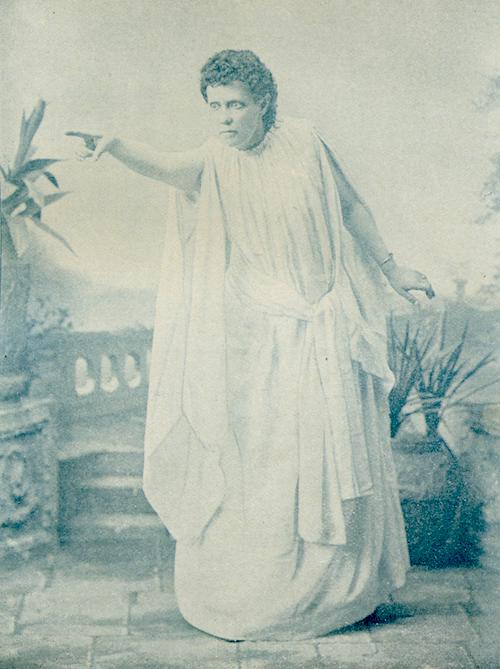
“Nathan said unto David, ‘Thou art the man.’”
PA.
I’ve got one of the best Pa’s in this world. Pa is very fond of me, too; in fact, no one ever comes to our house when Pa’s home that he don’t commence to praise me before he even asks the guest to be seated. Pa’s not rich, so we often have to make both ends meet by resorting to novel expedients; and even then, the ends don’t stay together worth speaking of. Pa’s memory is none of the best; poor, dear man, I’ve known him to eat two soft-boiled eggs while trying to determine whether or not he had seasoned them. The other day Pa brought young Judson, the lawyer, home to dinner; we had codfish and potatoes with warmed-up coffee from breakfast. Ma almost fainted. Judson said he doted on cod-fish—but then he is a lawyer—Ma trod on my foot—said she in a whisper, “Tell your father not to ask him to have more coffee.” Pa caught the word coffee. “Why, yes,” yelled out Pa, “Judson, my boy, pass over your cup!” I never felt so mortified in my life; there wasn’t a single drop in the pot!
“You must pardon us,” stammered Ma. “Never mind excuses,” interrupted Pa, “Pour out the nectar, Matilda—why—why—”
“Yes, why,”—mother’s face was scarlet—“it is why—why have you not had the hole in the bottom of this pot mended? the coffee’s all leaked out.” Poor ma! how I pitied her.
Last night the Higgins girls called to know if we liked the style of their new silk dresses—such stuck-up mortals I never saw—their father used to mend Pa’s boots—owes his fortune to a judicious use of chalk and an old pump—and styles himself a retired milk dealer. Pa happened to be in the parlor when the Higgins girls floated in. “Hannah,” said Pa, “go upstairs and get the silk dress you’ve just finished.” “Why Pa, how you do talk,” said I, my heart almost ceasing to beat. “Don’t be so modest, Hannah,” he continued, “show the young ladies how handy you are.” “Oh, Pa!” I cried, trying to get his mind off the dress, “did you ever see such beautiful bonnets?” The fates were against me. “Ladies,” said Pa, “that girl is worth her weight in gold; she’s just finished trimming over a last season’s hat, and has just made the handsomest dress out of her Ma’s old silk frock that ever a human eye rested on!” The Higgins girls giggled, and I—I could have sunk through the floor.
One day Pa said he would take us to a matinee. It was on a Monday, but Ma said she’d put off the washing, although the washerwoman declared she’d never put up with such tomfoolery again. Pa came home later than usual, and almost hurried us to death. At last we arrived at the theatre, streaming with perspiration. A grand opera was to be given, and the entrance was crowded. Pa began searching for his tickets. He first dove into one pocket, then into another; meantime we were elbowed and jostled by the throng. “Strange,” groaned Pa, “I put them in my vest pocket.” Just at that moment Judson and his two sisters alighted from a hack. Pa turned white as chalk, then red as a canned lobster. “Come, quick,” he gasped, “this way.” We followed him to the corner. “What’s the matter, dearie?” asked Ma. “Why,” groaned Pa, “Judson’s got my tickets. I gave them to him last night, but forgot all about it until he just now jumped out
—Geo. M. Vickers.
Dying to Win.
Fierce blows the gale and cold, Loudly the windows[27] rattle; Why, the stars seemed never half so bright. Hark![28] ’Twas a bell that tolled— There, again! must I battle Through another dreadful winter night? Better by far to die. Who[29] in this mighty city Wastes a thought on such a wretched life? Who heeds my weary sigh? Who sheds a tear in pity? All alone I wage[30] the bitter strife. Bright gleams yon chandelier,[31] Gay sound the reckless voices; And how tempting warm the red grate glows! No![32] rather perish here— Ah, no—my soul rejoices,[33] For I triumph spite of all my woes. Now, that I’ve made my vow, Who[34] comes to help me keep it? Are the saints that preach asleep or dead? Ripe is the harvest now, Yet comes there none to reap it. Not a cent![35] no home; no crust of bread. Fie,[36] upon hearts so cold! Not one will deign to aid me; And my own sex turn[37] me off with scorn; Sneer at me; call me bold; Taunt me, and then upbraid me— O, my God,[38] how can I wait till morn? Mother, is that you[39] there? Surely,[40] I must be dreaming— Do not leave me, mother;[41] take me home! Oh, how keen[42] bites the air! Yonder[43] the dawn is gleaming. It is I, your child: Oh, mother,[44] come! Sleepy, indeed, am I— Wait till I kneel[45] down, mother— Now[46] I lay me down to sleep—keep off—[47] Help! help! help! I shall die— Give me some air—I smother! I am saved![48] Now let the cold world scoff. * * * * * Fierce blows the gale and cold, Loudly the windows[49] rattle, And the stars are paling[50] out with fright: Oh, ’tis a tale oft told: Done is the hard-fought battle— And a weary soul has said good-night. —Geo. M. Vickers.
Gestures.
LITTLE BROWN EYES.
Many years ago there lived in a tiny cottage, a widow and her two children, Frank and Edith. The cottage stood by the roadside, not far from a village, and was almost hidden from view by the pretty roses and vines that clung to its sides.
One warm summer afternoon, when Frank was away to the village with his donkey and cart, and the widow was busy sewing in the back part of the cottage, little Edith, who had been weaving a wreath of flowers, lay fast asleep on the front porch, shaded from the rays of the sun by the arbor that covered the door. She lay there with her long golden hair partly hiding her pretty face, with the unfinished wreath still held in her hands, and her little straw hat filled with buds and sprays, upset at her side.
Now, the road that passed the cottage was much used by travelers, as it led in both directions to large cities; but on this particular afternoon not a human being, nor an animal, nor a vehicle of any sort could be seen on its white, gleaming surface; and save the drone of a passing bee, or an occasional chirp from a cricket under the porch, not a sound broke the deep stillness. Even the birds seemed to be dozing, so nap-inspiring was that sultry summer afternoon.
An hour later and Edith was still sleeping, when the distant rumble of wheels could be heard. They were yet a long way down the road, although from their peculiar rattle it was evident they belonged to a light wagon—perhaps some farmer returning from market. Presently a cloud of white dust rose above the trees and indicated the point reached by the wagon, but the latter could not yet be seen from the cottage on account of the intervening foliage that skirted the roadside. A few moments later an odd-looking, top-heavy vehicle,
When the wagon arrived in front of the house it stopped, and the man on the mule advanced to the garden fence, dismounted, and threw his reins over the gate post. He then opened the gate, and was about to pass to the rear of the cottage when he spied little Edith. The slanting sunbeams had crept so close to her face that it was only a question of a few moments when the bright glare would end her sleep.
The man paused and glanced cautiously about him; then, taking another look at Edith, he stealthily moved on until he reached the back part of the house. The widow sat in a large arm-chair near the kitchen door, which was open. In her lap lay an old garment that she had been mending; the cool breeze that came through the door from the front of the house blew the pendant honey-suckle against her cheek, but she heeded it not, for she, too, like little Edith, had succumbed to the influence of the sleepy afternoon.
The dark-visaged man no sooner took in the situation than he quickly, but quietly, returned to the wagon and said some strange words to a big, stupid-looking fellow who was perched on the front seat of the odd-shaped vehicle, and from whose hands dangled the lines of the lank horses. The fellow stood up, and shading his eyes with his huge, brawny hand, peered toward the house: then fastening his lines to a hook in the wagon bow, he jumped lightly to the ground and followed his companion to where little Edith lay sleeping.
In the back portion of the wagon sat two persons; one was an old woman with a swarthy, wrinkled face, and the other was a beautiful little girl about ten years of age. Her hair was not black as was that of the old woman, it was of a rich chestnut hue, and her complexion, although darkened by the sun, was extremely fair; but her eyes! oh, they were the rarest of
Mean while the men had reached the porch. Their movements were noiseless and cat-like. The dark-visaged man drew a handkerchief from his breast pocket, and the stupid looking fellow held a stout cord in his right hand. In an instant they gagged and bound little Edith and rapidly bore her to the rear of the wagon, when, opening the leather door, they handed her struggling form to the old crone, who stood ready to receive her. Quickly shutting the wagon door, the stupid-looking fellow mounted his seat, the dark-visaged man leaped upon the back of his mule, and in a twinkling the gypsies had disappeared behind a bend in the road.
As soon as the little girl with brown eyes saw the men bring Edith to the wagon she trembled and began to weep. The old crone shook her finger at her and bade her to have a care what she did. Then turning to Edith she said, “I will remove the gag from your mouth if you promise not to make any noise.” Edith, who was almost frightened to death, nodded her head whereupon the old crone untied the handkerchief not from kindness, but fear that the child would suffocate. Poor Edith sobbed as though her heart would break, and more than once looked appealingly at the brown-eyed girl. The latter, whenever the crone turned her head, glanced at Edith and tried in every possible way to mutely assure her of her sympathy and friendship.
The gypsies drove very fast for several miles, when they suddenly left the main road and turned into a narrow lane that led through a dense forest. The horses were then allowed to
The lank horses neighed as they entered the clearing, and in a moment the wagon was surrounded by a swarm of tawny-skinned people, men, women and children. Without speaking a word to any one, save the crone, the dark-visaged man led Edith and the brown-eyed little girl to a tent which they entered. “Now,” said he, for the first time speaking to Edith, “if you are a good girl, you will be treated well, but if you are a cross and troublesome, look out! And you, Little Brown Eyes,” he: continued, “see that your mate eats her supper when it comes. That’s all.” He then left them.
Edith advanced to the little girl and was about to speak, when the latter raised her finger, shook her head, and pointed to the door. Edith looked in the direction indicated, and saw the old crone seated without, just in the act of lighting her pipe. “You can talk, but speak low; old Myra will try to hear what we say,” and the little brown-eyed girl kissed Edith on the forehead.
“Oh, I am so dreadfully frightened,” whispered Edith, “will they never take me home again?” “I cannot tell,” replied the child. “I, too, was taken from my home, a long, long time ago; but Myra and Ike—that was Ike who came with us to the tent—say they will take me home some day. My name is Mary, yet they call me Little Brown Eyes; maybe they’ll call you Little Blue Eyes.”
This conversation was cut short by the entrance of a gypsy boy, who brought two tin plates of chicken stew, some bread and a big bowl of milk. He said nothing, merely placing their supper on the ground, when he walked out again without so
She little girls, in spite of their low spirits, could not resist the savory smell of the stew, for they were very hungry, and in a short time nothing remained of what the gypsy boy brought them except the empty bowls and the two tin plates. All at once there was a great noise in the camp. The tramping of horses’ feet could be heard, and the voices of men shouting; what could it mean? The little girls looked at one another in utter wonderment. “Let us peep out,” said Little Brown Eyes, and raising one corner of the canvas they looked out. Everything was in confusion. A body of horsemen were pulling down the tents, some of the gypsies were fleeing to the woods, while others were opposing the horsemen with all their might. Just then the dark-visaged man and Myra entered the tent. “Come, quick,” yelled the man, “this way,” and taking hold of each little girl, he pulled them to the door. Edith uttered a scream. Immediately the horsemen galloped toward them. “My papa! my papa!” cried Little Brown Eyes. A fine looking gentleman leaped from his horse, and in a moment his daughter was clasped in his arms. “Take these people prisoners,” said he, “they shall pay dearly for kidnapping my daughter. Who is this?” he continued, looking at Edith. “This, papa, is a little girl Ike stole to-day, as she lay asleep on her front porch.” “Poor child, we must return her to her parents,” spoke Little Brown Eyes’ papa; “come, we will go away from here at once.” So the little girls were led away to the lane where stood waiting a splendid carriage. “Oh, see! there comes brother Frank in his donkey-cart,” and clapping her hands with joy, Edith pointed down the lane, where, sure enough, her brother came jogging along as complacently as if nothing had happened.
The rest of the horsemen rode up to the carriage, and were about to start, when one of their number said, “Look! we have fixed the gypsies.” All looked toward the camp. It was in a blaze; both tents and wagons were being devoured by the red-tongued flames. “Why, Edith,” shouted Frank, who had just reached the carriage, “what on earth are you doing here?” The heat from the burning camp became so intense that Edith’s face was almost scorched, “Edith,” shouted Frank, louder than before. Edith looked at her brother, rubbed her eyes, and then looked again. “Where are the gypsies?” she asked—“Ha! ha! ha!” laughed Frank, “you have been dreaming; you are almost baked by the sun.”
—Geo. M. Vickers.
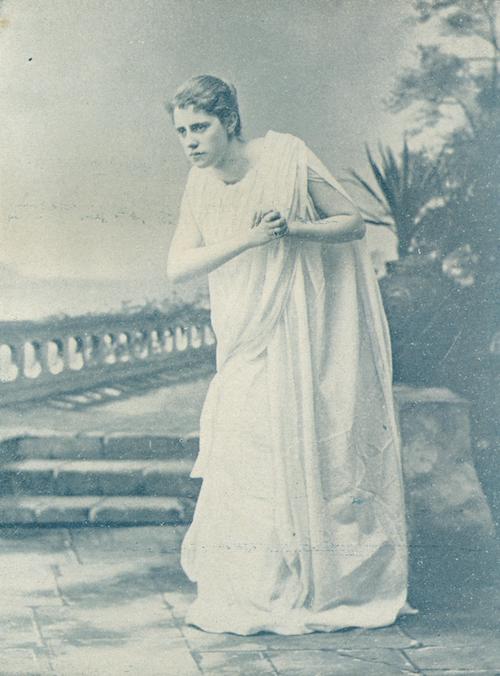
“When, lo! from out the lake arose a horrid monster form.”
The Last Salute.
Yes, the ranks are growing smaller With the coming of each May, And the beards and locks once raven Now are mingled thick with gray; Soon the hands that strew the flowers Will be folded still and cold, And our story of devotion Will forever have been told. Years and years have passed by, comrades, Though it seems but yesterday Since the Blue-garbed Northern legions Marched to meet the Southern Gray— But a day since Massachusetts Bade her soldier boys good-bye— But a day since Alabama Heard her brave sons’ farewell cry. Those are days we all remember, In our hearts we hold them yet; And the kiss we got at parting, Who can ever that forget? And it may have been a mother, A fond father, or a wife, Or a maid whose love was dearer To the soldier’s heart than life. Then the silent midnight marches, And the fierce-fought battle’s roar, And the sailor’s lonely watches, Gone, please God, forevermore: Though these ne’er can be forgotten While the dew our graves shall wet, Yet the color of our jackets Let each gallant heart forget; For the ranks are growing smaller, And though decked in blue or gray, Soon both armies will be sleeping In their shelter-tents of clay. But the loud reverberation Of the last salute shall be Oft re-echoed through the ages As the tocsin of the free! For we both but did our duty, In the Great Jehovah’s plan, And the world has learned a lesson That all men may read who can; And when gathered for the muster On the last and dreadful day, May that God extend His mercy Sweet, alike to Blue and Gray. —Geo. M. Vickers.
Studying For The Contest.
Oh dear! If ever I try to learn another piece I hope to be swallowed by a whale ten times the size of the one that lunched on Jonah. Here I’ve been three weeks trying to get “The Flight of the Hottentots” by heart, and to-morrow night I am to recite at the contest; but I’m bound that that squint-eyed Caddy Screech shall not out-do me this time. Well, here it goes again: [Reads from the book without gesture.]
The swarthy forms steal one by one Like shadows past the guard; Now soft they creep, now leap, now run, From tyrants base and hard; But hark! what sound is that which comes Across the sandy plain? The sentry’s cry, the roll of drums! Alas! their flight is vain. Behold! a thousand torches flash Like meteors into view! While swift the Pagans onward dash The bold dragoons pursue! See! now the captives reach a stream, A rushing torrent wild; They cannot pass—[Throws book on floor.]
Oh, grief! now for the gestures: [With hesitation as though forgetting lines.]
The swarthy forms steal[51] one by one Like shadows past the guard—
Confound[52] the gestures! they bother me worse than anything else. Why didn’t the fool that wrote the piece say [53] a hill, down[54] a hill, or across[55] the road? Well, I’ll try the next two lines.
They must have been acrobats to get over the ground in that shape; I’m desperate, I am!
But hark![59] what sound is that which comes Across the sandy plain?
No; I mustn’t put my finger up like that.[60] Why should a person when alone be required to do it? Am I to warn myself to listen when I have ears? or if at all necessary, why not do it effectually and hold up both fingers, thus?[61] I’ll skip that part.
The sentry’s cry, the roll of drums, Alas! their flight is vain[62]—
Now this is a puzzler.
The sentry’s cry—
Was it a whoop, a yell, a shriek, a halloo—but fiddle! Who ever heard a sentry cry? Why soldiers are brave men, and never weep. That is unquestionably a poetical li-cence.
—the roll of drums.
What on earth were the drums rolled for? It looks to me as though the Hottentots were drummed out of camp.
Alas! their flight is vain—
I don’t believe there was a flight of the Hottentots. What authority[63] is there for the flight? What made them fly anyhow? Well, I must move on:
Behold![64] a thousand torches flash Like meteors into view! While swift the Pagans onward[65] dash The bold dragoons[66] pursue!
That’s better. The Principal could not beat that, particularly the Behold, and the s-w-i-f-t. Next comes the climax—a long respiration, and—and—
Now I object to this vague style of literature. The poet is silent as to how they reached it. With their hands, thus![69] or with their feet, thus![70] or on horseback, with a whoa![71] whoa! Dobbin? How am I to gesticulate correctly, not knowing the facts? I’ll do the poem to suit myself, and if I fail to win the prize, it will be through the stupidity of the judges, so there!
Geo. M. Vickers.
Gestures.
Crazy Nell.
“Come, Rosy, come!” I heard the voice and, looked Out on the road that passed my window wide, And saw a woman and a fair-haired child That knelt and picked the daisies at the side. The child ran quickly with its gathered prize, And, laughing, held it high above its head; A light glowed bright within the woman’s eyes, And in that light a mother’s love I read. She took the little hand, and both passed on; The prattle of the child I still could hear, Mixed with the woman’s fond, caressing tone, That came in loving words upon my ear. “Come, Rosy, come!” Years, many years had gone, But yet had left the recollection of that scene— The woman and the fair-haired child that knelt And picked the daisies on the roadside green. I looked. The old familiar road was there— A woman, wan and stooping, stood there too; And beckoned slowly, and with vacant stare That fixed itself back where the daisies grew. “Come, Rosy, come!” I saw no fair-haired child Run from the daisies with its gathered prize; “Come, Rosy, come!” I heard no merry laugh To light the love-glow in the mother’s eyes. “Come, Rosy, come!” She turned, and down the road The plaintive voice grew fainter on my ear; Caressing tones—not mixed with prattle now, But full of loving words—I still could hear. I, wondering, asked a gossip at my door; He told the story—all there was to tell: A little mound the village churchyard bore; And this, he said, is only Crazy Nell. —Joseph Whitton.
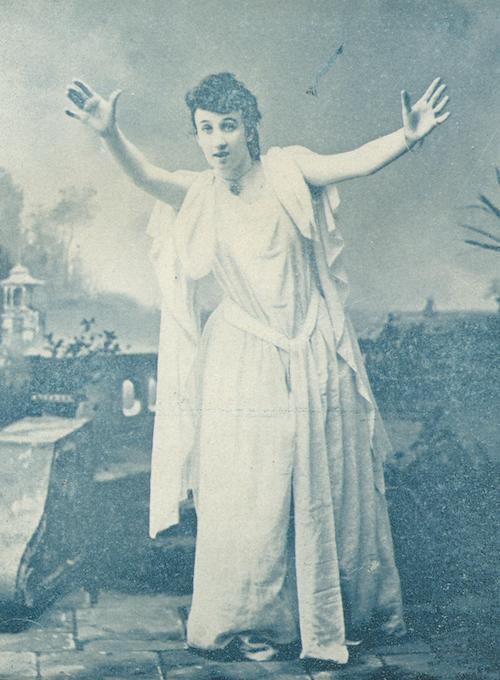
“Fly, fly, beloved mistress, the devils of the mountains are upon us!”
Sir Rupert’s Wife.
You see where the cliffs frown yonder in a line of dingy red?— That wild, fierce crag, the highest, is known as Sir Rupert’s Head: It’s five hundred feet and over from the brow to the sea below, And it won its name in the winter, a hundred years ago. There wasn’t a squire in Devon so famous as Rupert Leigh; He was lord of the broad, rich acres, good-looking and fancy free. He came of a race of giants, stood six feet two in his socks, And once, for a drunken wager, with his fist he had felled an ox. Dare-devil Leigh was his nick-name; he was last of a lawless line Who had gone to the deuce full gallop, through women and cards and wine. He wasn’t so bad as they were—he was more of a hunting squire, And he freed the name a little from some of the ancient mire. His wasn’t an easy country, but he’d take it every inch, And ride as straight as an arrow where the boldest well might flinch. When a lad he had climbed yon headland, climbed it from base to crest, For a short-frocked hussy who wanted the eggs from a seagull’s nest. One winter he went to London—he then was about forty-three; His steward had told the parson he’d lawyers in town to see. ’Twas dull in the place without him, for his mansion was Liberty Hall; There was always a warm, wet welcome for neighbors who chose to call. He was gone for a twelvemonth nearly, writing to no old friends, But a Devonshire man in London news to the parson sends. Sir Rupert had married a madam, a play-acting, mincing wench, Who painted and patched and powdered, and was finiking, fine and French. She was no more French than I am, but this was about the time, That French was the title given to nigh every kind of crime. She sang in a minor play-house—in opera, so they say— And he saw her as Polly Peachum in that famous work by Gay. He was always an easy target for a wench’s rolling eye, So it got to bouquets and presents, and to letters by-and-by, He was wax in the hussy’s fingers, and she moulded with practiced skill, Till he took the form of a husband, the slave of her slightest will. They traveled about a little, saw Paris, the Hague and Rome— Then the news went abroad Sir Rupert was bringing his lady home. The people about here liked him, and no warmth did their welcome lack, But they looked askance at my lady, and she gave them their glances back. They hated her then directly, they chafed at her cold disdain, And they gossiped her story over in language a bit too plain. They called her a “stuck-up stroller,” and somehow the scandal grew, Till my lady as “Polly Peachum” the whole of the country knew. Sir Rupert was broken-hearted when he heard of the mocking tone, And he quarreled with all his comrades until he was left alone— Alone at the Hall with “Polly,” for the gentry had cut her dead, But his heart was as true as ever to the woman he had stooped to wed. To him she was just an angel who had come from the holy skies That his heart might bask forever in the light of her lustrous eyes. No wine, no cards, and no hunting: he kept at my lady’s side— ’Twas a great big boy with a sweetheart, not a man with a year-won bride. She pined in the lonely mansion: she wanted society-life— She wanted to play my lady as well as Sir Rupert’s wife. Sir Rupert must ask a party—not of bumpkins, but folks from the town; He had plenty of friends in London; would he not ask them down? They came, and the sound of laughter rang through the Hall once more, And my lady was proud and happy, but her husband’s heart was sore; He had learned from an idle whisper—a whisper not meant for him— A secret that sapped his life-blood and the strength of each stalwart limb. He reeled when he heard the whisper and guessed at the ghastly truth: ’Twas the tale of a play-woman and a curled and scented youth, A dandy of six-and-twenty, the son of an old, old chum— He was one of the guests invited, and one of the first to come. Sir Rupert had been in London a guest of his father’s, too, And this young fop, he remembered, had led him his wife to woo; He had raved of this Polly Peachum, and dragged him to hear her sing; He said at the time he knew her—’twas a planned and plotted thing! And now she was always with him, they chatted and laughed away; She was cold and dull with Sir Rupert,—with him she was kind and gay. She was weary of playing my lady, and of being Sir Rupert’s wife— She pined for the tinsel glories of the old Bohemian life. She hated the dull decorum, she hated the legal tie— Her cage was a cage, though gilded. Then the tempter whispered “Fly!” One night their chairs were empty, and slowly the news leaked out: Two horses were gone from the stable—’twas a settled thing, no doubt. Sir Rupert was white with horror, but he turned to the gaping crew And cried, “It’s a lie, I tell you!—who dares to say its true?” Then seizing his holster pistols, he mounted his fleetest mare And made straight for the Red Cliff roadway—he guessed they had gone by there, For that was the way to London, from Exmouth the pair would post, And the road they were bound to travel was the road by the rugged coast. If you look you will see it passes right over the headland’s brow— Only a century distant it wasn’t as good as now. He dug his spurs in the hunter, and it flew up the fearful steep, ’Twas a wild, fierce night in winter, and the snow lay thick and deep; But the moon through the clouds had broken, and right on the Head he spied A horse that had slipped and fallen, and the rider by its side; And over them bent a figure, but whose he could scarcely see, Then he uttered a cry to Heaven that his wife unharmed might be; And lashing his steed to fury it flew through the slippery snow, While the wild waves roared a warning five hundred feet below. A slip, and both horse and rider would roll to a hideous fate, But Sir Rupert, with set white features, rode to the headland straight. They heard him now, and the woman rose from her knees and moaned, And the man gave a sudden shudder and opened his eyes and groaned. Sir Rupert reined up so fiercely that the mare on the precipice reared, And the woman sprang back with horror, in the jaws of the death she feared. For a moment she seemed to totter, and then with a piercing cry Went over that awful headland that seems to touch the sky. For a second no sound was uttered, only the billows roared, While up from its nest a sea-gull, startled and shrieking, soared; Then, shouting for help, Sir Rupert clutched at the snow-clad turf, And glanced with a look of horror down at the boiling surf. And as he lay there peering, right at the farthest edge, Something his eyes detected—a heap on a narrow ledge; It was thirty feet between them, but he knew ’twas his wretched wife, And he vowed, though his own paid forfeit, he would save her guilty life. He could see there were tiny juttings where his foot might find a hold, And the man he had quite forgotten was worth his weight in gold. The booby was bruised and shaken, and fancied that he should die, But Sir Rupert bade him help him, or he’d shoot him by-and-by Then the white-faced coward whimpered and lifted his jeweled hands, And Sir Rupert set him tearing his mantle in narrow bands. Then the strips were twined together and tied to a rough stone seat, And over went brave Sir Rupert, clinging with hands and feet. The waves in their winter fury shrieked for a human life, But down and down crept Rupert till he swung by his senseless wife, Stooping, he clasped her firmly, one hand on the doubtful rope, Pressed his lips on her marble forehead, and whispered her, “Darling—hope!” Then breathing a prayer to Heaven to save them both that night, He toiled with his heavy burden up the face of the frowning height. A fall of the soft red sandstone, a slip of his bleeding hand, And their bodies had lain together, crushed on the cruel strand. Safe! safe at last on the summit! safe on the firm hard road! There where the moonbeams glittered, he glanced at his senseless load. Her face was bruised and battered, and the warm blood welled and gushed; And he saw that his wife was injured, and her tender bones were crushed. No trace of the lady’s gallant; he’d limped to a horse and flown: Sir Rupert and “Polly Peachum” were there on the heights alone. He leaped on the gallant hunter; took his wife in his brawny arms, And galloped across the country to one of his tenants’ farms. For six long months my lady hovered ’twixt death and life— ’Twas a surgeon who came from London that saved Sir Rupert’s wife— And when she was out of danger it was known she was marked and maimed, A battered, misshapen cripple, distorted and scarred and lamed. But Sir Rupert clung closer to her; they traveled from place to place, And he never winced or shuddered at the sight of her injured face. It was he who carried the cripple, who nursed her with tenderest care: And never in knightly story such gallant had lady fair. For many a year she lingered—’twas up at the Hall she died, And here in the village churchyard they’re sleeping side by side. She died in his arms confessing the worth of his noble love, And in less than a year he sought her in the mansions of God above. There stands the great bluff headland—there swells the sea below— And the story I’ve told you happened nigh a hundred years ago, Yet there isn’t a soul that visits those towering crags of red But thinks of the love and daring that hallowed “Sir Rupert’s Head.” George R. Sims.
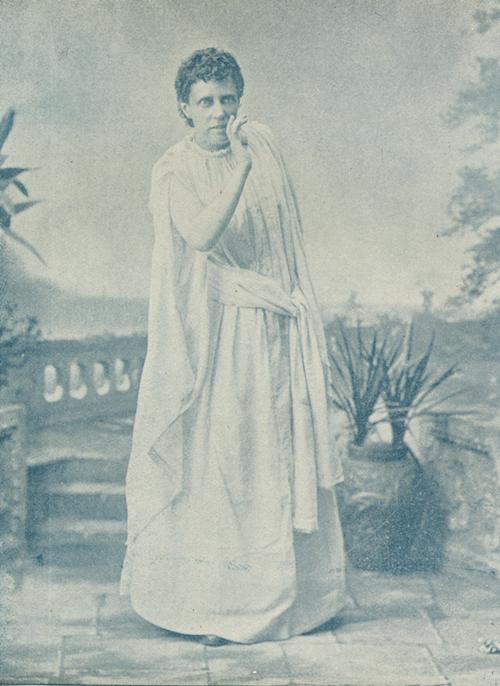
“And one sly maiden spake aside, ‘The little witch is evil-eyed.’”
Civilization.
As Discovered by Professor Peekwell, Samuel Searcher And Philip Deadlight.
Professor.—Civilization is the science of discontent.
Searcher.—How do you make that out?
Professor.—Gentlemen, allow me to explain. In the first place, all that man requires on this terrestrial ball can be expressed in three words, namely: food, shelter and raiment.
Searcher.—How about a wife?
Deadlight.—And segars?
Professor.—I use the term man as including the human race.
Searcher.—Well, go on.
Deadlight.—I’m ashamed of you, Professor; would you have us go back to savage life?
Professor.—Yes, but only in fancy, for the purpose of illustration. Let us drop down on a remote island in the Indian
Searcher.—Why didn’t the goose use soothing syrup?
Deadlight.—Or a cradle?
Professor.—Beneath a tall palm, circled about the embers of a dying fire, sit the tawny natives. They are listening to the words that fall from the lips of an aged chief. With rapture they hang upon the oft-told legend of the isle. In their hearts they wonder at the old man’s wisdom. As he dilates upon their by-gone deeds, and their present might, their eyes involuntarily wander toward the rich foliage that gently sways on yonder high hill top; now they glance at the bright stars that peep forth from the upper blue, and now at the dim ocean that stretches away on either hand like a desert waste. Contentment almost perfect sits on every brow. Each savage has his spear, his hut of twigs: thus the Great Creator hath set them to fulfill their mission; and yet the spear and hut are the initial steps in the march of civilization; only luxury lies beyond them; comparative luxury is the acme of civilization.
Searcher.—You’re a crank!
Deadlight.—No, he’s a philosopher. Think of the blessings of savage life! No creditors to ring your door bell, and make you leap out of your chair with consternation.
Searcher.—That is a point.
Deadlight.—Then there’s no fashion to ruin a man every time the seasons change. Look at that bonnet yonder! I’ll wager it cost thirty dollars.
Searcher.—And that dude’s coat, to say nothing of his monstrous collar.
Professor.—Hold on——
Deadlight.—And there’s no bank cashier to skip away with your limited balance.
Professor.—Hold on, I say. Civilization is good; it elevates mankind; but the higher our civilization the greater our wants; therefore civilization is the science of discontent.
Searcher.—Humph!
Deadlight.—Ahem!
Professor.—We will now adjourn.
Geo. M. Vickers.
Getting Ready.
Characters.
Nicholas Neverslip, a modern husband.
Patrick Dolan, an Irish lad.
Matilda, Neverslip’s wife.
Miss Spyall, a gossip.
Biddy Crogan, a domestic.
Scene:—A drawing room. Time, evening. Table and two chairs, C. Nicholas discovered standing near L. E. with cane and gloves in his hands: he calls to his wife, who is supposed to be up stairs dressing for the opera.
Nicholas.—My dear, it is half-past seven; do hurry; I am sure we will be late.
Matilda.—I am coming—be with you in one minute. Has Biddy fastened the back gate?
Nicholas (aside).—I know we’ll be late (calls), Biddy! (crosses to R. E.)
Biddy.—I’m here, sur. [Enter Biddy R. E.] What do you want wid me, sur?
Nicholas.—Biddy, is the back gate fastened?
Biddy.—I’ll see, sur, (turns to go).
Nicholas.—Biddy!
Biddy.—Sur!
Nicholas.—Biddy, I am going to the opera; that is, we are, Mrs. Neverslip and myself.
Matilda (calls).—Nicholas!
Nicholas.—Well, what’s the matter?
Matilda.—Where did you lay my fan?
Nicholas.—I never touched your fan. (looks at his watch.) It is twenty minutes to eight; I declare we will be late.
Biddy (aside).—I wonder if he manes to keep me shtandin’ here all night?
Nicholas (to Matilda).—I am going!
Matilda.—Here I come.
Nicholas.—It is time you were coming.
Matilda.—Oh, dear!
Nicholas.—What’s the matter?
Matilda.—Oh, you’ve hurried me so that I’ve gone and dressed without my fichu; I can never go without it.
Nicholas (aside).—Confound her fish-hook. (aloud) Snails and turtles! are you never coming?
Biddy (aside).—I’m nather a gate post nur a clothes prop. (aloud) Mr. Neverslip, I’ll be goin’ to the kitchen; I lift the banes on the sthove; I think they’re burnin’. [Exit Biddy R. E.]
Nicholas.—For mercy sake do come.
Matilda (singing).—I am coming, darling, coming——
Nicholas.—How provokingly cool you are. [Enter Matilda L. E.]
Matilda.—Now, my dear, we’ll be off. [Both start toward L. E.] Why, where’s your hat?
Nicholas (feels his head).—Good gracious! It is up stairs—Matilda, dear, will you get it for me?
Matilda.—You cruel man——(knock heard from without.)
Both.—Horrors! Some one at the door!
Nicholas.—Biddy!
Biddy.—Ay, sur! [Enter Biddy R. E.]
Nicholas.—Biddy, we’re out.
Biddy.—Yer what?
Nicholas.—We’re out; that is, we soon will be. We do not wish to see anyone—you comprehend?
Biddy (angrily).—Don’t want to see anyone I comprehend! Sur, I’m an honest Irish girl, and I niver comprehended anybody. (arms akimbo) Niver!
[Prolonged knock at the door.]
Nicholas.—Go to the door and say we’re out!
Biddy (aside).—The man is surely out of his head. [Exit Biddy L. E.]
Matilda.—Oh my! we’ll never get off.
Nicholas.—My dear it’s all your own fault.
Matilda (puts handkerchief to eyes).—Dear, dear! Nicholas. Hark!
Miss Spyall (from without).—Take this card to——
Biddy (from without).—They’re out, mum.
Miss Spyall.—Then I’ll just step in a moment and write a line or two.
Biddy.—But they’re out!
Matilda.—Oh grief! It is that awful Spyall; good-bye opera to-night.
Nicholas.—We might as well give up now.
[Enter Biddy L. E. walking backward followed by Miss Spyall.]
Miss Spyall (aside).—Out of the street; ah! I understand! (Extends hands to Nicholas and Matilda)—(aloud) How delighted I am to see you! What! going out?
Biddy.—Yis, out; they’re out—outward bound, I forgot part of the wurruds.
Nicholas.—Silence, Bridget!
Matilda.—We need you no longer, Biddy.
Biddy.—Indade, ye’ll give me two wakes’ notice. I’ll not lave now.
Matilda.—I mean we do not need you here. You may go to the kitchen. Oh, bother! My hair is coming down. Biddy get me a hair-pin, quick! [Exit Biddy R. E.]
Miss Spyall.—What a beautiful dress; is it all silk?
Nicholas.—Part muslin, Miss.
Matilda.—Nicholas, you shock me.
Nicholas (Pulls out watch and starts to go).—Oh, oh, oh!
Miss Spyall.—Going to church?
Nicholas.—No, not to church.
Miss Spyall.—Oh, I see; the museum.
Nicholas.—We have an engagement.
Miss Spyall.—A wedding? That’s it! I know. Who is it? Do tell me if it is Nancy Beadle? I thought she and John——
Matilda.—My husband and I are about going down town on important business, it is time we were there now.
Miss Spyall.—Anything important? You know I can be trusted.
Nicholas.—Gone! gone! gone!
Miss Spyall.—Hey?
Matilda.—Miss Spyall, you will please excuse me this evening, we must go at once.
[Enter Biddy R. E. with, clothes-pins in each hand.]
Nicholas (pointing to watch).—We’ve lost our seats. (Matilda and Miss Spyall take seats.)
Biddy (to Nicholas).—Niver moind me; still, I’ll bring two chairs from the dining-room if ye insist. (To Matilda) Here’s the puns, mum.
Matilda.—Stupid girl, these are clothes-pins.
Miss Spyall.—What a silly creature.
Biddy (aside).—The spalpeen!
Nicholas.—Excuse me. I must get my hat. [Exit L. E.]
Matilda.—Oh, he’s a darling man!
Miss Spyall.—Spe-len-did!(A crash heard.)
Matilda.—What have you done?
Nicholas (groans).—Broken my shins, smashed my hat and upset your toilet stand!
Matilda.—You wretch-edly unfortunate man.
[Enter Nicholas L. E. limping with smashed hat in hand.]
Miss Spyall.—I must be going.
Matilda.—We are going to the opera.
Nicholas.—To hear the final chorus.
Miss Spyall.—How delightful!
Matilda.—Biddy, keep a sharp look out.
[Exit all except Biddy L. E.]
Biddy.—Yis, I’ll kape a sharp look out. I’ll first take a look at the back gate. Poor Pat’s been waitin’ at that same gate for a whole hour; faith he’s stharved wid the cold (starts and listens) Arrah, what’s that? Sure some one’s in the kitchen. I hear a brogan on the stairs—the saints protect me. [Enter Pat R. E., looking around cautiously.] Oh, Pat Dolan! How dare ye frighten me loike that? How did ye enter the house?—What if the folks had been in?
Pat.—Whist, me darlin’; I saw them lave by the front door, and in the wink of an eye, its meself that lepped over the fince; I thried the back door, it was unlatched, and here I am, Biddy dear!
Biddy.—Niver do the loikes of that again. You might be shot for a burglar or a dynamiter.
Pat. (sitting at table).—Niver fear, Biddy dear; go ye and bring a crust of bread and sup of—of something stronger than tay, if yer have it; sure I’ve room here for a loaf, and I’m thrimblin’ wid wakeness——
Biddy.—I’ll see what’s lift in the pantry. Be aisy till I come back. (Starts to go.)
Pat.—Biddy!
Biddy.—What, darlint? (Pauses.)
Pat.—Do ye hear anything?
Biddy.—Its the Niverslips! Run for your life!
Pat.—Be aisy; it’s me poor heart beatin’; and nothin’ more. It always bates whin I see that face.
Biddy (Looks over her shoulder).—What face? I see no face!
Pat.—Don’t be a greenhorn. I mane your own lovely countenance.
Biddy.—Oh, ye blarney! [Exit R. E.]
Pat. (Rises from chair and walks up and down the stage).—Humph! this is a very foine house. It lacks the comforts of a home, howiver, for there’s not the sign of a pipe or a ’bacca bowl about the room. They’re evidently mane people.
[Enter Biddy R. E. carrying tray, on which are loaf of bread, a knife, a black bottle and two glasses.]
Look at that now! If that isn’t the tip of hospitality my name’s not Patrick Dolan.
Biddy (places tray on table).—Now, Pat, ye must not thrifle over the sup, (fills glass from bottle) but drink it at once. It would niver do to have the folks foind ye here.
Pat (takes glass).—Here’s to our wedding day, (drinks) Oh! ah! (jumps to his feet and runs about stage holding his throat) I’m pizened, I’m kilt.
Biddy (following him about).—Shpeak, shpeak, me darlint Pat.
Pat (gasping and pointing to bottle).—Look—look—look at that! What’s in the bottle?
Biddy.—Sure I can’t read. (Hands bottle to Pat.)
Pat.—Saint Patrick defind me! (reads) “Pure Jamaica Ginger,” Oh! its atin me up! (Noise heard without.)
Biddy.—Hark! (Both listen.)
Nicholas (from without).—We should have taken an umbrella; hurry in or we shall be drowned with the rain.
Pat (agitated).—Put me away! hide me! cover me up!
Biddy.—Run! No—shtop—they’re here! get under the table.
Pat (crawls under table).—Bad luck to the rain!
Biddy.—Arrah! What shall I do? He’s opening the door wid the noight key. Kape shtill, Pat.
Nicholas.—Walk in Miss Spyall; it is only a shower.
[Enter Neverslip, Matilda and Miss Spyall L. E.]
Miss Spyall (aside).—Refreshments, as I live! (Aloud) I feel real chilly! If I were home I’d have a bowl of hot tea, or something warm.
Biddy.—I was thinkin’ mum, that ye might be cold.
Matilda.—What’s that, Biddy?
Biddy.—I thought ye’d need a warrum drink and a bite, so I’ve the bottle and bread handy for yez. (Points to bottle.)
Nicholas (takes bottle).—Jamaica Ginger.
Matilda.—The idea! Bread and ginger. Why, Biddy, you are certainly becoming insane.
Miss Spyall (aside).—I thought they were too mean to have cake and wine, I thought it was a pound cake. How disappointed and hungry I feel. (Aloud) I wonder if it still rains?
Nicholas.—Be seated, ladies. Biddy, go to the door, and see if it has stopped raining.—(Matilda and Miss Spyall take seats at table).
I will see if I can find an umbrella for Miss Spyall. [Exit L. E.]
Pat.—(Pat’s head rises slowly from behind table).
Miss Spyall.—Does Mr. Neverslip smoke much?
Matilda.—Never at all. Why do you ask?
Miss Spyall.—I thought I detected a strong odor of an old pipe.
Pat.—(aside) Ye spalpeen! (Pulls her ear and stoops behind table).
Miss Spyall.—Oh! (indignantly).—Don’t do that again. I dislike such familiarity.
Matilda (astonished).—Why, what’s the matter with you?
Miss Spyall.—I guess if I were to pull your ear you would know how it feels. There! (They turn their backs to each other angrily).
(Pat peeps from under table and pulls Matilda’s ear).
Matilda (springing to her feet).—You impudent gossip! How dare you? (rubs her ear) If you want exercise, try pedestrianism; I will excuse your presence. (Points to door).
Miss Spyall (rising and backing off).—I am shocked beyond expression. (aside) If I only get out—the woman’s surely mad.
[Enter Nicholas L. E. with umbrella.]
Matilda.—My dear, give Miss Spyall the umbrella; she is surely ill and should get home with all possible speed.
Miss Spyall.—Not at all, not at all, sir; it is your insolent wife who needs your attention.
Nicholas.—What is the meaning of such singular language? (picks up bottle) You have not been tampering with this?
[Enters Biddy R. E. holding shawl in her hands.]
Biddy.—Look at me shplendid shawl! An illigant present that oi’ve just received. (unfolds shawl and advances towards rear of table.)
Nicholas.—Some other time, Biddy; we are engaged at present.
Miss Spyall (aside).—The whole family are certainly crazy.
Matilda.—I’m in no humor to look at shawls; I prefer taking a dissolving view of somebody’s back. (looks at Miss Spyall.)
Biddy (holds up shawl with both hands).—Pat, get behind the shawl.
Pat.—(crawls behind the shawl, screens himself from view, and moves off with Biddy).
Biddy. (backing towards the door)—It shows better at a distance, mum.
Nicholas. (advancing to Biddy).—This must cease.
Biddy.—Don’t come too close; ye’ll shpoil the effect.
Matilda.—Take the shawl from her.
Nicholas.—Let me have it. (pulls shawl from Biddy, exposing Pat to view).
Pat (bowing).—Yez’ll pardon me, but I was always bashful.
Nicholas.—Explain yourself, at once!
Matilda.—Look after the teaspoons!
Miss Spyall (aside).—Here’s a nut to crack! Here’s a scandal.
Biddy (crying and holding apron to eyes).—I’ll tell yez the truth. Patsy and meself are engaged to be married, and seein’ as I was to be lift alone in this big barn of a house, an’ bein’ timid, the poor man jist happened in to kape me company for a few minutes.
Pat.—What she says is intirely true, your honors; it’s meself that can bring a reference the lingth of me arrum.
Nicholas.—Enough. Biddy is too good a girl to be guilty of even a wrong thought. Our spoons are safe, and I (all advancing to front) have but one suggestion to make, that in future you entertain him in the kitchen, where you will not be likely to be disturbed by unwelcome visitors.
Matilda.—If I thought I would be free from unwelcome visitors (looking at Miss Spyall) I’d go to the kitchen too.
Pat.—The nixt kitchen we mate in will be the kitchen of Mr. and Mrs. Patrick Dolan; how do ye loike that?
Miss Spyall (aside).—Well I’m supplied with a lot of fresh news anyhow. (All take positions.)
NICHOLAS.—And as there appears to be a wedding near at hand, we must prepare for it; so we’ll say good night—and dream of getting ready.
[CURTAIN.]
Geo. M. Vickers.
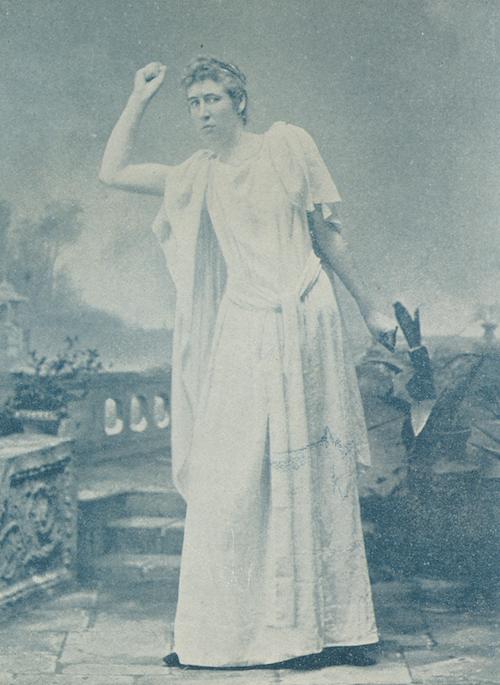
“I hate him, for he is a Christian.”
The Humors of Elocution
Sitting in our Library some few weeks ago we were startled by a resounding knock upon the door, and in answer to our summons, “Come in,” a large woman entered, followed by a bouncing girl of seventeen or thereabouts. The costumes of both bespoke them to be just from the rural districts. After a courtesy from the woman, followed by a fac-simile from the girl, the former said: “We’ve heard that you was a good hand at learnin’ people fur to speak pieces, and Samanthy here hez to spout at the next meetin’ of our Lyceum, and she wants you fur to larn her somethin’ funny. You see, all the young folks down our way has gone just cracked over speakin’ pieces, and the school ma’am has been coachin’ ’em, but Samanthy wants to do better nor the rest, and wants to hev it to say that she has took lessons from a reg’lar purfessor, so I thought if you would find her a piece and coach her on it, I wouldn’t begrudge a quarter of a dollar, even if I has to save it out of my egg-money, then if she’ll hold on to what she larns she can go ahead of the hull caboodle of ’em.” Seeing in the credulous face of the old woman a rich chance for some fun at her expense we said: “Is it howld on ye say? An’ didn’t I howld on till the heart of me was clane broke intoirely, an’ me wastin’ that thin you could clutch me wid yer two hands.” “Oh, law!” exclaimed the old woman, “is elocution so bad on you as that, but you don’t seem to look the wuss for it now.” “Seems! madam, nay, it is! I know not seems! Oh that this
“I’m mad, I’m mad, I know I’m mad, Enough to drive one mad, Stark, raving, howling, crazy mad, It is to lose one’s child.”
Samantha subsided and flew behind her mother like a chicken behind an old hen. The old woman laid her hand tenderly on our shoulder, and said sympathizingly: “Poor creetur she’s lost a child; I think I’d go crazy, too, if I lost Samanthy. Poor lamb!”
“Mary haf got a leetle lambs already, Dose wool vas vite like shnow, Und efery times dot Mary did vend oud, Dot lambs vent oud vid Mary.”
“Massy sakes!” cried the woman, “what do you call yourself, Dutch, Irish or American?” “My father and mother are Irish, and I am Irish too.” “Mon dieu, madame, vat you please.”
“Is this a dagger which I see before me, its handle toward my hand? Come, let me clutch thee, I have thee not, and yet I see thee still. What light is this which surrounds me and seems to set fire to my brain? What whistle that, yelling so shrilly? Ah! I know now, ’tis the train.”
The woman then said, “Samanthy, I think it is time we was takin’ the train. I don’t think I could trust you to come here alone. Good day, marm, we must be goin’. I would like to send you some of my yarb tea. Its powerful soothin’ to the nerves.”
“Be that word our sign of parting, Get thee back into the tempest and the night’s Plutonian shore; Leave no black plume as a token of that he thy soul has spoken, Leave my loneliness unbroken.”
By this time she had the door shut, but she went to some of the neighbors and asked if our place was not a private lunatic asylum.
F. Lizzie Peirce.
The Reason Why.
Can anybody tell why, when Eve was manufactured from one of Adam’s ribs, a hired girl wasn’t made at the same time to wait on her?
We can, easily. Because Adam never came whining to Eve with a ragged stocking to be darned, a collar button to be sewed on, or a glove to be mended “right away quick now.” Because he never read the newspaper until the sun got down behind the palm trees, and then stretched himself, yawning out, “Ain’t supper most ready, my dear.” Not he. He made the fire and hung over it the tea-kettle himself we’ll venture, and pulled the radishes and peeled the bananas, and did everything else that he ought to. He milked the cows and fed the chickens and looked after the pigs himself. He never brought home half a dozen friends to dinner when Eve hadn’t any fresh
—Anon.
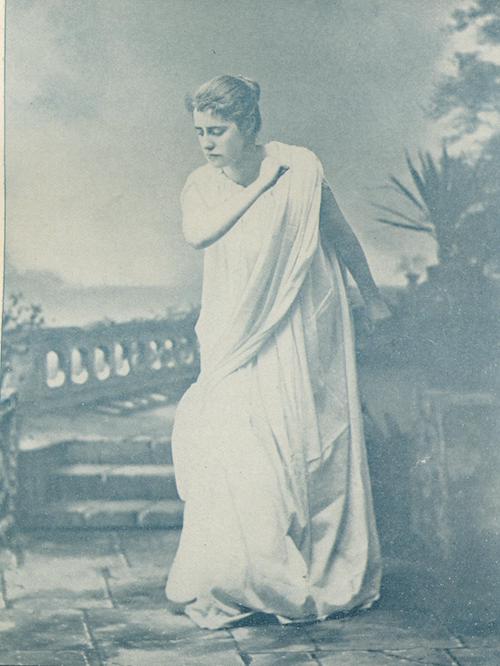
“Ha, ha! take that! and that! and that!”
Nothing to Wear.
Toby Simpson, a dealer most worthy and just, Slowly wended his way through the rattle and dust Of the city. He mused on the cholera scare, On his relative chance as a wheat or a tare In the prophesied raid. Then he mumbled a prayer, And each mud hole he eyed seemed a villainous snare, While his conscience said, solemnly, “Simpson, beware!” On the strength of a limited balance in cash He had planned for himself and his family a dash To the mountains, the seaside, it mattered not where; To delay any longer was more than he dare; Some relief must be had from the terrible flare Of the midsummer sun, which would surely impair The good health of Dame Simpson, now cross as a bear. ’Twas quite late in July and old Sol was aglow, All the people had gone who had money to go From the city to seek a few sniffs of fresh air, And forgot for a season their burdens of care; Then no wonder Dame Simpson was heard to declare That the Joneses looked up with an insolent stare, As she stood at her window exposed to the glare. But her husband that ev’ning when rising from tea, With his hands full of tickets and heart full of glee, Quite as proud as a lion could be in its lair, Shouted out: “To the Capes, yes, to-morrow, prepare, I’ve engaged jolly quarters and paid all the fare!” To which mother and daughters, with mock debonair, Chorused forth: “Why, dear papa, we’ve nothing to wear!” With a look most bewildered he clutched at a tray, For his mercantile courage was oozing away, And his features were grim ’neath his carroty hair; Twenty bills he had paid for goods costly and rare For those females! and now could not possibly spare An additional stamp. Unaccustomed to swear, It was startling to hear him say: “Darned if it’s fair!” In an eight by ten office, half sweltered with heat, Sat T. Simpson, the jobber. He gazed at his feet Which reposed on a desk, just in front of his chair, While his face was dejected and full of despair; And he owed not a cent; his accounts were all square— No, not that, but the problem of Nothing to Wear Was just why the poor fellow sat pondering there. George M. Vickers.
Echo and the Ferry.
Ay, Oliver! I was but seven, and he was eleven; He looked at me pouting and rosy. I blushed where I stood They had told us to play in the orchard (and I only seven! A small guest at the farm); but he said, “Oh! a girl was no good!” So he whistled and went, he went over the stile to the wood. It was sad, it was sorrowful! Only a girl—only seven! At home in the dark London smoke I had not found it out. The pear-trees looked on in their white, and blue-birds flashed about, And they, too, were angry as Oliver. Were they eleven? I thought so. Yes, every one else was eleven—eleven! So Oliver went, but the cowslips were tall at my feet, And all the white orchard with fast-falling blossom was littered; And under and over the branches those little birds twittered, While hanging head downward they scolded because I was seven. A pity—a very great pity. One should be eleven. But soon I was happy, the smell of the world was so sweet, And I saw a round hole in an apple-tree rosy and old. Then I knew, for I peeped, and I felt it was right they should scold. Eggs small and eggs many. For gladness I broke into laughter; And then some one else—oh! how softly!—came after, came after With laughter—with laughter came after. And no one was near us to utter that sweet, mocking call, That soon very tired sank low with a mystical fall. But this was the country—perhaps it was close under heaven; Oh! nothing so likely; the voice might have come from it even. I knew about heaven. But this was the country, of this Light, blossom, and piping, and flashing of wings, not at all. Not at all. No. But one little bird was an easy forgiver: She peeped, she drew near as I moved from her domicile small, Then flashed down her hole like a dart—like a dart from the quiver. And I waded atween the long grasses, and felt it was bliss. —So this was the country; clear dazzle of azure and shiver And whisper of leaves, and a humming all over the tall White branches, a humming of bees. And I came to the wall— A little low wall—and looked over, and there was the river, The lane that led on to the village, and then the sweet river, Clear shining and slow, she had far, far to go from her snow; But each rush gleamed a sword in the sunlight to guard her long flow, And she murmured, methought, with a speech very soft—very low. “The ways will be long, but the days will be long,” quoth the river, “To me a long liver, long, long!” quoth the river—the river. I dreamed of the country that night, of the orchard, the sky, The voice that had mocked coming after and over and under. But at last—in a day or two namely—Eleven and I Were very fast friends, and to him I confided the wonder. He said that was Echo. “Was Echo a wise kind of bee That had learned how to laugh; could it laugh in one’s ear and then fly, And laugh again yonder?” “No; Echo”—he whispered it low— “Was a woman, they said, but a woman whom no one could see. And no one could find; and he did not believe it, not he; But he could not get near for the river that held us asunder. Yet I that had money—a shilling, a whole silver shilling— We might cross if I thought I could spend it.” “Oh! yes, I was willing”— And we ran hand in hand, we ran down to the ferry, the ferry, And we heard how she mocked at the folk with a voice clear and merry When they called for the ferry; but, oh! she was very—was very Swift-footed. She spoke and was gone; and when Oliver cried, “Hie over! hie over! you man of the ferry—the ferry!” By the still water’s side she was heard far and wide—she replied, And she mocked in her voice sweet and merry, “You man of the ferry, You man of—you man of the ferry!” “Hie over!” he shouted. The ferryman came at his calling; Across the clear reed-bordered river he ferried us fast. Such a chase! Hand in hand, foot to foot, we ran on; it surpassed All measure her doubling—so close, then so far away falling, Then gone, and no more. Oh! to see her but once unaware, And the mouth that had mocked, but we might not (yet sure she was there), Nor behold her wild eyes, and her mystical countenance fair. We sought in the wood, and we found the wood-wren in her stead; In the field, and we found but the cuckoo that talked overhead; By the brook, and we found the reed-sparrow, deep-nested, in brown; Not Echo, fair Echo, for Echo, sweet Echo, was flown. So we came to the place where the dead people wait till God call. The church was among them, gray moss over roof, over wall. Very silent, so low. And we stood on a green, grassy mound And looked in at the window, for Echo, perhaps, in her round Might have come in to hide there. But, no; every oak-carven seat Was empty. We saw the great Bible—old, old, very old. And the parson’s great prayer-book beside it; we heard the slow beat Of the pendulum swing in the tower; we saw the clear gold Of a sunbeam float down to the aisle, and then waver and play On the low chancel step and the railing; and Oliver said, “Look, Katie! look, Katie! when Lettice came here to be wed She stood where that sunbeam drops down, and all white was her gown; And she stepped upon flowers they strewed for her.” Then quoth small Seven: “Shall I wear a white gown and have flowers to walk upon ever?” All doubtful: “It takes a long time to grow up,” quoth Eleven; “You’re so little, you know, and the church is so old, it can never Last on till you’re tall.” And in whispers—because it was old And holy, and fraught with strange meaning, half felt, but not told, Full of old parsons’ prayers, who were dead, of old days, of old folk. Neither heard nor beheld, but about us—in whispers we spoke. Then we went from it softly, and ran hand in hand to the strand, While bleating of flocks and birds’ piping made sweeter the land. And Echo came back e’en as Oliver drew to the ferry, “O Katie!” O Katie!” “Come on, then!” “Come on then!” “For see, The round sun, all red, lying low by the tree”—“by the tree.” “By the tree.” Ay, she mocked him again, with her voice sweet and merry; “Hie over!” “Hie over!” “You man of the ferry”—“the ferry.” “You man of the ferry—” “You man of—you man of—the ferry.” Ay, here—it was here that we woke her, the Echo of old; All life of that day seems an echo, and many times told. Shall I cross by the ferry to-morrow, and come in my white To that little low church? and will Oliver meet me anon? Will it all seem an echo from childhood passed over—passed on? Will the grave parson bless us? Hark! hark! in the dim failing light I hear her! As then the child’s voice clear and high, sweet and merry, Now she mocks the man’s tone with “Hie over! Hie over the ferry!” “And, Katie.” “And, Katie.” “Art out with the glow-worms to-night, My Katie?” “My Katie!” For gladness I break into laughter And tears. Then it all comes again as from far-away years; Again, some one else—oh, how softly!—with laughter comes after, Comes after—with laughter comes after. —Jean Ingelow.
Roderick Lee.
This is a wild, lone valley, and the road that threads it through Is the loneliest road I know of, and I’ve traveled not a few; Those hills on the left[72] so barren, and yon[73] towering, rocky ridge, Look down on a sluggish river that is spanned by a moss-grown bridge— And nigh to the bridge like a sentry, a tall, gray chimney stands, ’Mid the wreck that time has buried ’neath the tangled weeds and sands. In this valley three ruins moulder that were once three happy homes, And where once fond voices mingled, now the sly fox fearless roams; Then these locks[74] were thick and glossy, that are now so sparse and gray; Then I’d clamber these rocks as willing by night as I would by day— But, if a royal scepter, if the world[75] were promised mine To cross again this valley, I would shudder and decline. Roderick Lee was a miller, and as grist was hard to find Down in his old New Hampshire,[76] he had little or naught to grind; So, with his young wife blooming and his brown-eyed daughter Nell, Together with two young farmers, he came to this[77] place to dwell: And many’s the mile of prairie, and many’s the forest drear, That lay ’twixt the far-off Merrimack[78] and the stream[79] that ripples here. Yet with a heart as buoyant and as brave as it was true, Young Lee, ’mid the cheers at parting, bade his native town adieu; Then came the weeks of toiling, aye, months, ere the scorching plain Was crossed, and his eyes were greeted by the distant mountain chain; But the white-topped, dusty wagons at last made their final stand, And he knelt to breathe thanksgiving with his little pilgrim band. Stay! even now in fancy, I can see their forms once more, I can see their peaceful faces and the look of hope they wore— Poor Kate and Nell and Edith, young Harry, Mag and Joe— ’Neath that oak[80] I see them kneeling, tho’ ’tis thirty years ago! And long ere the hazy autumn had mellowed another year, Our huts were built in the clearing, and our corn hung ripe in the ear. Joe was a model husband, as fair Edith, his wife, well knew, And Mag and her raw-boned Harry, lived as loving couples do; But, as their homes were childless, very natural-like it fell That these kind and worthy people thought the world of little Nell. Many a time they kept her whole days ’gainst her mother’s will, First in the hut by the river[81], then in the hut by the hill[82]. Once in the chill November, when the slender moon[83] hung low, And the barren hill tops yonder[84] were clad in a gauze of snow; Kate with a gleam of mischief in her bright and twinkling eye, Started across the river[85] to the hut of Joe, hard by; And Roderick sat by the window, watching her out of sight, Dreamily watching the shadows of that chill November night. Ere it had seemed a moment she again stood by his chair; She had called at their neighbor’s cabin, but Nellie had not been there. Roderick slowly rising took his rifle from the rack, For the road was wild and lonely and led through a forest tract; Over the ruts and boulders, chatting, they strode[86] along Till the voice of raw-boned Harry was heard in a merry song. “Singing for Nell’s amusement,” said the wife, as she hurried on; “Pity,” she added, musing, “that they have no child of their own.” Soon with a hearty greeting they were met at the cabin door, “And where is your little daughter?” asked Mag, as she scanned them o’er. “Question your good man, Harry[87], for I’ll venture that he can tell,” Said Kate, then smiling added, “we must stop lending little Nell.” Mag, with a playful gesture drew the bed-room screen[88] aside, “See!” she exclaimed, “she’s not here; now I hope you are satisfied.” “Come, Maggie, come, don’t trifle, for the hour is growing late; I know that the child is hiding; would you have us longer wait?” Thus queried Kate, half pleading, when a look akin to fear Stole over the face of Harry as he said, “she is not here!”[89] “Not here! O God[90] protect her!” with a gasp young Roderick cried, And his pale wife like a statue, mute with fright, stood at his side. ’Twas but a single moment, yet it seemed like an age to wait Ere Mag and Kate with their husbands filed out[91] through the open gate; Dark[92] was the night as a dungeon, for the moon had sunk away[93], And the far-off cries of a panther[94] filled each breast with dread dismay. On[95] through the gloomy forest like a band of ghosts they sped, Silently, save when the mother sobbed, or a twig snapped ’neath their tread; “Hark[96]!” whispered tall, gaunt Harry, and they stood with heads[97] bent low, While faint on the air of midnight came shrieks[98] of pain and woe. “Hello! hello[99]!” cried Harry; but they heard no voice reply— “Heavens! what means that crimson, that glow[100] on the fleecy sky? See how it spreads[101] and deepens! Look! our cabins are ablaze!” Then Roderick paused in terror at the sight that met his gaze. Light grew the wood about[102] them; their shadows fell before, For behind[103] them on the hillside leaped the flames from Harry’s door: “On[104] for your lives!” screamed Harry, “on for little Nell!” Then, like an answering challenge, rose the distant Indians’ yell. Bang! bang! “That’s Joe replying; he’ll fight ’em game and well,” Were the words that Harry uttered; “God[105] spare my darling Nell!” This from the pallid mother; and the settlers fairly flew O’er the matted brush and boulders till the clearing came in view. Oh, such a sight[106] of ruin! oh, such a ghastly scene! Stark, dead,[107] lay Joe and Edith on the charred and trampled green. Crouching down ’mid the bushes they watched the painted fiends, Watched with the strange, grim calmness that despair so often lends; “My child! my child!” then springing from the group like astartled deer, Kate rushed[108] o’er the red-lit clearing ere one could interfere— The hideous, screeching cut-throats had captured little Nell; But, when they saw her mother, they stood bound, as by a spell. “Spare![109] oh, spare my darling! Here, pierce me,[110] strike me dead![111] Give back my child, my Nellie!” the frantic woman said; Then on her panting bosom her daughter’s head she laid, Then both sank[112] down in silence, looked up and mutely prayed; That was the fatal signal, for on, like a sweeping hell[113] They came with knife and hatchet, with rifle-shot and yell. Bravely they fought, yet vainly, that fated settler band, Clubbing their empty rifles, meeting them hand to hand; Roderick reeled and staggered, then fell[114] ’neath a crushing blow, And a whoop of fiendish malice told the triumph of the foe; Then like a flash they vanished[115] and Roderick bleeding lay, Hearing their yells grow fainter, till at last they died away. Gray dawned the wintry morning on that awful scene of death, And five cold brows of marble were kissed[116] by its chilling breath— God in his wisdom took them—save Nellie, who ne’er was found; And all of them sleep in this valley, each ’neath a grassy mound. Poor little Nell may be living, but if living she’s dead to me; Yes, the tale is indeed a true one—and my name?—is Roderick Lee. —Geo. M. Vickers.
Gestures.
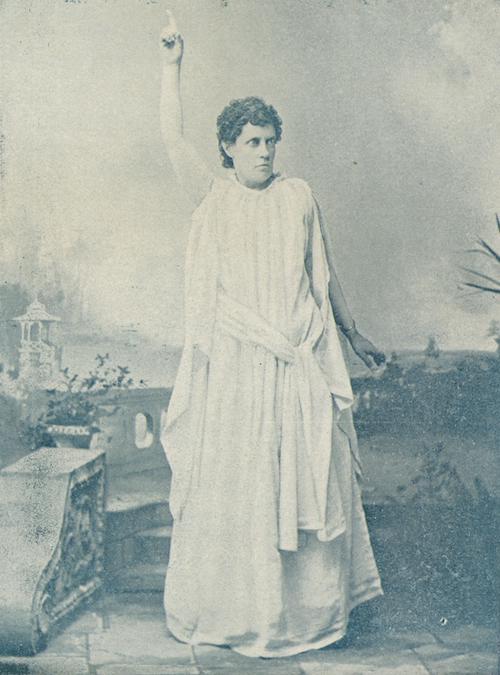
“Cursed, thrice cursed may you be evermore, and as my people on Mount Ebal spoke, so speak I thrice, Amen! Amen! Amen!”
Holding a Baby.
Yesterday, while waiting on the corner for a street-car, a woman, laden with an umbrella, a bandbox and a baby, accosted me with “Say, mister, can I git to Market street on these yer cars?” “You can,” I replied. “How long must I wait?” “Madam,” said I, noticing the string slipping from her bandbox, “may I hold your umbrella and bandbox until the car arrives? See, here it comes!” “I’d rather you’d hold Berthy, if you will, mister, ’cause this darned string’s a slippin’ off—quick!—ketch it! Land o’ misery! There be all my things scattered over the bricks! Do hold Berthy while I pick ’em up.” Here was a dilemma. The car was not forty yards off, while the sidewalk was strewn with every conceivable article, from a broken hair brush to a pair of old worsted slippers.
—Geo. M. Vickers.
The Spanish Mother.
[Supposed to be related by a veteran French officer.]
Yes! I have served that[117] noble chief throughout his proud career, And heard the bullets whistle past in lands both far and near— Amidst Italian flowers,[118] below the dark pines of the north,[119] Where’er the Emperor willed[120] to pour his clouds of battle forth. ’Twas then a splendid sight to see, though terrible, I ween, How his vast spirit filled[121] and moved the wheels of the machine; Wide sounding leagues[122] of sentient steel, and fires that lived to kill,[123] Were but the echo of his voice, the body of his will. But now my heart is darkened with the shadows[124] that rise and fall Between the sunlight and the ground to sadden and appall: The woeful things both seen and done we heeded little then, But they return, like ghosts, to shake the sleep of aged men. The German and the Englishman were each an open foe, And open hatred hurled[125] us back from Russia’s blinding snow; Intenser far, in blood-red light, like fires unquenched, remain The dreadful deeds wrung forth by war from the brooding soul of Spain. I saw a village[126] in the hills, as silent[127] as a dream, Naught stirring but the summer sound[128] of a merry mountain stream; The evening star[129] just smiled from heaven with its quiet silver eye, And the chestnut woods[130] were still and calm beneath the deepening sky. But in that place, self-sacrificed, nor man nor beast we found, Nor fig-tree on the sun-touched slope, nor corn upon the ground; Each roofless hut[131] was black with smoke, wrenched up each trailing vine, Each path was foul[132] with mangled meat and floods of wasted wine. We had been marching, travel-worn, a long and burning way, And when such welcoming we met, after that toilsome day, The pulses in our maddened breasts were human hearts no more, But, like the spirit of a wolf, hot on the scent of gore. We lighted on one dying man, they slew him where he lay; His wife, close-clinging, from the corpse they tore[133] and wrenched away; They thundered in her widowed ears, with frowns and curses grim, “Food, woman—food and wine, or else we tear[134] thee limb from limb.” The woman shaking off his blood, rose,[135] raven-haired and tall, And our stern glances quailed before one sterner far than all. “Both food and wine,”[136] she said, “I have; I meant them for the dead,[137] But ye are living still, and so let them be yours instead.” The food was brought, the wine was brought out of a secret place,[138] But each one paused aghast, and looked into his neighbor’s face; Her haughty step and settled brow, and chill indifferent mien, Suited so strangely with the gloom and grimness of the scene. She glided here,[139] she glided there,[140] before our wondering eyes, Nor anger showed, nor shame, nor fear, nor sorrow, nor surprise; At every step, from soul to soul a nameless horror ran, And made us pale and silent as that[141] silent murdered man. She sat, and calmly soothed her child into a slumber sweet; Calmly the bright blood on the floor crawled[142] red around our feet. On placid fruits and bread lay soft the shadows of the wine, And we like marble statues glared—a chill, unmoving line. All white, all cold; and moments thus flew by without a breath, A company of living things where all was still—but death;[143] My hair rose up from roots of ice as there unnerved I stood And watched[144] the only thing that stirred—the rippling of the blood. That woman’s voice was heard at length, it broke the solemn spell, And human fear, displacing awe, upon our spirits fell— “Ho![145] slayers of the sinewless! Ho! tramplers of the weak! What! shrink ye from the ghastly meats[146] and life-bought wine ye seek? Feed, and begone![147] I wish to weep—I bring you out my store[148]— Devour[149] it—waste[150] it all—and then—pass[151] and be seen no more. Poison! Is that your craven fear?” She snatched the goblet[152] up And raised it to her queen-like head, as if to drain the cup. But our fierce leader grasped her wrist—“No, woman! No!” he said, “A mother’s heart of love is deep—give it your child[153] instead.” She only smiled a bitter smile—“Frenchmen, I do not shrink— As pledge of my fidelity, behold[154] the infant drink!” He fixed on hers his broad black eye, scanning her inmost soul; But her chill fingers trembled not as she returned the bowl. And we with lightsome hardihood, dismissing idle care, Sat down[155] to eat and drink and laugh over our dainty fare. The laugh was loud around the board, the jesting wild and light; But I was fevered with the march, and drank no wine that night; I just had filled a single cup, when through my very brain[156] Stung, sharper than a serpent’s tooth, an infant’s cry of pain. Through all that heat of revelry, through all that boisterous cheer, To every heart its feeble moan pierced, like a frozen spear. “Aye,” shrieked the woman, darting up, “I pray you trust again A widow’s hospitality in our unyielding[157] Spain. Helpless and hopeless, by the light of God[158] Himself I swore To treat you[159] as you treated him[160]—that[161] body on the floor. Yon secret place[162] I filled, to feel, that if ye did not spare, The treasure of a dread revenge was ready hidden there. A mother’s love is deep, no doubt; ye did not phrase it ill, But in your hunger ye forgot, that hate is deeper still. The Spanish woman speaks for Spain;[163] for her butchered love,[164] the wife, To tell you that an hour is all my vintage leaves of life. I cannot paint the many forms of wild despair put on, Nor count the crowded brave who sleep beneath[165] a single stone; I can but tell you how, before that horrid hour went by, I saw the murderess beneath the self-avengers die. But though upon her wrenched limbs they leaped like beasts of prey, And with fierce hands, like madmen, tore[166] the quivering life away— Triumphant hate and joyous scorn, without a trace of pain, Burned to the last, like sullen stars, in that haughty eye of Spain. And often now it breaks my rest, the tumult vague and wild, Drifting, like storm-tossed clouds,[167] around the mother and her child— While she,[168] distinct in raiment white, stands silently the while, And sheds through torn and bleeding hair the same unchanging smile. —Sir Francis Hastings Doyle.
Gestures.
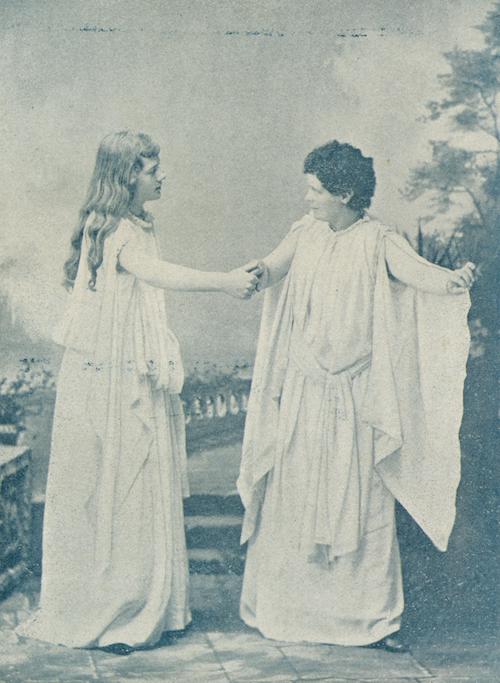
“Come, let us within.”
An Engineer’s Ride on a Piano.
Bill Jones is my fireman; we have run together on old “thirty-six” for more than twenty years. One night when we were off duty, said Bill, “Jim, let’s take in a show.” “Where?” I replied, at the same time scanning the bill-board at the end of the depot. “See!” cried Bill, “Mons. De Froglimb, the great French piano virtuoso—” “That’s enough, Bill,” said I, “we’ll go”—and we did. He was a Frenchman; looked like an animated switch-signal. I am an old engineer, and have often whistled through the wind, but that virtuoso!—Well, as soon as he sat down on the stool I knew by the way
“You could hear her thunder over culverts and bridges, and getting faster and faster, until the fellow rocked about in his seat like a cradle. Somehow I thought it was old ‘thirty-six’ pulling a passenger train and getting out of the way of a ‘special.’ The fellow worked his keys on the middle division like lightning, and then he flew along the north end of the line until the drivers went around like a buzz-saw, and I got excited. About the time I was fixing to tell him to cut her off a little, he kicked the dampers under the machine wide open, pulled the throttle away back in the tender, and, Jerusalem jumpers! how he did run! I couldn’t stand it any longer, and yelled to him that she was ‘pounding’ on the left side, and if he wasn’t careful he’d drop his ashpan.
“But he didn’t hear me. No one heard me. Everything was flying and whizzing. Telegraph poles on the side of the track looked like a row of cornstalks, the trees appeared to be a mud bank, and all the time the exhaust of the old machine sounded like the hum of a bumblebee. I tried to yell out, but my tongue wouldn’t move. He went around the curves like a bullet, slipped an eccentric, blew out his soft plug, went down grades fifty feet to the mile, and not a confounded brake set. She went by the meeting point at a mile and a half a minute and calling for more steam. My hair stood up like a cat’s tail, because I knew the game was up.
“Sure enough, dead ahead of us was the head-light of the
The World’s Hero.
[Recited by F. Lizzie Peirce at the Annual Re-union of the Independent Literary Society, August 8th, 1885.]
Go search the annals of the human race, Go hear the legends that the heathen tell, And learn that hist’ry, sacred or profane, Records no hero like the mighty Grant. Columbia proudly claims him as her own And rears her monuments with love and pride; But millions scattered o’er the face of earth, And millions yet unborn, will share that claim: Who serves mankind is deemed the friend of man, And nations nationalize him in their hearts. Since that first famous Battle of the Kings, Of which we read in holy writ, no sword E’er leaped from scabbard in a juster war Than that which made our country free indeed, Which, until then, was only free in name. The bond of unity that Washington To us bequeathed, Grant’s loyal arm maintained; Emancipation of the dusky race By Lincoln’s heaven-inspired pen, by Grant’s Unsullied sword was made complete! How well He proved the potency of equal rights, And how he dignified Democracy The monarchs of the world have told, thrice told, In homage, hospitality and love. No land is free where dwells a slave: to-day In all our land there dwells no slave, and we Are free, forever free! “Let us have peace.” Clasp hands across the ashes of the dead. No, no; Grant is not dead, he cannot die; The body is the worn-out coat of mail, That with his sword and shield the warrior casts Aside when life’s campaign is o’er, and home, Eternal home, is reached. He is not dead Whose power still exists; and Grant will live A life of immortality while yet Our starry banner floats for liberty, Which, thanks to God, will be forevermore. —Geo. M. Vickers.
The Coquette.
Two girls sat in a gay saloon, nor mingled with the crowd; The younger’s face was pale, and sad, the elder’s stern and proud. “O Gertrude,” said the younger girl, “thou art a sad coquette; Ah, many hearts have felt thy power, and thou art flirting yet. There’s one who fills a foreign grave, who loved thee all too well, Who breathed thy name forgivingly, as in the fray he fell; And yet his fate was better far than that of poor Martelle, Who lonely clanks his heavy chains—a madman—in his cell.” “O Gertrude,” in a softer tone, “give up thy selfish arts, Or hopeless love will be thy doom for blighting loving hearts.” Thus far had Maud unchecked reproved when Gertrude coldly said: “I care not for the living dupes, why blame me for the dead? Thy lover, sure, is naught to me, so quell thy jealous fears; When seeking game I ever strive to strike among my peers.” “Tis not my lover,” Maud replied, while blushes bathed her brow, “But brother Paul I fain would save—for him I’m pleading now. Of kin, he’s all I have on earth—so noble, brave and pure— Too good, alas, to sacrifice—defeat he’d ne’er endure.” But Gertrude rose and took the hand that claimed her for the dance, While Maud stole to the balcony—did Paul stand there by chance? It seemed not so—anon there came a lass surpassing fair; Some hurried words, a merry laugh—they seek the gaslight’s glare. Soon Paul claims Gertrude for the waltz; she yields and softly sighs, Then off they whirl while glances dart from scores of jealous eyes. * * * * * The full round moon now rides on high; the fragrant air is cool, The fountain’s spray, like flashing gems, darts in the limpid pool. A rustic seat girts round an oak, and Paul leads Gertrude there, She by his side, he takes her hand, so small, so soft and fair. In accents low he thus began: “O Gertrude, till to-night True happiness I never knew, and may it ne’er take flight. Say, may I tell my tale, and hope to gain a smile from thee? Approving words to ease a heart that is no longer free? I’m lonely now, for sister Maud is soon to be a bride; Then wonder not because I seek a refuge at thy side.” She murmured half inaudibly: “Dear Paul, I long to hear; Thou’lt get a smile for ev’ry smile, a tear for ev’ry tear.” “Enough, kind Gertrude, listen then: for years I’ve roamed afar; I’ve sailed beneath the Southern Cross, I’ve lost the Northern Star; But now I once more breathe the air of home, I’ll never stray; I only need a loving wife—why tremble, Gertrude, say? But soon I’ll tell thee all I may; say, wilt thou share my joy? God willing, this night, two weeks hence, I marry Kate LeRoy.” Poor Gertrude heard no more that eve, nor saw she Paul again; The rose-tints faded from her cheeks; at last she loved—in vain. * * * * * Her wasted form the church-yard holds; Ah! never this forget: A woman’s love is woman’s life, e’en tho’ a gay coquette. —Geo. M. Vickers.
Experience with a Refractory Cow.
[This piece is very effective given in costume.]
We used to keep a cow when we lived in the country, and sich a cow! Law sakes! Why, she used to come to be milked as reg’lar as clock-work. She’d knock at the gate with her horns, jest as sensible as any other human critter.
Her name was Rose. I never knowed how she got that name, for she was black as a kittle.
Well, one day Rose got sick, and wouldn’t eat nothing, poor thing! and a day or so arter she died. I raly do believe must Mr. Scruggins knowed I meant it. Well, a few days arter, he come home with the finest cow and young calf you ever seed. He gin thirty dollars for her and the calf, and two levies to a man to help bring her home. Well, they drove her into the back yard, and Mr. Scruggins told me to come out and see her, and I did; and I went up to her jest as I used to did to Rose, and when I said “Poor Sukey,” would you believe it? the nasty brute kicked me right in the fore part of my back; her foot catched into my dress—bran-new dress, too—cost two levies a yard, and she took a levy’s-worth right out as clean as the back of my hand.