GEORGE M. VICKERS. (continued 3)
Reading edition
Why She didn’t Stay in the Poorhouse.
No, I didn’t stay in the poorhouse, and this is how, you see, It happened at the very last, there came a way for me. The Lord, he makes our sunniest times out of our darkest days, And yet we fail most always to render His name the praise. But, as I am goin’ to tell you, I have a home of my own, And keep my house, an’—no, I’m not a-livin’ here alone. Of course you wonder how it is, an’ I’m a-goin’ to tell How, though I couldn’t change a jot, the Lord done all things well. I’ve spoke of Charlie and Thomas, and Rebecca, “that lives out West;” An’ Isaac, not far from her, some twenty miles at best; An’ Susan;—but not a single word I said about another one,— Yet we had six; but Georgie! Ah! he was our wayward son, An’ while his father was livin’ he ran away to sea, An’ never sent a word or line to neither him nor me. Each heart has some secret sorrow it hides in silence there, An’ what we can freely speak of is never so hard to bear. But I couldn’t talk of Georgie—he was too dear to blame,— It seemed as if I couldn’t bear even to hear his name. But when I took my pauper’s place in that old work-house grim, My weary heart was every day a-cryin’ out for him. For I’d tried the love of the others, and found it weak and cold, An’ I kind o’ felt if Georgie knew that I was poor and old, He’d help to make it better, and try to do his part, For love and trust are last of all to die in a woman’s heart. An’ he used to be always tellin’ when he was a man and strong, How he’d work for father and mother; and he never done no wrong, Exceptin’ his boyish mischief, an’ his runnin’ off to sea;— So somehow now, out of them all, he seemed the best to me. And so the slow days wore along, just as the days all go, When we cling to some wild fancy that all the time we know Is nothing but a fancy, yet we nurse it till ’twould seem That the dream alone is real, and the real but a dream. And so I clung to Georgie, or clung to my faith in him, And thought of him the long days through, until my eyes were dim. And my old heart ached full sorely to think that never again I should see my boy until we stood before the Judge of men. When one day a big brown-bearded man came rushin’ up to me, Sayin’ “Mother! my God! have they put you here?” An’ then I see ’Twas Georgie, my boy, come back to me, and I knowed nothin’ more, ’Cause I got faint, and but for him, I’d fallen on the floor. They say he swore some awful words,—I don’t know,—it may be; But swear or not, I know my boy’s been very, very good to me. An’ he’s bought the old home back again, an’ I’ve come here to stay, Never to move till the last move,—the final goin’ away. An’ I take a heap of comfort, for Georgie’s good an’ kind, An’ the thought of bein’ a pauper ain’t wearin’ on my mind; But still I never can forget until my dyin’ day, That they put me in the poorhouse ’cause I was in the way.
“Bill” the Engineer.
“All ’board!” “Sphee-ee-chee—sphee-ee-choof!” And the iron horse moves his steel-rimmed hoof, And snorts from his chest his breath of steam, With a quickening pulse and warning scream, Moves out[309] with his freight of human lives— A sinuous[310] chain of humming hives. Anon the hum is a rattling din, As the bright steel arms fly out and in, Till naught is heard save a deafening jar, As the train speeds[311] on like a shooting star, With a lengthening trail[312] like a smoky pall, Whose writhing folds envelope all. “Stoke up!” shouts Bill, the engineer; “We must rush this grade and the bottom clear With a monstrous bulge, to pull up hill T’other side—heavy train.” “All right, Bill!” And the coal went in and the throttle out. “Watch yo’ side the curve!” from Bill with a shout. Adown the grade with open throttle They swiftly glide as a flying shuttle— Weaving in streaks of green and gray, The warp and woof of bush and clay, While steam and smoke and dust behind Form mottled clouds in the tortured wind. Through the cut[313] and into the vale— Across the trestle that spans the swale; There the willows swirl, and the rank weeds sway, And the heron starts with a shriek away[314]— Blown from her course—a shrill refrain, ’Mid the whirling gusts of the flying train. * * * * * Beyond the curve this side the hill, There runs a creek—by the old saw-mill— A covered bridge[315] and a water tank, With the watchman’s shanty on this bank: A quiet nook, for the mill is done,— With crippled Jemmie it ceased to run. Just round[316] the curve in the shady wood That fringes the creek, his low hut stood, Where Jemmie, the watch, spent his useful life, With a lovely child and a loving wife. Naught now came their peace to mar Worse than a swift train’s rumbling jar. To fame unknown, but to roadmen dear; For Jemmie had watched from year to year— And more than once did his vigil save A train and its lives from a watery grave; Since broken in purse and form at the mill He worked on crutches—a good watch still! * * * * * “Hark![317] Tis the train! The mother’s ear Leans to the sound; then a mortal fear Freezes her veins—she sees not her child[318]! “Oh, darling! Oh, Maggie!” in accents wild. She starts[319] from the hut—now feeling the way, “Keep Maggie in when the trains go by.” She strains her eyes[320] out toward the creek, Where up the track, with an ashen cheek, Hobbled the watch[321]—one pointing crutch Where Maggie lay[322] in the engine’s clutch— The wilting flowers across her breast; She’d wearied to sleep in their eager quest. “Save her, Mary![323] For God’s sake run!” Came Jemmie’s voice like a signal gun; The mother sprang like a startled deer, But the rushing train[324] was now too near— She saw, and swooned[325] with a piercing shriek That echoed afar o’er the winding creek; Ay, pierced the boom round the curve so near,[326] And smote on the ear of the engineer; “Great God! Down brakes! Quick! Reverse!” And Bill was out[327] on the iron horse, Treading his thrills o’er the roaring fires With his nerves strung tense as electric wires. Alas! the engine’s speed is too great; The baby dreams in the path of fate! Yet Bill knows the force and just the brace To lift a pound in such a case; With a rushing train and the child asleep, ’Tis a giants’ power his place must keep. Still reaching forth with an iron grasp, He does with his might this God-like task; Bears the startled child on high[328]— So happy to hear its frightened cry— Then crushing it to his manly breast,[329] Kisses its cheeks with a lover’s zest. “More brakes!” calls Bill, for the mother’s seen,[330] And the crutches and form of Jemmie between His wife and the train—that’s crushed the life From his child, he thinks—“I’ll die with my wife!” But the train now slackens and stops apace— Hard by a pallid upturned face.[331] “Saved!” cries Bill, from the engine’s front; “Saved!” echoes Jemmie, his crutches shunt; “Saved!” shout the passengers, “Saved from death!” “Saved?”[333] queries Mary, with conscious breath. Then helped to her feet—“God bless you sir!” And Bill’s grimy hand wipes back a tear. “All ’board!” Sphee-ee-chee—sphee-ee-choof! And the iron horse moves his steel-rimmed hoof; And the train resumes its journey far. Heroes have been, and heroes are— Of battle and State, of travel and skill, Of letters and art—but give us “Bill.”[334] At the end of the road they gave him a purse “I don’t want that!” and he muttered a curse; But finally took it, and stowed it away, And then threw[335] it to “Mag” as he passed next day. It whirled through the air and struck by the stoop, Where the three stood to greet him, a joyful group. —Bettersworth.
Published by permission of T. J. Carey, Editor of “Excelsior Readings and Recitations.”
Gestures.
The True Remedy.
Don’t say that times are pinching, Don’t say that bread is dear; Don’t say that our prospects darken, And that worse times are near. Times are not so very pinching, Bread is not so very dear; Countless stores of loaves are wasted, Burned in whisky,—drowned in beer. Don’t say that the harvest failed us,— “Under average,” “short,” or “light;” Don’t say that the Bounteous Giver Gave not as you think he might. God is bountiful, and giveth As becomes the Godhead’s hand; Food for man and beast providing, Scattering plenty o’er the land. Man himself, the food destroyer, Spurns and wastes the bounties given; Turns to famine God’s abundance, Robs his brothers, blasphemes heaven. Don’t say that this is fearful, Killing men and burning corn; War is raging here among us, Day and night, and eve and morn. Noiselessly and never ending, In a quiet, legal way, Murdering, starving, scourging, blasting, All the year and every day! Take your grain in million quarters, Sink it in the lonely main, There to feed the gaping fishes, Never to be seen again; Hide it in earth’s drearest caverns, Burn it in the mid-day sun:— That were mercy, that were worship, When compared with what is done,— Taking bread from hungry children, And from starving, weeping wives; Turning it to direst poison; Demonizing human nature, Dwarfing it in moral stature, Blotting out each God-like feature, Shortening, tort’ring human lives! We say, something must be done; Government must interfere,— Take the “short and simple method;” Stop the whisky, stop the beer! You can stop them if you will. ’Tis a small thing, will you do it? ’Tis your country calls you to it; Stop the traffic—shut the still. —Temperance Speaker.
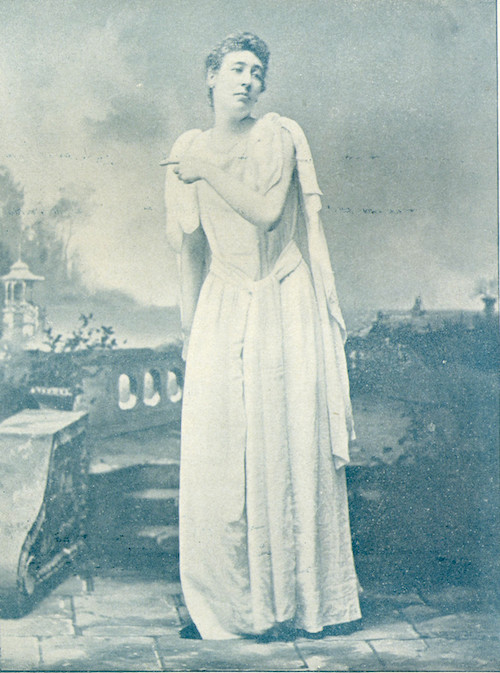
“But she, forsooth, must charm a man.”
Wanted—A Wife.
I DO wish somebody would tell me how to get a wife. For the last ten years I’ve been continually proposing, at all sorts of times, in all sorts of places, to all sorts of girls, and in all sorts of positions. I have knelt in the clear moonlight, while the soft zephyrs of June fanned my heated brow, and with my hands on my heart made the most passionate appeal romantic maiden could desire. I have proposed in the giddy mazes of the waltz; I have besought a fair girl to be mine while skating, reminding her at the time that the path of life was far too slippery to be trodden alone; I have popped the question on the stairs, and in fact everywhere I could; the last time being in the surf at Long Branch, where I begged the object of my affections to let us breast the waves of life together.
But it’s of no earthly use! No one will have me except some superannuated female, and I’m not partial to aged charmers, though, goodness knows, I want a wife almost bad enough to take one. I’ve hardly a button on any of my shirts, or other undergarments, and am consequently obliged to fasten them with pins, (which occasionally prick me at most inconvenient times). My toes are poking out of my socks, and my fingers out of my gloves, while to crown all, I, who am a great lover of cleanliness, am forced to sit in a horribly dirty room. I have changed my boarding house ever so many times, but it does’nt make a particle of difference. My landlady always says it isn’t her business to “clean up” after me; the servants invariably remark that its no business of theirs, and I’m sure nobody can say that I ought to get a broom and dustpan and keep my own room clean.
My washerwoman is everlastingly cheating me, besides continually suppressing various articles of clothing; and when I mildly inquire where they have gone to, she solemnly swears she never had them; though I could swear equally solemnly that she had. Then she cuts the pearl buttons off my shirts, and declares they came off in “the wash;” and if I venture timidly to suggest that she should put them on again, she thanks God that all the gentlemen are not as mean as I am.
Oh, dear! It’s very hard upon a poor fellow not to be able to get a wife when he wants one! I’m not so very bad looking either; to be sure I squint a little, but then that peculiarity is sometimes admired, and if it were not, surely some kind-hearted girl might shut her eyes to the fact and confer upon me the inestimable benefit of becoming my partner for life. I’m not bad-tempered, and don’t drink nor smoke. I’m only thirty, and though I now belong to a club, I’ll promise to give it up if required. I possess enough money to keep a wife comfortably; have a good disposition; and what more could a girl ask. If, after trying six months longer, I cannot induce any girl to have me, I will emigrate to some tropical climate where clothes are almost superfluous, and washerwomen unknown, and consequently where a wife will not be one of the absolute necessities of civilized life.
Back to Griggsby’s.
Pap’s got his patent-right, and rich as all creation; But where’s the peace and comfort that we all had before? Let’s go a-visitin’ back to Griggsby’s station— Back where we used to be so happy and so pore! The like of us a-livin’ here! It’s jest a mortal pity To see us in this great, big house, with carpets on the stairs, And the pump right in the kitchen! And the city! city! city! And nothin’ but the city all around us everywheres! Climb clean above the roof and look from the steeple, And never see a robin, nor a beech or ellum tree! And right here in ear-shot of at least a thousan’ people, And none that neighbors with us, or we want to go and see! Let’s go a-visitin’ back to Griggsby’s station— Back where the latch-string’s a-hangin’ from the door; And every neighbor round the place is dear as a relation— Back where we used to be so happy and so pore! I want to see the Wiggenses, the whole kit and bilin’ A-drivin’ up from Shallow Ford to stay the Sunday through; And I want to see them hitchin’ at their son-in-law’s and pilin’ Out there at Lizy Ellen’s, like they used to do! I want to see the piece quilts the Jones girls is makin’, And I want to pester Laury ’bout their freckled hired hand, And joke her ’bout the widower she come purt’ nigh a-takin’, Till her pap got his pension ’lowed in time to save his land. Let’s go a-visitin’ back to Griggsby’s station— Back where there’s nothin’ aggervatin’ anymore, Shet away safe in the wood around the old location— Back where we used to be so happy and so pore! I want to see Mirandy and help her with her sewin’, And hear her talk so lovin’ of her man that’s dead and gone And stand up with Emanuel to show me how he’s growin’, And smile as I have saw her, ’fore she put her mournin’ on. And I want to see the Samples on the old lower Eighty— Where John, our oldest boy, he was took and buried, for His own sake and Katy’s—and I want to cry with Katy As she reads all his letters over, writ from the war. What’s in all this grand life and high situation, And nary pink nor hollyhawk bloomin’ at the door— Let’s go a-visitin’ back to Griggsby’s Station— Back where we used to be so happy and so pore! —J. W. Riley.
The Old Spinster.
No, she never was married, but was to have been— At the time she was running the loom— But the fact’ry burned down, some were mangled and scarred, And her lover was never her groom, As he wedded a handsomer girl. To the stranger, old Rachel was ugly indeed, For her features were grim and distorted; Tho’ in years long gone by she was lovely and fair, As the hopes of her life that were thwarted By the dreadful mishap in the mill. But beneath the plain calico gown that she wore, Beat a heart that was loving and tender— As the villagers knew—and man, woman or child ’Gainst the merest rude speech would defend her So well was the poor woman loved. And right many’s the maid, who, bewailing her woe, Has told Rachel the slight that distressed her, Only soon to trip on with a happier look, While the silly goose inwardly blessed her, For her comforting words and advice. Then the urchins have gone to her, covered with mud, Afraid to go home—perhaps crying— But old Rachel (the remedy) washed out the stains, And they laughed while their garments were drying, In the yard at the back of her cot. When the villagers slept, and the cricket and owl, And the rustling of leaves were unheeded, In the room of the sick, by the flickering light Was she seen, where her presence was needed, While her gaunt shadow danced on the wall. And the out-casts who begged at her door for a crust, Ere they went on their wearisome ways, Felt that one thought them human and pitied their fate, Who recalled the remembrance of earlier days, And who reckoned them not by their rags. But the weight of her grief which was never revealed,— Save to Jesus—the friend of the lowly— Bore her down—and the sands of her desolate life, Which for years had been ebbing out slowly, Ceased to run—and her spirit was freed. When the villagers stood at the side of her grave, When the gray-headed preacher’s voice faltered, When the tears trickled down the bronzed cheeks of the men— Oh! her beauty seemed fresh and unaltered As when happy she worked in the mill. And oft where she lies a bent form can be seen When the twilight is deep’ning its shadows: And the sweetest of flow’rets are found on her tomb, All fresh from the dew-gleaming meadows; Yet who gathers them no one can tell. —Geo. M. Vickers.
A String of Broken Beads; or, Jingles from Favorite Authors.
Oh, with what pride I used To walk these hills, and look up to my God, And bless him that the land was free. ’Twas free— From end to end, from cliff to lake, ’twas free! Free as our torrents are that leap our rocks, And plow our valleys, without asking leave! Or as our peaks that wear their caps of snow In very presence of the Light Brigade. Cannon to right of them, Cannon to left of them, Cannon in front of them, All a gwine into the ark.
And there was the elephant-ah, that g-r-e-a-t animal-ah of which Goldsmith describes in his Animated Nater-ah, which is as big as a house-ah, and his bones as big as a tree-ah, depending somewhat upon the size of the tree-ah; and there was Shem, and there was Ham, and there was Japhet-ah, a-l-l a-gwine into the show-room.
The auctioneer then in his labor began; And called out aloud as he held up a man, How much for a bachelor, who wants to buy? In a twinkling each maiden responded, “I—I!” In short, at a hugely extravagant price, The bachelors all were sold off in a trice, And forty old maidens—some younger, some older— Each lugged an old bachelor home on her shoulder. But scarce had the honeymoon passed o’er their heads, When one morning to Zantippe, Socrates said, “I think for a man of my standing in life, This house is too small as I now have a wife: So without further delay Carpenter Cary Shall be sent for to widen my house and my dairy.” “Now, Socrates, dearest,” Zantippe replied, “I hate to hear everything vulgarly my’d; Now, whenever you speak of your chattles again, Say our cowhouse, our barn-yard; our pig-pen.” “By your leave Mrs. Snooks, I’ll say what I please Of my houses, my lands, my gardens, my trees.” Then he thought of his sisters, proud and cold, And his mother vain of her rank and gold. So, closing his heart, the judge rode on, And Maud was left in the fields alone. But the lawyers smiled that afternoon, When he hummed in court the Bugle Song. Oh, love, they die in yon fair sky, They faint on field, and hill, and river; Our echoes roll from soul to soul, And grow forever and forever. Blow, bugle, blow, set the wild echoes flying, Answer, echoes, answer. Hark! how the sign-board creaks! the blast howls by! Moan! moan! a dirge swells through the angry sky! Ha! tis his knock! he comes, he comes once more— Ha, ha! Take that! and that! and that! Ha, ha! So, through your coward throat The full day shines!... Two fox tails float And drift and drive adown the stream;
Therefore, my bruddren, if you’s a-gwine to git saved, you’s got to git aboard de Ship of Faith. Dere ain’t no udder way my bruddren. Dere ain’t no gitting up de back stairs, nor goin’ ’cross lots, you’s got to git aboard de Ship of Faith, for
Me thought I heard a voice cry ‘Sleep no more!’ to all the house, Glamis hath murdered sleep, and therefore, Cawdor shall sleep no more! Then, methought the air grew denser, perfumed from an unseen censor, Swung by seraphim, whose footfalls twinkled on the tufted floor. “Wretch,” I cried, “Thy God hath lent thee by these angels he hath sent thee Respite—respite and nepenthe from thy memories of Lenore! Quaff, oh, quaff, this kind nepenthe and forget this lost Lenore!’ Quoth the raven—Good night. —Arranged by F. Lizzie Peirce.
The Legend of Wissahickon.
While yet the Pale-face ne’er had peeped Within that tranquil vale,—where steeped In sombre, fir-clothed heights,[336] and bound On either side[337] with moss-grown ground And craggy cliff,[338] a goodly stream,[339] With many a rippling noontide gleam, Nor ceased her daily tithes to pay To good Queen Ocean[340] far away— Deep sheltered from the hostile world The smoke from many a tent up-curled, Where, round the wigwam fire, red dames Talked o’er their tawny lords’ brave names, While they, with feathered death and bow And trackless step, now quick, now slow, Gave chase, in neighboring hills,[341] the game, There pasturing heedless, till death came In one fell dart. Life surely here— With naught but Manitou[342] to fear— Seemed sweet to those blest sons of men; Yet it did find its cares e’en then, For lo![343] at last there came a day Of sorrow and of dread dismay, When from a lowering cloud that spread[344] Across the summer blue o’erhead, Their God-chiefs awful voice was heard, As like the thunder rolled each word: “My children, I am called away Where other souls my presence pray, But ere I leave ye I must ask One boon of all,—a simple task ’Twill be to those whose faith hath borne The tests of fiery stake or thorn. Yet some I know among ye, who Will find it hard to sin eschew When left alone, and all must know, An evil spirit dwells below These rocks, and ever guards his chance To tempt ye, with his fiendish dance And wicked ways, to but forsake My laws for aught that he may make; Lo, should he rise when I am gone, Let no temptation lead ye on To overstep the bounds here set About your hunting grounds, nor let Aught of shape, however fair And good it seems, entice ye where My word hath said ye nay.” Thus said, The cloudy spirit, then vanished Into the air from whence it grew; And now a wild commotion[345] flew Throughout the warriors gathered there; And wondered all how soon, and where, This new-brought ill its face should show, To tempt their Eve-like hearts; when lo! Ere two short days had dragged away, Within a distant wood,[346] where lay Soft twilight[347] ever ’mong the trees, Strange music stirred, and on the breeze Of evening came wild shouts of mirth,[348] That seemed to wake the very earth,[349] So boisterous were they, and, alas! The youths could not a moment pass Till they with stealthy steps were brought Close to that God-forbidden spot; And there, as o’er a lofty brow That hemmed the darksome glade, they now Did creep,[350] behold! a wondrous sight,[351] Such as their soul’s most fancied flight Had ne’er conceived of, met their eyes, Even like some glimpse of paradise: A Pale-face spirit,[352] lank and grim, With horns and claws that gave to him A weird, unearthly look, sat high Upon a rock that towered nigh; And while below[353] fair damsels played Wild antics through the woodland shade, He to loud fits of mirth gave vent, As near the maidens came and went, And cast before him laurels wreathed In crowns; then—ere the watchers breathed, Lest they should be discovered there— Lo! quick as lightning ’thwart the air, The fiendish god turned full to view, And ere the astonished gazers knew, Close by their side[354] with devilish smile He stood, and thus addressed them,[355] while With spell-bound gaze—their eyes made dim With fascination—now from him From whom they had no power to go, Did wander to the scene below,[356] Where still,—though now the sun had gone— To music soft, the dance went on:— “Would’st thou, oh man, to pleasure blind, Seeking a gift thou ne’er shalt find, Led by a promise far astray[357] Along that hard and narrow way, Would’st thou no more sad anguish know, Nor lose the chase with feeble bow? Would’st thou be free,[358] and tread once more The grounds your fathers roamed of yore? Wouldst thou find game in every copse And stream,[359] and gather plenteous crops In autumn, yet know naught of care Nor labor, but with damsels fair[360] And waxen, pass life’s endless days Along my smooth and flower-girt ways? Would’st thou, in fine, the height of bliss[361] Attain? I offer[362] ye all this, And more; come, follow me.” He ceased, And like some semi-human beast, His blood-cast eye the crowd scanned o’er, Where some, entranced, could hear no more, But, weak of heart, with outstretched hand, Forgetting quite their God’s command Of yester morn, were quickly led Adown the cliff[363] with dizzy head And burning brain, and those, alas! From mortal view for aye did pass; But some there were who still delayed, Not resolute and half afraid To follow; lingering there they stood Till lo! the dawn[364] crept through the wood; And on its gentle face, behold![365] A strange-shaped cloud, fringed round[366] with gold, Came darkly flitting through the sky, Till seemingly it had drawn nigh Above[367] that gathering in the vale. Then quick the subtle fiend turned pale, As from the frowning mists o’erhead A mighty voice and angry said:— “Depart, ye tempter of the night! Hence! Dare ye show your face in light? Did I not bid thee well beware Lest thou shouldst fall in thine own snare?” The spirit fled,[368] but scarce had left His seat, when some great earthquake cleft The rock beneath his feet in twain, And deep he plunged[369] between. In vain He strove to rise again, for quick The waters from a hillside creek[370] O’erran that pool,[371] that marks to-day The spot where Satan passed away. Then kindly smiled the Manitou On those around, and said:— “To you My children, who have yet withstood The things of evil for the good; To you whose faith has ne’er been turned Astray by sin, well have ye earned The joys foretold; so now go forth; The boundless woods from south to north, From east to west, are yours to roam For aye, till I shall call ye home.” —John L. Cooper.
Gestures.
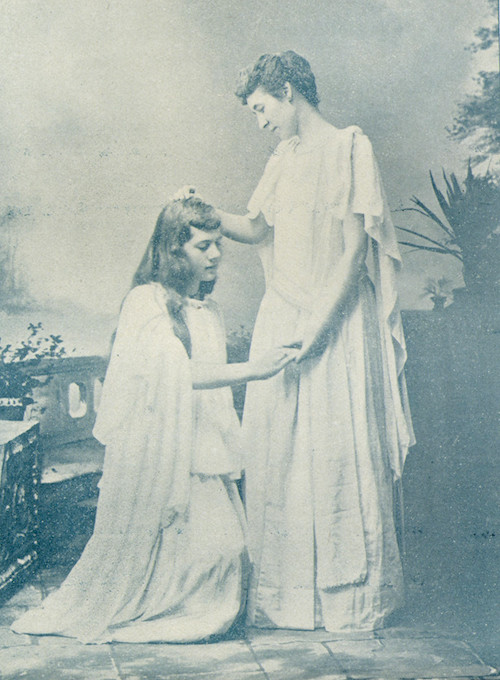
“To hear, to heed, to wed, Fair lot that maidens choose, Thy mother’s tenderest words are said, Thy face no more she views.”
A New Mother.
I was with my lady when she died: I it was who guided her weak hand, For a blessing on each little head, And laid her baby by her on the bed, Heard the words they could not understand. And I drew them round my knee at night, Hushed their childish glee, and made them say, They would keep her words with loving tears, They would not forget her dying fears, Lest the thought of her should fade away. I, who guess’d what her last dread had been, Made a promise to that still, cold face, That her children’s hearts, at any cost, Should be with the mother they had lost, When a stranger came to take her place. And I knew so much: for I had lived With my lady since her childhood: known What her young and happy days had been, And the grief no other eyes had seen— I had watch’d and sorrow’d for alone. Ah! she once had such a happy smile! I had known how sorely she was tried: Six short years before, her eyes were bright As her little blue-eyed May’s that night, When she stood by her dead mother’s side. No—I will not say he was unkind; But she had been used to love and praise. He was somewhat grave: perhaps, in truth, Could not weave her joyous, smiling youth Into all his stern and serious ways. She, who should have reigned a blooming flower, First in pride and honor as in grace— She, whose will had once ruled all around, Queen and darling of us all—she found Change enough in that cold, stately place. Yet she would not blame him, even to me, Though she often sat and wept alone; But she could not hide it near her death, When she said with her last struggling breath, “Let my babies still remain my own!” I it was who drew the sheet aside, When he saw his dead wife’s face. That test Seem’d to strike right to his heart. He said, In a strange, low whisper, to the dead, “God knows, love, I did it for the best!” And he wept—O yes, I will be just— When I brought the children to him there, Wondering sorrow in their baby eyes; And he sooth’d them with his fond replies Bidding me give double love and care. Ah, I loved them well for her dear sake: Little Arthur, with his serious air; May, with all her mother’s pretty ways, Blushing, and at any word of praise Shaking out her sunny golden hair. And the little one of all—poor child! She had cost that dear and precious life. Once Sir Arthur spoke my lady’s name, When the baby’s gloomy christening came, And he call’d her “Olga—like my wife.” Save that time he never spoke of her. He grew graver, sterner every day: And the children felt it, for they dropp’d Low their voices, and their laughter stopp’d While he stood and watch’d them at their play. No, he never nam’d their mother’s name. But I told them of her: told them all She had been, so gentle, good and bright; And I always took them every night Where her picture hung in the great hall. There she stood: white daisy’s in her hand, And her red lips parted as to speak With a smile; the blue and sunny air Seem’d to stir her floating golden hair, And to bring a faint blush on her cheek. Well, so time pass’d on; a year was gone, And Sir Arthur had been much away, When the news came! I shed many tears When I saw the truth of all my fears Rise before me on that bitter day. Any one but her I could have borne! But my lady lov’d her as her friend, Through their childhood and their early youth, How she used to count upon the truth Of this friendship that would never end! Older, graver than my lady was, Whose young, gentle heart on her relied, She would give advice, and praise, and blame, And my lady lean on Margaret’s name, As her dearest comfort, help and guide. I had never liked her, and I think That my lady grew to doubt her too Since her marriage; for she named her less, Never saw her, and I used to guess At some secret wrong that I never knew. That might be or not. But now, to hear She would come and reign here in her stead, With the pomp and splendor of a bride: Would no thought reproach her in her pride With the silent memory of the dead? Lo the day came, and the bells rang out, And I laid the children’s black aside; And I held each little trembling hand, As I strove to make them understand, They must greet their father’s new-made bride. Ah, Sir Arthur might look grave and stern, And his lady’s eyes might well grow dim, When the children shrank in fear away,— Little Arthur hid his face, and May Would not raise her eyes, or speak to him. When Sir Arthur bade them greet “their mother,” I was forced to chide, yet proud to hear How my little loving May replied, With her mother’s pretty air of pride,— “Our dear mother has been dead a year!” Ah! the lady’s tears might well fall fast, As she kiss’d them, and then turned away. She might strive to smile or to forget, But I think some shadow of regret Must have risen to blight her wedding-day. She had some strange touch of self-reproach; For she used to linger day by day By the nursery door or garden gate With a sad, calm, wistful look, and wait Watching the children at their play. But they always shrank away from her When she strove to comfort their alarms, And their grave, cold silence to beguile: Even little Olga’s baby smile Quiver’d into tears when in her arms. I never could chide them; for I saw How their mother’s memory grew more deep In their hearts. Each night I had to tell Stories of her whom I loved so well When a child, to send them off to sleep. But Sir Arthur—O, this was too hard!— He who had been always stern and sad In my lady’s time, seem’d to rejoice Each day more; and I could hear his voice Even, sounding younger and more glad. He might perhaps have blamed them; but his wife Never failed to take the children’s part. She would stay him with her pleading tone, Saying she would strive, and strive alone, Till she gained each little wayward heart. And she strove indeed, and seem’d to be Always waiting for their love, in vain; Yet when May had most their mother’s look, Then the lady’s calm, cold accents shook With some memory of reproachful pain. Little May would never call her mother: So one day, the lady bending low, Kiss’d her golden curls, and softly said, “Sweet one, call me Margaret, instead,— Your dear mother used to call me so.” She was gentle, kind, and patient too, Yet in vain: the children held apart. Ah, their mother’s gentle memory dwelt Near them, and her little orphans felt She had the first claim upon their hearts. So three years pass’d; then the war broke out; And a rumor seemed to spread and rise; First we guess’d what sorrow must befall, Then all doubt fled, for we read it all In the depths of her despairing eyes. Yes; Sir Arthur had been called away To that scene of slaughter, fear, and strife, Now he seemed to know with double pain The cold, bitter gulf that must remain To divide his children from his wife. Nearer came the day he was to sail, Deeper grew the coming woe and fear, When one night, the children at my knee, Knelt to say their evening prayer to me, I looked up and saw Sir Arthur near. There he waited till their low “Amen;” Stopp’d their rosy lips raised for “good night!” Drew them with a fond clasp, close and near, As he bade them stay with him, and hear Something that would make his heart more light. Little Olga crept into his arms; Arthur leant upon his shoulder; May Knelt beside him, with her earnest eyes Lifted up in patient, calm surprise— I can almost hear his words to-day. “Years ago, my children, years ago, When your mother was a child, she came From her northern home, and here she met Love for love, and comfort for regret, In one early friend,—you know her name. “And this friend—a few years older—gave Such fond care, such love, that day by day The new home grew happy, joy complete, Studies easier, and play more sweet, While all childish sorrows pass’d away. “And your mother—fragile, like my May— Leant on this deep love,—nor leant in vain. For this friend (strong, generous, noble heart!) Gave the sweet and took the bitter part, Brought her all the joy, and kept the pain. “Years pass’d on, and then I saw them first: It was hard to say which was most fair, Your mother’s bright and blushing face, Or the graver Margaret’s stately grace; Golden locks, or braided raven hair. “Then it happen’d by a strange, sad fate, One thought entered into each young soul: Joy for one—if for the other pain; Loss for one,—if for the other gain, One must lose, and one possess the whole. “And so this—this—what they car’d for—came And belong’d to Margaret: was her own. But she laid the gift aside, would take Pain and sorrow for your mother’s sake, And none knew it but herself alone. “Then she travell’d far away, and none The strange mystery of her absence knew, Margaret’s secret thought was never told: Even your mother thought her changed and cold, And for many years I thought so too. “She was gone; and then your mother took That poor gift which Margaret cast aside: Flower, or toy, or trinket, matters not— What it was had better be forgot; It was just then she became my bride. “Margaret is my dear and honored wife, And I hold her so. But she can claim From your hearts dear ones, a loving debt I can neither pay, nor yet forget: You can give it in your mother’s name.” Next day was farewell—a day of tears; Yet Sir Arthur as he rode away, And turned back to see his lady stand With the children clinging to her hand, Look’d as if it were a happy day. Ah, they lov’d her soon! The little one Crept into her arms as to a nest; Arthur always with her now; and May Growing nearer to her every day:— Well, I loved my own dear lady best. —Adelaide Proctor.
Richard Dingle’s Speech.
I am Master Richard Dingle, Tho’ my comrades call me Dick, And I have a purpose single, Which I’ll mention very quick. Every day I get a lecture For behaving very wrong; And with wise looks some conjecture That I’ll never get along. But what’s past my mind’s construing Is, that all these busy elves Scold and thrash poor me for doing What they daily do themselves! Master Meekly says ’tis fearful, To be crushing harmless flies, Yet can he, with gun, quite cheerful Seek the bird that bleeding lies. Others say: “Look here, Dick Dingle, Love of gold is vain and vile.” Yet when they detect its jingle, Why, somehow they always smile. Doctor Blacktooth says tobacco Is not even fit for brutes, Yet to make his teeth still blacker Smokes the rankest of cheroots! Now it seems to me the purest Seldom scold us when they teach, For they know the way that’s surest Is to practice what they preach! —Geo. M. Vickers.
Word Pictures.
In fulfillment of our promise in a former number, we will now endeavor to give a few ideas upon the important subject of “suiting the action to the word.” Gestures are of two kinds, curved and straight, or emphatic and descriptive.
In the preparation for emphatic gestures the hand should be
Descriptive gestures require the curved preparation, i. e., the hand is brought in front of the body in the direction of the opposite shoulder, and then a graceful sweep is made in the line desired.
In the preparation of a selection for recitation, the first requisite is to lay out your picture, and locate every object that is mentioned; let it be firmly set in your mind so that you will not change the position of any portion of the scene during the course of the recitation.
A very fine piece for practice upon this is the “Ballad of Breakneck,” in the present number. Suppose you turn to it and imagine yourself to be standing upon the banks of the Hudson, in a position commanding the view down the river; by examining the marked gestures you will be able to locate the entire scene. In the delivery of a piece, always try to see with your mind’s eye what you are describing to your audience, and if the object is supposed to be in sight, let the eye follow the gesture; this, however, should be avoided in emphatic gestures, or where the thing described is supposed to be hidden from view.
The following rules will serve as a guide in deciding the directions that gestures should take:
Front gestures express unity, personality, direct address, and forward motion; also refer to the future.
Oblique gestures express plurality, general assertion, and are used in addressing numbers.
Lateral gestures express vastness in time, numbers, space or idea; also casting away, and negation.
Backward gestures express remoteness in time or space.
Descending gestures pertain to the will, express determination and emphasis.
Horizontal gestures pertain to the intellect, and are used in argument and address.
Ascending gestures pertain to the imagination, and express exultation.
—F. Lizzie Peirce.
The Meeting at Wendletown.
’Twas early in the winter when first the talk began About the rights of women and the cruelty of man, Sech talk was new in Wendeltown, it scared us all to hear How ignorant we women was about our proper speer; And how we’d toiled and pinched and saved, and nothing better knew, While our husbands did the thinking and held the pursestrings too. Miss Harper come and tell us this—a lecturer—you know. Law me! how beautiful she talked; her words jest seemed to flow As smooth and easy as the brook—she looked and moved so quiet; But she fairly shook old Wendletown, she raised up sech a riot; And when I heerd her tell about us women’s “wasted years,” Although I’m old and tough, you’d think, I couldn’t keep from tears. Soon all the wives and mothers too, began to see quite plain That jest to bake and churn and mend was laboring in vain: While Mrs. Cap’n Brown she come and sez, sez she to me, “I’m going to have a high career,” whatever that may be. But Miss Harper hed to leave us, so she advertised one day That she’d lecture in the school-house once before she went away. Well, the room was packed that evening and Miss Harper did her best, Her gift of speech was wonderful,—that all the men confessed— She soared, way up into the clouds, and back to earth again, And showed us most convincin’ly the worthlessness of men! Her speech was drawing to a close, and she was jest a saying: “Dear sisters, spurn your tyrant, man, and scorn the part he’s playing; Let him perform the menial tasks he’s set for you so long, While you stand on the mountain tops, rejoicing free and strong!” Joe Hale was setting close at hand, right in the foremost row, And on his knees his little child, ’bout two year old or so: Joe was a poor, lone widower, his wife was dead and gone, His home was near the school-house, and I ’spose he felt forlorn, So he’d come and brought the baby, though the reason why I knew— His hired girl had slipped away to hear the lecture too. And jest that very minute, when the room was still as death, And you might have heerd a pin drop as Miss Harper stopped for breath, That little toddling thing slid from off her father’s knee, Crept close up to the lecturer’s desk and said: “Does ’ou love me?” Poor Joe jest turned a fiery red, and tried to snatch the child; But Miss Harper she leaned over and looked at him and smiled; Then dropping all her papers, in the twinkling of an eye, She clasped the little one, who gave a wondering, happy cry, And laid her little curly head right down upon her breast, With both arms clinging round her neck, as if she’d found her rest! It’s as fresh now as a picter, though it happened months ago, How she held that little baby girl a whispering soft and low; Her eyes as bright and smiles a-coming and a-going, While all the sound that you could hear was jest the child a-crowing. Up to this time astonishment had kept the folks all still; But some one shouted out—“Three cheers and give ’em with a will! It’s plain enough Miss Harper has found her proper speer, And man, the tyrant’s conquered! Now boys a rousing cheer!” That meeting broke up in a tumult, but Joe was waiting there; He’s a manly, handsome fellow, and when I saw the pair Go walking off together, I sez, sez I, “It needs no witch to tell What’s coming next.” And warn’t I right? Folks laughed and talked a spell, But we all danced at the wedding! Law! how she settled down! There ain’t no better housewife than Mrs. Hale in all this town.
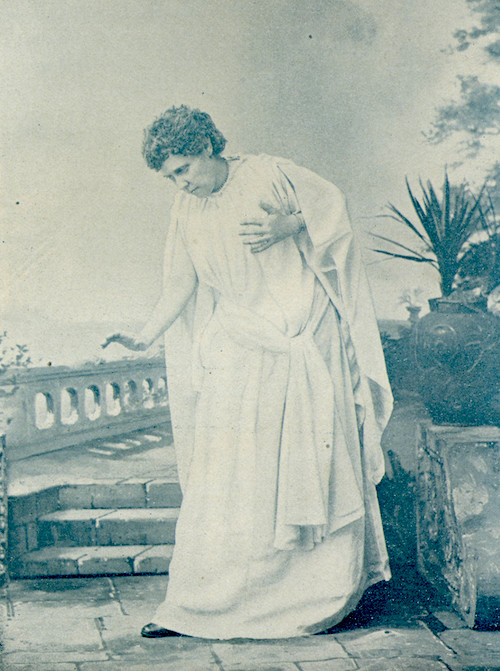
“Oh, my heart’s love! oh, my dear one! Lay thy poor head on my knee.”
Petruchio’s Widow.
A Shakesperian Travesty
In One Act.
Characters.
Mr. Romeo Montague, an unlucky suitor.
Mr. Moses Shylock, a pawnbroker.
Mrs. Kate Petruchio, a dashing widow.
Miss Helena, an affectionate spinster.
Mrs. Desdemona Othello, an unhappy neighbor.
Mrs. Jessica Lorenzo, an ungrateful daughter.
Scene:—A parlor; door pract. C. flat; window L. flat, open; table beneath window; rocking chair R. C.; chairs at wings; Mrs. Petruchio discovered standing in door.
Mrs. Pet.—’Tis a good thing that Jessica has finished dusting this parlor; no nonsense will I tolerate from man, woman, or child within this domicile. (Enters and throws herself in rocking chair.) Petruchio ran affairs while living; but, in his demise—poor fellow—I re-inherited the freedom of my tongue. (Calls) Jessica!
Jessica (from without).—I am here; please wait; don’t scold; here I am. (Enters L.) Your pleasure, madam.
Mrs. Pet.—Have you washed the front steps, scrubbed the pavement and wrung out the clothes that were wet by the rain?
Jessica.—Alas! all these, and more, have I done. I have picked the beans, mixed the batter for muffins, put the mackerel in soak for breakfast, and——
Mrs. Pet.—Enough! Why thus parade before my fancy’s eye the coarse details of cookery. I tell you ’tis scarce an hour since I ate—the subject is distasteful.
Jessica.—But, madam, you asked me what——
Mrs. Pet. (stamps foot).—Silence!
Jessica.—You are dreadfully cross. When I came to you and told you the story of my life, how I eloped with poor, dear Lorenzo, who was all a woman could ask, while the money I took from father lasted——
Mrs. Pet.—And who hastily departed simultaneously with the last ducat——
Jessica.—Do not wound my spirit. I repeat, you promised to give me shelter, to shield me, treat me kindly——
Mrs. Pet.—Shut up! move! Lorenzo, you say, has gone to Padua to seek a position as pen-wiper to Ballario; believe it not; he is in Venice suing for a divorce before the Duke. Unhappy woman, move!
Jessica (aside).—As Jessica Shylock I was envied as a rich man’s child; as Jessica Lorenzo I am——
Mrs. Pet.—What’s the use of whining; you will never see Lorenzo more.
Jessica.—
There is a tide in the affairs of men— If men, then women, too— Which taken at the flood leads on to fortune; Omitted, all the voyage of their life Is bound in shallows and in miseries; And we must take the current when it serves, Or lose our ventures!
I leave for Venice this very night!
Mrs. Pet.—Away to the kitchen and put on the beans!
Jessica (looks off L).
Mrs. Pet.—
Alas! how is it with you, That you do bend your eye on vacancy And with the incorporal air do hold discourse? Forth at your eyes your spirits wildly peep!
Jessica (points L).—T. O. M.
Mrs. Pet.—T. O. M.? Tom who?
Jessica.—No, no! The—old—man; my father, Moses Shylock, is creeping up the gravel path. Hide me! Do not betray me!
Mrs. Pet.—
Though all the world should crack their duty, And throw it from their soul; though perils did Abound as thick as thought could make them, and Appear in forms more horrid; yet would I Be true; yea, true as truth itself, And stand unshaken yours,—
Away to the kitchen and you are safe!
Jessica.—I love my father, but I fear his righteous rage.
Mrs. Pet.—Stay, then; confess and ask his pardon.
Jessica (Shakes head sadly and exits R).
Mrs. Pet.—
What! gone without a word? Ay, so true love should do: it cannot speak; For truth hath better deeds than words to grace it.
[Enter Shylock, door F.]
Mrs. Pet.—How now, Shylock? What news among the merchants? What will you loan upon my ulster?
Shylock.—Take it to my brother Solomon, on the Rialto; he’ll give you liberally and charge you naught for camphor.
Mrs. Pet.—Have you heard from your daughter, and your son-in-law, Lorenzo, lately?
Shylock.—No, no; not I. All hope to find her long hath fled. One-half the jewels that she took no doubt Lorenzo pawned; and yet the thankless knave sent me not e’en a ticket to redeem the goods!
Mrs. Pet.—’Tis said, for satisfaction’s sake, you now refuse to grant renewal of your loans, e’en though the interest thereon be paid; ay, that Antonio, the poor butcher, will lose the meats that now are forfeit. Why take his venison? Wilt answer, Shylock?
Shylock.—
I hate him, for he is a Christian; But more, for that, in low simplicity, He lends out money gratis, and brings down The rate of usance here with us in Venice. If I can catch him once upon the hip I will feed fat the ancient grudge I bear him. He hates our sacred nation; and he rails Even there where merchants most do congregate, On me, my bargains, and my well-won thrift, Which he calls interest. Cursed be my tribe If I forgive him.
Mrs. Pet.—If I were his wife you would not thus berate the man. If Petruchio could speak, he’d say so too.
Shylock.—I seek my truant child; I heard she lived, not long since, hereabouts.
Mrs. Pet.—Excuse me, Mr. Shylock, call again.
Shylock.—Have you any old garments to sell?
Mrs. Pet.—Leave, and call again; two neighbors now approach who may mistake the object of your visit. Go! Leave by the side door.
Shylock.—
O father Abraham, what these Christians are, Whose own hard dealings teach them to suspect The thoughts of others! Adieu!" [Exit L.]
Mrs. Pet (looking L).—O, you miserly old money-grabber, if you think I will tell on poor Jessica, you know but little of Kate Petruchio! Go! go! go! you old parent, you stingy father, and con over your collaterals of watches, fiddles, bibles and pistols!
[Enter Miss Helena and Mrs. Othello, door F.; they pause and observe Mrs. Petruchio.]
If I was your wife wouldn’t I take the kinks out of those grizzly locks, though!
Mrs. Othello (to Helena).—What should this mean?
Helena.—O what a noble mind is here o’erthrown!
Mrs. Pet.—Ah, ladies, kind, sweet neighbors, how glad I am to see you here!
Mrs. Othello.—Do you have any pain here? (Touches head).
Helena.—Is not the plumb-bob of your mental plumb-line out of plumb?
Mrs. Pet.—
Lay not that flattering unction to your soul. My pulse, as yours, doth temperately keep time, And makes as healthful music: It is not madness That I have uttered: bring me to the test, And I the matter will re-word, which madness Would gambol from.
Saw you not that animated gaberdine descend my garden path?
Mrs. Othello.—You do not mean our mutual uncle, Moses Shylock; from whom, however, I never borrow.
Helena.—Nor I.
Mrs. Petruchio.—Do you mean to insinuate that I presume upon his kinship to obtain loans?
Mrs. Othello.—What have I done that thou dar’st wag thy tongue in noise so rude against me?
Helena.—Hist! he comes!
Mrs. Petruchio.—Who comes?
Helena.—My Romeo.
Mrs. Othello.—Your Romeo! Forsooth you have not spoken to him more than twice.
Romeo (Without, singing).—
“Oh, meet me by moonlight alone, And then I will tell you a tale Must be told in the moonlight alone, In the grove——”
Helena.—
If music be the food of love, sing on, Give me excess of it; that, surfeiting, The appetite may sicken and so die.
Mrs. Pet.—
This music mads me; let it sound no more, For though it have helped mad men to their wits, In me, it seems, it will make wise men mad.
Romeo (without, sings).—
“Oh, meet me by moonlight a — — — — — lone!”
Helena.—
That strain again; it had a dying fall; Oh, it came o’er my ear like the sweet south, That breathes upon a bank of violets, Stealing and giving odor.
Romeo (without, sings).—
“Yes, meet—yes, meet—yes, meet me by moonlight a—lone.”
Mrs. Pet.—Horrible! monstrous! was ever sound so nerve-destroying heard save from the larynx of a dying calf? I despise these daylight serenades.
Mrs. Othello.—
The woman that hath no music in herself, Nor is not woo’d with concord of sweet sounds, Is fit for treasons, stratagems and spoils; The motions of her spirit are dull as night, And her affections dark as Erebus: Let no such dame be trusted!
Mrs. Pet.—Ha! this is more than I can brook; my tongue’s my own to wag it as I will, therefore attempt not to criticise my criticisms——I repeat, the fellow sings like a Scandinavian bag-pipe.
Helena.—Ladies, pray be still! He may hear your dreadful comments.
[Knock heard at door.]
’Tis he!
Mrs. Othello.—Let him not in until I depart! If Mr. Othello should happen to step in and find me in company with this gallant youth his jealousy would know no bounds!
[Knock repeated.]
Mrs. Pet.—Nonsense! I hope he does come, I’d like to give him my opinion of jealous husbands—
Foul jealousy! that turnest love divine To joyless dread, and mak’st the loving heart With hateful thoughts to languish and to pine, And feed itself with self-consuming smart; Of all the passions in the mind thou vilest art!
Romeo (without).—I suppose there’s no one home. (Knocks). Hello! anybody in?
Helena (opens door).—Mr. Romeo! how delightful this surprise.
Romeo (enters).—To me this is a pleasure sweet, sweet beyond comparison. (Aside.) Her looks do argue her replete with modesty.
Helena.—It gives me wonder, great as my content, to see you here before me.
Mrs. Pet.—
Sir, you are very welcome to our house: It must appear in other ways than words, Therefore I scant this breathing courtesy.
Mrs. Othello.—
A hundred thousand welcomes; I could weep, And I could laugh; I am light and heavy—welcome.
[Looks about cautiously.]
Yea, I could laugh and weep (aside.) It entirely depends upon the movements of Mr. Othello. He’s so jealous.
Mrs. Pet.—Be seated, friend Romeo; Miss Helena will entertain you while Mrs. Othello and I see that the festive board is spread below. Come, away to the pantry!
[Exit followed by Mrs. Othello.]
Romeo (places a chair for Helena).
(Aside) There’s language in her eye, her cheek, her lip, Nay, her foot speaks. (Aloud.) Be seated, miss.
Helena.—Thank you, sir. (Aside.) I know not why I love this youth.
Romeo.—
Helena, I love thee; by my life I do; I swear by that which I will lose for thee, To prove him false that says I love thee not!
Helena.—Dost thou love me? I know thou wilt say ay, and I will take thy word.
Romeo (takes chair).—
O happy fair! Your eyes are load-stars, and your tongue’s sweet air, More tunable than lark to shepherds’ ear, When wheat is green, when hawthorn buds appear.
Helena.—You have bereft me of all words.
Romeo (aside).—
See how she leans her cheek upon her hand! O that I were a glove upon that hand, That I might touch that cheek!
[Knock at door.]
(Aloud.) Ah, me! for aught that I could ever read; Could ever hear by tale or history, The course of true love never did run smooth.
[Rises and opens door.]
[Enter Shylock with old garments on his arm.]
Helena (rising).—
His horrid image doth unfix my hair, And make my seated heart knock at my ribs.
Romeo.—
Angels and ministers of grace, defend us! Be thou a spirit of health or goblin damned, Bring with thee airs from heaven or blasts from hell; Be thy intents wicked or charitable Thou comest in such a questionable shape That I will speak to thee!
Shylock (to Helena).—
I do defy him, and I spit at him; Call him a slanderous coward and a villain, Which to maintain, I would allow him odds, And meet him where I tried to run a-foot; Even to the frozen ridges of the Alps.
[Throws garments on floor.]
Helena.—
What cracker is this same that deafs our ears With this abundance of superfluous breath?
Romeo.—
He gives the bastinado with his tongue; Our ears are cudgel’d; not a word of his, But buffets better than a fist of France: Zounds, I was never so bethumped with words Since I first called my brother’s father dad.
Shylock.—Peace! one word: in yonder pile, for little more than half the cost, a seal-skin wrap and overcoat may grace your youthful forms.
Romeo (to Shylock in undertone).—I pray thee, gentle signor of the Gilded Balls, say naught before this maid that will reveal the fact that half my garments now repose upon your shelves.
Helena (to Shylock).—To-night I’ll steal into thy place of trade, and, under cover of the evening’s shades, examine well the seal-skin sack whereof you speak. Say nothing now, sir; mum’s the word!
Shylock.—’Tis in my memory locked, and you yourself shall keep the key of it.
[Enter Jessica, Mrs. Petruchio and Mrs. Othello.]
Jessica.—Oh! Oh! (jumps behind Mrs. Petruchio).
Mrs. Othello.—Hide me! Save me!
Mrs. Pet.—Thou shalt be punished for thus frightening me, thou man of loans. Be quiet sweet Mrs. Othello, thy husband is not here.
Mrs. Othello.—Mr. Romeo, what brings this, our general kinsman, here upon the scene?
Romeo.—His business calls him here.
Mrs. Pet.—Romeo, put him out: mind not his glaring eyes, but put him hence!
Romeo.—
Prythee, peace! I dare do all that may become a man; Who dares do more is none!
Mrs. Pet.—
What seek’st thou? Avaunt, and quit my sight! let the earth hide thee! Thy bones are marrowless, thy blood is cold; Thou hast no speculation in thy eyes Which thou dost glare with!
Helena (to Shylock).—
Win her with gifts if she respect not words; Dumb jewels often, in their silent kind, More quick than words do move a woman’s mind.
Mrs. Pet.—See here, old man, just tell me what you want?
Shylock.—
My daughter! O my ducats! O my daughter! Fled with a Christian! O my, my Christian ducats! Justice! the law! my ducats and my daughter! A sealed bag, two sealed bags of ducats, Stolen by my daughter! Justice! find the girl!
Romeo.—Poor man!
Helena.—Why not advertise her in the papers?
Mrs. Othello.—Or, like my husband, employ a private detective?
Shylock (to Mrs. Petruchio).—Woman, tell me where to find my child! Lorenzo, he has been set free by the Venice court’s decree. If the proof you wish to see, take the train for the city by the sea.
Mrs. Pet.—I know not where Jessica Shylock lives, nor care to hear your family cares.
Shylock.—
A serpent heart, hid with a flow’ring face, Did ever dragon keep so fair a case? Beautiful tyrant, fiend angelical! Just opposite to what thou seem’st— I see my daughter’s head behind thy ear, Ay, behind the wig that doth surmount thy head!
Mrs. Pet.—Me wear a wig? O wrinkled Jew, take back thy child, whom only kindness taught me to conceal. No more courage now remains: away with her! In saying that I wear a wig, you crush my heart, and now I fain would be alone.
Jessica (embraces Shylock).—Father, forgive me!
Romeo.—See! the Jew relents!
Helena.—O gentle Romeo!
Mrs. Othello.—I hope I shall get home before the Moor returns!
Shylock (takes Mrs. Petruchio’s hand.)
You are a widow, and I without a wife, Seek, vainly seek, for joy in life— Will you, in short, old Shylock wed?
Mrs. Pet.—Think you, sir, my reason’s fled. (Withdrawing hand indignantly.) Marry you? Never! Sooner would I see you hanged.
Shylock.—But are you happy?
Romeo.—
Happy in this, she is not yet so old But she may learn; and happier than this, She is not bred so dull but she can learn; Happiest of all is, that her gentle spirit Would ne’er commit itself to yours.
Shylock.—Go to, and why?
Mrs. Othello.—
Oh! sir, you are too old; Nature, in you, stands on the very Verge of her confine.
Helena.—
Our hostess needs no fossil staff On which to lean through life; The dame in scorn does at you laugh, Go, seek an older wife!
All.—Yes, go! (pounding and pushing him.) Go! go! go!
Shylock (runs to centre and kneels).—Mercy! (All take positions.)
[Curtain.]
—George M. Vickers.
[372]The Proud Flag of Freedom.
The proud flag of freedom, unsullied, behold How cluster about it the glories of years, As skyward and westward, ’mid purple and gold, In the land of the sunset, its home, it appears. America’s token of faith never broken, Sweet signal that flutters o’er mountain and sea; That mutely repeats what our fathers have spoken, That tells the oppressed they may come and be free! O proud flag of freedom, how swells with delight The breast of the wand’rer who meets thee afar; What home-visions come with the gladdening sight, And how fond dwells his eye on each stripe and each star! Thus be it forever, while oceans may sever, Or fate hold in exile, a man from our shore! Tho’ fairer the clime, an American never Forgets his own colors, but loves them the more. Thou proud flag of freedom, so lovely in peace, So awfully grand in the dread crash of war, Be ever unfaded ’till nations shall cease, While there’s room in the blue for another bright star: From danger defending, still onward, ascending; The hope of mankind and the envy of none: E Pluribus Unum, our motto transcending, Till earth’s constellations are blended in one! —Geo. M. Vickers.
Lost in the Mountains.
See you that[373] yellow thread, that, snake-like, winds High up the mountain side, now hid, now seen, Now lost[374] to view amid the shelving crags And stunted pines? That is a rugged pass, Called, hereabouts, The Devil’s Trail. Just where We stand,[375] I stood one Autumn day, and heard The legend from an aged mountaineer, And, as my mem’ry serves me, word for word, Like this the story ran: Mark Lysle, a rich, Eccentric widower, and Maud, his child, Long years agone, lived in that house[376] whose red Roof peeps from yonder clump of trees; and though You see a light, blue plume of smoke above The chimney top, yet other hearts now sit About the hearth and watch its glow, for that Bright fire which blazed when Lysle held sway, died out One stormy night, never to burn again. For miles and miles,[377] which way you went, the fame Of Lysle would greet your ear; his courtesies, His open house and hospitalities, Were themes discussed no less than were his quick Resentment of a fancied slight, his fierce, Hot temper, when aroused, or swiftness to Avenge a wrong. But those who knew his child, Who saw her pure, white brow, her gold brown hair, And read the truth within her hazel eyes, Deemed her in ev’ry[378] trait of character His antipode, his very opposite— A lion him, and her a sweet gazelle. Together lived they in that[379] red-roofed house, He, father, brother, lord and slave by turns: She, ever steadfast, mild, obedient, So like her mother—an exotic frail, A Northern lily ’neath a Southern sun. One Victor Dale, whose acres joined, and stretched[380] Far west from Lysle’s estate; whose negro huts Gleamed white amid the evergreens; the man Her father called his chosen friend, this man, Her senior by a score of years, and ill Of feature, sought the maiden’s hand, nay, claimed It by a compact with her father made Before her mother’s death. But Maud, sweet Maud, Who knew not how to hate, whom duty bound, Whose only statute was her father’s will, Thus far had viewed her marriage in the light Of something that she might escape, a thing She might avoid, that would not come to pass; As those condemned to death will hope when hope Is dead, so hung she on the rosy thought, And comfort took in hoping that it would Not be; and though his would-be gallantries Oft filled her with disgust,[381] and oft provoked A loathing in her breast, she hated not. Once, on a summer day, with book in hand, Maud sat beneath a tree. Upon the porch, Reclining on a bamboo chair, her father dozed: A sudden cry aroused them both in time To see a horse, with empty saddle, dash[382] Across the road and leap the hedge. While yet They stood amazed some field hands moving slow, Came up the shaded walk[383] bearing between Their swarthy forms the helpless body of A man. With almost woman’s tenderness Mark Lysle made haste to have the wounded youth Borne to his choicest room, and summoned quick A surgeon, nor would rest until assured His uninvited guest was doing well, As well as one with broken limb could do. Thus Henri Clair, an artist, far from home, Was thrust by fate upon a stranger’s care. The leaves[384] have lost their summer hue of green; The purple grapes in clusters thick hang low; The grain is garnered, and a late bee wings Its way across the porch. Young Clair and Maud Stand side by side[385]; the setting sun shines full Upon their faces[386]: pale is his and sad, And hers all tenderness and sympathy: His time to go has come; this night will be His last beneath her father’s roof. In two Short months, by merest chance, their youthful hearts Have learned to beat as one, yet hopelessly. Behind a tree[387] two other forms crouch low; Her father, and her suitor, Victor Dale. They glide away[388] unseen. That night when all Were gathered round the hearth, Mark Lysle, In tones that fell like death upon the ears Of those who heard him speak, announced It as his will,[389] that on the coming day His daughter Maud should wed his chosen friend; “And, sir,” said he to Clair, “as you must deem It time to go, I shall not press you to Remain, but bid you speed upon your way,” And then, with haughty bow, strode out.[390] “Farewell,[391] Until we meet again—” “No,[392] Maud, we must Not say good-bye; to leave you now would be To part forever,” then young Clair’s voice sank Into a whisper; then, with one pure kiss In haste imprinted on her brow, he left The room, and then the house. The tall, old clock That in the hallway stood, was striking nine As Maud stole out[393] into the night. Dark clouds Were rising[394] in the west. The lightning flashed From out the distant sky;[395] the thunder boomed And rattled off in echoes ’mong the hills;[396] The black mass rising soon obscured[397] the stars O’erhead; then plashing rain drops told the storm Had burst. “To wed the hand and not the heart Is sin, far greater than to disobey. May God forgive me if I err: my heart[398] Must be my guide.” Thus murmured Maud, as all Alone she sped across the fields to reach Yon rugged pass[399] where Clair had gone to wait, That when she came they both might mount his steed, And so avoid pursuit, none dreaming they Would choose that fearful path for flight. The sun Shone bright. The wet grass gleamed as though bedecked[400] With gems. The storm had gone; the night had gone, And she had gone, the star[401] of Mark Lysle’s home, Gone—to return no more. The dark night through, Young Henri Clair, high on a rocky cliff Had watched and listened for his promised bride; Had bended to the rock his ear,[402] had called, Loud as he dared, “Maud! I am waiting, Maud!” But never came reply. Again, “Here, Maud!” Then sobbed and sighed the wind,[403] all else was still. At dawn of day, and fearing that she could Not brave the storm, all wan and pale he rode Swift down the steep descent to learn the worst. He scarce had reached the narrow valley road Ere Lysle and Dale each bade him halt[404] or die. Then shouting loud they called the negroes, swore, And charged him with the maiden’s death or worse. “She’s lost! O God,[405] she’s lost! Come, follow me!” Cried Clair; then, struck with cruel spur, his horse In terror bore him up[406] the winding path. “I come!” shrieked out his rival, Dale; “I come!” And off he dashed,[407] his livid face drawn grim With jealous rage. Then followed Lysle, and then The throng of blacks, like hounds unleashed. A cry! Again a cry of mortal pain was heard! The throng pressed up, and round[408] a jutting point, Till came in view a level breadth[409] of rock That shelved and overhung a sheer descent[410] Of awful depth. There, like a sculptor’s work On pedestal of stone, young Henri Clair Sat rigid on his steed and pointed down[411] The deep abyss. In horror peered they all Below, where lay the object of his gaze— The white, the lifeless form of Maud. The spell Was broke by one wild laugh from Henri’s lips. With curb he drew[412] his horse erect; he threw His mantel o’er its head, struck deep his spurs, And with the shout, “My bride!” leaped down to death.[413] And to this day the story still is told Of trav’lers, who, belated on the pass, Have heard, when, softly sobbed the wind, a voice Call tenderly and low, “I’m waiting, Maud!— Here, Maud!—Is that you, Maud?” —George M. Vickers.
Gestures.
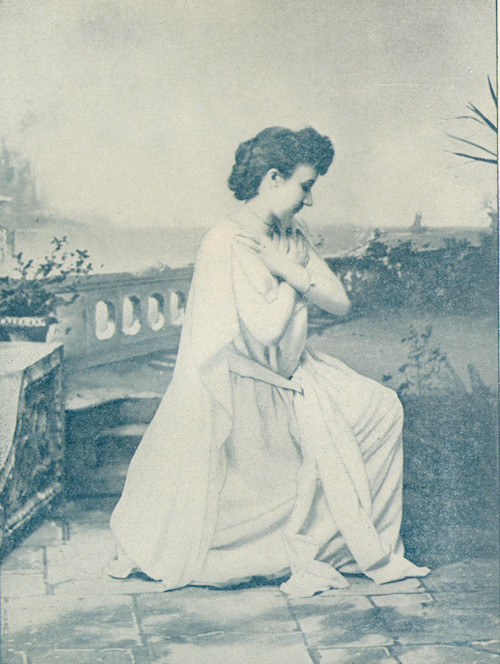
“Father, Thy will, not mine, be done.”
Maiden Song.
Long ago and long ago, and long ago still, There dwelt three merry maidens upon a distant hill. One was tall Meggan, and one was dainty May, But one was fair Margaret, more fair than I can say, Long ago and long ago. When Meggan plucked the thorny rose, and when May pulled the brier, Half the birds would swoop to see, half the beasts draw nigher; Half the fishes of the stream would dart up to admire: But when Margaret plucked a flag-flower, or poppy, hot aflame, All the beasts and all the birds and all the fishes came To her hand more soft than snow. Strawberry leaves and May-dew in brisk morning air, Strawberry leaves and May-dew make maidens fair. “I go for strawberry leaves,” Meggan said one day: “Fair Margaret can bide at home, but you come with me, May; Up the hill and down the hill, along the winding way, You and I are used to go.” So these two fair sisters went with innocent will Up the hill and down again, and round the homestead hill: While the fairest sat at home, Margaret like a queen, Like a blush-rose, like the moon in her heavenly sheen, Fragrant-breathed as milky cow or field of blossoming bean, Graceful as an ivy bough, born to cling and lean, Thus she sat to sew and sing. When she raised her lustrous eyes a beast peeped at the door; When she downward cast her eyes a fish gasped on the floor; When she turned away her eyes a bird perched on the sill, Warbling out its heart of love, warbling, warbling still With pathetic pleadings low. Light-foot May, with Meggan, sought the choicest spot, Clothed with thyme, alternate grass; then, while day waxed hot, Sat at ease to play and rest, a gracious rest and play; The loveliest maidens near or far, when Margaret was away, Who sat at home to sing and sew. Sun-glow flushed their comely cheeks, wind-play tossed their hair, Creeping things among the grass stroked them here and there; Meggan piped a merry note, a fitful, wayward lay, While shrill as bird on topmost twig piped merry May; Honey-smooth the double flow. Sped a herdsman from the vale, mounting like a flame, All on fire to hear and see, with floating locks he came; Looked neither north nor south, neither east nor west, But sat him down at Meggan’s feet as love-bird on his nest, And wooed her with a silent awe, with trouble not expressed; She sang the tears into his eyes, the heart out of his breast; So he loved her, listening so. She sang the heart out of his breast, the words out of his tongue; Hand and foot and pulse he paused till her song was sung. Then he spoke up from his place simple words and true: “Scanty goods have I to give, scanty skill to woo; But I have a will to work and a heart for you: Bid me stay or bid me go.” Then Meggan mused within herself: “Better be first with him, Than dwell where fairer Margaret sits, who shines my brightness dim, Forever second where she sits, however fair I be: I will be lady of his love, and he shall worship me; I will be lady of his herds and stoop to his degree, At home where kids and fatlings grow.” Sped a shepherd from the height headlong down to look, White lambs followed, lured by love of their shepherd’s crook: He turned neither east nor west, neither north nor south, But knelt right down to May, for love of her sweet-singing mouth; Forgot his flocks, his panting flocks in parching hillside drought; Forgot himself for weal or woe. Trilled her song and swelled her song with maiden coy caprice In a labyrinth of throbs, pauses, cadences: Clear-noted as a dropping brook, soft-noted like the bees, Wild-noted as the shivering wind forlorn through forest trees: Love-noted like the wood-pigeon who hides herself for love, Yet cannot keep her secret safe, but cooes and cooes thereof; Thus the notes rang loud or low. He hung breathless on her breath; speechless, who listened well; Could not speak or think, or wish till silence broke the spell. Then he spoke and spread his hands, pointing here and there: “See my sheep, and see my lambs, twin lambs which they bare. All myself I offer you, all my flocks and care, Your sweet song hath moved me so.” In her fluttered heart young May mused a dubious while: “If he loves me as he says”—her lips curved with a smile: “Where Margaret shines like the sun, I shine like the moon; If sister Meggan makes her choice I can make mine as soon: At cockcrow we were sister-maids, we may be brides at noon. Said Meggan,“Yes;” May said not “No.” Fair Margaret stayed alone at home, awhile she sang her song, Awhile sat silent, then she thought: “My sisters loiter long.” That sultry noon had waned away, shadows had waxed great: “Surely,” she thought within herself, “My sisters loiter late.” She rose, and peered out at the door, with patient heart to wait, And heard a distant nightingale complaining of its mate; Then down the garden slope she walked, down to the garden gate, Leaned on the rail and waited so. The slope was lightened by her eyes like summer lightning fair, Like rising of the haloed moon lightened her glimmering hair, While her face lightened like the sun whose dawn is rosy white. Thus crowned with maiden majesty she peered into the night, Looked up the hill and down the hill, to left hand and to right, Flashing like fire-flies to and fro. Waiting thus in weariness, she marked the nightingale, Telling, if any one would heed, its old complaining tale. Then lifted she her voice and sang, answering the bird: Then lifted she her voice and sang, such notes were never heard. From any bird when Spring’s in blow. The king of all that country, coursing far, coursing near, Curbed his amber-bitted steed, coursed amain to hear; All his princes in his train, squire, and knight, and peer, With his crown upon his head, his sceptre in his hand, Down he fell at Margaret’s knees, Lord, King of all that land, To her highness bending low. Every beast and bird, and fish came mustering to the sound, Every man and every maid from miles of country round: Meggan on her herdsman’s arm, with her shepherd, May; Flocks and herds trooped at their heels along the hillside way; No foot too feeble for the ascent, not any head too gray, Some were swift and none were slow. So Margaret sang her sisters home in their marriage mirth; Sang free birds out of the sky, beasts along the earth, Sang up fishes of the deep—all breathing things that move, Sang from far and sang from near to her lovely love; Sang together friend and foe; Sang a golden-bearded king straightway to her feet, Sang him silent where he knelt in eager anguish sweet. But when the clear voice died away, when longest echoes died, He stood up like a royal man and claimed her for his bride. So three maids were wooed and won in a brief May-tide, Long ago and long ago. —Christina G. Rossetti.
Lecture by One of the Sex.
My antiquated hearers, male and female. Squenchin’ my native modesty which is natural to the weaker vessels of whom I am which, I feel impelled to speak to you this evenin’ on the subject of woman—her origin, her mission, her destiny. A subject, bein’ as I am a woman myself, I hev given much attention to.
Man, my hearers, claims to be the superior of woman! Is it so? and ef so, in what, and how much?
Wuz he the fust creation? He wuz, my hearers, but what does that prove?
Man wuz made fust, but the experience gained in makin’ man wuz applied to the makin’ of a betterer and more finerer bein’ of whom I am a sample.
Nachur made man but saw in a brief space of time that he couldn’t take keer of himself alone, and so he made a woman to take keer uv him, and that’s why we wuz created; tho’ seein’ all the trouble we hev, I don’t doubt that it would hev been money in our pockets if we hedn’t been made at all.
Imagine, my beloved hearers, Adam afore Eve wuz created! Who sewed on his shirt buttons? Who cooked his beefsteak?
He wuz mizzable, he wuz,—he must have boarded out and eat hash!
But when Eve come, the scene changed. Her gentle hand soothed his achin’ brow when he come in from a hard day’s work. She hed his house in order; she hed his slippers and dressin’ gown ready, and after tea he smoked his meerschaum in peace.
Men, cruel, hard-hearted men, assert that Eve wuz the cause of his expulsion from Eden—that she plucked the apple and give him half; oh, my sisters, it’s true, it’s too true, but what uv it?
It proves fustly, her goodness. Had Adam plucked the apple, if it had been a good one, he’d never a thought of his wife at home, but would have gobbled it down himself, and perhaps have taken her the core.
Eve, angel that we all are, thought of him and went halvers with him.
Secondly, it wuz the means of good anyhow. It introduced death into the world, which separated ’em while they still hed love for each other.
I appeal to the sterner sex present to-night. S’posin’ all of you had been fortunate enough to win such virgin souls as me, could you endure charms like mine for an eternity. If I had a husband, I know he’d bless Eve for introducin’ death into the world.
Woman is man’s equal, but is she occupyin’ her true speer? Alas, not! We are deprived of the ballot, we ain’t allowed to make stump speeches, or take part in politics. Is it right? How many men vote who know what they are votin’ for?
I demand the ballot. I want to take part in torchlight processions!
There hev been women in the world who have done something. There was the Queen of Sheba, who was excelled only by Solomon, and all that surpassed her in him wuz that he could support 3,000 women.
Bless Solomon’s heart! I’d like to see him do it now. Where could he find a house big enough to hold ’em with their dozen Saratoga trunks apiece?
How shall we gain our lost rights and assume that position in the world to which we are entitled to?
Oh, my sisters, these is a question upon which I have cogitated long and vigorously.
We might do it by pisonin’ all the men, but we would be robbed of one-half of our triumph, for they wouldn’t be alive to see how well we did things without ’em.
We might resolve to do no more of the degradin’ work they have imposed onto us. But if we didn’t, who would?
One week’s eatin’ what they would cook, would sicken any well-regulated woman, and besides, they might not let us eat at all.
Matrimony, thus far in the world’s history, has been our only destiny.
I am glad I had always strength of mind enough to resist all propositions leadin’ to my enslavement.
I had too much respect for myself to make myself the slave of a man.
Wunst, indeed, I might have done so, but the merest accident in the world saved me. A young man in my younger
It wuz my fust beau, and oh, my sisters, had he that night asked me to be his’n, I should have been weak enough to have said Yes, and I would have been a washer of dishes and a mender of stockin’s for life.
But fate saved me! He did’nt ask me.
—Revised by F. Lizzie Peirce.
Enguerrande’s Child.
La Comtesse Marie holds festival In the fairest nook of her fair demesne, For courtly gallants and smiling dames To mimic the sports of the village green, In hats à la paysanne looped up with gems, And rustic kirtles of satin sheen. But Comtesse Marie, though crowned with May, Scarce smiles on the lovers who round her press, And sits on her floral throne distrait, Nor heeds who, watching her, strives to guess What troubles this heiress, free to choose From the proudest peers of the haute noblesse. She sighs—and a suitor the sigh repeats; Again—and another bends over her chair, For every mood of a lady charms When la dame is so wealthy, so young, and fair; She speaks—and the murmur of talk is hushed, And they throng around with expectant air: “Too sad to sing, and too tired to dance— Shall our sport take sober cast to-night? And gathering under the fragrant limes, Shall we tell old stories of maidens bright, Of crusader bold, and the Soldan grim, Of dreary legend of ghost and sprite?” Then gay De Norville, for wild, weird tale To please the layde, has racked his brain; While Saint Leu, with twirls of his huge mustache, His last duello fights o’er again, And fancies that Marie’s cheek grows pale As he lightly dwells on his wounds and pain. But on one tall figure, that stands aloof, The eye of la Comtesse is seen to fall: And hast thou nothing to tell?” she asks, “Canst thou from the past no deed recall, That might quicken awhile our sluggish blood? Bethink thee, I pray, good Capitaine Paul.” Le Capitaine Paul, whom no one knows, A soldier of fortune, scarred and browned, A man more prized in the camp than court, Steps into the circle and glances round; And scornful eyes on his boldness frown, But Marie has smiled, and he holds his ground. What boots the rest if she bids him speak? What matter who lists if he gains her ear? The shaft of malice is launched in vain, That aims at the stranger a barbèd sneer, And the sauciest suitors of belle Marie Unchecked may flout him while she is near. He turns from the guests, with their covert smiles, Begins with a stammer, and speaks by rote Till treasured mem’ries awake—and then His full lip quivers, and swells his throat, And his sinewy hand is clenched, as oft It hath clenched at the ring of the bugle’s note. And thus le capitaine tells his tale: “Revolt and faction had cursed our land— Tonnerre! that Frenchmen should be such curs! Our city walls was were but poorly manned; I—sous lieutenant—a boy in years; Our brave commander, Jacques Enguerrande. “We had one treasure, we soldiers, then— Enguerrande’s daughter, a happy child; She had no mother, but fifty slaves, By her winning looks and ways beguiled— Great bearded fellows—were at her call, And felt themselves paid if their mistress smiled. “One night—sharp—sudden—resistless broke The storm upon us: from every den The lawless rabble came howling forth, And we—ah, blind! not to learn till then, That in all that city we loved so well, There was but one handful of loyal men! “For life, for honor we fought, and still Our foes increased as the tumult spread, Yet side by side with Jacques Enguerrande I stood till we fell together—he, dead; I, wounded—how badly, these scars reveal; And then our last man, in his terror, fled. “Over our bodies the crowd tramped on, Nor recked if ’twere brothers their feet defiled; The city was all their own, and the greed Of plunder had made them mad or wild; And I heard one voice, with a drunken laugh, Call out for the child, Jacques Enguerrande’s child. “At that sound the blood to my heart returns, And fiercely I struggle on to my knees! Never must Enguerrande’s orphaned one Fall into such miscreant hands as these! To my feet and away, ere the roaring mob Can hunt back the wounded wretch who flees! “Doubling upon them, and first to gain The little chamber wherein she slept, Where, roused from repose by the horrid din, In the darkest corner she cowered and wept, I bore her down by a winding stair, And into the streets with my burden crept. “Hushing her sobs I staggered on, Faint, dizzy with pain, and perhaps despair; For sadly we needed some refuge safe, And who would offer it?—nay, who dare? Till an aged crone peeped fearfully out Of her wretched hovel, and hid us there. “But, alas! though almost too old to live, She feared the mob, and she feared to die, And in selfish dread, when again night fell, From her door she thrust us, and bade us fly; Yet she flung me a blouse, and bonnet rouge, That none should my soldier’s dress descry. “Bribed with the little one’s rosary— Le voici, I have it here on my breast; I brought it back for its weight in gold— A fellow I drew aside from the rest, Let us slip by while he kept the guard, And like hunted deer for the woods we pressed. “Scarce half a league from the city walls, Lo! swooping down like a fiery blast— Armed to the teeth, and hot with wrath— Rank after rank spurring quickly past— The avengers came of Jacques Enguerrande, And I felt that his child was safe at last! “She knew their leader—she shrieked his name— He halted—I told you what garb I wore, They thought me a rebel; the little one With oaths and blows from my arms they tore, And left me for dead on the cold hard earth; But the child was safe—and my tale is o’er.” “But your payment?” a dozen voices ask, And le Capitaine smiles in his deep disdain; “Pardon, mesdames! for a deed of love No soldier his palm with gold would stain; Only this boon did I ever crave— One look at her angel face again! “Qu’importe? she is rich and happy, and I——” He pauses—la Comtesse has left her throne; Once more on his breast a fair head lies, Once more round his neck are white arms thrown, And sweet lips murmur, “Mon brave! mon brave! Let my poor love for the past atone!” The play is ended—the guests depart— La Comtesse was none so fair after all! But many an eye looks back with regret On the broad domain, and the princely hall, That Enguerrande’s child with her hand bestows On the scarred and sun-burned Capitaine Paul. —Tid Bits.
The King’s Kiss.[414]
A king rode forth one summer morn, his vast domain to see; Through fields of wheat and fields of corn, rode on his majesty: Quoth he, “A mighty king am I; whate’er I say must be, For none there lives that dare deny a favor asked by me.” The king in search of rest and shade, dismounted in a dell, Where, drawing water, stood a maid beside a mossy well; With courtly bow the thirsty king, the proffered draught received, And as he drank, a gallant thing his royal mind conceived. “Fair girl,” said he, “those lips of thine were surely made to kiss, And fain I’d press them close to mine, refuse me not that bliss.” “No, no,” the blushing lass replied, “no kiss you’ll get from me, For I’m a true and promised bride, to one who’s far at sea.” “I am the King,” the monarch said, “must I be disobeyed?” The maiden slowly dropped her head, and trembled, sore afraid: Then looking up with marble face, and wet but brave blue eye, Said she, “Ere thus my troth debase, within the well I die!” “Enough,” the conquered sovereign cried, “this ring in honor wear, For truly have I found a bride, as pure as she is fair.” The king rode off a wiser man than oft is monarch’s lot, And deemed that naught was sweeter than the kiss he never got. —George M. Vickers.
Contrasts in Shakespeare.
Oration delivered at the Commencement of the Mt. Vernon Institute of Elocution and Languages, June, 1886.
Through the whole of Shakespeare’s plays, we find every prominent character stamped with a separate individuality, which is preserved in every detail and characteristic, whether in the insane jealousy of Othello, the impetuosity of Harry Hotspur, the constancy of Portia, the vindictiveness of Shylock, the wickedness of Don John, or the benign, forgiving spirit of Prospero.
There is a silvery vein of wit threading his plays, gleaming and flashing like a sparkling brook in the sunshine.
It runs smoothly in the calmly-uttered and thoughtful sentences of Hamlet; it bubbles and laughs in the saucy badinage of Beatrice and Celia; seeks the shadow in the melancholy of Jacques; enters the realm of the pun in the wordy self-assertion of Polonius, and descends to the comic and sometimes the vulgar in Falstaff and Dogberry.
In the character of Hamlet we find a keen sense of humor, overcast by the ever-present suspicion of his father’s foul end, and a vague distrust of those around him. A certain sarcasm lurks in the depths, and imparts an incisiveness to every well-turned sentence. He says to Guildenstern:
Hamlet.—Will you play upon this pipe?
Guildenstern replies:
Guild.—My lord, I cannot.
Ham.—I pray you.
Guild.—Believe me, I cannot.
Ham.—I do beseech you.
Guild.—I know no touch of it, my lord.
Ham.—’Tis as easy as lying: Govern these ventages with your finger and thumb, give it breath with your mouth, and it will discourse most excellent music. Look you, these are the stops.
Guild.—But these cannot I command to any utterance of harmony; I have not the skill.
Ham.—Why, look you, now, how unworthy a thing you make of me! You would play upon me; you would seem to know my stops; you would pluck out the heart of my mystery; you would sound me from my lowest note to the top of my compass: and there is much music, excellent voice in this little organ; yet cannot you make it speak! ’Sblood, do you think I am easier to be played on than a pipe? Call me what instrument you will, though you can fret me, you cannot play upon me.
Hamlet deals largely in simile and metaphor; no finer instance occurring than in the passage where he is called upon to account for the body of Polonius. Rosencranz, repelling his insinuations, asks:
Ros.—Take you me for a sponge, my lord?
Ham.—Ay, sir, that soaks up the king’s countenance, his rewards, his authorities. But such officers do the king best service in the end: he keeps them like an ape, in the corner of his jaw; first mouthed, to be last swallowed: when he needs what you have gleaned, it is but squeezing you, and, sponge, you shall be dry again.
With a feeling of relief we turn to merry, heart-whole Beatrice, and we glory in the ease with which she puts to rout the valiant soldier Benedick. With what exquisite nonchalance she remarks:
Beat.—I wonder that you will still be talking, Signor Benedick, nobody marks you.
She throws down the gauntlet of defiance to Cupid in the words:
Beat.—I had rather hear my dog bark at a crow, than a man swear he loves me.
And she retains her woman’s right to the last word in her parting shot:
Beat.—You always end with a jade’s trick. I know you of old.
Her merry derision of Don Pedro is shown in her reply to his gallant offer:
Don P.—Will you have me, my lady?
Beat.—No, my lord, unless I could have another for working days. Your grace is too costly to wear every day.
Of the same bright, refreshing character is Celia, but Beatrice is more brusque, while Celia has a tender vein of womanliness which tones her raillery, while her sprightliness is more strongly thrown out in the early scenes of the play by its contrast with the constantly recurring melancholy of Rosalind. This antithesis is clearly observable in the following:
Cel.—Why cousin! why Rosalind! Cupid have mercy! not a word?