GEORGE M. VICKERS. (continued 4)
Reading edition
Ros.—Not one to throw at a dog.
Cel.—No, thy words are too precious to cast away upon curs; throw some of them at me; come, lame me with reasons.
Ros.—Then were two cousins laid up; when the one should be lamed with reasons and the other mad without any.
Cel.—But is this all for your father?
Ros.—No, some of it is for my child’s father. Oh, how full of briers is this working-day world.
Cel.—They are but burs, cousin, thrown upon thee in holiday foolery; if we walk not in the trodden paths, our very petticoats will catch them.
Ros.—I could shake them off my coat; these burs are in my heart.
Cel.—Hem them away.
Ros.—I would try if I could cry “hem” and have him.
Cel.—Come, come; wrestle with thy affections.
Ros.—O, they take the part of a better wrestler than myself!
Cel.—O, a good wish upon you! You will try in time in despite of a fall.
After Rosalind and her cousin leave the court for the Forest of Arden, Rosalind’s spirits rise, and then it is she who becomes the prominent sprightly character in the play. She receives Orlando after a short absence with the reproach:
Ros.—Why how now, Orlando, where have you been all this while? You a lover! And you serve me such another trick, never come in my sight more.
Orl.—My fair Rosalind, I come within an hour of my promise.
Ros.—Break an hour’s promise in love! He that will divide a minute into a thousand parts, and break but a part of the thousandth part of a minute in the affairs of love, it may be said of him that Cupid hath clapped him on the shoulder, but I’ll warrant him heartwhole.
Orl.—Pardon me, dear Rosalind.
Ros.—Nay, and you be so tardy, come no more in my sight: I had as lief be wooed of a snail.
Orl.—Of a snail!
Ros.—Ay, of a snail; for though he comes slowly, he carries his house on his head; a better jointure, I think, than you make a woman.
In Polonius we meet with a character in direct contrast to those we have mentioned. The old gentleman, like many of the present day, loves to hear himself talk, and, owing to his high political position, has probably become so accustomed to receiving the applause of fawning courtiers, that the habit of punning has become a second nature to him; even after receiving the gentle reprimand of his Queen, it still is impossible for him to abstain from them, as is instanced in the conversation on the cause of Hamlet’s peculiarities.
Pol.—My liege and madam, to expostulate What majesty should be, what duty is, Why day is day, night night, and time is time, Were nothing but to waste night, day and time. Therefore, since brevity is the soul of wit, And tediousness the limbs and outward flourishes, I will be brief. Your noble son is mad: Mad call I it; for, to define true madness, What is’t but to be nothing else but mad? But let that go. Queen.— More matter, with less art. Pol.—Madam, I swear I use no art at all, That he is mad, ’tis true; ’tis true ’tis pity, And pity ’tis ’tis true; a foolish figure; But farewell it, for I will use no art. Mad let us grant him, then; and now remains That we find out the cause of this effect, Or rather say, the cause of this defect, For this effect, defective, comes by cause: Thus it remains, and the remainder thus.
Let us now turn to Portia, happy, witty Portia, with a soul far above the fickle spendthrift, Bassanio, but with all a woman’s devotion, adoring him in spite of his faults. Her gentle dignity in accepting the hoped-for result of his choice of the caskets is sweetly evinced in the following:
Por.—You see me, Lord Bassanio, where I stand, Such as I am; though for myself alone I would not be ambitious in my wish, To wish myself much better; yet, for you I would be trebled twenty times myself; A thousand times more fair, ten thousand times More rich; That only to stand high in your account, I might in virtues, beauties, livings, friends, Exceed account; but the full sum of me Is sum of nothing, which, to term in gross, Is an unlesson’d girl, unschool’d, unpractis’d; Happy in this, she is not yet so old But she may learn; happier than this, She is not bred so dull but she can learn; Happiest of all is that her gentle spirit Commits itself to yours to be directed, As from her lord, her governor, her king.
In the Trial Scene we discover the contrasting side of
Por.—The quality of mercy is not strained, It droppeth as the gentle rain from heaven Upon the place beneath: it is twice blest; It blesseth him that gives, and him that takes: ’Tis mightiest in the mightiest; it becomes The thronèd monarch better than his crown; His sceptre shows the force of temporal power, The attribute to awe and majesty, Wherein doth sit the dread and fear of kings; But mercy is above this sceptred sway; It is enthroned in the hearts of kings, It is an attribute to God himself; And earthly power doth then show likest God’s"poem" Ahen mercy seasons justice.
F. Lizzie Peirce.
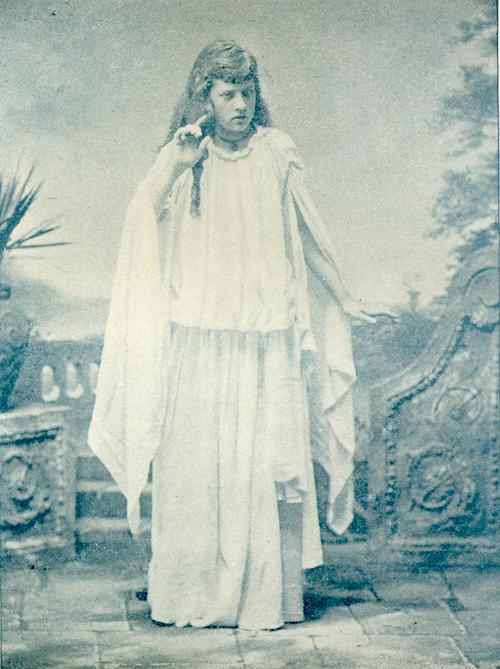
“Let me think!”
Merry Mike.
Merry Mike from the door bounded off to his play, With his head in his hat on a blustery day; When the wind of a sudden came frolicking down And lifted Mike’s hat from his round little crown. Don’t you call that funny, I’d like to know? Then he made up his mind to return to the house, But the merry wind pushed itself under his blouse. And it roared and it roared, and he puffed as he ran, Till it just knocked over this queer little man. “Ho! ho! ho!” said Mike, and he said “ha! ha! ha! I’ll get up again, old wind, you see.” Then the wind with a flurry of bluster and racket Went crowding and crowding under his jacket, And it lifted him off of his two little feet, And carried him bodily over the street. Mike laughed ha! ha! ha! and he laughed ho! ho! ho! But the wind, with its antics, was plainly not through, For fiercer and fiercer, and fiercer it blew, Till making one effort of fury intense It carried Mike bodily over the fence. He met there a somewhat discouraged old cow, That had blown thither too, though he failed to see how, Then he smiled and said, “Make yourself easy, my friend, Only keep your mind quiet and things will soon mend,” Mike laughed ha! ha! ha! and he laughed ho! ho! ho! “For the wind is just playing, old cow, you know.” As he scampered off home, what above should he see But the roof of a shed that had lodged in a tree; And he laughed and he laughed till his sides fairly ached, For, he said, this is better than wedding or wake. And he roared, ha! ha! ha! ho! ho! ho! “That boy,” say the terrified folks of the town, “He would laugh just the same if the sky tumbled down.” “Indeed, and I would,” answered Mike, with a grin, “For I might get a piece with a lot of stars in.” And he chuckled, he! he! he! and he chuckled, ho! ho! ho! The very idea delighted him so. His father complained to the priest, “Now, I say, Mike never stops laughing by night or by day.” “Let him laugh,” spoke the priest, “he will change by and by; ’Tis better to laugh than to grumble and cry; It’s the way with the lad; let him laugh if he like, And be glad you’ve a son that’s as merry as Mike.”
The Village Choir.
Half a bar, half a bar, Half a bar onward! Into an awful ditch, Choir and Precentor hitch, Into a mess of pitch, They led the Old Hundred. Trebles to right of them, Tenors to left of them, Basses in front of them, Bellowed and thundered. Oh! that Precentor’s look, When the sopranos took Their own time and hook, From the Old Hundred. Screeched all the trebles here, Boggled the tenors there, Raising the parson’s hair, While his mind wandered; Theirs not to reason why This psalm was pitched too high; Theirs but to gasp and cry Out the Old Hundred. Trebles to right of them, Tenors to left of them, Basses in front of them, Bellowed and thundered. Stormed they with shout and yell; Not wise they sang, nor well, Drowning the sexton’s bell, While all the church wondered. Dire the Precentor’s glare, Flashed his pitchfork in air, Sounding the fresh key to bear Out the Old Hundred. Swiftly he turned his back, Reached he his hat from rack, Then from the screaming pack Himself he sundered. Tenors to right of him, Trebles to left of him, Discords behind him, Bellowed and thundered. Oh, the wild howls they wrought; Right to the end they fought! Some tune they sang, but not— Not the Old Hundred.
The Book Agent Beats the Bandit.
Brown, Jones and Robinson, three of as good fellows as ever melted the heart of a country trader to the merry music of the pliant chin, sat one evening of last week in the smoking compartment of a chair car on the R. and T. H. Western Railroad. With them was a tall, thin, dyspeptic man with sandy hair, dressed in a rusty suit of black. Nature had endowed him with long legs, and his tailor with short pants. His coat collar was rich enough in accumulated grease to keep a soap factory going for a month. His mouth was of brass, and his cheek as hard as last year’s cider. He was a book agent. Already had he gobbled up the drummers for a Life of Christ and Pocket Encyclopedia of 215 numbers, when suddenly a real
Brown’s soul sank down into the heels of his boots. Beads of perspiration big as snow balls stood on Jones’ classic brow, while his hair lifted his hat two solid inches from the crown of his head. Robinson murmured the first verse of “Ever of Thee I’m Fondly Dreaming,” and thought he was praying. But the book agent bounded from his seat with a “How do, stranger? Delighted to see you. Do let me show you my superb ‘History of Boone County,’ a perfect bonanza of domestic peace and happiness to every householder who is fortunate enough to possess one. Three hundred pages of elegant letter press, printed on toned paper and embellished with fine steel engravings and an official map of the State. A carefully compiled, correct topographical and historical——”
“Shut up!” roared the bandit.
“Shut up? You bet it will, and fastens itself with a double-action brass clasp—my own invention—and from its simplicity of design and beauty of construction worth half the price of the book. Given away, sir; literally given away, for $3 in boards or $4.50 in morocco with beveled edges.”
“If yer say——”
“I do say it, sir. Look at this exquisite title page with a vignette portrait of the gifted author. Here you see a genealogical abstract chart in which you can write the names of your illustrious ancestors and beloved family—births, marriages, deaths and——”
“Stop!” shrieked the bandit, as the agent grasped him by the buttonhole.
“You may well say ‘stop,’ sir; I’ve said enough to make you ache to possess this beautiful volume, but I haven’t begun to——”
“Sit down!” the robber roared in a voice that made the puffs of the engine sound like the sighs of a sick zephyr, and loosened all the joints of Jones’s limbs.
“Biographical sketches of eminent men, glowing obituary, with an original poem on death, agricultural statistics, tables of mortality, valuable notes on immigration, trade reports, all the geological——”
“Lemme go, or I’ll blow the roof of yer head off,” shrieked the robber, as he wrested himself from the agent’s grasp and dropped off the rear car into the gathering gloom of the coming night.
Then Robinson drew from his pocket his faithful revolver and looked big. Jones rolled his sleeves up and asked where the villain was gone to. Brown fished from under the spittoon a roll of bills and hoped they didn’t think he had been scared. But the agent sank wearily to his seat, and for the first time in all that long journey was silent for nearly four consecutive minutes.
—Evansville Argus.
Not in the Ranks.
The old army overcoat that used to be such a familiar sight on our streets is one of the rarest now; indeed, it is so seldom seen that we involuntarily turn and gaze after it, as something that brings sad and often cruel memories. The other day an old man wearing a coat of this kind, which reached to his heels, stopped at a cottage a little way out of town and asked leave to rest awhile on the porch.
“I’m a bit tired,” he said to the woman who opened the door, “an’ if you don’t mind I’ll sit here and rest myself for a spell.”
“You’re welcome,” said the woman kindly, with a glance at
“Eat,” she said, gently; “I had a boy who was a soldier.”
“But I’m not a soldier,” answered the old man. “I never was a soldier; my boy went to war and was killed. He was all I had, too. This coat was his; seems like he’s near me when I have it on. I gave him to his country; the handsomest and bravest boy he was, too, in the whole regiment. God bless him. He did his duty, died on the field, and this coat was all that came back to his poor old dad. No; I never was a soldier.”
The woman went in and brought out some cake and the whitest honey, and added it to the coffee and biscuit.
“Are you alone in the world?” she asked.
“Oh, no,” answered the old man, cheerfully; “I’ve got a sister, but she’s old and lame, and she has a daughter that is sickly and ailing. You see I have them to work for, and they are a sight of comfort to me. Many’s the time I’d have broken down since Mary died but for them poor critters. Mary was my wife, ma’am; she was a master hand to nuss sick folks, and she thought after Tim died as it were her duty to go into the hospital service and nuss the soldiers, and she died these sixteen years ago; but she did a heap of good work first. Many a soldier has kissed her shadow on the wall! Mary, darlin’, God wanted ye in the ranks up there; I’ve often wished that I had been a soldier, if only to be fit for the little mother and Tim; but I never was.”
He drank the coffee, ate the good food thankfully, and offered to pay for it with some hoarded pieces of old worn silver; but the woman shook her head.
“Put back your money. My son was a soldier,” she said.
“But I am not a soldier. Well, well,” (as he looked into her face,) “I thank you, and I take it for his sake.”
He wished good-night to his kind entertainer and turned away. As he walked off, slow and limping, bent by infirmity, the long skirt of his army overcoat struck bright and blue against the splendor of the sunset; he shaded his eyes with one trembling hand and looked wistfully at the rose and amethyst door that seemed to open in the west. What saw he there? A little, round-shouldered woman with a small, homely face; a lank, overgrown boy, with sparse, red hair. Ay, and of such as these are angels made. So, watching, he passed down into the shadows and disappeared.
The woman at the gate looked after him.
“No soldier!” she said gently, “but I wonder if the boy who died on his first battle-field ever fought as he has, or sacrificed as much to his country? All the soldiers didn’t go into the war with flying flags and rolling drums. Some of them stayed at home and fought harder battles. I’m glad I gave him a bite and a sup. He is a soldier, and a brave one, too, and one day he will know it!”
And I think she was right.
—Detroit Free Press.
The Old Actor’s Story.
First Honor at the Third Annual Commencement of the Mt. Vernon Institute of Elocution and Languages, 1886.
Mine is a wild, strange story,—the strangest you ever heard; There are many[415] who won’t believe it, but it’s gospel[416] every word; It’s the biggest drama of any in a long,[417] adventurous life; The scene was a ship, and the actors—were myself and my new-wed wife. You musn’t mind if I ramble, and lose the thread now and then; I’m old, you know, and I wander—it’s a way with old women and men, For their lives lie all behind[418] them, and their thoughts go far away,[419] And are tempted afield, like children, lost on a summer day. The years must be five-and-twenty that have passed since that awful night, But I see it again this evening, I can never shut[420] out the sight. We were only a few weeks married, I and the wife, you know, When we had an offer for Melbourne,[421] and made up our minds to go. We’d acted together in England, traveling up and down[422] With a strolling band of players, going from town to town; We played the lovers together—we were leading lady and gent— And at last we played in earnest, and straight[423] to the church we went. The parson gave us his blessing,[424] and I gave Nellie the ring,[425] And swore that I’d love and cherish, and endow her with everything. How we smiled at that part of the service when I said “I thee endow!” But as to the “love and cherish,” friends, I meant to keep that[426] vow. We were only a couple of strollers; we had coin when the show was good, When it wasn’t we went without[427] it, and we did the best we could. We were happy and loved each other, and laughed at the shifts we made,— Where love makes plenty of sunshine, there poverty casts no shade. Well, at last we got to London, and did pretty well for a bit; Then the business dropped to nothing, and the manager took a flit,—[428] Stepped off one Sunday morning, forgetting the treasury call; But our luck was in, and we managed right on our feet[429] to fall. We got an offer for Melbourne,—got it that very week. Those were the days when thousands went over their fortunes to seek, The days of the great gold fever, and a manager thought the spot Good for a “spec,” and took us as actors among his lot. We hadn’t a friend in England—we’d only ourselves to please— And we jumped at the chance of trying our fortune across the seas.[430] We went on a sailing vessel, and the journey was long and rough; We hadn’t been out a fortnight before we had had enough. But use is a second nature, and we’d got not to mind a storm, When misery came upon us,—came in a hideous form.[431] My poor little wife fell ailing, grew worse, and at last so bad That the doctor said she was dying,—I thought ’twould have sent me mad,[432]— Dying where leagues[433] of billows seemed to shriek for their prey, And the nearest land was hundreds[434]—ay, thousands—of miles away. She raved one night in a fever, and the next lay still as death, So still I’d to bend and listen[435] for the faintest sign of breath. She seemed in a sleep,[436] and sleeping, with a smile[437] on her thin, wan face; She passed away[438] one morning, while I prayed[439] to the throne of grace. I knelt in the little cabin, and prayer after prayer I said, Till the surgeon came and told me it was useless—my wife was dead! Dead! I wouldn’t believe it. They forced me away that night, For I raved in my wild despairing, the shock sent me mad outright. I was shut in the farthest cabin,[440] and I beat my head on the side, And all day long in my madness, “They’ve murdered her!”[441] I cried. They locked me away from my fellows,—put me in cruel[442] chains, It seems I had seized a weapon to beat out the surgeon’s brains. I cried in my wild, mad fury, that he was a devil[443] sent To gloat o’er the frenzied anguish with which my heart was rent. I spent that night with the irons heavy upon my wrists, And my wife lay dead quite near[444] me. I beat[445] with my fettered fists, Beat at my prison panels, and then—O God!—and then I heard the shrieks of women[446] and the tramp of hurrying men. I heard the cry, “Ship a-fire!” caught up by a hundred throats, And over the roar the captain shouting to lower the boats; Then cry upon cry, and curses, and the crackle of burning wood, And the place[447] grew hot as a furnace, I could feel it where I stood. I beat[448] at the door and shouted, but never a sound came back, And the timbers above me started, till right through a yawning crack[449] I could see the flames shoot upward, seizing on mast and sail, Fanned in their burning fury by the breath of the howling gale. I dashed[450] at the door in fury, shrieking, “I will not die! Die in this burning prison!”—but I caught no answering cry. Then, suddenly, right upon me, the flames crept up with a roar, And their fiery tongues shot forward, cracking my prison door. I was free[451]—with the heavy iron door dragging me down[452] to death; I fought my way to the cabin,[453] choked with the burning breath Of the flames that danced around me[454] like man-mocking fiends at play, And then—O God! I can see it, and shall to my dying day. There[455] lay my Nell as they’d left her, dead in her berth that night; The flames flung a smile[456] on her features,—a horrible,[456a] lurid light, God knows how I reached and touched her, but I found myself by her side; I thought she was living a moment, I forgot that my Nell had died. In the shock of those awful seconds reason came back to my brain;[457] I heard a sound as of breathing,[458] and then a low cry of pain; Oh, was there mercy in heaven?[459] Was there a God in the skies? The dead woman’s lips were moving,[460] the dead woman opened her eyes. I cursed[461] like a madman raving—I cried to her, “Nell! my Nell!”[462] They had left us alone and helpless, alone in that burning hell, They had left us alone to perish—forgotten me living—and she Had been left for the fire to bear her to heaven,[463] instead of the sea.[464] I clutched at her,[465] roused her shrieking, the stupor was on her still; I seized her in spite of my fetters,—fear gave a giant’s will. God knows how I did it, but blindly I fought through the flames and the wreck Up—up[466] to the air, and brought her safe to the untouched deck. We’d a moment of life together,—a moment of life, the time, For one last word to each other,—’twas a moment supreme, sublime. From the trance we’d for death mistaken, the heat had brought her to life, And I was fettered and helpless, so we lay there,[467] husband and wife! It was but a moment, but ages seemed to have passed away, When a shout came over the water,[468] and I looked, and lo, there lay, Right away from the vessel,[469] a boat that was standing by; They had seen our forms on the vessel, as the flames lit up the sky. I shouted a prayer to Heaven,[470] then called to my wife,[471] and she Tore with new strength at my fetters—God helped her, and I was free; Then over the burning bulwarks we leaped[472] for one chance of life. Did they save us? Well, here I am,[473] sir, and yonder’s[474] my dear old wife. We were out in the boat till daylight, when a great ship passing by Took us on board, and at Melbourne[475] landed us by and by. We’ve played many parts in dramas since we went on that famous trip, But ne’er such a scene together as we had on the burning ship! —George R. Sims.
Gestures.
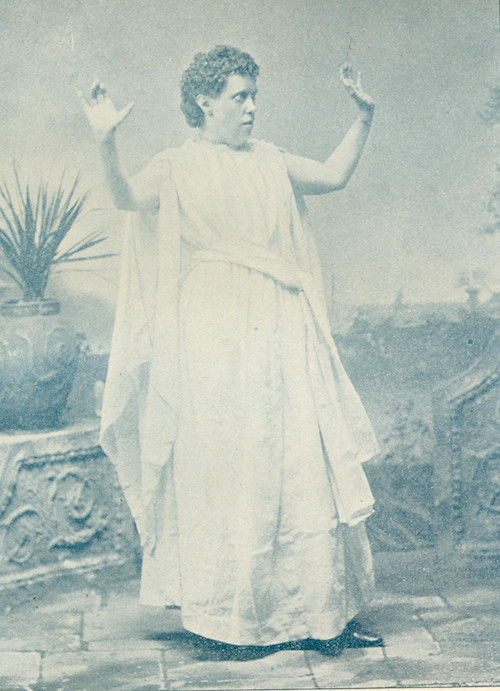
“Merciful heavens! is that true?”
Ben Hassan’s Dream.
I stood alone beside a mighty sea; The waves in awful majesty swept in And crashed upon the strand. Far out beyond The snowy-crested line of breakers rode A ship; and as she rose and fell her tall Masts seemed to trace a message on the sky: “O, ship! O, restless waste!” I cried, “Be true, Be merciful, that they who watch on board, And they that wait at home, may once more clasp The hands and press the lips of those they love.” The vision changed. I sat beneath my tent. ’Twas noon. Upon my right the desert sands Stretched hot and gleaming till they touched the sky; Upon my left lay leagues of sand; before, Behind; which way I looked was burning sand: The fierce sun overhead poured down a stream Of heat intolerable. Silence reigned. The caravan had gone. I leaned low down To hearken, but in vain. Abandoned! Lost! Would my siesta prove a sleep of death? Another scene: The sun had set, and peace Pervaded hill and dale. A sweet perfume Of flowers filled the evening air. The sound Of tinkling bells came faintly from a plain Where camels browsed. The slender minarets, And stately domes of mosques, proclaimed a town, That nestled ’mid the distant, waving palms. A troop of horsemen slowly came in view; Their banner bore the crescent and the star. I knelt and cried: “Praise be to Allah’s name!” And then, it seemed, I was within a grot That opened on a placid lake. The moon Was at the full and o’er the water threw A track of silver sheen. Beside me stood A child with upturned face. I placed my hand Upon its head, when, lo! from out the lake Arose a horrid, monster form. It glared With baleful eyes and then advanced. “Keep off! Keep off!” I shrieked, then seized the child and turned To fly—when suddenly the vision changed: Once more I dwelt beneath my parents’ roof, A happy, careless child. The olden scenes Were fresh again, and things forgot had life And form. O home!—how blest are they that have A home!—sweet haven sure when others fail! “Oh, do not leave me, darling boy, my own!” It was my mother’s voice. Ah, yes, her eyes Were beaming love, as angel-like she smiled And kissed my brow. And, as I watched her face, I woke and wept to know ’twas but a dream. —Geo. M. Vickers.
Six o’Clock.
Down by the rugged coast of Maine Breaks on the air the glad refrain That welcomes old Time on his westward flight, That makes the dull eye of the toiler bright, And heralds the bliss of a single night; Thus bell and whistle with clang and shriek, At six o’clock and six times a week. Loveliest hour of all the day, Blest is thy sweet and mystic sway: Affection and hope in their might are rife In each watching child; in the waiting wife; The father that tramps from his daily strife; The widow’s son and his fond embrace; In the smile that beams on her pallid face. Who hath not felt the wondrous spell, Ushered by whistle and by bell? A halo of peace round each home it flings; To poor and to weary relief it brings; And e’en the black tea-kettle gaily sings: O moments calm! Ye foretell the rest That soon must come to each human breast. Westward speed on o’er hill and dell, City and town and cot to tell; On, on, like a courier, dash away, Hard pressing the heels of departing day Till stopped by the waters of “’Frisco” Bay! Thus bell and whistle with clang and shriek, At six o’clock, and six times a week. —Geo. M. Vickers.
Charlie’s Story.
I was sitting in the twilight, With my Charlie on my knees, Little two-year old, forever Teasing “Talk a tory to me pease.” “Now,” I said, “talk me a ’tory.” “Well,” reflectively, “I’ll ’mence. Mamma, I did see a kitty, Great big kitty on the fence.” Mamma smiles. Five little fingers Cover up her laughing lips; “Is oo laughing?” “Yes” I tell him, But I kiss the finger tips; And I say: “Now tell another.” “Well” (all smiles) “now I will ’mence. Mamma, I did see a doggie, Great big doggie on the fence.” “Rather similar, your stories, Aren’t they, dear?” A sober look Swept across the pretty forehead; Then he sudden courage took. “But I know a nice new ’tory ’Plendid, Mamma! Hear me ’mence, Mamma, I did see a—elfunt Great big elfunt on the fence!”
The Months.
A Pageant.
Personifications.
January. ⎫ Gentlemen. February. ⎫ Ladies.
March. ⎪ April. ⎪
July. ⎬ May. ⎬
August. ⎪ June. ⎪
October. ⎪ September. ⎪
December. ⎭ November. ⎭
Robin Redbreasts; Lambs and Sheep; Nightingale and Nestlings.
Various Flowers, Fruits, etc.
Scene:—A Cottage with its Grounds.
(A room in a large, comfortable cottage; a fire burning on the hearth; a table on which the breakfast things have been left standing. January discovered seated at the fire.)
January. Cold the day and cold the drifted snow," Dim the day until the cold dark night. [Stirs the fire.] Crackle, sparkle, fagot; embers, glow: Some one may be plodding through the snow, Longing for a light, For the light that you and I can show. If no one else should come, Here Robin Redbreast’s welcome to a crumb, And never troublesome: Robin, why don’t you come and fetch your crumb?
Here’s butter for my bunch of bread, And sugar for your crumb; Here’s room upon the hearth-rug, If you’ll only come. In your scarlet waistcoat, With your keen bright eye, Where are you loitering? Wings were made to fly! Make haste to breakfast, Come and fetch your crumb, For I’m as glad to see you As you are glad to come.
(Two Robin Redbreasts are seen tapping with their beaks at the lattice, which January opens. The birds flutter in, hop about the floor, and peck up the crumbs and sugar thrown to them. They have scarcely finished their meal, when a knock is heard at the door. January hangs a guard in front of the fire, and opens to February, who appears with a bunch of snowdrops in her hand.)
January. Good-morrow, sister. February. Brother, joy to you! I’ve brought some snowdrops; only just a few, But quite enough to prove the world awake, Cheerful and hopeful in the frosty dew, And for the pale sun’s sake.
(She hands a few of her snowdrops to January, who retires into the background. While February stands arranging the remaining snowdrops in a glass of water on the window-sill, a soft butting and bleating are heard outside. She opens the door, and sees one foremost lamb, with other sheep and lambs bleating and crowding towards her.)
February. O you, you little wonder, come—come in, You wonderful, you woolly, soft, white lamb: You panting mother ewe, come too, And lead that tottering twin Safe in: Bring all your bleating kith and kin, Except the horny ram.
(February opens a second door in the background, and the little flock files through into a warm and sheltered compartment out of sight.)
The lambkin tottering in its walk, With just a fleece to wear; The snowdrop drooping on its stalk So slender,— Snowdrop and lamb, a pretty pair, Braving the cold for our delight, Both white, Both tender.
(A rattling of door and windows; branches seen without, tossing violently to and fro.)
How the doors rattle, and the branches sway! Here’s brother March comes whirling on his way, With winds that eddy and sing.
(She turns the handle of the door, which bursts open, and discloses March hastening up, both hands full of violets and anemones.)
February. Come, show me what you bring; For I have said my say, fulfilled my day, And must away. March. (Stopping short on the threshold.) I blow and arouse, Through the world’s wide house, To quicken the torpid earth: Grappling I fling Each feeble thing, But bring strong life to the birth. I wrestle and frown, And topple down; I wrench, I rend, I uproot; Yet the violet Is born where I set The sole of my flying foot.
(Hands violets and anemones to February, who retires into the background.)
And in my wake Frail wind-flowers quake, And the catkins promise fruit. I drive ocean ashore With rush and roar, And he cannot say me nay: My harpstrings all Are the forests tall, Making music when I play. And as others perforce, So I on my course Run and needs must run, With sap on the mount, And buds past count, And rivers and clouds and sun, With seasons and breath And time and death And all that has yet begun.
(Before March has done speaking, a voice is heard approaching accompanied by a twittering of birds. April comes along singing, and stands outside and out of sight to finish her song.)
April. (Outside.) Pretty little three Sparrows in a tree, Light upon the wing; Though you cannot sing, You can chirp of Spring: Chirp of Spring to me, Sparrows, from your tree. Never mind the showers, Chirp about the flowers, While you build a nest: Straws from east and west, Feathers from your breast, Make the snuggest bowers In a world of flowers. You must dart away From the chosen spray, You intrusive third Extra little bird; Join the unwedded herd! These have done with play, And must work to-day. April. (Appearing at the open door.) Good-morrow and good-bye: if others fly, Of all the flying months you’re the most flying. March. You’re hope and sweetness, April. April. Birth means dying, As wings and wind mean flying; So you and I and all things fly or die; And sometimes I sit sighing to think of dying. But meanwhile I’ve a rainbow in my showers, And a lapful of flowers, And these dear nestlings, aged three hours; And here’s their mother sitting, Their father merely flitting To find their breakfast somewhere in my bowers.
(As she speaks April shows March her apron full of flowers and nest full of birds. March wanders away into the grounds. April, without entering the cottage, hangs over the hungry nestlings watching them.)
April. What beaks you have, you funny things, What voices, shrill and weak; Who’d think anything that sings Could sing with such a beak? Yet you’ll be nightingales some day And charm the country-side, When I’m away and far away, And May is queen and bride.
(May arrives unperceived by April, and gives her a kiss. April starts and looks round.)
April. Ah, May, good-morrow, May, and so good-bye. May. That’s just your way, sweet April, smile and sigh; Your sorrows half in fun, Begun and done And turned to joy while twenty seconds run. At every step a flower Fed by your last bright shower,—
(She divides an armful of all sorts of flowers with April, who strolls away through the garden.)
May. And gathering flowers I listened to the song Tf every bird in bower. The world and I are far too full of bliss, To think or plan or toil or care; The sun is waxing strong, The days are waning long, And all that is, Is fair. Here are May buds of lily and of rose, And here’s my namesake-blossom, May; And from a watery spot See here, forget-me-not, With all that blows To-day. Hark to my linnets from the hedges green, Blackbird and lark and thrush and dove, And every nightingale And cuckoo tells its tale, And all they mean Is love.
(June appears at the further end of the garden, coming slowly towards May, who seeing her, exclaims:)
May. Surely you’re come too early, sister June. June. Indeed I feel as if I came too soon To round your young May moon, And set the world a-gasping at my noon, Yet must I come. So here are strawberries, Sun-flushed and sweet, as many as you please; And there are full-blown roses by the score, More roses and yet more.
(May, eating strawberries, withdraws among the flower beds.)
June. The sun does all my long day’s work for me, Raises and ripens everything; I need but sit beneath a leafy tree And watch and sing. (Seats herself in the shadow of a laburnum.) Or if I’m lulled by note of bird and bee, Or lulled by noontide’s silence deep, I need but nestle down beneath my tree And drop asleep.
(June falls asleep; and is not awakened by the voice of July, who behind the scenes is heard half singing, half calling.)
July. (Behind the scenes.) Blue flags, yellow flags, all freckled, Which will you take? Yellow, blue, speckled! Take which you will, speckled, blue, yellow, Each in its way has not a fellow.
(Enter July, a basket of many-colored irises swung upon his shoulders, a bunch of ripe grass in one hand, and a plate piled full of peaches balanced upon the other. He steals up to June, and tickles her with the grass. She wakes.)
June. What, here already? July. Nay, my tryst is kept; The longest day slipped by you while you slept. I’ve brought you one curved pyramid of bloom, (Hands her the plate.) Not flowers, but peaches, gathered where the bees, As downy, bask and boom In sunshine and in gloom of trees. But get you in, a storm is at my heels; The whirlwind whistles and wheels, Lightning flashes and thunder peals, Flying and following hard upon my heels. (June takes shelter in a thickly-woven arbor.) July. The roar of a storm sweeps up From the east to the lurid west, The darkening sky, like a cup, Is filled with rain to the brink; The sky is purple and fire, Blackness and noise and unrest; The earth, parched with desire, Opens her mouth to drink. Send forth thy thunder and fire, Turn over thy brimming cup, O sky, appease the desire Of earth in her parched unrest; Pour out drink to her thirst, Her famishing life lift up; Make thyself fair as at first, With a rainbow for thy crest. Have done with thunder and fire, O sky with the rainbow crest; O earth, have done with desire, Drink, and drink deep, and rest.
(Enter August, carrying a sheaf made up of different kinds of grain.)
July. Hail, brother August, flushed and warm, And scathless from my storm. Your hands are full of corn, I see, As full as hands can be: And earth and air both smell as sweet as balm In their recovered calm, And that they owe to me. (July retires into the shrubbery.) August. Wheat sways heavy, oats are airy, Barley bows a graceful head, Short and small shoots up canary, Each of these is some one’s bread; Bread for man or bread for beast, Or at very least A bird’s savory feast. Men are brethren of each other, One in flesh and one in food; And a sort of foster brother, Is the litter, or the brood Of that folk in fur and feather, Who, with men together, Breast the wind and weather.
(August descries September toiling across the lawn.)
August. My harvest home is ended; and I spy September drawing nigh With the first thought of Autumn in her eye, And the first sigh Of Autumn wind among her locks that fly.
(September arrives, carrying upon her head a basket heaped high with fruit.)
September. Unload me, brother. I have brought a few Plums and these pears for you, A dozen kinds of apples, one or two Melons, some figs all bursting through Their skins; and pearled with dew These damsons, violet-blue.
(While September is speaking, August lifts the basket to the ground, selects various fruits, and withdraws slowly along the gravel walk, eating a pear as he goes.)
September. My song is half a sigh Because my green leaves die; Sweet are my fruits, but all my leaves are dying; And well may Autumn sigh, And well may I Who watch the sere leaves flying. My leaves that fade and fall, I note you one and all; I call you, and the autumn wind is calling, Lamenting for your fall, And for the pall You spread on earth in falling. And here’s a song of flowers to suit such hours: A song of the last lilies, the last flowers, Amid my withering bowers.
In the sunny garden bed Lilies look so pale, Lilies droop the head In the shady, grassy vale; If all alike they pine In shade and in shine, If everywhere they grieve, Where will lilies live?
(October enters briskly, some leafy twigs bearing different sorts of nuts in one hand, and a long, ripe hop-vine trailing after him from the other. A dahlia is stuck in his button-hole.)
October. Nay, cheer up, sister. Life is not quite over, Even if the year has done with corn and clover, With flowers and leaves; besides, in fact, it’s true; Some leaves remain, and some flowers too, For me and you. Now see my crops. [Offering his produce to September.] I’ve brought you nuts and hops; And when the leaf drops, why the walnut drops.
(October wreathes the hop-vines about September’s neck, and gives her the nut twigs. They enter the cottage together, but without shutting the door. She steps into the background; he advances to the hearth, removes the guard, stirs up the smouldering fire, and arranges several chestnuts ready to roast.)
October. Crack your first nut, light your first fire, Roast your chestnuts, crisp on the bar, Make the logs sparkle, stir the blaze higher; Logs are as cheery as sun or as star, Logs we can find wherever we are. Spring, one soft day, will open the leaves, Spring, one bright day, will lure back the flowers; Never fancy my whistling wind grieves, Never fancy I’ve tears in my showers; Dance, nights and days! and dance on, my hours. [Sees November approaching.] October. Here comes my youngest sister, looking dim And grim, With dismal ways. What cheer, November? November. (Entering and shutting the door.) Nought have I to bring, Tramping a-chill and shivering, Except these pine cones for a blaze,— Except a fog which follows, And stuffs up all the hollows,— Except a hoar frost here and there,— Except some shooting stars, Which dart their luminous cars, Trackless and noiseless through the keen night air.
(October, shrugging his shoulders, withdraws into the background, while November throws her pine cones on the fire and sits down listlessly.)
November. The earth lies fast asleep, grown tired Of all that’s high or deep; There’s naught desired and naught required Save a sleep. I rock the cradle of the earth, I lull her with a sigh; And know that she will wake to mirth By and bye.
(Through the window December is seen running and leaping in the direction of the door. He knocks.)
November. (Calls out without rising.) Ah, here’s my youngest brother come at last: Come in, December.
(He opens the door and enters, loaded with evergreens in berry, etc.)
Come in and shut the door, For now it’s snowing fast; It snows, and will snow more and more; Don’t let it drift in on the floor. But you, you’re all aglow; how can you be Rosy and warm and smiling in the cold. December. Nay, no closed doors for me, But open doors and open hearts and glee To welcome young and old. Dimmest and brightest month am I; My short days end, my lengthening days begin; What matters more or less sun in the sky, When all is sun within? (He begins making a wreath as he sings.) Ivy and privet dark as night I weave with hips and haws a cheerful show, And holly for a beauty and delight, And milky mistletoe. While high above them all I set Yew twigs and Christmas roses, pure and pale; Then Spring her snowdrop and her violet May keep, so sweet and frail; May keep each merry singing bird, Of all her happy birds that singing build: For I’ve a carol which some shepherds heard Once in a wintry field.
(While December concludes his song, all the other months troop in from the garden, or advance out of the background. The twelve join hands in a circle, and begin dancing round to a stately measure as the Curtain falls.)
—Christina G. Rossetti.
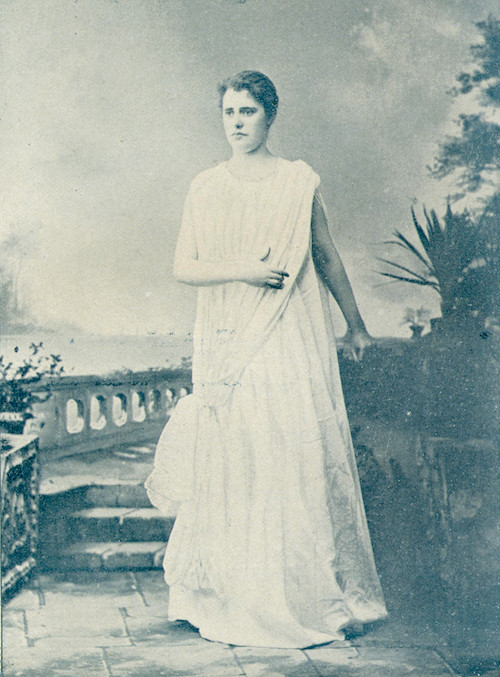
“Oh, come ye in peace here, or come ye in war, Or to dance at our bridal, young Lord Lockinvar?”
Uncle Ned’s Tale.
Well, lads, it was in summer time, and just at morning’s light We heard the “Boot and Saddle” sound: the foe was then in sight, Just winding round a distant hill[476] and opening on the plain. Each trooper looked with careful eye to girth and curb and rein. We snatched a hasty breakfast—we were old campaigners then: That morn, of all our splendid corps, we’d scarce one hundred men; But they were soldiers, tried and true, who’d rather die[477] than yield; The rest were scattered far and wide[478] o’er many a hard-fought field. Our trumpet now rang sharply out, and at a swinging-pace We left the bivouac behind;[479] and soon the eye could trace[480] The columns moving o’er the plain. Oh! ’twas a stirring sight To see two mighty armies there preparing for the fight: To watch the heavy masses, as, with practised, steady wheel, They opened out in slender lines of brightly flashing steel. Our place was on the farther flank,[481] behind some rising ground, That hid the stirring scene from view; but soon a booming sound Proclaimed the opening of the fight. Then war’s loud thunder rolled, And hurtling shells and whistling balls their deadly message told. We hoped to have a gallant day; our hearts were all aglow; We longed for one wild, sweeping charge,[482] to chase the flying foe Our troopers marked the hours glide by, but still no orders came: They clutched their swords[483] and muttered words ’twere better not to name. For hours the loud artillery roared—the sun was at its height— Still there we lay behind the hill,[484] shut out from all the fight! We heard the maddened charging yells, the ringing British cheers, And all the din of glorious war kept sounding in our ears. Our hearts with fierce impatience throbbed, we cursed the very hill That hid the sight: the evening fell, and we were idle still. The horses, too, were almost wild, and told with angry snort And blazing eye their fierce desire to join the savage sport. When lower still the sun had sunk, and with it all our hope, A horseman, soiled with smoke and sweat, came dashing down the slope.[485] He bore the wished-for orders. “At last!” our Colonel cried: And as he read the brief dispatch, his glance was filled with pride. Then he who bore the orders, in a low, emphatic tone, The stern, expressive sentence spake “He said it must be done!” “It shall be done!” our Colonel cried. “Men, look to strap and girth, We’ve work to do this day, will prove what every man is worth; Ay, work, my lads, will make amends for all our long delay— The General says on us depends the fortune of the day!” No order needed we to mount—each man was in his place, And stern and dangerous was the look on every veteran face. We trotted sharply up the hill,[486] and halted on the brow, And then that glorious field appeared.[487] Oh! lad, I see it now! But little time had we to spare for idle gazing then: Beneath us in the valley,[488] stood a dark-clad mass of men: It cut the British line in two. Our Colonel shouted, “There![489] Behold your work! Our orders are to charge and break that square!” Each trooper drew a heavy breath, then gathered up his reins, And pressed the helmet o’er his brow, the horses tossed their manes In protest fierce against the curb, and spurned[490] the springy heath, Impatient for the trumpet’s sound to bid them rush to death. Well, boy, that moment seemed an hour: at last we heard the words— “Dragoons! I know you’ll follow me. Ride steady, men! Draw swords!” The trumpet sounded: off[491] we dashed, at first with steady pace, But growing swifter as we went. Oh, ’twas a gallant race! Three-fourths the ground was left behind: the loud and thrilling “Charge!” Rang out; but fairly frantic now, we needed not to urge With voice or rein our gallant steeds, or touch their foaming flanks, They seemed to fly. Now straight in front[492] appeared the kneeling ranks. Above them waved[493] a standard broad: we saw their rifles raised— A moment more, with awful crash, the deadly volley blazed. The bullets whistled through our ranks, and many a trooper fell; But we were left. What cared we then? but onward rushing still! Again the crash roared fiercely out; but on![494] still madly on! We heard the shrieks of dying men, but recked not who was gone. We gored the horses’ foaming flanks, and on through smoke and glare. We wildly dashed, with clenched teeth. We had no thought, no care! Then came a sudden, sweeping rush. Again with savage heel I struck my horse: with awful bound he rose right o’er[495] their steel! Well, friend, I cannot tell you how that dreadful leap was made, But there I rode, inside the square, and grasped[496] a reeking blade. I cared not that I was alone, my eyes seemed filled with blood: I never thought a man could feel in such a murderous mood. I parried not, nor guarded thrusts; I felt not pain nor wound, But madly spurred the frantic horse, and swept my sword around.[497] I tried to reach the standard sheet; but there at last was foiled. The gallant horse was jaded now, and from the steel recoiled. They saw his fright, and pressed him then; his terror made him rear, And falling back he crushed[498] their ranks and broke their guarded square! My comrades[499] saw the gap he made, and soon came dashing in: They raised me up, I felt no hurt, but mingled in the din. I’d seen some savage work before, but never was engaged In such a wild and savage fight as now around me raged. The foe had ceased their firing, and now plied the deadly steel: Though all our men were wounded then, no pain they seemed to feel. No groans escaped from those who fell, but horrid oaths instead, And scowling looks of hate were on the features of the dead. The fight was round the standard: though outnumbered ten to one, We held our ground,—ay, more than that,—we still kept pushing on.[500] Our men now made a desperate rush to take the flag by storm. I seized the pole,[501] a blow came down and crushed my outstretched arm. I felt a sudden thrill of pain, but that soon passed away; And with a devilish thirst for blood, again I joined the fray. At last we rallied all our strength, and charged o’er heaps of slain: Some fought to death; some wavered—then fled[502] across the plain. Well, boy, the rest is all confused: there was a fearful rout; I saw our troopers chase the foe, and heard their maddened shout. Then came a blank: my senses reeled, I know not how I fell; I seemed to grapple with a foe, but that I cannot tell. My mind was gone: when it came back I saw the moon[503] on high, Around me all was still[504] as death. I gazed[505] up at the sky, And watched the glimmering stars above,—so quiet did they seem,— And all that dreadful field appeared like some wild, fearful[506] dream. But memory soon came back again, and cleared my wandering brain, And then from every joint and limb shot fiery darts of pain. My throat was parched, the burning thirst increased with every breath; I made no effort to arise, but wished and prayed for death. My bridle arm was broken, and lay throbbing on the sward, But something still my right hand grasped: I thought it was my sword. I raised[507] my hand to cast it off,—no reeking blade was there; Then life and strength returned,—I beheld the Standard of the Square! With bounding heart I gained my feet. Oh! then I wished to live, ’Twas strange the strength and love of life that standard seemed to give! I gazed around: far down the vale I saw a camp-fire’s glow.[508] With wandering step I ran that way,—I recked not friend or foe. Though stumbling now o’er heaps of dead, now o’er a stiffened horse, I heeded not, but watched the light, and held my onward course. But soon that flash of strength had failed, and checked my feverish speed; Again my throat was all ablaze, my wounds began to bleed. I knew that if I fell again my chance of life was gone. So, leaning on the standard pole, I still kept struggling on. At length I neared the camp-fire: there were scarlet jackets round, And swords and brazen helmets lay strewn upon the ground. Some distance off, in order ranged, stood men,[509]—about a score: O God! ’twas all that now remained of my old gallant corps! The muster-roll was being called: to every well-known name I heard the solemn answer—“Dead!” At length my own turn came. I paused to hear,—a comrade answered, “Dead! I saw him fall!” I could not move another step, I tried in vain to call. My life was flowing fast, and all around was gathering haze, And o’er the heather tops I watched my comrades’ cheerful blaze. I thought such anguish as I felt was more than man could bear, O God! it was an awful thing to die with help so near! And death was stealing o’er me: with the strength of wild despair. I raised the standard o’er my head, and waved it through the air. Then all grew dim: the fire, the men, all vanished from my sight, My senses reeled: I know no more of that eventful night. ’Twas weeks before my mind came back: I knew not where I lay, But kindly hands were round me, and old comrades came each day. They told me how the waving flag that night had caught their eye, And how they found me bleeding there, and thought that I must die; No wonder ’twas with all their care, I soon began to mend. The General came to see me, too, with all his brilliant train, But what he said, or how I felt, to tell you now ’twere vain. Enough, I soon grew strong again; the wished-for route had come, And all the gallant veteran troops set out with cheers for home. We soon arrived; and then my lads, ’twould thrill your hearts to hear How England welcomed home her sons with many a ringing cheer. But tush! what boots it now to speak of what was said or done, The victory was dearly bought, our bravest hearts were gone. Ere long the King reviewed us. Ah! that memory is sweet. They made me bear the foreign flag, and lay it at his feet. I parted from my brave old corps: ’twere matter, friends, for tears, To leave the kind old comrades I had ridden with for years. I was no longer fit for war, my wanderings had to cease. There, boys, I’ve told you all my tale, now let me smoke in peace. —James Boyle O’Reilly.
Published by special permission.
Gestures.
Read This if You Can.
Geoffrey, surnamed Winthrop, sat in the depot at Chicago waiting for his train and reading the Tribune, when a squadron of street Arabs (incomparable for squalor), thronged from a neighboring alley, uttering hideous cries, accompanied by inimitable gestures of heinous exultation, as they tortured an humble black and tan dog.
“You little blackguards!” cried Winthrop, stepping outside and confronting them, adding the inquiry, “Whose dog is that?”
“That audacious Caucasian has the bravado to interfere
“What will you take for him?” asked the lenient Geoffrey, ignoring the venial tirade.
“Twenty-seven cents,” piquantly answered the ribald urchin, grabbing the crouching dog by the nape.
“You can buy licorice and share with the indicorous coadjutors of your condemnable cruelty,” said Winthrop, paying the price and taking the dog from the boy. Then catching up his valise and umbrella, he hastened to his train. Winthrop, satisfied himself that his sleek protégé was not wounded, and then cleared the cement from the pretty collar, and read these words:
“Leicester. Licensed, No. 1770.”
Hearing the pronunciation of his name, the docile canine expressed gratitude and pleasure, and then sank exhausted at his new patron’s feet and slept.
Among the other passengers was a magazine contributor, writing vagaries of Indian literature, also two physicians, a somber, irrevocable, irrefragable allopathist, and a genial homeopathist, who made a specialty of bronchitis. Two peremptory attorneys from the legislature of Iowa were discussing the politics of the epoch, and the details of national finance, while a wan, dolorous person, wearing concave glasses, alternately ate troches and almonds for a sedative, and sought condolence in a high lamentable treble from a lethargic and somewhat deaf and enervate comrade not yet acclimated.
Near three exemplary brethren (probably sinecurists) sat a group of humorous youths; and a jocose sailor (from Asia) in a blouse waist and tarpaulin hat, was amusing his patriotic juvenile listeners by relating a series of the most extraordinary legends extant, suggested by the contents of a knapsack, which
A mature matron of medium height and her comely daughter soon entered the car, and took seats in front of Winthrop (who recalled having seen them one Tuesday in February in the parquet of a theatre). The young lady had recently made her debut into society at a musical soiree at her aunt’s. She had an exquisite bouquet of flowers that exhaled sweet perfume. She said to her parent, “Mamma, shall we ever find our lost Leicester?”
Geoffrey immediately addressed her, saying, as he presented his card—
“Pardon my apparent intrusiveness; but prithee, have you lost a pet dog?”
The explanation that he had been stolen was scarcely necessary, for Leicester, just awakening, vehemently expressed his inexplicable joy by buoyantly vibrating between the two like the sounding lever used in telegraphy (for to neither of them would he show partiality) till, succumbing to ennui, he purported to take a recess, and sat on his haunches, complacently contemplating his friends. It was truly an interesting picture.
They reached their destination ere the sun was beneath the horizon. Often during the summer Winthrop gallantly rowed from the quay with the naive and blithe Beatrice, in her jaunty yachting suit, but no coquetry shone from the depths of her azure eyes. Little Less, their jocund confidante and courier (and who was as sagacious as a spaniel) always attended them on these occasions, and whene’er they rambled through the woodland paths. While the band played Beethoven, Mendelssohn, Bach, and others, they promenaded the long corridors of
Let us look into the future for the sequel to perfect this romance, and around a cheerful hearth we see again Geoffrey and Beatrice, who are paying due homage to their tiny friend Leicester.
—Quarterly Elocutionist.
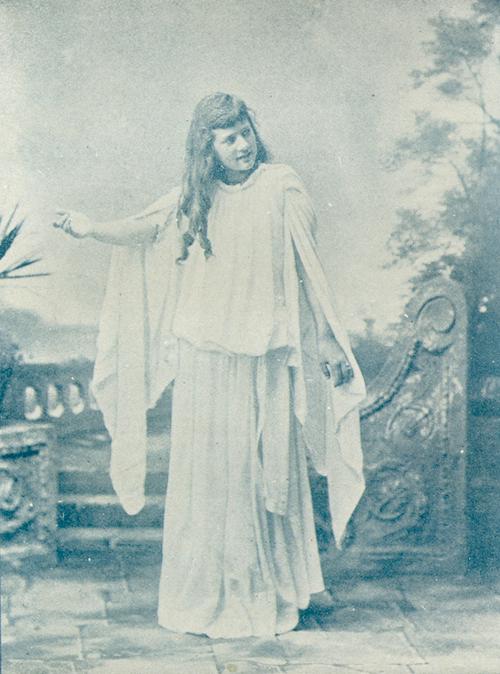
“Away then! I am locked in one of them. If you do love me, you will find me out.”
The Ivy-Clad Ruin.[510]
’Tis the old, old church that for years I’ve known, And with ivy green are its walls o’ergrown; All its ancient splendor has passed away, And there’s naught remaining but grim decay; The pale moonbeams glimmer the windows through, And the roofless floor is all damp with dew; Both the pious priest and his flock are gone, And the gravestones watch o’er their dead alone. Oh, how oft I’ve passed thro’ the spacious aisle And have met the throng with a friendly smile; In the bygone days when I saw them kneel, When I felt the thrill of the organ’s peal; But the forms I knew enter here no more, And no footsteps fall on the mouldy floor; There’s but one thing left that with life I’ve seen— ’Tis the faithful vine of the ivy green. —Geo. M. Vickers.
“Yes, I’m Guilty.”
“Yes, I’m guilty,” the prisoner said, As he wiped his eyes and bowed his head. “Guilty of all the crimes you name; But this yere lad is not to blame. ’Twas I alone who raised the row, And, Judge, if you please, I’ll tell yer how. You see, this boy is pale and slim; We calls him saint.—His name is Tim.— He’s like a preacher in his ways:— He never drinks, or swears, or plays, But kinder sighs and weeps all day; ’Twould break yer heart to hear him pray. Why, sir, many and many a night, When grub was scarce and I was tight, No food, no fire, no light to see, When home was hell, if hell there be, I’ve seen that boy in darkness kneel, And pray such words as cut like steel; Which somehow warmed and lit the room, And sorter chased away the gloom. Smile if you must, but facts are facts, And deeds are deeds, and acts are acts; And though I’m black as sin can be His prayers have done a heap for me, And make me think that God, perhaps, Sent him on earth to save us chaps. This man what squealed and pulled us in, He keeps a place called Fiddlers’ Inn, Where faiks, and snides, and lawless scamps Connive and plot with thieves and tramps. Well, Tim and me, we didn’t know Just what to do or where to go, And so we stayed with him last night. And this is how we had the fight: They wanted Tim to take a drink, But he refused, as you may think, And told them how the flowing bowl Contained the fire that kills the soul. ‘Drink! Drink!’ they cried, ‘this foaming beer; ’Twill make you strong and give you cheer. Let preachers groan and prate of sin, But give to us the flowing gin!’ Then Tim knelt down beside his chair, And offered up this little prayer: ‘Help me, dear Lord,’ the child began, As down his cheeks the big tears ran, ‘To keep the pledge I gave to you, And make me strong, and good, and true. I’ve done my best to do what’s right, But, Lord, I’m sad and weak to-night. Father, mother, oh, plead for me— Tell Christ I long with you to be!’ ‘Get up, you brat, don’t pray ’round here,’ The landlord yelled with rage and fear, Then, like a brute, he hit the lad, Which made my blood just b’iling mad. I guess I must uv hurt his head, For I struck hard for the man that’s dead. No, he hain’t no folks or friends but me: His dad was killed in ’sixty-three. Shot at the front, where bursting shell And cannon sang their song of hell, And muskets hissed with fiery breath, As brave men fell to their tune of death. I promised his father before he died, As the life blood rushed from his wounded side, I promised him, sir, and it gave him joy, That I’d protect his darling boy. I simply did what his father would, And helped the weak, as all men should. Yes, I knocked him down and blacked his eye, And used him rough I’ll not deny; But think of it, Judge, a chap like him Striking the likes of little Tim. If I did wrong, send me below, But spare the son of comrade Joe.— You forgive him; and me? Oh, no! A fact? God bless you! Come, Tim, let’s go.” —J. M. Munyon.
The Enchanted Shirt.
The King was sick. His cheek was red, And his eye was clear and bright; He ate and drank with a kingly zest, And peacefully snored at night. But he said he was sick, and a king should know, And the doctors came by the score. They did not cure him. He cut off their heads, And sent to the schools for more. At last two famous doctors came, And one was as poor as a rat,— He had passed his life in studious toil, And never found time to grow fat. The other had never looked in a book; His patients gave him no trouble; If they recovered, they paid him well; If they died, their heirs paid double. Together they looked at the royal tongue, As the King on his couch reclined; In succession they thumped his august chest, But no trace of disease could find. The old sage said, “You’re as sound as a nut.” “Hang him up,” roared the King in a gale— In a ten-knot gale of royal rage; The other leech grew a shade pale; But he pensively rubbed his sagacious nose, And thus his prescription ran— The King will be well if he sleeps one night In the shirt of a happy man. * * * * * Wide o’er the realm the couriers rode, And fast their horses ran, And many they saw, and to many they spoke, But they found no Happy Man.... They saw two men by the roadside sit, And both bemoaned their lot; For one had buried his wife, he said, And the other one had not. At last they came to a village gate, A beggar lay whistling there! He whistled, and sang, and laughed, and rolled On the grass in the soft June air. The weary couriers paused and looked At the scamp so blithe and gay; And one of them said, “Heaven save you friend! You seem to be happy to-day.” “O yes, fair sirs,” the rascal laughed, And his voice rang free and glad; “An idle man has so much to do That he never has time to be sad.” “This is our man,” the courier said; “Our luck has led us aright. I will give you a hundred ducats, friend, For the loan of your shirt to-night.” The merry blackguard lay back on the grass, And laughed till his face was black; “I would do it,” said he, and he roared with the fun, “But I haven’t a shirt to my back.” * * * * * Each day to the King the reports came in Of his unsuccessful spies, And the sad panorama of human woes Passed daily under his eyes. And he grew ashamed of his useless life, And his maladies hatched in gloom; He opened his windows and let the air Of the free heaven into his room. And out he went in the world, and toiled In his own appointed way; And the people blessed him, the land was glad, And the King was well and gay. —Col. John Hay.
Fra Giacomo.
Alas, Fra Giacomo, Too late!—but follow me;[511] Hush![512] draw the curtain[513]—so!— She is dead,[514] quite dead, you see. Poor little lady! she lies With the light gone out of her eyes, But her features still wear[515] that soft Gray, meditative expression, Which you[516] must have noticed oft, And admired, too, at confession. How saintly she looks[517] and how meek! Though this[518] be the chamber of death, I fancy I feel her breath[519] As I kiss her on the cheek. With that pensive, religious face, She has gone to a holier place![520] And I hardly appreciated her— Her praying, fasting, confessing, Poorly,[521] I own, I mated her; I thought her too cold, and rated[522] her For her endless image-caressing. Too saintly for me by far, As pure and as cold as a star,[523] Not fashioned for kissing and pressing— But made for a heavenly crown. Ay, father, let us go down— But first, if you please, your blessing![524] Wine?[525] No? Come, come, you must! You’ll bless it with your prayers, And quaff a cup, I trust, To the health of the saint[526] up stairs! My heart[527] is aching so! And I feel so weary and sad Through the blow that I have had— You’ll sit,[528] Fra Giacomo? My friend! (and a friend I rank you) For the sake of that saint[529],—nay, nay![530] Here’s the wine[531]—as you love me, stay! ’Tis Montepulciano!—Thank you.[532] Heigho! ’Tis now six summers Since I won that angel and married her: I was rich,[533] not old, and carried her Off in the face of all comers. So fresh, yet so brimming with soul! A tenderer morsel, I swear, Never made the dull black coal[534] Of a monk’s eye glitter and glare. Your pardon![535]—nay, keep your chair! I wander a little, but mean No offence to the gray gabardine: Of the church,[536] Fra Giacomo, I’m a faithful upholder,[537] you know. But (humor me![538]) she was as sweet As the saints in yon[539] convent windows, So gentle, so meek, so discreet, She knew not what lust does or sin does. I’ll confess, though, before we were one I deemed her less saintly, and thought The blood in her veins had caught Some natural warmth from the sun.[540] I was wrong[541]—I was blind as a bat— Brute[542] that I was, how I blundered! Though such a mistake as that Might have occurred as pat To ninety-nine men in a hundred.[543] Yourself,[544] for example: you’ve seen her? Spite[545] her modest and pious demeanor, And the manner so nice and precise, Seemed there not color and light,[546] Bright motion and appetite, That were scarcely consistent with ice?[547] Externals implying, you see, Internals less saintly than human! Pray speak,[548] for between you and me You’re not a bad judge of a woman! A jest—but a jest![549]... Very true:[550] ’Tis hardly becoming to jest, And that saint upstairs[551] at rest— Her soul may be listening, too! Well may your visage[552] turn yellow— I was always a brute[553] of a fellow! To think how I doubted and doubted, Suspected, grumbled at, flouted[554] That golden-haired angel—and solely Because she was zealous and holy! Noon and night and morn She devoted herself to piety; Not[555] that she seemed to scorn Or dislike[556] her husband’s society; But the claims of her soul[557] superseded All that I[558] asked for or needed, And her thoughts were far away[559] From the level of sinful clay, And she trembled if earthly matters Interfered with her aves and paters.[560] Poor dove, she so fluttered[561] in flying Above the dim vapors of hell— Bent on self-sanctifying— That she never thought of trying To save her husband as well. And while she was duly elected For a place in the heavenly roll,[562] I (brute[563] that I was!) suspected Her manner[564] of saving her soul. So half for the fun of the thing, What did I (blasphemer![565]) but fling On my shoulders[566] the gown of a monk— Whom I managed for that very day To get safely out of the way[567]— And seat me, half sober, half drunk, With the cowl thrown over my face; In the father confessor’s place. Eheu! benedicite![568] In her orthodox sweet simplicity, With that pensive, gray expression She sighfully knelt[569] at confession, While I bit my lips till they bled, And dug my nails into my hand,[570] And heard with averted head[571] What I’d guessed,[572] and could understand. Every word was a serpent’s sting, But wrapt[573] in my gloomy gown, I sat, like a marble thing, As she told me all![574] Sit down![575] More wine,[576] Fra Giacomo! One cup—if you love me! No? What, have these dry lips drank So deep of the sweets of pleasure— Sub rosa,[577] but quite without measure— That Montepulciano tastes rank? Come, drink![578] ’twill bring the streaks Of crimson back to your cheeks;[579] Come, drink again to the saint[580] Whose virtues you loved to paint, Who stretched on her wifely bed, With the tender gray expression You used to admire at confession, Lies POISONED,[581] overhead! Sit still[582]—or by Heaven, you die![583] Face to face,[584] soul to soul, you and I Have settled accounts in a fine Pleasant fashion,[585] over our wine. Stir not,[586] and seek not to fly— Nay, whether or not, you are mine! Thank Montepulciano[587] for giving You death in such delicate sips; ’Tis not every monk ceases living With so pleasant a taste on his lips; But, lest Montepulciano unsurely should kiss, Take this![588] and this! and this! * * * * * Cover him over, Pietro,[589] And bury him in the court below[590]— You can be secret, lad, I know! And, hark you,[591] then to the convent[592] go— Bid every bell[593] in the convent toll, And the monks say mass for your mistress’[594] soul. —Robert Buchanan.
Gestures.
A Grain of Truth.
The luxury derived in doing good Is oft the only recompense men get For kindly deeds; e’en toil of years is paid Too oft with ingrate acts, and motives pure As angel thoughts are powerless to stay Suspicion’s tongue; but, oh, ’tis sweet to know Our duty has been done ’twixt man and man, To feel we have been loyal to ourselves; To know one voice at least proclaims us true, The whispered voice of God, within our hearts! —George M. Vickers.
The Corsican.
This piece is most effective if given sitting by the right side of a table.
Well, Michel, the luck seems against[595] you to-night, You do nothing but lose;—it may change? You are right,[596] For Dame Fortune’s a jade that one never can trust; She may smile on our labors, but one[597] always must Keep both eyes wide open—your play,[598]—mine again,— Or he’ll pay[599] for his confidence, fifty to ten. Pshaw! don’t[600] be faint-hearted—another deal, try; Now don’t swear,—what’s the use? You may win by and by: Why! what are these?[601] Jewels? Your dead wife’s, you say? You’ll stake them against all I’ve won here to-day? You’ve nothing but these? All’s lost?—(the end’s near!)[602] Well, put the stones there;[603] why, how white you appear! You’re faint from reverses; ho![604] landlord! I say— A flask of your best without any delay: Come, drink, man; ’twill cheer you—tut![605] have no reserve; Here’s to your success![606] Ha! that strengthens one’s nerve. I’ll deal the cards first; ’tis your turn—come, begin; Just think of the stakes you will have if you win. Have you ever seen Paris? Were born there? Indeed! They say ’tis a place where a man must take heed[607] Lest his money and life be not taken away In a hurry,—one moment[608]—’tis my turn to play. A strange tale I’ve heard—no offence—of their mode, And the close-cutting rules of their well-prepared code; This narrative’s true;—at least, so I’ve been told.— A young Corsican noble, scarce twenty years old— A mere boy in years, but with wealth at command, And a title as proud as the best in the land— About twelve years ago to gay Paris repaired, To see life as ’tis there to be seen, and—get snared.[609] With some friends like himself,—young, thoughtless and gay,[610] He managed to while time and money away.[611] Among other places, the gossips all tell,— He was brought to a flash,[612] gilded gaming hell, Kept by a certain French Count—have a care![613] You play wildly; now put your best there;— By a certain French Count, De la Fontelle by name, And his wife, a bewitching, heart-damaging dame; As well-matched a pair for their devilish trade, As the fiend incarnate[614] had e’er till then made. Well, into this hell-trap of splendor and guilt,[615] Young Malletti—his name—was dragged;—see, you have spilt All your wine;—you are nervous from play: fill once more;— And then like the rest,[616] I imagine, before He well was aware or his own thoughts could tell, He madly in love with the fair Countess fell. He was handsome and rich, young, easily led— A most opportune prize, and so easily bled. She so skillfully—women, what devils[617] are ye!— Lured him on till no longer the power had he Or the will to resist;—I’ve just played the knave;— Till his honor and soul into her hands he gave— Heaven curse[618] her! It makes a man crazy to think How these fair, smiling creatures will drag to the brink Of destruction a poor, silly fool:—You are pale, And no wonder; the blood leaves the heart at the tale. But, mind you, the husband with eyes turned away—[619] Unconscious—ha! ha! of what passed every day,— To his own affairs kept, nor with her interfered; She could manage her own; but the end was soon neared. His money at last was all gone, and he then Turned to her—to her love appealed,[620] but when On his two knees, with words full of fond love, the young Noble knelt[621] with his proud heart and spirit sore wrung,— And abjectly—God! yes, abjectly[622] sued,— But your pardon; I feel so deeply imbued With the sense of this wrong, that the throats I could seize— A neck in each grasp—and complacently squeeze[623] Out the life of these two devils, breath after breath, Till my eager revenge would be stopped but by death. Well, in spite of his burning entreaties, this pair, With laughter and blows—ay, what wouldn’t they dare?— The young noble seized, and out[624] he was thrown Like a dog;—he who never till that time had known The harsh tone of insult. But come,[625] give me some wine; Such a tale would stir more than your feelings[626] and mine:[627] For all[628] who have souls and have hearts not of stone Can judge of the tumult his soul must have known, When robbed of his money,[629] his honor,[630] his life,[631] By this Judas incarnate and syren-tongued wife, He found himself out on the streets,[632] treated worse Than the veriest menial or slave.[633] May the curse Of the injured their foul souls pursue![634] But, howe’er, Young Malletti that night to this house did repair, And in her own bed the fair serpent slew;— Drove his knife to the hilt in her heart;[635]—Wouldn’t you?[636]— And cut her white throat—ay! he left a grand mark,— But the husband escaped from the house[637] in the dark— The cowardly cur![638] But you suffer; your frame Is all trembling. Ah! Michel, your nature’s[639] the same As my own, full of tenderness, gentle and weak; As regards now its sympathy ’tis that I speak. But come, play again; ’tis the last trick; I drink[640] To your health and success! Ha! ha! One would think From your looks you were pale with some terrible fear. There’s nothing to dread,—there are none but us here, And the days of dark murder in secret are o’er:— Ace! King! I win. Though mine is the gain, It gives me, friend Michel, less pleasure than pain. But let us return to our sheep, as they say In la belle France, your land ever charming and gay. Young Malletti was captured, convicted I’m told, To the galleys[641] was sent,—a life sentence, too: Now I think ’twas too much for his just crime—don’t you? But mark![642] two years since—ay! this very day,— The convicts rebelled, and some few got away, And among them Malletti.—Why, man, how you shake! And what a strange, terrified look your eyes take! Well, Malletti had Corsican blood in his veins,— Such blood as ne’er cools while on earth[643] there remains The being or thing that had offered insult: He no rest, peace or happiness ever would know, Till dead[644] at his feet he the Count would lay low. He searched France from north to south,[645] England went through,[646] And at last of his old foe discovered a clue: He found him disguised both in feature and name;— Come, Michel, what ails you? Your drinking’s too tame. Here, fill up your goblet;[647] I’ll give you a toast;[648] Dios! man; what a face! It would frighten a ghost; Here’s success to all men who the life blood may spill Of such as the Count and his wife! But sit still,[649] And wait till my narrative ends. ’Tis a queer Story, take it in all, but true—never fear. I’m sorry you lost, Michel, sorry indeed, And feel that at my hands some succor[650] you need, Which you shall receive—ay! shall, on my life. These gems are superb![651] They belonged to your wife? ’Tis the fortune of cards;—a full purse to-day; To-morrow like smoke-clouds it all melts away.[652] But, no doubt, you’re eager and anxious to know What held back the young noble’s long-wished-for blow: Ah! he wished his revenge to be perfect, complete, A sort of a climax. Revenge must be sweet; That is, if we judge from Malletti’s standpoint. What unction with which his keen sword to anoint! Well, at the card table day following day, The two were engaged, and strangely to say, The Count lost every sou[653] in the world he possessed; And at last by reverses became so hard pressed That he staked his wife’s jewels;—ha, ha! don’t stir yet![654] But wait, dearest Michel, my friend, till I get To the end. Well, the jewels he staked and he lost. Then Malletti uprose from his seat[655] and crossed To the side of the Count, as I now do to you,— Keep your seat—we’re alone—none can hear:— Revenge is so sweet when the cost was so dear;— He drew a stiletto[656]—in this manner,—see! And plunged it with joy to the hilt—look at me! Ha! you know me, vile caitiff! What, mercy! Forgive! The seconds are numbered that you have to live: This moment takes out of my life all the pain, And wipes out the stain on my honor again. Thy struggles are useless,—’tis revenge’s fell clasp That holds thee resistless within its close grasp. Look your last on my face, while thus with a blow[657] I send your black soul to the regions below;—[658] There[659]—Count de la Fontelle; now join your fair spouse In the chambers of hell,[660] and keep your carouse— Ha! that twinge again;[661]—twice I felt it before,— And a drowsy sensation[662] seems now stealing o’er All my frame;—God of heaven! what is this?[663] Can it be? Poisoned![664] Ha! slave![665] thou hast done too for me.— What pain darts across me![666] My blood is on fire! My brain reels,—Oh, mercy! is’t thus I expire![667] Help! help! Oh, will no one attend to my cry! Must I in my agony unaided lie, And suffer the torment the damned[668] only feel! Ha! no;—I’ve a friend left in thee, faithful steel:[669] Thou shalt end all and quickly;—thy virtue I’ll try; Ah, Count! thou art well avenged;—thus—thus![670] I die! —Thos. F. Wilford, A. M.
Gestures.
“Two fox-tails float and drift and drive adown the stream.”
All Wrong.
A FARCE, IN ONE ACT.
CHARACTERS.
John Dupewell, a rogue.
Oliver Openface, benevolent old gent.
Tommy, a street fakir.
Policeman.
Tilly, Openface’s daughter.
Pedestrians.
Scene: A City Street in the Morning.
(Tommy discovered standing in centre of stage, near flat, holding a string in right hand, to which are attached several small rubber balloons inflated with gas.)
Tommy.—Well, here goes for another hard day’s work. This standin’ on yer feet, an’ shoutin’ all day is wicked on the toes and lungs. Hello! here comes a swell. Balloons! balloons! Here’s yer genuine rubber air wessels filled with gas!
(Enter Dupewell—Left.)
Dupewell (Swinging cane and not noticing Tommy).—Something must be done to raise the wind.
Tommy.—Balloons! balloons! balloons!
Dupewell.—Shut up! shut up, sir! Your goods are too suggestive of the present state of my stomach.
Tommy.—Don’t lean on me that way; I’m a poor boy, I want to be encouraged, for me stock’s light, trade’s dull, and both pockets is empty.
Dupewell.—Poor fellow! Perhaps I can give you a start in life, but it all depends upon—
Tommy.—Oh, sir, I never had nobody to take me by the hand and say, “Tommy, here’s a chance, take it!” I’ve been lookin’ for a openin’ all me life—
Dupewell.—And the biggest kind of a one right under your nose. (Points cane at Tommy’s mouth.)
Tommy.—I can’t see it.
Dupewell.—Well, I’ll explain. How many balloons have you sold to-day?
Tommy.—Not one; haven’t broke a string.
Dupewell.—Good! People are beginning to throng the street. Now listen; if you will strictly obey all my instructions, I will to-night give you more cash, and a squarer meal than your pockets ever held or your palate ever tasted.
Tommy.—That’s what I dreamed last night; I seed a great big—
Dupewell.—Never mind your dream. What do you want for your balloons, all of them?
Tommy.—Fifty cents.
Dupewell.—If I purchase them, will you enter my employ at once, and promise to obey me, unquestioned, in all things?
Tommy.—When do you eat breakfast?
Dupewell.—In a short time; as soon as we attend to a small affair. Do you solemnly—
Tommy.—Hold on! I never swear. I’ll be bound, I’ll affirm, I’ll promise to agree; but don’t ask me to swear; ’tain’t right.
Dupewell.—That will answer; your word will do. (Takes half-dollar from pocket and looks at it.) (Aside.)—Farewell ’till next we meet. (Aloud.)—Well, sir, here is the money.
Tommy (Taking money).—Here’s your balloons.
Dupewell.—I don’t want them just now. Tommy, loan me that coin a few minutes.
Tommy (backing away).—Can’t do that.
Dupewell (angrily).—What! disobey my first request? Besides, you hold good collateral. (Points to balloons.)
Tommy (aside).—This is a bad openin’; he’s leanin’ on me heavy at the start. (Hands money to Dupewell.) I don’t see how I’m to make a profit on this sale.
Dupewell (hurriedly).—Tut! Now for business; mark what I say; there are some persons coming this way. I’ll step off in this direction a few paces. Watch me. When I raise my hat, let your balloons go, fall on your knees and groan; say nothing to any one, but groan in reply to every question. I will attend to the rest.
Tommy.—Let me hold the fifty cents.
Dupewell.—Silence. (Exit L.)
Tommy (looking after Dupewell).—That’s a queer fellow. I think I’ll skeet. Oh! there goes his hat. (Lets the balloons go, falls on his knees and groans.)
(Enter Oliver Openface—R.)
Openface (trying to assist Tommy to arise).—My poor fellow, what ails you? Do tell me, are you sick?
(Re-enter Dupewell—R.)
(Tommy groans and looks upward.)
Dupewell (to Openface).—Sad! sad! Know the man well; worthy case—sick wife—eleven children, oldest four years—wounded in late war—lost his balloons; look! (Points upward.)
Openface.—Ah, I see. (Pulls out handkerchief and wipes eyes.) What shall we do?
Dupewell.—Make donation—encourage honesty. (Hands fifty cents to Tommy, who takes it and groans.)
Openface (examining his wallet).—I have nothing less than a fifty-dollar bill. (Holds note in his hand.)
(Dupewell takes note.)
Openface.—Hold on, there. (Reaches for note.)
Dupewell.—No, no! Let this poor man get it changed around the corner; thoroughly honest—trusted him with thousands—be responsible myself. (Aside to Tommy)—Meet me at the Hero’s Inn. (Makes believe to give note to Tommy, but puts it in his own pocket.) (Aloud) Go, now! Run! The gentleman’s waiting. (Exit Tommy, running.)
Dupewell (touching Openface on arm and pointing up).—How small those balloons appear; a mere speck.
Openface (looking up).—I cannot see them; my eyes are too old.
Dupewell (points).—See! There they go! (Takes wallet from Openface’s pocket.) See! see!
Openface (impatiently).—I’d like to see that fellow coming with my change.
Dupewell (starting to go).—I’ll see what keeps him.
Openface.—But hold on—
Dupewell (aside).—That’s what I intend to do. (Taps wallet.) (Aloud.)—Be back in a second. (Exit R.—hurriedly.)
Openface.—I just recollect that there is a dollar bill in the middle pocket of my wallet; see what time I could have saved if—(feels in his pockets)—if—if—I had only—(still feeling in his pockets)—if I had only thought of it before. (Discovers that his wallet is gone.) Come back you, there! Watch! Thieves!
(Falls on his knees) Police! Police!
(Enter Policeman—R.)
Policeman (poking Openface in side with club).—Git up! Git up!
Openface.—Police! I’m robbed, I’m—I’m—murder!
(Enter Pedestrians—Running.)
Policeman.—He’s got ’em bad; a genteel case of the tremmens.
(Pedestrians laugh.)
Policeman.—Somebody git a push-cart; there’s one down at the corner grocery.
Pedestrian.—I
I’ll go, I’ll go! (Exit.)
Openface (attempts to rise).—Let me up, let me get up, I’m a——
Policeman (putting him down again).—Keep quiet; I’ve ordered the carriage; I’ll watch the snakes.
(Pedestrians laugh.)
Openface.—Let me speak.
Policeman (to pedestrians).—Here comes a lady. Clear the sidewalk.
(Pedestrians gather around Openface so that Tilly cannot see him.)
Policeman (aside).—What a beauty!
(Enter Tilly, carrying parasol.)
Tilly.—Dear me! I wonder what has happened.
Openface.—I am a gentleman, let me go! I have been basely robbed, let me go, I say!
Policeman.—Shut up! shut up!
Tilly.—That voice, that beloved voice! Surely I have heard that voice before!
Policeman (bowing low).—No doubt, lady, you have often listened to my tones when I’ve been on the beat——
Pedestrian (aside).—Which is all the time.
Tilly.—I do not mean your voice.
Openface (groans).—Let me rise.
Tilly.—’Tis he! My father!
Policeman (motioning her away).—Go home, Miss, go home; he’s got ’em bad; he wouldn’t know you.
Tilly (places handkerchief to her eyes).—My heart will surely break.
Policeman.—Oh! now we’ll get him off in good shape; here comes the push-cart.
(Enter Pedestrian, carrying an arm chair.)
Policeman.—Why didn’t you bring the barrow?
Pedestrian.—The groceryman just left with a load of onions and won’t be back for an hour.
Policeman.—Make way for the chair.
(Pedestrians divide to R. and L.)
Openface (stands up).—I will go straight to the Mayor and enter a complaint.
Tilly (rushes to Openface).—My father!
Openface.—My darling child! (They embrace.)
Tilly.—Oh, how did it happen?
Policeman.—What’s this mean?
Openface.—It means that I have been swindled on the highway, and that you have treated me in a villainous manner.
Pedestrians.—Hear! hear!
(Enter Dupewell and Tommy. The latter wears a straw hat and long linen duster.)
Openface.—I will give one hundred dollars for the arrest of the thieves!
Tilly.—And I will owe a debt of gratitude that years can ne’er efface.
Tommy (aside).—This is the opening I’ve been looking for. Here’s a chance for a fortune and a wife.—(Seizes Dupewell.)—(Aloud)—Here’s the thief!
Dupewell (takes wallet from his breast and slips it into Tommy’s pocket).—’Tis false, I deny the charge!
Policeman (arrests Dupewell).—Is this the man?
Openface.—He looks like one of the thieves, but I am not certain; the other one I could identify at once by his clothes.
Policeman.—If you cannot identify him I must let him go. (Releases Dupewell.)
Dupewell.—Pity must give way to justice;—(Points to Tommy)—Seize him, he is the robber!
Policeman.—Ah, ha! Come here. (Taking hold of Tommy.)
Dupewell.—Feel his pockets, search him.
Tommy.—You’re welcome to feel in these pockets. I’ve got nothing but loose change, the proceeds of a horse I just sold.
Policeman.—Let me see. (Taking wallet from Tommy’s pocket.) Is this your property? (Hands it to Openface.)
Openface.—It is; and yet I never saw this man before!
Tommy.—Of course he didn’t.
Dupewell.—Take off his coat and hat.
Policeman.—Come sir; take them off!
Tommy (struggles to escape).—I didn’t take it; I didn’t, I didn’t, let me go!
Dupewell (assists to remove Tommy’s hat and duster).—Now—(to Openface),—is this the culprit?
Openface.—It is; just as the rascal appeared when he committed the crime.
Dupewell.—I claim the reward.
Openface.—Come home with me. You shall dine with me; I will then reward you; you shall be my friend for life!
Policeman.—Bring the chair here.
Tilly.—Never mind sir; papa will order a coupé.
Policeman.—It is for this rogue. (Tommy is forced into )
Tommy.—Bad luck’s leanin’ on me heavy—at last I’ve found an openin’; but it’s the openin’ of the jail door. Ah! it’s all wrong, it’s all wrong.
(All form in line with Tommy at the head; Dupewell supports Tilly on his arm; next Openface and Pedestrians.)
Policeman.—Forward, march!
(March is played by Piano or Orchestra, while procession countermarches.)
Tommy (kicking in chair).—It’s all wrong! It’s all wrong! wrong! Balloons! balloons! it’s all wrong.
Openface.—Hold! (The procession halts.) My dear sir, (to Dupewell) the cry of balloons! balloons! from that young man in the chair reminds me that I had my wallet when you called my attention to the fugitive balloons that were growing smaller and smaller as they arose in the air!
Dupewell.—Well, sir!
Openface.—It is not well, sir, for you, sir, for I had my wallet then, and it was only after you left me that I missed it. Release the unhappy youth and let the iron talons of the law clutch this monstrous scoundrel who would fasten his crime upon a verdant youth.
(Tommy is released and Dupewell is placed in the chair.)
Tommy.—Luck’s openin’ an’ shuttin’ like an alligator’s jaw; where’ll it end?
Tilly.—You shall go home with us; we will try to educate you and give you profitable employment.
Openface.—It is even so; I will get you a government appointment, but! but, sir! hereafter beware of taking up with strangers in matters of business; bad associates have ruined many a man. Let the phalanx move.
(Music continues.)
Policeman.—Forward, march!
(Procession countermarches.)
Dupewell (will).—It’s all wrong! it’s all wrong! it’s all wrong!
[Curtain.]
—Geo. M. Vickers.
Go Fan Yourself.
When moist with perspiration, When the mercury is high, When stung to aggravation, When your tongue and lips are dry Then fretting’s worse than folly, Rather let this be your rule— Shake off all melancholy, Go and fan yourself—keep cool. Go fan yourself, cease growling, Just remember who you are; Stop snarling, snapping, scowling, It will pay you better far. If toiling melts your collars, Recollect that life’s a school— That all the lucky scholars Win the prize by keeping cool. Go fan yourself when heated, Set the motto to a tune, And let it be repeated Though December ’tis or June; Since mortal man is fickle And his brother oft doth fool, Just keep the saw in pickle, Go and fan yourself—keep cool. —George M. Vickers.
Nell.
You’re a kind[671] woman, Nan! Ay, kind and true![672] God[673] will be good to faithful folk like you! You knew my Ned? A better,[674] kinder lad never drew breath. We loved each other true, and we were wed In church, like some who took him to his death;[675] A lad as gentle as a lamb, but lost[676] His senses when he took a drop too much. Drink[677] did it all—drink made him mad when cross’d— He was a poor man, and they’re hard[678] on such. O Nan! that night! that night! When I was sitting in this[679] very chair, Watching and waiting in the candle-light, And heard[680] his foot come creaking up the stair, And turned and saw him standing yonder,[681] white And wild, with staring eyes and rumpled hair! And when I caught[682] his arm and called in fright, He pushed[683] me, swore, and to the door[684] he pass’d To lock and bar[685] it fast. Then down he drops[686] just like a lump of lead, Holding his brow,[687] shaking, and growing whiter, And—Nan!—just then the light[688] seem’d growing brighter, And I could see the hands[689] that held his head, All red![690] all bloody red! What could I do but scream? He groaned to hear, Jump’d to his feet, and gripped[691] me by the wrist; “Be still,[692] or I shall kill thee, Nell!” he hiss’d. And I was still for fear. “They’re after[693] me—I’ve knifed a man!” he said, “Be still![694]—the drink—drink did it!—he is dead!”[695] Then we grew still, dead still. I couldn’t weep; All I could do was cling[696] to Ned and hark,[697] And Ned was cold,[698] cold, cold, as if asleep, But breathing hard and deep. The candle[699] flicker’d out—the room grew dark[700] And—Nan!—although my heart[701] was true and tried— When all grew cold[702] and dim, I shuddered[703]—not for fear of them outside,[704] But just afraid to be alone with him.[705] “Ned! Ned!”[706] I whisper’d—and he moan’d and shook, But did not heed or look! “Ned! Ned![707] speak, lad! tell me[708] it is not true!” At that he raised his head and look’d so wild; Then, with a stare that froze my blood, he threw His arms around[709] me, crying like a child, And held me close—and not a word was spoken, While I clung tighter to his heart and press’d him, And did not fear him, though my heart was broken, But kiss’d his poor stain’d hands, and cried, and bless’d[710] him! Then, Nan, the dreadful daylight, coming cold With sound[711] of falling rain— When I could see his face,[712] and it look’d old, Like the pinch’d face of one that dies[713] in pain; Well, though we heard folk stirring[714] in the sun, We never thought to hide away or run, Until we heard those voices[715] in the street, That hurrying of feet, And Ned leap’d up,[716] and knew that they had come. “Run, Ned!”[717] I cried, but he was deaf and dumb; “Hide, Ned!”[718] I scream’d, and held him; “Hide thee, man!”[719] He stared with blood-shot eyes and hearken’d, Nan! And all the rest[720] is like a dream—the sound Of knocking[721] at the door— A rush of men—a struggle on the ground[722]— A mist—a tramp—a roar; For when I got my senses back again, The room was empty,[723] and my head[724] went round! God[725] help him? God will help him! Ay, no fear![726] It was the drink,[727] not Ned[728]—he meant no wrong; So kind! So good!—and I am useless[729] here, Now he is lost that loved me true and long. … That night before he died, I didn’t cry—my heart[730] was hard and dried; But when the clocks[731] went “one,” I took my shawl To cover up my face, and stole away, And walk’d[732] along the silent streets, where all Look’d cold[733] and still and gray, And on[734] I went, and stood in Leicester Square, But just as “three” was sounded close at hand I started and turn’d east,[735] before I knew, Then down Saint Martin’s Lane, along the Strand, And through the toll-gate on to Waterloo. Some men and lads went by, And turning round, I gazed,[736] and watch’d ’em go, Then felt that they were going to see him die,[737] And drew my shawl[738] more tight, and follow’d slow.[739] More people pass’d me, a country cart with hay Stopp’d close beside[740] me, and two or three Talk’d about it![741] I moan’d, and crept[742] away! Next came a hollow sound[743] I knew full well, For something gripped[744] me round the heart!—and then There came the solemn tolling[745] of a bell! O God! O God![746] how could[747] I sit close by, And neither scream nor cry? As if I had been stone, all hard and cold, I listen’d,[748] listen’d, listen’d, still and dumb, While the folk murmur’d, and the death-bell[749] toll’d, And the day brighten’d,[750] and his time had come. … Till, Nan!—all else was silent[751] but the knell Of the slow bell![752] And I could only wait, and wait, and wait, And what I waited for[753] I couldn’t tell— At last there came a groaning deep and great— St. Paul’s struck “eight”[754]— I scream’d, and seem’d to turn to fire and fell![755] God[756] bless him, live or dead! He never meant no wrong, was kind and true. They’ve wrought their fill of spite[757] upon his head. Why didn’t they be kind, and take me[758] too? And there’s the dear old things[759] he used to wear, And there’s[760] a lock of hair. And Ned, my Ned! is fast asleep,[761] and cannot hear me call. God bless you,[762] Nan, for all you’ve done and said! But don’t mind me, my heart[763] is broke, that’s all![764] —Robert Buchanan.