THE SECOND BATTLE OF THE SOMME.
Reading edition
At different periods during the War, important events took place in the Plains of Picardy, in the region which extends between Amiens and St. Quentin, Bapaume and Noyon, between the valleys of the rivers Ancre, Avre and Oise.
The Franco-British Offensive of July-September 1916, and the German Retreat of March 1917, are described in the Michelin Guide "The First Battle of the Somme, 1916-1917", which includes carefully prepared itineraries, enabling the reader to cover the whole battlefield of that period.
The present guide describes the operations which took place in Picardy in March-April 1918 (The German Offensive), and in August 1918 (The Franco-British Offensive); in a Word, the ebb and flow of the German Armies in 1918, from St. Quentin to Montdidier.
THE BATTLEFIELD.
Driven from the banks of the Somme by the Franco-British Offensive of 1916, the Germans were compelled, in March 1917, to retreat, before the menace of the Allied offensives on their flank.
They then established themselves on the Hindenburg Line, and in 1917, in consequence of British attacks in the Arras sector and before Cambrai, they unceasingly increased the number of their fortified lines. This redoubtable position stretched to the west of the Cambrai-La Fère road, via Le Catelet and St. Quentin, utilising a series of natural obstacles, the most important of which were the Escaut, the St. Quentin Canal and the marshy valley of the Oise. (See the Michelin Guide "The Hindenburg Line".)
But in the early days of 1918, having crushed Russia, Germany decided to assume the offensive, using the Hindenburg positions as a kind of spring-board, from which her mighty armies rushed forward to conquer France.
In February 1918, the British positions extended in front of the Hindenburg Line, as far as the village of Barisis, opposite the Forest of St. Gobain, to the south of the Oise. Three successive positions, widely separated from one another, had been actively strengthened. Moreover, the water-lines of the marshy valley of the Oise, the Crozat Canal, the loop in the Somme, and the North Canal, formed so many natural obstacles.
The Picardian Plain, with its broad and gentle undulations, dotted here and there with small woods, is closed, on the south, near the valley of the Oise, by the wooded hills of Genlis, Frières and La Cave, and to the west of the bend in the Oise, by the hills of Porquericourt and the wooded massif of Le Plémont, with its promontory, Mount Renaud, to the south of Noyon. Further west, the high ground of Boulogne-la-Grasse does not close the Plain of Santerre, which, between the slopes of Le Plémont and Montdidier, communicates freely with the Plain of Ile-de-France. The enclosed and wooded valleys of the rivers Avre, Trois-Doms and Luce intersect the tablelands of Santerre. Further north, stretches the old battlefield of 1916,—a chaotic waste of winding trenches and barbed wire entanglements.
In the Picardian Plain, beyond the bounds of the old battlefield, were numerous country villages, with their cottages grouped around the church. The long, straight roads, bordered with fine elms or fruit-trees, stretched as far as the eye could reach. This rich and prosperous region, with its vast fields of corn and beet, was completely ravaged by the War.
General View of the Second Battle of the Somme (1918). The German Offensive: Formation of the Montdidier Pocket(March 21-April 24.)
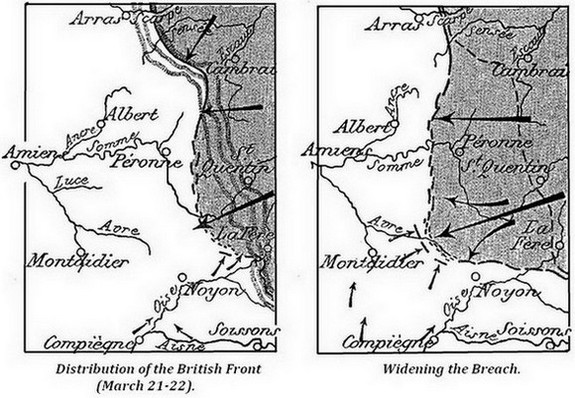
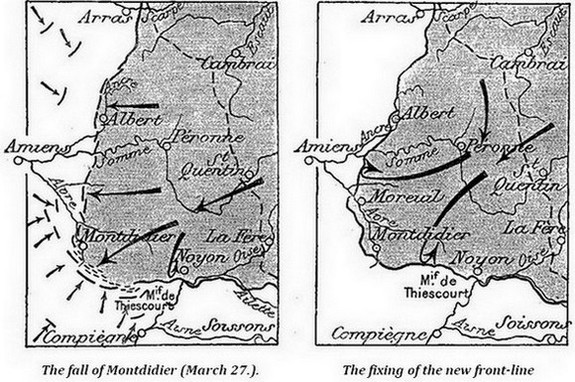
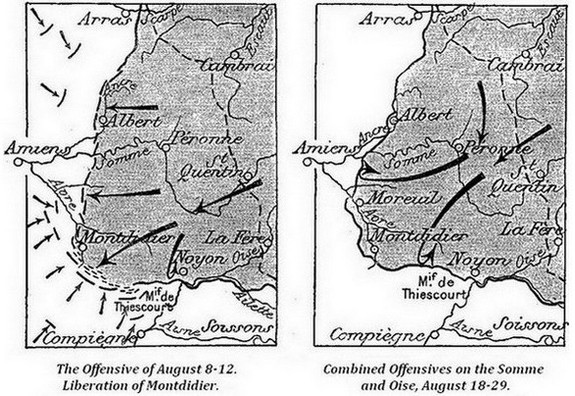
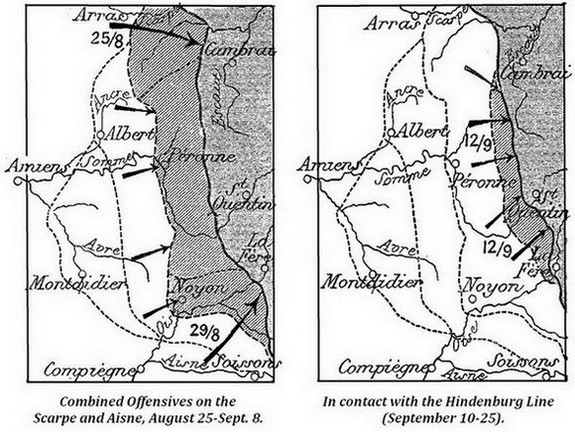
The Allied Offensive: Reducing the Pocket as far as the Hindenburg Line (August 8-September 25.).
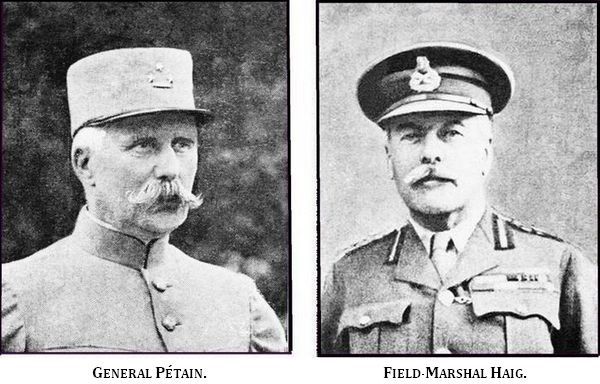
In March 1918, the British and French Armies, under separate commands, opposed the furious attacks of numerically superior and more powerfully equipped enemy forces, grouped under the command of a single chief: Ludendorff.