THE ALLIES' OFFENSIVES IN PICARDY. August-September 1918.
Reading edition
After the German Offensive of March.
After the check of their offensive in Picardy, the Germans attempted, by means of secondary offensives, to attain those results which they had failed to obtain in the first instance.
On April 9, they attacked in Flanders, from Béthune to the north of Ypres, in the direction of the Channel Ports, but failed to take Ypres, or to reach Hazebrouck. (See the Guide: Ypres.)
On May 27, the front of the Chemin des Dames was attacked by surprise, the enemy reaching the banks of the Marne. (See the Guide: The Second Battle of the Marne).
From June 9 to 18, their efforts were turned against the salients of the Aisne and Rheims. On June 11, they captured the massif of Thiescourt, but were held before Compiègne. In front of Rheims the road was barred by the French Colonial troops. (See the Guide: Rheims.)
Lastly, seeking a prompt decision at all cost, and hypnotised by Paris, the Germans planned a still more formidable offensive: the "Friedensturm" or Peace Battle. However, the French High Command were not taken unawares. The scope and time of the offensive were known, and the Germans failed.
The Strategy and Tactics of the Allies.
The hour of the counter-offensive was about to strike. The Allies had overcome the crisis due to the shortage of men. The British Army had been reorganized. The American forces had greatly increased in numbers. The fighting spirit of the French was higher than ever. The material strength of the Allies was satisfactory, and included large numbers of the new offensive arm: the tank, destined to relieve and support the infantry, and combat the German shock troops.
Lastly, the Allies were now grouped under a single chief: Foch, who knew where and when to strike.
The Allied Armies, he declared, have arrived at the turning of the ways; in the thick of battle they have regained the initiative, and their strength enables them to retain it; the principles of war command them to do so. The time has come to abandon the defensive attitude necessitated till now by numerical inferiority, and to take the offensive.
The action of the Commander-in-chief of the Allied Armies will, in future, aim at maintaining his hold on the German Commandment, giving him no respite which would allow him to recover and reconstitute his forces. To that end, separate surprise attacks will be made successively, as rapidly as possible, so as to augment progressively the disorganization of the enemy's armies and the confusion of the German Commandment, until the day of the general offensive, and of the final attack which will crumble up the whole of the adversary's front.
A comparison of this conception of Foch's with that of Ludendorff brings out all its suppleness and power.
The counter-offensive by the armies of Mangin and Degoutte in the Château-Thierry pocket, begun on July 18, was scarcely over, when the Second Battle of the Somme broke out.
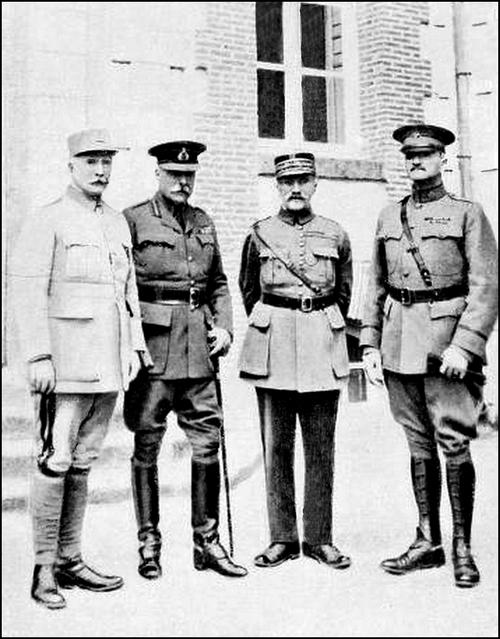
The Allied Military Chiefs. From left to right: PÉTAIN, HAIG, FOCH and PERSHING.
In this new battle of the Somme, the retreat of the German armies on the Hindenburg Line, in August-September 1918, was effected under the pressure of four successive thrusts:
I.—The operations carried out simultaneously by the British 4th Army and the French 1st and 3rd Armies against the Albert, Montdidier, Lassigny salient, to clear the Paris-Amiens railway. (Pages 38-45.)
II.—The British offensive north of the Somme, coinciding with the French offensive between the Oise and the Aisne. (Pages 46-49.)
III.—The British offensive on the Scarpe and the French offensive on the Ailette. (Page 50.)
IV.—The Franco-British offensive against the advanced defences of the Hindenburg line. (Page 51.)