THE GERMAN OFFENSIVE OF MARCH 21.
Reading edition
The Opposing Forces—Their Material and Moral Strength.
Towards the end of 1917, the abandonment of the Allies, by Russia, was consummated by the Russo-German Armistice of December 20, followed by the Peace of Brest-Litowsk, of February 9, 1918. As early as November 1917, Germany began to transfer her legions from the eastern to the western front. Arriving, via Belgium, in ever-increasing numbers, sixty-four new divisions were thus added to her Western Armies, already one hundred and forty-one divisions strong, giving a total strength of 205 German divisions against the Allies' 177 divisions.
The material resources, accumulated on the Russian front, were likewise transferred to the western front. The enemy's artillery was reinforced all along the line, the number of heavy batteries being doubled in many of the sectors.
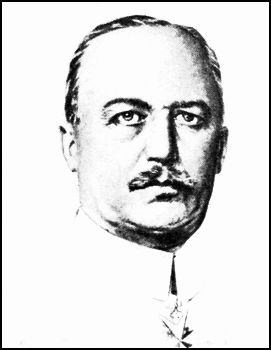
Ludendorff.
From General Buat's
"
Ludendorff
" (
Publishers: Payot. Paris.
)
Besides this numerical and material superiority, Germany possessed the additional advantage of a unique commander: Ludendorff, master of the hour, at once absolute military chief and political dictator. On the other hand, whilst the Allies were closely united by cordial friendship, sealed on the field of battle, their armies were independant units, separately commanded, each having its own reserves concentrated behind its particular front.
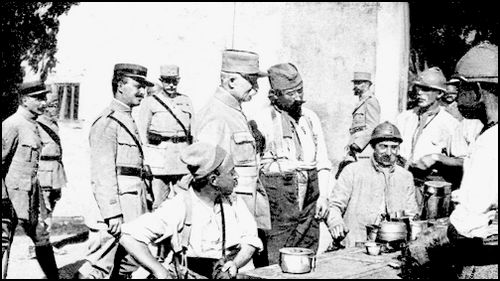
General Pétain among his "poilus"
On February 3, 1917, the United States of America ranged themselves on the side of the Allies, but their eventually powerful effort could not make itself seriously felt before the summer of 1918. In March 1918, four American divisions were in France, and a million more men were expected by the following Autumn, but the Germans were convinced that they would have the Allies beaten before then.
The moral strength of the opposing forces constituted one of the most important factors of victory.
During 1917, after the Allies' Spring Offensives, a wave of lassitude had lowered the fighting spirit of certain units of the French Army. However, the morale of the French Army had fully regained its former high level, when the great German offensive of March 1918 was launched.
The British Army had in the meantime perfected its training, and acquired, in addition to experience, splendid fighting qualities.
The Germans, badly shaken in 1916 by their failure at Verdun and by the Allies' Offensive on the Somme, had, in consequence of Russia's collapse, recovered all their former arrogant confidence and pride.
But the Allies' blockade, despite Germany's ruthless submarine warfare, tightened, and each day the menace of famine increased.
Triumphal announcements of victory, and promises of an early German peace appeared periodically in their press, yet still the war dragged on. Something had to be done to end it all, whatever the cost, and so the "Peace Offensive" was decided on.
Although inferior in numbers and equipment, the Allies had acquired moral superiority.
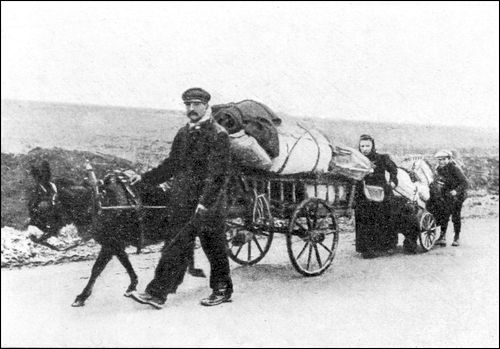
Driven from home by the German Push. (Photo Imperial War Museum).
The German Strategy and Tactics.
In all the previous offensives, especially that of the Somme in 1916, the artillery had been used, prior to the attack, to destroy the adversary's defences. The great number of fortified works and their ever increasing strength necessitated a proportionately longer and more intense artillery preparation. Thus warned, the enemy were able to make dispositions to counteract the effects of the attack, and to bring up reinforcements.
Moreover, the tremendous pounding of the ground greatly hampered the advance of the storming troops, who were hindered at every step by the enormous shell-holes and craters.
Breaking away from past errors, and adopting and perfecting the methods inaugurated the previous year before Riga, the German High Command attacked by surprise, in March 1918, thereby securing a crushing numerical superiority. The Allies were thrown into confusion, and all attempts at resistance were unavailing, until the arrival of the reserves. During this period of complete demoralisation, the enemy were able to exploit their initial success to the full.
The method employed was that of a sudden, violent shock, preceded by a short artillery preparation, mostly with smoke and gas shells, the aim of which was to put the men out of action, rather than to crush the defences. To this end, huge concentrations of troops were effected, in such wise that the masses of men could be thrown quickly and secretly at the presumed weak part of the Allies' front.
The semi-circular disposition of the front facilitated the enemy's task, as the German reserves, grouped in the Hirson-Mézières region, in the centre of the semi-circle, could be used with the same rapidity against any part of the front-line from Flanders to Champagne.
The point chosen by Ludendorff was the junction of the Franco-British Armies. To separate these two groups, by driving back the British, on the right, and the French, on the left; to exploit the initial success in the direction of the sea, isolating the British and forcing them back upon their naval bases of Calais and Dunkirk; then, having crushed the British, to concentrate the whole of his efforts against the French, who, unsupported and demoralized, would soon be driven to their knees,—such was apparently the strategical conception of the enemy's "Kaiserschlacht" or "Emperor's Battle".
The Opposing Forces.
On March 21, three German armies attacked along a 54-mile front, from the Scarpe to the Oise.
In the north, the XVIIth Army (von Below) and the IInd Army (von Marwitz) attacked on either side of the Cambrai salient, but the main effort was made by the XVIIIth Army (von Hutier), which stretched from the north of St. Quentin to the Oise.
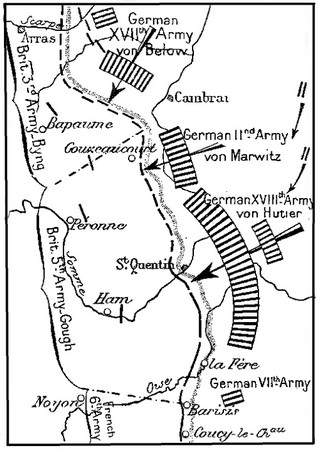
Facing these armies were: the right of the British 3rd Army (Byng), extending from the Scarpe to Gouzeaucourt, and the British 5th. Army (Gough), from Gouzeaucourt to south of the Oise.
The British expected the brunt of the attack to fall between the river Sensée and the Bapaume-Cambrai road, i.e. on the right of Byng's Army, which was reinforced accordingly, whilst the sector in front of the Oise, south of St. Quentin, against which von Hutier's huge army had been concentrated, was only held by 4 divisions.
More than 500,000 Germans were about to attack the 160,000 British under Gough and Byng, whilst from the outset of the battle, large enemy reserves swelled the number of the attacking divisions to 64, i.e., more than the total number of British divisions in France. In all, no less than 1,150,000 Germans were engaged in these tremendous onslaughts.
During the five nights which preceded the attack, the German divisions had been brought up secretly, the artillery having previously taken up its positions and corrected its range, without augmenting the volume of firing, so that nothing revealed the increased number of the batteries.
The shock troops, after several weeks of intensive training, were brought up by night marches to the points of attack. During the day, they were kept out of sight in the woods or villages. At night, whether on the march or bivouacking, lights and fires were strictly forbidden. Aeroplanes hovered above the columns to see that these orders were carried out. The ammunition parks and convoys were concealed in the woods. Until the last moment, the troops and most of the officers were kept in ignorance of their destination.
These huge forces moving silently under the cover of night, symbolized the enemy's might and cunning. "It is strange", wrote a German officer in his note-book, "to think of these huge masses of troops—all Germany on the march—moving westward to-night".