II.—THE BRITISH OFFENSIVE NORTH OF THE SOMME AND THE FRENCH OFFENSIVE BETWEEN THE OISE AND AISNE. August 18-29.
Reading edition
The first phase of the Battle of Picardy was ended, but a great new effort, between the Somme and the Scarpe, was being prepared.
Between the Aisne and the Oise, Mangin's Army attacked the plateaux on August 18th, advancing to the Ailette on the 23rd. (Sketch above).
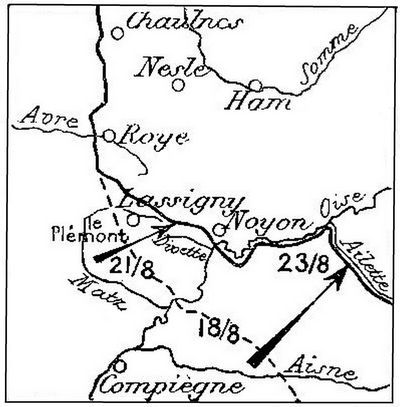
The Attack between the Oise and Aisne by the Armies of Generals Mangin and Humbert, August 18-23.
Following up this advance, Humbert's Army continued its offensive vigorously on the 21st, conquered the northern slopes of Le Plémont, crossed the Divette, and occupied Lassigny. (Sketch above).
By their advance, these two armies threatened the right of the German XVIIIth Army, established on the Chaulnes-Roye line.
At the same time, Byng's Army attacked between the Ancre and Croisilles, whilst Rawlinson's left attacked north of the Somme. (Sketch above).
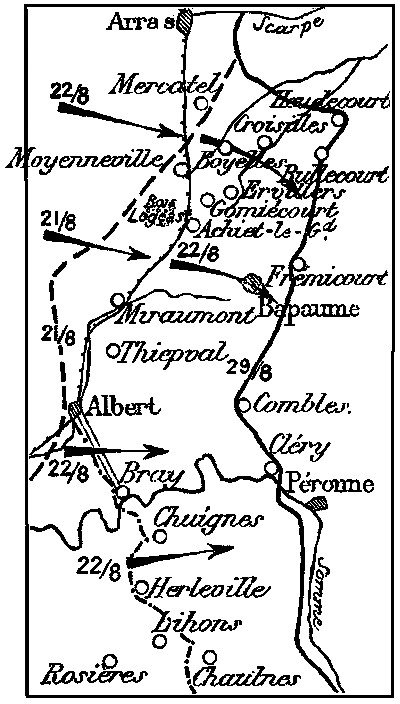
The Attack between the Somme and Scarpe by Byng and Rawlinson, August 21-29.
At dawn, on August 21, the 4th and 6th Corps of Byng's Army attacked between Miraumont and Moyenneville.
Supported by tanks, they captured the advance defences in brilliant style.
The fighting was particularly severe around Achiet-le-Grand and Logeast Wood, where, however, the advance continued steadily. The Arras-Albert railway which was the enemy's principal line of defence, was reached, 2,000 prisoners being taken.
After this preparatory attack, the offensive was launched on August 22, along a thirty-two mile front, between Lihons and Mercatel.
South of the Somme, the Australians captured Herleville and Chuignes, with 2,000 prisoners. Rawlinson's left crossed the Ancre, took Albert, and advanced its front to the hills east of the Albert-Braye road, capturing 2,400 prisoners.
But the hardest blow was struck further north by Byng's Army. Advancing beyond the principal line of defence (the Arras-Albert railway), the 4th and 6th Corps took Gomiécourt, Ervillers, Boyelles, many guns, and more than 5,000 prisoners, then pushed on towards Bapaume and Croisilles. The 6th Corps, astride the Arras-Bapaume road, marched on Bapaume, threatening to cut off the Germans who were hanging on to the Heights of Thiepval. The latter, attacked at the same time further south, fell. Bray-sur-Somme was also captured.
The battle continued from the 25th to the 29th, the enemy's resistance stiffening steadily.
Counter-attacking, the Germans defended this old battlefield of 1916, strewn with obstacles, with great desperation.
On the 29th, Bapaume fell, and the Germans retreated from the north of that town to the Somme, on the line Cléry, Combles, Frémicourt, Bullecourt, and Heudecourt.
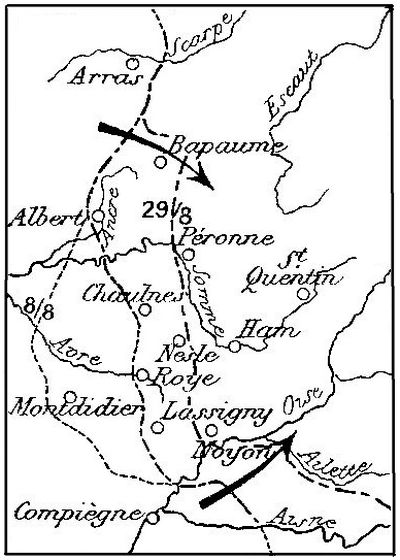
The German Retreat, south of the Somme, under the double menace of the British and French Advance.
Threatened by the British to the north of the Somme, and by the French on the banks of the Oise, the Germans began their retreat in the bend of the Somme. Closely pursued by the British 4th Army and the French 1st and 3rd Armies, they withdrew to the river, from Péronne to Ham.
Chaulnes and Nesle were occupied by the Allies.
"On the same ground which had seen their stubborn defence, the British troops went up to the attack with untiring vigour and unshakeable determination, which neither the difficulty of the ground, nor the obstinate resistance of the enemy could break or diminish." (Haig).
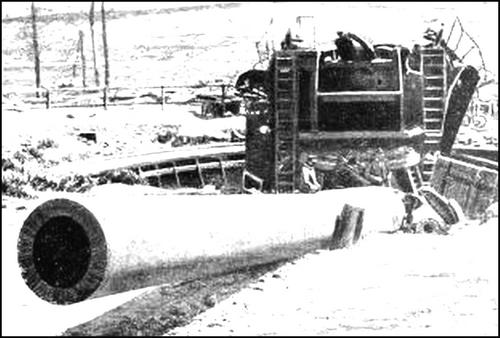
German long-range Gun captured by the Australians at Proyart.
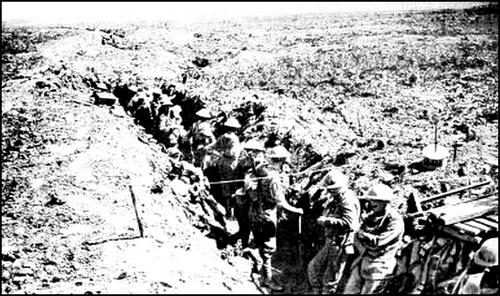
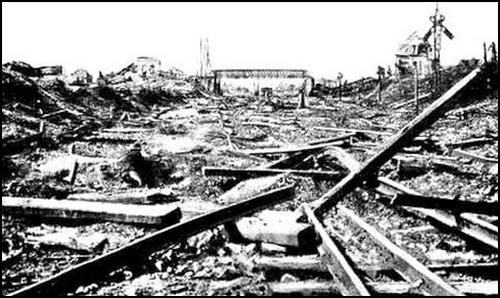
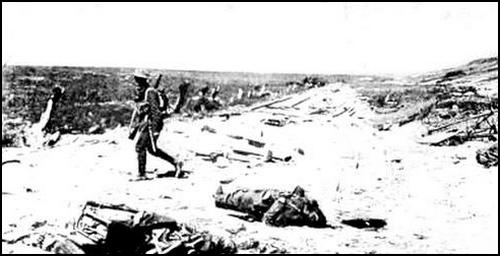
Photo Imperial War Museum.
PHOTOS, p. 48: (1) The 2nd German line near Albert, occupied by the British. (2) The Railway Station at Albert, a few minutes after the German retreat. (3) Railway destroyed by the British artillery, during the advance on Bapaume.
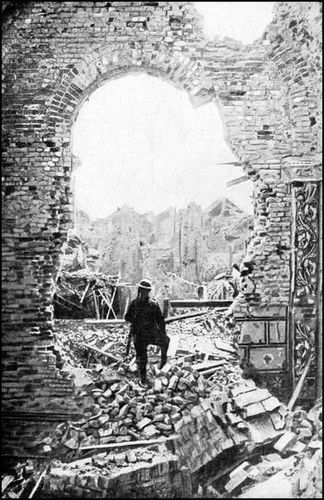
Photo Imperial War Museum.
Photo above:
Albert, seen from the interior of the Church, the day the town was liberated (Photo Imp. War Museum).