I.—THE ATTACK ON THE SALIENT OF ALBERT-MONTDIDIER-LASSIGNY. August 8-13, 1918.
Reading edition
Preliminary Operations of July.
Throughout July, the Allies carried out different local operations, in order to improve their positions and prepare for the coming offensive.
As early as July 4, Australians supported by Americans, had begun to advance between Villers-Bretonneux and the Somme, by capturing the village and wood of Hamel.
On July 9, after a brilliant attack between Castel and the north of Mailly-Raineval, the French captured Castel, and on the 23rd, Mailly-Raineval, which brought them nearer the Avre.
These different actions, and the flattening of the Cantigny salient by the American 1st Div. on May 28, had warned the enemy.
On August 2, the Germans fell back on the Ancre, and on the 3rd to the Avre. The bulk of their forces were withdrawn east of these rivers, leaving only light forces on the west bank.
On the Marne, Ludendorff had just suffered a severe defeat. From July 18 to August 4, his armies had been driven back from the Marne to the Vesle, where they organized new positions. (See the Guide: The Second Battle of the Marne.) In the belief that this effort had temporarily exhausted the Allies, Ludendorff was planning new operations in Flanders, when he was surprised by a new and powerful Allied Offensive. From that point, the initiative remained with Foch.
The Front Line and the Opposing Forces.
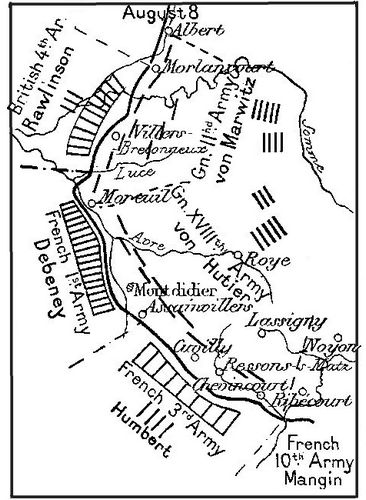
The Front Line on August 8, and the Opposing Forces.
On August 8, the front line passed west of Albert, east of Villers-Bretonneux, then followed the left bank of the Avre, and the Doms stream, west of Montdidier, running thence towards the Matz and the Oise, via Assainvillers, west of Cuvilly and Chevincourt.
From north to south, the enemy front was held by the IInd Army (von Marwitz) (10 Divns. in line from Albert to Moreuil), and by the XVIIIth Army (von Hutier) (11 Divns. from Moreuil to the Oise).
These two armies, with 21 divisions in line, engaged 17 other divisions during the course of the battle, i. e. 38 divisions in all.
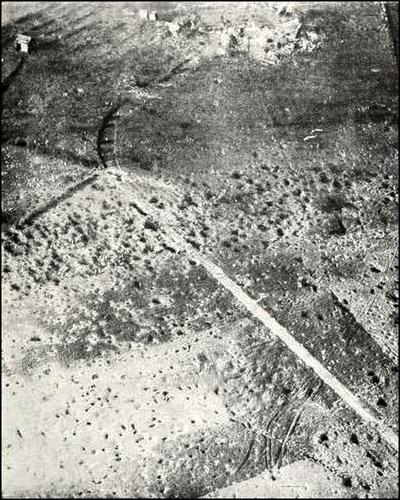
The Americans attacking Cantigny (May 28, 1918).
Photographed from, an accompanying aeroplane. At the top of photo:
Cantigny village. At bottom of photo: Tank tracks. The white dots and
dashes spread over the photo are the American Infantry. Two larger
dashes about three-quarters of an inch below Cantigny, on the right,
are tanks.
The undermentioned forces were grouped under the command of Field-Marshal Haig:
The British 4th Army (Rawlinson), comprising the 3rd Corps (3 divisions), the Australian Corps (4 divisions), the Canadian Corps (4 divisions), and 3 divisions of British Cavalry, 2 brigades of armoured cars and 1 battalion of Canadian Cyclists in reserve.
The French 1st Army (Debeney), comprising the 31st Corps (4 divisions), 9th Corps (2 divisions), 10th Corps (3 divisions), 35th Corps (4 divisions), and the 2nd Cavalry Corps in reserve.
The Franco-British Attack of August 8, 1918.
These armies attacked on August 8, along a 15-mile front, from the Ancre to the Avre.
"At 4.20 a.m., after three formidable cannon-shots,—the signal for the opening of the attack,—the rolling barrage broke out before the Australian and Canadian troops, who immediately dashed forward. At the same time, the heavy and light tanks, armoured cars and motor-lorries, loaded with supplies and ammunition, set out. At certain points, the cavalry, followed by the artillery and the aeroplanes, guarded or speeded up the advance. The enemy were taken completely by surprise. The troops and staffs were taken prisoners before they realized what had happened. One after another, the villages were surrounded and captured. Forging ahead of the infantry, the cavalry and tanks spread panic everywhere."
The British advanced rapidly in the direction of Rosières, along both sides of the Amiens-Chaulnes railway.
Towards evening, the advanced line passed through Mézières, Caix and Cerisy. Everywhere, except at Morlancourt, north of the Somme, where the enemy resisted desperately, the Germans were routed.
More than 13,000 prisoners, a general and the staff of an army corps, and 300 guns had fallen into the hands of the British by 9 a.m.
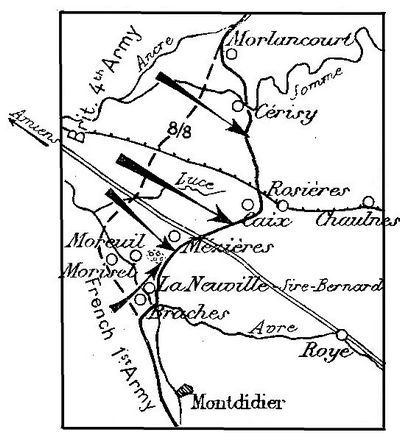
August 8.
Along the front of Debeney's Army, the artillery preparation was short but violent, (45 minutes). The infantry attacked about five o'clock i.e. after the British. The ground, divided for the greater part by the valley of the Avre, was more difficult, and General Debeney counted rather on manœuvering, than on surprise.
The attack began on a front of 2½ miles, south of the Amiens-Roye road, debouching from the valley of the Luce towards ground suitable for the tanks, the troops being gradually engaged on their right, along the Avre.
At 8 a.m., two divisions turned Moreuil Wood, from the north-east and south-west. On the Avre, another division captured Morisel, whilst to the south of Moreuil a battalion crossed the river. Moreuil, turned from the north and south, fell. South of Moreuil, two fresh divisions crossed the Avre, opposite Braches, opening up a way for the troops who had to fight on the plateaux.
At the end of the day, after an advance of about five miles, the French reached the line Braches, La Neuville-Sire-Bernard, and joined hands with the British near Mézières. 3,300 prisoners, including three regimental commandants, were taken.
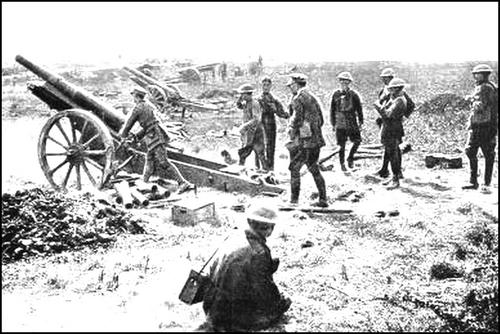
German battery captured by the British, who immediately turned it on the Enemy. The third gun is still pointing towards the Allies' lines. (Photo Imp. War Museum).
"It was a black day for the German Army" wrote Ludendorff, "the blackest of all the war, except September 15, which saw the defection of Bulgaria, and sealed the destinies of the Quadruple Alliance".
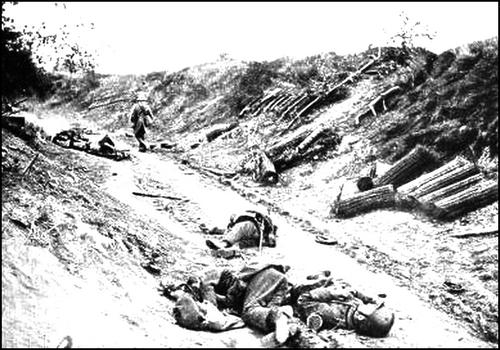
German Artillery Position in Sunken Road. (Photo Imp. War Museum).
From August 9 to 12.
On August 9-10, the British thrust and the French manœuvre developed.
The British Advance.
Between Albert and the Amiens-Roye road, the Canadians and Australians harassed the enemy without respite, and advanced several kilometres, capturing Bouchoir, Méharicourt, Rosières, Lihons and Proyart.
North of the Somme, in co-operation with American troops, they captured Morlancourt village and plateau to the south-east, where the enemy resisted desperately.
On the 11th, in spite of stubborn resistance, the British reached the Dernancourt crossroads, about a mile west of Bray, Chilly, Fouquescourt and the western suburbs of Villers-les-Roye.
On the 12th, they drove the enemy for good out of Proyart. On the 13th, they reached the suburbs of Bray-sur-Somme and the crossroads of Chuignolles. The front now ran along the old German lines of the Somme Battlefield of 1916, where the enemy, thanks to a number of strong points of support, succeeded in staying the advance. In five days, the British had scored a fine victory, their forces (13 infantry divisions, one regiment of the American 33rd Division, 3 divisions of cavalry, and 400 tanks) defeating 20 German divisions, advancing 12 miles, and capturing 22,000 prisoners and 400 guns.
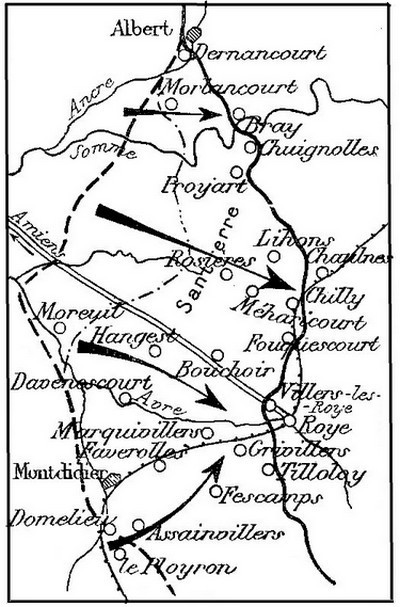
The Allies Advance from the morning of August 8 (dash line) to the evening of the same day (dot-and-dash line). The thick full line shows the front on August 12.
The French Manœuvre. Liberating Montdidier.
Meanwhile, General Debeney, by a series of turning movements, brought about the fall of important sections of the German front, without frontal attacks.
Constantly extending his attacks along the Avre, the approaches to the river on the north and north-east, as far as the confluence with the Doms stream, were cleared, whilst his hold on Montdidier, from the north-east, gradually tightened.
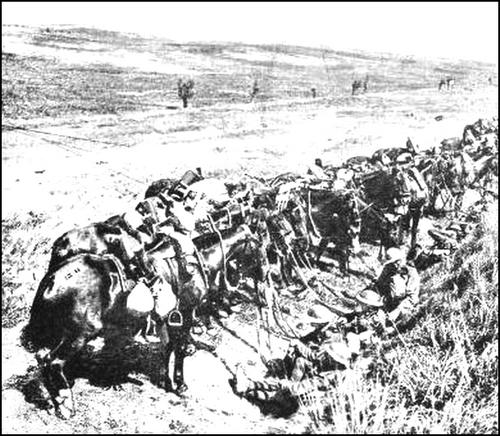
British Cavalry near Albert. (Photo Imperial War Museum).
On August 9, the French line was advanced as far as the station of Hangest-en-Santerre, on the Albert-Rosières-Montdidier railway.
In order to force the enemy to abandon Montdidier, without a frontal attack, General Debeney began a turning movement at about 4 p.m. A secondary attack was launched in the direction of Roye, between Domelieu and Le Ployron. The station of Montdidier and Faverolles Village on the Montdidier-Roye line, were reached that evening.
Throughout the day, the French airmen bombed Roye undisturbed by the enemy's planes or air-defence guns.
By evening, the 1st Army had taken 5,000 prisoners. From Faverolles, they threatened to join up with the men who had advanced north, via Davenescourt, and to cut off the Germans in Montdidier.
The latter was evacuated in great disorder the same night and on the following morning, only a few machine-gunners being left behind to retard the French advance as long as possible.
On August 10, at noon, the French entered the ruined town, and advanced rapidly eastward, beyond Fescamps, on both sides of the road to Roye. In the evening, they reached the line Villers-les-Roye (where they joined hands with the British) and Grivillers.
On the 11th, they captured the park and village of Tilloloy. By the evening of the 12th, the 1st Army had taken 8,500 prisoners (including 181 officers), 250 guns, numerous minenwerfer, 1,600 machines-guns, and huge quantities of stores.
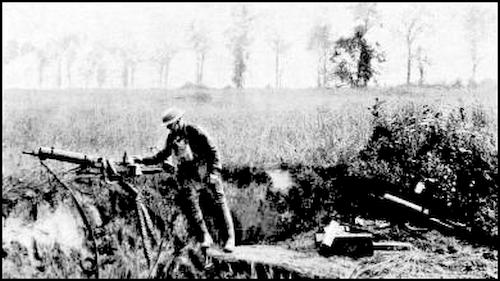
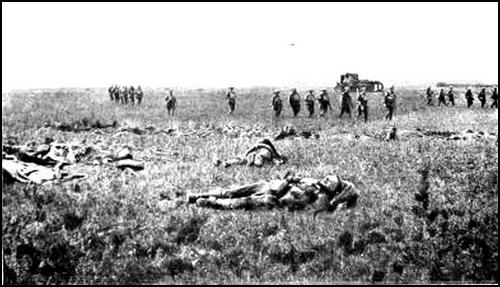
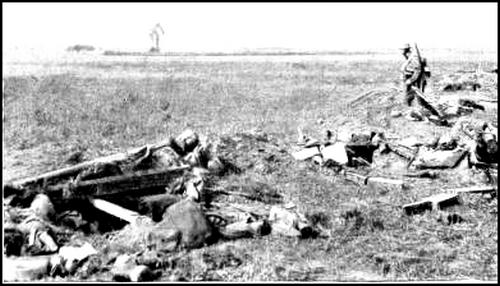
Photos, p. 44:
(1) Australian Sergeant examining a German Machine-gun captured by the 15th Brigade. (2) Near Warfusée-Abancourt, August 8. Infantry of the Australian 1st Division advancing on Harbonnières, after a tank had cleaned up a line of German Machine-guns which was holding them. (3) The Shelters of the above line of machine-guns— light constructions compared with the powerful trench organisations, yet strong enough to require tank treatment.
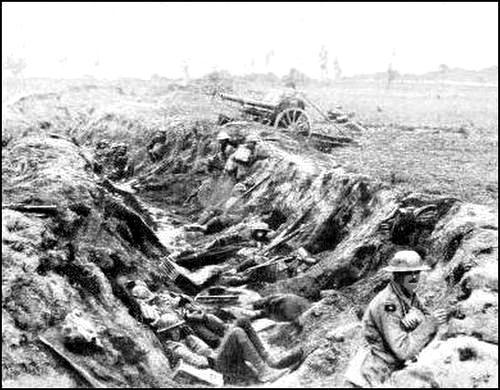
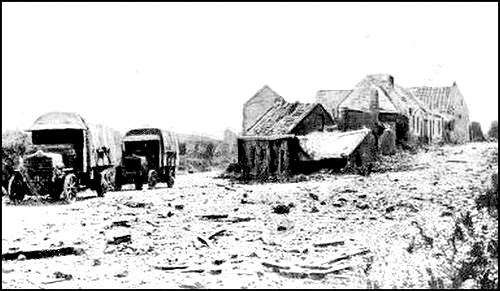
Photos above:
(1) Australians in German trench, with field-guns just captured (August 1918). (2) British lorries in Villers-Bretonneux (August 17, 1918).