IV.—THE OFFENSIVES AGAINST THE OUTWORKS OF THE HINDENBURG LINE. September 10-25.
Reading edition
The Germans had reached the advanced defences of their famous Hindenburg Line, consisting of the old British lines lost in March. These formidable positions protected the ramparts of the Hindenburg Line, said to be impregnable.
On September 10, the British 3rd and 4th Armies (Byng and Rawlinson) attacked between Havrincourt and Holnon.
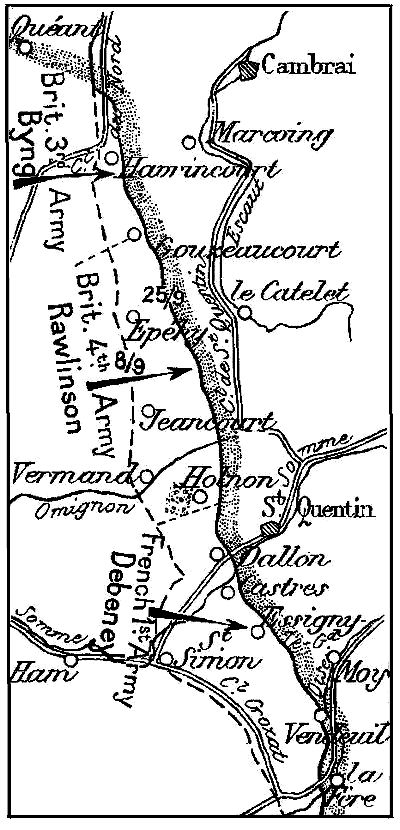
The 4th Army took Vermand, the western outskirts of Holnon Woods, and gained a footing in Épéhy and Jeancourt. On the 13th, after desperate fighting, it captured the woods and village of Holnon.
The 3rd Army crossed the Canal du Nord, south of the Bapaume-Cambrai road, turned the positions from Havrincourt to Gouzeaucourt, and captured the greater part of them, the enemy resisting desperately.
The same day (Sept. 12), the American 1st Army captured the whole of the St. Mihiel Salient, with 15,000 prisoners and 200 guns. (See the Guide: The Battle of St. Mihiel.)
On the 18th, a general attack was launched by the British 3rd and 4th Armies, in liaison with the French 1st Army. All the enemy's positions between Gouzeaucourt and Holnon were captured, with 10,000 prisoners and 150 guns.
To the south, Debeney's Army took over the front of Humbert's Army—transferred to the sector of the 10th Army—the latter, due to the shortening of the front, being sent to Lorraine, for a new offensive.
Debeney's Army, extending south of the Oise, attacked, and after capturing Dallon Spur, Castres and Essigny-le-Grand, reached the valley of the Oise, from Vendeuil to La Fère.
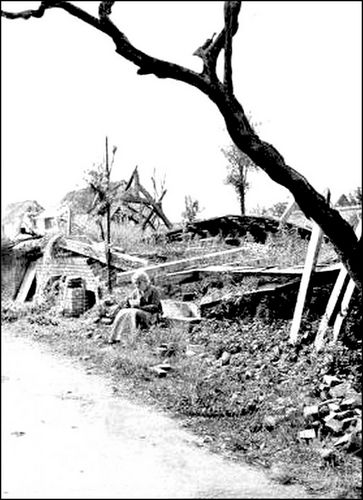
Peace after strife. Life in the ruins. Méharicourt, between Chaulnes and Caix, in 1919.
Disorganized and exhausted, their ranks depleted, the enemy were now incapable of attempting a counter-offensive.
To avoid this continuous, exhaustive battle, the Germans sought refuge in positions which they believed to be impregnable, and where they hoped to rest, reorganize and reconstitute their reserves.
This was an imperious necessity, as from July 15 to September 25, 163 of their divisions had been engaged, 75 of them two or three times.
On September 26, despite a reduction of 120 miles in the length of the front, they were forced to maintain practically the same number of divisions in line as on July 15, owing to their decreased effective strength and fighting value.
Moreover, to keep these forces effective, ten divisions had to be dissolved, and the battalions of fifty others reduced from four to three companies. Large numbers of men were called up from the works, in order to husband their last resources—the 1920 recruits.
Everywhere, the Allied armies were in contact with the Hindenburg Line, ready for the grand assault against the formidable positions from which the enemy had set out on March 21 for Paris and victory.
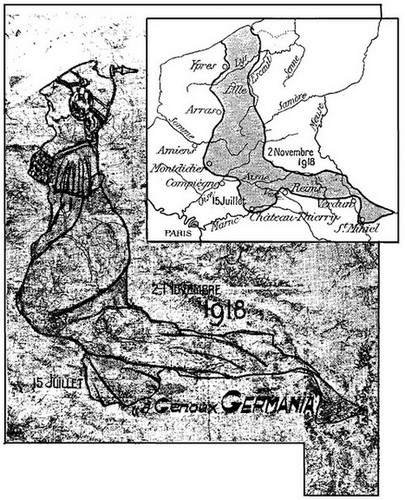
The above photograph represents an assemblage of the maps on which the Staff of the French 20th Corps traced the front from day to day. By bringing out the two lines of July 15 and November 2 (exactly reproduced), and by adding a few unimportant touches inside and the spike of the helmet, one of the Staff draughtsmen obtained this curious figure of Germania on her knees. With the help of the inset sketch-map, it is easy to trace the salients of Ypres, Arras, Montdidier, Château-Thierry (crossed by the Vesle), Rheims, Verdun, and St. Mihiel.
In six weeks, by repeated, inter-related attacks, vigorously executed without respite, the Allies had flattened out the salient from St. Quentin to beyond Montdidier and Albert, produced by the German push.
The end was near. To avoid a military disaster without precedent in the world's history, the enemy soon afterwards sued for an armistice and peace.

Ginchy (between Bapaume and Péronne) bombarded by the British (July 11, 1916).

Ginchy, ten days later (July 21, 1916).
Ginchy, two days before its capture by the British (Sept. 7, 1916). Illustrating the progressive destruction of a village by artillery. Taken from the Michelin Guide: "The First Battle of the Somme."
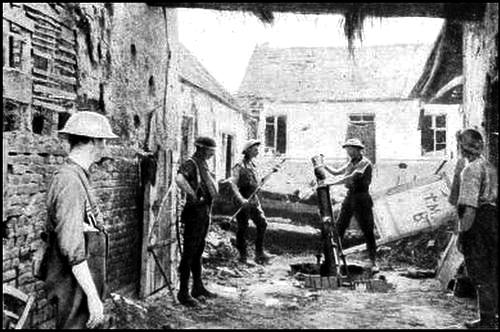
Modern war Weapons. A heavy trench-mortar of the 3rd Australian Medium Trench-Mortar Battery in action at Ville-sur-Ancre, on May 29, 1918, when the German front line was only 400 yards beyond this farm-house.
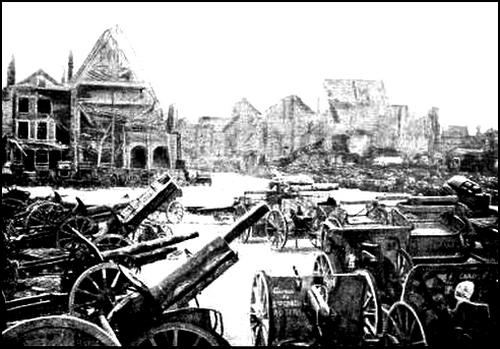
Péronne in 1918. The Grande Place. Captured German Guns. Taken from the Guide: The First Battle of the Somme.
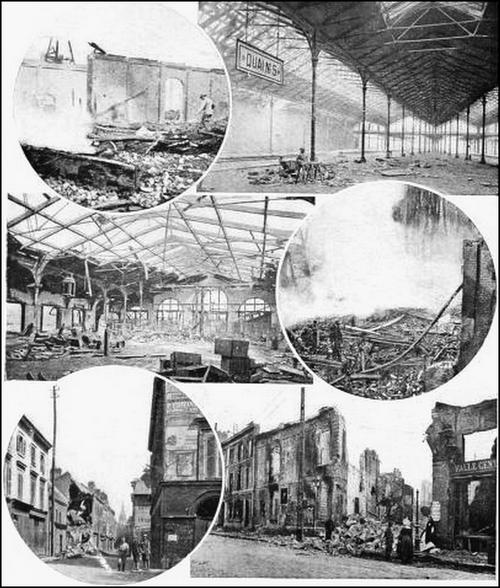
Amiens, during the German Offensives of 1918. (1) Fire at the Saint-Frères Works, April 23, 1918. (2) Platforms at the Gare du Nord, May, 1918. (3) One of the Warehouses at the Goods Station. (4) One of the buildings at the Saint-Frères Works. (5) The Rue de la Hotoie. (6) The Rue des Jacobins and the Passage du Commerce connecting it with the Rue des Trois Cailloux.
To visit AMIENS,
centre of the itineraries for Bapaume and Péronne ("The First Battle of the Somme") and Montdidier and Compiègne ("The Second Battle of the Somme"), see the MICHELIN Illustrated Guide:
"AMIENS, before and during the War."