PART VI. MISCELLANEOUS ANTIQUITIES FOUND ON THE LINE OF THE WALL.
Reading edition
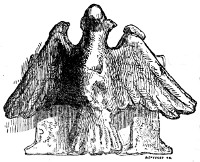
Most apposite is the remark of Dr. Johnson, that ‘Whatever withdraws us from the power of our senses; whatever makes the past, the distant, or the future predominate over the present, advances us in the dignity of thinking beings.’ Few things are so well calculated to produce this effect, as the altars and lettered tablets that have been left on our soil by the Romans. When we but glance at them, who is not moved at the reflection, that they were chiselled by 394hands which for so many centuries have mouldered nerveless in the dust!
Still on its march, unnoticed and unfelt
Moves on our being. We do live and breathe,
And we are gone! The spoiler heeds us not;
We have our spring-time and our rottenness;
And as we fall, another race succeeds
To perish likewise.
Kirke White.
On proceeding to decipher the antique records, our emotions are more varied and more intense. The old Roman seems to arise from the tomb, and to reveal his modes of thought and principles of action. His breast heaves; his heart is laid bare. In lines which his own fingers have carved, the gods before whom he trembled are declared. Looking on the very altar at which he knelt, we almost seem to see ‘the mean man bowing down, and the great man humbling himself.’
LETTERED STONES.
The region of the Wall has yielded more inscribed stones of the Roman period than any other portion of the kingdom. Many of them have already been presented to the reader; a few others will here be described. The lettered stones of the mural line may be divided into three classes—altars, funereal slabs, and centurial stones.
ALTARS.
PARTS OF AN ALTAR.
The offering of such sacrifices as were supposed to be acceptable to their deities, formed an essential part of the religion of the Greeks and Romans. Very numerous are the altars which 395have been discovered on the line of the Wall. Many of them are small, some not larger than the palm of the hand, rough in the workmanship, and without any inscription; others are of large size,
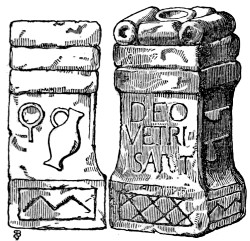
and of ornate character. The usual form of them is shewn in the annexed cut. The inscription is on the face of the altar; the base and upper portion project a little beyond the sides. A small cavity on the top called the focus, or hearth, received the offering. The sides of the altar were frequently adorned with carvings representing the victims, the implements used in sacrifice, and insignia of the god. On the altar[137] before us, we have represented the præfericulum, or pitcher, which contained the wine for the offering; the patera, a round, shallow dish, generally with a handle, which was used in throwing a small portion of the wine upon the altar; the securis, or axe, with which the animal was slain; and the culter, or knife, used in flaying or dividing it. In the Chesterholm altar, figured p. 240, the sacrificial ox is represented; and on the sides of the altar to Jupiter, which is shewn on page 290, the thunder-bolt of the god, and the wheel of Nemesis— 396the emblem of swift vengeance—are given. The small size of the focus proves that the offerings presented to the deities occupied a very small bulk. When an animal was slain, a portion of the entrails was often all that fell to the lot of the god.
Idibus in magni castus Jovis æde sacerdos
Semimaris flammis viscera libat ovis.[138]
Ovid’s Fasti, i. 587.
NATURE OF THE OFFERINGS.
Frequently the offering consisted of a little barley-meal, some fruit, some frankincense, or chips of fragrant wood, with wine or milk. Occasions of sacrifice were often times of merry-making. The slain victim and the dedicated wine formed the ready materials of a feast. Ovid sarcastically represents an old woman performing the rites due to the goddess of Silence; upon her offering (three grains of incense) she allows a few drops of wine to fall, and assisted by her companions, though needing little help, she drinks up the remainder, departing from her devotions tipsy, and anything but taciturn.
Ecce anus ... annosa,
Et digitis tria thura tribus sub limine ponit
Vina quoque instillat. Vini, quodcumque relictum est,
Aut ipsa, aut comites, plus tamen ipsa, bibit.
... ebriaque exit anus.
Fasti, ii. 571.
ALTAR TO JUPITER.
As might be expected, many altars are dedicated to Jupiter, the king and father, as he was styled, of gods and men. The wood-cut represents a very fine one, which was found in the station at Chesterholm, 397and is now preserved under the piazza of the House.
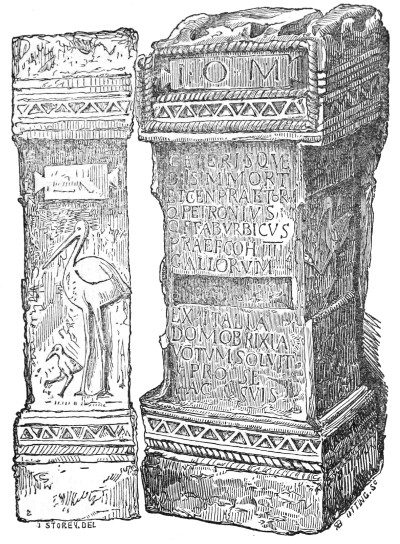
I[OVI] O[PTIMO] M[AXIMO]
CETERISQUE
DIIS IMMORT[ALIBVS]
ET GEN[IO] PRAETOR[II]
Q[VINTVS] PETRONIVS
Q[VINTI] F[ILIVS] FAB[IA] VRBICVS
PRAEF[ECTVS] COH[ORTIS] IIII
GALLORUM
EX ITALIA
DOMO BRIXIA
VOTVM SOLVIT
PRO SE
AC SVIS
To Jupiter, best and greatest,
And to the rest of the
Immortal gods,
And the genius of the pretorium,
Quintus Petronius
Son of Quintus, of the Fabian family, surnamed Urbicus.
Prefect of the Fourth cohort
Of the Gauls,
From Italy, and
Of a house of Brixia,
Performed a vow
For himself
And family.
Two lines have been purposely erased, perhaps in 398consequence of some error committed by the sculptor. The town of Brixia, the modern Brescia, is situated on a feeder of the Po. Petronius, it would appear, still remembered, and doubtless with affection, his former home in sunny Italy. Storks adorn both sides of the altar; the object of their introduction is rather doubtful. In the Risingham slab, now at Cambridge, to which reference has already been made (p. 332), a cock is associated with the figure of Mars, and a stork with that of Victory. Can the stork have been the emblem of victory, as the cock was of the god of war? The powerful wing and stately motions of this bird render it a fitting emblem of the goddess whose favours Petronius must often have sought. The inscription is distinct, and strikingly displays the polytheism of the Romans. Petronius associates with Jupiter, not only all the immortal gods, but the genius of the pretorium also.
POLYTHEISM OF ROME.
Not only were the superior deities and invisible genii blended in one invocation, but mortal men were not unfrequently associated with the greatest of the gods on the same altar. This is the case in one already described (p. 63). Quintus Verius, on an altar found at Housesteads, calls upon Jupiter, the best and greatest, together with ‘the deities of Augustus.’ The emperor himself is probably intended by this phrase, not the gods whom the emperor worshipped. The use of the noun in the plural number, numina, is not opposed to this view. Horsley remarks that numina is frequently, in classical writers, applied to a particular deity; thus we 399have numina Dianæ in Horace, and numina Phœbi in Virgil. The emperors, we know, were frequently worshipped as gods. The Mantuan bard, addressing Augustus, has no doubt of his divinity, though he knows not what region to assign to his especial care;
... urbesne invisere, Cæsar,
Terrarumque velis curam;...
An deus immensi venias maris, ac tua nautæ
Numina sola colant....
Georg. I. 25.
MARYPORT ALTAR.
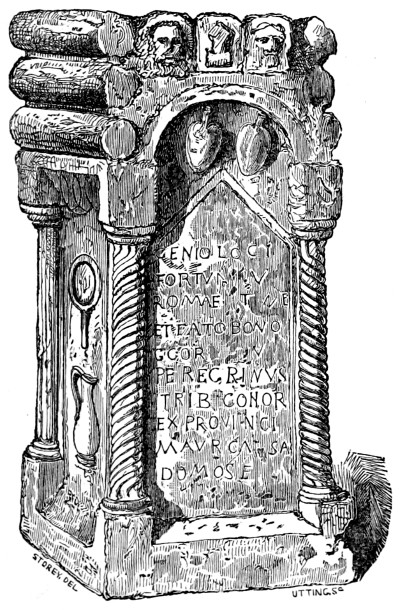
An altar, which is not less remarkable for the ornate character of its decorations, than for the striking display which it affords of the polytheism of 400the Romans, was found in the camp at Maryport, and is now in the possession of the earl of Lonsdale, at Whitehaven Castle. An accurate representation is given of it in the preceding engraving.
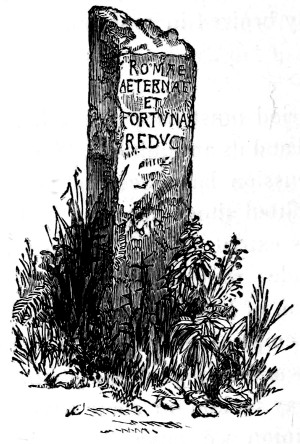
GENIO LOCI
FORTVNÆ REDVCI
ROMÆ AETERNÆ
ET FATO BONO
G[AIVS] CORNELIVS
PEREGRINVS
TRIB[VNVS] COHOR[TIS]
EX PROVINCIA
MAVR[ITANIÆ] CÆSA[RIENSIS]
DOMOS E . . .
. . . . .
To the Genius of the place,
To returning Fortune,
To eternal Rome,
And to propitious fate,
Gaius Cornelius
Peregrinus,
Tribune of a cohort,
From the province of
Mauritania Cæsariensis,
. . . . . . . . . .
. . . . . . . .
The lower lines of the inscription of this altar are much injured; they probably refer to the restoration of some buildings. The upper portion is sufficiently plain. Peregrinus addresses first the deity of the place over which his arms had triumphed; lest the local god should not smile benignantly, he resorts to Fortune, who had conducted him safely to the land of his adoption; if this deity should fail him, he thinks to find a refuge in the genius of the eternal city; but driven from this resource, there is nothing for it, but to trust to fate or chance.
On the back of this altar (which as it is at present placed at Whitehaven Castle, cannot be seen), are inscribed the words, VOLANTI VIVAS. This was probably the expression of the good wishes of some party for his friend, inscribed for greater efficacy on the sacred stone; and may be translated, Volantius, long may you live!
ALTARS TO MARS.
401Mars is occasionally addressed, though not so frequently as we might expect in a chain of mural garrisons. Two small altars dedicated to him have already been introduced. On several altars, chiefly found in Cumberland, he is addressed by the name of Cocidius. One which was found at Bank’s-head, and is now preserved at Lanercost Priory, is here introduced. An altar found at Lancaster bearing the inscription, DEO SANCTO MARTI COCIDIO, is the authority for supposing that Cocidius was a name of Mars. The altar before us has been dedicated by the soldiers of the twentieth legion, surnamed the Valiant and Victorious; the boar, the badge of the legion, is at the bottom of the altar. It appears also that Mars was sometimes styled Belatucadrus, the expression DEO MARTI BELATUCADRO being found upon some altars; the altars to Belatucadrus are, however, confined to Cumberland. One of them is here given. It was found at Walton Castlesteads, where it still remains. The letters are rudely carved, and the last two lines not very intelligible. The name Belatucadrus or Belatucader is derived from the words Baal and Cadir; and probably means—The invincible or omnipotent Baal. The fact that Baal, the great idol of the east, found votaries in Britain shews how easy it is to propagate error.
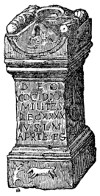
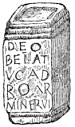
It was the practice of the Romans to adopt the 402deities of the countries which they subdued, and they may be supposed to have sought to amalgamate with their own god of war, the corresponding divinity worshipped in that part of Britain where these altars were reared.
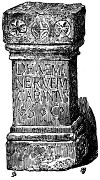
MINERVA.
The worship of Minerva was not neglected by the soldiers of the Wall. The wood-cut exhibits an altar to the virgin goddess, which was found in the station at Rochester; it is now at Alnwick Castle. Several others exist. Science is required in the arts of war as well as peace. The victory which mere daring achieved, was by the Greeks and Romans ascribed to the intervention of Mars; that which was the result of skilful strategy to the influence of Minerva. This altar was consecrated by Julius Carantus.
FORTUNA.
Fortune was one of the favourite deities of Rome. The great confidence which the Romans placed in her is expressed in the story related by Plutarch, that on entering Rome she put off her wings and shoes, and threw away her globe, as she intended to take up her permanent abode among the Romans. Several altars addressed to Fortune have been found on the line of the Wall. One of the most remarkable is shewn in the annexed cut. It was found in a building in the south-east corner of the station at Risingham, and is now in the Museum of
403Antiquities, Newcastle-upon-Tyne. The great peculiarity of it is, that the projecting base of the altar is provided with a focus, and that on the projection the inscription is repeated. It reads—
FORTVNAE
SACRVM
VALERIVS
LONGINVS
TRIB[VNVS]
To Fortune
Sacred
Valerius
Longinus
Tribune.
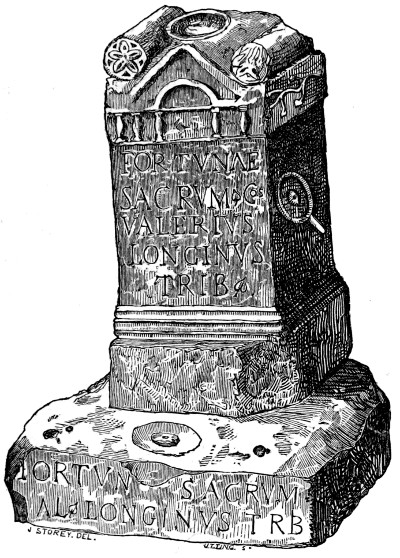
The altar, when in its original position, was raised by means of two courses of masonry considerably above the level of the ground. The object of the 404second focus is a matter of conjecture. According to the grammarians, altare (alta ara, high altar) was dedicated only to the gods above, whilst the ara was both lower, and employed in sacrificing to the gods below as well as those above. Can Fortune have been viewed in the double capacity of a superior and inferior divinity, and can the tribune, Valerius Longinus, have sought to secure the favour of the powerful deity both in this life and the one to come!
MITHRAS.
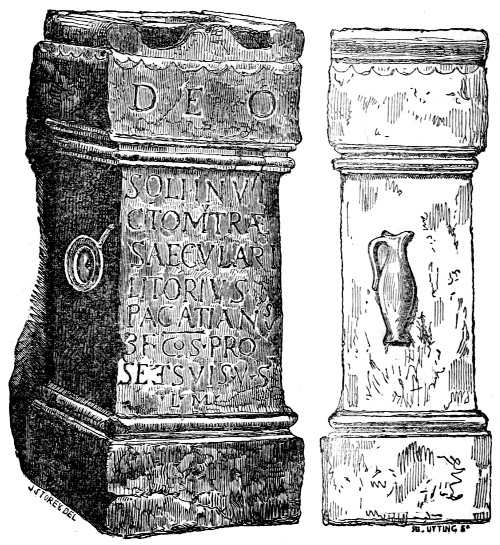
Several of the altars found on the line of the Wall are dedicated to the god Mithras. Mitra, it appears, is one of the names for the sun in Sanscrit; and that
405Mithras was, by the Romans, identified with the sun, is clearly proved by many of the inscriptions on the altars of that deity. One, found in the Mithraic cave at Housesteads, and which is now at Newcastle-upon-Tyne, is figured on the former page. The inscription upon it may be read thus;—
DEO
SOLI INVI
CTO MYTRÆ
SAECVLARI
LITORIVS
PACATIANVS
B[ENE]F[ICIARIVS] COS. PRO
SE ET SVIS V[OTVM] S[OLVIT]
L[IBENS] M[ERITO]
To the god
The Sun the in-
vincible Mithras
The Lord of ages
Litorius
Pacatianus
A consular beneficiary; for
himself and family discharges a vow
Willingly and deservedly.
WORSHIP OF THE SUN.
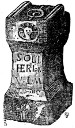
Another small and roughly-cut altar procured from the same place, and also now at Newcastle-upon-Tyne, has a figure of the sun on its capital: Hodgson reads the inscription in this manner—Hieronymus, performing a vow, freely and duly dedicates this to the sun.
When we contemplate the powerful and beneficial influence of the sun, we cannot be surprised that the worship of this luminary, especially in the east, constituted the first form of idolatry—
To solemnize this day, the glorious sun
Stays in his course, and plays the alchemist;
Turning, with splendour of his precious eye,
The meagre cloddy earth to glittering gold.
WORSHIP OF MITHRAS.
The various ceremonies which were observed in 406the worship of Mithras, are supposed to have been emblematic of the different influences exercised by the sun upon vegetable and animal life. The notices which we have of the meaning of these emblems are, however, a mass of mysticism and absurdity. The god is commonly represented as a youth wearing the Phrygian cap and attire, and kneeling on a bull thrown on the ground, the throat of which he is cutting. He is usually accompanied by two attendants, the one bearing an uplifted torch, representing the sun in the vernal equinox, ascending to the zenith of his power, the other, an extinguished torch, resting on the ground, emblematic of the orb of day, when hastening to the winter solstice. The wood-cut here introduced exhibits one of these figures (now at Newcastle-upon-Tyne), which was found in the cave at Housesteads.
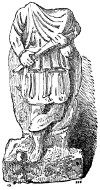
The Mithraic worship was introduced into the western world, from Persia, about the time of Julius Cæsar, and speedily spread over all parts of the empire. It appears to have outlived other forms of idolatry in Europe. Its favourers seem to have abandoned polytheism; on the line of the Wall at least, the name of Mithras is not combined with that of any other deity. This circumstance, together with the laborious, though vain, researches of its philosophical supporters, recommended it to those 407who rejected the pure and simple truths of Christianity.
MITHRAIC CAVE.
Another of the Housesteads altars to Mithras is here figured. It is inscribed—
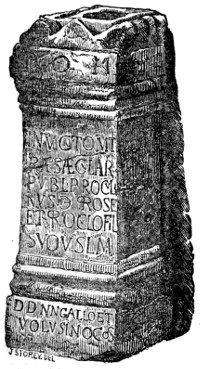
D[EO] O[PTIMO] M[AXIMO]
INVICTO MYT
RÆ SAECVLARI
PVBL[IVS] PROCVLI
NYS C[ENTVRIO] PRO SE
ET PROCVLO FIL[IO]
SVO V. S. L. M.
———
D.D. (dominis) N.N. (nostris) GALLO ET
VOLVSINO CO[N]S[VLIBVS]
CC
To the god best and greatest
The invincible Mith-
ras, lord of ages,
Publius Proculinus,
Centurion, for himself
And Proculus his son,
his vow freely and deservedly pays.
———
Our lords Gallus and
Volusinus being consuls.
The temples of Mithras generally consisted of a cave, or a small building from which the light was excluded. A cave was adopted, ‘because,’ says Porphyry, ‘a cave is the image and symbol of the world,’ and it was dark, ‘because the essence of the virtues is obscure.’ All who sought the favour of this god were subjected to a long course of painful initiatory discipline. Nonnius, a Greek poet, says—
MITHRAIC RITES.
No one can be admitted into his mysteries, unless he has previously undergone all the punishments, the number of which they say is eighty, some of them of the gentler sort, 408others more severe. The milder are undergone first, then the severer; and after the whole course is gone through, they are initiated. Fire and water are the sorts of punishment which they endure. These torments are said to be inflicted to produce examples of piety and greatness of mind under sufferings. After they have been many days in water, they cast themselves into fire; then live in desert places, and there subdue the cravings of hunger; and thus, as we have said, the aspirant goes through the whole course of eighty torments; which if he survive, then he is initiated into the mysteries of Mithras.
Human sacrifices seem to have been used in the worship of Mithras. Photius, in his life of Athanasius, asserts that there was a Greek temple in Alexandria, in which, in ancient times, the Greeks performed sacred rites to Mithras, sacrificing men, women, and children, and auguring from their entrails. Pliny tells us that in the year of Rome 657, a decree of the senate was passed, forbidding the immolation of man; for till that time monstrous solemnities were openly celebrated.[139] The emperor Heliogabalus, a native of Syria, styled himself high priest of Mithras. His assassination is partly ascribed to the horror with which the people listened to the tales of magic rites in which he was concerned, and of human victims secretly slaughtered.[140]
MITHRAIC CAVE.
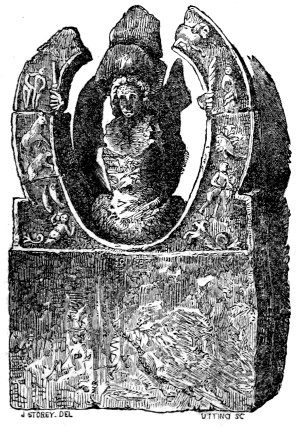
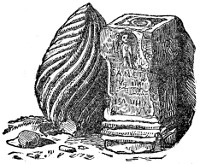
The cave at Housesteads in which the Mithraic sculptures were found, was situated in the valley to the south of the station. It was discovered in 1822 by the tenant of the farm in which it stood, who fixed 409upon the spot as one likely to yield him the material which he required for building a stone fence hard by. The building was square; its sides faced the cardinal points. It had been originally, as was usually the case in a Mithraic temple, permeated by a small stream. Hodgson, who saw it as soon as it was laid bare, says, ‘The cave itself seems to have been a low contemptible hovel, dug out of a hill side, lined with dry walls, and covered with earth or straw.’ Though the building has been entirely removed, a small hollow is left which marks the spot where it stood. All the sculptured stones have happily been placed in the custody of the Society of Antiquaries, Newcastle-upon-Tyne. Amongst them, besides the altars already given, and some which it has not been thought necessary here to engrave, is the curious stone shewn in the wood-cut. It represents Mithras, surrounded by the zodiac. The signs of cancer and libra are omitted. The zodiacal tablet assumes an egg-like form, probably to symbolize the principle of generation. The god holds a sword in his right hand, and a peculiar spiral 410object in his left. It more nearly resembles an ear of corn than the flame of a torch. We are reminded by it of the ornaments resembling pine apples, which are frequently found on the line of the Wall; and were probably connected with the worship of this deity. The example here figured, as well as the small altar which accompanies it, was found at Housesteads; both are now preserved at Chesters.
MITHRAIC SYMBOLS.
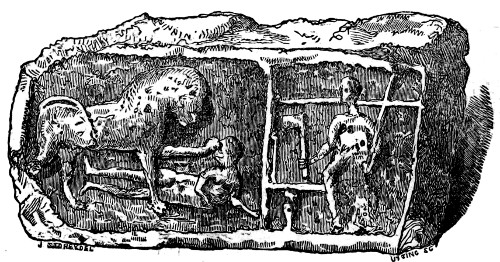
The accompanying wood-cut represents a subject which is supposed to be connected with the mysteries of Mithraic worship. The slab was found at Cilurnum, and is now at Alnwick Castle. Though not satisfied with Hodgson’s description of it, I am unable to supply a better. He says;—
The sculpture is in two compartments: that on the left seems to contain a lion, statant, raising the head of a naked and dead man: that on the right, a figure of Mithras seated on a bench, and having a flag in one hand, a wand in the other, and on its head the Persian tiara.(?) I would hazard a conjecture that the whole relates to the Mithraic rites called Leontica; for the lion, in the zodiac of the ancient heathens, 411stood for Mithras, or the sun, which threw its greatest heat upon the earth during its course through the constellation Leo.
ALTAR TO APOLLO.
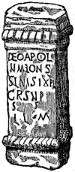
Numerous as are the altars on the line of the Wall to the Persian god, only one has been found dedicated to Apollo, the Grecian representative of the luminary of day. It was discovered in the summer of 1850, lying near a spring in the vicinity of the Cawfield mile-castle, about midway between the Wall and the Vallum, and is now preserved in the collection of antiquities at Chesters. The following reading must be regarded as, in a great measure, conjectural; no doubt, however, can exist as to the deity to which it is dedicated.
DEO APOL
INI ET O[MNIBVS] N[VMINIBV]S
SINIS[TRA] EXPL[ORATORVM]
CVI PR[AEEST] SVLP[ICIVS]
VOTVM S[OLVIT]
L.L. (libentissime) M[ERITO]
To the God Apol-
lo and the other deities,
The left wing of guides
Commanded by Sulpicius,
In discharge of a vow
Most willingly and deservedly.
It is believed that this is the only inscription to Apollo yet discovered in England, though one at least has been found in Scotland. The Roman soldiers in Britain were probably not much given to the study of the belles lettres, which were under the peculiar patronage of the god of the silver bow.
The next is an inscription of unusual importance.
Ultima Cumaei venit jam carminis aetas;
Magnus ab integro saeclorum nascitur ordo.
Jam redit et Virgo.
412
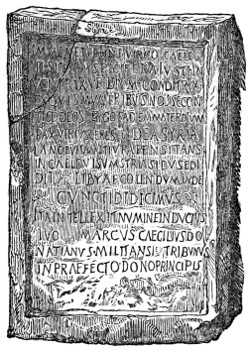
INSCRIPTION TO THE SYRIAN GODDESS.
A slab was found at Carvoran in 1816, and is now in the castle of Newcastle-upon-Tyne, which contains an exposition in iambic verse of the creed of a Roman tribune respecting the mother of the gods. Faber remarks, that Ceres, Cybele, Venus, the Syrian goddess Derceto, the Phœnician Astarte, and the Egyptian Isis, were all one and the same deity. The inscription, which is an unusually long one, is here arranged in lines of the length which the scansion requires—
IMMINET LEONI VIRGO CÆLESTI SITU
SPICIFERA, JUSTI INVENTRIX, URBIUM CONDITRIX,
EX QUIS MUNERIBUS NOSSE CONTIGIT DEOS
ERGO EADEM MATER DIVUM, PAX, VIRTUS, CERES,
DEA SYRIA; LANCE VITAM ET JURA PENSITANS.
IN CÆLO VISUM SYRIA SIDUS EDIDIT,
LYBIÆ COLENDUM INDE CUNCTI DIDICIMUS,
ITA INTELLEXIT, NUMINE INDUCTUS TUO
MARCUS CÆCILIUS DONATINUS, MILITANS
TRIBUNUS IN PRÆFECTO DONO PRINCIPIS.
The Virgin in her celestial seat overhangs the Lion,
Producer of corn, Inventress of right, Foundress of cities,
By which functions it has been our good fortune to know the deities;
Therefore the same Virgin is the Mother of the gods, is Peace, is Virtue, is Ceres,
Is the Syrian Goddess poising life and laws in a balance,
The constellation beheld in the sky hath Syria sent forth
To Lybia to be worshipped, thence have all of us learnt it,
Thus hath understood, overspread by thy protecting influence,
Marcus Cæcilius Donatinus, a warfaring
Tribune in the office of prefect, by the bounty of the emperor.
413Cæcilius probably prepared this exposition of his faith on being admitted into the mysteries of Ceres. However unintelligible, we cannot but admire the humility and teachable disposition of the tribune.
Their judge was conscience, and her rule their law,
That rule, pursued with reverence, and with awe,
Led them, however faltering, faint and slow,
From what they knew, to what they wished to know.
But let not him that shares a brighter day,
Traduce the splendour of a noontide ray,
Prefer the twilight of a darker time,
And deem his base stupidity no crime!
MINOR DEITIES.
A glance at some of the minor, and local deities must conclude our review of the gods of the Barrier.
The deities of Greece and Rome were without number. Every fountain and river, every hill and forest, had its tutelary deity; every product of earth, air, or sea, its guardian; every place its genius; every household its penates. The antiquities found on the Wall furnish us with numerous illustrations of this fact. The engraving represents an altar which was found at Birdoswald, and is now at Lanercost.
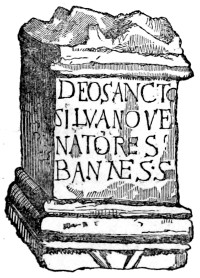
DEO SANCTO
SILVANO VE
NATORES
BANNE S.S. (sacraverunt)
To the holy god
Silvanus,
The hunters of
Banna
Have consecrated this.
THE NYMPHS.
414Silvanus seems to have presided over woods and boundaries. Several altars have been erected to him along the line. Forests must at that time have covered a great portion of the country, and given shelter to beasts of chase worthy of the martial prowess of the occupants of the Isthmus.
A host of female forms, denominated nymphs, haunted mountain, valley, and stream.
When in the Iliad, the father of the gods calls together his council,
Nor of the Floods was any absent thence
Oceanus except, or of the Nymphs
Who haunt the pleasant groves, or dwell beside
Stream-feeding fountains, or in meadows green.
An interesting altar, dedicated to these deities, was found by the side of a spring overlooking the station of Habitancum. It is now in the garden of Spencer Trevelyan, esq., of Long Witton.
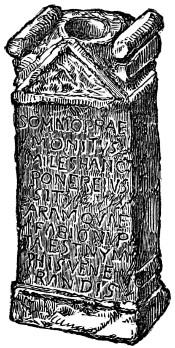
SOMNIO PRAE
MONITVS
MILES HANC
PONERE IVS
SIT
ARAM QVAE
FABIO NVP
TA EST NYM
PHIS VENE
RANDIS.
The inscription is roughly cut, but quite legible, no contraction is used in it, and no ligature is admitted, even in the case of diphthongs. The construction of the sentence is peculiar, and 415admits of two renderings. Taking nupta est to signify dedicated, a peculiar use of the word, suggested perhaps by its etymological relationship with the one which it governs, nymphis, the inscription will read—
A soldier, warned in a dream, directed the erection of this altar, which is dedicated by Fabius to the nymphs to whom worship is due.
The other method of rendering it is the following,—
A soldier, warned in a dream, directed her (eam supplied) who is married to Fabius to erect this altar to the nymphs to whom worship is due.
THE GODS OF THE MOUNTAINS.
According to either interpretation the altar was erected to the sylphs of the fountain, in consequence of a dream. The lively imagination of the Roman has invested the humble spring where it originally stood with such an air of romance, as to render it a matter of regret that the altar does not still grace the spot.
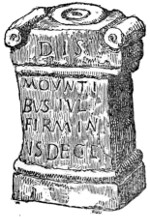
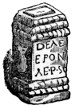
The adjoining wood-cut represents a small altar found at Rutchester, Vindobala, and now in the Castle of Newcastle-upon-Tyne. The inscription reads—To the gods of the mountains, Julius Firminus, the decurion,[141] erected this. Epona, to whom the next altar is dedicated, was the protectress of horses; images of her were to be seen in most stables. Juvenal’s dandy jockey swore by her alone. This 416altar was found at Carvoran, and is now in the High School of Edinburgh. The accompanying example is not the only instance of a toad being represented on an altar. This was found at Chesters, Cilurnum, where it is still preserved. Did the Romans stoop so low as to worship reptiles? If so, the superstitious practice has probably been derived from the east. Dr. Kitto remarks, ‘The importance attached to the frog, in some parts of Egypt, is shewn by its being embalmed, and honoured with sepulture in the tombs of Thebes. In the Egyptian mythology, the frog was an emblem of man in embryo.’

VITERES.
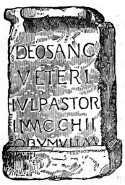
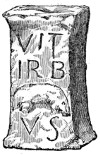
Many altars have been found on the line dedicated to gods unknown to Rome’s Pantheon, and supposed to have a purely local celebrity. The engraving exhibits one of a numerous class.[142] It was discovered near Thirlwall Castle about 1757, in the course of the formation of the military road, and shortly after presented to the Society of Antiquaries. Vitres, or Viteres, or Veteres, is a god whose name is confined to the north of Britain. Hodgson remarks, that Vithris was a name of Odin, as we find in the death-song of Lodbroc—'I will approach the courts of Vithris, 417with the faltering voice of fear.' If Viteres and the Scandinavian Odin be identical, we are thus furnished with evidence of the early settlement of the Teutonic tribes in England. The altar given on page 395 is also dedicated to Viteres. The occurrence of the name of this god in a plural form, as in the annexed example, which was found at Condercum, and is now at Somerset-house, has suggested the idea, that Viteres is not the proper name of a god, but that diis veteribus—the ancient gods—is the inscription intended. Most probably, however, Viteres was the name of a local deity.
LOCAL DEITIES.
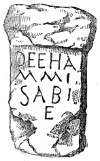
The next altar is also dedicated to a local goddess; at least it is not easy to give any more satisfactory account of the Dea Hamia. The altar was found near Thirlwall castle, and belongs to the Society of Antiquaries, London.
DEÆ MATRES.
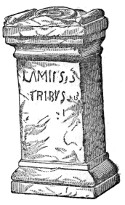
We now proceed to an important group of altars and sculptures, which, if not strictly local, are yet chiefly found in those regions of Europe which were swept by the Teutonic wave in its progress westward. They have been met with in England, the Netherlands, along the banks of the Rhine and other parts of Germany, and in France. These deities, when sculptured, are represented as triple, generally seated, clothed in long flowing drapery, and bearing in their laps baskets of 418fruit. A slab, of which a drawing has already been given (p. 140), is inscribed MATRIBUS CAMPESTRIBUS, to the mothers of the plains; it probably refers to the deities in question. An altar found in the same station, Condercum, and now in the vaults of Somerset-house, is inscribed LAMIIS TRIBUS, to the three Lamiæ. The wood-cut accurately represents it. In Rich’s companion to the Latin Dictionary, the Lamiæ are represented as ‘Vampires; believed to be malignant spirits of the female sex, who wandered about at night in the guise of old hags, sucking blood, and devouring the flesh of human beings. This superstition,’ continues the writer, ‘originated in Egypt.’ In corroboration of the Egyptian origin of this class of demons, it may be stated that small images, arranged in triplets, are of common occurrence among
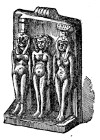
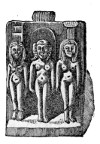
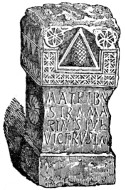
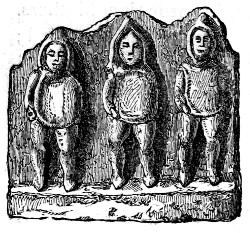
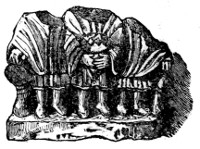
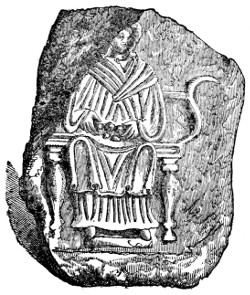
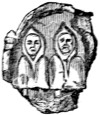
the antiquities of Egypt. The cuts here introduced exhibit two groups of this class of idols, selected from a large number of similar sets, in the possession of his Grace the duke of Northumberland, at Alnwick Castle. Their resemblance to some of those found upon the line of the Wall is striking. The foreign origin of these mother-deities is 419further proved by their being denominated in inscriptions MATRES TRAMARINÆ, Transmarine Mothers. The altar here figured is an example of this kind; it was found at Habitancum, and is now preserved at Alnwick Castle. The inscription records, that Julius Victor dedicated it in discharge of a vow freely and deservedly to the Transmarine Mothers. This Victor, it appears by another inscription, was a tribune of the first cohort of the Vangiones, a Germanic tribe. On none of these altars are the deities distinguished by a proper name. This would seem to be in conformity with the superstitious feelings of the middle ages in England and Germany, where it was thought unlucky to call the fairies and elves by any other denominations than the respectful titles of ‘the ladies,’ or ‘the good people.’ Several sculptures representing, as is supposed, the mother-goddesses, have been found on the line of the Wall. One group, found at Housesteads, and now in the castle of Newcastle-upon-Tyne, is drawn (fig. 4) on Plate XI. When seen by Horsley, this slab had in the upper part of it two fishes and a sea-goat in relief. Two other sets got at the same place, are figured in the Britannia Romana. In one of them, the central or chief figure is represented as bound by the legs. The ancients, in order to prevent a deity, whose favour they coveted, taking his 420departure against their will, not unfrequently used the unwarrantable liberty of securing him by chains. At Netherby, there are three sculptures belonging to this class. One of them, shewn in the wood-cut, is in a perfect condition. The figures are standing, an ample covering envelopes their heads, and a short tunic scantily invests their bodies. Another group, here engraved, has met with the usual fate of Roman sculptures in the north of England—they have suffered decapitation; the ample folds of the garments by which they are clothed have happily not been disturbed, and the central or chief personage holds a basket of fruit. The third sculpture is of larger size and has suffered more extensive injury; the left hand figure of the group only remains; she is seated, and holds fruit in her lap. The Byzantine character of the drapery will 421be noticed. At Nether-hall another fragment of a group, procured from the neighbouring station, is preserved—the left hand figure has been broken off; the two remaining ladies wear the same cowl-like head-dress as the Netherby mothers; shewn on the former page. Mr. Thomas Wright, speaking of these mythic personages, says—
The ancient mythology of the Germanic race was not entirely eradicated by Christianity; and it is interesting to trace it as reflected in the popular superstitions of the present day. The reverence for the three goddesses who presided over the woods and fields, pre-arranged the fates of individuals, and dispensed the blessings of Providence to mankind, may thus be traced down to a comparatively late period, both in Germany and in England. They are sometimes regarded as the three Fates—the Norni of the north, the wælcyrian of the Anglo-Saxons (the weird sisters, transformed in Shakespeare into three witches), disposing of the fates of individuals, and dealing out death and life. But they are also found distributing rewards and punishments, giving wealth and prosperity, and conferring fruitfulness. They are the three fairies who are often introduced in the fairy legends of a later period, with these same characteristics.[143]
INTRODUCTION OF CHRISTIANITY.
After so long a companionship with the heathen relics found on the line of the Wall, the reader will naturally ask—Have no Christian remains been found?—Does no memorial record the name of Jehovah, the living God? A negative reply must 422be given to the inquiry. There is, however, abundant evidence to prove, that Christianity was extensively diffused through the world long before the Romans departed from Britain. Tacitus tells us, that in his day there was a great multitude of Christians at Rome itself. The younger Pliny, in the second century, addressing the emperor, complains that the heathen temples were almost deserted. Justin Martyr says, there is not a nation in which prayers and thanksgivings are not offered up in the name of the crucified Jesus; and Tertullian, the most ancient of the Latin fathers, appealing to the magistrates, says, ‘We are but of yesterday, yet we have filled every place, your cities, garrisons, and free towns, your camps, senate, and forum; we have left nothing empty but your temples.’ Britain early received the glad tidings. ‘The concurrent voice of antiquity,’ says Mr. Thackeray, ‘although it has not designated the individuals who were the immediate instruments of Providence in enlightening Britain, assigns the year 60 as about the period when the Christian religion was introduced into this island.’ At this time there were not fewer than 48,000 Roman soldiers, including their auxiliaries, in this country, some of whom must have been well acquainted with the name of Christ. In the army there would be some centurions like Cornelius, some deputies like Sergius Paulus, who, not content with knowing the truth themselves, endeavoured to communicate it to others, and yet these Christian soldiers have, along the line of the Wall, 423left no memorial of their faith. The God whom they served required not the erection of an altar of stone, or an offering of frankincense. Their ‘inscription’ was, a holy life, ‘seen and read of all men.’ Notwithstanding the example and teaching of such men, it is a lamentable fact, that heathenism continued to rear its head in Britain until near the close of the period of Roman occupation, as several of the altars found on the line of the Wall clearly testify.
CHRISTIAN SYMBOL.
Brand conceived that an altar discovered at Rutchester, and now in the museum at Newcastle-upon-Tyne, exhibited the Christian symbol. It may well be doubted whether the rude carving to which he refers, is any thing more than a partially obliterated letter. There are other letters, evidently of modern fabrication, carved on this altar.
Fas est ab hoste doceri. An obvious remark clothed in Horsley’s own language, and extracted from a work that is now scarce, will form a suitable conclusion to this section. Speaking of vows in sickness he says—
There is one thing in these pagan votive altars that may be a shame and reproach to a great many who call themselves Christians; and that is, the willingness and cheerfulness with which they paid, or pretended to pay, the vows they had made. Such as have any acquaintance with those things, know how commonly these letters V. S. L. M. or V. S. L. L. M., are added at the end of inscriptions that are on such altars, whereby they signified how willingly and cheerfully, as well as deservedly, they performed the vows they had made, viz., votum solvit libens merito, or votum solvit libens, lubens (or lætus) merito. Much more deservedly, and therefore more willingly and 424cheerfully, should the vows made to the Most High, to the true and living God, be paid or performed to him, and particularly the vows made in trouble.[144]
SEPULCHRAL INSCRIPTIONS.
MONUMENTAL SLABS.
Extreme importance was attached by both Greeks and Romans to the due discharge of the rites of sepulture. Until earth had been three times sprinkled over the body of the departed, his spirit was conceived to be denied admission into the Elysian fields. The practice of burning the dead became common at Rome about the latter period of the republic. The inconvenience and expense of the process would necessarily restrict it to persons of some wealth. After the pile was consumed, the ashes of the deceased were gathered up by the nearest relative, and deposited in an urn. There are numerous instances in Britain of the Romans having buried their dead entire. Skeletons have been found in London, which Mr. Charles Roach Smith considers must have been deposited in the higher empire. As Christianity gained ground, the custom of burning the dead fell into disuse; the early Christians were unwilling to do needless violence to the dust of a fellow disciple, and resolved to discontinue the superstitious ceremonies which usually attended cremation.
Whether the body was previously reduced to 425ashes, or deposited in the ground unburnt, it was usual to raise a mound over the spot.
Ergo instauramus Polydoro funus: et ingens
Aggeritur tumulo tellus.
Æn. III. 62.
FUNERAL URN.
Sometimes, instead of a mound of earth, a monument of stone covered the place where the sepulchral urn was deposited. This was the case at Bremenium, as already described (p. 326). With the ashes or body of the deceased, it was usual to deposit a small brass coin to answer the demands of Charon. 'This custom of burying valuables and coins with the dead is by no means extinct; the humbler Irish will pawn their clothes to provide fresh pieces of money to throw into the coffins of their departed friends.'[145] The Romans, as formerly observed, did not usually deposit either the unburnt bodies of the dead, or their ashes, within the walls of towns or stations. A curious exception to this practice has lately been noticed. In the month of October last (1850), a funereal urn was discovered within the station of Borcovicus, near the north-west corner. It was sunk in the earth, and was covered by an oblong flat stone, without inscription. The vase, which was of earthen-ware, and altogether devoid of ornament, was globular in its form, and of large dimensions. It measured two feet in diameter, and two feet in height. It contained ashes, amongst which was found a solitary silver coin of Hadrian. This urn is preserved at Chesters. On the slab covering 426the remains of the deceased person, the name and age were not unfrequently inscribed. The carving, which sometimes includes an effigy of the individual, is often very rude; the back of the stone is, for the most part, undressed. The inscriptions on these ‘frail memorials’ which in the mural region have come down to our times, and ‘implore the passing tribute of a sigh,’ almost uniformly commence |DII MANES.| with the letters D. M.—diis manibus. The shades or departed spirits are, probably, themselves intended in this address, though much confusion exists upon the subject in the works of the ancient writers. In the following lines, Ovid represents the manes as being objects of worship:—
Est honor et tumulis: animas placate paternas;
Parvaque in extinctas munera ferte pyras.
Parva petunt MANES: pietas pro divite grata est
Munere: non avidos Styx habet ima Deos.
Tegula projectis satis est velata coronis;
Et sparsæ fruges, parcaque mica salis.
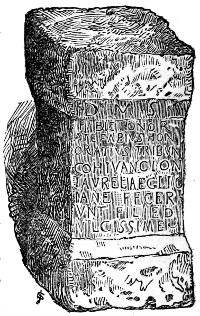
Some of the ceremonies here referred to by the Latin poet, are still in use, as all know who have visited the cemetery of Père la Chaise, in Paris. On the sepulchral slab, death is rarely mentioned; but the number of years, months, and days, that the deceased lived, is recorded with great particularity. The altar, of which an engraving is here introduced, was found at Cilurnum, and is now in the Library of the Dean and Chapter 427at Durham. It bears the following inscription—
D[IIS] M[ANIBVS] S[ACRVM]
FABIÆ HONOR
ATÆ FABIVS HON
ORATIVS TRIBVN[VS]
COH[ORTIS] I. VANGION[VM]
ET AVRELIA EGLIC
IANE FECER
VNT FILIÆ DVLCISSIMÆ
Sacred to the divine Manes of
Fabia Honorata.
Fabius Hon-
oratius the tribune of the
First cohort of Vangiones,[146]
And Aurelia Eglic-
iane erected this
To their most sweet daughter.
MORTALITY OF THE GARRISON.
‘Tender souls!’ exclaims Hodgson, ‘your last act of piety to a beloved daughter has not been forgotten: the altar that bears the memorial of your affection still exists, though it has been banished from the custody of the ashes which were committed to its care.’ Though painful, it is yet pleasant to notice the heavings of natural affection in the martial bosom of a Roman soldier. This stone differs from most of the sepulchral monuments, in being an altar instead of a slab, and in not mentioning the age of the deceased. It has been remarked that the larger proportion of the tomb-stones of the mural region record the deaths of young persons. The climate of the north of England, particularly of the exposed district of the Barrier, must have told with fearful severity upon the constitutions of those who had been reared under the sunny skies of Italy and Spain.
428
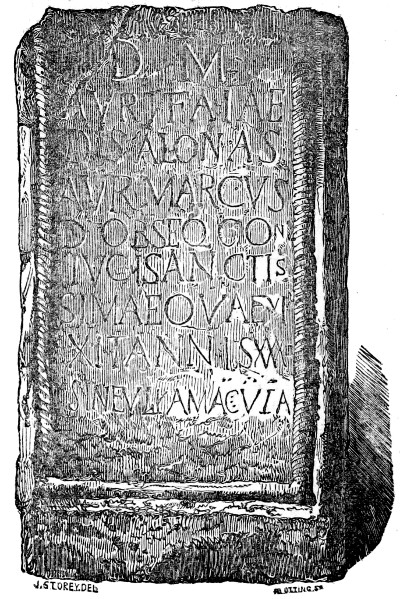
SEPULCHRAL SLAB.
The large slab which is here figured, was found at Carvoran, and is now in the castle of Newcastle-upon-Tyne. It reads—
D[IIS] M[ANIBVS]
AVRE[LIAE] FAIAE
D[OMO] SALONAS
AVRE[LIVS] MARCVS
Ↄ (centurio) OBSEQ[IO] CON-
IVG[IS] SANCTIS-
SIMAE QVAE VI-
XIT ANNIS XXXIII.
SINE VLLA MACVLA
To the divine Manes of
Aurelia Faia,
Of a house of Salona,
Aurelius Marcus
A centurion, out of affection
For his most holy wife
Who lived
Thirty three years,
Without any stain, erected this.
MONUMENTAL INSCRIPTIONS.
429It is not unnatural that a soldier while bemoaning the loss of a beloved wife in a land of strangers, should so dwell upon her virtues as to conceive that hers was a faultless character. Gruter gives an inscription which nearly resembles this. It was erected by Marcus Aurelius Paullus—
CONIVGI INCOMPARABILI
CVM QVA VIXIT ANNIS XXVII
SINE VLLA QVERELA
To his incomparable wife, with whom he had lived twenty-seven years without having had a single squabble.
‘This couple,’ says Mr. Akerman, ‘must for ever throw into the shade all the candidates for the Dunmow flitch.’
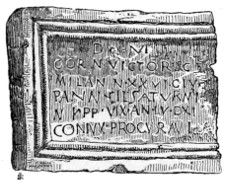
At Chesterholm is a slab which, though suffering from exposure to the weather, is still distinct:—
DIIS MANIBVS
CORN[ELIVS] VICTOR S. C. (Sibi Constitvit)
MIL[ES] ANN[OS] XXVI CIV[IS]
PANN[ONIAE] FIL[IVS] SATVRNI-
NI P.P VIX[IT] ANN[OS] LV. D[IES] XI
CONIVX PROCVRAVI
To the divine Manes; Cornelius Victor ordered this to be erected over himself. He was a soldier twenty-six years, a citizen of Pannonia, and the very dutiful (P.P. pientissime) son of Saturninus. He lived fifty-five years and eleven days. I, his wife, saw his order executed.
The tomb-stone to a young physician has already been given, page 227.
CENTURIAL STONES.
CENTURIAL STONES.
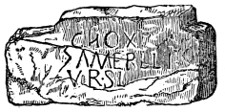
The only other class of inscribed stones to which reference will now be made, is that of centurial 430stones. The centurions seem to have been in the habit of placing a common stone, inscribed with the name of their century—company or troop, in that section of the Wall which they had built. The letters are usually very rudely cut; sometimes they are enclosed in a border, as in the annexed example, which, probably found in the vicinity of Cilurnum, is now at Alnwick Castle.
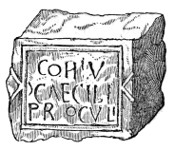
COH[ORS] V
> (centuria) CAECILI[I]
PROCVLI
The fifth cohort.
The century of Cæcilius
Proculus.
More frequently, however, the stone is entirely unadorned, as in this example, which, along with the former, was removed from Walwick Chesters to Alnwick Castle. The letter C, reversed thus Ↄ, or more frequently an angular mark resembling the letter V, laid upon its side thus >, is the sign usually adopted for centuria, century. Two centurial stones are shewn in the wood-cut introduced in page 190. The upper one, that of Valerius Maximus, was described, a century ago, by Horsley, who found it near Haltwhistle-burn. Afterwards it was built up in a gable of the Cawfield farm-house, against which a coal-shed was formed. Here, though sadly begrimed, it was protected from further injury, until rescued by the present owner of 431the farm, and safely deposited in the museum of antiquities at Chesters.
COINS.
NUMISMATIC REMAINS.
Next in importance to the inscribed stones found on the line of the Wall, the student of history will reckon the coins which the spade and plough of the husbandman turn up in considerable numbers in the mural region. In a rude state of society the commercial transactions of the residents of a district are almost entirely confined to an interchange of the commodities produced by each. A body of soldiery, however, liable to be removed from place to place, and compelled to expend their energies in unproductive industry, are necessarily obliged to resort to the use of money. It is chiefly in the stations where the Roman legions lodged, or on the roads which they traversed, that the imperial coin is found. These metallic pieces, bearing the insignia of Rome, thus become exceedingly important in tracking the march of Roman armies. As works of art, the design and execution of many of them are truly admirable. The copper coins of Hadrian are especially worthy of study. The custom which prevailed during the best periods of the empire, of rendering the circulating medium of the market-place the means of commemorating the leading events of the day, gives them increased value. Were all the other records of Roman story destroyed, its most stirring incidents might be recovered by a careful examination of the coins which the cabinets of the antiquary contain.
COINS.
432Ample use has already been made of this source of information in the first Part of this work. Why is it that Britain neglects this means of rousing the spirit of her people, of communicating information, and of securing an almost imperishable memorial of her mighty acts? Had she recorded upon her coinage the events of the last half-century, she would have transmitted to posterity the memory of a series of warlike achievements and peaceful triumphs unparalleled in extent and unequalled in glory. As it is, our metallic currency has little value beyond its commercial worth, and generation after generation is compelled to contemplate, with what complacency they may, the same lady sitting immoveably upon the same enduring rock, and the same mounted knight making his interminable attempt to slay the same deathless dragon. The immense number of the coins found upon the line of the Wall, and the extension of the series from the earliest periods down to the time of Honorius, prove incontestibly the length of time that the Romans maintained their hold of this isthmus. The accidental loss of pieces of money will not, alone, account for the large quantity which has been found. In times of danger the possessors of treasure seem to have been in the habit of concealing it in the earth; the secret of their having done so must often have perished with them. In excavating that portion of the station of Cilurnum which was opened in 1843, not fewer than seventy Roman coins were found. In 1833, near the west gateway of Vindolana, three hundred small brass 433coins, mostly of Constantius and Mangentius, were found, not in a heap or vessel, but dispersed among the soil. The Rev. John Walton, who, about a century ago was vicar of Corbridge, made a considerable collection of Roman coins, by purchasing such as were turned up in the neighbouring station of Corchester. The following circumstance is related concerning him. A party of Jews having established in the neighbourhood a prussian-blue manufactory, felt disposed to enter the market with the vicar. Mr. Walton, unwilling to compete with them by offering a larger price, had the fields where the coins were found, strewed with imitations of the genuine pieces. These, on being picked up, were freely bought by the Jews, who, soon finding the trade a losing one, abandoned it altogether.
The station, notwithstanding such systematic gleaning, is not yet deprived of its treasures. Not long ago, a rustic eked out a livelihood by searching for its coins, and disposing of them to occasional customers. The other day a plough-boy being asked if he had found any lately, produced straight-way from his pocket not less than thirty, most of them, indeed, highly corroded.
The coinage of Rome seems to have continued in circulation in the north of England for a very short time after the departure of the Roman forces from Britain. Saxon money is found in Northumberland of a date coeval with the arrival of that people, but is never mingled with the Roman coinage. The coins of the Romans, on the other hand, are 434never accompanied by those of their successors. Within about forty years after the departure of the Romans, the circulation of the imperial coinage seems to have ceased. This circumstance proves incontestibly that a mighty political revolution had taken place in the interval. The present appearance of the stations corroborates the idea. The walls have been forcibly thrown down, the statues and other objects within them purposely mutilated, and the whole inclosure rendered, as far as possible unfit for human habitation.
THORNGRAFTON COINS.
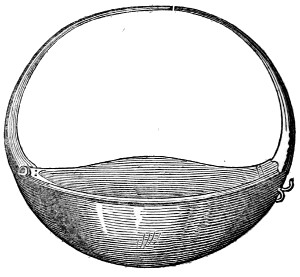
To attempt a description of even the principal coins that can still be ascertained to have been procured from the district of the Wall, would be to compose a treatise upon numismatics. It will perhaps be sufficient to lay before the reader a brief account of the hoard which was discovered in 1837, in an ancient quarry near Thorngrafton. The coins, sixty-five in number, were contained in a small skiff-shaped receptacle with a circular handle. The vessel represented in the adjoining wood-cut is about six inches long; the lid has a hinge at one end, and fastens with a spring at the other. The coins are at present in the possession of the brother of the quarryman who discovered them, and he holds them with such tenacity, that my artist was refused permission 435to see even the case which contained them, though he had taken a journey of thirty miles for the purpose of drawing them. Mr. Fairless, of Hexham, was more fortunate, and obtained leave to take sealing-wax impressions of the coins, from which the wood-cuts have been prepared. I am indebted to Mr. Fairless for the description of the coins, which he took from the pieces themselves.
GOLD.
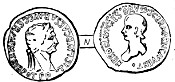
Obv. TI. CLAVD. CAESAR. AVG. GERM. P.M. TRIB.POT. P.P.
Rev. NERO CLAVD. CAES. DRVSVS. GERM. PRINC. IVVENT.
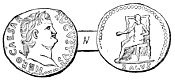
Obv. NERO CAESAR AVGVSTVS.
Rev. SALVS.
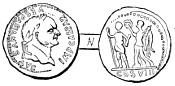
Obv. IMP. CAESAR VESPASIANVS AVG.
Rev. A Victory holding a garland over the head of a Roman soldier, and in the exergue, COS. VIII.
SILVER.
1. Obv. IMP. NERO CAESAR AVGVSTVS.
Rev. SALVS. Device same as in gold above.
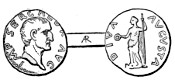
2. Obv. IMP. SER. GALBA CAESAR AVG.
Rev. DIVA AVGVSTA.
436
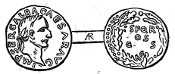
3. Obv. IMP. SER. GALBA CAESAR AVG.
Rev. S.P.Q.R. OB. C.S. (Within a wreath.)
4. Obv. SER. GALBA AVG. Rev. Same as last.
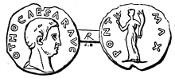
5. Obv. OTHO CAESAR AVG.
Rev. PONT. MAX.
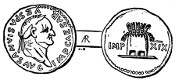
6. Obv. IMP. CAESAR VESPASIANVS AVG.
Rev. IMP. XIX. A basket filled with corn or bread.

7. Obv. CAES. VESP. AVG. P.M. COS. III.
Rev. CONCORDIA AVGVSTI.
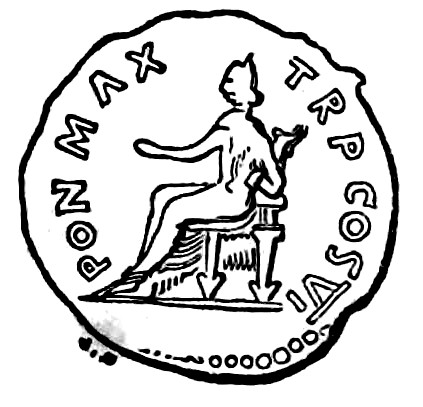
8. 9. 10. Obv. IMP. CAESAR VESPASIANVS AVG.
Rev. PON. MAX. TR.P. COS. VI.
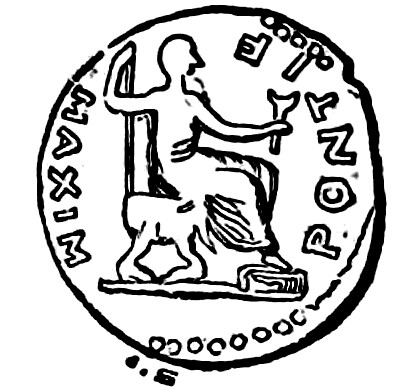
11. Obv. IMP. CAES. VESP. AVG. CENS.
Rev. PONTIF. MAXIM.

12. Obv. DIVV. AVGVSTVS VESPASIANVS.
Rev. No inscription. A figure standing.

13. Obv. IMP. VESP. AVG. P. M. COS. VIII.
Rev. VES (figure) TA.
437
14. Obv. IMP. CAES. VESPASIANVS AVG.
Rev. COS. ITER.—(figure)—TR. POT.

15. Obv. Same as last.
Rev. COS.—(an eagle standing on cippus)—VII.

16. Obv. Inscription same as last.
Rev. Reversed goats’ heads, bearing a shield.

17. Obv. Inscription same as last.
Rev. COS. ITER. TR. POT.
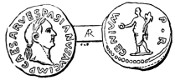
18. Obv. Inscription same as last.
Rev. GENIVM—(figure)—P.R.
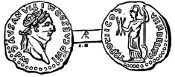
19. Obv. IMP. CAES. DOMITIANVS AVG. P.M.
Rev. TR. POT. II. COS. VIIII. DES. X. P.P.

20. 21. Obv. Same as last.
Rev. IMP. XXI. COS. XVI. CENS.P. P.P.

22. 23. Obv. CAESAR AVG. DOMITIANVS.
Rev. COS. IIII. Pegasus.
438
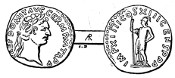
24. Obv. CAES. DOMIT. AVG. GERM. P.M. T.R.P.
Rev. IMP. XIIII. COS. XIII. CENS. P. P. P.

25. Rev. IMP. XXII. COS. XVI. CENS.P. P. P.

26. Obv. IMP. CAES. DOMITIANVS AVG. P. M
Rev. TR. POT. II. COS. VIIII. DES. XII.

27. Obv. CAES. AVG. DOMIT. COS. III.
Rev. PRINCEPS IVVENTVT.
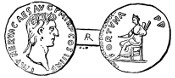
28. Obv. IMP. NERVA. CAES. AVG. P.M. TR.P. COS. III. P.R.
Rev. FORTVNA P.R.
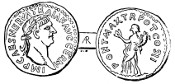
29. Obv. IMP. CAES. NERVA. TRAIAN. AVG. GERM.
Rev. PONT. MAX. TR. POT. COS. II.

30.31. Obv. IMP. CAES. NERVA TRAIAN. AVG.
Rev. P.M. TR.P. COS. VI. P.P. S.P.Q.R.
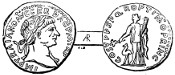
32. Obv. IMP. TRAIANO AVG. GER. DAC. P. M. TR.P.
Rev. COS. V. P.P. S.P.Q.R. OPTIMO PRINC.
439

33. 34. 35. Rev. COS. V. P.P. S.P.Q.R. OPTIMO PRINC.

36. Obv. IMP. TRAIANO AVG. GER. DAC. P.M. TR.P. COS. V. P.P.
Rev. S.P.Q.R. OPTIMO PRINCIPI.

37. Obv. Same as last.
Rev. S.P.Q.R. OPTIMO PRINCIPI.
Exergue. FORT.RED.

38. Same as before.
Exergue. PAX.
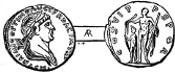
39. Obv. IMP. TRAIANO OPTIMO AVG. GER. DAC. P.M. TR.P.
Rev. COS. VI. P.P. S.P.Q.R.

40. Obv. IMP. CAES. NERVA TRAIANO OPTIMO AVG. GER. DAC.
Rev. P.M. TR.P. COS. VI. P.P. S.P.Q.R.
41. Obv. IMP. CAES. NERVA TRAIAN. AVG. GERM.
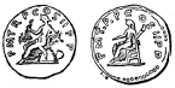
42. 43. Obv. IMP. CAES. NERVA TRAIAN. AVG. GERM.
Rev. P.M. TR. P. COS. II. P.P.
440

44. Same as 40. with Exergue. TRO—VIO.

45. Obv. IMP. TRAIANO AVG. GER. DAC. P.M. TR.P.
Rev. COS.V. P.P. S.P.Q.R. OPTIMO PRINC.

46. The same as last.

47. Same as last. Seated figure, the right hand extended, holding a Victory.
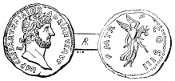
48. Obv. IMP. CAESAR TRAIAN. HADRIANVS AVG.
Rev. P.M. TR.P. COS. III.

49. Obv. Same as last.
Exergue. FEL. P.R. (doubtful.)
Rev. P.M. TR.P. COS. III.

50. Obv. IMP. CAESAR TRAIAN. HADRIANVS AVG.
Rev. P.M.TR.P. COS. III.
PIE—TAS, in the field.
51. Obv. Same as last.
Rev. P.M.TR.P. COS. III.
441CONSULAR AND OTHERS.
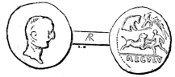
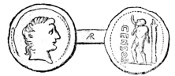
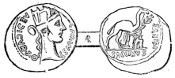
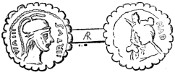
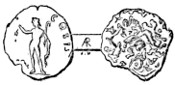
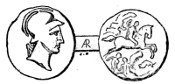
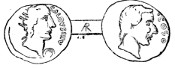
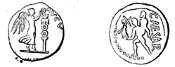
This coin symbolizes the peace concluded between the Roman general Scaurus and the Arabian monarch Aretas.
MINERALS AND METALS.
In nearly all the stations of the line, the ashes of mineral fuel have been found; in some, a store of unconsumed coal has been met with, which, though intended to give warmth to the primeval occupants 442of the isthmus, has been burnt in the grates of the modern English. In several places the source whence the mineral was procured can be pointed out; but the most extensive workings that I have heard of, are in the neighbourhood of Grindon Lough, near Sewingshields. Not long ago, a shaft was sunk, with the view of procuring the coal which was supposed to be below the surface; the projector soon found, that though coal had been there, it was all removed. The ancient workings stretched beneath the bed of the lake.
MINING OPERATIONS.
In Allendale and Alston Moor, numerous masses of ancient scoriæ have been found, which must have resulted from the reduction of lead from its ore. In the station of Corchester, portions of lead pipe have been found; it is an inch and a half in diameter, and has been formed by bending round a flat strip of the metal, and soldering the joint.
Iron has been produced in large quantities. In the neighbourhood of Habitancum masses of iron slag have been found. It is heavier than what proceeds from modern furnaces, in consequence, probably, of the imperfect reduction of the ore. In the neighbourhood of Lanchester, the process seems to have been carried on very extensively. On the division of the common, two large heaps were removed, the one containing about four hundred cart loads of dross, the other six hundred. It was used in the construction of some new roads which were then formed, a purpose for which it was admirably adapted. In the neighbourhood of one of these 443heaps of scoriæ, the iron tongs represented in Plate XVII. fig. 8, so much resembling those at present used by blacksmiths, were ploughed up. During the operation of bringing this common into cultivation, the method adopted by the Romans of producing |BLAST FURNACE.| the blast necessary to smelt the metal was made apparent. Two tunnels had been formed in the side of a hill; they were wide at one extremity, but tapered off to a narrow bore at the other, where they met in a point. The mouths of the channels opened towards the west, from which quarter a prevalent wind blows in this valley, and sometimes with great violence. The blast received by them would, when the wind was high, be poured with considerable force and effect upon the smelting furnaces at the extremity of the tunnels.
METALLIC IMPLEMENTS.
Notwithstanding the tendency of iron to oxidize, several weapons made of this material, and used by the Romans, have come down to our day. Their general character and form can be better learnt from an inspection of the drawings which depict them than by verbal description. On Plate X. are shewn two spear or javelin heads, and on Plate XVII. the iron points of some arrows.
Vessels of cast-metal, fitted for domestic use, are occasionally met with. On Plate XVII. fig. 2, is a specimen of a pot or boiler, closely resembling those in modern use; it was found in cutting the Newcastle and Carlisle Railway, near Haydon Bridge.
METALLIC IMPLEMENTS.
444Bronze vessels are occasionally found. The utensils depicted on Plate XVI. are of this metal. Fig. 1, is a pan, evidently intended for culinary purposes. The use of the other vessel, fig. 2, so nearly resembling a modern coffee-pot, is not so apparent, though several of this form have been found in the Roman stations in the north of England. Is it a decanter—a sort of wine flagon? Both of these vessels were found on the line of the Wall, but at what point I have been unable to learn.
Near to Whitfield, were recently found three camp-kettles, of peculiar make, which are now in the Museum of Antiquities at Newcastle-upon-Tyne. They are formed of bronze, but of exceedingly thin metal; they have evidently seen much service, and are patched in several places. Owing to the thinness of the metal they would very readily feel the fire. In Italy, where during a great part of the year a fire is only lighted when indispensable, similar vessels are still in use. These three vessels vary in size, so as to allow of their being placed one within the other. The smallest of them is shewn on Plate XVII. fig. 3. The strainer, fig. 1, also of bronze, and very finely and tastefully perforated, was found with them.
The boss of a shield, having something of the appearance of the head of a snake, Plate VII. fig. 2, is also of bronze. It is preserved at Chesters.
Fibulæ or clasps, for fastening the loose robes worn by the Romans, are, as may be supposed, of ordinary occurrence. The one represented, of the full size, 445Plate XIV. fig. 2, was found at Carvoran. It is of bronze, and is of a form of which there are many examples. The tongue is wanting, but the spiral spring to which it was attached, and the groove which caught it, are distinctly observed. The small pair of bronze shears or scissors, which are shewn of their full size, Plate XIV. fig. 1, were also found at Carvoran.
PLATE XV.
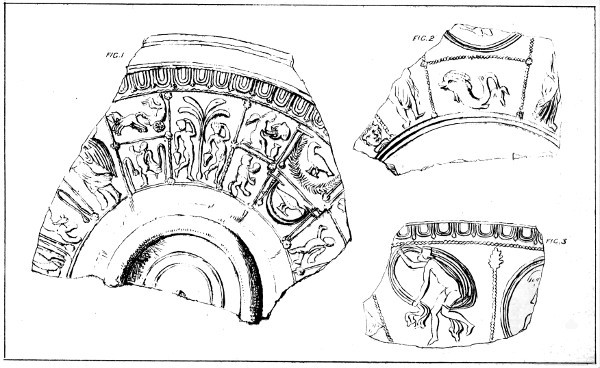
J. STOREY DEL ET LITH.PRINTED BY A. REID. Samian Ware, from Wallsend and Lanchester
PLATE XVI
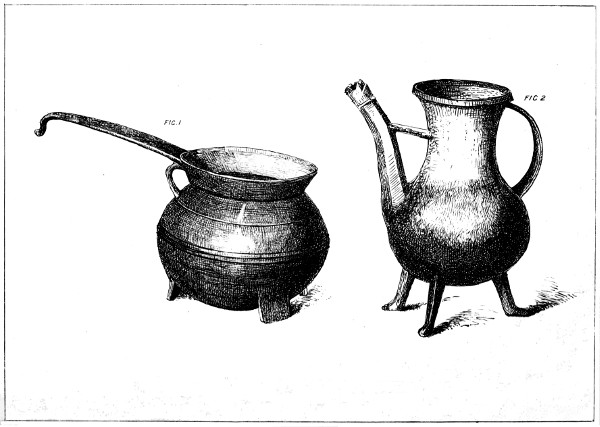
J STOREY DEL ET LITHPRINTED BY ANDw REID. Bronze Vessels
PLATE XVII.
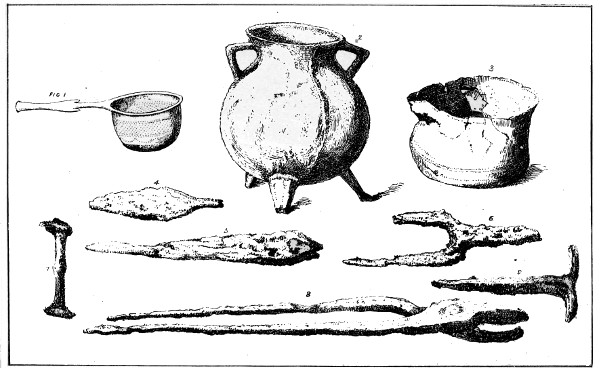
J STOREY DEL ET LITHPRINTED BY ANDw REID. Iron Pot, Bronze Vessel, Tongs, etc.
PLATE XVIII
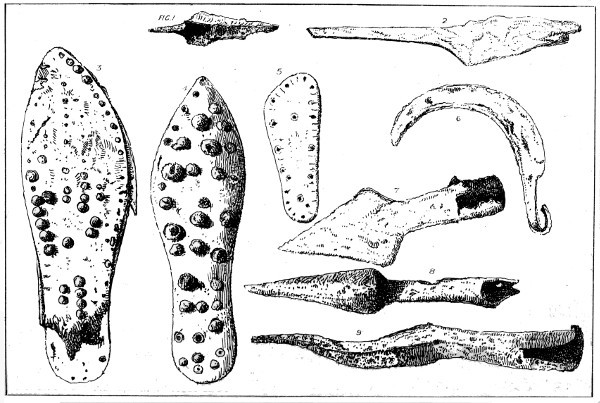
J STOREY DEL ET LITHPRINTED BY ANDw REID. Soles of Sandals, etc.
EARTHENWARE AND MISCELLANEOUS ARTICLES.
ROMAN POTTERY.
Few subjects possess more interest than the pottery of the Romans. Whether we regard the shape of the vessels, the beauty of their ornaments, or the excellence of the material of which they are composed, they are worthy of our admiration. Fortunately for the present writer, so much has recently been published upon the subject, as to justify him in dismissing it with a brief notice.
Among the earthenware vessels found in the mural region are some of coarse structure, such as amphoræ, mortaria, pans for common domestic purposes, and some which have probably been intended for exposure to the fire. The amphoræ are large narrow-necked vessels, capable of containing several gallons, and formed of red clay. In general, they have been furnished with two handles, on one of which the maker’s name is not unfrequently stamped. They were used for holding wine. I am not aware of any having been found on the line of the Wall, in a state at all approaching to completeness.
The mortars are strong shallow vessels, provided 446with a lip for the convenience of pouring. They are formed of clay, resembling fire-brick in colour. On their inner surface, are frequently imbedded angular fragments of quartz, chert, or iron scoriæ. By this contrivance, the bruising of parched corn or other articles of food would be more easily effected.
Various vessels of common earthenware, such as would be required in every household for holding water, grain, and kindred substances, are discovered, occasionally nearly perfect. At Nether Hall some very fine ones are preserved, which were found in the neighbouring station; one is twelve inches in diameter, and nearly six deep. Another, of globular form, is ten inches in diameter, and nine in depth.
Besides these, fragments of thick vessels are frequently met with, which are of a porous nature, and hence well adapted to withstand the sudden application of heat. In these, when placed upon the fire, we may readily conceive that food was baked or stewed.
Other vessels, for the most part of smaller size, more elegant shape, and composed of finer materials, are of common occurrence. Some are nearly black, others grey or slate-coloured: these are quite plain and unembossed. A species of yellow earthen-ware is found, tinted with a brown pigment, by the partial removal of which, a sort of pattern is given to it. All these are of British manufacture. Many of the potteries in which they were fabricated, have been clearly ascertained. The slate-coloured and grey kinds owe their peculiar hue to the action of what has been called, the smother kiln. During 447the process of baking the vessels, the vent of the furnace has been closed, so as to fill the kiln with smoke. The unconsumed carbon not only communicated its own hue to the objects exposed to it, but prevented the iron, which usually forms the colouring matter of clay, from being converted into the peroxide, which is of a brick-red colour.[147]
SAMIAN WARE.
The finest species of earthenware found in Roman camps, is that called Samian. It is of a bright coral-red colour. It can at once be detected by its glaze, which has not yet, in modern times, been successfully imitated. Some vessels are quite plain, but others are very tastefully embossed. Plates IX. and XV. furnish specimens of the more ornamental kind. The large fragment, engraved Plate XV. fig. 1, was found in sinking the shaft of the famous Wallsend pit. No potteries for the manufacture of this species of ware, have been found in Britain; and as the maker’s marks, and the patterns of the embossed varieties correspond with those found on the continent, it is conceived to be of foreign origin. Gaul and Spain have been pointed out as the countries from which the specimens exhumed in Britain were probably procured. The vast quantity of fragments of Samian ware mingled with the rubbish of some of the stations is truly remarkable; and not less worthy of observation is the fact, that not only has the clay of which the broken vessels are composed, undergone no deterioration by being buried for centuries in the damp 448earth, but even the glaze is, to all appearance, uninjured. That even the plainer kinds of Samian ware have been accounted valuable by their owners, is evident from the circumstance, that marks and names, by which they might be identified, have in numerous instances been scratched upon them. In Plate VII. figs. 9 and 11, are two examples of this kind, found at Cilurnum, and still preserved there. In some cases where a vessel has been fractured, it has been joined by clasps of lead. Fig. 1, Plate VII., is an example of this, also found at Cilurnum. The process of boring the holes to receive the lead must have been one of some labour, and would not have been undertaken unless the vessel had been accounted valuable.
An imitation of the Samian ware seems to have been made in Britain during the continuance of the Roman period. It is not equal to the original in colour, texture, or design. Fig. 2, Plate IX. differs in appearance from true Samian—it may be an imitation.
The lamp shewn on Plate XIV. fig. 4, is of red earthenware, covered with a black pigment; it proves the vast amount of skill and taste which the Romans lavished even upon articles of minor importance.
MINOR ANTIQUITIES.
Mill-stones are among the most frequent of the discoveries made in our Roman stations. Some, found at Cilurnum, are shewn in Plate XIII. fig. 4. They closely resemble the querns which were used in Scotland and the rural districts of Northumberland, 449within a recent period. Many of the stones consist of the mill-stone grit, basalt, or granite of the district; others are formed of a species of lava which is not procured in any locality nearer than Rhine Prussia. The advantage of these foreign stones is, that, though hard, they are porous, and, as they wear away, still present a continuity of sharp edges to the action of the grain.
The process of grinding the corn by hand-mills must have been a most tedious one. Probably a large proportion of the grain consumed by the soldiers of the Barrier was simply boiled, after being slightly bruised in mortars.
CONCLUSION.
Here a period must be put to this account of the Roman Wall and its antiquities. Many topics worthy of fuller discussion have been but cursorily treated, and some omitted altogether; but it is impossible, in a work of this extent, to do full justice to a subject of such magnitude; we content ourselves with imitating the moderation of Hadrian, who, instead of grasping at universal empire, sought only a dominion which he might reasonably hope to maintain.
Still, we may reckon on some advantage from the brief communion we have held with the Mighty among the Ancients. We can hardly tarry, even for an hour, in association with the palmy days of the Great Empire, without learning, on the one hand, to emulate the virtues that adorned her prosperity, and on the other, to shun the vices that were punished by 450her downfall. The sceptre which Rome relinquished, we have taken up. Great is our Honour—great our Responsibility—
... Heavenly wisdom on this ball
Creates, gives birth to, guides, consummates all.
States thrive or wither (as moons wax and wane)
E'en as His will and His decrees ordain;
While Honour, Virtue, Piety, bear sway,
They flourish; and as those decline, decay.
451