Chapter III
Reading edition
THE FIRST WARS OF WILLIAM RUFUS. 1090–1092.[479]
THE Character of the year 1089.rest of the year in which Lanfranc died was unmarked by any striking public event, political or military. The causes of evil which had begun to play their part before the Primate’s death, which were 176 enabled to play it so much more powerfully after his death, were no doubt already at work; but they had as yet not wrought any open change, or done anything specially to impress men’s minds. Natural phænomena. The writers of the time have nothing to record, except natural phænomena, and it must be remembered that natural phænomena, and those mostly of a baleful kind, form a marked feature of the reign of William Rufus. Even he could hardly be charged with directly causing earthquakes, storms, and bad harvests; but, in the ideas of his day, it was natural to look on earthquakes, storms, and bad harvests, either as scourges sent to punish his evil deeds, or else as signs that some more direct vengeance was presently coming upon himself. The ever-living belief of those times in the near connexion between the moral and the physical world must always be borne in mind in reading their history. And in the days of William Rufus there was plenty in both worlds to set men’s minds a-thinking. The great earthquake. Aug. 11, 1089. Lanfranc had not been dead three months before the land was visited with a mighty earthquake. The strongest buildings—the massive keeps and minsters lately built or still building—seemed to spring from the ground and sink back again into their places.[480] Then came a lack of the fruits of the earth of all kinds; the harvest was slow in ripening and scanty when it came; men reaped their corn at Martinmas and yet later.[481]
177 Character of the year 1090. The next year we find no entries of this kind. There was a mighty stir in England and in Normandy; but it was not a mere stirring of the elements. Beginnings of foreign adventure. We now enter on the record of the foreign policy and the foreign wars of the Red King, and we hear the first wail going up from the oppressed folk within his kingdom. Throughout his reign the growth of the prince’s power and the grievances of his people go together. In the former year there was nothing to chronicle but the earthquake and the late harvest. First mention of domestic opposition. This year we hear of the first successes of the King beyond the sea, and we hear, as their natural consequence, that the “land was fordone with unlawful gelds.”[482]
The years 1090–1091. The two years which followed the death of Lanfranc saw the attempt of the first year of Rufus reversed. Instead of the lord of Normandy striving to win England, the lord Successes in Normandy. of England not only strives, but succeeds, in making himself master of a large part of the Norman duchy. Supremacy over Scotland. 1091. Having thus become a continental potentate, the King comes back to his island kingdom, to establish his Imperial supremacy over the greatest vassal of his crown, and to do what his father had not done, to enlarge the borders Annexation of Cumberland. 1092. of his immediate realm by a new land and a new city.
Through a large part then of the present chapter the scene of our story will be removed from England to Normandy. Close connexion of English and Norman history.Yet it is only the scene which is changed, not the actors. One main result of the coming of the first William into England was that for a while the history of Normandy and that of England cannot be kept asunder. The chief men on the one side of the water are the chief The same main actors in both. men on the other side. And the fact that they were so is the main key to the politics of the time. We have in the last chapter seen the working of this fact from one side; 178 we shall now see its working from the other side. The same men flit backwards and forwards from Normandy to England and from England to Normandy. Normandy the chief seat of warfare. But of warfare, public and private, during the reign of William Rufus and still more during the reign of Henry the First, Normandy rather than England is the chosen field. Without warfare of some kind a Norman noble could hardly live. And for that beloved employment Normandy gave many more opportunities than England. The Duke of the Normans, himself after all the man of a higher lord, could not be—at least no duke but William the Great could be—in his continental duchy all that the King of the English, Emperor in his own island, could be within his island realm. Contrast between Normandy and England as to private war. Private war was lawful in Normandy—the Truce of God itself implied its lawfulness; it never was lawful in England. And wars with France, wars with Anjou, the endless struggle in and for the borderland of Maine, went much further towards taxing the strength and disturbing the peace of the Norman duchy, than the endless strife on the Welsh and Scottish marches could go towards taxing the strength and disturbing the peace of the English kingdom. Normandy then will be our fighting-ground far more than England; but the fighting men will be the same in both lands.
The old and the new generation. The old companions of the Conqueror were by this time beginning to make way for a new generation. The rebellion of 1088 saw the last exploits of some of them. Yet others among them will still be actors for a while. Bishop Odo. Bishop Odo, cut off from playing any part in England, still plays a part in Normandy. The great border earls, Hugh of Hugh. d. 1101. Chester and of Avranches, Roger of Shrewsbury and of Roger. d. 1094. Montgomery, die in the course of our tale, but not till we have something more to tell about both of them, and a good deal to tell about the longer-lived of the two. Robert of Mowbray. Their younger fellow, Robert of Mowbray, after becoming the 179 chief centre of one part of our story, leaves the world by a living death. William of Warren. The new Earl of Surrey, if not already dead, passes away without anything further to record of him; Walter Giffard, d. 1102. Walter Giffard, old as a man, but young as an earl, still lives on. But younger men are coming into sight. William of Eu. William of Eu, the son of the still living Count Robert, has already come before us as a chief actor in our story, and we shall see him as the chiefest sufferer. But above all, two men, whom we have hitherto seen only by fits and starts, now come to the front as chief actors on both sides of the sea. Before we enter on the details of Norman affairs, it will be well to try clearly to take in the character and position of two famous bearers of the same name, great alike in England, in Normandy, and in France, Robert of Bellême. Robert of Bellême, afterwards of Shrewsbury, of Bridgenorth, and of both Montgomeries, and Robert of Meulan. Robert, Count of the French county of Meulan, heir of the great Norman house of Beaumont, and forefather of the great English house of Leicester.
The two Rogers, fathers of the two Roberts, are still living; but for the rest of their days they play a part quite secondary to that played by their sons. History and character of Robert of Bellême. Robert of Bellême, the eldest son of Roger of Montgomery, has already come before us several times, most prominently as a sharer in the rebellion raised by the present Duke against his father in Normandy[483] and in the rebellion raised on his behalf against his brother. Succeeds his mother Mabel. 1082. As son of the slain Countess Mabel,[484] he was heir of the house of Talvas, heir alike of their possessions and of their reputed wickedness. Lord through his mother of the Her inheritance.castle from which he took his name, lord of a crowd of other castles on the border-lands of Normandy, Perche, and Maine, Robert of Bellême, Robert Talvas, Succeeds his father at Montgomery, 1094; stands forth for the present as the son of Mabel rather 180 than as the son of Roger. In after times counties and lordships flowed in upon him from various sources and in various quarters. The death of his father gave him the old Norman possessions of the house of Montgomery; and his brother at Shrewsbury, 1098. the death of his brother gave him the new English possessions of that house, the great earldom of Shrewsbury and all that went with it. We seem to be carried back to past times when we find that Robert of Bellême His wife Agnes of Ponthieu. was married to the daughter of Guy of Ponthieu, the gaoler of Harold, and that, at the accession of William Rufus, Guy had still as many years to reign as the Red King himself. Guy Count of Ponthieu. 1053–1100. Guy’s death at last added Ponthieu to the possessions of the house of Bellême, nominally in the person of Robert’s son William Talvas, practically in that of Robert himself. Greatness of Robert’s possessions. The lord of such lands, master of four and thirty castles,[485] ranked rather with princes than with ordinary nobles; and even now, when Robert held only the inheritance of his mother, the extent and nature of his fiefs gave him a position almost princely. The man alike of Normandy and of France, he could make use of the profitable as well as the dangerous side of a divided allegiance, and it is not 181 without reason that we find the lord of the border-land spoken of by the fitting title of Marquess.[486] Great part played by him. From the death of the Conqueror onwards, through the reigns of Robert and William, till the day when Henry sent him to a life-long prison, Robert of Bellême fills in the history of Normandy and England a place alongside of their sovereigns.
His character. With the inheritance of Mabel and William Talvas, their son and grandson was believed to have succeeded in full measure to the hereditary wickedness of their house. That house is spoken of as one at whose deeds dæmons themselves might shudder,[487] His surname. and Robert himself bears in the traditions of his Cenomannian enemies the frightful surname which has been so unfairly transferred to the father of the Conqueror. His name lives in proverbs. In the land of Maine his abiding works are pointed to as the works of Robert the Devil. Elsewhere the “wonders of Robert of Bellême” became a familiar saying.[488] That Robert was a man of no small natural gifts is plain; to the ordinary accomplishments of the Norman warrior he added a mastery of the more intellectual branches of the art of warfare. His skill in engineering. As the Cenomannian legend shows, he stood at the head of his age in the skill of the military engineer.[489] Firm and daring, ready of wit and ready of speech, he had in him most of the qualities which might have made him great in that or in any other age. His special and wanton cruelty. But, even in that age, he held a place by himself as a kind of incarnation 182 of evil. Restless ambition, reckless contempt of the rights of others, were common to him with many of his neighbours and contemporaries. But he stands almost alone in his habitual delight in the infliction of human suffering. The recklessness which lays waste houses and fields, the cruelty of passion or of policy which slays or mutilates an enemy, were common in his day. But even then we find only a few men of whom it was believed that the pangs of other men were to them a direct source of enjoyment. In Robert sheer love of cruelty displaced even greediness; he refused ransom for his prisoners that he might have the pleasure of putting them to lingering deaths.[490] The received forms of cruelty blinding and mutilation, were not enough for him; he brought the horrors of the East into Western Europe; men, and women too, were left at his bidding to writhe on the sharp stake.[491] Distrustful of all men, artful, flattering, courteous of speech, his profession of friendship was the sure path to destruction.[492] The special vices of William Rufus are not laid to his charge; it is at least to the credit of Latin Christendom in the eleventh century that it needs the union of its two worst sinners 183 to form the likeness of an Ottoman Majesty, Excellency, or Highness in the nineteenth. But his domestic life was hardly happy. His treatment of his wife His wife Agnes, the heiress of Ponthieu, the mother of his one child William Talvas, was long kept by him in bonds in the dungeons of Bellême.[493] and his godson. And, more piteous than all, we read how a little boy, his own godchild, drew near to him in all loving trust. Some say, in the sheer wantonness of cruelty, some say, to avenge some slight fault of the child’s father, the monster drew the boy under his cloak and tore out his eyes with his own hands.[494]
The list of the men, great and small, who were simply wronged and dispossessed by Robert of Bellême, is long indeed.[495] Some of them, it is true, were now and then able to revenge their wrongs with their own arms. His enmity to the men of Domfront; He seems, as might have been expected, to have been the special enemy of all that was specially good in individuals or in communities. He was the bitter foe of the valiant and faithful men of Domfront.[496] to Helias; He was before all things the enemy of Helias of La Flèche. to Rotrou of Perche; He was the enemy of his neighbour Count Rotrou of Perche, who also bears a good character among the princes of his day.[497] to the prelates of Seez. As temporal lord of Seez, he was the enemy of its churches, episcopal and abbatial; he had not that reverence for the foundation of his 184 father which is one of the redeeming features in the character of the Red King. Abbot Ralph, afterwards Archbishop of Canterbury. He underwent excommunication from the zeal of Bishop Serlo, and by the wrongs done by him to Abbot Ralph of Seez, which drove that prelate to seek shelter in England, he unwittingly gave England a worthy primate and Anselm a worthy successor.[498] One is inclined to wonder how such a man gained the special favour of the Conqueror, whose politic sternness had nothing in common with the fiendish brutality of Robert.[499] Perhaps, as in William Rufus, the worst features of his character may for a while have been hidden. It is less surprising that, in the days of William’s sons, we find him in honour at the courts of England, Normandy, and France. But at last vengeance came upon him. His imprisonment by Henry. 1110. When King Henry sent him to spend his days in prison, it was in a prison so strait and darksome that the outer world knew not whether he were dead or alive, nor was the time of his death set down in any record.[500]
Robert Count of Meulan and Earl of Leicester. The other Robert, the son of the other Roger, was a man of a different mould, a man who would perhaps seem more in place in some other age than in that in which he lived. He was the son of the old and worthy Roger of Beaumont, the faithful counsellor of princes, His father Roger of Beaumont. who, like Gulbert of Hugleville, refused to share in 185 the spoils of England.[501] Great, like his namesake, in France, Normandy, and England, Robert passed through a long life unstained by any remarkable crime, though it was hinted that, of his vast possessions on both sides of the sea, some were not fairly come by.[502] He inherits Meulan from his uncle, He is known in history by the name of his French county of Meulan, which he inherited from his mother’s brother, Count Hugh, son of Count Waleran, who withdrew to become a monk of Bec.[503] and Beaumont from his father. From his father, when he too had gone to end his days in his father’s monastery of Preaux, Robert inherited the lordship of Beaumont, called, from his father’s name, Beaumont-le-Roger.[504] His earldom of Leicester. He shared in the Conqueror’s distribution of lands in England, and in after days he received the earldom of Leicester from King Henry, as his less stirring brother Henry had already received that of Warwick from the Red King. His exploits at Senlac. That he was a brave and skilful soldier we cannot doubt; his establishment in England was the reward of good service done at one of the most critical moments of the most terrible of battles.[505] But the warrior of Senlac hardly appears again in the character of a warrior; he His fame for wisdom. lives on for many years as a cold and crafty statesman, the counsellor of successive kings, whose wisdom, surpassing that of all men between Huntingdon and 186 Jerusalem, was deemed, like that of Ahithophel, to be like the oracle of God.[506] His counsels were not always of an amiable kind. Character of his influence with Rufus and Henry. Under Rufus, without, as far as we can see, sharing in his crimes, he checked those chivalrous instincts which were the King’s nearest approach to virtue.[507] Under Henry his influence was used to hinder the promotion of Englishmen in their own land.[508] Yet on the whole his character stands fair. He discouraged foppery and extravagance by precept and example; he was the right-hand man of King Henry in maintaining the peace of the land, and he seems to have shared the higher tastes of the clerkly monarch.[509] Of Anselm he was sometimes the enemy, sometimes the friend.[510] His sons. His sons were well taught, and they could win the admiration of Pope and cardinals by their skill in disputation.[511] The eldest, Waleran, his Norman heir, plays an unlucky part in the reign of Henry;[512] his English heir Robert continued 187 the line of the Earls of Leicester.[513] His last days. His last days were clouded by domestic troubles;[514] and he is said to have formally perilled his own soul in his zeal for the temporal welfare of his sons. His death. 1118. On his death-bed, so the story runs, Archbishop Ralph and other clergy bade him, for his soul’s health, to restore whatever lands he had gained unjustly.[515] Story of his death-bed.What then, he asked, should he leave to his sons? “Your old inheritance,” answered Ralph, “and whatever you have acquired justly. Give up the rest, or you devote your soul to hell.” The fond father answered that he would leave all to them, and would trust to their filial piety to make atonement for his sins.[516] But we are told that Waleran and Robert were too busy increasing by wrong what had been won by wrong to do anything for the soul of their father.[517]
These are the two men who, of secondary importance in the tale of the Conquest and of the reign of the first 188 William, become the most prominent laymen of the reign of the second. The churchmen of the time who stand forth conspicuously for good and for evil will have their place in another chapter. Prominence of the two Roberts. But the two Roberts will, next to the King and the Ætheling, hold the first place in the tale which we have immediately to tell, as they held it still in days of which we shall not have the telling, long after the Ætheling had changed into the King. The force of him of Bellême, the wit of him of Meulan, had their full place in the affairs both of Normandy and of England, and both were brought to bear against the prince and people of Maine.
§ 1. Normandy under Robert. 1087–1090.
Temptations to the invasion of Normandy. That the thought of an invasion of his elder brother’s duchy should present itself to the mind of William Rufus was not very wonderful. The fact that it was his elder brother’s duchy might perhaps be of itself enough to suggest the thought. The dutiful son of his father, whom alone his father had called to rule of his own free will, might feel himself in some sort defrauded, if any part of his father’s dominions was held by a brother whose only claim was the accident of his elder birth, and whose personal unfitness for the rule of men his father had emphatically set forth. Indeed, without seeking for any special motive at all, mere ambition, mere love of enterprise, might be motive enough to lead a prince like Rufus to a campaign beyond the sea, a campaign which might make him master of the native dominion of his father, the land of his own birth. Interest of those who held land in both countries. And such schemes would be supported on grounds of reasonable policy by a large part of the Norman possessors of the soil of England. Holding, many of them, lands on both sides of the sea, it was their interest that the same prince 189 should reign on both sides of the sea, and that they themselves should not be left open to the dangers of a divided allegiance. They had failed to carry out this purpose by putting Robert in possession of England; they might now carry it out by putting William in possession of Normandy. And the attempt might even be made with some show of justice. Provocation given by Robert. The help which Robert had given to the rebellion against Rufus might, in the eyes of Rufus, or of a much more scrupulous prince than Rufus, have been held to justify reprisals. State of Normandy. And to a prince seeking occasions or excuses for an invasion of Normandy the actual condition of that duchy might seem directly to invite the coming of an invader. The invader might almost comfort himself with the belief that his invasion was a charitable work. Any kind of rule, almost any kind of tyranny, might seem an improvement on the state of things which was now rife through the whole length and breadth of the Norman land. His invasion likely to be largely welcome. William Rufus might reasonably think that no small part of the inhabitants of Normandy would welcome invasion from an invader of their own blood, the son of their greatest ruler. And the event showed that he was by no means mistaken in so thinking.
The Conqueror foretells the character of Robert’s reign. No words of man were ever more truly spoken than the words in which William the Great, constrained, as he deemed himself, to leave Normandy in the hands of Robert, was believed to have foretold the fate of the land which should be under his rule. Robert was, so his father is made to call him, proud and foolish, doomed to misfortune; the land would be wretched where he was master.[518] The Conqueror was a true prophet; 190 Utter anarchy of the duchy. when Robert stepped into his father’s place, the work of the fifty years’ rule of his father was undone in a moment. Normandy at once fell back into the state of anarchy from which William had saved it, the state into which it fell when the elder Robert set forth for Jerusalem.[519] Once more every man did what was right in his own eyes. And the Duke did nothing to hinder them. Again we are brought to that standard of the duties of a sovereign of which we have heard so often, that standard which was reached by the Conqueror and by his younger son, but which neither Robert in this generation nor Stephen in the next strove to reach. Character of Robert. Robert, it must always be noticed, is never charged with cruelty or oppression of any kind in his own person. His weak good-nature. His fault was exactly of the opposite kind. He was so mild and good-natured, so ready to listen to every suppliant, to give to every petitioner, to show mercy to every offender, that he utterly neglected the discharge of the first duty of his office, that which the men of his time called doing justice.[520] William the Great 191 had done justice and made peace. Revival of brigandage and private war. The smaller brood of thieves and murderers had been brought to feel the avenging arm of the law. Thieves and murderers on a greater scale, the unruly nobles of the duchy, had been forced to keep back their hands from that form of brigandage which they dignified with the name of private war. Under Robert both classes of offenders found full scope for their energies. He did nothing to restrain either. He neither made peace nor did justice. Lack of “justice.” Brave, liberal, ready of speech, ready of wit and keen of sight in supporting the cause of another, Robert undoubtedly could be. But stronger qualities were needed, and those qualities Robert had not. Sunk in sloth and dissipation, no man heeded him; the land was without a ruler. Forgetful alike of injuries and of benefits, Robert, from the first moment of his reign, tamely endured the most flagrant outrages to the ducal authority, without doing anything to hinder or to avenge.[521]
192 Spread of vice and evil fashions. In other respects also Normandy suddenly changed from what it had been under the great King-duke. William the Great, strict to austerity in his private life, careful in the observance of all religious duties, a zealous supporter of ecclesiastical discipline, had made his duchy into a kind of paradise in ecclesiastical eyes. All this was now swept away. The same flood of foolish and vicious fashions which overspread England overspread Normandy also. There is nothing to convict Robert personally of the special vices of Rufus; but the life of the unmarried Duke was very unlike the life of his father. And vice of the grossest kind, the vices of Rufus himself, stalked forth into broad daylight, unabashed and unpunished.[522] Weakness of the spiritual power. The ecclesiastical power, no longer supported by the secular arm, was too weak to restrain or to chastise.[523] As every form of violence, so every form of licentiousness, had its full swing in the Normandy of Robert Curthose.
Building of castles. But, above all, this time stood out, like all times of anarchy, as a time of building and strengthening of castles. One of the means by which the Conqueror had The Conqueror keeps garrisons in the castles of the nobles.maintained the peace of the land had been by keeping garrisons of his own in the castles of such of his nobles as were likely to be dangerous. He had followed this wise policy with the castle of Evreux, the stronghold of Instances at Evreux, and in the Bellême castles.his kinsman Count William. He had followed it with the crowd of castles which, as the inheritance of his 193 mother, had passed to Robert of Bellême, the man who is to be the leading villain of our present drama. But the precautions of the Conqueror lasted no longer than his life; his successor might be defied without danger. At the moment of the King’s death, Robert of Bellême was on his way to the court to “speak with the King,” in the ordinary phrase,[524] on some affairs of his own. He had reached Brionne when he heard of the Conqueror’s death. Robert of Bellême drives out the ducal forces. Instead of going on to offer his homage or support to the new Duke, he turned back, gathered his own followers, marched on Alençon, and by a sudden attack drove the ducal garrison out of the fortress by the Sarthe, the southern bulwark of Normandy. He did the same with better right on his own hill of Bellême, which was not strictly Norman soil. He did so with all his other castles, and with as many of the castles of his neighbours as he could.[525] The lord of Bellême in short established himself as a prince who might well bear himself as independent of the lord of Rouen. The like done by the Count of Evreux and others. Count William of Evreux followed his example; the late King’s garrison was driven out of the fortress which had arisen within the walls of the Roman Mediolanum. William of Breteuil, Ralph of Toesny or of Conches, the nobles of Normandy in general wherever they had the power, all did the like.[526] They drove out the garrisons; they strengthened the old fortresses; they raised new ones, adulterine 194 castles in the phrase of the day, built without the Duke’s licence and placed beyond his control. Those who were strong enough seized on the castles of weaker neighbours. The land was again filled with these robbers’ nests, within whose walls and circuit law was powerless, lairs, as men said, of grievous wolves, who entered in and spared not the flock.[527] Robert’s lavish grants. Some nobles indeed had the decency to go through the form of asking the Duke for gifts which they knew that he would not have strength of mind to refuse them. One of them was William of Breteuil, the son of the famous Earl William of Hereford, the brother of the rebel Roger,[528] and once a sharer in Robert’s rebellion against his father. Ivry. He asked and received the famous tower of Ivry, the tower of Albereda, the now vanished stronghold which once looked down on the plain where Henry of Navarre was in after ages to smite down the forces of the League. This gift involved a wrong to the old Roger of Beaumont, who had held that great fortress by the Conqueror’s commission. Brionne. Roger was accordingly recompensed by a grant of Brionne, the island stronghold in the heart of Normandy, which had played such a part in the early wars of the Conqueror.[529] Thus places specially connected with the memory of the great William, places like Alençon and 195 Brionne, which had cost him no small pains to win or to recover, passed away from his son without a thought. Robert gave to every man everything that he asked for, to the impoverishment of himself and to the strengthening of every other man against him.[530]
The Ætheling Henry. In one corner only of the duchy was there a better state of things to be seen. The Ætheling Henry had received from his dying father a bequest in money, but no share in his territorial dominions.[531] He claims his mother’s lands. He claimed however the English lands which had been held by his mother Matilda, but which the late King had kept in his own hands after her death.[532] This claim had not as yet been made good, and Henry’s possessions still consisted only of his five thousand pounds in money. With part of this he was presently to make a splendid investment. Lavish waste of Robert. While Henry had money but no lands, Robert had wide domains, but his extravagance soon left him without money. The Norman portion of the Conqueror’s hoard was presently scattered broadcast among his mercenary soldiers and other followers. Of these he kept a vast number; men flocked eagerly to a prince who was so ready to give; but before long he was 196 without the means of giving or paying any more. He asks a loan of Henry. He asked Henry for a gift or a loan. The scholar-prince was wary, and refused to throw his money away into the bottomless pit of Robert’s extravagance.[533] The Duke then proposed to sell him some part of his dominions. At this proposal Henry caught gladly, and a bargain was struck. Henry buys the Côtentin and Avranchin. For a payment of three thousand pounds, Henry became master of a noble principality in the western part of the Norman duchy. The conquest of William Longsword,[534] the colony of Harold Blaatand,[535] the whole land from the fortress of Saint James to the haven of Cherbourg, the land of Coutances and Avranches, the castle and abbey of Saint Saviour,[536] and the house that was castle and abbey in one, the house of Saint Michael in Peril of the Sea—all this became the dominion of Henry, now known as Count of the Côtentin. With these territories he received the superiority over a formidable vassal; he became lord over the Norman possessions of Earl Hugh of Chester.[537] Thus the English-born son of the Norman Conqueror held for his first dominion no contemptible portion of his father’s duchy, as ruler of the Danish land which in earlier days had beaten back an English invasion.[538] In that land, under 197 Henry’s firm rule. the rule of him who was one day to be called the Lion of Justice, there was a nearer approach to peace and order than could be found in other parts of Normandy. The young Count governed his county well and firmly; no such doings went on in the lands of Coutances and Avranches as went on in the rest of the duchy under the no-rule of Duke Robert.[539]
Henry goes to England. Summer, 1088. Henry, Ætheling on one side of the sea and now Count on the other side,[540] next thought of crossing the channel to seek for those estates in his native land which he claimed in right of his mother.[541] These lands, in Cornwall, Buckinghamshire, and specially in Gloucestershire, had mostly formed a part of the forfeited possessions of Brihtric, the man whose name legend has so strangely connected with that of Matilda.[542] Henry must have reached England about the time when the rebellion had been put down, and when the new King might be expected to be in a mood inclined either to justice or to generosity. William promises him the lands of Matilda. William received his brother graciously, and granted, promised, or pretended to grant, the restitution of the lands of their mother.[543] Henry, already a ruler on one side of the sea, a sharer in his father’s inheritance, went back to his peninsula in a 198 character which was yet newer to him, that of a sharer in his father’s conquest, a great land-owner on the other side of the sea. But his luck, which was to shine forth so brightly in after times, forsook him for the present. If Henry ever came into actual possession of his English estates, his tenure of them was short. He seizes them again. At some time which is not distinctly marked, the lands which had been Matilda’s were again seized by William. They are granted to Robert Fitz-hamon.They were granted to one of the rising men of the time, one of the few who had been faithful to the King in the late times of trouble, to Robert Fitz-hamon, perhaps already the terror of the southern Cymry. Thus the old possessions of Brihtric passed into the hands of the lord of the castle of Cardiff, the founder of the minster of Tewkesbury.[544] In the next generation the policy of Henry was to win them back, if not for himself, yet for his son.[545]
Influence of Odo with Robert. If the Count of Coutances failed of his objects in England, a worse fate awaited him for a season on his return to Normandy. He had enemies at the court of Duke Robert; first of all, it would seem, his uncle Odo, lately Earl of Kent and still Bishop of Bayeux. He was now driven from his earldom to his bishopric, like a dragon, we are told, with fiery wings cast down to the earth.[546] Autumn, 1088. The tyrant of Bayeux, the worst of prelates—such are the names under which Odo now appears in the pages of our chief guide[547]—had again become Robert’s chief counsellor. His counsel seems to have taken the 199 form of stirring up the Duke’s mind to abiding wrath against his brother of England, and against all who were, or were held to be, his partisans.[548] Henry brings back Robert of Bellême. When Henry left England to come back to Normandy, he brought with him a dangerous companion in the person of Robert of Bellême. That rebel of a few months back was now thoroughly reconciled to Rufus. Duke Robert was even made to believe that his namesake of Bellême, so lately his zealous supporter, was joined with Henry by a mutual oath to support the interests of the King of the English at the expense of the Duke of the Normans.[549] They are seized and imprisoned. The measures of Robert or of Odo were speedily taken; the coasts were watched; the voyagers were seized before they could disembark from their ships.[550] They were put in fetters, and presently consigned to prisons in the keeping of the Bishop. They had not even the comfort of companionship in bonds. While the Ætheling, Count of the Côtentin, was kept in Odo’s episcopal city, the place of imprisonment for the son of the Earl of Shrewsbury was the fortress of Neuilly, in the most distant part of Odo’s diocese, near the frontier stream of Vire which parts the Bessin from Henry’s own peninsula. The less illustrious captive was the first to find a champion. Earl Roger makes war on the Duke. Earl Roger, by the licence of the King, left England, crossed into Normandy, entered into open war with the Duke on behalf of his son, and garrisoned all his own castles and those of his son against him. Vassal of three lords, the lord 200 of Montgomery and Shrewsbury, the father of the lord of Bellême, might almost rank as their peer. As a prince rather than as a mere baron, Earl Roger took to arms. His fortresses. The border-fortresses on the frontier ground of Normandy, Maine, and Perche were all put into a state of defence.[551] Alençon, by the border stream, was again, as in the days when its burghers mocked the Tanner’s grandson,[552] garrisoned against his son and successor. Bellême itself, the cradle of the house of Talvas—the Rock of Mabel, bearing the name of her who had united the houses of Talvas and Montgomery, and whose blood had been the price of its possession—Saint-Cenery on its peninsula by the Sarthe, another of the spoils of Mabel’s bloody policy—all these border strongholds, together with a crowd of others lying more distinctly within the Norman dominions, had again become hostile spots where the Duke of the Normans was defied.
The episcopal gaoler of Bayeux, in his character of chief counsellor of Duke Robert, is described as keeping his feeble nephew somewhat in awe. But his counsels, it is added, were sometimes followed, sometimes despised.[553] Odo’s exhortation to Robert. Now that all Normandy was in a blaze of civil war, Odo came to Rouen, and had an audience of the Duke, seemingly in an assembly of his nobles.[554] If our guide is to be trusted, Robert, who had no love for hearing sermons even from the lips of his father, was now condemned to hear a sermon of no small length from the perhaps even readier lips of his uncle. Odo 201 gave Robert a lecture on the good government of his duchy, on the duty of defending the oppressed and putting down their oppressors. A long list of princes are held up as his examples, the familiar heroes of Persia, Macedonia, Carthage, and Rome, among whom, one hardly sees why, Septimius Severus takes his place along with the first Cæsar. Rivalry of Normandy and France. On the same list too come the princes of his own house, the princes whom the warlike French had ever feared, winding up with the name of his own father, greatest of them all.[555] In all this we hear the monk of Saint Evroul rather than the Bishop of Bayeux; but any voice is worth hearing which impresses on us a clearer understanding of the abiding jealousy between Normandy and France. But we may surely hear Odo himself in the practical advice that follows.The line of Talvas to be rooted out. Now is the time to root out the whole accursed stock of Talvas from the Norman duchy. They were an evil generation from the beginning, not one of whom ever died the death of other men.[556] It is as the son of Mabel, not as the son of Roger, that Robert of Bellême comes in for this frightful inheritance, and Odo could not foresee how pious an end the Earl of Shrewsbury was to make in a few years.[557] He reminded the Duke that a crowd of castles, which had been ducal possessions as long as his father lived, had been seized on his father’s death by Robert of Bellême, and their ducal garrisons driven out.[558] It was the 202 Duke’s duty, as the ruler of the land, as a faithful son of Holy Church, to put an end to the tyranny of this usurper, and to give to all his dominions the blessing of lawful government at the hand of their lawful prince.
But the overthrow of the house of Talvas was not the only work to which Odo stirred up his nephew. Affairs of Maine. There was another enterprise to be undertaken before the great lord of the Cenomannian border could be safely attacked. These early days of Robert lead us on at once to that side of the continental wars and continental policy of Rufus which seems to have drawn to itself the smallest amount of English interest at the time,[559] but which is that on which we are now led to look with a deeper interest than any other. Before Robert could safely attack Bellême, he must make sure of Le Mans and of all Maine. Every mention of that noble city, of its counts and its bishops, its renowned church, and its stout-hearted citizens, has a charm which is shared by no other spot between the Loire and the Channel. Helias and Hildebert. And at no stage of its history did the Cenomannian state stand forth with greater brilliancy than in the last days of its independent being, when Le Mans had Helias to its count and Hildebert to its bishop. Those days are still parted from us by a few years; but the advice given by Odo to Robert brings us to the beginning of the chain of events which leads straight to them. The historian of William Rufus must now begin to look forward to the days when Rufus, like his father, tried his strength against the valiant men of the Cenomannian land and city, and tried it at a time 203 when land and city could put forth their full strength back again under a leader worthy of them. But as yet the land of Maine has neither to deal with so mighty a foe nor to rejoice in the guardianship of so worthy a champion. In the stage of the tale which we have now reached, Rufus plays no part at all, and Helias plays only a secondary part. History of Maine under the Conqueror. The general story of Le Mans and Maine has been elsewhere carried down to the last mention of them in the days of the Conqueror.[560] It has been told how the land passed under 1063. William’s power in the days before he crossed the sea to win England[561]—how the city and land had revolted against the Norman—how, after trying the rule of a foreign branch of their own princely house, its people had 1073. risen as the first free commonwealth north of the Loire—how they had been again brought into William’s hand, and that largely by the help of his English warriors[562]—and how, after the final submission of the city, isolated spots of the Cenomannian land had again risen against the Norman power. The last act of this earlier 1083. drama was when a single Cenomannian fortress successfully withstood the whole strength of Normandy and England.[563] We have seen how Hubert of Beaumont beheld the Conqueror baffled before his hill fortress of Sainte-Susanne, the shattered keep which still stands, sharing with Dol in the Breton land the honour of being the two spots from which William had to turn away, conqueror no longer.[564] 1086. But, if Hubert had beaten back William from his castle, he had found it expedient to return to his allegiance; and, at the death of the Conqueror, Maine seems to have been as thoroughly under William’s power as Normandy and England. Dissatisfaction in Maine. Things 204 changed as soon as the great King had passed away. The land and city which had striven so often against the Conqueror himself were not likely to sit down quietly under the feeble rule of Robert. Relations with Fulk of Anjou. And, besides the standing dislike of the people of Maine to Norman rule, there was a neighbour who was likely to be stirred up by his own ambition to meddle in the affairs of Maine, and to whom the actual provisions of treaties gave at least a colourable claim to do so. By the terms of the peace of Blanchelande, the new Duke of the Normans had become the man of Count Fulk of Anjou for the county of Maine.[565] It is true that the homage had been of the most formal kind. There had been no reservation of authority on the part of the superior lord, nor, as far as we can see, was any service of any kind imposed on the fief, if fief it is to be called. Robert’s homage to Fulk. The homage might almost seem to have been a purely personal act, a homage expressing thankfulness for the surrender of all Angevin rights over Maine, rather than an acknowledgement of Angevin superiority over the land and city. Still Robert, as Count of Maine, had, in some way or other, become Count Fulk’s man, and Count Fulk had, in some way or other, become Robert’s lord. A relation was thus established between them of which the Rechin was sure to take advantage, whenever the time came.
Robert Count of Maine. Robert, on his father’s death, had taken his title of Prince of the Cenomannians as well as that of Duke of the Normans,[566] and his authority seems to have been acknowledged at Le Mans no less than at Rouen. State of things in Maine. We may suspect that there was no very deep felt loyalty in the minds of a people whose rebellious tendencies had deeply impressed the mind of William the Great. He is 205 said—though we may guess that the etymology comes rather from the reporter than from the speaker—to have derived the name of their land and city from their currish madness.[567] But there was as yet no open resistance. Of the three chief men in Church and State, Howel. Bishop Howel was an active supporter of the Norman connexion, while Geoffrey of Mayenne and Helias of La Flèche were at least not ready openly to throw it off. Geoffrey of Mayenne. Geoffrey, who had fought against the Conqueror twenty-five years before,[568] who had betrayed the young commonwealth of Le Mans fifteen years before,[569] must have been now advanced in life; but we shall still hear of him for some years to come. Helias. Helias, the chief hero of later wars, was of a younger generation, and now appears for the first time. His descent and position. He was, it will be remembered, the son of John of La Flèche and of Paula the youngest sister of the last Count Herbert.[570] He was therefore, before any other man in the land, the representative of Cenomannian independence, as distinguished both from Norman rule and from Angevin superiority. But his father had, in the Conqueror’s second Cenomannian war, remained faithful to the Norman, alike against commonwealth, Lombard, and Angevin.[571] His son for the present followed the same course. Story of Bishop Howel’s appointment. Bishop Howel was in any case a zealous Norman partisan; according to one story he was a special nominee of the Conqueror, appointed for the express purpose of helping to keep the people of Maine in order. According to the local historian, he had been appointed Dean of Saint Julian’s by his predecessor Arnold, and was, on 206 Arnold’s death, freely and unanimously chosen to the bishopric.[572] In Normandy it was believed that King William, on Arnold’s death, offered the bishopric to one of his own clerks, Samson of Bayeux, who declined the offer on the ground that a bishop, according to apostolic rule, ought to be blameless, while he himself was a grievous sinner in many ways. The King said that Samson must either take the bishopric himself or find some fit person in his stead. Samson recommends him for the see. Samson made his nomination at once. There was in the King’s chapel a clerk, poor, but of noble birth and of virtuous life, Howel by name, and, as his name implied, of Breton birth or descent.[573] He was the man to be bishop of Le Mans. Howel was at once sent for. He came, not knowing to what end he was called. Young in years, slight and mean in figure, he had not the stately presence with which Walcher of Durham had once impressed the mind of Eadgyth, perhaps of William himself.[574] But Howel was not called upon, like Walcher, to be a goodly martyr, but only a confessor on a small scale. William was at first tempted to despise the unconscious candidate for the chair of Saint Julian. But Samson, who, sinner as he may have been, seems not to have been a bad preacher or reasoner, warned the King that God looked not at the 207 outward appearance, but at the heart. William examined further into Howel’s life and conversation, and presently gave him the temporal investiture of the bishopric.[575] At the same time a congé d’élire went to Le Mans, which led to Howel’s “pure and simple” election by the Chapter.[576] A point both of canon and of feudal law turned up. Temporal relations of the bishopric of Le Mans. The old dispute between the Norman Duke and the Angevin Count about the advowson of the bishopric had never been settled; the Peace of Blanchelande was silent on that point. Legally there can be no doubt that the true temporal superior of the Bishop of Le Mans was neither Fulk nor William, but their common, if forgotten, lord King Philip.[577] But, whoever might be his temporal lord, no one doubted that the Bishop of Le Mans was a suffragan, and the suffragan highest in rank, of the Archbishop of Tours.[578] Yet, as things stood, as Tours was in the dominions of Fulk, a subject of William who went to that metropolis for consecration might have been called on to enter into some engagement inconsistent with his Norman loyalty. Howel consecrated at Rouen. April 21, 1085. By a commission therefore from Archbishop Ralph of Tours, Howel received consecration at 208 Rouen from the Primate of the Normans, William the Good Soul.[579]
This story is worth telling, as it is thoroughly characteristic of the Conqueror; but there is this difficulty about it, that we can hardly understand either how the historian of the Bishops of Le Mans could fail to know the succession of the deans of his own church, or else how the head of the chapter of Saint Julian’s could be lurking as a poor clerk in King William’s chapel. Be this as it may, there is thorough agreement as to the episcopal virtues of Howel, as to his zeal in continuing the works in the church of Saint Julian,[580] Howel’s Norman loyalty. and as to his unwavering loyalty to the Norman house. And, builder and adorner of the sanctuary as he was, he did not scruple to rob the altars of the saints of their gold and silver to feed the poor in the day of hunger.[581] His loyalty to Robert seems to have carried with it, for a time at least, the submission of the city. Robert before Le Mans. The Duke drew near at the head of his army. Bishop Odo was again in harness as one of his nephew’s chief captains. With him came not a few of the lords who had seized castles in the Duke’s despite, but who were nevertheless ready to follow his 209 banner. There was the elder Ralph of Toesny, he who had taken the strange message to King Henry after the day of Mortemer, and who had refused to bear the banner of Normandy on the day of Senlac.[582] With him was his nephew, William of Breteuil, the elder and more lucky of the two sons of William Fitz-Osbern. He had been one of Robert’s companions in his day of rebellion, along with the younger Ralph of Toesny and with Robert of Bellême, now their enemy.[583] The host entered Le Mans without resistance, and was received, we are told, with joy by clergy and citizens alike.[584] Messages were sent forth to summon the chief men of the county to come and do their duty to their new lord. Helias came; so did Geoffrey of Mayenne. General submission of the county. When two such leaders submitted, others naturally followed their example. All the chief men of Maine, it would seem, became the liegemen of Duke Robert. Ballon holds out. One obstinate rebel alone, Pagan or Payne of Montdoubleau, defended with his followers the castle of Ballon against the new prince.[585]
The castle of Ballon. The fortress which still held out, one whose name we shall again meet with more than once in the immediate story of the Red King, was a stronghold indeed. About twelve miles north of Le Mans a line of high ground ends to the north in a steep bluff rising above the Cenomannian Orne, the lesser stream of that name which mingles its waters with the Sarthe. The river is not the same prominent feature in the landscape which the Sarthe itself is at Le Mans and at some of the other towns and castles which it washes; it does not in the same way flow directly at the foot of the hill. But it comes fully near enough to place 210 Ballon in the long list of peninsular strongholds. The hill forms a prominent feature in the surrounding landscape; and the view from the height itself, over the wooded plains and gentle hills of Maine, is wide indeed. He who held Ballon against the lord of Normandy, the new lord of Le Mans, might feel how isolated his hillfort stood in the midst of his enemies. To the south Le Mans is seen on its promontory; and, if the mighty pile of Saint Julian’s had not yet reached its present height, yet the twin towers of Howel, the royal tower by their side, the abbey of Saint Vincent then rising above all, may well have caught the eye even more readily than it is caught by the somewhat shapeless mass of the cathedral church in its present state. To the north and north-west the eye stretches over lands which in any normal state of things would have been the lands of enemies, the lands of the houses of Montgomery and Bellême. But at the moment of Robert’s siege the defenders of Ballon must have looked to them as friendly spots, joined in common warfare against the Norman Duke. To the north the eye can reach beyond the Norman border at now rebellious Alençon, to the butte of Chaumont, the isolated hill which looks down upon the Rock of Mabel. To the north-east the horizon skirts the land, at other times the most dangerous of all, but which might now be deemed the most helpful, the native home of the fierce house of Talvas. But, even if Ballon had been begirt on all sides by foes, its defenders might well venture to hope that they could defy them all. The hill had clearly been a stronghold even from præhistoric times. The neck of the promontory is cut off by a vast ditch, which may have fenced in a Cenomannian fortress in days before Cæsar came. This ditch takes in the little town of Ballon with its church. A second ditch surrounds the castle itself, and is carried 211 fully round it on every side. The castle of Ballon therefore does not, like so many of its fellows, strictly overhang the stream or the low ground at its foot. At no point does it, like many other fortresses in the same land, mingle its masonry with the native rock. Ballon is more like Arques[586] on a smaller scale than like any of the strictly river fortresses. Within the ditch, the wall of the castle remains, a gateway, a tower, a house of delicate detail; but every architectural feature at Ballon is later than the days of Rufus; the greater part of the present castle belongs to the latest days of mediæval art. Siege of Ballon. This stronghold, to be fought for over and over again in the course of our story, now underwent the earliest of its sieges which concerns us. August-September, 1088. It held out stoutly for some time during the months of August and September. The loss on both sides was great. At last the besieged The castle surrenders.surrendered, and were admitted to the Duke’s grace.[587] Robert was for a moment the undisputed lord of all Maine.
Further schemes of Odo. The first part of Bishop Odo’s counsel was thus successfully carried out. But the submission of Maine was in Odo’s scheme only a means to the thorough rooting out of the house of Bellême. And Robert found himself in such sure possession of Le Mans and Maine that he could call on the warriors of city and county to follow him in carrying out the second part of the Bishop’s scheme. Robert attacks Saint Cenery. The first point for attack among the fortresses held on behalf of Earl Roger or his captive son was the castle of Saint Cenery. Description and history of the fortress. This was a border fortress of Normandy and Maine, one which could boast of a long and stirring history, and its small remains still occupy a site worthy 212 of the tale which they have to tell. Just within the Norman border, some miles west of the town and castle of Alençon, not far from the junction of the lesser stream of Sarthon with the boundary river, a long narrow peninsula is formed by the windings of the Sarthe. It forms an advanced post of Normandy thrust forward with the Cenomannian land on three sides of it. The greater part of the peninsula consists of a steep and rocky hill,[588] which, as it draws near to its point, is washed by the stream on either side, though nearer to the isthmus the height rises immediately above alluvial meadows between its base and the river. The site was a tempting one for the foundation of a castle, in days when, though there might be hostile ground on three sides, yet no bow-shot or catapult from any hostile point could reach the highest part of the hill. Yet, as the name of the place is ecclesiastical, so its earliest memories are ecclesiastical, and its occupation as a fortress was, in the days of our story, a thing of yesterday. Cenericus or Cenery, a saint of the seventh century, gave the place its name. Monastery of Saint Cenery.A monastery arose, where a hundred and forty monks prayed around the tomb of their patron. His memory is still cherished on his own ground. A church contemporary with our story, a church of the eleventh century crowned by a tower of the twelfth, rises boldly above the swift stream which flows below the three apses of its eastern end. Within, the art of a later but still early age has adorned its walls with the forms of a series of holy persons, among whom the sainted hero of the spot holds a chief place.[589] But if 213 the name of Saint Cenery first suggests the ecclesiastical history of the place, its surname[590] marks a chief feature in its secular history. The place is still Saint Cenery-le-Gerey. That is, it keeps the name of the famous house of Geroy, the name so dear to the heart of the monk of Saint Evroul.[591] For the monastery of Saint Cenery was but short-lived. The monks flee to Château-Thierry. When the wiking Hasting was laying waste the land, the monks of Saint Cenery fled away with the body of their patron, like that of Saint Cuthberht in our own land, to the safer resting-place of Château-Thierry in the land of Soissons.[592] As things now stand, the peninsula of Saint Cenery, with its church and the site of its castle, might suggest, as a lesser object suggests, a greater, the grouping of abbey and castle on that more renowned peninsula where the relics of Saint Cuthberht at last found shelter. The forsaken monastery was never restored. The holy place lost its holiness; over the tombs of the ancient monks arose a den of thieves, a special fortress of crime.[593] In other words, after a century and a half of desolation, a castle arose on the tempting site which was supplied by the neck of the peninsula.[594] Fragments of its masonry may still be 214 seen, and its precinct seems to have taken in the church and the whole peninsula, though in the greater part of its circuit no defence was needed beyond the steep and scarped sides of the rocky hill itself. The castle founded by Geoffrey of Mayenne for William of Geroy.The castle was the work of a man whose name has been familiar to us for thirty years, a man who was still living, and who was actually in the host before the fortress of his own rearing. Geoffrey of Mayenne was closely connected, as kinsman and as lord, with William the son of Geroy. When Geoffrey fell into the hands of William Talvas, the faithful vassal ransomed his lord by the sacrifice of his own castle of Montacute, which stood just beyond the Sarthon within the borders of Maine. To repair this loss of his friend, no doubt also to repay the invasion of Cenomannian soil by a like invasion of Norman soil, and to put some check in the teeth of the house of Bellême, Geoffrey built the castle of Saint Cenery on the left bank of the Sarthe, and gave it as a gift of thankfulness to the son of Geroy.[595] But the inhabitants of the new stronghold, in their dangerous border position, never knew peace or good luck, but were visited with every kind of evil.[596] History of the descendants of Geroy. The sons of the pious and virtuous Geroy yielded to the influence of the spot; they fell into crime and rebellion, and were punished by banishments and strange deaths. The second lord of Saint Cenery, Robert the brother of William, had rebelled against the Conqueror; he had held his fortress against him, and he had died in a mysterious way of a poisoned apple.[597] His son and successor Arnold found how 215 dangerous was the greed and hate of a powerful and unscrupulous neighbour. Roche-Mabille. Nearly north from Saint Cenery, at much the same distance as Alençon is to the east, not far from the foot of the hill of Chaumont which makes so marked a feature in the whole surrounding landscape, on a peninsula formed by a bend of the Sarthon, just within the borders of Maine as Saint Cenery is just within the borders of Normandy, rises the solitary rock which once had been known as Jaugy. There we still trace the ruins of the castle which bore the name of the cruel Countess, the despoiler of the house of Jaugy, the castle of the Rock of Mabel.[598] To the possessor of the Rock of Mabel the mightier rock of Saint Cenery, forming part of the same natural line of defence, could not fail to be an object of covetousness. Arnold died of poison, by the practice of the ruthless wife of Roger of Montgomery. Saint Cenery seized by Mabel. Saint Cenery became part of the possessions of the fierce line of Bellême; and, under its present master, it doubtless deserved the strongest of the names bestowed on it by the monk of Saint Evroul.
Saint Cenery held by Robert Carrel. At this moment Saint Cenery was held on behalf of Robert of Bellême by a specially valiant captain named Robert Carrel.[599] We have no details of the siege. We are told nothing of the positions occupied by the besiegers, The siege. or how they became masters of the seemingly impregnable height. We are told that the resistance was long and fierce; Surrender of Saint Cenery. but at last the castle was taken; and, as failure of provisions is spoken of as the cause, we may guess that 216 the garrison was driven to surrender. If so, the surrender must have been to the Duke’s mercy, and the mercy of Duke Robert or of his counsellors was cruel. Robert Carrel blinded. The Duke, we are told, in his wrath, ordered the eyes of Robert Carrel to be put out. The personal act of the Duke in the case of the rebel leader seems to be contrasted with Other mutilations.the sentence of a more regular tribunal of some kind, by which mutilations of various kinds were dealt out to others of the garrison.[600] Yet personal cruelty is so inconsistent with the ordinary character of Robert that we are driven to suppose either that some strong personal influence was brought to bear on the Duke’s mind, or else that Robert Carrel had given some unpardonable offence during the course of the siege. But it is worth while to notice the words which seem to imply that the punishment of the other defenders of Saint Cenery was the work of some body which at least claimed to act in a judicial character. Question of the military tribunal. We can hardly look as yet for the subtlety of a separate military jurisdiction, for what we should now call a court-martial. That can hardly be thought of, except in the case of a standing body of soldiers, like Cnut’s housecarls, with a constitution and rules of their own.[601] But as in free England we have seen the army—that is, the nation in arms—act on occasion the part of a national assembly, so in more aristocratic Normandy the same principle would apply in another shape. The chief men of Normandy were there, each in command of his own followers. If Robert or his immediate counsellors wished that the cruel punishments to be dealt out to the revolted garrison should not be merely their own work, 217 if they wished the responsibility of them to be shared by a larger body, the means were easy. There was a court of peers ready at hand, before whom they might arraign the traitors.
Claims of Robert, grandson of Geroy. But if there were those within Saint Cenery who were marked for punishment, there was one without its walls who claimed restitution. A son of Geroy’s son Robert, bearing his father’s name, had, like others of his family, served with credit in the wars of Apulia and Sicily. He was now in the Duke’s army, seemingly among the warriors of Maine, ready to play his part in winning back the castle of his father from the son of the murderess of his uncle. Geoffrey of Mayenne and the rest of the Cenomannian leaders asked of the Duke that the son of the former owner of the castle, Geoffrey’s own kinsman and vassal, should be restored to the inheritance of his father, the inheritance which his father held in the first instance by Geoffrey’s own gift. The warfare which was now waging was waged against the son of the woman by whom one lord of Saint Cenery had been treacherously slain. The triumph of right would be complete, if the banished man were restored to his own, at the prayer of the first giver. The castle granted to him. The Duke consented; Saint Cenery was granted afresh to the representative of the house of Geroy; Geoffrey saw the castle of his own rearing once more in friendly hands. The new lord strengthened the defences of his fortress, and held it as a post to be guarded with all care against the common enemy, the son of Mabel.[602]
Two fortresses were thus won from the revolters; and the success of the Duke at both places, his severity at 218 one of them, had their effect on those who still defended other castles for Robert of Bellême.[603] Surrender of Alençon, of Bellême. Alençon, where the great William had wrought so stern a vengeance for the mockeries of its citizens, stood ready to receive his son without resistance. So did Bellême itself, the fortress which gave its name to the descendants of the line of Talvas, the centre of their power, where their ancient chapel of Mabel’s day still crowns the elder castle hill, standing, isolated below the town and fortress of later date.[604] Its defenders made up their minds to submit to the summons of the Duke, if only the Duke would come near to summon them. The other castles ready to surrender. So did the garrisons of all the other castles which still remained in rebellion. Frightened at the doom of Robert Carrel and his companions, they stood ready to surrender as soon as the Duke should come. But it is not clear whether the Duke ever did draw near to receive the fortresses which were ready to open their gates to him. Robert had had enough of success, or of the exertions which were needful for success. It would almost seem as if the siege of Saint Cenery had been as much as he could go through, and as if he turned back at once on its surrender. At all events he stopped just when complete victory was within his grasp. He longed for the idle 219 repose of his palace. Robert disbands his army. His army was disbanded; every man who followed the Duke’s banner had the Duke’s licence to go to his own home.[605]
Robert of Bellême still in prison. All this while, it will be remembered, Robert of Bellême himself was actually in bonds in the keeping of Bishop Odo. The war had been waged rather against his father Earl Roger than against himself. But it was wholly on Robert’s account that it had been waged. Whatever we may think of the right or wrong of his imprisonment at the moment when it took place, there can be no doubt that it was for the general good of the Norman duchy that Robert of Bellême should be hindered from doing mischief. He was the arch-rebel against his sovereign, the arch-plunderer of his neighbours, the man who, in that fierce age, was branded by common consent as the cruellest of the cruel. It was to break his power, to win back the castles which he had seized, that the hosts of Normandy and Maine had been brought together; it was for the crime of maintaining his cause that Robert Carrel and his comrades had undergone their cruel punishment. But the fates of the chief and of his subaltern were widely different. Duke Robert, weary of warfare, was even more than ever disposed to mercy, that is more than ever disposed to gratify the biddings of a weak good-nature. Earl Roger prays for his son’s release. Earl Roger marked the favourable moment, when the host was disbanded, and when the Duke had gone back to the idle pleasures of Rouen. He sent eloquent messengers, charged with many promises in his name—promises doubtless of good behaviour on the part of his son—and prayed for the release of the prisoner.[606] 220 With Duke Robert an appeal of this kind from a man like Earl Roger went for more than all reasonable forethought for himself and his duchy. The welfare of thousands was sacrificed to a weak pity for one man. Robert of Bellême set free.Robert of Bellême was set free. His promises were of course forgotten; gratitude and loyalty were forgotten. Till a wiser sovereign sent him in after days to a prison from which there was no escape, he went on with his His career.career of plunder and torture, of utter contempt and defiance of the ducal authority.[607] But, under such a prince as Robert, contempt and defiance of the ducal authority was no disqualification for appearing from time to time as a ducal counsellor.[608]
Robert of Bellême was thus set free, because his father had asked for his freedom. A prince who sought to keep any kind of consistency in his acts could hardly have kept his own brother Henry in ward one moment after the prison doors were opened to his fellow-captive. But it would seem that the gaol-delivery at Bayeux did not follow at once on that at Neuilly. Henry set free. Henry was still kept in his prison, till, at the general request of all the chief lords of Normandy, he was set free.[609] He went back to his county of the Côtentin with no good will to either of his brothers.[610] Here he strove to strengthen himself 221 in every way, by holding the castles of his principality, by winning friends and hiring mercenaries. Henry strengthens his castles. He strengthened the castles of Coutances and Avranches, those of Cherbourg by the northern rocks and of Gavray in the southern part of the Côtentin. His partisans. Among his counsellors and supporters were some men of note, as Richard of Redvers, and the greater name of the native lord of Avranches, Earl Hugh of Chester.[611] Indeed all the lords of the Côtentin stood by their Count, save only the gloomy, and perhaps banished, Robert of Mowbray, Earl of Northumberland. That we find the lords of two English earldoms thus close together in a corner of Normandy shows how thoroughly the history of the kingdom and that of the duchy form at this moment one tale. His good government. While the Count and Ætheling was strengthened by such support, the land of Coutances and Avranches enjoyed another moment of peace and order, while the rest of Normandy was torn in pieces by the quarrels of Robert of Bellême and his like.
§ 2. The first Successes of William Rufus. 1090.
Schemes of William Rufus. While the duchy of Normandy had thus become one scene of anarchy under the no-government of its nominal prince, the King of the English had been carefully watching the revolutions of his brother’s dominions. He now deemed that the time had come to avenge the wrongs which he deemed that he had suffered at his brother’s hands. He must have seen that he had not much to fear from a prince who had let slip 222 such advantages as Robert had held in his hands after the taking of Saint Cenery. He watched his time; he made his preparations, and was now ready to take the decisive step of crossing the sea himself or sending others to cross it. But even William Rufus in all his pride and self-confidence knew that it did not depend wholly on himself to send either native or adopted Englishmen on such an errand. He had learned enough of English constitutional law not to think of venturing on a foreign war without the constitutional sanction of his kingdom. He consults the Assembly at Winchester. Easter, 1090.In a Gemót at Winchester, seemingly the Easter Gemót of the third year of his reign,[612] he laid his schemes before the assembled Witan, and obtained their consent to a war with the Duke of the Normans. His speech. If we may trust the one report which we have of his speech, William the Red had as good reasons to give for an invasion of Normandy as his father had once had to give for an invasion of England. He went forth to avenge the wrongs which his brother had done to him, the rebellion which he had stirred up in his kingdom. But he went also from the purest motives of piety and humanity. The prince who had tried to deprive him of his dominions had shown himself utterly unable to rule his own. A cry had come into the ears of him, the Red King, to which 223 he could not refuse to hearken. It was the cry of the holy Church, the cry of the widow and the orphan. All were alike oppressed by the thieves and murderers whom the weakness of Robert allowed to do their will throughout the Norman land. That land looked back with a sigh to the days of William the Great, who had saved Normandy alike from foreign and from domestic foes. It became his son, the inheritor of his name and crown, to follow in his steps, and to do the same work again. He called on all who had been his father’s men, on all who held fiefs of his granting in Normandy or in England, to come forward and show their prowess for the deliverance of the suffering duchy.[613] But it was for them to take counsel and to decide. His constitutional language. Let the Assembly declare its judgement on his proposal. His purpose was, with their consent, to send over an army to Normandy, at once to take vengeance for his own wrongs, and to carry out the charitable work of delivering the Church and the oppressed, and of chastising evil-doers with the sword of justice.[614]
This constitutional language in the mouth of William Rufus sounds somewhat strange in our ears; the profession of high and holy purposes sounds stranger still. There is of course no likelihood that we are reading a genuine report of an actual speech; still the words of our historian are not without their value. No one would have been likely to invent those words, unless they had fairly represented the relations which still existed 224 between a King of the English and the Assembly of his kingdom. The piety may all come from the brain of the monk of Saint Evroul; Its witness to constitutional usage. but the constitutional doctrines which he has worked into the speech cannot fail to set forth the ordinary constitutional usage of the time. Even in the darkest hour in which England had any settled government at all, in the reign of the worst of all our kings, it was not the will of the King alone, not the will of any private cabal or cabinet, but the will of the Great Council of the nation, which, just as in the days of King Eadward,[615] decided questions of peace and war.
The Witan unanimously agreed to the King’s proposal, and applauded, so we are told, the lofty spirit—the technical name is used—of the King himself.[616] War voted by the Witan. War was at once voted, and it might have been expected that a brilliant campaign would at once have followed on the warlike vote. We might have looked to see the Red King, the mirror of chivalry, cross the sea, as his father had done on the opposite errand, at the head of the whole force of his realm. We might have looked to see a series of gallant feats of arms take place between the two hostile brothers. The real story is widely different. The King stays in England. William Rufus did not cross the sea till a year after war had been declared, and remarkably little fighting happened, both while he stayed in England and after he set forth for Normandy. His policy. But we have seen that William Rufus, as a true Norman, was, with all his chivalry, at least as much fox as lion.[617] And a ruler of England, above all, a son of William the 225 Great, had many weapons at his command, one only of which could the Duke of the Normans hope to withstand with weapons of the like kind. His advantages in a a struggle with Robert. Robert was in his own person as stout a man-at-arms as Rufus, and, if the chivalry of Normandy could only be persuaded to rally round his banner, he might, as the valiant leader of a valiant host, withstand on equal terms any force that the island monarch could bring against him. But courage, and, we may add, whenever he chose to use it, real military skill, were the only weapons which Robert had at his bidding. The armoury of the Red King contained a choice of many others, any one of which alone might make courage and military skill wholly useless. William, headstrong as he often showed himself, could on occasion bide his time as well as his father, and, well as he loved fighting, he knew that a land in such a state as Normandy was under Robert could be won by easier means. Besides daring and generalship equal to that of Robert, Rufus had statecraft; and he was not minded to use even his generalship as long as his statecraft could serve his turn. He knew, or his ready wit divined, that there were men of all classes in Normandy who would be willing to do his main work for him without his striking a blow, without his crossing the sea in person, almost without a blow being struck in his behalf. He had only to declare himself his brother’s rival, and it was the interest of most of the chief men in Normandy to support his claims against his brother. Interest of the chief Normans. The very same motives which had led the Normans in England to revolt against William on behalf of Robert would now lead the Normans in Normandy to revolt against Robert on behalf of William. Norman nobles and land-owners who held lands on both sides of the sea had deemed it for their interest 226 that one lord should rule on both sides of the sea. They had then deemed it for their interest that that lord should be Robert rather than William. The former doctrine still kept all its force; on the second point they had learned something by experience. Position of William and Robert. If England and Normandy were to have one sovereign, that sovereign must needs be William and not Robert. There was not the faintest chance of placing Robert on the royal throne of England; there was a very fair chance of placing William in the ducal chair of Normandy. Simply as a ruler, as one who commanded the powers of the state and the army, William had shown that he had it in his power to reward and to punish. Robert had shown that it was quite beyond his power to reward or to punish anybody. He who drew on himself the wrath of the King was likely enough to lose his estates in England; he who drew on himself the wrath of the Duke had no need to be fearful of losing his estates in Normandy. Power of William’s wealth. And William had the means of making a yet more direct appeal to the interests of not a few of his brother’s subjects, in a way in which it was still more certain that his brother would not appeal to any of his subjects. The hoard at Winchester was still well filled. If it had been largely drawn upon, it was again filled to the brim with treasures brought in by every kind of unrighteous exactions. Already was the land “fordone with unlawful gelds;”[618] but the King had the profit of them. But there was no longer any hoard at Rouen out of which Robert could hire the choicest troops of all lands to defend his duchy, as William could hire them to attack it. Hiring of mercenaries. And the wealth at William’s command might do much even without hiring a single mercenary. The castles of Normandy were strong; but 227 few of them were so strong that, in the words of King Philip—Philip of Macedon, not Philip of France—an Bribes. ass laden with gold could not find its way into them.[619] Armed at all points, master alike of gold and steel, able to work himself and to command the services of others alike with the head and with the hand, William Rufus could, at least in contending with Robert, conquer when he chose and how he chose. Bribes. He conquers without leaving England. And for a while he chose, like the Persian king of old, to win towns and castles without stirring from his hearth.[620]
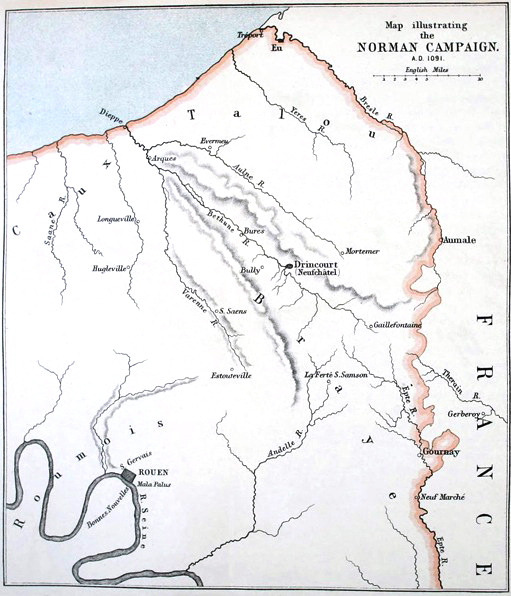
Edwᵈ. Weller
For the Delegates of the Clarendon Press.
Map illustrating the NORMAN CAMPAIGN. A.D. 1091.
Submission of Saint Valery. The first point of the mainland which the Red King won was one which lay beyond the strict bounds of the Norman duchy; but no spot, either in Normandy or in England, was more closely connected with the fortunes of his house. And it was one which had a certain fitness as the beginning of such a campaign. The first spot of continental ground which was added to the dominion of one who called himself King of the English, and who at least was truly King of England, was the spot from which his father had set forth for the conquest of England. He won it by the means which were specially his own. “By his cunning or by his treasures he gat him the castle at Saint Valery and the havens.”[621] Englishmen had fought for the elder William 228 in Maine and before Gerberoi;[622] but that was merely to win back the lost possessions of the Norman Duke. Now the wealth and the arms of England were used to win castles beyond the sea for a prince whose possessions and whose titles up to that moment were purely English. Beginning of English action on the continent. In the history of England as a power—and the history of England as a power had no small effect on the history of the English as a people—the taking of Saint Valery is the beginning of a chain of events which leads on, not only to the fight of Tinchebray and the first loss of Rouen, but to the fight of Crecy and the fight of Chastillon, to the taking of Boulogne and the loss of Calais.
Saint Valery had, by the forced commendation of the still reigning Count Guy, passed under Norman superiority;[623] but it was no part of the true Norman land. Submission of Stephen of Aumale. The first fortress within the Norman duchy which passed into the hands of Rufus was the castle of Aumale, standing just within the Norman border, on the upper course of the river of Eu. Its lord, the first of the great Norman nobles to submit to William and to receive his garrison into his castle, was Stephen, son of Count Odo of Champagne and of Adelaide, whole sister of the Conqueror, cousin-german therefore of the two contending princes.[624] Aumale was won, as Saint Valery had been won, by cunning or by treasure. Stephen may simply have learned to see that it was better for him to have the same lord at Aumale and in Holderness, or his eyes may have been yet further enlightened by the brightness of 229 English gold. But the Red King had other means at his disposal, and it seems that other means were needed, if not to win, at least to keep Aumale. Aumale strengthened as the King’s headquarters. The defences of the castle were greatly strengthened at the King’s cost,[625] and it became a centre for further operations. “Therein he set his knights, and they did harms upon the land, in harrying and in burning.”[626] Other castles were soon added to the Red King’s dominion. Submission of Count Robert of Eu and his son William; Count Robert of Eu, whom we have heard of alike at Mortemer and in Lindesey,[627] the father of the man whom we have more lately heard of at Berkeley, still held the house where William the Great had received Harold as his guest,[628] hard by the church where he had received Matilda as his bride.[629] The Count had been enriched with lands in southern England; he is not recorded as having joined in his son’s rebellion; and the lord of Eu now transferred the allegiance of his Norman county to the prince of whom he held his command on the rocks of Hastings.[630] Aumale and Eu, two of the most important points on the eastern border of Normandy, are thus the first places which we hear of as receiving Rufus on the mainland. We shall hear of both names again, but in quite another kind of tale, before the reign of Rufus is over.
of Gerard of Gournay. The next Norman noble to join the cause of William was another lord of the same frontier, who held a point of hardly less importance to the south of Eu and Aumale. 230 This was Gerard of Gournay, son of the warrior of Mortemer who had gone to end his days as a monk of Bec,[631] son-in-law of the new Earl of Surrey,[632] husband of perhaps the only woman on Norman ground who bore the name of English Eadgyth.[633] His castle of Gournay, from which many men and more than one place[634] in England have drawn their name, stood on the upper course of the Epte, close to the French border. The fortress itself has vanished; The church of Gournay. but the minster of Saint Hildebert, where the massive work of Gerard’s day has been partly recast in the lighter style of the next century, still remains, with its mighty pillars, its varied and fantastic carvings, to make Gournay a place of artistic pilgrimage. Nor is it hard to trace the line of the ancient walls of the town, showing how the border stream of Epte was pressed into the service of the Norman engineers. The adhesion of the lord of Gournay seems to have been of the highest importance to the cause of Rufus. The influence of Gerard reached over a wide district north of his main dwelling. Other castles of Gerard. Along with Gournay, he placed at the King’s disposal his fortress of La Ferté Saint Samson, crowning a height looking over the vale of Bray, and his other fortress of Gaillefontaine to the north-east, on another height by the wood of its own name, overlooking the early course of the Bethune or Dieppe, the stream which joins the eastern Varenne by the hill of Arques.[635] Gerard too was not only ready in receiving the King’s forces into his own castles, but zealous also in bringing over his neighbours to follow his example.[636] Among 231 these was the lord of Wigmore, late the rebel of Worcester, Ralph of Mortemer.[637] Submission of Earl Walter Giffard. Old Walter Giffard too, now Earl of Buckingham in England, had English interests far too precious to allow him to oppose his island sovereign. His castle of Longueville. He held the stronghold of Longueville—the north-eastern Longueville by the Scie, the stream which, small as it is, pours its waters independently into the Channel between Dieppe and Saint Valery-in-Caux. There, from a bottom fenced in by hills on every side, the village, the church where the hand of the modern destroyer has spared only a few fragments of the days of Norman greatness, the priory which has been utterly swept away, all looked up to a hill on the right bank of the stream which art had changed into a stronghold worthy to rank alongside of Arques and Gisors. Girt about with a deep ditch, on the more exposed southern side with a double ditch, the hill was crowned by a shell-keep which still remains, though patched and shattered, and a donjon which has been wholly swept away. In this fortress the aged warrior of Arques and Senlac received, like so many of his neighbours, the troops which William of England had sent to bring the Norman duchy under his power.
Ralph of Toesny and Count William of Evreux. The domains of all these lords lay in the lands on the right bank of the Seine, the oldest, but, as I have often remarked, not the truest Normandy. But the Red King also won a valuable ally in quite another part of the duchy. This was Ralph of Conches or of Toesny, with whom we are now most concerned as the husband of the warlike Isabel of Montfort, and, in that character rather than in any other, the enemy of the Countess Heloise and of her husband Count William of Evreux. The rival lords were in fact half-brothers. The old 232 Roger of Toesny, the warlike pilgrim of Spain,[638] was succeeded by Ralph, who has so often played his part in our story, and whom we last met in Duke Robert’s army before Le Mans.[639] The widow of Roger, the mother of Ralph, had married Richard Count of Evreux, and was by him the mother of the present Count William.[640] Enmity of their wives. But this near kindred by birth had less strength to bind the brothers together than the fierce rivalry of their wives had to set them at feud with one another. The jealousy of these two warlike ladies kept a large part of Normandy in a constant uproar. Our historian bitterly laments the amount of bloodshed and havoc which was the result of their rivalry.[641] Countess Heloise of Evreux. Heloise was of the house of the Counts of Nevers, the Burgundian city by the Loire, a descent which carries us a little out of our usual geographical range.[642] Tall, handsome, and ready of speech, she ruled her husband and the whole land of Evreux with an absolute sway. Her will was everything; the counsels of the barons of the county went for nothing.[643] Violent and greedy, she quarrelled with many 233 of the nobles of Normandy, with Count Robert of Meulan among them, and stirred up her husband to many disputes and wars to gratify her fierce passions.[644] At this time some slight which she had received from the lady of Conches had led her to entangle her husband in a bitter feud with his half-brother. Isabel of Montfort. Isabel or Elizabeth—the two names are, as usual, given to her indifferently—the wife of Ralph of Toesny, was a daughter of the French house of Montfort,[645] the house of our own Simon. Like her rival, she must now have been long past her youth; but, while Heloise was childless,[646] Isabel was the mother of several children, among them of a son who has already played a part in Norman history. This was that younger Ralph of Toesny who married the daughter of Waltheof and who had taken a part in the present Duke’s rebellion against his father.[647] Handsome, eloquent, self-willed, and overbearing, like her rival, Isabel had qualities which gained her somewhat more of personal regard than the Countess of Evreux. She was liberal and pleasant and merry of 234 speech, and made herself agreeable to those immediately about her. Moreover, while of Heloise we read indeed that she stirred up wars, but not that she waged them in her own person, Isabel, like the ancient Queens of the Amazons, went forth to the fight, mounted and armed, and attended by a knightly following.[648] War between Conches and Evreux. The struggle between the ladies of Evreux and Conches was at its height at the moment when the castles of eastern Normandy were falling one by one into the hands of Rufus. Isabel and Ralph were just now sore pressed. Ralph in vain asks help of the Duke. The lord of Conches therefore went to Duke Robert and craved his help;[649] but from Duke Robert no help was to be had for any man. Ralph then bethought him of a stronger protector, in the sovereign of his English possessions. He submits to William.King William gladly received such a petition, and bade Count Stephen and Gerard of Gournay, and all who had joined him in Normandy, to give all the help that they could to the new proselyte.[650] Advance of William’s party. The cause of the Red King prospered everywhere; well nigh all Normandy to the right of Seine was in the obedience of Rufus. All its chief men had, in a phrase which startles us in that 235 generation, “joined the English.”[651] And for them the King of the English was open-handed. Into the hoard at Winchester the wealth of England flowed in the shape of every kind of unlawful exaction. Out of it it flowed as freely to enable the new subjects of King William to strengthen the defences of their castles and to hire mercenaries to defend them.[652]