Chapter III · (continued 2)
Reading edition
Helias of Saint-Saens. During all this time Duke Robert himself does not seem to have thought of striking a blow. But there was one man at least between Seine and Somme who was ready both to give and to take blows on his behalf. He marries Robert’s daughter. Robert had given one of his natural children, a daughter born, to him in his wandering days,[653] in marriage to Helias, lord of Saint-Saens.[654] Helias, like so many of the Norman nobles, came of a house which had risen to importance His descent.through the loves of Gunnor and Richard the Fearless.[655] A daughter of one of Gunnor’s sisters married Richard Viscount of Rouen, and became the mother of Lambert of Saint-Saens, the father of Helias.[656] Helias and the daughter of Robert had thus a common, though distant, forefather in the father of Gunnor. He has Caux as his wife’s dowry. With his wife Helias received a goodly dowry, nothing less, we are told, than the whole land of Caux.[657] Helias’ own lordship of Saint-Saens lies on the upper course of the Position of Saint-Saens. 236 Varenne, in a deep bottom girt on all sides by wooded hills, one of which, known as the Câtelier, overhanging the town to the north, seems to have been the site of the castle of Helias. His stronghold has vanished; but the church on which the height looks down, if no rival to Saint Hildebert of Gournay, still keeps considerable remains of an age but little later than that with which we have to do. Importance of his position. The possessions of Helias, both those which he inherited and those which he received with his wife, made his resistance to the invader of no small help to the cause of his father-in-law. They barred the nearest way to Rouen, not indeed from Gournay, but from Eu and Aumale. They came right between these last fortresses and the domain of Walter Giffard at Longueville. Of the three streams which meet by Arques, while Helias himself held the upper Varenne at Saint-Saens, Bures. his wife’s fortress of Bures held the middle course of the Bethune or Dieppe below Gerard’s Gaillefontaine, and below Drincourt, not yet the New Castle of King Henry.[658] The massive church, with parts dating from the days of Norman independence, rises on the left slope of the valley above an island in the stream. But the site of the castle which formed part of the marriage portion of Duke Robert’s daughter is hard to trace. Helias holds Arques. But lower down, nearer the point where the streams meet, the bride of Helias had brought him a noble gift indeed. Through her he was lord of Arques, with its donjon and its ditches, the mighty castle whose tale has been told in recording the history of an earlier generation.[659] A glance at the map will show how strong a position in eastern Normandy was held by the man who commanded at once Saint-Saens, Bures, and Arques. But the son-in-law of Duke Robert deserves our notice 237 for something better than his birth, his marriage, or his domains. Faithfulness of Helias towards Robert. Helias of Saint-Saens was, in his personal character, a worthy namesake of Helias of La Flêche. Among the crimes and treasons of that age, we dwell with delight on the unswerving faithfulness with which, through many years and amidst all the ups and downs of fortune, he clave to the reigning Duke and to his son after him.[660] But this his later history lies beyond the bounds of our immediate tale. What directly concerns us now is that Helias was the one noble of Normandy whom the gold of England could not tempt. It would be almost ungenerous to put on record the fact that, unlike most of his neighbours, he had no English estates to lose. The later life of Helias puts him above all suspicion of meaner motives. Saint-Saens, Arques, Bures, and all Caux, remained faithful to Duke Robert.
With this honourable exception, an exception which greatly lessened the value of his new conquests, William Rufus had won, without hand-strokes, without his personal presence, a good half of the original grant to Rolf, the greater part of the diocese of Rouen. William’s dealings with France. He was soon to win yet another triumph by his peculiar policy. By those arms which were specially his own, he was to win over an ally, or at least to secure the neutrality of an enemy, of far higher rank, though perhaps of hardly greater practical power, than the Count of Aumale and the aged lord of Longueville. Robert asks help of Philip. Robert in his helplessness cried to his over-lord at Paris. Had not his father done the same to Philip’s father? Had not King Henry played a part at least equal to that of Duke William among the lifted lances of Val-ès-dunes?[661] Philip had 238 had his jest on the bulky frame of the Conqueror, and his jest had been avenged among the candles of the bloody churching at Mantes.[662] By this time at least, so some of our authorities imply, Philip had brought himself to a case in which the same jest might have been made upon himself with a good deal more of point. Philip comes to help. At the prayer of his vassal the bulky King of the French left his table and his dainties, and set forth, sighing and groaning at the unusual exertion, to come to the help of the aggrieved Duke.[663] It was a strange beginning of the direct rivalry between England and France. Meeting of the Norman and French armies. King Philip came with a great host into Normandy. And Robert must somewhere or other have found forces to join those of his royal ally. And now was shown the value of the position which was held by the faithful Helias in the land of Caux. They march on Eu. It must have been by his help that the combined armies of Robert and Philip were able to march to the furthest point of the Red King’s new acquisitions, to the furthest point of the Norman duchy itself, to the castle of Eu, which was held, we are told, by a vast host, Norman and English.[664] Let an honest voice from Peterborough 239 tell what followed. “And the King and the Earl with a huge fyrd beset the castle about where the King’s men of England in it were. Philip bribed to go back. The King William of England sent to Philip the Franks’ King, and he for his love or for his mickle treasure forlet so his man the Earl Robert and his land, and went again to France and let them so be.”[665] A Latin writer does not think it needful to allow Philip the perhaps ironical alternative of the English writer. Love between Philip and William Rufus is not thought of. We are simply told that, while Philip was promising great things, the money of the King of England met him—the wealth of Rufus seems to be personified. Before its presence his courage was broken; he loosed his girdle and went back to his banquet.[666]
The first English subsidy. Thus the special weapons of Rufus could overcome even kings at a distance. But, ludicrous as the tale sounds in the way in which it is told, this negotiation between Philip and William is really, in an European, and even in an English point of view, the most important event in the whole story. We should hardly be wrong in calling this payment to Philip the first instance of the employment of English money in the shape of subsidies to foreign princes. For such it in strictness was. It was not, like a Danegeld, money paid to buy off a foreign invader. Nor was it like the simple hiring of mercenaries at home or abroad. It is, like later subsidies, money paid to a foreign sovereign, on 240 condition of his promoting, or at least not thwarting, the policy of a sovereign of England. The appetite[667] which was now first awakened in Philip of Paris soon came to be shared by other princes, and it lasted in full force for many ages. First direct dealings between England and France. Again, we have now for the first time direct political dealings between a purely insular King of England—we may forestall the territorial style when speaking of England as a state rather than of Englishmen as a nation—and a French King at Paris. The embassies which passed between Eadward and Henry, even when Henry made his appeal on behalf of Godwine,[668] hardly make an exception. Different position of the two Williams. William the Great had dealt with France as a Norman duke; if, in the latter part of his reign, he had wielded the strength of England as well as the strength of Normandy, he had wielded it, as far as France was concerned, wholly for Norman purposes. But William the Red, though his position arose wholly out of the new relations between England and Normandy, was still for the present a purely English king. Relation of England, Normandy, and France. The first years of Rufus and the first years of Henry the First are alike breaks in the hundred and forty years of union between England and Normandy.[669] Had not a Norman duke conquered England, an English king would not have been seeking to conquer Normandy; but, as a matter of fact, an English king, who had no dominions on the mainland, was seeking to conquer Normandy. And he was seeking to win it with 241 the good will, or at least the neutrality, of the French King. This was a state of things which could have happened only during the few years when different sons of the Conqueror ruled in England and in Normandy. Whenever England and Normandy were united, whether by conquest or by inheritance, the old strife between France and Normandy led England into the struggle. But at the present moment an alliance between England and France against Normandy was as possible as any other political combination. Results of Rufus’ dealings with Philip. And the arts of Rufus secured, if not French alliance, at least French neutrality. But either alliance or neutrality was in its own nature destructive of itself. Let either Normandy win England or England win Normandy, and the old state of things again began. The union of England and Normandy meant enmity between England and France, an enmity which survived their separation.[670] Friendly dealings between William and Philip were a step towards the union of England and Normandy, and thereby a step towards that open enmity between England and France which began under Rufus himself and which lasted down to our fathers’ times. The bribe which Philip took at Eu has its place in the chain of events which led to Bouvines, to Crécy, and to Waterloo.
State of Normandy. But while things were thus, unknown to the actors in them, taking a turn which was permanently to affect the history of mankind, the immediate business of the time went on as before in the lands of Northern Gaul. In Normandy that immediate business was mutual destruction—civil war is too lofty a name; in Maine it was deliverance from the Norman yoke. I am not called on to tell in detail the whole story of every local strife between one Norman baron and another, not even in those 242 rare cases when the Duke himself stepped in as a judge or as a party in the strife. Those who loved nothing so well as slaughter, plunder, and burning, had now to make up for the many years during which the strong hand of William the Great had kept them back from those enjoyments. Private wars not interrupted by the invasion. They had no thought of stopping, though the kings of England and France, or all the kings of the earth, should appear in arms on Norman soil. Many a brilliant feat of arms, as it was deemed in those days, must be left to local remembrance; even at events which closely touched many of the chief names of our story we can do no more than glance. The revolt of Maine will have to be spoken of at length in another chapter; Action of Robert of Bellême. among strictly Norman affairs we naturally find Robert of Bellême playing his usual part towards his sovereign and his neighbours, and we find the tower of Ivry and the fortified hall of Brionne ever supplying subjects of strife to the turbulent nobles. We see Robert of Bellême at war with his immediate neighbour Geoffrey Count of Perche,[671] and driving Abbot Ralph of Seez to seek shelter in England.[672] We also find him beaten back from the walls of Exmes by Gilbert of Laigle and the other warriors of his house, the house of which we have heard in the Malfosse of Senlac 243 and beneath the rocks of Sainte-Susanne.[673] William of Breteuil loses, wins, and loses again, his late grant of the tower of Ivry, and the second time he is driven to give both the tower and the hand of his natural daughter as his own ransom from a specially cruel imprisonment at the hands of a rebellious vassal.[674] Brionne forms the centre of a tale in which its new lord and his son, the other Roger and the other Robert of our story, play over again the part of the Earl of Shrewsbury and his son of Bellême. Robert of Meulan claims the tower of Ivry. Robert of Meulan comes from England to assert his claim among others to the much-contested tower of Ivry. The Duke reminds him that he had given Brionne to his father in exchange for Ivry. The Count of Meulan gives a threatening answer.[675] He is imprisoned, but set free at the intercession of his father. The Duke, with unusual spirit, puts him in prison, seizes Brionne, and puts it into a state of defence. Then the old Roger of Beaumont, old a generation earlier,[676] obtains, by the recital of his own exploits, 244 the deliverance of his son.[677] He then prays, not without golden arguments, for the restitution of Brionne.[678] Robert takes Brionne. The officer in command, Robert son of Baldwin, asserts his own hereditary claim, and, at the head of six knights only, stands a siege, though not a long one, against the combined forces of the Duke and of the Count of Meulan and his father.[679] This siege is remarkable. The summer days were hot; all things were dry; the besiegers shot red-hot arrows against the roof of the fortified hall, and set fire to it.[680] So Duke Robert boasted that he had taken in a day the river-fortress which had held out for three years against his father.[681]
These events concern us only because we know the actors, and because they helped to keep up that state of confusion in the Norman duchy which supplied the Red King at once with an excuse for his invasion, and with the means for carrying out his schemes. Advance of Rufus. It must be remembered that the two stories are actually contemporary; while Robert was besieging Brionne, the fortresses of eastern Normandy were already falling one by one into the hands of Rufus. It is even quite possible that 245 Robert of Meulan’s voyage from England to Normandy, and the demands made by him and his father on the Duke, were actually planned between the cunning Count and the Red King as a means of increasing the confusion which reigned in the duchy. But there are tales of local strife which concern us more nearly. The war of Conches and Evreux. The war of the half-brothers, the war of the Amazons, the strife between Conches and Evreux, between Isabel and Heloise, is an immediate part of the tale of William Rufus. The lord of Conches was strengthened in his struggle with his brother by forces directly sent to his help by the King’s order.[682] Movement at Rouen. The war went on; and, while it was still going on, a far more important movement began in the greatest city of Normandy, a movement in which the King of the English was yet more directly concerned. Up to this time his plans had been everywhere crowned with success. His campaign, if campaign we can call it, had begun soon after Easter. Half a year had passed, and nearly the whole of the oldest, though not the truest, Normandy had fallen into his hands without his stirring out of his island realm. It now became doubtful whether Robert could keep even the capital of his duchy.
November, 1090. The month of November of this year saw stirring scenes alike in the streets of Rouen and beneath the walls of Conches. But, while Conches was openly aided by the King’s troops, no force from England or from the parts of Normandy which William had already won had as yet drawn near to Rouen. Rufus knew other means to gain over the burghers of a great city as well as the lords of castles and smaller towns. State of things in Rouen. The glimpse which we now get of the internal state of the Norman metropolis tells us, like so many other glimpses which are given us in the history of these times, just enough to make us wish to be 246 told more. A state of things is revealed to us which we are not used to in the history of Normandy. Rouen appears for a moment as something like an independent commonwealth, though an enemy might call it a commonwealth which seemed to be singularly bent on its own destruction. The municipal spirit. The same municipal spirit which we have seen so strong at Exeter and at Le Mans[683] shows itself now for a moment at Rouen. We may be sure that under the rule of William the Great no man had dreamed of a commune in the capital of Normandy. His arm, we may be sure, had protected the men of Rouen, like all his other subjects, in the enjoyment of all rights and privileges which were not inconsistent with his own dominion. But in his day Rouen could have seen no demagogues, no tyrants, no armies in civic pay, no dealings of its citizens with any prince other than their own sovereign. But the rule of William the Great was over; in Robert’s days it may well have seemed that the citizens of so great a city were better able to rule themselves, or at all events that they were entitled to choose their own ruler. When the arts of Rufus, his gifts and his promises, began to work at Rouen in the same way in which they had worked on the castles of the eastern border, his agents had to deal, not with a prince or a lord, but with a body of citizens under the leadership of one of whom one doubts whether he should be called a demagogue or a tyrant. We seem to be carried over two hundred and forty years to the dealings of Edward the Third with the mighty brewer of Ghent. Conan demagogue or tyrant. The Artevelde of Rouen was Conan—the name suggests a Breton origin—the son of Gilbert surnamed Pilatus. He was the richest man in the city; his craft is not told us; but we must always remember that a citizen was not necessarily a trader.[684] His wealth 247 was such that it enabled him to feed troops of mercenaries and to take armed knights into his pay.[685] Another leading citizen, next in wealth to Conan, was William the son of Ansgar,[686] whose name seems to imply the purest Norman blood. Conan’s treaty with William. Conan had entered into a treaty with William, the object of which, we are told, was to betray the metropolis of Normandy and the Duke of the Normans—the sleepy Duke, as our guide calls him—into the power of the island King.[687] The citizens favour William. Nor was this merely the scheme of Conan and William; public feeling in the city went heartily with them. A party still clave to the Duke; but the mass of the men of Rouen threw in their lot with Conan, and were, like him, ready to receive William as their sovereign instead of Robert.[688] They may well have thought that, in the present state of things, any change would be for the better; the utter lawlessness of the time, which might have its charms for turbulent nobles, would have no charms for the burghers of a great city. Or the men of Rouen may have argued then, much as the men of Bourdeaux argued ages later, that they were likely to enjoy a greater measure of municipal freedom, under a King of the English, dwelling apart from them in his own island, than they would ever win from a Duke of the Normans, holding 248 his court and castle in Rouen itself. Yet the friends of Robert might have their arguments too. A party for Robert. The party of mere conservatism, the party of order, would naturally cleave to him. But other motives might well come in. True friends of the commune might doubt whether William the Red was likely to be a very safe protector of civic freedom. They might argue that, if they must needs have a master, their liberties were less likely to be meddled with under such a master as Robert. But the party of the Duke’s friends, on whatever grounds it stood by him, was the weaker party. A majority of the citizens was zealous for William. A day fixed for the surrender to William. A day was fixed by Conan with the general consent, on which the city was to be given up,[689] and the King’s forces were invited to come from Gournay and other points in his obedience. Robert sends for help. Robert seems to have stayed in the capital which was passing from him; but he felt that, if he was to have supporters, he must seek for them beyond its walls. He sent to tell his plight to those of the nobles of Normandy in whom he still put any trust.[690] And he also hastened to seek help in a reconciliation with some neighbours and subjects with whom he was at variance.
Henry and Robert of Bellême come to the Duke’s help. It is certainly a little startling, after the history of the past year, to find at the head of the list of Duke Robert’s new allies the names of the Ætheling Henry and of Robert of Bellême. We may well fancy that they took up arms, not so much to support the rights of the Duke against the King as to check the dangerous example of a great city taking upon itself to choose among the 249 claims of kings, dukes, and counts. Danger of the example of Rouen. Robert of Bellême may indeed have simply hastened to any quarter from which the scent of coming slaughter greeted him. But Henry the Clerk could always have given a reason for anything that he did. Popular movements at Rouen might supply dangerous precedents at Coutances. The Count of Coutances too might have better hopes of becoming Duke of Rouen, if Rouen were still held for a while by such a prince as Robert, than he could have if the city became either the seat of a powerful commonwealth or the stronghold of a powerful king. But, from whatever motive, Henry came, and he was the first to come.[691] Others to whom the Duke’s messengers set forth his desolate state[692] came also. Others who help Robert. Robert of Bellême, so lately his prisoner, Count William of Evreux and his nephew William of Breteuil, all hastened, if not to the deliverance of Duke Robert, at least to the overthrow of Conan. And with them came Reginald of Warren, the younger son of William and Gundrada,[693] and Gilbert of Laigle, fresh from his victory over his mightiest comrade.[694] November 3, 1090. At the beginning of November Duke Robert was still in the castle of Rouen; but his brother Henry was now with him within its walls, and the captains Henry at Rouen. who had come to his help were thundering at the gates of the rebellious city.
E. Weller
For the Delegates of the Clarendon Press.
ROUEN
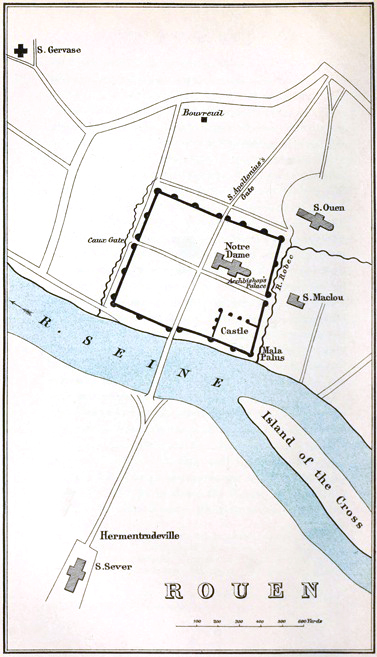
Rouen in the eleventh century. The Rouen of those days, like the Le Mans, the York, and the Lincoln, of those days, was still the Roman city, the old Rothomagus. As in those and in countless other cases, large and populous suburbs had spread themselves over the neighbouring country; at Rouen, as at York, 250 those suburbs had passed the river; but the city itself, the walled space to be attacked and defended in wartime, was still of the same extent as it had been in the days before Rolf and before Chlodwig. The rectangular space marking the Roman camp stretched on its southern side nearly to the Seine, whose stream, not yet fenced in by quays, reached further inland on that side than it now does. Position of the city. Rouen is essentially a river city, not a hill city. The metropolitan church does indeed stand on sensibly higher ground than the buildings close to the river; but to one fresh from Le Mans or Chartres the rise which has to be mastered seems trifling indeed. For a hill city the obvious site would have been on the natural akropolis supplied by the height of Saint Katharine to the south-east. Yet Rouen is a city of the mainland; the islands which divide the waters of the Seine must have been tempting points for Rolf in his Wiking days; but even the largest of them, the Isle of the Cross, was hardly large enough for a town to grow upon it. Of the walls of Rothomagus not a fragment is left; yet the impress of a Roman chester is hard to wipe out; it is still easy to trace its lines among the streets and buildings of the greatly enlarged mediæval and modern city. Frightful as has been the havoc which the metropolis of Normandy has undergone in our own time, mercilessly as the besom of destruction has swept over its ancient streets, churches, and houses, the dæmon of modern improvement has spared enough to enable us, if not to tell the towers, yet in idea to mark well the bulwarks, of the city where the Conqueror reigned. The ducal castles. Near the south-west corner of the parallelogram, not far from the river-side, had stood the earlier castle of the Dukes. Its site in after times became the friary of the Cordeliers, a small fragment of whose church, as well as another desecrated church within the castle 251 precinct, does in some faint way preserve the memory of the dwelling-place of Rolf.[695] But by the days of Robert, the dukes had moved their dwelling to the south-eastern corner, also near the river, where the site of the castle is marked by the vast halles, and by the graceful Renaissance porch, where the chapter of our Lady of Rouen yearly, on the feast of the Ascension, exercised the prerogative of mercy by saving one prisoner condemned to die. Here the memory of the castle, though only its memory, lives in the names of the Haute and the Basse Vieille Tour, one of which is soon to be famous in our story. The eastern side of the city. On the eastern side the wall was washed by a small tributary of the Seine, the Rebecq, a stream whose course has withdrawn from sight almost as thoroughly as the Fleet of London or the Frome of Bristol.[696] On this side of the city lay a large swampy tract, whose name of Mala palus still lives in a Rue Malpalu[697], though a more distant part of it has taken the more ambitious name of the Field of Mars. The archbishopric. Within the wall lay the metropolitan church of our Lady and the palace of the Primate of Normandy. If this last reached to anything like its present extent to the east, the Archbishops of Rouen, like the Counts of 252 Maine,[698] must have been reckoned among the men who sat on the wall. Abbey of Saint Ouen. Outside the city, but close under the wall, near its north-eastern corner, stood the great abbey of Saint Ouen, the arch-monastery,[699] still ruled by its Abbot Nicolas, though his long reign was now drawing to an end.[700] At the opposite north-western angle, but much further from the walls, where the higher ground begins to rise above the city, stood the priory of Saint Gervase, the scene of the Conqueror’s death.[701] Priory of Saint Gervase. Saint Gervase indeed stood, not only far beyond the Roman walls, but beyond those fortifications of later times which took Saint Ouen’s within the city. For Rouen grew as Le Mans grew. Castle of Bouvreil. On the higher ground like Saint Gervase, but more to the east, rose the castle of Bouvreil, which Philip of Paris, after the loss of Norman independence, reared to hold down the conquered city. Walls of Saint Lewis. Between his grandfather’s castle and the ancient wall Saint Lewis traced out the newer line of fortification which is marked by the modern boulevards. His walls are gone, as well as the walls of Rothomagus; but of the house of bondage of Philip Augustus one tower still stands, while of the dwelling-place of her own princes even mediæval Rouen had preserved nothing.
The gates. The four sides of the Roman enclosure were of course pierced by the four chief gates of the city, of three of which we hear in our story. Of these the western, the gate of Caux, is in some sort represented by the Renaissance gate of the Great Clock[702] with its adjoining 253 tower. The northern gate bore the name of Saint Apollonius. The river was spanned by at least one bridge, which crossed it by way of the island of the Cross, near the second ducal castle. Suburbs beyond the Seine. Beyond the stream lay the suburb of Hermentrudeville, now Saint Sever, where Anselm had waited during the sickness of the Conqueror.[703] There too the Duchess Matilda, soon to be Queen, had begun the monastery of the meadow, the monastery of our Lady of Good News, the house of Pratum or Pré, whose church still stood unfinished, awaiting the perfecting hand of her youngest son.[704]
Fright of Duke Robert. Meanwhile the elder and best-beloved son of Matilda was trembling within the city on the right bank of the broad river. Luckily he had the presence of his youngest brother, the English Ætheling, the Count of the Côtentin, to strengthen him. Personal courage Duke Robert never lacked at any time; but something more than personal courage was now needed. Robert was perhaps not frightened, but he was puzzled; at such a moment he seemed to the calm judgement of Henry to be simply in the way; it was for wiser heads to take counsel without him. But deliverance was at hand. Both sides of the Seine sent their helpers. Approach of Gilbert and Reginald. Gilbert of Laigle crossed the bridge by the island close under the ducal tower, and turned to the left to the attack of the southern gate. Reginald of Warren at the head of three hundred knights drew near to the gate of Caux.[705] Efforts of Conan. Against this twofold attack Conan strove hard to keep up the hearts of his partisans. He made speeches exhorting to a valiant defence. Division among the citizens. Many obeyed; but the city was already divided; while one party hastened to the southern gate to withstand the assault of Gilbert, 254 another party sped to open the western gate and to let in the forces of Reginald. Utter confusion. Soldiers of the King of the English, the advanced guard doubtless of a greater host to come, were already in the city, stirring up the party of Conan to swifter and fiercer action.[706] Soldiers and citizens were huddled together in wild confusion; shouts passed to and fro for King and Duke; men at either gate smote down neighbours and kinsmen to the sound of either war-cry.[707] The strength of the city was turned against itself. The hopes of the commonwealth of Rouen, either as a free city or as a favoured ally of the island King, were quenched in the blood of its citizens. Le Mans and Exeter had fallen; but they had fallen more worthily than this.
Henry sends Duke Robert away. Meanwhile Henry and those who were with him in the castle deemed that the time had come for the defenders of the ducal stronghold to join their friends within and without the city. But there was one inhabitant of the castle whose presence was deemed an encumbrance at such a moment. Men were shouting for the Duke of the Normans; but the wiser heads of his friends deemed that the Duke of the Normans was just then best out of the way. Robert came down from the tower, eager to join in the fray and to give help to the citizens of his own party.[708] But all was 255 wild tumult; it needed a cooler head than Robert’s to distinguish friend from foe. He might easily rush on destruction in some ignoble form, and bring dishonour on the Norman name itself.[709] He was persuaded by his friends to forego his warlike purposes, and to suffer himself to be led out of harm’s way. While every other man in the metropolis of Normandy was giving and taking blows, the lord of Normandy, in mere personal prowess one of the foremost soldiers in his duchy, was smuggled out of his capital as one who could not be trusted to let his blows fall in the right place. With a few comrades he passed through the eastern gate into the suburb of the Evil Swamp, just below the castle walls. No attacks from the east. It is to be noticed that no fighting on this side of the city is mentioned. The King’s troops were specially looked for to approach from Gournay, and the east gate was the natural path by which an army from Gournay would seek to enter Rouen. One would have expected that one at least of the relieving parties would have hastened to make sure of this most important point. Yet one division takes its post by the southern gate, another by the western, none by the eastern. Were operations on that side made needless, either by the neighbourhood of the castle, by any difficulties of the marshy ground, or by the disposition of the inhabitants of the suburb? Certain it is that Duke Robert’s nearest neighbours outside his capital were loyal to him. The men of the Evil Swamp received the Duke gladly as their special lord.[710] He allowed himself to be put into a boat, and ferried across to the suburb on the left bank. 256 There he was received by one of his special counsellors, William of Arques, a monk of Molesme, and was kept safely in his mother’s monastery till all danger was over.[711]
It was clearly not wholly for the sake of such a prince as this that so many Norman leaders, Henry of Coutances among them, had made up their minds that the republican movement at Rouen was to be put down. The moment for putting it down had come. Gilbert enters Rouen. Gilbert of Laigle had by this time, by the strength of his own forces and by the help of the citizens of his party, entered Rouen through the southern gate. His forces now joined the company of Henry; they thus became far more than a match for the citizens of Conan’s party, even strengthened as they were by those of the King’s men who were in the city. Slaughter of the citizens. A great slaughter of the citizens followed; the soldiers of Rufus contrived to flee out of the city, and to find shelter in the neighbouring woods;[712] the city was full of death, flight, and weeping; innocent and guilty fell together; Conan taken prisoner. Conan and others of the ringleaders were taken prisoners. Conan himself was led into the castle, and 257 there Henry took him for his own share of the spoil, not indeed for ransom, but to be dealt with in a strange and dreadful fashion. It is one of the contrasts of human nature that Henry, the great and wise ruler, the king who made peace for man and deer, the good man of whom there was mickle awe and in whose day none durst hurt other, should have been more than once guilty in his own person of acts of calm and deliberate cruelty which have no parallel in the acts of his father, nor in those of either of his brothers. Fate of Conan. So now Conan was doomed to a fate which was made the sterner by the bitter personal mockery which he had to endure from Henry’s own mouth. The Ætheling led his victim up through the several stages of the loftiest tower of the castle, till a wide view was opened to his eyes through the uppermost windows.[713] Henry and Conan in the tower. Henry bade Conan look out on the fair prospect which lay before him. He bade him think how goodly a land it was which he had striven to bring under his dominion.[714] These words well express the light in which Conan’s schemes would look in princely eyes; the question was not whether Robert or William should reign in Rouen; it was whether Conan should reign there as demagogue or tyrant in the teeth of all princely rights. Henry went on to point out the beauties of the landscape in detail; the eyes of the scholar-prince could perhaps better enjoy them than the eyes of Rufus or of Robert of Bellême. Beyond the river lay the pleasant park, the woody land rich in beasts of chase. There was the Seine washing the walls of the city, the river rich in fish, bearing on its waters the ships which enriched Rouen with the wares of many 258 lands.[715] On the other side he bade him look on the city itself thronged with people, its noble churches, its goodly houses. The modern reader stops for a moment to think that, of the buildings which then met the eye of Conan, churches, castles, halls of wealthy burghers like himself, clustering within and without the ancient walls, all doubtless goodly works according to the sterner standard of that day, hardly a stone is left to meet his own eye as he looks down from hill or tower on the great buildings of modern Rouen. It was another Saint Romanus, another Saint Ouen, of far different outline and style from those on which we now gaze, which Henry called on Conan to admire at that awful moment. He bade him mark the splendour of the city; he bade him think of its dignity as the spot which had been from of old the head of Normandy.[716] The trembling wretch felt the mockery; all that was left to him was to groan and cry for mercy. He confessed his guilt; he simply craved for grace in the name of their common Maker. He would give to his lord all the gold and silver of his hoard and the hoards of his kinsfolk; he would wipe out the stain of his past disloyalty by faithful service for the rest of his days.[717] The Conqueror would have granted such a prayer in sheer greatness of soul; the Red King might well have deemed it beneath him to harm so lowly a suppliant. But the stern purpose of Henry was fixed, and his wrath, when it was 259 once kindled, was as fierce as that of his father or his brother. “By the soul of my mother”—that seems to have been the most sacred of oaths with Matilda’s defrauded heir, as he looked out towards the church of her building—“there shall be no ransom for the traitor, but rather a hastening of the death which he deserves.”[718] Conan no longer pleaded for life; he thought only of the welfare of his soul. “For the love of God, at least grant me a confessor.”[719] Had the Lion of Justice reached that height of malice which seeks to kill the soul as well as the body? At Conan’s last prayer his wrath reached its height;[720] Conan should have no time for shrift any more than for ransom. If the clergy of Saint Romanus already enjoyed their privilege of mercy, they were to have no chance of exercising it on behalf of this arch-criminal. Death of Conan. With all the strength of both his hands, Henry thrust Conan, like Eadric,[721] through the window of the tower. He fell from the giddy height, and died, so it was said, before he reached the ground. His body was tied to the tail of a pack-horse and dragged through the streets of Rouen to strike terror into his followers. The spot from which he was hurled took the name of the Leap of Conan.[722] The tower, as I have said, has perished; the site of the Leap of Conan must be 260 sought for in imagination, at some point, perhaps the south-eastern corner, of the vast halles of ancient Rouen.
Policy of Henry. The rule of Robert was now restored in Rouen, so far as Robert could be said to rule at any time in Rouen or elsewhere. It is remarkable that after the death of Conan we lose sight of Henry; that is, as far as Rouen is concerned, for we shall before long hear of him again in quite different relations towards his two brothers. He may well have thought that one fearful example was needed, but that one fearful example was enough. He would secure the punishment of the ringleader, even by doing the hangman’s duty with his own hands; but mere havoc and massacre had no charms for him at any time. His policy might well have forestalled the later English rule, “Smite the leaders and spare the commons.” If Robert or anybody else was to reign in Rouen, nothing would be gained by killing, driving out, or recklessly spoiling, the people over whom he was to reign. But there were men at his side to whom the utmost licence of warfare was the most cherished of enjoyments. The Duke, never personally cruel,[723] was in a merciful mood. Robert brought back. When all danger was over, he was brought across the river from his monastery to the castle. He saw how much the city had already suffered; his heart was touched, and he was not minded to inflict any further punishment. Treatment of the citizens. But he had to yield to the sterner counsels of those about him, and to allow a heavy vengeance to be meted out.[724] He seems however to have prevailed so far as to hinder the shedding of blood. At least we hear nothing of any general slaughter. The fierce men who had brought him back seem to have contented themselves with plunder and leading into captivity. The citizens 261 of Rouen were dealt with by their countrymen as men deal with barbarian robbers. They were spoiled of all their goods and led away into bondage. Robert of Bellême and William of Breteuil, if they spared life, spared it only to deal out on their captives all the horrors of the prison-house.[725] Imprisonment and ransom of William son of Ansgar. The richest man in Rouen after the dead Conan, William the son of Ansgar, became the spoil of William of Breteuil. After a long and painful imprisonment, he regained his liberty on paying a mighty ransom of three thousand pounds.[726]
Before his captive was set free, the lord of Breteuil himself learned what it was to endure imprisonment, this time doubtless of a milder kind than that which he inflicted on William the son of Ansgar or that which himself endured at the hands of Ascelin.[727] Count William marches against Conches. November, 1090. The Count of Evreux and his nephew of Breteuil must have marched almost at once from their successful enterprise at Rouen to a less successful enterprise at Conches. For it was still November when Count William or his Countess resolved on a great attack on the stronghold of their rival.[728] Evreux was doubtless the starting-point for an undertaking which followed naturally on the work which had been done at Rouen. The Count of Evreux might keep on the garb of Norman patriotism which he had worn in the assault on the rebellious capital, and 262 his Countess might add to the other crimes with which she charged Ralph and Isabel a share in the crime of Conan, that of traitorous dealing with the invading enemy. The forces of Evreux and Breteuil were therefore arrayed to march together against the stronghold of the common kinsman and enemy at Conches.
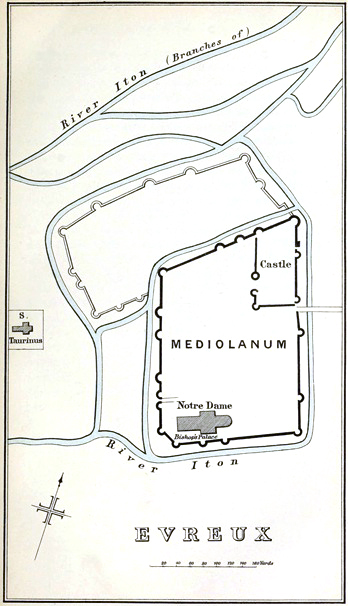
No contrast could well be greater than the contrast between the spot from which Count William set forth and the spot which he led his troops to attack. Position of Evreux and Conches. Near as Conches and Evreux are, they are more thoroughly cut off from one another than many spots which are far more distant on the map. The forest of Evreux parts the hills of Conches from the capital of Count William’s county. The small stream of the Iton flows by the homes of both the rival heroines. But at Conches it flows below the hill crowned by castle, church, and abbey; at Evreux its swift stream had ages before been taught to act as a fosse to the four walls of a Roman chester. Position of Mediolanum or Evreux. Low down in the valley, like our own Bath, with the hills standing round about his city, the Count of Evreux lived among the memorials of elder days. The walls of Mediolanum, which can still be traced through a large part of their circuit, fenced in to the south the minster of Our Lady and the palace of the Bishop, then still tenanted by the eloquent Gilbert.[729] His home, like that of his metropolitan at Rouen,[730] might seem to stand upon the Roman wall itself. At the north-west corner, the wall fenced in the castle from which Count William had driven out the Conqueror’s garrison, and where he, either then or at some later time, overthrew the Conqueror’s donjon.[731] History of Evreux. The wall of Mediolanum, like the wall of the Athenian akropolis, had 263 fragments of ornamental work, shattered columns, capitals, cornices, built in among its materials. It would thus seem to belong to a late stage of Roman rule, when the Frank was dreaded as a dangerous neighbour, perhaps when he had already once laid Mediolanum waste. To the north, much as at Le Mans and at Rouen, the city in later times enlarged its borders, as, in later times still, it has enlarged them far to the south. The “Little City”—a name still borne by a street within the Roman circuit—is a poor representative of the Old Rome on the Cenomannian height;[732] but both alike bear witness to the small size of the original Roman encampments, and to the gradual process by which they were enlarged into the cities of modern times. The Roman walls. But in the days of William and Heloise the circuit of Roman Mediolanum was still the circuit of Norman Evreux. And, as in so many other places, the oldest monuments have outlived many that were newer. Small traces of the eleventh century at Evreux. Neither church, castle, nor episcopal palace, keeps any fragments of the days of the warlike Countess; it is only in the minster of Saint Taurinus without the walls that some small witnesses of those times are to be found. Even the Romanesque portions of the church of Our Lady must be later than Count William’s day, and the greater part of the building of the twelfth century has given way to some of the most graceful conceptions of the architects of the fourteenth. The home of the Bishop has taken the shape of a stately dwelling in the latest style of mediæval art; the home of the Count has vanished like the donjon which Count William overthrew. But the old defences within which bishops and counts had fixed themselves in successive ages still live on, to no small extent in their actual masonry, and in the greater part of their circuit in their still easily marked lines. And, high upon the hills, the eye rests 264 on the stronghold of yet earlier days, bearing the local The Câtelier. name of the Câtelier, the earth-works which rise above Evreux as the earth-works of Sinodun rise above the northern Dorchester. Here we may perhaps see the point where the Gaul still held out on the hill, when the Roman had already entrenched himself by the river-side. At Evreux the works of the earliest times, the works of the latest times, the works of several intermediate times, are there in their fulness. But there is nothing whatever left in the city directly to remind us of the times with which we are now dealing. A man might pass through Evreux, he might make a diligent search into the monuments of Evreux, and, unless he had learned the fact from other sources, he might fail to find out that Evreux had ever had counts or temporal lords of any kind.
E. Weller
For the Delegates of the Clarendon Press.
EVREUX
Position of Conches. It is otherwise with the fortress of the warlike lady of the hills, against which the warlike lady of the river-city now bade the forces of her husband’s county to march. The home of Isabel has no more of her actual work or date to show than the home of Heloise; but the impress of the state of things which she represents is stamped for ever on the stronghold of the house of Toesny. At Evreux the Count and his followers lived in the midst of works which, even in their day, were ancient; at Conches, on the other hand, all was in that day new. Conches had already its minster, its castle, most likely its growing town; but all were the works of its present lord or of his father. The hill of Conches is another of those peninsular hills which, as the chosen sites of castles, play so large a part in our story. But the castle of Conches does not itself crown a promontory, like the castle of Ballon. The cause doubtless was that at Conches the abode of peace came first, and the abode of warfare came only second. Either Ralph himself, the 265 first of his house who bears the surname of Conches as well as that of Toesny, Foundation of the monastery. or else his fierce father in some milder moment, had planted on the hill a colony of monks, the house of Saint Peter of Conches or Castellion.[733] The monastery arose on that point of the high ground which is most nearly peninsular, that stretching towards the north. To the south of the abbey presently grew up the town with its church, a town which, in after times at least, was girded by a wall, and which was sheltered or threatened The castle. by the castle of its lords at the end furthest from the monastery. To the east, the height on which town and castle stand side by side rises sheer from a low and swampy plain, girt in by hills on every side, lying like the arena of a natural amphitheatre. On the hill-side art has helped nature by escarpments; the mound of the castle, girt by its deep and winding ditch, rises as it rose in the days of Ralph and Isabel; but the round donjon on the mound and the other remaining buildings of the fortress cannot claim an earlier date than the thirteenth century. The donjon and the apse of the parish church, a gem of the latest days of French art, now stand nobly side by side; in Isabel’s day they had other and ruder forerunners. The abbey. But of the abbey, which must have balanced the castle itself in the general view, small traces only now remain; it has become quite 266 secondary in the general aspect of the place, which gathers wholly round the parish church and the donjon. The western side of the hill, towards the forest which takes its name from Conches, shows nearly the same features as the eastern side on a smaller scale. It looks down on another plain girt in by hills; but on this side the slope of the hill of Conches itself is gentler, and the town is here defended by a wall. Altogether it was a formidable undertaking when the lord of the ancient city in the vale carried his arms against the fortress, the work of his brother, which had arisen within his own memory on the height overlooking his own river.
Siege of Conches. Count William thus began his winter siege of Conches; but, as usual, we get no intelligible account of the siege as a military operation. We are told nothing of the Count’s line of march, or by what means he sought to bring the castle to submission. Near kindred of the combatants. But, as usual too, we have no lack of personal anecdotes, anecdotes some of which remind us how near were the family ties between the fierce nobles who tore one another in pieces. We have already mentioned one nephew of the Count of Evreux who came with him to the attack of Conches. But William of Breteuil was nephew alike of both the contending brothers. His mother Adeliza, daughter of Roger of Toesny, wife of Earl William of Hereford before he went to seek a loftier bride in Flanders,[734] was the whole sister of Ralph of Conches and the half-sister of Count William of Evreux.[735] Another nephew and follower of Count William, Richard of Montfort, son of his whole sister, was moreover a brother of the Penthesileia of Conches.[736] The fate of these two kinsmen was different. Death of Richard of Montfort. Richard, in warring against his sister’s castle, with some chance of meeting his sister personally in the 267 field, did not respect the sanctity of the neighbouring abbey of her husband’s foundation. He heeded not the tears of the monks who prayed him to spare the holy place. A chance shot of which he presently died was looked on as the reward of his sacrilege. Both sides mourned for one so nearly allied to both leaders.[737] William of Breteuil taken prisoner. William of Breteuil, the ally of his uncle of Evreux, became the captive of his uncle of Conches. That wary captain, when the host of Evreux came a-plundering, was at the head of a large force of his own followers and of the King of England’s soldiers.[738] But he bade his men keep back till the foe was laden with booty; they were then to set upon them in their retreat. His orders were successfully carried out. Many of the party became the prisoners of the lord of Conches, among them the lord of Breteuil, the gaoler of William the son of Ansgar.[739] Of this incident came a peace which ended the three years’ warfare of the half-brothers.[740] The captive William of Breteuil procured his freedom by a ransom of three thousand pounds paid to his uncle of Conches, which 268 was presently made good to him by the ransom of his own victim from Rouen. Settlement of the county of Evreux on young Roger of Conches. Moreover, as he had no lawful issue,[741] he settled his estates on his young cousin Roger, the younger son of Ralph and Isabel. The same youthful heir was also chosen by his childless uncle of Evreux to succeed him in his county.[742] Perhaps Duke Robert confirmed all these arrangements as a matter of course; perhaps the consent of such an over-lord was not deemed worth the asking.
The young Roger of Toesny thus seemed to have a brilliant destiny opened to him, but he was not doomed to be lord either of Evreux or of Breteuil. He was, it is implied, too good for this world, at all events for such a world as that of Normandy in the reign of Robert. Character of Roger. Pious, gentle, kind to men of all classes, despising the pomp of apparel which was the fashion of his day,[743] the young Roger attracts us as one of a class of whom there may have been more among the chivalry of Normandy than we are apt to think at first sight. An order could not be wholly corrupt which numbered among its members such men as Herlwin of Bec, as Gulbert of Hugleville,[744] 269 and the younger son of Ralph of Conches. A tale is told of him, a tale touching in itself and one which gives us our only glimpse of the inner and milder life of the castle of Conches under the rule of its Amazonian mistress. A number of knights sat idle in the hall, sporting and amusing themselves with talk in the presence of the lady Isabel.[745] At last they told their dreams. The three dreams. One whose name is not given, said that he had seen the form of the Saviour on the cross, writhing in agony and looking on him with a terrible countenance. All who heard the dream said that some fearful judgement was hanging over the head of the dreamer. Baldwin of Boulogne. Then spoke Baldwin the son of Count Eustace of Boulogne, one of the mightier sons of an ignoble father.[746] He too had seen his Lord hanging on the cross; but the divine form was bright and glorious; the divine face smiled kindly on the dreamer; the divine hand blessed him and traced the sign of the cross over his head.[747] All said that rich gifts of divine favour were in store for him. Roger’s dream. Then the young Roger crept near to his mother, and told her that he too knew one not far off who had beheld his vision also. Isabel asked of her son of whom he spoke and what the seer had beheld. The youth blushed and hesitated, but, pressed by his mother and his comrades, he told how there was one who had lately seen his vision of the Lord, how the Saviour had placed his hand on his head, and had bidden him, as his beloved, to come quickly that he might receive the joys of life. And he added that he knew that he who was thus called of his Lord would not long abide in this world.
270 Such talk as this in the hall of Conches, in the presence of its warlike lady, whether we deem it the record of real dreams or a mere pious imagining after the fact, seems like a fresh oasis in the dreary wilderness of unnatural war. Fulfilment of the dreams. Each vision was of course fulfilled. The nameless knight, wounded ere long in one of the combats of the time, died without the sacraments. Baldwin of Boulogne, afterwards son-in-law of Ralph and Isabel,[748] was indeed called to bear the cross, but in a way which men perhaps had not thought of six years before Pope Urban preached at Clermont. Count of Edessa, King of Jerusalem, the name of Baldwin lives in the annals of crusading Europe; to Englishmen it perhaps comes home most nearly as the name of a comrade of our own Robert son of Godwine.[749] Death of young Roger. But a brighter crown than that of Baldwin’s kingdom was, long before Baldwin reigned, the reward of the young Roger. A few months after the date of the tale, he died peacefully in his bed, full of faith and hope, and, amid the grief of many, his body was laid in the minster of Saint Peter of his father’s rearing.[750]
Later treaty between the two brothers. 1100. There was thus peace between Conches and Evreux, a peace which does not seem to have been again broken. Ten years later, in a time of renewed licence, we find the two brothers joining in a private war against Count Robert of Meulan.[751] Eight years later again, when Banishment and death of Count William. April 18, 1108. Count William and his Countess were busy building a monastery at Noyon, they fell under the displeasure of King Henry, and died in banishment in the land of Anjou.[752] Ralph of Toesny was succeeded by his son 271 the younger Ralph, and Isabel, after a long widowhood, withdrew as a penitent to atone for the errors of her youth, one would think of her later days also, in a life of religion.[753]
Orderic’s picture of Normandy. It is after recording the war of Conches and the sack of Rouen that the monk of Saint Evroul takes up his parable to set forth the general wretchedness of Normandy in the blackest colours with which the pictures of Hebrew prophets and Latin poets could furnish him. And it is Orderic the Englishman[754] that speaks. His English feelings. In his Norman cell he never forgot that he first drew breath by the banks of the Severn. In his eyes the woes of Normandy were the righteous punishment for the wrongs of England. The proud people who had gloried in their conquest, who had slain or driven out the native sons of the land, who had taken to themselves their possessions and commands, were now themselves bowed down with sorrows. The wealth which they had stolen from others served now not to their delight but to their torment.[755] Normandy, like Babylon, had now to drink of the same cup of tribulation, of which she had given others to drink even to drunkenness. A Fury without a curb raged through the land, and smote down its inhabitants. 272 The clergy, the monks, the unarmed people, everywhere wept and groaned. None were glad save thieves and robbers, and they were not long to be glad.[756] And so he follows out the same strain through a crowd of prophetic images, the locust, the mildew, and every other instrument of divine wrath. We admit the aptness of his parallel when he tells us that in those days there was no king nor duke in the Norman Jerusalem; we are less able to follow the analogy when he adds that the rebellious folk sacrificed at Dan and Bethel to the golden calves of Jeroboam.[757] At last, when his stock of metaphors is worn out, he goes back to his story to tell the same tale of crime and sorrow in other parts of the Norman duchy.[758]
§ 3. Personal Coming of William Rufus. 1091.
In a general view of the state of affairs, William Rufus had lost much more by the check of his plans at Rouen 273 than he could gain by any successes of his Norman allies at Conches. The attempt of the Count of Evreux on the castle of his new vassal had been baffled; but his own far greater scheme, the scheme by which he had hoped to win the capital of Normandy, had been baffled also. It may have been this failure which led Christmas Gemót at Westminster. 1090.the King to see that his own presence was needed beyond the sea. The Christmas Gemót of the year was held, not, as usual, at Gloucester, but at Westminster. At Candlemas the King crossed to Normandy with a great fleet.[759] The King crosses to Normandy. February, 1091.The two things are mentioned together, as if to imply that a further sanction of the assembled Witan was given to this new stage of the war. War indeed between William and Robert there was none. It does not seem that a single blow was struck to withstand the invader. But blows were given and taken in Normandy throughout the winter with as much zeal as ever. And this time Duke Robert himself was helping to give and take them. Duke Robert helps Robert of Bellême. Stranger than all, he was giving and taking them in the character of an ally of Robert of Bellême against men who seem to have done nothing but defend themselves against the attacks of the last-named common enemy of mankind. Hugh of Grantmesnil and Richard of Courcy. Old Hugh of Grantmesnil, once the Conqueror’s lieutenant at Winchester and afterwards his Sheriff of Leicestershire,[760] was connected by family ties with Richard of Courcy,[761] and the spots from which they 274 took their names, in the diocese of Seez, between the Dive and the Oudon, lay at no great distance from one another. They thus lay between Earl Roger’s own Montgomery[762] and a series of new fortresses on the Orne and the neighbouring streams, by which Earl Roger’s son hoped to extend his power over the whole land of Hiesmes.[763] Hugh and Richard strengthened themselves against the tyrant—such is the name which Robert bears—gathering their allies and putting their castles in a state of defence. Their united forces were too much for the lord of Bellême. He sought help from his sovereign, and the Duke, who was not allowed to strike a blow for his own Rouen, appeared as the besieger of Courcy, no less than of Brionne. He who had fought to turn the tyrant out of Ballon and Saint Cenery now fought to put Courcy into the tyrant’s power.
Siege of Courcy. January, 1091. The siege of Courcy began in January.[764] At the end of the month or the beginning of the next, a piece of news came which caused the Duke and the other besiegers to cease from their work. News of William’s coming. February. Robert himself could see that there was something else to be done besides making war on Hugh of Grantmesnil on behalf of Robert of Bellême, when the King of the English was in his own person on Norman ground. The siege raised. The host before Courcy broke up; some doubtless went to their own homes;[765] but we may suspect that some found their way to Eu. For there it was that King William had fixed his quarters; there the great men of Normandy were gathering around him. They did not come empty-handed. They welcomed the King with royal gifts; but it 275 was to receive far greater gifts in return. Men flock to William from all parts. Thither too men were flocking to him, not only from Normandy, but from France, Flanders, Britanny, and all the neighbouring lands. And all who came went away saying that the King of the English was a far richer and more bountiful lord than any of their own princes.[766] In such a state of things it was useless for Robert to think of meeting his brother in arms. His only hope was to save some part of his dominions by negotiation before the whole Norman land had passed into the hands of the island king. Treaty of Caen. 1091. A treaty of peace was concluded, by which Robert kept his capital and the greater part of his duchy, but by which William was established as a powerful and dangerous continental neighbour, hemming in what was left of Normandy on every side.
The treaty was agreed to, seemingly under the mediation of the King of the French, in a meeting of the rival brothers at Caen.[767] Cession of Norman territory to William. The territorial cession made by Robert mainly took the form of recognizing the commendations which so many Norman nobles had made to the Red King. They had sought him to lord, and their lord he was to be. The fiefs held by the lords of Eu, Aumale, Gournay, and Conches, and all others who had submitted to William, passed away from Robert. They were to be held of the King of the English, under what title, if any, does not appear. To hold a fief of William Rufus meant something quite different from holding a fief of Robert. The over-lordship of Robert meant nothing at all; it did 276 not hinder his vassal from making war at pleasure either on his lord or on any fellow-vassal. But the over-lordship of William Rufus, like that of his father, meant real sovereignty; the lords who submitted to him had given themselves a master. If any of them had a mind to live in peace, their chance certainly became greater; in any case the dread of William’s power, combined with the attractions of the rich hoard which was so freely opened, might account for the sacrifice of a wild independence. Their geographical aspect. The territory thus ceded to the east, the lands of Eu, Aumale, and Gournay, involved a complete surrender of the eastern frontier of the duchy. The addition of the lands of Conches formed an outpost to the south. Rouen was thus hemmed in on two sides. But this was not enough, in the ideas of the Red King, to secure a scientific frontier. The lord of the island realm must hold some points to strengthen his approach to the mainland, something better than the single port of Eu in one corner of the duchy. Robert had therefore to surrender two points of coast which had not, as far as we have heard, been occupied by William or by his Norman allies. Cession of Fécamp and Cherbourg. Rouen was to be further hemmed in to the north-west, by the cession of Fécamp, abbey and palace. The occupation of this point had the further advantage for William that it put a check on the districts which had been kept for Robert by Helias of Saint-Saen. These were now threatened by Fécamp on one side and by Eu and Aumale on the other. And William’s demands on the Duke of the Normans contained one clause which could be carried out only at the cost of the Count of the Côtentin. Henry’s fortress of Cherbourg, not so long before strengthened by him,[768] was also to pass to William. So early was the art known by which a more powerful prince, with no ground to show except his own 277 will, claims the right to shut out a weaker prince or people from the seaboard which nature has designed for them.
William demands Saint Michael’s Mount. Besides Cherbourg, the Red King demanded the island fortress of Saint Michael’s Mount, the abbey in peril of the sea. Otherwise he seems to have claimed nothing in the west of Normandy. Robert might reign, if he could, over the lands which his father had brought into submission on the day of Val-ès-Dunes. Nor were the great cessions which Robert made to be wholly without recompence. It might be taken for granted that the Duke whose territories were thus cut off was to have some compensation in another shape out of the wealth of England. Money paid to Robert. So it was; vast gifts were given by the lord of the hoard at Winchester to the pauper prince at Rouen.[769] But he was not to be left without territorial compensation also. The lost dominions of the Conqueror to be restored to Robert. William not only undertook to bring under Robert’s obedience all those who were in arms against him throughout Normandy; he further undertook to win back for him all the dominions which their father had ever held, except those lands which, by the terms of the treaty, were to fall to William himself. This involved a very considerable enlargement of Robert’s dominions, besides turning his nominal rule into a reality in the lands where he was already sovereign in name. It was aimed at lands both within and without the bounds of the Norman duchy. Maine, city and county, was again in revolt against its Norman lords.[770] Projected recovery of Maine. By this clause of the treaty William bound himself to recover Maine for Robert. This obligation he certainly never even attempted to fulfil. He did not meddle with Maine till the Norman lord and the English King were again one. Then the recovery of 278 Maine, or at least of its capital, became one of the chief objects of his policy.
But this clause had also a more remarkable application. Its terms were to be brought to bear on one nearer by blood and neighbourhood to both the contending princes than either Cenomannian counts or Cenomannian citizens. Henry to be despoiled of the Côtentin. The terms of the treaty amounted to a partition of the dominions of the Count of the Côtentin between his two brothers. Cherbourg and Saint Michael’s Mount were, as we have seen, formally assigned to William, and the remainder of Henry’s principality certainly came under the head of lands which had been held by William the Great and which the treaty did not assign to William the Red. As such they were to be won back for Robert by the help of William. That is to say, William and Robert agreed to divide between themselves the territory which Henry had fairly bought with money from Robert. No agreement could be more unprincipled. Character of the agreement. As between prince and prince, no title could be better than Henry’s title to his county; while, if the welfare of the people of Coutances and Avranches was to be thought of, the proposed change meant their transfer from a prince who knew the art of ruling to a prince whose nominal rule was everywhere simple anarchy. Neither Robert nor William was likely to be troubled with moral scruples; neither was likely to think much of the terms of a bargain and sale; but one might have expected that Robert would have felt some thankfulness to his youngest brother for his ready help in putting down the rebellious movement at Rouen.[771] William 279 might indeed on that same account look on Henry as an enemy; but such enmity could hardly be decently professed in a treaty of alliance between Robert and William. We may perhaps believe that the chief feeling which the affair of Rouen had awakened in Robert’s mind was rather mortification than gratitude. A brother who had acted so vigorously when he himself was not allowed to act at all was dangerous as a neighbour or as a vassal. The memory of his services was humiliating; it was not well to have a brother so near at hand, and in command of so powerful a force, a brother who, if he had at one moment hastened to his elder brother’s defence, might at some other moment come with equal speed on an opposite errand. But whatever were their motives, King and Duke agreed to rob their youngest brother of his dominions. Henry attacked at once.And the importance which was attached to this part of the treaty is shown by the speed and energy with which it was carried out. While the recovery of Maine was delayed or forgotten, the recovery of the Côtentin was the first act of the contracting princes after the conclusion of the treaty.
Probable objects of William. But, when we look to some other terms of the treaty, it is possible that, in the mind of William at least, the spoliation of Henry had a deeper object. One purpose of the treaty was to settle the succession both to the kingdom of England and to the duchy of Normandy. Settlement of the English and Norman succession.Neither the imperial crown nor the ducal coronet had at this moment any direct and undoubted heir, according to any doctrine of succession. Both William and Robert were at this time unmarried; Robert had more than one illegitimate child; no children of William Rufus are recorded at any time. William and Robert to succeed one another. The treaty provided that, if either King or Duke died without lawful issue during the lifetime of his brother, the survivor should succeed 280 to his dominions. I have spoken elsewhere of the constitutional aspect of this agreement.[772] Constitutional aspect of the agreement.It was an attempt to barter away beforehand the right of the Witan of England to bestow the crown of a deceased king on whatever successor they thought good. And, like all such attempts, before and after, till the great act of settlement which put an end to the nineteen years’ anarchy,[773] it came to nothing. Growth of the hereditary principle, But that such an agreement should have been made shows what fresh strength had been given by the Norman Conquest to the whole class of ideas of which the doctrine of hereditary succession to kingdoms forms a part.[774] But, putting this view of the matter aside, the objects of the provision, as a family compact, were obvious. It was William’s manifest interest to shut out Robert’s sons from any share in the inheritance of their father. and of the doctrine of legitimacy. This was easily done. The stricter doctrine of legitimacy of birth was fast growing.[775] It was but unwillingly that Normandy had, sixty years earlier, acknowledged the bastard of an earlier Robert; it was most unlikely that Normandy would submit to a bastard of the present Robert, while there yet lived lawful sons of him who had made the name of Bastard glorious. Robert, on the other hand, might not be unwilling to give up so faint a chance on the part of his own children, in order to be himself declared presumptive heir to the crown of England. But there were others to be shut out, one of whom at least was far more dangerous than the natural sons of Robert. The two Æthelings There were then in Normandy two men who bore the English title of Ætheling, one of the old race, one of the new; one whom Englishmen had once chosen as the last of the old race, another to whom Englishmen looked 281 as the first of the new race who had any claim to the privileges of kingly birth. Henry; We must always remember that, in English eyes, Henry, the son of a crowned King of the English, born of his crowned Lady on English ground, had a claim which was not shared by his brothers, foreign born sons of a mere Norman Duke and Duchess.[776] Eadgar. The kingly and native birth of Henry might put his claims at least on a level with those of Eadgar, who, male heir of Ecgberht and Cerdic as he was, was born of uncrowned parents in a foreign land.[777] Indeed it might seem that by this time all thoughts of a restoration of the West-Saxon house had passed out of the range of practical politics, and that the claims of Eadgar were no longer entitled to a thought. The Red King however seems to have deemed otherwise. He was clearly determined to secure himself against the remotest chances of danger. Henry was to be despoiled; Eadgar banished from Normandy. Eadgar was to be banished. Eadgar had come back from Apulia;[778] he was now living in Normandy on terms of the closest friendship with the Duke, who had enriched him with grants of land, and, as we have seen, admitted him to his inmost counsels.[779] We know not whether Eadgar had given the Red King any personal offence, or whether William was simply jealous of him as a possible rival for the crown. At any rate, whether by a formal clause of the treaty or not, he called on Robert to confiscate Eadgar’s Norman estates and to make him leave his dominions.[780] William’s policy towards Henry and Eadgar. Neither towards Henry nor towards Eadgar would the policy of William Rufus seem to have been wise; but 282 sound policy, in any high sense, was not one of the attributes of William Rufus. Whatever may be said of Henry’s relations towards Normandy, he was more likely to plot against his brother of England if he became a landless wanderer than if he remained Count of Coutances and Avranches. As for Eadgar, it might possibly have been a gain if he could have been sent back to Apulia or provided for in his native Hungary. As it was, he straightway betook himself to a land where he was likely to be far more dangerous than he could ever be in Normandy. Eadgar goes to Scotland. As in the days of William the Great,[781] he went at once to the court of his brother-in-law of Scotland.[782] It may be that William presently saw that he had taken a false step in the treatment of both the Æthelings. At a later time we shall see both Henry and Eadgar enjoying his full favour and confidence.
The man before whose eyes the crown of England had twice been dangled in mockery, and the man who was hereafter to grasp that crown with a grasp like that of the Conqueror himself, were thus both doomed to be for the moment despoiled of lands and honours. The followers of each side to be restored. To men of less exalted degree the treaty was more favourable. King and Duke alike, so far to the credit of both of them, stipulated for the safety and restoration of their several partisans in the dominions of the other. All supporters of William in any of those parts of Normandy which were not to be ceded to him were to suffer no harm at the hands of Robert. The rebels of 1088 to be restored. And, what was much more important, all those who had lost their lands in England three years before on account of their share in the rebellion on behalf of Robert were to have their 283 lands back again. An exception, formal or practical, must have been made in the case of Bishop Odo. He certainly was not restored to his earldom of Kent.
The treaty sworn to. The treaty was sworn to by twelve chief men on each side.[783] The English Chronicler remarks, with perfect truth, It stands but a little while. that it stood but a little while.[784] But one part at least was carried out at once and with great vigour. William and Robert march against Henry. Within less than a month after William had landed in Normandy to dispossess Robert, he and Robert marched together to dispossess Henry. They spent their Lent in besieging him in his last stronghold. Lent, 1091.When the Count of Coutances heard of the coalition against him, he made ready for a vigorous resistance. Henry’s position. He put his two cities of Coutances and Avranches and his other fortresses into a state of defence, and gathered a force, Norman and Breton, to garrison them.[785] Britanny indeed was the only quarter from which he received any help in his struggle.[786] Earl Hugh of Chester and others betray their castles to William. Those who seemed to be his firmest friends turned against him. Even Earl Hugh of Chester, the foremost man in the land from which his father had taken his name,[787] had no mind to jeopard his great English palatinate for the sake of keeping his paternal Avranches in the obedience of the Ætheling. Henry’s other supporters, Richard of Redvers, it is to be supposed, among them, were of the same mind. They saw no hope that Henry could withstand the might, above all the wealth, of Rufus; they accordingly surrendered their fortresses 284 into the King’s hands.[788] Henry takes up his quarters at Saint Michael’s Mount. One stronghold only was now left to Henry, one of the two which had been specially marked out to be taken from him, the monastic fortress of Saint Michael. The sacred mount was then famous and venerable through all Normandy, and far beyond the bounds of Normandy. The buildings on the Mount. Of that vast and wondrous pile of buildings, halls, cloister, church, buildings which elsewhere stand side by side, but which here are heaped one upon another, little could then have been standing. The minster itself, which crowns all, had begun to be rebuilt seventy years before by the Abbot Hildebert,[789] and it may be that some parts of his work have lived through the natural accidents of the next age[790] and the destruction and disfigurement of later times. But the series of pillared halls, knightly and monastic, which give its special character to the abbey of the Mount, are all of far later date than the war of the three brothers. Yet the house of the warrior archangel was already at once knightly and monastic. Abbot Roger. 1085. The reigning abbot Roger was, in strict ecclesiastical eyes, a prelate of doubtful title. He had come in—as countless other bishops and abbots of Normandy and England had come in—less by free election of the monks than by the will of the great 285 Duke and King.[791] What personal share Roger took in the struggle is not recorded; but some at least of his monks, The monks welcome Henry. like the monks of Ely in the days of Hereward,[792] welcomed the small body of followers who still clave to Henry, and at whose head he now took up his last position of defence in the island sanctuary.[793]
Siege of the Mount. Lent, 1091 Here Henry was besieged by his two brothers, Duke and King. Yet we hear of nothing which can in strictness be called a siege. The Mount stands in the mouth of a bay within a bay. Its position. At high water it is strictly an island; at low water it is surrounded by a vast wilderness of sand—those treacherous sands from which thirty years before Harold had rescued the soldiers of the elder William[794] , and which stretch back as far as the rocks of Cancale on the Breton shore. The inner bay. In this sense the bay of Saint Michael may be counted to stretch from Cancale to the opposite point on the Norman coast, where the land begins to bend inwards to form the narrower bay. This last may be counted to stretch from the mouth of the border stream of Coesnon below Pontorson to Genetz lying on the coast nearly due west from Avranches. The Mount itself and its satellite the smaller rock of Tombelaine lie nearly in a straight line between these two points. Alternately inaccessible by land and by water, accessible by land at any time only by certain known routes at different points, the Mount would seem to be incapable of direct attack by any weapons known in the eleventh century. On the other hand, it would be easy to cut it off from all communication with the outer world by the occupation of the needful points on 286 the shore and by the help of a blockading fleet. Later sieges. 1417–1424. And in the great siege three hundred and thirty years later—when Normandy had again a kingly duke of the blood of Rolf and Henry, but when the Mount clave to the King of Paris or of Bourges—we hear both of the blockading fleet of England and of the series of posts with which the shore was lined. No mention of ships. Without a fleet the Mount could hardly be said to be besieged; but, on the other hand, its insular position would be of no use to its defenders, unless they had either ships at command or friends beyond sea. In the present case we hear nothing of ships on either side, nor of any help coming to the besieged. Nor do we hear of any systematic occupation of the whole coast. Positions of the besiegers. We hear only that the besiegers occupied two points which commanded the two sides of the inner bay, On the north the Duke took up his quarters at Genetz; to the south the besiegers occupied Arderon, not far from the mouth of the Coesnon, while King William of England established himself in the central position of Avranches.[795] Character of the siege. The siege thus became an affair of endless small attacks and skirmishes. We hear of the plundering expeditions which Henry was able to make into the lands of Avranches and even of Coutances, lands which had once been his own, but which had now become hostile ground.[796] We hear too how, before each of the 287 extreme points occupied by the besiegers, before Genetz and before Arderon, Combats the knights on both sides met every day in various feats of arms, feats, it would seem, savouring rather of the bravado of the tourney than of any rational military purpose.[797]
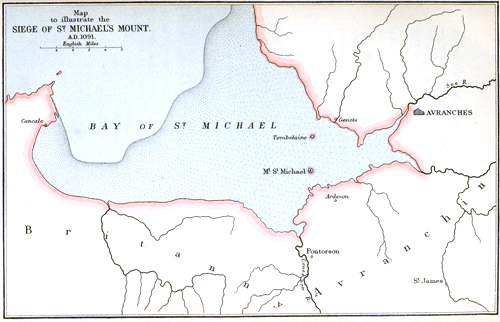
Edwᵈ. Weller
For the Delegates of the Clarendon Press.
Map to illustrate the SIEGE of Sᵀ MICHAEL’S MOUNT. A.D. 1091.
Personal anecdotes. We now get, in the shape of those personal anecdotes in which this reign is so rich, pictures of more than one side of the strangely mixed character of the Red King. At the other end of Normandy William had won lands and castles without dealing a single blow with his own sword, and with a singularly small outlay of blows from the swords of others. At Eu, at Aumale, and at Gournay, the work had been done with gold far more than with steel. Beneath Saint Michael’s Mount steel was to have its turn; and, when steel was the metal to be used, William Rufus was sure to be in his own person the foremost among those who used it. The change of scene seemed to have turned the wary trafficker into the most reckless of knights errant. Amidst such scenes he became, in the eyes of his own age, the peer of the most renowned of those Nine Worthies the tale of whom was made up only in his own day. William compared to Alexander. We shall see at a later stage how the question was raised whether the soul of the Dictator Cæsar had not passed into the body of the Red King; by the sands of Saint Michael’s bay he was held to have placed himself on a level with the Macedonian Alexander. The likeness could hardly be carried on through the general military character of the two princes; for Alexander, when he began an enterprise, commonly carried it on to the end. And it may be doubted whether Alexander ever jeoparded his own life 288 in the senseless way in which Rufus in the tale is made to jeopard his. We must picture to ourselves the royal head-quarters between the height of Avranches and the sands of Saint Michael’s bay. Knight-errantry of William. The King goes forth from his tent, and mounts the horse which he had that morning bought for fifteen marks of silver.[798] He sees the enemy at a distance riding proudly towards him. Alone, waiting for no comrade, borne on both by eagerness for the fray and by the belief that no one would dare to withstand a king face to face, he gallops forward and charges the advancing party.[799] The King upset. The newly bought horse is killed; the King falls under him; he is ignominiously dragged along by the foot, but the strength of his chain-armour saves him from any actual wound.[800] By this time the knight who had unhorsed him has his hand on the hilt of his sword, ready to deal a deadly blow. William, frightened by the extremity of his danger, cries out, “Hold, rascal, I am the King of England.”[801] The words had that kind of magic effect which is so often wrought by the personal presence of royalty. From any rational view of the business in hand, to slay, or better still to capture, the hostile king should have been the first object of every man in Henry’s garrison. To no case better applied the wise order of the Syrian monarch, “Fight neither with small nor great, save only with the King of Israel.”[802] But as soon as a voice which some at least of them knew proclaimed that it was a king who lay helpless among them, every arm was stayed. The soldiers of Henry tremble at the thought of what they were so near 289 doing; with all worship they raise the King from the ground and bring him another horse.[803] His treatment of the knight who unhorsed him. William springs unaided on his back; he casts a keen glance on the band around him,[804] and asks, “Who unhorsed me?” As they were muttering one to another, the daring man who had done the deed came forward and said, “I, who took you, not for a king but for a knight.” A bold answer was never displeasing to Rufus; he looked approval, and said, “By the face of Lucca,[805] you shall be mine; your name shall be written in my book,[806] and you shall receive the reward of good service.” Here the story ends; we are to suppose that William, instead of being carried a prisoner to the Mount, rode back free to Avranches, having lessened the small force of Henry by a stout knight and two horses.
Character of the story. The tale is told as an example of the magnanimity of the Red King. And there is something which moves a kind of admiration in the picture of a man, helpless among a crowd of enemies, yet bearing himself as if they were his prisoners, instead of his being theirs. The point of the story is that Rufus did no harm, that he felt no ill will, towards the man who had unhorsed, and all but killed him; that he honoured his bold deed and bold bearing, and promised him favour and promotion. But had the soldiers of Henry done their duty, William would have had no opportunity, at least no immediate opportunity, of doing either good or harm to his antagonist. 290 William assumes that the enemy will not dare to withstand him, and his assumption is so far justified that he is withstood only by one who knows not who he is, and whose words imply that, if he had known, he would not have ventured to withstand him. Trusting to this kind of superstitious dread, William is able to speak and act as he might have spoken if the man who unhorsed him had been brought before him in his own tent. Comparison with Richard the First. Richard of the Lion-heart, when the archer who had given him his death-wound was brought before him, first designed him for a death of torture, and then, on hearing a bold answer, granted him life and freedom.[807] In this, as in some other cases, the Red King, the earliest model of chivalry, certainly does not lose by comparison with the successor who is more commonly looked on as its ideal.[808]
Another and perhaps better known story which is told of this siege puts the character of William Rufus in another light, while it brings out the character of Robert in a lively form. Contrast between William and Robert. The Duke, heedless of the consequences of his acts but not cruel in his own person, was, above all men, open to those passing bursts of generosity which are quite consistent with utter weakness and want of principle. William Rufus was always open to an appeal to his knightly generosity, to that higher form of self-assertion which forbade him to harm one who was beneath him, and which taught him to admire a bold deed or word even when directed against himself. But the ties 291 of kindred, still more the ties of common humanity, sat very lightly on him. The gentler soul of Robert was by no means dead to them. He did not shrink from waging an unjust war against his brother and deliverer; he did not shrink from despoiling that brother and deliverer of dominions which he had sold to him by his own act for a fair price; but he did shrink from the thought of letting the brother against whom he warred suffer actual bodily hardships when he could hinder them. Lack of water on the Mount. The defenders of the Mount had, according to one account, plenty of meat; but all our narratives agree as to the difficulty of providing fresh water for the fortress which twice in the day was surrounded by the waves.[809] Henry asks to be allowed to take water. Henry sent a message to the Duke, praying that he might be allowed access to fresh water; his brothers might, if they thought good, make war on him by the valour of their soldiers; they should not press the powers of nature into their service, or deprive him of those gifts of Providence which were open to all human beings.[810] Answer of Robert and William. Robert was moved; he gave orders to the sentinels at Genetz not to hinder the besieged from coming to the mainland for water.[811] One version even adds that he added the further gift of a tun of the best wine.[812] This kind of generosity, where no appeal was made to his own personal pride, was by no means to 292 the taste of Rufus; as a commander carrying on war, he was ready to press the rights of warfare to the uttermost. When he heard what Robert had done, he mocked at his brother’s weakness; it was a fine way of making war to give the enemy meat and drink.[813] Robert answered, in words which do him honour, but which would have done him more honour if they had been spoken at the beginning as a reason for forbearing an unjust attack on his brother—“Shall we let our brother die of thirst? Where shall we find another, if we lose him?”[814]