Chapter II
Reading edition
THE EARLY DAYS OF WILLIAM RUFUS.[4] 1087–1090.
THE Character of the accession of Rufus.way by which the second William became fully established on the throne of his father has some peculiarities of its own, which distinguish it from the accessions of most English kings, earlier and later. The only claim of William Rufus to the crown was a nomination by his father which we are told that his father hardly ventured to make.No formal election. Of election by any assembly, great or small, we see no trace. Yet the new king is crowned, and he receives the nationalHis general acceptance. submission at his crowning, with the fullest outward national consent, with no visible opposition from any quarter, and, as events proved, with the hearty good will of the native English part of his subjects. Yet the King is hardly established in his kingdom before 10 he has to fight for his crown. William Rufus had, like his father, to win the kingdom of England by war after he was already its crowned king. But, as regards those against whom he fought and those at whose head he fought, his position was the exact reverse of that of his father. Nominated by his father, elected, one might say, by Lanfranc, crowned with no man gainsaying him, William Rufus was at last really established in the royal power by the act of the conquered English. It was they who won the crown for the son of their Conqueror in fight against his father’s nearest kinsmen and most cherished comrades.
§ 1. The Coronation and Acknowledgement of William Rufus. September, 1087.
One prominent aspect of the reign of William Rufus sets him before us as the enemy, almost the persecutor, of the Church in his realm, as the special adversary of the ecclesiastical power when the ecclesiastical power was represented by one of the truest of saints. And yet there have been few kings whose accession to the throne was in so special a way the act of the ecclesiastical power. William Rufus was made king by Lanfranc in a somewhat fuller sense than that in which every king of those times might be said to be made king by the prelate who poured the consecrating oil upon his head. Nomination by the last king, in the form of recommendation to the electors, had always been taken into account when the people of England came together to set a new king over them. The nomination of Eadward had formed a part, though the smallest part, of the right of Harold to become the chief of his own people.[5] An alleged nomination by Eadward 11 formed the only plausible part of the claim by which William asserted his right to thrust himself upon a people of strangers. And now a nomination by William himself was the only right by which his second surviving son claimed to succeed to the crown which he had won. Modern notions of hereditary right would have handed over England as well as Normandy to the eldest son of the last king. English feeling at the time would doubtless, if a formal choice had to be made among the sons of the Conqueror of England, have spoken for his youngest son. Of all the three Henry alone was a true Ætheling; he alone had any right to the name of Englishman; he alone was the son of a crowned king and a man born in the land.[6] But the last wish of William the Great was that his island crown should pass to William the Red. He had not, as our fullest narrative tells us, dared to make any formal nomination to a kingdom which he had in his last days found out to be his only by wrong. He had not dared to name William as his successor; he left the kingdom in the hands of God; he only hoped that the will of God might be that William should reign, and should reign well and happily.[7] And as the best means of finding out whether the will of God were so, he left the actual decision to the highest and wisest of God’s ministers in his kingdom. He gave no orders for the 12 coronation of Rufus; he simply prayed Lanfranc to crown him, if the Primate deemed such an act a rightful one.[8] As far as the will of the dying king went, one alone of the Witan of England, the first certainly among them alike in rank and in renown, was bidden to make the choice of the next sovereign on behalf of the whole kingdom.
The special agency of Lanfranc in the promotion of William Rufus is noticed by all the writers who give any detailed account of his accession.[9] Nor was it likely that, when the Archbishop was to be the one elector, the claims of the candidate should be refused. It would seem indeed as if Lanfranc doubted for a moment whether he ought to take upon himself the responsibility of the choice.[10] But everything must have helped to make him ready to carry out the wishes of his late master. That they were the Conqueror’s last wishes was no small matter, and Lanfranc had every personal reason to incline him the same way. To make William Rufus king was to promote the man who stood in a special relation to himself, who had been in some sort his pupil, and whom he had himself girded with the belt of knighthood.[11] And it really seems as if there was no other elector besides Lanfranc himself. For once in our history we read of a king succeeding without any formal election, without any meeting of the Witan before the coronation. Within three weeks of the death of the first William, the second William was full king over the land. As soon as he had heard the last wishes of his father, as soon as the dying king had dictated the all-important letter which was to express 13 those wishes to the Primate, William Rufus left the bedside of his father while the breath was still in him. He started for the haven of Touques, a spot of which we shall get a vivid picture later in our story. With him set forth the bearer of the letter, one of the great King’s chaplains, and, as some say, his Chancellor. This was Robert Bloet, he who was presently to succeed Remigius of Fécamp in his newly-placed throne on the hill of Lincoln.[12] Before they had left Norman ground, the news came that all was over, that England had no longer a king.[13] William crossed with all speed, seemingly to Southampton, and found in England no rival, English or Norman. He indeed brought with him two men, either of whom, if Englishmen had still heart enough to dream of a king of their own blood, might have been his rival. Among the captives whom the Conqueror set free on his death-bed were two men who represented the mightiest of the fallen houses of conquered England. These were Morkere the son of Ælfgar, once the chosen Earl of the Northumbrians, and Wulfnoth, the youngest son of Godwine and brother[14] of Harold.Wulf and Duncan set free by Robert. Two other captives of royal blood, Duncan the son of Malcolm and Ingebiorg, so long a hostage for his father’s doubtful faith to his over-lord,[15] 14 and Wulf the son of Harold and Ealdgyth, the babe who had been taken when Chester fell,[16] were set free at the same time. Duncan and Wulf were in the power of Robert. They in no way threatened his possession of Normandy, and Robert, with all his faults, did not lack generous feeling. They were knighted and set free.[17] Of Wulf we hear no more; Duncan lived to sit for a moment on the throne of his father. The fate of their fellow-sufferers was harsher. Morkere and Wulfnoth had come, by what means we know not, into the power of William. As Morkere had once crossed the sea with the father,[18] he now came back with the son. But their day of freedom was short. The son of Godwine and the grandson of Leofric might either of them be dangerous to the son of William. They therefore tasted the air of freedom only for a few days. William, acting as already king, went to his capital at Winchester, and there thrust the delivered captives once more into the house of bondage.[19] Of Morkere we hear no more; we must suppose that the rest of his days, few or many, were spent in this renewed imprisonment. Wulfnoth seems to have been released at some later time, to enter religion, and to be made the subject of the praises of a Norman poet.[20]
15 Such was the first act of authority done by the new ruler. Having thus disposed of the men whom he seems to have dreaded, William found no opposition made to his succession. But it was important for him to take possession without delay. The time, September, was not one of the usual seasons for a general assembly of the kingdom, and William could not afford to wait for the next great festival of Christmas. No native English competitor was likely to appear; but he must at least make himself safe against any possible attempts on the part of his brothers beyond the sea. From Winchester he hastened to the presence of Lanfranc—seemingly at Canterbury; as the story is told us, it seems to be taken for granted that it rested with the Primate to give or to refuse the crown.[21] Whether the younger William himself brought the news of the death of the elder is not quite clear; but we are not surprised to hear from an eye-witness that the first feeling of Lanfranc was one of overwhelming grief at the loss of the king who was dead, a king who, if he had been to him a master, had also been in so many things a friend and a fellow-worker.[22] Rufus is crowned at Westminster, September 26, 1087. The formal consecration of his successor was not long delayed; the new king was solemnly crowned and anointed by the hands of Lanfranc in the minster of Saint Peter, on Sunday the feast of the 16 saints Cosmas and Damian. So the day is marked by a scholar who had specially explored the antiquities of Rome; Englishmen, who knew less of saints whose holy place was by the Roman forum, were content to mark it by its relation to the great festival three days later, or even by the mere day of the month.[23] On that day, before the altar of King Eadward’s rearing, the second Norman lord of England took the oaths which bound an English king to the English people. And, besides the prescribed oaths to do justice and mercy and to defend the rights of the Church, Lanfranc is said to have bound the new king by a special engagement to follow his own counsel in all things.[24] William Rufus was thus king, and, if anything had been lacking in the way of regular election before his crowning, it was fully made up by the universal and seemingly zealous acceptance of him at his crowning. “All the men on England to him bowed and to him oaths swore.”[25] The crown which had passed to Eadward from a long line of kingly forefathers, the crown which Harold had worn by the free gift of the English people, the crown which the first William had won by his sword and had kept by his wisdom, now passed to the second of his name and house. And it passed, to all appearance, with the perfect good will of all the dwellers in the land, conquerors and conquered alike. William the Second, William the Younger, William the Red, took his place on the seat 17 of the great Conqueror without a blow being struck or a dog moving his tongue against him.
The first act of the uncrowned candidate for the kingly office had been one of harshness—harshness which was perhaps politic in the son, but which trod under foot the last wishes of a repentant father. The first act of the crowned King was one which might give good hopes for the reign which was beginning, and which certainly carried out his father’s wishes to the letter. From Westminster William Rufus went again to Winchester, this time not to make fast the bars of his father’s prison-house, but to throw open the stores of his father’s treasury.Wealth of the treasury at Winchester. Our native Chronicler waxes eloquent on the boundless wealth of all kinds, far beyond the powers of any man to tell of, which had been gathered together in the Conqueror’s hoard during his one and twenty years of kingship. The Chronicler had, as we must remember, himself lived in William’s court, and we may believe that his own eyes had looked on the store of gold and silver, of vessels and robes and gems and other costly things, which it was beyond the skill of man to set forth.[26] These were the spoils of England, and from them were made the gifts which, in the belief of those days, were to win repose in the other world for the soul of her despoiler.Gifts to churches. Every minster in England received, some six marks of gold, some ten, besides gifts of every kind of ecclesiastical ornament and utensil, rich with precious metals and precious stones, among which books for the use of 18 divine service was not forgotten.[27] Gifts to Battle Abbey. And, above all, the special foundation of his father, the Abbey of the Battle, received choicer gifts than any, the royal mantle of the departed King among them.[28] Every upland church, every one at all events on the royal lordships, received sixty pennies.[29] Gifts to the poor. Moreover a hundred pounds in money was sent into each shire to be given away in alms to the poor for William’s soul.[30] Such a gift might be bountiful in a small shire like Bedford, where many Englishmen still kept their own; but it would go but a little way, even after eighteen years, to undo the work of the great harrying of Yorkshire. Meanwhile Robert, already received as Duke of the Normans, was doing the same pious work among the poor and the churches of his duchy.[31] The dutiful son and the rebel were both doing their best for the welfare of their father in the other world.
The Christmas Assembly. 1087–1088. From Winchester the new King went back to Westminster, and there he held the Christmas feast and assembly. It was attended by the two archbishops and by several other bishops, among whom the saint 19 of Worcester is specially mentioned. Odo restored to his earldom. At this meeting too appeared Odo of Bayeux, who received again from his nephew his earldom of Kent.[32] Released from his bonds by the pardon which had been so hardly wrung from the dying Conqueror,[33] he already filled the first place in the councils of the new Duke of the Normans,[34] and he hoped to win the like power over the mind of his other nephew in England. But before long events came about which showed how true had been the foresight of William the Great, when he had said that mighty evils would follow if his brother should be set free from his prison.
Unusual character of William’s accession. It is certainly something unusual in those times for a king thus to make his way to his crown by virtue, as it were, of an agreement between a dead king and a living bishop, without either the nobles or the nation at large either actively supporting or actively opposing his claim. It is clear that men of both races had very decided views about the matter; but they gave no open expression to them at the time. The discussion of the succession came after the coronation, among men who had already acknowledged the new King. It may be that all parties were taken by surprise. The accession 20 of William Rufus had not indeed followed the death of his father with anything like the same speed with which the accession of Harold had followed the death of his brother-in-law. But then the death of Eadward had long been looked for; the succession of Harold had long been practically agreed on; above all, the Witan were actually in session when the vacancy took place. Everything therefore could be done at a moment’s notice with perfect formal regularity. Now everything, if much less sudden, was much more unlooked for. The kingdom found itself called on to acknowledge a king whom no party had chosen, but whom no party had at the moment the means, perhaps not the will, to oppose. The Normans, we may believe, would, if they had been formally asked, have preferred Robert. The English, we may be sure, would, if they had been formally asked, have, at least among Norman candidates, preferred Henry. William the only available king at the moment. And practically the choice lay among Norman candidates only, and among them Henry was the one who was practically shut out. All hopes, we may be sure, had passed away of seeking for a king either in the house of Cerdic, in the house of Godwine, or in the house which, if not the house of Cnut, was, at least by female succession, the house of his father Swegen. Of the sons of the Conqueror, Henry, the one who was at once Norman and Englishman, was young and beyond the sea. William was in England, with at least his father’s recommendation to support him. The practical question lay between William and Robert. Was William to be withstood on behalf of Robert? Comparison between William and Robert. Between William and Robert there could at the moment be little doubt in the minds of Englishmen. Their father’s policy had kept both back from any great opportunity of doing either good or evil to the conquered kingdom. But, as far as their personal characters went, 21 Robert had as yet shown his worst side and William his best. There could be little room for doubt between the man who had fought against his father and the man who had risked his life to save his father.Political bearing of William’s accession. And, besides this, the accession of William would separate England and Normandy. England would again have, if not a king of her own blood, yet at least a king of her own. The island world would again be the island world, no longer dependent on, or mixed up with, the affairs of the world beyond the sea. The harshness which had again thrust back Morkere and Wulfnoth into prison might be passed by, as an act of necessary precaution. Morkere too might by this time be well nigh forgotten, and Wulfnoth had never been known. If a native king was not to be had, William Rufus was at the moment by no means the most unpromising among possible foreign kings.
No real choice. But in truth neither Normans nor Englishmen were in this case called on to make any real choice. Both were called on, somewhat after the manner of the sham plebiscita of modern France, to acknowledge a sovereign who was already in possession. Whatever might have been the abstract preference of the Normans for Robert or of the English for Henry, neither party felt at the moment that degree of zeal which would lead them to brave the dangers of opposition. At any rate, William Rufus was a new king, and a new king is commonly welcome. Men of both races might reasonably expect that the rule of one who had come peacefully to his crown would be less harsh than that of one who had made his entry by the sword. Employment of the treasure. It is further hinted that William partly owed his recognicitaition to his early possession of his father’s hoard, perhaps to his careful discharge of his father’s will, perhaps, even thus early in his reign, to 22 some other discreet application of his father’s treasures.[35] Certain it is that, from whatever cause, all men accepted Rufus with all outward cheerfulness, though perhaps without any very fervent loyalty towards him on any side. It needed the events of the next few months, it needed strong influences and strong opposing influences, to turn the Normans in England into the fierce opponents of the new King, and the native English into his zealous supporters. It needed the further course of his own actions to teach both sides how much they had lost when they passed from the rule of William the Great to that of William the Red.
§ 2. The Rebellion against William Rufus. March-November, 1088.
The winter of the year which beheld the Conqueror’s death passed without any disturbance in the realm of his son.[36] Beginning of the rebellion. But in the spring of the next year it became plain that the general acceptance which Rufus had met with in England was sincere on the part of his English subjects only. As the native Chronicler puts it, “the land was mightily stirred and was filled with mickle treason, for all the richest Frenchmen that were in this land would betray their lord the King, and would have his brother to King, Robert that was Earl in Normandy.”[37] The leaders in this revolt were the bishops 23 whom the Conqueror had clothed with temporal power. Discontent of Odo. And foremost among them was his brother, the new King’s uncle, Odo Bishop of Bayeux, now again Earl of Kent; and, according to one account, already Justiciar and chief ruler in England.[38] But whatever might be his formal position, Odo soon began to be dissatisfied with the amount of authority which he practically enjoyed. He seems to have hoped to be able to rule both his nephews and all their dominions, and, in England at least, to keep the whole administration in his own hands at least as fully as he had held it before his imprisonment. In this hope he was disappointed. The Earl of Kent was not so great a man under the younger William as he had been under the elder. The chief place in the confidence of the new King was held by another man of his own order. Influence of William of Saint-Calais. This was William of Saint Carilef or Saint Calais, once Prior of the house from which he took his name, and afterwards Abbot of Saint Vincent’s without the walls of Le Mans.[39] He had succeeded the murdered Walcher in the see of Durham, and he had reformed his church according to the fashion of the time, by putting in monks instead of secular canons.[40] His place in the King’s counsel was now high indeed. “So well did the King to the Bishop that all England went after his rede and so as he would.”[41] Besides this newly 24 born jealousy of the Kings newly chosen counsellor, Odo had a long standing hatred against the other prelate who had so long watched over the King, and whose advice the King was bound by oath to follow.[42] He bore the bitterest grudge against the Primate Lanfranc, as the inventor of that subtle distinction between the Bishop of Bayeux and the Earl of Kent which had cost the Earl five years of imprisonment.[43]
Action of Odo. Of the two personages who might thus be joined or separated at pleasure, it is the temporal chief with whom we have now to deal. March 1, 1088. Lent was now come. Of the spiritual exercises of the Bishop of Bayeux during the holy season we have no record; the Earl of Kent spent the time plotting with the chief Normans in England how the King might be killed or handed over alive to his brother.[44] Gatherings of the rebels.We have more than one vigorous report of the oratory used in these seditious gatherings. According to some accounts, they went on on both sides of the sea, and we are admitted to hear the arguments which were used both in Normandy and in England.[45] Arguments on behalf of Robert. Both agree in maintaining the claims of Robert, as at once the true successor, and the prince best fitted for their purpose. But it is on Norman ground that the necessity for an union between Normandy and England is set forth most clearly. The main 25 object is to hinder a separation between the two kingdoms, as they are somewhat daringly called.[46] It is clear that to men who held lands in both countries it would be a gain to have only one lord instead of two; but, if we rightly understand the arguments which are put into the mouths of the speakers, it was held that, if England had again a king of her own, though it were a king of the Conqueror’s house, the work of the Conquest would be undone. The men who had won England with their blood would be brought down from their dominion in the conquered island.[47] If they have two lords, there will be no hope of pleasing both; faithfulness to the one will only lead to vengeance on the part of the other.[48] William was young and insolent, and they owed him no duty. Robert was the eldest son; his ways were more tractable, and they had sworn to him during the life-time of his father. Let them then make a firm agreement to stand by one another, to kill or dethrone William, and to make Robert ruler of both lands.[49] Robert, we are told, approved of the scheme, and promised that he would give them vigorous help to carry it out.[50]
26 These arguments of Norman speakers are given us without the names of any ringleaders. We may suspect that the real speaker, in the idea of the reporter, was no other than the Bishop of Bayeux.[51] Speech of Odo. We hear of him more distinctly on English ground, haranguing his accomplices somewhat to the same effect; only the union of the two states is not so distinctly spoken of. It may be that such a way of putting the case would not sound well in the ears of men who, if not Englishmen, were at least the chief men of England, and who might not be specially attracted by the prospect of another conquest of England, now that England was theirs. Reasons for preferring Robert to William. The chief business of the Bishop’s speech is to compare the characters of the two brothers between whom they had to choose, and further to compare the new King with the King who was gone. The speaker seems to start from the assumption that, in the interests of those to whom he spoke, it was to be wished that the ruler whom they were formally to acknowledge should be practically no ruler at all. William the Great had not been a prince to their minds; William the Red was not likely to be a prince to their minds either. Robert was just the man for their purpose. Under Robert, mild and careless, they would be able to do as they pleased; under the stern and active William they would soon find that they had a master. Comparison of the elder and younger William. The argument that follows is really the noblest tribute that could be paid to the memory of the Conqueror. It sets him before us, in a portrait drawn by one who, if a brother, was also an enemy, as a king who did justice and made peace, and who did his work without shedding 27 of blood. It is taken for granted that the death of the great king, at whose death we are told that peaceable men wept and that robbers and fiends rejoiced,[52] was something from which Odo and men like Odo might expect to gain. But nothing would be gained, if the rod of the elder William were to pass into the hands of the younger. The little finger of the son would be found to be thicker than the loins of the father. Their release from the rule of the King who was gone would profit them nothing, if they remained subjects of one who was likely to slay where his father had merely put in bonds.[53] In this last contrast, though we may doubt whether there could have been any ground for drawing it so early in the reign of Rufus, we see that the men of the time were struck by the difference between the King whose laws forbade the judicial taking of human life and the King under whom the hangman began his work again. To pleadings like these we are told that the great mass of the Norman nobility in England hearkened; a small number only remained faithful to the King to whom they had so lately sworn their oaths. Thus, as the national Chronicler puts it, “the unrede was read.”[54]
Bishop Geoffrey of Coutances joins the rebels. As the chief devisers of the unrede we have the names of two bishops besides Odo. One name we do not wonder to find along with his. Geoffrey Bishop of Coutances was a prelate of Odo’s own stamp, one of 28 whose doings as a wielder of the temporal sword we have heard in northern, in western, and in eastern England.[55] But we should not have expected to find as partner of their doings the very man whose high promotion had filled the heart of Odo with envy. Treason of the Bishop of Durham. It was indeed the most unkindest cut of all when the Bishop of Durham, the man in whose counsel the King most trusted, turned against the benefactor who had raised him so that all England went at his rede. What higher greatness he could have hoped to gain by treason it is hard to see. Different statements of his conduct. And it is only fair to add that in the records of his own bishopric he appears as a persecuted victim,[56] while all the writers of southern England join in special reprobation of his faithlessness. The one who speaks in our own tongue scruples not to make use of the most emphatic of all comparisons. “He would do by him”—that is, Bishop William would do by King William—“as Judas Iscariot did by our Lord.”[57] We should certainly not learn from these writers that, after all, it was the King, and not the Bishop, who struck, or tried to strike, the first blow.
It is certainly far from easy to reconcile the different accounts of this affair. At a time a little later the southern account sets Bishop William before us as one who “did all harm that he might all over the North.”[58] But at Durham it was believed that at all events a good deal of harm had been already done by the King to the Bishop; and the Bishop claims to have at an earlier time done the best of good service to the King.[59] That service must have been rendered while 29 the Lenten conspiracy was still going on; for at no later time does the Bishop of Durham seem to have been anywhere in the south of England. His alleged services to the King. Lent, 1088. Then, according to his own story, the Bishop secured to the King the possession of Hastings, of Dover, and of London itself. We have only William of Saint-Calais’ own statement for this display of loyal vigour on his part; but, as it is a statement made in the hearing of the King and of the barons and prelates of England, though exaggeration is likely enough, the whole story can hardly be sheer invention. Bishop William claims to have kept the two southern havens in their allegiance when the King had almost lost them. His action towards London. He claims further to have quieted disturbances in London, after the city had actually revolted, by taking twelve of the chief citizens to the King’s presence.[60] Our notes of time show that the events of which the Bishop thus speaks must have happened at the latest in the very first days of March. Early movements in Kent and Sussex. March, 1088. It follows that there must have been at the least seditious movements in south-eastern England, before the time of the open revolt in the west. In short, the rebellion in Kent and Sussex must have begun very early indeed in the penitential season.
We gather from the Durham narrative that, even at this early stage, both Bishop Odo and Earl Roger were already known to the King as traitors. Bishop William’s advice to the King. We gather further that it was by the advice of the Bishop of Durham that the King was making ready for military operations against them, and that, when the Bishop was himself summoned to the array, he made answer that he would at once join with the seven knights whom 30 he had with him—seven chief barons of the bishopric, as it would seem—and would send to Durham for more. He forsakes the King. But, instead of so doing, he left the King’s court without his leave; he took with him some of the King’s men, and so forsook the King in his need.[61] Such was afterwards the statement on the King’s side. Certain it is that, whatever the Bishop’s fault was, the royal vengeance followed speedily on it. His temporalities seized. March, 1088. Early in March, whether with or without the advice of any assembly,[62] Rufus ordered the temporalities of the bishopric to be seized, and the Bishop himself to be arrested. The Bishop escaped to his castle at Durham, whence it would not be easy to dislodge him without a siege. Meanwhile the King’s men in Yorkshire and Lincolnshire, though they failed to seize the Bishop’s own person, took possession in the King’s name of his lands, his money, and his men. He writes to the King. From Durham the Bishop wrote to the King, setting forth his wrongs, protesting his innocence, and demanding restitution of all that had been taken from him. He goes on to use words which remind us in a strange way at once of Godwine negotiating with his royal son-in-law and of Odo in the grasp of his royal brother. He offers the services of himself and his men. He offers to make answer to any charge in the King’s court. But, like Godwine, he asks for a safe-conduct before he will come;[63] like Odo, he declares that it is not for every one to judge a bishop, and that he will make answer only according to his 31 order.[64] On the receipt of this letter, the King at once, in the sight of the Bishop’s messenger, made grants of the episcopal lands to certain of his barons;[65] those lands were therefore looked on as property which had undergone at least a temporary forfeiture. He is summoned to the King’s Court. He however sent an answer to the Bishop, bidding him come to his presence, and adding the condition that, if he would not stay with the King as the King wished, he should be allowed to go back safe to Durham. It must however be supposed that this promise was not accompanied by any formal safe-conduct; otherwise, though it is not uncommon to find the officers of a king or other lord acting far more harshly than the lord himself, it is hard to understand the treatment which Bishop William met with at the hands of the zealous Sheriff of Yorkshire. Action of Ralph Paganel. That office was now held by Ralph Paganel, a man who appears in Domesday as holder of lands in various parts, from Devonshire to the lands of his present sheriffdom,[66] and who next year became the founder of the priory of the Holy Trinity at York.[67] The Bishop, on receiving the King’s answer, sent to York to ask for peace of the Sheriff. But all peace was refused 32 to the Bishop, to his messengers, and to all his men. A monk who was coming back from the King’s presence to the Bishop was stopped; his horse was killed, though he was allowed to go on on foot. The lands of the bishopric laid waste. March-May, 1088. Lastly, the Sheriff ordered all men in the King’s name to do all the harm that they could to the Bishop everywhere and in every way. The Bishop was thus cut off from telling his grievances; and for seven weeks, we are told, the lands of the bishopric were laid waste.[68] This date brings us into the month of May, by which time important events had happened in other parts of England.
We have seen that, in south-eastern England at least, the unrede of this year’s Lent must have gone beyond mere words, and must have already taken the form of action. General rebellion. But it seems not to have been till after Easter that the general revolt of the disaffected nobles broke forth throughout the whole land. By this time they had all thoroughly made up their minds to act. And we may add that it is quite possible that the King’s treatment of the Bishop of Durham may have had some share in helping them to make up their minds. They may have been led to think that open rebellion was the safest course. The Easter Gemót. April 16, 1088. The first general sign was given at the Easter Gemót of the year, which, according to rule, would be held at Winchester. The rebel nobles, instead of appearing to do their duty when the King wore his crown, kept aloof from his court.The rebels refuse to come. They gat them each man to his castle, and made them ready for war.[69] Soon 33 after the festival the flame burst forth. The great body of the Norman lords of England were in open revolt against the son of the man who had made England theirs.
The rebel nobles. The list of the rebel nobles reads like a roll of the Norman leaders at Senlac or a choice of the names which fill the foremost places in Domesday. With a few marked exceptions, all the great men of the land are there. Robert of Mortain Along with Odo, Bishop and Earl, the other brother of the Conqueror, Robert of Mortain and of Cornwall, the lord of Pevensey and of Montacute, joined in the revolt against his nephew.[70] and William of Eu. So did another kinsman, a member of the ducal house of Normandy and gorged with the spoils of England, William son of Robert Count of Eu, grandson of the elder William and his famous wife Lescelina.[71] Earl Roger and the border lords. Of greater personal fame, and of higher formal rank on English soil, was the father of one of the men who had crossed the sea to trouble England, Roger of Montgomery, whose earldom of Shrewsbury swells, in the statelier language of one of our authorities, into an earldom of the Mercians.[72] He brought with him a great following from his own border-land. Among these was Roger of Lacy, great in the shires from Berkshire to Shropshire;[73] Osbern. and with him came the old enemy Osbern of Richard’s Castle, whose 34 name carries us back to times that now seem far away.[74] With Osbern came his son-in-law Bernard of Neufmarché or Newmarch, sister’s son to the noble Gulbert of Hugleville, the man who was soon to stamp his memory on the mountain land of Brecheiniog.[75] From the same border too came the lord of Wigmore, Ralph of Mortemer.[76] But the treason of the great Earl of the central march was not followed by his northern neighbour. Loyalty of Earl Hugh. Hugh of Chester clave to the King, while the mightiest of his tenants joined the rebels. For the old Hugh of Grantmesnil raised the standard of revolt in Northhamptonshire, and in Leicestershire, the land of his sheriffdom.[77] Rebellion of Robert of Rhuddlan; And his rebellion seems to have carried with it that of his nephew the Marquess Robert of Rhuddlan, the terror of the northern Cymry.[78] Robert thus found himself in arms, not only against his king, but against his immediate and powerful neighbour and lord Earl Hugh. But the tie which bound a man to his mother’s brother was perhaps felt to be stronger than duty towards either king or earl. of Roger the Bigod; Along with the lords of the British marches stood the guardian of the eastern coast of England against the Dane, Roger the Bigod, father of earls, whose name, fated to be so renowned in later times, appears in the records of these days with a special brand of evil.[79] of Bishop Geoffrey of Coutances; And with Odo and William of Durham a third prelate joined in the unrede, a prelate the worthy compeer of Odo, the warrior Geoffrey of Coutances, the bishop who knew better how to marshal mailed knights for the battle than to teach surpliced clerks to chant their psalms in the choir.[80] He brought with 35 him the last of the elder succession of Northumbrian earls, his nephew Robert of Mowbray, of Robert of Mowbray. tall of stature, swarthy of countenance, fierce, bold, and proud, who looked down on his peers and scorned to obey his betters, who loved better to think than to speak, and who, when he opened his lips, seldom let a smile soften his stern words.[81] With these leaders were joined a crowd of others, “mickle folk, all Frenchmen,” as the Chronicler significantly marks.[82] The sons of the soil, we are to believe, had no part in the counsels of that traitorous Lent, in the deeds of that wasting Easter.
Ravages of the rebels. The war now began, a war in which, after the example of the chief combatants, fathers fought against sons, brothers against brothers, friends against their former friends.[83] The rebel leaders, each from the point where his main strength lay, began to lay waste the land, specially the lordships of the King and the Archbishop. Evidence against the Bishop of Durham. And among these evil-doers the loyal monk of Peterborough distinctly sets down William of Saint-Calais, meek victim as he seems in the records of his own house. The Bishop may have argued that he was only returning what the King had done to him; but the witness is such as cannot be got over; “The Bishop of Durham did to harm all that he might over all the 36 north” Some others of the confederates and their doings are sketched in a few words by the same sarcastic pen; Ravages of Roger Bigod; “Roger hight one of them that leapt into the castle at Norwich, and did yet the worst of all over all the land.”[84] So does the English writer speak of the first Bigod who held the fortress which had arisen on the mound of the East-Anglian kings.[85] Roger had succeeded to the place, though not to the rank, of Ralph of Wader, and, as Ralph had made Norwich a centre of rebellion against the father, so Roger now made it a centre of rebellion against the son. of Hugh of Grantmesnil. Then we read how “Hugo eke did nothing better neither within Leicestershire nor within Northampton.”[86] This was the way in which the lord of Grantmesnil, so honoured at Saint Evroul, was looked on in the scriptorium of the house which had once been the Golden Borough. In some other parts of the country we get fuller accounts than these of the doers and of what was done. Three districts in the west and in the south-east of England became the scene of events which are set down by the writers of the age in considerable detail.
Bristol and its castle. Of Bristol, the great merchant-haven on the West-Saxon and Mercian border, we last heard when the sons of Harold failed to make their way within its walls,[87] and when its greedy slave-traders cast aside, for a while at least, their darling sin at the preaching of Saint Wulfstan.[88] The borough was now beginning to 37 put on a new character, one which, in the disturbances half a century later, won for it the name of the stepmother of all England.[89] Bristol in the eleventh century.A fortress, the forerunner of the great work of Robert Earl of Gloucester,[90] had now arisen, and its presence made Bristol one of the chief military centres of England down to the warfare of the seventeenth century. The Bristol of those days had not yet occupied the ground which is now covered by its two chief ecclesiastical ornaments. The abbey of Saint The chief churches not yet built. Augustine, the creation of Robert Fitz-Harding, had not yet arisen on the lowest slope of the hills to the west, nor the priory of Saint James, the creation of Earl Robert, on the ground to the north of the borough. These foundations arose in the next age on the Mercian ground without the walls. And any forerunner which may then have been of the church of Saint Mary on the Red cliff, for ages past the stateliest among the parish churches of England, stood beyond the walls, beyond the river, on undisputed West-Saxon ground. Peninsular site of the borough. The older Bristol lay wholly on the Mercian side of the Avon, at the point where the Frome of Gloucestershire still poured its waters into the greater stream in the sight of the sun.[91] But nowhere, unless at Palermo, have the relations of land and water been more strangely turned about than they have been at Bristol. The two rivers. The course of the greater river, though not actually turned aside, is disguised by cuts and artificial harbours which puzzle the 38 visitor till the key is found. The lesser stream of the Changes in later times. Frome has had its course changed and shortened, and the remnant is, like the Fleet of London, condemned by art to the fate which nature has laid on so many of the rivers of Greece and Dalmatia;[92] it runs, as in a katabothra, under modern streets and houses. The marshy ground lying at the meeting of the streams has been reclaimed and covered with the modern buildings of the city. In the twelfth century, still more therefore in the eleventh, this space was covered at every high tide, when the waters rushing up the channels of both rivers made Bristol seem to float on their bosom like Venice or Ravenna.[93] The castle. Of the castle again the more part of its site is covered by modern buildings; a great part of its moat is filled up; the donjon has vanished; the green is no longer a green; it is only by searching that we can find out some parts of the outer walls of the fortress, and some still smaller parts of the buildings which they fenced in.[94] But, when the key is once found, it is not hard to follow the line both of the borough and of the fortress. Bristol belongs to the same general class of peninsular towns as Châlons, Shrewsbury, Bern, and Besançon; but, as at Châlons, the height above the rivers is not great; and it is at Bristol made quite insignificant by comparison with the hills to the west and north. Yet on the narrow neck of the isthmus itself, the actual slope towards the streams on either side is 39 not to be despised. To the west of that isthmus, within the peninsula, stood the original town, girded to the north by the original course of the Frome, to the south-west by the marshy ground at the junction of the rivers.[95] To the west of the isthmus, outside the peninsula, stood the castle. Standing on the exposed side, open to an attack from the east, it was fenced in on three sides by a moat joining the two rivers at either end. Works of Earl Robert. A writer of the next age gives us a picture of Bristol Castle as it then stood, strengthened by all the more advanced art of that time.[96] But the great keep of Earl Robert, slighted in the days of the Commonwealth, was not yet. We can only guess at the state of borough and fortress, as they had stood when the sons of Harold were driven back from the walls of Bristol, or as they stood now at the opening of the civil war which we have now reached. But there are few towns whose general look must have been more thoroughly unlike what it is now. The central and busy streets which occupy the area of the older Bristol must, allowing for the difference between the eleventh century and the nineteenth, still keep the general character of the old merchant-borough. Growth of the town. But few changes can be greater than those which have affected Bristol both in earlier and in later times. One period of change first surrounded the elder town 40 with a fringe of ecclesiastical buildings, and then took them within a more extended line of wall. Another in later days has swept away well nigh every trace of the fortress which was so famous both in the twelfth century and in the seventeenth, and has covered the whole range of the neighbouring hills with a new and airy city of modern days.
Edwᵈ. Weller
For the Delegates of the Clarendon Press.
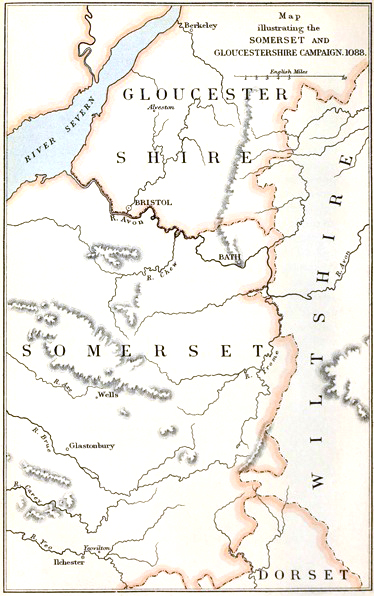
Map illustrating the SOMERSET AND GLOUCESTERSHIRE CAMPAIGN. 1088.
Bristol occupied by Bishop Geoffrey. The castle of Bristol then, though not perched, like so many of its fellows, on any lofty height, was placed on a strong and important site. That site, commanding the lower course of the Avon and the great borough upon it, and guarding the meeting-place, still of two shires, as once of two kingdoms, supplied an admirable centre for the work of those whose object was, not to guard those shires, but to lay them waste.[97] To that end Bristol was occupied and garrisoned by the warrior Bishop of Coutances, Geoffrey of Mowbray. It is not unlikely that he was already in command of the castle. He was not only a land-owner in the two neighbouring shires, a very great land-owner in that of Somerset;[98] but the meagre notice of Bristol in the Great Survey His relation to the town. also shows that he stood in some special relation to the borough as the receiver of the King’s dues within it.[99] He doubtless added anything that the castle needed in 41 His works. the way of further defences, and conjecture has attributed to him one of the several lines which the city walls have taken, that which brought the line of defence most closely to the banks of the Frome.[100] But whatever were his works, we have no record of them; we know only that the fierce prelate, at the head of his partisans, turned Bristol Castle into a den of robbers. Ravages of William of Eu and Robert of Mowbray. His chief confederates were William of Eu, of whom we have already spoken[101] , and his own nephew Robert of Mowbray. Among them they harried the land, and brought in the fruits of their harrying to the castle.[102] The central position of Bristol made a division of labour easy. Of Bishop Geoffrey’s two younger confederates, Robert undertook the work in Somerset and William in Gloucestershire. Robert marched up the valley of the Robert burns Bath. Avon to the Roman town of Bath, emphatically the “old borough.”[103] At the foot of the hills on either side, lying, as wicked wits put it, amid sulphureous vapours, at the gates of hell,[104] the square, small indeed, of the Roman walls sheltered the abbey of Offa’s rearing, now widowed by the death of its English abbot Ælfsige.[105] The city had been overthrown by the arms of Ceawlin; it had lain 42 waste like the City of the Legions;[106] it had risen again as an English town to share with the City of the Legions in the two chief glories of the days of the peaceful Eadgar. If Chester saw his triumph,[107] Bath had seen his crowning. And now the hand of the Norman, not the Norman Conqueror but the Norman rebel, fell as heavily on the English borough as the hand of the West-Saxon invader had fallen five hundred years before. Bath was a king’s town; as such it drew on itself the special wrath of the rebels; the whole town was destroyed by fire, to rise again presently in another character.[108] From He marches through Wiltshire to Ilchester. Bath, the greatest town of Somerset, but which, as placed in a corner of the land, has never claimed to be one of its administrative centres, the destroyer passed on to another town of Roman origin, which once did aspire to be the head of the Sumorsætan, but from which all traces of greatness have passed away. From Bath Robert first marched into Wiltshire, most likely following the line of the Avon; he there wrought much slaughter and took great spoil. He then turned to the south-west along the high ground of Wiltshire; he made his way into the mid parts of Somerset, and laid siege to the King’s town of Givelceaster, Ivelchester, Ilchester, Position of Ilchester. the Ischalis of a by-gone day.[109] The town lay at the foot of the most central range of the hills of Somerset, 43 on the edge of one of the inlets of the great marshland of Sedgemoor. The site was marked by the junction of the great line of the Fossway with a number of roads in all directions. The spot was defended by the river, the Ivel, which gives the town its English name. Here, at the foot of the high ground, the stream widens to surround an island, a convenient outpost in the defences of the town which arose on its southern bank. The siege. Ilchester, like Bath, drew on itself the special enmity of the rebels as being a king’s town, an enmity likely to be the sharper because Ilchester stands within sight of Count Robert’s castle of Montacute, and is divided only by the river from lands which were held by his fellow-rebel William of Eu.[110] The Ilchester of our day seems a strange place for a siege; but in the days of the Red King the town was still surrounded by strong walls, and those walls were defended by valiant burghers. The walls and gates have perished; the ditches have been filled up; yet the lasting impress of the four-sided shape of the Roman chester may still be traced in the direction of the roads and buildings of the modern town.[111] The importance of Ilchester had passed away even in the sixteenth century, when of its five or six churches all but one were in ruins; but, in the times with which we are dealing, its hundred and seven 44 burgesses, with their market held in the old forum at the meeting-place of the roads, held no inconsiderable place among the smaller boroughs of Western England.[112] What Robert of Mowbray driven back from Ilchester. the men of Ilchester had they knew how to defend; the attack and the defence were vigorously carried on on either side. Our one historian of the leaguer—he becomes almost its minstrel—tells us how the besiegers fought for greed of booty and love of victory, while the besieged fought with a good heart for their own safety and that of their friends and kinsfolk. The stronger and worthier motive had the better luck. The dark and gloomy Robert of Mowbray, darker and gloomier than ever, turned away, a defeated man, from the unconquered walls of Ilchester.[113]
This utter failure of a man who stands forth in a marked way as one of the skilful captains of the age was a good omen for success at points which were still William of Eu plunders in Gloucestershire. more important in the struggle. Meanwhile the work of destruction was going steadily on in the lands on the other side of Bristol, among the flock of the holy Wulfstan. Gloucestershire was assigned as the province of William of Eu, and he did his work with a will along the rich valley of the Severn, still the land of pasture, then also the land of vines.[114] The district called Berkeley He harries Berkeley. Harness was laid waste with fire and sword, and the town of Berkeley itself was plundered.[115] Berkeley, once 45 the abode of Earl Godwine and the scene of the pious scruples of Gytha,[116] is now simply marked as a king’s town;[117] the abbey had vanished in a past generation; the famous castle belongs to a later generation; but the Position of Berkeley. place was not defenceless. Berkeley is indeed one of those places which have become strongholds almost by accident. It looks up at a crowd of points on the bold outlying promontories of the Cotswolds, points some of them marked by the earthworks of unrecorded times, which in Normandy or Maine could hardly fail to have been seized on for the site of fortresses far sooner than itself. Nor is it near enough to the wide estuary of the Severn to have been of any military importance in the way of commanding the stream. It is rather one of those places where the English lord fixed his dwelling on a spot which was chosen more as a convenient centre for his lands than with any regard to purposes of warfare. The mound, the church, the town, rose side by side on ground but slightly higher than the rich meadows around them. But the mound on which the great Earl of the West-Saxons had once dwelled had been, as usual, turned to Norman military uses. The castle. Earl William of Hereford, whose watchful care stretched on both sides of the river, had crowned it with what Domesday marks as “a little castle.”[118] One would be well pleased to know in what such a defence was an advance on the palisades or other defences which may have surrounded the hall of Godwine. In after days 46 the “little castle” was to grow into the historic home of that historic house in whom, whether they themselves acknowledge it or not, history must see the lineal offspring, not of a Danish king, but of an English staller.[119] At present however the savage William of Eu had not to assault the stronghold of Robert, son of Harding and grandson of Eadnoth, but merely to overcome whatever resistance could be offered by the castellulum of William Fitz-Osbern. Its defences were most likely much less strong than the Roman walls of Ilchester. Berkeley and the coasts thereof were thoroughly ravaged. On the whole, notwithstanding the defeat of Robert of Mowbray, the Bishop of Coutances and his lieutenants had done their work to their own good liking. No small spoil from each of the three nearest shires had been brought in to the robbers’ hold at Bristol.
Meanwhile the same work was going on busily to the north and north-west of Bishop Geoffrey’s field of action. Rebel centre at Hereford. Of the movements in Herefordshire and Worcestershire we have fuller accounts, accounts which, before we have done, land us from the region of military history into that of hagiography. The centre of mischief in this region was at Hereford. The city which Harold had called back into being, and where William Fitz-Osbern had ruled so sternly, had now no longer an earl; the rebel Roger was paying the penalty of his treason at some point far away alike from Hereford, from Flanders, and from Breteuil.[120] The city had now the King for its immediate lord. It was presently seized by Roger of Lacy,[121] and was turned into a meeting-place 47 for the disaffected. The host that came together is marked as made up of “the men that eldest were of Hereford, and the whole shire forthwith, and the men of Shropshire with mickle folk of Bretland.”[122] Some of their names, besides that of Roger of Lacy, we have heard already.[123] Action of Earl Roger. And we are significantly told that the men of Earl Roger—the men of Shropshire—were with them, a formula which seems specially meant to shut out the presence of the Earl himself.[124] And though the leaders were “all Frenchmen,”[125] yet among their followers were men of all the races of the land. Not only Normans and Britons, but Englishmen also, were seen in the rebel ranks. So it seemed, if not in the general prospect as it was looked at from distant Peterborough, yet at least in the clearer view which men took from the watch-towers of more nearly threatened Worcester.[126]
The rebels march on Worcester. For it was the “faithful city” of after days on which the full storm of the Western revolt was meant to burst. The Norman lords of the border, with their British allies, now marched on Worcester, as, thirty-three years before, 1055.an English earl of the border, with his British allies, had marched on Hereford.[127] They came of their own will to deal by Worcester, shire and city, as, forty-seven years 1041. before, English earls had been driven against their will to deal with them at the bidding of a Danish king.[128] “They harried and burned on Worcestershire forth, and they came to the port itself, and would then the port burn and the 48 minster reave, and the King’s castle win to their hands.”[129] But Worcester was not doomed to see in the days of the second William such a day as Hereford had seen in the days of Eadward, as Worcester itself had seen in the days of Harthacnut. Deliverance of Worcester. The port was not burned, the minster was not reaved, nor was the King’s castle won into the hands of his enemies. And the deliverance of Worcester is, with one accord, assigned by the writers of the time to the presence within its walls of its bishop, the one remaining bishop of English blood, whose unshaken loyalty had most likely brought the special wrath of the rebels upon his city and flock. Action of Wulfstan. The holy Wulfstan was grieved at heart for the woes which seemed coming upon his people; but he bade them be of good courage and trust in the Lord who saveth not by sword or spear.[130] The man who had won the heart of Northumberland for Harold,[131] who had saved his own city for the first William,[132] was now to save it again for the second. Position of Worcester. At Worcester, castle, minster, and episcopal palace rose side by side immediately above the Severn. But Worcester is no hill city like Durham or Le Mans. The height above the stream is slight; the subordinate buildings of the monastery went down almost to its banks. The mound, traditionally connected with the name of Eadgar the Giver-of-peace, has now utterly vanished; 49 it then stood to the south of the monastery, and had become, as elsewhere, the kernel of the Norman castle. It will be remembered that it was the sacrilegious extension of its precincts at the hands of Urse of Abetot which had brought down on him the curse of Ealdred.[133] But by this time the new minster of Wulfstan’s own building, whose site, we may suppose, was further from the castle, that is, more to the north, than that of the church of Oswald,[134] was, if not yet finished, at least in making. It may be that at this moment the two minsters—the elder one which has wholly passed away, the newer, where Wulfstan’s crypt and some other portions of his work still remain among the recastings of later times,—both stood between the mound of Eadgar and its Norman surroundings, and the bishop’s dwelling, whatever may have been its form in Wulfstan’s day. Still along the line of the river, lay the buildings of the city further to the north, with the bridge leading to the meadows and low hills beyond the stream, backed by the varied outline of the heights of Malvern, the home of the newly-founded brotherhood of Ealdwine.[135] At the moment when the rebels drew near to Worcester, all the inhabitants of the city, of whatever race or order, were of one heart and of one soul under the inspiration of their holy Bishop. Wulfstan called to the command. Like the prophets and judges of old, Wulfstan suddenly stands forth as first, if not in military action, at least in military command. We know not whether the fierce Sheriff or some captain of a milder spirit formally bore rule in the castle. But we read that the Norman garrison, by whom the mild virtues of the English bishop were known and loved, practically put him at their head. They prayed him to leave his episcopal home beyond the church, and to take up his abode 50 with them in the fortress. If danger should be pressing, they would feel themselves all the safer, if such an one as he were among them.[136] Wulfstan enters the castle. Wulfstan agreed to their proposal, and set out on the short journey which he was asked to make, a journey which the encroachments of the Sheriff had made shorter than it should have been.[137] On his way he was surrounded by the inhabitants of Worcester of all classes, all alike ready for battle. He himself had, after the new fashion of Norman prelates, a military following,[138] and the soldiers of the King and of the Bishop, with all the citizens of Worcester, now came together in arms. From the height of the castle mound, Wulfstan and his people looked forth beyond the river. Advance of the rebels. The foes were now advancing; they could be seen marching towards the city, and burning and laying waste the lands of the bishopric.[139] Sally of the royal forces. Soldiers and citizens now craved the Bishop’s leave to cross the river and meet the enemy. Wulfstan gave them leave, encouraging them by his blessing, and by the assurance that God would allow no harm to befall those who went forth to fight for their King and for the deliverance of their city and people.[140] Grieved further by the sight of the harrying of 51 the church-lands, and pressed by the urgent prayer of all around him, Wulfstan curses the rebels. Wulfstan pronounced a solemn anathema against the rebellious and sacrilegious invaders.[141] The loyal troops, strengthened by the exhortations and promises of their Bishop, set forth. Victory of the king’s men. The bridge was made firm; the defenders of Worcester marched across it;[142] and the working of Wulfstan’s curse, so the tradition of Worcester ran, smote down their enemies before them with a more than human power. The invaders, scattered over the fields for plunder, were at once overtaken and overthrown. Their limbs became weak and their eyes dim; they could hardly lift their weapons or know friend from foe.[143] The footmen were slaughtered; the horsemen, Norman, English, and Welsh, were taken prisoners; of the whole host only a few escaped by flight. The men of the King and of the Bishop marched back to Worcester—so Worcester dutifully believed—without the loss of a single man from their ranks. They came back rejoicing in the great salvation which had been wrought by their hands, and giving all thanks to God and his servant Wulfstan.[144]
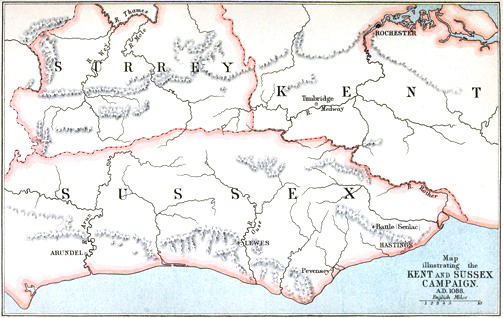
Among the sorrows which rent the breast of the holy Bishop of Worcester, one may have been to see a man of 52 his own order, one whom he had, somewhat strangely perhaps, honoured with his friendship, acting as a temporal leader in the rebellion against which he had to wield his spiritual arms. It was, it may be remembered, Geoffrey of Mowbray, the lord of the robbers’ hold at Bristol, who had rebuked the lamb-like simplicity of Wulfstan’s garb.[145] The lamb of Severnside had now overthrown alike the wolves of Normandy and the wild cats of the British hills. But, if Wulfstan mourned over the evil deeds of the warlike Bishop of Coutances, he had no such personal cause for grief over either the sins or the sorrows of another bishop who was meanwhile, like himself, besieged in an episcopal city. That bishop however was not, like Wulfstan, defending his own flock with either spiritual or temporal arms; he was doing all the wrong in his power to the flock of another. Movements of Odo in Kent. The source and leader of the whole mischief,[146] Odo, Bishop and Earl, chose his own earldom of Kent for the scene of his ravages. Our notes of time are very imperfect, and we have seen that there were movements in Kent, movements in which Odo seems to have had a share, much earlier in the year.[147] But it would seem that the great outbreak of rebellion in south-eastern England happened about the same time as the great outbreaks more to the west and north. As the Bishop of Coutances had fixed his head-quarters in the castle of Bristol, so the Bishop of Bayeux now fixed his head-quarters in the castle of Rochester, and thence ravaged the lands of the King and the Archbishop.[148] 53 Another great Kentish fortress, that of Tunbridge, was also in rebellion. Tunbridge and Pevensey. So in Sussex was Pevensey, the very firstfruits of the Conquest, where Odo’s brother Count Robert also held out against the King. These three fortresses now become the busy scene of our immediate story; but the centre of all is the post occupied by the Bishop of Bayeux and Earl of Kent. This part of the war is emphatically the war of Rochester.
Edwᵈ. Weller
For the Delegates of the Clarendon Press.
Map illustrating the KENT AND SUSSEX CAMPAIGN. A.D. 1088.
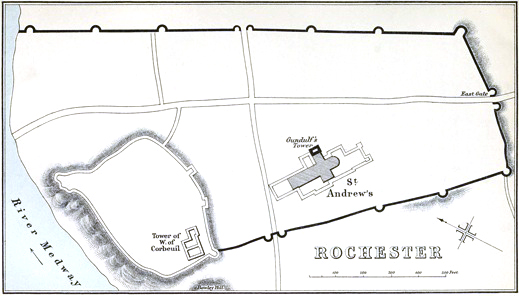
Early history of Rochester. The city by the Medway had been a fortress from the earliest times. We have seen that it had already played a part both in foreign and in civil wars. In the days of Æthelred it still kept the Roman walls parts of which still remain, walls which were then able to withstand two sieges, one at the hands of the King himself, and one at those of the Danish invaders.[149] Importance of its position. In truth the position of Rochester, lying on the road from London to Canterbury, near to the sea on a navigable river, made it at all times a great military post.[150] The chief ornament of the city did not yet exist in the days of Odo. The later castle. The noble tower raised in the next age by Archbishop Walter of Corbeuil, the tower which in one struggle held out against John[151] and in the next held out for his son,[152] and still remains one of the glories of 54 Norman military architecture, had perhaps not even a forerunner of its own class.[153] The cathedral church. And the minster of Saint Andrew, which the enlargements of the twelfth and thirteenth centuries have still left one of the least among the episcopal churches of England, had then only the lowly forerunner which had risen, which perhaps was still only rising, under the hands of Gundulf.[154] The castle site fortified by the Conqueror. But the steep scarped cliff rising above the broad tidal stream was a stronghold in the Conqueror’s days, as it had doubtless been in days long before his. Whether a stone castle had yet been built is uncertain; the fact that such an one was built for William Rufus by Gundulf later in his reign might almost lead us to think that as yet the site, strong in itself, was defended only by earthworks and defences of timber.[155] The city. Below the castle to the south-east lay the city, doubtless fenced 55 by the Roman wall; and a large part of its space had now begun to form the monastic precinct of Saint Andrew. The town is said to have been parted from the castle by a ditch which, as at Le Mans and at Lincoln, was overleaped by the enlarged church of the twelfth century;[156] in any case the castle, in all its stages, formed a sheltering citadel to the town at its feet. Nature of the site. Neither town nor castle by itself occupies a peninsular site; but a great bend of the river to the south makes the whole ground on which they stand peninsular, with an extent of marshy ground between the town and the river to the north and east. The stronghold of Rochester, no lofty natural peak, no mound of ancient English kings, perhaps as yet gathering round no square keep of the new Norman fashion, but in any case a well-defended circuit with its scarped sides strengthened by all the art of the time, was the chief fortress of the ancient kingdom over which the Bishop of Bayeux now ruled as Earl. The castle occupied by Odo. It now became, under him, the great centre of the rebellion. Gundulf, renowned as he was for his skill in military architecture, must have been sore let and hindered in the peaceful work of building his church and settling the discipline of his monks,[157] when his brother bishop filled the castle with his men of war, five hundred of his own knights among them.[158] But 56 Odo was not satisfied with his garrison. Odo asks Robert to come. He sent beyond sea to Duke Robert for further help. The prince in whose name Rochester was now held was earnestly prayed to come at once at the head of the full power of his duchy, to take possession of the crown and kingdom which were waiting for his coming.[159]
E. Weller
For the Delegates of the Clarendon Press.
ROCHESTER
The news brought to Robert. According to the narrative which we are now following, it would seem that Robert now heard for the first time of the movement which was going on in his behalf in England. His heart is lifted up at the unlooked for news; he tells the tidings to his friends; certain of victory, he sends some of them over to share in the spoil; he promises to come himself with all speed, as soon as he should have gathered a greater force.[160] He sends over Eustace of Boulogne and Robert of Bellême. At the head of the party which was actually sent were two men whose names are familiar to us.[161] One of them, Count Eustace of Boulogne, united the characters of a land-owner in England and of a sovereign prince in Gaul. This was the younger Eustace, the son of the old enemy of England, the brother of the hero who was within a few years to win back the Holy 57 City for Christendom.[162] With him came Robert of Bellême; his share in the rebellion is his first act on English ground that we have to record. Three sons of Earl Roger at Rochester. Himself the eldest son of Earl Roger of Shrewsbury, he had either brought with him two of his brothers, or else they had already embraced the cause of Odo in England. Three sons of Roger and Mabel were now within the walls of Rochester.[163] Hugh of Montgomery. The second was Hugh, who was for a moment to represent the line of Montgomery while Robert represented the line of Bellême, and who was to be as fierce a scourge to the Britons of the Northern border as Robert was to be to the valiant defenders of the land of Maine.[164] Roger of Poitou. And with them was the third brother, Roger of Poitou, the lord of the debateable land between Mersey and Ribble,[165] carrying as it were to the furthest point of the earldom of Leofric the claim of his father to the proud title which the elder Roger bears at this stage of our story. Action of Earl Roger. It is as Earl of the Mercians that one teller of our tale bids us look for a moment on the lord of Montgomery and Shrewsbury.[166] But the Earl of 58 the Mercians was not with his sons at Rochester any more than he had been with his men before Worcester. He was in another seat of his scattered power. His presence was less needed at Shrewsbury, less needed at the continental or the insular Montgomery, than it was in the South-Saxon land where the lord of Arundel and Chichester held so high a place. He stays at Arundel. While his men were overthrown before Worcester, while his sons were strengthening themselves at Rochester, Earl Roger himself was watching events in his castle of Arundel.[167] The spot was well fitted for the purpose. Arundel lies in the same general region of England as the three great rebel strongholds of Rochester, Tunbridge, and Pevensey; it lies in the same shire and near the same coast as the last named of the three. Position of Arundel. But it lies apart from the immediate field of action of a campaign which should gather round those three centres. A gap in the Sussex downs, where the Arun makes its way to the sea through the flat land at its base, had been marked out, most likely from the earliest times, as a fitting spot for a stronghold. A castle at Arundel T. R. E. The last slope of this part of the downs towards the east was strengthened in days before King William came with a mound and a ditch, and Arundel is marked in the Great Survey as one of the castles few and far between which England contained before his coming.[168] Description of the castle. The shell-keep which crowns the mound, and the gateway which flanks it, have been recast at various later times from the twelfth century onward, but it would be rash to assert that the mere wall of the keep may not contain portions either of the days of King William or of the days of King Eadward. The traces of a vast hall, more immediately 59 overlooking the river, reared as usual on a vaulted substructure, almost constrain us to see in them the work of no age earlier or later than that of Roger or his successor of his own house.[169] The site is a natural watchtower, whence the eye ranges far away to various points of the compass, over the flat land and over the more distant hills, and over the many windings of the tidal river which then made Arundel a place of trade as well as of defence.[170] Less threatening than his vulture’s nest at Tre Baldwin,[171] less tempting to an enemy than his fortresses on the peninsula of Shrewsbury and within the walls of Chichester,[172] the stronghold of Arundel seems exactly the place for an experienced observer of men and things like Earl Roger to look out from and bide his time. He had to watch the course of things in the three rebel fortresses; he had further to watch what might come from a nearer spot, another break in the hill ground, where, between his doubtful Arundel and rebellious William of Warren at Lewes. Pevensey, the twin mounds of loyal Lewes,[173] the home of William and Gundrada, looked up to what was one day to be the battle-ground of English freedom. Its lord, long familiar to us as William of Warren, stood 60 firm in his allegiance, and it was now, according to some His earldom of Surrey. accounts, that he received his earldom of Surrey, an earldom to be borne in after times along with that which took its name from Roger’s own Arundel.[174] William became the King’s chief counsellor, and his position at Lewes must have thrown difficulties in the way of any communication between Arundel and Pevensey. His loyalty. And in truth, when Earl Roger found it safest to watch and be prudent, we are not surprised to find events presently shaping themselves in such a way as to make it his wisest course to play the part of the Curio of the tale.[175]
Action of the King. But meanwhile where was King William? Where was the king who had taken his place on his father’s seat with so much ease, but whose place upon it had been so soon and so rudely shaken? We have been called on more than once in earlier studies to mark how the two characters of fox and lion were mingled in the tempers of the Conqueror and his countrymen, and assuredly the Conqueror’s second surviving son was fully able to don either garb when need called for it.[176] At this moment we are told in a marked way that William Rufus showed himself in the character of that which is conventionally looked on as the nobler beast. He had no mind to seek for murky holes, like the timid fox, but, like the bold and fearless lion, he gave himself mightily to put down the devices of his enemies.[177] Yet the first time when 61 He wins over Earl Roger. we distinctly get a personal sight of him, the Red King is seen playing the part of the fox with no small effect. Earl Roger was assuredly no mean master of Norman craft; but King William, in his first essay, showed himself fully his equal. By a personal appeal he won the Earl over from at least taking any further personal share in the rebellion. At some place not mentioned, perhaps at Arundel itself, the Earl, disguising, we are told, his treason, was riding in the King’s company.[178] The King took him aside, and argued the case with him. He would, he said, give up the kingdom, if such was really the wish of the old companions of his father. He knew not wherefore they were so bitter against him; he was ready, if they wished it, to make them further grants of lands or money. Only let them remember one thing; his cause and theirs were really the same; it was safer not to dispute the will of the man who had made both him and them what they were. “You may,” wound up Rufus, “despise and overthrow me; but take care lest such an example should prove dangerous to yourselves. My father has made me a king, and it was he alone who made you an earl.”[179] Roger felt or affected conviction, and followed the King, in his bodily presence at least, during the rest 62 of the campaign.[180] Count Robert at Pevensey. But Robert, Count of Mortain and lord of Cornwall, still made Pevensey one of the strongholds of the revolt. Of the third great neighbour of these two lords, Count Robert of Eu, father of the ravager of Berkeley, we hear nothing on this side of the water.
Loyal Normans. But, amid the general falling away, the throne of William Rufus was still defended by some men of Norman birth on whom he could better rely than on the Earl Hugh.doubtful loyalty of the Earl of Shrewsbury. Earl Hugh of Chester remained faithful; so, as we have seen, did Earl Roger’s neighbour, now or afterwards Earl William.[181] William of Warren. And to these already famous names we must add one which was now only beginning to be heard of, but which was presently to equal, if not to surpass, the renown of either. Robert Fitz-hamon. This was Robert Fitz-hamon, the son or grandson of Hamon Dentatus, the rebel of Val-ès-dunes.[182] But it was not on the swords of the Norman followers of his father that the son of the Conqueror rested his hopes of keeping the crown which the Conqueror had left him. Forces on the side of Rufus, William Rufus had at his side two forces, either of which, when it could put forth its full power, was 63 stronger by far than the Norman nobles. All that in any way represented the higher feelings and instincts of man was along with him. All that in any shape was an embodiment of law or right was arrayed against the men whose one avowed principle was the desire to shake off the restraints of law in any shape. the Church, and the people. Against the openly proclaimed reign of lawlessness the King could rely on the strength of the Church and the strength of the people. With the single exception of him of Durham, the marauding bishops of Bayeux and Coutances found no followers among the men of their order in England. Loyalty of the Bishops. Lanfranc stood firmly by the King to whom he had given the crown; and the other bishops, of whatever origin, sought, we are told, with all faithfulness of purpose, the things which were for peace.[183] The King appeals to the English. Either by their advice or by his own discernment, the King saw that his only course was to throw himself on the true folk of the land, to declare himself King of the English in fact as well as in name. His proclamation. A written proclamation went forth in the name of King William, addressed, doubtless in their own ancient tongue, to the sons of the soil, the men of English kin. The King of the English called on the people of the English, on the valiant men who were left of the old stock; he set forth his need to them and craved for their loyal help.[184] At such a 64 moment he was lavish of promises. His promises. All the wrongs of the days of William the Elder were to be put an end to in the days of William the Younger. The English folk should have again the best laws that ever before were in this land. King William would reign over his people like Eadward or Cnut or Ælfred. The two great grievances of his father’s days were to cease; the King’s coffers were no longer to be filled by money wrung from his people; the King’s hunting-grounds were no longer to be fenced in by the savage code which had guarded the Conqueror’s pleasures. All unrighteous geld he forbade, and he granted to them their woods and right of hunting.[185] The English take up the King’s cause. At the sound of such promises men’s hearts were stirred. At such moments, men commonly listen to their hopes rather than to their reason; the prospects and promises of a new reign are always made the best of; and there was no special reason as yet why the word of William the Red should be distrusted. He had not conquered England; he had not as yet had the means of oppressing England; he had shown at least one virtue in dutiful attachment 65 to his father; his counsellor was the venerated Primate; chief in loyalty to him was one yet more venerated, the one native chief left to the English Church, the holy Bishop of Worcester. If the English dealt with William as an English king, he might deal with them as an English king should deal with his people. Motives for supporting William. In fighting for William against the men who had risen up against him, they would be fighting for one who had not himself wronged them against the men who had done them the bitterest of wrongs. If the Bishop of Bayeux and the Bishop of Coutances, if Robert of Mortain and Robert of Mowbray, if Eustace of Boulogne and the fierce lord of Bellême, could all be smitten down by English axes or driven into banishment from the English shores, if their estates on English soil could be again parted out as the reward of English valour, the work of the Norman Conquest would indeed seem to be undone. And it would be undone none the less, although the king whose crown was made sure by English hands was himself the son of the Conqueror of England.
Loyalty of the English. With such feelings as these the sons of the soil gathered with glee around the standard of King William. Not a name is handed down to us. We know not from what shires they came or under what leaders they marched. They meet in London. We see only that, as was natural when the stress of the war lay in Kent and Sussex, the trysting-place was London.[186] How did that great city stand at this moment with regard to the rebellion? It will be remembered by what vigorous means Bishop William of Durham claimed to have secured the allegiance of the citizens some time earlier.[187] At all events, whether by 66 the help of William of Saint-Calais or not, London was now in the King’s hands. William’s English army. There the royal host met, a motley host, a host of horse and foot, of Normans and English, but a host in which the English element was by far the greatest, and in which English feeling gave its character to the whole movement. Thirty thousand of the true natives of the land came together of their own free will to the defence of their lord the King.[188] The figures are of much the same value as other figures; it is enough if we take them as marking a general and zealous movement. Their zeal in his cause. The men who were thus brought together promised the King their most zealous service; they exhorted him to press on valiantly, to smite the rebels, and to win for himself the Empire of the whole island.[189] This last phrase is worth noting, even if it be a mere flourish of the historian. William accepted as the English king. It marks that the change of dynasty was fully accepted, that the son of the Conqueror was fully acknowledged as the heir of all the rights of Æthelstan the Glorious and of Eadmund the Doer-of-great-deeds. A daughter of their race still sat on the Scottish throne; but for Malcolm, the savage devastator of Northern England, Englishmen could not be expected to feel any love. William was now their king, their king crowned and anointed, the lord to whom their duty was owing as his men.[190] Him they would make fast on the throne of England; for him they were ready to win the Empire of all Britain. The English followers of Rufus loudly proclaimed their 67 hatred of rebellion. They even, we are told, called on their leader to study the history of past times, where he would see how faithful Englishmen had ever been to their kings.[191]
William’s march. At the head of this great and zealous host William the Red set forth from London. He set forth at the head of an English host, to fight against Norman enemies in the Kentish and South-Saxon lands. And in that host there may well have been men who had marched forth from London on the like errand only two-and-twenty years before. Great as were the changes which had swept over the land, men must have been still living, still able to bear arms, who had dealt their blows in the Malfosse of Senlac amidst the last glimmerings of light on the day of Saint Calixtus. The enemy was nationally and even personally the same. English hatred of Odo. The work before all others at the present moment was to seize the man whose spiritual exhortations had stirred up Norman valour on that unforgotten day, and whose temporal arm had wielded, if not the sword, at least the war-club, in the first rank of the invaders. Odo, the invader of old, the oppressor of later days, the head and front of the evil rede of the present moment, was the foremost object of the loyal and patriotic hatred of every Englishman in the Red King’s army. Could he be seized, it would be easier to seize his accomplices.[192] The great object of the campaign was therefore to recover the castle of Rochester, the stronghold where the rebel Bishop, with his allies from 68 Boulogne and from Bellême, bade their defiance to the King and people of England.
It was not however deemed good to march at once upon the immediate centre of the rebellion. A glance at the map will show that it was better policy not to make the attack on Rochester while both the other rebel strongholds, Tunbridge and Pevensey, remained unsubdued. Tunbridge castle. The former of these, a border-post of Kent and Sussex, guarding the upper course of the stream that flows by Rochester, would, if won for the King, put a strong barrier between Rochester and Pevensey. Attack on the castle. The march on Rochester therefore took a roundabout course, and this part of the war opened by an attack on Tunbridge which was the first exploit of the Red King’s English army. Position of Tunbridge. At a point on the Medway about four miles within the Kentish border, at the foot of the high ground reaching northward from the actual frontier of the two ancient kingdoms, the winding river receives the waters of several smaller streams, and forms a group of low islands and peninsulas. On the slightly rising ground to the north, commanding the stream and its bridge, a mound had risen, fenced by a ditch on the exposed side to the north. This ancient fortress had grown into the castle of Gilbert the son of Richard, called of Clare and of Tunbridge, the son of the famous Count Gilbert of the early days of the Conqueror.[193] As Tunbridge now stands, the outer defences of the castle stand between the mound and the river, and the 69 mound, bearing the shell-keep, is yoked together in a striking way with one of the noblest gateways of the later form of mediæval military art.[194] The general arrangements of the latter days of the eleventh century cannot have been widely different. The mound, doubtless a work of English hands turned to the uses of the stranger, was the main stronghold to be won. It was held by a body of Bishop Odo’s knights, under the command of its own lord Gilbert; to win it for the King and his people was an object only second to that of seizing the traitor prelate himself. The rebel band bade defiance to the King and his army. The castle held out for two days; but the zeal of the English was not to be withstood; no work could be more to their liking than that of attacking a Norman castle on their own soil, even with a Norman King as their leader. The castle stormed. The castle was stormed; the native Chronicler, specially recording the act of his countrymen, speaks of it, like the castles of York in the days of Waltheof, as “tobroken.”[195] Most likely the buildings on the mound were thus “tobroken;” but some part of the castle enclosure must have been left habitable and defensible. For the garrison, with their chief Gilbert, were admitted to terms; and Gilbert, who had been wounded 70 in the struggle, was left there under the care of a loyal guard.
The first blow had thus gone well to the mark. Such an exploit as this, the capture by English valour of one of the hated strongholds of the stranger, was enough to raise the spirit of William’s English followers to the highest pitch. And presently they were summoned to a work which would call forth a yet fiercer glow of national feeling. They march towards Rochester. After Tunbridge had fallen, they set forth on their march towards Rochester, believing that the arch-enemy Odo was there. Their course would be to the north-east, keeping some way from the left side of the Medway; Bishop Gundulf’s tower at Malling,[196] if it was already built, would be the most marked point on the road. But they were not to reach Rochester by so easy a path. While they were on their way, news came to the King that his uncle was no longer at Rochester. Odo at Pevensey. While the King was before Tunbridge, the Bishop with a few followers had struck to the south-east, and had reached his brother’s castle of Pevensey.[197] Odo exhorts Robert of Mortain to hold out. The Count of Mortain and lord of Cornwall was perhaps wavering, like his neighbour at Arundel. The Bishop exhorted him to hold out. While the King besieged Rochester, they would be safe at Pevensey, and meanwhile Duke Robert and his host would cross the 71 sea. The Duke would then win the crown, and would reward all their services.[198]