Volume 1 — Chapter IX The Conduct of the War
Reading edition
It is not my intention to attempt to write a history of the war which began on February 4, 1899, nor to discuss any one of its several campaigns. I propose to limit myself to a statement of the conditions under which it was conducted, and a description of the two periods into which it may be divided.
Men of means were drafted into the ranks and then excused from service on the payment of cash.
The soldiery, quartered on the towns, committed endless abuses. Conditions were bad enough before the outbreak of hostilities, as I have shown in the chapters dealing with Insurgent rule. They grew rapidly worse thereafter, and human life became cheap indeed.
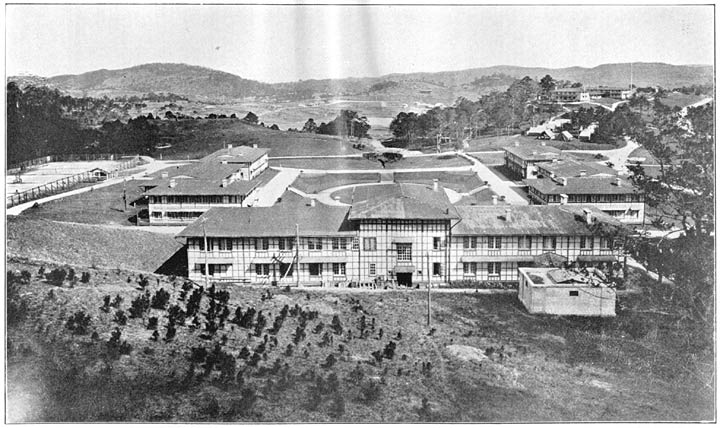
Government Centre at Baguio
The Visayas
That very serious conditions promptly became general is conclusively shown by the record of Aguinaldo’s government for February 24, 1899, when it decided—
“that the president of the council shall study such measures as will put an end to the continual discord and friction between the civil and military authorities of every province, in order that fatal consequences may be avoided.”
It was promptly charged in the United States that American soldiers were committing barbarities, and Blount has revived these old tales.
I know personally that during the early days of the war Insurgent prisoners and wounded were treated with the greatest humanity and kindness.
“December 22.—It was 7 A.M. when we arrived in Ambayuan. Here we found the women worn out from the painful journey they had suffered. They were seated on the ground. In their faces were observed indications of the ravages of hunger; but they are always smiling, saying they would prefer suffering in these mountains to being under the dominion of the Americans, and that such sacrifices are the duties of every patriot who loves his country.
“We secured some camotes in this settlement, cooked them immediately, and everybody had breakfast. Our appetites were satisfied.
“The honorable president had already decided some days before to send all the women to Manila, including his family, and this was his motive in hurrying his family forward with him.
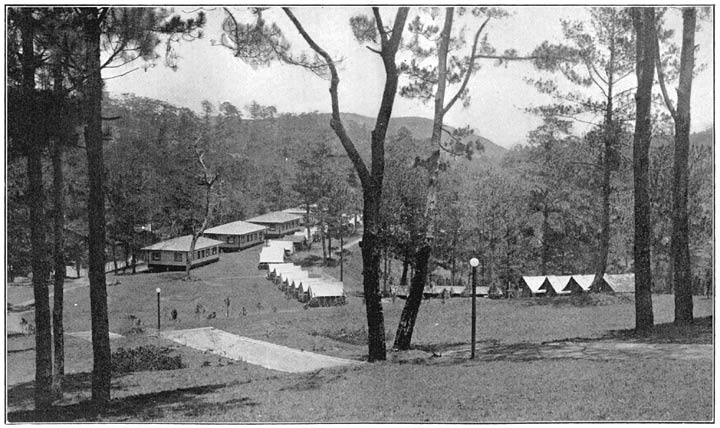
A Scene in the Baguio Teachers’ Camp
The houses are for visiting lecturers and persons of similar rank. The tents are for the teachers.
In this, as in all other similar cases, the women were kindly treated and safely conducted to their destination. Aguinaldo and his fellows knew the happy fate of the members of his own family, as is shown by a later entry:—
The mother and son, accompanied by Buencamino, had allowed themselves to be captured at an earlier date. What shall we say of a leader who would turn his mother, wife, sister and son over to American soldiers for safekeeping, and then continue to denounce the latter as murderers, and violaters of women? Aguinaldo did just this. That the Insurgent leaders were early and fully aware of the treatment accorded their wounded is shown by the following extract from a letter to General Moxica of Leyte, dated March 2, 1900, giving instructions as to what should be done with wounded men:—
There were some rare individual instances in which uninjured Filipinos were treated with severity, and even with cruelty, by American soldiers. They occurred for the most part late in the war when the “water cure” in mild form was sometimes employed in order to compel persons who had guilty knowledge of the whereabouts of firearms to tell what they knew, to the end that the perpetration of horrible barbarities on the common people, and the assassination of those who had sought American protection, might the more promptly cease. Usually the sufferers were themselves bloody murderers, who had only to tell the truth to escape punishment. The men who performed these cruel acts knew what treatment was being commonly accorded to Filipinos, and in some instances to their own comrades. I mention these facts to explain, not to excuse, their conduct. Cruel acts cannot be excused, but those referred to seldom resulted in any permanent injury to the men who suffered them, and were the rare and inevitable exceptions to the general rule that the war was waged, so far as the Americans were concerned, with a degree of humanity hitherto unprecedented under similar conditions. The Insurgents violated every rule of civilized warfare, yet oathbreakers, spies and men fighting in citizens’ clothes not only were not shot by the Americans, as they might very properly have been, but were often turned loose with a mere warning not to offend again.
The false news circulated to aid the Insurgent cause was by no means limited to such matters. Every time their troops made a stand they were promptly defeated and driven back, but their faltering courage was bolstered up by glorious tidings of wonderful, but wholly imaginary, victories won elsewhere. It was often reported that many times more Americans had fallen in some insignificant skirmish than were actually killed in the whole war, while generals perished by the dozen and colonels by the thousand. Our losses on March 27, 1899, in fighting north of Manila, were said to be twenty-eight thousand. In reality only fifty-six Americans were killed in all northern Luzón during the entire month.
On April 26, 1899, the governor of Iloilo published the following remarkable news items among others:—
“Pavia, April 6th, 1899.
“The Liberating Army of the Visayan Islands to the Local Presidents of the towns shown on the margin:
“Towns: Santa Barbara, Pavia, Leganes, Zárraga, Dumangas, Batac Viejo, Tuilao, Batac Nuevo, Banate.
“Santa Ana taken by Americans burning town our troops advancing to Rosario and Escolta Americans request parley account death General and officers and many soldiers.
“At 3 P.M. of the 14th battle at Santolan 500 American prisoners who are to be taken to Malolos.
“At 9.45 P.M. Commissioner Laguna details 6000 more Americans dead and 600 prisoners.
“Otis requests parley, and our representatives being present, he tells them to request peace and conditions, to which they replied that he, and not they, should see to that, so the parley accomplished nothing.
“To-day, Wednesday, a decisive battle will be fought.
“Among the 5000 prisoners there are two generals. Tomorrow 7.15 Pasig in our power. Americans little by little leaving for Manila.
“General Malbar to Provincial Chief Batangas.
“According to reports by telegraph hostilities have commenced and all at Santa Mesa have fallen into our hands, also Pasay and Maytubig.
“American boat surrendered at Laguna de Bay many prisoners taken.
“General Ricarte to Provincial Chief of Batangas: Battle stopped by truce Japan and Germany intervene to learn who provoked war.
Santa Ana is a suburb of Manila. The Rosario and Escolta are the main business streets of the city.
But why continue. No tale concerning American losses in the Philippines was too fantastic to be told by the leaders and believed by the soldiery and the populace. The American soldiers were even said to be refusing to fight, and great prisons were being constructed in order properly to punish them.
The first period of the war, which we may term the period of organized armed resistance, drew rapidly to its close, and there followed the second period, characterized by guerrilla tactics on the part of the Insurgents.
On September 14, 1899, Aguinaldo accepted the advice of General Pío del Pilar, ex-bandit, if indeed he had ever ceased to rob and murder, and authorized this man, whom he had been again and again asked to remove, to begin guerrilla warfare in Bulacan. Guerrilla tactics were duly authorized for, and had been adopted by, Insurgent forces everywhere before the end of November.
Of this style of fighting Taylor has truly said:—
“If war in certain of its aspects is a temporary reversion to barbarism, guerrilla warfare is a temporary reversion to savagery. The man who orders it assumes a grave responsibility before the people whose fate is in his hands, for serious as is the material destruction which this method of warfare entails, the destruction to the orderly habits of mind and thought which, at bottom, are civilization, is even more serious. Robbery and brigandage, murder and arson follow in its wake.
The case under discussion furnished no exception to the general rule.
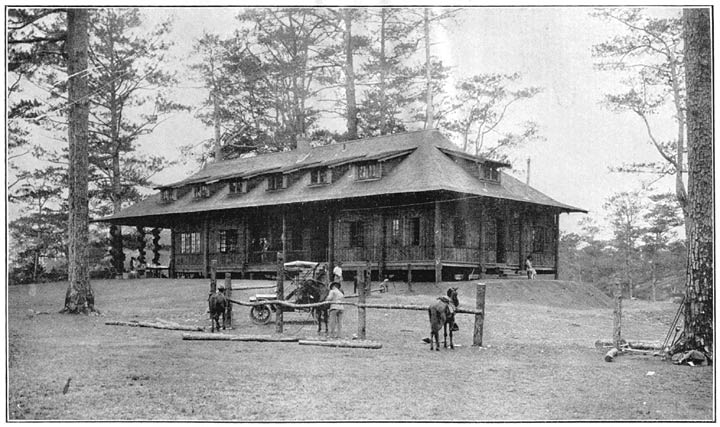
The Baguio Country Club
In the effort to protect the towns which showed themselves friendly, the American forces were divided, subdivided and subdivided again. On March 1, 1901, they were occupying no less than five hundred two stations. By December of the same year the number had increased to six hundred thirty-nine, with an average of less than sixty men to a post. As a result of the protection thus afforded and of the humane conduct of our troops, the people turned to us in constantly increasing numbers.
It remained to stamp out the dying embers of insurrection, while continuing to seek to protect those who put their trust in us. Further subdivision of the troops in order to garrison more points was hardly possible, but field operations were actively pushed. One after another the Insurgent leaders were captured or voluntarily surrendered. Most officers of importance issued explanatory statements to the people shortly after giving up active field operations, whether they surrendered voluntarily or were taken prisoners. Aguinaldo himself was captured on March 23, 1901, at Palanan, the northernmost point on the east coast of Luzon inhabited by civilized people. No place in the islands, inhabited by Filipinos, is more completely isolated, and he had long been almost entirely cut off from his followers, many of whom believed him to be dead. On April 19, 1901, he issued an address to the Filipino people, in which he clearly recognized the fact that they wanted peace. He said:—
“Manila, April 19, 1901.
“To the Filipino People:—
“I believe that I am not in error in presuming that the unhappy fate to which my adverse fortune has led me is not a surprise to those who have been familiar day by day with the progress of the war. The lessons thus taught, the full meaning of which has recently come to my knowledge, suggested to me with irresistible force that the complete termination of hostilities and a lasting peace are not only desirable but absolutely essential to the welfare of the Philippines.
“The Filipinos have never been dismayed by their weakness, nor have they faltered in following the path pointed out by their fortitude and courage. The time has come, however, in which they find their advance along the path impeded by an irresistible force—a force which, while it restrains them, yet enlightens the mind and opens another course by presenting to them the cause of peace. This cause has been joyfully embraced by a majority of our fellow-countrymen, who have already united around the glorious and sovereign banner of the United States. In this banner they repose their trust in the belief that under its protection our people will attain all the promised liberties which they are even now beginning to enjoy.
“The country has declared unmistakably in favor of peace; so be it. Enough of blood; enough of tears and desolation. This wish cannot be ignored by the men still in arms if they are animated by no other desire than to serve this noble people which has thus clearly manifested its will.
“So also do I respect this will now that it is known to me, and after mature deliberation resolutely proclaim to the world that I cannot refuse to heed the voice of a people longing for peace, nor the lamentations of thousands of families yearning to see their dear ones in the enjoyment of the liberty promised by the generosity of the great American nation.
“By acknowledging and accepting the sovereignty of the United States throughout the entire Archipelago, as I now do without any reservation whatsoever, I believe that I am serving thee, my beloved country. May happiness be theirs.
“Manila, April 19, 1901.”
This announcement of Aguinaldo, published in Spanish, Tagálog and English, undoubtedly hastened the end of the war, but it did not lead to immediate general surrender, for as Taylor has very truly said:—
Aguinaldo’s forces now passed through these several stages. Some of his more important subordinates had previously been captured or had surrendered. Others, still remaining in the field, now acted on his advice, more or less promptly. A few remained obdurate for a time, but as a rule not for long, and soon there remained in the field only a very limited number of real military leaders, like General Malvar in Batangas and General Lukban in Samar, and a very considerable number of bandit chiefs, some of whom had posed as Insurgents. The forces of the latter were now materially and rapidly augmented by men who had been Insurgent officers or soldiers and while serving in this capacity had become so enamoured of a lawless life that they were now unwilling to settle down and work for their daily bread, preferring to continue to live off their long-suffering fellow-countrymen, whom they robbed and murdered more mercilessly than ever.
The war was practically over. The insurrection had failed. In my opinion no Filipino who held out to the end for independence compared in intellectual power with Mabini, and I deem his views as to why it failed worthy of special attention. At the time of his death, he left behind a memoir from which I quote the following:—
These are by no means the only reasons why the revolution failed, but they foredoomed it to failure.
The surrender or capture of the more respectable military element left the unsurrendered firearms in the hands of men most of whom were ignorant, many of whom were criminal, and nearly all of whom were irresponsible and unscrupulous.
Strict enforcement of the rules of civilized warfare against them was threatened, but not actually resorted to.
The situation was particularly bad in Batangas. General J. F. Bell was put in charge there, and he found a humane and satisfactory solution of the existing difficulties in reconcentration—not the kind of reconcentration which made the Spaniards hated in Cuba, but a measure of a wholly different sort. This measure and its results have been concisely described by Taylor, as follows:—
“General Bell said he was as anxious as any one could be to avoid making war against those who really wanted the termination of hostilities, and it was his duty to protect them against the vengeance of others. Over and above all these considerations in importance, however, was the absolute necessity of making it impossible for insurgents to procure food by levying contributions. Therefore, in order to give those who were pacifically inclined an opportunity to escape hardship, as far as possible, and preserve their food supply for themselves and their families, it was determined to establish zones of protection with limits sufficiently near all towns to enable the small garrisons thereof to give the people living within these zones efficient protection against ruinous exactions by insurgents. He accordingly, ‘in order to put an end to enforced contributions now levied by insurgents upon the inhabitants of sparsely settled and outlying barrios and districts by means of intimidation and assassination,’ ordered the commanding officers of all towns in the provinces of Batangas and Laguna to ‘immediately specify and establish plainly marked limits surrounding each town bounding a zone within which it may be practicable, with an average-sized garrison, to exercise sufficient supervision over and furnish protection to inhabitants (who desire to be peaceful) against the depredation of armed insurgents. The limits may include the barrios which exist sufficiently near the town to be given protection and supervision by the garrison, and should include some ground on which live stock could graze, but so situated that it can be patrolled and watched. All ungarrisoned towns will be garrisoned as soon as troops become available.
“It was deemed best not to compel the people to enter these zones; but they were warned that unless they accepted that protection their property, which consisted almost entirely of food supplies, would become liable to confiscation or destruction, because it might be impossible to determine whether it belonged to hostile or peaceful people. To put an end to vengeance by assassination, it was determined to make use of the right of retaliation conferred by General Order 100 issued by President Lincoln in 1863. A circular telegram was published announcing an intention to retaliate by the execution of prisoners of war in case any more were assassinated by insurgents for political reasons. It was not found necessary to do this. Assassinations stopped at once.
“As the campaign progressed it became more and more apparent that a large number of poor people had contributed through fear, for the power of the insurgents to collect came to an end after they had lost their power of intimidation. The efficiency of the protection afforded in such zones was the determining factor in forming the decision and attitude of many of the natives. The protection afforded was efficient, and from time to time many additional families entered the zones. The sentiment for peace grew stronger steadily and natives volunteered assistance to Americans at every hand and in every town. When these volunteers were trustworthy they were armed and sent out into the mountains from which they brought back guns, and insurgents, and hundreds of half-famished men, women, and children who, released from the intimidating influence of the insurgents, entered the zones of protection.
“Malvar surrendered on April 16, 1902. Most of the people had turned against their once highly respected chief, and toward the end several thousand natives of Batangas joined the Americans in their determined hunt for the fugitive leader. Realization of the fact that the people were against him materially aided in forcing his surrender.
“General Bell had captured or forced to surrender some 8000 to 10,000 persons actively engaged, in one capacity or another, in the insurrection. These prisoners were rapidly released when they had taken the oath of allegiance. By the first week of July no political prisoners were held in this region. They had returned to their homes.
“The policy of concentrating the people in protected zones and destroying the food which was used for the maintenance of guerrilla bands was not new. There had been precedents even in the United States. One of these is the order issued on August 25, 1863, by Brigadier-General Ewing, commanding the district of the border, with headquarters at Kansas City, Mo., in which he ordered the inhabitants of a large part of three counties of that State to remove from their residences within fifteen days to the protection of the military stations which he had established. All grain and hay in that district was ordered to be taken to those military stations. If it was not convenient to so dispose of it, it would be burned (Rebellion Records, Series I, Vol. XXII, Part II, p. 473). The American commanders in the Philippines had adopted no new method of procedure in dealing with war traitors; they had, however, effectively employed an old one.
“The insurrection had originated among the Tagálogs and had spread like a conflagration from the territory occupied by them. The fire had been quenched everywhere else. General Bell had now stamped out the embers in the Tagálog provinces.
“On July 2 the Secretary of War telegraphed that the insurrection against the sovereign authority of the United States in the Philippines having come to an end, and provincial civil governments having been established throughout the entire territory of the archipelago not inhabited by Moro tribes, the office of military governor in the archipelago was terminated. On July 4, 1902, the President of the United States issued a proclamation of amnesty proclaiming, with certain reservations, a full and complete pardon and amnesty to all persons in the Philippine Archipelago who had participated in the insurrection.”
General Bell’s motives and methods in reconcentrating the inhabitants of this troubled region have been grossly misrepresented, and he himself has been sadly maligned. He is the most humane of men, and the plan which he adopted resulted in the reëstablishment of law and order at a minimum cost of human suffering.
Many of the occupants of his reconcentration camps received there their first lessons in hygienic living. Many of them were reluctant to leave the camps and return to their homes when normal conditions again prevailed.
The report of the United States Philippine Commission for 1903 gives the population of Manila as 221,000, while in 1900 it had been 260,000. Does this mean that there had been a holocaust in Manila? Not at all. It means only that the thousands of Filipinos who had sought the protection of the American forces there during the period when they feared their own soldiers in the provinces had mostly returned to their homes. During the disturbed period in Batangas great numbers of people took refuge in other and more peaceful regions. Some of them returned later; others did not.
Blount further quotes a statement in the 1901 report of the Provincial Secretary of Batangas to the effect that:
Apart from the fact that these figures, showing a mortality of a hundred thousand from disease alone, are hardly consistent with those quoted by Blount as showing a decrease in population during a longer period of only fifty-four thousand four hundred and forty-seven, it is not apparent why Americans should be charged with deaths due to malaria or dysentery, since no systematic effort to rid Batangas of these ills had ever previously been made, and the very thing which then prevented the adoption of the measures subsequently so successfully put forth to this end was the disorderly conduct of the people themselves. As a simple matter of fact, however, there was no such dreadful mortality from these diseases at this time. Malaria has never been especially bad in this province, and even cholera, which swept it during the period in question and is far more readily communicated than is dysentery, caused only twenty-three hundred and ninety-nine known deaths.
In the end peace was established and prosperity followed in its wake.