Volume 1 — Chapter VIII Did We Destroy a Republic?
Reading edition
He would doubtless have set up just this sort of a government, if not assassinated too soon, but it would hardly have accorded with the principles of the declaration of independence, nor would it have been exactly “a government of the people, by the people, for the people.”
“There could be no republic here, even though the Americans should consent, because, according to the treaties, the Filipinos are not in condition for a republic. Besides this, all Europe will oppose it, and if it should be that they divide our country as though it were a round cake, what would become of us and what would belong to us?”
I will now trace the evolution of the government which Aguinaldo did set up. In doing so I follow Taylor’s argument very closely, drawing on his unpublished Ms., not only for ideas, but in some instances for the words in which they are clothed. I change his words in many cases, and do not mean to unload on him any responsibility for my statements, but do wish to acknowledge my indebtedness to him and at the same time to avoid the necessity for the continual use of quotation marks.
Aguinaldo still had a month in which to seize enough Spanish territory to erect thereon what would appear to the Americans on their arrival to be a government of Luzón, of which he was the head. The Hongkong junta and Aguinaldo himself intended to ask for the recognition of their government, but they had first to create it. To obtain recognition it was necessary that the American commander on land should be able to report that wherever he or his troops had gone the country was ruled by Aguinaldo according to laws which showed that the people were capable of governing themselves.
As the United States is a republic it was natural that the directing group of insurgent leaders should decide upon a republican form of government. That form would appeal to the people of the United States; the first “Christian Asiatic Republic” was a description which would inevitably awaken sympathy in that mother of republics. The idea was a wise and subtle one; but Aguinaldo’s republic was merely an elaborate stage-setting, arranged for the contemplation of the people of the United States.
This provincial council was to elect representatives for the revolutionary congress, which was to be charged with submitting suggestions to the central government upon interior and exterior affairs, and was to be heard by the government upon serious matters which admitted of delay and discussion.
Before any person elected to office was permitted to discharge his functions, his election was to be approved by the central government. The military commanders, except in time of war, were to have no jurisdiction over the civil authorities. They could, however, demand such supplies as they might need, and these could not be refused. The government was to appoint commissioners to carry these regulations into effect.
On June 23 he proclaimed the establishment of a revolutionary government, with himself as “president.” In this capacity he had all the powers of the Spanish governor-general, unhampered by any orders from Spain. It is true that the scheme provided for the eventual formation of a republic, but it is doubtful if the people who drew it up really knew what that word meant. What was provided for in practice was a strong and highly centralized military dictatorship, in which, under the form of election, provision was made for the filling of all offices by men devoted to the group which had seized control.
According to this decree the dictatorial government was in future to be entitled the revolutionary government. Its duty was to struggle for the independence of the Philippines in order to establish a true republic. The dictator was to be known as the president of the revolutionary government. There were to be four secretaries—one of foreign affairs, commerce and marine; one of war and public works; one of police and interior order, justice, education and hygiene; one of the treasury, agriculture and manufactures. The government could increase the number of secretaries if necessary. They were to assist the president in the despatch of business coming under their departments.
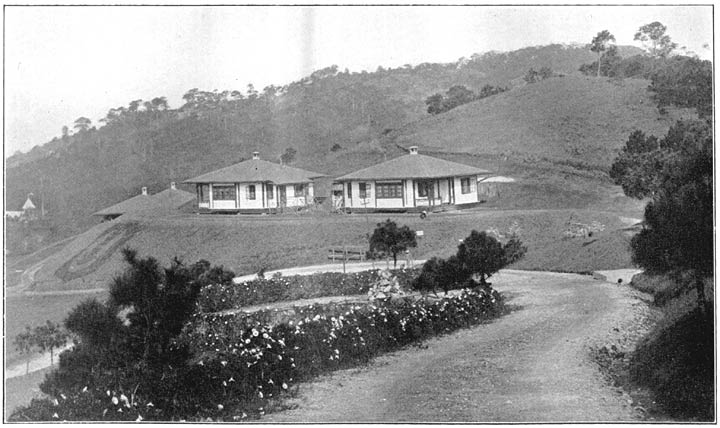
Typical Cottages at Baguio
Cottages of this type are used by officers of the government.
In addition to the president and his secretaries, there was to be a revolutionary congress composed of representatives from the provinces of the Philippine Archipelago, elected as provided by the decree of June 18. In case a province was not able to elect representatives, the government would appoint them for such province. The congress was to discuss and advise, to approve treaties and loans, and to examine and approve the accounts of the secretary of the treasury. If important matters admitted of delay, the congress would be heard concerning them; but if they did not admit of delay, the president of the government was to act at once. Projects of law could be presented by any representative, and by the secretaries of the government.
A permanent committee of congress presided over by the vice-president was to be chosen by that body. This was to serve as a court of appeal in criminal cases and as a court of final jurisdiction in cases arising between the secretaries of the government and provincial officials. The acts of congress were not to go into effect until the president of the government ordered their execution. He was also to have the right of veto.
This was a well-devised plan to secure control for the central group about Aguinaldo. His commissioners, under a form of election in which the electors were carefully selected men, established municipal governments devoted to the cause of the revolution. These were to choose provincial officials and members of the congress. All elections were subject to Aguinaldo’s approval, and every province was under the command of a military representative of his, who could and did call upon the civil authorities for such supplies as he deemed fit. All real power was vested in the central group, and the central group was composed of Emilio Aguinaldo and his public and private advisers. By this time he had gathered about him men who were trained in the law, some of whom had served the Spanish government in various capacities. They were accustomed to the methods that had previously prevailed under the Spanish régime, and were now ready to draw up constitutions and regulations for the new government. Mabini wrote the three organic decrees. Copies of them were sent to the foreign consuls in Manila, and on July 15, 1898 to Admiral Dewey.
The people of the provinces obeyed the men who had arms in their hands. It is not probable that many of them had any conviction concerning the form of government which would be best for the Philippines. There were no signs of a spontaneous desire for a republic. Orders came from the group about Aguinaldo, and the people accepted a dictator and a republic as they accepted a president and a republic, without knowing, and probably without caring very much, what it all meant, except that they hoped that taxes would cease with the departure of the friars. A determined and well-organized minority had succeeded in imposing its will upon an unorganized, heterogeneous, and leaderless majority.
As soon as a province was occupied by the Insurgents it was divided into territorial zones within which command was exerted by military officers. On July 20, 1898, Cavite had been divided into four zones, and next day Brigadier-General Artemio Ricarte was placed in command of the province and the first zone.
By July 7 Bulacan Province had been divided into six zones, and Nueva Ecija into four zones, with a separate commander for each zone. These men established the government prescribed by Aguinaldo’s decrees of the middle of June. Probably by the end of July Aguinaldo’s municipal governments had been established in the greater part of the towns of Luzón. These governments were not established by the mass of the people. The mass of the people were not consulted, but they were not in the habit of being consulted in such matters and probably saw no necessity for it in this case. As an evidence of this we have the fact that from the beginning the acts of election were almost always drawn up in Spanish, although by far the greater portion of the people of the archipelago spoke only the native dialects.
The method of establishing these municipal governments employed in Cavite in June, 1898, was continued to the end of Aguinaldo’s rule. It was the same in different places and at different times. Data obtained from reports and documents written in towns far removed from each other follow. They must be considered together in order to obtain an idea of what this method really was.
The commissioners do not seem to have been able to find many men who had the necessary requisites for electors. In the town of Lipa, Batangas Province, with a population of forty thousand seven hundred forty-three, at the election held July 3, 1898, a presidente was chosen for whom twenty-five votes were cast. On November 23, 1898, an election was held at Vigan, Ilocos Sur, for a presidente to succeed one who had been elected representative in congress. One hundred and sixteen votes were cast. The population of Vigan is nineteen thousand. On October 5, 1898, at Echague, Isabela Province, a presidente was elected for whom fifty-four votes were cast. The population of Echague is fifty-four thousand. On October 2, 1898, at Cabagan Nuevo, Isabela, one hundred and eleven men voted out of a population of sixty-two hundred and forty. On January 29, 1899, the town of Hernani, in Samar, elected its municipal officials under the supervision of V. Lukban. Fifty-four men voted. The town has a population of twenty-five hundred and fifty-five.
The elections, so-called, were not always held without protest. For example, the town of San José, Batangas, protested unavailingly to Aguinaldo against the result of an election held at 10 P.M., in a storm of rain. Men who had been on friendly terms with the Spaniards were usually excluded from all participation. If in spite of the precautions taken men were elected who were disliked by the commissioner or his supporters, the election could be set aside on the ground that the person elected was not an adherent of the revolution.
“On August 20, 1898, four men of Tondo appeared before Aguinaldo on Bacoor and announced that they were representatives of the people of the district, who loved liberty. Then in accordance with the directions of the president of the republic under the supervision of the secretary of the interior, they drew lots from a hat to decide how the offices of the head of the district, delegate of police, delegate of the treasury and delegate of justice were to be distributed. The decision having been made in this simple fashion, Aguinaldo gravely approved the election as expressing the will of the people. Perhaps it did, for they seem to have continued, at least for a time, to obey them. On November 14, 1898, Aguinaldo again approved an election for local officials in Tondo which since August 13 had been within the American lines.”
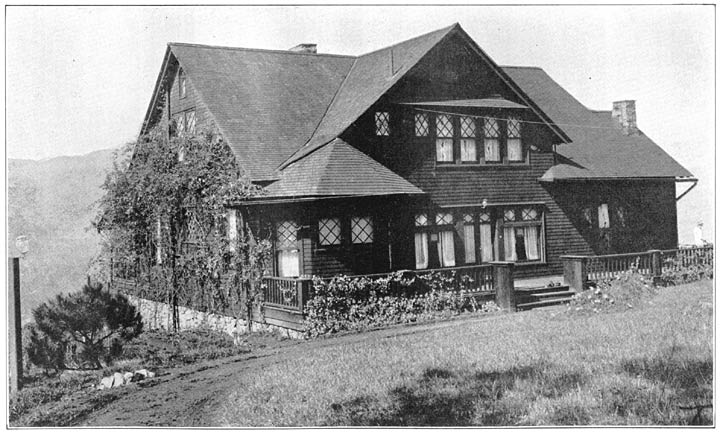
A Baguio Home
This is the residence of the author. Note the rose buses climbing up to the second story.
This form of government spread with the advance of Aguinaldo’s arms. Municipal elections were held in Tarlac in July, in Ilocos Norte and Tayabas in August, in Benguet and the Batanes Islands in September, 1898, in Panay in December, 1898, and in Leyte and Samar in January, 1899.
It is not probable that the number of provinces under civil governors much increased. If in Pangasinán Province, where there are many Tagálogs, organizations opposed to the rule of Aguinaldo could cause serious disorders, as was the case, it must have been considered expedient for the success of the attempt of the Tagálogs, who form only a fifth of the population, to dominate the archipelago, that all provinces in which an effective majority of the people were not of that tribe, should be kept under military rule. The municipal governments which had been established in Luzón were in the hands of Aguinaldo’s adherents, or of men who it was hoped would prove loyal to him. They were men of the Spanish-speaking group, which has always dominated the people of the islands. They were probably not as a rule men of means. Many of them, perhaps most of them, had been clerks and employees under the Spanish government, and they saw no reason for changing the methods of town administration which had then been followed. The municipal taxes, the estimates for expenditures, and the regulations for town government, were but little modified from those they found in force. In many ways such changes as were made were for the worse.
Once installed in power, Aguinaldo’s officials were required to exercise over the mass of the people about the same control that had always been exercised over them. The governing group considered that they were perfectly capable of providing for the welfare of the islands, and that it was the duty of the people to obey them without question.
Blount quotes the following statement from the report of the First Philippine Commission:—
The men who composed this congress were among the ablest natives of the archipelago; but representative institutions mean nothing unless they represent the people; if they do not, they are a conscious lie devised either to deceive the people of the country or foreign nations, and it is not possible for any system founded upon a lie to endure. A real republic must be founded not upon a few brilliant men to compose the governing group but upon a people trained in self-restraint and accustomed to govern by compromise and concession, not by force. To endure it must be based upon a solid foundation of self-control, of self-respect and of respect for the rights of others upon the part of the great majority of the common people. If it is not, the government which follows a period of tumult, confusion and civil war will be a government of the sword. The record the Philippine republic has left behind it contains nothing to confirm the belief that it would have endured, even in name, if the destinies of the islands had been left in the hands of the men who set it up.
The national assembly met on the appointed day in the parish church of Barasoain, Malolos, which had been set aside for the meetings of congress. This body probably had then more elected members than at its subsequent meetings, but even so it contained a large number of men who were appointed by Aguinaldo after consultation with his council to represent provinces which they had never even seen.
In considering this table it must be remembered that the relationship given between the number of delegates assigned to a given people and the number of individuals composing it is only approximate, as no one of these peoples is strictly limited to the provinces where it predominates.
People Number Elected Delegates Appointed Delegates
Visayans 3,219,030 0 68
Tagálogs 1,460,695 18 19
Ilocanos 803,942 7 11
Bicols 566,365 4 7
Pangasináns 343,686 2 2
Pampangans 280,984 2 2
Cagayans 159,648 4 6
Zambalans 48,823 1 2
Non-Christians 647,740 4 34
42 151
It will be noted that the Tagálog provinces had eighteen out of a total of forty-two elected delegates. The Visayans, by far the most numerous people in the islands, did not have one. The non-Christian provinces had a very disproportionately large total of delegates, of whom four are put down as elected, but on examination we find that one of these is from Lepanto, the capital of which was an Ilocano town; one is from Nueva Vizcaya, where there is a considerable Cagayan-Ilocano population; one is from Benguet, the capital of which was an Ilocano town, and one from Tiagan, which was an Iloeano settlement. These delegates should therefore really be credited to the Ilocanos.
If the individual relationships of the several members are considered, the result is even more striking. Of the thirty-eight delegates assigned to the non-Christian provinces, one only, good old Lino Abaya of Tiagan, was a non-Christian. Many of the non-Christian comandancias were given a number of delegates wholly disproportionate to their population, and in this way the congress was stuffed full of Tagálogs.
Think of Filipe Buencamino, of Aguinaldo’s cabinet, representing the Moros of Zamboanga; of the mild, scholarly botanist Leon Guerrero representing the Moros, Bagobos, Mandayas and Manobos of Davao; of José M. Lerma, the unscrupulous politician of the province of Bataan, just across the bay from Manila, representing the wild Moros of Cotabato; of Juan Tuason, a timid Chinese mestizo Manila business man, representing the Yacan and Samal Moros of Basilan; of my good friend Benito Legarda, since a member of the Philippine Commission, and a resident delegate from the Philippines to the congress of the United States, representing the bloody Moros of Jolo! Yet they appear as representatives of these several regions.
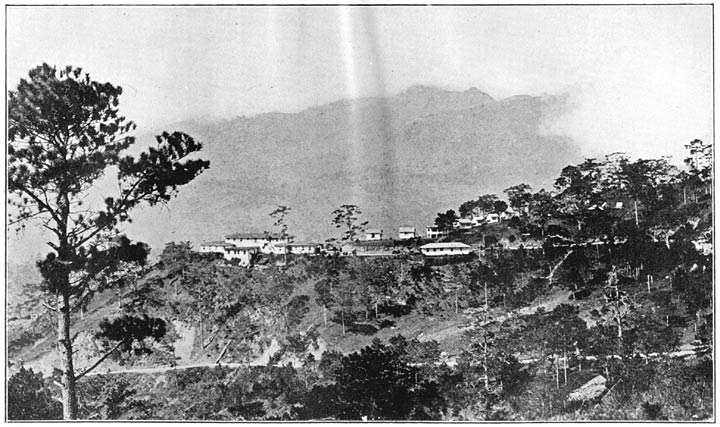
The Baguio Hospital
This hospital, built on a picturesque site in the midst of imposing mountain scenery, where it gets the full sweep of the cool pine-scented breezes, has done wonderful work. Note the tuberculosis cottages on the crest of the ridge.
Few, indeed, of the delegates from non-Christian territory had ever set foot in the provinces or comandancias from which they were appointed, or would have been able to so much as name the wild tribe or tribes inhabiting them.
I have been furnished a list, made up with all possible care by competent persons, from which it appears that there were eighty-five delegates actually present at the opening of congress, of whom fifty-nine were Tagálogs, five Bicols, three Pampangans, two Visayans, and one a Zambalan. For the others there are no data available. Yet it has been claimed that this was a representative body! It was a Tagálog body, without enough representatives of any other one of the numerous Philippine peoples to be worth mentioning.
With a congress thus organized, Aguinaldo should have had no difficulty in obtaining any legislation he desired.
“The work whose results the commission has the honour to present for the consideration of congress has been largely a matter of selection; in executing it not only has the French constitution been used, but also those of Belgium, Mexico, Brazil, Nicaragua, Costa Rica, and Guatemala, as we have considered those nations as most resembling the Filipino people.”
The most important difference between this project and the actual constitution adopted was that, although the project provided that the Dominican, Recollect, Franciscan and Augustinian friars should be expelled from the country and that their estates should become the property of the state, yet it recognized the Catholic religion as that of the state and forbade state contribution to the support of any other, although it permitted the practice in private of any religion not opposed to morality, which did not threaten the safety of the country. The government was authorized to negotiate a concordat with the Pope for the regulation of the relations between church and state. A strong party was in favour of this recognition, but it finally failed of adoption, and the constitution as promulgated provided for the freedom and equality of religion and for free and compulsory education which had not been provided for in the original project. The constitution as approved forbade the granting of titles of nobility, decorations or honorary titles by the state to any Filipino. This paragraph did not exist in the original project, which merely forbade any Filipino to accept them without the consent of the government.
On January 4, 1899, General Otis issued a proclamation in which he announced that the United States had obtained possession of the Philippines and that its government would be extended over the islands of the archipelago. Aguinaldo replied next day with one which, if not intended to be a declaration of war, was at least a warning that hostilities were imminent. This proclamation was carried into Manila by his emissaries and posted up over the one issued by the American commander. It was a challenge to a trial of strength, and Aguinaldo and his advisers hastened their preparations for the coming combat.
The secretary of the interior on the same day sent an order to the heads of all provinces directing the organization of territorial militia to resist the American invasion, and ordering the heads of the towns to hold meetings of the people to protest against the aggression of the United States. They were held in accordance with these orders, and records of the proceedings were sent to Malolos and published in the official organ of the government as evidence of the feeling of the people. It was, however, not considered necessary in publishing them to mention the fact that they had been held in compliance with orders.
The constitution of the Philippine Republic was ratified at a session of the congress on January 20, 1899.
As long as Mabini remained in power the constitution was mere paper. Its adoption was not indicative of the capacity of the people to maintain self-government. It expressed only the academic aspirations of the men who drafted it. There is not the slightest evidence from any previous or subsequent experience of the people that it would have worked in practice. It was enacted for the misleading of Americans rather than for the benefit of the Filipinos.
While the government of Aguinaldo was called a republic, it was in fact a Tagálog military oligarchy in which the great mass of the people had no share. Their duty was only to give soldiers for the army and labourers for the fields, and to obey without question the orders they received from the military heads of their provinces.
There is no cause for vain regrets. We did not destroy a republic in the Philippines. There never was anything there to destroy which even remotely resembled a republic.
Names Classes
Albay Highest class 2. Salvador V. del Rosario and Felipe Buencamino
Ilocos Norte do 2. José, Antonio Luna
Ilocos Sur do 2. Ignacio Villamor, José Aleji
Isabela de Luzón Third class 1. Aristón Bautista
Sorsogón do 1. José Albert
Cagayán do 1. Pablo Tecson
Abra Pol.-Mil. Govt. 1. Isidro Paredes
Nueva Viscaya do 1. Enrique Mendiola
Corregidor do
Catanduanes do
Batanes do
Masbate and Ticao Pol.-Mil. Comandancia 1. Alberto Barreto
Amburayan do
Apayaos do
Benguet do 1. Joaquín Luna
Binatanga do
Bontoc do 1. Fernando Canon
Burias do
Cayapa do
Itaves do
Lepanto do 1. León Apacible
Príncipe do 1. Mariano Ocampo
Quiangan do
Tiagan do
Cabugauan do
Island of Cebú Pol.-Mil. Govt. of highest class 2. Cayetano Arellano and Pardo de Tavera
Iloilo, Panay do 2. Gregorio Araneta and Melecio Figueroa
Island of Leyte do 1. León Guerrero
Negros Occidental do 1. José María de la Viña
Island of Samar do Pablo Ocampo
Antique, Island of Panay do 1. Hipólito Magsalin
Cápiz Lowest class 1. Miguel Zaragoza
Negros Oriental do 1. Aguedo Velarde
Island of Bohol do 1. Juan Manday Gabriel
Romblón Pol.-Mil. Comandancia 1. Vicente González Maninang
Concepción do 1. Mariano V. del Rosario
Zamboanga 1st Dist. Pol.-Mil. Govt. 1. Pedro A. Paterno
Misamis 2d Dist. do 1. Maximino Paterno
Surigao 3d Dist. do 1. Benito Valdés
Davao 4th Dist. do 1. Telesforo Chuidian
Cotabato 5th Dist. do 1. Enrique Mercaida
Basilan 6th Dist. do 1. Juan Tuason
Lanao 7th Dist. do 1. Gonzalo Tuason
Dapitan Pol.-Mil. Comandancia 1. Gonzalo Tuason
Butúan do
Barás is under Pol.-Mil. Govt. of Bahia Illana
Levac is under Pol.-Mil. Comandancia of Cottabatto
Matti Pol.-Mil. Comandancia
Malabang. This Comandancia is under the Military Comandancia of Bahia Illana.
Reina Regente. This Comandancia is under the Pol.-Mil. Govt. of Cottabato
Bay of Sarangani and adjacent islands Pol.-Mil. Comandancia
Tucuran Pol.-Mil. Govt.
Island of Joló do 1. Benito Legarda
Siassi Pol.-Mil. Com.
Tataan do
Bongao do
Island of Paragua Pol.-Mil. Govt. 1. Felipe Calderón.
Balabac do 1. Manuel Jérez
Calamianes do 1. Manuel Genato
Marianas Islands do
Oriental Carolines do
Camarines, North and South Don Tomás del Rosario and Don Cecilio Hilario