Volume 1 — Chapter IV The Premeditated Insurgent Attack
Reading edition
The possible, if not the probable, desirability of attacking the United States troops was, it is evident, clearly foreseen from the beginning. Active preparations for doing this now soon began.
Although Insurgent officers in full uniform freely visited Manila at all times, Aguinaldo wrote on October 1 to his commander in Laguna Province that he must not permit Americans there without passes. He was to get rid of them civilly, but he was to keep them out and inform all authorities there of his instructions.
On August 24 an American soldier was killed and others were wounded in Cavite by Insurgent troops who fired from behind. An Insurgent officer in Cavite at the time reported on his record of services that he—
“took part in the movement against the Americans on the afternoon of the 24th of August, under the orders of the commander of the troops and the adjutant of the post.”
This shows that the movement was ordered, but the Insurgents promptly realized that it was ill advised.
On August 28 General Llanera was reported to be preparing for operations against the Americans. He was ordered to suspend his preparations. The same day General P. Mercado Rizal, commanding in Laguna Province, wrote Mabini asking whether they were to consider the Americans as their allies or their enemies. He wanted to know whether the war was to stop or continue becoming more furious. This not because he desired to ask questions about the secrets of the government, but because he wished to prepare the minds of the people for the future. Mabini’s answer has not been found.
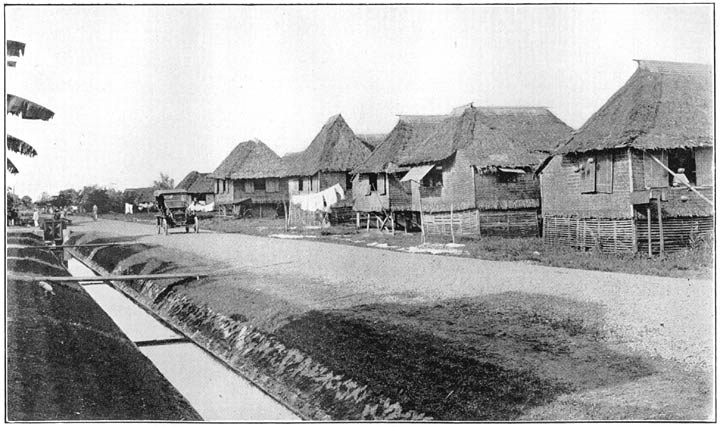
An Improved Street in the Filipino Quarter of Manila
The construction of such streets and drains makes it possible successfully to combat disease.
At this time Sandico entered the service of the Americans as an interpreter and acted as a spy, endeavouring to keep his people fully informed relative to the plans and acts of his employers. Incidentally he endeavoured to convince the latter that the barbarities really committed by Insurgent officers and troops in Manila were perpetrated by enemies of the Insurgent cause who wished to discredit it.
General Pío del Pilar was directed:—
“To have a detachment posted in the interval from the branch of the river of Paco in a northerly direction to the bridge and so on up to the Pasig river in the direction of Pandacan, the river serving as a line until the suburb of Panque is reached which will be under our jurisdiction. Proceed to execute this order on its receipt, posting detachments where they are necessary and trenches will be made without loss of time working day and night. Do not rest for by doing so we may lose the opportunity; beg of the troops to assist in the formation of intrenchments. Matters have a bad aspect, we especially expect something Wednesday and Thursday, the 15th and 16th of this month. The danger is imminent on the mentioned days, also in the time that follows.
“Keep strict vigilance at all hours. In case you receive orders to leave that place, do not do so on any account without my orders, happen what may....
“Concentrate all your forces in Santa Ana before the day arrives.
“Warn your soldiers against firing at random as the Spaniards did, if possible have them calculate the number of their antagonists and how much ammunition there is in comparison with the number of the attacking force, in fact, there are occasions when each shot fired kills as many as four men.
General Garcia was instructed as follows:—
The instructions to Noriel or Cailles read as follows:—
“At eight o’clock in the morning of Wednesday, the 14th, withdraw your command from the town of Malate as indicated on the enclosed plan, from the bridge in Singalong and in a straight line from there to the branch of the river in Paco will be the line of our jurisdiction even though we may not be of one mind in the matter. On receipt of this proceed to determine the most suitable places to post our troops even if they are not supplied with batteries; on posting the detachments give instructions to have intrenchments made immediately without resting, especially on the days of the 15th and 16th. Since affairs have a serious aspect, do not lose vigilance and be on the alert at all times....
“Concentrate all the forces and have a call to arms in Cavite so that all the troops may be in Pasay on Wednesday night.
Obviously the maintenance of peace at this time hung by a very slender thread. On September 14 the governor of Cavite telegraphed Aguinaldo as follows:—
On December 6 Sandico telegraphed Aguinaldo as follows:—
San Juan was where the firing commenced on February 4, 1899.
On December 9 Cailles wired Aguinaldo as follows:—
By this time the Insurgents had made up their minds that the Americans, who had been bearing their insults in silence, were cowards. Aguinaldo’s indorsement on this telegram reads:—
“Fortune had been good to Aguinaldo and his associates in the eight months during which the United States had prevented Spain from relieving her beleaguered garrisons in the Philippines, and she might still be kind. The men about Aguinaldo who had risen farthest and fastest could not endure the thought of having to accept subordinate positions in a government not directed by themselves. The halberdiers at the door of the palace of the president saluted them as the halberdiers at the doorway of his lordship the governor-general in Manila had struck the marble steps with their halberds at the coming of the Spanish generals. They swaggered down the streets of Malolos, clashing their swords behind them, and they knew that if they won, the Philippines would be divided into fiefs which they, as dukes and marquises, would hold in feudal tenure from a Malay potentate. They were confident. They held Luzón. They held the people. They had no intention of returning to office stools or to the life of outlaws and hunted men. The United States force in Manila was small and America was far. It was true that they might have to fight for the prize which they had seized, but the military leaders about Aguinaldo were confident of winning in case they fought. They believed the Americans were afraid of them and would be easily beaten. American soldiers had been seized and had been insulted by the followers of Aguinaldo and no resort had been made to force. The Americans had been ordered to avoid bringing on an engagement and had obeyed. It is also probable that many of the insults to which they had been subjected were not appreciated by them. A tall soldier from western America paid no attention to the insults hurled at him in a language which he did not understand. And yet the small excited Filipinos might retire feeling that the American had tamely submitted to insult worse than a blow.”
By the middle of December, Aguinaldo had placed in position in the vicinity of Manila all of the field guns in his possession.
On the following day Cailles reported that he had occupied blockhouse No. 12, which was within the American lines, and added the following significant statement:—
San Quintin’s Day was the anniversary of the Sicilian vespers, the massacre of the French in Sicily in 1268. Obviously the Insurgents were planning something similar for Manila.
For some reason the attack was not made as planned, but there was no intention of abandoning it. Within fifteen days of January 1 some 40,000 Filipinos left Manila. Why? On January 7, Aguinaldo wrote to Señor Benito Legarda at Manila, saying:—
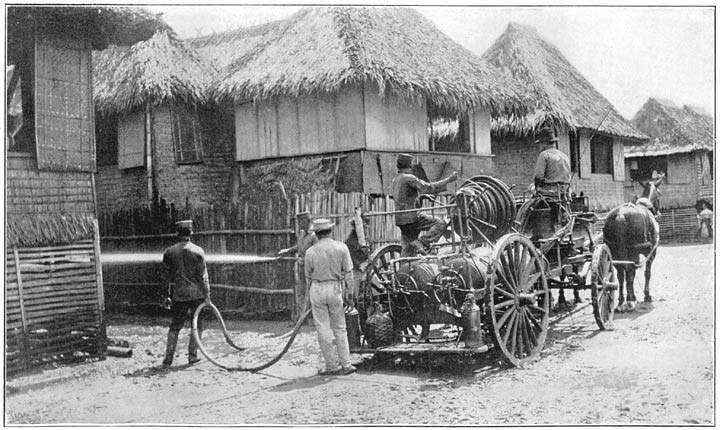
Disinfecting by the Acre
During the last cholera epidemic chemical fire engines were used to disinfect whole native sections of Manila.
In his message to Congress dated January 1, 1899, Aguinaldo said:—
An unsigned letter addressed to Apacible on January 4, 1899, contains the following statement:—
On January 4 the following significant telegram was sent out:—
“Circular Telegram from the Secretary of the Interior to Provincial Presidents, wherever there may be Telegraphic Service, to be communicated to the Local Chiefs of each Town.
“Malolos, January 4, 1899, 9.35 A.M.
“To the Provincial President of the Province of Pangasinán:
“Hasten the preparation of all the towns in order to oppose the American invasion. See that all the inhabitants prepare their bolos and daggers; also that in each street and barrio national militia is organized, each six of whom should be commanded by a corporal, each thirteen by a sergeant, each twenty-six by a second lieutenant, each fifty-two by a first lieutenant, and each one hundred and four by a captain, directing that the soldiers of the national militia elect their own officers, informing all that upon our attitude depends our salvation.
Lingayen, January 4, 1899.”
There is a note thereon which reads:—
“Communicate this to all of the local chiefs, and to the commanding general.”
On January 5, 1899, Aguinaldo issued a proclamation which contains the following statement:—
“The said generals accepted my concessions in favor of peace and friendship as indications of weakness. Thus it is, that with rising ambition, they ordered forces to Iloilo on December 26, with the purpose of acquiring for themselves the title of conquerors of that portion of the Philippine Islands occupied by my govermnent.
“My government cannot remain indifferent in view of such a violent and aggressive seizure of a portion of its territory by a nation which has arrogated to itself the title, ‘champion of oppressed nations.’ Thus it is that my government is ready to open hostilities if the American troops attempt to take forcible possession of the Visayan Islands. I announce these rights before the world, in order that the conscience of mankind may pronounce its infallible verdict as to who are the true oppressors of nations and the tormentors of human kind.
Three days later this proclamation, which was rather dangerously like a declaration of war, was reissued with a significant change in the last one of the passages quoted, the words “attempt to take forcible possession of any part of the territory submitted to its jurisdiction” being substituted for the words “attempt to take forcible possession of the Visayan Islands.”
On January 8, 1899, at 9.40 P.M., Sandico telegraphed Aguinaldo as follows:—
Preparations for the attack, which was to begin inside the city of Manila, were now rapidly pushed to conclusion. I quote Taylor’s excellent summary of them:—
“After Aguinaldo’s proclamation of January 5 the number of organizations charged with an attack within the city increased rapidly and it is possible that those which had been formed during Spanish rule had never been disbanded. Sandico’s clubs for athletic exercises and mutual improvement formed a nucleus for these bodies and the directing boards of the popular committees took up the work of recruiting, while some of the members became officers of the militia or sandatahan. On January 6 the commander of militia in Trozo, Manila, reported that 1130 soldiers had been enrolled by the popular committee. On January 7 Bonifacio Arévalo forwarded to the head of the central committee a list of the officers of the battalion which had just been organized in Sampaloc for the defence of their liberties. Apparently about the same time J. Limjap submitted to Sandico a project for arming the prisoners in Bilibid Prison with the arms of the American soldiers quartered in the Zorrilla Theatre across the street. He said:—
“‘Jacinto Limjap having been proclaimed commander of the volunteers of the penitentiary, I ask you to authorize the creation of a disciplinary battalion and the provisional appointments of officers for 600 sandatahan, or militia, ready to provide themselves by force with the American rifles in the Zorrilla Theatre.’
“He followed by a statement of the officers desired. It was not difficult for him to obtain volunteers there to rob, to burn, to rape and to murder. These were the crimes for which they were serving sentences. The political prisoners had been released....
“On January 18 Sandico approved of the officers for the first battalion organized by the committees of Sampaloc; on January 27 he approved those of the second battalion. By January 22 two battalions had been organized in Quiapo. At least one regiment of eight companies was raised in Binondo, for on January 23 its commander forwarded a roll of the officers to Aguinaldo for his approval.... On January 25 T. Sandico, at Malolos, submitted for approval the names of a number of officers of the territorial militia in the city of Manila. On January 30, 1899, a roll of four companies just organized in Malate was forwarded approved by T. Sandico, and on the same day the committee of Trozo, Manila, applied to T. Sandico for permission to recruit a body for the defence of the country. The regiment of ‘Armas Blancas’ had already been raised in Tondo and Binondo. It was in existence there in December, 1898, and may have been originally organized to act against Spain. On February 2 all officers of the territorial militia in Manila reported at Caloocan, in accordance with orders of Sandico, for the purpose of receiving their commissions and taking the oath to the flag. A man who took part in this ceremony wrote that a multitude of men were present in uniform, and that the oath was administered by Gen. Pantaleón García. There is no reason for believing that this is a complete statement of sandatahan organized in Manila by the end of January, and yet this statement gives a force of at least 6330 men. General Otis said that this force had been reported to him as being 10,000 men. It is probably true that only a small number of them had rifles; but armed with long knives and daggers they could have inflicted much damage in a sudden night attack in the narrow and badly lighted streets of Manila. On January 9, 1899, Aguinaldo wrote his instructions for the sandatahan of Manila. Members of this body were to enter the houses of the American officers on the pretext of bringing them presents. Once in they were to kill. The sentinels at the gates of the barracks were to be approached by men dressed as women and killed. The gates of the barracks held and as many officers as possible treacherously murdered, the sandatahan were to rise throughout the city, and by attacking in the rear the United States troops on the outer line were to aid in opening a way for Aguinaldo’s force. To further increase the confusion and perhaps to punish the natives who had not joined them, the sandatahan were to fire the city.
“It is a fair deduction from Luna’s orders for an uprising in Manila, from Aguinaldo’s instructions for the sandatahan, from other documents among the papers of the insurgents and from what was done in Manila on February 22 that Aguinaldo and his advisers about the middle of January, 1899, drew up a plan of attack upon Manila which would, if carried out, have inflicted a severe blow upon the Americans. It was not carried out, but that was not the fault of Aguinaldo or of Luna.
“... And then there was nothing abhorrent to Aguinaldo and the men about him in beginning a war by the murder of the commanding general on the other side.
“... Aguinaldo and all his followers have declared that on February 4 the Americans attacked the unsuspecting Filipinos who were using their utmost efforts to avoid a war. And yet here in Aguinaldo’s own handwriting is the record of the fact that on January 10, 1899, he ordered the murder of the American commander.
“The attack which Aguinaldo was preparing to deliver upon and in Manila was not to be a mere raid such as the bandits of Cavite were in the habit of making upon the defenceless towns. The plan was a piece of calculated savagery in which murder and outrage were considered means to accomplish a purpose. The servants were to kill their employers; organized bands, dressed in the dress of civilians, living in the city of Manila under the government of the Americans, in many cases employed by the Americans, were to suddenly fall upon the barracks of the American soldiers and massacre the inmates; all Americans in the streets were to be killed, the city was to be fired and its loot was to be the reward of loyalty to Aguinaldo. If this plan had been carried out no white man and no white woman would have escaped. The reinforcements from the United States would have arrived to find only the smoking ruins of Manila. Buencamino had warned General Augustín what the fate of Manila would be if taken by a horde of Indians drunk with victory. That fate was now deliberately planned for the city. Aguinaldo planned to occupy the capital not as it had been occupied by the Americans. He planned to take it as Count Tilly took Magdeburg.
Some portions of Aguinaldo’s instructions to the sandatahan are particularly worthy of perpetuation, as they illustrate his ideas as to the conduct which should be observed by cultured, patriotic, honourable and very humane men, who were not cruel:—
“Art. 3. The chief of those who go to attack the barracks should send in first four men with a good present for the American commander. Immediately after will follow four others who will make a pretence of looking for the same officer for some reason and a larger group shall be concealed in the corners or houses in order to aid the other groups at the first signal. This wherever it is possible at the moment of attack.
“Art. 4. They should not, prior to the attack, look at the Americans in a threatening manner. To the contrary, the attack on the barracks by the sandatahan should be a complete surprise and with decision and courage. One should go alone in advance in order to kill the sentinel. In order to deceive the sentinel one of them should dress as a woman and must take great care that the sentinel is not able to discharge his piece, thus calling the attention of those in the barracks. This will enable his companions who are approaching to assist in the general attack.
“Art. 5. At the moment of the attack the sandatahan should not attempt to secure rifles from their dead enemies, but shall pursue, slashing right and left with bolos until the Americans surrender, and after there remains no enemy who can injure them, they may take the rifles in one hand and the ammunition in the other.
“Art. 6. The officers shall take care that on the tops of the houses along the streets where the American forces shall pass there will be placed four to six men, who shall be prepared with stones, timbers, red-hot iron, heavy furniture, as well as boiling water, oil and molasses, rags soaked in coal oil ready to be lighted and thrown down, and any other hard and heavy objects that they can throw on the passing American troops. At the same time in the lower parts of the houses will be concealed the sandatahan, who will attack immediately. Great care should be taken not to throw glass in the streets, as the greater part of our soldiers go barefooted. On these houses there will, if possible, be arranged, in addition to the objects to be thrown down, a number of the sandatahan, in order to cover a retreat or to follow up a rout of the enemy’s column, so that we may be sure of the destruction of all the opposing forces.
“Art. 7. All Filipinos, real defenders of their country, should live on the alert to assist simultaneously the inside attack at the very moment that they note the first movement in whatever barrio or suburb, having assurance that all the troops that surround Manila will proceed without delay to force the enemy’s line and unite themselves with their brothers in the city. With such a general movement, so firm and decided against the Americans, the combat is sure to be a short one, and I charge and order that the persons and goods of all foreigners shall be respected and that the American prisoners shall be treated well.
“Art. 9. In addition to the instructions given in paragraph 6, there shall be in the houses vessels filled with boiling water, tallow, molasses and other liquids, which shall be thrown as bombs on the Americans who pass in front of their houses, or they can make use of syringes or tubes of bamboo. In these houses shall be the sandatahan who shall hurl the liquids that shall be passed to them by the women and children.
“Art. 10. In place of bolos or daggers, if they do not possess the same, the sandatahan can provide themselves with lances and arrows with long sharp heads, and these should be shot with great force in order that they may penetrate well into the bodies of the enemy, and these should be so made that in withdrawal from the body the head will remain in the flesh.
The Filipinos were now ready to assume the offensive, but desired, if possible, to provoke the Americans into firing the first shot. They made no secret of their desire for conflict, but increased their hostile demonstrations and pushed their lines forward into forbidden territory. Their attitude is well illustrated by the following extract from a telegram sent by Colonel Cailles to Aguinaldo on January 10, 1899:—
Aguinaldo approved the hostile attitude of Cailles, for there is a reply in his handwriting which reads:—
On January 13 Noriel and Cailles telegraphed Aguinaldo as follows:—
“We desire to know results of ultimatum which you mention in your telegram, and we also wish to know what reward our Government is arranging for the forces that will be able first to enter Manila.”
This telegram is endorsed in Aguinaldo’s handwriting:
“As to the contents of your telegram, those who will be the heroes will have as their rewards a large quantity of money, extraordinary rewards, promotions, crosses of Biak-na-bató, Marquis of Malate, Ermita, Count of Manila, etc., besides the congratulations of our idolizing country on account of their being patriotic, and more, if they capture the regiments with their generals, and, if possible, the chief of them all who represents our future enemies in Manila, which (lot?) falls to you, or, better said, to General Noriel and Colonel Cailles.
“The ultimatum has not been sent, but it will be within a few days.
(Signed) “E. A.
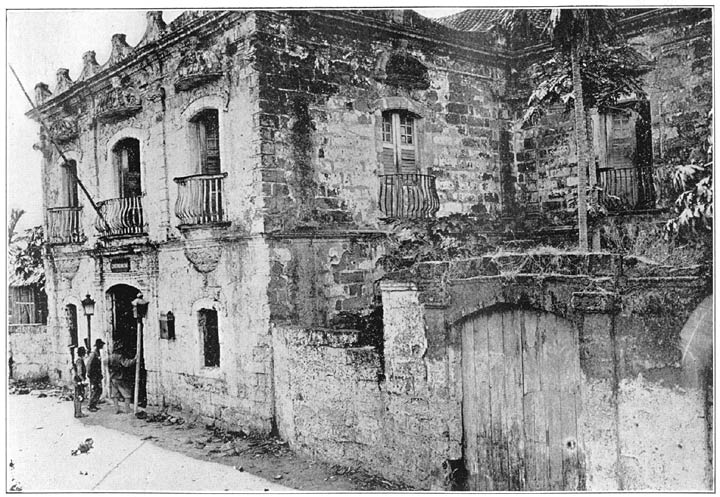
An Old-style Provincial Jail
Lieutenant Gilmore, of the United States Navy, and his fellow prisoners were detained in this building for a time.
On January 21 General Otis wrote to Admiral Dewey that:—
About the middle of January General Otis stationed the First Nebraska Regiment upon the high ground at Santa Mesa for sanitary reasons. Of conditions at this time, and of the circumstances leading to the actual outbreak of hostilities Taylor says:—
“During the latter part of January General Otis was informed on good insurgent authority that the insurgents meditated an attack upon those troops, and he was advised to remove them, as in their exposed position they would kill them all. General MacArthur, under whose command the regiment was, placed two guns in position there, as it was fully expected that the insurgents would direct their attack upon that point, as in fact they did. On February 4, 1899, the tents of the regiment covered the ridge, and its outposts extended along the San Juan River, a small stream which formed part of the line of delimitation between the Americans and the insurgents.
“For some days before the outbreak of hostilities the pressure of the insurgents was constant along this position, so constant indeed that in the light of subsequent events it indicated a premeditated purpose on the part of some one in the insurgent army to force a collision at that point. On February 2 General MacArthur, commanding the Second Division of the Eighth Army Corps, wrote to the commanding general of the Filipino troops in the third zone in front of him that—
“‘An armed party from your command now occupies the village in front of blockhouse No. 7, at a point considerably more than a hundred yards on my side of the line, and is very active in exhibiting hostile intentions. This party must be withdrawn to your side of the line at once. From this date if the line is crossed by your men with arms in their hands they must be regarded as subject to such action as I may deem necessary.’
General Otis’s account of the opening of active hostilities follows:—
“On the night of February 2 they sent in a strong detachment to draw the fire of our outposts, which took up a position immediately in front and within a few yards of the same. The outpost was strengthened by a few of our men, who silently bore their taunts and abuse the entire night. This was reported to me by General MacArthur, whom I directed to communicate with the officer in command of the insurgent troops concerned. His prepared letter was shown me and approved, and the reply received was all that could be desired. However, the agreement was ignored by the insurgents and on the evening of February 4 another demonstration was made on one of our small outposts, which occupied a retired position at least 150 yards within the line which had been mutually agreed upon, an insurgent approaching the picket and refusing to halt or answer when challenged. The result was that our picket discharged his piece, when the insurgent troops near Santa Mesa opened a spirited fire on our troops there stationed.
Thus began the Insurgent attack, so long and so carefully planned for. We learn from the Insurgent records that the shot of the American sentry missed its mark. There was no reason why it should have provoked a hot return fire, but it did.
The result of the ensuing combat was not at all what the Insurgents had anticipated. The Americans did not drive very well. It was but a short time before they themselves were routed and driven from their positions.
Aguinaldo of course promptly advanced the claim that his troops had been wantonly attacked. The plain fact is that the Insurgent patrol in question deliberately drew the fire of the American sentry, and this was just as much an act of war as was the firing of the shot. Whether the patrol was acting under proper orders from higher authority is not definitely known.
In this connection the following telegram sent by Captain Zialcita from Santa Ana on February 4, 1899, at 9.55 P.M., to Major Gray, San Juan del Monte, is highly interesting:
This looks as if Zialcita at least knew that something was to be done to draw the American fire.
Aguinaldo’s first statement relative to the opening of hostilities is embodied in a general order dated Malolos, February 4, 1899, and reads in part as follows:—
“Nine o’clock P.M., this date, I received from Caloocan station a message communicated to me that the American forces, without prior notification or any just motive, attacked our camp at San Juan del Monte and our forces garrisoning the blockhouses around the outskirts of Manila, causing losses among our soldiers, who in view of this unexpected aggression and of the decided attack of the aggressors, were obliged to defend themselves until the firing became general all along the line.
“No one can deplore more than I this rupture of hostilities. I have a clear conscience that I have endeavoured to avoid it at all costs, using all my efforts to preserve friendship with the army of occupation, even at the cost of not a few humiliations and many sacrificed rights.
“... I order and command:—
“1. Peace and friendly relations between the Philippine forces and the American forces of occupation are broken, and the latter will be treated as enemies, with the limits prescribed by the laws of war.
“2. American soldiers who may be captured by the Philippine forces will be treated as prisoners of war.
Aguinaldo’s protestations relative to his efforts to avoid hostilities are absurd, in view of his own instructions concerning the attack to be made simultaneously within and without the city of Manila.
Apacible apparently did not take this view of the matter, for on January 31 he wrote to Aguinaldo that the Senate in Washington would take final vote upon the treaty of peace between the United States and Spain on February 6, and said:—
Obviously this letter might be interpreted as a recommendation that hostilities begin before February 6 if America did not answer meanwhile. It was evidently well understood in Hongkong that Aguinaldo’s receipt of Apacible’s letter might cause war to begin, for on February 3, 1899, Bray, anticipating the outbreak of hostilities of the following day, cabled Senator Hoar at Washington as follows:—
The extracts from the Insurgent records above quoted leave no escape from the conclusion that the outbreak of hostilities which occurred on February 4, 1899, had been carefully prepared for and was deliberately precipitated by the Filipinos themselves.
Blount says:—
It may have been wooden-headed for the Filipinos to expect this, but expect it they certainly did. We have seen how they held their soldiers in check until after Spain had been ousted from the Philippines by the Treaty of Paris as they had originally planned to do. It now only remained to carry out the balance of their original plan to get rid of the Americans in one way or another.
The Insurgents brought down upon themselves the punishment which they received on February 4 and 5.
“That the United States hereby disclaim any disposition or intention to exercise sovereignty, jurisdiction, or control over said islands except for the pacification thereof, and assert their determination when an independent government shall have been duly erected therein entitled to recognition as such, to transfer to said government, upon terms which shall be reasonable and just, all rights secured under the cession by Spain, and to thereupon leave the government and control of the islands to their people.”
I must take issue with Blount as to the effect which these resolutions might have had if passed. The Insurgents felt themselves to be fully competent to bring about such pacification of the islands as they deemed necessary. At the time the resolutions were presented in the Senate their soldiers were straining at the leash, ready to attack their American opponents upon the most slender excuse. Aguinaldo himself could not have held them much longer, and it is not impossible that they got away from him as it was. They would have interpreted the passage of the Bacon resolutions as a further evidence of weakness, and hastened their attack. As we have seen, “war, war, war” was what they wanted.
Blount has endeavoured to shift the responsibility for the outbreak of hostilities to the United States by claiming that certain words italicized by him in what he calls the “Benevolent Assimilation Proclamation” were necessarily, to the Insurgents, “fighting words.” The expressions referred to have to do with the establishment of United States sovereignty and the exercise of governmental control in the Philippine Islands.
These words were not “fighting words,” the Insurgent policy being, as I have shown by the records, to consider the acceptance of a protectorate or of annexation in the event that it did not prove possible to negotiate absolute independence, or probable that the American troops could be driven from the islands.
The growing confidence of the Insurgents in their ability to whip the cowardly Americans, rather than any fixed determination on their part to push a struggle for independence to the bitter end, led to their attack.