Volume 1 — Chapter V Insurgent Rule and the Wilcox-Sargent Report
Reading edition
The Good Book says, “By their fruits ye shall know them, whether they be good or evil,” and it seems proper to apply this test to the Insurgents and their government.
The extraordinary claim has been advanced that the United States destroyed a republic in the Philippines and erected an oligarchy on its ruins. Various writers and speakers who have not gone so far as this have yet maintained that Aguinaldo and his associates established a real, effective government throughout the archipelago during the interim between his return and the outbreak of hostilities with the United States.
He bases his claim as to the excellent state of public order in the Insurgent territory at this time on a report of Paymaster W. E. Wilcox and Naval Cadet L. R. Sargent of the United States Navy, who between October 8 and November 20, 1898, made a long, rapid trip through northern Luzon, traversing the provinces of Bulacan, Pampanga, Tarlac, Pangasinán, Nueva Ecija, Nueva Vizcaya, Isabela, Cagayan, South Ilocos and Union, in the order named, thence proceeding to Dagupan and down the railroad through Pangasinán, Tarlac, Pampanga and Bulacan to Manila.
Now if it be true that Aguinaldo established complete machinery of government throughout all of Luzon outside of Manila for all matters of justice, taxes and police, so that life and property were safe and peace, tranquillity and justice assured, we may well dispense with quibbling as to whether the proper name was applied to such government. But did he?
Let us examine with some care the history of the Wilcox-Sargent trip, and see if we can gain further light from other sources relative to the condition of public order in the territory which they traversed.
I propose, for the most part, to let the captured Insurgent records speak for themselves, as it is fair to assume that Insurgent officers were at no pains to represent conditions as worse than they really were. In view of the fragmentary character of these records, we may also assume that the complete story would be still more interesting and instructive than the one which I have been able to reconstruct.
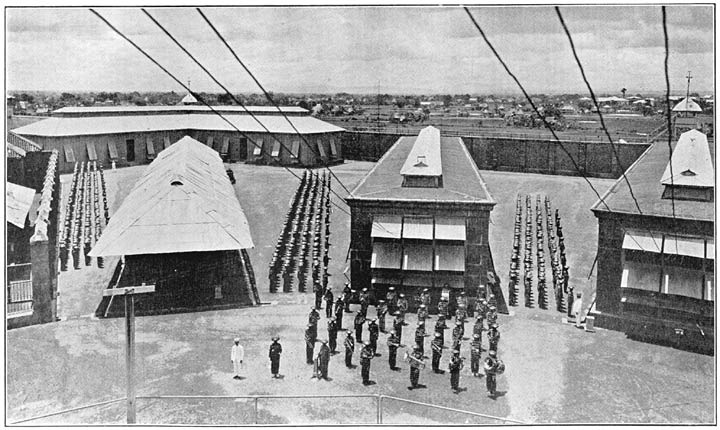
Retreat at Bilibid Prison, Manila
Messrs. Sargent and Wilcox were almost everywhere hospitably received, and were entertained with dinners and dances after the inimitable fashion of the hospitable Filipino everywhere. They gained a very favourable impression of the state of public order in the provinces through which they passed for the reason that from the very start their trip was strictly personally conducted. They saw exactly what it was intended that they should see and very little more. Their progress was several times interrupted for longer or shorter periods without adequate explanation. We now know that on these occasions the scenery so carefully prepared in advance for them had become a little disarranged and needed to be straightened up. Facts which I will cite show that most shocking and horrible events, of which they learned nothing, were occurring in the territory through which they passed.
For a considerable time before their departure American visitors had been carefully excluded from the Insurgent territory, but the Filipino leaders decided to let these two men go through it to the end that they might make as favourable a report as possible. How carefully the way was prepared for American visitors is shown by the following telegram:—
“San Pedro, Macati,
“July 30, 1898.
“To the Local Presidente of Pasig:
“You are hereby informed that the Americans are going to your town and they will ask your opinion [of what the people desire.—Tr.] You should answer them that we want a republican government. The same answer must be given throughout your jurisdiction.
(Signed) “Pío Del Pilar,
“President R. G., Bacoor, from Gen. Noriel, Pineda, July 30, 12.10 P.M.: I inform your excellency that some commissioners of the American admiral are making investigations in the region around Pasay as to the wishes and opinion of the people as to the government. To-day I received a statement from some, giving the answer: ‘Free government under American protectorate [copy mutilated, two or three words missing here] the President.’”
The admiral might have gone further and said that it contained practically the only information then obtainable in regard to conditions in the territory in question, but as I shall conclusively show it was neither complete nor reliable.
Judge Blount in describing the experiences of Messrs. Wilcox and Sargent naïvely makes the statement that:
It certainly was!
Very little Spanish was then spoken in Nueva Vizcaya, Isabela or Cagayan. What opportunity had these two men, ignorant as they were of the native dialects, to learn the sinister facts as to what had been and was occurring in the territory which they visited?
Bulacan
Paua was later made a general in consideration of his valuable services!
Pampanga
Our travellers next visited Pampanga. Here they apparently overlooked the fact that Aguinaldo did not have “his whole people a unit at his back.” The citizens of Macabebe seem not to have approved of the Aguinaldo regime, for the Insurgent records show that:—
When it is remembered that persons tied up and exposed to the full rays of the sun in the Philippine lowlands soon die, in a most uncomfortable manner, we shall agree with the head of this province that this custom has its objectionable features!
Tarlac
While the failure of Messrs. Wilcox and Sargent to learn of the relations between the Tagalogs of Macabebe and their neighbours, or of the fact that people were being publicly tortured in Pampanga, is perhaps not to be wondered at under the circumstances, it is hard to see how they could have failed to hear something of the seriously disturbed conditions in Tarlac if they so much as got off the train there.
On August 24 the commissioner in charge of elections in that province asked for troops to protect him, in holding them in the town of Urdaneta, against a party of two thousand men of the place, who were going to prevent them.
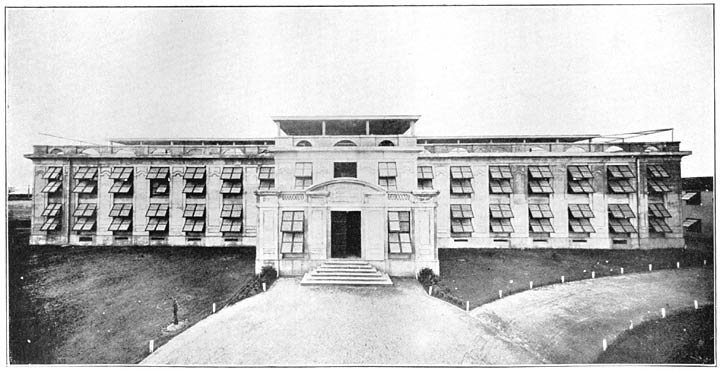
Bilibid Prison Hospital
The Philippine Government has been charged with the neglect of prisoners. The truth is that it has made the prisons of the Philippines the most sanitary structures of their kind in the tropics, and gives its sick prisoners the best of care.
The following letter to Aguinaldo, from Juan Nepomuceno, Representative from Tarlac, speaks for itself as to conditions in that province on December 27, 1898, shortly after the American travellers passed through it on their return:—
“I regret exceedingly being compelled to report to you that since Sunday the 25th instant scandalous acts have been going on in the Province of Tarlac, which I represent. On the night of the Sunday mentioned the entire family of the Local Chief of Bamban was murdered, and his house and warehouse were burned. Also the Tax Commissioner and the Secretary, Fabian Ignacio, have been murdered. Last night Señor Jacinto Vega was kidnapped at the town of Gerona; and seven travellers were murdered at O’Donnel, which town was pillaged, as well as the barrio of Matayumtayum of the town of La Paz. On that day various suspicious parties were seen in the town of Pañique and in the same barrio, according to reliable reports which I have just received.
Obviously the police machinery was not working quite smoothly when a detachment of Insurgent troops could be kept under fire for four hours by a robber band, and perhaps the attacking party were not all “robbers.” Soldiers do not ordinarily carry much to steal.
We obtain some further information from the following telegram of December 27, 1898, sent by the secretary of the interior to the President of the Revolutionary Government:—
Evidently tax collectors were not popular in Tarlac.
Still further light is shed on the situation by a telegram from the secretary of the interior to Aguinaldo, dated December 28, 1898:—
Note also the following from the secretary of the interior, under date of December 27, 1898, to Aguinaldo:—
The secretary of agriculture took a more cheerful view of the situation. Under date of December 28 he telegraphed Aguinaldo as follows:—
Obviously the robbery of Chinese shops and the killing of a few individuals was at first considered by the secretary of agriculture to be without political importance. Evidently he changed his mind, however, for on the same day, December 28, 1898, he telegraphed Aguinaldo as follows:—
At this stage of events Aguinaldo was summoned to Malolos by a telegram from Mabini under date of December 29, which reads as follows:—
The measures which were actually taken are set forth in another telegram of the same date from the secretaries of war and interior to Aguinaldo, which reads as follows:—
Let us hope that the commander was able to attract the people with his six companies of soldiers, and make them return to a peaceful life.
Still further light is thrown on the situation in Tarlac by the following extract from “Episodios de la Revolucion Filipina” by Padre Joaquin D. Duran, an Augustinian priest, Manila, 1901, page 71:—
“At that period the Filipinos, loving order, having been deceived of the emancipation promise, changed by the Katipúnan into crimes and attacks on the municipality of the pueblos, discontent broke out in all parts, and, although latent in some provinces, in that of Tarlac was materialized in an ex-sergeant of the late Spanish civil guard. A valorous and determined man, he lifted up his flag against that of Aguinaldo. One hundred rifles were sufficient to terrorize the inhabitants of said province, crushing the enthusiastic members of the revolutionary party.... Having taken possession of four towns, Pecheche would have been everywhere successful if ambition and pride had not directed his footsteps. In January, 1899, the Aguinaldista commander of Tarlac province, afraid that his whole province would espouse the cause of the sergeant, attempted by every means in his power to interrupt his career, not hesitating to avail himself of crime to destroy the influence of Pecheche with the many people who had been incensed by the Katipúnan and had in turn become firm partisans of the Guards of Honour.
“The Ilocano Tranquilino Pagarigan, local presidente at that time of Camiling, served as an admirable instrument for this purpose.... Pecheche was invited to a solemn festivity organized by Tranquilino, who pretended to recognize him as his chief, and rendering himself a vassal by taking an oath to his flag. He accepted the invitation, and after the mass which was celebrated went to a meal at the convent, where, after the meal was over, the members of the K.K.K. surrounded Pecheche and 10 of his officers and killed them with bolos or tied them and threw them out of the windows and down the staircase. Some priests were held captive in the building where this took place and were informed of what had taken place immediately afterwards.”
This extract shows how easy it then was for any man of determination to acquire a following, especially if he could dispose of a few rifles. It also gives an excellent idea of the methods employed by the Insurgents in dealing with those who opposed their rule.
General Fred D. Grant once told me, with much amusement, of an interesting experience during a fight on Mt. Arayat in Pampanga. His men took a trench and captured some of its occupants. Several of these were impressed as guides and required to show the attacking forces the locations of other trenches. At first they served unwillingly, but presently became enthusiastic and rushed the works of their quondam fellow-soldiers in the van of the American attack. Finally they begged for guns. Grant added that he could start from Bacolor for San Fernando any morning with a supply of rifles and pick up volunteers enough to capture the place, and that on the return trip he could get enough more to attack Bacolor!
Pangasinán
And now we come to Pangasinán, the most populous province of Luzon, and the third in the Philippines in number of inhabitants.
What should we say if United States troops entered the town of Wellesley and raped numerous students at the college, the officers subsequently taking away with them the young ladies who happened to suit them? Yet things of this sort hardly caused a ripple in the country then under the Insurgent flag, and I learned of this particular incident by accident, although I have known Legarda for years.
I quote the following general description of conditions in Pangasinán from a letter addressed by Cecilio Apóstol to General Aguinaldo on July 6, 1898:—
“You probably know that in the Province of Pangasinán, of one of the towns in which your humble servant is a resident, the Spanish flag through our good fortune has not flown here for the past few months, since the few Spaniards who lived here have concentrated in Dagupan, a place not difficult of attack, as is said.
“But this is what is going on in this Province” There exist here two Departmental Governments, one calling itself that of Northern Luzón and of which Don Vicente del Prado is the President, and the other which calls itself that of Northern and Central Luzón, presided over by Don Juliano Paraiso. Besides these two gentlemen, there are two governors in the province(!) one Civil Political Military, living in Lingayen, named Don Felipe J. Bartolomé, and another living in Real Guerrero, a town of Tayug, named Don Vicente Estrella. And in addition there are a large number of Administrators, Inspectors, Military Judges, Generals, ... they cannot be counted. It is a pandemonium of which even Christ, who permits it, cannot make anything. Indeed, the situation is insupportable. It reminds me of the schism in the middle ages when there were two Popes, both legitimate, neither true. Things are as clear as thick chocolate, as the Spaniards say. In my poor opinion, good administration is the mother-in-law of disorder, since disorder is chaos and chaos produces nothing but confusion, that is to say, death.
“I have had an opportunity, through the kindness of a friend, to read the decree of that Government, dated June 18th, of the present year, and the accompanying ‘Instructions for the government of towns and provinces.’ Article 9 of the said decree says that the Superior Government will name a commissioner for each province with the special duty of establishing there the organization set forth in the decree. Very well so far: which of the so-called Presidents of Northern or of Northern and Central Luzón is the commissioner appointed by that government to establish the new organization in that province? Are military commanders named by you for Pangasinán? I would be very much surprised if either of them could show his credentials. Aside from these, the fact remains that in those instructions no mention is made of Presidents of Departments, there is a manifest contradiction in their jurisdictions, since while one calls himself president of a Departmental Government, of Northern Luzón, the other governs the Northern and Central portion of the Island, according to the seals which they use.
“And, nevertheless, a person calling himself the General Administrator of the Treasury and the said Governor of the Province, both of whom live in Tayug, came to this town when the Spaniards voluntarily abandoned it and gathered all the people of means, and drew up an act of election, a copy of which is attached. From it you will see how this organization violates the provisions of the decree of the 18th of June.
“Another item: They got up a contract with the people of means of this town, and did the same thing in the other towns, in which contract they exact from us $1250 which they call contributions of war (see document No. 2 attached). Among the doubtful powers of these gentlemen is the one to exact these sums included?
“Have they express orders from that Government?
“Perhaps these blessed gentlemen—they are high flyers there is no doubt about that,—have struck the clever idea of calling themselves generals, governors, etc., in order to enjoy a certain prestige and to give a certain color of legality to their acts—this, although they don’t know an iota of what they are doing. But what I am sure of, and many other men also, is that there is no order, that here there is not a single person in authority whom to obey. This superfluity of rulers will finally lead to strained relations between them and the towns of this province will end by paying the piper.
“But we poor ignorant creatures in so far as the republican form of government is concerned, in order to avoid worse evils took them at their word, obeyed them like automatons, hypnotized by the title of ‘Insurgents’ which they applied to themselves. But when I had an opportunity to read the said decree, doubts were forced upon me, I began to suspect—may God and they pardon me—that they were trying to impose upon us nicely, that, shielded by the motto, ‘have faith in and submit to the will of the country’ they came to these towns ‘for business.’
“In order to dissipate this doubt, in order to do away with abuses, if there are abuses, I made up my mind to send you this account of the condition of things here. I flatter myself that when you learn of the lamentable situation of this province, you will soon deign to take steps to establish order, because thereon depends the tranquillity of Pangasinan and in the end a strict compliance with your superior orders.
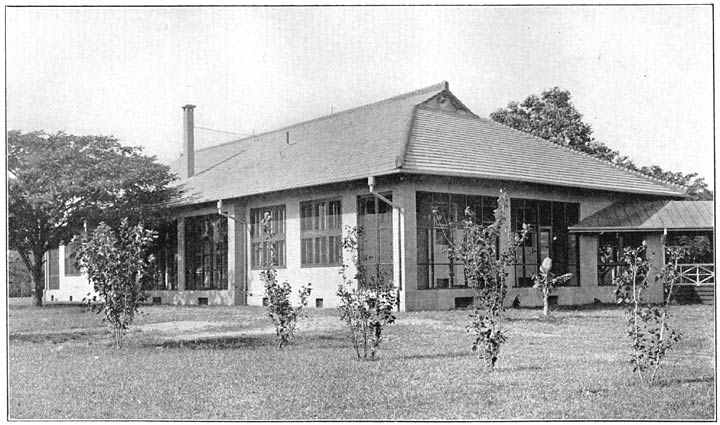
Modern Contagious Disease Ward, San Lazaro Hospital
It will be noted that the picture thus drawn by Señor Apóstol differs in certain important particulars from that painted in such engaging colours by Judge Blount.
The sum total of Blount’s description of affairs in this, the most populous province of Luzón, is derived from the narrative of Messrs. Wilcox and Sargent and reads as follows:—
Doubtless true, but as a summary of conditions perhaps a trifle sketchy.
Nueva Ecija
Nueva Ecija was the next province visited by Wilcox and Sargent. They have failed to inform us that:—
“In December, 1899, certain men charged with being members of this society [Guards of Honour] were interrogated in Nueva Ecija as to their purposes. One of those questioned said:—
Blount has assured us that the Filipinos were a unit at Aguinaldo’s back and were and are an united people, and here are the Ilocanos of Nueva Ecija spoiling his theory by remembering that they are Ilocanos and proposing to kill whom? Not certain individual Filipinos, who might have offended them, but the Tagálogs!
That there were other troubles in Nueva Ecija is shown by the following statement:—
And now, in following the route taken by our tourist friends, we reach Nueva Vizcaya and the Cagayan valley.