Volume 1 — Chapter III Insurgent “Coöperation”
Reading edition
The treacherous policy then outlined was never departed from by Aguinaldo and his associates, who sailed for Manila with their eyes wide open, knowing full well that they had been promised nothing; prepared to match their wits against those of Admiral Dewey, and intent on deceiving him and on securing from him arms to be used first against the Spaniards and later against the Americans, after they had been employed to help bring about the downfall of Spain.
It contains the following statements:—
“The true patriots have organized a committee to which I belong, naming Aguinaldo as President and Agoncillo as Vice-President. The latter and three others have commenced diplomatic negotiations with the Admiral and American Consul, and we infer that they are trying to make colonies of us, although they said they would give us independence. The Committee deemed it advisable to simulate belief, at the same time equipping ourselves with arms.
“We have accepted arms offered by the Admiral which will be disembarked in the Philippines by the squadron.
“A part of our forces will aid the Americans by fighting with them in order to conceal our real intentions, and part will be held in reserve. If America triumphs and proposes a colony, we shall reject such offer and rise in arms.
“A separate expedition will disembark at whatever point may be considered suitable.
“José Alejandrino embarked with the American squadron in order to give secret instructions to the Chiefs.
Here, then, in a faked-up letter on which Basa’s initials were forged in order to gain the prestige of his name for this treacherous plan, we have definitely set forth the purpose of the Filipinos to deceive the Americans by allowing a part of the Insurgent force to fight with them, and then to attack them.
Reference has already been made to Agoncillo’s advice to Aguinaldo, given under date of August 26, 1898, to the effect that friendly relations should be maintained with the Americans until the diplomatic negotiations at Paris should end; that an effort should be made to find out the future status of the islands “by deceitful means,” and that confidence should never be put in the Americans.
Aguinaldo put the whole matter in a nutshell in a postscript to this letter, saying:—
But the Filipinos had fought Spain before and were by no means sanguine. Their more intelligent and reasonable men clearly foresaw that they could not win unaided. Señor Antonio Regidor was at the time residing in London. He was a Filipino of unusual intelligence and exceptionally good education. He took a keen interest in the situation, and on July 28, 1898, telegraphed Agoncillo as follows:—
This leaves no room for doubt as to Regidor’s views, but Agoncillo did not share them. He replied on July 29:—
Regidor was not to be persuaded. On July 30 he replied as follows, addressing his communication to Basa:
Obviously, Agoncillo was somewhat impressed by this cablegram, for on August 1 in a letter to Aguinaldo he made the following statements and inquiries:—
Note that the Basa here referred to is the man whose initials were forged on the letter quoted on page 67.
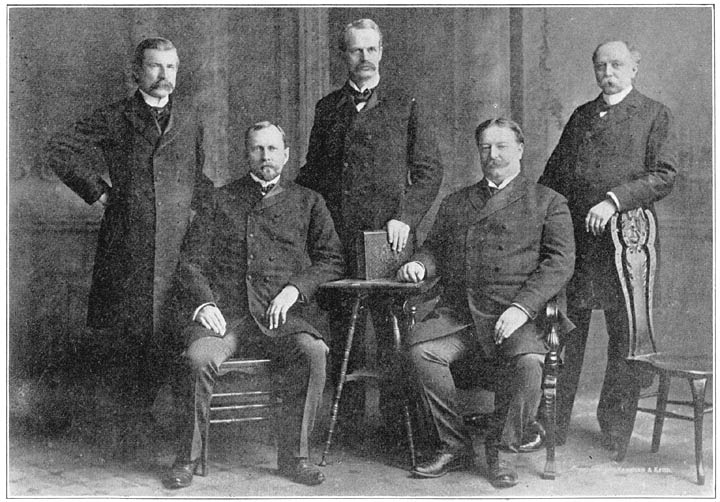
The Second Philippine Commission
From left to right: General Luke E. Wright, Professor Dean C. Worcester, Professor Bernard Moses, Judge William H. Taft, and Judge Henry C. Ide.
Even annexation to the United States was not excluded by Aguinaldo from the possible accepted solutions, for in outlining the policy of the Philippine government to Sandico on August 10, 1898, he wrote:—
Meanwhile the Filipinos in Hongkong who favoured annexation made themselves heard.
On July 18, 1898, Consul-General Wildman wrote from that place:—
Felipe Buencamino, writing in 1901, said:—
But annexationists were not confined, in the Philippines, to the vicinity of Manila.
Clearly, then, the situation early in September was as follows: All were agreed that the assistance of the United States was necessary in getting rid of Spanish sovereignty.
Under the plan of Aguinaldo and his followers friendly relations were to be maintained with the United States, if possible, until Spain was ousted from her Philippine territory, and then they were to “show their teeth,” and see “who was deceiving whom,” resorting to “force of arms” if necessary. Protection or annexation would be accepted only when it could be clearly seen that the recognition of independence, won either by force of arms or by diplomacy, was impossible.
Other influential and patriotic Filipinos favored annexation to the United States or a United States protectorate, but their views were in the end ignored by Aguinaldo and his following, and as the latter had the guns their ideas prevailed.
The Treaty of Paris, which terminated Spanish sovereignty in the Philippines, was signed on December 10, 1898. It is important to bear this date in mind later, when considering the Insurgent records relative to the preparations which were so carefully made for attacking the American troops.
And now let us consider the actual facts as to the coöperation alleged to have been asked by Americans and given by Filipinos. The following points are not in dispute:—
Pratt asked Aguinaldo to coöperate with Dewey.
Aguinaldo was taken to Manila with the understanding that he would do so.
Dewey assisted Aguinaldo by destroying the main Spanish fleet; by bringing him and his associates back to the Philippines; by furnishing them arms and ammunition; by blockading Manila and by keeping at a safe distance the Spanish mosquito fleet, which would have made dangerous, or impossible, the landing of the arms subsequently imported by the Insurgents.
Aguinaldo successfully attacked the Spanish garrisons in the provinces and used the arms and ammunition captured, or brought in by deserters, to equip a force which surrounded and attacked Manila, drove large numbers of people into the walled city, thus rendering the position of the Spanish garrison very difficult in the face of a possible bombardment, and prevented this garrison from betaking itself to the provinces, as it might otherwise have done, leaving Manila to shift for itself.
Aguinaldo was powerless to take the place by assault.
It lay at the mercy of Dewey’s guns, and it would have been possible for the Admiral to take it at any time, but he could not at first have garrisoned it with United States forces, and never thought of attempting to use Insurgent forces for this purpose.
Did Dewey really want or need Aguinaldo’s help? Let us consider his testimony on the subject:—
“Senator Carmack. You did want a man there who could organize and rouse the people?
“Admiral Dewey. I didn’t want anybody. I would like to say now that Aguinaldo and his people were forced on me by Consul Pratt and Consul Wildman; I didn’t do anything—
“Senator Carmack. Did they have any power to force him upon you?
The picture of the poor admiral, busy getting his fleet ready for battle, pestered by officious consuls on the one hand and by irresponsible Filipinos on the other, is pathetic; but it had its humorous features, which were not lost on the Admiral himself. I quote the following:—
“Senator Patterson. Was there any communication between you and Pratt in which the matter of a written pledge or agreement with Aguinaldo was discussed with reference to the Philippine Islands?
“Admiral Dewey. No.
“Senator Patterson. What became of the correspondence, Admiral, if you know?
“Admiral Dewey. It is all in the Navy Department. When I turned over my command my official correspondence was all sent to the Navy Department. “Senator Patterson. You retained all of your letters from any United States officials?
“Admiral Dewey. No; they went to the Department.
“Senator Patterson. I mean you did not destroy them.
“Admiral Dewey. No; I did not destroy them.
“Senator Patterson. And you turned them over to the Navy Department?
“Admiral Dewey. Yes; our regulations require that. I may say that for my own information I kept copies of certain telegrams and cablegrams. I don’t think I kept copies of Mr. Pratt’s letters, as I did not consider them of much value. He seemed to be a sort of busybody there and interfering in other people’s business and I don’t think his letters impressed me.
“Senator Patterson. He was the consul-general?
“Admiral Dewey. Yes; but he had nothing to do with the attack on Manila, you know.
“Senator Patterson. I understand that.
“Admiral Dewey. I received lots of advice, you understand, from many irresponsible people.
“Senator Patterson. But Pratt was the consul-general of the Government there?
“Admiral Dewey. Yes; he was consul-general.
“Senator Patterson. And he communicated with you, giving you such information as he thought you might be interested in, and among other information he gave you was this concerning Aguinaldo?
“Admiral Dewey. I don’t remember; no, I really don’t remember his telling me anything about Aguinaldo more than that cablegram there, and I said he might come. And you see how much importance I attached to him; I did not wait for him.
“Senator Patterson. What you said was: ‘Tell Aguinaldo to come as soon as possible.’
“Admiral Dewey. Yes; but I did not wait a moment for him.
“Senator Patterson. Yes; but there was a reason for that.
“Admiral Dewey. I think more to get rid of him than anything else.
“Senator Carmack. Rid of whom?
“Admiral Dewey. Of Aguinaldo and the Filipinos. They were bothering me. I was very busy getting my squadron ready for battle, and these little men were coming on board my ship at Hongkong and taking a good deal of my time, and I did not attach the slightest importance to anything they could do, and they did nothing; that is, none of them went with me when I went to Mirs Bay. There had been a good deal of talk, but when the time came they did not go. One of them didn’t go because he didn’t have any toothbrush.
“Senator Burrows. Did he give that as a reason?
However, Dewey ultimately yielded to the pressure exercised on him by Pratt and Wildman, and allowed Aguinaldo and some of his associates to be brought to Manila. Having them there he proposed to get assistance from them, not as allies, but as a friendly force attacking a common enemy, in its own way.
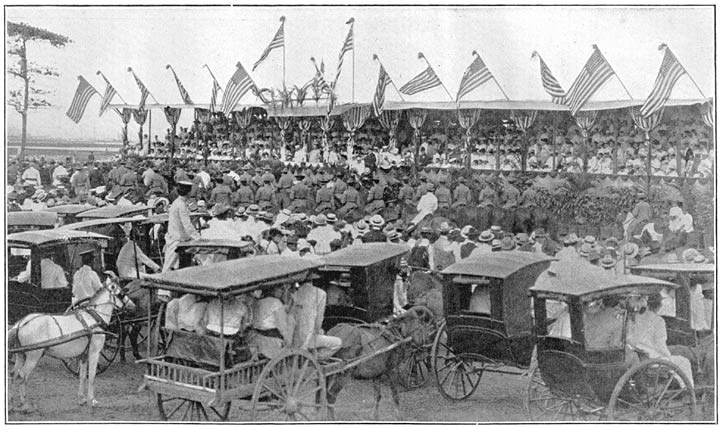
The Return of Mr. Taft
This photograph, taken on the occasion of the return of Mr. Taft to the Philippines after his appointment as secretary of war, shows him in a stand on the Luneta reviewing the procession organized in his honor, in which thousands of Filipinos participated.
Let us continue with his testimony as to cooperation between Aguinaldo and the naval forces of the United States:—
“Senator Patterson. Then, Admiral, until you knew that they were going to send land forces to your assistance you thought there was a necessity to organize the Filipinos into land forces, did you?
“Admiral Dewey. No; not a necessity.
“Senator Patterson. You thought it might prove of value to you?
“Admiral Dewey. I testified here, I think, in a way that answers that. I said to Aguinaldo, ‘There is our enemy; now, you go your way and I will go mine; we had better act independently.’ That was the wisest thing I ever said.
“Senator Patterson. But you stated that you were using these people and they were permitted to organize, that you might use them.
“Admiral Dewey. They were assisting us.
“Senator Patterson. Very well, they were to assist you. Did you not either permit them or encourage them—I do not care which term you use—to organize into an army, such as it was, that they might render you such assistance as you needed?
“Admiral Dewey. They were assisting us, but incidentally they were fighting their enemy; they were fighting an enemy which had been their enemy for three hundred years. “Senator Patterson. I understand that, Admiral.
“Admiral Dewey. While assisting us they were fighting their own battles, too.
“The Chairman. You were encouraging insurrection against a common enemy with which you were at war?
“Admiral Dewey. I think so. I had in my mind an illustration furnished by the civil war. I was in the South in the civil war, and the only friends we had in the South were the negroes, and we made use of them; they assisted us on many occasions. I had that in mind; I said these people were our friends, and ‘we have come here and they will help us just exactly as the negroes helped us in the civil war.’
“Senator Patterson. The negroes were expecting their freedom—
“Admiral Dewey. The Filipinos were slaves, too.
“Senator Patterson. What were the Filipinos expecting?
“Admiral Dewey. They wanted to get rid of the Spaniards; I do not think they looked much beyond that. I cannot recall but I have in mind that the one thing they had in their minds was to get rid of the Spaniards and then to accept us, and that would have occurred—I have thought that many times—if we had had troops to occupy Manila on the 1st day of May before the insurrection got started; these people would have accepted us as their friends, and they would have been our loyal friends—I don’t know for how long, but they would have been our friends then.
“Senator Patterson. You learned from Pratt, or Wildman, or Williams, very early, did you not, that the Filipinos wanted their own country and to rule their own country; that that is what they were expecting?
“Admiral Dewey. I heard from Williams that there was an insurrection there against the Spaniards. The Spaniards were very cruel to them, and I think they did not look much beyond getting rid of them. There was one, Dr. Rizal, who had the idea of independence, but I don’t think that Aguinaldo had much idea of it.
“Senator Carmack. Then what useful purpose did the Filipino army serve; why did you want the Filipino army at all?
“Admiral Dewey. I did not want them.
“Senator Carmack. Did you not want the Filipino forces?
“Admiral Dewey. No, not really. It was their own idea coming over there. We could have taken the city at any moment we had the troops to occupy it.”
Admiral Dewey has made the following statements relative to the importance of Aguinaldo’s military operations:—
“Then he began operations toward Manila, and he did wonderfully well. He whipped the Spaniards battle after battle, and finally put one of those old smoothbore guns on a barge, and he wanted to take this up—wanted me to tow it up so he could attack the city with it. I said, ‘Oh, no, no; we can do nothing until our troops come.’ I knew he could not take the city without the assistance of the navy, without my assistance, and I knew that what he was doing—driving the Spaniards in—was saving our own troops, because our own men perhaps would have had to do that same thing. He and I were always on the most friendly terms; we had never had any differences. He considered me as his liberator, as his friend. I think he had the highest admiration for us because we had whipped the Spaniards who had been riding them down for three hundred years.
“Senator Patterson (continuing). You sent this short dispatch to the Secretary of the Navy:—
“‘Aguinaldo, the revolutionary leader, visited the Olympia yesterday. He expects to make general attack on May 31. Doubt his ability to succeed. Situation remains unchanged.’
“Do you recall that visit?
“Admiral Dewey. Yes.
“Senator Patterson. He came to tell you, did he, that he was going to make a general attack, and you—
“Admiral Dewey. Yes.
“Senator Patterson. And you doubted his ability to succeed?
“Admiral Dewey. And he wanted me to assist him. He wanted me to tow one of his guns up into position. I knew he could not take the city; of course he could not.
“Senator Patterson. Did you urge that he should not make the attack?
“Admiral Dewey. I do not remember that; very likely I did.
“Senator Patterson. And was he not persuaded or restrained by you from doing so?
“Admiral Dewey. I do not remember; but it is very likely. I did not want to see a lot of them killed unnecessarily, because I knew they could not take that walled city. They had no artillery, and they could not take it, I knew very well, and I wanted the situation to remain as it was until our troops came to occupy it.
“Senator Patterson. But you found that whenever you expressed a strong objection to anything being done at that time that Aguinaldo yielded to your request?
But Dewey’s influence over Aguinaldo was not sufficient to prevent his looting, as the following extracts from his testimony show:—
“Senator Patterson. Is that what you mean when you say he looted—that he made reprisals for his army, took provisions and whatever was necessary? That is what you meant?
“Admiral Dewey. That is one part of it.
“Senator Carmack. This was taking provisions for the use of the army?
“Admiral Dewey. That is one thing he did.
“Senator Carmack. You said you did not object to that at the time?
“Senator Carmack. You said yesterday you suspected that Aguinaldo took the lion’s share of the provisions that were gathered for the army. What was the ground upon which you made that accusation?
“Senator Patterson. Do you believe in this proclamation he was uttering falsehoods to the Filipino people?
“Senator Patterson. And you found nothing to cause any doubt as to his loyalty up to the time until after Manila surrendered?
“Admiral Dewey. His loyalty to whom?
“Senator Patterson. To you and to the cause for which he was fighting?
“Admiral Dewey. I began to suspect he was not loyal to us about the time our troops arrived, when he demurred at moving out of Cavite to make room for our troops.
“Senator Patterson. Do you mean by that that you feared that he was commencing to think more of independence than the success of the American cause?
We have seen to what extent Aguinaldo coöperated with the marine forces of the United States. Now let us examine the claim that he cooperated with the land forces after their arrival.
The landing of the American troops for the attack on Manila was not actively opposed by the Filipinos, but it was narrowly and distrustfully watched.
Necessary transportation requested by General Anderson was ultimately furnished by Aguinaldo, but only grudgingly after a three weeks’ delay, and as a result of threats that it would be seized if not voluntarily supplied.
The necessary positions in the trenches around Manila from which to make the attack on that city were, in part at least, yielded to the Americans by the Filipinos upon the request of the former.
The Insurgents twice informed the Spaniards in advance of projected American attacks.
They carried out their own attack on the city without regard to the plans, or the requests, of the Americans. They secretly treated with the Spaniards in the endeavour to secure the surrender of the city to themselves.
After the capitulation to the Americans had been agreed upon, and on the very morning of the day of the surrender, they endeavoured to push home an attack. Disregarding the request that they keep out of the final assault, they crowded into the city with, and after, the American troops. They fired on Spanish soldiers on the city wall while a flag of truce was flying, provoking a return fire which killed and wounded American soldiers.
They demanded for themselves Malacañang palace and other buildings and a share in “the war booty.” They promptly looted the parts of the city which they occupied, and ultimately retired from their positions within the city limits on the evening of their last day of grace after being warned by General Otis that if they did not do so they would be driven out.
I will now quote from the records in support of these statements.
The following is the programme of “coöperation” outlined to Aguinaldo by Bray in a letter dated June 30, 1898:—
“I am very anxious to receive the news of the capitulation of Manila and I hope that General Augustín will be obliged to turn over his sword to you in person and not to the Americans. You are by right entitled to it and I should like to see it so from a political standpoint, as I am of the opinion that you should declare the independence of the Philippines before the arrival of General Merritt, appointed by the President to be Governor with full powers to establish a provisional government.
Any attempt on the part of the Americans to garrison the interior towns with their troops or any other act which might be construed as a conquest, should meet with resistance.
When General Anderson, with the first United States troops of occupation, arrived at Manila Bay, Aguinaldo did not call on him, as an “ally” might have been expected to do. Later, however, Admiral Dewey and General Anderson went to see Aguinaldo, but without any of the ceremony of an official military call, the Admiral saying to General Anderson:—
And they went in that way.
On July 4, 1898, General Anderson wrote Aguinaldo definitely requesting his coöperation in the following words:—
On July 5 Aguinaldo replied, thanking General Anderson for the
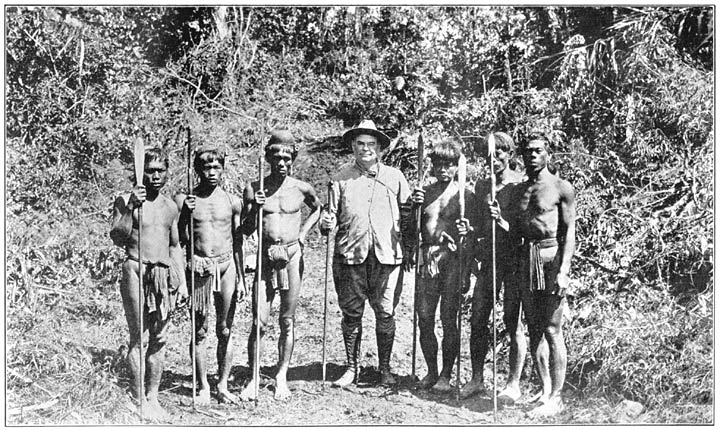
Governor-general James F. Smith with a Bontoc Igorot Escort
Up to the time of Governor-general Smith, no governor-general had ever penetrated the land of the Luzon head-hunters. He crossed Bontoc and Ifugao, in company with the author, in 1907. This photograph shows him on the crewst of the Polis range, at the boundary line between these two sub-provinces, sixty-four hundred feet above the sea.
and also for his desire to have friendly relations with the Filipinos and treat them with justice, courtesy and kindness. There is, however, not a word relative to coöperation in his reply, and Anderson apparently never renewed his request for coöperation in military operations.
On July 6 he wrote to Aguinaldo again, saying:—
To this letter there was no reply. However, in a letter dated July 9, 1898, to the Adjutant-General of the United States Army, General Anderson says of Aguinaldo:—
Evidently, however, coöperation, even in the matter of getting necessary transportation, did not materialize, for on July 17 S. R. Jones, Chief Quartermaster, wrote Aguinaldo as follows:—
“We will want horses, buffaloes, carts, etc., for transportation, bamboo for shelter, wood to cook with, etc. For all this we are willing to pay a fair price, but no more. We find so far that the native population are not willing to give us this assistance as promptly as required. But we must have it, and if it becomes necessary we will be compelled to send out parties to seize what we may need. We would regret very much to do this, as we are here to befriend the Filipinos. Our nation has spent millions in money to send forces here to expel the Spaniards and to give good government to the whole people, and the return we are asking is comparatively slight.
“General Anderson wishes you to inform your people that we are here for their good, and that they must supply us with labor and material at the current market prices. We are prepared to purchase five hundred horses at a fair price, but cannot undertake to bargain for horses with each individual owner.”
Aguinaldo sent this letter by a staff officer to General Anderson inquiring whether it was sent by authority of the latter, who then indorsed on it in a statement that it was. Nevertheless, Major Jones reported on July 20 that it was impossible to secure transportation except upon Aguinaldo’s order and that the natives had removed their cart wheels and hidden them, from which it is to be inferred that the transportation requested had not been furnished.
Obviously General Anderson was informed that Aguinaldo had given orders against furnishing the transportation desired, for on July 21 he wrote the Adjutant-General of the Army as follows:—
“Since I wrote last, Aguinaldo has put in operation an elaborate system of military government, under his assumed authority as Dictator, and has prohibited any supplies being given us, except by his order. As Go this last, I have written to him that our requisitions on the country for horses, ox carts, fuel, and bamboo (to make scaling ladders) must be filled, and that he must aid in having them filled.”
On July 23 General Anderson wrote Aguinaldo as follows:—
“General: When I came here three weeks ago I requested Your Excellency to give what assistance you could to procure means of transportation for the American Army, as it was to fight the cause of your people. So far we have received no response.
“As you represent your people, I now have the honor to make requisition on you for five hundred horses and fifty oxen and ox carts. If you cannot secure these I will have to pass you and make requisition directly on the people.
“I beg leave to request an answer at your earliest convenience.
To this letter, Aguinaldo replied as follows:—
“Replying to your letter of yesterday, I have the honor to manifest to Your Excellency that I am surprised beyond measure at that which you say to me in it, lamenting the non-receipt of any response relative to the assistance that you have asked of me in the way of horses, carabaos, and carts, because I did reply through the bearer that I was disposed to issue proper orders whenever you advised me of the number of these, giving me notice in advance.
“I have sent orders to the nearest provinces in order that within the shortest time possible horses be brought for sale, but I cannot assure Your Excellency that we will have the number of 500 that you need, because there are not many horses in this vicinity, owing to deaths from epizoötic diseases in January, February, and March last.
“Whenever we have them collected, I shall have the pleasure to advise Your Excellency.
General Anderson replied:—
From this series of communications it appears that it took three weeks, and a very direct threat to seize transportation, to bring about Aguinaldo’s promise of assistance in securing it. What help had he given, meanwhile, in other matters?
Such records as I have been able to find do not show what response, if any, Aguinaldo made to these several requests, but General Anderson’s original views as to the willingness of the Insurgents to coöperate with him underwent an early change, for on July 18, 1898, in a letter to the Adjutant-General of the United States Army he makes the following statement:—
“The Insurgent chief, Aguinaldo, has declared himself Dictator and self-appointed President. He has declared martial law and promulgated a minute method of rule and administration under it.
“We have observed all official military courtesies, and he and his followers express great admiration and gratitude to the great American republic of the north, yet in many ways they obstruct our purposes and are using every effort to take Manila without us.
This suspicion was entirely justified, as we shall see later.
Aguinaldo’s assumption of civil authority on July 15, 1899, did not pass unnoticed. On July 21 General Anderson wrote the Adjutant-General of the army concerning it:—
“His assumption of civil authority I have ignored, and let him know verbally that I could, and would, not recognize it, while I did not recognize him as a military leader. It may seem strange that I have made no formal protest against his proclamation as Dictator, his declaration of martial law, and publication and execution of a despotic form of government. I wrote such a protest, but did not publish it, at Admiral Dewey’s request, and also for fear of wounding the susceptibilities of Major-General Merritt, but I have let it be known in every other way that we do not recognize the Dictatorship. These people only respect force and firmness. I submit, with all deference, that we have heretofore underrated the natives. They are not ignorant, savage tribes, but have a civilization of their own; and although insignificant in appearance, are fierce fighters, and for a tropical people they are industrious. A small detail of natives will do more work in a given time than a regiment of volunteers.”
Because he was invited as general rather than as president, Aguinaldo refused to attend a parade and review on the 4th of July. This fact is, in itself, an answer to his claim that the Americans were tacitly recognizing his pretensions.
After referring to this incident, Blount says:—
This statement is incorrect. I myself was present the following year when the declaration was read on the Luneta to a considerable gathering of Filipinos among whom were many school children, and it has often been read since.
On July 16 General Noriel telegraphed Aguinaldo as follows:—
“An American has come here who says that he is a Colonel of the Army whom we should obey; and that it is your desire. We did not listen to him, awaiting your order.”
On the back of the telegram is written the following:—
Obviously there was no real coöperation between American and Filipino troops at this time. General Anderson ignored General Aguinaldo’s request for information as to places where American troops were to land in Filipino territory and the objects of disembarking them.
The Americans proceeded with their plans for the attack upon Manila, and it became desirable to occupy some of the Insurgent trenches. On July 29 Arévalo telegraphed Aguinaldo as follows:—
This clear direct declaration of intention by General Greene is the actual transaction referred to by Blount as “Jockeying the Insurgents out of their trenches.” He bases his statements concerning the matter on a newspaper report.
The attitude of the army officers in the matter of obtaining permission to occupy the trenches needed in preparing for the assault on the city could not have been more correct.
On August 10 General Merritt gave the following emphatic instructions relative to the matter:—
“No rupture with Insurgents. This is imperative. Can ask Insurgent generals or Aguinaldo for permission to occupy their trenches, but if refused not to use force.”
On the same day General Anderson wrote to Aguinaldo, asking permission to occupy a trench facing blockhouse No. 14, in order to place artillery to destroy it. The permission was granted on the following day.
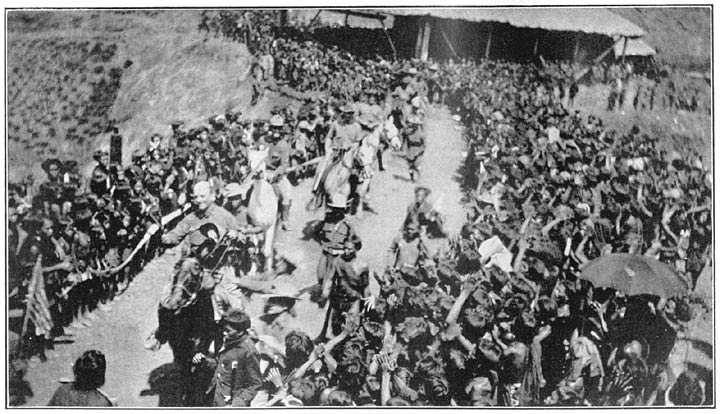
Governor-general Forbes in the Wild Man’s Country
Mr. Forbes has made frequent trips through the wild man’s country in Northern Luzon, and knows it from end to end. Its people know and like him. This photograph shows a crowd of Ifugaos welcoming him on his arrival at Banaue in May, 1913. They are clapping their hands over their heads in true Ifugao fashion.
Worse yet, information was sent to the Spaniards of the proposed American attack on the 13th instant, as is shown by the following letter:—
“(Battalion of Cazadores, No. 2. Expeditionary. Office of the Lieutenant-Colonel. Private.)
“My Dear Sir: I have received to-day your kind letter giving warning of the attack on Manila, and I thank you for your personal interest in me, which, on my part, I reciprocate. I assure you that I am yours, most truly and sincerely,
“Luis Martinez Alcobendas.
According to Taylor, this was not the first occurrence of this sort. He says:—
Taylor continues:—
The feeling toward the American troops at this time is further shown by a telegram from General Pío del Pilar, sent from San Pedro Macati on August 10, 1898:—
This is perhaps not quite the kind of coöperation that Admiral Dewey and Generals Anderson and Merritt had expected.
Of conditions at this time, Taylor says:—
“On July 7, Aguinaldo appointed Artemio Ricarte and Pantaleón García to negotiate the surrender of Manila by the Spaniards to him (Exhibit 155). On July 5 Pantaleón García was planning to enter Manila by way of Tondo or of Santa Cruz (P.I.R., 243.7). On the 9th Aguinaldo ordered that rice should be gathered from the towns of Manila Province for the use of his troops in the decisive attack upon Manila which he intended making in a few days (P.I.R., 1087. 5).
There was certainly no need of Insurgent assistance in the assault on Manila.
The reports which reached Aguinaldo that the surrender of Manila had been agreed upon in advance were correct, as is shown by the following testimony of Admiral Dewey:
“Admiral Dewey. Several days before.
“Senator Patterson. To whom did you communicate the arrangement that you had?
“Admiral Dewey. General Merritt and, of course, all of my own captains—General Merritt, and I think a council of officers on board of one of the steamers. I think there were several army officers present when I told the General that; and I may say here that I do not think General Merritt took much stock in it.
“Senator Patterson. What statement did you make to them, Admiral, in substance?
An endorsement written by Mabini and signed by Aguinaldo on the above paper reads:—
Naturally, trouble followed. At 1.30 P.M. General Ricarte telegraphed to Aguinaldo:—
Apparently about the same hour he wired more at length, as follows:—
At 3.52 he wired again:—
At 5 P.M. another was sent by Ricarte to Aguinaldo as follows:—
At 6.15 P.M. he telegraphed as follows:—
No attention was paid to General Anderson’s request that the Insurgent troops should not enter Manila without permission. They crowded forward with and after the American forces. Coming out on Bagumbayan drive, they found American and Spanish troops confronting each other but not firing, the former on the drive, the latter on the neighbouring city wall. A flag of truce was waving from the south bastion, nevertheless the Insurgents fired on the Spanish forces, provoking a return fire which killed and wounded American soldiers. Of this incident General Greene has said:—
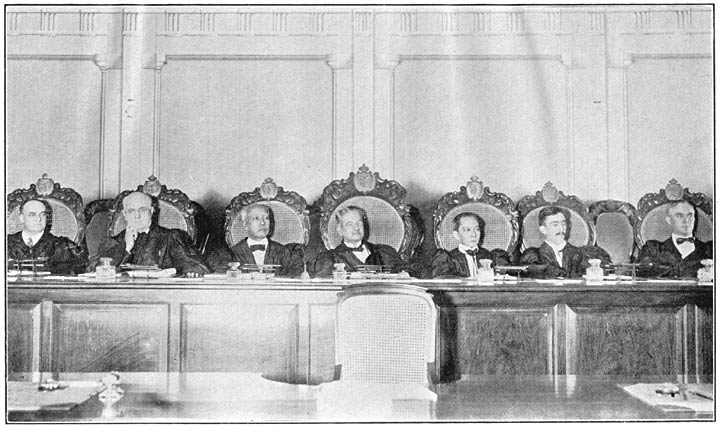
The Philippine Supreme Court
From left to right, Justice Moreland, Justice Johnson, Justice Torres, Chief-Justice Arlleano, Justice Mapa, Justice Carson, and Justice Trent.
Some of these matters must have come to the attention of General Anderson, for he sent Aguinaldo a telegram, received by the latter at 6.35 P.M., as follows:—
“Dated Ermita Headquarters 2nd Division 13 to Gen. Aguinaldo. Commanding Filipino Forces.—Manila, taken. Serious trouble threatened between our forces. Try and prevent it. Your troops should not force themselves in the city until we have received the full surrender then we will negotiate with you.
In view of the known facts, how absurd becomes the following contention of Aguinaldo, advanced in his “Reseña Verídica:—
On August 14 Aguinaldo telegraphed General Anderson as follows:—
Aguinaldo and his associates pressed the demand for joint occupation. On August 13 Admiral Dewey and General Merritt informed the government that since the occupation of Manila and its suburbs the Insurgents outside had been insisting on this, and asked how far they might proceed in enforcing obedience in the matter.
They were informed by a telegram dated August 17 that the President of the United States had directed:—
This left the military and naval commanders no option in the premises, and in any event dual occupation was out of the question because of the lawlessness of the Insurgent troops.
The Insurgents promptly demanded their share in the “war booty,” and asked certain other extraordinary concessions as follows:—
“(4) Our sacrifices in coöperating in the siege and taking of Manila being well known, it is just that we should share in the war booty.
“(5) We demand for our use the palace of Malacañang and the Convents of Malate, Ermita and Paco or San Fernando de Dilao.
“(6) We demand that the civil offices of Manila be filled by North Americans and never by Spaniards; but if General Merritt should require some Filipinos we should be pleased if he will grant our President, Don Emilio Aguinaldo, the favour of recommending select and skilled Filipinos. The jurisdiction of the authorities of Manila shall not be recognized beyond the municipal radius.
“(7) The American forces shall not approach nor penetrate our military positions without permission of the respective commanders thereof and shall evacuate all the positions which they occupy at the present time beyond the municipal radius; Spaniards who pass our lines without permission of the commander will be considered as spies.
Under the instructions of the President these demands could not be acceded to. Nor could they have been acceded to had there been no such instructions. In this connection the following extract from General Jáudenes’s cablegram for June 8th to his home government is highly significant:—
It would seem that the population of the suburbs did not have a high idea of Insurgent discipline.
That their apprehensions were not groundless is shown by a passage in a letter sent the following day to Governor-General Augustin by Buencamino:—
Don Felipe knew his own people. He also knew, none better, what they had in mind at this time.
As it was the Insurgent forces made the most of such opportunity as they had, and their own records show it.
Some time during this month Sandico wrote Aguinaldo as follows:—
Evidently Sandico continued to interest himself in the matter of preventing disorder, for on September 24, 1898, he wrote Aguinaldo from Manila as follows:—
“By authority of General Don Pío del Pilar and accompanied by the War Auditor, Señor Urbano, we entered a prison where the individuals Mariano de la Cruz and Mariano Crisóstomo were kept. They were almost prostrated. They had lately been released from Bilibid where they had been confined for political crimes. On being asked the reason for their imprisonment they began by showing us their bodies from which blood still issued as the result of the barbarous treatment received from Major Carmona who, by the way, is the same person of whom I spoke to you in one of my previous letters; I declared to you then that he had assaulted, revolver in hand, a man in the middle of one of the most frequented streets of the suburb of Paco on pure suspicion.
“The prisoners in question stated that if they admitted the accusations made against them it was for fear of greater punishments promised by said Major. The officer of the guard took the liberty of striking with his fist the one who dared to express himself so.
“I take the liberty of calling your attention to the matter in question and other abuses in order that the measures you may think fit be adopted to remedy this evil. In fact, we are making a target of ourselves in the sight of all nations, especially so in that of the Americans who note any act of ours and judge us secretly now in order to do so later in public. To make light of this is to plant a seed of future injury to us, because many will desire to place themselves under the protection of the American flag, seeing that ours refuses to defend the citizens’ individual rights.
Murder, pillaging, torture of prisoners, kidnapping, theft—these are not pleasant things, but they continued to occur, and Aguinaldo, who apparently desired to prevent them, was powerless to do so. He did not dare discipline General Pío del Pilar, nor remove him from the vicinity of Manila, and the soldiers of that officer continued to work their will on their own unfortunate and helpless people.
Aguinaldo at first flatly refused to direct the disorderly Insurgent forces to leave Manila. The American commander showed great forbearance and negotiations continued.
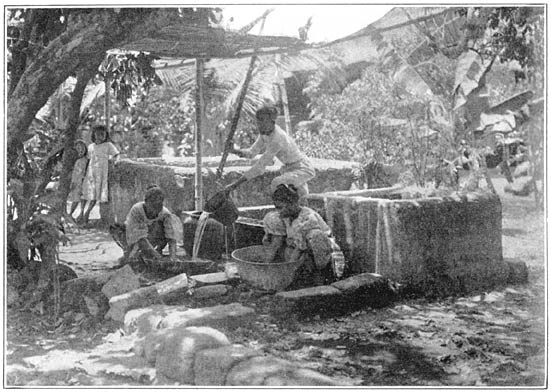
An Unsanitary Well
This is a typical old-style well, with the family washing going on beside it. Under such circumstances infection of the well water invariably resulted.
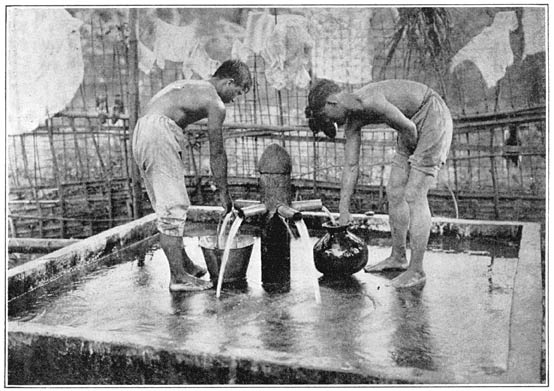
A Flowing Artesian Well
There is no way in which the water from such a well can become infected. More than eight hundred fifty have been sunk, and the death rate in some towns fortunate enough to possess them has fallen off fifty per cent, as a result.
While negotiations were pending General Merritt sent Major J. F. Bell to Aguinaldo with a letter and also with a memorandum in which were the words:—
“In case you find Aguinaldo inclined to be generous in his arrangements with us, you may communicate to him as follows: ...”
There follow six paragraphs, of which the third is of special importance. It reads as follows:—
Relative to the italicized portion of this statement Major Bell says:—
Aguinaldo ordered that the machinery of the water works be started up at once, a thing which was very necessary as Manila was suffering from lack of water. I should be glad if I could leave this matter here, but I cannot, for Major Bell elsewhere makes the further statement:—
Let us hope that Major Bell misunderstood General Merritt’s intention. If this is not the case, I must say in all frankness that in my opinion it was General Merritt’s intention to indulge in sharp practice.
Obviously, the American naval forces did not find Aguinaldo in any “condition,” in the sense in which General Merritt uses the term. On the contrary, they brought him from Hongkong and assisted him in starting a revolution. The negotiations in question were relative to the positions held by the Insurgents at the time the negotiations took place, and General Merritt’s promise could not legitimately be interpreted to refer to anything else.
Had Aguinaldo accepted his offer, a most embarrassing situation would have resulted. General Merritt was obviously not authorized to make such a proposition in the first instance, and the only honourable course left open to him would have been to advise Washington of his improper action and beg the Government to support him in it and thus save the honour of the country.
Fortunately, Aguinaldo did not act upon the promise nor accept the offer. On the contrary, he promptly and indignantly denied that he was committed to anything, and sought to impose new conditions which were not acceded to.
Meanwhile some one doubtless got hold of General Merritt and called his attention to the fact that in making this offer he had grossly exceeded his authority, for in his reply to Aguinaldo’s protest General Merritt says:—
Coming, as this statement did, after the offer made in the memorandum hereinbefore referred to, it must have aroused the suspicions of Aguinaldo and his associates, and in my opinion Merritt’s conduct in making such a proposal in the first instance was inexcusable.
Before he could terminate the negotiations which followed he was called away, and turned this matter, together with other unfinished business, over to his successor, General E. S. Otis.
On August 31, 1898, the latter official wrote to Aguinaldo as follows:—
“General Aguinaldo, Bacoor:
“Referring to promise made by General Merritt to reply to your letter of August 27 within four days, I desire to state that he was unexpectedly ordered away and had not opportunity to reply. Being unacquainted with the situation, I must take time to inform myself before answering, which I will do at the earliest opportunity.
“Otis.”
On September 8 General Otis wrote Aguinaldo a long letter fully discussing the whole situation in the light of the complete information which he had meanwhile obtained. Since so much has been made of this incident by Blount and others, I invite attention to the following extracts from General Otis’s letter, which embody a fair and judicial statement of the conditions which existed:—
“You designate certain lines within the suburbs of the city of Manila, to which you promise to retire your troops, and name as conditions precedent: First, protection to your shipping by the United States Navy, and the free navigation of your vessels within the waters in United States occupation; second, restitution to your forces of all positions which are now occupied by your troops, in the event that treaty stipulations between the United States and Spain surrender to the last-named government the territory occupied by the former; and thirdly, that United States troops now occupying positions beyond the lines you name shall retire within the same.
“A discussion of your proposition to hold, jointly, with the United States Government, the city of Manila, involves consideration of some of the other concessions you desire to be made, and to that I will at once refer. I wish to present the matter, in the first instance, in its legal aspect, although, from remarks contained in former correspondence, I am of the opinion that you are fully aware how untenable the proposition is. The United States and Spain were and are belligerent parties to a war, and were so recognized by the civilized world. In the course of events the entire city of Manila, then in full possession of Spanish forces, was surrendered to the first-named belligerent power. The articles of agreement and capitulation gave the United States Government full occupancy of the city and defences of Manila, and that Government obligated itself to insure the safety of the lives and property of the inhabitants of the city to the best of its ability. By all the laws of war and all international precedents the United States authority over Manila and its defences is full and supreme, and it cannot escape the obligations which it has assumed.
“But conceding, as you do, the strictly legal right of my Government to hold and administer the affairs of the city of Manila and its suburbs (I thus conclude from expressions contained in former correspondence and from my appreciation of your intellectual attainments), you base your proposition—a joint occupation—upon supposed equitable grounds, referring to the sacrifices your troops have made and the assistance they have rendered the American forces in the capture of Manila. It is well known they have made personal sacrifices, endured great hardships, and have rendered aid. But is it forgotten that my Government has swept the Spanish navy from the seas of both hemispheres; sent back to Spain the Spanish army and navy forces, recently embarked for your destruction, and the secure holding of the Philippine possessions; that since May 1 last its navy has held the city of Manila at its mercy, but out of consideration of humanity refused to bombard it, preferring to send troops to demand surrender, and thereby preserve the lives and property of the inhabitants? Is it forgotten that the destruction of the Spanish navy and the retention of Spanish armed men in its European possessions has opened up to you the ports of the Island of Luzon and held Spain helpless to meet its refractory subjects?
“Apart from all legal and equitable considerations, and those having their origin in personally conceived ideas of justice, I wish respectfully to call your attention to the impracticability of maintaining a joint occupation of Manila and its suburbs, and in this I know that I shall have the approval of your excellent judgment. It would be extremely difficult to prevent friction between our respective forces, which might result in unfortunate consequences, labor as we may for continued harmonious relations. Located in close proximity, irresponsible members of our organizations, by careless or impertinent action, might be the means of inciting grave disturbances; and in this connection I call to your attention the recent shooting affair at Cavite, which still requires investigation. There might also arise conflict of authority between our subordinate officers. Even now, within precincts in entire actual possession of our troops, I find that permits are given to citizens, who are styled local presidents, to make arrests, to carry arms, etc., in violation of our instructions and authority, and that several cases of kidnapping have taken place. In pursuance of our obligations to maintain, in so far as we can, domestic tranquillity, our officers have arrested suspected parties, and they have asserted (with what element of truth I know not) that the insurgent forces are the offenders. I have declined to accept their statements, as I prefer to believe the contrary, although it would appear that officers connected with those forces have issued the permits to which I allude. Such interference with our administration of civil affairs must eventually result in conflict.
“... And here permit me to remark upon a view of the subject you have advocated in support of the plea for dual occupation of the city’s suburbs. Your forces, you say in substance, should have a share in the booty resulting from the conquest of the city, on account of hardships endured and assistance rendered. The facts on which you base your conclusion granted, your conclusion, under the rules of war which are binding on my Government, does not follow, for it has never recognized the existence of spoils of war, denominated ‘booty,’ as have many European governments. No enemy’s property of any kind, public or private, can be seized, claimed by, or awarded to, any of its officers or men, and should they attempt to appropriate any of it for their individual benefit, they would be very severely punished through military tribunals, on which have been conferred by law very sweeping jurisdiction. The enemy’s money and property (all that is not necessary to be expended in administering local affairs in the enemy’s territory) must be preserved for final arbitrament or settlement by and between the supreme authorities of the nations concerned. My troops cannot acquire booty nor any individual benefit by reason of the capture of an enemy’s territory. I make this comment, believing that you hold erroneous opinions in respect to individual advantages which occupation bestows.
“I request your indulgence while I briefly consider the concessions you ask us to make as conditions precedent to the retirement of your forces to the lines indicated by your note of the 27th ultimo.
“The first is: Protection to your shipping and free navigation to your vessels. Neither the extent of protection nor the limit of free navigation you request is understood. Certainly you could not mean protection on the high seas, or in the ports not in the rightful possession of the United States. That, as you are fully aware, could only be effected by treaty, or guarantee, following international recognition of the belligerent rights of the Philippine revolutionary government. While the existing armistice continues, the United States are in rightful possession, in so far as the navigable waters of the Philippine Islands are concerned, only of the bay of Manila and its navigable tributaries. Within the same all vessels of trade and commerce and the war vessels of recognized national powers sail freely as long as the sovereignty of my Government is not assailed nor the peace of the locality threatened. In this respect, whatever concessions are extended by way of relaxation of trade restrictions, incident to war, to the citizens of these islands will be extended to all alike, and discrimination in this regard is neither intended nor permitted. Admiral Dewey exercises supervision over all naval matters, and they are in no way related to the duties conferred upon me by law. Nor would it avail should I seek his consent for greater latitude of action, for even if disposed to grant special concessions he could not do so, and I doubt if the supreme authority of my Government could now, under the prevailing truce with Spain, invest him with the requisite powers to do so and at the same time preserve its international obligations.
“The second concession named by you is restitution of positions in the city of Manila to your forces, in case the treaty of peace remands to Spain the territory surrendered under the late capitulatory articles; and the third and last is a promise to retire our troops within the lines indicated by you, as the lines on which you desire your troops to remain permanently. These propositions, having a kindred nature, may be considered together, and, indeed, have already been impliedly answered. From previous statements of facts and logical conclusions made and stated in this communication, concerning the nature of the obligations resting on the United States with regard to the territory to which they have the legal right of possession under contracting articles with Spain, it is evident that neither in law or morals can the concessions be made. I would be powerless to grant them in any aspect of the case, being nothing more than an agent to carry out the instructions of the executive head of my Government and not being vested with discretionary power to determine matters of such moment. In the present instance I am not only powerless to accede to your request, but have been strictly enjoined by my Government, mindful of its international promises and national honour, which it has never broken nor sacrificed, not to accede joint occupation of the city and suburbs of Manila and am directed specially to preserve the peace and protect persons and property within the territory surrendered under the terms of the Spanish capitulation. These mandates must be obeyed.
“Thus have I endeavoured with all candor and sincerity, holding nothing in reserve, to place before you the situation as understood by me, and I doubt not by the Republic which I represent. I have not been instructed as to what policy the United States intends to pursue in regard to its legitimate holdings here, and hence I am unable to give you any information on the subject. That it will have a care and labor conscientiously for the welfare of your people I sincerely believe. It remains for you, beneficiaries of its sacrifices, to adopt a course of action which will manifest your good intentions and show to the world the principles which actuate your proceedings.
“It only remains for me to respectfully notify you that I am compelled by my instructions to direct that your armed forces evacuate the entire city of Manila, including its suburbs and defences, and that I shall be obliged to take action with that end in view within a very short space of time should you decline to comply with my Government’s demands; and I hereby serve notice on you that unless your troops are withdrawn beyond the line of the city’s defences before Thursday, the 15th instant, I shall be obliged to resort to forcible action, and that my Government will hold you responsible for any unfortunate consequences which may ensue.
“In conclusion, I beg to inform you that I have conferred freely with Admiral Dewey upon the contents of this communication and am delegated by him to state that he fully approves of the same in all respects; that the commands of our Government compel us to act as herein indicated, and that between our respective forces there will be unanimity and complete concert of action.”
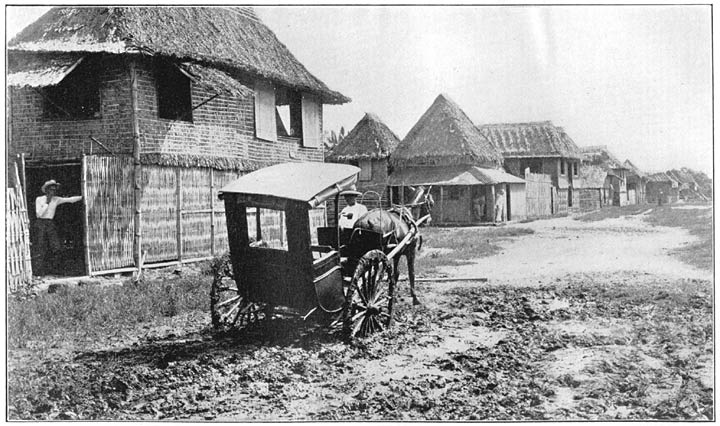
An Unimproved Street in the Filipino Quarter of Manila
The condition of the streets formerly made it impossible to remove night-soil and garbage from this district, and cholera was rampant there when this photograph was taken.
This calm and temperate discussion of the situation, coupled with the firm statement of intention with which it closed, produced a decided effect on Aguinaldo. Concerning the events to which it led, General Otis has made this statement:—
“On September 13, a commission sent by Aguinaldo and consisting of three members, one of whom was the treasurer and another the attorney-general of the insurgent government, called for the purpose of discussing the subject of my letter of the 8th. They asked me to withdraw it and simply request in writing that the insurgent troops retire to the line designated by General Merritt, which I refused to do, stating that unless they withdrew as directed we would be obliged to resort to force. They then asked that I withdraw the letter and issue a request unaccompanied by any threat to use force, as Aguinaldo was fearful that he would be unable to remove his troops upon a demand. To which I replied that the letter of the 8th instant would stand. They then said that as the demands of that letter must remain unchanged, the insurgents would withdraw as directed therein, but that if I would express in writing a simple request to Aguinaldo to withdraw to the lines which I designated—something which he could show to the troops and induce them to think that he was simply acting upon a request from these headquarters—he would probably be able to retire his men without much difficulty; that, of course, they themselves understood the direction to withdraw, which would be obeyed, and thereupon repeated their desire to obtain a note of request, whereupon I furnished them with the following:—
“‘Office U. S. Military Governor in the
“‘Philippine Islands,
“‘Manila, P. I., September 13, 1898.
“‘The Commanding General of the Philippine Forces:
“‘Sir: Referring to my communication of September 8, I have the honour to inform you that I have had a most agreeable conversation with certain gentlemen who are in the interests of your revolutionary government upon the matters therein contained. We have discussed at length the complications now existing, which will exist, and will doubtless increase, while our troops continue to occupy jointly certain districts of the city of Manila. I have urged upon them the necessity of the withdrawal of your troops in order that the friendly relations which have always been maintained by and between them and the forces of the United States Government may be perpetuated. I am sure that the gentlemen fully appreciate my sentiments and will clearly report them to you. May I ask you to patiently listen to their report of our conversation?
“‘It is my desire that our friendly intercourse and mutual amicable relations be continued; that they be not jeopardized if we can by consistent action avoid it, and such, I am certain, is the desire of yourself and associates.
“‘May I ask, therefore, that you withdraw your troops from Manila?
“‘Permit me to add in conclusion that I have that confidence in your ability and patriotism which will lead you to accede to this request.
“‘I am, with great respect, your most obedient servant,
(Signed) “‘E. S. Otis,
“‘Major-General, U. S. V.,
“‘United States Military Governor in the Philippines.’
“In reply to which, on the 16th, the following was received:—
“‘Malolos, Bulacan, September 16, 1898.
“‘The Commanding General of the American Forces:
“‘My Dear Sir: Referring to your esteemed communication, dated the 13th instant, I have the honour to inform you that I have given appropriate orders that my troops should abandon their most advanced positions within some of the suburbs, and that they should retire to points where contact with yours would be more difficult, in order to avoid all occasion for conflict.
“‘I hope that by these presents you will be fully convinced of my constant desire to preserve amicable relations with the American forces, even at the risk of sacrificing a part of the confidence placed in my government by the Philippine people.
“‘A consideration of my many occupations will serve to excuse me for not having answered with the promptness desired.
“‘Your very respectful servant,
(Signed) “‘Emilio Aguinaldo.’
I have given the facts thus fully for the reason that this is the one instance I have found in which a promise was made, fortunately in the form of an offer which was not accepted, and then withdrawn. It has seemed to me that the reasons why General Merritt should never have made it, and why General Otis could not possibly have renewed it, should be fully set forth.
On September 7, 1898, General Otis had cabled to Washington that Admiral Dewey and he considered conditions critical, and that the number of armed Insurgents in the city was large and rapidly increasing. He stated that on the 8th he would send a notification to Aguinaldo that unless the latter’s troops were withdrawn beyond the line of the suburbs of the cry before September 15 he would be obliged to resort to forcible action and that the United States would hold Aguinaldo responsible for any unfortunate consequences which might ensue.
Aguinaldo still hoped to obtain recognition of his government by the United States, but did not consider such recognition probable, and pushed preparations to attack if a favorable opportunity should offer.
Before occupying ourselves with these preparations, let us briefly review the results of our investigations as to Insurgent coöperation with the American forces up to this time.
Taylor has made the following excellent summary of the case:—
“Up to this time Aguinaldo had continued a desultory warfare with the Spanish troops in Manila. That none of his attacks were very serious is shown from the Spanish reports of casualties; but although he had failed to secure the surrender of the city to himself, he had kept its garrison occupied and within their works. The American force on land was now strong enough to begin offensive operations. So far the relations between the Americans and Aguinaldo had not been really friendly. They were in his way, and yet he could not break with them, for he hoped to use them for the attainment of the designs which he had by this time frankly declared. The Americans had listened to these declarations, and had not answered them, nor was it possible to answer them. The American forces were there under the instructions of the President to make war on Spain and to establish a military government in the Philippines. Aguinaldo had declared himself a dictator and the Philippines independent. To have recognized him in his civil capacity, to have dealt with him in his civil capacity, would have meant a recognition of his government by the military commander in the field—a thing impossible and unlawful. Officers of the United States forces are not empowered to recognize governments; that function is reserved to the President of the United States; and in this case he, in his orders to the Secretary of War, dated May 19, copies of which were forwarded to General Merritt for his guidance, informed him that the army of occupation was sent to the Philippines ‘for the twofold purpose of completing the reduction of the Spanish power in that quarter and of giving order and security to the islands while in the possession of the United States.’ These instructions contemplated the establishment of a military government in the archipelago by military officials of the United States.
“it is true that in spite of the date of these instructions General Merritt in San Francisco had received no copy of them on August 28, three days after the departure of General Anderson, and what that officer knew of them could only have been what General Merritt remembered of the contents of an unsigned copy of them shown him at the White House, but they were in accordance with the practice of the United States Government in occupying conquered territory, that practice General Anderson well knew, and his relations with Aguinaldo were guided by it.
“It has been claimed that Aguinaldo and his followers received the impression at this time from their conversation with American officers that the United States would undoubtedly recognize the independence of the Philippines, and that the cooperation of the insurgents was due to this impression. There was no cooperation. That he attempted in vain to secure the surrender of Manila to himself was not cooperation. That he refrained from attacking the Americans and occasionally permitted them to be furnished supplies, for which they paid, was not cooperation. The fact that for a time their plans and his plans were parallel does not mean cooperation. Aguinaldo was forced by the exigencies of the situation, by the necessity of strengthening his hold upon the people, by the necessities of his operations against the Spaniards, to make Spaniards and natives alike believe that all that he did was with the aid of the Americans by whom he would be supported in all his acts. He needed their support, and if he could not obtain that he needed the appearance of their support for the attainment of his ends; and this he was forced to purchase by compliance, or apparent compliance, with their demands. But his compliance with them, as all American officers serving there well knew, was never willing, was never complete, and was never given except under pressure. It is true that writers upon the subject, speaking with the confidence which is born of insufficient and incomplete information, assure their readers that any government but that of the United States, any colonial administrators but Americans, would have been able to obtain the hearty cooperation of Aguinaldo and his followers by judicious concessions to them at this time. The only concession which would have obtained that hearty cooperation would have been the recognition of the independence of the Philippines under a United States protectorate, of Aguinaldo clothed with the plenitude of the powers of the Katipúnan as dictator, and a promise to promptly withdraw from the islands. This promise the Government of the United States could not make. Until the ratification of a treaty of peace with Spain the insurgents of the Philippine Islands were rebellious subjects of Spain, and with them, except as fighting men, no relations could be had.
“General Merritt saw this and the necessity for immediately taking such steps as would lead to his occupation of Manila. With the arrival of the third expedition he was able to pass through the insurgent lines between Camp Dewey and Manila, for he had sufficient force to accept no refusal from Aguinaldo.
“In his report he said that the insurgents had obtained positions of investment opposite the Spanish lines along their full extent, and that on the bay front their lines ran within 800 yards of San Antonio Abad. The approaches to the beach and village of Pasay were in their possession.
All that the Insurgents and the Americans ever had in common was an enemy. They each fought that enemy in their own way. There was no coöperation. On the part of the Insurgents there was treachery. I will submit further evidence of this fact.