Volume 29 — Bañuelos y Carrillo’s Relation
Reading edition
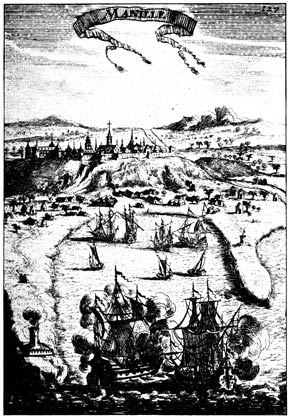
View of city of Manila; photographic facsimile of engraving in Mallet’s Description de l’univers (Paris, 1683)
[From copy in Library of Congress]
Although that Parián is built only of wood, and the Chinese who live there have no weapons, we do not fail to keep a strong guard on that side. We even have some pieces of artillery pointed toward that city, for the Chinese are a very spirited and bold nation. We have experienced that heretofore, and are still threatened [with danger] in that hour that we are not so closely on our guard. There is no Spanish house where nine or ten of these merchants cannot be seen every morning, who take their merchandise there; for all the traffic passes through their hands, even all that is used for the sustenance of the Spaniards. There are some men who say that they mix a slow poison in our food, which works its effect chiefly on the women. It is a fact that a woman who reaches the age of twenty-six years is seldom seen. Those persons add that their intention in doing that is to prevent the Spaniards from fortifying themselves more strongly in that island, and that the Chinese would drive them out entirely. That would be very easy for them, by employing such means, if it were not for the interest that they have in the commerce of the silver of Nueva España. These people have a subtle and universal intelligence. They imitate whatever one presents to them, and they make the article as well as do those who invented it. The riches of Manila, and the felicity of existence there, are steadily decreasing. I shall relate here the causes for it, having regard only to the service of God and of the king.
The chief cause for the ruin of these islands is the great trade that the Sangleys carry on. The king has permitted the inhabitants of the Manilas to export a portion of their capital to Nueva España. in the merchandise of that country. The Spanish inhabitants daily lend their names to those Sangleys and to the Portuguese of Macao, so that they may enjoy the freedom of that commerce. These people do not attempt to hide the fact that they are acting as agents for the inhabitants of Mexico; and these last years they sent such a quantity of merchandise to Peru and to Nueva España that no sale could be found for it. That is a hindrance to the voyages of the trading fleet. The king of China could build a palace with the silver bars from Peru which have been carried to his country because of that traffic, without their having been registered, and without the king of España having been paid his duties, as has been well shown by Dom Pedro de Quiroga y Moya. That silver was sent at the account of influential persons, who do not reside at the Manilas. The two vessels which left in his time paid more duties to the king than all the other ships put together which had made that voyage before; that clearly shows the neglect of the other officials commissioned to receive the duties from his Majesty. They have attempted to conceal this truth, by saying that those ships were richer than the others because Dom Sebastian Hurtado de Corcuera had written, in the preceding year, that he would not send the vessels that year; and that he had even detained and caused the unlading of those that had been on the point of sailing on the voyage to Acapulco. I do not know his reason for so doing, but I know well that he wrote that resolution at the Embocadero of Manila—that is to say, eighty leguas from the city—and that without having consulted the inhabitants of the Manilas. Those of the country are agreed that that delay has been their ruin; for they all know that they cannot maintain themselves against the Dutch or against the Mahometans except by means of the regular succor that is sent them from Nueva España.
They report another reason for obscuring so apparent a truth. They say that Don Pedro de Quiroga had specified among the orders that he had drawn up as a remedy for the disorders of the past, that for those ships; and that it was he alone who prevented their sailing. But he himself says that that is false, and that he had heard that those who had encomiendas [Fr., commanderies], and the merchants of Mexico, had resorted to entreaties to Don Sebastian Hurtado de Corcuera (for I cannot believe that they were in compact with him); and that they had represented to him the great quantity of Chinese merchandise then in Mexico, and declared that, if new vessels were sent there, a market could not be found for that merchandise, and that the merchants of Mexico and Nueva España would lose a great amount by it.
Don Pedro de Quiroga adds that having learned that the governor of the Filipinas had given his word not to have any new vessels sail, in order to better carry out his Majesty’s service, he had employed this expedient—namely, that if they entered the port that year, they would enjoy the benefit of the rules which had been made during that time; but that, if they came only the following year, they would not enjoy these, and that they would pay the king’s duties in all strictness. That plainly showed that he was advised of the promise which the governor of the islands had given to the merchants of Mexico, to detain the vessels and the merchandise that ought to have been sent that year. The transaction was, in truth, greatly to the interest of the inhabitants of Mexico, and of the Spaniards who have encomiendas—although to the great prejudice of the islands, which cannot get along without the reënforcement which they ought to have annually from Mexico; and to the decrease of his Majesty’s duties, which are an aid in the discharge of the expense for that succor. In fine, if the marqués de Cadereta had not reënforced the islands as powerfully as he did, they would have fallen into extreme need. It would be easy for me to show here other consequences of that delay of the vessels which Don Juan Cereço y Salamanca had prepared to sail that year, as is done every year; and it will not be more difficult for me to demonstrate the other damages that we suffer in that commerce. The inhabitants of the Manilas have nothing on those vessels; their cargoes belong entirely to the Chinese, to the Portuguese of Macao, or to the Mexican merchants. If the king does not put a stop to it, the Chinese will absorb all the riches of Peru, and the subjects of the king in those islands will be forced to abandon them. I will go on to represent to your Excellency the other disorders in the government of those islands, as far as I have been able to learn them in the short time that I have spent there.
We have also as enemies the people of Jolo and those of Terrenate, who are also more to be feared on account of the help that they get from the Dutch. They declare themselves neutral, but they help the Dutch underhandedly on all occasions. The chiefs of those Indians take the title of kings, but they are among the kings who go quite naked and who live by their labor. True, those of Macassar, of Cochinchina, and of Cambaya, are more powerful. But for all that, it would be enough for us, for the little help that we can get out of them, to become the arbitrator of their differences, and thus to keep them favorable to our side. But since they have seen that we have made this friendship with the Sangleys, with the inhabitants of Martavan, of Borneo, and other neighboring islands, they have broken off all trade with us, and have begun to take all the products of their country to the Dutch, so that they do nothing except at their orders. If for that reason also the king does not prevent the trade with the Sangleys, the Filipinas are lost. I come now to the remedy that can be applied to this disorder.
Among all those one hundred and fifty families who are settled at Manila, there are not two who are very rich. My plan would be to allow those inhabitants to export Chinese merchandise to the value of two hundred and fifty thousand escudos, the greater part of which should be raw silk and cotton bolls, so that they could be manufactured in this country [i.e., Mexico]. For there is less [chance for] trickery in that sort of merchandise than in the stuffs manufactured in China, which ought never to be allowed to be taken to Manila. The permission of trade to that sum would also be proportioned to the ability of the Manila merchants; and they would get more than five hundred thousand escudos in return for it, for the profits of that trade are exorbitant. Today even, when there is so much of this merchandise, four hundred per cent is gained on the poorest quality exported. By that means the Spaniards could be employed in manufacturing that silk, the textiles would be better, and they would secure innumerable other advantages. Accordingly, the inhabitants of the Manilas would not charge themselves with the commissions of Mexico, and they would get all the profit derived from those islands, which is now quite universally in the hands of foreigners. Further, as their affairs in the country became more prosperous, they would become more interested in its conservation; and they would be more careful to have the Indians, who have been assigned to them in encomiendas, instructed and held in subjection. They would save what they give to their agents in Mexico, who often ruin them. They keep their merchandise two or three years, and it has a poor sale in Mexico, because of the great quantity that is taken there; and trading only at Acapulco, and conducting their own business, they alone would enjoy, and that every year, the profits of that traffic.
Fifty thousand escudos could be employed in white mantas, unbleached [cruës] and of excellent quality; that is a kind of merchandise very largely used among the Indians, and Mexico has great need of it. That would be the right commerce that ought to be carried on by pilots and sailors; for some of it can always be sold, and those people are obliged to sell it quickly. Care must be taken that only that quantity be carried, and that any surplus be confiscated; and the governors and other officials should be very careful in this. In order that your Excellency may see that I am not trying to weaken the commerce of those islands, as some might believe, I will state here that the inhabitants of the Manilas should be allowed to export as many shiploads as possible of the products of their country—such as wax, gold, perfumes, ivory, and lampotes. Those they would buy from the natives of the country, thus preventing them from carrying those goods to the Dutch. Thus would the people become friendly, and would supply Nueva España with that merchandise; and the silver taken to the Manilas would not be exported thence. I may be told that the king of China does not use that silver to make war on us; but even if it is used only to swell his treasury, it is as lost to us as if it were at the bottom of the sea. Your Excellency should consider that one and one-half millions in gold are sent annually to China. If what I have just said be closely observed, the merchandise of the Manilas will be sold to good advantage, and the natives of the country will become our friends; while their neighbors will leave the Dutch, who are deriving heavy profits from them; for there is scarcely a place in those islands where the Dutch do not possess a factory. Thus have they become the masters, and they give arms to the natives to make war on us. Add to all these considerations that the Spaniards inhabiting the islands will not be obliged to be continually on their guard because of twenty thousand Sangleys or enemies, whom they have in a corner of the world where the Spaniards can muster scarcely eight hundred men.
Perhaps your Excellency will be told that, if we break with the Sangleys, they will go to live in the island of Formosa, or in some other place among the Dutch, and will carry to them the trade that they have with us; and that, having enjoyed the trade of Japon as conveniently as we have that of the Western Indias, they will still carry their merchandise to Nangazaki, the chief port of Japon, from which they will also obtain silver. To that I will reply that the kingdom of China is so full of merchandise, and the Sangleys are so shrewd in commerce, and so keen after gain, that they know what quantity of that merchandise is needed by the English, how much by the Dutch, and what quantity ought to be sold in all of Japon—and that with so great exactness that a tailor, after once seeing the figure of a person, decides how much goods is necessary to clothe him. They do the same in regard to us, and, knowing that only two ships sail annually to Nueva España, they generally have in the Parian the quantity necessary to lade those ships. If the inhabitants of the Manilas had trade with Japon, they would derive great profit from it; but a secret judgment of God has broken the communication that we had with those islanders, and has given it into the hands of the heretics, after having permitted them to destroy our churches there, and their having put to fire and sword all the Spaniards or Japanese Christians there. Hence we do not believe that a single religious is now left in all the country; and the people are compelled, under pain of death, to come to denounce those whom they know to be Christians. Our religious go there no longer, for it means certain death to them to go to Japon. The following is the manner in which that persecution was reported.
Since that time all the trade of that island has fallen into the hands of the Dutch, English, Portuguese, and Sangleys, although the king of China has forbidden the last named to have any communication with the inhabitants of Japon, under penalty of death, because the Japanese had formerly revolted against China, of which they had formed a part. But for all that, their greed for silver makes them go there as they do to the Manilas, so that Japon does not lack any of the goods that pass through the hands of those peoples. As for the silver, the Dutch do not carry any more to China or to Japon, because those countries get all the amount that they can buy by means of the Sangleys who live in the Manilas. It would be very advantageous to the inhabitants of the Manilas and to his Majesty to break off that commerce with the Chinese, and it is unnecessary to say that by that means advantageous disposition may be made of the silver of Peru and the silks of the Filipinas—for in truth the king does not find there his account; the silks would come to Mexico with greater advantage, and the islanders and his Majesty would get more profit from it, and that at the admission of all informed persons. As for the governor, he should possess the following qualities: he should be discreet; his distance from Madrid, and his authority as governor, should not make him presumptuous, but should serve rather as a check than as a cause for vanity; he should be a fine seaman, and very sedulous in despatching and making the ships sail every year. All the exports should be registered. In order that the islands be better reënforced, the ships should be of five hundred toneladas, and they should have two decks, better equipped than they have as yet been; for if they are poorly equipped they take much time in making their voyage, and have been the cause of great expense to his Majesty. Besides, the viceroy of Nueva España has been unable to make them depart by the first of April, as would be necessary. Those vessels ought only to carry seamen. The offices of the ships ought not to be sold to merchants, but given as a reward to those who have served well at sea. Great disorders have happened from that, which was the former custom, and because the offices of pilot, boatswain’s mate, and steward have been sold.
In the year 1637, when I was about to set out as admiral of the vessels that were to take the reënforcements to those islands, I went to the port of Acapulco. There I found the vessel “San Juan Bautista,” which had come that year from those islands, and which had lost its mast on the way. I endeavored to get Don Pedro de Quiroga to advise the marqués de Cadereta of the poor condition of the masts and other rigging of the vessel. He refused to permit it, and compelled me to embark, telling me that if we failed to embark by the first day of the month of April, we would run the risk of losing our voyage. While at sea, I asked the boatswain’s mate for an inventory of the sails and rigging. I found that there were no spare sails, but one single cable, and one other old cable, which was used to make fast the pieces of artillery that were rolling about the ship. Ordering him to bring me also the inventory of what there was when they left the islands, I found that it had been equipped with three spare sails, five cables, and a quantity of rigging. He answered me that the sea had carried away the sails and that the ship had lost its cables as they left San Bernardino. Without pressing him further, he confessed to me that he had used the money that had been given him for that purpose in buying merchandise, in order to discharge a debt of three thousand escudos that he had paid for his post of boatswain, but that he had not found his account in that merchandise. I endeavored to punish him. He appealed to the commander-in-chief, and the latter ordered me not to prosecute him until I should have arrived at the Manilas. At the Manilas he was excused, because they said that he had paid three thousand escudos, although he had made the king lose more than sixty thousand. Those who furnish the provisions for the crew put in food of poor quality. The pilots cram their room at the stern with merchandise, thus endangering the vessel. Had I encountered a capful of wind during that voyage, I could scarcely have finished it. I had to take a capstan at Maribeles to lift my anchor, and to make the port of Cabite, which is three leguas from that place. Thus for the twenty thousand escudos that is drawn from the sale of those offices, thirty thousand are lost, and the fleet is in danger of being lost—which means, of losing those islands. It is not sufficient to give the offices to sailors who deserve them; it is not at all necessary to compel them to perform the functions of soldiers when they have no inclination for it, or to punish them when they gamble, as is done.
It is of great importance to have galleys on these coasts; that is the means of keeping away from them the Dutch, and the Indians from Mindanao and Jolo—who do not cease to be hostile to the Spaniards, although they have neither courage nor discipline; for one Spaniard has been seen to put twenty of their caracoas to flight with only one shot from his musket. The enemy most to be feared are the Dutch, who have taken possession of that sea. It is easy to manage the oared vessels of that country, and they have been used in several emergencies to tow the vessels, which otherwise would have been in danger of being wrecked. Besides, those boats are more suitable for a sea like that, full of islands, than vessels with high freeboard. It would also be very much to the point to have work done in Camboya in the building of new vessels, as the wood of those parts, and that of Angely, resist the seaworms and decay better than other woods, and especially those of the Filipinas.
In the year 1637, when I arrived at the islands, there were no vessels ready for Nueva España. They were obliged to send a small vessel of one hundred toneladas to advise the marqués de Cadereta of their wretched condition, and to entreat him to send the usual reënforcement—notwithstanding the prohibition of the commerce with Peru, and their knowledge that there were no vessels at Acapulco. That showed how important it is to be continually building vessels for the Filipinas, and for the governor to be a seaman rather than a soldier of the Low Countries. It is also important for the governor and the archbishop to live in harmony. The spiritual government in these countries is the one thing of greater consequence than the political government, because of the scandal that the Indians receive from it. It is also important that those sent by the viceroy be men of merit and service, and that they be well treated in the islands. The observation of all the above points will be of use to us in keeping off the Dutch, who are the most terrible enemy that we have; and who will become absolute masters of the Manilas, if they can attain their ends. España, by observing those things, will triumph over its enemies. For my part, I will fulfil my duty as a subject by doing my utmost for the service of my master, and for the welfare of my country; and at the same time I shall discharge my obligation toward your Excellency of serving you.