Volume 29 — Relation of the Filipinas Islands
Reading edition
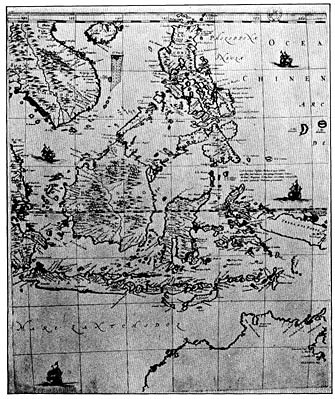
Archipelagus orientalis, sive Asiaticus (Eastern or Asiatic archipelago); photographic facsimile of map by Joannis Blaeu (Amsterdam, 1659)
[From original map in Bibliothèque Nationale, Paris]
The geographies say that there are eleven thousand islands in that great archipelago of which the Filipinas are a part, and that they are adjacent to Asia as are the Canaries and the Terceras to Africa. They cross into the torrid zone and extend along the coasts of China and India. South of them lie the Malucas, and on their northern coast, Japon. More than forty of them are subject to the king of España, the largest and most important being Manila and Mindanao. Manila is the capital of all the others, the residence of the governor and the archbishop, and the seat of the royal Audiencia. Those two islands are each six hundred miles in circuit; they are full of mountains, have rivers and dense forests, and lie in thirteen and one-half degrees north latitude. The other islands are not so large, some being one hundred miles in circuit, some fifty, and some even less. Almost all of them are inhabited by Indians, and those which are not are used by the Indians for their crops, and for the chase of deer and wild boars, and for the gathering of wax, with which the islands most abound.
The islands not yet under the dominion of the king of España have their own kings, who are Mahometans. The island of Borneo, three times greater than the whole of Italia, is the largest of all the islands. Those subject to the king of España are Manila, Zebu, Oton, Mindanao, Bohol, Leite, Samar, Mindoro, Marinduque, the island of Negros, the island of Fuegos, Calamianes, Masbat, Jolo, Taquima, Capul, La Paragua, the island of Tablas, Verde Island, Burias, Tiago, Maripipe, Panama, Panaon, Sibuian, Luban, Bantajan, Panglao, Siquior, Catanduan, Imaras, Tagapolo, Banton, Romblon, Similara, Cuio, Cagaianes, Marivelez, Poro, Babuianes, the island of Cabras (which is distant from the others), and other smaller ones.
In the islands subject to the king of España, every married man pays ten reals of tribute, and he who is unmarried five. Nearly all of them have received the gospel, and hence there are few heathen. However, in the islands of Mindanao, Taquima, and Jolo, conquered but recently, most of the people are Moros or heathen; but it is hoped that the zeal of the missionaries will convert them very soon to Jesus Christ.
All the religion of those Indians is founded on tradition, and on a custom introduced by the devil himself, who formerly spoke to them by the mouth of their idols and of their priests. That tradition is preserved by the songs that they learn by heart in their childhood, by hearing them sung in their sailing, in their work, in their amusements, and in their festivals, and, better yet, when they bewail their dead. In those barbarous songs, they recount the fabulous genealogies and deeds of their gods, of whom they have one who is chief and head of all the others. The Tagáls call that god Bathala mei Capal, which signifies “God the Creator.” The Bisayans call him Laon, which signifies “Time.” They are not far from our belief on the point of the creation of the world. They believe in a first man, the flood, and paradise, and the punishments of the future life.
There are some priests who have special communication with the devil. He speaks to them through the mouths of their little idols, and makes them believe that these are the voices of their ancestors, whom they worship. Sometimes the devil passes into the bodies of their sacrificers, and, during the short time of the sacrifice, he makes them say and do things that fill the bystanders with fear. They take that order of sacrificers from among their friends or their relatives, who wish to learn the mystery of it from them. Their blindness causes them to esteem that rank greatly, for besides the reputation and respect that that employment brings them, they also receive large offerings. All who have been present at the sacrifice make them gifts, one cotton, one gold, and one a fowl. The sacrifice takes place in their houses. The victim is now a hog, now a fowl, now some fish or rice; and the sacrifice is differently named according to the various victims. It is performed by the sacrificer stabbing the victim amid certain ceremonies, which he performs to a cadence marked by a drum or a bell. That is the time in which the devil takes possession of them. He causes them to make innumerable contortions and grimaces, after the end of which they tell what they believe they have seen or heard.
As for their persons, those people are well built, have handsome features, and are light-complexioned. They are clad in a garment that falls to the ankles, which is made of striped cotton of various colors. When in mourning, they wear white; however, that mode of dress is not so general. Those called Pintados, and those of the island of Mindanao, wear short white, yellow, or red tunics, which hang to the knees, bound in by a girdle one vara wide and two and one-half brazas long; this is, as a general rule, white or red, and always falls to the knees. They wear neither stockings nor shoes; and instead of a hat they use a bit of cloth, which they wind twice or thrice around the head. Their whole adornment consists in having very rich and beautiful necklaces, earrings, and gold rings or bracelets. They wear those bracelets above the ankle; some wear these of ivory, and others of brass. They also have little round plates three fingers in diameter, which they pass through a hole that they make in the ear. In some of those islands, the men formerly marked all the body with figures, whence comes the Spanish name “Pintados” [“pictured,” i.e., tattooed]. That operation was performed in the flower of their age, and at the period when they had most strength to suffer that torture. They had themselves adorned in that way after they had performed some illustrious deed. The masters of that art first trace on their bodies the design of the picture, which they next follow up with pricks from very sharp points, and throw on the blood which comes out a powder which never fades away. The whole of the body is not pricked at once, but bit by bit; and formerly, in order that one might have the right of making it for each part, it was necessary to perform an illustrious deed, and to show new prowess. Those pictures are pretty, and well proportioned to the portions of the body on which they are made; and, although they are of an ashen color, they are nevertheless agreeable to the sight. The children are not tattooed at all. The women do not bear the marks of that adornment except on one hand and on some part of the other. In regard to their teeth, they imitate the men in everything. They file them from their earliest childhood; some making them even in this way, others filing them into points, thus giving them the appearance of a saw. They cover the teeth with a black, glossy polish, or one that is flame-colored; and thus their teeth become black, or as red as vermilion. In the upper row, they make a little covering which they fill with gold, which shows off to advantage on the black or red background of that polish.
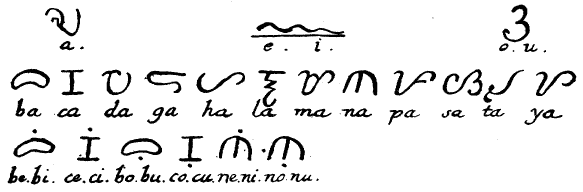
Marginal note: “The consonants not marked with any point are pronounced with ‘a;’ if they have a point above, they are pronounced with ‘e,’ or ‘i;’ if the point is below, they are pronounced with ‘o’ or ‘u.’”
Those people live in houses thatched with straw, with the leaves of trees, or with large reeds which, divided into two, serve them as a tiling. There is but little furniture to be seen in their houses. But rarely are chairs seen there, for they always sit on the ground, or on carpets made from reeds. They have neither beds nor mattresses, as their reed mats serve as both. They eat on the ground or on very small low tables, but the tables are used only among the chiefs. Banana leaves, which are one braza long and one-half braza wide, serve them as napkins. Their employment consists of agriculture, the very abundant fishing along their coasts and in their rivers, and hunting wild boars and deer with dog and spear—an employment to which their agility and their skill renders them very suitable. They also go to gather honey and wax in the mountains or in the trees, where nature has taught the bees to make both those substances.
They lose courage when they are sick. They do not use either bleeding or other remedies, except certain medicinal herbs, of which there is abundance in these islands. They use the cupping-glass; but it is not made of glass, for there is no glass in that country, but of small shells or the small horns of deer. They drink the liquor of cocoanuts after it has been kept some time in the evening damp; and that liquor is so healthful that their continual use of it keeps them from gravel, a disease of which the name is unknown among those peoples.
When anyone dies, the music of the mourning and lamentation begins immediately. Some weep because they are truly touched by their loss; others are hired by the day to weep. Women are usually chosen, as they are most apt for that music. They wash the body of the deceased to that sad cadence, and perfume it with storax, and other perfumes which are used among them. After bewailing the body for three days, they bury it. They do not place it in the earth, but in coffins of very hard and incorruptible wood, which they kept in their houses. The boards of the coffins are so well joined that the air cannot enter. They placed a piece of gold in the mouths of some, and adorned their coffins with precious gems. Moreover they were careful to carry all sorts of food to their grave, and to leave it there as if it were to be used by the deceased. Some they would not allow to go alone, and it was necessary to give them some male and female slaves to keep them company. They killed the latter after having given them a fine repast, so that they might go with the deceased. With one of their chiefs of the country they once encased a galley equipped with rowers, so that they could serve him in the other world. The most usual place of burial was the house of the deceased, in the lowest story, where they dug a hole to place the coffin. Sometimes the burial was in the open field; and in such case great fires were made below the house, and sentinels were posted there, for fear lest the deceased should come to take away those who were yet alive. The tears and lamentations were finished with the burial; but the feasts and orgies lasted a greater or less time, according to the station of the deceased. The Tagáls wore black as a sign of mourning; the Bisayans wore white, and shaved the head and eyebrows. When a person of rank happened to die, silence was observed throughout the village, until that the interdict should have been removed—which lasted a greater or less time, according to the quality of the deceased. During that time not the least noise could be made. But the mourning of those who had been killed in war or by treachery lasted a longer time, and did not end until their children and relations had killed many others—not only those who were known as enemies, but even strangers or unknown men; for their fury having thus been assuaged, they thought that they could put an end to their mourning, and solemnize it by great festivities and prolonged feasting.
They are for the most part good sailors—I mean for the navigation among the islands; for, as they do not use the compass, they do not get along so well on the open sea. They use various kinds of craft, which are propelled by sail and oar. The largest craft of the second class are called caracoas. Although these are not very large, they do not hesitate to put one hundred Indians in them; for there are three banks of rowers on each side. They make use of those craft for trading among those islands; and they lade them with dried fish, wine, salt, wax, cotton, cocoanuts, and other like merchandise.
They are cowards naturally, and more apt to make an ambuscade than to face their enemies. Upon that is chiefly founded their submission to the Spaniards, for they do not serve them out of affection.
They readily received our religion. Their meager intelligence does not permit them to sound the depths of its mysteries. They also have little care in the fulfilment of their duties to the Christianity which they have adopted; and it is necessary to constrain them by fear of punishment, and to govern them like schoolchildren. Intoxication and usury are the two vices to which they are most addicted. The piety and care of our religious have not as yet been able to make them lose those habits altogether.
The climate of Manila and most of the other Filipinas Islands is very warm. The difference between the seasons is not perceived, for the heat is equally great all the year. The rains commence at the end of the month of May and last for three or four months without interruption; but beyond that time it rains but rarely. In the months of October, November, and December, the country is subject to hurricanes, which the natives of the country call vaguios. They are furious winds which make the entire round of the compass in twenty-four hours, commencing at the north. They break the palm-trees, uproot the largest trees, overthrow the houses, and sometimes carry persons into the air; and some have been seen which have hurled vessels a musket-shot inland.
The reeds [i.e., bamboos] of those islands have the following peculiarity, namely, that they are as much as three palmos in circumference and eight brazas in length. They are used as the materials out of which to build a whole house. The pillars, the lintels, the stairs, the floors, and the walls are made from them. They are used as rafters for the roof, and split into several parts, as tiles for covering the roof. They have no other saucepans in which to cook their food than those reeds, and no other wood to burn; for the trees serve them as material with which to build their little boats—or rather, rafts—with which they carry for traffic their rice, cocoanuts, and abacá, the hemp of that country.
I will place in the list of vegetables a sort of leaf which serves them for nourishment, or rather for refreshment. It is used very commonly among the Indians, both Christians and Mahometans, and even among the Spaniards. A mixture is made of it which is called mamuen, into which three things enter: one is this leaf, which is called buio, which is smooth, and resembles in color and size a large ivy leaf, but it is not so thick. It smells very good, and is aromatic. It is planted under some dry tree, on which it climbs. The other fruit that enters into that mixture is called bonga, and it is as large as an olive. Lastly, they mix in a small quantity of quicklime. A little cornucopia is made of the leaf, the bonga and lime are placed inside, and it is all chewed together. That mixture colors the saliva as red as blood, and the lips the most beautiful vermilion ever seen. It preserves the teeth, strengthens the stomach, and produces a very good breath. Eighty of those leaves can be bought at Manila for one real. Nevertheless, so great a quantity is consumed that it has been ascertained that it was sold in one year to the amount of ninety thousand reals, of seven and one-half sols apiece.
There are also animals in those islands of which I ought to give a description. The civet-cat is found in the mountains. Its skin resembles that of a tiger, and it is no less savage than the tiger, although much smaller. It is captured and bound, and, after its civet is obtained, which is contained in a little pouch under its tail, it is set at liberty to be caught once more. The crocodiles, of which their rivers are full, are so huge that when their jaws are open, a man of the largest size could stand upright between the two jaws. The crocodile is quite covered with scales; has scarcely any tongue; and its teeth are set closely together, and are very sharp, and arranged in several rows. The teeth of the middle lower row fit into holes or breaks in the others which correspond to them in the upper jaw; and consequently, when it seizes its prey, there is no force that can make it let go. It lays a great number of eggs. In the water it is furious, and attacks boats. It is not so greatly feared when ashore—where it goes sometimes to seize some prey, or to sun itself.
I will end [this account], finally by a description of the tabon, an ashen-colored bird as large as a hen, which lays eggs three times as large as those of hens, but which lays them in a peculiar manner. It chooses desert islands and those full of sand, where it first makes a hole one or one and one-half brazas deep; and after having laid its eggs, it covers them over with sand. The chicks break the shell, and gradually turn up the sand that covers them with their feet. If any of those chicks is so unfortunate as to break the egg at the lower end, it does not succeed so well, and dies for lack of strength to overturn the sand. Sometimes one hundred and fifty of the eggs are found in the same hole. I have eaten those eggs often when I have had occasion to stop at those islands during my voyages.
There is cinnamon in the island of Mindanao; and pepper at Patani, and at Champan, a country lying on the mainland of China.
The political government of those islands is the same as that of other provinces subject to the crown of Castilla. The governor resides at Manila, and is president of the Audiencia; while, as captain-general, he has charge of all the posts of peace and war, as well as of the encomiendas of one or two thousand Indians [each], who pay their encomendero the tribute that the other Indians pay to the king. But the encomendero who has been appointed by the captain-general is obliged to get the confirmation of his grant from Madrid within three years.
The governor establishes the corregidors and alcaldes-mayor, or governors of the provinces into which these islands are divided. He appoints the captains and the admirals of the fleets which sail to Acapulco and Terrenate annually. He takes cognizance of civil affairs, on which the royal Audiencia pronounces the decisions or decrees. That Audiencia is composed of a president (who is always the governor), four oidores or auditors, and one procurator-fiscal. There are four cities in the Filipinas—Manila, Zebu, [Nueva] Caçares, and Nueba Segovia; and one town, called Arevalo. There is a garrison at Manila and at Cabite, which is the port where the warships enter, six miles from Manila. There are also garrisons at Zebu, Otong, Carouga, Lanbuangang [sc. Zamboanga], Jolo, Nueva Segobia, the island of Hermosa, and the Malucas. All those ports are fortified, and have their redoubts mounted with artillery. Whatever is necessary for those garrisons is sent from Manila. It would be a very difficult task to mention the names of all the different peoples among the Indians, and in those islands, who are subject to the king of España. There are fully three hundred thousand families, who might count one million souls.
Besides the Chinese merchandise that is brought into the islands, there is wax, cinnamon, civet, and a sort of very strong cotton cloth which is called campotes [misprint for lampotes]. All those goods are exported to Mexico, where they are sold at great profit, and on the spot. I do not believe there is a richer traffic in the world than that. The duties that the king gets out of it are large, and, with what he gets from the islands, amount to fully five hundred thousand escudos. But he spends eight hundred thousand in the maintenance of his governor, the counselors, the archbishop, the bishops, the canons, those who possess the prebends, and the other ecclesiastics. The greater part of that sum is employed in the equipment of the galleons that are sent to Mexico and to the Malucas, and of those which are kept in those seas to resist the Dutch. A considerable sum is spent on the maintenance of alliance with the kings of those districts—especially with the king of one of the Malucas, called Tidore. Consequently, the king of España rather holds those islands for the conservation there of the faith, as was stated by Felipe the Second in a certain council-meeting, than for the profit that is derived from them to this hour. The Dutch have been unable to get a footing on those islands, although they have attacked them many times. They have a considerable city [i.e., Batavia] on the island of Java Major, whence they send what their garrisons at the island of Hermosa, Amboina, and Terrenate need. They have made an alliance with the inhabitants of that island, and they secure the greater part of the cloves of the Malucas. They trade in Japon, in a port called Firando. The Chinese have refused to have trade with them, because of a tradition current in China, that blue-eyed men will some day conquer them.
As the [American] coast is neared, at a distance of sixty, eighty, or one hundred leguas signs are to be seen in the sea by which it is recognized that the ship is within that distance. Those signs consist of long reeds, brought down by the rivers of Nueva España, which being massed together resemble a kind of raft; and on those reeds are to be seen monkeys—another sign that they are approaching the coast. When the pilot discovers those signs, he immediately changes his course, and instead of continuing east he puts the nose of the ship south, in order to avoid getting caught in the land, or in some gulf whence he would have a hard time to get out; but, when he has sighted the coast of Nueva España, he follows it to the port of Acapulco, which lies in eighteen degrees.
Acapulco is a fine port, well sheltered from all the winds, and defended by a celebrated redoubt. There the passengers and goods are disembarked, and are afterward carried by mules to the City of Mexico, which is eighty leguas distant thence. The way is desert and bestrewn with mountains; and the pest of mosquitoes is suffered, as well as the extreme heat. In order to go to España from Mexico one goes to the port of Vera Cruz, a journey of eighty-five leguas; en route is passed the city of Los Angeles, which has about six thousand inhabitants, and whose bishop gets a salary of sixty thousand escudos. The reefs and rocks at the mouth of the port of Vera Cruz defend the entrance better than the fortress that commands it, although that fort is an excellent one. At that port anchor the trading fleets that come from España, laden with wine, olive-oil, cloths, wax, cinnamon, paper, and other European merchandise. Those trading fleets formerly passed the winter there, as they arrived [formerly] in the month of June, and remained there until the same month of the following year. Now they reach that port in the month of May, and leave about the month of August. They take as a rule three months to go to España. For my part, I took one hundred days in making that voyage. The port of Havana in Cuba, which is the best port of the Western Indias—and which is very safe, and defended by three redoubts—is touched at. There the two trading fleets—that of Mexico and that of Tierrafirme—are united with the galleons. Thence, after having coasted along the shores of Florida, and of Nueva Francia, they make the cape of Fineterre [Finisterre] or San Vincent, in order to lay their course toward Cadiz, which is the end of their voyage. That will also be the end of this relation, which I have written in order to be obedient to a person to whom I earnestly desire that it may prove agreeable.