Volume 29 — From the Year 1638 to that of 1639
Reading edition
Today, August 14, I learned that thirteen Macasars and Basilas, of those who had been sold as slaves, had fled in a small boat, and that they had been furnished with arms. Some suspected that the Lascars aided them. A few days before, six of them had fled, but they were captured and brought to this port by the Indians of Maragondon.
At the end of September Nuestra Señora del Rosario [i.e., our Lady of the Rosary] was robbed. Only three jewels were taken from her—a diamond of the value of one thousand two hundred pesos; a cross of smaller diamonds; and a gold rosary. The holy image was found in a prostrate condition. It is said that there are some indications of the robber. A portion of the robe was found in the possession of a soldier; but he says that he found it on the ground, and it has been impossible to prove anything else.
In the beginning of October came a despatch from Sanboangan, in which it is declared that although the Spaniards tried to constrain Cachil Moncay to make his men pay the tribute, he replied that he would not do so, but that he would take arms and declare war. In fact, he retired to the mountains and took captive Father Francisco Angel; but another chief, his opponent, had the boldness to take the father from him and deliver him to the Spaniards.
Three ships left this port for Macan: the Macan patache, on the thirteenth of October; on the fourteenth, that from Camboja; and on the sixteenth, that which came from India. It has to return here to collect its goods which it left here [for sale] on commission [fiada], and will go hence to Goa.
Letter from Father Pedro Gutierrez
“These three posts of Sanboangan, Jolo, and Mindanao, were left so destitute, for lack of the little fleet that was here at the beginning, that I am surprised that the commandant, Don Pedro de Almonte, has been able to attend with so great promptness to the necessities that have arisen. The time when the [lack of the] fleet began to be felt was when a soldier and a Pampango were brought badly wounded from Basilan. In order to remedy the damages that might ensue from not inflicting punishment, it was necessary to equip a caracoa with Pampangos and servants of the Spaniards. The matter was entrusted to Adjutant Cristoval de las Eras, who had the two evildoers shot in Basilan. Then, seeing that the Spaniards who were in Basilan were poorly accommodated, and without any defense, he advised the commandant, Don Pedro; and, by virtue of the order sent him, he built a fortified house in a very good position. After the people of the mountain (some of whom had absented themselves through fear) had calmed down, he returned to this port.
“During that time the commandant, Don Pedro, was already getting ready a small fleet among the Lutaos, in order to attack the Joloans who had gone to Tabitabi and other islands. That he might accomplish this, he requested a good juanga which was at Dapitan, whence it was brought with fifty Indians. With one that he procured from those that his Majesty had here, and those which he had made by the Lutao chiefs, he had five caracoas with four pieces of artillery, besides three other small boats called pilanes, all of them excellently equipped with infantry and ammunition.
“While the fleet was on the point of being despatched, news arrived from Mindanao of various acts of treachery which Moncay, chief of Buayen, had attempted against the Spaniards; and that he had seized Father Angel; and that after the said father had escaped from them, they fell upon the food and the household effects that the father left, thus declaring themselves. But the commandant, Don Pedro, seeing the danger in delaying help, and knowing that if Corralat and Manaquior were to unite with Moncay much damage might be done, determined to send the fleet that was prepared for Jolo to Mindanao. For greater abundance, he added a champan with food and ammunition for the said fleet, and as an aid to the fort at Buayen. He charged Adjutant Cristoval de las Eras with all this, on account of his experience as a good soldier, and his knowledge of wars with the Indians. In addition he charged me to go in the fleet, so that I might see Corralat and Manaquior; and as that was my affair, and the Spaniards were not to meddle in it, it was made certain that those chiefs would not unite with Moncay. We came near to Lamitan, where Corralat was living, and I found Father Carrion, who was with Corralat, and who was coming to Sanboangan to ask for an order to make peace with Manaquior, to make war on Moncay, to talk to Corralat, in order that he should not unite with Moncay, and to request succor in some things. I told him that the commandant Don Pedro had already prepared for all that he wanted, and more; and that he was sending that fleet, collected as if by a miracle. The father was very much surprised by that, and even told me that if they saw what had been done, they would not believe it in Buayen; for, as they know the limited resources in Sanboangan, they had not dared to ask for a single soldier.
“I landed alone, and the fleet went to await me at La Zabanilla. I talked to Corralat, and he promised me all that I wanted. For greater security, he told me that he would give two caracoas to guard me. He offered me four, but I did not desire more than two, which he sent after me. It was diverting to hear the Mindanaos say that on no account must they separate from my caracoa; and when I told them, as we were returning, to stay behind and look for food, that did not avail, for they told me that they were not to leave me until I should return, and they kept their word.
“We arrived at the fort. I informed Adjutant Eras of the condition of affairs. According to his orders, Manaquior was summoned; and he made a treaty of peace with Captain Marquez. For a beginning, he offered an iron piece that uses a ball weighing three libras, which he handed over to the said adjutant Eras. We continued to ascend the river to quiet the villages that the hostile Moncay had taken from Manaquior, and which he had fortified. But when they learned that the Spaniards were coming, they discarded their foolish ideas, and, as sensible men, abandoned the village, which was excellently fortified. They set fire to a part of it, but were unable to burn it all because of their haste in escaping. They went to join those who were fortified in a village higher up the same river, which was the village which prevented those who could have done so from carrying refreshment to the fort of the Spaniards. The Spaniards went up the river, and before they arrived the natives deserted that village also, and that so hastily that they were unable to burn more than one house. We went up as far as the village of Manaquior, where we were well received. We took five days to reach that place from the fort. Manaquior said that the inhabitants of the two villages had united with a third, in order to fight, and that they were on an arm of the river. The adjutant with his fleet, and with Manaquior, who had always accompanied him, descended the river; and, arriving at the entrance of the said arm, as one of the caracoas was large, the adjutant left it there (it was the one in which I was embarked), and ascended with the rest. Before his arrival, the enemy also fled and said that all those who had abandoned the other villages were going to fortify themselves in another position farther up the river. Thereupon, those who accompanied Adjutant Eras tried to persuade him not go any farther, since those Moros did not await them, and the river was becoming narrower. The adjutant refused to do anything else but pursue them, and did so for two days by that arm of the sea. He reached the last site, where the enemy were fortifying themselves with an excellent stockade. There must have been a great force of men, since they had done so much in so few hours. They did not hold their ground there, either, but according to the track that they left went to the mountains in two divisions. Thereupon we returned to Samboangan, after having reënforced the fort with food and ammunition.
“Two bronze versos were found at that last site, which had been hidden in the river. The adjutant seized them, and is sending them, I believe, to Don Sebastian. I have been in various fleets, and have seen in none of them what I have seen in this one—namely, that although those people had never encountered Spaniards before, there was not a single soldier who ill-treated any Indian, while the latter came very willingly. Perhaps the cause for it was the speech that Adjutant Eras made to the Spaniards—who, as they know that he treats them with great courtesy, and that for that reason he will stand no nonsense, did not wish to give him cause for anger. As we were returning, I saw Corralat, and tried to ascertain from him his intentions. He does not wish to fight with the Spaniards; but, on the other hand, he makes impertinent demands—namely, that the country from Sibuguei to near Catel (a region about two hundred leguas in circuit), and the lake of Malanao, be left to him. As my intention was not to make any agreement with him, except that he should not unite with Moncay, I told him that I was writing to Don Sebastian, as I did, whose letter I am despatching now.
“All the Mindanaos fear the Castilians, especially Don Sebastian. Corralat’s whole anxiety was lest he might come here, and he asked why he should come, when it would be sufficient to send a captain; and he said other things in this manner. May our Lord arrange matters as is most fitting to His holy service; and may He preserve your Reverence, to whose holy prayers and sacrifices I earnestly commend myself. Sanboangan, September 30, 1638.”
Section of a letter written in Manila
October 31, the patache from the island of Hermosa entered this port. It brings as news that five or six Franciscan and Dominican friars are there, who have been exiled from China; and that they hope to be able to reënter that country. The report that the Dutch had occupied the post of Tanchui, which we had left, is said to be false. On the contrary, the inhabitants of Tanchui came to beg friendship and Spaniards, to which the only answer given was that they should come with safety to the fort with their drugs, which would furnish them a safe passage.
A champan also arrived from Terrenate at the end of October. It brought news that the sargento-mayor, Francisco Hernandez, made an important raid into the country of the enemies, with good result. He found in Macasar the Spaniards who deserted from this place last year with Captain Ramos, whom they had already killed through anger. Francisco Hernandez begged the king for permission and aid to arrest them; and, being given it, arrested them and placed them in the galleys.
A small vessel, called a cho, came from Macan November 2. It brings more authentic news of the conversion of the king of China, than what I wrote by the ships. The fathers say of him that he is earnestly considering becoming and living as a Christian. Word is also received that the fathers of the province of Macan, which is the same province as that of Japon, formed a congregation; and that, because they have strong hopes of the opening of the door for the conversion of that kingdom, in which the faith has been so severely persecuted, they have elected two procurators to go to Europa by two different ways—Father Antonio Cardin, in the first place, who goes by way of Goa; and Father Reymundo de Gouca, who is about to come to Manila in order to go by way of Mexico.
At midnight on November 10, so fierce a gale of wind came from the south that it broke five of the moorings of the flagship “San Luis,” which was about to set sail to Terrenate, having been already laden and with its artillery aboard. The wind carried away its shrouds, and grounded it in the sand near Palañaque, but in such a manner that it could be floated off after five days. The wind also drove the second galley ashore, but without doing it any damage.
At dawn on the morning of the eleventh, the ship from India, which was the last to go to Macan, anchored in the bay. It lost most of its masts by the fierceness of the storm, and the others were disabled. That storm struck them after they had already anchored. Had it struck them outside, all think that no one would have escaped, to judge from the way in which the ship is disabled.
News arrived on the night of November 20 that the second patache, which was going to Octong to get a cargo of rice for Terrenate, was driven ashore some leguas from here by the gale of wind above mentioned, but that all the crew were saved.
Early on the night of November 21, the two galleons, “San Luis” as flagship and “San Juan” as almiranta, left for Terrenate. The commander-in-chief is Don Pedro de Almonte, and the admiral Don Alonso de Alcoçer, although with the title of governor of the almiranta galleon. The commander of the flagship as far as Sanboangan is Don Pedro Fernandez del Rio, who is captain and sargento-mayor for the voyage.
At Christmas came news that the Chinese pirates were pillaging these neighboring coasts. A fleet was sent to attack them, under command of Captain Maroto, which returned on the second of January, 1639. The report he gives is, that some Chinese of the Parián of Manila fled in a champan. They attacked another champan on the sea beyond Mariveles, pillaged it, and sent it to the bottom. They attacked another anchored in a port, and pillaged and burned it. After that they put out to sea, in order to cross over to China. Our men brought in the Chinese who had escaped from both champans.
Later, at the beginning of January, news came that the same men were pillaging, although in more remote districts where they had captured some boats and killed many Spaniards and Indians, who were sailing quite unsuspicious of danger. Consequently, a few champans under command of Don Pedro Bermudez were again sent against them.
January 15, General Don Geronimo de Sumonte took possession of [the post of] castellan and other offices at this port.
January 27, a violent north wind sunk a boatload of Joloan captives who were fleeing from Manila, six of whom were captured.
February 24, an advice-boat arrived from Macan with news that the Portuguese had done a thriving business in the fairs of Japon, but that the Japanese were very particular that no priests should go there. Accordingly they came to request that the fathers in these islands wait patiently, and that no priests go there until God gives a better opportunity.
March 4, the father provincial arrived from the visit to Pintados. Two days previous they had been attacked by two champans of Chinese pirates—who were beaten off, however, because our vessel had sufficient defense. Later however, they saw that the pirates were pursuing another champan, and that of the father provincial hastened to aid the latter, with which aid that vessel escaped safely—which, had he not aided it, would infallibly have been captured.
March 20, came tidings that large pieces of planking, masts, and the ribs of a vessel which had suffered shipwreck had been found on the coast of Paracali, opposite Manila. From appearances, it is thought that it is the almiranta “San Ambrosio,” which sailed for Mexico from these islands last August, quod Deus avertat [“which may God forbid”].
In the middle of March, the ship from India set out for Goa. It was the one which had come from Goa, and after setting out for Macan had returned disabled to put in at this port. The cho from Macan returned to its city by November. The four fathers of the Society who belong to that province are going. Don Pedro Bermudez sailed once more, with three champans, to attack the Chinese pirates who were harassing the coasts of this island, and had committed depredations. They attacked the flagship champan, which was a large vessel; they killed sixty Sangleys in it, and seized and sent to Manila the others. These men have disclosed extensive treacheries that the Chinese were plotting in order to stir up the country. The authorities have been making arrests and investigations, and they are still doing so; and in the middle of April they hanged six of the Sangleys. They declared that they were building two champans on the Pangasinan coast, of the heaviest planking, and suitable for fighting. The Spaniards went for these vessels, and brought them to Manila with the carpenters who were working on them. God had great pity for these islands.
On April 18 came the flagship and patache of the Terrenate relief ships; they say that the almiranta was driven to leeward of them near Macasar. The soldiers remained with the commander Don Pedro de Almonte, in order to make an expedition in Mindanao, together with other squadrons of ships that have sailed from Caragan and Bisayas. From Xolo they write that the inhabitants have attempted to plan other acts of treason like the past. The leaders have either been killed or are in the galleys. Father Melchor de Vera writes of the Moros near Sanboangan that some of them are being baptized, and that there are hopes of a great conversion.
News of a new revolt came from Nueva Segobia. The natives killed seventeen persons, counting soldiers and their wives. They did not wish to kill the father who instructed them, as he was a mild-mannered man. Don Marcos Zapata went to attack them, and killed thirty and captured thirty others. The rest retreated to the mountains.
It is learned from a ship from Macan, that the second patache, in which were two of the recently-ordained fathers, and which sailed from here in November, has not arrived at that city. During the last few days the report has been current that both it and the vessel from India (which sailed again from here in March) have been pounded to pieces on the shoals of Paragua, and that great bits of wreckage have been washed up at Calamianes, whence they write this. These losses will be a great calamity.
Father Alexandro Lopez writes from Jolo that the commandant of that island [i.e., Xines Ros] begged pardon in public from God and the fathers for the insults that he had uttered, and for the injuries that he had done them; and that he was building the church for them with much fervor, before his successor should arrive.
A champan arrived here on May 30, with fifty arrobas of nails which had been taken from the wreckage of the ship which, as I said, had run aground on the coast of Paracali. Those whose opinion is most accurate in that matter have examined it, and believe that it is all from the almiranta “San Ambrosio.” On that account the profound sadness that was general in April and May has ceased; for it had been reported that indubitable signs were found that the flagship had been wrecked.
“At that same time the commander, Don Pedro de Rozas, marched from the Spanish fort to that of Moncay, which was very strong; for, besides being surrounded by swamps and water, and by a dike that had been made, and besides the fort (which was built long ago) of stone, there had been added ditches, terrepleins, and stockades with their bulwarks. Having reached it, our men planted two bulwarks upon fascines with which they could bombard the enemy’s fort. At the end of three days, a white flag was displayed; and there was a cessation in the hostilities, for the time being. Moncay, having declared that he wished to become a friend, abandoned the fort that night, after setting fire to some of the houses. Next day our men finished burning what was left. Not a little wonder was caused, and thanks to our Lord, at seeing that so strong a fort had been gained with the loss there of one Spaniard and two wounded, one of whom died afterward; and four wounded Indians, of whom one died. Besides that, they burned many fortified houses, and destroyed palm-trees and sago plantations. Some days afterward, the commander sent Don Agustin de Çepada to reconnoiter the creeks. The latter came upon a well-fortified house, which he burned. He sent Sargento-mayor Pedro de la Mata to coast along the shores, and do all the damage possible to the enemy. He found a fortified hill also, and it was regarded as a miracle that it was taken without any loss of our men. It is thought that the chief man in the post was one who was in the bulwark; for as soon as he was laid low by a volley from the Spaniards, all the enemy fled, and the Spaniards burned all the fortifications and the neighboring houses.
“The commander, Don Pedro, also sent Captain Don Francisco del Castillo to an islet which was situated opposite the bar of Buayen. He captured some Lutaos, destroyed a great number of boats (and the same was done by Adjutant Don Albaro Galindo, who destroyed some boats); but found no people. He sent the chief Manaquior to discover whether there were any means of finding Moncay, and returned at the end of fourteen or fifteen days. As there was no way of being able to pursue Moncay, and as the season was advanced, and many were falling sick, and as he had to go to Jolo, the commander, Don Pedro Almonte, went with the rest of his fleet to La Zabanilla, after having planned that the Spaniards who remained in the fort of Buayen, and the men of Manaquior, should continue to pursue Moncay—all being under the order of Captain Juan Lopez Luçero, castellan and captain of the said post.
“The inhabitants of Basilan, who had gone to Jolo to do all the damage possible to the Joloans—in company with six Spaniards, under command of Alférez Juan de Ulloa—returned with seventy-seven captives and some of our Bisayans, who had been seized by the enemy. They destroyed about two hundred boats, counting large and small, first selecting for themselves fifteen of the best. They reported that a Lutao chief of Jolo, named Lohon, had taken to the fort of Jolo fifty other captives, with which, necessarily, the [forces of the] Joloans must be exhausted.
“The commander, Don Pedro de Almonte, coming from Buayen, reached the passage of the river of Sibuguei; and Datan, the chief of the river, registered eight hundred tributes, and handed over the arms and Bisayan slaves that he had there.”
We received news here, on the twenty-fifth of June, that the sea of Camarines is continually floating ashore more fragments of the wrecked ship, which some think that they recognize as belonging to the flagship. Consequently, it has begun to be rumored again as more probable that, if only one ship has been wrecked, it is the flagship. But others are of the opinion that the wreckage shows unmistakable signs of the two ships, both flagship and almiranta. That casts a gloom over all the land. If that has happened (which may God not have permitted), it is thought that it will be impossible for these islands to recover in many years.
June 27, a destructive hurricane came down upon this port from the northwest, and veered about to almost all points of the compass. It overturned some houses, and did great damage in all the others and in the churches. It blew the tiles through the air as if they were bits of paper. The galleons along the shore were a great cause for anxiety; and the commander, Don Geronimo de Sumonte, and Captain Pedro Muñoz hastened to them quickly, with the prominent men of this port, all of whom worked valiantly. That was very necessary; for the galleon “San Juan Baptista,” although held by eleven cables, came dragging upon “La Concepcion,” which was being made ready to sail to Mexico. They would infallibly have been dashed to pieces, had they not been attended to so carefully and diligently. Of the other smaller craft, some have been wrecked; and some men were drowned. It was God’s pleasure to allow the wind’s fury to last only four hours. Had it blown with the same violence during all the twenty-four hours while it lasted, no ship would have escaped, and not a house or church would have been left standing. Two hundred houses were overthrown in the village of the Indians. But what caused most fear to those natives (and the old men say that they have never seen such a thing, or heard it told by their ancestors), is that the hurricane carried into the air the small boats that they use, which are called bancas and resemble canoes. It is said that they were blown about like paper, and that when they fell again they were broken to pieces. The hurricane blew with the same violence in all the surrounding villages, and caused the same damage; it blew down one hundred and seventy houses in Palañaque.
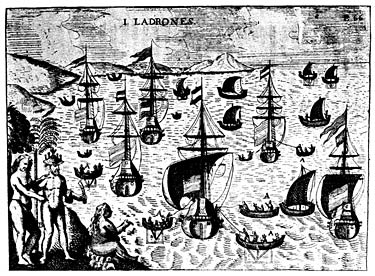
View of one of Ladrones Islands—Levinus Hulsius (Franckfurt am Mayne, M.DC.XX)
[From original in Library of Harvard University]
On July 19, a letter was received from the alcalde-mayor of Nueva Segovia, which states that two English galleons had anchored in a port of that coast, and that they are coming to this port of Cavite to trade; if the weather permits them to reach this place, their intentions will be known.
Good news is received of the almiranta, for they say that they saw it but shortly before they were wrecked, sailing on a good tack; and that it was a swift sailer, and seaworthy. Consequently it is thought that it has arrived at Nueva España. May God grant that it has so happened.