Volume 29 — Royal Orders and Decrees, 1639
Reading edition
Missions in Mindanao
The King. To Don Sebastian Hurtado de Corcuera, knight of the Order of Alcantara, my governor and captain-general of the Filipinas Islands, and president of my royal Audiencia therein: a letter of August 21, 637, has been examined in my royal Council of the Indias, in which you advise me that you have stationed ministers of the gospel in the islands of Mindanao and Bacilan—not only for the instruction of the infidels who are in those islands, but for administering the holy sacraments to the Castilian soldiers whom you leave there—and that you have assigned them such stipends as you considered necessary. I approve what you have done in this matter. Moreover, to provide for future increase [in the number of infidels converted], the necessary mission stations [doctrinas] will have to be established; but in this you must avoid unnecessary expense, and, conformably to my royal patronage, confer regarding such establishments with such persons as you should consult. I trust in you that you will carry out my intentions. [Madrid, February 3, 1639.]
I the King
By command of his Majesty:
Don Gabriel de Ocaña y Alarcon
In behalf of Grau y Monfalcón
The King. To the council, magistracy, and municipal body of the city of Manila in the Philipinas Islands: Don Juan Grau y Monfalcón has reported to me that in the past year, one thousand six hundred and thirty, you appointed him as your procurator-general; and that during all that time he has attended to your business affairs, with the utmost intelligence, personal attention, friendly interest, and promptness (as is generally known). He states that you assigned him a salary of a thousand pesos a year, paid in that city, which was to come here, invested, at his account and risk; but that, even when it arrives in safety, he can realize very little from it that remains free from the costs. He regards a thousand pesos as a very small salary for his continual occupation [in your affairs], and on this account claims that it be increased. Moreover, besides the many negotiations that he has despatched, he has been occupied nearly two years in preparing and composing the printed memorials which he has presented, and which have been examined in my royal Council of the Indias; and has given them much labor and solicitude, since they embrace so many, so diverse, and so important considerations for the conservation of those islands and their commerce, in order that they may be presented clearly and distinctly. He has furnished from his own funds all the money that has been spent for these books, and has never received one real on account of that expense. This sum amounts to much more in times so straitened as these, and should be highly esteemed. It would be a great disappointment to him if, after he had proceeded in all matters with the greatest tact and discretion possible (as is proved by the many negotiations which he has concluded for the benefit of that city), the powers which he has held from the city should be revoked—as usually happens, and as has been done with others, his predecessors, solely through interested motives and for the personal ends of some of the governors who go to that country. They, being well-affectioned to the correspondents whom they leave here, urge that city to entrust its affairs to those persons—for which no opportunity should be given, since that advice is influenced by various motives and considerations. To obviate this, and because it is not right that some other person should secure that for which he has toiled and incurred expense with so much zeal and solicitude, he has entreated me that I would be pleased to command you not to revoke, without legitimate cause, the powers that you have given him; and that you shall, before enforcing such revocation, state what reasons you have for doing so. The matter has been examined in the said my Council, where have been and are very evident the personal care, interest, and solicitude with which he has been and is attending to your affairs aforesaid—as also you will have understood by my decrees of the ninth of October in the year one thousand six hundred and thirty-six, and the twenty-first of October in six hundred and thirty-seven, to which I refer you for all this; together with what you wrote me in regard to this in a letter of the fourteenth of June, six hundred and thirty-six. In that letter you express your satisfaction with the promptness and care with which he furthers your affairs, and ask me to confirm the salary which you assign him of the said thousand pesos a year, from the funds belonging to that city. I have thought it best to issue the present, by which I approve and confirm the salary which you have assigned to the said Don Juan Grau as your procurator-general, in order that it may be paid to him from the day when it was voted to him. And it is my will that this salary be not revoked, either now or at any time, while he shall attend to your affairs at this my court, unless there be legitimate and sufficient cause for doing so; also that the said my Council be first notified of such cause, so that, having considered it in their sessions, they may declare whether or not it is legitimate; and the said salary shall always be paid to him, until some other decision be made. I also command my governor and captain-general of those Philipinas Islands, both him who now is and those who shall hereafter be in that office, and the president and auditors of my royal Audiencia which resides there, and yourselves, that you all observe and execute, and cause to be observed and executed, exactly and inviolably, the commands contained in this my decree, without contravening or exceeding its tenor and form in any manner; for such is my will. [Madrid, March 29, 1639.]
I the King
By command of the king our sovereign:
Don Gabriel de Ocaña y Alarcon
Restraining the Augustinians
The King. To Don Diego Faxardo, whom I have appointed as my governor and captain-general of the Filipinas Islands, and president of my royal Audiencia therein. It has been reported in my royal Council of the Yndias that the religious of the Order of St. Augustine are trading in merchandise with whomever they please; and that they make use of the natives of the regions and districts wherever they are and reside, for whatever they need, without paying the poor men who work in their service, or giving them anything else (employing violence for this), and thus obtain great wealth for [their houses in] these my kingdoms. This is all considered to merit severe correction, both because of the traffic and trading that they openly engage in, and because of the oppression that many of the said natives receive. I have thought best to tell you to be very careful in this, and to provide, by the most gentle and prudent measures, all that may be necessary for the correction of those transgressions. You shall regulate yourself by the decrees and orders that have been issued in this regard; and you shall cause those decrees and orders to be observed according to their tenor. Madrid, June 2, 1639.
I the King
By order of the king our sovereign:
Don Gabriel de Ocaña y Alarcon
[From another transcript made from the copy of this decree in the Archivo general de Indias—its pressmark, “Audiencia de Filipinas; registros de oficio; reales ordenes dirigidas á las autoridades del distrito de dicha Audiencia; años 1635 á 1672; est. 105, caj. 2, leg. 2, libro 4, folio 122 verso” we take the following endorsement: “To Don Diego Faxardo, whom your Majesty has appointed governor of the Filipinas Islands, advising him of certain things touching the religious of the Order of St. Augustine, which require a remedy; so that he may know them, and take what measures are advisable, in accordance with the orders and decrees that have been issued regarding it.” This transcript states also that the decree was signed by the members of the Council.]
Regarding ecclesiastical districts
The King. To Don Diego Faxardo, knight of the Order of Santiago, whom I have appointed as my governor and captain-general of the Philipinas Islands: report has been made to me, on the part of the archbishop of that city of Manila, that Don Sebastian Hurtado de Corcuera, your predecessor, gave the district of Quiapo (which belonged to the seculars), and the Indians who were reserved for the service of the cathedral and of the archiepiscopal house (which was the sustenance of the cathedral), to the fathers of the Society of Jesus, because of the great pressure that they exerted on him for it, on account of the advantages that would follow to them, as they have many estates of importance near that district. One of the conditions of their removing the said archbishop’s exile, was that he must consent to have that district given to the fathers of the Society. In order to relieve himself from his distressed condition, the archbishop feigned, under compulsion, assent to this—regarding it as certain that, as such action was to the prejudice of my royal patronage, I would not consent to it. He also petitioned that I would be pleased to have my royal decree issued, ordering that the fathers of the Society be despoiled of the said district of Quiapo, and that it be restored to the seculars, together with the adjoining districts of San Anton and Santa Cathalina—which the bishop of Camarines separated from the said district, in the time while he governed the archbishopric during the exile and absence of the said archbishop; and which he gave to the cura of Santiago, who was his creature; also the district of Nauhang, on the island of Mindoro, which has always belonged to seculars. By negotiations effected by the fathers of the Society, those districts have been set aside for them, to the prejudice of so many poor seculars. The matter having been examined by my royal Council of the Yndias, as well as what was written to me concerning the same matter by the said archbishop, I have considered it fitting to issue this my decree. By it, I order you, immediately upon its receipt, to place those districts, exactly, and without admitting any excuse or other reason, in the same condition that they always had and have had, notwithstanding the contract signed by the said archbishop, at the instance and petition of the said my governor and of the auditor then in my Audiencia. You shall advise me at the first opportunity that you have carried out my order. Madrid, July 8, 1639.
I the King
By order of the king our sovereign:
Don Gabriel de Acaña y Alarcon
Rebuking the bishop of Camarines
I the King
By order of his Majesty:
Don Gabriel de Ocaña y Alarcon
The King. To the officials of my royal treasury of the Filipinas Islands: inasmuch as it was reported in my royal Council of the Yndias that the bishop of Camarines resides in that city of Manila, where he attempts to hold his court under pretext of certain appeals, I charge him, by another decree of the date of this, to go immediately to his own church, because of the deficiency that his person may cause in its government. In order that he may offer no excuse in this matter, I order you to grant him nothing from my royal treasury on his salary, unless he shall obey my orders; for so is my will. Madrid, July 8, 1639.
I the King
By order of the king our sovereign:
Don Gabriel de Ocaña y Alarcon
Inspection at Acapulco
[I the King]
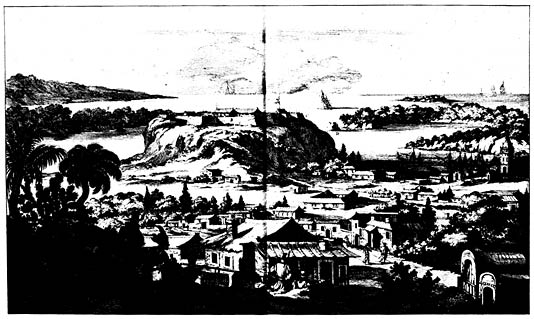
View of harbor of Acapulco—Arnoldus Montanus (Amsterdam, 1671)
[From original in Library of Harvard University]
A. Acapulco. B. Fuerca de San Diego tiene de longitad 122 varas de latitad 80 varas. C. Boca Grande. D. El Grifo. E. Boca chica. F. Puerto del Marques.
Colonists needed in the islands
The King. To Marqués de Cadereyta, my relative, member of my Council of War, and my viceroy and governor and captain-general of Nueva España, or the person or persons vested with its government: in a letter written to me by the city of Manila, under date of August two of the past year, six hundred and thirty-eight, in regard to various matters, and which has been examined in my royal Council of the Indias, there is a section of the following tenor:
“This kingdom finds itself in great need of inhabitants at the present time, as a result of the said campaign; for they are dying off, and it is many years since people have come to live in these islands as citizens. That has been understood to arise from the loss that the citizens have experienced, both in the affairs of this commerce and in the execution of the favors and rewards that his Catholic Majesty Phelipe Second, our king and sovereign (who is in heaven), was pleased to grant to such citizens. For at present, with those of account in this community, the citizens do not number ninety. This is very pitiful, and it is fitting that your Majesty please to have it corrected by ordering the said viceroy to use all possible and effective efforts in sending as many citizens as possible every year. They should be persons of good standing and ability, both for the service of your Majesty and for the greater renown and authority of this kingdom.”
And inasmuch as it is proper that you attempt to relieve such necessity, I order you to try to procure this by all possible ways and plans, and with all the mildness and prudence that is fitting. By so doing I shall consider myself well served by you. Given at Madrid, October three, one thousand six hundred and thirty-nine.
I the King
By order of the king our sovereign:
Don Gabriel de Ocaña y Alarcon
Signed by the members of the Council.
[Endorsed: “To the viceroy of Nueva España, ordering him to endeavor by all the means possible to send to Filipinas every year as many citizens as possible who should be of good standing and ability.”]
Directions to the archbishop
The King. To the very reverend father in Christ, archbishop of the metropolitan church of the city of Manila: your letter of July 31 of the past year, 1638, has been examined in my royal Council of the Yndias, and I shall answer you in the present in regard to some points that have been decided.
You state that, although the mode of the presentations for the missions has been resolved upon and determined, the decrees are not obeyed; that there is a very great need of seculars for those missions, and those who are there are but youths who do not understand the language [of the natives]; and that hence you have deemed it advisable not to assign any mission to seculars: You state that having conferred on this point with the Audiencia, they resolved that no innovation should be made until the arrival of the governor, who had gone on the Jolo expedition. It has been deemed best to tell you that when the governor shall arrive, and shall come to a decision, you shall advise me of the results of it. In the meanwhile you shall observe the decrees, unless serious troubles result from doing the contrary.
The prebends that you state are vacant in that church have been provided with incumbents, as you will have heard. My royal Council of the Yndias will take care of the names which you present to me, for the occasions that arise.
In regard to the property of Don Fray Francisco Zamudio, bishop of Nueva Caceres, who died on the twenty-seventh of last April, you shall cause the orders that have been issued to be observed, so that his creditors may be heard and paid, in accordance with justice, and upon legal proof of their claims.
I have read what you wrote about the great exhaustion and distress experienced by the natives of those islands through the many assessments that are made continually, throughout the year, on all the products of the country. I am writing to the governor and Audiencia not to make any innovation in these matters, so that this evil may be corrected; and under no consideration to load any new troubles or burdens on the Indians. Madrid, December 16, 1639.
I the King
By order of the king our sovereign:
Don Gabriel de Ocaña y Alarcon
Oppression of the Indians
The King. To the president and auditors of my royal Audiencia of the city of Manila: in a letter written to me by the archbishop of that church, July 31 of the past year, 638, he states that the natives of those islands are greatly exhausted and burdened by the many assessments made on them every year, in all the products of the country, by my governors. The latter take the products from them at a loss, gathering and collecting them with great trouble to the natives, and no money is given them; while they are seized and beaten, and thrust into prison for many days, because they do not give what they do not possess—although the goods can be bought at a somewhat higher price in the market-place. On account of this, and by the hardships consequent on sending them to the forests to cut wood, the natives are being exterminated, and are dying off. The matter having been examined in my royal Council of the Yndias, I have considered it fitting to issue the present. By it I order you not to make any innovation; and you shall not, under any consideration, cause new troubles or burdens to the Indians. Madrid, December 17, 1639.
I the King
By order of the king our sovereign:
Don Gabriel de Ocaña y Alarcon