LEVITICUS.
Reading edition
The Laws of Printing, that is, the rules by which artisans in the various branches of this Art do their work, are the theme of this chapter.
In the first place, the laws by which the Typefounder is governed in making good and true types, are explained. Then, the laws by knowledge of which the Compositor combines those types ready for printing. And lastly, the rules by which the Pressman is guided in obtaining impressions from the types.
From the extensive scope of this chapter it will be seen at once that it is only possible to describe the bare principles of each section, without attempting explanatory details.
THE TYPEFOUNDER.
Of the processes by which the first printers made their types very little is known. In none of the early colophons* is any allusion made to them; we are therefore confined to the internal evidence of manufacture discoverable in the types themselves.
* Bibliographers call the final sentence, which in many old books contains the printer’s name, place, and date, the “colophon.” It answered to the modern imprint, but was more full, and frequently contained important information.
The page of any early book shows a number of lines of type, all of them running from left to right beneath each other in straight lines.
It will be seen from the following diagram that each stamp stands on its own particular piece of metal, and the fact here to be noted is the exact regularity of all the letters: for although a capital “E” seems to the eye much taller than a small letter “a,” it will be at once seen by looking at the illustration, that in one direction, viz., from top to bottom, these and all the other letters are identical as to size. Each of the divisions here marked shows the size of the shank upon which every separate letter is cast, measuring this way |, and that measurement, which by printers is called the “body,” must be identical for each and every letter, or else unevenness would be the result.

In the following specimen, a single letter in each line is made slightly larger in body than its fellows, the uneven effect being very apparent.

To obtain exact regularity was the great difficulty of the early printers. Letters of wood soon became unmanageable from warping or shrinkage, being affected even by change of weather. No doubt the experiment was made of cutting a quantity of letters upon metal shanks, suited to their width.
Concerning the Mayence Psalter of 1454, the first printed book with a plain date, we find opinions, even of experts, very various and contradictory. Some writers, devoid of practical knowledge, declare all the letters to be separately cut in wood; others, whose opinions deserve respect, imagine the types to have been (as already suggested) cut separately, each on a cube of metal. Others, again, while admitting that these early types were cast in metal, consider that the original punches, or models, may have been cut in wood, and that matrices were produced by dabbing these into metal while in a semi-congealed state.
No writers in the infancy of printing deign to notice typefounding, although in 1508 we meet with the representation of a typefounder at work, which, however, is far too rude to teach us anything. Whichever way we turn, perplexity accompanies us, and the wisest course, perhaps, is to acknowledge that in reality we know very little about the methods of the first typefounders.
By careful examination of the types themselves, however, a few facts are ascertained, which, without revealing method, are full of significance. For instance, Colard Mansion, of Bruges, began to print with a fine, bold letter, called “bâtarde,” shaped like that known in England as “German text.” But when his first fount was worn he made another, every letter of which is slightly thinner in face than that used in the first printing, owing evidently to the fact that a single type of each sort had been chosen out, and, after being trimmed carefully by a graving tool, had been used as a punch to form a matrix of some sort for the second fount. The same thing exactly appears in the second casting of Caxton’s No. 2 Type; and here, in many instances, the matrix has actually reproduced some slight slips made by the graver in trimming his pattern letters. These facts are interesting, and as yet indications of no similar process have been observed among the German printers. But we are as far off as ever from the knowledge of how the types were cast. From what has been said it is evident that the early printers had some method of casting types from a mould which was adjustable as to width; so that while the same mould would cast a letter as thick as an “M,” or as thin as an “i,” it would make the “body” of each letter identical. This is the whole secret of typefounding; that this result was obtained we know, but how, we know not.
While in all probability we shall never know for certain the processes used to produce the earliest types, we have nevertheless some few data from which we may learn something. Mr. Madden in 1875 gave a fac-simile of a curious accident which he had noticed in a book printed by Conrad Hamborch, at Cologne, in 1476. A single letter had by some means been left lying sideways on the face of a page of type, and when the sheet of paper was pulled, an extensive “batter” took place by the truant letter being squeezed into the face of the type, the whole shape of the shank showing very accurately in the impression. Curiously enough, an identical occurrence was noticed about the same time by Mr. Bradshaw, in another early printed German book of about the same date. Again, M. Claudin of Paris possesses a number of actual 15th century types, which were found during a very dry summer in the bed of the Saône, opposite to where an old Printing-office is known to have existed.
We give fac-simile representations of these three instances, and from them draw several conclusions.
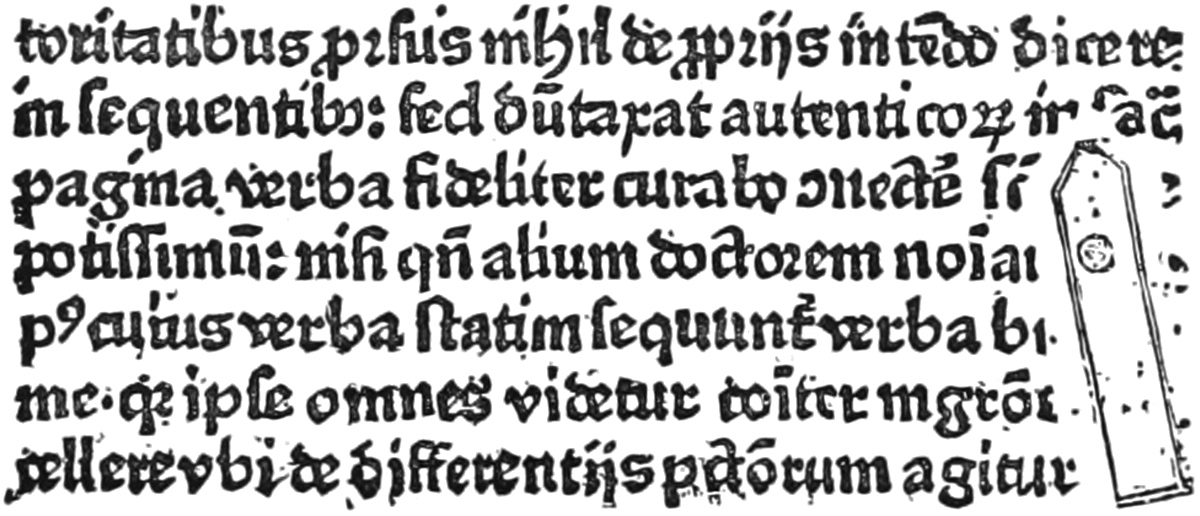
IMPRESSION OF A type IN 1476. (From
Madden
.)
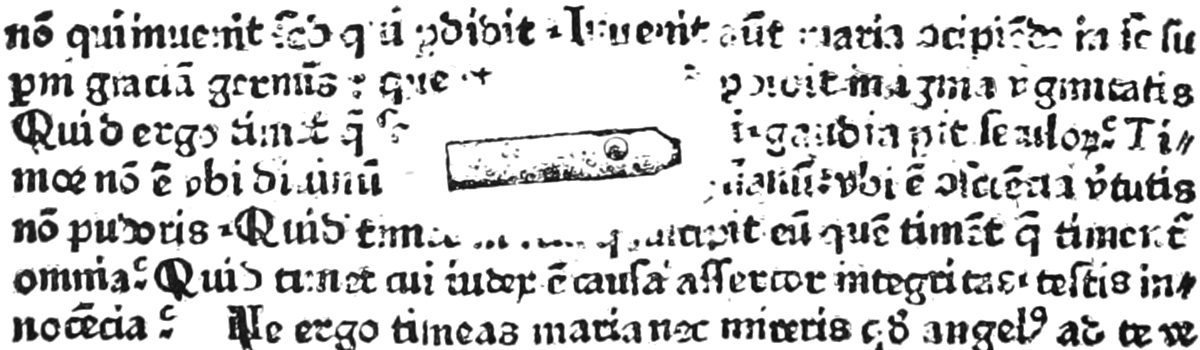
IMPRESSION OF A TYPE, CIRC. 1470, DISCOVERED BY BRADSHAW.
(From
Reed’s “Old English Letter Foundries.”
)
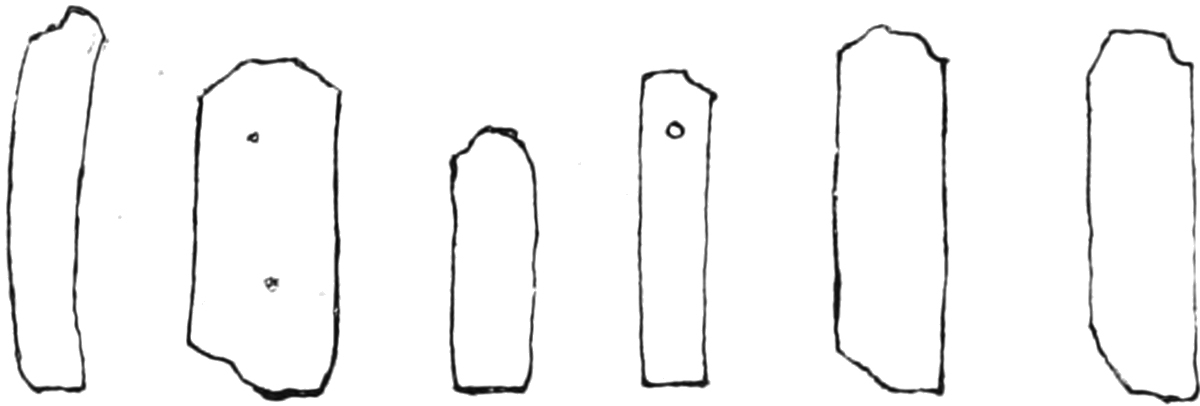
PROFILE TRACINGS FROM M. CLAUDIN’S TYPES. OCTOBER, 1883.
(From
Reed’s “Old English Letter Foundries.”
)
1. We see that there was no standard height for the types. In the types of M. Claudin hardly any two agree, nor do the types of the two German books. It would be a necessity that the types of one fount should all be of one height, and if no other founts were used for the work there would be no difficulty. This indeed seems the reason why, in the earliest books, we find little or no mixture of types.

2. We see that none of the types have any feet, and that therefore the “mould” as invented shortly after was then unknown. The great improvement by which, in a sliding mould, every letter must be of the same height has often been attributed to Schœffer—an improvement of which he now appears to have been utterly ignorant. Unless every separate letter is made exactly the same height, the result would be that some would be battered because they stood too high, while others would not print at all, because they stood too low. To obtain an even measure for all, the mould was made to give the height in a very ingenious manner. The diagram shows a type as it appears when thrown from the mould. a is the top containing the letter which prints in relief; b b are the “feet” of the type, and c is the superfluous metal. Now when the piece c is broken off, it will leave b b untouched; these are the feet upon which the perfect type will stand.
To look at a type it does not at first strike one as so very difficult to make, and yet a good punch-cutter must be a born artist, and a good mould-maker a model of skilfulness. Without attempting to describe the modern improvements in casting type by machinery, whereby the molten lead is pumped up into the moulds, and types ready for use come streaming out by thousands, we will try to explain the method used in 1689 by Moxon, who was the first English writer to describe the process with any exactitude. The same methods have been in all probability used by Caxton’s successors in the sixteenth, seventeenth, and eighteenth centuries, and are still resorted to now when any letters have to be cast by hand.
The four principal requisites in a type foundry are: 1. The Punch. 2. The Matrix. 3. The Mould. 4. Good Type-metal.
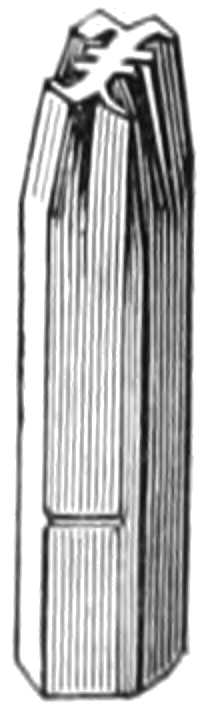
A PUNCH
1. The Punch. The punch-cutter, with the help of several tools, engraves each letter upon the end of a short piece of steel. Upon the beauty, congruity, and accuracy of this operation depends the success of the type. The art of engraving, reverse-way, a series of punches, all varying in shape, and yet all agreeing in the thickness and curves of the various down and up strokes—called by the Dutch “fats” and “leans”—is very difficult, and when successfully accomplished, the engraver may truly lay claim to that greatly misused word “artist.” If in the humour, he can cut two single or one double letter per diem.
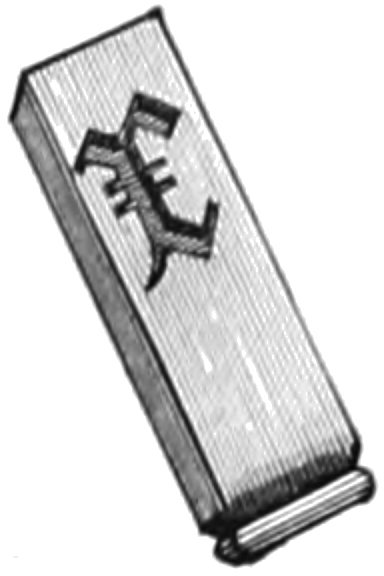
A MATRIX.
2. The Matrix. The steel punch being engraved and hardened, it is held face downwards upon a small cube of copper, and then with a steady, an even, and a strong blow from a mallet, the punch is driven some distance into the softer metal, leaving a sunken impression. This, after due trimming and adjusting—called “justifying,”—is a matrix ready for use in the mould.
3. The Mould is a complicated instrument made in two distinct halves, which fit accurately, or rather lock into each other, leaving an opening between, into which the melted type-metal is poured. The matrix which only gives the “face” to a type, is kept close to the bottom of this cavity in the mould by a spring. The mould, which is imbedded in wood to prevent the heat reaching the workman’s hand, is held in the left hand. A small ladleful of melted metal is then poured in, the workman at the same time giving his hand a jerk upwards, a movement which drives the metal into the finest parts of the matrix. The workman then slides the mould open, and the type falls out, only requiring the superfluous metal to be broken off, and the burr on the edges rubbed down, to become fit for use. About 5,000 types can be cast in this manner per day by a skilful workman.
4. The Metal of which type is made consists of Lead, Tin, and Antimony, in various proportions. The alloy, however, varies considerably in different foundries. We will only mention in conclusion that the Antimony is used not so much for the hardness it imparts to the alloy, as for the anomaly, which belongs also to freezing water, that it expands in the act of solidifying.
THE COMPOSITOR.
The work of a Compositor in the fifteenth century did not differ in any essential particular from that performed at present. He received the types from the founder, placed each sort in its own assigned place in the “case,” ready for use, and within easy reach. The “case” was an arrangement of small wooden boxes placed on the slant for convenience of reaching, each box being appropriated to its own letter. Standing in front of the case, the compositor held in his left hand a wooden “composing stick,” in which a rectangular trench had been cut to receive the letters. Reading and keeping in his mind a few words of his manuscript, he picked up the types letter by letter and placed them side by side until first words, and then sentences, were composed. When the end of a line was reached, and there was no room for more words and yet some space left, the compositor by placing a little extra space between the words made the line fill out the stick. This was called “justifying” the line. Each line was lifted out of the stick and placed on a wooden board; thus line after line was added until there were enough for a page.
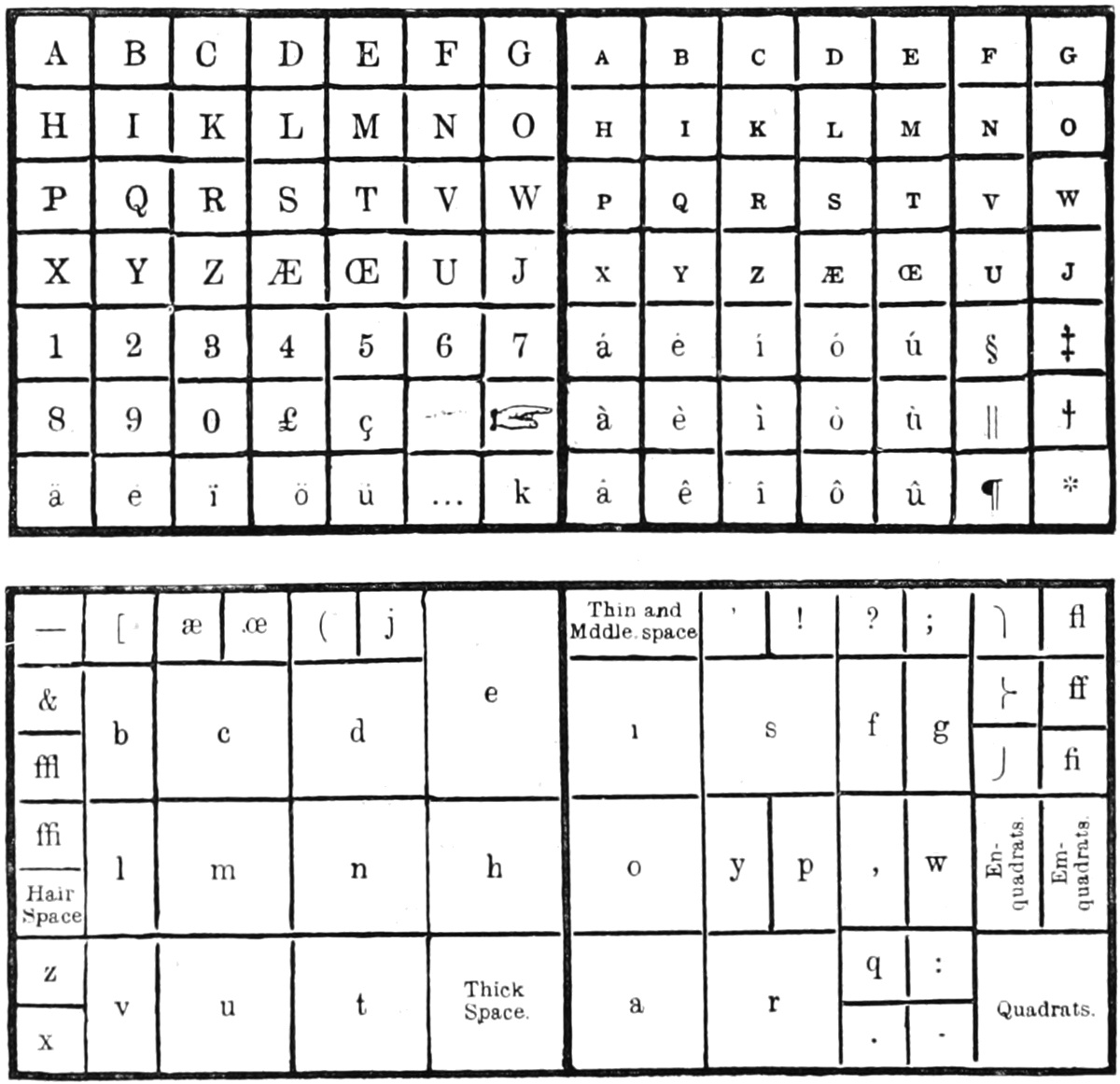
THE “LAY” OF A PAIR OF TYPE CASES.
When two or four pages were ready, they were placed upon a flat surface within an iron frame called a “chase,” the proper distance between each page being regulated by small blocks of wood suited to the size of the paper on which they were to be printed. The pages being properly arranged, were all bound together tightly by means of screws, or by small wedges of wood called “quoins.” When all was secure, the whole, now styled a “form,” was lifted up in one piece, and taken to the press, where a first proof was pulled for the “Reader.” The necessary corrections having been made by the Compositor, the “form” was ready for the Pressman.

OLD IRON COMPOSING STICK.
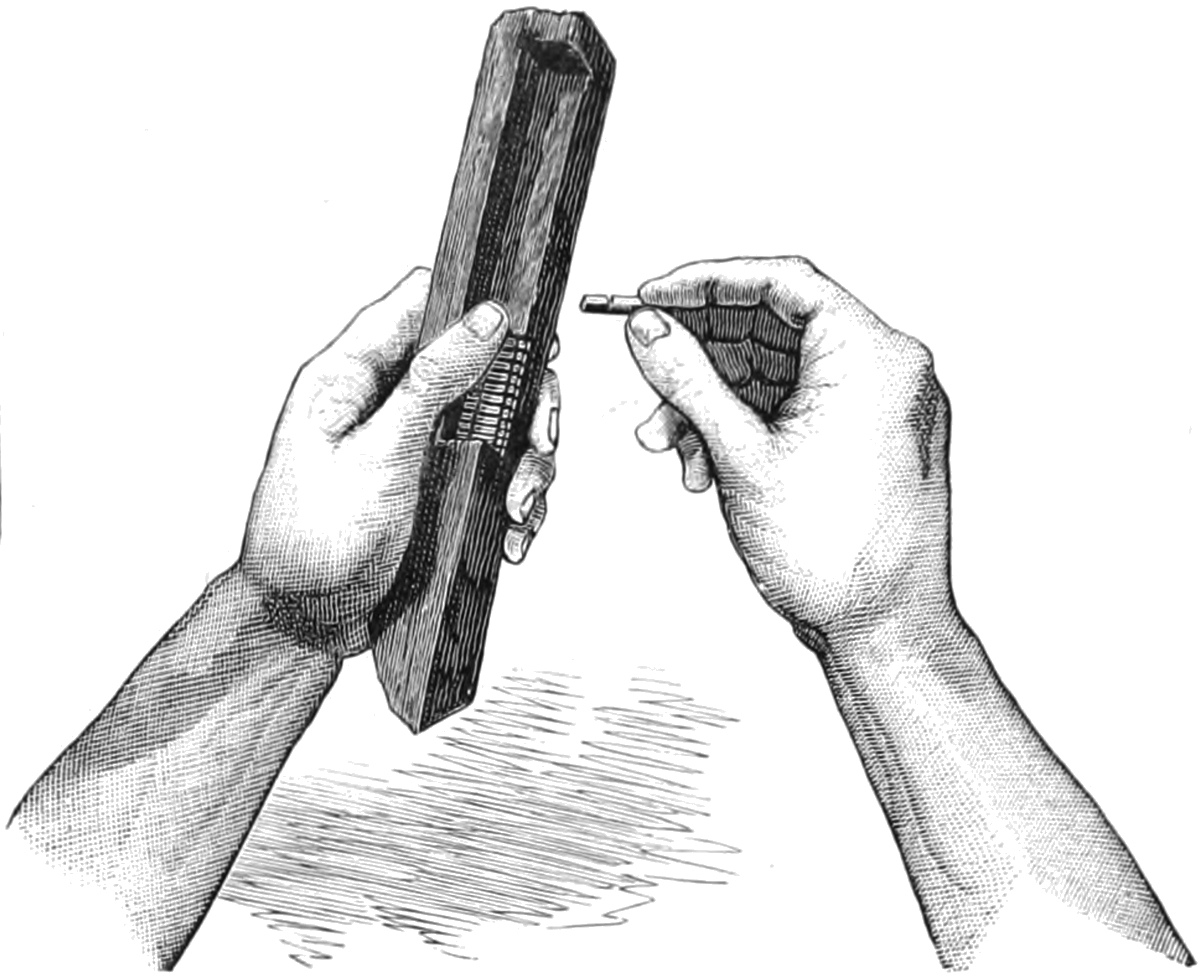
A FIFTEENTH CENTURY WOODEN COMPOSING STICK.
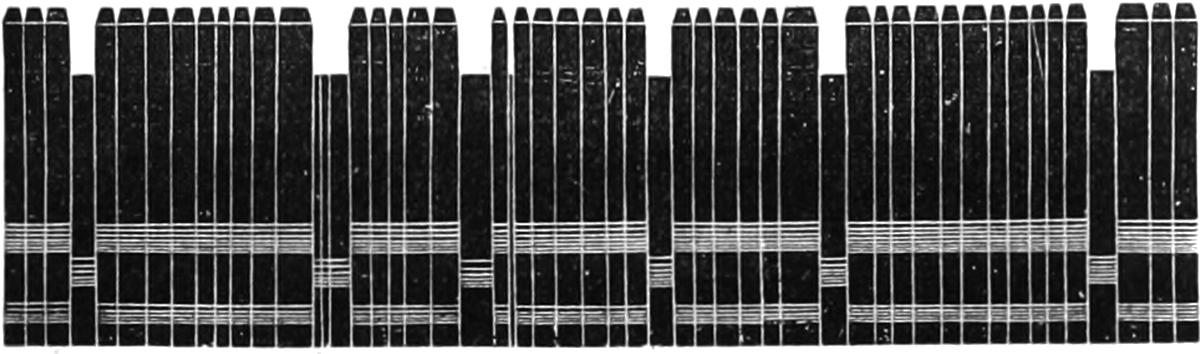
A LINE OF COMPOSED TYPE.
THE PRESSMAN.
OLD WOODEN PRESS. 1508.
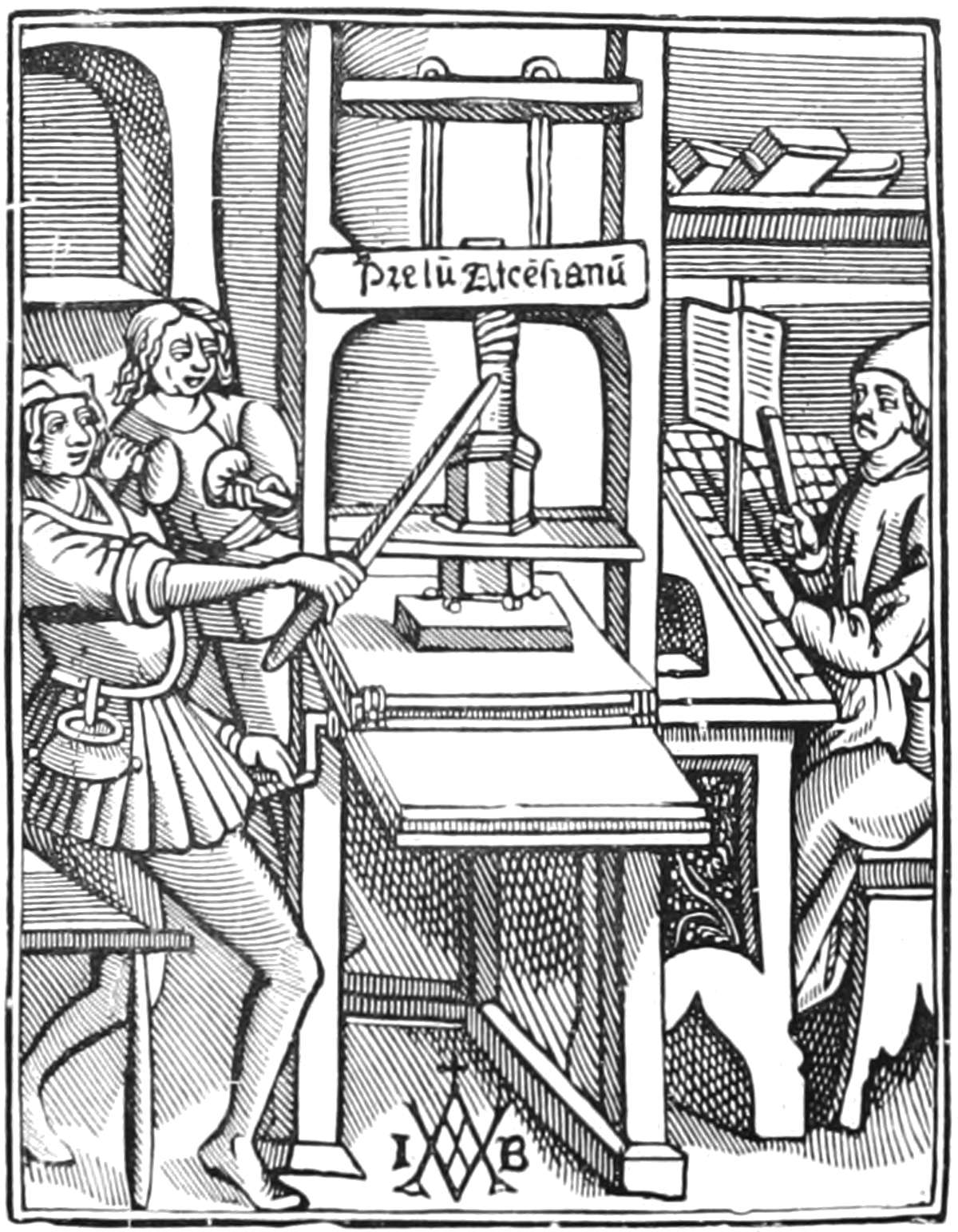
The first printers had but small presses made entirely of wood. Their power was also slight, and they printed, as a rule, but one page at a time. The screw was of wood, and worked by a “bar,” much the same as a modern napkin press. The chief thing was to obtain an even surface on the “bed” upon which the page of type rested; and, secondly, an even surface for the “platen,” which was lowered as the “bar” turned the “screw,” and thus pressed the paper upon the face of the type. The evenness of impression, as well as of colour, in many old books, shows that this object was accomplished with great success, and proves what good mechanicians they were four hundred years ago. It is a task which we could not now accomplish so successfully were our modern tools and appliances withdrawn.
The ink was doubtless a sore trial to the early fathers of the press. It was only by long experience upon block-books and wood engravings that the working together of boiled oil and lampblack was found to give that consistency which would be stiff enough not to spue over the sides of the letters when pressed, and yet not so thin as to run away into unevenness of surface or want of colour.
There were nearly always two workmen to one press. One “beat” the “form,” that is, he dabbed two big, soft balls covered with ink over all the type; the other placed the white paper on the “tympan,” and ran the whole, by means of a winch, beneath the “platen,” and then made a strong pull at the bar.
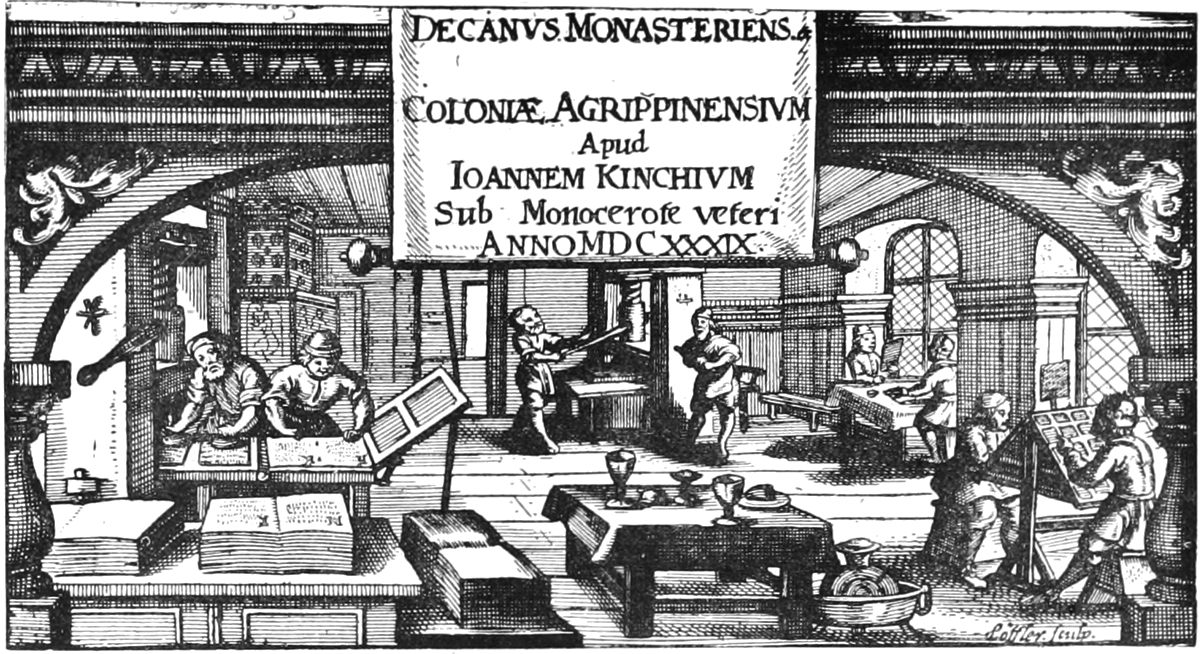
INTERIOR OF A 17TH CENTURY PRINTING OFFICE. (From
Mallinkrot
.)
Modern pressmen know nothing of the skill and experience requisite in olden times to beat a “form” properly. First the balls, which were made of prepared skins padded with wool, and fastened on to a “stock,” had to undergo peculiar treatment requiring both experience and sagacity. Extremes of heat and cold, of dampness and dryness, called out all the resources of the pressman in order to keep the skins of his balls in the proper state to receive and distribute the ink evenly. The distribution was effected by taking a small portion of the ink upon one ball; then began a series of twists and twirls, and punching of the balls together, worthy of an acrobat, until the ink, by an elaborate manipulation of one ball against the other, was evenly spread over the surface of the “form.” Whilst the “man at the bar” was placing the sheet of paper in such a position that it should be printed with the proper amount of margin all round, his fellow or “partner” was dabbing the ink over the face of the pages. In this he had to be very careful not to miss any part; if missed, the impression appeared very pale, and the blunder was called a “friar”; but if blotched with too much ink, and the face of the type filled up, it was a “monk.” This race of antiquated pressmen is now almost extinct. One of the last worked in jacket and hose at an old wooden press at the “Caxton Celebration” in London, in 1877, where he attracted great notice.
IMPROVED WOODEN PRESS. 1640.
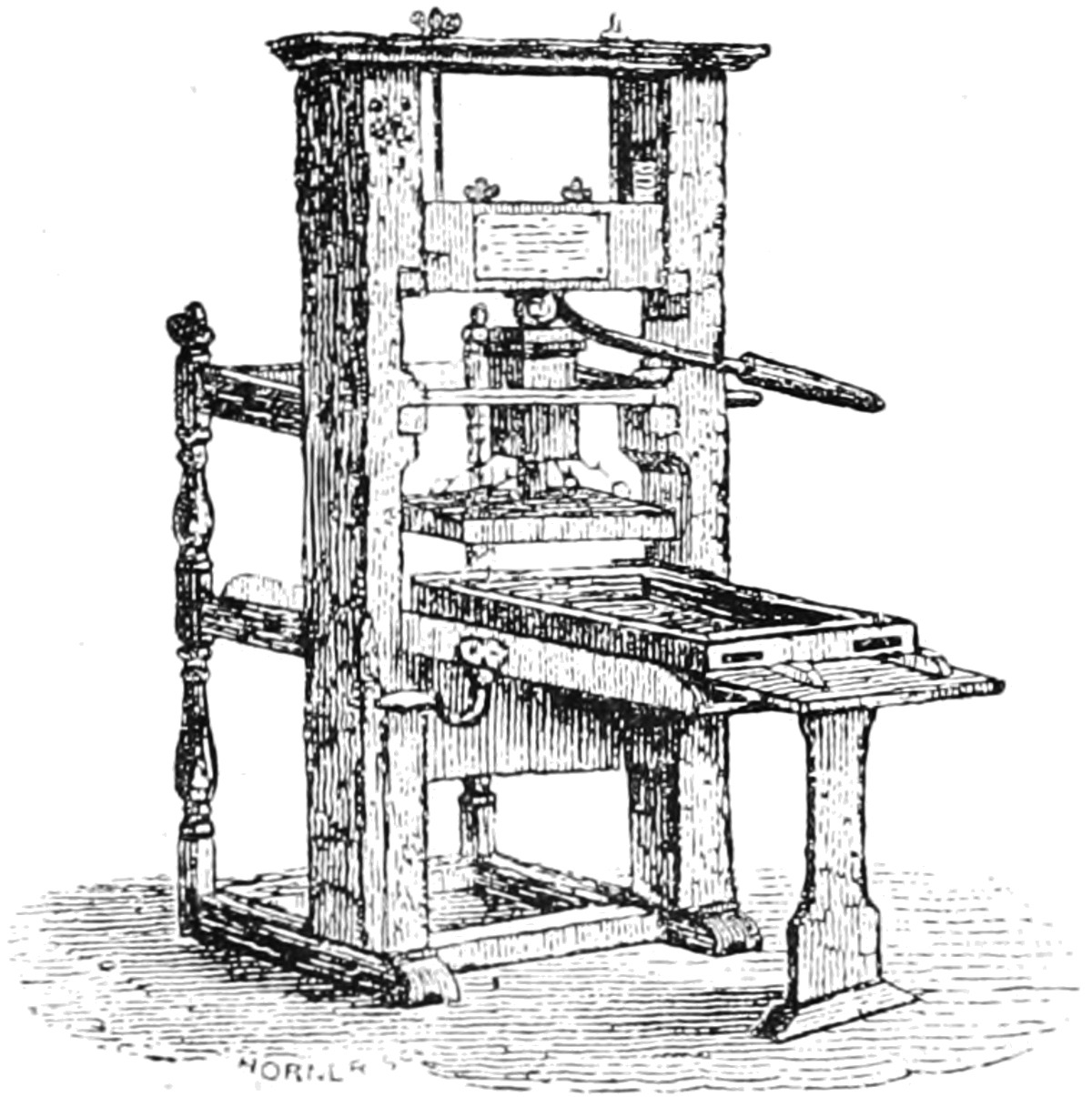
As a matter of convenience many of the early printers made their pages just of the size to agree with one page of the MS. The advantage of this plan was that they had no occasion to compose straight on, but might print page 8 with page 1, and page 7 with page 2, without noticing the intermediate pages, thus getting the first sheet of a quaternion out of the way.
Signatures, which are of great use to the binder, were letters and figures at the foot of certain pages, which served as signs to show the sequence of the various sheets. They are by no means peculiar to printed books, nor were they, as some writers assume, invented by the early printers. The manuscript-writers knew their use long before Gutenberg, and where a MS. is still intact, nothing having been cut off the bottom edges, the manuscript signatures may often be recognised at the extreme edge of the sheet. Sometimes the signature was put in the back, and so, when bound, became invisible.
Catchwords were the first word from the top of a page repeated below the bottom line of the previous page, thus assuring the correctness of the collation.
After a time the pages, especially if small, were arranged so that four or eight might be printed at a time. A sheet of quarto required four pages on one side, and four pages on the other side of the sheet. Octavo had eight pages on one side and eight pages on the other; and these had so to be placed that when the sheet was folded the pages came in proper order.
Some of the earliest books were issued without any Title-page, in this respect agreeing with MS. books.
The omission of head lines to the pages was common among the first Printers.
The numbering of pages was a development of numbering the leaves, which last custom is also a peculiarity of early printed books; as is the custom of manuscript initials at the beginning of Chapters.
Thus in a very imperfect manner the outlines of the laws upon which the old printers worked have been given; but ten minutes in a printing-office would explain more than ten chapters of ear-knowledge, and there is no difficulty nowadays in obtaining permission to see any of the great printing-offices.

NUMBERS.
“Who, departing, left behind them Footprints on the sands of time.” Longfellow.