GENESIS.
Reading edition
“
In the beginning!” What a whirlpool of disputations and theories have these three words created! Our grandfathers attributed the creation of the world with amusing accuracy to the year B.C. 4004; and just as geology and astronomy have pushed back this old-fashioned “beginning” to indefinite millions of years, during which Evolution, with slow but certain progress, was working out this world’s destiny in obedience to the fiat of the Almighty, so modern research and criticism have demonstrated that the same law of evolution applies to mental as well as physical phenomena, and that in both cases what is follows by fixed law on what was. Looked at in this light, the Art of Printing, as indeed all arts, never had a definite beginning, but was the necessary development of a previous process, as sure to come in the due course of events as harvest is to follow seed-time.
No acorn, no oak; and the idea that Printing, Minerva-like, started up, perfect from its birth, in the form of the Mazarin Bible or the Mayence Psalter, will not bear the test of criticism, although long current in typographical histories. The steam engine, the gasometer, the railway, the telegraph, the telephone, and all the great discoveries of modern science, had to pass through an imperfect infancy and gradual development; why, then, imagine that Invention in the one instance of typography reached perfection by a sudden leap?
Typography, or the art of combining separate letters and taking from them an impression, was a growth of the fifteenth century. At that time progress of any kind was much more slow and difficult than now; and we hardly realise the immense advantage all modern inventors have derived from the Printing-press. Every step forward in art or science is now chronicled, and we can watch the infancy and growth of each great discovery through all its stages. But just imagine the Printing-press to be non-existent, and not only would invention be a slow and tedious process, through the absence of that previous knowledge which leads up to it, but of those tardy advances which were made posterity would learn but little and profit less.
In this respect the art which is “omnium artium servatrix” has been at a great disadvantage. Slowly born, just as the nations were emerging from centuries of torpor, its promoters realised to a very limited extent its future greatness, and omitted to register, with any attempt at accuracy, either the date of its birth or even its parentage. The chroniclers of those days, mostly ecclesiastics, who noted carefully the occurrence of an unusually high flood or the death of some obscure abbot, had the barest recognition for the young Hercules whose infancy gave no intimation of his future prowess, and whose only mission seemed to be the manufacture of cheap school books or poor imitations of the picturesque old manuscripts.
But here the question arises, Was Printing, strictly speaking, a development of the fifteenth century? The word Printing in its broad sense means “making an impression”; and if this be accepted as a definition, we can trace its footsteps to a period long before man stood upon this earth. All over the world we find, in the various strata of the earth’s crust, Nature herself printing on the pliant rocks representations of animals and trees; a life history entombed ages before language was born or man possessed the power of observation.
Language itself was of necessity a slow development, and equally slow was the next step; for speech existed long before man discovered that the human voice, which informed the brain through the ear, could be represented by figures or a combination of signs which produced the same result through the eye.
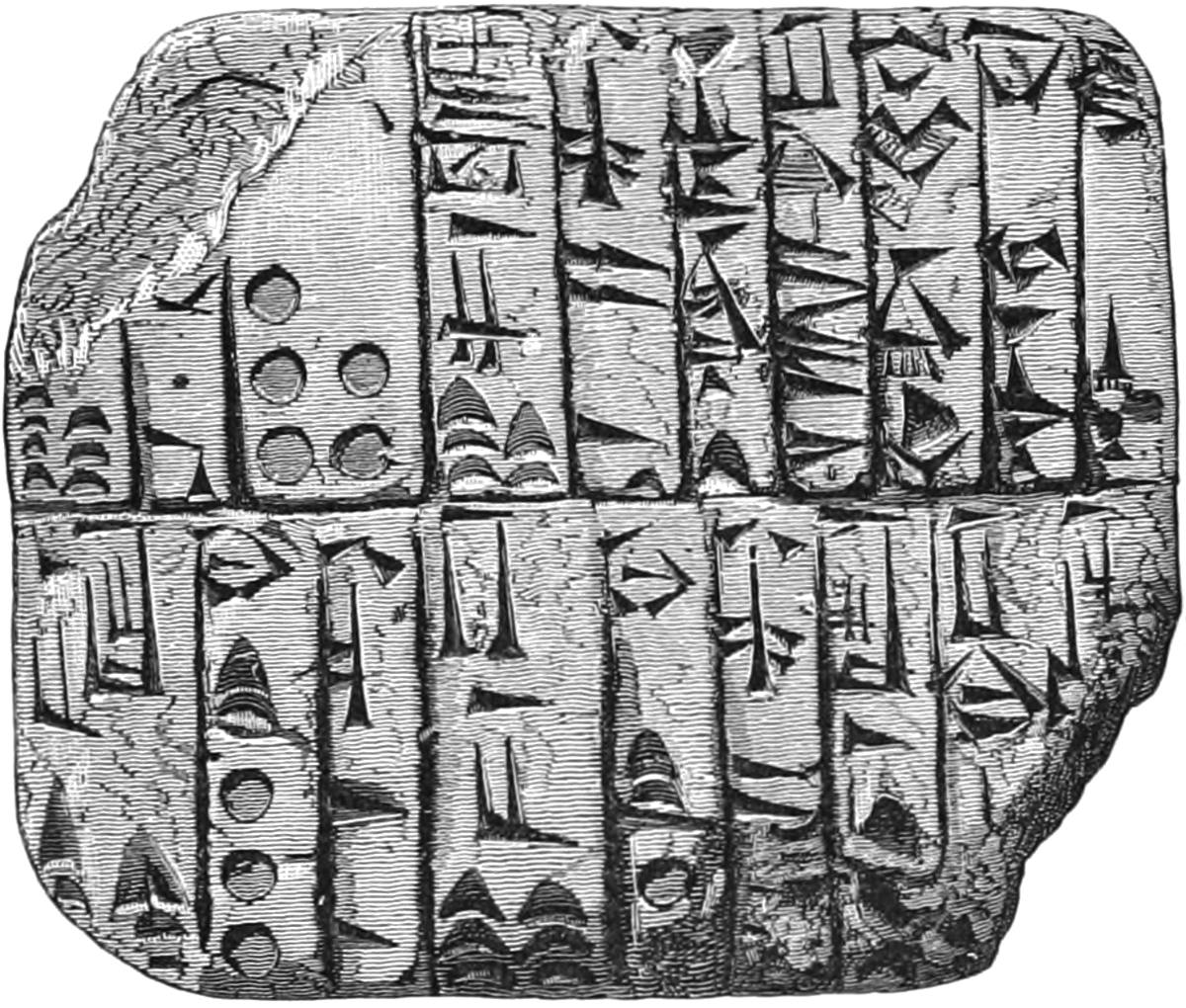
ASSYRIAN CLAY TABLET, STAMPED.
This wonderful development—the art of writing—was progress sufficient for many centuries, during which all kinds of materials were used to perpetuate the deeds and ideas of various nations. Leaves of trees and pieces of wood were written upon; clays, slabs and cylinders were stamped; seals, even signatures, by which personal authority was transferred, were engraved on wood or metal; vases preserved the name of the artist who formed them, and even the common clay lamps of the Greeks and Romans showed the names of their makers, printed with a stamp in bold relief upon the under surface.
LETTERS STAMPED ON GREEK LAMP.
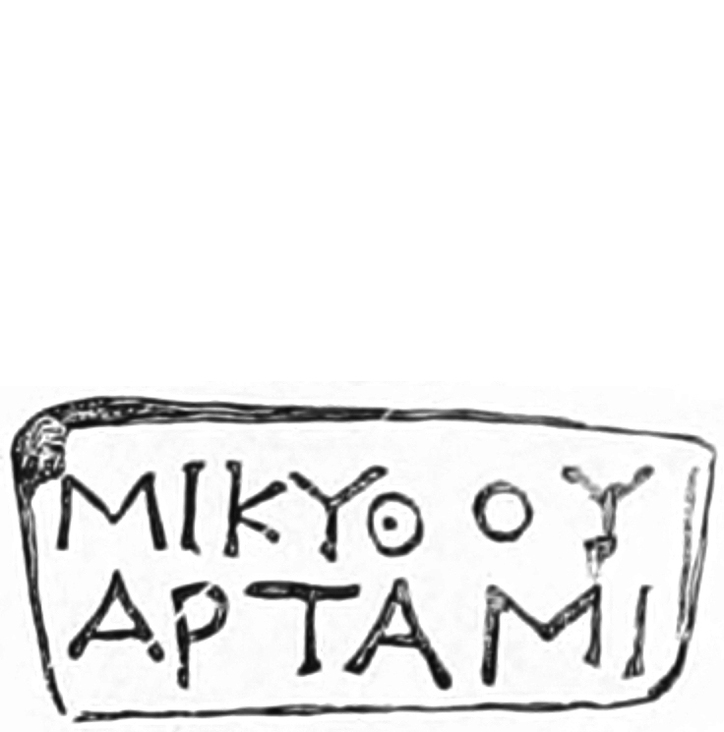
LETTERS STAMPED ON ROMAN LAMP.
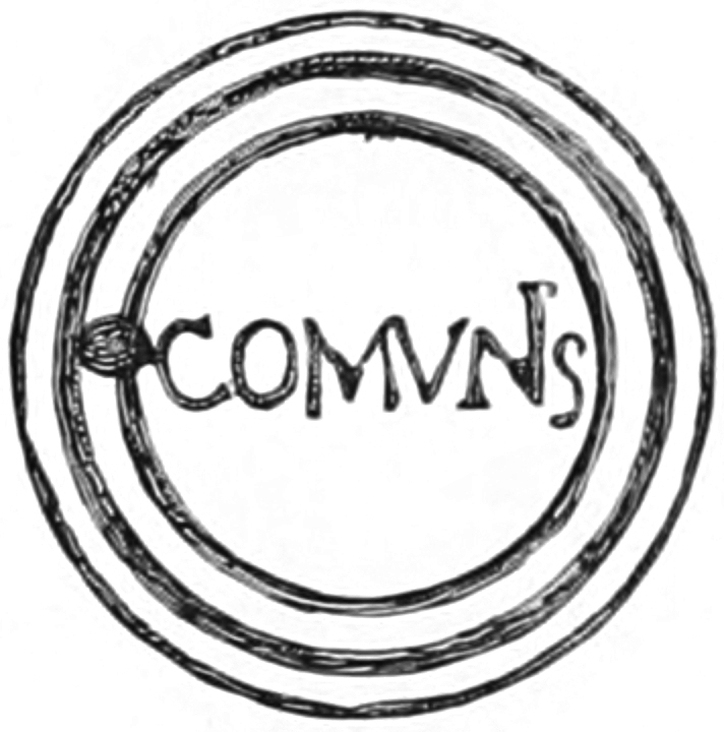
The style, which marked the waxen tablets, the pen or brush, with which words were formed on the papyrus sheet, and the pointed reed or quill which was used on parchment or paper were simply improvements, all leading on to still further developments.
As ages rolled on and learning increased, book-writing and book-binding became important trades, and were subdivided into special branches, such as the calligraphers, who wrote luxuriously for the libraries of the rich, and the scriveners, who supplied the wants of poor scholars and priests.
The Chinese were probably the nation who first used vegetable fibre to make sheets of paper. In Europe, our oldest MSS. are upon prepared skins; and paper, the manufacture of which was not common until the twelfth and thirteenth centuries, was seldom used, although specimens derived from the Arabs are found as early as the sixth century.
FIFTEENTH CENTURY PLAYING CARD. Engraved on Wood. (From Singer.)
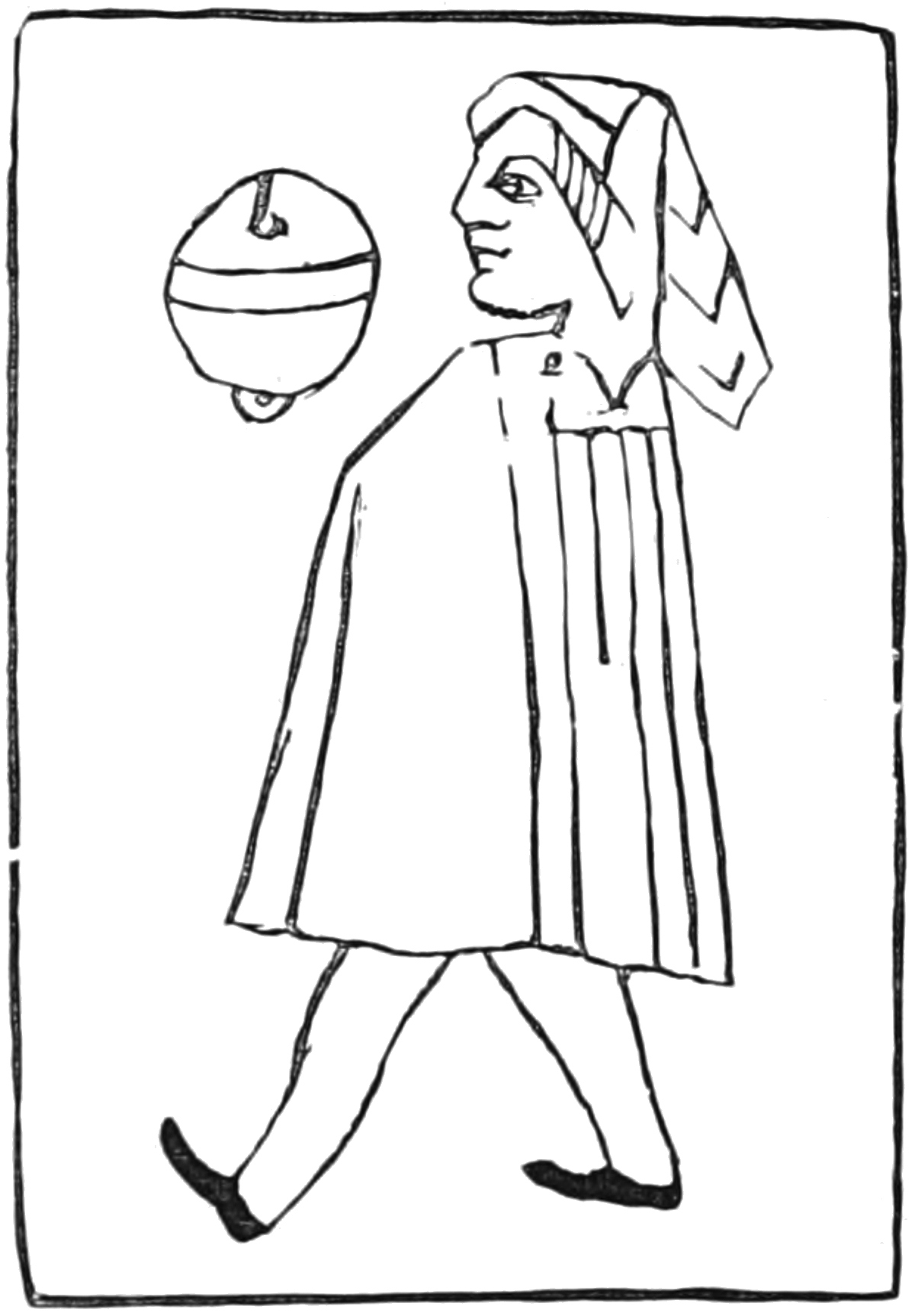
Printing from engraved blocks of wood or soft metal was practised in the fourteenth century, when rude figures of the Virgin and other saints, often coarsely coloured by hand, made their appearance. (See Frontispiece.) About the same time ornamental patterns were printed on stuffs from engraved blocks. Cardboard was developed from paper, and playing-cards, printed from blocks, were common in the fourteenth and fifteenth centuries. All these methods of Printing were so many decided advances towards Typography; but two new processes were still necessary to success, viz.: a thicker ink than previously used, and some kind of press with which to make a regular and even impression.
The next step was the making of that interesting class of books called “Block-books.” These consisted for the most part of a series of rude woodcuts the full size of the page, representing various parts of Scripture History, Heaven, Hell, Death, and the Judgment. The earliest known specimens of these works are printed in a brown ink similar to distemper drawings. Lampblack was already well known to the ancients as a basis for writing ink, and, mixed with gum water, formed that deep glossy hue so much admired in many old MSS.; but how to thicken the ink so as to make it suitable for printing from a raised surface was a discovery of great importance, made long before typography was invented. This object was attained by prolonged boiling of oil and then grinding it with carbon or lampblack.
After experience in printing small wood blocks, the production of larger ones, such as are seen in the Block-books was an easy progression. Most of these were representations of Bible History, and a considerable variety of opinion is still held concerning their use. They were called “Biblia Pauperum,” and have therefore been supposed to be books for poor people. This idea is evidently erroneous if we think for a moment how uncommon in those days was the ability to read, particularly among the great mass of the people. It is more probable that these pictorial sermons were used by the poor friars, many of whom could scarcely read, and in preaching trusted to memory and imagination. To such, the numerous suggestions of these pictures would be invaluable.
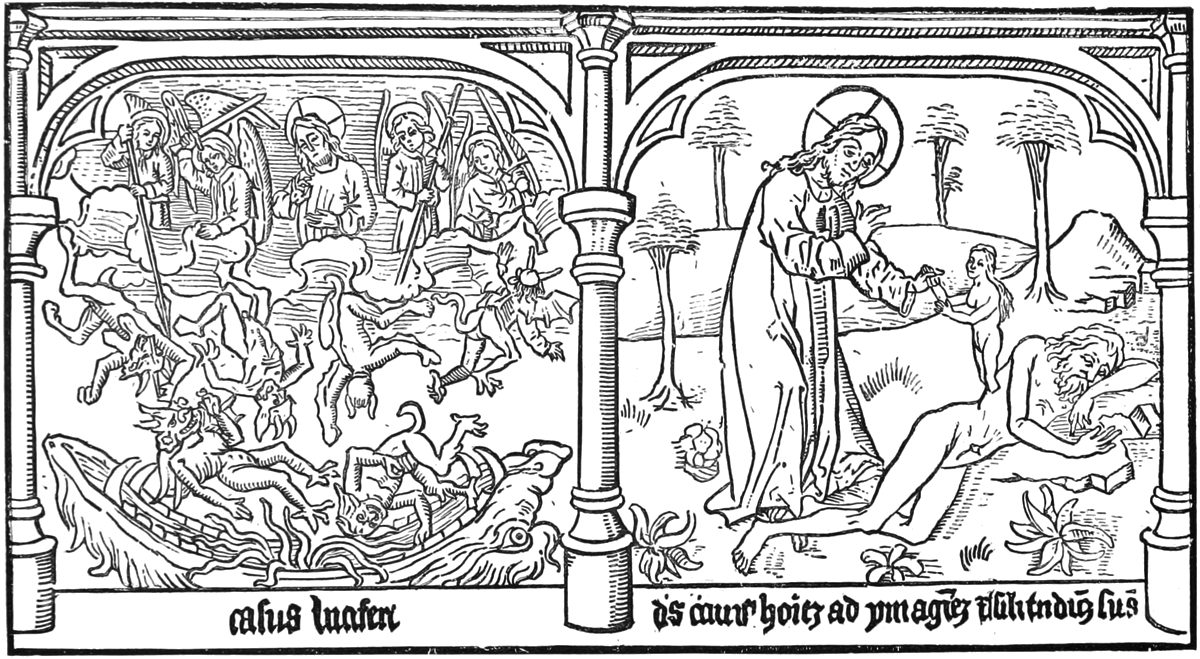
FROM THE BIBLIA PAUPERUM. BLOCK-BOOK. 15TH CENTURY.
In the later Block-books, engraved sentences and even half-pages of explanation are seen. The dislike of wood engravers to cut letters is the same now as it was four centuries and a-half ago, the mechanical nature of such work being distasteful to any one with artistic feeling. The idea, therefore, of using a second time sentences, already engraved and printed, simply by cutting them away from the old block, was very natural and would easily lead to the attempt to utilise the letters separately. Thus we float along the stream of gradual development, until we reach movable types, properly termed Typography. This was never an invention pure and simple which suddenly enlightened the mind of Gutenberg (as stated by Van der Linde, and echoed by Theo. De Vinne), but an end successfully accomplished, after numerous efforts and gradual advances.*
* The reader who has any real interest in these “firstlings” of the Printing-press should carefully examine the glass cases in the Grenville Library at the British Museum, where specimens of Block Printing, from the earliest to the latest, are displayed in chronological order.
The full meaning of the discovery of typography will be better understood if we call to mind the intellectual state of Europe in the middle of the fifteenth century.
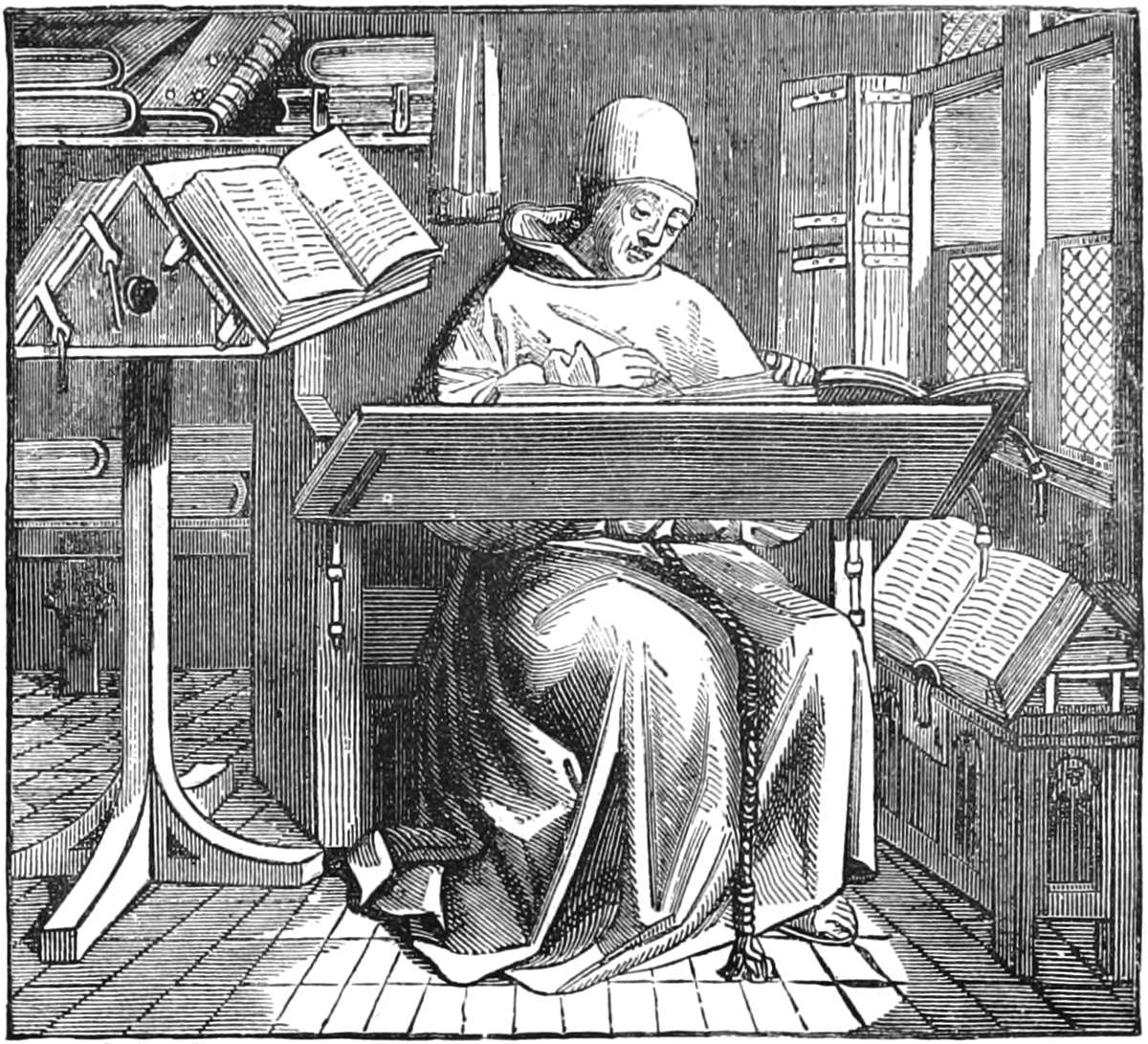
SCRIPTORIUM MONK AT WORK. (From
Lacroix
.)
BOOKBINDER.—16TH CENTURY.
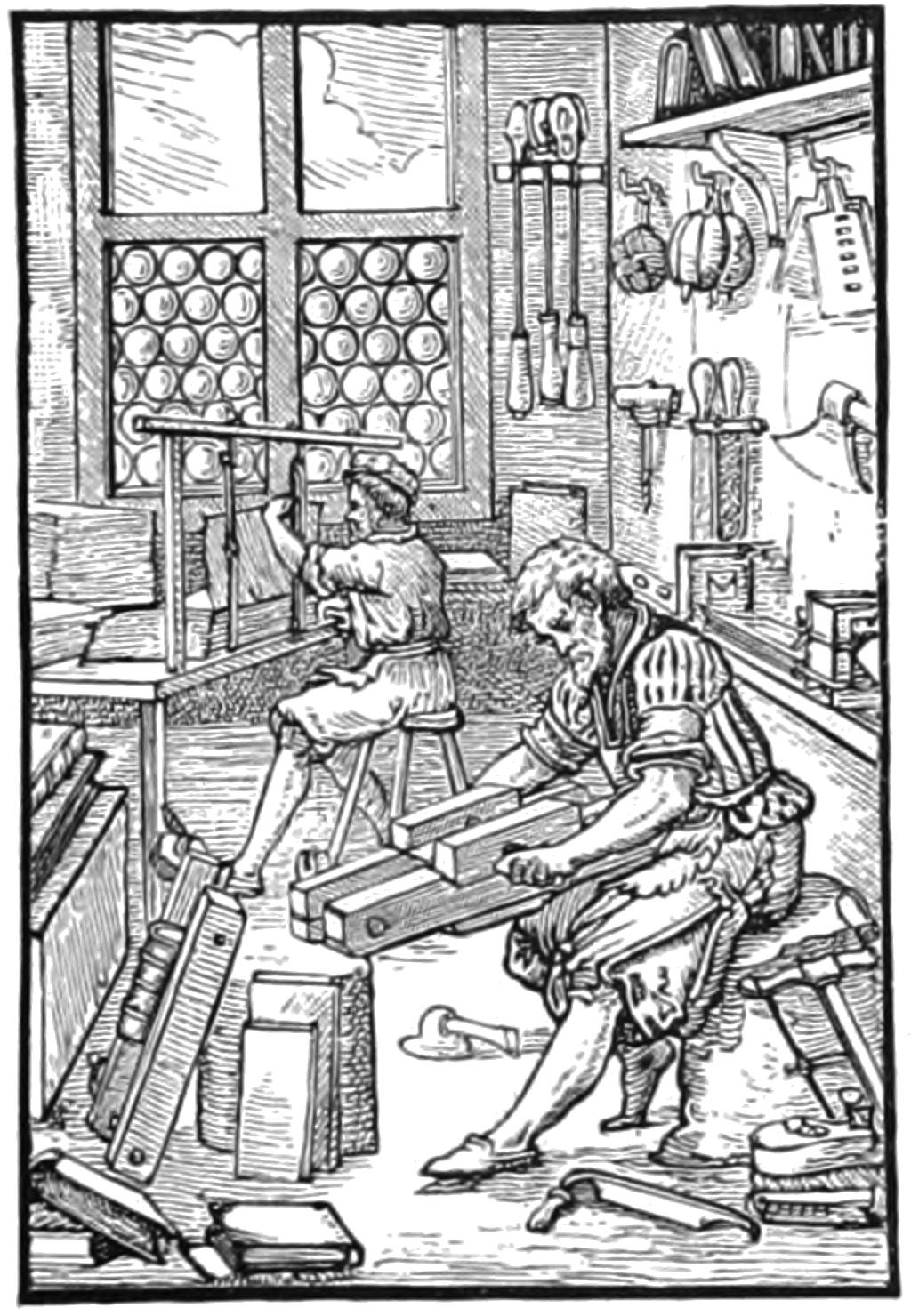
With the eclipse of literature during the Middle Ages, the Church alone, and that in a sluggish manner, kept up the manufacture of manuscript books, principally for ecclesiastical use. But when, in the fourteenth century, the brain of Europe began to show unwonted activity—when the Lollard doctrines set men thinking and doubting—when in the fifteenth century all Europe became excited over the discovery of new worlds—when military tactics were revolutionised through the invention of gunpowder—when education became general, and colleges and schools were multiplied—then the minds of men everywhere began to long for books, more books; for Cicero and Boethius, for Bibles, Psalters and Legends, for Chronicles, Tales of Travel and Romances, for Donatuses, School books and Absies—at such a time the need was urgent, the demand imperative, and the Printing-press came.
The change, however, was by no means sudden. The first effect of the increased demand was to create a great division of labour in the manufacture of Manuscripts, so that whereas two or three Scribes had, in former times, been sufficient to complete a Manuscript, as many as fifteen different trades were now employed in Paris, Bruges and other centres to produce a single book. Long before the invention of typography, the book-makers of Holland had their Guilds, which included a variety of the trades concerned in the production, viz.: parchment-makers, boss-makers, binders, etc. Amongst them we now and then find enumerated “prenters,” that is, the printers from engraved blocks, who had already discovered the use of the press and a thick ink. The most numerous craft, however, was that of the Scribes, who wrote only the running text; and in this portion of the work it was, where speed and accuracy were most wanted, that the Printing-press was destined to make its earliest triumphs.
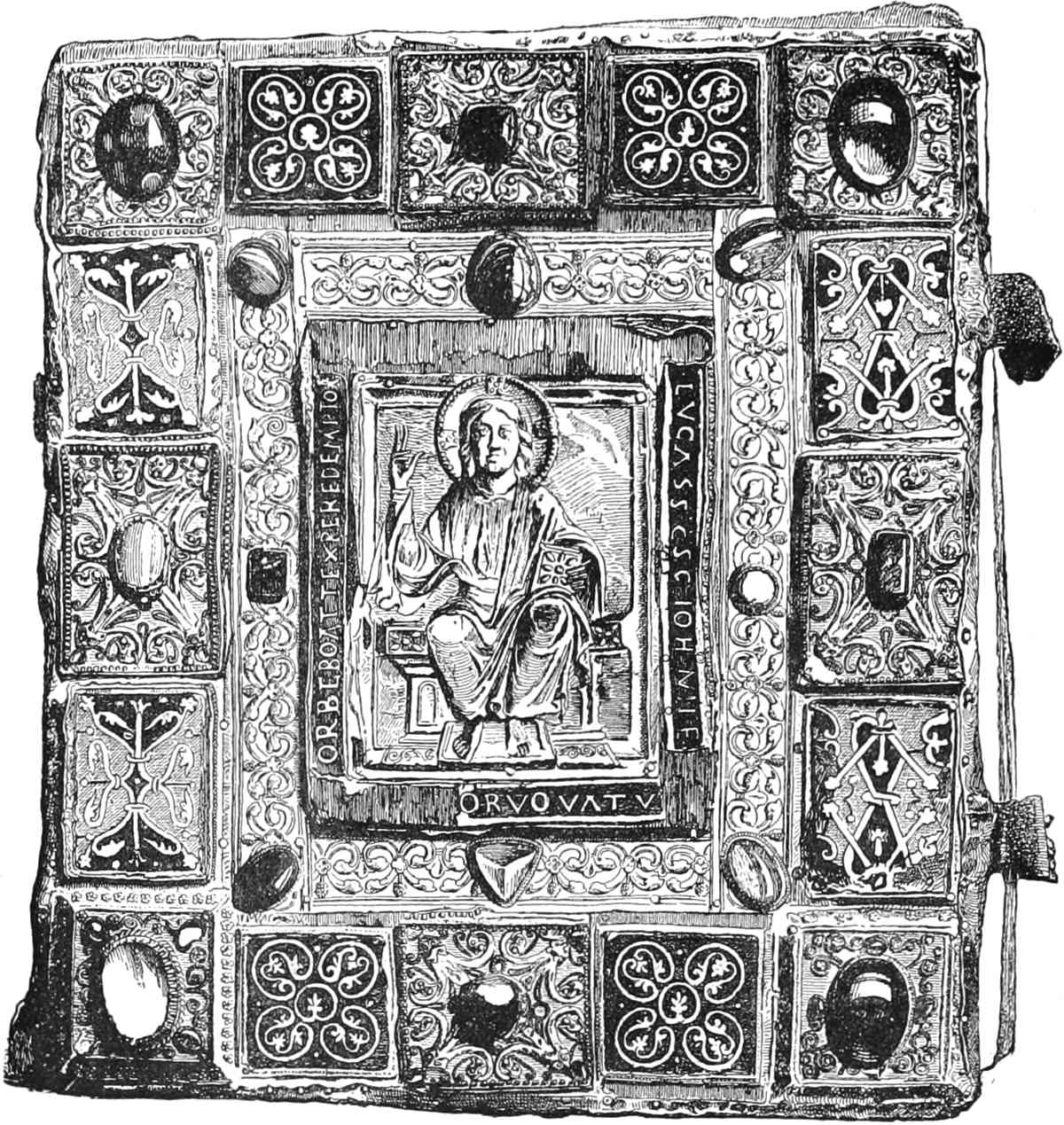
COVER OF A BOOK. 15TH CENTURY.
The foundation of many colleges and schools in the fifteenth century led to an extensive demand for school books and grammars, the most popular of which were the “Donatus,” a grammar so called from the name of its author, and “Catho,” a kind of delectus in Latin. These were sold at a cheap price, and, to lessen the cost of their production, were often engraved on blocks of wood, from which the pages were printed. These and the Block-books already described were contemporary, and the immediate forerunners of separate types.
Think of the numerous editions of the Eton and Valpy Latin Grammar, which, two generations ago, were used throughout the kingdom, and you may well wonder how it is that there is extreme difficulty in getting a single copy now. They have nearly all perished. It is the same with the school books of all ages; and we can, therefore, hardly wonder that the fifteenth century school books, manuscript, or printed from engraved blocks, are now amongst the most scarce of bibliographical rarities.
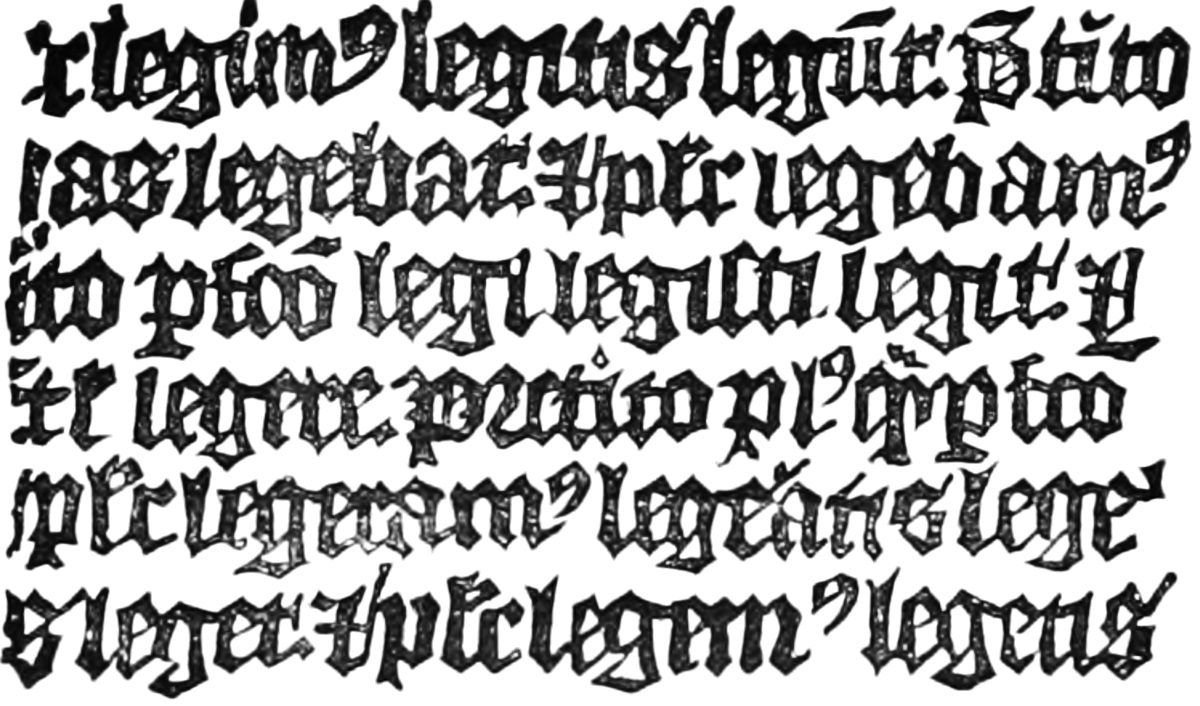
FRAGMENT OF A XYLOGRAPHIC DONATUS.
(From
Holtrop
.)
The process of cutting letters and sentences on wood is much more trying work than engraving figures; the Block-books generally show some approach to artistic feeling in the pose and drapery of the figures, but the engraver was very careless over the letters. Doubtless the tedium of the operation would suggest the idea of separating the letters, so as to use them again in a different combination for other sentences. We have indeed direct evidence of such attempts having been made; for (as noticed by Mr. Bradshaw in his “Memoranda No. 3,” pp. 5 and 6) a Block-book edition of the “Biblia Pauperum,” printed at Zwolle, was cut up, and the pieces used afterwards in a different combination. The same operation took place with the blocks of the “Speculum nostræ Salvationis,” which were cut up, and the pieces used again for an edition printed at Utrecht in 1481. This could not be successfully accomplished with separate letters, on account of their small size, but the attempt would be most natural. There is no known instance of separate wooden types having been used by any early printers, but in certain editions of the “Speculum” we distinctly find metal movable types, with the woodcuts printed in one coloured ink, and the text in another. The types bear plain evidence that they were cast, but in an extremely rude way, showing a much more imperfect method of casting than appears in the German Indulgence of 1454 (which is the earliest known date of any printed piece), or the first books of the Mayence printers. There are also numerous fragments of the Donatus, of the Doctrinale, and of Catho, in various editions, and in cast types. The language of some, as well as the shape of the letters in all, show that these were, without doubt, produced in the Low Countries, although they are all, as was natural for such unimportant books, without any printer’s name and without the year of production, thus rendering it difficult to assign to them an unimpeachable date.
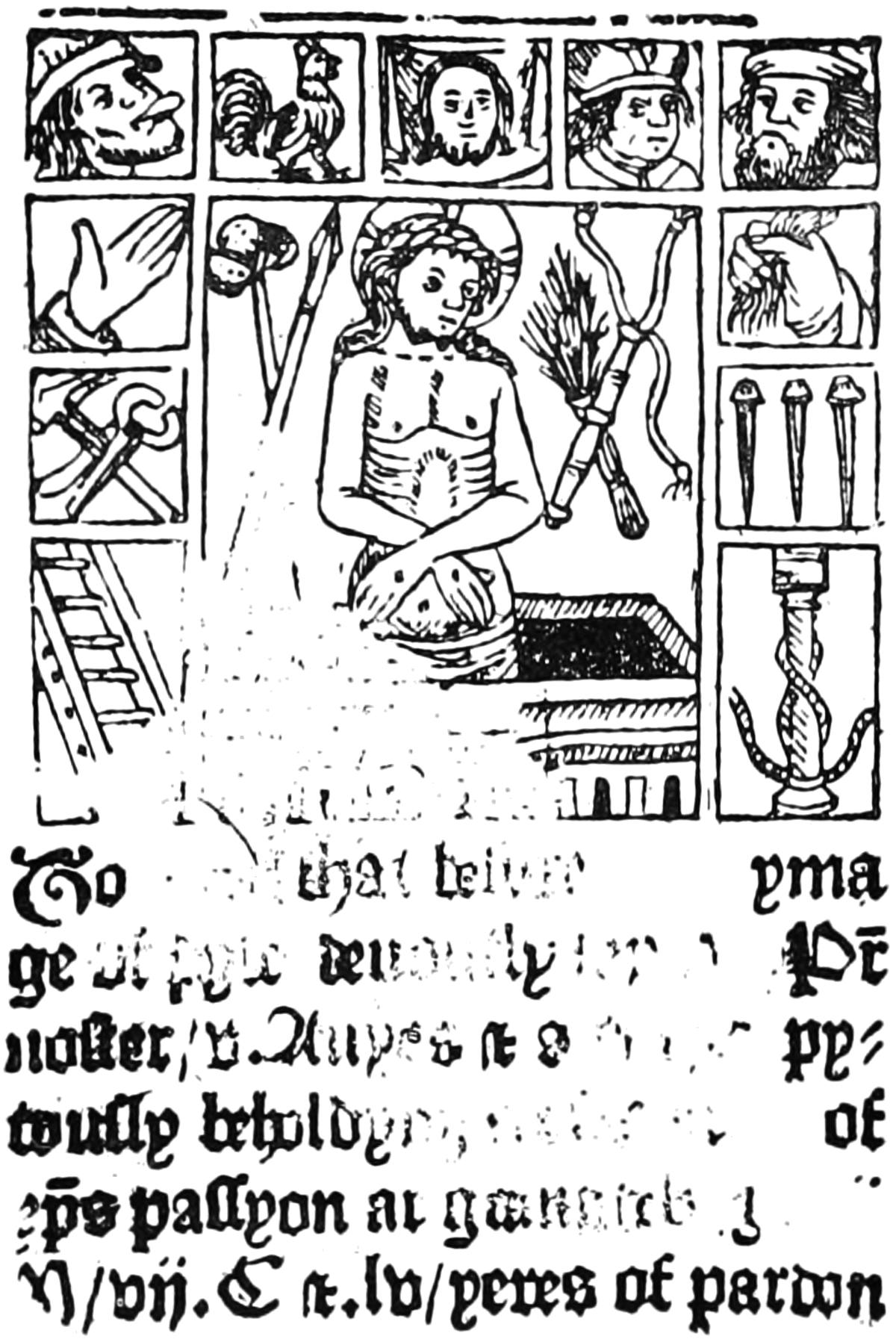
“IMAGE OF PITY.”
(WOOD BLOCK AND TYPE.)
After much study I cannot help thinking that Holland was not only the birthplace of these Donatuses, etc., but that they gave the starting idea to the Mayence school of printers. The notice of the invention of Printing written at Cologne from the mouth of the earliest printer in that city, one who had learnt his art from the first printers at Mayence, seems decisive. The Chronicler, who wrote in 1499, states that Ulric Zell told him as follows:—
(1) “Item: This most revered Art was discovered first of all at Mentz in Germany, and it is a great honour to the German nation that men so ingenious were there found. This was in the year of our Lord 1440. From that time until the year 1450 the Art and the things pertaining to it were greatly improved, and in this year men began to print, and the first book so printed was the Bible in Latin, the character of which was larger than that now in use for mass-books.
(2) “Item: Although this Art was discovered at Mentz in the manner now commonly used, yet its first prefiguration was found in Holland, in the Donatuses which had been already printed there. From these Donatuses was derived the origin of this Art, which is now more masterly and clever than before, and far more ingenious.... The first inventor of Printing was a citizen of Mentz, born in Strasbourg, and called John Gutenberg.
(3) “Item: From Mentz the Art was first taken to Cologne, thence to Strasbourg, and thence to Venice. This beginning and progress of the Art was told me by that worthy man, Master Ulric Zell, of Hainault, Printer, of Cologne, in this present year, 1499, by whom indeed the Art was first brought into that city.”
Similar evidence is given by Mariangelus Accursius, an Italian writer of the fifteenth century, who, while attributing the invention of types as then used to Fust and Schœffer at Mayence, says that the idea was certainly taken originally from the Donatuses printed in Holland.
Now these “Items” are quite distinct in idea. The first tells us that Printing was invented at Mayence, and goes on to particularise what the writer means by Printing, viz.: a Latin Bible in large type. The second qualifies the first by saying that “this Art,” which, of course, means the same art as was used for the Bible, was prefigured by Donatuses printed in Holland, but that John Gutenberg’s invention was more masterly and skilful than the Dutch method. The third tells us how the Art spread, and the writer’s authority for his statements. We are here face to face with a plain statement which, to my mind, settles the point. The Dutch had already types cast in that rough and ready manner familiar to all of us who have studied the wonderful fac-simile plates in Holtrop’s “Monuments Typographiques,” or the “Principia Typographica” of Sotheby. Gutenberg, according to this account, commenced his study of typography in 1440, but it was 1450 before he had so far improved in his method of casting letters that he could venture to begin upon his great Bible.
How these ten years were spent, and how near to 1450 it was before the sight of Dutch Donatuses gave the final impulse to his genius, we shall probably never know.
Dr. Van der Linde and other writers who agree with him maintain that the Cologne Chronicler must have referred to xylographic, i.e., block-book, Donatuses, and that the sight of such works developed in the mind of Gutenberg the idea of movable types. Unfortunately for this argument there is not a single Dutch block-book Donatus known, while there are nineteen different editions of early type-printed Dutch Donatuses already catalogued—a number which is being increased every year. Why, too, if Gutenberg derived his inspiration from the sight of a Donatus cut in wood, did he ignore those of his own country, which were before his eyes, in order to gain his impulse from non-existent Dutch ones?
It is an important bibliographical fact that forty-seven different books, or fragments of books, exist, printed with eight different founts of type, all Dutch in origin, all without any name, date, or place, nearly all discovered in the bindings of fifteenth century manuscript or printed books, thirty-three of them on vellum, and four of them printed on one side only. What can we do with this interesting regiment of incunabula? To make them later than, or even contemporaneous with, the earliest dated Dutch books seems impossible: we might as well attribute the language of the Canterbury Tales to the reign of good Queen Bess; but place them about 1450 and onwards, and they take rank naturally.
We will here notice one of the chief causes of the many and contradictory accounts of the origin of printing. It is the natural tendency of all writers to Hero-worship. The value of a central figure around which may be grouped the features of a story is fully appreciated by all authors: it strengthens the weak and adds vigour to the strong. This bias is recognised in the world’s earliest records. Honour and glory, often semi-divine, are attributed to the inventor. For the discovery of letters we must have a Cadmus; Apollo first made harmony; Moses, according to Vergil, originated trumpets; Vulcan, iron weapons; Noah, ships—and so on. And so, Dutchmen who claimed the invention of printing for Holland found the embodiment of it in Coster; Germans, for a similar reason, revere Gutenberg; and Italians, their countryman Castaldi. The Hero obtained, definite records and historical particulars group themselves around him, and thus with a few personal details an impression of truthfulness is given to the story which carries conviction to the reader’s mind, while at the same time artistic requirements are satisfied.
The duty of the historian and critic is to separate judiciously the kernel of truth from the husk, by which in the course of time it is sure to be surrounded—to preserve carefully the one and reject the other.
Although I think we must look to Holland for the earliest specimens of typography, it does not follow that we must believe all the story as given by Junius. There is no reason to doubt he gave the account of Coster as he received and believed it; and his was not an age in which criticism was expected, or was able to separate husk from kernel.
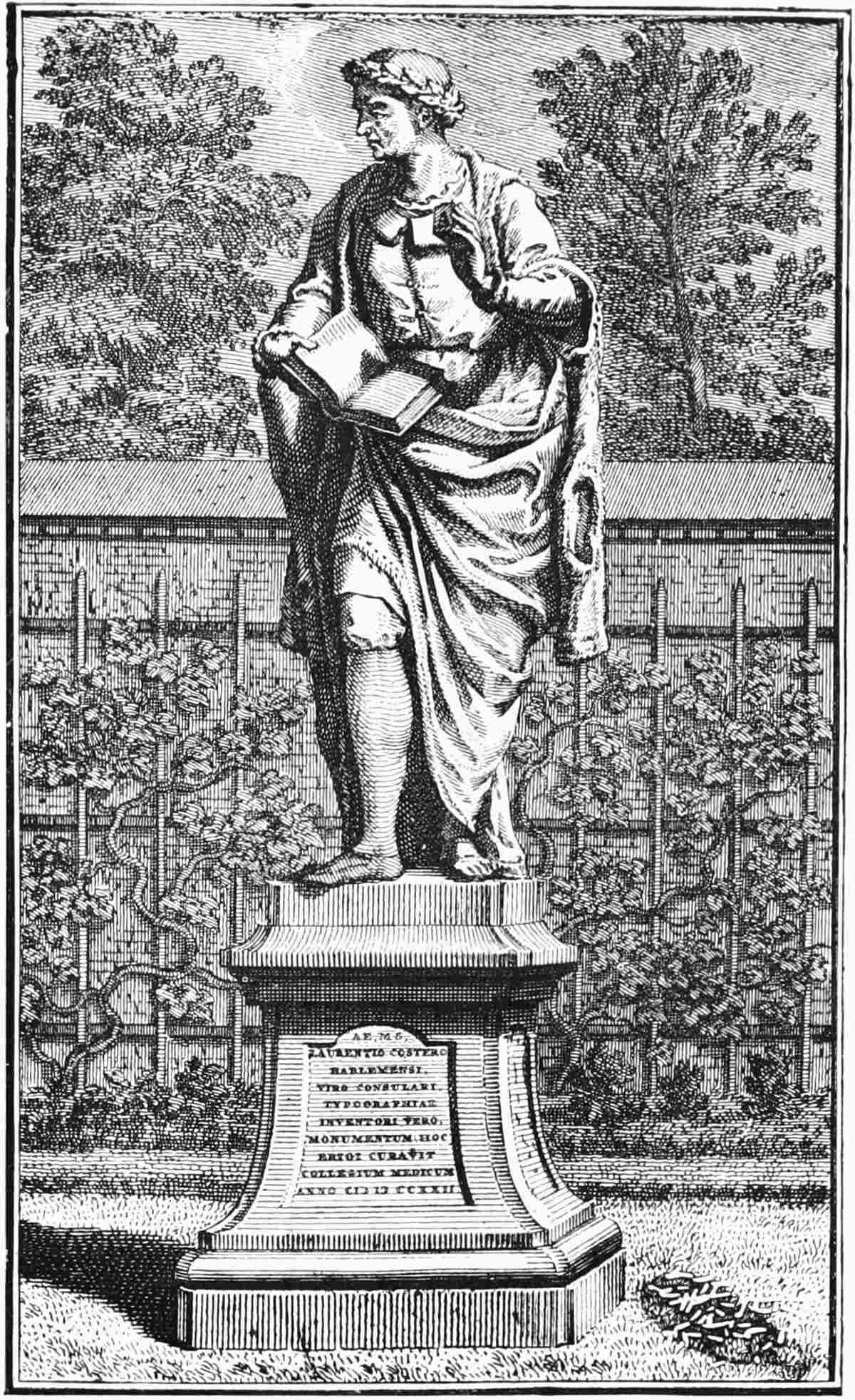
STATUE OF COSTER. (From
Zeiz
.)
If we suppose the Cologne Chronicler of 1499 to have misunderstood his informant as to the Dutch “prefiguration”; or if the Laurens Janszoon Coster of Junius and the Haarlem Archives was perfectly innocent of any typographical proclivities, it still leaves the Costeriana to be accounted for; and it is these silent witnesses, dug out from the earliest strata of typographical deposits, which by their evidence should determine the vexed question.
It is, however, necessary to know the story which was current when Junius wrote, and we therefore give it as the accepted truth in his time:—
“There lived, about 1440, at Haarlem, in the market-place opposite the Town Hall, in a respectable house, still in existence, a man named Laurens Janszoon Coster, i.e., Laurence, son of John Coster. The family name was derived from the hereditary office of Sacristan or Coster of the Church—a post both honourable and lucrative. The town archives give evidence of this, his name appearing therein many times, and in the Town Hall are preserved his seal and signature to various documents. To this man belongs the honour of inventing Printing—an honour of which he was unjustly robbed, and which afterwards was ascribed to another. The said Laurence Coster, one day after dinner, took a walk in the wood near Haarlem. While there, to amuse himself, he began to cut letters out of some beech-bark. The idea struck him to ink some of these letters and use them as stamps. This he did to amuse his grand-children, cutting them in reverse. He thus formed two or three sentences on paper. The idea germinated, and soon, with the assistance of his son-in-law, and by using a thick ink, he began to print whole pages, and to add lines of print to the Block-books, the text of which was the most difficult part to engrave. Junius had such a book, called ‘Spieghel onzer Behoudenisse.’ It should have been said that Coster was descended from the noble house of Brederode, and that his son-in-law was also of noble descent. Coster’s first efforts were of course very rude, and to hide the impressions of the letters on the back, they pasted the leaves, which had one side not printed, together. His letters at first were made of lead, which he afterwards changed for tin. Upon his death these letters were melted down and made into wine-pots, which at the time when Junius wrote were still preserved in the house of Gerrit Thomaszoon, the grandson of Coster. Public curiosity was greatly excited by Coster’s discovery, and he gained much profit from his new process. His trade, indeed, so increased that he was obliged to employ several workmen, one of whom was named John. Some say this was John Faust, afterwards a partner with Gutenberg, and others say he was Gutenberg’s brother. This man when he had learnt the Art in all its branches, took the opportunity one Christmas eve, when all good people are accustomed to attend Church, to break into the rooms used for printing, and to pack up and steal all the tools and appliances which his master, with so much care and ingenuity, had made. He went off by Amsterdam and Cologne to Mayence, where he at once opened a workshop and reaped rich fruit from this theft, producing several printed books. The accuracy of this story was attested by a respectable bookbinder, of great age but clear memory, named Cornelis, who had been a fellow servant with the culprit in the house of Coster, and indeed had occupied the same bed for several months, and who could never talk of such baseness without shedding tears and cursing the thief.”
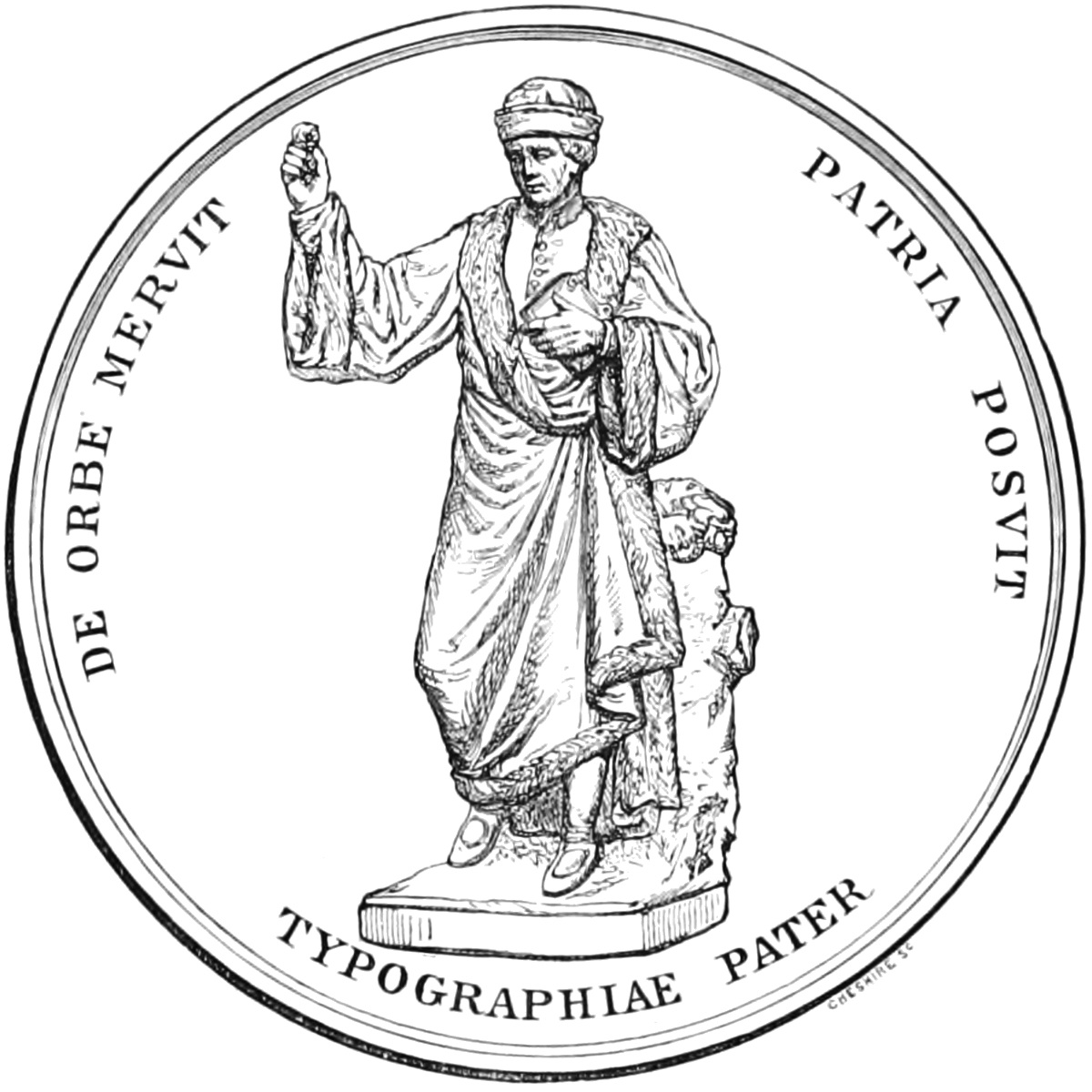
COSTER COMMEMORATION MEDAL, 1856.
(
From a Medal in the Author’s Collection.
)
While giving Junius all credit for recounting this story as he found it handed down by tradition, we must be careful not to take it too literally. Stories of this kind although founded on fact, always grow by repetition. The central truths illuminated by the Cologne Chronicle seem to be: (1.) The discovery of movable letters was a growth from small beginnings. (2.) The country was Holland and the place probably Haarlem. (3.) Gutenberg derived his ideas of printing from Holland.
Let us now expound the claims of Gutenberg as gathered from undoubted evidence and facts.
John Gutenberg is a real man in history. He was born at Mentz in 1399, and some members of his family are known. Several documents testify to his existence, but the first which by possibility connects him with printing is an action at law brought against him by a man named Dritzehen in 1439 to recover a loan of money. The original text of this document, unfortunately, cannot be verified, having been destroyed at the siege of Strasbourg.
Numerous witnesses gave evidence which showed Gutenberg as practising several arts by which he made money, one of which was a great secret carried on by him in a ruined convent near Strasbourg. Here he was surprised at his work by his creditors, to whom at last he divulged his secret, making partners of them. Some curious particulars of tools and four pieces of wood to form a press are given in the depositions, and apparently refer to experiments connected with printing. The want of capital to carry on his experiments is also very evident. Andrew Dritzehen had helped him for some time, but died before success crowned their efforts. Gutenberg then tried to obtain possession of all the materials which Andrew Dritzehen had left, but his partners stepped in and took them, although they were not sufficiently instructed to make any use of them. This action went against Gutenberg, who, now much impoverished, sold the last remaining portion of his paternal estate. Again and again he had to borrow money, and in 1450 entered into a five-years’ partnership with John Fust, each to have half the profits of the business.
As time rolled on and nothing satisfactory resulted, Fust took advantage of his legal powers, and by a lawsuit to recover his loan compelled Gutenberg, in November, 1455, to give up all the printing plant, which he conveyed away, and with the assistance of Peter Schœffer, who married Fust’s daughter, started a printing-office on his own account. Gutenberg, deprived of all his material and without money, but not disheartened, now found a new friend in Conrad Homery, Syndic of Mentz, with whose help new types and presses were made. Misfortune and debt still pursued him, and had not the materials been the property of Homery, he would have been again deprived of them. In 1460 the book known as the “Catholicon” was printed, and several other small books. The city of Mentz was sacked in 1462 and its trade entirely destroyed. The next we hear of Gutenberg is his appointment in 1465 to be one of the gentlemen of the Court to Adolphus II, in whose service he remained till his death, about 1468. Gutenberg’s types were removed to Eltville, where his relatives, Henry and Nicholas Bechtermunze, printed with them in 1467.
The weak part of Gutenberg’s case is that only in the year 1462 do we first meet with any mention of him as a printer, and that mention not in Germany but in Paris. This interesting reference was discovered by the Librarian of the Basle City Library, who examining a copy of “Gasparini Pergamensis Orthographia” preserved in the Heynlin collection found a unique Prologue from the pen of Heynlin the donor. The book, as is well known, was printed at the Sorbonne Press, Paris, in 1470, and the portion of the Prologue which is of most interest to us reads thus:—
“... I imagine that the friends of literature will receive great benefit from the Art invented by the new sort of Printers, who in these our days have (like the warriors from the Trojan Horse) issued from the womb of Germany and scattered themselves abroad.
“In this country (France) the story is, that a certain John Gutenberg, not far from Mayence, was the first inventor of the printing art, by means of which books are made, not with a reed as of old, nor with a pen, as in our days, but with metal letters, and that rapidly, evenly, and elegantly.”
Then after noticing the divine honours bestowed upon Bacchus and Ceres for endowing mankind with the kindly fruits of the earth, he adds:—
“Gutenberg has made a discovery still more fruitful and more divine for he has discovered a way by which letters may be engraved and by their means all that can be thought and spoken is at once reproduced and so passed on to posterity.”
The remainder, though in praise of the new art, adds nothing to this testimony.
Here then we may leave the vexed problem of the Genesis of Printing.
It requires but a slight examination of the early Donatuses, whether Dutch or German, to be convinced that whatever the means adopted to make the types, they were quite dissimilar to those adopted at a later date. We shall probably never know the slow degrees by which the punch, matrix and type-mould were brought to perfection. The old types, apparently 15th century, described later in our chapter on “Leviticus,” prove that in a most essential particular, viz., the regular height of each letter, there was great inferiority. But, although the crude method of casting in the 15th century was undoubtedly perfected by later generations, one thing is certain that the whole dispute concerning the invention of Typography as a development of, though distinct from, Printing, would be settled by a reply to the simple question: Where and by whom were the first movable types cast?
This question has become very involved, and has evoked so much bad feeling, been darkened by so many forgeries on all sides, and has roused such fierce national jealousy, that the necessary labour of sifting the true from the untrue is a thankless and wearisome task.
EXODUS. “Their sound is gone out into all lands.”