A CHAPTER ON JUDGES.
Reading edition
This work is intended to be a popular outline only of an extensive subject; but, in order to assist any reader who wishes to study the question more deeply, a list of authors, who by their works are entitled to be called Judges, is here given. Several works well known to bibliographers, such as those of Dr. Dibdin, have been purposely omitted, because, however pleasant to read, they carry no weight historically or bibliographically. The titles of English works have been preferred when the author has written with care and knowledge; but as the subject in its entirety cannot be mastered without consulting also the writings of French and German Judges, such of their works as supply new facts or arguments unnoticed in English bibliography are also admitted on the list. Full titles are not necessary and occupy much room; and as all the works quoted ought to be in every good public library, short titles have been considered sufficient, the name under which they should be sought in the catalogue being printed in italics.
The bibliography of the Genesis of Printing may be divided into two classes—external and internal. The external, or historical, aspect has been of late subjected to a searching scrutiny never contemplated a generation ago. The result has been to nullify the testimony of many witnesses whose evidence was considered unimpeachable by former judges. One good result has been effected: the innumerable writers who have founded their theories and arguments upon what now are acknowledged to be spurious documents may be swept out of our path. The real judges are now few.
1. “The Haarlem Legend,” by Dr. Van der Linde, was originally published in Dutch, in 1870. Translated and printed in English, in 1871. This work sweeps away all the so-called historical evidence upon which the claims of Coster to be the Inventor of Printing were founded.
2. “Gutenberg.” By Dr. Van der Linde. 1880. Here, in addition to demolishing the Coster-myth, the author narrates the invention of Printing by Gutenberg, with full historical references.
3. “Gutenberg: Was he the Inventor of Printing?” By Dr. Hessels. 1882. All the original documents concerning Gutenberg, as quoted by Van der Linde, are here examined critically; many are shown to be false, and the residue not decisive as to Gutenberg’s claims to the invention.
4. “Geschichte der Erfindung der Buchdruck-kunst.” By Dr. Van der Linde. 1886. The subject is treated in three immense folio volumes, padded and watered to an unlimited extent, no attempt being made to uphold the genuine character of the documents disallowed by Dr. Hessels. This work is not likely to be translated on account of its swollen bulk and uncritical character.
The internal evidences deduced from the character of the types, the evidence of individual workmanship often apparent, and what may be called the “habits” of the early printers, are of the greatest importance. They are, to some extent, noticed in works 1, 2, 3, and 4, but may be specially noted under the names of:—
05. Fournier, Henri; “Traité de la Typographie.”
06. Didot, Amb. Firmin; “Essai sur la Typographie.”
07. Bernard, Aug.; “De l’Origine et des Débuts de l’Imprimerie en Europe.”
08. Dupont, Paul; “Histoire de l’Imprimerie.”
09. Faulman, Karl; “Geschichte der Buchdruckerkunst.”
10. Ottley, W. T.; “Inquiry concerning the Invention of Printing.”
11. De Vinne, Theo; “The Invention of Printing.”
12. Skeen, W.; “Early Typography.”
Excellent fac-simile plates will be found in
13. Sotheby, S. L.; “Principia Typographica.”
14. Berjeau, J. Ph.; facsimiles of the “Biblia Pauperum,” “Speculum,” and several other block-books, not so good.
15. Holtrop, J. W.; “Monuments Typographiques des Pays Bas.”
16. Weigel & Zestermann; “Collectio Weigeliana,”—best of all.
This list by no means exhausts the books to be consulted under this head, but will furnish the student with an ample basis for further research.
The Exodus, or spread, of Printing is treated generally in the works 1 to 9. To these must be added the following useful books:—
17. Cotton, Rev. H.; “Typographical Gazetteer,” series 1 and 2.
18. Panzer, G. W.; “Annales Typographici.”
19. Hain, L.; “Repertorium Bibliographicum.”
The special works on the first Presses of the various countries are so numerous that only a few can be noted:—
For England:
20. Herbert’s Edition of Ames’ “Typographical Antiquities.” This edition is preferable to Dibdin’s.
For Caxton and Westminster:
21. Blades, Wm.; “Biography and Typography of William Caxton.”
For Cambridge:
22. Bradshaw, Henry; Introduction to reprint of “Bullocks’ Oratio.”
For St. Albans:
23. Blades, Wm.; Introduction to reprint of the “Boke of St. Albans.”
For York:
24. Davis, Rob.; “Memoir of the York Press.”
For Oxford:
25. Latham, H.; “Oxford Bibles and Printing in Oxford.”
26. Reed, Talbot B.; “Old English Letter Foundries,” Chapter 6.
For Scotland:
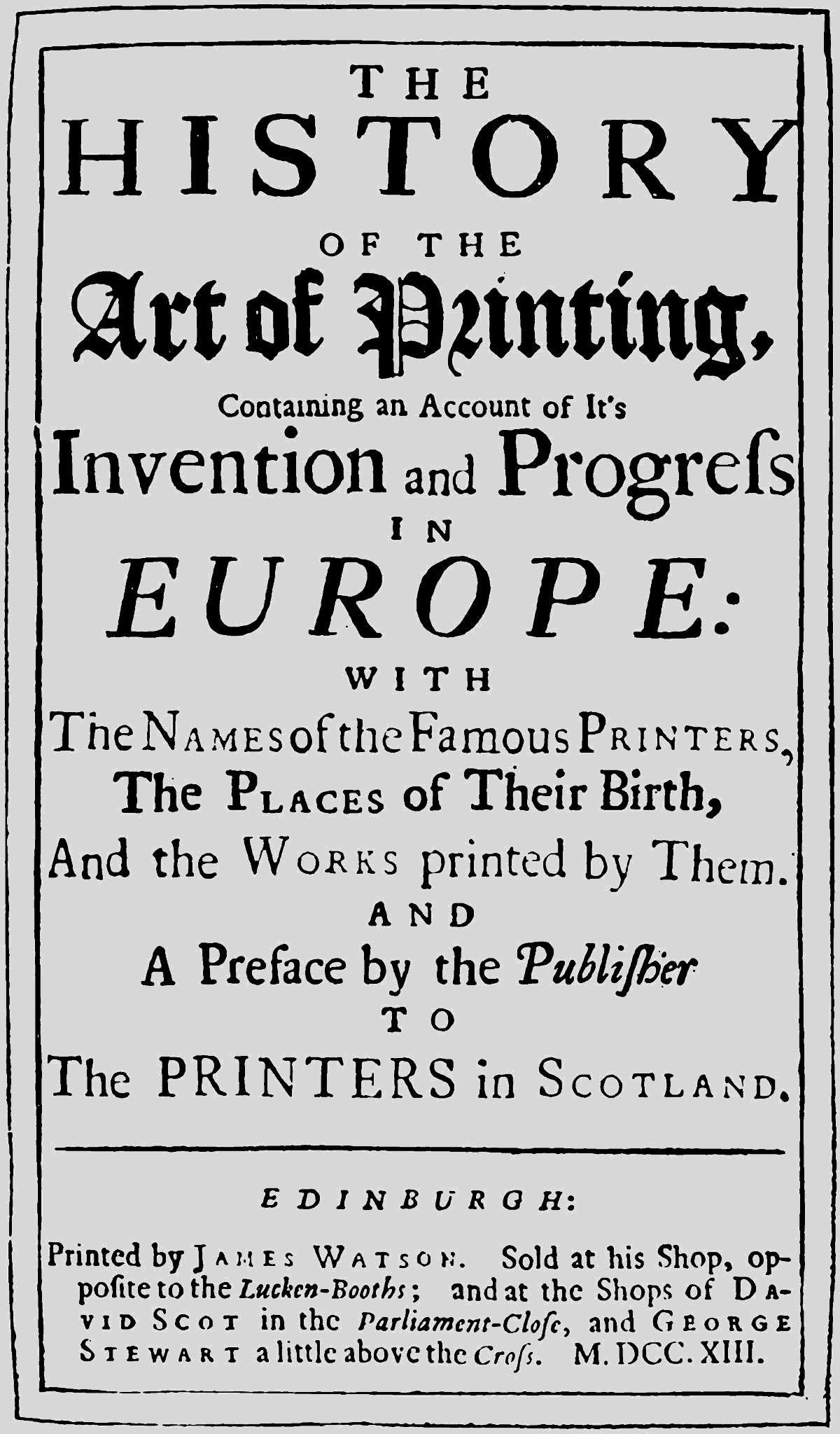
27. Watson, Jas.; “History of the Art of Printing.”
28. Dickson, Robert; “Introduction of the Art of Printing into Scotland.” *
* Since the death of the Author, Messrs. Dickson & Edmund’s “Annals of Scottish Printing” has appeared.
For Aberdeen:
29. Edmund, J. P.; “The Aberdeen Printers.”
For America:
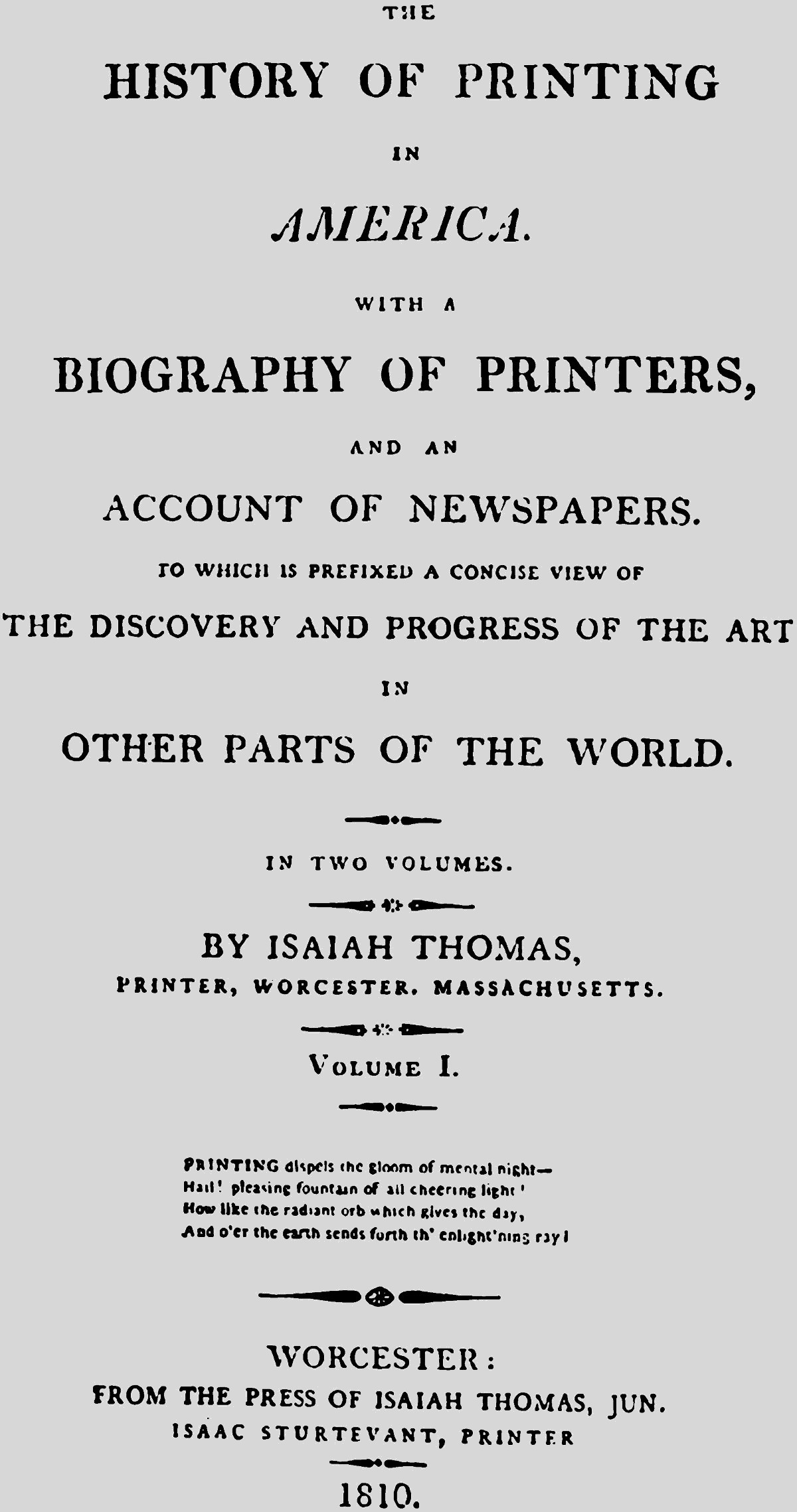
30. Thomas, Isaiah; “History of Printing in America.” (See p. 113.) The reprint of this work, in its omissions and careless inaccurate extracts, is a disgrace to the Society which issued it.
Numerous monographs exist, describing the first Presses in most of the large Cities of Europe; but our space prohibits their enumeration here.
The Leviticus is treated of in a large number of books on the Mechanics and Practice of Printing; amongst others—
31. Smith John; “The Printers’ Grammar” is the oldest instructor.
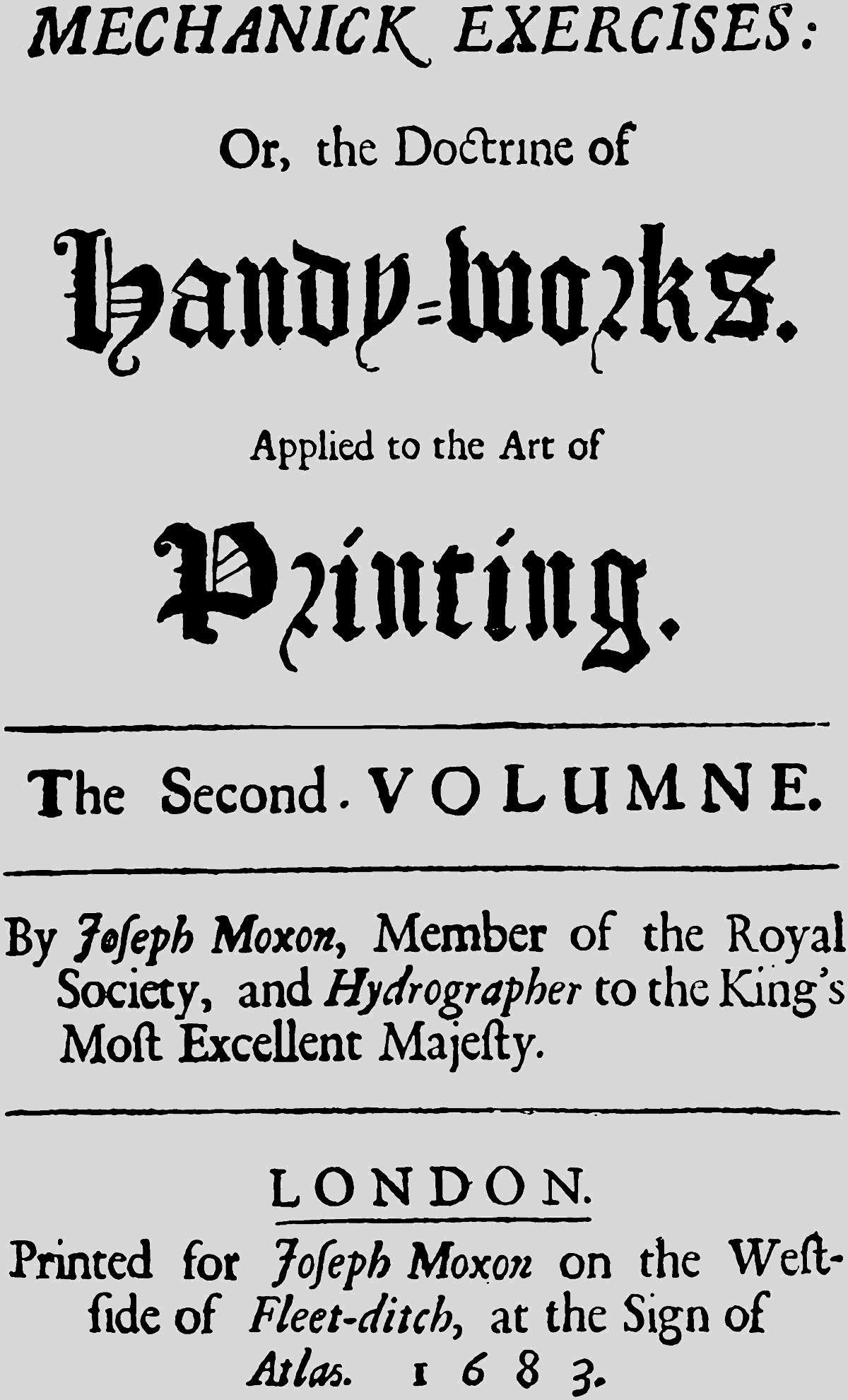
32. Moxon, Jos.; “Mechanick Exercises” is the oldest mechanical handbook. (See p. 108.)
33. Johnson, J.; “Typographia.”
34. Hansard, T. C.; “Typographia.”
35. Luckombe, P.; “History and Art of Printing.”
36. Savage, W.; “Dictionary of the Art of Printing.”
For Typefounding:
37. Mores, E. Rowe; “Dissertation upon English Typographical Founders and Foundries.” (See p. 112.)
38. Reed, Talbot B.; “History of the Old English Letter Foundries.”
39. Hansard, T. C.; “Treatises on Printing and Typefounding.”
For an account of the early mechanics of Typefounding, see Moxon, (No. 32 ante).
The Numbers of Printers whose biographies exist have not been very numerous. The best known are:—
For the first German Printers:
40. Gessner, C. F.; “Die so nöthig ... Buchdruckerkunst.”
For the early Printers generally:
41. Madden, J. P. A.; “Lettres d’un Bibliographe.”
For the Aldine family:
42. Renouard, A. A.; “Annales de l’Imprimerie des Alde.”
43. Didot, A. F.; “Alde Manuce et l’Hellénisme à Venice.”
For Jenson:
44. Sardini, G.; “Storia Critica de Nic. Jenson.”
For the Junta:
45. Bandini, A. M.; “De Florentina Juntarum Typographiâ.”
For Bodoni:
46. Bernardi, Jac.; “Vita di Giambattista Bodoni.”
For the first Parisian Printers:
47. Philippe, J.; “Origine de l’Imprimerie à Paris.”
For Geofroy Tory:
48. Bernard, Aug.; “Geofroy Tory, Peintre et Graveur.”
For the Stephens:
49. Bernard, A. J.; “Les Estienne.”
For the Dutch Printers:
50. Ledeboer, A. M.; “Alfabetische Lijst der Boekdrukkers ... in Noord-Nederland.”
For Colard Mansion:
51. Van Praet, J. B. B.; “Notice sur Colard Mansion.”
52. Carton, C.; “Colard Mansion.”
For Martens of Alost:
53. Gand, M. J.; “Recherches Historiques sur ... Thierry Martens.”
For Plantin:
54. Rooses, Max; “Christophe Plantin, Imprimeur Anversois.”
For the Elzevirs:
55. Pieters, Ch.; “Annales de l’Imprimerie Elsevirienne.”
56. Willems, A.; “Les Elzevier.”
For English Printers before 1600, consult Herbert (No. 20, ante).
For English Printers generally:
57. Timperley, Chas. H.; “Encyclopædia of Literary and Typographical Anecdotes.”
For Day:
58. Strype, J.; “Life of Parker.”
For Bowyer:
59. Nichols, J.; “Life of William Bowyer.”
For English Printers in the 18th century:
60. Nichols, J.; “Literary Anecdotes.”
For Baskerville, consult Reed (No. 38 ante, Chapter 13).
For Scotch Printers:
61. Dickson & Edmund; “Annals of Scottish Printing.”
The Deuteronomy, and modern developments of Printing, are dealt with in numerous current hand-books, of which the following may be named:—
62. Wilson, F. J. F.; “Stereotyping and Electrotyping”; also “Printing Machines and Machine Printing.”
63. Southward, John; “Practical Printing.”
Fac-simile Title-pages of a few curious works, not included in the above list, but worthy to rank among the Judges, are appended.
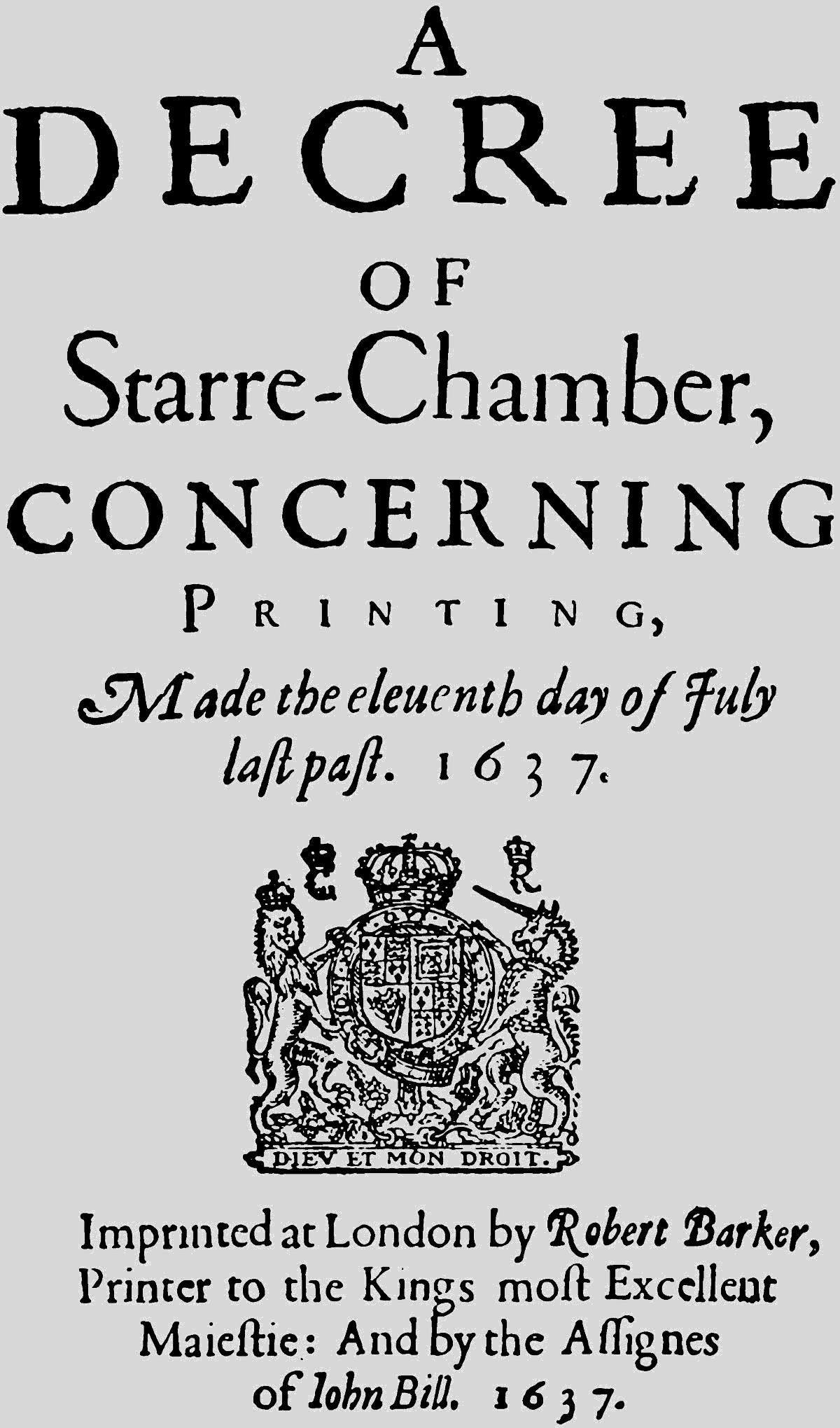
Fac-simile Title-page of the Star Chamber Decree, 1637.
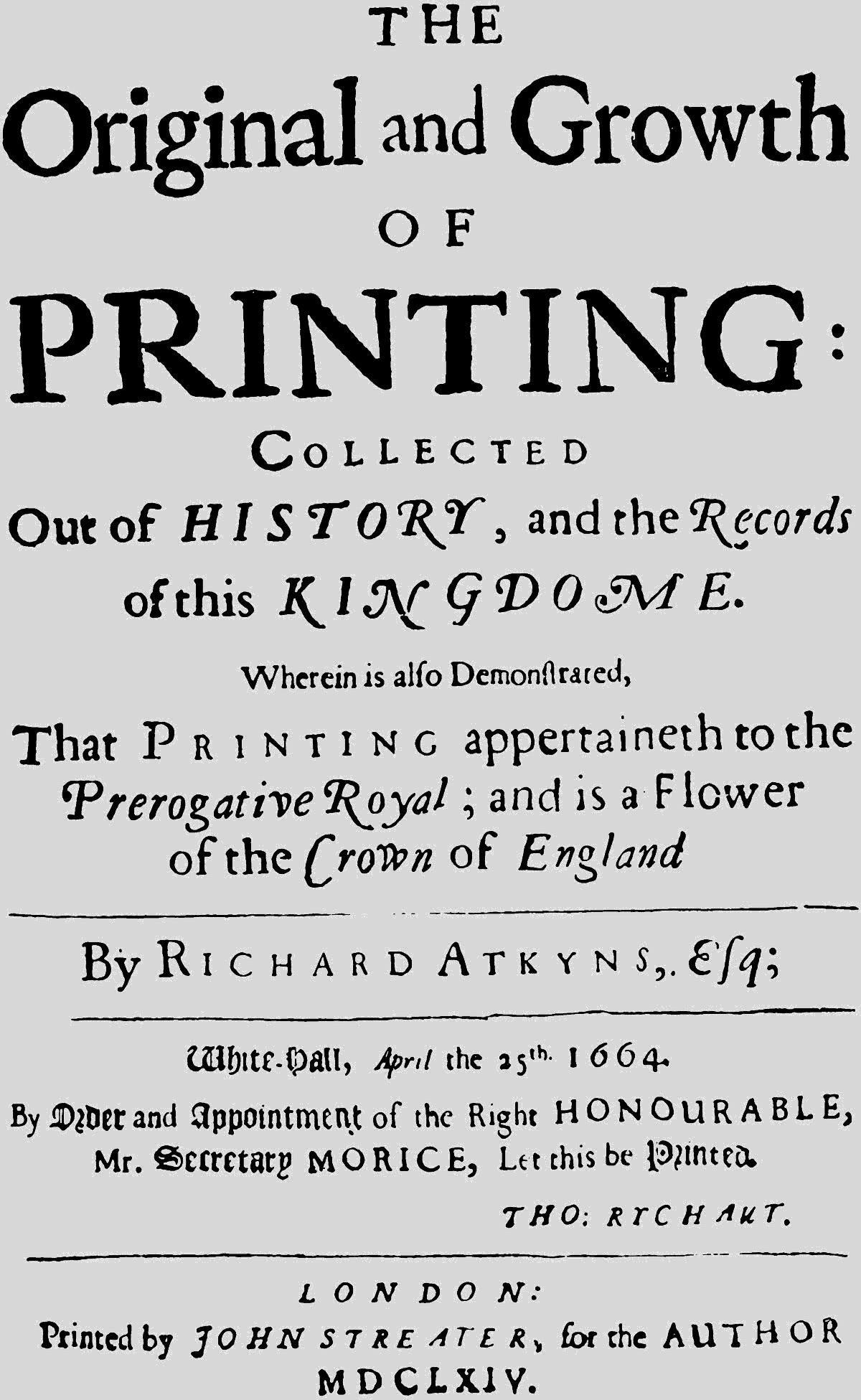
Fac-simile Title-page of Atkyn’s Original and Growth of Printing, 1664.
Fac-simile Title-page from Wolffger’s Format Buchlein, 1620.
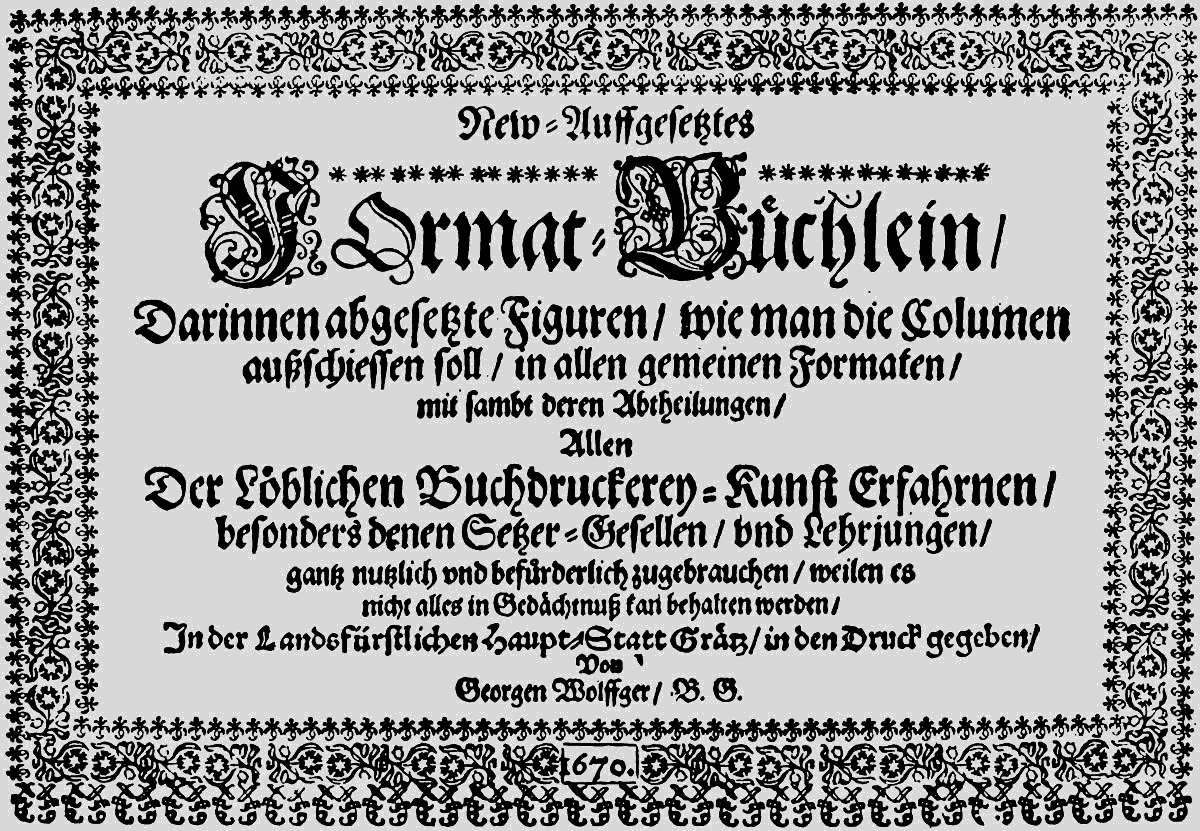
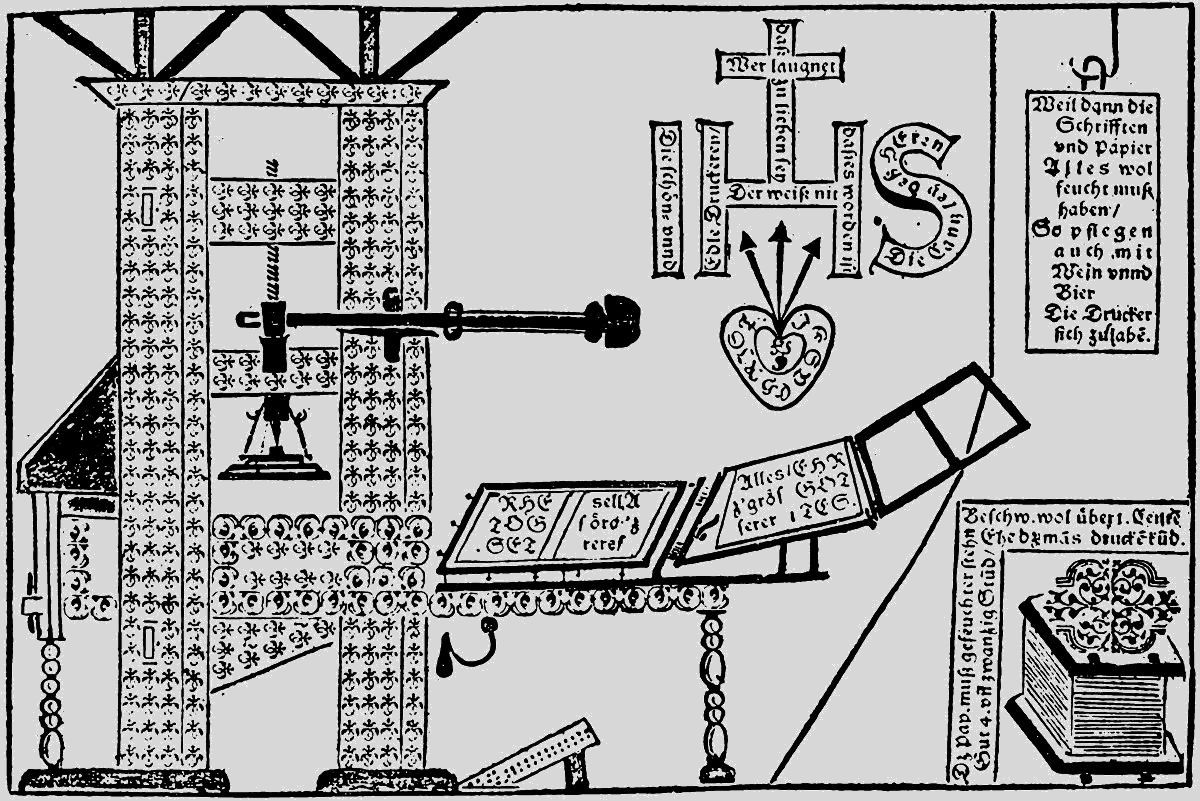
Fac-simile Illustration from Wolffger’s Format Buchlein, 1620.
Fac-simile Title-page of Moxon’s Mechanick Exercises, 1683.
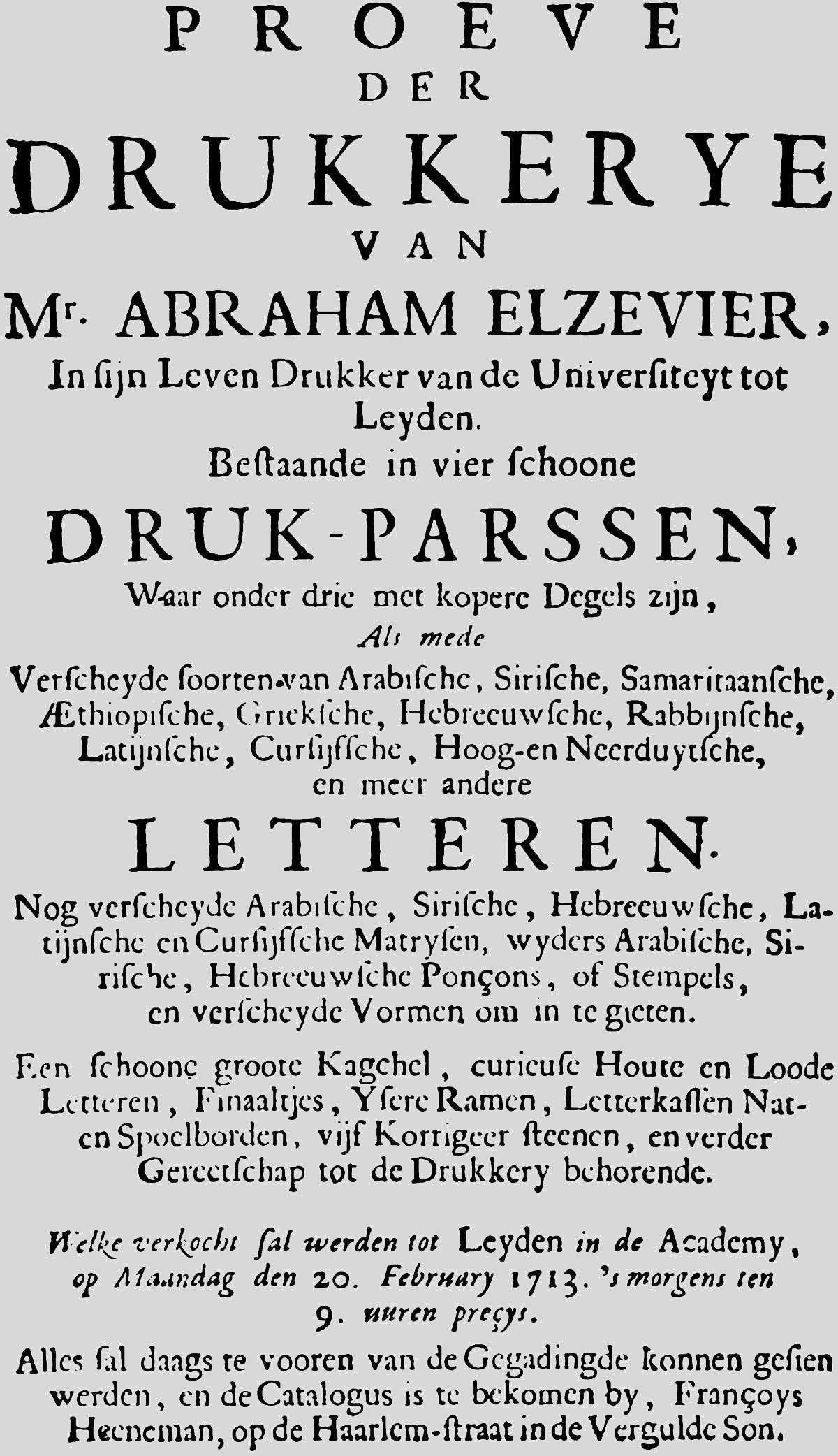
Fac-simile Title-page of the Elzevir Specimen Book, 1713.
Fac-simile Title-page of Watson’s History of Printing, 1713.
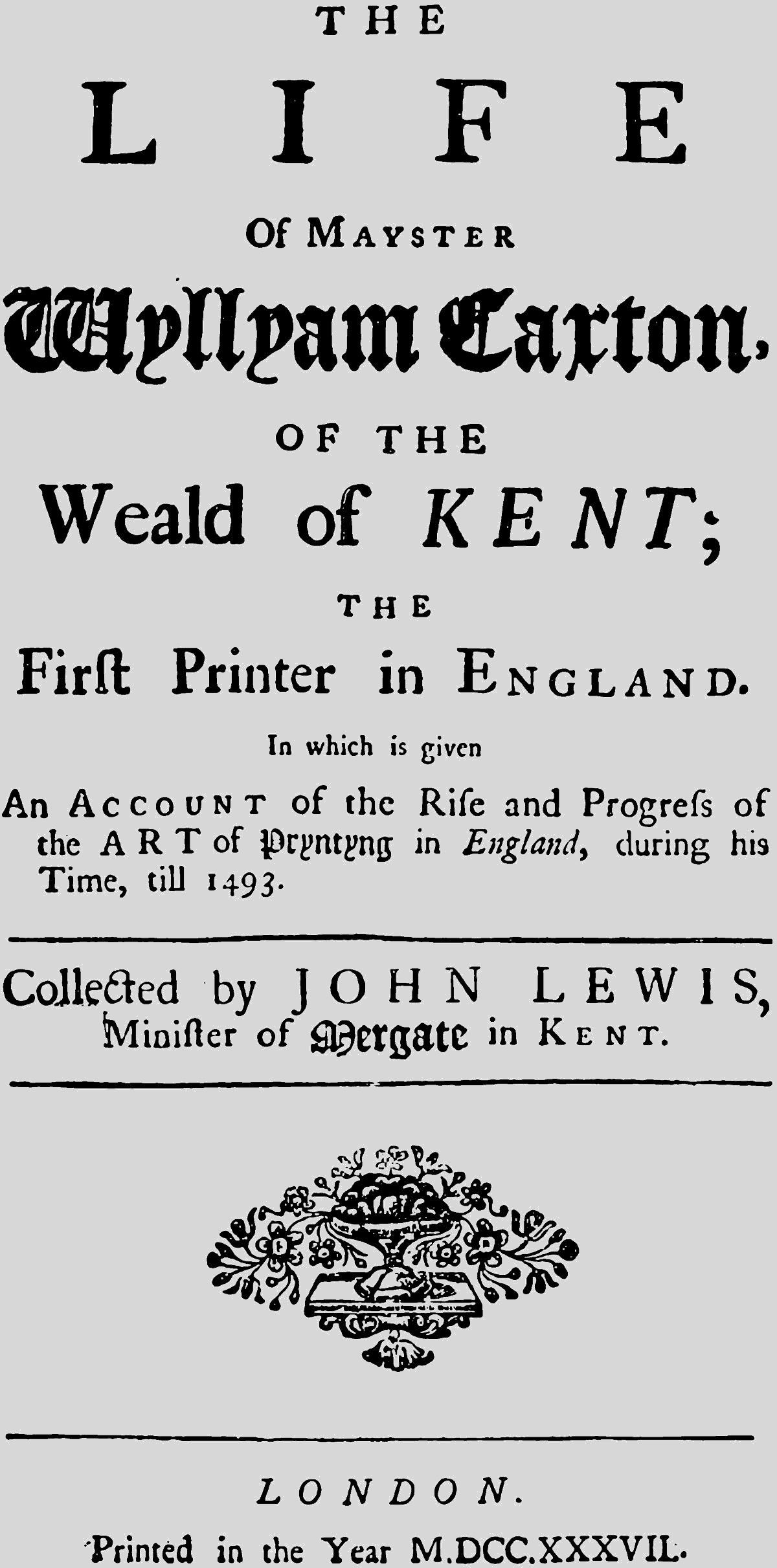
Fac-simile Title-page of Lewis’ Life of Caxton, 1737.
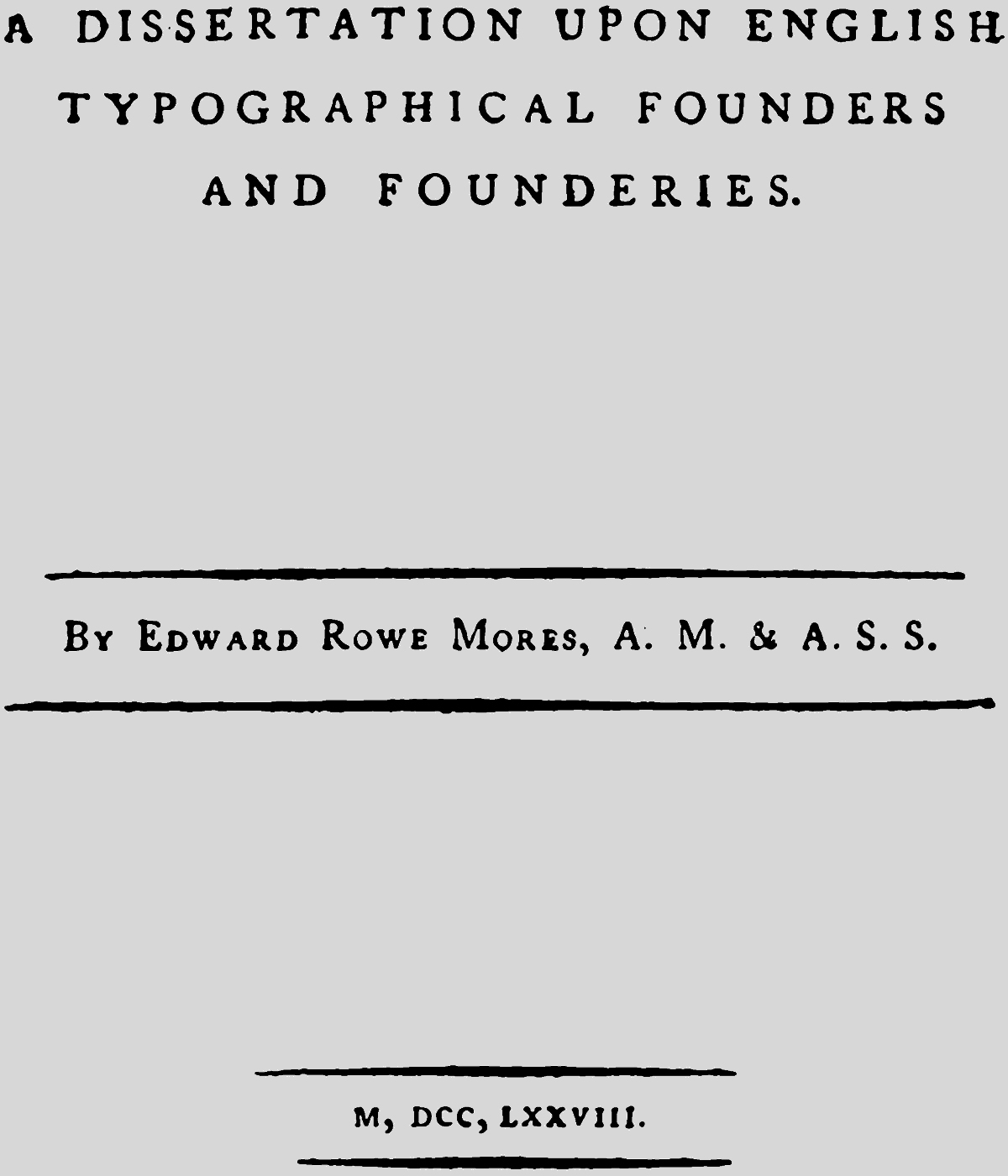
Fac-simile Title-page of Mores’ Dissertation on Founders, 1778.
Fac-simile Title-page of I. Thomas’ History of Printing in America, 1810.