DEUTERONOMY.
Reading edition
In Leviticus we traced the laws which governed the earliest stage of the printing-press. In Deuteronomy—which is the repetition and development of the law—we see an expansion and a second birth of the press, almost equal in importance to the first—viz., the invention of the Steam Printing Machine. The advance then made towards rapid and cheap printing has had almost as revolutionary an effect on the education and opinions of the nineteenth century masses as had the original invention of printing upon the sixteenth century middle-class. And as at first the art of printing was developed and improved both in excellence and speed for many a year after Gutenberg, so the modern machine, which started in 1814, is still developing its wonderful capacity for improvement and speed until the mind wonders if any limit can be assigned to its powers.
In 1790 all printing was effected by hand-labour. The types were hand-cast—the compositors’ hands were employed in arranging them—the paper was hand-made—the pressman’s muscles were called into play to handle the bar. Sheet by sheet he took up the paper and placed it in position upon the tympan, brought down the frisket to keep it in place, turned it over upon the ready-inked type, ran the whole by means of a winch under the press, pulled the bar or lever which gave the impression, turned the winch again, raised the tympan and frisket, and released the now-printed sheet. This series of movements, all requisite to print one side only, took really a shorter time in action than is here taken in the description; but the strongest workman, with muscles indurated by years of labour, could, with the help of a “fly-boy” to take off the sheets, and a “partner” to beat the form, scarcely exceed 250 pulls per hour, and that only on one side of a sheet—a snail-pace at which all cheap printing was impossible.
In this same year, 1790, the shadow of a great change soon to be effected in printing was thrown upon the scene. John Nicholson, a clever mechanician, took out a patent for printing by machinery, in which he specified those very principles of action which have been the basis of every successful printing machine since made. Nicholson, although clever in many ways, had none of the qualities which ensure success in life. Improvident, without tenacity of purpose or perseverance, his brains benefited others but not himself, and he died in 1815 without seeing the success of any of his numerous inventions.
Until the year 1811, when Kœnig succeeded in the attempt, the possibility of a machine being invented which could successfully perform all the varied operations just described was considered by all master printers as a scheme fit only for Utopia. Thus it happened that Nicholson, bankrupt and disheartened by misfortune, let his plans slumber in the Patent Office neglected and unnoticed, simply because no one had sufficient faith in him to advance capital for the purposes of experiment.
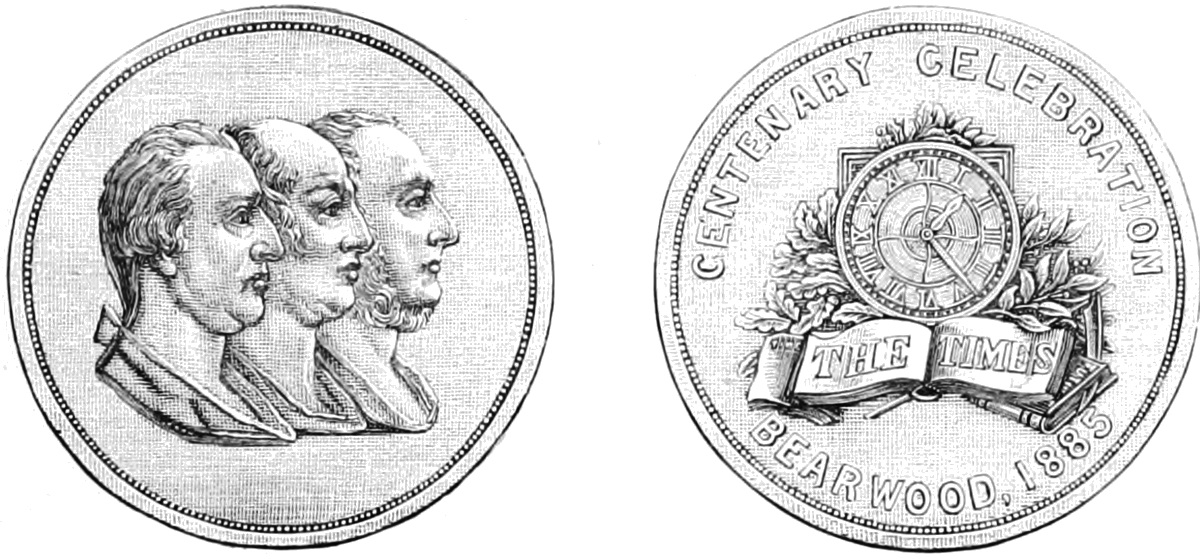
CENTENARY MEDAL OF THE WALTERS, OF “THE TIMES.” 1885.
Of a very different mould was Frederick Kœnig, a young German, who about 1804, began to work out his ideas for improving the mechanism of the old wooden press. Endowed with mechanical genius, great perseverance, and, above all, a firm belief in himself, he worked unceasingly to accomplish his aim, and to him, without doubt, must be awarded the honour of making the first workable printing machine. His early attempts were quite unsuccessful. Neglected in his native land, and befooled in Russia, he at last came to London, where, after a period of want and disappointment, his evident cleverness and perseverance interested the well-known printer, J. Bensley, in his designs. Although in after years bitter feelings existed, and still more bitter words passed between these two, it should never be forgotten that Bensley was Kœnig’s earliest and best friend in London. He was the first to recognise his powers, and without his assistance, Kœnig would, in all probability, have gone to his grave—as many other inventors quite as clever have done—his genius unrecognised, and his whole life embittered by disappointment. Mr. Walter, of The Times, although more interested than any one in the improvement of the press, did not see enough in Kœnig’s first machines to induce him to assist, until success had made assistance safe; but Bensley year after year supported him, and found funds for costly experiments, which, although displaying great cleverness and ingenuity, led to no successful result. From 1806, when he came to London, to 1811, Kœnig made two complete machines (not including his first wooden trial), but both were unsuccessful, because they were founded on the false principle of the old hand-presses, viz., impressions from a flat surface or platen. Disheartened by failure, and, as he himself confessed, at his wits’ end what to do next, an accidental occurrence put him on the right road. Bensley, his partner, by chance visited Nicholson, to obtain from him some information concerning those patent laws with which a long and sad experience had rendered him familiar. He found him in the debtors’ gaol, and then he heard for the first time of Nicholson’s patents. Fluttered and anxious, Bensley took Kœnig straight off to read the particulars. Kœnig did read them, and read them carefully, but with great contempt for their crudeness, and immediately forgot all he had read! (at least he declared so fifteen years later). However this may have been, he at once set about constructing a new machine, in which all his previous plans of impression were thrown aside, and (wonderful coincidence!) Nicholson’s method of pressure, by means of a cylinder, beneath which the type ran, was adopted. This was the turn in the tide which led on to fortune, at least the magic word “success” crowned Kœnig’s toil.
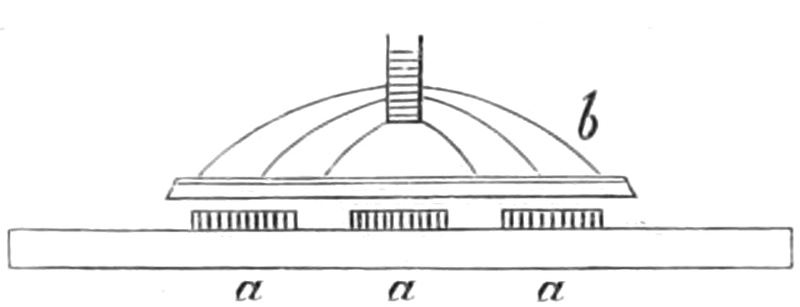
FLAT IMPRESSION.
(a) Type. (b) Platen.
John Walter, of “The Times,” now approved and adopted the new machine; and from that time to the present improvements have been made by a succession of clever mechanicians, until the printing machine of today is a surprising piece of human ingenuity, which by its simplicity excites the wonder, and by its cleverness the admiration, of every beholder.
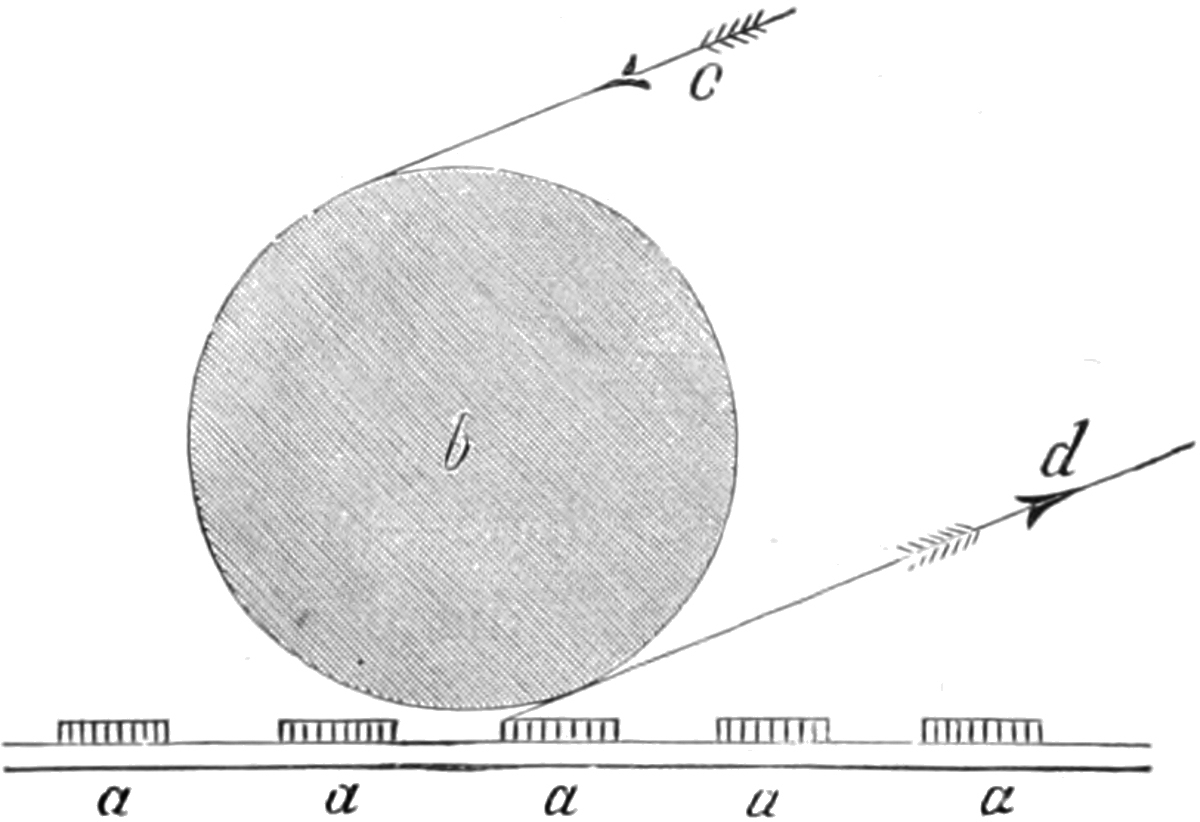
SINGLE CYLINDRICAL IMPRESSION—TYPE OR PLATES ON THE FLAT.
(a) Type or Plates. (b) Cylinder. (c, d) Direction of Cylinder.
It is here only fair to state that Herr Goebel, the German biographer of Kœnig, and all who sympathise with him, are very indignant at this version of the story. They utterly deny that Kœnig owed anything to Nicholson, and have heaped scorn on the heads of unbelievers in their hero. But the plain sequence of facts is against them. First, we have Kœnig unsuccessful in his trials with a platen machine; secondly, we find him reading Nicholson’s plans for a cylinder machine; thirdly, we see Kœnig rejecting at once his first ideas, and successfully adopting those of Nicholson. I adhere to my opinion that, while admitting the great mechanical genius of Kœnig, as shown throughout his career, he nevertheless at this critical point owed his success to the undeveloped plans of William Nicholson.
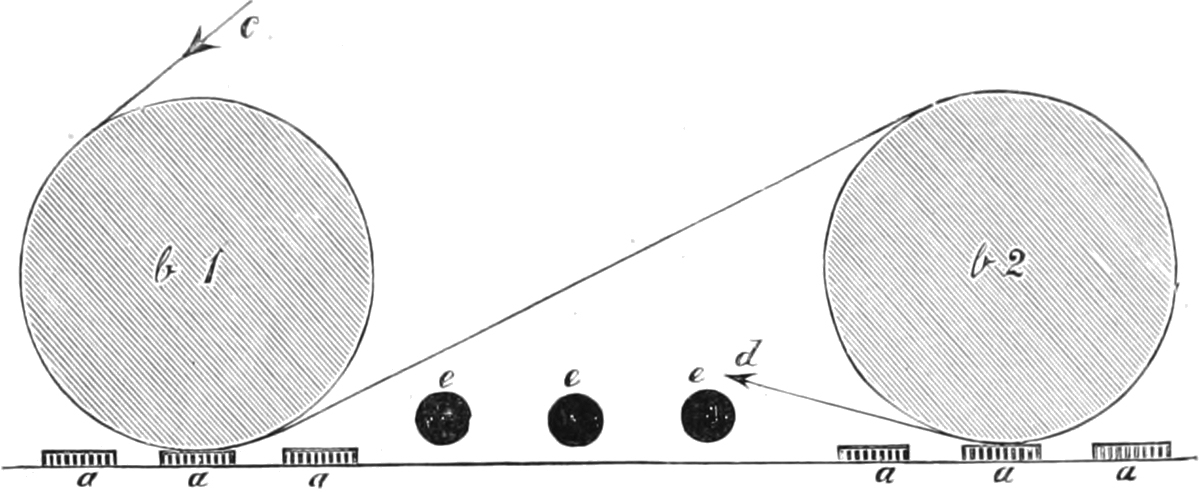
DOUBLE CYLINDRICAL IMPRESSION OF A PERFECTING MACHINE—TYPE OR PLATES ON THE FLAT.
(a) Type or Plates. (b1, b2) Cylinders. (c, d) Direction of Cylinders. (e) Ink Rollers.
To consider this as derogatory to the genius of Kœnig is to take a false view of things. No one doubts Handel’s genius because he built some of his melodies upon the themes of previous musicians, or thinks the worse of Shakespeare for adopting the old story of “Romeo and Juliet,” and weaving therewith his immortal tragedy. Why, then, should Germans resent the statement (which is simply historical) that Nicholson supplied Kœnig with an idea which his mechanical genius at once made his own, and successfully developed?
Kœnig’s first success was a machine which printed one side of the paper only. He next constructed one which, by duplicating the parts, printed both sides of the sheet. Donkin and Bacon made the great advance of using a composition of glue and treacle for rollers, instead of leather, which had never been satisfactory. In 1815 Cowper took out a patent for placing curved stereotype plates round a cylinder, the principle of which had already engaged the attention of Nicholson. Cowper carried this plan to a great pitch of perfection in the machines made for The Times, and from that time to the present every year shows new improvements and higher efficiency. The varieties in modern printing machines are innumerable, and their management requires great intelligence on the part of the “minder,” who, if he understands his duty, deserves and can command high wages.
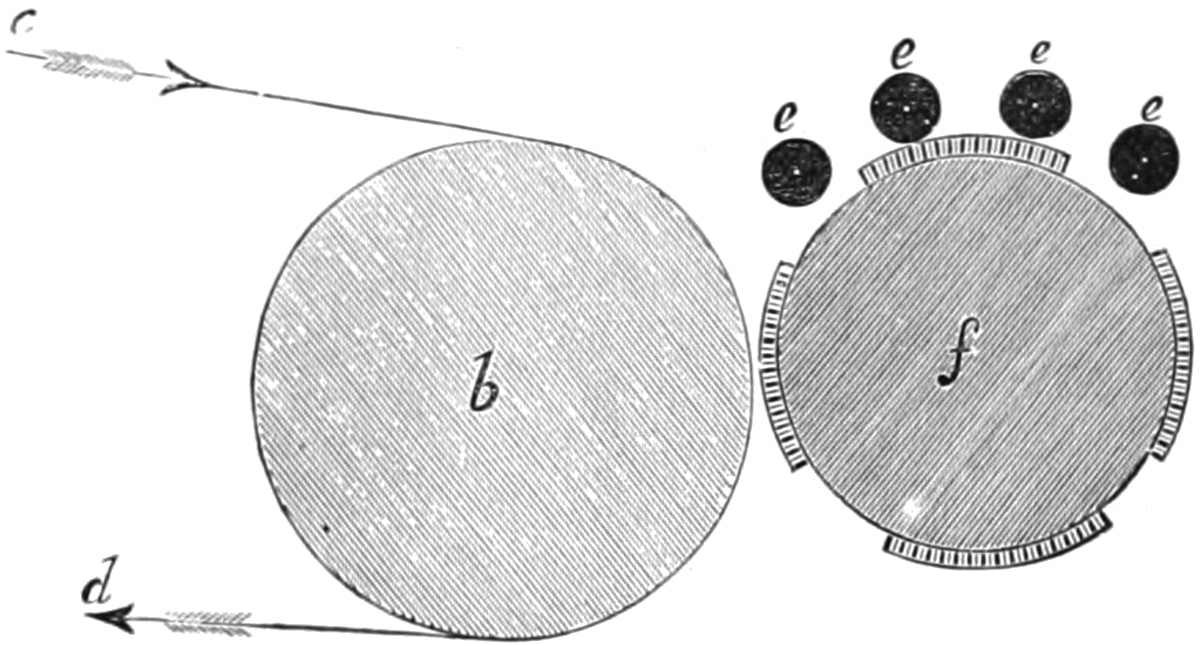
CYLINDRICAL IMPRESSION FROM CURVED STEREOTYPE.
(b) Cylinder. (c, d) Direction Of Cylinder. (c) Ink Rollers. (f) Cylinder on which are mounted Curved Stereotypes.
Few sights are more impressive than the machine-room of one of our daily papers in the small hours of the morning. Suppose you have obtained an order to see the paper put to press, the best way is to engage rooms for the night at a neighbouring hotel. If the stage has attractions for you, there will be plenty of time for a leisurely supper after the play is over, and then, about two o’clock, to sally into Fleet Street, which, even at this hour, is anything but a neglected thoroughfare. Entering the printing-office, we visit the foundry-room first, where the foreman explains the use of various tools and arrangements, and has scarcely finished when the first page of the paper comes down from the composing-room. There is no dawdling now. The page of type is quickly placed beneath the platen of a press, and a thick sheet of a soft material—a mixture of papier-maché and plaster of Paris, called the flong—is placed upon the face of the type. The platen descends, and by pressure forces the type into the soft flong, and makes a complete mould. The flong is then dried rapidly while still adhering to the type. When taken off, it is placed in a beautifully made steel mould. This mould is curved to a quarter-circle, and when the flong is placed inside it, and the liquid metal poured in, the result is a curved plate, with a cast from the type on its outer surface. This plate is placed upon a saddle, and all excrescences rapidly removed with great skill from the edges and various spaces; it is ready then for the machine-room. So soon as eight pages are fastened on the cylinder of the first machine the printing begins. At one end of the machine is a heavy reel of paper, sufficient to make about 6,000 complete papers. It is wound round a core like that used for a garden-hose, and forms a solid mass, which unwinds rapidly when the machine grips it. A knife with unerring precision cuts off each paper as soon as printed, and delivers it onto a collecting board. Soon after No. 1 machine gets to work, No. 2 is supplied with plates and started; so with the other machines, until eight or nine are all printing at once, each delivering about 12,000 complete copies an hour, so that with eight machines the delivery would be 96,000 per hour. The din is something awful, and entirely prevents the asking of questions. Relays of men are always hurrying away from each machine loaded with printed papers. These are counted into quires in the warehouse, and at once delivered to the newsagents. A curious and interesting circumstance attending such speedy printing is the large amount of electricity excited by the friction of the paper in its passage, and the storing of this electricity in the printed heaps. I have seen quite a long spark dart out of a heap into a man’s knee; and occasionally much inconvenience arises from electrical repulsion and attraction, interfering with the passage of the sheets.
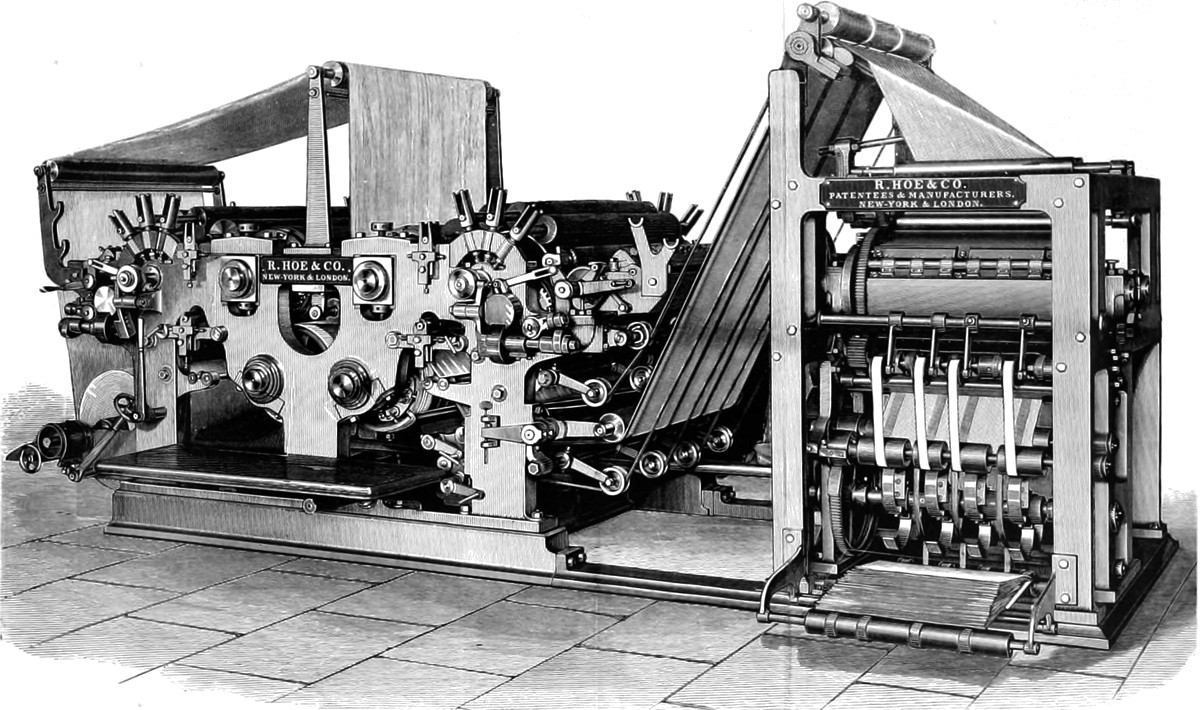
THE “HOE” NEWSPAPER PRINTING MACHINE.
The laws of printing machinery are not the only phase of the Art in which the original invention has been supplemented by a second.
The compositor’s work is so specially intelligent that it was thought no machinery could ever be brought to supersede it. Early in the present century, however, an attempt was made to economize labour by cementing into one piece common words, or combinations of letters of frequent recurrence. These “logotypes,” as they were styled, were introduced by Mr. John Walter, of The Times, and used in the composition of that paper, as well as in general bookwork, for some years. But the difficulty of adapting the “case” for these numerous additional “sorts” proved a bar to their general adoption, and in a short time the compositor reverted to the single letters.
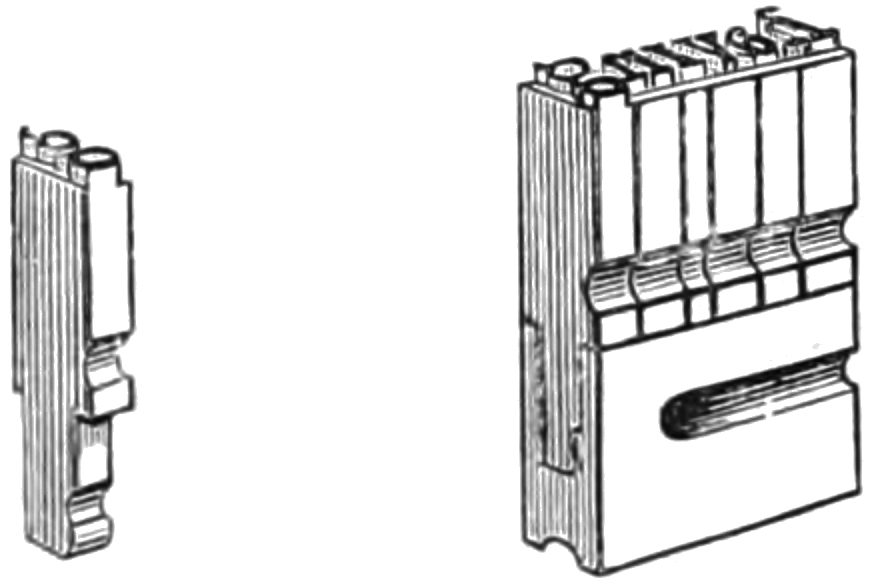
EARLY LOGOTYPES.
Of late years the composing machine, formerly but a plaything, has made great strides towards perfection. The help of electricity has here also been called in, and as fast as the hand can move, the separate types make a continuous and rapid flow into perfect lines. More wonderful still, a distributing machine has been made, which takes the pages of types after they have fulfilled their duty, and without the aid of hands sends each letter down a separate channel to its own particular destination, and that at a speed with which a compositor could never compete.
One more marvel: Before me is a book which to the eye appears printed as other books with types, and yet not a type has been used. It is truly an anomaly, typography without types. The machine is worked by means of keys something like a piano. Behind is a block of teak wood, properly placed in its position. This block shifts and adapts itself automatically to the various positions requisite for it to occupy. Suppose the first word of your copy is “Print,” you touch the right key and out darts a steel punch, on the end of which is a “P.” This punch is driven into the wood an exact distance, and in the exact position proper for the first word of a sentence. The blow given, the punch retires, and leaves a beautifully clear matrix in the wood. The punch “r” follows in the same way; the “r” key is pressed, and the punch is driven in just by the side of the former. The other three letters follow in due course, and so on with word after word, until a whole line is complete, when the block automatically shifts itself, and a fresh line just beneath the other is commenced. By a clever arrangement, the lines are all made of one even length, and when a page is thus completely punched, the block of wood is used as a mould from which stereotype plates are taken, which print evenly and beautifully. The speed and accuracy of this wonderful machine is truly astonishing, but there are too many drawbacks to the method to commend it for most practical purposes. Correction, for instance, entails entire recomposition; while as regards the appearance of the matter in print, it must be admitted that, excellent as the result is, considering the method and material in which it is produced, it cannot for a moment compare for delicacy and regularity with the result to be obtained by the old-fashioned use of types, set by the compositor’s hand. The great merit claimed for these machines and others of a similar kind (amongst which the “Linotype” may be mentioned as mechanically the most ingenious), is speed and cheapness,—qualities which do not always assort with fine work, or even easy legibility.
The last invention I will mention is the method of producing printing surfaces by photo-typography—a plan which to a great extent supersedes stereotype plates, especially where any change of size is desirable. A zinc plate is prepared photographically, and the drawing or page of a book to be used is focused with a camera to the size ordered. An image is thus taken on the metal plate, which is chemically rendered insoluble by acids in the parts where the image has impinged. The plate is then treated to an acid bath, when all the parts where the image is not are eaten away, and in half an hour to an hour a raised surface, sufficiently high to print from, is left. For work without very fine lines this process is extremely useful.
A CHAPTER ON JUDGES.
“’Tis with our judgments as with our watches; none Go just alike, yet each believes his own.”—