EXODUS.
Reading edition
In these days of rapid inter-communication every good invention becomes public property in a very short time. Not so in the fifteenth century. Typography did not spread rapidly for many years after its birth. The workmen were probably bound to secrecy, and the Press itself had to create work for itself by educating a public up to the reading point. Indeed, so restricted was the sale of books at first, that in a commercial sense the profits were very poor.
In October, 1462, one printing-house at Mayence was at work, under Fust and Schœffer, who are supposed to have had many workmen in their service. It is not known for certain that Gutenberg, who a little later was printing at Eltville, had at that time a press in the same city: probably he had. Pfister at the same time was printing in Bamberg, and Mentelin and Eggestein at Strasbourg. Besides these we know no other presses then existing, and not much had yet been issued from these four put together. Bernard, indeed, says that several neighbouring towns had established printing-presses, although of this there is really no proof. But the captivity of the young giant was soon to end, for, in the month and year just stated, the famous city of Mayence, which had become the battlefield for two opposing archbishops, was captured by Adolphus of Nassau and given up to pillage. From a nourishing city it became a half-burnt, forsaken ruin, and all who could, deserted it. Schaab gives a fearful account of the devastation and fire which befel this once populous city. Fust and Schœffer’s printing-office was burnt down, masters and workmen were driven away. This Exodus of practical Printers formed an epoch in the history of the Art. Presses were soon established by the fugitives in Cologne, Rome, Augsburg, Nuremberg, and other places. In Cologne, especially, typography took deep root and flourished. Here Ulric Zell, who had learnt the art under Peter Schœffer, established a press, which proved very prolific. It was one of Zell’s workmen who, in 1499, penned the remarkable statement about Germany having taken the first idea of printing from the Donatuses of Holland. Zell’s first dated book bears the year 1466; but as nearly all his books were issued without any date, it is more than probable he began two or three years earlier. His types are bold and easily recognised; they are of three sizes, and all of the same style. A few years later several other printers were at work in the same city, which, by the end of the century, boasted of a considerable number of presses, that of Arnold Therhoernen being the best known.
In 1469 printing found its way to Nuremberg, where Henri Keffer, one of the original Mentz printers, joined in partnership with Jean Sensenschmidt, and published many books. Friedrich Creussner was another Nuremberg printer of whose works many have survived; but the most celebrated was Anton Koburger, one of the greatest and most artistic printers of the fifteenth century, who kept twenty-four presses going in this city, besides branch establishments at Basle and Lyons. In this town, too, was produced, in 1517, a piece of work, the technical peculiarities of which it has puzzled even printers and typefounders to understand. This was the celebrated “Theurdanck,” a beautifully illustrated book printed for the Emperor Maximilian, by Melchior Pfinzig, in which the flourishes and ornamentation rise or fall from one line to another in a manner apparently irreconcilable with types which must be cast in a mould. The typographical curiosities of this book are indeed most interesting, and afford evidence of skill in typefounding, which could only have been developed where Imperial funds were used for the education of both punch-cutters and typefounders. From that time until lately, no such work has issued from any printing-office. In Germany, however, and in America, the modern typefounders have in the last few years shown capabilities of combination in well devised types, which prove that were the “Theurdanck” to be placed in their hands today for reproduction, they could not only equal, but even excel that wonderful effort of the sixteenth century.
Berthold Rot, of Hanau, one of Gutenberg’s workmen, carried the art to Basle, and set up his press before 1468; and six years later there were three printing-houses at work in that city.
A press was established in Augsburg, about 1469, by Gunther Zainer, who came from Strasbourg, and had the credit of being among the first to introduce the Roman character into Germany.
The City of Spire received printing in 1471, and speedily became famous, sending out in her turn several pioneer printers.
In Italy the first press was erected in the monastery of Subiaco, a few miles from Rome, by two workmen, Sweynheym and Pannartz, whose earliest work bears the date 1465. In 1467 the same printers moved to Rome, where they soon became famous for their editions of the classics, which were published with remarkable speed one after another. Here, of course, the types used were Roman; that shape being as natural to Italy as the Gothic types to other countries. Had the sale of their books been at all commensurate with the rapidity of their production, all would have been well, but at the end of five years the two printers found themselves burdened with heavy stocks of unsold books, and with empty purses, while several rival printers had erected presses in the same city. They appealed to the Pope for assistance, but with what success is unknown. Neither of them battled much longer with the ills of this life, Death claiming both printers in 1477, just as our Caxton was starting in his typographical career.
After Rome, the Printing-press travelled to Venice, where Jean de Spire introduced the new art in 1469. His name, however, was soon overshadowed by the renown of two celebrated typographers, Nicholas Jenson and Christopher Valdarfer, whose beautiful Roman types were much admired. Vendelin of Spire, brother of Jean, also was a famous printer in the same city.
Lucca, Foligno, Milan, and Florence received printing early, but there is no space to add particulars.
Considering the pre-eminent position held by Paris and its celebrated University in the fifteenth century, it is somewhat remarkable that printing did not take root in France until the year 1471. Printed books from other cities, however, were not uncommon, having been sold there continuously for nine years from the time that Fust brought the first printed Bible to Paris in 1462, and when Schœffer in 1468 sold there an edition of Cicero.
At last Guillaume Fichet, who was Rector of the Sorbonne, and, although by birth a German, was anxious to see some of his own writings printed by the new method, joining with Jean Heynlin, a Swiss, and professor at the same University, sent to Switzerland for workmen to start a printing-office in Paris. Three men, Ulric Gering, Michael Friburger, and Martin Cranz, all of Basle, answered to the call, and after occupying a year in preparation, completed the first book ever printed on French soil, in the precincts of the famous Sorbonne. It was entitled “Gasparini Pergamensis Epistolæ,” a work celebrated for the classical beauty of its style, to which Fichet added an introductory chapter. After an edition of “Sallust” and the “Orationes Bessarionis” came Fichet’s own work, “Rhetoricæ Ficheti.” Of this he appears to have been very proud. He took great pains to have several copies carefully printed on vellum for presents, which were splendidly illuminated, and to each he added a specially printed preface written by himself, and suited to some particular recipient, so that in this respect each copy was unique. These copies were presented to the French King, to the Pope, to Edward IV of England, and a few other distinguished personages, whose names are all detailed in the interesting history of Parisian printing lately issued by M. J. Philippe.
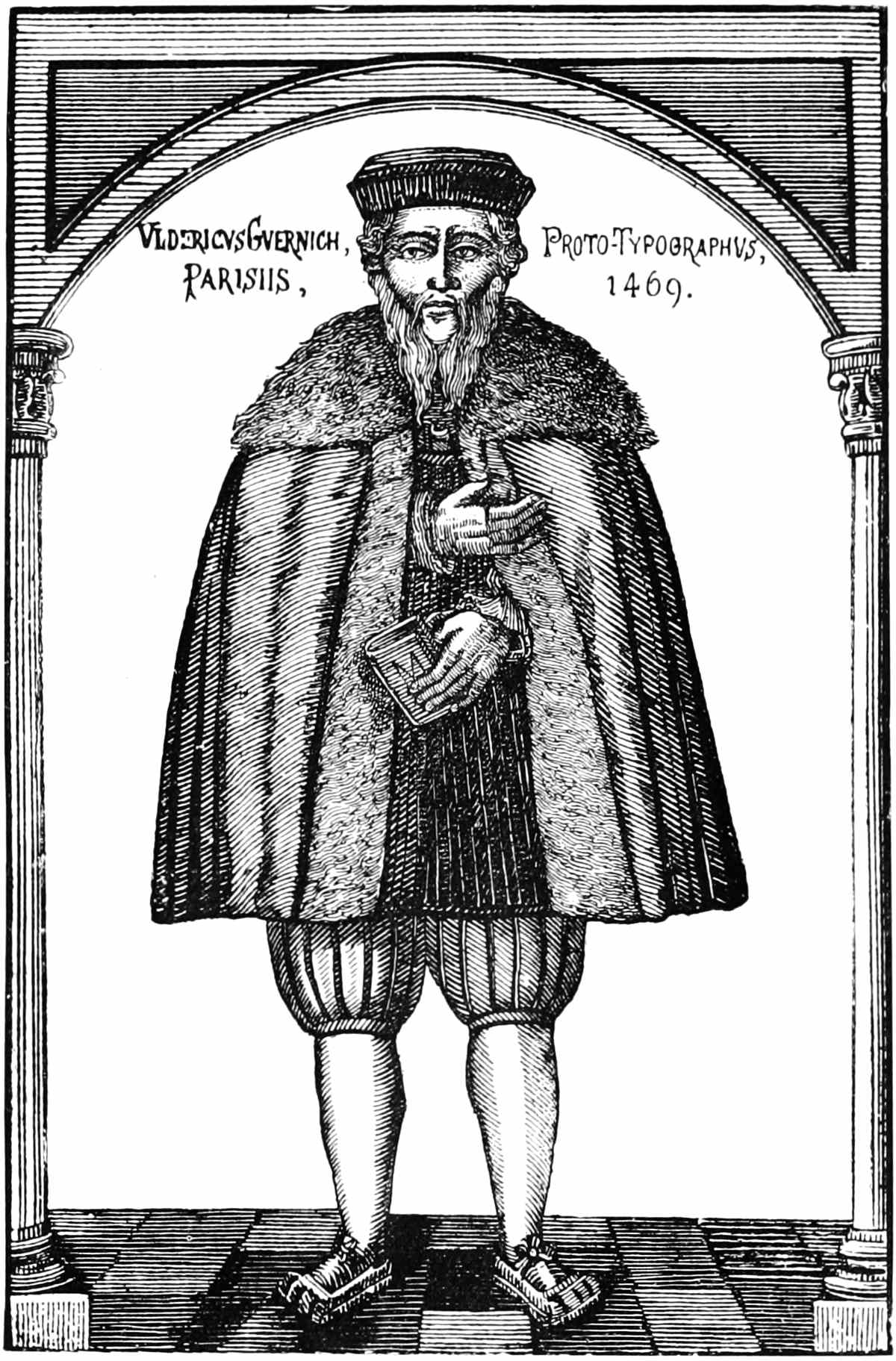
PORTRAIT OF ULRIC GERING. (From
Philippe
.)
After nearly three years’ work, and when thirty books had been published, half in quarto and half in folio, with an average of seventy-two pages to each, the expense was found too heavy, and in December, 1472, the Sorbonne Press was relinquished.
It is curious to notice with reference to the earliest press of France, that the first Printers there were not Frenchmen, and that they printed their earliest books in Roman type; that the first twelve books printed in France were not in the French tongue; and the very first book issued in the French tongue was not printed in France. The first book, indeed, printed in English, and the first book printed in French, issued from the same press, that of Colard Mansion of Bruges. The English book was “The Recuyell of the Histories of Troye” and the French, “Le Recueil des Histoires de Troye.” Both are undated, but were probably printed in 1474.
The Sorbonne Press having ceased work in 1472, Gering with his associates, started a fresh printing-house on their own account, two of their workmen doing the same. These men, by adapting themselves to the times, and printing, not classics in Roman type for a few scholars, but works popular with all who could read, succeeded well. These books were printed in a picturesque Gothic type made in imitation of the manuscript books to which French readers were accustomed. About 1477 Gering’s associates retired, and he was joined by a printer named Maynyal. To Englishmen this is a fact of some interest, as it was to this same Maynyal that William Caxton applied when he wanted help to print a Sarum Missal in 1484. In this missal Caxton’s trade mark appeared for the first time.
The Netherlands did not receive the new art until 1473; and, as if to make up for lost time, presses were erected at Alost, Utrecht, and Louvain, all in the same year. There is a beautiful statue in the city of Alost to Thierry Martens, who first printed there. In Louvain the well-known typefounder and printer, John Veldener, began work in 1473, and in consequence of the great similarity of his types to those of Caxton he is supposed by some bibliographers to have supplied England with the first printing materials used there. Veldener left Louvain in 1478 to print at Utrecht.
In Brussels the press was erected in a monastery, where “The Brothers of Common Life” printed from 1476 to 1487. The city of Bruges has a special interest for English bibliographers, as it was there that for thirty years William Caxton resided. Here Colard Mansion started a press about 1473, although the earliest date in any of his books is 1475. More particulars of this printer and his connection with the first English press will be given when narrating the story of Caxton’s life. In Gouda, Gerard Leeu, also a friend of William Caxton, began to print in 1477. Antwerp did not see a printing-press until 1482, while Leyden and Ghent waited until 1483. Haarlem itself cannot show a book with a printed date earlier than 1483, but, as shown in the previous chapter, the probability is that printing was practised there much earlier.
In forming opinions upon debatable points in early printed books, much caution is necessary, and the more one studies the earliest specimens the greater becomes the conviction that all dogmatic assertion not founded on positive dates should be avoided. Yet, before leaving the Netherlands, it may be well to draw attention to some points which ought to receive consideration with reference to the source from which the Netherland printers obtained their typographical knowledge. In a book intended for popular reading, technical peculiarities would be tedious; but to anyone practically acquainted with type-printing it is very difficult to believe that the early Netherland books, say the Colard Mansions and the Veldeners, could have been produced by men who had learnt to print from disciples of the Gutenberg School.
The books of Ulric Zell of Cologne show, typographically speaking, ways of working superior to and differing from the books of Caxton and Mansion; and it is against all probability that the Netherland printers, after learning their art in such a school would, upon returning to their own country, have adopted customs and habits of printing belonging to an early and imperfect state of the art, which they could never have seen in the workshops of their instructors. That the early specimens of Dutch printing shown with such wonderful accuracy in Holtrop’s “Monuments Typographiques” could have been true descendants of the Mayence Psalter and Gutenberg Bible, is more difficult to believe than the origination of a Dutch school of typography which was improved by and merged into the German school.
The Exodus of the Press and its journeyings through the principal cities of Europe having been thus recorded, we have now especially to narrate the circumstances in which it took root and flourished in Great Britain.
Although some of the older writers throw doubt upon the priority of William Caxton’s press in England, there is now a general consensus of opinion that the claims of Oxford to have had a Press in 1468 cannot be sustained. To state and refute these claims, which are founded entirely on a typographical blunder in the printing of a date, would occupy too much space. It will therefore be better at once to trace the career of the Westminster Press.
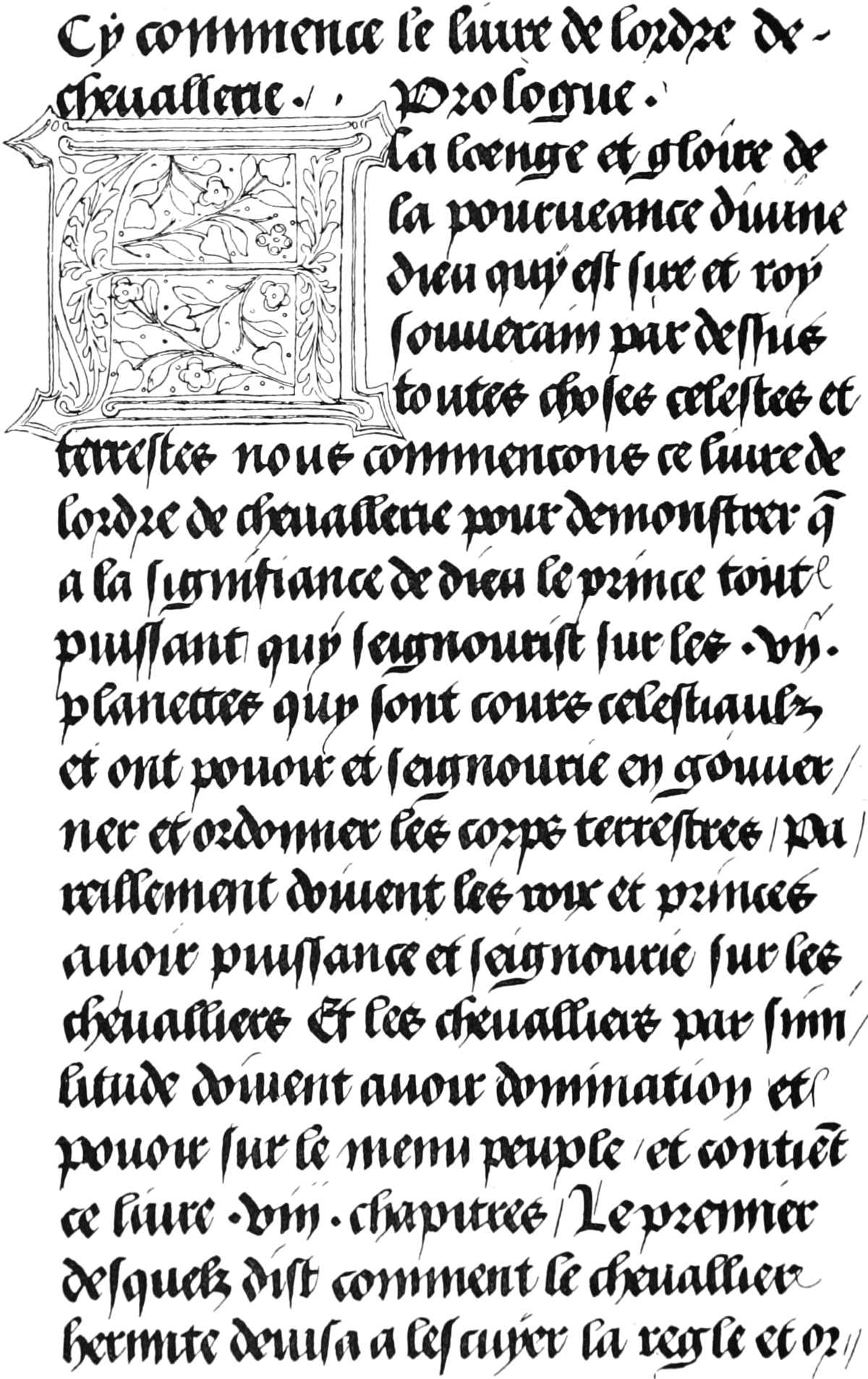
MANUSCRIPT, WRITTEN AT BRUGES, CIRC. 1472.
William Caxton was not born in 1412, as nearly all his biographers assert, but about ten or twelve years later, as we learn from the records preserved at Mercers’ Hall, Cheapside. His name is there inscribed as having been apprenticed in the year 1438. His birthplace was somewhere in the Weald of Kent, perhaps at a place called Caustons, near Hadlow. His father sent him to school—by no means a usual experience for lads in the fifteenth century—for which in his after-age he was deeply grateful. He was apprenticed at the age of twelve or fourteen to a wealthy mercer, a fact which, at a time when class prejudices were very strong, shows that his family were connected with the merchant princes of London. After a few years his master, Robert Large, died, and as Caxton’s name, when he issued from his apprenticeship, does not appear in the Mercers’ books, there is little doubt that he went abroad. In 1446 we find his name mentioned in the town records preserved at Bruges, where he was considered sufficient security for a sum equal to £110. In 1453 he paid a visit to London, and took up his livery in the Mercers’ Company. Ten years later he had raised himself to the highest honour an English merchant could attain abroad—that of Governor of the Merchant Adventurers in the Low Countries. Here he had great responsibilities, and was consulted and employed by the English Government in various matters connected with trade in those parts. In 1468 the Princess Margaret, sister of our Edward IV, was married to Charles the Bold, Duke of Burgundy, at Bruges. Here Caxton would be brought into friendly intercourse with the nobles of the English Court, many of whom took refuge there when King Edward, in 1470, was driven from his kingdom. Several treaties about trade between England and the Burgundian dominions were ratified about this time, in which Caxton took a leading part. In Bruges at this period there were magnificent libraries, consisting almost entirely of illuminated manuscripts; and no doubt a few books from the German presses, which we know were selling at Paris, were to be had at Bruges also. In these literary treasure-houses Caxton would be able to indulge that taste for books which was a prominent feature in his character. He became known to the Duchess, and from some cause which at present has not been discovered, resigned his post of Governor, and entered into her service. Whatever were the duties he undertook for the Duchess, his position was one of honour and trust, requiring his personal attendance upon her. Two causes may have influenced Caxton in retiring from his post of Governor. Reckoning from a lawsuit in which his married daughter was engaged in 1496, she would then have been twenty-six years of age, had her father married in 1469. As a married man he could not be a merchant in a foreign city, foreigners abroad as well as in England living a monastic life. Thus marriage may have been the moving cause. Added to this, the duties of Governor compelled him to make frequent journeys to other cities, and the occupation of so arduous a post for many years would naturally make him wish for relief and quietude.
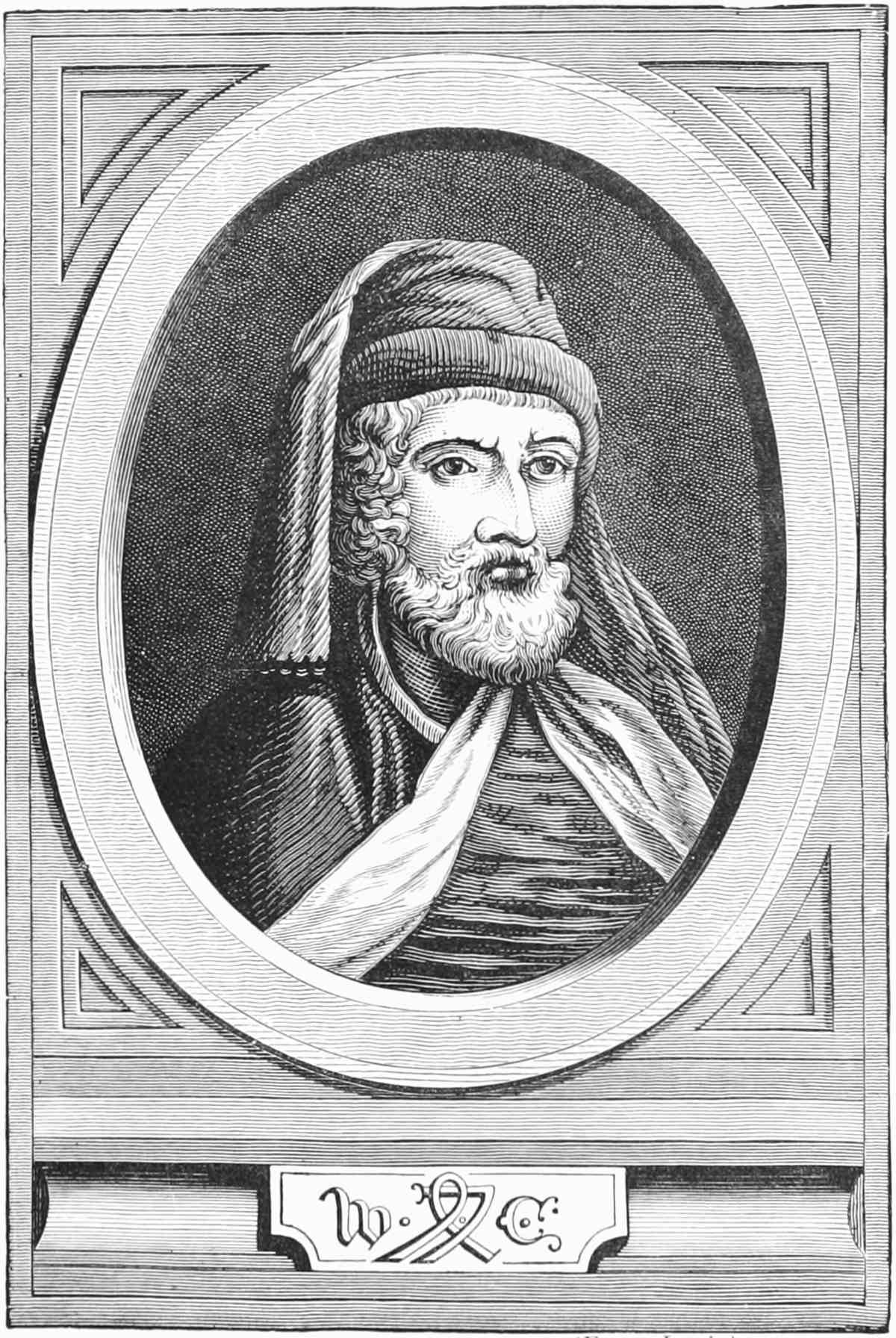
SUPPOSED PORTRAIT OF CAXTON. (From
Lewis
.)
Whatever the cause, his retirement gave him leisure to indulge his literary tastes, and he set to work to translate into English a French novel, which was then (1469) much admired in the Burgundian Court. It was a medley of Roman mythology mixed with Gothic knight-errantry and love adventures. Its title was “The Recuyell (collection) of the Histories of Troy,” and the fact that it held its place in the popular esteem for at least two centuries later, shows us that it stood high in public opinion. After translating a few sheets, Caxton put it on one side, but “on a time,” when conversing with the Duchess, he showed his attempt to her. This was in 1469. She commanded him at once to finish the translation, which he appears to have taken two years to accomplish, continuing it, as he himself tells us, in Ghent, and finishing it at Cologne. And here it is important to notice that in both those cities there is no question of his learning printing. All he mentions about himself refers to the translation alone. This brings us to 1472-3. The new book, patronised by the Duchess and the Court, was soon in greater demand among the courtiers than Caxton could possibly supply by manuscript. He was tired of so much writing, and naturally his mind turned to the new Art of Printing, specimens of which he had probably examined. Just at this time Colard Mansion, a citizen of Bruges, had erected a printing-press in a large room over the church porch of St. Donatus, and to him went Caxton. Colard Mansion set to work, Caxton helping him with money, and learning at the same time the new art and mystery. So it was that about 1474-5 the book was completed and a copy presented to the Duchess.
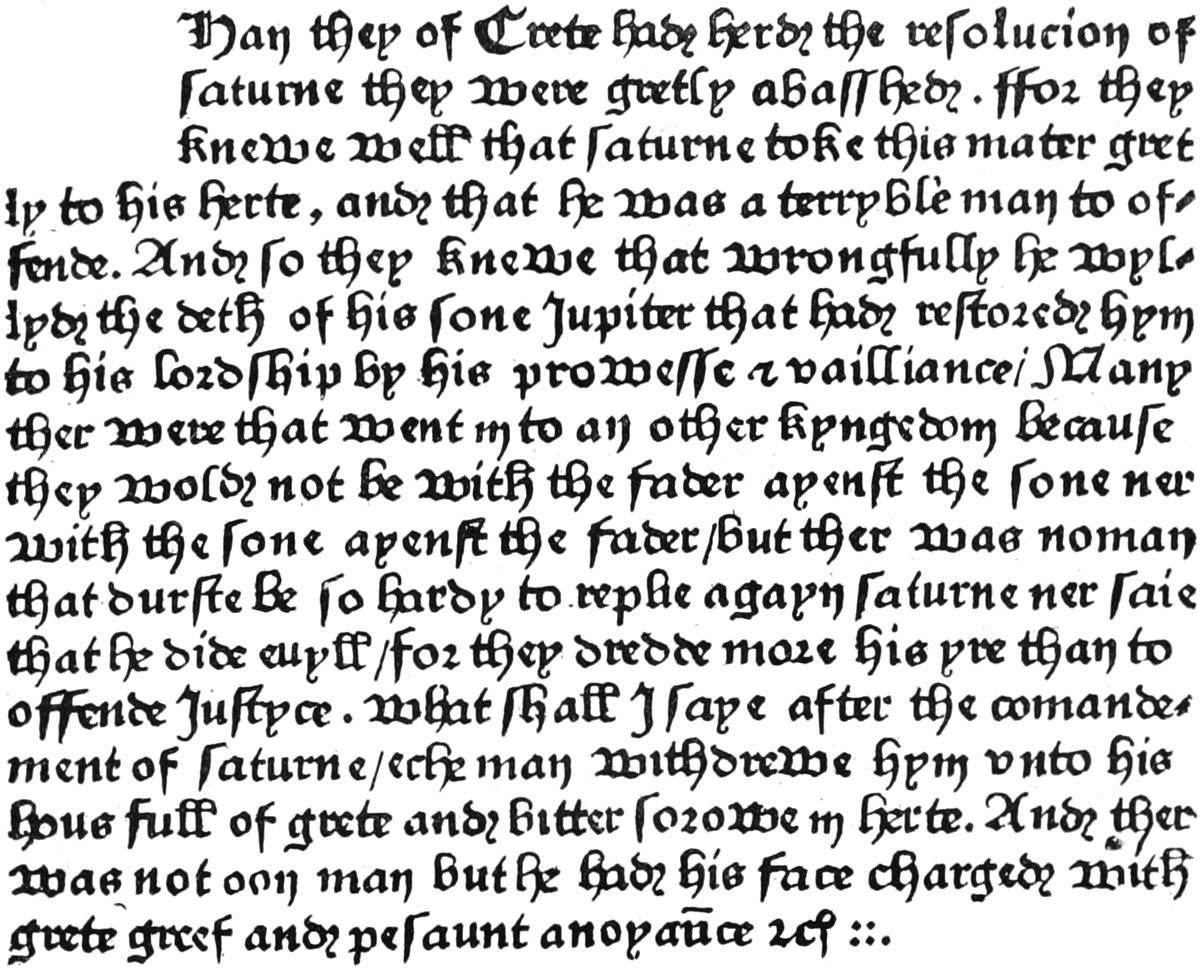
FROM “THE RECUYELL OF THE HISTORIES OF TROYE,” 1474.
(
Caxton’s Type. No. 1.
)
This was the turning point in Caxton’s career; for although he did not immediately leave his Royal mistress’s service, he spent some time in mastering the new art, and then, with a quantity of newly-cast types, made his way to England. There seems to have been no special reason why Caxton should choose Westminster as the locality of his printing-office. There was no Scriptorium in the Abbey, and the Abbot does not seem to have held towards him any other relationship than that of landlord, leasing to him a tenement in the Almonry, just where the Guards’ Memorial now stands. Here Caxton settled down and worked for at least fifteen years. His first book which bears a date is “The Dictes and Sayinges of the Philosophers,” finished in November, 1477. Upon the strength of this date the Caxton Quarcentenary Festival was held in 1877; but there can be no doubt that he printed many books of which no copies remain, some of which were doubtless earlier than the “Dictes.”
Unlike some of the French and Italian printers who ruined themselves by printing classical books, Caxton began with small pamphlets, and short pieces of poetry by Lydgate and Chaucer. These were soon followed by books of greater pretence, historical, poetical, and religious. The most imposing book from Caxton’s press was “The Golden Legend,” a thick and large folio volume, full of rude woodcuts, and narrating the lives of all the Saints in the English calendar. In translating, editing, and printing, Caxton spent the remaining years of his life, and at a ripe old age was buried in St. Margaret’s, Westminster, in the year 1491.
His character was that of a pious, diligent, and educated man, who, without aiming very high, led the life of an honest and useful merchant. He never foresaw, any more than his contemporaries, the wonderful capabilities and future strength of that printing-press which was to bring so many blessings to his native country. His successor was Wynken de Worde, one of the founders of the Stationers’ Company, a workman who, while quite young, came over with Caxton, and was a prolific printer for years after his master’s death. The well-known printers, Pynson and Machlinia, had also worked under Caxton.
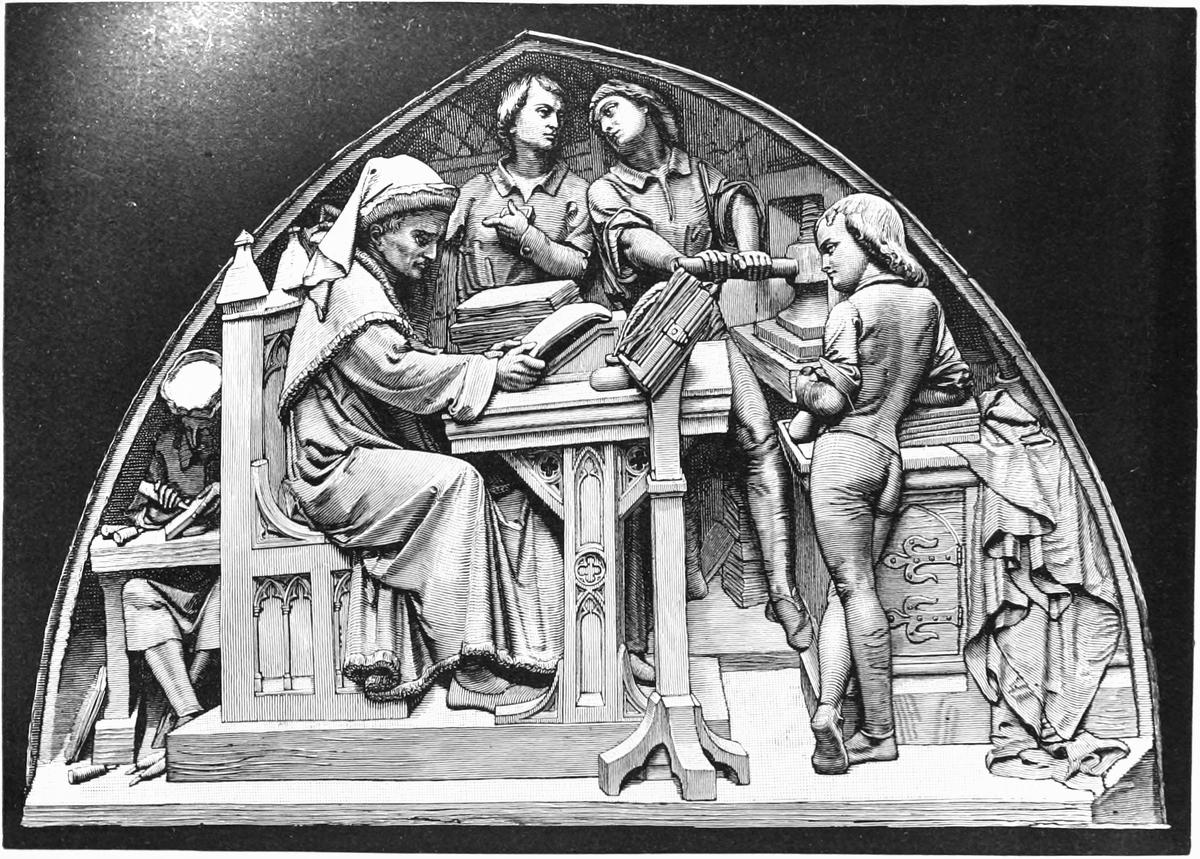
BAS-RELIEF FROM THE ENTABLATURE, JERUSALEM CHAMBER, WESTMINSTER ABBEY.
The city of Oxford was the next after Westminster in which the printing-press was erected in England. The first book printed there, the “Exposicio sancti Hieronymi,” is, indeed, dated 1468, but it is not worth while producing the reasons which have led all modern bibliographers to agree that an “x” has been omitted in the date, and that the real year was 1478. Rood and Hunte, who were the first Oxford printers, were Germans, and their books are very different from those of the Bruges and Westminster presses.
Cambridge, the sister University, had no press until 1521, when John Siberch printed there.
The only other press in England to be noticed in the fifteenth century is that of St. Albans, where a schoolmaster turned typographer in 1480, and printed for a few years. His most noted work was “The Boke of Hawking and Huntyng, and Cote armor.”
Considering the close connection of Scotland with France, it is rather surprising that printing did not reach that country earlier than 1504. In that year Androw Millar began to print some ballads.
Ireland did not receive printing until the year 1551, when Humphrey Powell printed a prayer book.
In the New World the first City to receive a Printing-press was Mexico, where Cromberger worked in 1540. In the North, Stephen Daye erected a Press at Cambridge, Mass., in 1638.
The Latin names of towns are frequently seen on the title-pages of early books; and as these are extremely puzzling to young bibliographers, the following short list of those most likely to be met with may be found useful:—
Alta Villa Eltville
Amstelædamum Amsterdam
Antverpia Antwerp
Argentina Strasbourg

Argentoratum
Athenæ Rauracæ Basle
Augusta Vindelicorum Augsburg
Bononia Bologna
Brixia Breschia
Bruxellæ Brussels
Cantabrigia Cambridge
Colonia Agrippina Cologne
Daventria Deventer
Delphi Delft
Duacum Douay
Eblana Dublin
Erfordia Erfuhrt
Florentia Florence
Firenze
Francofurtum Frankfort
Gandavum Ghent
Gand
Hafnia Copenhagen
Haga Comitum The Hague
Hispalis Seville
Holmia Stockholm
Leida Leyden
Lipsia Leipzig
Lovanium Louvain
Lugdunum Lyons
Lugdunum Batavorum Leyden
Lutetia Paris
Mediolanum Milan
Moguntia Mayence
Moscua Moscow
Nannetes Nantes
Neapolis Naples
Norimberga Nuremberg
Oxonia Oxford
Patavium Padua
Rostochium Rostock
Roterodamum Rotterdam
Rothomagum Rouen
Sublacense Monasterium Subiaco
Taurinum Turin
Toletum Toledo
Trajectum ad Rhenum Utrecht
Treviri Treves
Tridentum Trent
Turones Tours
Venetiæ Venice
Vlma Ulm
Vlyssipo Lisbon
Vratislavia Breslau
The cities and towns the names of which are the same, or nearly the same, in the Latin and native spelling have been omitted purposely.
LEVITICUS.
“Here order in variety we see, And here, though all things differ, all agree.”— Pope.