INTRODUCTION. (continued 2)
Gilbert Goudie translation
The Diploma states that after the death of the first Henry St. Clair, his mother, the daughter of Malise,[98] came to Orkney, and, outliving all her sisters and all their sons and daughters, became the only heiress of the earldom. It is added that of this thing there were faithful witnesses still living who had seen and spoken with the mother of Henry the first.
Her grandson Henry, son of the first Henry, succeeded to the earldom, but there seems to be no record of his investiture lxviiiby the Norwegian king. In 1404 he was entrusted with the guardianship of James I., and on his way to France with the young prince, for whose safety it was judged necessary that he should be removed from Scotland, he was captured by the English off Flamborough Head, and retained some time in captivity.[99] In 1412 he went to France with Archibald Douglas to assist the French against the English.[100] In 1418 John St. Clair, his brother, swears fealty to King Eirik at Helsingborg for the king’s land of Hjaltland, and becomes bound to administer the Norse laws according to the ancient usage, and it is stipulated that at his death Shetland should again revert to the crown of Norway.[101] It seems from this that Earl Henry must have been dead in 1418, though Bower in his continuation of Fordun says that he died in 1420.[102] A dispensation was granted for his widow’s marriage in 1418.[103]
Henry was succeeded by his son William, the last of the Orkney earls under Norwegian rule. But the investiture of the new earl did not take place till 1434, and for a period of fourteen years the administration of the Islands was carried on by commissioners appointed by King Eirik.
On the death of Earl Henry, Bishop Thomas Tulloch was appointed commissioner in 1420. He swore fealty to King Eirik in the church of Vestenskov in Laland, undertaking the administration of the Islands according to the Norsk law-book and the ancient usages.[104] On 10th July 1422 he lxixreceived as a fief from the king “the palace of Kirkwall and pertinents, lying in Orkney, in Norway, together with the lands of Orkney and the government thereof.”[105]
In 1423 the administration of the Orkneys and Shetland was committed to David Menzies of Wemyss by King Eirik. In 1426 a complaint was sent to the king by the inhabitants, setting forth that they had been subjected to oppression and wholesale spoliation during the period of his administration.[106] Among the accusations preferred against him it was asserted that he diminished the value of the money by one-half, that he threw the Lawman of the Islands into prison unjustly, and illegally possessed himself of the public seal and the law-book of the Islands, which the Lawman’s wife had deposited on the altar of the Church of St. Magnus for their security; that he exacted fines and services illegally and with personal violence, and was guilty of many other illegal acts of tyrannical oppression.
The government of the Islands seems to have been again entrusted to Bishop Tulloch[107] until 1434, when the young earl received his formal investiture.[108]
William, the last of the Orkney earls under Norwegian rule, succeeded to his father Henry, and received investiture on terms nearly similar to those imposed upon his grandfather. Moreover, he was to hold for the king and his successors the castle of Kirkwall, which his grandfather had built without the king’s consent. He had taken the title lxxbefore he received investiture from King Eirik, for in 1426 he appears as Earl of Orkney on the assize at Stirling, for the trial of Murdoch, Duke of Albany.[109] In 1435, as Lord High Admiral of Scotland, he had command of the fleet that conveyed the Princess Margaret to France. In 1446 he was summoned by the Norwegian Rigsraad to appear at Bergen on next St. John’s Day,[110] to take the oath of allegiance to King Christopher, the successor of Eirik of Pomern. In 1460 the king’s commissioners in Kirkwall certify to King Christian I. that John of Ross, Lord of the Isles, has for a long time most cruelly endeavoured to depopulate the Islands of Orkney and Shetland by burning the dwellings and slaying the inhabitants, and that in these circumstances Lord William St. Clair, the Earl of Orkney and Caithness,[111] had been prevented from coming to the king.[112] On 28th June 1461 Bishop William of Orkney writes to the king from Kirkwall excusing the earl for not having come to take the oath of allegiance, because in the month of June of that year he had been appointed one of the regents of the Kingdom of Scotland on account of the tender years of the prince (King James III.), and therefore was personally resident in Scotland. The bishop also repeats the complaint against John of Ross, Lord of the Isles, and the bands of his Islesmen, Irish, and Scots from the woods, “who came in great multitudes in the month of June, with their ships and fleets in battle array, wasting the lands, plundering the farms, destroying habitations, and putting the inhabitants to the sword, without regard to age or sex.”[113] Tradition still points in several parts of the Islands to “the Lewismen’s graves,” probably those of the invaders who were killed in their plundering expeditions through the Islands.
On the 8th September 1468 a contract of marriage was signed between James III. of Scotland and Margaret, lxxidaughter of King Christian I. of Denmark, Sweden, and Norway, by which, after discharging the arrears of the tribute due by Scotland for Man and the Hebrides,[114] King Christian engaged to pay a dowry of 60,000 florins with his daughter, stipulating for certain jointure lands (including the palace of Linlithgow and the castle of Doune), and her terce of the royal possessions in Scotland if left a widow. Of the dowry 10,000 florins were to be paid before the princess’s departure, and the Islands of Orkney were pledged for the balance of 50,000 florins. Only 2000 florins of the 10,000 promised were paid, and the Islands of Shetland were pledged for the remainder. The amount for which the whole of the Islands of Orkney and Shetland were thus impignorated was 58,000 florins of 100 pence each, or about £24,000.
In 1471 King James III. gave William, Earl of Orkney, the castle and lands of Ravenscraig in Fife in exchange for all his rights to the earldom of Orkney, and an Act of Parliament was passed on the 20th of February of the same year annexing to the Scottish Crown “the Erledome of Orkney and Lordship of Schetland, nocht to be gevin away in time to cum to na persain or persainis, excep alenarily to ane of the king’s sonnis of lauchful bed.”
VIII. The Bishopric of Orkney—1060-1469.
The origin of the bishopric of Orkney is involved in obscurity. Its early history is complicated by the fact that there were two if not three distinct successions of bishops, only one of which is recognised by the Norse writers.
The Saga statement regarding the origin of the bishopric unfortunately is lacking in precision. It is stated that Earl Thorfinn built Christ’s Kirk in Birsay, apparently after his return from his pilgrimage to Rome, and that the first bishop’s see in the Orkneys was established there. Taking this in lxxiiconnection with the statement that William the Old, who was bishop in 1115, when St. Magnus was murdered, was the first bishop, the inference would be that the bishopric was erected in his time. The statement regarding his tenure of office for sixty-six years is scarcely credible; but supposing it to be the fact, as he died in 1167, we obtain 1102 as the date of the erection of the bishopric.
On the other hand, Adam of Bremen states[115] that Thorolf was the first Bishop of Orkney, and that he was consecrated by Adalbert, Archbishop of Hamburg, in the middle of the 11th century,[116] and that another bishop named Adalbert succeeded him. Now, as William the Old was not consecrated before 1102, if there was a bishop in Earl Thorfinn’s time (the date of his death being 1064), it must have been this Thorolf. If Thorolf was consecrated in the middle of the 11th century, it was probably before Earl Thorfinn’s death in 1064. But it seems that the see was vacant or unoccupied before 1093.
It appears from a letter of Lanfranc, Archbishop of Canterbury (1070-1089), that Earl Paul of Orkney had sent to him a cleric whom he wished to be consecrated a bishop, and Lanfranc orders Wulstan, Bishop of Worcester, and Peter, Bishop of Chester, to go to York and assist the archbishop there at the consecration. This must refer to the Earl Paul, son of Thorfinn, who with his brother Erlend was carried to Norway by King Magnus on his second expedition to the west in 1098, and neither of them ever returned. The name of this bishop is not given in Lanfranc’s letter. But the English writers[117] mention that in the end of the 11th century a cleric named Ralph was consecrated Bishop of Orkney by Thomas, lxxiiiArchbishop of York. Thomas was archbishop from A.D. 1070 to 1100. It is mentioned that when the right of the Archbishop of York to consecrate Turgot Bishop of St. Andrews was asserted in 1109, it was proposed that he should do it by the assistance of the (English) Bishops of Scotland and of Orkney. Anselm, Archbishop of Canterbury (1092-1107), wrote[118] to Earl Hakon Palson, exhorting him and his people to obey the bishop “whom now by the grace of God they had.”
A second bishop, named Roger, was consecrated by Gerard, who was Archbishop of York in the beginning of the 12th century, from 1100 to 1108.
A third bishop, named Ralph, previously a presbyter of York, said to have been elected by the people of Orkney, was consecrated by Archbishop Thomas, the successor of Gerard. It is this Ralph who figures in the accounts of the battle of Northallerton, 1138. Pope Calixtus II. and Pope Honorius II. addressed letters to the Norwegian Kings, Sigurd and Eystein, in favour of Ralph.[119] In the letter of Pope Honorius it is expressly stated that another bishop had been intruded in the place of Ralph. This must refer to William the Old, whom the Sagas make bishop from the year 1102.
The explanation of all this seems to be that the Archbishops of Hamburg and York both tried in vain to secure the right of consecrating the Bishops of Orkney; the former on the ground that as the successors of St. Anschar they were primates of the Scandinavian churches, and the latter on the same ground on which they claimed the right to consecrate the Bishop of St. Andrews—viz. that their jurisdiction extended to the whole of Scotland and the Isles. In the appendix to Florence of Worcester’s Chronicle,[120] written in the beginning of the 12th century, it is said that “the Archbishop of York had jurisdiction over all the bishops north of the Humber, lxxivand all the bishops of Scotland and the Orkneys, as the Archbishop of Canterbury had over those of Ireland and Wales.” Meantime, however, the Norwegians made their own bishops, and these, having obtained possession of the see, were the real bishops of Orkney, though the others might enjoy the empty title.
Thus William the Old was the first of the actual bishops of Orkney of whom we have distinct record. As the Saga and the Saga of St. Magnus both state explicitly that he held the bishopric for sixty-six years, and the Annals place his death in 1168, he must have been consecrated in 1102. The see, which was first at Birsay, where Earl Thorfinn erected the Christ’s Kirk,[121] was removed to Kirkwall on the erection of the Cathedral, 1137-52. He went with Earl Rögnvald to the Holy Land in 1152. When Pope Anastasius erected the metropolitan see of Trondheim in 1154 he declared the Bishop of Orkney one of its suffragans, and Bishop William’s canonical rights were thus implicitly recognised. He died in 1168; and in 1848, when certain repairs were being executed on the cathedral, his bones were found enclosed in a stone cist thirty inches long and fifteen inches wide, along with a bone object like the handle of a staff, and a leaden plate, inscribed in characters apparently of the 13th century:—
Hic requiescit Willialmus senex, felicis memoriæ,
primus Episcopus.
The position in which the bones were found in the choir seems to indicate that they must have been moved from their previous resting-place. Bishop William’s bones, and the cist which contained them, were carted away with the rubbish when the church was re-seated in 1856.[122] The leaden plate and bone object which were found in the cist are lxxvpreserved in the Museum of the Society of Antiquaries of Scotland.
William II., the second bishop, is only known from the entry of his name in the list of bishops[123] (1325), and the entry of his death under the year 1188 in the Icelandic Annals.
Bjarni, son of Kolbein Hruga (who built the castle on the island of Weir), was the third bishop. His mother, Herborg, was a great-granddaughter of Earl Paul.[124] Bjarni himself was a famous poet, and to him is ascribed the Jomsvikinga-drapa—the Lay of the Jomsburg Vikings.[125] A bull of Pope Innocent III., dated at the Vatican, 27th May 1198,[126] is addressed to him in connection with the refusal of Bishop John of Caithness to collect an annual tribute in his diocese, as noticed hereafter.[127] It appears from a deed of his in the Chartulary of the monastery of Munkalif at Bergen that he possessed lands in Norway, as well as his patrimonial lands in Orkney and castle in the island of Weir. By that deed he gives to the monastery, “for the souls of his father (Kolbein Hruga), his mother, his brother, his relations and friends,” the lands called Holand, near the Dalsfiord, north of Bergen. It is curious thus to find in authentic records a mortification of lands to a church in Norway to provide masses for the soul of a man who is now known in his own former home in Orkney only as Cobbie Row, “the giant,” or “goblin” of the castle, which he built and inhabited. Bishop Bjarni was present with John, Earl of Orkney, at the great assembly of nobles at Bergen,[128] in 1223, and died shortly thereafter.
Jofreyr, the fourth bishop, was consecrated in 1223, according to the Annals. There was a Jofreyr, Dean of Tunsberg, present at the same assembly in Bergen above lxxvireferred to, and as the name is a very uncommon one, it is probable that he is the same who was made Bishop of the Orkneys. He seems to have been long an invalid, for, by a bull dated at Viterbo, 11th May 1237,[129] Pope Gregory IX. enjoins Sigurd, Archbishop of Nidaros (Drontheim), to move Bishop Jofreyr of Orkney, who had been paralytic and confined to bed for many years, to resign office, or, if he was unwilling to resign, to provide him with a wise and prudent helper. Jofreyr retained the see, however, for ten years after this. The Annals place his death in 1247.
Henry (I.) was the fifth bishop. A papal dispensation for the defect of his birth, by Pope Innocent IV., is dated 9th December 1247.[130] He was then a canon in the Orkneys. He was with King Hakon’s expedition in 1263, and died in 1269.
Peter, the sixth bishop, was consecrated in 1270. A brief of his,[131] dated at Tunsberg, 3d September 1278, grants forty days’ indulgence to those in his diocese who contribute in aid of the restoration of St. Swithin’s cathedral at Stavanger, which had been destroyed by fire. He died in 1284.
Dolgfinn, the seventh bishop, was consecrated in 1286. Nothing is known of him but the name. He died, according to the Annals, in 1309.
William (III.) was the eighth bishop. He was consecrated in 1310. At the Provincial Council held at Bergen, in 1320, there were several complaints made by the archbishop against William, Bishop of Orkney.[132] Kormak, an lxxviiarchdeacon of the Sudreys, and Grim Ormson, prebendary of Nidaros, had been sent by the archbishop on a visitation of the diocese of Orkney, and had reported that William had squandered the property of the see, that he had bestowed the offices of the church on foreigners and apostates, that he had compromised his dignity as a prelate of the church by participation in the boisterous pastime of hunting and other unseemly diversions, that he had been careless and lukewarm in the exercise of his spiritual office, and had not sought out those who practised idolatry and witchcraft, or who were heretics or followed ungodly ways. Moreover, he had imprisoned Ingilbert Lyning, a canon of Orkney, whom the archbishop had sent to make inquiry into the collection of the Peter’s pence, and had deprived him of his prebendary and all his property. He had also clandestinely appropriated to himself during fifteen years a portion of the church dues, amounting to the value of 53 marks sterling, and he had refused to permit the removal of the corpse of a woman from Orkney, although her will had been that she should be interred in the cathedral of Trondheim. He was suspended in the following year (1321) by the archbishop, but in 1324 we find him assisting at the consecration of Laurentius, Bishop of Hole.[133] By a deed,[134] dated at Bergen, 9th September 1327, he mortgages his dues of Shetland to his metropolitan, Eilif, Archbishop of Nidaros, for the payment of 186 marks sterling, which he should have paid the archbishop for six years’ teinds. By another document of the same year,[135] Bishop Audfinn of Bergen requests Bishop William of Orkney to assist his priest Ivar in the collection of the Sunnive-miel—a contribution which the inhabitants of Shetland had paid from old time to the shrine of St. Sunniva at Bergen. The date of this bishop’s death has not been ascertained.
William (IV.), ninth bishop, succeeded him, sometime lxxviiiafter the year 1328. There is extant an agreement between him and Hakon Jonsson, dated at Kirkwall, 25th May 1369.[136] The next mention we have of him is the entry in the Annals, under the date 1382—“Then was heard the mournful tidings that Bishop William was slain in the Orkneys.”
William (V.), tenth bishop, appears only in a record of the time of King Robert III. of Scotland. Munch supposes that he may have been the William Johnson who appears as Archdeacon of Zetland, in a Norse deed dated at Sandwick in Shetland, March 4, 1360.
Henry (II.), eleventh bishop, according to Torfæus, appears in a record of 1394.
John, twelfth bishop, appears in the Union Treaty of Calmar in 1397.
Patrick, thirteenth bishop, appears in an Attestation by the Lawman of Orkney, two canons of the church of St. Magnus, and four burgesses of Kirkwall, of the descent and good name of James of Cragy, laird of Hupe.[137] He is otherwise unnoticed, but as he is there referred to by his canonical title, and the many losses, injuries, and disquietudes which he endured at the hands of his adversaries, are specially alluded to, there seems to be no doubt that he held the bishopric between the death of John and the incumbency of Thomas de Tulloch.
Thomas de Tulloch, fourteenth bishop, first appears in existing records in 1418. He seems to have been previously Bishop of Ross.[138] On 17th June 1420, at the church of Vestenskov in Laland, he gives his pledge to King Eirik and his successors, and undertakes that he will hold the crown lands of Orkney committed to him, for the Kings of Norway, lxxixpromising at the same time to give law and justice to the people of Orkney according to the Norsk law-book and the ancient usages.[139] In 1422 he receives the palace and pertinents of Kirkwall—“thet slot oc faeste Kirkqwaw liggende j Orknoy j Norghe meth landet Orknoy,” etc.—as a fief from King Eirik. A record of the set of the threepenny lands of Stanbuster, in the parish of St. Andrews, executed by him on 12th July 1455, and confirmed by his successor in 1465, is preserved at Kirkwall. His death took place before 28th June 1461, when we find his successor in office.[140]
William (VI.) de Tulloch, the last bishop during the dominion of Norway in the Orkneys, was bishop in June 1461, and tendered his oath of allegiance in 1462.
A bull of Pope Sixtus IV., dated at the Vatican, 17th August 1472, placed the see of the Orkneys under the metropolitan Bishop of St. Andrews.
IX. The Bishopric of Caithness—1150-1469.
The Bishopric of Caithness appears to have been co-extensive with the older earldom, comprehending Caithness and Sutherland as far south as Ekkialsbakki or the Kyle of Sutherland. In later times the cathedral church was at Dornoch.[141] But it would seem as if the episcopal see had at one time been at Halkirk (called in the Saga Há Kirkia, or the High Kirk), near Thurso, where we find the bishops frequently residing. The date of the erection of the bishopric is unknown.
Andrew is the first bishop who appears in authentic records. About the year 1153 King David granted to him lxxxthe lands of Hoctor Comon,[142] and about the same time he himself gave a grant of the Church of the Holy Trinity of Dunkeld to the monks of Dunfermline.[143] About the year 1165 he and Murethac, his clerk, are witnesses to a charter of Gregory, Bishop of Dunkeld, confirming the said gift. About the year 1181 he is a witness to the grant by Earl Harald Maddadson to the see of Rome of a penny annually from every inhabited house in Caithness, which brought his successor, Bishop John, into such trouble.[144] He is also a witness to the remarkable document engrossed in the Book of Deer, by which King David I. declares the clerics of Deer to be free from all lay interference and undue exaction, “as it is written in their book, and as they pleaded at Banff and swore at Aberdeen.”[145] The Chronicle of Mailros records his death at Dunfermline on 30th December 1185. He seems to have been a learned man, and was much about the court of David I. He is said to have been the author of part of the curious treatise “De Situ Albaniæ,” attributed to Giraldus Cambrensis.
John, second bishop, succeeded him. He seems to have refused to exact from the inhabitants the papal contribution of one penny annually from each inhabited house in Caithness granted by Earl Harald, for in a bull[146] dated at the Vatican, 27th May 1198, Pope Innocent III. enjoins Bishop Bjarni of Orkney and Bishop Reginald of Ross to compel Bishop John to give up his opposition to its collection on pain of the censure of the Church. About this time also Caithness had been taken from Harald by King William the Lion, with whom he was involved in hostilities, and given over to Reginald Gudrodson, the petty king of the Hebrides. Hence, on Harald’s recovery of his possessions in 1202, he was so exasperated that he took vengeance on the bishop[147] by blinding lxxxihim and cutting out his tongue, and inflicted severe punishments on the people, whom he held to have been guilty of rebellion. Bishop John appears to have survived his mutilation till 1213.
Adam, third bishop, was consecrated in 1214 by Malvoisin, Bishop of St. Andrews. He was a foundling exposed at a church door, but he had been Abbot of Melrose previous to his appointment to the see of Caithness. In 1218 he went with the Bishops of Glasgow and Moray on a pilgrimage to Rome. He seems to have been of an opposite disposition to that of his predecessor, who suffered martyrdom in the cause of his people. It was an old custom in Caithness that the husbandmen paid the bishop a spann of butter for every twenty cows. Bishop Adam exacted the contribution first for every fifteen, and at length for every ten cows. Exasperated by these exactions, the people rose in a body and came to him at Halkirk, where in the tumult a monk of Newbottle named Serlo was killed and the bishop himself burned in his own kitchen. A letter of Pope Honorius III., dated in January 1222, and addressed to the Scottish bishops of the time, is extant in the archives of the Vatican,[148] in which, after commending King Alexander for his promptitude and zeal in avenging Bishop Adam’s murder, he goes on to tell that, having learned from their letters what a horrible crime, what a detestable deed had been committed, his spirit quailed and his heart trembled and his ears tingled as he realised the daring atrocity of the deed. “Your letters,” he says, “have informed us that a dispute having arisen between Adam, Bishop of Caithness, of adorable memory, on the one part, and his parishioners on the other, concerning the tithes and other rights of the Church, and these matters having been submitted to the king himself by the mediation of certain ecclesiastics, with consent of the bishop, and the king being absent in England, his parishioners, moved with anger against him because he upheld the cause of his Church against them, fell on their pious pastor like ravening lxxxiiwolves, on their father like degenerate sons, and on their Lord Christ like emissaries of the devil, stripped him of his clothing, stoned him, mortally wounded him with an axe, and finally killed and burned him in his own kitchen.” The letter concludes with an injunction to excommunicate all concerned in the murder. The bishop’s body was interred in the church at Skinnet, and is said to have been subsequently removed to Dornoch in 1239.[149] The Saga states that the fearful vengeance taken by King Alexander II. for the murder of the bishop was still fresh in memory in the writer’s time; and we learn from the Annals that “the Scottish king caused the hands and feet to be hewn from eighty men who had been present at the burning, so that many of them died.”
Gilbert de Moravia, fourth bishop, had been Archdeacon of Moray previous to his elevation to the see of Caithness in 1223. He built the cathedral at Dornoch, and his charter of constitution[150] is still extant in the record-room at Dunrobin Castle. For many years there had been an intimate connection between the diocese of Caithness and the abbey of Scone,[151] and in the constitution of his cathedral Bishop Gilbert named the Abbot of Scone one of the canons. The fourteen churches assigned to the prebends were those of Clyne, Dornoch, Creich, Rogart, Lairg, Farr, Kildonan, and Durness, in Sutherland; and Bower, Watten, Skinnet, Olrig, Dunnet, and Canisbay, in Caithness. Golspie and Loth, Reay, Thurso, Wick, and Latheron, were reserved to the bishop.
lxxxiiiHe seems to have been a man of mark in his time. He built the “Bishop’s Castle” at Scrabster, and was made keeper of the king’s castles in the north.[152] He seems also to have been the first discoverer of gold in Sutherlandshire, for Sir Robert Gordon states that he “found a mine of gold in Duriness, in the lands belonging to his bishoprick.” He died at Scrabster in 1245, and was afterwards canonised. His relics were preserved in the cathedral church at Dornoch, and continued to be held in reverence down to the middle of the 16th century. In a record of the year 1545 it is stated that the parties compearing before Earl John of Sutherland in the chapter-house of the cathedral at Dornoch made oath by touching the relics of the blessed Saint Gilbert. He is the only bishop of Caithness, except Bishop Adam, whose death is recorded in the Icelandic Annals. The entry is under the year 1244:—“Death of Gilibert, bishop in Scotland.”
William, fifth bishop, was his successor. In 1250 he appears among the other Scottish bishops in a document addressed to Alexander III. concerning the liberties of the Church. He died in 1261 or 1262.
Walter de Baltrodin, a canon of Caithness, was chosen as his successor. Pope Urban IV. in 1263 addressed a letter[153] to the bishops of Dunkeld, Brechin, and Ross, setting forth that his election had not been proceeded with according to canonical form, but as it had been unanimous, and in consideration of the poverty of the Church, and the expense of making such long journeys to distant places, he enjoins them to prefer the said Walter to the bishopric if they find that he is not disqualified by defect of birth or otherwise. He died before 1274. On his death, Nicolas, Abbot of Scone, was chosen as his successor, but rejected by the Pope.[154]
Archibald, Archdeacon of Moray, was chosen on the rejection by the Pope of Nicolas, Abbot of Scone. The Pope’s lxxxivletter confirming his election mentions R., the Dean, Patrick, the treasurer, and Roger de Castello, canon of Caithness, as the parties by whom he was nominated. In his time Boyamund de Vitia was commissioned by Pope Gregory X. to collect a special subsidy in aid of the crusade, and his accounts furnish us with the names of a number of the churches in the diocese of Caithness and the amounts contributed.[155]
Bishop Archibald must have been dead before 1279, for in that year the Pope addressed a letter to the Bishops of St. Andrews and Aberdeen,[156] setting forth that the see of Caithness being vacant, the chapter had proceeded to the election of R., the Dean of Caithness, and had constituted Henry of Nottingan[157] (in Caithness) their procurator to obtain confirmation of the said election, and that the said Henry, in the Pope’s presence, had confessed that the said dean had a son thirty years old or more, and that he was said to have another, although he (Henry of Nottingan) did not believe it; and, moreover, that he had been stricken with paralysis, and was old and debilitated. The bishops are enjoined to use their influence to oblige him to resign.
Alan de St. Edmund, eighth bishop, was an Englishman, elected by the influence of Edward I. of England. In 1290 lxxxvhe signs the letter addressed to that king, proposing a marriage between the Maid of Norway and the young Prince Edward. Alan was a favourite with King Edward, and was made Chancellor of Scotland in 1291. In that year a writ[158] was addressed by the king to Alexander Comyn, keeper of the royal forest of Ternway, in Moray, ordering him to give Bishop Alan 40 oaks suitable for material for the fabric of the cathedral church of Caithness, which the king had granted for the souls of Alexander, King of Scotland, and Margaret, his queen, the sister of King Edward. Bishop Alan died in 1291, and on his death King Edward ordered the Bishops of St. Andrews and Glasgow to commit the vacant cure to some cleric in the king’s allegiance.[159] The fulfilment of this mandate is not on record, but we learn from the letter of Pope Boniface VIII.[160] addressed to Bishop Adam in 1296, that on the death of Alan the chapter of Caithness had chosen the Archdeacon of Caithness, whose name is given as I(oannes?) to be his successor, but because the election had not been in canonical form it was not confirmed by the Pope, who preferred to the vacant diocese Adam, then precentor of the church of Ross.
Adam, ninth bishop, as we learn from the Pope’s letter above mentioned, was not elected in the usual way, but preferred by the Pope and consecrated by the Bishop of Ostia. The letter addressed by the Pope[161] “to the chapter of Caithness, to the people of the district and diocese of Caithness, and to our dearest son in Christ the King of Scots,” in 1296, announces his preferment, and the reasons that led to it. He died at Sienna very shortly after the date of this letter.[162]
Andrew, abbot of the Cistercian monastery of Cupar,[163] was now preferred to the see of Caithness; and because, “on account of the wars that are imminent in those parts, and the dangers of the way, which is long and perilous, it is impossible for lxxxvihim to approach the apostolic seat for consecration,” a mandate was addressed to the Bishops of Aberdeen, Glasgow, and Ross, to give him consecration.
Ferquhard, Bishop of Caithness, appears in 1310, among the other bishops of Scotland, acknowledging Robert Bruce as King of Scotland. In 1312, along with Magnus, Earl of Caithness and Orkney, he attests the payment of 100 marks sterling (the annual tribute payable for the Hebrides) by King Robert Bruce to the King of Norway, in St. Magnus’ Cathedral, Kirkwall. He was dead and the see vacant in 1328.[164]
Nicolas, a deacon, was bishop-elect in 1332.[165]
David was the next bishop, but of him we have no record except that he was dead before 1340.[166]
Alan, Archdeacon of Aberdeen, was confirmed as Bishop of Caithness in 1341 by Pope Benedict XII.[167] He died in 1342.
Thomas de Fingask was elected on the death of Alan, and his confirmation by Pope Clement VI. is dated in November 1342.[168] He is witness to a writ by William, Earl of Ross, in 1355, declaring the abbey of Ferne exempt from all the king’s taxes.[169] He appears as witness to a deed with Ingelram of Caithness, Archdeacon of Dunkeld, in 1359.[170] He died at Elgin in 1360, and was buried in our Lady’s aisle of the chanonry church of Elgin, under the bishop’s seat.
Malcolm is the next bishop of whom we have any authentic account.[171] His confirmation by Pope Urban V. is dated lxxxviiFeb. 21, 1369.[172] A bull of Pope Gregory XI., dated at Avignon in March 1376, confirms to Dr. William of Spynie the chanonry and prebendary of the church of Orkney, which had become vacant by the preferment of Malcolm to be Bishop of Caithness.[173]
Alexander appears as Bishop of Caithness in 1389, when, along with Alexander, Bishop of Ross, and Adam, Abbot of Kinloss, he takes part in the settlement of a dispute between the Earl and Bishop of Moray.[174] He appears by proxy at the provincial synod held at Perth in 1420.[175]
Robert was bishop in 1434, and his successor William, who appears as bishop in 1449, was still in office at the period of the transference of the Orkneys from the Norwegian to Scottish rule, in 1469.
X. Ancient Churches of Orkney.
“The Cathedral of St. Magnus,” says Worsaae, “is incontestably the most glorious monument of the time of the Norwegian dominion to be found in Scotland.” “It is,” says Peterkin, “one of the two cathedral churches in Scotland remaining entire, and is, therefore, a national monument, interesting from its antiquity, its beauty, and the rarity of such relics in this part of the empire.” Nothing conveys to the mind of the stranger visiting Kirkwall a more vivid impression of the ancient importance of this quaint little town, which has been the capital of the Orkneys for at least 800 lxxxviiiyears, than the grandeur of its cathedral, and the imposing aspect of the ruins of the palaces of the Bishops and Earls of Orkney.
The Saga tells how the erection of the cathedral was undertaken by Earl Rögnvald II. (Kali Kolson), in fulfilment of a vow which he had made to build and endow a splendid stone minster in Kirkwall in honour of St. Magnus, his mother’s brother, from whom he derived his right to a share of the earldom of the Orkneys. He won the earldom in the year 1136, and the erection of the cathedral was commenced under the superintendence of his father Kol, in 1137, and carried on until the earl’s means failed. By agreement with the odallers, a mark for each ploughland in the islands was contributed for the purpose of carrying on the work, and this brought in money enough to enable the erection of the church to be proceeded with.
The cathedral, as it now stands, however, is by no means the work of Earl Rögnvald’s time, although the portion built by him is still clearly distinguishable. “The church,” says Sir Henry Dryden,[176] “as designed and partly built in the time of Kol (father of Earl Rögnvald), was of the same width as at present, but possibly one bay shorter at the west end. There can be little doubt that the choir terminated in an apse, which began about half-way along the great piers in front of the subsequent altar steps, and extended as far as the line of those steps. The builders, having laid out the whole church, carried up the choir and its two aisles and the transepts to the eaves, and built the piers of the central tower.” The architectural history of the structure, however, is puzzling. “Though I spent eighteen weeks at the cathedral,” says Sir Henry in a letter to Mr. Worsaae, “and have thought over the thing many times, I cannot make out the history of the building to my own satisfaction. There is no doubt that there is a great lxxxixdeal of copying in it, i.e. of building at one time in the style of another.”[177] The chief interest of the structure lies in the fact that it was built by a Norwegian earl, and designed and superintended by the Norwegian Kol, who had the principal oversight of the whole work. It is significant of their community of origin that the oldest portions of St. Magnus show traces of the same peculiarities of style which are found in the nearly contemporary but somewhat older Norman churches in Normandy, the home of the Christian descendants of the Vikings who followed Hrólf the Conqueror, son of Rögnvald, Earl of Moeri.
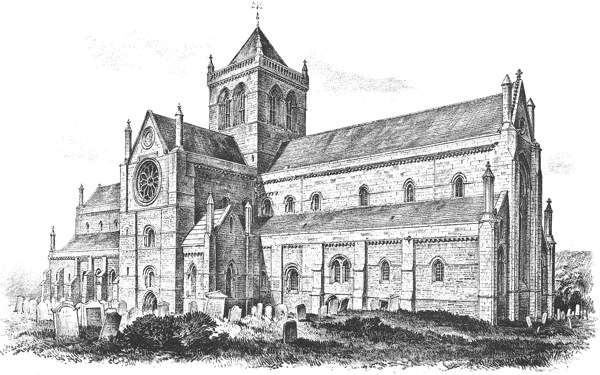
St. MAGNUS CATHEDRAL, KIRKWALL from the South east
The cathedral was erected for the express purpose of receiving the relics of St. Magnus, but we have no record of their transference to the new church. There is reason to believe that they had been brought to Kirkwall before the erection of the cathedral was begun, and, though it is not so stated, it may be inferred that on their removal from Christ’s Church in Birsay, they were deposited in the church of St. Olaf at Kirkwall, and remained there for some years until the cathedral was ready to receive them. It seems probable that it is to the church of St. Olaf that Kirkwall owes its name of Kirkiu-vagr, the Creek of the Kirk. This name does not occur in the Saga before the time of Earl Rögnvald Brusison, who is said to have resided there, and it is most likely that the church of St. Olaf was built by him in memory of his foster-father, King Olaf the Holy. Earl Rögnvald was in the battle of Stiklestad (1030) in which the warrior saint of Norway fell, and being his foster-son he was more likely than any of the subsequent earls to dedicate a church to his memory. We are told in the Saga[178] that the relics of St. Magnus were exhumed by Bishop William twenty years after his death and placed in a shrine at Christ’s Kirk. Shortly thereafter, xcsays the Saga, St. Magnus appeared in a dream to a man who lived in Westray, by name Gunni, and ordered him to tell Bishop William that he (St. Magnus) wished to go out of Birgishérad and east to Kirkwall. Gunni was afraid to do so lest he should excite the wrath of Earl Paul, whose father had been the murderer of St. Magnus. The following night St. Magnus again appeared to him, ordering him to disclose his dream whatever the consequences might be, and threatening him with punishment in the life hereafter if he disobeyed. Struck with terror, Gunni went to the Bishop and told him in the presence of Earl Paul and all the congregation. Earl Paul, it is said, turned red with anger, but all the men there united in requesting the bishop to proceed at once to carry the wishes of St. Magnus into execution. So the bishop went east to Kirkwall with the relics, accompanied by a great concourse of people, and “placed them in a shrine upon the altar of the church which then was there,” and which could have been no other than St. Olaf’s,[179] seeing that the building of the cathedral was not commenced until after Earl Paul had been carried off to Athole by Swein Asleifson. The Saga of St. Magnus adds that there were then few houses in the town, but that after the relics of St. Magnus had been transferred thither the town rapidly increased.
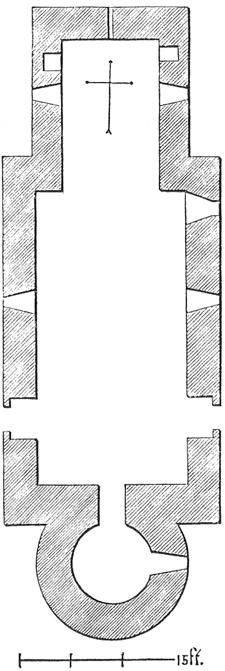
EGILSHA S. MAGNUS.
Earl Rögnvald (II.) himself was buried[180] in the cathedral in 1158. In the winter of 1263 the remains of King Hakon xciHakonson were deposited in the cathedral previous to their removal to Bergen. Worsaae states that the remains of the Princess Margaret, the Maid of Norway, were interred in the cathedral in 1290, and the local tradition is to the same effect, but there is no authority for the statement. The princess’s remains were taken back to Norway and buried in the High Church of Bergen by King Eirik, beside the remains of her mother.[181]
Egilsey Church, on the little isle of Egilsey, is interesting from the suggestions of its connection with the earlier Christianity of the islands previous to the Norse invasion.
The church stands on the highest ground of the island, on the west side, and is a conspicuous object in the landscape from all sides. It consists of chancel and nave, but differs from all the existing churches in the islands in having a round tower rising at the west end of the nave. It is of small size, the nave being 30 feet long by 15½ feet in breadth inside, and the chancel 15 feet long by 9½ feet in breadth. The chancel is vaulted, and the walls are about 3 feet thick. The tower, which seems to have been built with the nave, is 7 feet diameter inside, and is now 48 feet high, the walls being about 3½ feet thick. It is stated that about 15 feet were taken off the height to prevent its falling.[182] The only two windows in xciithe nave that are original are round-headed and 3 feet high, with jambs splaying inwards from 8½ to 33 inches wide, and having no external chamfer. Two windows in the chancel are exactly similar but smaller. Over the chancel vault there is a small chamber lighted by a flat-headed window 18 inches high.
Its original dedication is unknown,[183] and there is nothing to fix the date of its erection with absolute certainty.
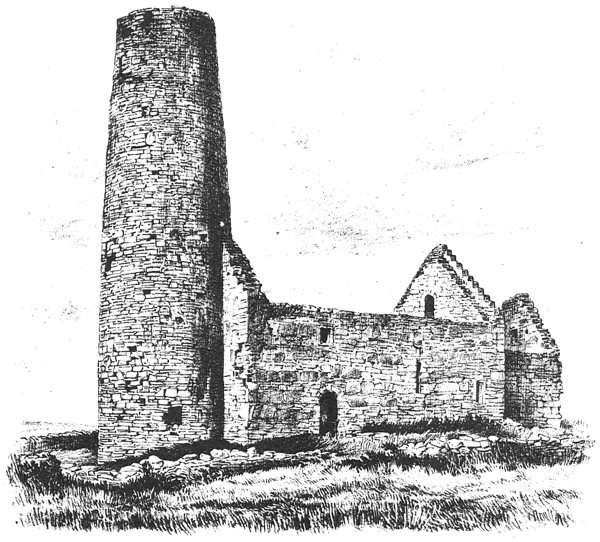
EGILSEY CHURCH, from the South east (from a Photograph)
“The church of Egilsey,” says Munch, “is shown by its construction to have been built before the Northmen arrived in Orkney, or, at all events, to belong to the more ancient Christian Celtic population; both its exterior and its interior show so many resemblances to the old churches in Ireland of the 7th and 8th centuries, that we are compelled to suppose it to have been erected at that time by Irish priests or Papas. As we find no remains of any similar churches on the islands,[184] we must suppose it to have been the first of the few on the thinly inhabited isle-group. The island on which it stood might, therefore, very justly be called ‘Church isle.’ But the Irish word Ecclais (church), derived from the Latin Ecclesia, might easily be mistaken by our forefathers for Egils, the genitive of the man’s name Egil.”
If we could unhesitatingly adopt Munch’s view of the origin of the name Egilsey, it might be safely assumed that this was the church which gave its name to the island, as no other ecclesiastical site is known within its bounds. The Norsemen were heathens down to the time of the Christianising cruise of King Olaf Tryggvason in A.D. 1000, and not very hearty in their Christianity for a long time after that. The church could not have been built, therefore, between 872 xciiiand the accession of Earl Thorfinn in 1014. Nor is it likely to have been erected during Thorfinn’s minority, for he was only five years old when his father fell fighting under a heathen banner at Clontarf. The Saga tells that Thorfinn built Christ’s Church in Birsay, and made it the first bishop’s see in the Orkneys. If he, or any of his successors previous to the death of St. Magnus, had erected such a notable structure as that of Egilsey, it would probably have been recorded. There was a church in Egilsey in 1115 when St. Magnus was murdered, and the only question is whether it was the present church. Its resemblances to the Irish churches of the 7th and 8th centuries are not sufficiently definite and determinative to enable us to assign to it unhesitatingly an Irish origin; while, on the other hand, the resemblance to the round-towered churches of Norfolk suggests that it may have been of Scandinavian origin. But there is nothing in the architecture of the building either to fix the date of its erection or to determine the questions of Celtic or Scandinavian origin with any degree of certainty.[185]
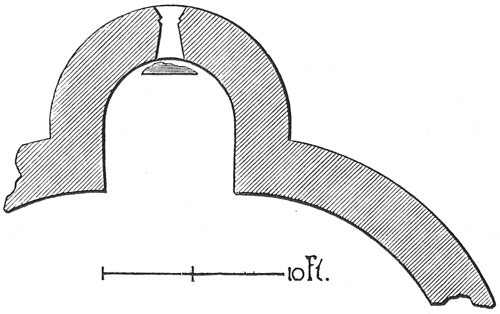
ORPHIR.
The Church of Orphir is one of the few circular churches in Britain, built in imitation of the church of the Holy Sepulchre at Jerusalem. The crusades were the means of importing this form into the ecclesiastical architecture of the west. A few of these round churches remain in Denmark, and, like those of England, they are mostly of the 12th century.[186]
xcivAll that remains of this interesting structure is merely the semicircular chancel and about 9 feet of the walls of the circular nave on either side, as shown in the annexed ground-plan. It is described in the Old Statistical Account as having been a rotundo, 18 feet in diameter and 20 feet high, two-thirds of which were taken down to build the present parish church. The curvature of the part of the walls still remaining would give a diameter of 18 to 19 feet. The semicircular chancel is 7 feet wide and a little more than 7 feet deep. The walls are well built of yellow Orphir freestone. The only remaining window is a small one in the east end of the chancel, 30 inches high, having a semicircular head, and the jambs splaying inwards from 10½ inches to 20 inches wide. It has a groove for glass.
The Rev. Alex. Pope of Reay, who visited Orphir in 1758, has given a description of “The Temple of Orphir, or Gerth House,” but there is little to be gathered from it, and the measurements as given[187] are evidently wrong. He states, xcvhowever, that extensive remains, supposed to be those of the Earls’ Palace at Orphir, had been discovered in excavating the foundations of the neighbouring farm-buildings. Indications of these, and of an extensive refuse-heap, are still to be seen.
The church of Orphir is first mentioned in the Saga in connection with Earl Paul Hakonson’s residence at Orphir. The church is there referred to as a splendid structure, and it is not spoken of as recently erected, or as having been built by Earl Paul. But Earl Hakon, his father, who had made a pilgrimage to Rome and the Holy Land, is said in the Saga to have brought back relics which he would doubtless deposit in the church at Orphir, where he seems to have resided. The probability is that the church was built by him after his return from his pilgrimage, perhaps as an expiatory offering for the murder of his cousin, St. Magnus. Earl Hakon died in 1122, and three out of the six round churches in Britain had been built before that time.
Christ’s Church in Birsay is the first church of which we have any record in the Saga, and, so far as we know, the first church erected in the Orkneys after the conversion of the Norwegian inhabitants to Christianity. It was built by Earl Thorfinn some time about the middle of the 11th century. Earl Thorfinn made a pilgrimage to Rome about the year 1050, and it is likely that Christ’s Church would be built after his return to Orkney, or between 1050 and 1064, the date of his death. It was the seat of the bishopric previous to the erection of the cathedral of St. Magnus, and William the Old, who was the first (actual) bishop, lived to see the bishopric transferred to Kirkwall some time after 1137.
It is doubtful whether any recognisable traces of the original Christ’s Church now remain. Neale says, “The parish church, which contains some fragments of old work, seems to have been the famous Christ’s Church built by Earl Thorfinn.” But it does not seem at all likely that any portion of the existing parish church can be as old as the middle of the 11th century. There are remains of an older church, however, xcvibeside it, which are still known as the Christ’s Kirk, and Mr. George Petrie, who has made a ground-plan of the structure (of which only part of the foundation remains), has ascertained that it had an apse at the east end.
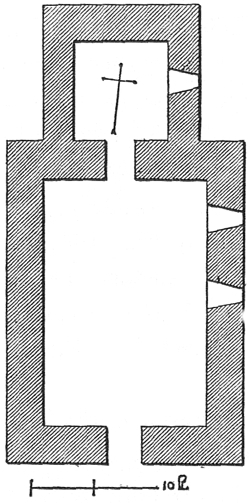
WEIR
The Church of Weir, on the island of the same name, consists of chancel and nave, the extreme length exteriorly being 36 feet, and the width 18½ feet. The nave is 19 feet by 13 feet inside, and the chancel little more than 7 feet square. The door is in the west end, having parallel jambs with no rebate. The doorway has a semicircular head, roughly arched with thin slaty stones set on edge, the arch being set a little back on the imposts.[188] There are two windows on the south side of the nave, only one of which appears to be original. It is flat-headed, 22 inches high and 8 inches wide, the jambs splaying inwards to a width of 27 inches. The chancel arch, of which a representation is given in the accompanying plate, is exactly like the doorway. There is one window in the south side, which seems to have been round-headed, 27 inches high by 11 inches wide.
Of this chapel Mr. Muir says,[189] “Excepting that at Lybster, in Caithness, the entrance to the chancel is the most diminutive, not of primitive date, I have ever seen, the total height being xcviionly 4 feet. In plan, size, and general expression, Weir and Lybster are remarkably alike, and in all probability both buildings are the work of the same period, though Lybster is perhaps fully the older of the two.” Sir Henry Dryden also remarks the similarity of the chapels of Weir and Lybster, and adds “Probably Weir is of the 12th or 13th century, but the characteristics are not decisive enough to approximate more closely to its date.”
It is most probable that this chapel[190] was built by Bishop Bjarni, the son of Kolbein Hruga, who built the castle on the island of Weir, as recorded in the Saga. Bjarni was bishop from 1188 to 1223, and would probably reside on his paternal estate in Weir when not required by the duties of the episcopate to be in Kirkwall. This period answers to the indications afforded by the architectural characteristics of the building, and we have no record of any other person who was likely to have erected a chapel on this little island. The fact that it is still called “Cobbie Row’s Chapel” points to its connection with Kolbein Hruga’s family.
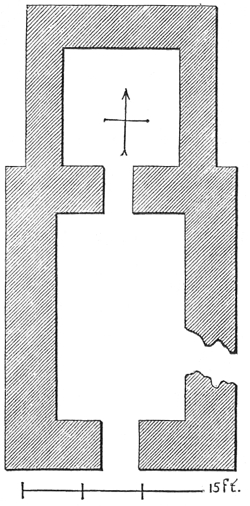
LYBSTER S. MARY
The Church at Lybster[191] (Reay), in Caithness, corresponds in style and plan so closely to the church of Weir that it may be described here briefly. There is no other church in Caithness of any antiquity which demands special notice. Ecclesiastical sites of early date are thickly scattered over the county, but the ruins of the buildings themselves have suffered so much that there is scarcely an architectural xcviiifeature left to guide us to conclusions as to their date. The church at Lybster is fortunately an exception. It consists of chancel and nave, slightly larger than Weir, and very rudely constructed. There is a doorway with inclined jambs in the west end, of which a representation is given in the accompanying plate; but Mr. Muir notices as a singular feature of the building that there are nowhere traces of windows, although all the elevations except the east one, which is broken down to a little below the gable line, remain nearly entire. The entrance to the chancel is of the same form as the doorway, having inclined jambs. “With regard to even the probable age of this building,” says Mr. Muir, “I would not like to venture an opinion. The diversified shapes and sizes of the stones, and the primitive form and smallness of the entrances to the nave and chancel, would suggest extreme earliness of date; whilst, on the other hand, the refined character of the ground-plan would indicate a period of time not more remote than the 12th century.”
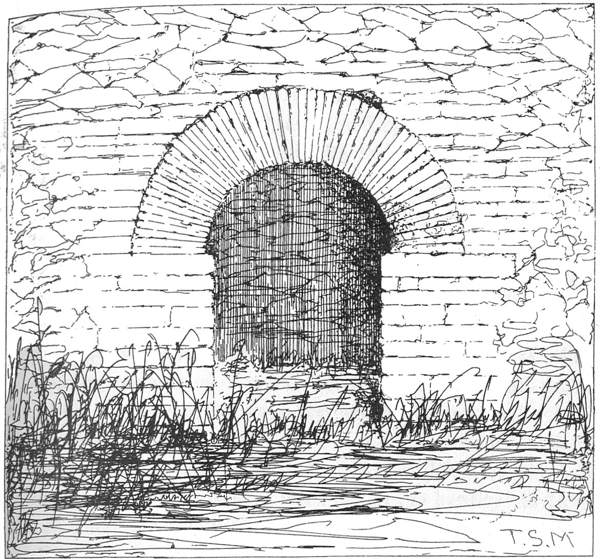
Chancel-Arch of Church at Weir.
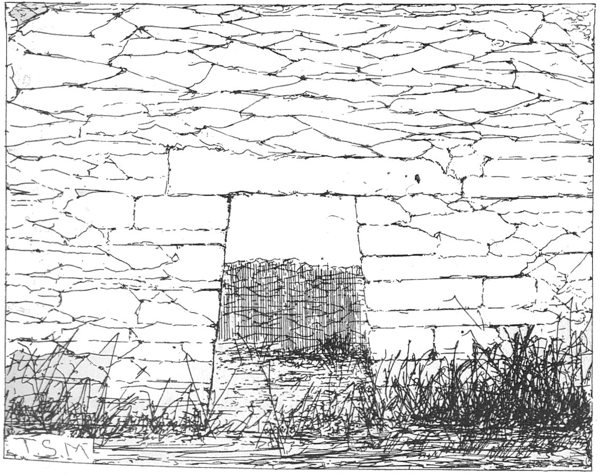
Doorway in West end of Church at Lybster, Reay.
St. Peter’s Church, on the Brough of Birsay, a holm of about 40 acres, separated from the mainland by a channel about 150 yards wide, and dry at low water, consists of nave, chancel, and apse, all well defined, and apparently built at the same time, the material being a grey whinstone. The total length of the building is 57 feet. The nave is 28 feet by 15½ inside, and the chancel about 10 feet square. There is but one doorway, in the west end of the church. It has parallel jambs without any rebate for a door.[192] There are xcixthe remains of a window in the north wall, 3 feet high by 10½ inches wide, square-headed, and splaying both internally and externally to a width of 22½ inches. Only the foundations of the apse remain. The floor was originally level to the end of the apse, but subsequently there had been a reredos which blocked off the apse, and then there were steps to the altar, some portion of which still remains. A stone projection or “seat,” 14 inches high and the same in width, runs all round the nave. In the north-east and south-east corners are two circular spaces, 5½ feet in diameter, in one of which are the remains of a spiral stone staircase. In all probability the church was twin-towered, like many of the Scandinavian churches dating from the 13th century. Barry states that this church was dedicated to St. Peter, but the dedication seems to have been unknown in the locality[193] in 1627.
There are the remains of a chapel similarly situated on the Brough of Deerness, at the east end of the Mainland. The Brough of Deerness is an outlying rock, nearly 100 feet high, and covered with green sward on the top. The chapel stands near the centre of the area, and is surrounded by a stone wall enclosing an area of about 60 feet by 45. The chapel, which is a smaller and ruder building than that on the Brough of Birsay, is a simple parallelogram of not more than 17 feet by 10 inside, the walls being from 3 to 4 feet thick. The doorway is in the west end, and there are the remains of a window in the east end, but the heads of both are gone. Around the chapel there are the foundations of about a score of stone-built huts scattered irregularly over the area of the Brough. They are irregularly built, with a tendency towards the rectangular form, the walls being from 2½ to 3 feet thick. Several of them are nearly as long as the church, but not so wide, the internal carea measuring about 18 feet by 6. Low[194] states that in his time, notwithstanding the difficulty and danger of the access to the Brough, “even old age scrambled its way through a road in many places not six inches broad, where certain death attended a slip.” Jo. Ben, in 1529, mentions that people of all classes and conditions were in the habit of climbing up to the top of the Brough on their hands and knees to visit the chapel called the “Bairns of Brugh;” and when they had reached the top, “on their bended knees and with hands joined they offered their supplications with many incantations to the Bairns of Brugh, throwing stones and water behind their backs, and making the circuit of the chapel twice or thrice.” There is still a fine spring on the Brough, which doubtless had the reputation of a “holy well” in connection with these superstitious practices. The Brough was fenced with a strong stone wall toward the land side in Low’s time, and from this and the remains of the huts he concludes that it had been a rock fort subsequently converted into a sanctuary by the ecclesiastics.
The old parish church of Deerness, of which Low has preserved three sketches (one of which is engraved in Hibbert’s Shetland), had the peculiarity of being twin-towered, as the church on the Brough of Birsay seems also to have been, and as many of the Scandinavian churches dating from the 13th century were.[195] Low describes it as having a vaulted chancel at the east end, of which the twin towers rose from each corner. The tower on the south-east corner of the chancel was entered by a doorway opening from the chancel (in the same manner as the one at Brough of Birsay), and a spiral staircase led to a small apartment or vestry between the towers, on the second storey. From this apartment was the entrance to the other tower.
ciThere were three towered churches in Shetland—St. Laurence in West Burra, St. Magnus at Tingwall, and Ireland Head, but, like the old church of Deerness, they have long disappeared, and there is no description of them more precise than the casual notices of Low and Brand. It is not even quite clear whether they were single-towered or twin-towered. If single-towered they may have been examples of the rare form of which Egilsey is now the only remaining instance.
XI. Maeshow and the Stones of Stennis.
Maeshow, the Orkahaug of the Saga, is connected in such an interesting way with the Norse history of the Isles that it is necessary to notice briefly its most peculiar features.
It stands about a mile to the north-east of the great stone ring of Stennis. Its external appearance is that of a truncated conical mound of earth, about 300 feet in circumference at the base and 36 feet high, surrounded by a trench 40 feet wide. Nothing was known of its internal structure till the year 1861, when it was opened by Mr. Farrer, M.P.,[196] but the common tradition of the country represented it as the abode of a goblin, who was named “the Hogboy,”[197] though no one knew why. When excavated, the mound was found to cover a great cairn of stones, in the centre of which was a chamber about 15 feet square, the walls of which still remained entire to a height of 13 feet. A long low passage led from the west side of the chamber to the exterior of the mound, a distance ciiof about 54 feet, and on the other three sides of the chamber there were small cells or loculi entered by openings in the walls about 2½ feet square at a height of about 3 feet above the floor.
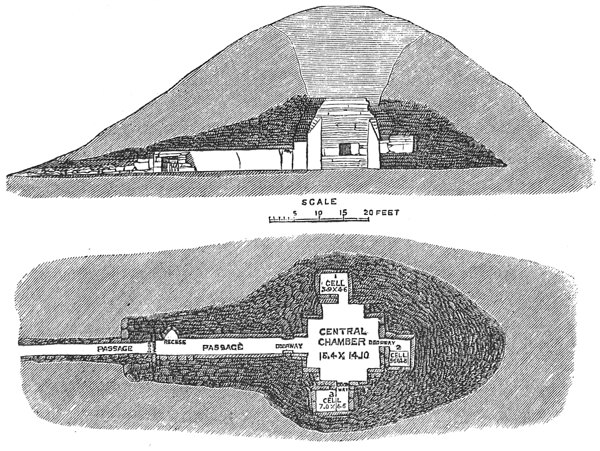
Plan and Section of Maeshow.
Structurally, Maeshow belongs to a class of chambered sepulchral cairns of common occurrence in the north of Scotland, but to a special variety of that class which is peculiar to the Orkneys.[198] These chambered tombs occur in groups in certain places, thus suggesting the probability that, as in the great royal cemeteries of early times in Ireland, they may have been for centuries the gathering places of the tribes and the burying-places of their kings.
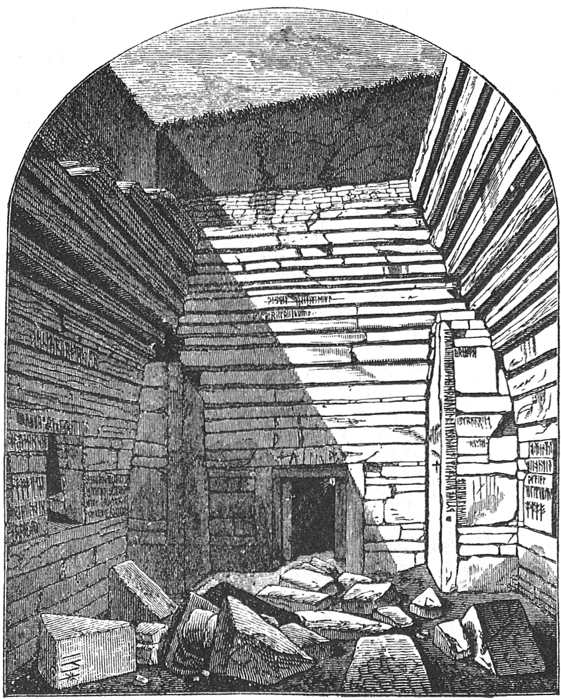
View of Chamber in Maeshow.
But the most interesting fact connected with Maeshow was the discovery that a large number of Runic inscriptions ciiihad been scratched on the stones of the interior walls of the chamber. It was evident, from the height at which the inscriptions occurred, as well as from indications of the weathering of the stones previous to their being inscribed, that when the runes were cut the chamber was roofless and partially filled up with rubbish. The form of the letters of which the inscriptions are composed is that of the later class of Norse Runes, “which,” says Professor Munch, “are never older than A.D. 1100 at least.” The majority of the inscriptions are such as men seeking the shelter or concealment of the “broken how” might scribble from mere idleness. One gives the Runic alphabet. A number of others are simple memoranda consisting of the name of a man and the statement that he “hewed this” or “carved these runes.” But one of the longer inscriptions supplies the important information that “the Jorsala-farers broke open the Orkahaug in the lifetime civof the blessed earl.” This seems to imply that the inscription was carved after the death of “the blessed earl” Rögnvald, or subsequent to 1158. The Jorsala-farers who accompanied him from Norway in 1152 remained a considerable time in Orkney before the expedition was ready, and as we learn from the Saga their conduct during that time was such as would naturally result from the enforced idleness of a numerous body of rough and uncontrolled adventurers. The “breaking of a how” in the hope of finding treasure was a common exploit among the Northmen. It seems to have been done sometimes also as a proof of courage, for the bravest were not altogether void of superstitious fears. From another part of the inscription we gather that the Jorsala-farers who broke the Orkahaug were disappointed in the hope of finding treasure, as it had been previously carried away. In all probability they were not the first who had been tempted cvby the magnitude of the monument to try the venture. On one of the buttresses, long slabs inserted in the corners of the chamber, is carved a cross, and on another a dragon, similar in style to that in the tomb of King Gorm the Old at Jellinge in Denmark, and bearing also some resemblance to one sculptured on the Runic stone dug up in St. Paul’s Churchyard, London, and to another at Hunestad in Scania. The tomb of King Gorm is dated about the middle of the 10th century. Rafn assigns the stone dug up in London to about the middle of the 11th century; while the Hunestad example is assigned to about 1150, which is close on the date of Earl Rögnvald’s expedition to the Holy Land, which brought the Jorsala-farers to Orkney.
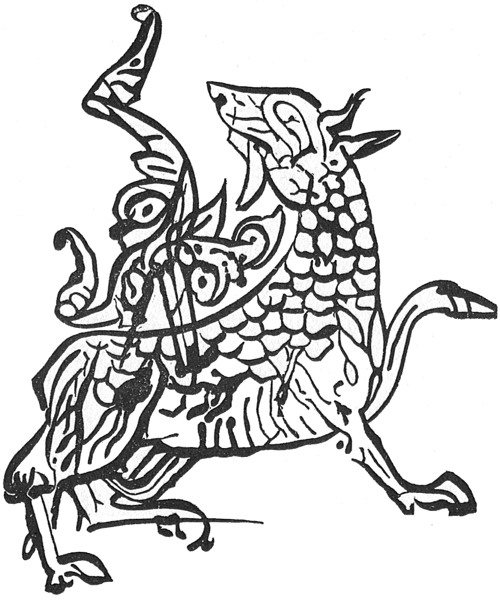
RUBBING FROM MAESHOW TUMULUS.
Among the names thus carved on the stones of Maeshow are those of Ingibiorg, Ingigerd, Thorer, Helgi, Ingi, and Arnfinn. All these are names of persons who are mentioned in the Saga as living in Earl Rögnvald’s time, and several of whom were closely connected with him. Ingigerd, his daughter, was married to Eric Slagbrellir, and they had a daughter named Ingibiorg. Helgi was a particular friend of Earl Rögnvald’s. Arnfinn was taken prisoner by Earl Harald the morning after he and his men had spent the Yule-feast day at Orkahaug on his way to surprise Earl Erlend.[199] There is nothing, however, to identify any of these names with certainty as the names of the persons mentioned in the Saga. But the fact that the name Orkahaug, which only occurs once in the Saga, is not known to occur anywhere else except in the inscription carved on the walls of Maeshow, referring to the breaking open of the tumulus, is interesting in more ways than one. It shows that the Norsemen were ignorant of the origin of the tumulus, which they knew only as the Orka-haug[200] or “mighty how.” In one of the inscriptions cvithe writer assigns its construction to the sons of Lodbrok, which is equivalent to saying that its origin was quite unknown[201] to them.
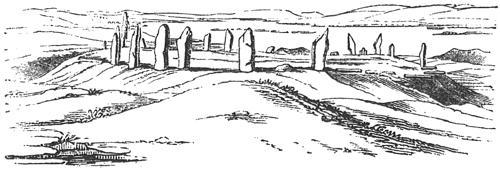
Ring of Brogar, from the south-west.
About a mile to the south-west of Maeshow, and scattered over the ness or tongue of land separating the loch of Stennis from the sea, is a remarkable group of stone circles and tumuli.[202] The largest of the circles, the “Ring of Brogar,” having a diameter of 366 feet, encloses an area of 2½ acres. It is surrounded by a trench 29 feet broad and 6 feet deep. Within the enclosure thirteen stones of the great circle still remain standing, the stumps of thirteen more are visible, and ten are lying prostrate. The original number of the stones, says Captain Thomas, on the presumption that they were placed at nearly equal distances apart, would have been sixty, so that twenty-four have been entirely obliterated. The highest stone stands almost 14 feet above the surface of the ground, and the lowest is about 6 feet, the average being from 8 to 10 feet. It is difficult to realise the amount of laborious effort expended in the construction of a work like this, which does not appeal to the eye like the magnitude of the great mounds cviiaround it. But when one reflects on what is implied in the transportation and erection of these great stones, and the excavation of a ditch round them of 10 yards wide, 2 yards deep, and 366 yards long, it loses none of its magnificence in comparison with the more imposing monuments.
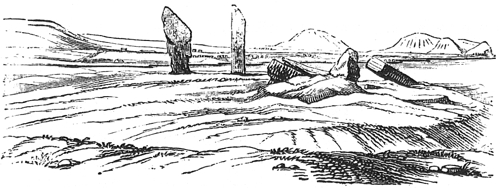
Ring of Stennis and Cromlech, from the northward.
The smaller circle, called the “Ring of Stennis,” is more clearly monumental than the Ring of Brogar, as it contains the remains of a cromlech within it. It seems to have consisted originally of twelve stones placed round the circumference of a circle of about 100 feet in diameter, and surrounded by a deep and broad trench with a circumscribing mound, now nearly obliterated. Only two stones of the circle remain standing, and a third lies prostrate. Peterkin states that some were thrown down and removed by the tenant of the adjoining lands in 1814. The cromlech is also thrown down, but one of the supports of the massive capstone is still standing, and the capstone, which lies beside it, is 9 feet long by 6 feet broad.
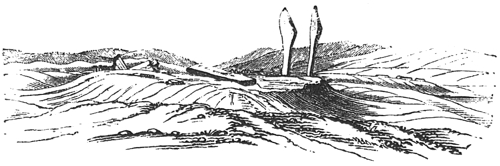
Ring of Stennis, from the westward.
The Ring of Bookan is a circular space 136 feet in cviiidiameter, surrounded by a trench 44 feet broad and 6 feet deep. There are upwards of twenty tumuli, some of them very large, in the immediate vicinity.
In the Saga of Olaf, Tryggvi’s son, Stennis is mentioned as the place where Havard, eldest of the five sons of Earl Thorfinn Hausakliuf, was slain in battle with his sister’s son Einar. The Saga says:[203]—“Havard was then at Stæinsnes in Hrossey. There it was they met, and there was a hard battle, and it was not long till the Earl fell. The place is now called Havard’s teigr.” Teigr is an individual’s share, or allotment, of the tun or town-land, and the expression might be taken to mean rather that Havard was buried by simple inhumation than that there was a cairn or tumulus raised over him, in which case it would have been known as Havard’s How. But the name of Havard was never connected with the great tumulus known as Maeshow, and if he was buried in a tumulus at all, it is more likely that his corpse was burnt with the customary ceremonies of that heathen time and his ashes placed in a great stone urn. The grave-mounds of the Viking period in Norway prove this to have been then the common practice. Such a mound, enclosing such an urn, was opened at Stennis by Mr. Farrer, M.P., in 1853. This tumulus, if not Havard’s, was apparently Norse, and being the largest in the neighbourhood of Stennis, must have been that of a person of great distinction.
The fact that the Norsemen at this early period (about A.D. 970) called this place Steins-ness, shows that it was known to them, only as it is to us, as the ness of the monumental stones. If they had had anything to do with the erection of any of these monuments, in all probability we should have had some incidental record of the fact in one or other of the Sagas.
cix
XII. Mousa and the Pictish Towers.
The little island of Mousa (the Mosey of the Saga), lying off the Mainland of Shetland, is interesting as containing the best preserved specimen of the “towers of defence,” which were the strongholds of the native inhabitants previous to the Norse invasion.
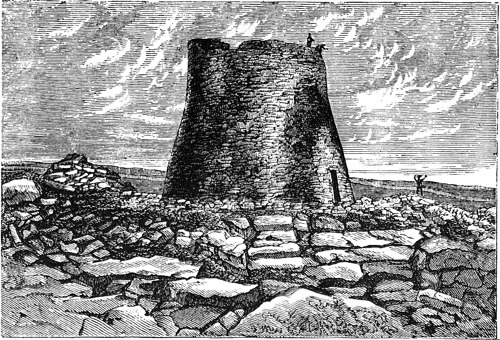
The tower of Mousa, of which a view is here given, consists of a circular dry-built wall, 15 feet thick at the base, enclosing an area or circular court 30 feet in diameter, and open to the sky, so as to admit light to the ranges of windows which open from the galleries towards the interior. The doorway leading through the wall into this interior court is the only opening to the outside of the tower. From the court other openings in the wall give access to small ovoid chambers in the thickness of the wall on the ground-floor, and to a stair which ascends to the upper galleries. Above the chambers on the ground-floor the wall is carried up hollow, or rather there are two concentric walls with a space of about 3½ feet between them, which is divided into storeys or galleries by horizontal courses of transverse slabs, which bind the two walls together. Thus each of these courses of horizontal slabs cxforms the roof of the gallery beneath it, and serves as a floor to the one above it.
These singularly-constructed towers were once thickly planted over the whole of the northern mainland of Scotland, as well as over the most of the Northern and Western Isles.[204] A number of them have been excavated of late years, and the results of these excavations[205] furnish us with interesting evidences of the conditions of life among the people who lived in them. The relics that have been obtained from them have no connection as a class with those that are usually found in the cisted graves and chambered tombs of earlier times.[206] But judging from the general character of their included remains, the people who lived in these towers were possessed of a considerable degree of civilisation. There is abundant evidence that they were not only expert hunters and fishers, but that they kept flocks and herds, grew grain and ground it by hand-mills,[207] practised the arts of spinning and weaving, had ornaments of gold of curious workmanship, and were not unskilled workers in bronze and iron. Their pottery was rude, but not ruder than the pottery manufactured and used for common or domestic purposes in some of the islands of Scotland cxiwithin the present century. It is true that silver denarii of the Roman Emperors Antoninus, Trajan, and Vespasian, have been found in the outbuildings connected with the Broch or “Pictish Tower” of Lingrow at Scapa in Orkney; but it is to be noticed that upwards of 4000 of these Roman denarii have been found in Scandinavia, where the Romans never were, and found so often associated with relics of the Viking period as to suggest that they were carried thither some centuries after their dates.
The Tower of Mousa, Moseyjar-borg, is twice mentioned by the Saga writers. The earliest notice occurs in the Saga of Egill Skalagrimson, the warrior-poet, and refers to a period about A.D. 900. It is there stated that Björn Brynulfson, fleeing from Norway with Thora Roald’s daughter, because his father would not allow him to celebrate his marriage with her, was shipwrecked on the island of Mousa, landed his cargo, and lived in the Borg through the winter, celebrating his marriage in it, and afterwards sailed for Iceland. The second notice of Mousa,[208] singularly enough, occurs on an occasion somewhat similar to this, when Earl Erlend Ungi fled from Orkney with Margaret, the widow of Maddad, Earl of Athole, and was besieged in the Borg by Earl Harald (Maddadson), who was displeased at the prospect of having Erlend for a step-father.
XIII. Remains of the Northmen.
Turning from the pages of the Saga to the scenes of the events which it records, we find, both in the topography and traditions of the localities, and in the customs and characteristics of the people, abundant evidence of the substantial truth of the narrative.
The range of territory possessed and occupied by the Norsemen may still be distinguished on the map of Scotland by the prevalence of Norse place-names. In Shetland and cxiiOrkney the topography is altogether Norse. In Caithness and Sutherland there is a core of Celtic topography in the central mountain districts, while the Norse names spread out through the valleys, forming a broad fringe along the seaboard, and occupying the whole angle of lowland Caithness. But south of Ekkialsbakki they rapidly thin out, and finally disappear, with a few outlying instances, in Moray. The permanent dominions of the Northmen in the mainland of Scotland were limited to the earldom proper, the southern boundary of which was the Kyle of Sutherland. The Saga says they conquered the country as far south as Ekkialsbakki; and though they sometimes extended their power over parts of Ross and Moray, and even made a raid on one occasion as far south as Fife, they made no permanent lodgment south of the Moray Firth, and their presence in Ross has but slightly affected the topography between the Kyle of Sutherland and the Beauly Firth.
In the Hebrides the Norse names, though much disguised by contact with the Celtic, still form a considerable if not a preponderating element in the topography, and their old Norse name, “Sudreyar,” still survives in the title of the Bishop of Sodor and Man. Along the western seaboard of the Scottish mainland, from Cape Wrath to the Mull of Kintyre, the Northmen have left their traces more sparsely, but very distinctly, upon the topography. In Bute, Arran, and the Cumbraes, and on the shores of the Solway Firth, the topography also shows the influence of the Northern element, exerted during the existence of the Norse “Kingdom of Man and the Isles.”
There are many remnants of the older usages[209] in the peculiar local customs; and in the characteristics of the people of the Northern Isles there are also, of necessity, many striking resemblances to those of the Scandinavian race. The elucidation of these, however, would lead into a field far too wide to cxiiibe entered on here. The language of the early colonists, which must have survived as long as the Islands were governed “according to the Norse law-book and the ancient usages,” seems to have died out rapidly after they were transferred to Scottish rule. Yet Jo. Ben found it existing in Rendal in Orkney in 1529; and it is stated[210] that in 1593 a clergyman, named Magnus Norsk, who was ordained to a Shetland parish, went to Norway to learn the Norse language, in order to qualify himself for his ministry, because the Shetlanders at that time understood no other tongue. Even so late as 1774, Low found people in Foula who could repeat the Lord’s Prayer in Norse, and he gives thirty-five stanzas of an old Norse ballad which he took down from oral recitation. In the Faroe Isles a large number of these ballads and metrical tales have been collected.[211] There can be no doubt that they were equally common in the neighbouring island groups, but no literary antiquary possessed of the requisite knowledge seems to have visited Shetland and Orkney in time to rescue them from oblivion.
The curious literary fragment, taken down phonetically by Low, who was completely ignorant of the language, is plainly akin to the old Scandinavian Kæmpeviser. The story is based on the Sörlathattr, one of the scenes of which is laid in the island of Hoy. The main incidents of the older poem cxivare as follow:—Hedin, a prince of Serkland, had sworn mutual brotherhood with Hogni, King of Denmark. Nothing occurred to disturb their friendship until Hogni went on a war expedition. Hedin, wandering in the woods, fell in with a sorceress, from whom he received a magic philtre to enable him to win the love of Hilda, Hogni’s daughter. The result was that he ran off with her in a splendid ship belonging to Hogni, and made for Serkland. When Hogni came home he set off in pursuit, and came up with them at the island of Hoy. There they both landed with their men, and a furious battle commenced. Odin (who enjoyed a good fight) cast a spell upon the combatants, so that they were obliged to fight on without ceasing, until a Christian should come who should have the hardihood to mingle in the fray, of which Hilda was doomed to be all the time an agonised spectator. At last Olaf Tryggvi’s son came to the Orkneys, and Ivar Liomi, one of his men who landed in Hoy, went into the fight and broke the spell, killed Hedin and Hogni, and bore off the prize.[212]
The story of the Shetland ballad is that Hiluge, a young nobleman at the court of Norway, made love to the king’s daughter Hildina, and was rejected by her, though her father supported his pretensions to her hand. When the king and Hiluge were away at the wars, an Earl of Orkney came to Norway, and found such favour with Hildina that she consented to fly with him to the Orkneys. When the king and Hiluge returned and discovered what had happened in their absence, they set sail, with a great host, in pursuit of the fugitives. Hildina persuaded the earl to go unarmed to meet her father, and ask for his pardon and peace. The king was pleased to forgive him, and to grant his consent to their union. cxvBut now Hiluge, by artfully working on the king’s mind, stirs up his latent wrath against the earl, and induces him to revoke his consent. The result is, that he decides that Hiluge and the earl shall meet in single combat, and fight it out to the death of one or other. Hiluge was victorious; and, not content with the death of his enemy, he cut off his head and cast it into Hildina’s lap with taunting words. Hildina answered his taunts boldly, and conceived a bloody revenge. But she must now follow him to Norway, where he renewed his courtship. Ere long she seemed to relent, and gave him her promise, but besought her father to grant her this boon, that she herself should fill out the first wine-cup at the bridal. Her request was granted. The guests came, the feast was set, and Hildina filled up the wine-cups for them. The wine was drugged, and they were all cast into a deep sleep, from which nothing could awake them. Hildina now caused her father to be carried forth, and set fire to the house. Hiluge, awaking in the midst of the burning, cried out for mercy. Hildina replied that she would give him the same mercy as he had given to her earl, and left him to perish in the flames.

The dialect of the ballad resembles that which prevailed in Norway in the middle of the 15th century, but presents several peculiarities of local origin. The allusions in it to St. Magnus show that it cannot be older than the 12th century in its present form, although the story of Hedin and Hogni, on which it appears to have been founded, belongs to the heathen time.
Looking at the number of Runic monuments in the island of Man,[213] and the beauty of their workmanship, it certainly seems surprising that none of these characteristic works of northern art should have survived in the Orkneys.[214] Previous cxvito the discovery of the inscriptions in Maeshow, the only Rune-inscribed monument known within the bounds of the ancient earldom was the stone in the churchyard of Crosskirk, Northmavine, Shetland, described by Low, which reads (according to his imperfect copy) “Bid pray for the soul of ——,” and consequently belongs to the Christian time. That there were similar monuments in other places, however, is shown by the recent discovery of a Runic fragment at Aithsvoe, Cunningsburgh, Shetland.[215] It is a mere fragment of the terminal part of a monumental inscription, incised on the edge of the stone, consisting of the letters KVIMIK, which Professor Stephens reads as the concluding part of the customary formula, “—— hewed me,” i.e. carved this stone.
But perhaps the most interesting and suggestive remains of the Northmen are those that have been from time to time recovered from the soil which they made their own—the relics which were actually possessed by the men and women of the Saga time; the weapons they used, and the ornaments they wore. In the grave-mounds of the heathen period, the warrior Viking still lies as he was laid, with his shield at his shoulder, and his sword ready to his hand.
The sword here figured, which is of a distinctively Scandinavian type, was dug up in making the railway near Gorton, in Morayshire, and is now in the museum of the Society of cxviiAntiquaries of Scotland. It is 35 inches in length, of excellent workmanship, damascened along the centre of the blade, and the pommel and recurved guard are beautifully inlaid with silver. A number of fragments of shield-bosses and broken swords, from Orkney graves, are also in the museum. The swords are chiefly of the older form, with straight guard and massive square or triangular pommel. In one of the interments at Westray the scabbard-tip here figured was found, and in others the bones of the dog and horse were found along with the human skeleton, indicating the continuance in Orkney of the sepulchral rites which prevailed in the heathen time in Norway.
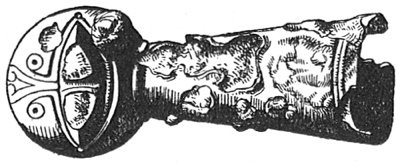
For at least a century and a half after the establishment of the Norse earldom in Orkney and Shetland, the heathen Norsemen practised the burial customs which they had brought with them from Norway. Sigurd, Eystein’s son, the first Earl of Orkney, was buried in a cairn on Ekkialsbakki, (and his grave-mound was known as Sigurd’s How (Siwardhoch) in the 12th century,[216]) and Torf Einar caused his men to rear a cairn over the remains of Halfdan Hálegg, the son of Harald Harfagri, whom he offered to Odin in Rinansey.
A vivid picture of the ceremonies attending the burial of a Norse chief of the 10th century is preserved in the narrative of an eye-witness, in the work of an Arab geographer;[217] and cxviiiall its details are amply confirmed by the contents of the grave-mounds of the period. Ahmed Ibn Fozlan, being in the country on the upper part of the Volga (then occupied by the Norsemen), as ambassador from the Caliph Al Moktader (A.D. 907-932), resolved to see for himself whether what he had heard of their burial customs was true. A great chief among the Norsemen had just died, and Ibn Fozlan describes, with curious minuteness of detail, the strange things he witnessed on the occasion. He gives a most characteristic picture of the drinking habits of the Northmen. “This nation,” he says, “is much given to wine and drink, by day and night, and it is not uncommon for one or another of them to die with beakers in their hands. When a chieftain dies, his family ask his maids (concubines) and men-servants, ‘Which of you will die with him?’ One of them will say, ‘I,’ and by this promise he is bound, and cannot revoke it. If he should desire to do so, he is not permitted.” It is mostly the maids who are willing to be thus sacrificed, says Ibn Fozlan, and on this occasion it was one of them who offered to die with her lord. She was accordingly given in charge to the other servants, who were to indulge her in every wish till the day of her sacrifice; and he adds, that “every day she drank, sang, was lively and merry.” Meantime the dead man had been laid in a temporary grave, and strong drink, fruits, and musical instruments placed beside him, as if to relieve the tedium of his confinement until the completion of the preparations for the funeral rites. A splendid suit of clothing was prepared for him, his ship was hauled up on the strand, and placed on four posts erected for the purpose. A bed was prepared in the midst of the deck, with a tent-like canopy over it, and covered with gold-embroidered cloth. In the preparation of this bed there comes on the scene an old hag, “whom they called the dead man’s angel.” It was she who took charge of the making of the dead man’s clothing and all needful arrangements, and she it was also who was to put the girl to cxixdeath. “I saw her,” says Ibn Fozlan; “she was sallow and stern.” While the “dead man’s angel” was arranging the bed, the multitude were away at the temporary grave, disinterring the corpse. They clothed him in the rich garments provided for the occasion, and then bore him to the ship, where he was laid in state under the canopy. “So they laid him on the mattress, and stayed him up with pillows, then brought the strong drink, the fruits, and odoriferous herbs, and set them by his side, placing bread, meat, and onions also before him. Then came a man forward with a dog, hewed it into two portions, and cast them into the ship. So brought they all the dead man’s weapons and laid them by his side. Then they led forth two horses, made them run till they were covered with sweat, then hewed them in pieces with the sword, and cast the flesh into the ship. So also they brought forth two oxen, hewed them in pieces, and cast them into the ship. Next they came with a cock and hen, slew them, and cast them also into the ship.” In the meantime the woman who was to die kept going backwards and forwards in and out of the tent. At last they led her away to an object which they had made in the form of the framework of a door—two posts, with a cross piece on the top, or, as is suggested, a substitute for a trilithon. “She set her feet on the palms of men’s hands, stepped up on the frame, and said some words in their tongue, after which they made her stand down. Then they lifted her up a second and third time, and she went through the same ceremony. Now they handed her a hen, the head of which she cut off and cast away, but the body they cast into the ship. I asked my interpreter what it was that the woman had said. He answered, she said the first time, ‘Lo! I see my father and my mother;’ the second time, ‘Lo! here I see seated all my deceased relations;’ the third time, ‘Lo! here I see my master seated in paradise—paradise, beautiful and green, my master surrounded by his men and his menials; he calls for me; bring me to him.’ Thereupon cxxthey conveyed her to the ship. She took the bracelets from her arms, and gave them to the crone whom they called ‘the dead man’s angel;’ and the rings from her ankles, and gave them to the two young girls who had attended her, and who were ‘the dead man’s angel’s daughters.’ Then came men with shields and staves, and brought her a beaker of strong drink. She sang a song, and drank it out. Folk said to me that she thereby took leave of her friends. They reached her a second beaker. She took it, and sang a long time. The old hag bade her hasten to empty it, and go into the tent where her dead master was. I watched her; she was out of herself. In attempting to go into the tent she stuck by the head in the space between the tent and the ship. The old hag caught hold of her by the head and dragged her in with her, while the men commenced to beat their shields with the staves, that her shrieks might not be heard, and so frighten other girls, and make them unwilling to die with their lords.” The sequel is too horrible to be given as it stands in the old Arab’s plain-spoken narrative. A cord was finally wound round her neck, at the ends of which two men pulled, while the “dead man’s angel” stabbed her to the heart with a broad-bladed knife. Then the relatives of the dead man set fire to the pile. A storm that was just beginning to rage fanned the flames, and drove them aloft to a great height. A Norseman who was standing by said to Ibn Fozlan “You Arabs are fools. You take the man whom you most have loved and honoured, and put him down into the earth, where vermin and worms devour him. We, on the contrary, burn him up in a twinkling, and he goes straight to paradise.” After the pile was consumed to ashes they raised a great-mound over the spot, and set up on it a pillar made of a tree-trunk, on which they carved the names of the dead man and of their king.
The burial usages, however, were not always the same. Great men were buried with the pomp and ceremony befitting their rank, while meaner men were simply reduced to ashes and inhumed in a clay urn, or in a stone pot, not unfrequently cxxiin the stone cooking-kettle that had served them when in life.[218] This burial in stone urns, or in cooking vessels of steatite, is of common occurrence in the grave-mounds of the Viking period in Norway, and is also not unfrequently found in Orkney and Shetland.
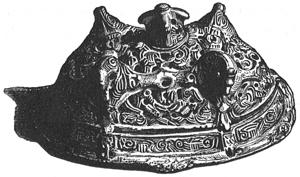
Associated with such burials in Norway there are occasionally found the peculiar brooches which are characteristic of the later Pagan time.[219] Although they occur perhaps more frequently with unburnt burials, they link on with the custom of cremation. Thus they afford a valuable index to the chronology of these remains in Scotland, because the Pagan period of the Scandinavian occupation may be said to be limited to the time between the expedition of Harald Harfagri and the battle of Clontarf (872-1014). These brooches are found in Scandinavian graves of this period, in Scotland, England, Ireland, Normandy, Russia, and Iceland—in short, wherever the heathen Vikings effected a settlement. In Scotland they have been found in various places—in Sutherland, in Caithness, in Orkney, in the Hebrides, and even in remote St. Kilda. The specimen here figured, which is now cxxiiin the Museum of the Society of Antiquaries of Scotland is one of a pair found in a stone cist on a mound which covered the remains of a “Pictish Tower” at Castletown in Caithness.[220] They are usually found in pairs, one near each shoulder of the skeleton. This corresponds with the statement of an ancient Arab writer, that the Norse women used to wear such brooches in pairs on their breasts.[221]
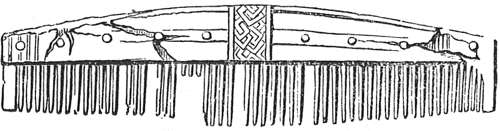
The most remarkable discovery of these characteristic Scandinavian interments that has hitherto occurred in Scotland was made in the island of Westray, Orkney, in 1849, by Mr. William Rendall.[222] A number of graves were found in the sandy links near Pierowall (the Hofn of the Saga), in some of which were swords and shield-bosses, indicating that the skeletons were those of men. But in one a pair of tortoise or shell-shaped brooches and a trefoil ornament were the only objects found with the skeleton. In another, a pair of these brooches were found on the breast, and a pair of combs, of the form here figured, lay on either side of the neck, apparently as they had fallen out of the hair. In a third, a pair of brooches, a pair of combs, and a bronze pin, were found. It appears from these examples that the brooches undoubtedly belonged to women, and that the warriors were usually buried with sword and shield and “panoply of war;” and, as we read in Ibn Fozlan’s account, the dog and the horse of the deceased appear also to have been sacrificed at the grave, and cxxiiiinterred with him, in Orkney as well as on the banks of the Volga.
But we meet with few memorials of the daily life of the Norsemen beyond those which have been buried with them in the early period of their occupation of the Islands. Christianity abolished the custom of burying such relics with the dead, and for the remains of the Christian period we must look to the yet unexcavated sites of the skális and homesteads of which we read in the Saga. It would be equally interesting to the archæologist, and instructive to the historian, to be able to compare the relics from such sites as those of Kolbein Hruga’s castle in Weir, the castle of which Blán was the keeper in Damsey, or the skáli of Swein Asleifson at Langskail in Gairsay, with the extensive collections obtained in recent years from the “Pictish Towers” of Orkney, which have given us such suggestive glimpses of the domestic life of the period preceding the Norse occupation.
It gives a curious feeling of reality to the ancient legends when we can thus handle the blades and bucklers of which we read such stirring stories, and remember that it was because the Norse sword was then the longest, and the Norse arm the strongest, that we now read the earliest chapters of the history of northern Scotland in the guise of an Iceland Saga.
cxxiv